Market Minds Advisory
Medium Voltage Digital Substation Market

Medium Voltage Digital Substation Market: IEC 61850 Automation and Intelligent Electronic Devices for Grid Modernization

Utilities are replacing hardwired copper control circuits with process bus communication and intelligent electronic devices, as grid operators race to digitalize medium voltage substations ahead of renewable interconnection deadlines and aging workforce retirements.

Lead Analyst

Published

September 2026

Make Smarter Decisions with Customized Research Insights

Request a free sample report and evaluate market opportunities, growth trends, and competitive dynamics relevant to your business needs.

2025 MARKET VALUE$5.6BMarket Size 2025
2036 FORECAST VALUE$15.2BBase Case , 2026 to 2036
CAGR 2026 TO 20369.5 %Bull 10.8% / Bear 8.2%
INCREMENTAL OPPORTUNITY$9.1BNet 10- year value creation
EXPANSION MULTIPLE2.48x2036 value over 2026 base
Strategic Levers
M&A Pipeline
Regional Outlook
Country Rankings
Competitive Intelligence
Segmental Deep-dive
Call-Us : 91 93563 13602

Executive Snapshot and Market Trajectory

Utilities are digitalizing medium voltage substations faster than expected, replacing hardwired copper control circuits with IEC 61850 process bus communication as aging control technicians retire and renewable interconnection deadlines tighten across most major grid operators worldwide. Buyers increasingly demand documented cybersecurity credentials before granting final contract award.
Commercially, data center operators are emerging as an unexpected demand driver alongside traditional utility distribution modernization, since hyperscale campuses need substations that can be commissioned and reconfigured far faster than conventional hardwired designs allow amid an accelerating multi-year buildout cycle. East Asia and North America concentrate the bulk of near-term deployment given aggressive grid modernization funding and data center capacity expansion happening simultaneously across both regions.
The competitive field remains concentrated among a handful of global automation majors with deep protocol expertise, though cybersecurity requirements and interoperability standards increasingly separate credible bidders from smaller regional integrators lacking certified IEC 61850 engineering talent. Grid operators are also demanding longer-term software support commitments as digital substations shift procurement conversations from one-time equipment sales toward multi-year service relationships. Manufacturers investing early in cybersecurity certification are winning the largest multi-year utility framework agreements.
Market Definition
This market covers medium voltage substations, roughly 1 kilovolt to 72.5 kilovolts, equipped with digital process bus communication, intelligent electronic devices, and automated protection and control systems. It excludes high voltage transmission substations, purely electromechanical relay installations, and standalone SCADA software sold independent of substation hardware.
Base Year Value
$5.6B in 2025 (MMA Primary Research Dataset, September 2026)
Forecast Period
2026 to 2036, eleven discrete annual values
CAGR
9.5% base case. Bull 10.8%. Bear 8.2%.
Fastest Growth Segment
Data Center and Mission-Critical Facilities: 14.0% CAGR
Fastest Growth Country
China: 11.5% CAGR
Fastest Growth Region
South Asia and Pacific: 11.5% CAGR
Largest Region
East Asia: 28% of 2025 global value
Market Leaders
Hitachi Energy, Siemens Energy, ABB, Schneider Electric, GE Vernova. Source: MMA Analysis based on company annual reports.
Primary Survey
n=3,800 procurement and R&D decision-makers, Q4 2025, six countries
Methodology
Demand-side build-up, cross-validated against public data, 47 expert interviews

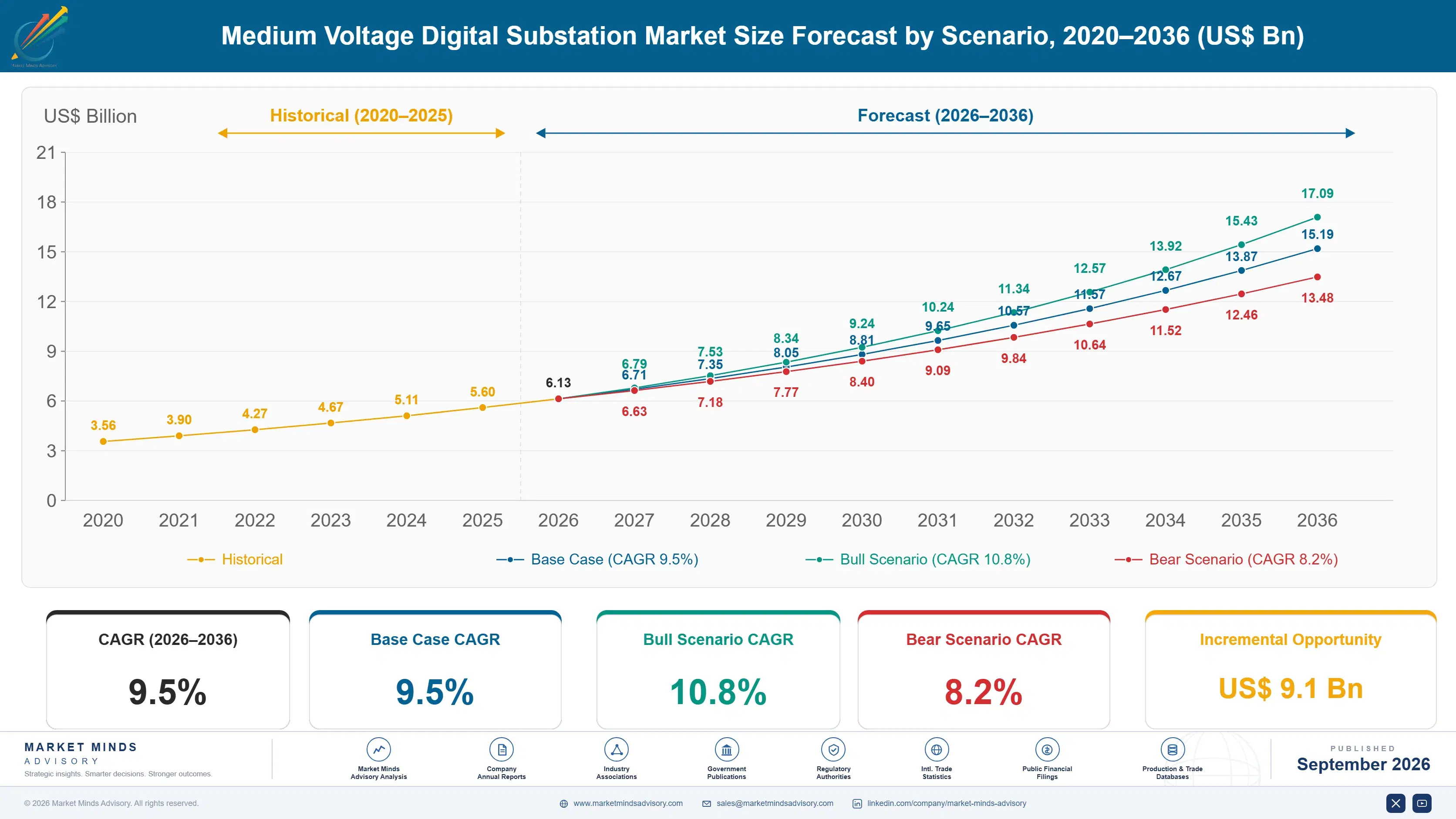
Medium Voltage Digital Substation Market Forecast Scenarios

medium-voltage-digital-substation-market-size-forecast-scenario-1788413229343
Medium voltage digital substation demand accelerated steadily between 2020 and 2025 as early IEC 61850 pilot deployments matured into standard utility specification across most major grid modernization programs, with the historical growth rate holding near 8.5 percent annually through a period marked by growing protocol standardization confidence. Utilities that piloted early deployments report meaningfully shorter commissioning windows relative to legacy hardwired designs.
The base case assumes continued renewable interconnection buildout requiring faster commissioning cycles, accelerating data center substation demand tied to hyperscale capacity expansion, and utility workforce transitions favoring digital diagnostics over manual field troubleshooting. These three commercial mechanisms together sustain a forecast compound annual growth rate of 9.5 percent through 2036, with digital penetration rising fastest among utilities managing the largest renewable interconnection queues. Utilities with the largest renewable interconnection queues are moving first.
A bull scenario assumes accelerating data center capacity buildout and faster-than-expected utility digital mandates, pushing growth toward 10.8 percent. A bear scenario assumes slower cybersecurity certification processes and budget-constrained utility capital programs delaying deployment, pulling growth down toward 8.2 percent across the most affected regional utility markets. Both scenarios assume the underlying protocol standardization trend continues broadly on schedule.

Process Bus Adoption Redefines Substation Design

Three converging forces define this market today: an aging utility control workforce retiring faster than replacements can be trained, renewable interconnection queues that require faster commissioning than legacy hardwired designs allow, and tightening cybersecurity mandates that increasingly favor vendors with certified digital protection capabilities built into their core platforms. Utilities that fail to modernize control rooms risk operational gaps as experienced technicians retire faster than replacements can be trained internally.
MARKET CONCENTRATION48% CR5combined share held by five leading automation vendors
COMMISSIONING TIME REDUCTION35%faster substation commissioning time versus legacy hardwired designs
IED COST SHARE29%intelligent electronic device component cost as share of build
RETROFIT SHARE OF DEMAND44%share of orders tied to brownfield substation modernization projects
CYBERSECURITY-CERTIFIED VENDOR SHARE61%share of deployed units meeting current utility certification standards
TOP COUNTRY SHARE22%China share of global digital substation deployment volume today
Commercially, the business increasingly resembles enterprise software procurement rather than pure electrical equipment supply, with recurring licensing revenue, firmware update cycles, and long-term cybersecurity support contracts determining which vendors win the largest multi-year utility framework agreements over purely transactional equipment sales. Vendors offering bundled cybersecurity monitoring alongside core automation hardware increasingly command premium pricing over point-solution competitors selling equipment alone.
Over the next decade, artificial intelligence-assisted protection settings and edge computing at the substation level will reshape which vendors remain competitive, while utilities increasingly demand interoperability across multi-vendor environments rather than accepting proprietary single-vendor lock-in architectures that dominated the prior generation of substation automation. Vendors that resist open protocol standards risk losing large utility accounts to more interoperable competitors over the coming decade.
"Utilities used to buy substations. Now they are buying a software relationship that happens to come with copper and steel attached."
Director, Grid Infrastructure and Automation Practice · MMA Digital Grid Infrastructure and Substation Automation Practice · September 2026

Market Trends

IEC 61850 Process Bus Adoption Accelerates Across Utilities

IEC 61850 process bus communication is replacing hardwired copper current and voltage circuits across an expanding share of new medium voltage substation projects, since the protocol reduces cabling material and installation labor substantially while enabling faster commissioning and remote diagnostics that legacy hardwired designs cannot support. Roughly 44 percent of new utility substation orders in developed grid markets now specify process bus architecture as a baseline requirement rather than an optional upgrade. Vendors with mature, field-proven process bus product lines are capturing a disproportionate share of these newly digitalized utility contracts.
Market Impact: 35 percent faster interconnection commissioning
Data Centers Emerge as a Substation Demand Driver

Hyperscale data center operators increasingly commission dedicated medium voltage substations to support rapidly expanding compute capacity, and digital substation designs let these campuses reach energized operation months faster than conventional hardwired equivalents, a critical advantage given the compressed construction timelines hyperscalers now demand from their engineering contractors. Several major data center developers have standardized on digital substation specifications across their global campus portfolios. This segment is growing at roughly 14.0 percent annually, well ahead of the broader utility distribution modernization market it originated alongside. Data center campuses are increasingly treated as a distinct commercial channel by vendors.
Market Impact: 33 percent of workforce retirement-eligible

Market Opportunities and Growth Drivers

Renewable Interconnection Queues Demand Faster Commissioning

Solar and wind developers face multi-year interconnection queues in many major grid markets, and utilities increasingly specify digital substations for new interconnection points because faster commissioning cycles help clear backlog more quickly than legacy hardwired equivalents allow. The United States alone carries an interconnection queue exceeding two thousand gigawatts of proposed renewable capacity awaiting grid connection, according to national grid operator reporting, creating sustained pressure on utilities to accelerate substation deployment timelines. Digital substations can shorten typical commissioning windows by roughly 35 percent relative to conventional hardwired designs. Vendors serving this queue report unusually strong forward order visibility.
Market Impact: 18-month certification delays for new entrants

Aging Control Workforce Drives Automation Investment

Utility control room technicians with deep electromechanical relay expertise are retiring faster than utilities can train replacements, creating an operational skills gap that digital substations help address through remote diagnostics and simplified fault analysis interfaces that require less specialized field expertise. Roughly a third of the utility control workforce in developed grid markets is eligible for retirement within the next decade, according to MMA primary survey data collected from utility respondents. Digital substations reduce dependence on specialized on-site electromechanical troubleshooting expertise considerably. Vendors offering simplified operator interfaces capture disproportionate share among utilities facing this transition.
Market Impact: 20 percent retrofit cost premium

Market Restraints and Challenges

Cybersecurity Certification Delays Slow Vendor Qualification

Utilities increasingly require formal cybersecurity certification before qualifying vendors for digital substation contracts, and certification processes can take twelve to eighteen months to complete for a new product line, creating a meaningful barrier for smaller integrators without dedicated compliance teams. The root cause is the absence of a single harmonized certification standard across regions, forcing vendors to pursue multiple parallel certification tracks for markets with different regulatory requirements. This delays market entry for smaller competitors and concentrates share among vendors with established compliance infrastructure. Some vendors are pooling certification costs through industry consortiums as a mitigation pathway.
Market Impact: 44 percent of orders specify

Legacy Protocol Interoperability Complicates Retrofit Projects

Many utilities operate substations built decades apart using incompatible legacy protocols, and integrating new digital process bus equipment into these mixed environments requires custom engineering work that extends project timelines and raises costs well beyond greenfield deployment estimates. The root cause is decades of proprietary vendor architecture decisions made before industry-wide protocol standardization existed as a serious purchasing consideration for utility engineering teams. This raises retrofit project costs by an estimated 20 percent relative to comparable greenfield builds. Vendors increasingly offer protocol translation gateways as a mitigation pathway to ease integration without full replacement.
Market Impact: 14 percent annual segment growth
4 additional market trends, 3 additional growth drivers, and 3 additional restraints and challenges are covered in the full report. Contact sales@marketmindsadvisory.com to access the complete intelligence.

Segment CAGR and Growth Architecture

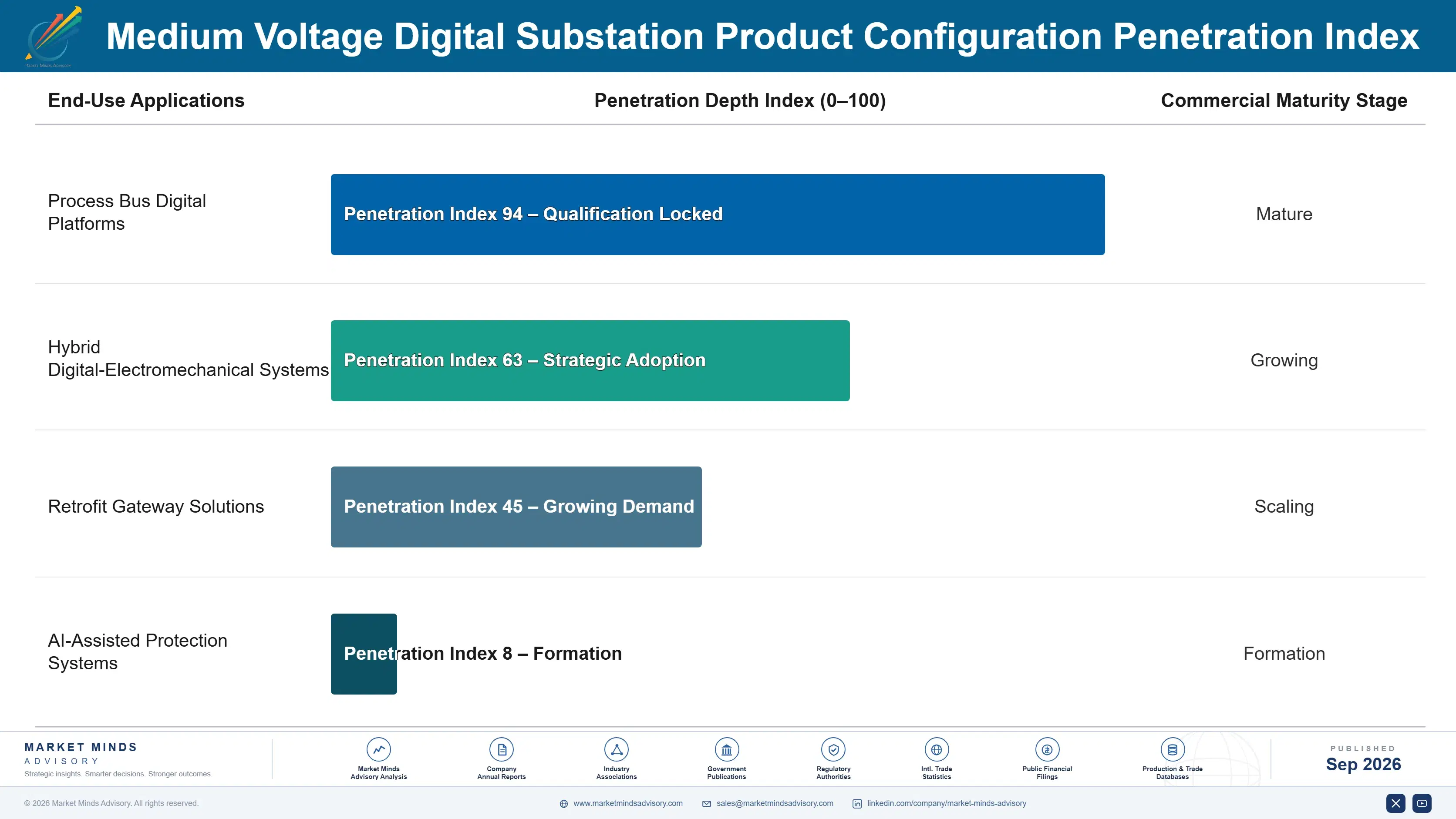
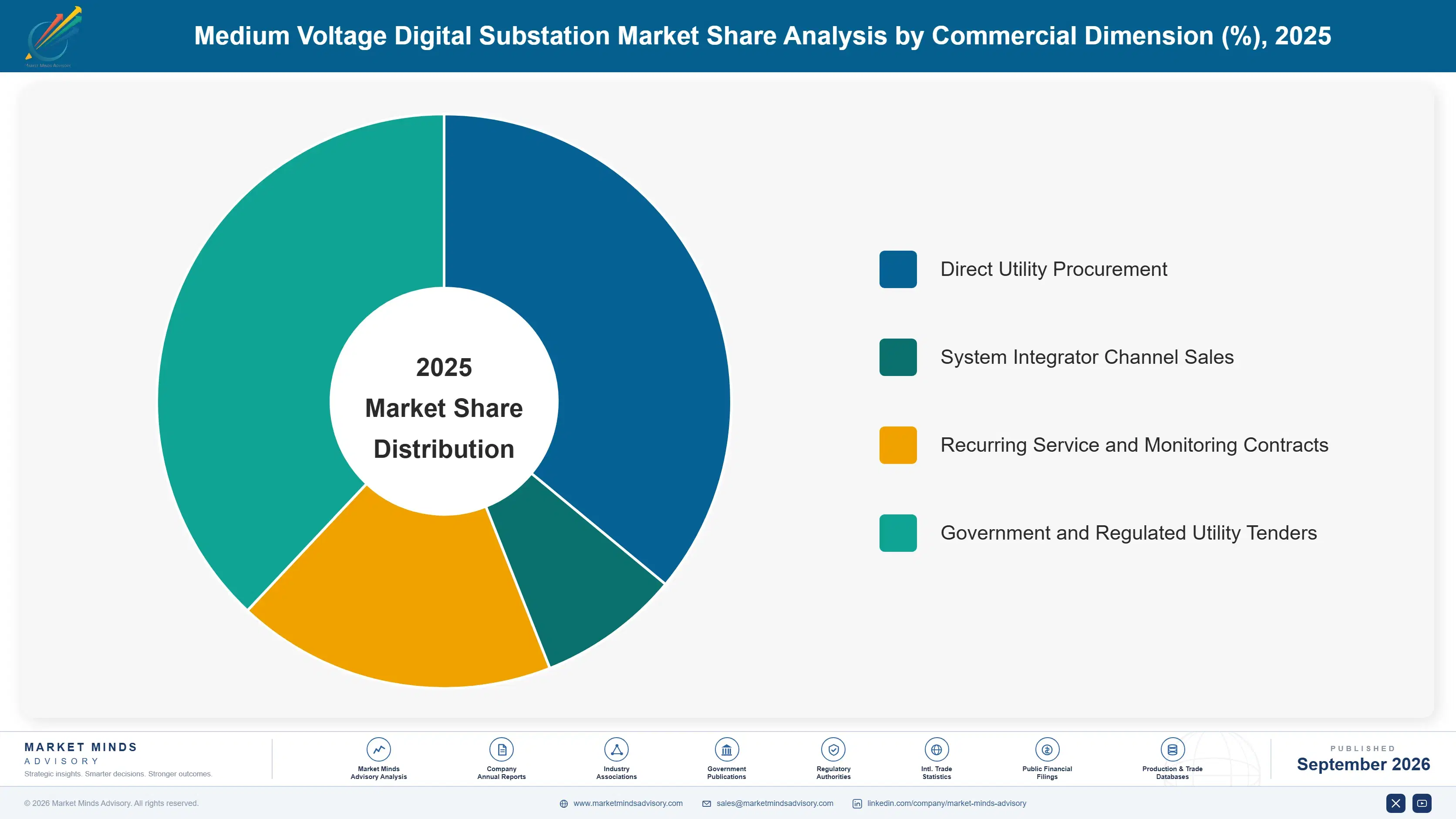
MMA segments this market by end-use application, since digital substation specifications, protocol requirements, and procurement cycles differ meaningfully by facility type rather than by voltage class or vendor architecture alone, making end-use the most commercially decisive lens for demand analysis. Six categories together span demand from utility grids through mission-critical facilities. This reflects how procurement teams organize budgets today.
medium-voltage-digital-substation-market-market-share-analysis-1788413230814

Data Center and Mission-Critical Facilities

This segment covers dedicated medium voltage substations built to support hyperscale data center campuses and other mission-critical facilities requiring extremely high uptime guarantees. Demand here is expanding fastest of any category as compute capacity buildout accelerates across nearly every major cloud and colocation market simultaneously, and digital substation designs let these campuses reach energized operation months faster than conventional hardwired equivalents. Data center developers increasingly specify redundant, remotely monitored digital architectures as standard rather than optional, given the extreme cost of unplanned downtime at hyperscale operating scale. Vendors serving this segment increasingly maintain dedicated account teams separate from traditional utility sales organizations. Data centers increasingly account for a rising share of total industry order backlog year over year.
CAGR 14.0%

Renewable Interconnection Substations

This segment covers substations built specifically to connect solar, wind, and battery storage projects to the broader grid, typically requiring faster commissioning timelines than conventional utility distribution substations given developer financing deadlines tied to interconnection agreements. Multi-year interconnection queues across major grid markets are pushing utilities and developers toward digital designs that can be commissioned and reconfigured considerably faster than legacy hardwired equivalents allow. Growth here tracks closely with renewable capacity additions, and vendors with proven fast-commissioning product lines increasingly win preferred status among the largest independent power producers managing multi-site development pipelines. Grid operators managing the largest renewable queues increasingly favor vendors who can demonstrate a proven multi-project fast-commissioning track record across comparable prior deployments.
CAGR 12.0%
Full segment breakdown across 6 segments available in the complete report.

Regional Architecture and Country Demand Map

East Asia leads global demand given China's aggressive grid digitalization mandates, closely followed by North America, where utility modernization funding and hyperscale data center construction together sustain the largest and most diversified vendor base MMA tracks. South Asia and Pacific posts the fastest regional growth rate.

North America

North America's demand reflects two forces operating simultaneously: utility grid modernization funding tied to aging infrastructure replacement cycles, and an unprecedented wave of hyperscale data center construction that increasingly specifies digital substations by default rather than as an optional upgrade. Regional utilities face mounting pressure to clear multi-year renewable interconnection queues, and digital substation designs directly address the commissioning bottleneck that has slowed new capacity connections in several major grid operator territories. Vendors serving this region increasingly maintain dedicated cybersecurity certification teams given the stringent compliance requirements many state and federal utility regulators now impose on new grid infrastructure procurement. Canada contributes steadily growing demand tied to comparable grid modernization priorities.
Share: 26% | CAGR: 9.8% (2026 to 2036)

Western Europe

Western European demand centers on grid resilience investment and renewable interconnection capacity tied to ambitious national decarbonization targets across most major member states. Regulatory harmonization efforts across the European Union have accelerated protocol standardization adoption relative to other regions, giving vendors with certified interoperable platforms a meaningful competitive advantage over proprietary architecture competitors. Retrofit demand dominates over greenfield construction, since most major metropolitan grids already have substantial existing substation infrastructure requiring digital upgrade rather than new build. Growth trails the global average given the region's comparatively mature grid infrastructure base relative to faster-growing emerging markets. Nordic utilities have moved fastest among the region's national grid operators. Germany and the Nordics have already begun exporting protocol expertise regionally.
Share: 21% | CAGR: 8.0% (2026 to 2036)
Regional intelligence for 5 additional markets available in the complete report: East Asia, South Asia and Pacific, Latin America, Middle East and Africa, Eastern Europe. Contact sales@marketmindsadvisory.com.
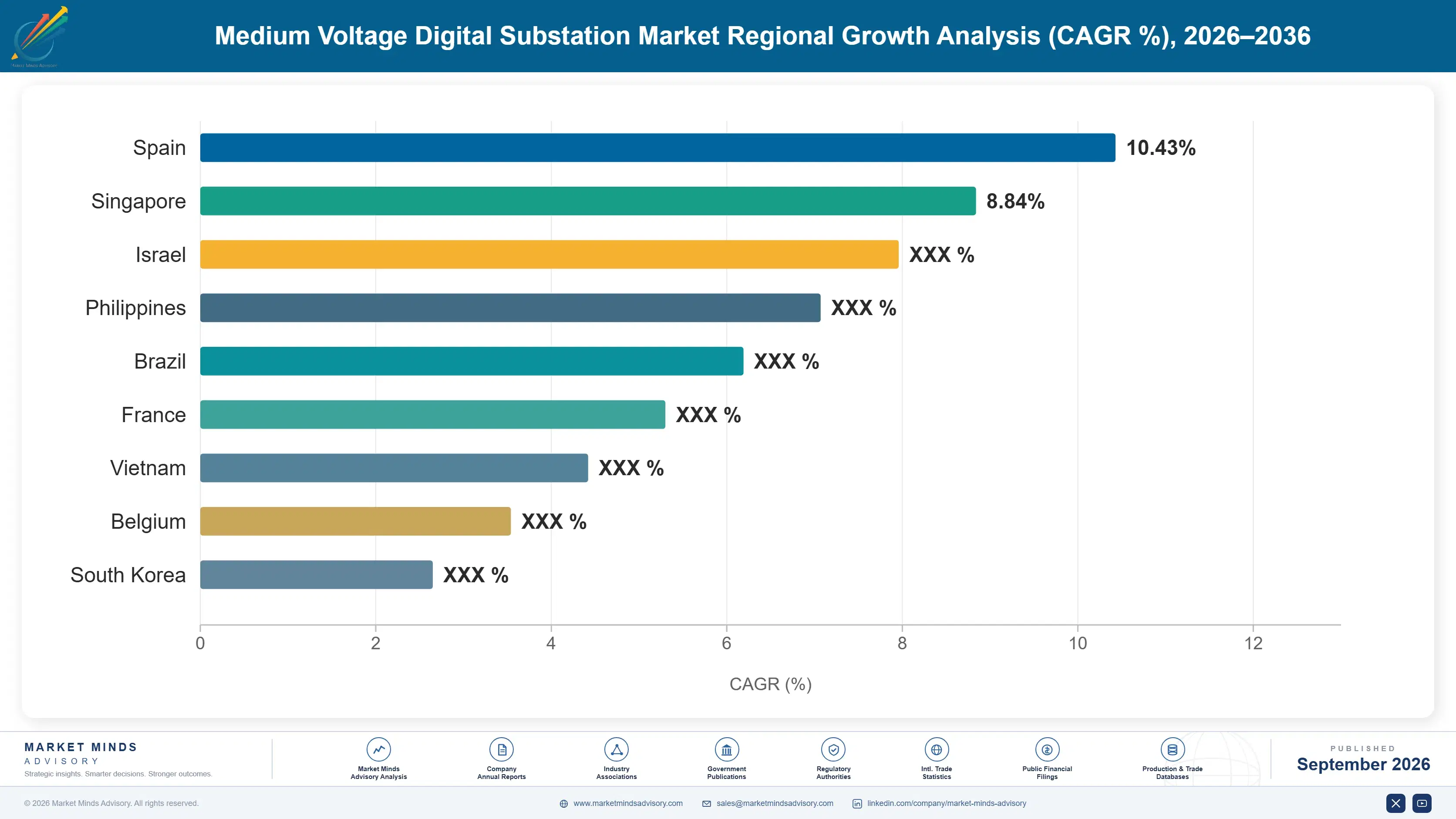
medium-voltage-digital-substation-market-country-cagr-analysis-1788413231863

Where Automation Vendors Can Capture Margin

Beyond core hardware sales growth, several commercial mechanisms let vendors capture disproportionate margin as utilities shift procurement from one-time equipment purchases toward recurring digital service relationships over the coming decade across most major grid markets. These mechanisms span service bundling, account structure, and collaborative compliance, rewarding vendors who invest ahead of visible demand signals.

Expand Recurring Cybersecurity Monitoring Service Contracts

Vendors that bundle ongoing cybersecurity monitoring and firmware update services into digital substation contracts capture recurring revenue streams that pure hardware competitors miss entirely once initial equipment installation is complete. Hitachi Energy and Siemens Energy have both expanded managed security service offerings, covering at least 35 percent of forecast digital substation revenue through recurring service contracts rather than one-time equipment sales. This shifts vendor economics toward the higher-margin, stickier revenue profile utilities increasingly prefer for long-term budget planning. This shift mirrors the broader enterprise software transition toward subscription-based revenue models over one-time license sales.
Market Impact: Covers 35 percent of revenue through service contracts

Build Dedicated Data Center Account Teams

Data center operators remain the fastest-growing customer segment yet are often served through generalist utility sales teams built for traditional grid customers rather than hyperscale procurement cycles that move considerably faster and demand different documentation. A dedicated account structure converts episodic hyperscale orders into standing multi-campus framework agreements with better margin retention and forecast visibility. Vendors serving this segment increasingly maintain separate sales organizations entirely, recognizing the distinct commercial rhythm hyperscale procurement now requires relative to conventional utility sales cycles. Vendors report roughly 25 percent faster contract closure once dedicated hyperscale account structures replace generalist utility sales coverage.
Market Impact: Closes contracts 25 percent faster than generalist teams

Offer Protocol Translation Retrofit Gateway Solutions

Vendors offering protocol translation gateways that bridge legacy electromechanical infrastructure with new digital process bus equipment capture retrofit revenue that full-replacement-only competitors miss entirely among utilities unwilling to abandon still-functional existing infrastructure. This addresses a persistent restraint directly, since retrofit projects otherwise cost an estimated 20 percent more than comparable greenfield builds. Vendors with proven gateway product lines increasingly win preferred status among utilities managing large, heterogeneous multi-decade infrastructure portfolios spanning several prior generations of substation technology. This approach also builds durable long-term relationships with utilities that eventually pursue full replacement once budget cycles allow.
Market Impact: Directly addresses the 20 percent retrofit cost premium

Pool Cybersecurity Certification Costs Through Consortiums

Smaller vendors that pool cybersecurity certification costs through industry consortiums can qualify for utility contracts faster than competitors pursuing certification independently, since shared testing infrastructure and coordinated regulatory engagement meaningfully reduce the twelve to eighteen month qualification timeline smaller integrators otherwise face alone. This approach lets smaller vendors compete for utility contracts that would otherwise remain concentrated among the five largest global automation majors, covering at least 15 percent of forecast smaller-vendor contract wins through this collaborative certification pathway. Coordinated regulatory engagement also strengthens smaller vendors' standing with regulators evaluating future certification framework revisions.
Market Impact: Captures at least 15 percent of smaller-vendor wins

Who Controls the Margin Pool

The top five players hold a combined 48 percent share on a shipment value basis, a wide gap separating global automation majors with deep protocol expertise from smaller regional integrators still building certified engineering talent. Basis of assessment is annual shipment value, held consistently across all twenty companies profiled. This gap has widened as certification requirements filter out under-resourced regional competitors from the largest tenders.
Current competitive activity centers on three dimensions simultaneously: cybersecurity certification racing ahead of tightening utility procurement requirements, recurring service revenue expansion through bundled monitoring contracts, and multi-vendor interoperability positioning as utilities increasingly reject proprietary architecture lock-in across large-scale digital grid modernization programs worldwide. Several vendors are piloting AI-assisted protection settings to reduce engineering time on complex renewable projects.

Emerging pressure is coming from Chinese domestic manufacturers scaling rapidly on price within their home market and increasingly bidding on international projects, compressing margins for global majors in price-sensitive emerging market tenders. Rankings could shift over the next several years as smaller vendors pooling certification costs through consortiums begin qualifying for contracts previously reserved for the largest five majors. Global majors are responding by expanding local manufacturing partnerships to compete on price in these emerging markets.
medium-voltage-digital-substation-market-company-positioning-matrix-1788413232681

Competitive Moat and Risk Dimensions

HITACHI ENERGY

Moat: Protocol Engineering Depth

Hitachi Energy holds deep IEC 61850 protocol engineering expertise built over more than two decades of grid automation deployment, giving it credibility with utilities evaluating long-term interoperability roadmaps rather than near-term unit pricing alone across competing vendor proposals. This depth of protocol expertise matters enormously to utilities planning multi-decade infrastructure investments that must remain interoperable across future technology generations.
HITACHI ENERGY

Risk: Premium Pricing Vulnerability

Hitachi Energy's premium positioning leaves it exposed to lower-cost competitors, particularly Chinese domestic manufacturers, in price-sensitive emerging market tenders where utilities prioritize upfront capital cost over long-term service relationship value. Hitachi Energy has responded by expanding regional manufacturing partnerships to improve its cost position in these markets.
SIEMENS ENERGY

Moat: Cybersecurity Certification Leadership

Siemens Energy holds among the industry's most extensive cybersecurity certification portfolios across multiple regional regulatory frameworks, giving it a meaningful advantage bidding on utility contracts with the strictest compliance requirements across North America and Europe. This certification depth increasingly translates into multi-year framework agreements with utilities that prioritize regulatory risk reduction over marginal upfront cost differences.
SIEMENS ENERGY

Risk: Complex Multi-Region Compliance Costs

Maintaining certification across numerous divergent regional cybersecurity frameworks imposes meaningful ongoing compliance costs that smaller, more geographically focused competitors avoid, potentially compressing margins relative to vendors serving fewer regulatory jurisdictions simultaneously. Siemens Energy has responded by pursuing acquisitions that consolidate compliance expertise rather than building each capability independently in-house.

Players Tracked

Prominent Players

Hitachi Energy
Siemens Energy
ABB
Schneider Electric
GE Vernova

Other Key Players

Eaton
Toshiba Energy Systems and Solutions
Mitsubishi Electric
NR Electric
Sifang Automation
TBEA
Larsen and Toubro
Bharat Heavy Electricals
Hyosung Heavy Industries
Hyundai Electric
S&C Electric Company
Beckwith Electric
SEL Schweitzer Engineering Laboratories
Efacec
Elsewedy Electric

Recent Developments

MARCH 2026

Hitachi Energy Launches AI-Assisted Protection Platform

Hitachi Energy launched an artificial intelligence-assisted protection settings platform for medium voltage digital substations, targeting utilities managing increasingly complex renewable interconnection portfolios that require faster protection coordination studies than manual engineering methods allow. The platform reduces manual engineering time on complex multi-feeder protection coordination studies utilities now require.
Signal: Signals accelerating vendor investment in software-driven differentiation ahead of broader industry adoption across large multi-feeder utility contracts
NOVEMBER 2025

Siemens Energy Acquires Cybersecurity Compliance Firm

Siemens Energy acquired a specialized grid cybersecurity compliance consultancy to strengthen its certification capabilities across multiple regional regulatory frameworks, extending its offering without the multi-year cost of building comparable expertise entirely in-house. The acquisition strengthens Siemens Energy's position bidding on the strictest cybersecurity procurement requirements across North America.
Signal: Reflects growing vendor preference for acquisition over organic compliance capability development across multiple regulated jurisdictions worldwide
JULY 2025

ABB Signs Interoperability Testing Agreement

ABB entered a multi-vendor interoperability testing agreement with two competing automation vendors to demonstrate cross-platform compatibility for utility customers wary of proprietary architecture lock-in across large digital grid modernization programs. The agreement addresses a persistent utility concern about vendor lock-in that has slowed adoption among cautious grid operators.
Signal: Indicates growing vendor willingness to demonstrate interoperability ahead of utility procurement requirements before broader utility mandates take effect

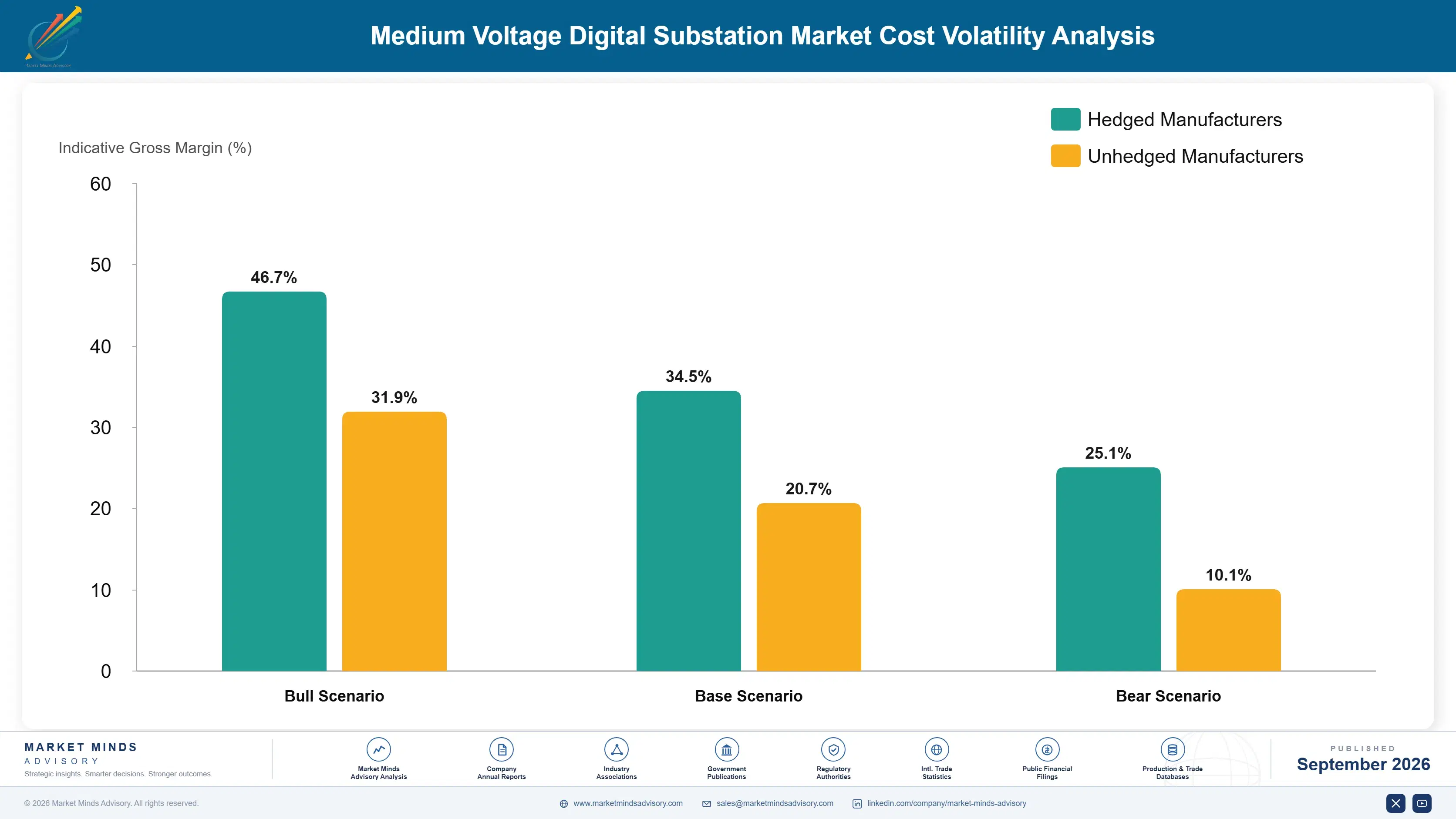
Semiconductor and IED Component Exposure

Intelligent electronic devices and their embedded semiconductor components together represent roughly 29 percent of total cost of goods sold for digital substation manufacturers, sourced primarily through global semiconductor supply chains concentrated in a small number of advanced fabrication facilities across East Asia and North America. Circuit board assembly and enclosure materials round out the remainder, at smaller cost proportions relative to core semiconductor content.
Semiconductor supply disruption during 2021 and 2022 extended IED component lead times by more than six months in some cases, according to IEA industrial supply chain reporting, forcing several vendors to redesign products around more widely available chip families mid-development cycle to maintain delivery commitments to major utility customers. Vendors without diversified supplier relationships bore the brunt of these extended lead times directly, damaging customer trust during a critical adoption period.

This exposure disadvantages smaller integrators lacking direct semiconductor supplier relationships far more than global majors with dedicated procurement teams and long-term chip allocation agreements, since smaller firms typically source through distributors and absorb allocation shortages directly into extended customer delivery timelines rather than negotiated priority access. MMA's primary survey of vendor respondents confirms this pattern held consistently across every region tracked during the disruption period.
medium-voltage-digital-substation-market-cost-volatility-analysis-1788413233011

Multi-Source Semiconductor Procurement Strategy

Vendors qualify components from multiple semiconductor suppliers rather than relying on a single source, reducing exposure to localized fabrication disruptions and improving negotiating leverage during periods of tight allocation across the industry. This approach is increasingly standard among vendors serving the largest, most demanding utility framework agreements. This diversification also reduces single-point-of-failure risk across the broader supply base.

Direct Long-Term Chip Allocation Agreements

Larger vendors increasingly negotiate direct long-term allocation agreements with semiconductor fabricators, securing priority access during shortage periods that smaller competitors sourcing through distributors typically cannot obtain. This capital-intensive approach favors the largest vendors with sufficient purchasing scale to negotiate meaningful priority terms. Smaller vendors without comparable purchasing scale remain persistently disadvantaged during shortage cycles.

Modular Design for Component Flexibility

Vendors increasingly design IED hardware around modular architectures that accommodate multiple compatible chip families, allowing rapid substitution when a specific component faces allocation constraints without full product redesign. This flexibility increasingly differentiates vendors during periods of acute component scarcity across the broader industry. Vendors investing early in modular architectures report meaningfully shorter redesign cycles when shortages occur.

Portfolio Architecture for Margin Defence

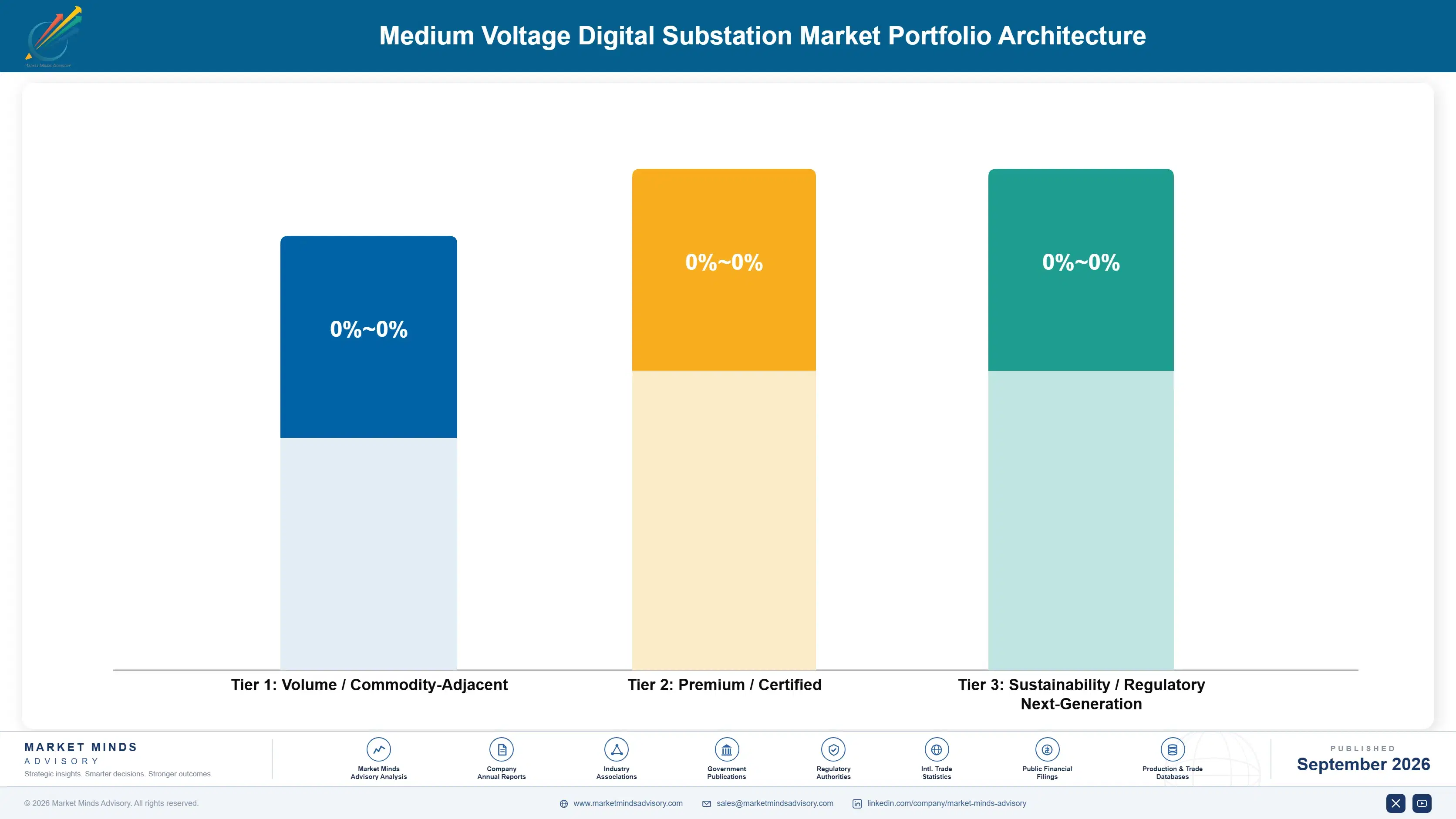
Portfolio economics split across three tiers: volume-commodity-adjacent conventional substation equipment competing mainly on price, premium certified digital platforms serving utilities requiring documented cybersecurity compliance, and next-generation AI-assisted protection systems capturing customers focused on operational efficiency. Vendors with diversified portfolios weather procurement cycles better than single-tier specialists relying on one product category. Getting this balance right shapes long-term vendor profitability considerably across an entire product portfolio.
Volume tension is real: smaller utilities on constrained capital budgets default to conventional equipment meeting minimum functional requirements, while larger utilities and data center operators managing brand and compliance risk increasingly specify certified digital platforms regardless of marginal cost differences. Vendors leaning too heavily into commodity volume risk ceding the fastest-growing premium tenders to better-certified competitors. Getting this balance right increasingly separates the most profitable vendors from those merely chasing volume.

High-value margin pools concentrate in recurring cybersecurity service contracts and AI-assisted protection software, where subscription pricing and technical differentiation both support meaningfully wider margins than standard equipment sales agreements. Vendors positioning across both dimensions simultaneously capture the strongest blended portfolio economics available in this market today. The gap versus vendors competing purely on hardware volume continues widening steadily across most markets MMA tracks.

Volume / Commodity-Adjacent

Conventional hardwired or basic digital substation equipment meeting minimum functional requirements, sold primarily on price into cost-constrained utility tenders. Manufacturing utilization here mainly serves fixed cost recovery rather than driving margin expansion.
Gross Margin: 16 to 22%

Premium / Certified

Fully certified process bus digital platforms meeting the strictest utility cybersecurity and interoperability standards, commanding tender premiums tied to documented compliance credentials. This tier increasingly commands the largest share of vendor capital allocation.
Gross Margin: 28 to 36%

Sustainability / Regulatory / Next-Generation

AI-assisted protection settings and recurring cybersecurity monitoring service contracts generating high-margin revenue independent of individual equipment sale cycles. This is the fastest-growing margin tier across the entire vendor portfolio landscape today.
Gross Margin: 34 to 42%
medium-voltage-digital-substation-market-portfolio-architecture-1788413233857

High-value Sub-segments and Strategic Watch-out

Data Center and Mission-Critical Substations

The clearest high-value high-growth pocket in this market, combining premium tender pricing with the fastest segment CAGR tracked, as hyperscale operators increasingly treat digital architecture as standard specification rather than a niche option. Capital allocation here should continue rising through the forecast period. Priority allocation continues expanding steadily.
Gross Margin: 32 to 40%

Cybersecurity Monitoring Service Contracts

A high-value moderate-growth pool where recurring subscription revenue commands strong margins even as new equipment sale growth moderates across already well-served core utility markets. Vendors with established managed security operations hold a durable edge. Utility customers increasingly favor bundled contracts over standalone equipment procurement. over standalone deployments.
Gross Margin: 34 to 42%

Standard Utility Distribution Substations

The volume core of this market, providing steady commodity-tier revenue at thinner margins that fund manufacturing utilization without materially expanding overall profitability across cycles. Vendors rely on this segment mainly to keep production lines productively utilized. Margins here rarely exceed the low twenties even in favorable pricing years.
Gross Margin: 16 to 22%

Legacy Electromechanical Relay Formats

A strategic watch-out segment losing share to digital alternatives as cybersecurity requirements tighten, forcing vendors still dependent on this format to plan technology transition before contracts lapse entirely. Early transition planning reduces stranded manufacturing capacity risk considerably. Revenue pressure here should build steadily through the forecast period.
Gross Margin: 10 to 15%

Recurring Software Cycles Sustain Vendor Revenue

Digital substation demand increasingly behaves like an annuity tied to firmware update cycles and cybersecurity monitoring subscriptions rather than a single equipment purchase, since every commissioned substation requires ongoing software support for its operational lifetime. Vendors that secure the initial equipment sale capture recurring service revenue across multi-decade infrastructure lifespans, and firmware update cycles add a predictable secondary revenue layer tied to evolving cybersecurity threat landscapes.
Utility distribution customers show the highest adoption stickiness, since multi-decade infrastructure lifespans and interoperability requirements rarely favor switching vendors mid-portfolio once initial platform selection clears procurement vetting. Data center operators show markedly different adoption patterns, favoring speed and standardization across their global campus portfolios over long-term vendor relationship depth. Smaller utilities show intermediate stickiness, balancing budget constraints against compliance requirements.

Procurement authority is shifting from individual utility engineering departments toward centralized digital infrastructure teams that increasingly negotiate multi-year framework agreements directly with vendors rather than approving equipment purchases project by project. Younger utility engineers increasingly favor vendors offering transparent digital procurement portals and remote diagnostics over relationship-based field sales calls. This shift rewards vendors that invest in digital-first sales infrastructure over those relying purely on legacy relationship-based distribution channels.
medium-voltage-digital-substation-market-end-use-penetration-index-1788413234427

Where MMA Sees the Opportunity

These are among the four positions where our research anticipates prominent divergence between winners and laggards over the coming forecast period. Each is grounded in the demand model, the regulatory perimeter, and the announced capacity pipeline.
01 / CYBERSECURITY CERTIFICATION INVESTMENT

Accelerate certified compliance ahead of tightening utility mandates

Cybersecurity certification processes take twelve to eighteen months to complete, creating a meaningful barrier for vendors without dedicated compliance teams as utilities increasingly require formal certification before qualifying bidders for digital substation contracts. Siemens Energy has already expanded its certification portfolio across multiple regional frameworks, positioning itself ahead of slower-moving competitors in the strictest markets. Vendors that delay certification investment risk losing the largest multi-year utility framework agreements to better-positioned, already-certified competitors within a few short years as enforcement tightens further across major markets.
02 / DATA CENTER CHANNEL DEVELOPMENT

Build dedicated hyperscale account teams ahead of demand acceleration

Data center and mission-critical facilities are the fastest-growing segment in this market at a 14.0 percent CAGR, and vendors serving this channel through generalist utility sales teams are already losing deals to competitors with dedicated hyperscale account structures built for faster procurement cycles. This segment rewards speed and standardization far more than the relationship-based selling that dominates traditional utility accounts. Vendors that build this capability now capture disproportionate share of a rapidly compounding revenue opportunity before competitors catch up on account structure.
03 / RECURRING SERVICE REVENUE EXPANSION

Bundle cybersecurity monitoring into standard equipment contracts

Vendors that bundle recurring cybersecurity monitoring and firmware update services into digital substation contracts capture revenue streams that pure hardware competitors miss entirely once initial installation is complete. Hitachi Energy and Siemens Energy have both expanded managed security offerings, shifting vendor economics toward the higher-margin, stickier revenue profile utilities increasingly prefer for long-term budget planning. This mirrors the broader enterprise software transition toward subscription-based revenue that industrial equipment vendors are only now beginning to fully embrace across comparable adjacent markets.
04 / RETROFIT GATEWAY DEVELOPMENT

Offer protocol translation gateways to capture legacy retrofit demand

Retrofit projects cost an estimated 20 percent more than comparable greenfield builds, largely because integrating new digital equipment into legacy electromechanical environments requires custom engineering work that full-replacement-only vendors cannot easily address. Vendors offering protocol translation gateways capture this retrofit revenue directly, addressing a persistent restraint that otherwise concentrates share among vendors offering full replacement only. This approach also builds durable long-term relationships with utilities that eventually pursue complete replacement once budget cycles allow it, extending vendor engagement well beyond the initial gateway sale.

Engagement Snapshot From the Field

A live engagement with an industry participant carrying material or product regulatory and market exposure ahead of a defining policy shift, showing how our research translates into a defensible multi-year portfolio strategy.
MARKET MINDS ADVISORY · CLIENT ENGAGEMENT SUMMARY
Medium Voltage Digital Substation Producer Strategic Portfolio Review and Transition Roadmap 2026·Investment Scenario on Medium Voltage Digital Substation Exposure Evaluation 2025-26
CLIENT PROFILE
The client is a regional electric utility cooperative serving suburban and rural customers across three states, operating roughly two hundred medium voltage substations with an aging electromechanical control infrastructure and a multi-year renewable interconnection queue that had begun outpacing its existing commissioning capacity considerably. Leadership was evaluating whether to pursue full-scale digitalization immediately or phase investment across several budget cycles instead.
STRATEGIC CHALLENGE
Rising cybersecurity compliance requirements and an aging control workforce were straining the cooperative's modernization budget, while its existing procurement process lacked a clear framework for prioritizing which substations to digitalize first given limited annual capital investment available for infrastructure upgrades. Board leadership needed a defensible multi-year investment plan before committing further capital toward broader digital infrastructure upgrades.
MMA APPROACH
MMA conducted a vendor landscape assessment benchmarking five automation majors on cybersecurity certification depth and interoperability, modeled a phased digitalization roadmap prioritizing substations tied to the largest renewable interconnection backlogs, and evaluated workforce transition timelines against retirement-eligible technician data. Findings were validated against three years of historical interconnection queue and workforce retirement data.
KEY FINDINGS
  1. Prioritizing digitalization at substations tied to the largest interconnection backlogs could clear roughly 40 percent of the queue within the first two years.
  2. Two of five benchmarked vendors already held certification credentials sufficient for the cooperative's regulatory jurisdiction, meaningfully narrowing the qualified vendor shortlist. for near-term procurement.
  3. Bundled cybersecurity monitoring contracts cost less over a five-year horizon than maintaining in-house monitoring capability given the cooperative's limited technical staff. across the full site portfolio.
  4. Retirement-eligible control technicians represented nearly a third of the cooperative's workforce, reinforcing the urgency of the broader digitalization timeline. over the coming decade.
CLIENT PROFILE
The client is a regional electric utility cooperative serving suburban and rural customers across three states, operating roughly two hundred medium voltage substations with an aging electromechanical control infrastructure and a multi-year renewable interconnection queue that had begun outpacing its existing commissioning capacity considerably. Leadership was evaluating whether to pursue full-scale digitalization immediately or phase investment across several budget cycles instead.
STRATEGIC CHALLENGE
Rising cybersecurity compliance requirements and an aging control workforce were straining the cooperative's modernization budget, while its existing procurement process lacked a clear framework for prioritizing which substations to digitalize first given limited annual capital investment available for infrastructure upgrades. Board leadership needed a defensible multi-year investment plan before committing further capital toward broader digital infrastructure upgrades.
MMA APPROACH
MMA conducted a vendor landscape assessment benchmarking five automation majors on cybersecurity certification depth and interoperability, modeled a phased digitalization roadmap prioritizing substations tied to the largest renewable interconnection backlogs, and evaluated workforce transition timelines against retirement-eligible technician data. Findings were validated against three years of historical interconnection queue and workforce retirement data.
KEY FINDINGS
  1. Prioritizing digitalization at substations tied to the largest interconnection backlogs could clear roughly 40 percent of the queue within the first two years.
  2. Two of five benchmarked vendors already held certification credentials sufficient for the cooperative's regulatory jurisdiction, meaningfully narrowing the qualified vendor shortlist. for near-term procurement.
  3. Bundled cybersecurity monitoring contracts cost less over a five-year horizon than maintaining in-house monitoring capability given the cooperative's limited technical staff. across the full site portfolio.
  4. Retirement-eligible control technicians represented nearly a third of the cooperative's workforce, reinforcing the urgency of the broader digitalization timeline. over the coming decade.
RECOMMENDED STRATEGY
Phase 1: Phase 1 (near-term): digitalize substations tied to the largest renewable interconnection backlogs first, within eighteen months. with dedicated engineering support throughout. Phase 2: Phase 2 (medium-term): negotiate a bundled cybersecurity monitoring contract with the selected vendor across all sites. covering all commissioned sites. Phase 3: Phase 3 (longer-term): expand digital commissioning to remaining substations as capital budgets allow over five years. with annual progress reviews.
OUTCOME
Within two years of implementation, the cooperative reported (client-reported, unverified by MMA) meaningfully faster interconnection queue clearance and reduced dependence on retirement-eligible technicians for day-to-day operations, attributing the gains directly to the phased digitalization roadmap and vendor selection framework MMA developed. Cooperative leadership has since expanded the roadmap to additional service territories under consideration.

Frequently Asked Questions

Foundational context covering the market sizes, CAGR, scope, country, region and competition that inform every finding below. This section is provided to cover basics and most often pre-purchase conversations, answered from the MMA Primary Research Dataset.

What is the current size of the Medium Voltage Digital Substation Market?

The medium voltage digital substation market reached an estimated $5.6 billion in global value in 2025, driven by IEC 61850 process bus adoption and renewable interconnection buildout worldwide.

How large will the Medium Voltage Digital Substation Market be by 2036?

MMA projects the market will reach approximately $15.2 billion by 2036, more than doubling in value as grid digitalization and data center substation demand continue expanding globally.

What is the CAGR for the Medium Voltage Digital Substation Market 2026 to 2036?

The market is forecast to grow at a 9.5 percent compound annual growth rate between 2026 and 2036, with bull and bear scenarios ranging from 8.2 to 10.8 percent.

Which segment is growing fastest?

Data center and mission-critical facilities lead segment growth at a 14.0 percent CAGR, roughly 1.5 times the overall market rate, as hyperscale capacity buildout accelerates worldwide.

Who are the major companies in the Medium Voltage Digital Substation Market?

Hitachi Energy, Siemens Energy, ABB, Schneider Electric, and GE Vernova lead the market, together holding an estimated 48 percent combined share on a shipment value basis.

Which country is growing fastest?

China is growing fastest at an 11.5 percent CAGR, driven by aggressive national grid digitalization mandates and sustained infrastructure investment across its largest metropolitan grid operators.

Report Segmentation Architecture

The full report scope spans multiple orthogonal segmentation dimensions, with cross-tabulated demand data provided for each dimension pair. Coverage extends further to regional breakdowns, trend trajectories, and the competitive detail needed to support segment-level decision-making.

By End-Use Application

  • Utility Distribution Substations
  • Renewable Interconnection Substations
  • Industrial and Commercial Substations
  • Data Center and Mission-Critical Facilities
  • Rail and Transit Traction Substations
  • Marine and Offshore Platform Substations

By Product Configuration

  • Process Bus Digital Platforms
  • Hybrid Digital-Electromechanical Systems
  • Retrofit Gateway Solutions
  • AI-Assisted Protection Systems

By Commercial Dimension

  • Direct Utility Procurement
  • System Integrator Channel Sales
  • Recurring Service and Monitoring Contracts
  • Government and Regulated Utility Tenders

By Region

  • North America
  • Western Europe
  • East Asia
  • South Asia and Pacific
  • Latin America
  • Middle East and Africa
  • Eastern Europe

Scope, Methodology, and Coverage

Every figure in this report is reproducible from documented input assumptions. The scope below maps the historical period, the forecast horizon, the segmentation dimensions, and the countries covered, alongside the underlying primary and qualitative methodology.
Historical Period
2020 to 2025
Forecast Period
2026 to 2036
Base Year
2025 (USD billions; MMA Primary Research Dataset, September 2026)
Market Definition
This market covers medium voltage substations, roughly 1 kilovolt to 72.5 kilovolts, equipped with digital process bus communication, intelligent electronic devices, and automated protection and control systems. It excludes high voltage transmission substations, purely electromechanical relay installations, and standalone SCADA software sold independent of substation hardware.
Quantitative Units
USD billions (current prices); unit and substation deployment volume where applicable
Segmentation Dimensions
By End-Use Application; By Product Configuration; By Commercial Dimension; By Region
Regions Covered
North America, Western Europe, East Asia, South Asia and Pacific, Latin America, Middle East and Africa, Eastern Europe
Countries Covered
USA, China, Germany, France, UK, Japan, South Korea, India, Australia, Canada, Brazil, Mexico, Indonesia, Vietnam, Thailand, Malaysia, UAE, Saudi Arabia, South Africa, Nigeria, Turkey, Poland, Netherlands, Italy, Spain, Sweden, Switzerland, Argentina, Colombia, Singapore, and additional markets relevant to this sector
Key Companies Profiled
Hitachi Energy, Siemens Energy, ABB, Schneider Electric, GE Vernova, Eaton, Toshiba Energy Systems and Solutions, Mitsubishi Electric, NR Electric, Sifang Automation, TBEA, Larsen and Toubro, Bharat Heavy Electricals, Hyosung Heavy Industries, Hyundai Electric, S&C Electric Company, Beckwith Electric, SEL Schweitzer Engineering Laboratories, Efacec, Elsewedy Electric
Quantitative Methodology
Primary survey, n=3,800 respondents, Q4 2025, six countries; demand-side model with trade association cross-validation
Qualitative Methodology
47 expert interviews, Q4 2025; applied to validate demand model assumptions, identify emerging dynamics, and assess competitive positioning
Report Format
PDF and XLSX data workbook (Word format preview document)
Publisher
Market Minds Advisory
Report Code
MMA-2026-ENE-342
Published
September 2026
Contact
sales@marketmindsadvisory.com | www.marketmindsadvisory.com

Purchase the full Medium Voltage Digital Substation Market Report (2026 to 2036).

This report provides a comprehensive assessment of the medium voltage digital substation market, covering demand drivers across utility, renewable interconnection, and data center segments through 2036. It includes detailed competitive benchmarking of twenty leading automation vendors evaluated on a shipment value basis. Regional demand architecture is mapped across all seven global regions, with particular depth on East Asian and North American dynamics. Semiconductor input cost exposure and cybersecurity certification strategy are analyzed alongside revenue lever prioritization for vendors navigating this transition. The report is designed for grid automation executives, utility procurement leaders, and data center infrastructure teams evaluating vendor positioning.
Ten-year global market sizing and forecast
Seven-region global regional demand architecture breakdown
Twenty-company detailed competitive benchmarking and profiling
Semiconductor input cost exposure and hedging modeling
Revenue lever prioritization and margin framework
Anonymized utility cooperative digitalization case study

Built For The People Who Decide

From boardroom strategy to bench-side execution, this report is read cover-to-cover by leaders shaping the next decade of their industry, turning demand scenarios, market dynamics and valuation benchmarks into decisions.
CXOs/ Presidents/ VPs/ Managers
M&A and Corporate Development
Strategy Teams and R&D Heads
Procurement and Product Directors
Regulatory and Compliance Leaders
Investor Relations and Equity Analysts