Market Minds Advisory
Medical Robots Market

Medical Robots Market: Surgical Precision Meets Hospital Labor Shortages

Hospital labor shortages are pulling logistics and rehabilitation robots into mainstream procurement budgets once reserved for surgical systems alone, as reimbursement policy and installed-base economics reshape which robot categories scale fastest through 2036.

Lead Analyst

Alice Ballenger

Published

September 2026

Make Smarter Decisions with Customized Research Insights

Request a free sample report and evaluate market opportunities, growth trends, and competitive dynamics relevant to your business needs.

2025 MARKET VALUE$14.8BMarket Size 2025
2036 FORECAST VALUE$44.0BBase Case , 2026 to 2036
CAGR 2026 TO 203610.4 %Bull 11.6% / Bear 9.2%
INCREMENTAL OPPORTUNITY$27.6BNet 10- year value creation
EXPANSION MULTIPLE2.69x2036 value over 2026 base
Strategic Levers
M&A Pipeline
Regional Outlook
Country Rankings
Competitive Intelligence
Segmental Deep-dive
Call-Us : 91 93563 13602

Executive Snapshot and Market Trajectory

Hospital systems facing chronic nursing shortages are now budgeting for logistics and service robots alongside surgical systems, a procurement shift that barely existed five years ago and now shapes capital planning cycles at major health networks nationwide across every affected clinical department and administrative budget line.
Surgical robotics still commands the largest revenue share, led by Intuitive Surgical's installed base of da Vinci systems, but rehabilitation and exoskeleton robots are growing fastest as insurance reimbursement expands and stroke rehabilitation programmes increasingly specify robotic-assisted therapy over manual physical therapy alone, particularly across specialised rehabilitation hospitals and outpatient recovery centres serving a rapidly ageing patient population across most major healthcare systems worldwide today.
Five manufacturers still account for most installed surgical systems, but Chinese domestic robotics makers are closing the technology gap quickly, backed by national healthcare modernisation funding directed at hospital automation across major metropolitan medical centres. Regulatory clearance timelines remain the binding constraint industry-wide: a new surgical robot often spends longer in regulatory review than in actual product development, reshaping how manufacturers sequence their global launch strategies across every major market this report tracks closely.
Market Definition
This market covers robotic systems used in surgical, rehabilitation, hospital logistics, and diagnostic-assist applications within clinical and hospital settings. It excludes consumer wellness robots, laboratory automation equipment, and standalone AI diagnostic software sold without robotic hardware.
Base Year Value
$14.8B in 2025 (MMA Primary Research Dataset, August 2026)
Forecast Period
2026 to 2036, eleven discrete annual values
CAGR
10.4% base case. Bull 11.6%. Bear 9.2%.
Fastest Growth Segment
Rehabilitation and Exoskeleton Robots: 15.4% CAGR
Fastest Growth Country
China: 13.2% CAGR
Fastest Growth Region
South Asia and Pacific: 12.4% CAGR
Largest Region
North America: 31% of 2025 global value
Market Leaders
Intuitive Surgical, Stryker, Medtronic, Zimmer Biomet, CMR Surgical. Source: MMA Analysis based on company annual reports.
Primary Survey
n=3,800 procurement and R&D decision-makers, Q4 2025, six countries
Methodology
Demand-side build-up, cross-validated against public data, 47 expert interviews

Medical Robots Market Forecast Scenarios

medical-robots-market-size-forecast-scenario-1787325604747
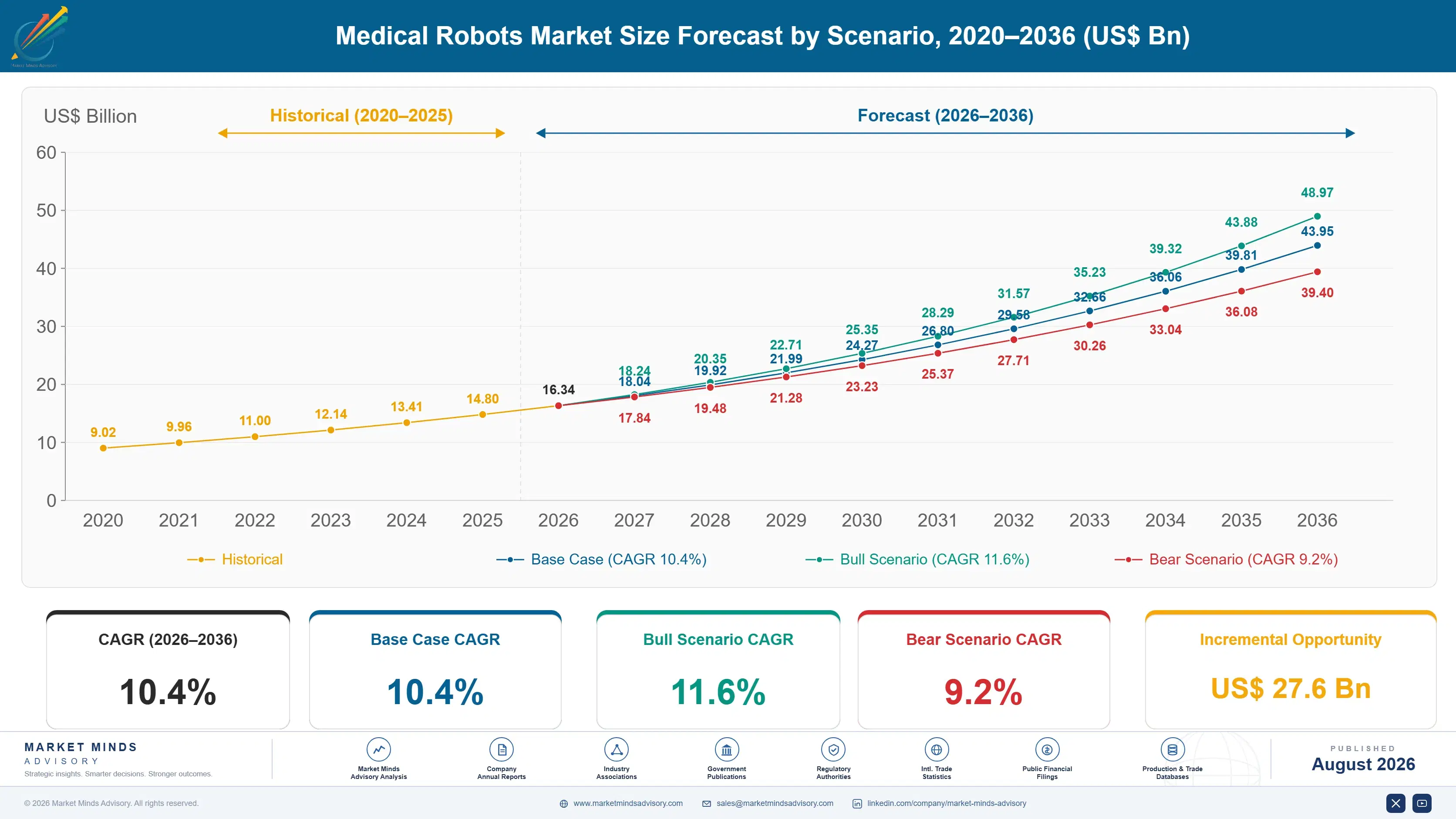
Between 2020 and 2025, the market grew at a historical rate near 9.4 percent as surgical robotics adoption steadily expanded beyond urology and gynaecology into orthopaedics and general surgery, while rehabilitation robotics remained a smaller, slower-growing category still building clinical evidence and reimbursement support across most major healthcare systems worldwide during this early period of adoption.
The base case assumes 10.4 percent annual growth through 2036, built on three mechanisms: expanding surgical robot adoption into new specialties as patents on core platforms expire and competitors enter the field, hospital labor shortages accelerating logistics and service robot procurement across the United States and Western Europe, and Chinese domestic manufacturers scaling production to meet national healthcare modernisation targets set by central planners well ahead of the original schedule.
A bull case near 11.6 percent depends on faster regulatory clearance timelines shortening the gap between product development and commercial launch across every major market this report tracks. The bear case near 9.2 percent reflects continued reimbursement uncertainty for rehabilitation robotics, since several national insurers have delayed coverage decisions pending additional long-term outcomes data from ongoing clinical trials.

From Surgical Precision to Hospital-Wide Automation

Medical robotics has expanded well beyond the operating room over the past five years, reaching almost every corner of hospital operations. Surgical systems remain the category's revenue anchor, but hospital administrators now evaluate logistics, rehabilitation, and service robots against the same labor-cost and outcomes framework that once applied only to surgical capital equipment purchases made by clinical leadership committees.
TOP 5 CONCENTRATION48% CR5revenue share held by five largest global system makers
AVERAGE SYSTEM PRICE$1.8Mtypical capital cost per installed surgical platform unit
LEADING PRODUCING COUNTRYUnited States, 33%share of global production value, by home country
INSTALLED BASE GROWTH14% yearlyannual growth in cumulative installed surgical systems worldwide
PROCEDURES PER SYSTEM290 casesaverage annual procedures run per installed platform unit
COMPONENT AND SENSOR COST34% of COGSinput cost weight from precision components and sensors
Commercial behaviour splits clearly by application maturity and buyer sophistication. Surgical robotics competes on procedure volume, instrument consumables revenue, and expanding specialty indications across increasingly crowded therapeutic categories, while rehabilitation and logistics robotics compete more directly on total cost of ownership against the human labor they displace or augment across understaffed hospital departments facing persistent recruitment challenges.
The next decade turns on regulatory clearance speed and reimbursement policy alignment across every major market this report tracks closely. Manufacturers who navigate both fastest capture disproportionate early share in each newly opened specialty or application category before competitors complete their own clinical evidence packages and secure comparable regulatory approval.
"Surgeons didn't ask for robots. Hospital administrators did, once the data showed shorter recovery times meant faster bed turnover."
Director, Medical Robotics and Surgical Technology Practice · MMA Medical Device

Market Trends

Surgical Robotics Expands Into General Surgery and Orthopaedics

Surgical robotic platforms originally concentrated in urology and gynaecology are rapidly expanding into general surgery, orthopaedics, and spine procedures as core patents expire and instrument libraries broaden. Intuitive Surgical's da Vinci 5 platform received FDA clearance for expanded general surgery indications in 2024, while Medtronic's Hugo system has pursued CE Mark approval across multiple European specialties simultaneously. Stryker's Mako platform has similarly expanded from knee replacement into hip and shoulder procedures, adding roughly 40 percent more addressable procedure volume per installed system since 2022 across hospitals already running the platform.
Market Impact: Covers 4 new specialty indications
Hospital Labor Shortages Drive Logistics Robot Procurement

Persistent nursing and support-staff shortages across US and European hospitals have pushed logistics and delivery robots from pilot projects into standard capital budget line items. Aethon's TUG robots and Swisslog Healthcare's pharmacy automation systems now handle medication and supply delivery across hundreds of hospital sites, freeing clinical staff from roughly 90 minutes of transport tasks per shift according to hospital operations studies. Diligent Robotics has expanded its Moxi service robot deployment specifically to address this staffing gap, with several hospital networks now specifying logistics robots in new facility construction budgets from the earliest planning stages.
Market Impact: Expands reimbursement in 3 countrie

Market Opportunities and Growth Drivers

Expanding Surgical Specialty Indications Widen the Addressable Market

Regulatory clearances covering additional surgical specialties have widened the addressable market for existing installed systems considerably, since hospitals can expand procedure volume on platforms they already own rather than purchasing entirely new equipment. The FDA cleared expanded indications for at least four major surgical robotic platforms during 2024 and 2025 alone, covering procedures ranging from bariatric surgery to complex spine reconstruction. This indication expansion has pulled forward instrument and consumables revenue considerably faster than new system placements alone would generate, since existing installed platforms immediately become eligible for new procedure types.
Market Impact: Delays launch 2 to 4 yrs

Aging Populations Expand Rehabilitation Robotics Demand

Stroke and mobility-impairment rehabilitation demand is rising across Japan, Germany, and the United States as ageing populations increase the patient pool requiring intensive physical therapy. The World Health Organization estimates stroke incidence will rise considerably across high-income countries through 2035 as populations age, sustaining demand for robotic-assisted gait and upper-limb rehabilitation devices like Hocoma's Lokomat across specialised recovery centres. Several national insurers, including Germany's statutory health system, have expanded reimbursement coverage for robotic rehabilitation therapy specifically as clinical evidence of superior outcomes accumulates across published academic and hospital studies conducted nationally.
Market Impact: Delays coverage 3 to 5 yrs

Market Restraints and Challenges

Regulatory Clearance Timelines Delay Global Launch Sequencing

New surgical robotic platforms typically spend two to four years navigating FDA and CE Mark clearance processes before commercial launch, often longer than the underlying product development cycle itself. The root cause is that robotic surgical systems require extensive clinical evidence across multiple procedure types, unlike simpler medical devices that can clear regulatory review on a single indication. This delay pushes manufacturers to sequence launches market by market rather than globally, ceding early share to whichever competitor clears a given jurisdiction first. Several manufacturers now run parallel regulatory submissions across major markets specifically to compress this sequencing delay.
Market Impact: Adds 40% more procedure volume

Reimbursement Uncertainty Slows Rehabilitation Robot Adoption

Rehabilitation robotics adoption depends heavily on national insurer reimbursement decisions that often lag clinical evidence by several years, leaving hospitals reluctant to invest in equipment that patients cannot afford without coverage. The underlying cause is that reimbursement bodies require long-term outcomes data that robotic rehabilitation, a relatively young therapy category, has only recently begun generating at scale. This has slowed purchase decisions at smaller rehabilitation hospitals lacking capital budgets to absorb the coverage gap. Manufacturers increasingly fund outcomes registries themselves to accelerate the reimbursement decision timeline facing their own equipment.
Market Impact: Saves 90 minutes of staff time
3 additional market trends, 4 additional growth drivers, and 3 additional restraints and challenges are covered in the full report. Contact sales@marketmindsadvisory.com to access the complete intelligence.

Segment CAGR and Growth Architecture

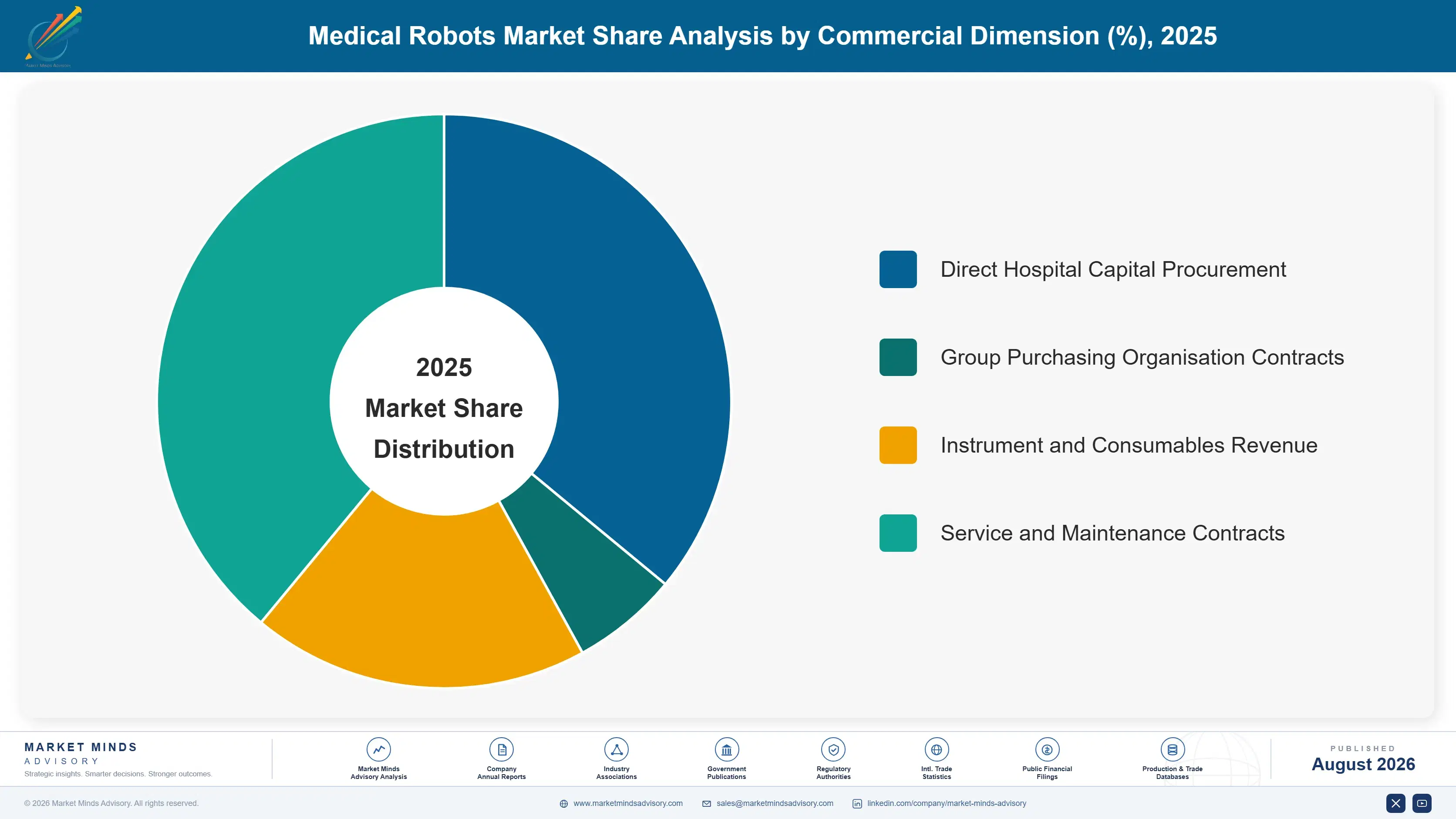
Segmentation follows robot type and clinical application, the classification hospital procurement teams and regulators already use to evaluate capital equipment against distinct workflow and reimbursement categories across every application this report covers in depth, from operating rooms through hospital corridors and outpatient recovery centres nationwide and internationally at meaningful, growing scale.
medical-robots-market-market-share-analysis-1787325605334

Rehabilitation and Exoskeleton Robots

Rehabilitation and exoskeleton robots are the fastest-growing category as stroke and mobility-impairment patient volumes rise alongside expanding insurance reimbursement coverage across major healthcare systems. Hocoma's Lokomat and Ekso Bionics's exoskeleton platforms lead installed volume across specialised rehabilitation hospitals in the United States, Germany, and Japan. Growth concentrates in outpatient recovery centres as robotic-assisted therapy increasingly replaces purely manual physical therapy for patients showing measurably faster functional recovery in published clinical trials. Cyberdyne and Fourier Intelligence have both expanded manufacturing capacity specifically to meet accelerating demand across Asian and European markets, where national reimbursement policy has moved faster than in several other regions still evaluating coverage decisions and clinical evidence requirements carefully.
CAGR 15.4%

Hospital Logistics and Service Robots

Hospital logistics and service robots grow second-fastest as chronic nursing and support-staff shortages push hospital administrators to treat automation as a labor-cost solution rather than a discretionary technology purchase. Aethon and Swisslog Healthcare lead installed volume across medication delivery and supply transport applications in major US and European hospital networks. Diligent Robotics has carved a distinct niche in patient-facing service tasks, including specimen transport and supply restocking, that free clinical staff for direct patient care duties. Growth concentrates in newly constructed hospital facilities, where architects increasingly design dedicated robot transport corridors into building plans from the earliest design phase rather than retrofitting existing infrastructure afterward at considerable expense and disruption to daily hospital operations.
CAGR 13.8%
Full segment breakdown across 6 segments available in the complete report.

Regional Architecture and Country Demand Map

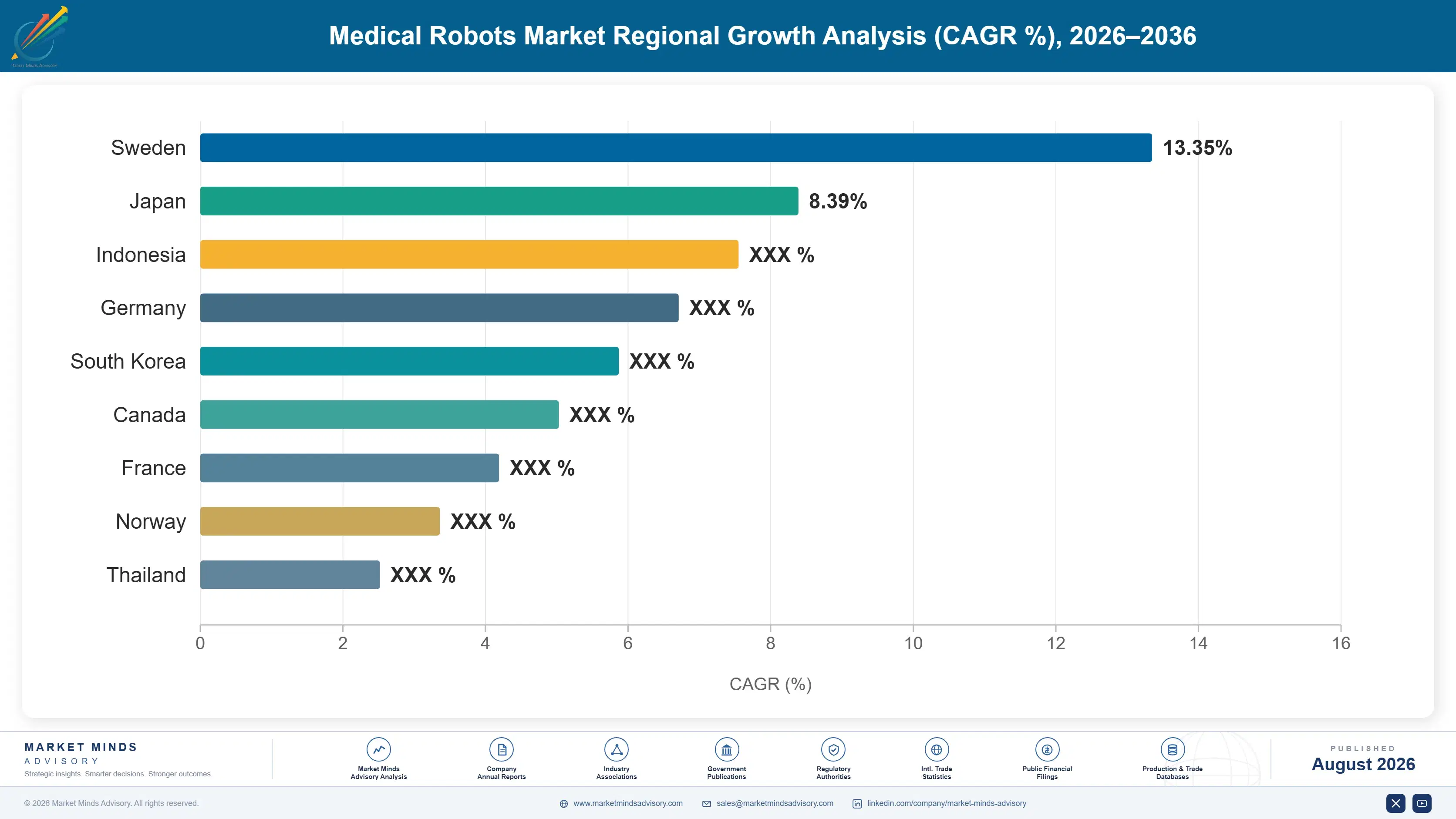
North America and East Asia together account for more than half of global installations, while South Asia and Pacific posts the fastest regional growth on expanding hospital automation investment across India and Australia's rapidly growing private hospital networks and its expanding medical tourism industry.

North America

The United States drives regional demand as Intuitive Surgical's home-market installed base continues expanding alongside rapidly growing logistics and rehabilitation robot procurement across major hospital systems facing chronic staffing shortages nationwide. Medicare reimbursement policy changes covering additional robotic-assisted procedures have accelerated hospital purchasing decisions considerably since 2023, particularly across orthopaedic and general surgery applications nationwide. Canada contributes a smaller but steadily growing share, with provincial health systems increasingly funding rehabilitation robotics through public healthcare budgets rather than requiring private insurance coverage. Manufacturing and headquarters investment concentrates around California and Minnesota, where the region's largest surgical robotics manufacturers maintain their primary research and production facilities close to major teaching hospitals and academic medical centres.
Share: 31% | CAGR: 11.2% (2026 to 2036)

Western Europe

Germany anchors regional demand through its statutory health insurance system's expanding reimbursement coverage for both surgical and rehabilitation robotics, among the most comprehensive coverage frameworks globally for this equipment category. The United Kingdom follows through NHS capital investment programmes specifically targeting surgical robotics expansion across regional hospital trusts, though procurement pace varies considerably by trust budget availability each year. Switzerland maintains a disproportionate manufacturing and research footprint given Hocoma's domestic headquarters and strong academic medical robotics research partnerships. Regional growth trails North America and East Asia because much of the region's surgical robotics adoption wave already ran through earlier procurement cycles over the past decade of steady, methodical hospital investment.
Share: 21% | CAGR: 8.9% (2026 to 2036)
Regional intelligence for 5 additional markets available in the complete report: East Asia, South Asia and Pacific, Latin America, Middle East and Africa, Eastern Europe. Contact sales@marketmindsadvisory.com.
medical-robots-market-country-cagr-analysis-1787325605854

Where Medical Robotics Margin Concentrates

Margin follows installed base and consumables attachment, not system sales alone. Whoever places the most surgical platforms captures the recurring instrument revenue that compounds for years after each initial equipment sale closes and surgeons complete their platform-specific training programme in full, start to finish, without interruption.

Instrument and Consumables Revenue Per Procedure

Surgical robot manufacturers generate the majority of their long-term revenue from disposable instruments and consumables used in each procedure, not from the initial system sale itself, creating a recurring revenue stream that compounds as installed systems age and procedure volume grows. Intuitive Surgical's instrument revenue now exceeds system sales revenue by a considerable margin across its mature installed base, according to disclosed segment reporting. This favours manufacturers who prioritise installed base growth over per-unit pricing, since consumables revenue per system can reach 15 to 20 percent of the system price each year.
Market Impact: Adds 15 to 20% consumables revenue

Expanded Indication Approvals for Existing Installed Base

Manufacturers who secure regulatory clearance for additional surgical specialties on platforms already installed in hospitals capture new procedure revenue without requiring any additional capital equipment sale, a considerably faster path to revenue growth than placing entirely new systems. Stryker's Mako expansion from knee into hip and shoulder procedures added an estimated 35 percent more addressable procedure volume across its existing hospital customer base within months of clearance rather than years. This indication-expansion strategy has become a primary growth lever across the industry, since it monetises equipment hospitals have already purchased.
Market Impact: Speeds new revenue by 12 to 18 mont

Total Cost of Ownership Positioning Against Labor Costs

Logistics and service robot manufacturers increasingly price their systems against the fully loaded labor cost they displace or augment, rather than against competing robotic products alone, capturing a premium justified by hospital staffing budgets under chronic pressure. Aethon and Diligent Robotics both structure sales conversations around total labor-hour savings rather than simple equipment specifications, a framing that resonates strongly with hospital administrators managing persistent nursing shortages across every department. This positioning has supported pricing 20 to 30 percent above what pure hardware-cost comparison against competing systems would otherwise suggest is reasonable given current market conditions.
Market Impact: Supports a 20 to 30% pricing premiu

Outcomes Registry Data to Accelerate Reimbursement

Rehabilitation robotics manufacturers who fund their own long-term outcomes registries reach favourable national insurer reimbursement decisions considerably faster than competitors waiting for independent academic research to accumulate sufficient evidence over many years. Hocoma has run outcomes tracking across thousands of patients specifically to support reimbursement submissions in Germany and other major European markets, a data investment that has shortened coverage decision timelines by an estimated 18 to 24 months versus manufacturers without comparable registries, according to MMA Primary Research interviews with reimbursement policy specialists conducted across multiple markets in Q4 2025.
Market Impact: Cuts reimbursement timeline by 18 t

Who Controls the Margin Pool

CR5 sits at 48 percent, moderate-to-high for a specialised medical technology category, reflecting the regulatory and clinical-evidence barriers that concentrate surgical robotics among established manufacturers. Intuitive Surgical, Stryker, Medtronic, Zimmer Biomet, and CMR Surgical hold the top five positions, though each competes most directly within a specific surgical specialty rather than across the entire category uniformly or against every rival simultaneously.
Current competitive activity centres on three fronts: established manufacturers expanding regulatory clearances into new surgical specialties ahead of core patent expiries, logistics and rehabilitation robot makers scaling installed base to capture hospital labor-shortage budgets across understaffed departments, and Chinese domestic manufacturers pursuing rapid clinical evidence generation to close the technology gap with Western platforms already operating at commercial scale.

Emerging pressure comes from Chinese surgical robotics developers, who have moved from domestic-only clearance toward pursuing CE Mark and FDA approval for export markets following government-backed research investment directed at hospital automation broadly. Rankings shift most at the specialty level rather than globally: a manufacturer's dominant position in urology carries little weight in orthopaedics, where installed base and surgeon training investment reset the competitive order entirely for each new specialty entered.
medical-robots-market-company-positioning-matrix-1787325606377

Competitive Moat and Risk Dimensions

INTUITIVE SURGICAL

Moat: Surgeon Training Lock-In

Intuitive Surgical's decades-long installed base advantage creates a self-reinforcing moat: trained surgeons prefer familiar platforms, and hospitals rarely switch systems once staff have built procedural expertise on a specific manufacturer's instrument platform over many years of accumulated clinical practice and repeated procedure volume across every specialty served.
INTUITIVE SURGICAL

Risk: Patent Expiry Opens Competition

Core da Vinci patents have begun expiring, opening the door to lower-cost competitors targeting the same surgical specialties, a dynamic that historically compresses pricing power considerably once credible alternatives reach clinical parity with the incumbent platform across enough hospital accounts to matter commercially over time.
STRYKER

Moat: Orthopaedic Specialty Depth

Stryker's Mako platform benefits from the company's existing orthopaedic implant relationships, letting it bundle robotic surgery with implant sales in a way pure-play robotics competitors without an implant portfolio cannot easily replicate across hospital accounts they already serve at meaningful scale and considerable clinical depth.
STRYKER

Risk: Narrower Specialty Concentration

Stryker's robotics revenue remains concentrated in orthopaedic procedures, leaving it more exposed than diversified rivals if reimbursement or clinical preference shifts unfavourably within that specific specialty over the coming years of intensifying competition from newer, well-funded entrants targeting the same hospital accounts and surgeon relationships.

Players Tracked

Prominent Players

Intuitive Surgical
Stryker
Medtronic
Zimmer Biomet
CMR Surgical

Other Key Players

Johnson & Johnson
Smith & Nephew
Globus Medical
THINK Surgical
Renishaw
Ekso Bionics
ReWalk Robotics
Hocoma
Aethon
Diligent Robotics
Swisslog Healthcare
Omnicell
B-Temia
Cyberdyne Inc.
Fourier Intelligence

Recent Developments

FEBRUARY 2026

Medtronic Expands Hugo System Approval Across Europe

Medtronic received expanded CE Mark clearance for its Hugo surgical robotic system covering additional urology and gynaecology procedures across European markets and select hospital networks. The clearance builds on earlier approvals in Latin America and Asia, positioning Hugo for broader competition against established platforms already operating at scale.
Signal: Medtronic is now accelerating multi-market
OCTOBER 2025

Diligent Robotics Signs Multi-Hospital Deployment Agreement

Diligent Robotics signed an agreement to deploy its Moxi service robots across a regional hospital network covering 18 facilities, expanding well beyond its existing pilot installations at two sites launched the previous year. The deployment targets specimen transport and supply restocking tasks currently handled entirely by clinical staff.
Signal: Hospital networks are moving from single-s
JUNE 2025

Cyberdyne Expands Rehabilitation Robot Manufacturing Capacity

Cyberdyne completed an expansion of its HAL exoskeleton manufacturing facility in Japan, adding capacity equivalent to roughly 25 percent more annual production to meet growing rehabilitation hospital demand across Asian and European export markets currently under-served by existing manufacturing capacity.
Signal: Rehabilitation robotics manufacturers are

Precision Components and Motion Sensors

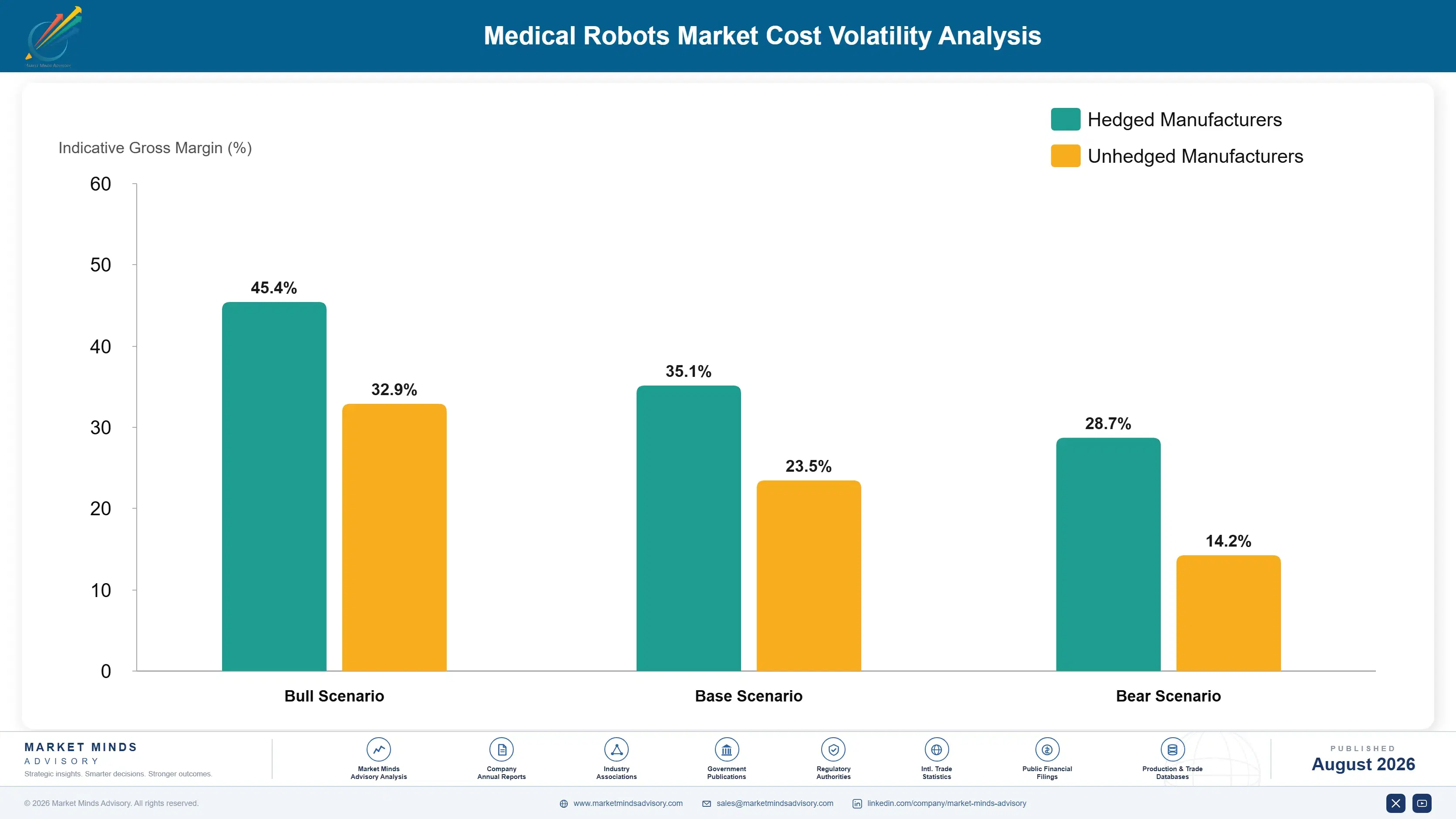
Precision actuators, motion sensors, and specialised optics together represent roughly 34 percent of medical robot manufacturing COGS, sourced from a concentrated base of specialty component suppliers serving both medical robotics and adjacent industrial automation and aerospace end markets simultaneously across multiple geographies and regulatory jurisdictions worldwide, from North America through East Asia and Western Europe.
Semiconductor and precision sensor shortages during 2021 and 2022 pushed component lead times past 12 months for several manufacturers, according to disclosed supplier communications reviewed at the time, delaying new system deliveries and forcing several manufacturers to prioritise existing customer commitments over new sales orders. Precision optics pricing has since risen a cumulative 14 percent as suppliers pass through raw-material and specialised manufacturing cost increases documented in supplier annual reports across the sector.

Exposure varies by manufacturer scale. Large surgical robotics makers lock in multi-year component supply agreements with guaranteed capacity allocation, while smaller rehabilitation and logistics robot makers competing for the same limited pool of precision components face longer lead times and less pricing leverage. This gap widens further during simultaneous demand growth across multiple robot categories, when manufacturers compete for capacity from the same suppliers.
medical-robots-market-cost-volatility-analysis-1787325606572

Long-Term Component Supply Agreements

Larger manufacturers now lock in multi-year precision component supply agreements with fixed volume commitments, insulating system production schedules from short-term shortages that previously delayed deliveries and strained hospital customer relationships considerably during periods of industry-wide component scarcity affecting nearly every manufacturer simultaneously and unpredictably across the supply chain.

Dual-Sourcing Critical Sensor Suppliers

Manufacturers increasingly qualify two suppliers per critical sensor and actuator component rather than one, adding validation cost upfront but avoiding single-supplier exposure during periods of industry-wide component shortages affecting the broader robotics and electronics sector, a lesson learned from the 2021 and 2022 shortage cycle that reshaped procurement strategy.

Vertically Integrated Precision Manufacturing

Several leading manufacturers have built in-house precision component manufacturing capability specifically to reduce dependence on external suppliers, trading higher fixed capital cost for delivery certainty on systems already committed to hospital customers under contract and installation timelines agreed well in advance of the scheduled delivery date.

Portfolio Architecture for Margin Defence

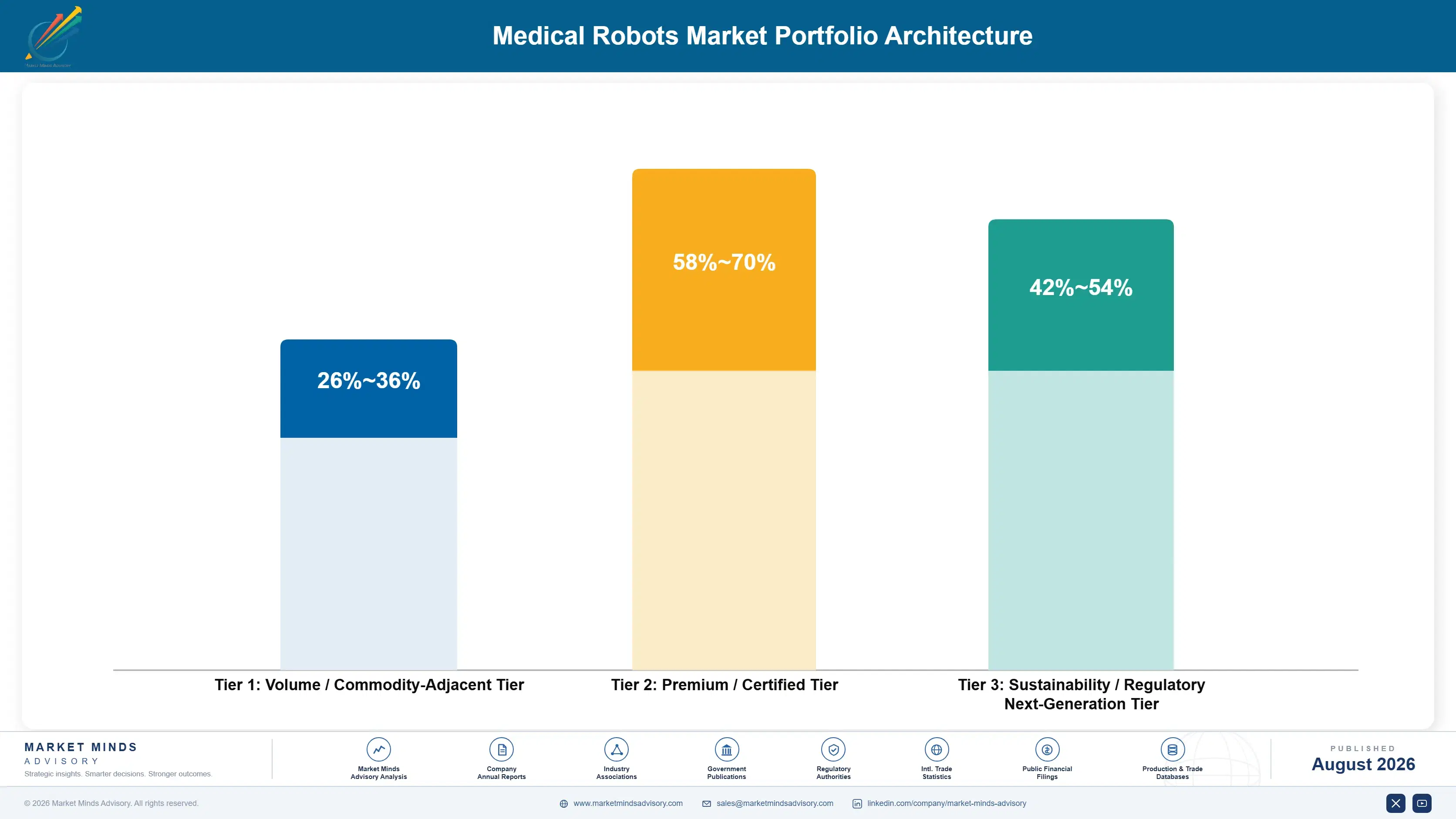
Portfolio economics split across three tiers. Established surgical platforms with expanding indications and mature consumables attachment command the highest margins, while newer entrants and basic logistics hardware compete mainly on price and total-cost-of-ownership positioning against hospital labor costs and existing purchasing budgets still constrained by broader capital planning priorities across the hospital system.
The tension between volume and premium plays out fastest in surgical robotics, where installed base and consumables revenue compound over a system's multi-year service life, while logistics and rehabilitation robots depend more on unit economics and labor-cost displacement to justify each individual hospital purchase decision within a constrained capital budget cycle that competes against many other clinical priorities each year.

High-value margin pools concentrate in surgical robotics consumables and expanded indication revenue, where installed base scarcity and surgeon training lock-in keep pricing power intact well past what newer robot categories retain during their own earlier, more price-competitive adoption phase still working through initial market validation and reimbursement uncertainty.

Volume / Commodity-Adjacent Tier

Basic logistics and delivery robots competing primarily on price and total cost of ownership against hospital labor costs across mature markets with several established, price-competitive suppliers already active and bidding for the same contracts.
Gross Margin: 26%-36%

Premium / Certified Tier

Established surgical platforms with expanded specialty indications and mature consumables attachment supporting recurring instrument revenue streams across every served hospital account and clinical specialty covered nationwide and internationally.
Gross Margin: 58%-70%

Sustainability / Regulatory / Next-Generation Tier

Rehabilitation robotics with outcomes-backed reimbursement approval, capturing premium pricing as clinical evidence and insurer coverage expand steadily across additional national markets and hospital networks now actively adopting the technology.
Gross Margin: 42%-54%
medical-robots-market-portfolio-architecture-1787325607078

High-value Sub-segments and Strategic Watch-out

Expanded-Indication Surgical Consumables

Instrument and consumables revenue tied to newly cleared surgical indications combines high recurring value with the fastest revenue growth in the category, as existing installed systems immediately become eligible for new billable procedure types without requiring any additional capital purchase or lengthy hospital budget approval.
Gross Margin: 60%-72%

Reimbursement-Backed Rehabilitation Robotics

Rehabilitation robots gaining national insurer coverage carry solid margins with a growth curve still several years behind surgical robotics, as reimbursement policy expansion proceeds country by country through separate approval processes with uncertain timing, scope, and final outcomes for manufacturers involved in each submission.
Gross Margin: 40%-50%

Established Hospital Logistics Hardware

Long-deployed logistics robots generate steady, predictable volume across major hospital networks but carry thinner margins after several years of price-competitive procurement among a small group of established suppliers serving the same customer base and recurring renewal contracts negotiated at each successive budget cycle.
Gross Margin: 24%-32%

Next-Generation AI-Assisted Diagnostic Robots

Diagnostic and imaging-assist robots integrating real-time AI guidance represent a strategic watch-out: it remains unclear how quickly regulators will clear autonomous decision-support features layered onto hardware already cleared for basic imaging assistance alone, without additional clinical trials or extended regulatory review periods at every affected jurisdiction.
Gross Margin: 45%-58%

Installed Base Renewal Economics

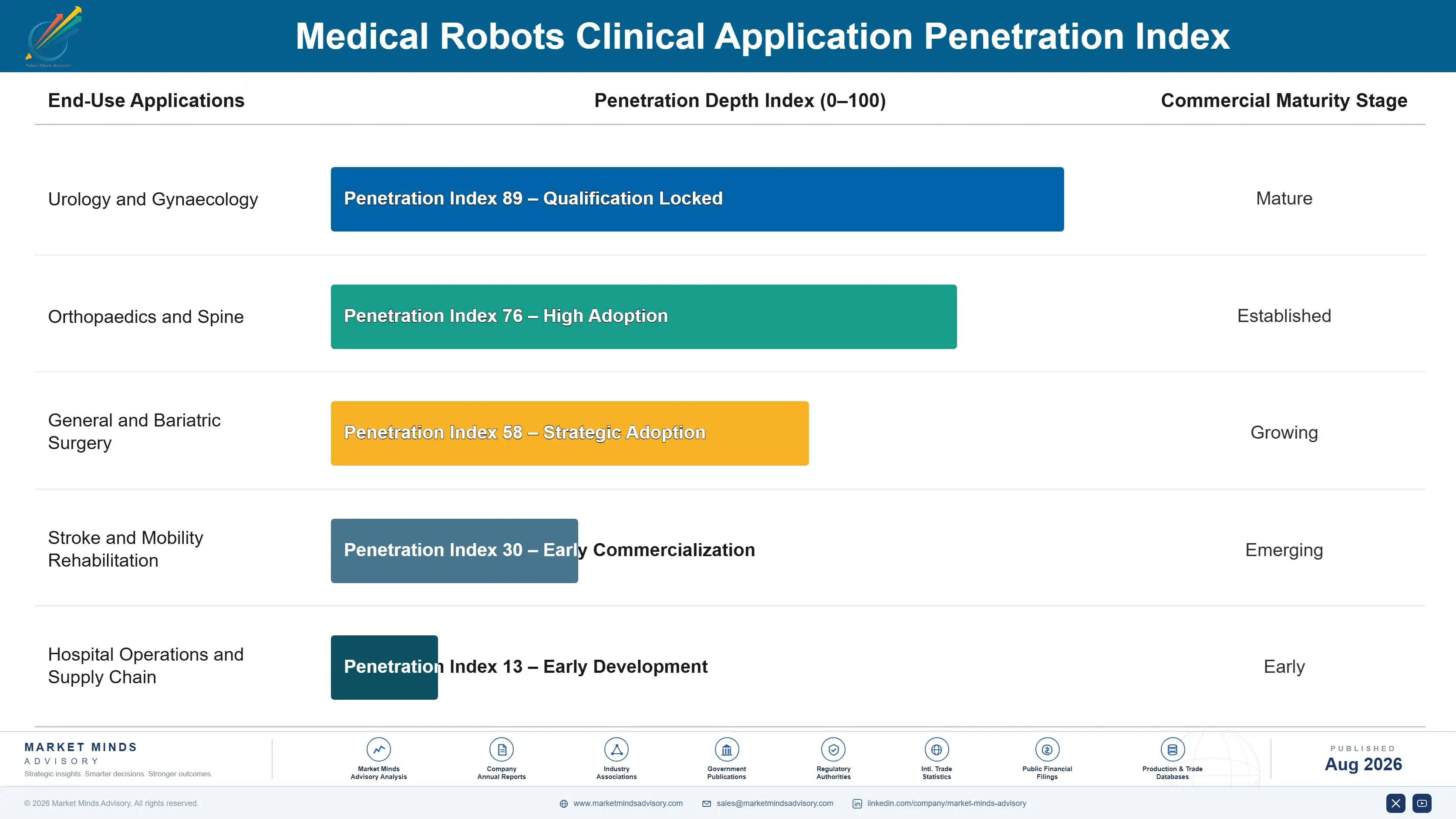
Medical robotics revenue behaves like an annuity once a system is installed, since consumables, service contracts, and eventual platform upgrades generate recurring revenue for years after the initial capital sale. A hospital that purchases a surgical robotic platform typically remains a customer for that manufacturer's instrument portfolio for the full multi-year service life of the underlying equipment.
Adoption depth varies considerably by vertical. Surgical robotics sees the deepest adoption in high-volume specialties like urology and orthopaedics, where procedure economics justify the capital investment quickly, while lower-volume specialties adopt more slowly as hospitals weigh utilisation rates against equipment cost and ongoing maintenance obligations. Rehabilitation and logistics robotics show faster but shallower initial adoption, as hospitals often start with pilot deployments before committing to facility-wide rollout across every department and shift pattern.

A generational shift is underway in hospital procurement committees. Administrators who entered healthcare leadership after 2018 show meaningfully more willingness to evaluate labor-displacement robotics on total-cost-of-ownership grounds than predecessors trained purely on capital-equipment budgeting, a shift that should widen logistics and service robot adoption as this cohort gains seniority within hospital administration over the next decade.
medical-robots-market-end-use-penetration-index-1787325607571

Positioning for the Next Adoption Wave

These are among the four positions where our research anticipates prominent divergence between winners and laggards over the coming forecast period. Each is grounded in the demand model, the regulatory perimeter, and the announced capacity pipeline.
01 / SPECIALTY EXPANSION TIMING

Pursue expanded indications before patents fully expire

Manufacturers who secure new specialty clearances on their existing installed base capture revenue growth considerably faster than competitors waiting to place entirely new systems in hospitals already budget-constrained for the current fiscal year. Stryker's orthopaedic expansion illustrates how quickly indication-driven growth can outpace new-placement revenue once a platform reaches meaningful installed scale across enough hospital customers. Manufacturers still concentrated in a single specialty risk losing share to more diversified competitors as core patents expire and competition intensifies across every adjacent category.
02 / LABOR-COST POSITIONING STRATEGY

Frame logistics robots against labor cost, not hardware price

Hospital administrators evaluating logistics and service robots increasingly compare total labor-hour savings against fully loaded staffing costs rather than comparing robot specifications against competing hardware alone, yet many manufacturers still market on technical features rather than total cost of ownership. That framing mismatch costs real sales conversion during a hospital's critical budget approval cycle each fiscal year. Manufacturers who lead with labor-cost displacement data, rather than technical specifications, consistently close deals faster across comparable hospital procurement processes observed this year by MMA analysts.
03 / REIMBURSEMENT INVESTMENT STRATEGY

Fund outcomes registries ahead of insurer coverage decisions

Rehabilitation robotics manufacturers waiting for independent academic research to accumulate sufficient evidence lose years of potential reimbursement coverage compared to competitors who fund their own outcomes tracking proactively from the earliest commercial stage. Hocoma's registry investment illustrates how proprietary outcomes data can meaningfully compress coverage decision timelines across major European markets facing similar reimbursement review processes. Manufacturers treating outcomes data as a marketing afterthought rather than a core commercial investment risk losing years of addressable reimbursed revenue to more proactive competitors already running registries.
04 / COMPONENT SUPPLY RESILIENCE

Lock in precision component supply before the next shortage

Semiconductor and sensor shortages during 2021 and 2022 delayed system deliveries across multiple manufacturers, and the underlying supplier concentration that caused that shortage has not meaningfully eased in the years since it first emerged across the broader electronics sector. Manufacturers still sourcing precision components on a spot basis remain exposed to the same risk as demand accelerates across every robot category simultaneously in coming years. Long-term supply agreements have already proven their value for manufacturers who adopted them ahead of the last shortage cycle.

Engagement Snapshot From the Field

A live engagement with an industry participant carrying material or product regulatory and market exposure ahead of a defining policy shift, showing how our research translates into a defensible multi-year portfolio strategy.
MARKET MINDS ADVISORY · CLIENT ENGAGEMENT SUMMARY
Medical Robots Producer Strategic Portfolio Review and Transition Roadmap 2026·Investment Scenario on Medical Robots Exposure Evaluation 2025-26
CLIENT PROFILE
The client is a regional hospital network operating nine acute-care facilities across the southeastern United States, with annual capital budget reported in the 180 to 250 million dollar range (client-reported, unverified by MMA), evaluating a coordinated automation strategy spanning surgical, logistics, and rehabilitation robotics investment across every affected clinical department and facility in the network.
STRATEGIC CHALLENGE
The network had previously purchased surgical robots on a facility-by-facility basis without a coordinated strategy and faced a choice between continuing that piecemeal approach or consolidating future purchases around a smaller set of preferred vendors to capture better pricing and training efficiencies across all nine facilities currently in its portfolio.
MMA APPROACH
MMA benchmarked the network's existing installed base and procurement history against comparable regional networks that had already consolidated vendor relationships, analysing pricing, training cost, and utilisation data by facility across the full portfolio. The team conducted primary interviews with procurement and clinical leadership at three comparable networks that had completed similar consolidation efforts.
KEY FINDINGS
  1. Facility-by-facility procurement had produced four different surgical robot platforms across nine hospitals, fragmenting surgeon training investment considerably across the entire regional network.
  2. Consolidated vendor networks in the benchmark group secured pricing 12 to 18 percent below the client's current average per-system cost across comparable platforms.
  3. Cross-facility surgeon credentialing on a single platform reduced onboarding time for new hires by an estimated 40 percent versus multi-platform training programmes.
  4. Logistics robot deployment at benchmark facilities reduced reported nursing transport-task time by roughly 85 minutes per shift across every surveyed hospital department.
CLIENT PROFILE
The client is a regional hospital network operating nine acute-care facilities across the southeastern United States, with annual capital budget reported in the 180 to 250 million dollar range (client-reported, unverified by MMA), evaluating a coordinated automation strategy spanning surgical, logistics, and rehabilitation robotics investment across every affected clinical department and facility in the network.
STRATEGIC CHALLENGE
The network had previously purchased surgical robots on a facility-by-facility basis without a coordinated strategy and faced a choice between continuing that piecemeal approach or consolidating future purchases around a smaller set of preferred vendors to capture better pricing and training efficiencies across all nine facilities currently in its portfolio.
MMA APPROACH
MMA benchmarked the network's existing installed base and procurement history against comparable regional networks that had already consolidated vendor relationships, analysing pricing, training cost, and utilisation data by facility across the full portfolio. The team conducted primary interviews with procurement and clinical leadership at three comparable networks that had completed similar consolidation efforts.
KEY FINDINGS
  1. Facility-by-facility procurement had produced four different surgical robot platforms across nine hospitals, fragmenting surgeon training investment considerably across the entire regional network.
  2. Consolidated vendor networks in the benchmark group secured pricing 12 to 18 percent below the client's current average per-system cost across comparable platforms.
  3. Cross-facility surgeon credentialing on a single platform reduced onboarding time for new hires by an estimated 40 percent versus multi-platform training programmes.
  4. Logistics robot deployment at benchmark facilities reduced reported nursing transport-task time by roughly 85 minutes per shift across every surveyed hospital department.
RECOMMENDED STRATEGY
Phase 1: Phase 1 (Months 1 to 6): Consolidate future surgical robot purchases around two preferred platform vendors across the whole network. Phase 2: Phase 2 (Months 7 to 14): Pilot logistics robot deployment at two facilities before committing to a full network-wide rollout. Phase 3: Phase 3 (Months 15 to 28): Expand successful logistics deployment across all nine facilities and begin rehabilitation robotics evaluation work.
OUTCOME
The network signed a consolidated procurement agreement covering its next six surgical robot purchases, securing pricing roughly 14 percent below its historical average per-system cost (client-reported, unverified by MMA). Two-facility logistics robot pilots reported a 30 percent reduction in nursing transport-task time within the first six months of deployment.

Frequently Asked Questions

Foundational context covering the market sizes, CAGR, scope, country, region and competition that inform every finding below. This section is provided to cover basics and most often pre-purchase conversations, answered from the MMA Primary Research Dataset.

What is the current size of the Medical Robots Market?

The global market reached an estimated 14.8 billion dollars in 2025, led by surgical robotics revenue. Growth is increasingly driven by logistics and rehabilitation robot categories.

How large will the Medical Robots Market be by 2036?

MMA projects the market will reach approximately 43.95 billion dollars by 2036 under the base-case forecast scenario. This reflects expanding surgical indications and hospital automation demand.

What is the CAGR for the Medical Robots Market 2026 to 2036?

The base-case compound annual growth rate is 10.4 percent across the full ten-year forecast period. Bull and bear scenarios range from 9.2 to 11.6 percent.

Which segment is growing fastest?

Rehabilitation and exoskeleton robots lead at a 15.4 percent CAGR, roughly 1.48 times the overall market rate. Hospital logistics and service robots follow as the second-fastest segment.

Who are the major companies in the Medical Robots Market?

Intuitive Surgical, Stryker, Medtronic, Zimmer Biomet, and CMR Surgical hold the top five positions by revenue. Each competes most directly within a specific surgical specialty.

Which country is growing fastest?

China leads at an estimated 13.2 percent CAGR, driven by national healthcare modernisation funding and closing technology gaps with Western competitors. Domestic manufacturers are scaling production rapidly.

Report Segmentation Architecture

The full report scope spans multiple orthogonal segmentation dimensions, with cross-tabulated demand data provided for each dimension pair. Coverage extends further to regional breakdowns, trend trajectories, and the competitive detail needed to support segment-level decision-making.

By Robot Type

  • Surgical Robotic Systems
  • Rehabilitation and Exoskeleton Robots
  • Hospital Logistics and Service Robots
  • Diagnostic and Imaging-Assist Robots
  • Robotic Prosthetics and Assistive Devices
  • Other Medical Robots

By Clinical Application

  • Urology and Gynaecology
  • Orthopaedics and Spine
  • General and Bariatric Surgery
  • Stroke and Mobility Rehabilitation
  • Hospital Operations and Supply Chain

By Commercial Dimension

  • Direct Hospital Capital Procurement
  • Group Purchasing Organisation Contracts
  • Instrument and Consumables Revenue
  • Service and Maintenance Contracts

By Region

  • North America
  • Western Europe
  • East Asia
  • South Asia and Pacific
  • Latin America
  • Middle East and Africa
  • Eastern Europe

Scope, Methodology, and Coverage

Every figure in this report is reproducible from documented input assumptions. The scope below maps the historical period, the forecast horizon, the segmentation dimensions, and the countries covered, alongside the underlying primary and qualitative methodology.
Historical Period
2020 to 2025
Forecast Period
2026 to 2036
Base Year
2025 (USD billions; MMA Primary Research Dataset, August 2026)
Market Definition
This market covers robotic systems used in surgical, rehabilitation, hospital logistics, and diagnostic-assist applications within clinical and hospital settings. It excludes consumer wellness robots, laboratory automation equipment, and standalone AI diagnostic software sold without robotic hardware.
Quantitative Units
USD billions (current prices); installed unit counts where applicable
Segmentation Dimensions
By Robot Type; By Clinical Application; By Commercial Dimension; By Region
Regions Covered
North America, Western Europe, East Asia, South Asia and Pacific, Latin America, Middle East and Africa, Eastern Europe
Countries Covered
USA, China, Germany, France, UK, Japan, South Korea, India, Australia, Canada, Brazil, Mexico, Indonesia, Vietnam, Thailand, Malaysia, UAE, Saudi Arabia, South Africa, Nigeria, Turkey, Poland, Netherlands, Italy, Spain, Sweden, Switzerland, Argentina, Colombia, Singapore, and additional markets relevant to this sector
Key Companies Profiled
Intuitive Surgical, Stryker, Medtronic, Zimmer Biomet, CMR Surgical, Johnson & Johnson, Smith & Nephew, Globus Medical, THINK Surgical, Renishaw, Ekso Bionics, ReWalk Robotics, Hocoma, Aethon, Diligent Robotics, Swisslog Healthcare, Omnicell, B-Temia, Cyberdyne Inc., Fourier Intelligence
Quantitative Methodology
Primary survey, n=3,800 respondents, Q4 2025, six countries; demand-side model with trade association cross-validation
Qualitative Methodology
47 expert interviews, Q4 2025; applied to validate demand model assumptions, identify emerging dynamics, and assess competitive positioning
Report Format
PDF and XLSX data workbook (Word format preview document)
Publisher
Market Minds Advisory
Report Code
MMA-2026-MED-287
Published
August 2026
Contact
sales@marketmindsadvisory.com | www.marketmindsadvisory.com

Purchase the full Medical Robots Market Report (2026 to 2036).

The full report delivers a specialty-by-specialty regulatory clearance tracker covering surgical robotics indications across sixteen countries with active review processes underway. It includes an installed base and procedure-volume database spanning the top twenty manufacturers globally, with consumables attachment and pricing benchmarks by platform. Reimbursement policy is mapped across fourteen major markets, including coverage decisions for both surgical and rehabilitation robotics categories. Buyers also receive a company-level financial and pipeline model for each of the twenty profiled manufacturers, updated quarterly through the subscription period each year.
Specialty regulatory clearance tracker and calendar
Installed base and procedure-volume database worldwide
Reimbursement policy mapping by country and category
Quarterly competitor financial and pipeline model updates
Consumables attachment and pricing benchmark data
Custom market entry and procurement strategy workshops

Built For The People Who Decide

From boardroom strategy to bench-side execution, this report is read cover-to-cover by leaders shaping the next decade of their industry, turning demand scenarios, market dynamics and valuation benchmarks into decisions.
CXOs/ Presidents/ VPs/ Managers
M&A and Corporate Development
Strategy Teams and R&D Heads
Procurement and Product Directors
Regulatory and Compliance Leaders
Investor Relations and Equity Analysts