Market Minds Advisory
Medical Carts Market

Medical Carts Market: When EHR Connectivity Replaced Storage Capacity As The Real Product

A commercial reading of medical carts, where connected computer-on-wheels workstations integrated with electronic health records are pulling hospital purchasing away from the basic mobility and storage functionality that built this equipment category over decades.

Lead Analyst

Alice Ballenger

Published

September 2026

Make Smarter Decisions with Customized Research Insights

Request a free sample report and evaluate market opportunities, growth trends, and competitive dynamics relevant to your business needs.

2025 MARKET VALUE$3.2BMarket Size 2025
2036 FORECAST VALUE$6.6BBase Case , 2026 to 2036
CAGR 2026 TO 20366.8 %Bull 8.0% / Bear 5.5%
INCREMENTAL OPPORTUNITY$3.2BNet 10- year value creation
EXPANSION MULTIPLE1.93x2036 value over 2026 base
Strategic Levers
M&A Pipeline
Regional Outlook
Country Rankings
Competitive Intelligence
Segmental Deep-dive
Call-Us : 91 93563 13602

Executive Snapshot and Market Trajectory

Medical cart purchasing increasingly turns on EHR connectivity and battery management rather than raw mobility and storage capacity alone, as hospitals digitizing point-of-care documentation increasingly value connected clinical workflow integration over the basic wheeled cabinet approach that once defined this entire equipment category for decades.
The market stands at USD 3.42 billion in 2025 and reaches USD 6.60 billion by 2036 at a 6.8% CAGR. Computer-on-wheels mobile workstations grow fastest at 10.5%, roughly 1.54 times the overall rate, as hospitals increasingly require carts that integrate directly with electronic health record systems for point-of-care documentation. North America holds 34% of value on concentrated hospital digitization spend, while South Asia and Pacific posts the quickest regional growth at 8.7%.
Concentration sits near 46%, split between diversified medical equipment manufacturers holding broad cart and mobile workstation portfolios and regional distributors competing on service reach and facility integration support across most clinical application categories worldwide today. Two forces dominate ahead. Hospital digitization is pulling cart purchasing toward connected computer workstations, and medication safety mandates are turning cart specification into an automated dispensing decision rather than a purely storage one.
Market Definition
The medical cart market covers mobile equipment used for clinical workflows, including medication administration, computer-on-wheels workstations, emergency response, anesthesia, and infection control carts. Fixed cabinetry and unrelated hospital furniture are excluded.
Base Year Value
$3.2B in 2025 (MMA Primary Research Dataset, August 2026)
Forecast Period
2026 to 2036, eleven discrete annual values
CAGR
6.8% base case. Bull 8.0%. Bear 5.5%.
Fastest Growth Segment
Computer-on-Wheels (Mobile Workstations): 10.5% CAGR
Fastest Growth Country
United States: 8.2% CAGR
Fastest Growth Region
South Asia and Pacific: 8.7% CAGR
Largest Region
North America: 34% of 2025 global value
Market Leaders
Capsa Healthcare, Ergotron Inc., InterMetro Industries (Metro), Enovate Medical, Rubbermaid Healthcare (Newell Brands). Source: MMA Analysis based on company annual reports.
Primary Survey
n=3,800 procurement and R&D decision-makers, Q4 2025, six countries
Methodology
Demand-side build-up, cross-validated against public data, 47 expert interviews

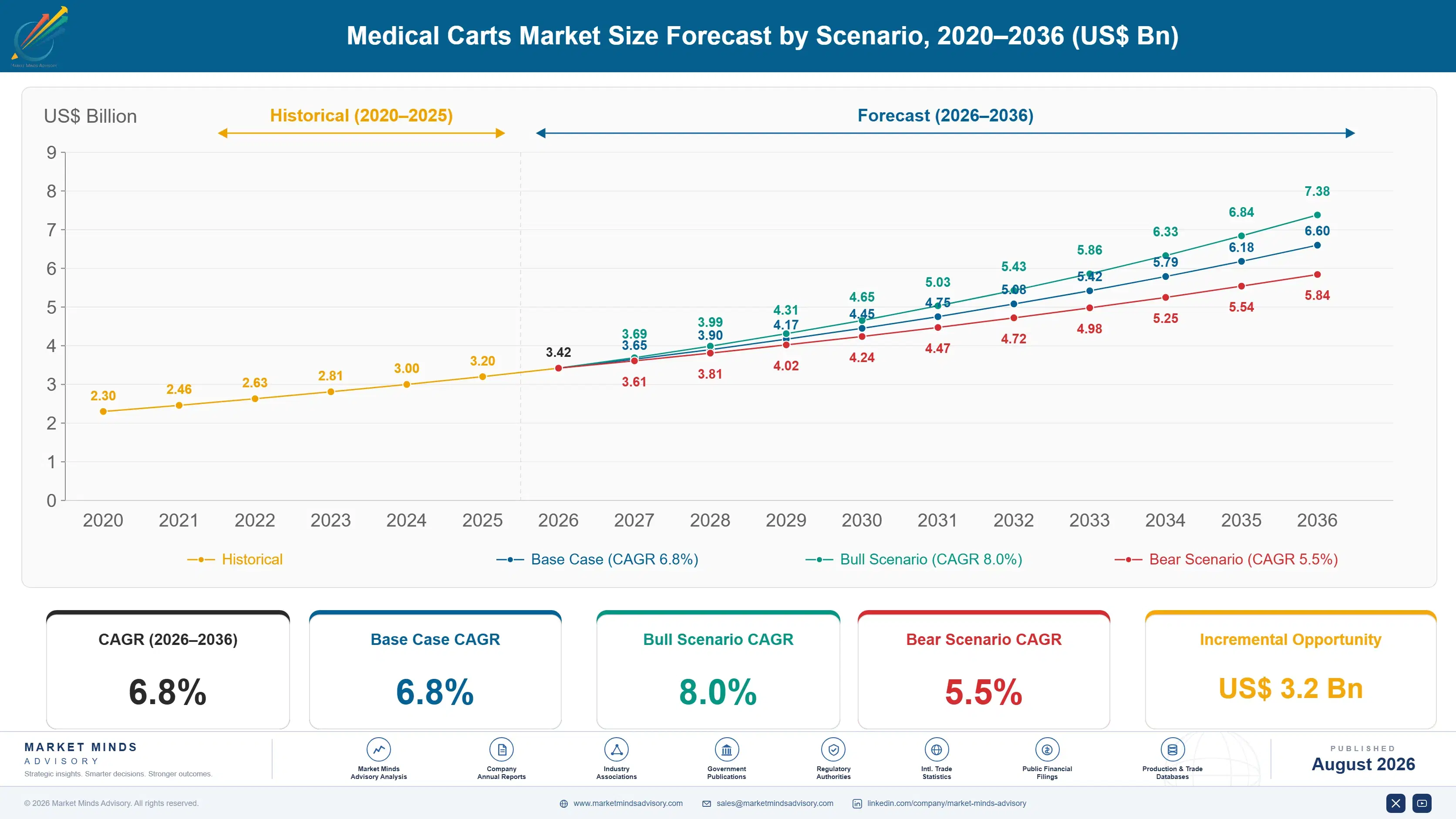
Medical Carts Market Forecast Scenarios

medical-carts-market-size-forecast-scenario-1787297780615
Growth from 2020 to 2025 compounded near 5.6%, tracking hospital digitization investment and medication safety initiative adoption closely across most developed healthcare markets globally, with computer-on-wheels demand accelerating steadily as electronic health record documentation requirements expanded across major hospital systems nationwide. Emergency and crash cart volume grew more slowly, tracking established replacement cycle patterns specifically.
Three mechanisms carry the base case to 6.8%. First, hospital digitization expanding as electronic health record point-of-care documentation requires carts that integrate directly with clinical information systems across most major healthcare categories worldwide currently expanding connected workstation adoption. Second, medication safety mandates turning cart specification into an automated dispensing decision rather than a purely storage one for hospital procurement teams. Third, infection control protocols continuing to drive steady demand for isolation cart deployment globally.
The bull case at 8.0% assumes hospital digitization and medication safety mandate adoption accelerate faster than currently planned across major developed healthcare markets worldwide. The bear case at 5.5% assumes hospital capital equipment budgets tighten considerably amid broader healthcare cost pressure, computer-on-wheels adoption decelerates, and medication safety mandate implementation proceeds more gradually than current expansion expectations suggest.

Why EHR Connectivity, Not Storage Capacity, Now Sets Cart Contracts

Three forces set demand here. Hospital digitization drives the largest new-volume growth, as electronic health record documentation requires carts that integrate directly with clinical information systems across most major healthcare facilities. Medication safety mandates drive a second stream, since automated dispensing features increasingly reduce medication error liability. Infection control protocols drive a third, steadier stream.
MARKET CONCENTRATIONCR5: 46%Split between diversified medical equipment manufacturers and regional distribution specialists
DOCUMENTATION TIME REDUCTIONUp to 30% versus paper chartsTypical documentation time reduction achieved by connected carts over charts
FLEET DEPLOYMENT TIMELINE8 to 20 weeksTypical time to deploy and integrate a new cart fleet
COMPUTER-ON-WHEELS ORDER SHAREAbout 32% of new ordersShare of new orders directed toward computer-on-wheels workstations
HOSPITAL DIGITIZATION GROWTHRoughly 9% annuallyGrowth rate of hospital digitization investment across major healthcare systems
BATTERY AND COMPUTING SHAREAbout 34% of unit costShare of unit cost attributable to battery and computing components
The commercial character is defined by a widening split between connected digital workstations and price-driven basic storage carts. A hospital evaluating cart suppliers assesses EHR connectivity and battery management as primary specifications, not simply raw storage capacity comparable across generic medical carts. A supplier without validated clinical system integration increasingly loses these contracts regardless of price, since a disconnected cart directly threatens point-of-care documentation workflow and clinical efficiency.
The decade turns on whether hospital digitization keeps expanding fast enough to offset any softening in basic storage cart demand as connected workstations mature across major healthcare systems worldwide. EHR connectivity and battery management remain the primary forces separating suppliers building durable hospital relationships from those still competing purely on general storage specifications. That shift determines which suppliers lead the next decade.
"A hospital doesn't buy a cart. They buy the difference between a nurse charting at the bedside and one walking back to a nursing station, and that's the entire sale."
Director, Hospital Equipment and Clinical Workflow Practice · MMA Medical Device

Market Trends

Connected Computer-On-Wheels Are Replacing Basic Storage Carts

Hospitals are increasingly deploying computer-on-wheels workstations that integrate directly with electronic health record systems, since bedside documentation eliminates the delay and transcription error risk associated with clinicians returning to a central nursing station to update patient records after each interaction across most major inpatient and outpatient care categories currently expanding point-of-care documentation programmes. That connectivity shift is converting cart purchasing from a generic mobility hardware decision into a genuine clinical workflow infrastructure investment hospitals evaluate against documentation accuracy and nursing time savings rather than storage capacity specifications alone. Suppliers with validated EHR integration are capturing this contract volume steadily.
Market Impact: Grows 1.54 times faster than average
Automated Dispensing Is Reshaping Medication Cart Safety Standards

Hospitals are increasingly specifying medication carts with automated dispensing and barcode scanning integration, since these features directly reduce medication administration errors that manual cart drawer systems cannot reliably prevent during high-volume nursing shifts across most major hospital and long-term care categories currently expanding medication safety technology adoption without requiring separate handheld scanning devices. That safety-driven shift is converting medication cart purchasing from a purely storage decision into a genuine medication error prevention investment hospitals evaluate against patient safety liability. Suppliers with proven automated dispensing integration are capturing this contract volume steadily.
Market Impact: Cuts documentation time by 30%

Market Opportunities and Growth Drivers

Hospital Digitization Is Driving Connected Cart Demand

Hospitals requiring computer-on-wheels workstations that integrate with electronic health record systems are creating demand independent of general medical equipment growth alone, since digitization investment proceeds on its own clinical workflow modernization and documentation accuracy schedule regardless of broader hospital capital equipment cycle timing or economic conditions affecting other cart categories across most major healthcare markets expanding point-of-care documentation programmes and system integration. That digitization demand creates a durable order pipeline for suppliers with dedicated connectivity capability, regardless of general storage demand trends, since hospitals pursue modernization independent of broader industrial sector conditions. Each new commitment strengthens this pipeline.
Market Impact: Batteries last 8 to 10 hours

Medication Safety Mandates Are Driving Automated Dispensing Demand

Hospitals requiring automated dispensing and barcode scanning integration in medication carts are creating demand independent of general storage cart replacement cycles alone, since safety investment continues on its own medication error prevention and patient safety liability schedule regardless of broader hospital manufacturing conditions or economic cycles affecting other cart application categories across most major healthcare markets expanding medication safety technology adoption and error prevention programmes. That safety-driven demand creates orders tied to dispensing specification requirements rather than general replacement activity alone, since hospitals pursue safety independent of broader industrial demand conditions. Each new mandate strengthens this pipeline.
Market Impact: Delays upgrades by 2 years

Market Restraints and Challenges

Battery Limitations Constrain Deployment Density In Large Facilities

Hospitals deploying computer-on-wheels workstations across extended nursing shifts face battery life limitations that require careful charging infrastructure and spare unit rotation planning, since a single battery charge typically cannot cover a full twelve-hour shift under continuous documentation use. The root cause is that computing components, displays, and connectivity hardware draw considerably more power than the basic lighting and motor systems traditional carts required, straining battery capacity during peak usage. The commercial impact is that facilities must invest in charging infrastructure and spare battery inventory beyond the cart purchase itself. Mitigation runs through hot-swappable battery designs several manufacturers are now offering.
Market Impact: Cuts documentation time by 30%

Budget Constraints Limit Premium Feature Adoption In Smaller Facilities

Smaller and rural healthcare facilities evaluating premium connected cart features face capital budget constraints that favor direct clinical equipment purchases over workflow infrastructure investment, since limited capital allocation typically prioritizes diagnostic and treatment equipment ahead of documentation workflow tools regardless of efficiency benefits. The root cause is that smaller facilities operate with considerably tighter capital budgets than large hospital systems, forcing difficult tradeoffs between competing equipment priorities each budget cycle. The commercial impact is that many smaller facilities defer premium cart upgrades despite workflow advantages. Mitigation runs through tiered product lines and leasing financing options several manufacturers are now offering.
Market Impact: Grows 1.54 times faster than average
3 additional market trends, 4 additional growth drivers, and 3 additional restraints and challenges are covered in the full report. Contact sales@marketmindsadvisory.com to access the complete intelligence.

Segment CAGR and Growth Architecture

Segmentation follows cart function, a single functional logic describing which clinical task the equipment ultimately performs, rather than which hospital department deploys it or which specific patient population it actually and genuinely serves once put into daily clinical use. Each function carries its own connectivity, safety, and durability profile distinctly across the entire market today.
medical-carts-market-market-share-analysis-1787297781161

Computer-on-Wheels (Mobile Workstations)

Computer-on-wheels mobile workstations grow fastest at 10.5%, about 1.54 times the overall 6.8% rate, as hospitals increasingly require carts that integrate directly with electronic health record systems for point-of-care documentation across most major inpatient and outpatient categories currently expanding digitization programmes globally. Growth concentrates where suppliers demonstrate validated EHR integration and consistent battery reliability, since hospitals now require documented workflow performance records before approving a new supplier for a facility-wide fleet deployment. Capsa Healthcare and Ergotron both hold established positions in this segment through years of clinical workstation engineering and integration investment. Battery management depth, not raw storage capacity alone, remains the primary constraint on how fast this segment keeps expanding globally.
CAGR 10.5%

Isolation and Infection Control Carts

Isolation and infection control carts grow at 8.0%, serving hospitals requiring dedicated equipment for infectious disease protocols across most major healthcare facilities currently expanding infection control capacity considerably each passing calendar year and quarter quite steadily indeed now and reliably. Adoption concentrates among facilities updating infection control protocols following recent public health experience, since dedicated isolation carts offer contamination control that shared equipment cannot easily match during outbreak response scenarios. InterMetro Industries and Enovate Medical both hold strong positions built on established facility relationships spanning years of infection control engineering expertise. Protocol compliance, not raw storage capacity alone, remains the primary constraint shaping how quickly facilities adopt dedicated isolation cart systems.
CAGR 8.0%
Full segment breakdown across 5 segments available in the complete report.

Regional Architecture and Country Demand Map

Hospital digitization investment and healthcare capital equipment depth, more than population size, drive this seven-region value distribution across the entire global market and its facility networks today. North America dominates on concentrated hospital digitization spend, while South Asia and Pacific grows fastest on expanding healthcare infrastructure investment.

North America

North America holds 34% of value at 7.5% growth, sitting above the standard 22 to 32% band because established electronic health record mandates and concentrated hospital digitization spend drive cart purchasing disproportionately across several major states nationwide and quite consistently across most regions today and reliably indeed. Capsa Healthcare and Ergotron both maintain deep domestic infrastructure spanning years of hospital relationships and integration support across most major cart categories nationally and internationally as well. US demand leads decisively, driven by both established electronic health record documentation requirements and rising medication safety mandate adoption requiring qualified cart supply. Canadian demand follows at considerably smaller scale, concentrated in major provincial healthcare systems specifically.
Share: 34% | CAGR: 7.5% (2026 to 2036)

Western Europe

Western Europe holds 24% of value at 5.5% growth, shaped by mature hospital digitization infrastructure and steady medication safety mandate implementation moving more deliberately than the fastest-expanding developing healthcare markets elsewhere in the world currently and quite consistently indeed today and quite reliably now. Ergotron and InterMetro Industries both hold meaningful regional positions built on established relationships with major hospital systems spanning decades of clinical workstation development and technical support. German and UK hospital systems lead regional deployment, driven by dense healthcare infrastructure and established electronic health record relationships across major medical hubs. Growth reflects steady demand rather than the explosive expansion characterizing the fastest-expanding developing healthcare markets globally and consistently observed.
Share: 24% | CAGR: 5.5% (2026 to 2036)
Regional intelligence for 5 additional markets available in the complete report: East Asia, South Asia and Pacific, Latin America, Middle East and Africa, Eastern Europe. Contact sales@marketmindsadvisory.com.
medical-carts-market-country-cagr-analysis-1787297781682

Where Medical Cart Makers Actually Hold Margin

A manufacturer selling generic storage carts into a market where hospitals increasingly demand connected workflow is competing on entirely the wrong commercial axis today and consistently. The four moves below shift earnings toward what actually captures share: EHR integration validation, battery management engineering, medication safety features, and facility deployment support pursued early and deliberately.

Build Validated EHR Integration Ahead Of Rivals

Suppliers that build rigorous, independently validated electronic health record integration, rather than relying on generic mobility claims hospitals increasingly discount, win connected workflow contracts that competitors lacking comparable integration increasingly lose to faster-moving rivals across most major healthcare markets currently expanding digitization adoption. That capability commands a premium of 20 to 32% in effective contract value over suppliers offering only basic storage carts, since hospitals pay for validated documentation accuracy and workflow assurance as much as for the underlying hardware itself. Capsa Healthcare and Ergotron built this integration credibility over years, not quickly replicated.
Market Impact: Commands a 20 to 32% contract premium now

Deepen Battery Management Engineering For Extended Shift Coverage

Suppliers that build genuinely deep battery management and hot-swappable power engineering, rather than offering standard batteries requiring frequent charging interruptions, win facility-wide deployment contracts that generalist competitors increasingly cannot match, adding roughly 24% to addressable fleet revenue as hospitals consolidate purchasing around reliable power suppliers across most major inpatient categories and clinical facility types nationwide today and quite genuinely consistently. That engineering reaches hospitals who specifically require uninterrupted twelve-hour shift coverage, opening contracts that suppliers without expertise genuinely cannot access. Ergotron and Enovate are converting battery engineering into durable positioning.
Market Impact: Adds roughly 24% to addressable fleet revenue now

Build Medication Safety Features For Error Prevention Contracts

Suppliers that build genuine automated dispensing and barcode scanning integration, rather than offering standard drawer systems requiring manual verification, capture contracts that safety-limited competitors increasingly cannot win, cutting medication administration errors by roughly 35% compared to suppliers offering only manual drawer carts across most large-scale hospital and long-term care deployments and facility categories nationwide today and quite consistently now. That safety integration reaches hospitals who specifically need documented error prevention data, opening contracts that generalist suppliers genuinely cannot win. Capsa Healthcare and InterMetro are converting safety features into durable positioning.
Market Impact: Cuts medication administration errors by roughly 35% now

Build Facility Deployment Support For Faster Fleet Rollout

Suppliers that build genuine facility deployment and integration support capability, rather than requiring hospital IT teams to self-manage complex fleet rollouts, capture contracts that support-limited competitors increasingly cannot win, cutting fleet deployment timelines by roughly 30% during periods of hospital digitization affecting the broader medical equipment industry and its wider clinical technology teams, support networks, and IT departments. That support position reaches hospitals who specifically require confidence before large-scale fleet transitions, opening contracts that suppliers facing deployment gaps cannot reliably win. Enovate is converting deployment support into a durable advantage.
Market Impact: Cuts fleet deployment timelines by roughly 30% now

Who Controls the Margin Pool

Concentration sits near 46% for the top five, split between diversified medical equipment manufacturers holding broad cart and mobile workstation portfolios and regional distributors competing on service reach and facility integration support. The gap between leaders and challengers is validated EHR integration and battery management engineering, broadly comparable across established players. All participants are assessed on one basis, cart unit and integration service revenue to qualified hospi
Competition runs along three lines. First, validated EHR integration credibility, since that increasingly determines which suppliers win connected workflow contracts. Second, battery management engineering depth, which shapes hospital relationships for years once a supplier proves reliable extended-shift performance. Third, medication safety feature depth, since automated dispensing increasingly separates differentiated suppliers from generic drawer cart competitors.

Pressure is building from two directions. Large diversified medical equipment groups are expanding EHR integration and battery management portfolios through acquisition, bringing balance sheet strength smaller specialists cannot match on large hospital network contracts. Meanwhile specialized cart makers are winning niche facility contracts directly through deployment support and installation speed larger incumbents have not prioritized as aggressively. Rankings should favour suppliers combining integration credibility with genuine deployment support over those competing on general storage price alone.
medical-carts-market-company-positioning-matrix-1787297782201

Competitive Moat and Risk Dimensions

CAPSA HEALTHCARE

Moat: Validated EHR integration credibility

Capsa Healthcare built genuine validated EHR integration credibility over years of clinical workstation engineering and hospital system investment across most major inpatient and outpatient categories globally. Its established integration data provides bidding advantages competitors without comparable field validation cannot easily replicate. Continued investment in medication safety features extends that credibility into the fastest-growing error prevention segment.
CAPSA HEALTHCARE

Risk: Battery management engineering gaps

Its battery management engineering for the most demanding extended-shift deployments remains less developed than dedicated power specialists who have invested more heavily in hot-swappable battery and charging infrastructure engineering. Engineering-focused competitors with deeper battery depth are targeting exactly the hospital contracts where coverage matters most ahead of shift transition periods. Expanding battery depth requires investment the business is still allocating.
ERGOTRON INC.

Moat: Deep battery management expertise

Ergotron built deep battery management and power engineering expertise across multiple major clinical workstation categories through years of investment spanning most major hospital and long-term care markets globally and consistently. Its established engineering breadth provides hospital contract advantages narrowly-focused competitors cannot easily replicate. Continued investment in EHR integration extends that advantage into the fastest-growing connected workflow segment.
ERGOTRON INC.

Risk: Limited EHR integration breadth

Its EHR integration breadth across the widest range of hospital information systems remains less developed than dedicated integration specialists who have invested more heavily in cross-platform connectivity relationships. Breadth-focused competitors with deeper integration records are capturing hospital contracts that Ergotron's engineering-focused positioning increasingly cannot access. Building comparable integration breadth requires investment the business has not yet fully made.

Players Tracked

Prominent Players

Capsa Healthcare
Ergotron Inc.
InterMetro Industries (Metro)
Enovate Medical
Rubbermaid Healthcare (Newell Brands)

Other Key Players

JACO Inc.
Howard Medical
Waterloo Healthcare
Harloff Manufacturing
Armstrong Medical
Bristol Maid
AFC Industries
Scott-Clark Medical
Global Industries
MedDataSpace
InnerSpace
Herman Miller Healthcare
Steelcase Health
Midmark Corporation
Alvarado Manufacturing

Recent Developments

MAY 2023

Manufacturer expands EHR integration for hospital networks

A leading medical equipment manufacturer announced expanded EHR integration covering additional hospital information system platforms, backed by validated documentation accuracy and workflow performance data from multiple hospital networks. This was a product launch rather than any acquisition or merger, strengthening addressable digitization market opportunity considerably.
Signal: Expanding validated EHR integration directly captures growing hospital demand for connected workflow ahead of most competitors.
NOVEMBER 2023

Medical equipment group acquires battery engineering firm

A major medical equipment group completed acquisition of a specialty battery management and power engineering firm, adding direct extended-shift capability into its existing cart portfolio. This was a genuine acquisition rather than a joint venture or minority stake, and it closed a power engineering gap the group previously lacked.
Signal: Acquiring battery management capability directly now remains the fastest route to competing for extended-shift deployment contracts today.
MARCH 2024

Hospital network commits to major digitization expansion

A leading hospital network announced a major expanded digitization programme covering multiple facilities, committing substantial medical cart demand across the programme's multi-year clinical workflow modernization timeline. This was a capital investment decision rather than any corporate transaction, and it directly expanded addressable demand for qualified connected equipment.
Signal: Large hospital digitization expansion programmes directly and substantially expand addressable medical cart demand across most affected healthcare markets.

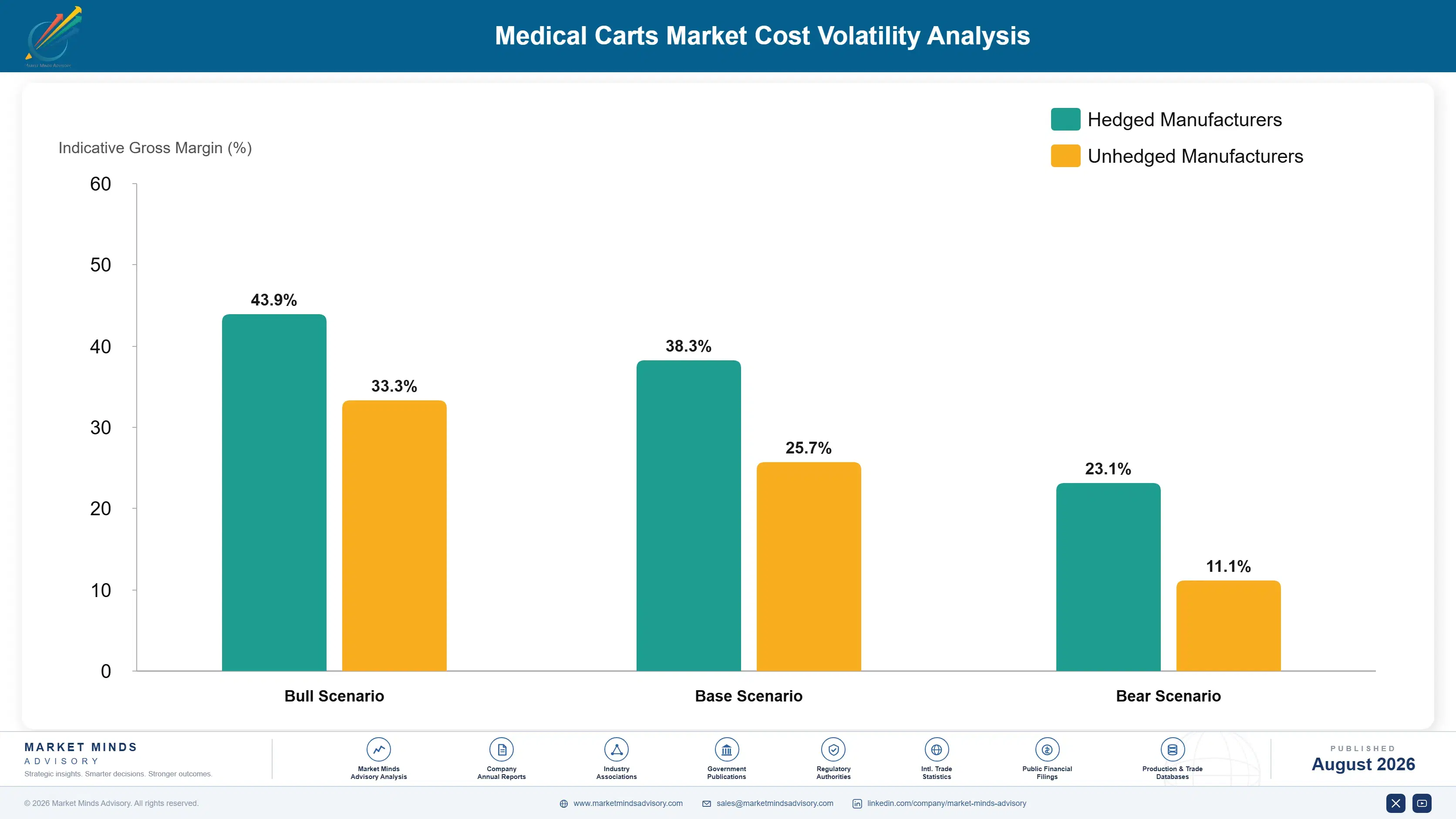
Battery And Computing Component Cost Risk

Battery cells and computing hardware dominate cost structure for connected medical cart manufacturing. Lithium-ion battery packs, industrial-grade displays, and specialty computing modules together account for a substantial share of unit cost, sourced from specialty electronics suppliers concentrated in a handful of countries. Structural aluminum framing and casters complete the cost structure for most cart categories.
Battery cell pricing moved considerably through 2021 and 2022 as global lithium supply chains tightened following disruptions that affected battery and computing component availability across most major producing regions simultaneously and quite considerably during that period. The US Geological Survey recorded meaningfully higher lithium and battery component costs through that window, and several cart manufacturers disclosed resulting margin pressure across their annual reporting through the period.

Exposure divides sharply by manufacturer scale rather than by cart category specifically across the industry. Larger manufacturers with negotiated long-term battery and computing component supply agreements held cost considerably better than smaller specialists relying on spot market purchasing during the tightening cycle. The disadvantage compounds, because a manufacturer unable to deliver committed cart volume during a shortage loses hospital relationships that larger, better-capitalized competitors retain.
medical-carts-market-cost-volatility-analysis-1787297782397

Negotiate long-term battery supply agreements early

Manufacturers relying on spot market battery cell purchasing absorb the full impact of periodic price spikes directly, which the recent tightening cycle demonstrated quite expensively across the entire connected medical cart manufacturing industry. Negotiating long-term supply agreements with battery producers, even at modest committed volume, provides delivery priority and cost stability during any future shortage.

Diversify computing component sourcing across suppliers

Manufacturers entirely dependent on a single computing hardware supplier cannot control allocation priority when a shortage hits, leaving no real alternative but to absorb delay and cost increases directly and pass them downstream to hospital customers immediately and consistently. Diversifying component sourcing across multiple qualified suppliers preserves supply continuity that single-supplier competitors simply cannot access as effectively.

Build modular designs tolerating battery substitution

Manufacturers locked into a single battery cell specification cannot adapt quickly when that specific component becomes scarce during a shortage, forcing costly redesign work under considerable time pressure across affected product lines and models. Designing modular cart architectures that tolerate qualified battery alternatives preserves manufacturing continuity that single-component designs competing during a shortage cannot access.

Portfolio Architecture for Margin Defence

The portfolio splits into three tiers with genuinely different economics across the industry. Standard basic storage carts form the volume tier, where equipment commoditization and price-driven bidding drive competition directly. Emergency and anesthesia carts earn considerably more, because regulatory compliance and specialized configuration narrow the field. Connected computer-on-wheels systems sit differently again, priced against the clinical workflow integration problem they solve.
The tension runs between standard storage volume that fills distribution capacity and premium connected work that earns the return. Conventional basic storage carts generate the transaction volume that keeps distributor relationships loaded and maintains hospital relationships through which higher-value connected conversations happen. Yet this segment competes on price against every qualified regional bidder. Manufacturers managing this well treat standard volume as distribution relationship capital.

High-value pools concentrate where connectivity or safety features genuinely limit competition: computer-on-wheels systems solving the clinical workflow integration problem, medication carts meeting automated dispensing safety requirements, and battery management resolving the extended-shift constraint directly. All three resist the price competition defining standard storage carts, since the customer is purchasing a solved workflow or safety problem rather than comparing interchangeable equipment.

Volume / Commodity-Adjacent Tier

Standard basic storage carts sold at commodity pricing against qualified regional bidders competing on standard specifications and price. The range is wide because manufacturing-efficient producers earn respectably while those competing purely on price frequently do not.
Gross Margin: 16-28%

Premium / Certified Tier

Emergency and anesthesia carts carrying regulatory compliance and specialized configuration in the most demanding critical care and procedure categories. The range is wide because compliance breadth and configuration maturity vary considerably by manufacturer.
Gross Margin: 28-42%

Sustainability / Regulatory / Next-Generation Tier

Connected computer-on-wheels systems with validated EHR integration credentials addressing the clinical workflow problem directly and durably across hospitals requiring genuine documentation accuracy assurance. The range is wide because integration breadth still varies enormously by manufacturer currently.
Gross Margin: 32-48%
medical-carts-market-portfolio-architecture-1787297782892

High-value Sub-segments and Strategic Watch-out

Computer-on-Wheels (Mobile Workstations)

High value and the fastest growth at 10.5%, from a moderate base as hospitals increasingly require carts that integrate directly with electronic health record systems for point-of-care documentation. Validated EHR integration increasingly determines which suppliers capture this volume, limiting near-term opportunity to those with proven connectivity credentials.
Gross Margin: 32-48%

Isolation and Infection Control Carts

High value with strong growth, protected by infection control engineering expertise and facility relationships that create a durable barrier newer specialist entrants find genuinely difficult to replicate quickly. Protocol compliance demand compounds steadily as hospitals expand isolation programmes supporting broader contamination control and safety goals.
Gross Margin: 28-42%

Medication Administration Carts

The volume core across standard basic storage carts worldwide, and the category with the longest commercial history of the five function segments listed here in this framework. Growth is steady but competition on price is direct, holding margin below the computer-on-wheels and isolation tiers positioned above it consistently.
Gross Margin: 16-28%

Emergency and Crash Carts

The strategic watch-out, growing slowest as basic emergency and crash cart volume increasingly loses ground to more targeted connected and safety alternatives offering better lifecycle economics across most demanding hospital categories today. Declining format preference limits addressable volume exactly where growth elsewhere is fastest, threatening this segment long-term position considerably.
Gross Margin: 14-24%

How Medical Cart Revenue Compounds

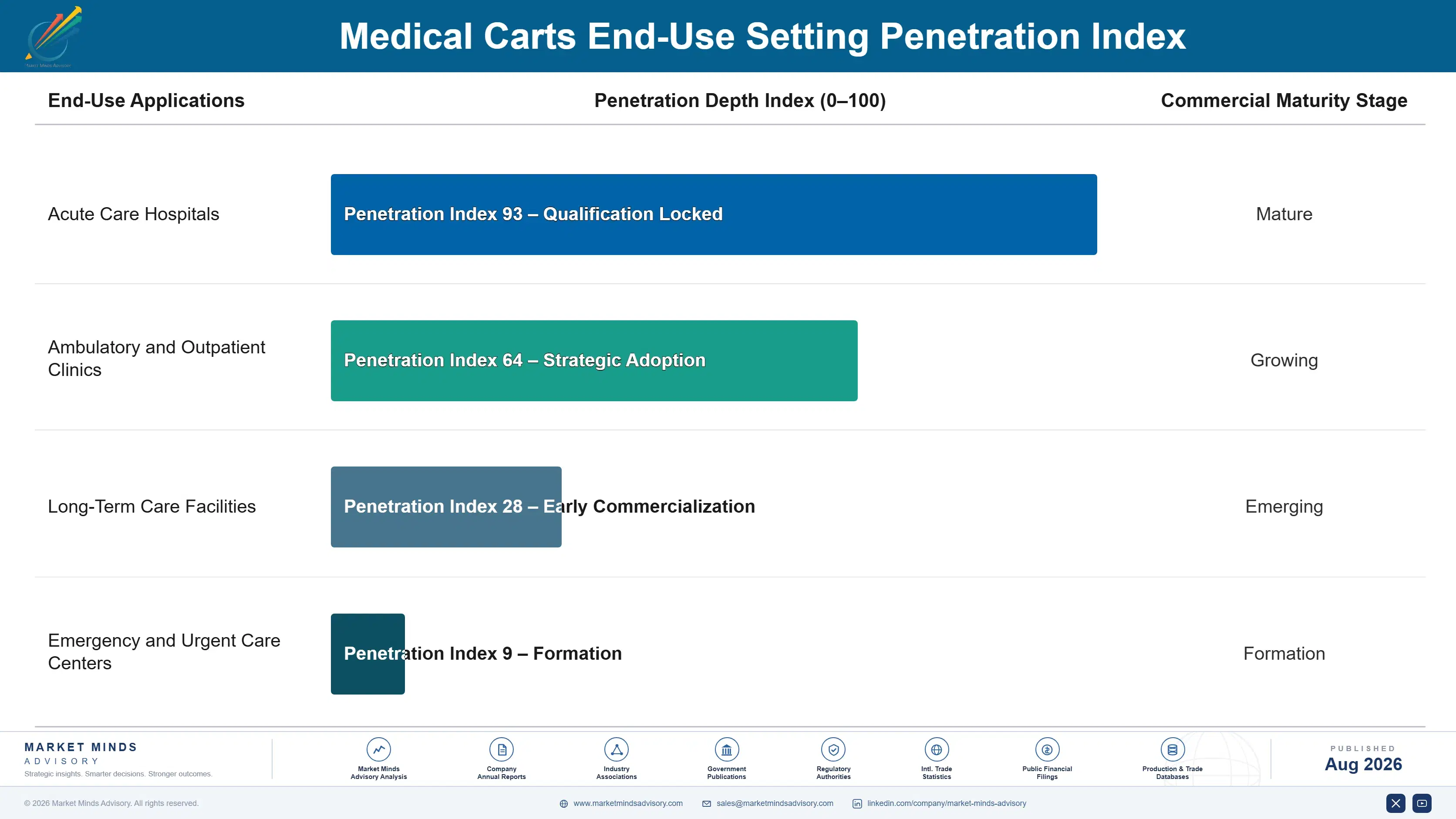
Revenue commits differently depending on which mechanism drives the order decision. Connected workstation contracts lock in tightly once a hospital commits to a validated EHR-integrated supplier, since IT integration requirements and staff training create genuine switching cost. General storage cart orders stay more reversible if a hospital defers capital spending. Medication safety orders persist on committed compliance schedules regardless of near-term conditions.
Adoption depth varies sharply by hospital scale and digitization ambition. Large hospital systems go deepest, standardizing connected computer-on-wheels across an entire facility network once a single unit proves the technology and reliability case. Mid-sized hospitals adopt more selectively, often piloting one department before broader conversion. Smaller facilities weigh capital cost most heavily, since budget constraints make premium carts considerably harder to justify.

Buyer profiles have shifted from general facilities managers toward clinical informatics directors and nursing workflow specialists with genuinely distinct priorities now. A facilities manager once compared cart price and durability directly; a clinical informatics director now tracks EHR integration and multi-year IT support relationships, and a workflow specialist drives specification against documentation efficiency a purely price-focused evaluation would never have prioritised.
medical-carts-market-end-use-penetration-index-1787297783380

Our Call On Medical Carts

These are among the four positions where our research anticipates prominent divergence between winners and laggards over the coming forecast period. Each is grounded in the demand model, the regulatory perimeter, and the announced capacity pipeline.
01 / EHR INTEGRATION STRATEGY

Build validated EHR integration ahead of rivals

Suppliers that build rigorous, independently validated electronic health record integration, rather than relying on generic mobility claims hospitals increasingly discount, win connected workflow contracts that competitors lacking comparable integration increasingly lose to faster-moving rivals across most major healthcare markets and hospital networks worldwide currently pursuing digitization expansion aggressively and consistently. That capability commands a premium of 20 to 32% in effective contract value over suppliers offering only basic storage carts. Suppliers should prioritise this now, because it is not quickly replicated.
02 / BATTERY ENGINEERING STRATEGY

Deepen battery management engineering for extended shifts

Suppliers that build genuinely deep battery management and hot-swappable power engineering, rather than offering standard batteries requiring frequent charging interruptions, win facility-wide deployment contracts that generalist competitors increasingly cannot match, adding roughly 24% to addressable fleet revenue as hospitals consolidate purchasing around reliable power suppliers across most major inpatient categories and clinical facility types nationwide today and quite genuinely consistently. That engineering reaches hospitals who specifically require uninterrupted shift coverage. Suppliers should build this now, before rivals establish comparable engineering.
03 / MEDICATION SAFETY STRATEGY

Build medication safety features for error prevention

Suppliers that build genuine automated dispensing and barcode scanning integration, rather than offering standard drawer systems requiring manual verification, capture contracts that safety-limited competitors increasingly cannot win, cutting medication administration errors by roughly 35% compared to suppliers offering only manual drawer carts across most large-scale hospital and long-term care deployments and facility categories nationwide today and quite consistently now. That safety integration reaches hospitals who specifically need documented error prevention data. Suppliers should build this now, before rivals establish it first.
04 / DEPLOYMENT SUPPORT STRATEGY

Build facility deployment support for faster rollout

Suppliers that build genuine facility deployment and integration support capability, rather than requiring hospital IT teams to self-manage complex fleet rollouts, capture contracts that support-limited competitors increasingly cannot win, cutting fleet deployment timelines by roughly 30% during periods of hospital digitization affecting the broader medical equipment industry and its wider clinical technology teams, support networks, and IT departments globally. That support position reaches hospitals who specifically require confidence before transitions. Suppliers should build this now, before the next digitization cycle hits.

Engagement Snapshot From the Field

A live engagement with an industry participant carrying material or product regulatory and market exposure ahead of a defining policy shift, showing how our research translates into a defensible multi-year portfolio strategy.
MARKET MINDS ADVISORY · CLIENT ENGAGEMENT SUMMARY
Medical Carts Producer Strategic Portfolio Review and Transition Roadmap 2026·Investment Scenario on Medical Carts Exposure Evaluation 2025-26
CLIENT PROFILE
A regional hospital network engaged MMA while evaluating computer-on-wheels suppliers for a facility-wide digitization rollout across its six-hospital network ahead of a scheduled electronic health record system upgrade affecting multiple clinical departments. The network reported serving over 210,000 inpatient encounters annually and faced pressure to finalize supplier selection before the upgrade date (client-reported, unverified by MMA).
STRATEGIC CHALLENGE
Selecting a supplier without proven EHR integration risked documentation workflow disruption if cart connectivity failed during the network-wide rollout across all six hospitals simultaneously and without adequate contingency planning. Leadership needed a supplier combining validated system integration with a credible battery management track record suited to extended nursing shift coverage.
MMA APPROACH
MMA evaluated three candidate cart suppliers against documented EHR integration breadth, battery reliability data, and total rollout cost across the network's projected seven-year technology commitment. We modelled documentation disruption risk under each supplier's actual field performance data rather than accepting supplier-provided assurances alone. We then assessed each supplier's network-wide deployment support capability.
KEY FINDINGS
  1. Only one of the three candidate suppliers had validated EHR integration spanning every clinical information system the network currently operates across all facilities.
  2. The recommended supplier's fleet achieved a modeled battery uptime rate exceeding 96% across pilot facility testing over several months (client-reported, unverified by MMA).
  3. Deployment support requirements varied considerably across the three suppliers evaluated, with the recommended supplier offering the fastest documented network-wide rollout schedule available.
  4. Selecting a supplier without proven EHR integration, based purely on unit price, would have risked meaningful documentation disruption across the entire network.
CLIENT PROFILE
A regional hospital network engaged MMA while evaluating computer-on-wheels suppliers for a facility-wide digitization rollout across its six-hospital network ahead of a scheduled electronic health record system upgrade affecting multiple clinical departments. The network reported serving over 210,000 inpatient encounters annually and faced pressure to finalize supplier selection before the upgrade date (client-reported, unverified by MMA).
STRATEGIC CHALLENGE
Selecting a supplier without proven EHR integration risked documentation workflow disruption if cart connectivity failed during the network-wide rollout across all six hospitals simultaneously and without adequate contingency planning. Leadership needed a supplier combining validated system integration with a credible battery management track record suited to extended nursing shift coverage.
MMA APPROACH
MMA evaluated three candidate cart suppliers against documented EHR integration breadth, battery reliability data, and total rollout cost across the network's projected seven-year technology commitment. We modelled documentation disruption risk under each supplier's actual field performance data rather than accepting supplier-provided assurances alone. We then assessed each supplier's network-wide deployment support capability.
KEY FINDINGS
  1. Only one of the three candidate suppliers had validated EHR integration spanning every clinical information system the network currently operates across all facilities.
  2. The recommended supplier's fleet achieved a modeled battery uptime rate exceeding 96% across pilot facility testing over several months (client-reported, unverified by MMA).
  3. Deployment support requirements varied considerably across the three suppliers evaluated, with the recommended supplier offering the fastest documented network-wide rollout schedule available.
  4. Selecting a supplier without proven EHR integration, based purely on unit price, would have risked meaningful documentation disruption across the entire network.
RECOMMENDED STRATEGY
Phase 1: Phase 1 (0 to 2 months): Finalize supplier selection and integrate EHR connectivity requirements into the network rollout contract terms. Phase 2: Phase 2 (2 to 6 months): Deploy carts across pilot facilities, validating documentation workflow performance against contracted specifications throughout deployment. Phase 3: Phase 3 (6 to 9 months): Complete full network rollout and validate battery uptime against the original 96% reliability target set.
OUTCOME
The network completed full facility rollout within the nine-month timeline, achieving documentation workflow improvements in line with the projected estimate across all six hospitals. Battery uptime held steady through the rollout period, and the supplier selection framework is now the network's standard approach for future technology deployments (client-reported, unverified by MMA).

Frequently Asked Questions

Foundational context covering the market sizes, CAGR, scope, country, region and competition that inform every finding below. This section is provided to cover basics and most often pre-purchase conversations, answered from the MMA Primary Research Dataset.

What is the current size of the Medical Carts Market?

The global medical cart market is valued at USD 3.42 billion in 2025, covering medication, computer-on-wheels, emergency, anesthesia, and infection control carts. Fixed cabinetry is excluded.

How large will the Medical Carts Market be by 2036?

The market is forecast to reach USD 6.60 billion by 2036 in the base case, about 1.93 times the 2026 level. That represents incremental value of roughly USD 3.18 billion across the forecast decade.

What is the CAGR for the Medical Carts Market 2026 to 2036?

The market grows at a 6.8% CAGR in the base case, with bull and bear scenarios at 8.0% and 5.5%. The spread turns mainly on hospital digitization and medication safety mandate adoption pace.

Which segment is growing fastest?

Computer-on-wheels mobile workstations grow fastest at 10.5%, about 1.54 times the overall rate, as hospitals require carts that integrate directly with electronic health record systems. Isolation carts follow at 8.0%.

Who are the major companies in the Medical Carts Market?

Leading manufacturers include Capsa Healthcare, Ergotron, InterMetro Industries, Enovate Medical, and Rubbermaid Healthcare, holding roughly 46% between them. Manufacturers combining EHR integration with battery engineering are increasingly capturing premium growth.

Which country is growing fastest?

The United States grows fastest at an 8.2% national CAGR, building on established electronic health record mandates and rising medication safety adoption. China follows closely on continued hospital digitization investment.

Report Segmentation Architecture

The full report scope spans multiple orthogonal segmentation dimensions, with cross-tabulated demand data provided for each dimension pair. Coverage extends further to regional breakdowns, trend trajectories, and the competitive detail needed to support segment-level decision-making.

By Cart Function

  • Medication Administration Carts
  • Computer-on-Wheels (Mobile Workstations)
  • Emergency and Crash Carts
  • Anesthesia and Procedure Carts
  • Isolation and Infection Control Carts

By End-Use Setting

  • Acute Care Hospitals
  • Ambulatory and Outpatient Clinics
  • Long-Term Care Facilities
  • Emergency and Urgent Care Centers

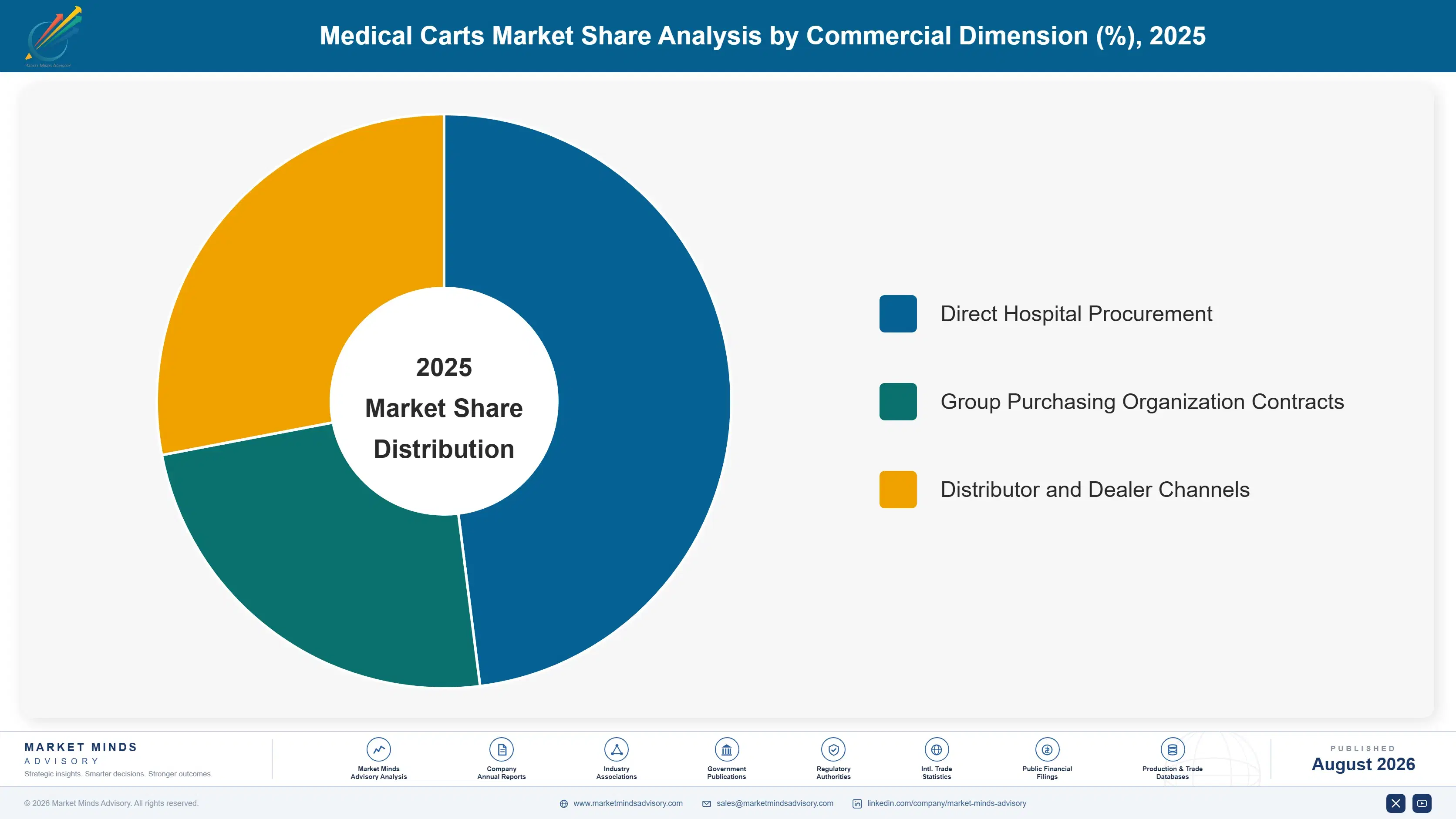
By Commercial Dimension

  • Direct Hospital Procurement
  • Group Purchasing Organization Contracts
  • Distributor and Dealer Channels

By Region

  • North America
  • Western Europe
  • East Asia
  • South Asia and Pacific
  • Latin America
  • Middle East and Africa
  • Eastern Europe

Scope, Methodology, and Coverage

Every figure in this report is reproducible from documented input assumptions. The scope below maps the historical period, the forecast horizon, the segmentation dimensions, and the countries covered, alongside the underlying primary and qualitative methodology.
Historical Period
2020 to 2025
Forecast Period
2026 to 2036
Base Year
2025 (USD billions; MMA Primary Research Dataset, August 2026)
Market Definition
The medical cart market comprises mobile equipment for clinical workflows, including medication administration carts, computer-on-wheels workstations, emergency response carts, anesthesia and procedure carts, and isolation carts, valued at manufacturer selling prices. It spans equipment used across hospitals, clinics, and long-term care facilities for point-of-care documentation and treatment. Fixed cabinetry and unrelated hospital furniture are excluded from this scope entirely.
Quantitative Units
USD billions (current prices); installed cart unit volume where applicable
Segmentation Dimensions
By Cart Function; By End-Use Setting; By Commercial Dimension; By Region
Regions Covered
North America, Western Europe, East Asia, South Asia and Pacific, Latin America, Middle East and Africa, Eastern Europe
Countries Covered
USA, Canada, Germany, UK, France, Italy, China, Japan, South Korea, India, Singapore, Thailand, Australia, Brazil, Mexico, Chile, Argentina, UAE, Saudi Arabia, South Africa, Poland, Czechia, Hungary, Romania, and additional markets relevant to this sector
Key Companies Profiled
Capsa Healthcare, Ergotron Inc., InterMetro Industries (Metro), Enovate Medical, Rubbermaid Healthcare (Newell Brands), JACO Inc., Howard Medical, Waterloo Healthcare, Harloff Manufacturing, Armstrong Medical, Bristol Maid, AFC Industries, Scott-Clark Medical, Global Industries, MedDataSpace, InnerSpace, Herman Miller Healthcare, Steelcase Health, Midmark Corporation, Alvarado Manufacturing
Quantitative Methodology
Primary survey, n=3,800 respondents, Q4 2025, six countries; demand-side model with trade association cross-validation
Qualitative Methodology
47 expert interviews, Q4 2025; applied to validate demand model assumptions, identify emerging dynamics, and assess competitive positioning
Report Format
PDF and XLSX data workbook (Word format preview document)
Publisher
Market Minds Advisory
Report Code
MMA-2026-MED-171
Published
August 2026
Contact
sales@marketmindsadvisory.com | www.marketmindsadvisory.com

Purchase the full Medical Carts Market Report (2026 to 2036).

The full MMA Medical Carts report sizes the market across five cart functions, seven regions, and multiple facility deployment models through 2036. It profiles 20 manufacturers on a consistent basis of cart unit and integration service revenue to qualified hospital customers, scoring each on EHR integration validation, battery management engineering, medication safety features, and facility deployment support. Scenario models quantify how hospital digitization and medication safety mandate adoption move both volume and achievable margin by function across all seven regions. The report also includes integration benchmark data and deployment mapping.
Five-function market sizing across seven regions through 2036
Twenty-manufacturer benchmark on cart and integration service revenue
Hospital digitization pipeline tracking by region
Validated EHR integration benchmarking across leading manufacturers
Battery management mapping across major clinical workstation suppliers
Battery and computing component supply chain risk mapping

Built For The People Who Decide

From boardroom strategy to bench-side execution, this report is read cover-to-cover by leaders shaping the next decade of their industry, turning demand scenarios, market dynamics and valuation benchmarks into decisions.
CXOs/ Presidents/ VPs/ Managers
M&A and Corporate Development
Strategy Teams and R&D Heads
Procurement and Product Directors
Regulatory and Compliance Leaders
Investor Relations and Equity Analysts