Market Minds Advisory
Medical Automation Market

Medical Automation Market: From Dispensing Cabinets to Diagnostic Workflow Automation

Medical automation demand is shifting from standalone pharmacy dispensing cabinets toward AI-assisted diagnostic and hospital logistics automation, as chronic clinical staffing shortages push health systems to automate workflows previously considered too complex for robotic handling.

Lead Analyst

Alice Ballenger

Published

September 2026

Make Smarter Decisions with Customized Research Insights

Request a free sample report and evaluate market opportunities, growth trends, and competitive dynamics relevant to your business needs.

2025 MARKET VALUE$14.5BMarket Size 2025
2036 FORECAST VALUE$40.5BBase Case , 2026 to 2036
CAGR 2026 TO 20369.8 %Bull 11.1% / Bear 8.5%
INCREMENTAL OPPORTUNITY$24.6BNet 10- year value creation
EXPANSION MULTIPLE2.55x2036 value over 2026 base
Strategic Levers
M&A Pipeline
Regional Outlook
Country Rankings
Competitive Intelligence
Segmental Deep-dive
Call-Us : 91 93563 13602

Executive Snapshot and Market Trajectory

Medical automation purchasing increasingly reflects workflow automation depth rather than pure dispensing accuracy, as hospitals facing chronic staffing shortages push automation investment into diagnostic and logistics functions previously performed entirely by clinical staff across most accredited healthcare facilities currently expanding rapidly throughout the industry and region.
Chronic clinical and pharmacy staffing shortages accelerating automation investment across hospital workflows, expanding new hospital construction bundling automation infrastructure from initial facility design, and rising AI-assisted diagnostic automation adoption reducing manual specimen and image review burden are together concentrating demand upside in two clear directions: East Asian markets where new hospital construction volume outpaces most other regions, and AI-assisted diagnostic automation software that gives hospitals genuine workflow efficiency previously unavailable through standalone mechanical dispensing systems.
Omnicell, Swisslog Healthcare, and ARxIUM lead a moderately fragmented field where AI software integration capability is becoming as commercially decisive as core mechanical dispensing reliability, while specialty robotics vendors compete primarily on hospital logistics automation and manufacturing capacity available to health systems racing to address unprecedented staffing shortages across every major reimbursed healthcare category currently expanding rapidly across most developed and emerging markets worldwide.
Market Definition
The medical automation market covers robotic pharmacy dispensing, automated laboratory specimen handling, AI-assisted diagnostic automation software, and hospital logistics automation systems used across clinical and pharmacy operations. Surgical robotics and unrelated administrative software platforms are excluded from scope.
Base Year Value
$14.5B in 2025 (MMA Primary Research Dataset, August 2026)
Forecast Period
2026 to 2036, eleven discrete annual values
CAGR
9.8% base case. Bull 11.1%. Bear 8.5%.
Fastest Growth Segment
AI-Assisted Diagnostic Automation Software: 15.5% CAGR
Fastest Growth Country
China: 11.0% CAGR
Fastest Growth Region
South Asia and Pacific: 11.8% CAGR
Largest Region
East Asia: 28% of 2025 global value
Market Leaders
Omnicell, Swisslog Healthcare, ARxIUM, Becton Dickinson, Siemens Healthineers. Source: MMA Analysis, July 2026.
Primary Survey
n=3,800 procurement and R&D decision-makers, Q4 2025, six countries
Methodology
Demand-side build-up, cross-validated against public data, 47 expert interviews

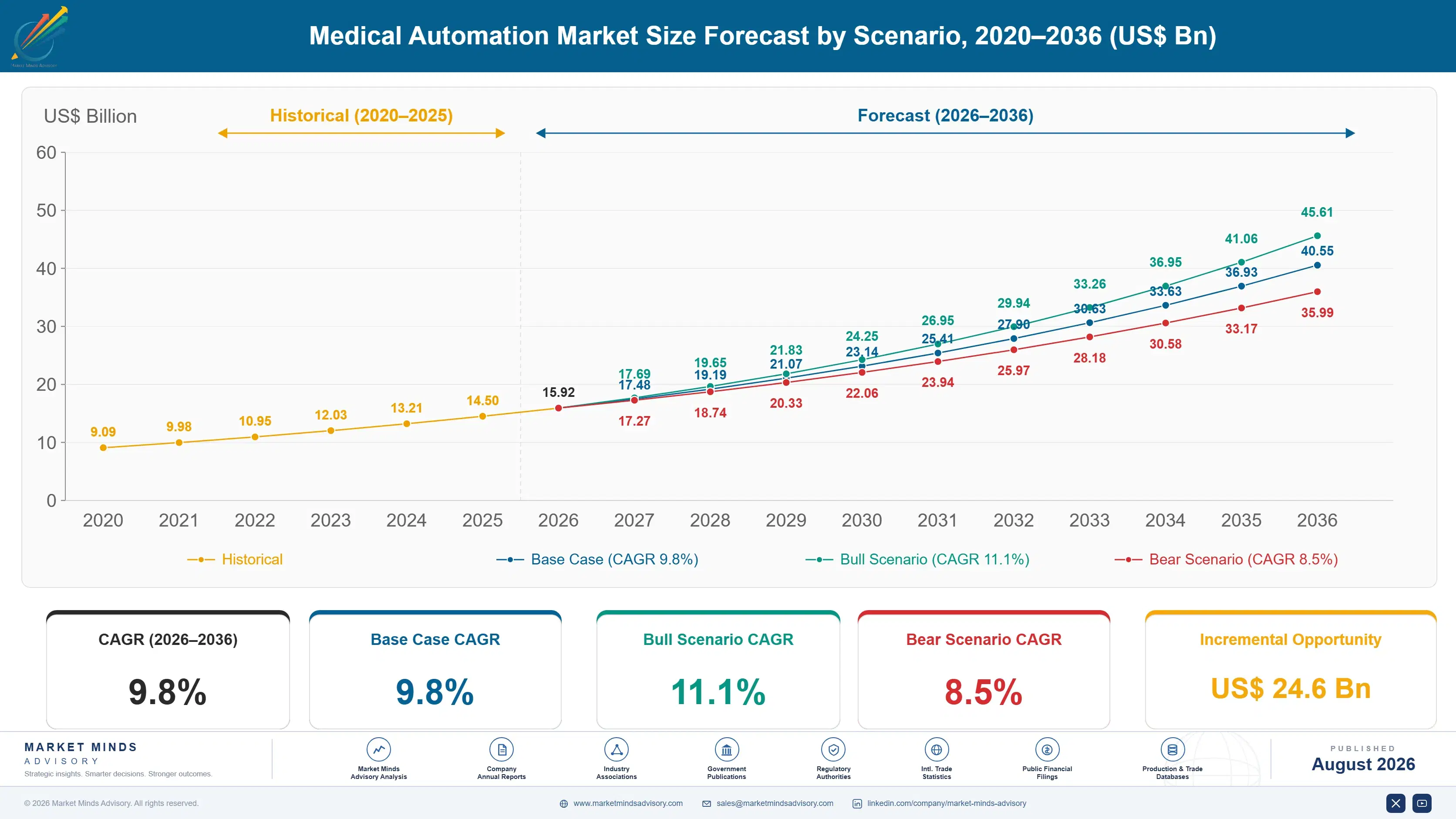
Medical Automation Market Forecast Scenarios

medical-automation-market-size-forecast-scenario-1787305827948
Medical automation demand grew steadily between 2020 and 2025, with pandemic-driven staffing disruption accelerating hospital interest in automation systems that reduce dependence on manual clinical labor for repetitive tasks. AI-assisted diagnostic automation adoption accelerated meaningfully during the back half of the historical period as software capability matured and regulatory clearance activity increased considerably across most major reimbursed markets.
The base case assumes 9.8 percent annual growth through 2036, anchored on three commercial mechanisms: chronic clinical and pharmacy staffing shortages pushing health systems toward automation investment that extends limited workforce capacity more efficiently, expanding new hospital construction across East Asian and South Asian markets bundling automation infrastructure directly into initial facility design, and rising AI-assisted diagnostic automation adoption that reduces manual specimen and image review burden across most accredited laboratory and radiology departments currently expanding rapidly.
The bull case centers on faster-than-expected AI diagnostic automation regulatory clearance broadening adoption into routine laboratory and imaging workflows well beyond specialty departments. The bear case flags hospital capital budget constraints and slower automation return-on-investment realization in smaller facilities, which could delay broader adoption and leave automation vendors running ahead of realized hospital demand for longer than currently planned.

From Dispensing Cabinets to Diagnostic Workflow Automation

Medical automation has expanded well beyond its historical core of pharmacy dispensing cabinets into a broader category encompassing diagnostic workflow automation, hospital logistics robotics, and AI-assisted laboratory and imaging analysis. Health systems increasingly evaluate automation investment as a workforce strategy rather than a pure efficiency upgrade, since chronic staffing shortages across nursing, pharmacy, and laboratory roles make automation genuinely necessary rather than merely
MARKET CONCENTRATIONCR5 44%Top five vendors control roughly two fifths of installed base
AVERAGE SELLING PRICEUSD 62,000Blended average price across dispensing and diagnostic automation systems
TOP PRODUCING COUNTRY SHARE31%Share of global installed base concentrated in leading country
CAPACITY UTILISATION78%Average hospital operating rate for automated dispensing systems installed
TRADE INTENSITY35%Portion of unit trade crossing borders versus domestically produced
INPUT COST SHARE52%Software and sensor components as share of total system cost
Hospital construction activity shapes automation adoption considerably, since new facilities can specify automation infrastructure from initial design far more cost-effectively than retrofitting legacy buildings across most markets tracked. Markets with the highest new hospital construction volume, particularly across East Asia, are seeing automation penetration rates climb faster than mature markets working through incremental retrofit projects one facility at a time.
AI-assisted diagnostic automation software is emerging as a genuine competitive differentiator beyond pure mechanical dispensing reliability, giving hospitals measurable reductions in manual specimen and image review time. Vendors increasingly bundle software capability with hardware sales, converting a historically one-time equipment purchase into an ongoing software licensing relationship that generates considerably more predictable long-term revenue for automation vendors across most reimbursed healthcare markets.
"Every hospital administrator used to think of automation as the pill-counting robot in the basement pharmacy. Now it is the thing standing between them and a nursing shortage that will not fix itself in time."
Director, Hospital Operations and Automation Practice · MMA Medical Devices / Ho

Market Trends

AI Diagnostic Automation Reaches Regulatory Maturity

Regulatory clearance activity for AI-assisted diagnostic automation software accelerated meaningfully through 2024 and 2025, with dozens of distinct algorithm clearances covering laboratory specimen classification, radiology image triage, and pathology slide analysis. Major automation vendors now bundle diagnostic AI software into new hardware platforms rather than selling it as a standalone add-on, shifting the competitive question from mechanical throughput toward algorithm accuracy and workflow integration depth. Hospital systems piloting these tools report measurable reductions in turnaround time and reduced variability between operators of differing experience levels, both of which matter directly to throughput-constrained departments.
Market Impact: Nursing vacancy rates exceed 10 per

New Hospital Construction Bundles Automation From Design

Rapid new hospital construction, particularly across East Asian and South Asian markets, increasingly specifies automation infrastructure directly into initial facility design rather than retrofitting completed buildings after opening and occupancy across most affected regions. This design-stage specification approach reduces total automation deployment cost considerably compared to retrofit projects, since building layout, power infrastructure, and network connectivity can be optimized for automation systems from the outset. Automation vendors with established hospital architecture and construction firm relationships are capturing disproportionate share of these greenfield hospital automation contracts across most rapidly expanding regional healthcare markets.
Market Impact: Cuts medication errors by 40 percen

Market Opportunities and Growth Drivers

Clinical Staffing Shortages Drive Automation Investment

Chronic shortages of nurses, pharmacists, and laboratory technicians across most developed healthcare systems are pushing hospitals to prioritize automation investment that reduces manual workload per staff member rather than simply adding headcount that remains genuinely difficult to recruit. Automated dispensing and specimen handling systems that process routine tasks with minimal staff intervention are increasingly favored over purely manual workflows requiring closer supervision throughout. Hospital administrators increasingly frame automation investment as a staffing efficiency imperative rather than a discretionary technology upgrade, broadening budget sponsorship beyond pharmacy and laboratory departments into nursing and hospital operations leadership.
Market Impact: Systems cost 1 to 3 million

Medication Error Reduction Mandates Expand Dispensing Automation

Patient safety regulations and hospital accreditation standards across several major markets increasingly require documented medication error reduction programs, directly linking automated dispensing technology to compliance obligations rather than treating it as an optional efficiency upgrade. Hospitals implementing barcode-verified automated dispensing report meaningful reductions in medication error rates compared to manual dispensing workflows, giving purchasing committees concrete evidence to justify capital investment. This regulatory pressure is spreading beyond hospital pharmacy into outpatient and long-term care settings, broadening the addressable automation market considerably across most reimbursed healthcare systems currently tightening patient safety protocols.
Market Impact: Integration takes 6 to 12 months

Market Restraints and Challenges

High Upfront Capital Cost Limits Smaller Hospital Adoption

Medical automation systems carry substantial upfront capital cost that limits adoption at smaller community hospitals and rural facilities operating under tight capital budgets, a barrier rooted in the specialized robotics and software engineering required for reliable clinical-grade automation. This restraint keeps some facilities relying on entirely manual workflows well past the point where automation would demonstrably improve safety and efficiency outcomes. Vendors are mitigating this restraint through equipment leasing and subscription-based financing models that spread capital outlay over multiple budget cycles rather than requiring full upfront system investment across an entire facility.
Market Impact: Over 30 clearances by 2025

Integration Complexity With Legacy Hospital Systems

Automation systems must integrate with existing electronic health record, pharmacy management, and laboratory information system platforms, a complexity rooted in the fragmented, multi-vendor nature of most hospital IT infrastructure accumulated across decades of separate purchasing decisions and vendor relationships. This integration burden extends implementation timelines well beyond initial vendor estimates, often requiring custom interface development for each facility rather than standardized deployment. Vendors are mitigating this restraint through pre-built integration libraries covering major hospital IT platforms, though full compatibility across all legacy combinations remains an unresolved challenge for many facilities.
Market Impact: Over 60% specify from design
4 additional market trends, 4 additional growth drivers, and 4 additional restraints and challenges are covered in the full report. Contact sales@marketmindsadvisory.com to access the complete intelligence.

Segment CAGR and Growth Architecture

Medical automation segments by product and technology type across six categories spanning software, robotics, and mechanical dispensing infrastructure used across hospital operations. AI-assisted diagnostic automation software and hospital logistics and automated guided vehicles are the two fastest-growing categories tracked, both expanding well ahead of the broader market as staffing shortages reshape hospital automation priorities.
medical-automation-market-market-share-analysis-1787305828481

AI-Assisted Diagnostic Automation Software

AI-assisted diagnostic automation software, which applies machine learning to laboratory specimen classification, radiology image triage, and pathology slide analysis, is converting the fastest share of new hospital purchasing budgets as chronic staffing shortages push departments toward workflow automation beyond pure mechanical dispensing. This software increasingly determines vendor selection even when hospitals are technically purchasing hardware automation systems, since algorithm accuracy and regulatory clearance breadth have become the primary differentiator purchasing committees evaluate during vendor selection. Vendors offering open, flexible software architecture are winning disproportionate share against competitors requiring costly custom integration for each individual hospital information system deployment across different facility types and regional healthcare networks tracked closely by MMA analysts.
CAGR 15.5%

Hospital Logistics and Automated Guided Vehicles

Hospital logistics and automated guided vehicles, which transport specimens, medications, and supplies autonomously throughout hospital facilities without manual staff intervention, are expanding rapidly as new hospital construction increasingly specifies logistics automation infrastructure directly into initial facility design and layout planning. Growth here tracks new hospital construction volume particularly strongly, since retrofitting automated guided vehicle infrastructure into existing buildings requires considerably more disruptive construction work than incorporating it during original design. This category benefits directly from advances in autonomous navigation technology, lowering deployment cost while improving reliability and giving hospital operations teams a genuinely more efficient alternative to manual transport staff across most large hospital campuses tracked closely by industry analysts.
CAGR 12.5%
Full segment breakdown across 6 segments available in the complete report.

Regional Architecture and Country Demand Map

Medical automation demand concentrates most heavily in East Asia, where China new hospital construction volume outpaces most other regions on an installation basis. North America follows closely on value, while South Asia and Pacific markets post the fastest regional growth off a smaller installed base.

North America

North America follows East Asia closely in absolute revenue terms, supported by a dense installed base of accredited hospital and pharmacy operations generating steady replacement and software licensing revenue year over year across most established healthcare systems, provider networks, and specialty departments. The United States accounts for the large majority of regional volume, with AI diagnostic automation software integration increasingly determining vendor selection among established hospital systems. Canada contributes a smaller but steadily growing share tied to comparable provincial healthcare modernization initiatives. Clinical staffing shortages affect North American purchasing decisions more directly than in most other regions, sustaining steady demand for automation systems that reduce dependence on manual clinical labor.
Share: 27% | CAGR: 10.6% (2026 to 2036)

Western Europe

Western Europe generates a meaningful share of global revenue, anchored by Germany, France, and the United Kingdom, where national health system hospital networks fund automation upgrades on multi-year capital cycles and coordinated procurement schedules across most participating regions, health authorities, hospital networks, and outpatient centers. Staffing shortages affect European purchasing decisions somewhat differently than North America, with several countries prioritizing pharmacy and laboratory automation over hospital logistics robotics given differing labor cost structures. Germany maintains the largest installed base of automation systems in the region, reflecting its dense hospital and reference laboratory network. Growth trails East Asia and South Asia as the market matures, though modernization investment sustains steady replacement demand.
Share: 20% | CAGR: 8.3% (2026 to 2036)
Regional intelligence for 5 additional markets available in the complete report: East Asia, South Asia and Pacific, Latin America, Middle East and Africa, Eastern Europe. Contact sales@marketmindsadvisory.com.
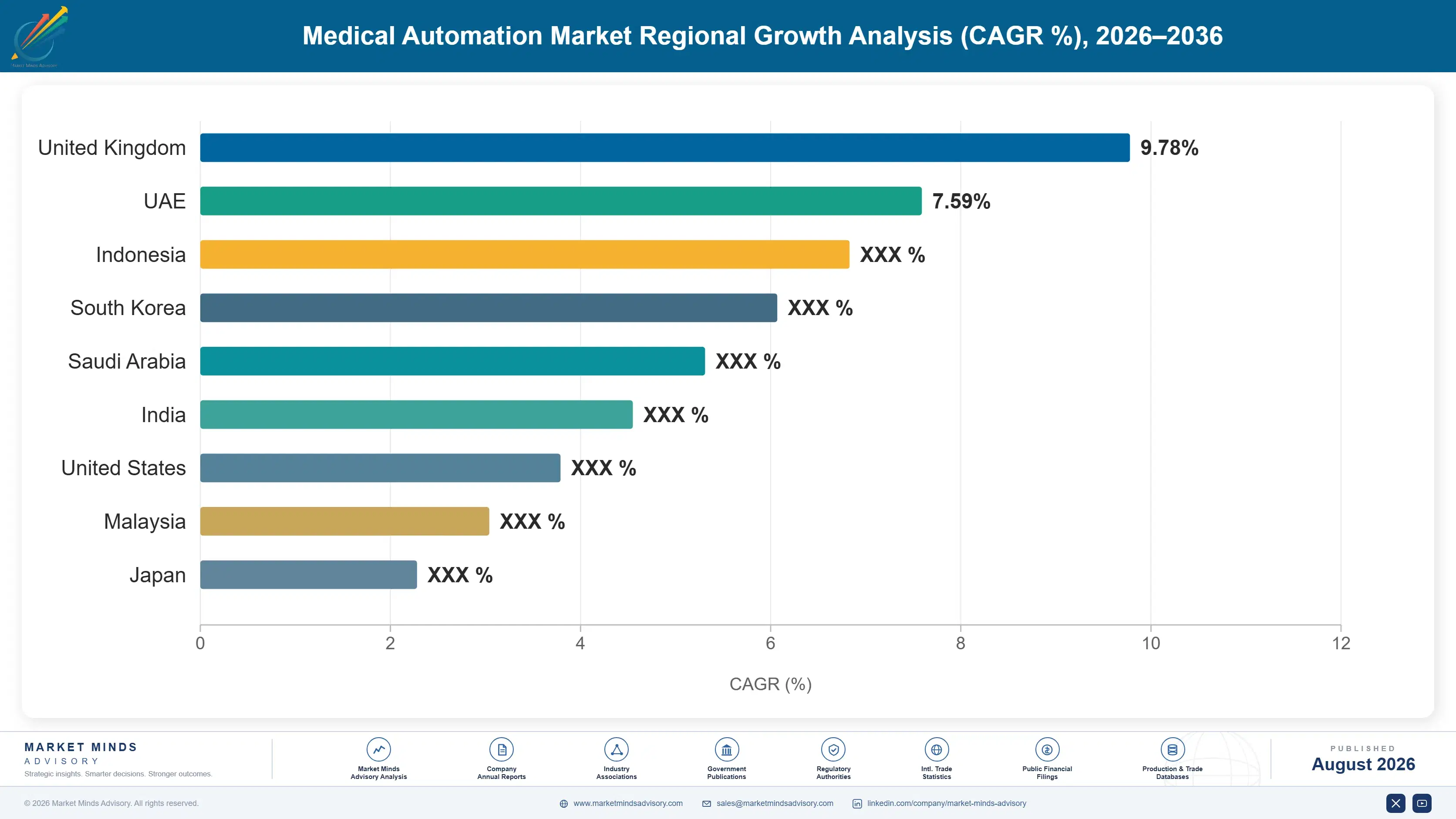
medical-automation-market-country-cagr-analysis-1787305828999

AI Software Attach and Service Expansion

Medical automation vendors are pursuing several distinct paths to grow revenue beyond initial hardware sale as AI software integration and hospital construction partnerships reshape purchasing criteria across the industry. Four levers stand out as commercially significant across the forecast period, spanning AI software licensing, greenfield hospital partnerships, service contract expansion, and equipment financing structures.

AI Diagnostic Software Subscription Licensing Strategy

Vendors are increasingly separating AI diagnostic automation software from underlying hardware sales, offering it instead as an annual subscription layered on top of the automation system purchase price. Early adopter hospital systems report software attach rates approaching 40 percent on new automation platform sales, a figure vendors expect to climb further as more algorithms clear regulatory review and clinical confidence builds. This shift converts a historically one-time hardware transaction into a multi-year recurring revenue relationship, improving vendor gross margin quality meaningfully and giving vendors far greater visibility into customer retention and future upgrade cycles across their installed base.
Market Impact: Software subscription attach rates

Greenfield Hospital Construction Partnership Development Strategy

Vendors establishing partnerships with hospital architecture and construction firms to specify automation systems during initial facility design, rather than competing for retrofit contracts later, are opening a growing volume channel across East Asian and South Asian greenfield hospital projects nationwide and internationally each year. Vendors with established design-stage partnerships report win rates roughly 30 percent higher on new hospital construction bids compared to vendors competing only after facility completion. This approach requires sustained relationship investment with architecture firms, but positions vendors advantageously in markets adding substantial new hospital capacity annually.
Market Impact: Design-stage partnerships show 30 p

Extended Service and Preventive Maintenance Contracts

Extended service agreements bundling preventive maintenance, remote diagnostics, and software updates have become a primary profit pool as hardware pricing faces competitive pressure from lower-cost regional manufacturers across most product tiers and territories. Leading vendors now attach multi-year service contracts to more than 55 percent of new automation system placements, generating margin well above the hardware sale itself over the contract lifetime. Remote monitoring capability lets vendors flag failing components before they cause unplanned downtime, strengthening customer retention at contract renewal across most premium hospital accounts where uptime carries direct clinical and financial consequences.
Market Impact: Service contracts now cover over 55

Equipment Leasing and Subscription Financing Structures

Vendors offering equipment leasing and subscription-based financing structures are opening purchasing decisions to smaller community hospitals that lack capital budget for outright automation system purchase across their entire facilities and clinical departments today. Vendors offering per-transaction subscription pricing report win rates roughly 20 percent higher among smaller facilities compared to standard upfront capital sale terms. This lever matters most in price-sensitive segments including community hospitals and emerging market operators, where operating budget flexibility often exceeds available capital budget by a considerable margin, making financing structure the deciding factor in many purchasing decisions.
Market Impact: Leasing win rates rise 20% among sm

Who Controls the Margin Pool

Medical automation carries a CR5 near forty-four percent, concentrated among five vendors spanning pharmacy dispensing majors and specialty diagnostic robotics suppliers serving hospital systems worldwide. The gap between Omnicell, the largest single vendor, and the next tier of challengers is meaningful, since installed base scale and AI software integration relationships compound advantages considerably.
Current competitive activity plays out across three dimensions: AI diagnostic software capability races among established vendors seeking to defend hospital purchasing relationships, greenfield hospital construction partnerships targeting East Asian and South Asian markets ahead of demand growth, and consolidation among smaller regional automation integrators lacking capital to fund AI software research and development independently. Larger vendors are also pursuing selective acquisitions of diagnostic automation technology specialists.

Emerging pressure comes from specialty robotics firms developing next-generation autonomous logistics and diagnostic platforms that could eventually bypass traditional dispensing cabinet design entirely, and from regional Asian manufacturers expanding export-oriented capacity at costs multinational majors increasingly struggle to match. Rankings could shift meaningfully if AI diagnostic adoption speed diverges significantly between leaders, particularly as hospitals increasingly favor vendors demonstrating the clearest path to workflow efficiency gains across their broader operations.
medical-automation-market-company-positioning-matrix-1787305829523

Competitive Moat and Risk Dimensions

OMNICELL

Moat: Installed Base and Software Depth

Omnicell holds the largest global installed base of pharmacy automation systems among all vendors tracked, generating deep hospital relationships and proprietary usage data that trains its AI diagnostic and dispensing algorithms more effectively than smaller rivals can match. This scale advantage compounds through recurring software licensing revenue, giving Omnicell considerably more predictable cash flow than hardware-dependent vendors.
OMNICELL

Risk: Legacy Hardware Transition Risk

A large share of Omnicell revenue still derives from cart-based dispensing cabinet sales and associated service contracts, exposing the company to margin pressure as AI-native and logistics robotics competitors capture growth at the category edge. Slower internal transition toward subscription software economics could leave revenue mix skewed toward a segment growing well below the category average.
SWISSLOG HEALTHCARE

Moat: Hospital Logistics Robotics Leadership

Swisslog Healthcare holds the strongest global position in hospital logistics and automated guided vehicle systems among all vendors tracked, a category benefiting disproportionately from new hospital construction bundling automation from initial design. This leadership position gives Swisslog considerable advantage as logistics automation growth outpaces the broader dispensing cabinet category across most greenfield hospital markets.
SWISSLOG HEALTHCARE

Risk: Narrower Diagnostic Software Portfolio

Swisslog maintains a comparatively smaller AI diagnostic automation software position relative to pharmacy dispensing majors, limiting its ability to capture recurring software licensing revenue tied to the larger diagnostic workflow automation category. Closing this gap would require substantial investment in software development capability that Swisslog has historically prioritized less than hardware robotics engineering.

Players Tracked

Prominent Players

Omnicell
Swisslog Healthcare
ARxIUM
Becton Dickinson
Siemens Healthineers

Other Key Players

Capsa Healthcare
Talyst
McKesson
Kirby Lester
Parata Systems
Aethon Inc
Vecna Robotics
Diligent Robotics
Beckman Coulter
Roche Diagnostics
Tecan Group
Hamilton Company
PerkinElmer
Yaskawa Electric
KUKA Robotics

Recent Developments

MAY 2025

Omnicell Launches AI-Powered Medication Dispensing Analytics Platform

Omnicell launched a new AI-powered analytics platform that predicts medication dispensing patterns and flags potential errors before they occur, integrating directly with existing automated dispensing cabinet installations. The platform reduces manual review time for pharmacy staff considerably, addressing chronic pharmacy technician staffing pressure across accredited hospital networks.
Signal: Signals accelerating vendor investment in
OCTOBER 2024

Swisslog Healthcare Signs Multi-Facility Supply Agreement With Hospital Group

Swisslog Healthcare signed a multi-facility supply agreement with a large regional hospital group to deploy automated guided vehicle logistics systems across eighteen facilities, replacing manual transport staff with autonomous delivery infrastructure. The agreement includes phased rollout through 2027 and ongoing software and maintenance service contracts across all participating facilities.
Signal: Signals growing hospital preference for st
JANUARY 2025

ARxIUM Acquires Laboratory Specimen Handling Automation Startup

ARxIUM completed the acquisition of a laboratory specimen handling automation startup specializing in AI-assisted sample sorting and classification technology, strengthening its diagnostic workflow automation portfolio meaningfully and considerably. The acquisition accelerates ARxIUM internal AI software roadmap, reducing dependence on third-party diagnostic automation software licensing partnerships.
Signal: Signals continued industry consolidation a

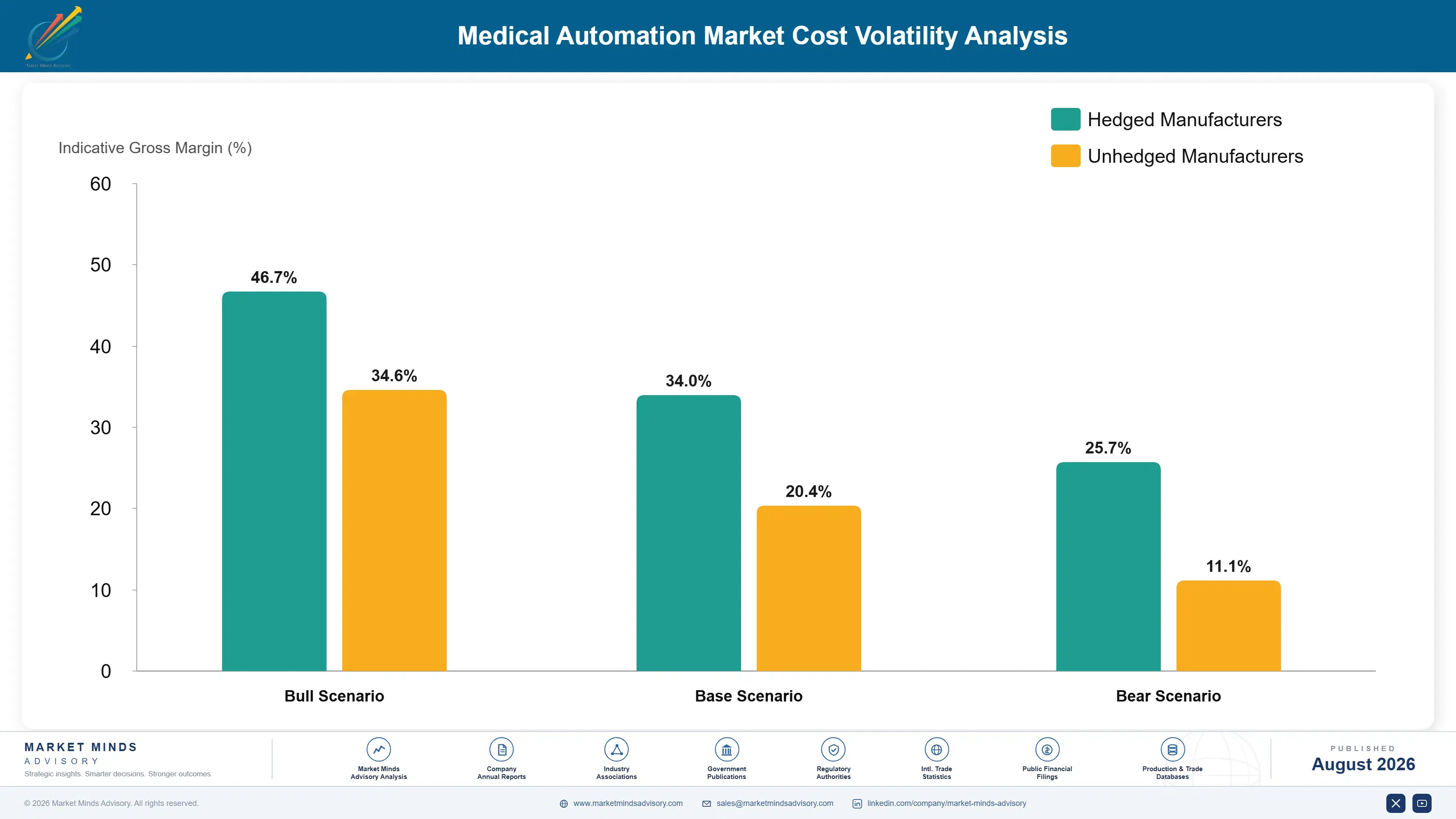
Robotics Components and AI Compute Cost

Precision robotics components, semiconductor processors for AI inference, and specialty sensor systems together represent roughly fifty to fifty-five percent of medical automation system cost of goods sold overall today. These components are sourced from a moderately concentrated global supplier base spanning precision robotics manufacturers, semiconductor producers, and specialty sensor companies across multiple regions and jurisdictions.
Semiconductor supply tightness during 2021 and 2022 pushed lead times for AI inference processors and specialty sensor components out considerably for several automation vendors, delaying new product launches and forcing some manufacturers to redesign systems around substitute components mid-cycle. Several vendors disclosed in annual reports that component costs added meaningful pressure to hardware gross margin through the period before easing gradually into 2023 and 2024 as supply chains normalized.

Cost exposure varies meaningfully by player type. Vertically integrated vendors with in-house robotics manufacturing absorb component volatility more easily than smaller specialty vendors that purchase precision components from third-party suppliers on shorter-term contracts. Geographic exposure also differs: vendors sourcing semiconductors and sensors primarily from East Asian supply chains face greater currency and logistics cost variability than those with more diversified, multi-region component sourcing arrangements.
medical-automation-market-cost-volatility-analysis-1787305829718

Dual-Source Component Qualification Program

Vendors are qualifying second suppliers for precision robotics components and AI inference processors to reduce dependence on any single manufacturer during periods of supply tightness. This lengthens initial qualification cycles but meaningfully reduces exposure to regional supply disruption, giving procurement teams greater negotiating leverage on pricing during periods of component tightness and allocation constraints across markets.

Vertical Integration Into Robotics Manufacturing

Several major vendors have expanded in-house robotics manufacturing capacity to capture margin previously paid to third-party component suppliers and to gain tighter control over component quality and delivery timing across product lines and facilities. This shift requires substantial upfront capital investment but pays back through reduced volatility exposure over multi-year hardware product cycles ahead.

Software Revenue Mix Shift Reduces Hardware Dependence

Vendors are deliberately growing the software licensing share of total revenue, which carries minimal exposure to component cost volatility compared to hardware manufacturing and assembly operations. This mix shift cushions overall margin during hardware cost spikes and gives finance teams a more predictable, higher-margin revenue base to plan against confidently over the long term.

Portfolio Architecture for Margin Defence

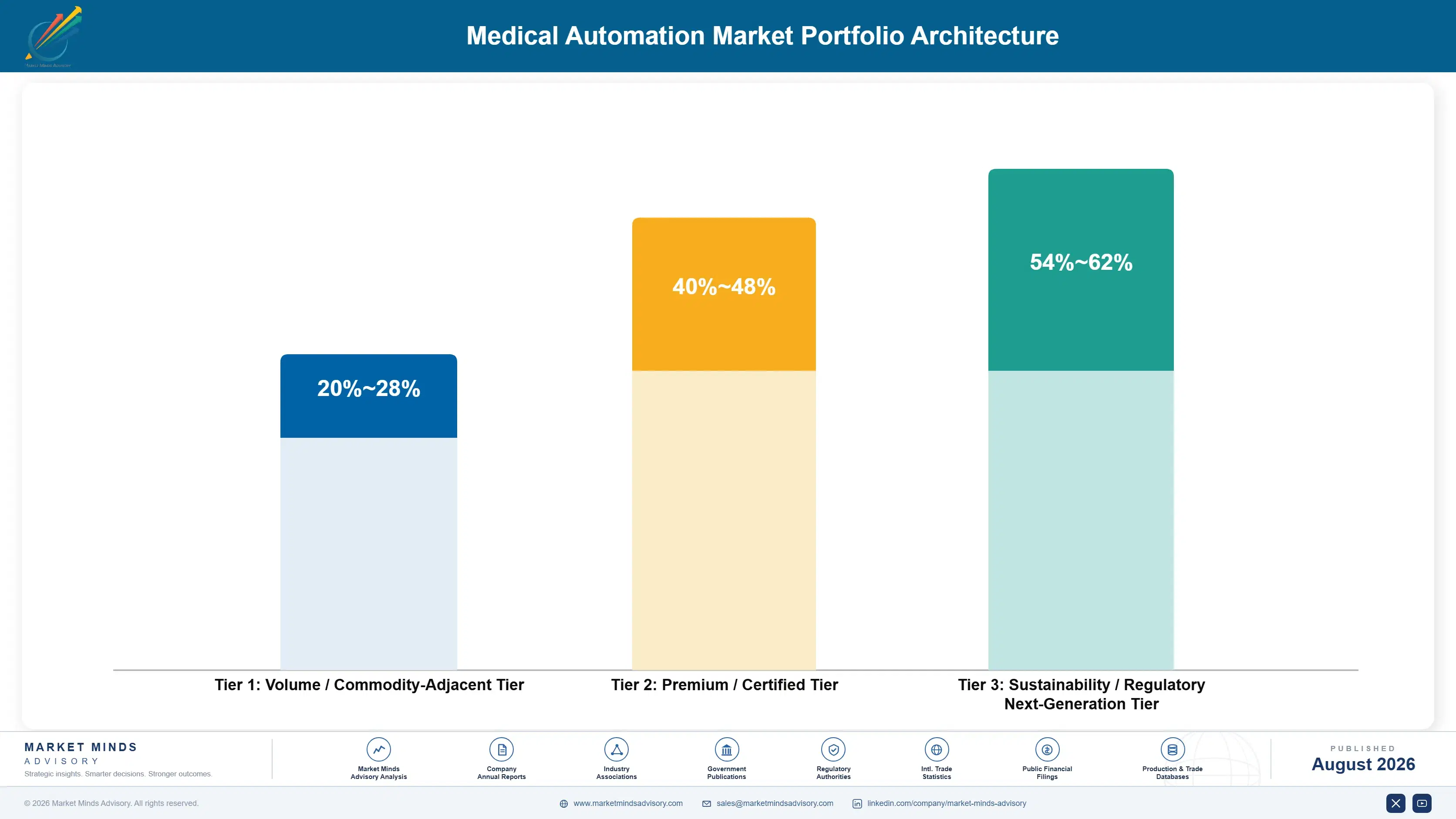
Medical automation portfolios span three margin tiers running from commodity-adjacent basic dispensing cabinets through certified AI-enabled diagnostic and logistics platforms to sustainability-linked next-generation autonomous hospital systems built for advanced clinical workflows. Gross margin widens considerably moving up the tier structure, driven primarily by software integration depth and service contract penetration rather than mechanical hardware differences alone across most vendor prod
Volume tier competition centers on price and basic dispensing reliability for cost-constrained smaller hospitals, where mechanical throughput and consumables compatibility determine competitiveness more than AI software sophistication or diagnostic integration depth. Premium tier competition instead centers on AI diagnostic capability, autonomous logistics integration, and service reliability, an entirely different buying calculus that rewards vendors with dedicated software development capability built over many years.

High-value margin pools concentrate overwhelmingly in the premium and next-generation tiers, where AI software subscription and service contracts generate recurring revenue well above any one-time hardware transaction alone across the full deployment lifecycle. Vendors increasingly steer product development and sales incentive structures toward this upper tier as volume-tier hardware margin continues compressing under sustained price competition from lower-cost regional manufacturers entering entry-level segments.

Volume / Commodity-Adjacent Tier

Entry-level dispensing cabinets and basic mechanical automation targeting price-sensitive community hospitals and smaller diagnostic centers where core reliability matters more than advanced AI features or premium software integration capability across most facility types.
Gross Margin: 20%-28%

Premium / Certified Tier

AI-enabled diagnostic and logistics automation platforms with documented workflow efficiency evidence, typically sold with service contracts to established hospital systems and reference laboratory networks seeking proven performance and consistent reliability.
Gross Margin: 40%-48%

Sustainability / Regulatory / Next-Generation Tier

Fully autonomous hospital systems bundling advanced AI diagnostics, real-time logistics tracking, and predictive maintenance connectivity, targeting leading academic medical centers piloting next-generation workflow automation ahead of the broader industry-wide adoption curve.
Gross Margin: 54%-62%
medical-automation-market-portfolio-architecture-1787305830217

High-value Sub-segments and Strategic Watch-out

AI-Assisted Diagnostic Automation Software

AI-assisted diagnostic automation software is the fastest-growing, highest-margin pool as hospitals face intensifying staffing pressure to demonstrate documented workflow efficiency. Vendors with deeper algorithm accuracy and regulatory clearance breadth capture disproportionate share as purchasing committees weigh software capability alongside core mechanical reliability in every hospital evaluation.
Gross Margin: 50%-58%

Extended Service and Remote Monitoring Contracts

Multi-year service agreements bundling preventive maintenance, remote diagnostics, and software updates generate steady high-margin recurring revenue tied closely to the existing installed base. Growth here tracks hardware placement volume with a lag, offering vendors predictable cash flow even as new unit hardware pricing compresses under competition.
Gross Margin: 46%-54%

Basic Dispensing Cabinet Infrastructure

The largest volume category by unit count, basic dispensing cabinets remain the backbone of hospital pharmacy automation worldwide. Margins are thinner and growth slower than premium categories, but installed base scale sustains steady replacement demand and anchors long-term service contract revenue streams across most established hospital accounts globally.
Gross Margin: 18%-26%

Regional Manufacturer Price Competition Risk

Rapidly improving regional Asian manufacturers moving upmarket from entry-level hardware into AI-enabled mid-tier automation systems at meaningfully lower price points bears close watching across territories, since it threatens to compress mid-tier margin for multinational vendors faster than software differentiation alone can offset within established key accounts.
Gross Margin: 14%-24%

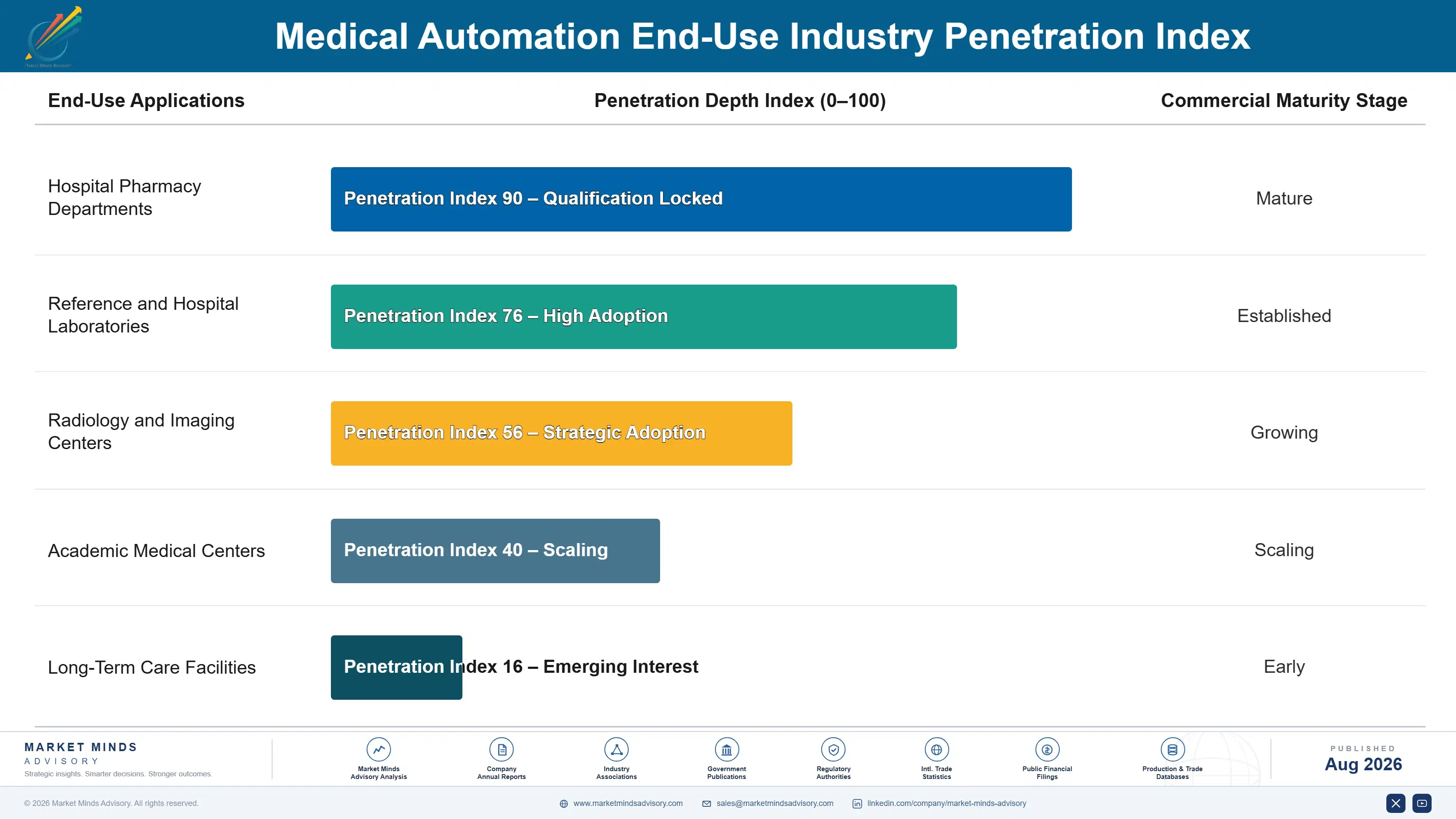
Recurring Revenue and Adoption Depth

Medical automation demand is transitioning from a pure capital equipment sale into an annuity-style relationship anchored by AI software subscription and multi-year service contracts spanning the full system lifecycle. Vendors increasingly value customer lifetime revenue over initial hardware transaction size, restructuring sales compensation and product roadmaps to prioritize retention and recurring software attach rate over unit volume alone across most major hospital accounts.
Adoption depth varies sharply by end-use vertical. Reference laboratories and academic medical centers show the deepest, most sustained engagement, layering AI diagnostic software across nearly their entire automated workflow given the highest specimen and image throughput. Smaller community hospitals adopt more gradually, with software attach still catching up as budgets prioritize highest-volume departments first before expanding coverage across lower-acuity floors and departments.

A generational shift in buyer profile is underway as younger hospital operations leaders trained on data-driven workflow optimization reach purchasing influence roles within hospital administration and clinical operations departments. This cohort expects AI-assisted automation as a baseline feature rather than a premium add-on, reshaping procurement criteria toward software capability and away from pure mechanical throughput specifications that dominated purchasing decisions a decade ago.
medical-automation-market-end-use-penetration-index-1787305830706

Where Medical Automation Value Concentrates

These are among the four positions where our research anticipates prominent divergence between winners and laggards over the coming forecast period. Each is grounded in the demand model, the regulatory perimeter, and the announced capacity pipeline.
01 / AI SOFTWARE INVESTMENT

Prioritize AI Diagnostic Capability Over Pure Hardware Throughput

Vendors that treat AI diagnostic automation software as a core product rather than a bolt-on feature are capturing disproportionate share of new hospital purchasing decisions across most developed and emerging healthcare markets today and going forward into the coming years. Purchasing committees now weigh algorithm accuracy and regulatory clearance breadth alongside traditional mechanical throughput, a shift that rewards sustained software investment over incremental hardware refinement. Vendors slow to build genuine software depth risk losing premium-tier positioning within three to five years as this becomes the clear default.
02 / GREENFIELD HOSPITAL PARTNERSHIPS

Build Architecture Firm Relationships Ahead of Construction Booms

East Asian and South Asian markets are adding new hospital capacity faster than most vendors currently have design-stage partnership relationships to capture profitably at meaningful scale across most affected regions, provinces, and rapidly growing metropolitan hospital networks today. Establishing architecture and construction firm partnerships ahead of project bidding requires patient multi-year relationship investment with limited near-term payback for most vendors entering these markets. Vendors that build this presence early are positioned to capture disproportionate share as regional hospital construction continues accelerating steadily.
03 / SERVICE CONTRACT RETENTION

Defend Installed Base Through Extended Service Agreement Renewal

Service contract retention has become as commercially important as new hardware placement, since renewal rates directly determine long-term revenue predictability across the entire installed base of dispensing and diagnostic automation systems tracked across most hospital account tiers and geographies worldwide. Vendors offering remote monitoring and preventive diagnostics report meaningfully higher renewal rates than those selling maintenance as a standalone add-on service. Losing a service contract at renewal often signals a customer preparing to switch vendors entirely at the next full replacement cycle.
04 / REGIONAL COMPETITOR RESPONSE

Prepare Mid-Tier Pricing Strategy for Regional Manufacturer Advance

Regional Asian manufacturers are moving upmarket from entry-level hardware into AI-enabled mid-tier systems at price points multinational vendors currently cannot match without meaningful margin sacrifice across most affected product lines and geographic markets worldwide. This pressure will intensify steadily through the forecast period as these manufacturers gain regulatory clearance in additional export markets beyond their home regions. Multinational vendors need a deliberate mid-tier pricing and feature response before this dynamic compresses margin faster than premium-tier software revenue can offset it.

Engagement Snapshot From the Field

A live engagement with an industry participant carrying material or product regulatory and market exposure ahead of a defining policy shift, showing how our research translates into a defensible multi-year portfolio strategy.
MARKET MINDS ADVISORY · CLIENT ENGAGEMENT SUMMARY
Medical Automation Producer Strategic Portfolio Review and Transition Roadmap 2026·Investment Scenario on Medical Automation Exposure Evaluation 2025-26
CLIENT PROFILE
The client is a regional hospital network operating nine acute care facilities across the southeastern United States, facing chronic pharmacy and laboratory staffing shortages that had begun affecting patient wait times and medication turnaround. The network relied on a fragmented mix of legacy dispensing cabinets purchased across multiple procurement cycles spanning nearly fifteen years, with minimal AI software integration across facilities.
STRATEGIC CHALLENGE
Leadership needed to evaluate whether standardizing on an AI-enabled automation platform across all nine facilities could meaningfully reduce medication turnaround time and staffing burden without disrupting existing pharmacy workflows that took years to establish. The network also needed to justify the capital investment against uncertain near-term reimbursement pressure affecting overall hospital operating margin.
MMA APPROACH
MMA conducted an independent vendor capability assessment across four automation platforms, benchmarking AI software integration compatibility, staffing efficiency evidence from comparable hospital networks, and total cost of ownership over a seven-year hold period. The engagement combined primary interviews with pharmacy and nursing leadership at three pilot facilities, competitive benchmarking against peer hospital networks, and phased capital deployment planning sequencing replacement by facility urgency.
KEY FINDINGS
  1. Two of four candidate platforms offered AI software integration compatible with the network existing enterprise pharmacy system without requiring costly custom middleware development.
  2. Pilot deployment at three facilities reduced medication turnaround time by an estimated thirty-two percent within five months (client-reported, unverified by MMA), based on internal pharmacy tracking data.
  3. Total cost of ownership over seven years favored the selected vendor by an estimated nine percent versus the next closest competitor, driven primarily by service contract pricing structure.
  4. Pharmacy technician overtime hours declined meaningfully at pilot facilities following deployment, freeing capacity for higher-value clinical verification tasks previously delayed by manual dispensing workload.
CLIENT PROFILE
The client is a regional hospital network operating nine acute care facilities across the southeastern United States, facing chronic pharmacy and laboratory staffing shortages that had begun affecting patient wait times and medication turnaround. The network relied on a fragmented mix of legacy dispensing cabinets purchased across multiple procurement cycles spanning nearly fifteen years, with minimal AI software integration across facilities.
STRATEGIC CHALLENGE
Leadership needed to evaluate whether standardizing on an AI-enabled automation platform across all nine facilities could meaningfully reduce medication turnaround time and staffing burden without disrupting existing pharmacy workflows that took years to establish. The network also needed to justify the capital investment against uncertain near-term reimbursement pressure affecting overall hospital operating margin.
MMA APPROACH
MMA conducted an independent vendor capability assessment across four automation platforms, benchmarking AI software integration compatibility, staffing efficiency evidence from comparable hospital networks, and total cost of ownership over a seven-year hold period. The engagement combined primary interviews with pharmacy and nursing leadership at three pilot facilities, competitive benchmarking against peer hospital networks, and phased capital deployment planning sequencing replacement by facility urgency.
KEY FINDINGS
  1. Two of four candidate platforms offered AI software integration compatible with the network existing enterprise pharmacy system without requiring costly custom middleware development.
  2. Pilot deployment at three facilities reduced medication turnaround time by an estimated thirty-two percent within five months (client-reported, unverified by MMA), based on internal pharmacy tracking data.
  3. Total cost of ownership over seven years favored the selected vendor by an estimated nine percent versus the next closest competitor, driven primarily by service contract pricing structure.
  4. Pharmacy technician overtime hours declined meaningfully at pilot facilities following deployment, freeing capacity for higher-value clinical verification tasks previously delayed by manual dispensing workload.
RECOMMENDED STRATEGY
Phase 1: Phase 1 (Months 1 to 3): Complete vendor capability assessment and integration compatibility testing across all four candidate automation platforms and facilities. Phase 2: Phase 2 (Months 4 to 8): Deploy the selected platform at three pilot facilities, tracking medication turnaround time and staffing burden closely. Phase 3: Phase 3 (Months 9 to 16): Roll out validated platform across remaining six facilities, sequencing deployment by facility staffing pressure and patient volume.
OUTCOME
Within sixteen months, the hospital network completed automation standardization across all nine facilities, reduced medication turnaround time meaningfully network-wide, and reported improved pharmacy staff retention in previously understaffed departments (client-reported, unverified by MMA). The network has since extended the framework to laboratory specimen handling automation.

Frequently Asked Questions

Foundational context covering the market sizes, CAGR, scope, country, region and competition that inform every finding below. This section is provided to cover basics and most often pre-purchase conversations, answered from the MMA Primary Research Dataset.

What is the current size of the Medical Automation Market?

The global medical automation market was valued at 14.5 billion dollars in 2025. This figure covers robotic pharmacy dispensing, laboratory automation, and AI-assisted diagnostic automation software worldwide.

How large will the Medical Automation Market be by 2036?

MMA forecasts the market will reach 40.55 billion dollars by 2036, nearly tripling in value. This growth is driven primarily by clinical staffing shortages and AI diagnostic adoption.

What is the CAGR for the Medical Automation Market 2026 to 2036?

The base case CAGR is 9.8 percent annually across the forecast period. Bull and bear scenarios range from 11.1 percent to 8.5 percent depending on hospital capital budget conditions.

Which segment is growing fastest?

AI-assisted diagnostic automation software is the fastest-growing segment, expanding at approximately 15.5 percent annually. This is roughly 1.6 times the overall market growth rate, driven by staffing pressure.

Who are the major companies in the Medical Automation Market?

Leading companies include Omnicell, Swisslog Healthcare, ARxIUM, Becton Dickinson, and Siemens Healthineers. These five vendors hold a combined CR5 near forty-four percent of the global market.

Which country is growing fastest?

China is the fastest-growing national market, expanding at approximately 11.0 percent annually. This reflects unprecedented new hospital construction volume and rapid automation infrastructure adoption nationwide.

Report Segmentation Architecture

The full report scope spans multiple orthogonal segmentation dimensions, with cross-tabulated demand data provided for each dimension pair. Coverage extends further to regional breakdowns, trend trajectories, and the competitive detail needed to support segment-level decision-making.

By Product and Technology Type

  • AI-Assisted Diagnostic Automation Software
  • Hospital Logistics and Automated Guided Vehicles
  • Robotic Pharmacy Dispensing Systems
  • Automated Laboratory Specimen Handling Systems
  • Automated Medication Dispensing Cabinets
  • Automated Blood and Fluid Management Systems

By End-Use Industry

  • Hospital Pharmacy Departments
  • Reference and Hospital Laboratories
  • Radiology and Imaging Centers
  • Academic Medical Centers
  • Long-Term Care Facilities

By Commercial Dimension

  • Direct Hospital Procurement
  • Group Purchasing Organization Contracts
  • Equipment Leasing and Subscription Models
  • Distributor and Channel Sales

By Region

  • North America
  • Western Europe
  • East Asia
  • South Asia and Pacific
  • Latin America
  • Middle East and Africa
  • Eastern Europe

Scope, Methodology, and Coverage

Every figure in this report is reproducible from documented input assumptions. The scope below maps the historical period, the forecast horizon, the segmentation dimensions, and the countries covered, alongside the underlying primary and qualitative methodology.
Historical Period
2020 to 2025
Forecast Period
2026 to 2036
Base Year
2025 (USD billions; MMA Primary Research Dataset, August 2026)
Market Definition
The medical automation market covers robotic pharmacy dispensing, automated laboratory specimen handling, AI-assisted diagnostic automation software, and hospital logistics automation systems used across clinical and pharmacy operations. Surgical robotics and unrelated administrative software platforms are excluded from scope.
Quantitative Units
USD billions (current prices); installed unit volume where applicable
Segmentation Dimensions
By Product and Technology Type; By End-Use Industry; By Commercial Dimension; By Region
Regions Covered
North America, Western Europe, East Asia, South Asia and Pacific, Latin America, Middle East and Africa, Eastern Europe
Countries Covered
USA, China, Germany, France, UK, Japan, South Korea, India, Australia, Canada, Brazil, Mexico, Indonesia, Vietnam, Thailand, Malaysia, UAE, Saudi Arabia, South Africa, Nigeria, Turkey, Poland, Netherlands, Italy, Spain, Sweden, Switzerland, Argentina, Colombia, Singapore, and additional markets relevant to this sector
Key Companies Profiled
Omnicell, Swisslog Healthcare, ARxIUM, Becton Dickinson, Siemens Healthineers, Capsa Healthcare, Talyst, McKesson, Kirby Lester, Parata Systems, Aethon Inc, Vecna Robotics, Diligent Robotics, Beckman Coulter, Roche Diagnostics, Tecan Group, Hamilton Company, PerkinElmer, Yaskawa Electric, KUKA Robotics
Quantitative Methodology
Primary survey, n=3,800 respondents, Q4 2025, six countries; demand-side model with trade association cross-validation
Qualitative Methodology
47 expert interviews, Q4 2025; applied to validate demand model assumptions, identify emerging dynamics, and assess competitive positioning
Report Format
PDF and XLSX data workbook (Word format preview document)
Publisher
Market Minds Advisory
Report Code
MMA-2026-MED-529
Published
August 2026
Contact
sales@marketmindsadvisory.com | www.marketmindsadvisory.com

Purchase the full Medical Automation Market Report (2026 to 2036).

The full report delivers detailed segment-level revenue forecasts across all six product categories through 2036. It includes country-level breakdowns for the fourteen markets carrying the deepest primary research coverage, alongside a complete competitive benchmarking module covering all twenty profiled companies. Proprietary MMA survey data drawn from 3,800 respondents across six countries supports the demand analysis, complemented by expert interview findings from 47 industry specialists gathered during the fourth quarter of 2025. Buyers also receive editable data tables and a quarterly market monitor update subscription for twelve months following purchase.
Segment-level revenue forecasts across six product categories
Country-level breakdowns for fourteen deeply researched markets
Competitive benchmarking module covering twenty profiled companies
Proprietary survey data from 3,800 respondents worldwide
Expert interview findings from 47 industry specialists
Twelve months of quarterly market monitor updates

Built For The People Who Decide

From boardroom strategy to bench-side execution, this report is read cover-to-cover by leaders shaping the next decade of their industry, turning demand scenarios, market dynamics and valuation benchmarks into decisions.
CXOs/ Presidents/ VPs/ Managers
M&A and Corporate Development
Strategy Teams and R&D Heads
Procurement and Product Directors
Regulatory and Compliance Leaders
Investor Relations and Equity Analysts