Market Minds Advisory
Meat Shrink Bag Market

Meat Shrink Bag Market: Bone Puncture, Purge Control and the Bag That Decides Whether a Primal Travels

A shrink bag holding a beef primal survives a rib bone pressing into it for six weeks in a chilled container, and one puncture in ten thousand is a rejected shipment.

Lead Analyst

Bilal Shaikh

Published

September 2026

Make Smarter Decisions with Customized Research Insights

Request a free sample report and evaluate market opportunities, growth trends, and competitive dynamics relevant to your business needs.

2025 MARKET VALUE$3.4BMarket Size 2025
2036 FORECAST VALUE$6.3BBase Case , 2026 to 2036
CAGR 2026 TO 20365.8 %Bull 7.0% / Bear 4.6%
INCREMENTAL OPPORTUNITY$2.7BNet 10- year value creation
EXPANSION MULTIPLE1.76x2036 value over 2026 base
Strategic Levers
M&A Pipeline
Regional Outlook
Country Rankings
Competitive Intelligence
Segmental Deep-dive
Call-Us : 91 93563 13602

Executive Snapshot and Market Trajectory

A shrink bag is the only thing between a beef primal and forty days of chilled transit. It must shrink tight enough to eliminate purge, hold oxygen out, and survive a cut rib bone pressing into it throughout. Failure at any point in that sequence costs a whole container.
High-abuse bone-in bags compound at 8.7%, exactly 1.50 times the market, as bone-in primal export volumes grow and buyers stop accepting the puncture rates they once tolerated. Latin America holds 20% of demand, well above the standard band, because Brazilian and Argentine beef export packing is where these bags are actually consumed. Bags are consumed where primals are cut, rather than where the meat is eventually eaten.
Concentration is high at 61%. Irradiated multilayer coextrusion is difficult, and a failure costs a container rather than a pack. Resin runs near 63% of producer cost, and barrier grades move on their own supply dynamics. Processors refuse unvalidated substitution on export product, so a shortage becomes lost volume rather than a cost increase. Nobody accepts unvalidated film on export product, so producers who validated a second grade early keep supplying while others stop.
Market Definition
The market covers heat-shrinkable barrier bags used for primal, subprimal and whole-muscle meat packing, spanning standard barrier shrink bags, high-abuse bone-in shrink bags, vacuum shrink bags for case-ready cuts, poultry and small bird shrink bags, printed retail-ready shrink bags, and cook-in shrink bags for processed meat. Thermoformed vacuum pouches, non-shrink vacuum bags, lidding films, and casings for ground and formed products are excluded.
Base Year Value
$3.4B in 2025 (MMA Primary Research Dataset, August 2026)
Forecast Period
2026 to 2036, eleven discrete annual values
CAGR
5.8% base case. Bull 7.0%. Bear 4.6%.
Fastest Growth Segment
High-Abuse Bone-In Shrink Bags: 8.7% CAGR
Fastest Growth Country
India: 8.4% CAGR
Fastest Growth Region
South Asia and Pacific: 7.9% CAGR
Largest Region
North America: 24% of 2025 global value
Market Leaders
Sealed Air, Amcor, Winpak, Flexopack, Vidhi Laminates. Source: MMA Analysis based on company annual reports.
Primary Survey
n=3,800 procurement and R&D decision-makers, Q4 2025, six countries
Methodology
Demand-side build-up, cross-validated against public data, 47 expert interviews

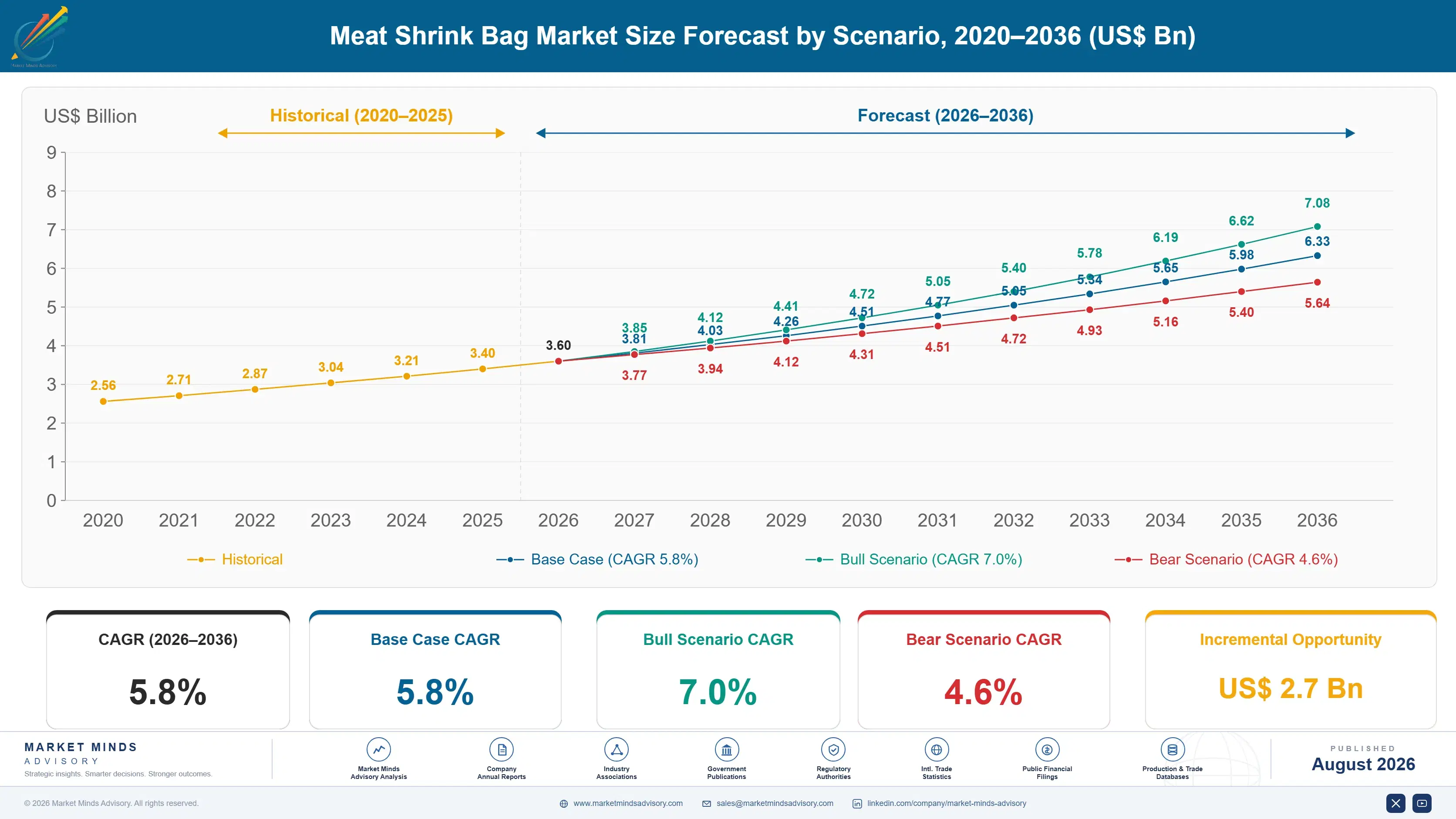
Meat Shrink Bag Market Forecast Scenarios

meat-shrink-bag-market-size-forecast-scenario-1787308570931
Growth ran at an implied 4.7% across 2020 to 2025, and export demand rather than domestic consumption drove it. Chinese beef and pork imports rose sharply, South American export capacity expanded to meet it, and processing plants that had packed for domestic retail rebuilt around primal export requirements that are considerably more demanding on the bag.
The base case at 5.8% rests on three mechanisms. Global protein trade keeps growing as consumption rises faster than domestic production in importing markets. Bone-in primal export keeps expanding as buyers seek carcass utilisation rather than boneless cuts alone. And case-ready conversion continues in developed retail, which adds vacuum shrink volume alongside the export bags. High-abuse constructions compound at 8.7% against a market at 5.8%, and case-ready vacuum shrink takes a further share as grocery retail keeps moving protein out of in-store butchery.
The bull case at 7.0% assumes Asian import demand recovers strongly and bone-in export penetration rises faster as abuse resistance improves. The bear case at 4.6% follows from protein trade disruption through disease outbreaks or tariff action, which has interrupted this market repeatedly, alongside plant-based substitution slowly reducing volume growth in developed retail markets. Neither scenario is unusual for this category.

Forty Days in a Chilled Container

The requirement here is unusually absolute. A beef primal leaving a South American plant for an Asian port spends around 42 days in a chilled container, and the bag has to hold vacuum for every one of them. Lose the seal and the meat spoils, the container is rejected on arrival, and the cost lands on somebody who priced the bag at a few cents.
TOP FIVE CONCENTRATION61%Combined share held by the five largest bag producers globally
CHILLED TRANSIT DURATION42 daysTypical sea freight period the bag must survive intact
ACCEPTABLE LEAKER RATE0.8 per thousandPuncture and seal failure tolerance buyers now enforce contractually
RESIN COST SHARE63% of COGSPolymer and barrier resin as a proportion of producer cost
SHRINK RATIO38% biaxialDimensional reduction achieved during the hot water shrink step
PURGE LOSS REDUCTION2.1 percentage pointsWeight retention gained against loose vacuum packing methods
What makes it hard is bone. A cut rib or chine bone presses against the film with the whole weight of the primal behind it, through vibration and temperature change, for weeks. Standard barrier film punctures. High-abuse constructions add layers and toughness specifically to survive that, and they compound at 8.7% because export buyers now write leaker rates into contracts rather than accepting whatever arrives.
The shrink step is what distinguishes these bags from ordinary vacuum packaging. Biaxial shrink around 38% pulls the film tight against irregular muscle geometry, which eliminates the pockets where purge collects and where bacteria grow. That weight retention alone, about 2.1 percentage points against loose vacuum packing, pays for the bag several times over on a container of primals.
"Processors will argue for a week about half a cent on the bag and then lose a forty tonne container to three leakers. The bag is the cheapest insurance in the whole export chain and it gets bought like a commodity."
Principal, Protein Packaging and Barrier Films Practice · MMA Flexible Packaging

Market Trends

Bone-In Primal Export Demands Higher Abuse Resistance

Importers increasingly buy bone-in primals rather than boneless cuts, because carcass utilisation is better and because certain cuts command premiums only with the bone attached. That transfers the puncture problem directly onto the bag: a cut rib bone under primal weight will defeat standard barrier film across 42 days of transit. High-abuse constructions compound at 8.7% against a market at 5.8% on exactly this shift, and the buyers driving it now write leaker tolerances near 0.8 per thousand into their purchase contracts. Processors resist the premium until they lose a container.
Market Impact: Transit demanding 42 days integrity
Purge Control Becomes a Yield Argument Not a Quality One

Purge is lost weight, and on a container of primals the arithmetic is substantial. Biaxial shrink around 38% pulls film tight against irregular muscle surfaces and removes the voids where liquid collects, retaining roughly 2.1 percentage points more weight than loose vacuum packing achieves. Processors who calculate that against bag cost stop comparing suppliers on price per bag, since the yield difference exceeds the entire bag spend. Very few of them have run the calculation, which is the commercial opportunity sitting in plain view. It sits in yield accounting rather than in packaging cost.
Market Impact: Rejection costing 40 tonne loads

Market Opportunities and Growth Drivers

Protein Trade Growth Outpaces Domestic Production Gains

Consumption in importing markets keeps rising faster than domestic livestock production can supply, which pushes primal volumes into international trade and onto ships. Chinese, Japanese, Korean and Middle Eastern import demand is the pull, and South American, North American and Australian export capacity is the push. Every tonne moving that way needs a barrier shrink bag capable of 42 days chilled, which is a requirement domestic retail packing never imposed on the same producers. Bone-in share within those flows keeps rising, which makes the requirement harder rather than merely larger.
Market Impact: Routes closing within 5 days

Container Rejection Cost Overwhelms Any Bag Saving

A rejected export container of primals costs a processor the product, the freight, the destination handling and frequently the customer relationship. Against that, the difference between a standard bag and a high-abuse construction is trivial per unit. Buyers have started enforcing the arithmetic by writing leaker tolerances into contracts, which removes the processor's option to gamble on cheaper film. Producers who quantify rejection exposure per container rather than quoting per thousand bags change the purchase decision entirely. Contractual tolerances near 0.8 per thousand have made that explicit. Nobody gambles twice.
Market Impact: Resin at 63% of COGS

Market Restraints and Challenges

Disease Outbreaks and Tariffs Interrupt Trade Abruptly

African swine fever, avian influenza and foot and mouth disease have each closed major export routes with days of notice, and tariff action has done the same for political reasons. The root cause is that this market rides on trade flows rather than on consumption, and trade flows are politically and biologically fragile. Producers mitigate by serving multiple export corridors rather than concentrating on one, and by holding domestic case-ready volume that continues when export stops abruptly. Case-ready volume growing at 7.3% is the most useful ballast available. It runs on entirely different demand drivers.
Market Impact: Leaker tolerance near 0.8 thousand

Resin and Barrier Polymer Volatility Compresses Producer Margin

Polymer and barrier resin account for roughly 63% of producer cost of goods, and barrier grades move independently of commodity polyethylene on their own supply dynamics. The root cause is that annual processor contracts meet monthly resin movement. Producers mitigate with index-linked pricing on quarterly resets, by qualifying alternate barrier resin grades during initial validation rather than after a shortage, and by holding structures that tolerate grade substitution without full requalification. Separate indexation for the barrier component matters, since a contract tied to general resin references misses most of the exposure that actually moves.
Market Impact: Weight retention improved 2.1 point
4 additional market trends, 3 additional growth drivers, and 2 additional restraints and challenges are covered in the full report. Contact sales@marketmindsadvisory.com to access the complete intelligence.

Segment CAGR and Growth Architecture

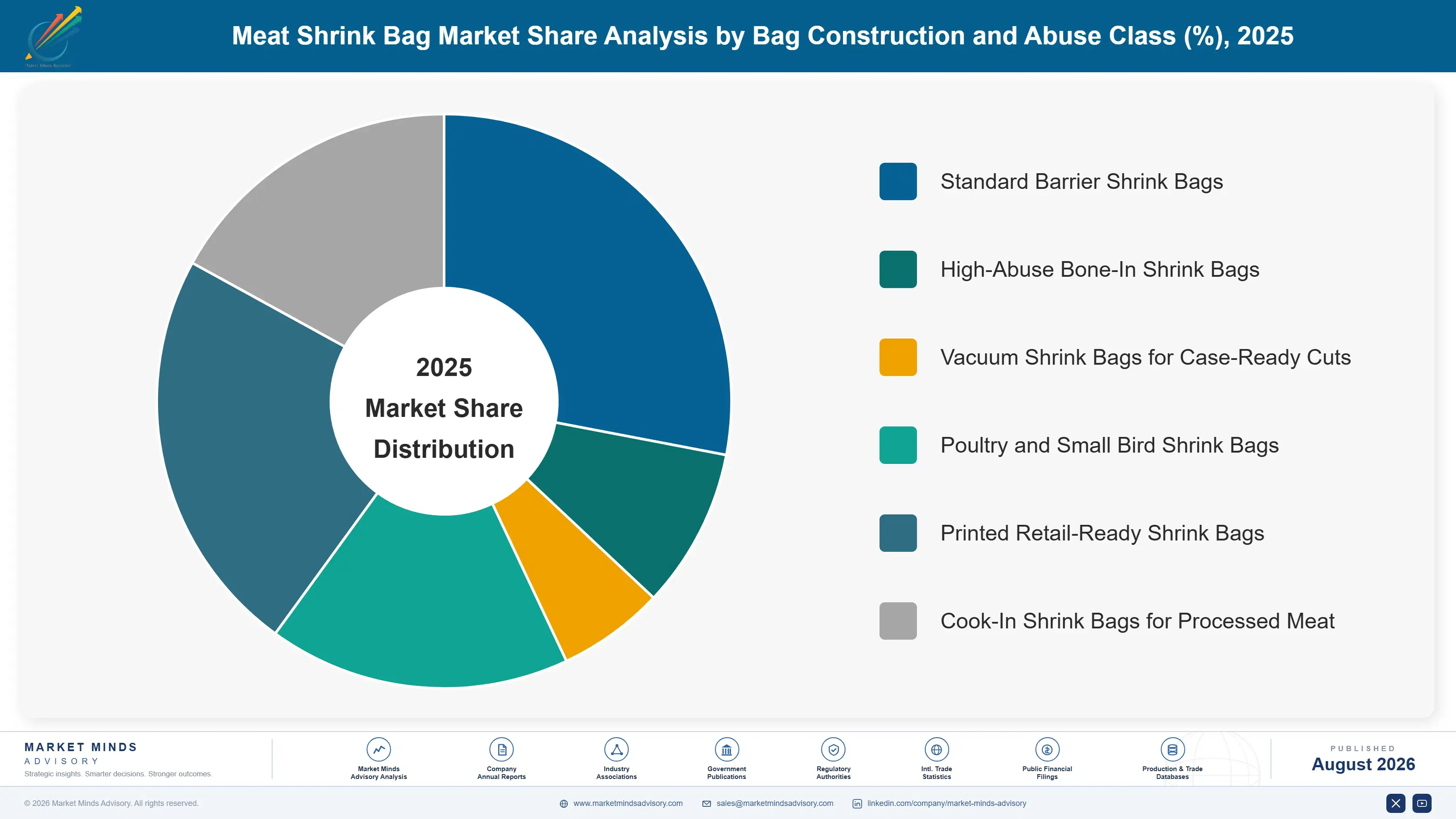
Segmentation follows bag construction and the abuse the pack must survive, because those determine barrier layers, film toughness and shrink behaviour together. A processor choosing between standard and high-abuse construction is buying puncture resistance against bone, which is the failure mode that actually loses containers. Six construction classes sit in the hierarchy, separated by barrier build and abuse rating.
meat-shrink-bag-market-market-share-analysis-1787308571472

High-Abuse Bone-In Shrink Bags

High-abuse constructions compound at 8.7%, exactly 1.50 times the market, on bone-in primal export volumes and on buyers enforcing leaker tolerances near 0.8 per thousand contractually. The engineering problem is specific: a cut rib or chine bone carries the whole primal weight against a small area of film through 42 days of vibration and temperature cycling, and standard barrier structures fail. Additional tough layers, higher irradiation crosslinking and sometimes bone guard patches address it at a cost premium that is trivial against a rejected container. Processors resist the premium until they lose a shipment, which is why producers who quantify rejection exposure per container rather than quoting per thousand bags convert accounts that price comparison never moves.
CAGR 8.7%

Vacuum Shrink Bags for Case-Ready Cuts

Case-ready vacuum shrink grows at 7.3% as grocery retail keeps moving protein from in-store butchery to centrally packed cuts. The requirements differ substantially from export work: transit is days rather than weeks, bone exposure is lower, and appearance matters because the consumer sees the pack. Clarity, print quality and the absence of wrinkles after shrink become genuine specifications rather than afterthoughts. Purge control still drives the yield argument, and the tight film surface presents the cut better than loose vacuum packing does. Producers serving both export and case-ready need quite different film constructions and different conversations with the customer, since one buyer worries about rejection and the other about shelf appearance.
CAGR 7.3%
Full segment breakdown across 6 segments available in the complete report.

Regional Architecture and Country Demand Map

Demand follows meat packing and export capacity rather than consumption, since the bag is applied where the primal is cut. Export-oriented processing regions therefore consume far more bag volume than their domestic protein consumption alone would indicate. Latin America leads on export packing capacity. Export capacity is the variable.

Latin America

Latin America accounts for 20% of global demand, growing at 7.6%. Note: this sits far above the standard band because Brazilian and Argentine beef export packing is among the largest single consumers of barrier shrink bags anywhere, and bags are used where primals are cut rather than where meat is eaten. Brazil alone compounds at 8.4%, the fastest national market, on beef and poultry export volumes into Asia and the Middle East. Argentine and Uruguayan beef export packing serves premium European and Asian buyers with demanding specifications. Chilean and Mexican pork and poultry export adds further volume, and all of it requires 42 day chilled integrity. Regional bag production has grown alongside that packing capacity.
Share: 20% | CAGR: 6.8% (2026 to 2036)

North America

Twenty-four percent of demand sits in North America, growing at 5.5%. United States beef and pork export packing is the largest element and applies the most stringent leaker tolerances anywhere, since Japanese and Korean buyers reject containers rather than negotiating. Domestic case-ready conversion adds substantial vacuum shrink volume as grocery chains continue moving protein out of in-store butchery. Canadian beef and pork export follows similar patterns at smaller scale. The region also holds the deepest technical capability in bag production, with the leading producers headquartered and developing film here. Bone-in export share is rising here as it is elsewhere, which pushes the mix steadily toward high-abuse construction across all three national markets in the region.
Share: 24% | CAGR: 5.5% (2026 to 2036)
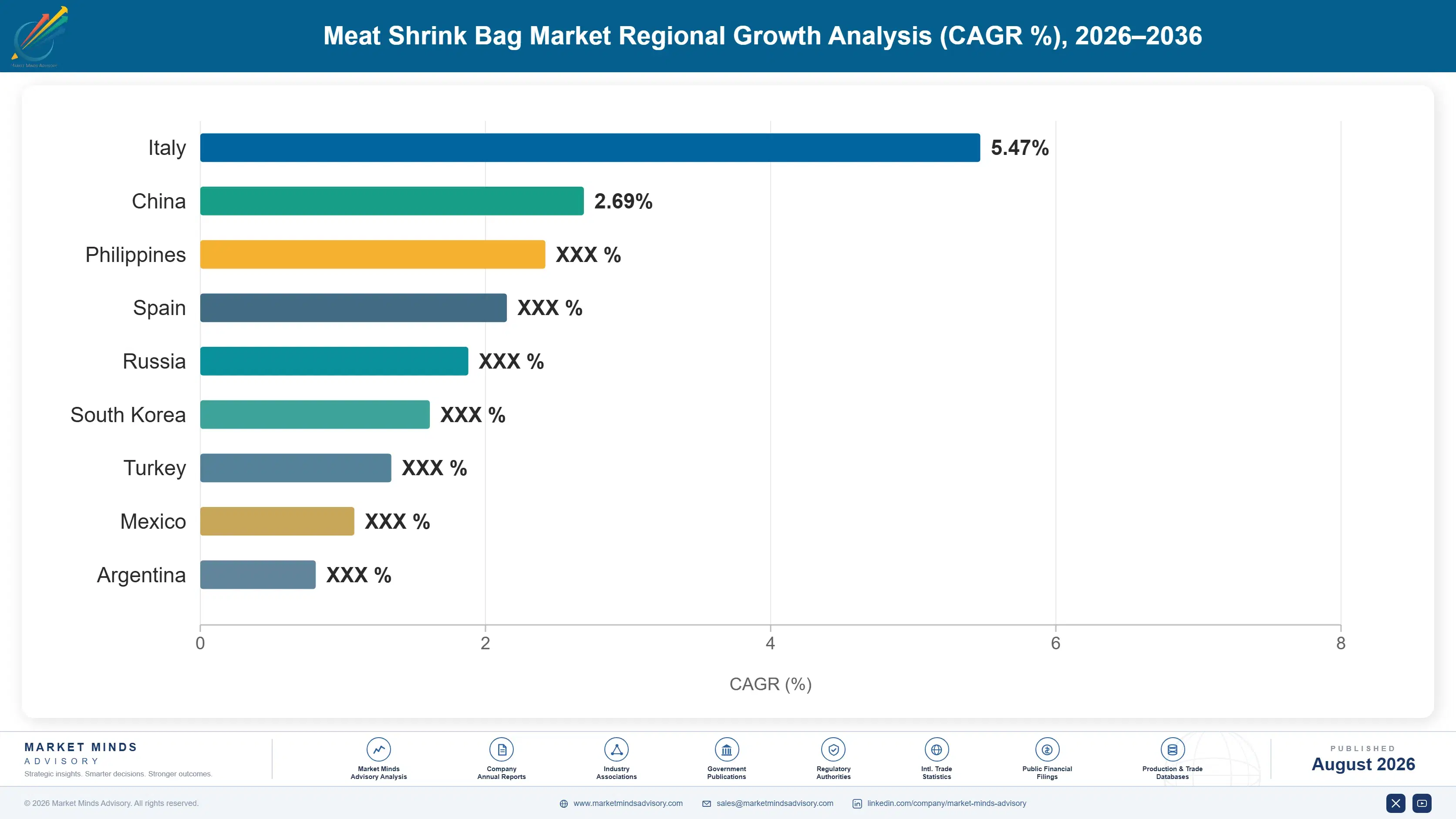
Regional intelligence for 5 additional markets available in the complete report: Western Europe, East Asia, South Asia and Pacific, Middle East and Africa, Eastern Europe. Contact sales@marketmindsadvisory.com.
meat-shrink-bag-market-country-cagr-analysis-1787308572004

Pricing Against the Container, Not the Bag

Shrink bags get bought on price per thousand by processors carrying rejection exposure measured in containers. Every position worth holding here reframes what the bag is being compared against. Four qualify, and two of them require doing arithmetic the customer has never performed on their own yield data. The other two protect the producer rather than persuade the customer.

Quantify Container Rejection Exposure Per Export Corridor

A rejected container costs the product, the freight, the destination handling and often the customer, while the difference between standard and high-abuse construction is fractions of a cent per bag. Producers who calculate rejection exposure per corridor, using the processor's own leaker history, replace a price comparison with a risk calculation. Buyers enforcing tolerances near 0.8 per thousand have already made the argument for the supplier. High-abuse constructions compound at 8.7%, and almost none of that growth is won on unit price. The processor's own rejection history makes the case.
Market Impact: Tolerances now enforced at 0.8 per

Sell Purge Retention as Recovered Saleable Weight

Biaxial shrink near 38% removes the voids where purge collects, retaining roughly 2.1 percentage points more saleable weight than loose vacuum packing. On a container of primals that yield difference exceeds the entire bag spend by a wide margin, and it lands in a processor's yield accounting rather than in packaging cost. Producers who run that calculation against a customer's actual carcass data reach operations and finance rather than procurement, and very few competitors bother to do it at all. Procurement never sees the number at all. Finance signs off where packaging never could.
Market Impact: Yield improved 2.1 percentage point

Serve Multiple Export Corridors Against Trade Disruption

Disease outbreaks and tariff action close major export routes within days, and producers concentrated on a single corridor lose that volume with no warning. Building qualified positions across several corridors, and holding domestic case-ready volume that continues when export stops, converts an existential exposure into a manageable one. Case-ready vacuum shrink grows at 7.3% and behaves quite differently from export demand, which is precisely what makes it useful as ballast when a trade route closes without notice. Producers concentrated on one route learn this expensively. Case-ready demand behaves independently of trade policy.
Market Impact: Corridors closing within 5 days of

Qualify Alternate Barrier Resin Grades During Validation

Barrier polymers move independently of commodity polyethylene and account for a disproportionate share of the 63% resin cost, so a single-grade structure leaves a producer exposed whenever that grade tightens. Qualifying two barrier grades during initial film validation costs one additional trial and avoids a full requalification when substitution becomes necessary. Processors will not accept an unvalidated switch on export product, so the work has to be done before it is needed rather than during the shortage itself. Validation takes longer than most shortages last. Nobody accepts unvalidated film on a container.
Market Impact: Resin sitting at 63% of total produ

Who Controls the Margin Pool

Five producers hold 61% measured on barrier shrink bag revenue, the basis used consistently in this section. Concentration is high because irradiated multilayer coextrusion with consistent shrink behaviour is genuinely difficult and because a bag failure costs a container. Sealed Air and Amcor lead, and the gap to the challenger group is wide on high-abuse construction and considerably narrower on standard barrier work.
Competition runs on three dimensions. Abuse resistance against bone decides participation in the fastest-growing export segment. Shrink consistency and appearance decide case-ready work where the consumer sees the pack. And technical service into processing plants decides who holds accounts, since bag performance depends on how the plant runs its vacuum and shrink tunnel operations. Bag performance is partly a plant variable rather than purely a film one.

Two pressures are moving position. Bone-in export growth rewards producers with genuine high-abuse capability and steadily excludes those selling standard barrier film. Meanwhile regional producers in Brazil, China and India are closing the technical gap on standard constructions. Rankings will shift toward whoever holds abuse performance alongside real plant-level technical support. Packaging waste rules will eventually reach these multilayer structures, and no recyclable design yet performs.
meat-shrink-bag-market-company-positioning-matrix-1787308572518

Competitive Moat and Risk Dimensions

SEALED AIR

Moat: Abuse resistance film development

Sealed Air has the deepest development history in high-abuse bone-in constructions and supplies the vacuum and shrink equipment inside many of the processing plants using them. That combination puts the company where bag performance is actually determined, since abuse resistance depends on how the plant evacuates, seals and shrinks as much as on the film itself.
SEALED AIR

Risk: Regional producer cost position

Brazilian, Chinese and Indian producers have closed much of the technical gap on standard barrier constructions and price well below global suppliers in their home markets. As those regions grow faster than developed ones, a premium position built on high-abuse capability faces volume erosion in exactly the geographies expanding fastest.
AMCOR

Moat: Global plant network reach

Amcor produces barrier shrink bags across multiple continents, which lets it serve processors in each major export region from local capacity rather than shipping film across oceans. For customers who need supply continuity through trade disruption and currency movement, that geographic spread is worth more than any single film advantage.
AMCOR

Risk: Bone-in abuse specialisation depth

High-abuse bone-in construction is the fastest-growing segment at 8.7% and it demands specific film development rather than general barrier capability. A producer strong across the breadth of protein packaging competes at a disadvantage against one that has concentrated on the puncture problem for decades and holds the reference specifications.

Players Tracked

Prominent Players

Sealed Air
Amcor
Winpak
Flexopack
Vidhi Laminates

Other Key Players

Berry Global
Coveris
TC Transcontinental Packaging
Kureha Corporation
Okada Shigyo
Sun Packaging Technologies
Atlantis Pak
Plasel Plastic
Buergofol
Allfo Vakuumbeutel
Shenzhen Jinhaoyang Packaging
Hubei Fuhua Packaging
Poligal
Terinex Flexibles
Vacpac Industries

Recent Developments

MARCH 2025

Asian importers write leaker tolerances into primal purchase contracts

Japanese and Korean beef importers moved leaker rate limits from informal expectation into written purchase contract terms, with rejection rights attached. These were commercial buyer policy changes rather than regulatory actions or transactions between packaging producers themselves. Processors could no longer absorb occasional failures quietly within a shipment.
Signal: A contractual leaker limit removes the pro
JULY 2025

Bone-in primal export share rises across South American shipments

South American beef exporters shipped a higher proportion of bone-in primals as Asian buyers sought better carcass utilisation and cuts commanding bone-attached premiums. This reflects trade composition rather than any corporate development among barrier film producers. Standard barrier construction failed at materially higher rates on those loads.
Signal: Every point of bone-in share transfers pun
NOVEMBER 2025

Barrier resin availability tightens for multilayer shrink construction

Specialty barrier polymer supply tightened, and producers without qualified alternate grades faced substitution requests that processors would not accept on export product. This reflects polymer supply conditions rather than any transaction between the bag producers involved. Producers holding a second validated grade continued supplying without interruption.
Signal: Unvalidated grade substitution is refused

Polymer, Barrier Grades and Irradiation

Polymer and barrier resin account for roughly 63% of producer cost of goods, with specialty barrier grades carrying costs well above the polyolefin layers surrounding them. Coextrusion and irradiation crosslinking energy adds around 13%, and irradiation is the step that gives these films their shrink and toughness characteristics. Converting labour, bag making and quality inspection account for most of the remainder.
Barrier polymer availability tightened through 2021 and 2022 and again in late 2025, and shrink bag producers carried it worse than general flexible converters because processors refuse unvalidated grade substitution on export product. Company annual reports across the protein packaging groups disclose the resulting margin and volume effects. Energy Information Administration data on petrochemical feedstock pricing documents the underlying commodity movement through the period. Validation timing decided who kept supplying.

Exposure divides by validation depth rather than by scale. Producers who qualified alternate barrier grades during initial film development substitute quickly and keep supplying. Those on a single validated grade must either stop or ask a processor to accept unvalidated film on product heading for a 42 day container, which no export processor will do. Geography compounds it where barrier resin is imported.
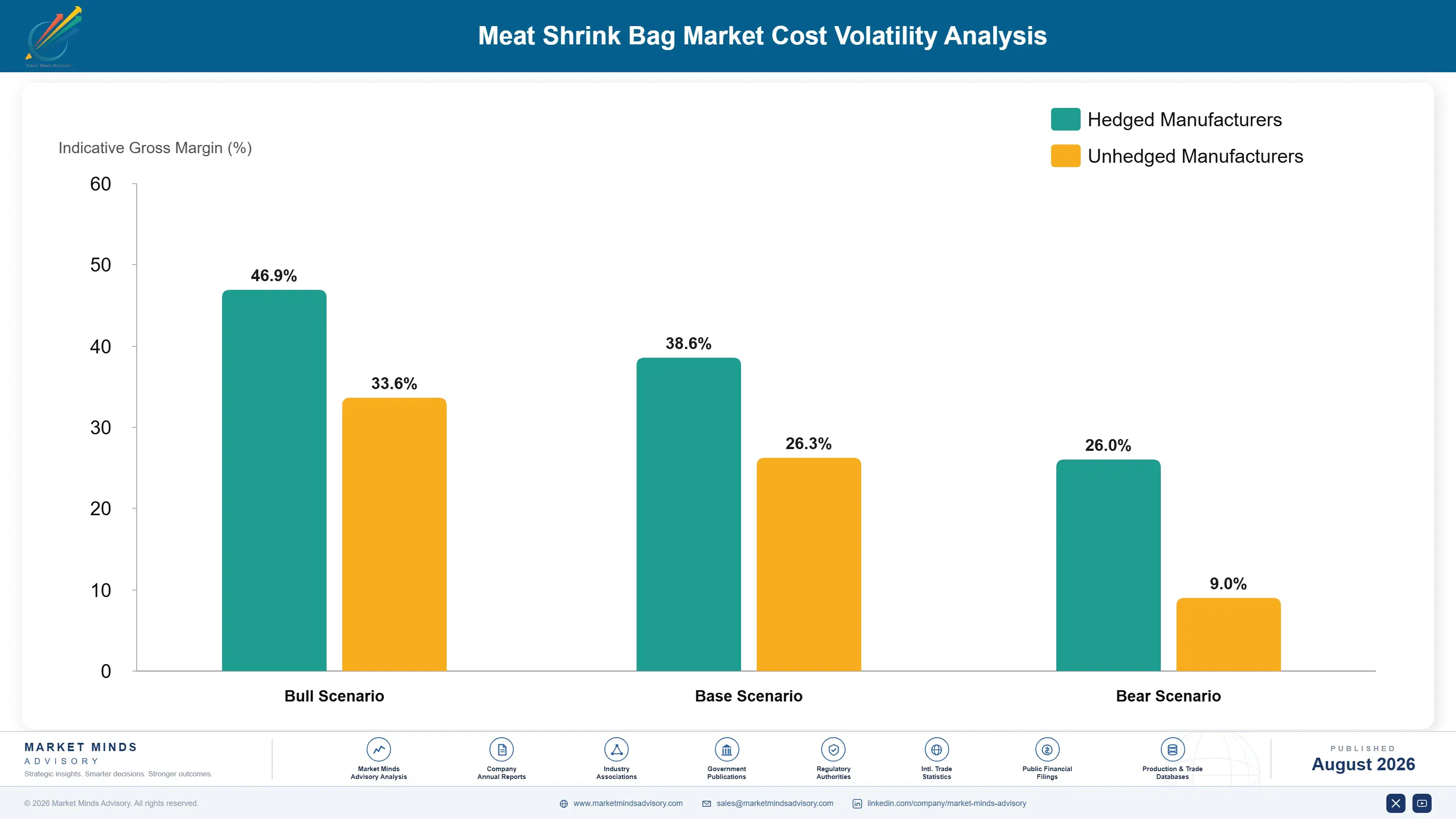
meat-shrink-bag-market-cost-volatility-analysis-1787308572713

Validate two barrier grades in every film development cycle

Processors refuse unvalidated substitution on export product, which turns a resin shortage into lost volume rather than a cost increase. Qualifying a second barrier grade during initial development costs one extra trial and removes that exposure entirely. Doing it during a shortage is impossible, because the validation work itself takes longer than the shortage usually lasts.

Index processor contracts to barrier resin references quarterly

Barrier polymers move on their own supply dynamics rather than tracking commodity polyethylene, so a contract indexed to general resin references misses most of the actual exposure. Separate indexation for the barrier component, reset quarterly, matches the pass-through to the cost that genuinely moves and processors accept the logic once it is shown. The evidence is straightforward to assemble.

Match irradiation dose to the abuse the application requires

Crosslinking dose drives both toughness and energy cost, and producers frequently run one dose across most output for simplicity. Matching dose to the actual abuse profile, bone-in export against boneless case-ready, recovers energy cost on the large share of volume that never needed maximum crosslinking to perform correctly. Dose is rarely reviewed once a line is set.

Portfolio Architecture for Margin Defence

The portfolio separates on what the bag has to survive and who looks at it. Standard barrier shrink bags for boneless domestic work are the base. High-abuse bone-in constructions add puncture engineering for export transit. Case-ready vacuum shrink adds appearance and print requirements the export bags never face. Cook-in bags sit apart entirely, with thermal performance demands and their own processor base. Poultry bags form a separate geometry problem again.
The tension is between export volume and export fragility. Bone-in export carries the best margin and the fastest growth, and it disappears within days when a disease outbreak or tariff closes a corridor. Case-ready volume is steadier, lower margin, and continues regardless of what happens to trade. Producers need both, and the ones concentrated purely on export learn that lesson expensively every few years.

High-value pools concentrate where failure costs a container. High-abuse bone-in construction, long-corridor export work and technical service into plant vacuum and shrink operations all qualify, and none of them is decided on price per thousand bags. What they share is a buyer inside the plant rather than in procurement, because the rejection consequence lands on operations and quality rather than on the packaging budget.

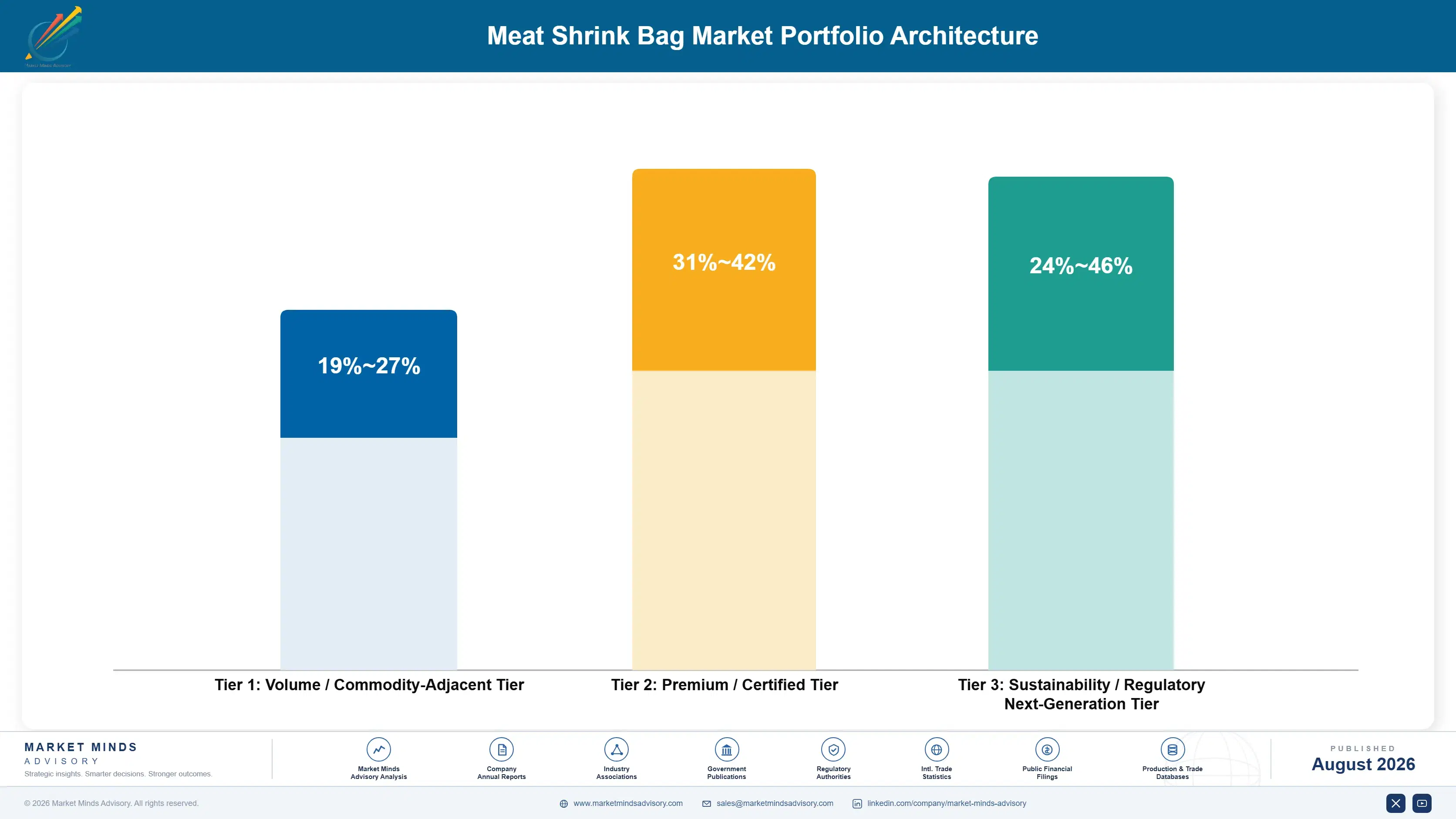
Volume / Commodity-Adjacent Tier

Standard barrier shrink bags for boneless domestic work and short-transit export. Sold on price per thousand against straightforward barrier and shrink specifications that most established producers can meet reliably and repeatedly.
Gross Margin: 19-27%

Premium / Certified Tier

High-abuse bone-in constructions and long-corridor export bags carrying contractually enforced leaker tolerances. Puncture performance against cut bone qualifies the supplier, and a single rejected container settles that argument permanently and for good.
Gross Margin: 31-42%

Sustainability / Regulatory / Next-Generation Tier

Recyclable-stream shrink constructions and downgauged reduced-thickness bags responding to packaging waste rules. The wide margin range separates validated structures from development work still absorbing all of its own qualification cost.
Gross Margin: 24-46%
meat-shrink-bag-market-portfolio-architecture-1787308573214

High-value Sub-segments and Strategic Watch-out

High-Abuse Bone-In Shrink Bags

Compounding at 8.7% as bone-in primal export grows and buyers enforce leaker tolerances near 0.8 per thousand contractually. Puncture engineering against bone under primal weight is where the technical barrier genuinely sits. Processors accept the premium only after losing a shipment. Very few of them run the numbers first.
Gross Margin: 33-42%

Case-Ready Vacuum Shrink Bags

Growing at 7.3% on grocery retail moving protein out of in-store butchery. Appearance, clarity and wrinkle-free shrink matter here in a way export packing never demands, which requires quite different film development. It also continues running when export corridors close. Margin is lower and volume is far steadier.
Gross Margin: 26-34%

Standard Barrier Shrink Bags

The volume core at 3.9%, sold on price for boneless domestic and short-transit work where abuse resistance is not tested. Regional producers have closed most of the technical gap, so differentiation is largely gone. Regional producers compete strongly on price in their home markets. Volume alone justifies keeping it.
Gross Margin: 19-27%

Recyclable-Stream Shrink Constructions

The strategic watch-out. Packaging waste rules will eventually reach these multilayer structures, and no current recyclable design delivers the barrier and abuse performance that 42 day export transit actually requires. The rules will arrive before any workable design does, which is an uncomfortable position for the whole category.
Gross Margin: 22-46%

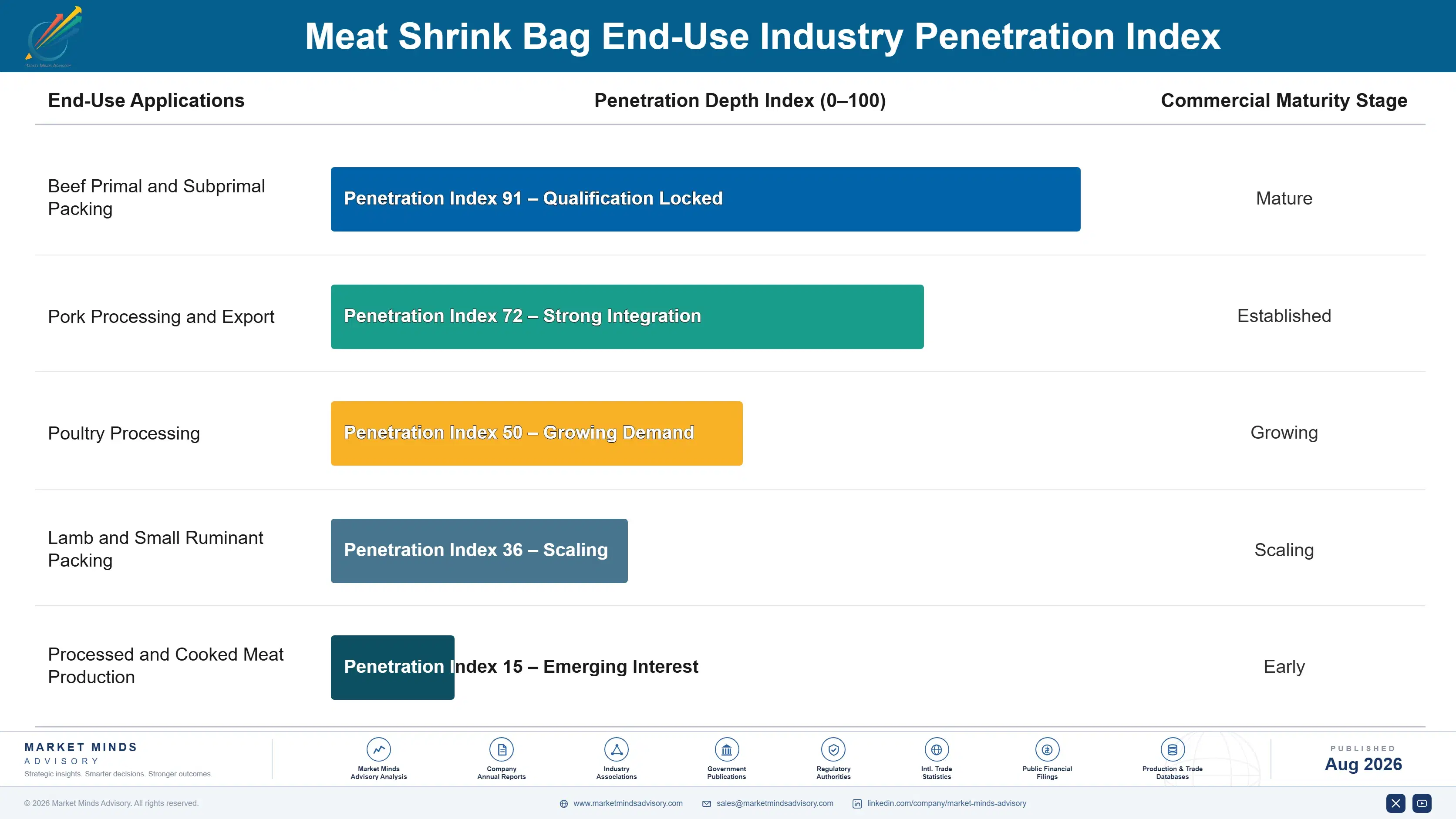
Volume Follows the Kill Floor

Demand is consumption-linked in the purest sense. Every primal packed uses a bag, so volumes track a processor's throughput exactly and reorder without any commercial process at all. Forecasting is straightforward from slaughter data, which is published in most producing countries. The vulnerability is that the same directness applies downward: when a corridor closes, the volume stops that week rather than tapering over a quarter. That volatility is the defining feature.
Depth varies by transit and by bone. Long-corridor bone-in export processors buy deepest and specify hardest, since a container rejection is catastrophic rather than annoying. Short-transit boneless export buys steadily on standard construction. Case-ready processors buy heavily with appearance requirements layered on. Poultry processors buy high volume at lower unit value with quite different bag geometry.

The buying population sits closer to operations than in most packaging categories. Plant managers and quality functions specify these bags because they carry the rejection consequence directly, and procurement negotiates within a specification somebody else has already fixed. Producers who reach plant technical staff hold positions that survive procurement tendering rounds intact. Reaching plant technical staff is therefore worth considerably more than reaching the buyer.
meat-shrink-bag-market-end-use-penetration-index-1787308573707

Where Bag Producers Win

These are among the four positions where our research anticipates prominent divergence between winners and laggards over the coming forecast period. Each is grounded in the demand model, the regulatory perimeter, and the announced capacity pipeline.
01 / REJECTION RISK QUANTIFICATION

A container is the unit of loss, not a bag

A rejected export container costs the product, the freight, the destination handling and frequently the customer relationship, while high-abuse construction costs fractions of a cent more per bag. Producers who calculate rejection exposure per corridor from the processor's own leaker history replace a price comparison with a risk calculation. Asian buyers enforcing tolerances near 0.8 per thousand have already made that argument, and the supplier only has to finish it, using the leaker data the processor already collects and never analyses.
02 / YIELD ACCOUNTING ACCESS

Purge retention is money the packaging buyer never sees

Biaxial shrink near 38% eliminates the voids where purge collects and retains roughly 2.1 percentage points more saleable weight than loose vacuum packing achieves. On a container of primals that exceeds the entire bag spend, and it lands in yield accounting rather than packaging cost. Producers running that calculation on a customer's actual carcass data reach operations and finance, where almost no competitor has ever presented anything at all, which is why the argument works even against an incumbent holding a lower unit price.
03 / EXPORT CORRIDOR DIVERSIFICATION

Trade routes close in days and take the volume with them

Disease outbreaks and tariff decisions have each shut major export corridors with less than a week of notice, and producers concentrated on one route lose that volume outright. Qualified positions across several corridors, plus domestic case-ready volume growing at 7.3%, convert an existential exposure into a manageable one. The case-ready business is lower margin and it keeps running on exactly the weeks when export stops without warning, and that steadiness is the whole reason to carry a lower-margin business at all.
04 / BARRIER GRADE VALIDATION

Nobody accepts unvalidated film on a forty day container

Barrier polymers move on their own supply dynamics and represent a disproportionate share of the 63% resin cost, so a single validated grade becomes lost volume the moment supply tightens. Processors refuse unvalidated substitution on export product, and rightly so. Qualifying a second barrier grade during initial development costs one extra trial, and attempting it during a shortage takes longer than the shortage itself usually lasts, so the work has to be done before anybody needs it rather than during the disruption.

Engagement Snapshot From the Field

A live engagement with an industry participant carrying material or product regulatory and market exposure ahead of a defining policy shift, showing how our research translates into a defensible multi-year portfolio strategy.
MARKET MINDS ADVISORY · CLIENT ENGAGEMENT SUMMARY
Meat Shrink Bag Producer Strategic Portfolio Review and Transition Roadmap 2026·Investment Scenario on Meat Shrink Bag Exposure Evaluation 2025-26
CLIENT PROFILE
A beef processor operating three export-approved plants shipping primals to Asian and Middle Eastern buyers, with roughly USD 1.9 billion in annual revenue (client-reported, unverified by MMA). Shrink bags were purchased on price per thousand across two suppliers, with standard barrier construction used for both boneless and bone-in primals across every corridor. No leaker analysis had ever been performed on recovered bags.
STRATEGIC CHALLENGE
Two Asian buyers had introduced contractual leaker tolerances and had rejected three containers in the preceding year, at a direct cost above USD 1.4 million before accounting for the commercial damage (client-reported, unverified by MMA). Plant quality functions attributed the failures to handling during loading rather than to bag construction.
MMA APPROACH
MMA recovered failed bags from two rejected containers and classified the failure mode on each. Bag construction, vacuum and shrink tunnel parameters were recorded across all three plants, and leaker incidence was matched against bone-in versus boneless content and against corridor transit duration. Bag pricing across both suppliers was compared against the rejection losses recorded over the preceding year.
KEY FINDINGS
  1. Eighty-four percent of recovered failures were bone puncture rather than seal failure, with the perforation site adjacent to a cut rib or chine bone in almost every recovered sample examined.
  2. Leaker incidence on bone-in primals ran roughly six times the rate seen on boneless product moving through the identical loading and handling process at the same plants.
  3. Shrink tunnel dwell time varied materially between the three plants, and the plant with the shortest dwell produced measurably looser film and a higher leaker rate.
  4. The price advantage of standard construction across annual bag volume was under USD 90,000 against rejection losses more than fifteen times that figure in a single year.
CLIENT PROFILE
A beef processor operating three export-approved plants shipping primals to Asian and Middle Eastern buyers, with roughly USD 1.9 billion in annual revenue (client-reported, unverified by MMA). Shrink bags were purchased on price per thousand across two suppliers, with standard barrier construction used for both boneless and bone-in primals across every corridor. No leaker analysis had ever been performed on recovered bags.
STRATEGIC CHALLENGE
Two Asian buyers had introduced contractual leaker tolerances and had rejected three containers in the preceding year, at a direct cost above USD 1.4 million before accounting for the commercial damage (client-reported, unverified by MMA). Plant quality functions attributed the failures to handling during loading rather than to bag construction.
MMA APPROACH
MMA recovered failed bags from two rejected containers and classified the failure mode on each. Bag construction, vacuum and shrink tunnel parameters were recorded across all three plants, and leaker incidence was matched against bone-in versus boneless content and against corridor transit duration. Bag pricing across both suppliers was compared against the rejection losses recorded over the preceding year.
KEY FINDINGS
  1. Eighty-four percent of recovered failures were bone puncture rather than seal failure, with the perforation site adjacent to a cut rib or chine bone in almost every recovered sample examined.
  2. Leaker incidence on bone-in primals ran roughly six times the rate seen on boneless product moving through the identical loading and handling process at the same plants.
  3. Shrink tunnel dwell time varied materially between the three plants, and the plant with the shortest dwell produced measurably looser film and a higher leaker rate.
  4. The price advantage of standard construction across annual bag volume was under USD 90,000 against rejection losses more than fifteen times that figure in a single year.
RECOMMENDED STRATEGY
Phase 1: Phase 1 (months 1 to 4): Move all bone-in primal packing to high-abuse construction and confirm leaker rates against the enforced contractual tolerance. Phase 2: Phase 2 (months 4 to 10): Standardise shrink tunnel dwell and temperature across the three plants and verify film tightness on recovered samples. Phase 3: Phase 3 (months 10 to 18): Requalify a second bag supplier on high-abuse construction to remove single-source exposure on export volume.
OUTCOME
Leaker incidence on bone-in shipments fell below the contractual tolerance within two months and no container was rejected across the following twelve (client-reported, unverified by MMA). Annual bag spend rose by approximately USD 310,000 against avoided rejection losses several times larger (client-reported, unverified by MMA). Bag construction is now specified by plant quality rather than negotiated by procurement.

Frequently Asked Questions

Foundational context covering the market sizes, CAGR, scope, country, region and competition that inform every finding below. This section is provided to cover basics and most often pre-purchase conversations, answered from the MMA Primary Research Dataset.

What is the current size of the Meat Shrink Bag Market?

The global market was worth USD 3.4 billion in 2025, reaching USD 3.6 billion in 2026. North America holds the largest regional share at 24% of demand.

How large will the Meat Shrink Bag Market be by 2036?

MMA forecasts USD 6.33 billion by 2036, an expansion multiple of 1.76 times the 2026 base. That represents roughly USD 2.73 billion of incremental value.

What is the CAGR for the Meat Shrink Bag Market 2026 to 2036?

The base case compounds at 5.8% annually, with a bull case of 7.0% and a bear case of 4.6%. Historical growth from 2020 to 2025 ran at 4.7%.

Which segment is growing fastest?

High-abuse bone-in shrink bags compound at 8.7%, exactly 1.50 times the market rate. Bone-in primal export growth and enforced leaker tolerances together drive that expansion.

Who are the major companies in the Meat Shrink Bag Market?

Sealed Air, Amcor, Winpak, Flexopack and Vidhi Laminates together hold a combined 61% of the market. Irradiated multilayer coextrusion capability sustains that unusually high concentration.

Which country is growing fastest?

India compounds at 8.4%, ahead of every other national market. Buffalo meat export volumes into Southeast Asian and Middle Eastern buyers together drive that growth.

Report Segmentation Architecture

The full report scope spans multiple orthogonal segmentation dimensions, with cross-tabulated demand data provided for each dimension pair. Coverage extends further to regional breakdowns, trend trajectories, and the competitive detail needed to support segment-level decision-making.

By Bag Construction and Abuse Class

  • Standard Barrier Shrink Bags
  • High-Abuse Bone-In Shrink Bags
  • Vacuum Shrink Bags for Case-Ready Cuts
  • Poultry and Small Bird Shrink Bags
  • Printed Retail-Ready Shrink Bags
  • Cook-In Shrink Bags for Processed Meat

By End-Use Industry

  • Beef Primal and Subprimal Packing
  • Pork Processing and Export
  • Poultry Processing
  • Lamb and Small Ruminant Packing
  • Processed and Cooked Meat Production

By Commercial Dimension

  • Direct Supply to Export Processors
  • Domestic Case-Ready Programmes
  • Equipment and Film Combined Supply
  • Distributor Channel for Smaller Processors

By Region

  • North America
  • Western Europe
  • East Asia
  • South Asia and Pacific
  • Latin America
  • Middle East and Africa
  • Eastern Europe

Scope, Methodology, and Coverage

Every figure in this report is reproducible from documented input assumptions. The scope below maps the historical period, the forecast horizon, the segmentation dimensions, and the countries covered, alongside the underlying primary and qualitative methodology.
Historical Period
2020 to 2025
Forecast Period
2026 to 2036
Base Year
2025 (USD billions; MMA Primary Research Dataset, August 2026)
Market Definition
The market covers heat-shrinkable barrier bags used for primal, subprimal and whole-muscle meat packing, spanning standard barrier shrink bags, high-abuse bone-in shrink bags, vacuum shrink bags for case-ready cuts, poultry and small bird shrink bags, printed retail-ready shrink bags, and cook-in shrink bags for processed meat, together with the bone guard and patch components applied to them. Thermoformed vacuum pouches, non-shrink vacuum bags, tray lidding films, sausage and ground product casings, and the vacuum and shrink equipment used to apply the bags are excluded. Sizing is measured at producer revenue in current prices.
Quantitative Units
USD billions (current prices); bag units, shrink ratio as percentage and leaker rate per thousand where applicable
Segmentation Dimensions
By Bag Construction and Abuse Class; By End-Use Industry; By Commercial Dimension; By Region
Regions Covered
North America, Western Europe, East Asia, South Asia and Pacific, Latin America, Middle East and Africa, Eastern Europe
Countries Covered
USA, Brazil, Argentina, Uruguay, Australia, New Zealand, China, Japan, South Korea, India, Canada, Mexico, Netherlands, Germany, Spain, Denmark, Ireland, UK, France, Poland, Thailand, Vietnam, Indonesia, Chile, Colombia, Paraguay, UAE, Saudi Arabia, South Africa, Turkey, and additional markets relevant to this sector
Key Companies Profiled
Sealed Air, Amcor, Winpak, Flexopack, Vidhi Laminates, Berry Global, Coveris, TC Transcontinental Packaging, Kureha Corporation, Okada Shigyo, Sun Packaging Technologies, Atlantis Pak, Plasel Plastic, Buergofol, Allfo Vakuumbeutel, Shenzhen Jinhaoyang Packaging, Hubei Fuhua Packaging, Poligal, Terinex Flexibles, Vacpac Industries
Quantitative Methodology
Primary survey, n=3,800 respondents, Q4 2025, six countries; demand-side model with trade association cross-validation
Qualitative Methodology
47 expert interviews, Q4 2025; applied to validate demand model assumptions, identify emerging dynamics, and assess competitive positioning
Report Format
PDF and XLSX data workbook (Word format preview document)
Publisher
Market Minds Advisory
Report Code
MMA-2026-PAC-850
Published
August 2026
Contact
sales@marketmindsadvisory.com | www.marketmindsadvisory.com

Purchase the full Meat Shrink Bag Market Report (2026 to 2036).

The full report sizes meat shrink bags across six construction classes, three commercial dimensions and seven regions, with annual forecasts to 2036 under base, bull and bear scenarios. Leaker incidence is analysed by bone content, corridor transit duration and shrink tunnel practice, which is where container rejections actually originate. Purge retention economics are quantified against carcass yield data to establish the value the bag returns. Export corridor exposure is mapped by producer against disease and tariff disruption history. Twenty producers are profiled on a consistent barrier shrink bag revenue basis.
Leaker incidence analysed by bone content and transit duration
Purge retention economics quantified against actual carcass yield
Export corridor exposure mapped against disruption history
Shrink tunnel practice compared across processing plant operations
Barrier resin validation depth assessed across the producer base
Contractual leaker tolerances tracked across major importing buyers

Built For The People Who Decide

From boardroom strategy to bench-side execution, this report is read cover-to-cover by leaders shaping the next decade of their industry, turning demand scenarios, market dynamics and valuation benchmarks into decisions.
CXOs/ Presidents/ VPs/ Managers
M&A and Corporate Development
Strategy Teams and R&D Heads
Procurement and Product Directors
Regulatory and Compliance Leaders
Investor Relations and Equity Analysts