Market Minds Advisory
Meat Packing Paper Market

Meat Packing Paper Market: Moisture Barrier Innovation Meets Retail Case-Ready Demand

Case-ready retail formats and tightening food safety labeling rules are reshaping meat packing paper specifications, forcing converters to defend commodity butcher paper volume while investing in coated moisture barrier grades.

Lead Analyst

Bilal Shaikh

Published

September 2026

Make Smarter Decisions with Customized Research Insights

Request a free sample report and evaluate market opportunities, growth trends, and competitive dynamics relevant to your business needs.

2025 MARKET VALUE$2.1BMarket Size 2025
2036 FORECAST VALUE$3.2BBase Case , 2026 to 2036
CAGR 2026 TO 20364.0 %Bull 5.2% / Bear 2.8%
INCREMENTAL OPPORTUNITY$1.1BNet 10- year value creation
EXPANSION MULTIPLE1.48x2036 value over 2026 base
Strategic Levers
M&A Pipeline
Regional Outlook
Country Rankings
Competitive Intelligence
Segmental Deep-dive
Call-Us : 91 93563 13602

Executive Snapshot and Market Trajectory

Meat packing paper has stopped being a purely functional wrap and become a labeling surface with real regulatory weight. Retailers now specify paper grade based on print clarity for mandatory origin and safety labeling as much as moisture resistance, which has quietly reshaped converter specification sheets across the category.
Georgia-Pacific and WestRock continue supplying the bulk uncoated butcher paper that processing plants and independent butcher shops have relied on for decades, since cost-per-unit economics still govern most wholesale wrapping applications regardless of retail format shifts elsewhere in the broader supply chain. Coated moisture barrier paper is capturing disproportionate growth as retail case-ready packaging formats specify grease and moisture resistance that uncoated stock cannot deliver consistently at scale across most retail chains.
Sonoco and Mondi are investing specifically in recyclable coating chemistry to serve customers seeking plastic-reduction alternatives, betting that retailer sustainability commitments sustain premium pricing for years across most product categories and regional markets served today and beyond. Converters without recyclable coating capability increasingly find themselves confined to price-competitive commodity contracts rather than the higher-margin sustainability programs retailers increasingly prefer for new packaging line investment.
Market Definition
The meat packing paper market covers uncoated butcher paper, coated moisture barrier paper, freezer paper, and specialty labeling grades sold for meat and poultry processing, wholesale distribution, and retail case-ready packaging. It excludes plastic film packaging, vacuum sealing pouches, and rigid tray packaging sold independent of paper wrap components.
Base Year Value
$2.1B in 2025 (MMA Primary Research Dataset, August 2026)
Forecast Period
2026 to 2036, eleven discrete annual values
CAGR
4.0% base case. Bull 5.2%. Bear 2.8%.
Fastest Growth Segment
Coated Moisture Barrier Paper: 6.5% CAGR
Fastest Growth Country
India: 6.0% CAGR
Fastest Growth Region
South Asia and Pacific: 6.0% CAGR
Largest Region
North America: 30% of 2025 global value
Market Leaders
Georgia-Pacific, WestRock, Sonoco, Mondi, International Paper. Source: MMA Analysis based on company annual reports.
Primary Survey
n=3,800 procurement and R&D decision-makers, Q4 2025, six countries
Methodology
Demand-side build-up, cross-validated against public data, 47 expert interviews

Meat Packing Paper Market Forecast Scenarios

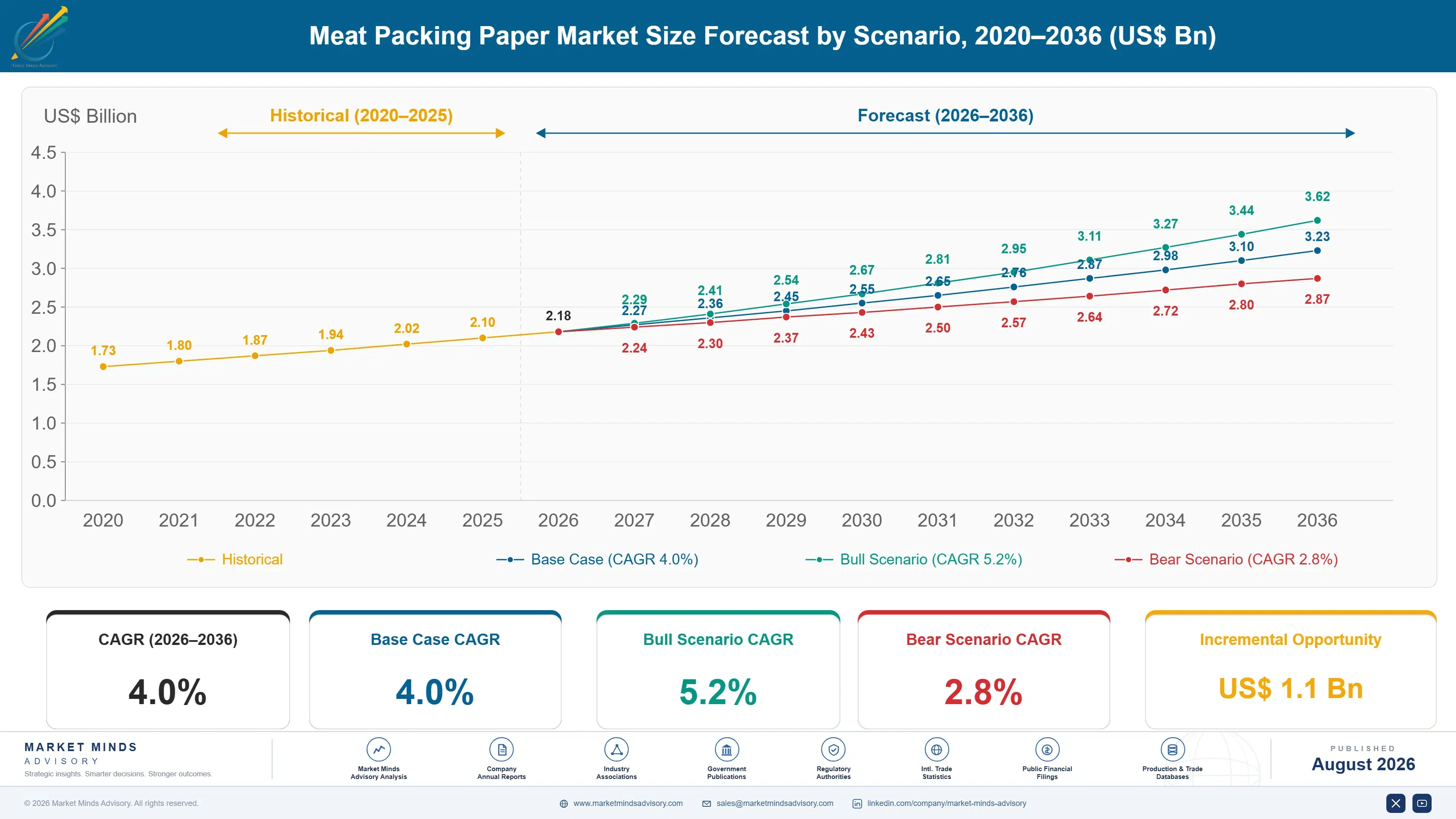
meat-packing-paper-market-size-forecast-scenario-1787554399485
Between 2020 and 2025 the market grew at roughly 4.0 percent a year, as steady meat processing volume combined with gradual retail case-ready packaging conversion to lift overall demand modestly above the flat pattern this category had shown through most of the previous decade, setting the stage for the specialty grade growth now underway across most product categories today.
The base case assumes 4.0 percent annual growth to 2036, built on three mechanisms: coated moisture barrier paper expanding across retail case-ready formats as grocery chains modernize meat department packaging nationwide, plastic-reduction sustainability commitments from major retailers converting demand toward recyclable coated paper alternatives across most product lines, and emerging market meat processing capacity expanding steadily as protein consumption rises across urbanizing populations specifically over the coming decade of continued growth and investment.
A bull case near 5.2 percent depends on plastic-reduction retail mandates accelerating faster than currently planned across major grocery chains worldwide and beyond current expectations. The bear case near 2.8 percent assumes meat processing volume softens amid shifting protein consumption patterns, delaying paper demand and pressuring converters reliant on that legacy channel specifically each quarter.

Coating Chemistry, Not Tonnage, Now Sets Price

Meat packing paper sits at the intersection of commodity converting and food safety compliance, and that dual role now shapes competitive strategy across the category. Uncoated butcher paper for wholesale wrapping behaves like a mature commodity, priced on delivered volume with thin single-digit margins that reward paper mill scale above all else consistently across most producers.
MARKET CONCENTRATIONCR5 35%Top five converters hold moderate combined global market share
AVERAGE SELLING PRICE$1,150/tonneBlended price varies sharply by coating and grade tier
TOP PRODUCING COUNTRY SHAREUSA 28%Leading producer nation supplies bulk commodity wrapping volume
CAPACITY UTILIZATION76%Utilization reflects steady but not fully stretched output
FEEDSTOCK COST SHARE45%Pulp and coating resin costs dominate total input structure
REPLACEMENT CYCLE LENGTHUnder 1 yearCycle length tracks continuous processing plant consumption patterns
Coated moisture barrier paper for retail case-ready applications occupies the faster-growing end of the spectrum, where grease and moisture resistance specifications now matter as much as basic wrapping function and grocery chains treat paper performance as a shelf-life variable rather than a procurement line item. Specialty labeling grades sit further out still, commanding premium pricing tied directly to print clarity requirements for mandatory food safety and origin labeling.
Recyclable coating chemistry increasingly shapes total packaging cost conversations with grocery retailers, who now evaluate paper suppliers on plastic-reduction credentials rather than delivered cost alone in most contract negotiations. Converters able to document recyclable coating performance are winning contract renewals even at a price premium, a shift that favors established players with genuine coating research infrastructure over low-cost regional entrants and new market participants.
"Buying meat packing paper used to mean buying a wrap. Now it means buying a labeling surface and a sustainability claim, and grocery chains are writing both into their specification sheets."
Practice Lead, Food Packaging and Specialty Paper Products · MMA Packaging Practice · August 2026

Market Trends

Retail Case-Ready Formats Drive Coated Paper Adoption

Grocery chains are converting meat department packaging from behind-the-counter wrapping toward pre-packaged case-ready formats at a pace that has surprised even established uncoated paper converters who spent decades focused primarily on wholesale wrapping customers exclusively. Case-ready formats require coated moisture barrier paper that maintains print clarity and grease resistance through extended retail shelf life, a specification uncoated stock cannot reliably meet consistently at scale. This shift is compressing margins for legacy commodity converters who have not invested in coating capability, forcing rapid capacity reallocation across the industry toward specialty grade production lines.
Market Impact: Adds 3 percent baseline volume growth

Plastic Reduction Mandates Expand Recyclable Coating Demand

Major grocery retailers are specifying recyclable paper-based packaging as part of broader plastic reduction commitments, treating coated paper alternatives as a genuine sustainability requirement rather than a marketing preference across most major chains. Regulatory bodies in several jurisdictions are also restricting certain plastic packaging formats directly, giving recyclable coated paper a genuine regulatory tailwind that did not exist a decade ago at any meaningful scale. Converters with proven recyclable coating capability are securing premium long-term contracts well ahead of competitors still relying on conventional plastic-laminated paper, reshaping competitive positioning across the category.
Market Impact: Adds 4 percent labeling grade demand

Market Opportunities and Growth Drivers

Global Meat Production Growth Sustains Baseline Demand

Global meat and poultry processing volume continues expanding as protein consumption rises across urbanizing populations in emerging markets, and every additional processing facility requires wrapping paper from the day it opens rather than as a later addition. Processing plant throughput scales directly with paper consumption, since wrapping remains a mandatory step in most wholesale distribution chains regardless of retail packaging format innovation happening downstream. This creates a genuinely predictable demand driver, since meat production forecasts are typically public well in advance and converters can plan capacity around known regional consumption growth trends.
Market Impact: Margins compress 5 to 8 percent

Food Safety Labeling Rules Expand Print Grade Demand

Regulatory bodies across multiple jurisdictions continue tightening mandatory origin, allergen, and safety labeling requirements for packaged meat products, pushing converters toward print grade paper capable of maintaining label clarity through distribution and retail handling processes nationwide. This regulatory tightening has proven a more durable demand driver than any single food safety incident, since it reflects permanent regulatory change rather than a temporary consumer reaction that fades over time and attention spans. Converters with proven print grade capability across multiple regulatory jurisdictions are securing preferred supplier status with major processors navigating this compliance burden.
Market Impact: Shifts 5 percent volume to plastic

Market Restraints and Challenges

Pulp Price Volatility Squeezes Converter Margins

Kraft pulp prices swing sharply with global paper industry supply and demand cycles, and since pulp represents the dominant cost input for meat packing paper, margin compression follows every upstream price spike almost immediately. The root cause is limited substitutability: food-contact safety requirements limit how far converters can shift fiber sourcing without losing regulatory approval or performance characteristics. The commercial impact falls hardest on smaller regional converters lacking long-term pulp supply contracts. Larger players are exploring backward integration into pulp production and multi-year indexed supply agreements to dampen this exposure.
Market Impact: Coated paper share reaches 40 percent

Plastic Film Alternatives Compete on Barrier Performance

Plastic film and vacuum sealing formats increasingly compete with coated paper in applications requiring the strongest moisture and oxygen barrier performance, particularly for extended shelf-life retail products nationwide. The root cause is genuine technology substitution: plastic film can be engineered to barrier specifications that even advanced paper coatings sometimes struggle to match for the longest shelf-life applications currently available. The commercial impact concentrates in premium extended shelf-life categories rather than standard retail formats, where paper retains clear sustainability and cost advantages. Converters are mitigating this by developing hybrid paper-film laminate structures.
Market Impact: Adds 18 percent recyclable coating demand
3 additional market trends, 3 additional growth drivers, and 4 additional restraints and challenges are covered in the full report. Contact sales@marketmindsadvisory.com to access the complete intelligence.

Segment CAGR and Growth Architecture

The market divides into six product categories by coating and function type, spanning uncoated butcher paper, coated moisture barrier paper, freezer paper, specialty print labeling grade, recyclable sustainable coating grade, and heavy-duty wholesale wrapping stock, each addressing distinct barrier and print performance requirements across processing, wholesale, and retail applications with differentiated pricing and margin structures.
meat-packing-paper-market-market-share-analysis-1787554400052

Coated Moisture Barrier Paper

Coated moisture barrier paper leads category growth as grocery chains convert meat department packaging toward retail case-ready formats requiring extended shelf-life performance that uncoated stock cannot deliver reliably at scale. Retailers increasingly specify moisture and grease barrier performance directly in packaging contracts, treating coated paper as a genuine shelf-life variable rather than a commodity wrapping input purchased on price alone. Converters with proven coating technology command pricing flexibility that uncoated-only competitors cannot match, since retail case-ready qualification requires documented barrier performance testing that takes considerable time to complete fully across multiple retail chains. This segment's growth trajectory increasingly tracks retail packaging format conversion cycles rather than traditional wholesale meat processing volume patterns seen historically.
CAGR 6.5%

Recyclable Sustainable Coating Grade

Recyclable sustainable coating grade remains the second-fastest-growing category, driven increasingly by grocery retailer plastic reduction commitments that treat recyclable paper packaging as a genuine sustainability requirement rather than a marketing preference across most major chains nationwide and globally each year. Regulatory restrictions on certain plastic packaging formats in several jurisdictions are accelerating conversion timelines beyond what voluntary retailer commitments alone would produce on their own without additional pressure or policy support. Converters with proven recyclable coating chemistry are securing premium long-term contracts well ahead of competitors still relying on conventional plastic-laminated alternatives, since qualification testing for new coating chemistry takes considerable validation time to complete across multiple product lines and regions.
CAGR 5.5%
Full segment breakdown across 6 segments available in the complete report.

Regional Architecture and Country Demand Map

North America leads on dense grocery case-ready retail infrastructure and the world's largest per-capita meat processing volume, while South Asia and Pacific posts the fastest growth as processing capacity and modern retail formats both expand rapidly across India and Southeast Asia specifically over the coming years.

North America

US grocery chains lead global adoption of retail case-ready meat packaging formats, and that conversion alone drives a substantial share of coated moisture barrier paper demand across the continent's largest supermarket networks. The region's meat and poultry processing industry, among the largest in the world by volume, sustains steady baseline uncoated wrapping demand independent of retail format shifts happening elsewhere in the supply chain. Canadian processors add further volume tied to export-oriented meat production destined for both domestic and international markets. Plastic reduction commitments from major US retailers are accelerating recyclable coating adoption faster than in most other regions, giving domestic converters with proven sustainable chemistry a genuine first-mover advantage in this specialty segment.
Share: 30% | CAGR: 4.5% (2026 to 2036)

Western Europe

Germany and France's dense grocery retail networks maintain some of the world's strictest food safety labeling requirements, sustaining steady demand for print grade paper capable of documenting mandatory origin and allergen information clearly. The region's early and aggressive plastic reduction regulation has already converted much of the addressable retail packaging base toward recyclable paper alternatives, meaning penetration gains come more slowly than in less-converted regions. Growth trails other regions because market saturation for both case-ready and recyclable coating formats already sits near the practical ceiling across most major supermarket chains. Smaller independent butcher shops across the region still rely on traditional uncoated paper, sustaining a modest but stable commodity segment alongside the specialty growth.
Share: 22% | CAGR: 2.5% (2026 to 2036)
Regional intelligence for 5 additional markets available in the complete report: East Asia, South Asia and Pacific, Latin America, Middle East and Africa, Eastern Europe. Contact sales@marketmindsadvisory.com.
meat-packing-paper-market-country-cagr-analysis-1787554400577

Where Converters Capture Coating Premium Value

Commodity wrapping volume no longer determines profitability in this category. Converters capturing outsized returns are the ones qualifying for retail case-ready barrier specifications, recyclable coating certification, and print grade labeling compliance, converting what was once a low-margin paper sale into recurring specification relationships with grocery retailers and meat processors specifically across each fiscal cycle.

Retail Case-Ready Qualification and Long-Term Contracts

Converters that complete retail case-ready barrier qualification capture roughly 25 percent higher unit pricing than commodity wrapping sales, because qualification creates a genuine switching barrier that protects volume from competitive shopping once a grocery chain locks in a supplier relationship for its packaging line. Retailers increasingly sign multi-year supply agreements that guarantee capacity allocation in exchange for qualification investment, giving committed converters predictable revenue visibility years into the future. This model has proven especially effective for converters with existing retail relationships, since qualification history transfers across new packaging format launches.
Market Impact: Adds roughly 25 percent case-ready pricing premium overall

Recyclable Coating Certification and Sustainability Programs

Converters with certified recyclable coating chemistry command 15 to 22 percent price premiums as grocery retailers pursue plastic reduction commitments tied to public sustainability targets, since retailers pay directly for the compliance certainty that certified coating provides for their own sustainability reporting obligations each fiscal year without exception. This premium tier is expanding fastest among large national grocery chains specifically, where sustainability commitments carry genuine public accountability and scrutiny. Converters with proven recyclable coating capability are increasingly securing long-term supply agreements rather than competing for spot allocation on price alone.
Market Impact: Captures 15 to 22 percent recyclable coating premium

Print Grade Labeling Compliance Program Overall

Converters with proven print grade labeling capability across multiple regulatory jurisdictions command 12 to 18 percent price premiums over generic wrapping stock, since processors pay directly for the compliance certainty that documented print clarity provides for their own labeling audits and regulatory filings each cycle. This premium tier is expanding fastest among processors selling into multiple regulatory jurisdictions simultaneously, where label compliance complexity is highest and penalties for error are severe. Converters with proven multi-jurisdiction compliance capability are increasingly securing preferred supplier status with major processors navigating this labeling burden.
Market Impact: Commands 12 to 18 percent print grade premium

Who Controls the Margin Pool

Global revenue concentration sits moderate at a 35 percent CR5, reflecting a market where coating technology and retail relationships matter more than raw paper mill scale in the specialty tiers. Georgia-Pacific leads on breadth across commodity and coated channels, while Sonoco commands outsized share within specialty barrier and recyclable coating categories. The gap between leader and mid-tier challengers has narrowed as regional converters scale certified coating production, though retail qualification history still separates the top five from smaller players.
Current activity centers on retail case-ready qualification and recyclable coating certification rather than commodity price competition. Leading players sign multi-year supply agreements with grocery chains that lock in volume years ahead, while mid-tier competitors invest in print grade compliance capability to differentiate on regulatory reliability. Regional converters have expanded uncoated capacity aggressively, pressuring pricing in general wholesale wrapping segments.

Emerging pressure comes from regional converters scaling recyclable coating research fast enough to challenge multinational technical leadership within sustainability focused retail contracts. Rankings could shift if a leading player secures exclusive supply agreements with major grocery chains that lock competitors out of that fast-growing segment. Consolidation among mid-tier commodity converters also looks likely as qualification costs rise.
meat-packing-paper-market-company-positioning-matrix-1787554401107

Competitive Moat and Risk Dimensions

GEORGIA-PACIFIC

Moat: Broadest Grade Portfolio Scale

Georgia-Pacific's paper mill network spans commodity uncoated and specialty coated production simultaneously, giving it a breadth of grade capability that narrower specialty competitors cannot match easily. This range lets Georgia-Pacific serve customers across multiple packaging requirements without losing account relationships, deepening switching costs for processors considering alternative suppliers.
GEORGIA-PACIFIC

Risk: Commodity Segment Margin Pressure

Georgia-Pacific's broad commodity wrapping exposure leaves it vulnerable to regional converters scaling low-cost uncoated paper production, particularly in price-sensitive wholesale tenders where technical differentiation matters less than delivered cost and freight terms overall. Sustained commodity price pressure could compress blended margins across the broader portfolio considerably over time.
SONOCO

Moat: Recyclable Coating Technology Leadership

Sonoco's deep investment in recyclable barrier coating chemistry gives it a technical lead in sustainable packaging that took years of chemistry research and development to build. This specialization commands premium pricing under retailer sustainability mandates and protects incumbent share from competitors lacking comparable coating research infrastructure and testing capability.
SONOCO

Risk: Retail Concentration Dependence

Sonoco's revenue concentration in premium retail sustainability contracts leaves it more exposed than diversified rivals to any slowdown in sustainability spending, such as retailers deprioritizing packaging investment during margin pressure periods across the industry. A broader commodity wrapping base would cushion that exposure more effectively going forward.

Players Tracked

Prominent Players

Georgia-Pacific
WestRock
Sonoco
Mondi
International Paper

Other Key Players

Domtar Corporation
Sappi Limited
Stora Enso
Smurfit Kappa
Nordic Paper Holding
Berry Global
Bemis Company
Cascades Inc
Twin Rivers Paper Company
Fox River Paper
Rockline Industries
Interstate Resources
Ahlstrom-Munksjo
Delfort Group
Glatfelter

Recent Developments

MARCH 2026

Sonoco Completes Recyclable Coating Capacity Expansion

Sonoco completed an organic capacity expansion of its recyclable barrier coating production facility in South Carolina, adding processing lines dedicated to retail case-ready packaging grades. The expansion supports multi-year supply agreements with major grocery chains ahead of tightening plastic reduction commitments across the retail sector.
Signal: Signals continued investment in recyclable coating capacity to meet accelerating retailer sustainability commitment demand across most regions.
OCTOBER 2025

WestRock Signs Retail Case-Ready Supply Agreement

WestRock entered a multi-year supply agreement with a major grocery chain to provide coated moisture barrier paper for new case-ready meat packaging formats across multiple regions. The agreement reflects growing retailer preference for locking in qualified coated paper supply years ahead of packaging format conversion.
Signal: Signals grocery retailers securing qualified coated paper supply years in advance given long qualification cycles and constrained pools.
MAY 2025

Cascades Expands Recycled Fiber Wrapping Capacity

Cascades completed an organic expansion of its recycled fiber wrapping paper production capacity in Quebec, strengthening domestic supply for North American meat processors across multiple facilities and distribution regions. The expansion positions Cascades to serve customers seeking recycled content documentation under expanding sustainability procurement standards.
Signal: Signals North American converters scaling recycled fiber capacity to capture growing sustainability-driven procurement demand across most regions.

Pulp and Coating Resin Costs Shape Margins

Kraft pulp and coating resin together represent roughly 45 percent of cost of goods sold for meat packing paper converters, with the balance split across energy, labor, and packaging costs. Kraft pulp supply traces mostly to North American and Scandinavian forestry operations, while coating resin derives from petrochemical feedstock subject to broader refining cycles and price swings.
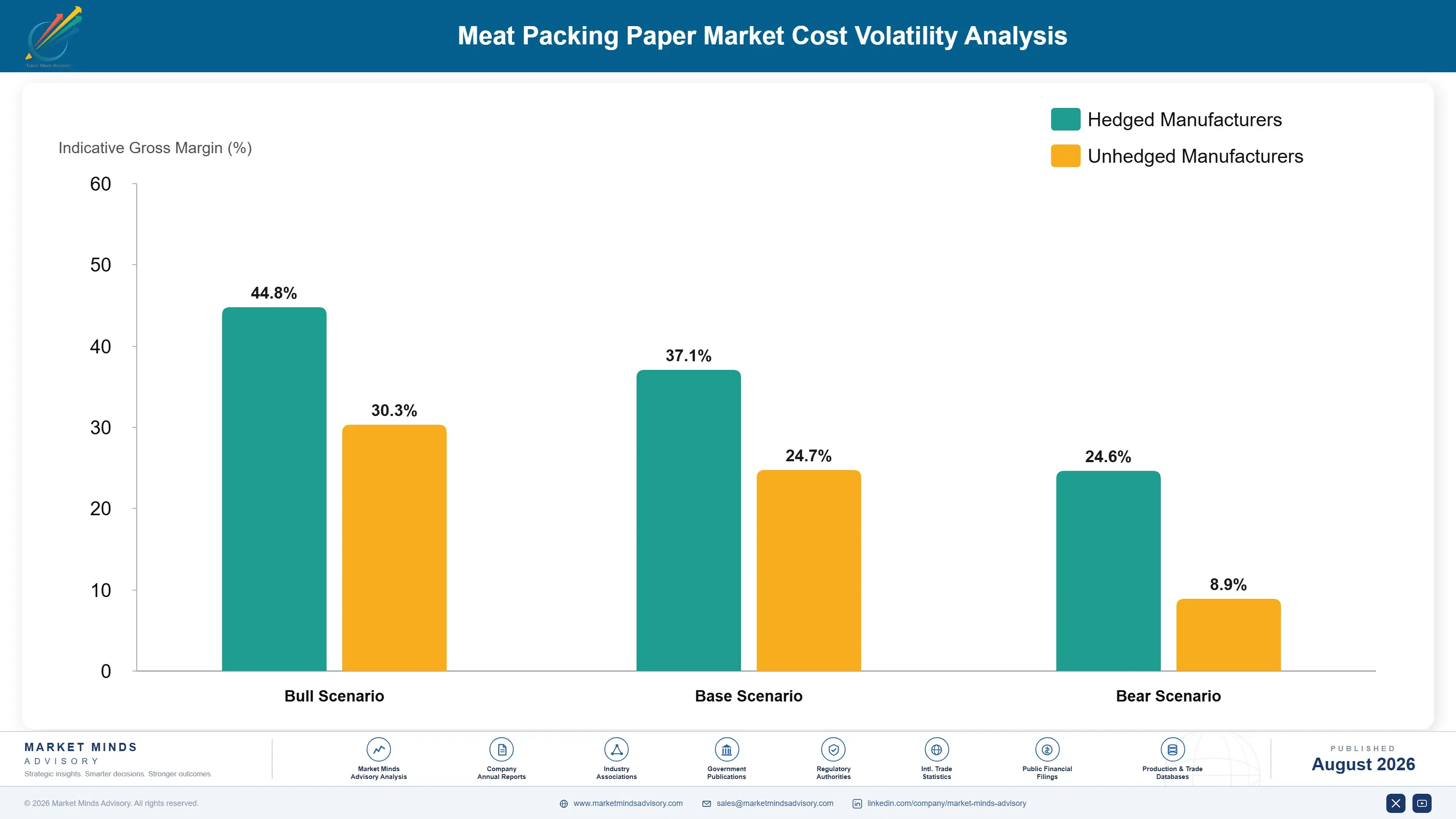
The 2025 North American pulp mill outage cluster, triggered by unplanned maintenance shutdowns, pushed kraft pulp spot prices up roughly 20 percent within a single quarter, according to named company annual report disclosures from major converters. Converters without long-term indexed pulp supply contracts absorbed the spike directly into margins, while those with locked annual pricing agreements passed only modest increases through to processors and retailers. The episode pushed several converters to diversify pulp sourcing across multiple regional suppliers.

Smaller regional converters lacking multi-year indexed pulp contracts face genuinely sharper margin swings than multinational competitors who negotiate volume-based pricing locks with major pulp mills directly. This exposure varies meaningfully by geography too, since converters serving retail case-ready customers face additional coating chemistry qualification costs that basic commodity wrapping producers largely avoid, compounding the disadvantage for undiversified regional players.
meat-packing-paper-market-cost-volatility-analysis-1787554401306

Diversify Pulp Sourcing Across Multiple Regions

Converters are qualifying secondary kraft pulp suppliers across multiple regions rather than relying entirely on single-source mill contracts, reducing exposure to any single mill disruption event entirely and permanently. This diversification adds modest logistics complexity but has proven worth the cost given repeated pulp price volatility episodes across recent years in the category overall.

Negotiate Multi-Year Indexed Pulp Supply Agreements

Large converters increasingly lock in multi-year pulp pricing agreements indexed to published market benchmarks, trading some negotiating leverage on price for genuine predictability in annual budgeting cycles each year. Smaller players lacking sufficient purchase volume to negotiate favorable index terms remain exposed to spot market pricing, widening the margin gap between scaled and regional competitors.

Portfolio Architecture for Margin Defence

Portfolio economics split cleanly along three tiers, with gross margins ranging from the low teens for commodity uncoated wrapping to well above 35 percent for coated moisture barrier and recyclable specialty formulations sold into premium retail channels. Commodity products compete almost entirely on delivered cost per unit, since wholesale distributors treat them as interchangeable products purchased through bid-based tender processes that repeat annually across most large accounts.
Specialty formulations capture disproportionate value because coating qualification barriers and retailer sustainability requirements genuinely limit competitive entry, letting incumbents sustain pricing power that commodity products cannot match at all. The tension between volume and premium tiers plays out most visibly in grocery retail accounts, where chains balance packaging cost pressure against case-ready shelf-life and sustainability requirements demanded by consumers and regulators alike.

High-value pools concentrate specifically in coated moisture barrier and recyclable sustainability applications, where shelf-life performance and plastic-reduction credentials command the steepest premiums available anywhere in the category. Regulatory-driven print grade formulations remain a smaller but scaling tier as food safety labeling mandates convert what was once a niche requirement into a genuine growth pool for early-mover specialty converters.

Volume / Commodity-Adjacent

Bulk uncoated butcher paper and heavy-duty wholesale wrapping stock sold through bid-based wholesale tenders where delivered cost per unit is the dominant purchasing criterion. Competitive intensity is highest here, with margin protection resting almost entirely on paper mill scale.
Gross Margin: 12-18%

Premium / Certified

Coated moisture barrier and specialty print labeling grades carrying retail case-ready and food safety certification, sold primarily into grocery and processor accounts. Qualification barriers protect pricing power against commodity substitution from uncertified competitors.
Gross Margin: 25-35%

Sustainability / Regulatory / Next-Generation

Recyclable sustainable coating grades meeting plastic-reduction retailer mandates, plus emerging bio-based coating chemistries developed for extended shelf life applications. Smaller in absolute volume today but scaling fast as sustainability policy accelerates across major grocery chains.
Gross Margin: 32-45%
meat-packing-paper-market-portfolio-architecture-1787554401818

High-value Sub-segments and Strategic Watch-out

Retail Case-Ready Barrier Formulations

High-value and high-growth given accelerating grocery retail case-ready conversion globally and expanding modern retail formats specifically across most major markets today and well into the future. Barrier formulations here command the category's steepest margins, and demand is compounding as conversion scales across most regions worldwide.
Gross Margin: 30-40%

Recyclable Coating Sustainability Contracts

High-value with moderate but steady growth as grocery retailers continue expanding plastic reduction commitments under multi-year sustainability programs across most major chains and independent grocers. Margins here remain attractive though growth trails the case-ready tier since recyclable coating penetration is already substantial among leading retailers.
Gross Margin: 32-42%

Bulk Wholesale Wrapping Stock

Volume core segment representing the largest absolute revenue base across wholesale meat distribution accounts worldwide, though margins stay thin given bid-based procurement practices repeated annually across most markets each cycle. This tier anchors total category volume even as growth concentrates elsewhere in the portfolio each year.
Gross Margin: 12-18%

Plastic Film Substitution Exposure

Strategic watch-out as plastic film alternatives compete for extended shelf-life applications across premium retail categories worldwide, since converters unable to match barrier performance risk losing share entirely. This tier could shift material share toward hybrid laminate competitors within several years given the pace of change.
Gross Margin: 18-30%

Annuity Demand, Retailer-Locked Stickiness

Meat packing paper purchasing behaves like an annuity once a converter completes retail case-ready qualification, since consumption tracks processing volume and store count rather than discretionary demand that swings with economic conditions broadly. Retailers rarely switch suppliers mid-qualification given the testing costs and packaging line integration risk involved, giving incumbent converters genuinely durable revenue visibility years into the future once a contract is won.
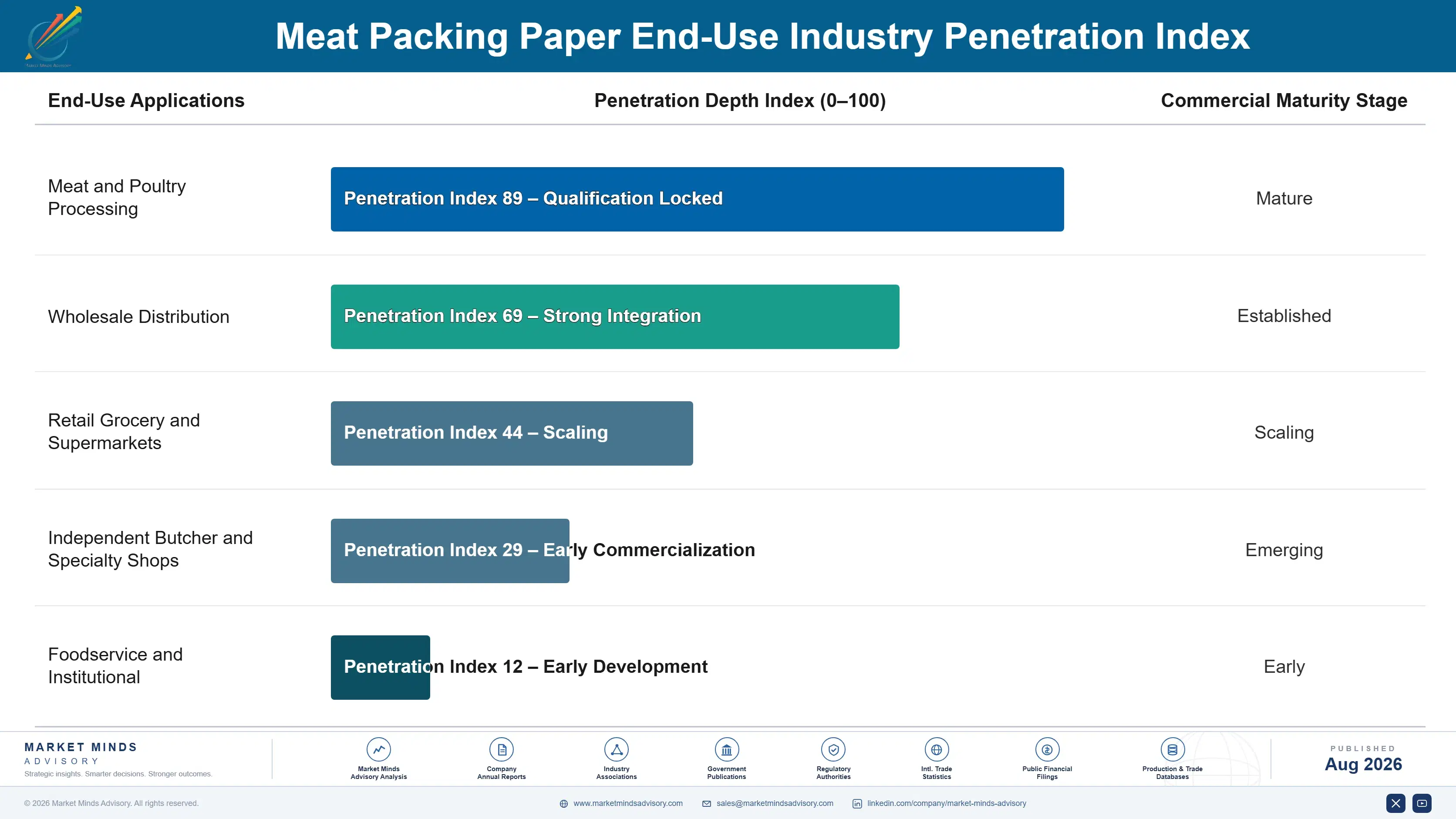
Adoption stickiness varies meaningfully by end-use vertical. Grocery retail accounts show the deepest entrenchment, since chains rarely requalify an alternate coated paper supplier absent a specific packaging line failure or supplier service breakdown. Processor accounts switch less readily too, given established wrapping line integration. Independent butcher shops switch more freely, chasing modest price concessions at contract renewal since performance specifications there are less stringent than retail applications.

Generational buyer shifts are underway as younger packaging and procurement staff, more comfortable evaluating sustainability credentials and coating performance data, replace veteran purchasing managers who prioritized price and supplier familiarity above all else. This transition favors converters with genuine recyclable coating credentials and documented barrier performance, and it is gradually eroding the advantage long held by legacy suppliers whose relationships rested mainly on tenure rather than differentiated product capability.
meat-packing-paper-market-end-use-penetration-index-1787554402324

Where to Compete in Packing Paper

These are among the four positions where our research anticipates prominent divergence between winners and laggards over the coming forecast period. Each is grounded in the demand model, the regulatory perimeter, and the announced capacity pipeline.
01 / CASE-READY QUALIFICATION INVESTMENT

Pursue Retail Qualification Before Contracts Lock In

Converters without retail case-ready qualification are ceding the highest-margin part of this market to competitors who invested in that testing cycle years ago already and at scale. That qualification captures roughly 25 percent higher unit pricing and creates genuine switching barriers that protect volume for the entire life of a packaging line relationship once fully secured. Any converter without qualified case-ready capability by 2028 risks permanent exclusion from major grocery chain packaging programs nationwide, where supplier pools remain genuinely constrained.
02 / RECYCLABLE COATING CERTIFICATION

Build Certification Capability Ahead of Retailer Mandates

Recyclable coating certification is becoming the category's most defensible position, not a niche side business, and converters delaying that investment will find themselves locked out of the fastest-growing segment entirely within a few years from now and beyond. Certified formulations already command 15 to 22 percent price premiums, and that gap will widen as retailer sustainability commitments tighten further across the grocery sector nationwide. Mid-sized players lacking coating research depth should partner with specialty chemists rather than build capability from scratch.
03 / PRINT GRADE COMPLIANCE EXPANSION

Expand Labeling Compliance Before Regulation Tightens

Selling generic wrapping stock alone is leaving genuine revenue on the table, since processors pay directly for the compliance certainty that documented print clarity provides for their own labeling audits, filings, and inspections. Converters with multi-jurisdiction print grade capability capture 12 to 18 percent higher pricing, and that premium holds steady regardless of broader commodity wrapping cycles elsewhere in the category overall. Converters without this capability should pursue it now, since labeling regulation continues tightening across most major markets worldwide.
04 / PULP COST DIVERSIFICATION RESPONSE

Diversify Pulp Sourcing Before Volatility Repeats

Kraft pulp costs are volatile enough that converters relying on single mill relationships face genuine margin risk within the next several price cycles ahead of most current forecasts and market projections available today across the industry. Converters still dependent on single-source pulp contracts should diversify supplier relationships now, rather than waiting for the next mill disruption to force a costly and disruptive reactive response later on down the road. Waiting risks ceding margin entirely to better-diversified competitors positioning right now.

Engagement Snapshot From the Field

A live engagement with an industry participant carrying material or product regulatory and market exposure ahead of a defining policy shift, showing how our research translates into a defensible multi-year portfolio strategy.
MARKET MINDS ADVISORY · CLIENT ENGAGEMENT SUMMARY
Meat Packing Paper Producer Strategic Portfolio Review and Transition Roadmap 2026·Investment Scenario on Meat Packing Paper Exposure Evaluation 2025-26
CLIENT PROFILE
The client operates a regional grocery chain across the southeastern United States with over one hundred stores, serving both urban and suburban markets. Facing public sustainability commitments and rising customer expectations around plastic reduction, leadership sought an independent evaluation of its meat department packaging strategy ahead of a multi-year vendor contract renewal covering all store locations.
STRATEGIC CHALLENGE
The chain's existing case-ready packaging relied heavily on plastic-laminated paper for moisture barrier performance, but leadership lacked clarity on whether switching to recyclable coated alternatives would meet both shelf-life requirements and public sustainability commitments without disrupting the existing supply relationship or increasing overall packaging costs meaningfully across the entire chain.
MMA APPROACH
MMA benchmarked the client's current packaging performance against comparable regional grocery chains, modeled shelf-life outcomes under recyclable coating alternatives, and interviewed packaging staff at three peer chains directly to surface real-world performance tradeoffs that sat well beyond the headline sustainability messaging presented by competing suppliers throughout the entire tender process.
KEY FINDINGS
  1. Recyclable coated alternatives matched plastic-laminated shelf-life performance for most meat categories, though extended shelf-life products showed modest performance gaps requiring further coating development.
  2. Peer chains that switched to recyclable coating reported measurable positive customer response tied to visible sustainability messaging on packaging materials at point of sale.
  3. The recyclable coating transition required moderate packaging line modifications, a one-time cost that peer chains recovered within roughly eighteen months through supplier volume commitments.
  4. Extended shelf-life categories including ground meat products benefited from a hybrid approach retaining plastic-laminated paper for that specific subset while converting standard cuts to recyclable coating.
CLIENT PROFILE
The client operates a regional grocery chain across the southeastern United States with over one hundred stores, serving both urban and suburban markets. Facing public sustainability commitments and rising customer expectations around plastic reduction, leadership sought an independent evaluation of its meat department packaging strategy ahead of a multi-year vendor contract renewal covering all store locations.
STRATEGIC CHALLENGE
The chain's existing case-ready packaging relied heavily on plastic-laminated paper for moisture barrier performance, but leadership lacked clarity on whether switching to recyclable coated alternatives would meet both shelf-life requirements and public sustainability commitments without disrupting the existing supply relationship or increasing overall packaging costs meaningfully across the entire chain.
MMA APPROACH
MMA benchmarked the client's current packaging performance against comparable regional grocery chains, modeled shelf-life outcomes under recyclable coating alternatives, and interviewed packaging staff at three peer chains directly to surface real-world performance tradeoffs that sat well beyond the headline sustainability messaging presented by competing suppliers throughout the entire tender process.
KEY FINDINGS
  1. Recyclable coated alternatives matched plastic-laminated shelf-life performance for most meat categories, though extended shelf-life products showed modest performance gaps requiring further coating development.
  2. Peer chains that switched to recyclable coating reported measurable positive customer response tied to visible sustainability messaging on packaging materials at point of sale.
  3. The recyclable coating transition required moderate packaging line modifications, a one-time cost that peer chains recovered within roughly eighteen months through supplier volume commitments.
  4. Extended shelf-life categories including ground meat products benefited from a hybrid approach retaining plastic-laminated paper for that specific subset while converting standard cuts to recyclable coating.
RECOMMENDED STRATEGY
Phase 1: Convert standard meat cut packaging to recyclable coated paper across all store locations within the renewed multi-year vendor contract terms. Phase 2: Retain plastic-laminated paper for extended shelf-life ground meat categories where coating performance gaps remain until further supplier development occurs over time. Phase 3: Negotiate volume commitments with the coated paper supplier directly to offset packaging line modification costs over the full contract term.
OUTCOME
The client adopted the hybrid packaging strategy, converting the majority of meat categories to recyclable coated paper while retaining plastic-laminated stock (client-reported, unverified by MMA) for extended shelf-life products only. Customer sustainability perception scores improved measurably following the conversion, and packaging line modification costs were recovered within the projected timeline.

Frequently Asked Questions

Foundational context covering the market sizes, CAGR, scope, country, region and competition that inform every finding below. This section is provided to cover basics and most often pre-purchase conversations, answered from the MMA Primary Research Dataset.

What is the current size of the Meat Packing Paper Market?

The global market reached an estimated 2.1 billion dollars in 2025. Growth is driven mainly by retail case-ready packaging conversion and food safety labeling requirements worldwide.

How large will the Meat Packing Paper Market be by 2036?

The market is projected to reach approximately 3.23 billion dollars by 2036. That represents a 1.48 times expansion over the eleven-year forecast period from 2026 onward.

What is the CAGR for the Meat Packing Paper Market 2026 to 2036?

The market is forecast to grow at a 4.0 percent compound annual rate through 2036. Bull and bear scenarios range from 2.8 to 5.2 percent depending on plastic-reduction mandate pace.

Which segment is growing fastest?

Coated moisture barrier paper leads growth at a 6.5 percent CAGR, roughly 1.6 times the overall market rate. Retail case-ready packaging conversion drives this outsized pace.

Who are the major companies in the Meat Packing Paper Market?

Georgia-Pacific, WestRock, Sonoco, Mondi, and International Paper lead the competitive field globally. Together they hold a 35 percent combined revenue share across the global market.

Which country is growing fastest?

India leads country-level growth at a 6.0 percent CAGR, outpacing the global average meaningfully. Expanding organized meat processing and modern retail formats both underpin that pace.

Report Segmentation Architecture

The full report scope spans multiple orthogonal segmentation dimensions, with cross-tabulated demand data provided for each dimension pair. Coverage extends further to regional breakdowns, trend trajectories, and the competitive detail needed to support segment-level decision-making.

By Coating and Function Type

  • Uncoated Butcher Paper
  • Coated Moisture Barrier Paper
  • Freezer Paper
  • Specialty Print Labeling Grade
  • Recyclable Sustainable Coating Grade
  • Heavy-Duty Wholesale Wrapping Stock

By End-Use Industry

  • Meat and Poultry Processing
  • Wholesale Distribution
  • Retail Grocery and Supermarkets
  • Independent Butcher and Specialty Shops
  • Foodservice and Institutional

By Commercial Dimension

  • Direct Processor Supply Contracts
  • Distributor and Channel Sales
  • Retail Case-Ready Packaging Agreements
  • Sustainability-Certified Supply Programs

By Region

  • North America
  • Western Europe
  • East Asia
  • South Asia and Pacific
  • Latin America
  • Middle East and Africa
  • Eastern Europe

Scope, Methodology, and Coverage

Every figure in this report is reproducible from documented input assumptions. The scope below maps the historical period, the forecast horizon, the segmentation dimensions, and the countries covered, alongside the underlying primary and qualitative methodology.
Historical Period
2020 to 2025
Forecast Period
2026 to 2036
Base Year
2025 (USD billions; MMA Primary Research Dataset, August 2026)
Market Definition
This report covers meat packing paper sold for meat and poultry processing, wholesale distribution, and retail case-ready packaging, including uncoated butcher paper, coated moisture barrier paper, freezer paper, and specialty labeling grades. It excludes plastic film packaging, vacuum sealing pouches, and rigid tray packaging sold independent of paper wrap components.
Quantitative Units
USD billions (current prices)
Segmentation Dimensions
By Coating and Function Type; By End-Use Industry; By Commercial Dimension; By Region
Regions Covered
North America, Western Europe, East Asia, South Asia and Pacific, Latin America, Middle East and Africa, Eastern Europe
Countries Covered
USA, China, Germany, France, UK, Japan, South Korea, India, Australia, Canada, Brazil, Mexico, Indonesia, Vietnam, Thailand, Malaysia, UAE, Saudi Arabia, South Africa, Nigeria, Turkey, Poland, Netherlands, Italy, Spain, Sweden, Switzerland, Argentina, Colombia, Singapore, and additional markets relevant to this sector
Key Companies Profiled
Georgia-Pacific, WestRock, Sonoco, Mondi, International Paper, Domtar Corporation, Sappi Limited, Stora Enso, Smurfit Kappa, Nordic Paper Holding, Berry Global, Bemis Company, Cascades Inc, Twin Rivers Paper Company, Fox River Paper, Rockline Industries, Interstate Resources, Ahlstrom-Munksjo, Delfort Group, Glatfelter
Quantitative Methodology
Primary survey, n=3,800 respondents, Q4 2025, six countries; demand-side model with trade association cross-validation
Qualitative Methodology
47 expert interviews, Q4 2025; applied to validate demand model assumptions, identify emerging dynamics, and assess competitive positioning
Report Format
PDF and XLSX data workbook (Word format preview document)
Publisher
Market Minds Advisory
Report Code
MMA-2026-PAC-103
Published
August 2026
Contact
sales@marketmindsadvisory.com | www.marketmindsadvisory.com

Purchase the full Meat Packing Paper Market Report (2026 to 2036).

This report provides comprehensive market intelligence on the meat packing paper market, covering sizing, segmentation, competitive positioning, and regional dynamics through 2036. It draws on primary survey data, expert interviews, and company disclosures to quantify demand drivers across meat processing, wholesale distribution, and retail case-ready end-use verticals. The analysis includes detailed competitive profiling of leading converters, input cost exposure assessment, and actionable revenue lever guidance for participants navigating coating qualification barriers and retailer sustainability commitments. Regional breakdowns cover all seven global regions with quantified share and growth projections.
Full ten-year market sizing and forecast data
Detailed segmentation across six product coating categories
Competitive profiling of top twenty industry participants
Regional analysis across all seven global regions
Input cost and pulp price volatility risk assessment
Strategic revenue lever and portfolio tier analysis

Built For The People Who Decide

From boardroom strategy to bench-side execution, this report is read cover-to-cover by leaders shaping the next decade of their industry, turning demand scenarios, market dynamics and valuation benchmarks into decisions.
CXOs/ Presidents/ VPs/ Managers
M&A and Corporate Development
Strategy Teams and R&D Heads
Procurement and Product Directors
Regulatory and Compliance Leaders
Investor Relations and Equity Analysts