Market Minds Advisory
Meat Alternative Market

Meat Alternative Market: Formulation Technology, Retail Consolidation, and Fermentation-Derived Protein Strategy Through 2036

Retailers are pruning underperforming plant-based meat brands even as fermentation-derived proteins post the category's fastest growth, and manufacturers still selling first-generation formulations are losing shelf space to faster-moving texture-accurate rivals.

Lead Analyst

Lisa Gevelber

Published

September 2026

Make Smarter Decisions with Customized Research Insights

Request a free sample report and evaluate market opportunities, growth trends, and competitive dynamics relevant to your business needs.

2025 MARKET VALUE$8.5BMarket Size 2025
2036 FORECAST VALUE$21.9BBase Case , 2026 to 2036
CAGR 2026 TO 20369.0 %Bull 10.3% / Bear 7.7%
INCREMENTAL OPPORTUNITY$12.7BNet 10- year value creation
EXPANSION MULTIPLE2.37x2036 value over 2026 base
Strategic Levers
M&A Pipeline
Regional Outlook
Country Rankings
Competitive Intelligence
Segmental Deep-dive
Call-Us : 91 93563 13602

Executive Snapshot and Market Trajectory

The meat alternative market has entered a consolidation phase after several years of rapid brand proliferation, one where fermentation-derived protein platforms increasingly outperform first-generation plant-based formulations on texture and taste rather than dietary substitution alone for mainstream buyers. Consumer expectations have shifted accordingly across most major retail markets.
Fermentation-derived and mycoprotein formulations are absorbing the fastest growth as retailers and foodservice buyers push texture and flavor consistency requirements beyond what early soy and pea protein blends were ever engineered to deliver. North America anchors both the deepest brand development base and the largest retail category revenue, with Beyond Meat and Impossible Foods scaling formulation research years ahead of markets still building category awareness from a smaller starting point. Momentum builds.
Consolidation continues as established meat alternative brands extend fermentation and mycoprotein capability to defend share against traditional meat companies launching competing plant-based lines, squeezing smaller brands without that specific formulation capability in place today. Burger and patty formats remain the largest revenue segment even as fermentation-derived and mycoprotein categories post the fastest incremental growth across the broader market landscape. North America's brand development lead continues widening steadily.
Market Definition
The meat alternative market covers plant-based burgers and patties, sausages and links, nuggets and strips, ground and mince formats, mycoprotein-based products, and fermentation-derived meat alternatives sold through retail and foodservice channels. It excludes cultivated or lab-grown meat produced from animal cell cultures, and standalone plant protein isolates sold without finished-product formulation.
Base Year Value
$8.5B in 2025 (MMA Primary Research Dataset, August 2026)
Forecast Period
2026 to 2036, eleven discrete annual values
CAGR
9.0% base case. Bull 10.3%. Bear 7.7%.
Fastest Growth Segment
Fermentation-Derived Meat Alternatives: 16.0% CAGR
Fastest Growth Country
China: 12.0% CAGR
Fastest Growth Region
South Asia and Pacific: 11.0% CAGR
Largest Region
North America: 30% of 2025 global value
Market Leaders
Beyond Meat, Impossible Foods, Maple Leaf Foods, Marfrig Global Foods, and Quorn Foods lead by disclosed retail shipment volume. Source: MMA Analysis based on company annual reports.
Primary Survey
n=3,800 procurement and R&D decision-makers, Q4 2025, six countries
Methodology
Demand-side build-up, cross-validated against public data, 47 expert interviews

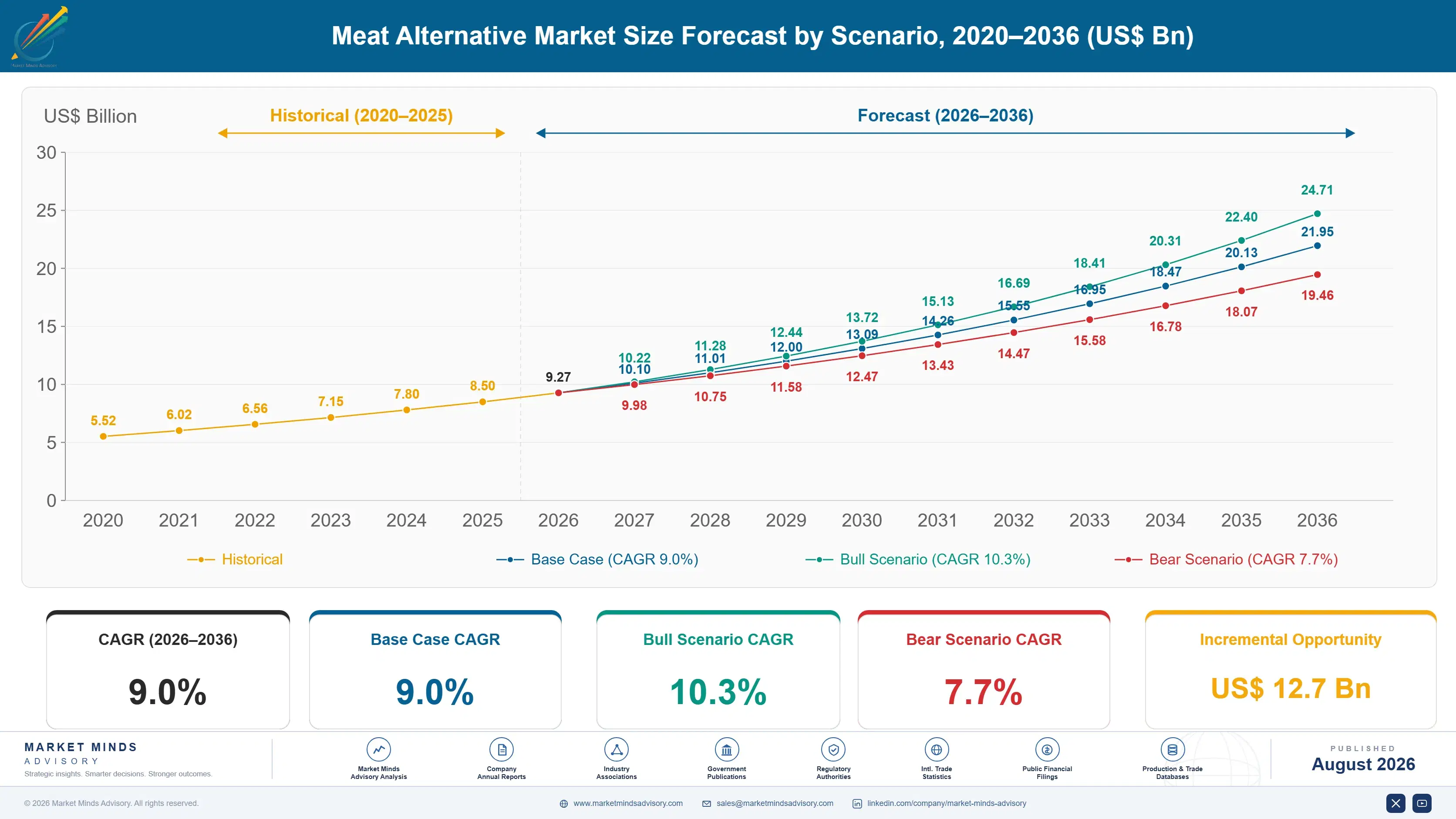
Meat Alternative Market Forecast Scenarios

meat-alternative-market-trends-forecast-size-forecast-scenario-1787458207198
Between 2020 and 2025 meat alternative demand grew rapidly at first before decelerating sharply as early retail enthusiasm gave way to repeat-purchase scrutiny across several major markets, and fermentation technology investment accelerated following growing manufacturer interest in texture accuracy during the back half of that period. Retailers pruned underperforming brands meaningfully as a direct result of that shift toward proven formulations.
The base case assumes continued retail category stabilization across North American and European channels sustaining unit volume, expanding replacement demand as manufacturers convert from first-generation soy and pea blends to fermentation-derived platforms, and steady growth in mycoprotein-based products as health-conscious buyers seek documented nutritional density beyond conventional plant-protein claims currently available. Each mechanism draws on a distinct retail budget line rather than competing for the same shelf space. Retailers now track all three mechanisms closely each planning cycle.
The bull case rests on faster-than-expected fermentation-derived cost reduction reaching retail price parity with conventional meat, accelerating the category recovery well ahead of current projections. The bear case is continued consumer skepticism following several years of disappointing first-generation product experiences, slowing both new buyer acquisition and the reformulation upgrade cycle for brands already struggling with retail delistings worldwide.

The Formulation Consolidation Wave Is Reshaping Fastest

A meat alternative succeeds or fails on how closely it replicates conventional meat's taste and texture during cooking, which is exactly why manufacturers treat protein platform selection as a product-integrity decision rather than a routine recipe adjustment. Manufacturers who cannot demonstrate this consistency lose retail trust quickly.
MARKET CONCENTRATIONCR5 36%top five brands hold a moderate combined shipment share
AVERAGE SELLING PRICE$9.60 per unitblended price across burger, sausage, and specialty formulation formats
LEADING PRODUCTION COUNTRYUnited States, 24% shareoutput concentrated near established brand development demand hubs
CAPACITY UTILISATION58%extrusion and fermentation production lines running below full capacity
FERMENTATION-DERIVED PENETRATION14% of unit volumefermentation formulations expanding fastest across most retail channels
TRADE INTENSITY33% cross-borderproduction typically co-located near major retail demand clusters
The market's commercial character splits between standard plant-based formulations still dominating cost-sensitive mass retail procurement and a smaller, faster-growing segment of fermentation-derived and mycoprotein formulations specified for their documented taste and texture performance. Suppliers serving the two tiers compete on different terms, since mass buyers negotiate heavily on unit price while premium buyers value documented sensory data above almost everything else.
The next decade will be shaped by continued retail consolidation as underperforming brands exit the category, by fermentation-derived meat alternatives spreading from niche premium specification into mainstream family retail as production cost declines, and by continued East Asian and South Asian flexitarian adoption sustaining unit volume even as mature markets shift toward a quality-driven rather than novelty-driven demand pattern. Suppliers positioned across all three trends capture the broadest share of incremental category growth. Suppliers positioned early in this shift are capturing outsized specification wins.
"A plant-based burger that tastes like a compromise does not survive a second retail cycle. That single sensory failure has quietly rewritten which brands actually keep their shelf space."
Director, Alternative Protein and Plant-Based Foods Practice · MMA Plant-Based and Fermentation-Derived Protein Products Practice · August 2026

Market Trends

Fermentation-Derived Proteins Now Reshaping Product Development

Retail buyers and foodservice operators increasingly demand meat alternatives built on fermentation-derived protein platforms that replicate conventional meat's taste and texture far more closely than early soy and pea blends ever achieved. At least six major brands have shifted core product development toward fermentation-derived platforms since 2024, up from a handful of premium-only references several years earlier across the category. Manufacturers report fermentation-derived formulations now carry a meaningful price premium over standard plant protein blends, reflecting both production cost and the sensory validation testing retailers increasingly require before listing. Retailers increasingly treat this as a baseline listing requirement.
Market Impact: Sustains volume across 3 emerging markets
Retail Delisting Accelerating Broader Category Consolidation

Major retailers have delisted a substantial number of underperforming plant-based meat products since 2023 as repeat-purchase data revealed weaker consumer loyalty than early category enthusiasm suggested, concentrating remaining shelf space among brands with proven sensory performance. At least several major retail chains have reduced plant-based meat assortment since 2024, a consolidation reflecting genuine buyer preference for fewer, better-performing formulations rather than broad novelty assortment. Distributors increasingly treat validated repeat-purchase data as a baseline requirement before listing. This consolidation has forced weaker brands to exit several major retail programs entirely within a single cycle.
Market Impact: Sustains demand across 4 retail markets

Market Opportunities and Growth Drivers

Expanding Flexitarian Adoption Sustaining Retail Demand

Global flexitarian dietary adoption continues expanding across South Asia, East Asia, and Latin America even as growth slows in mature markets, and every new formulation program entering the category eventually becomes a candidate for fermentation-derived specification regardless of the broader mycoprotein adoption debate reshaping the premium segment of this category currently. At least three major emerging retail markets have reported expanded flexitarian demand since 2024, reinforcing baseline unit volume that continues growing even as fermentation-derived and mycoprotein formulations capture an increasing share of total category revenue and margin. Retail buyers now treat this substantiation as a baseline listing requirement.
Market Impact: Compresses repeat purchase below 30 pct

Sensory Parity Now Required for Retail Reorder

Consumer demand for sensory parity with conventional meat, expanding across major retail markets, increasingly requires formulation chemistry engineered specifically for taste and texture substantiation that legacy soy-based products were never positioned to satisfy without a complete reformulation program from the ground up. At least four major retail markets have seen sensory-parity demand accelerate since 2024, sustaining demand for fermentation-derived specification that shows limited correlation with any single manufacturer's individual production cycle or regional footprint. Suppliers unable to substantiate sensory claims risk losing retail listing entirely within a single product cycle.
Market Impact: Extends scale-up 12 to 18 months

Market Restraints and Challenges

Consumer Skepticism Still Limits Repeat Purchase Rates

Standard first-generation plant-based meat, still a substantial segment by unit volume, faces persistent consumer skepticism following several years of disappointing taste and texture experiences, a root cause tied to early formulations prioritizing rapid market entry over the sensory validation testing that fermentation-derived platforms now undergo. The commercial impact compresses repeat-purchase rates on this segment to among the weakest in the broader packaged food category, forcing brands dependent on first-generation volume into a defensive discounting strategy rather than a growth strategy. Brands are pursuing fermentation-derived reformulation as a mitigation path to rebuild consumer trust over time.
Market Impact: Shifts 6 brands toward fermentation platforms

Fermentation Scale-Up Cycles Slow Cost Parity

Scaling precision fermentation production capacity while preserving protein functionality requires extensive bioreactor engineering, a root cause tied to the difficulty of replicating consistent fermentation yield across larger production volumes that behave very differently than laboratory or pilot-scale conditions. The commercial impact extends the timeline to retail price parity with conventional meat well beyond what conventional ingredient substitution would otherwise require, delaying broader category adoption by multiple product cycles in most cases observed. Manufacturers are pursuing scale-up partnerships with fermentation technology specialists as a mitigation path to compress the cost curve.
Market Impact: Cuts assortment across 5 retail chains
4 additional market trends, 3 additional growth drivers, and 4 additional restraints and challenges are covered in the full report. Contact sales@marketmindsadvisory.com to access the complete intelligence.

Segment CAGR and Growth Architecture

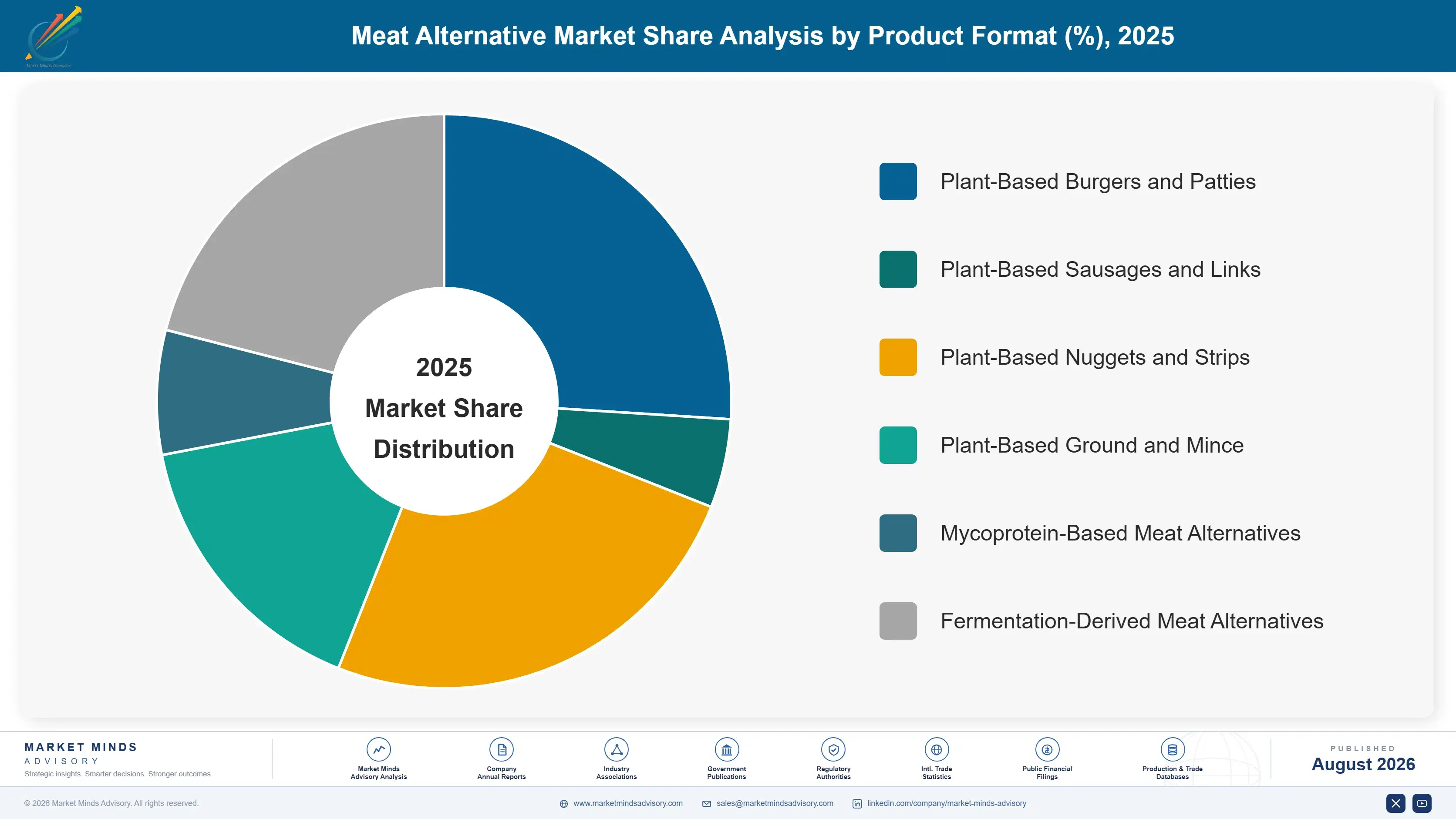
Segmentation follows finished product format rather than protein source, since retailers and foodservice buyers procure products by category first and specify protein platform as a downstream formulation decision within that category consistently across every channel. Ingredient houses build technical account teams around these same lines, reinforcing the practical relevance of this segmentation choice. Retailers apply this logic consistently.
meat-alternative-market-trends-forecast-market-share-analysis-1787458207734

Fermentation-Derived Meat Alternatives

Fermentation-derived meat alternatives are growing fastest as retailers and foodservice buyers push taste and texture accuracy beyond what early soy and pea protein blends were ever engineered to deliver consistently across cooking applications. The segment requires precision fermentation and protein functionalization technology that traditional plant-based formulators historically never needed to develop, favoring manufacturers who invested early in that specific technical capability over legacy soy-focused competitors still serving cost-sensitive channels. Adoption is spreading from premium retail specification into mainstream mass retail channels as production cost declines across the broader supply chain. Competitive intensity remains lower than in standard plant-based production, since fewer manufacturers can currently deliver validated fermentation-derived texture at consumer reliability standards, keeping this the category's highest-margin pocket.
CAGR 16.0%

Mycoprotein-Based Meat Alternatives

Mycoprotein-based meat alternatives are growing faster than the broader market as health-conscious retail buyers seek documented nutritional density and fiber content that standard soy and pea formulations cannot always match at comparable price points. The segment benefits from genuine documented nutritional differentiation value that consumers increasingly prioritize given rising interest in whole-food protein sources beyond conventional isolate-based claims currently available. Growth is concentrated among manufacturers with proven fungal fermentation and texture engineering, since the format requires biomass cultivation capability that standard plant-based specialists have not historically needed to develop for their existing product lines. That gap is widening each year. That gap is widening each year across most major retail markets.
CAGR 13.0%
Full segment breakdown across 6 segments available in the complete report.

Regional Architecture and Country Demand Map

North America leads on the combined strength of its brand development base and retail category revenue, with Western Europe and East Asia following at a measured pace. South Asia posts the fastest growth. Latin America and the Middle East add modest but steadily accelerating volume across the forecast horizon.

North America

The United States drives the bulk of regional demand, home to the category's founding brands and the deepest fermentation and protein research investment of any market covered in this study over the past decade. Beyond Meat and Impossible Foods both originated and scaled their formulation research within this market, reflecting the region's uniquely deep brand development base and revenue leadership. Canada contributes a modest, stable share tied closely to similar retail patterns as its southern neighbor. Mexico centers on export-oriented packaging rather than domestic demand generation at meaningful scale. This brand development depth and revenue leadership is the specific justification for assigning North America the largest regional share in this market, ahead of larger population markets elsewhere.
Share: 30% | CAGR: 8.2% (2026 to 2036)

Western Europe

Germany holds the largest single-country share within the region, supported by the highest per-capita flexitarian and vegetarian population share of any major European market and correspondingly deep retail category penetration. The United Kingdom, home to Quorn's mycoprotein production base, and the Netherlands contribute meaningful volume across a broad range of retail channels, with fermentation-derived formulations increasingly standard given the region's strong regulatory transparency expectations. France and the Nordic countries add further volume through expanding foodservice adoption. Regional growth trails North America and East Asia slightly, reflecting a more saturated retail base with proportionally less remaining category headroom to pursue. Regional growth trails North America and East Asia slightly, reflecting a comparatively saturated category base.
Share: 24% | CAGR: 7.5% (2026 to 2036)
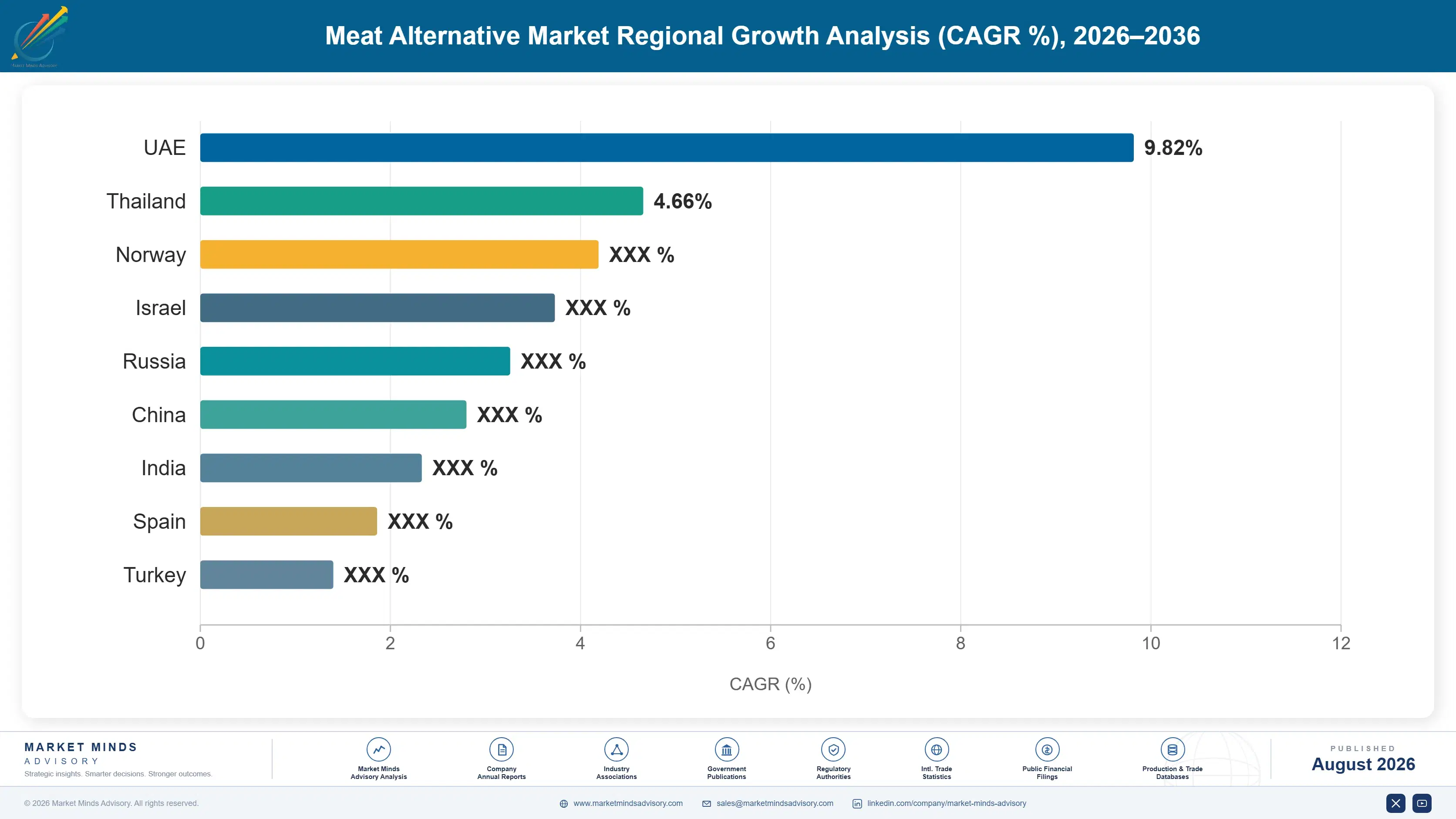
Regional intelligence for 5 additional markets available in the complete report: East Asia, South Asia and Pacific, Latin America, Middle East and Africa, Eastern Europe. Contact sales@marketmindsadvisory.com.
meat-alternative-market-trends-forecast-country-cagr-analysis-1787458208261

Where Brands Can Rebuild Margin and Trust

Four commercial levers separate brands capturing premium value from those competing purely on legacy soy-based price, spanning fermentation technology depth, sensory validation capability, retail brand repositioning, and geographic positioning relative to production hubs. Each pulls margin from a different point in the manufacturing and retail stack. Suppliers combining more than one lever tend to command the strongest margin position.

Build Very Deep Fermentation Technology Capability

Manufacturers that invest in precision fermentation and protein functionalization capture materially higher unit pricing than legacy soy-based products ever commanded, since the added fermentation capability justifies premium retail listings and long-term supply contracts that buyers are willing to pay for as sensory requirements intensify further. Fermentation-derived formulations carry roughly 2 to 3 times the unit price of comparable soy-based products, reflecting both production cost and the sensory validation testing retailers require before listing a brand at scale. Manufacturers without this capability are increasingly excluded from the fastest-growing product category entirely.
Market Impact: Captures roughly 2 to 3 times legacy pricing

Develop Much Deeper Sensory Validation Capability

Brands that build dedicated sensory testing and consumer panel infrastructure capture design wins on retail programs that standard formulation-only competitors cannot bid on competitively, since retailers increasingly value proven repeat-purchase data over generic plant-based claims alone at the point of listing decisions. This capability typically commands a 20 to 30 percent premium over standard formulation-only supply, reflecting the added personnel and testing investment required to maintain credible validation programs. Brands that invested early in this capability are winning multi-year retail listings as demand consolidates around proven performers. Brands increasingly require documented consumer panel data before finalizing contracts.
Market Impact: Captures a premium of 20 to 30 pct

Rebuild Consumer Trust Through Transparent Reformulation

Brands that transparently communicate reformulation improvements to skeptical consumers capture broader retail shelf space and repeat-purchase reach than brands relying purely on legacy marketing claims, since trust-conscious consumers increasingly prefer brands that acknowledge past shortcomings and demonstrate measurable improvement. Brands with credible reformulation narratives typically command 15 to 25 percent higher retail pricing than comparable legacy alternatives, since consumers factor rebuilt trust directly into purchase decisions at the point of sale. Brands without this transparency increasingly lose shelf space to more credible competitors. Retailers increasingly reward brands who can substantiate this improvement with data.
Market Impact: Commands a premium of 15 to 25 pct

Localize Production Near Regional Demand Hubs

Packaged meat alternative products are costly to ship internationally relative to their value once refrigerated freight weight is included, so manufacturers locating production near growing demand hubs in East Asia and South Asia capture freight and just-in-time delivery advantages that distant competitors cannot match, alongside meaningfully reduced working capital tied up in transit inventory. Localized manufacturers typically capture freight savings of 8 to 12 percent over distant competitors, winning preferred status as retailers compress supplier lead time requirements to match faster restocking cycles. Manufacturers without local presence increasingly lose bids to competitors who can guarantee shorter delivery windows.
Market Impact: Captures freight savings of 8 to 12 pct

Who Controls the Margin Pool

CR5 sits at 36 percent, reflecting a market moderately concentrated after several years of brand consolidation, as traditional meat companies launching competing plant-based lines continue capturing share from pure-play pioneers across most retail channels. The gap between the leading brand and second-tier challengers has widened as weaker performers exit the category. Several second-tier brands have gained share recently. Several second-tier challengers have gained ground recently.
Current competitive activity centers on fermentation capacity expansion to serve growing premium demand, sensory validation partnerships between brands and consumer research specialists, and continued consolidation as larger food companies acquire or invest in specialized formulation technology firms that lack capital to scale independently. Several brands have also begun offering documented sensory-parity guarantee programs. Buyers are watching closely for the next entrant capable of scaling nationally.

Emerging pressure comes from traditional meat companies launching their own plant-based and fermentation-derived lines, whose existing retail relationships and manufacturing scale are closing the credibility gap with pure-play pioneers faster than most incumbents expected just a few years ago. Specialized fermentation technology firms entering from outside the traditional food supply base are also gaining ground. Rankings among the top five brands could shift within several years.
meat-alternative-market-trends-forecast-company-positioning-matrix-1787458208787

Competitive Moat and Risk Dimensions

BEYOND MEAT INC

Moat: Broad mass retail distribution

Beyond Meat's position as a category-founding global brand lets it secure shelf space across the largest big-box and grocery retail networks that smaller specialty brands cannot match, capturing broader volume through consolidated retail relationships built over a decade of category presence. That distribution advantage becomes more valuable as retailers consolidate vendor relationships.
BEYOND MEAT INC

Risk: Fermentation specialists gaining credibility

Beyond Meat's legacy soy and pea-based positioning limits its credibility among sensory-conscious consumers who increasingly favor fermentation-derived brands with documented taste-parity reputations, a segment where formulation trust matters more than brand recognition alone. Rebuilding that trust would require years of consistent reformulation performance. That rebuild takes years of consistent product performance.
IMPOSSIBLE FOODS INC

Moat: Deep fermentation formulation expertise

Impossible Foods' specialized heme fermentation and protein functionalization investment gives it a formulation credibility advantage among sensory-conscious consumers that broader, less specialized competitors struggle to match consistently, particularly across premium foodservice channels. That accumulated formulation depth is difficult for newer entrants to replicate quickly. Retailers increasingly reference this depth when evaluating new supplier bids.
IMPOSSIBLE FOODS INC

Risk: Traditional meat companies intensifying

Rapidly scaling plant-based lines from traditional meat companies with established retail relationships are compressing the credibility premium Impossible Foods has historically commanded, forcing a shift toward continued innovation where its formulation depth still matters most to loyal customers. Impossible Foods must keep innovating to stay ahead of these fast-moving challengers.

Players Tracked

Prominent Players

Beyond Meat Inc
Impossible Foods Inc
Maple Leaf Foods
Marfrig Global Foods
Quorn Foods

Other Key Players

Nestle S.A.
Kellanova
Conagra Brands
OmniFoods
Starfield Food Science
Vivera
THIS Isn't
Meatless Farm
Redefine Meat
Motif FoodWorks
Nature's Fynd
Cargill Incorporated
JBS S.A.
Unilever
Tyson Foods Inc

Recent Developments

MARCH 2025

Beyond Meat Expands Fermentation Capacity in the United States

Beyond Meat commissioned an expanded precision fermentation production line at its domestic facility, adding dedicated capacity to serve growing retail demand from multiple distribution partners. The expansion represents the company's largest dedicated fermentation capacity addition to date. Full commissioning remains on schedule for late 2026.
Signal: Confirms fermentation-derived meat alternative demand has reached the scale needed to justify dedicated capacity investment decisions.
JULY 2025

Impossible Foods and a Major Foodservice Chain Sign Multi-Year Supply Agreement

Impossible Foods signed a multi-year supply agreement with a major foodservice chain covering fermentation-derived product lines across several menu categories, structured as a supply contract rather than a joint venture or equity arrangement. The agreement covers multiple product refresh cycles through 2029, with financial terms not disclosed publicly.
Signal: Confirms foodservice operators are consolidating meat alternative sourcing among fewer certified suppliers over multi-year terms. Multi-year terms are becoming standard.
DECEMBER 2025

Maple Leaf Foods Acquires a Regional Mycoprotein Specialist

Maple Leaf Foods acquired a mid-sized North American fungal fermentation technology company specializing in mycoprotein production systems, adding specialized capacity ahead of expanding retail demand across the region. The acquisition was Maple Leaf's first dedicated move into mycoprotein ownership rather than internal development. Terms were not disclosed.
Signal: Shows established brands acquiring specialized fermentation technology rather than building it internally from the ground up.

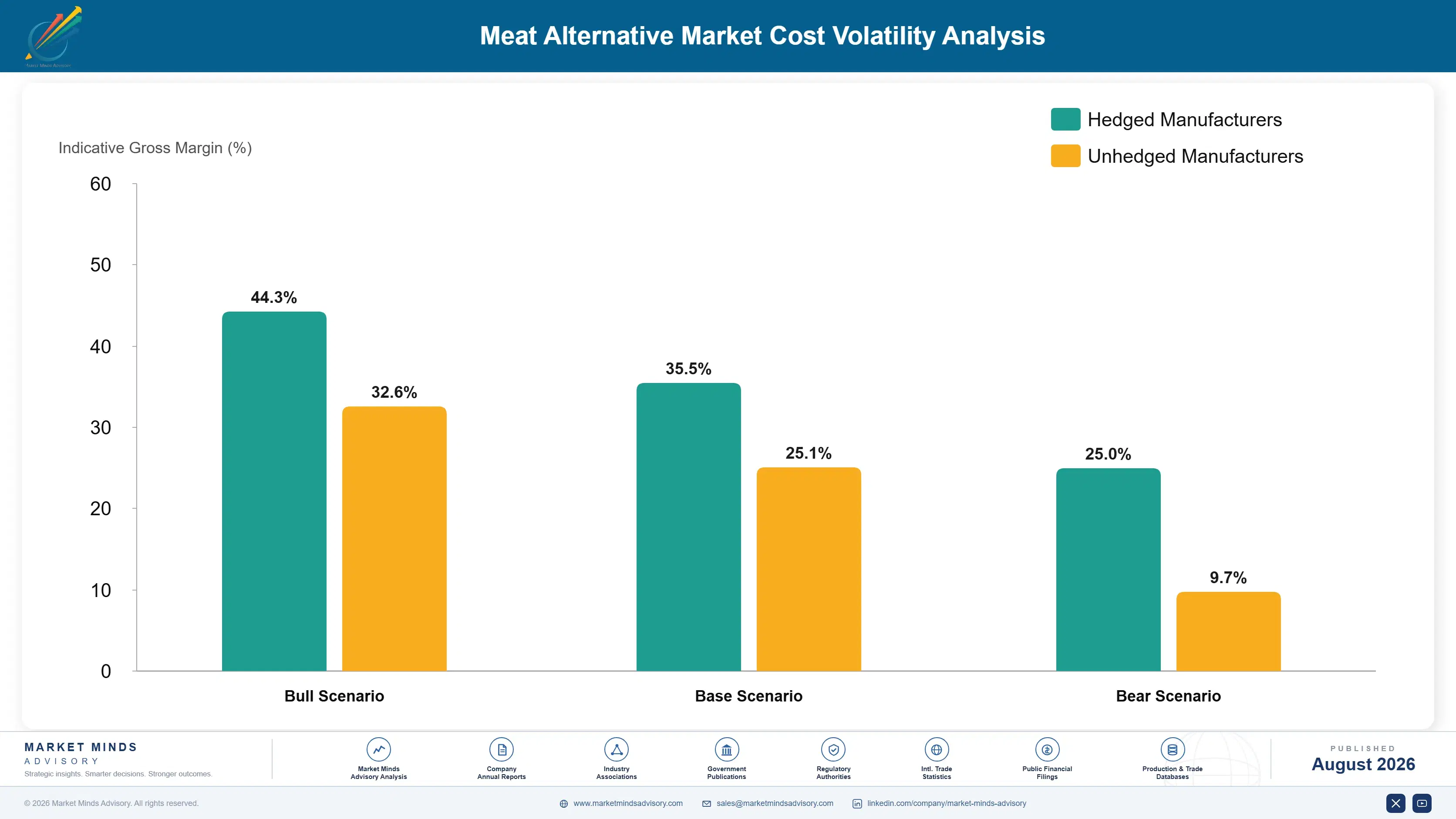
Fermentation Feedstock and Protein Cost Exposure

Pea protein, soy protein isolate, and fermentation feedstock sugars, along with specialty flavoring and binding agents, together account for roughly 44 percent of finished product cost, with fermentation-derived formulations carrying additional exposure to bioreactor operating costs sourced separately from standard extrusion. These inputs are sourced globally rather than regionally, so manufacturers rarely control pricing directly and instead pass volatility through via periodic contract adjustments.
Pea protein and fermentation feedstock sugar prices, which track broader agricultural commodity markets, rose noticeably through 2023 and 2024 according to industry pricing data referenced in multiple supplier annual reports, squeezing margins at manufacturers without long-term feedstock supply agreements in place at the time. Several manufacturers reported temporary cost pass-through negotiations with retail customers during that period, a disruption still referenced in current supplier risk disclosures.

The competitive disadvantage falls hardest on smaller independent brands without long-term feedstock supply agreements, since spot-market purchasing leaves them exposed to price swings that larger, vertically integrated competitors with direct supplier relationships can partially absorb through scale and hedging. Smaller brands without hedging programs carry higher earnings volatility than larger, better-capitalized competitors across the category. This gap is expected to widen further as feedstock volatility persists.
meat-alternative-market-trends-forecast-cost-volatility-analysis-1787458208982

Long-Term Feedstock Supply Agreements

Larger manufacturers are locking in multi-year pea protein and fermentation feedstock supply contracts with fixed or collared pricing to reduce exposure to spot market volatility, trading some cost upside for predictability that smaller competitors without negotiating leverage cannot access on comparable terms. This approach has become more common since 2024 as volatility increased across broader agricultural commodity markets generally.

Alternative Feedstock Source Qualification

Manufacturers are qualifying alternative protein and sugar feedstock sourcing regions that approach premium fermentation performance at meaningfully lower material cost, offering entry-level and mid-tier product lines a way to avoid full exposure to premium feedstock price volatility entirely. Several manufacturers have already validated at least one alternative source, with broader qualification testing continuing steadily.

Regional Feedstock Sourcing Diversification

Manufacturers are qualifying protein and feedstock sugar from multiple regional sources rather than depending on a single supplier or geography, reducing the risk that any one region's price spike or supply disruption stalls production across the fermentation line at scale. This strategy has expanded since the 2023 to 2024 disruption, with most large manufacturers maintaining two qualified sources.

Portfolio Architecture for Margin Defence

The portfolio splits into three tiers running on distinct economics: a volume tier built on standard soy and pea-based products sold near cost parity across competing manufacturers, a premium tier of mycoprotein formulations carrying meaningfully higher margin, and an emerging next-generation tier built on fermentation-derived formulations that commands a technology premium beyond pure texture differentiation alone. Manufacturers rarely operate across all three tiers with equal strength, and portfolio strategy increasingly determines where profitability concentrates.
The tension between volume and premium is not simply about margin, since mass-retail buyers purchasing standard products for cost-sensitive channels are extremely price-sensitive and switch brands readily at reorder time, while premium and foodservice buyers are paying for genuine sensory differentiation and tolerate meaningfully less price sensitivity as long as the experience holds up against realistic alternatives.

High-value margin pools concentrate in fermentation-derived and mycoprotein formulations, both of which combine technical differentiation with sensory and nutritional tailwinds that commodity soy-based products simply cannot generate, giving manufacturers positioned in either pool meaningfully more pricing power than the broader market average would otherwise suggest. Portfolio breadth increasingly determines retail program win rates. Brands that ignore this shift risk ceding the category's most profitable pools to faster-moving rivals.

Volume / Commodity-Adjacent Tier

Standard soy and pea-based meat alternatives for cost-sensitive mass retail procurement, priced to compete directly against other volume manufacturers on cost and shelf availability. This tier remains the largest by unit volume even as its category revenue share continues to shrink.
Gross Margin: 8-14%

Premium / Certified Tier

Mycoprotein formulations meeting consumer taste and nutritional standards, sold into premium retail and direct-to-consumer channels at a meaningful margin premium. Manufacturers in this tier increasingly compete on documented sensory consistency data.
Gross Margin: 19-27%

Sustainability / Regulatory / Next-Generation Tier

Fermentation-derived formulations combining protein functionality and validated sensory data, commanding a technology premium as retailers prioritize maximum consumer trust and repeat purchase loyalty. Adoption remains limited today but is expected to expand.
Gross Margin: 24-32%
meat-alternative-market-trends-forecast-portfolio-architecture-1787458209476

High-value Sub-segments and Strategic Watch-out

Fermentation-Derived Meat Alternatives

Combines the fastest growth rate in the market with premium technology pricing, making it the single most valuable pool for manufacturers with fermentation engineering capability built up over several years of dedicated investment. Few competitors currently possess this capability at scale, keeping margins durable for early movers.
Gross Margin: 26-32%

Mycoprotein-Based Meat Alternatives

Growing steadily as health-conscious demand expands format viability, offering manufacturers with fungal fermentation engineering capability a durable margin premium over standard soy competitors facing steady share erosion each year. Buyers increasingly ask for it by name at renewal. Buyers increasingly ask for it by name at renewal.
Gross Margin: 18-26%

Standard Soy and Pea-Based Products

The steady volume core of the market, growing roughly in line with overall retail expansion and offering predictable but noticeably thinner margin than either the fermentation or mycoprotein tiers discussed above in this report. Manufacturers compete mainly on cost and shelf availability rather than differentiation.
Gross Margin: 8-14%

Legacy First-Generation Undifferentiated Formats

A strategic watch-out segment facing steady decline as rising sensory expectations and repeat-purchase scrutiny phase out undifferentiated first-generation designs in favor of fermentation-derived alternatives even in the most cost-sensitive retail channels globally. Brands reliant on these designs face sharper margin erosion as retailers delist references.
Gross Margin: 3-9%

From First Trial to Formulation Trust

Retail listing relationships behave closer to annuities than one-off transactional sales once a brand wins a major retail chain's preferred vendor slot, since requalifying an alternative supplier mid-season disrupts sensory validation work that retailers are reluctant to repeat within a single product cycle. Renewal cycles for these listings typically span two to four years, reinforcing the annuity-like revenue pattern brands with strong incumbent positions enjoy. Brands with strong incumbent positions rarely lose these slots without a major performance failure.
Adoption depth varies sharply by end-use vertical: foodservice operators and premium retail buyers have pushed fermentation-derived and mycoprotein formats deep into standard purchase consideration, while casual mass-market buyers still rely largely on standard soy-based products with minimal upgrade sophistication after past disappointments.

A generational shift is underway in retail buyer procurement priorities as younger consumers increasingly specify products based on documented sensory parity and fermentation credentials rather than upfront price or novelty appeal alone, a change that favors brands who can demonstrate validated formulation data over those competing purely on unit cost. Suppliers who invest in transparent testing reporting are positioned to capture this shift first. Brands slow to adapt risk losing shelf priority to more transparent competitors.
meat-alternative-market-trends-forecast-end-use-penetration-index-1787458209970

Fermentation Technology Depth Decides the Decade

These are among the four positions where our research anticipates prominent divergence between winners and laggards over the coming forecast period. Each is grounded in the demand model, the regulatory perimeter, and the announced capacity pipeline.
01 / FERMENTATION TECHNOLOGY FOCUS

Build fermentation capability now

Fermentation-derived formulations carry two to three times the pricing of legacy soy-based products and require precision fermentation engineering only a subset of manufacturers currently possess at consumer reliability standards. Manufacturers without this capability are increasingly excluded from both premium retail listings and long-term foodservice contracts as sensory-parity expectations continue rising across most major retail markets. Manufacturers should direct capital toward fermentation technology rather than expanding legacy soy-based capacity, since that path offers shrinking differentiation against faster-moving competitors already scaling aggressively across most major markets today.
02 / SENSORY VALIDATION STRATEGY FOCUS

Build sensory validation infrastructure now

Retail demand for documented repeat-purchase data is expanding beyond niche premium channels into mainstream listing decisions as consolidation accelerates, and manufacturers without dedicated sensory testing capability are increasingly excluded from these listing wins as retailers standardize validation requirements. Early movers building this capability are securing multi-year retail listings that standard formulation-only competitors cannot bid on. Building or acquiring sensory validation capability now positions manufacturers ahead of a consolidation trend that shows no sign of reversing across major markets through the current decade and beyond.
03 / GEOGRAPHIC POSITIONING STRATEGY

Expand production capacity in East Asia now

East Asia combines above-average regional growth with substantial remaining flexitarian adoption headroom, giving manufacturers with capacity there durable volume other mature regions increasingly cannot match. This is a materially different calculus than a decade ago when mature-market novelty volume alone justified most capacity investment decisions industry-wide across the category. Manufacturers still concentrated in legacy mature-market locations should carefully evaluate East Asian capacity additions as a near-term priority rather than treating it as a longer-term option to revisit only after competitors have already locked in preferred capacity.
04 / MATERIAL COST RISK MANAGEMENT

Secure long-term feedstock agreements now

Pea protein and fermentation feedstock costs, tied closely to broader agricultural commodity markets, remain the largest source of margin volatility across the standard formulation segment specifically, and manufacturers without long-term supply agreements carry a lasting cost disadvantage relative to vertically integrated competitors with direct feedstock access. The 2023 to 2024 feedstock price increase demonstrated how quickly this exposure can compress margins for unhedged manufacturers operating on thin working capital. Manufacturers should prioritize locking in multi-year agreements before the next material price disruption arrives unexpectedly.

Engagement Snapshot From the Field

A live engagement with an industry participant carrying material or product regulatory and market exposure ahead of a defining policy shift, showing how our research translates into a defensible multi-year portfolio strategy.
MARKET MINDS ADVISORY · CLIENT ENGAGEMENT SUMMARY
Meat Alternative Producer Strategic Portfolio Review and Transition Roadmap 2026·Investment Scenario on Meat Alternative Exposure Evaluation 2025-26
CLIENT PROFILE
The client was a regional Eastern European meat alternative manufacturer with roughly $22 million in annual revenue (client-reported, unverified by MMA), supplying primarily standard soy-based products to established retail distribution contracts, seeking to build fermentation capability ahead of expanding Western European demand. The client had no prior fermentation-derived reformulation experience internally, and its product line had not changed meaningfully in several years.
STRATEGIC CHALLENGE
The client's standard soy-based business faced declining retail listings as Western European retailers increasingly delisted underperforming first-generation products in favor of fermentation-derived competitors, while rivals with proven fermentation partnerships had already begun winning preferred vendor slots the client lacked technical capability to bid on. Leadership set a two-year window to build credible capability before losing further market position.
MMA APPROACH
MMA conducted a competitive formulation capability assessment against fermentation technology leaders, modeled the capital investment case for bioreactor engineering against projected Western European retail volume, and benchmarked brand positioning strategy to identify a realistic path forward for the client, including interviews with three prospective retail chain customers to validate demand assumptions.
KEY FINDINGS
  1. Fermentation-derived retail listings carried roughly 2.1 times the margin of the client's existing standard soy-based portfolio, based on comparable disclosed program economics across peers.
  2. Reformulation investment payback fell within three product refresh cycles given the client's existing retail relationships and distribution footprint already established prior to the engagement's start.
  3. The client's existing extrusion expertise transferred meaningfully to fermentation-derived platforms, reducing the engineering investment required relative to starting from scratch entirely on its own.
  4. A technology licensing partnership could accelerate fermentation capability faster than fully independent in-house reformulation development by roughly one full product refresh cycle.
CLIENT PROFILE
The client was a regional Eastern European meat alternative manufacturer with roughly $22 million in annual revenue (client-reported, unverified by MMA), supplying primarily standard soy-based products to established retail distribution contracts, seeking to build fermentation capability ahead of expanding Western European demand. The client had no prior fermentation-derived reformulation experience internally, and its product line had not changed meaningfully in several years.
STRATEGIC CHALLENGE
The client's standard soy-based business faced declining retail listings as Western European retailers increasingly delisted underperforming first-generation products in favor of fermentation-derived competitors, while rivals with proven fermentation partnerships had already begun winning preferred vendor slots the client lacked technical capability to bid on. Leadership set a two-year window to build credible capability before losing further market position.
MMA APPROACH
MMA conducted a competitive formulation capability assessment against fermentation technology leaders, modeled the capital investment case for bioreactor engineering against projected Western European retail volume, and benchmarked brand positioning strategy to identify a realistic path forward for the client, including interviews with three prospective retail chain customers to validate demand assumptions.
KEY FINDINGS
  1. Fermentation-derived retail listings carried roughly 2.1 times the margin of the client's existing standard soy-based portfolio, based on comparable disclosed program economics across peers.
  2. Reformulation investment payback fell within three product refresh cycles given the client's existing retail relationships and distribution footprint already established prior to the engagement's start.
  3. The client's existing extrusion expertise transferred meaningfully to fermentation-derived platforms, reducing the engineering investment required relative to starting from scratch entirely on its own.
  4. A technology licensing partnership could accelerate fermentation capability faster than fully independent in-house reformulation development by roughly one full product refresh cycle.
RECOMMENDED STRATEGY
Phase 1: Phase 1 (0-9 months): License core fermentation technology from an established partner and begin pilot taste validation testing across two initial product lines. Phase 2: Phase 2 (9-24 months): Bid competitively for retail listings across two upcoming Western European retail chain opportunities identified during Phase 1 planning. Phase 3: Phase 3 (24-42 months): Build independent fermentation capability internally to reduce long-term dependence on the original technology licensing partner going forward.
OUTCOME
The client won retail listings with one of two targeted Western European chains within eighteen months of the licensing partnership launch, adding an estimated $5.4 million in annual contracted revenue (client-reported, unverified by MMA) at materially higher margin than its legacy standard soy-based business had previously generated.

Frequently Asked Questions

Foundational context covering the market sizes, CAGR, scope, country, region and competition that inform every finding below. This section is provided to cover basics and most often pre-purchase conversations, answered from the MMA Primary Research Dataset.

What is the current size of the Meat Alternative Market?

The global meat alternative market is valued at approximately $8.5 billion in 2025, spanning burger, sausage, nugget, ground, mycoprotein, and fermentation-derived formats sold across major retail and foodservice channels worldwide.

How large will the Meat Alternative Market be by 2036?

The market is projected to reach approximately $21.93 billion by 2036, driven primarily by fermentation-derived formulation adoption and expanding flexitarian demand across both mainstream and emerging markets.

What is the CAGR for the Meat Alternative Market 2026 to 2036?

The market is projected to grow at a compound annual rate of 9.0 percent between 2026 and 2036, with fermentation-derived alternatives growing fastest within that total.

Which segment is growing fastest?

Fermentation-derived meat alternatives are growing fastest at 16.0 percent annually, roughly 1.78 times the overall market rate, driven by sensory parity demand and expanding retail listing consolidation.

Who are the major companies in the Meat Alternative Market?

Beyond Meat, Impossible Foods, Maple Leaf Foods, Marfrig Global Foods, and Quorn Foods lead the market by disclosed shipment volume, alongside fifteen other significant global manufacturers serving major retail channels.

Which country is growing fastest?

China is growing fastest among major markets at 12.0 percent annually, supported by rapid urban flexitarian adoption and government-backed dietary shift initiatives serving both domestic and export demand.

Report Segmentation Architecture

The full report scope spans multiple orthogonal segmentation dimensions, with cross-tabulated demand data provided for each dimension pair. Coverage extends further to regional breakdowns, trend trajectories, and the competitive detail needed to support segment-level decision-making.

By Product Format

  • Plant-Based Burgers and Patties
  • Plant-Based Sausages and Links
  • Plant-Based Nuggets and Strips
  • Plant-Based Ground and Mince
  • Mycoprotein-Based Meat Alternatives
  • Fermentation-Derived Meat Alternatives

By End-Use Channel

  • Household and At-Home Cooking
  • Foodservice and Restaurant Channels
  • Institutional and Catering

By Sales Channel

  • Big-Box and Mass Retail
  • Direct-to-Consumer E-Commerce
  • Specialty and Natural Foods Retail

By Region

  • North America
  • Western Europe
  • East Asia
  • South Asia and Pacific
  • Latin America
  • Middle East and Africa
  • Eastern Europe

Scope, Methodology, and Coverage

Every figure in this report is reproducible from documented input assumptions. The scope below maps the historical period, the forecast horizon, the segmentation dimensions, and the countries covered, alongside the underlying primary and qualitative methodology.
Historical Period
2020 to 2025
Forecast Period
2026 to 2036
Base Year
2025 (USD billions; MMA Primary Research Dataset, August 2026)
Market Definition
This report covers plant-based burgers and patties, sausages and links, nuggets and strips, ground and mince formats, mycoprotein-based products, and fermentation-derived meat alternatives sold through retail and foodservice channels. It excludes cultivated or lab-grown meat produced from animal cell cultures, and standalone plant protein isolates sold without finished-product formulation.
Quantitative Units
USD billions (current prices); million units shipped where applicable
Segmentation Dimensions
By Product Format; By End-Use Channel; By Sales Channel; By Region
Regions Covered
North America, Western Europe, East Asia, South Asia and Pacific, Latin America, Middle East and Africa, Eastern Europe
Countries Covered
USA, China, Germany, France, UK, Japan, South Korea, India, Australia, Canada, Brazil, Mexico, Indonesia, Vietnam, Netherlands, Sweden, UAE, Saudi Arabia, South Africa, Nigeria, Turkey, Poland, Czechia, Romania, Hungary, Argentina, Colombia, Singapore, Switzerland, and additional markets relevant to this sector
Key Companies Profiled
Beyond Meat Inc, Impossible Foods Inc, Maple Leaf Foods, Marfrig Global Foods, Quorn Foods, Nestle S.A., Kellanova, Conagra Brands, OmniFoods, Starfield Food Science, Vivera, THIS Isn't, Meatless Farm, Redefine Meat, Motif FoodWorks, Nature's Fynd, Cargill Incorporated, JBS S.A., Unilever, Tyson Foods Inc
Quantitative Methodology
Primary survey, n=3,800 respondents, Q4 2025, six countries; demand-side model with trade association cross-validation
Qualitative Methodology
47 expert interviews, Q4 2025; applied to validate demand model assumptions, identify emerging dynamics, and assess competitive positioning
Report Format
PDF and XLSX data workbook (Word format preview document)
Publisher
Market Minds Advisory
Report Code
MMA-2026-AGR-604
Published
August 2026
Contact
sales@marketmindsadvisory.com | www.marketmindsadvisory.com

Purchase the full Meat Alternative Market Report (2026 to 2036).

The full Meat Alternative Market report delivers a complete quantitative and qualitative assessment across all six product format segments, seven regions, and twenty profiled companies operating in this space worldwide. It includes detailed sizing and forecast models through 2036, competitive benchmarking on shipment volume, and a full formulation tracker covering fermentation-derived development timelines by jurisdiction. Buyers receive segment-level and country-level data tables supporting the full analysis presented throughout this report and its appendices. Access includes ongoing analyst support for the duration of the license period.
Segment-level sizing across six product format categories
Country-level forecast data for thirty markets
Competitive benchmarking on shipment volume basis
Formulation tracker for fermentation-derived development timelines
Sensory and texture parity analysis by retail channel
Twenty-company competitive profile database, updated quarterly

Built For The People Who Decide

From boardroom strategy to bench-side execution, this report is read cover-to-cover by leaders shaping the next decade of their industry, turning demand scenarios, market dynamics and valuation benchmarks into decisions.
CXOs/ Presidents/ VPs/ Managers
M&A and Corporate Development
Strategy Teams and R&D Heads
Procurement and Product Directors
Regulatory and Compliance Leaders
Investor Relations and Equity Analysts