Market Minds Advisory
Mattifying Skin Care Products Market

Mattifying Skin Care Products Market: Mattifying Skin Care Products Market: Absorbent Effects, Sebum Regulation and Climate Driven Demand, 2026 to 2036

Most of this category is absorbent powder that lasts until lunchtime. The formulations that genuinely reduce sebum production get sold under quite different claims, in an entirely different aisle altogether.

Lead Analyst

Published

September 2026

Make Smarter Decisions with Customized Research Insights

Request a free sample report and evaluate market opportunities, growth trends, and competitive dynamics relevant to your business needs.

2025 MARKET VALUE$6.4BMarket Size 2025
2036 FORECAST VALUE$13.8BBase Case , 2026 to 2036
CAGR 2026 TO 20367.2 %Bull 8.4% / Bear 6.0%
INCREMENTAL OPPORTUNITY$6.9BNet 10- year value creation
EXPANSION MULTIPLE2.00x2036 value over 2026 base
Strategic Levers
M&A Pipeline
Regional Outlook
Country Rankings
Competitive Intelligence
Segmental Deep-dive
Call-Us : 91 93563 13602

Executive Snapshot and Market Trajectory.

Around 68% of this category works by absorbing oil rather than reducing how much the skin produces, and the visible effect lasts about 3.4 hours. That is a cosmetic result sold as a skincare one, and consumers reapply because the underlying condition never changed. Reapplication follows, not loyalty.
Sebum-regulating serums grow at 10.8%, half again the market rate of 7.2%, as consumers move toward formulations that alter production rather than mask output. Mattifying sun protection follows at 9.4%, since shine is the main reason daily sun protection goes unused in humid climates and removing it removes the objection. Men now account for 31% of purchases, frequently entering skincare through oil control. Consumption per person in humid markets stays far below mature levels.
Climate rather than fashion drives the geography. East Asia holds 31% of category revenue and South Asia and Pacific 18%, both above their usual bands, because shine control is a daily practical concern there rather than an occasional aesthetic one. Around 42% of users report tightness or irritation from oil-stripping routines, and brands pairing oil control with barrier support are taking share from those stripping harder.
Market Definition
This market covers skin care products formulated to reduce visible facial shine or control sebum, including mattifying moisturisers and lotions, oil-control cleansers and toners, sebum-regulating serums and treatments, clay masks and absorbing treatments, blotting and touch-up products, and mattifying sun protection. It excludes colour cosmetics foundations and powders, prescription acne medicines, clinical procedures, general skin care carrying no oil-control claim, and professional salon treatments.
Base Year Value
$6.4B in 2025 (MMA Primary Research Dataset, September 2026)
Forecast Period
2026 to 2036, eleven discrete annual values
CAGR
7.2% base case. Bull 8.4%. Bear 6.0%.
Fastest Growth Segment
Sebum-Regulating Serums And Treatments: 10.8% CAGR
Fastest Growth Country
Indonesia: 12.4% CAGR
Fastest Growth Region
South Asia and Pacific: 9.2% CAGR
Largest Region
East Asia: 31% of 2025 global value
Market Leaders
L'Oreal, Beiersdorf, Unilever, Shiseido, and Amorepacific lead the field. Source: MMA Primary Research Dataset, July 2026.
Primary Survey
n=3,800 procurement and R&D decision-makers, Q4 2025, six countries
Methodology
Demand-side build-up, cross-validated against public data, 47 expert interviews

Mattifying Skin Care Products Market Forecast Scenarios

mattifying-skin-care-products-market-size-forecast-scenario-1790012044121
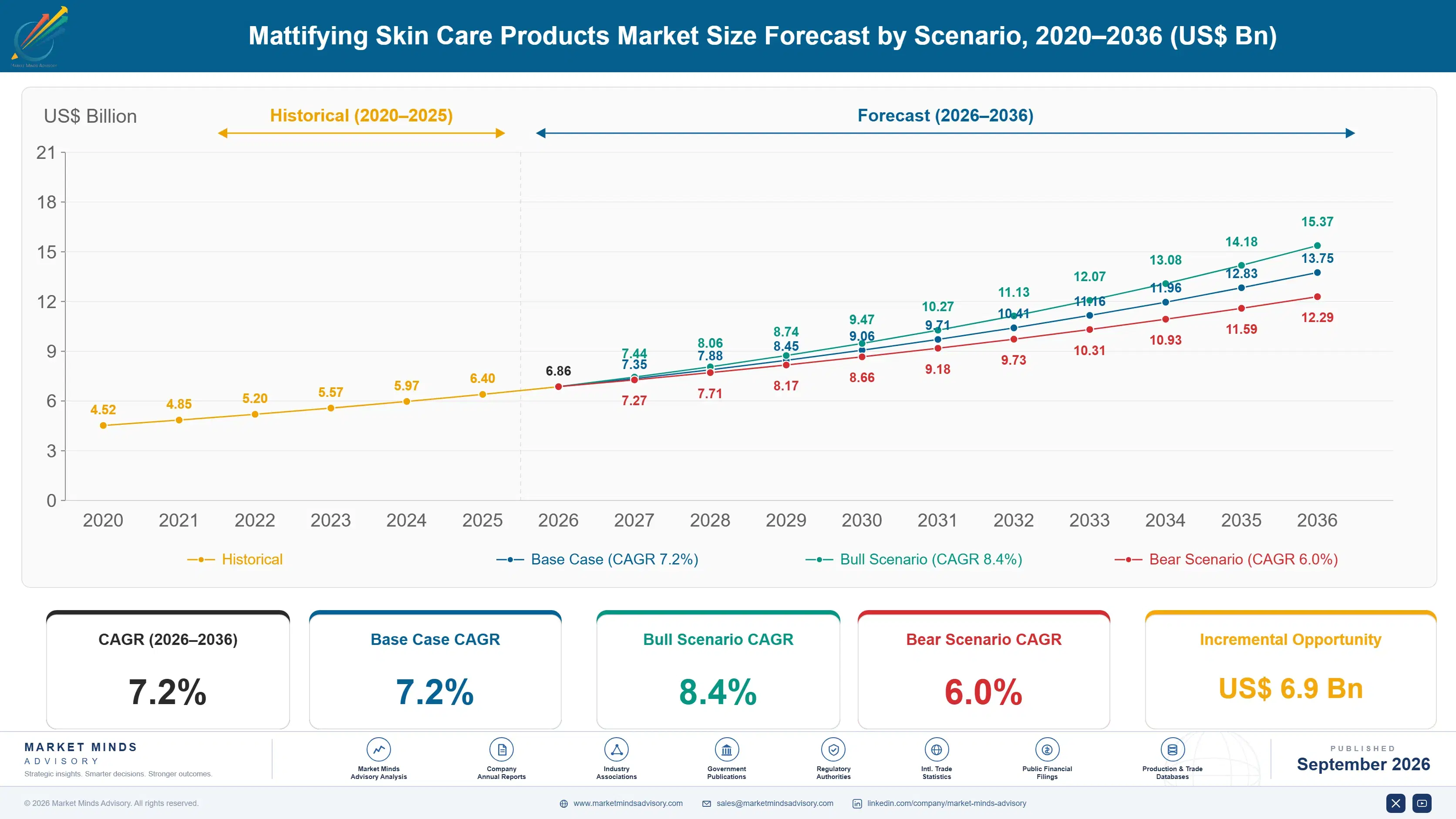
Between 2020 and 2025 the category grew steadily while its centre of gravity shifted. Consumers became considerably better informed about ingredients, and the gap between products that absorb oil and products that reduce its production became visible to anybody willing to read a label. Historical growth of 6.2% covers absorbent products growing slowly against active formulations expanding much faster.
The base case at 7.2% rests on three mechanisms. Sebum-regulating actives take share as informed consumers distinguish between masking and treating. Mattifying sun protection grows because shine is the principal reason daily protection goes unused in hot climates. And male consumers, already 31% of purchases, continue entering the category through oil control rather than through any broader skincare interest. None depends on absorbent products improving. Male consumers keep entering the category through oil control as a first purchase.
The bull case at 8.4% depends on humid-market consumption per person rising toward mature market levels, which would enlarge the category considerably given the populations involved. The bear case at 6.0% is barrier awareness working against the category: around 42% of users report tightness or irritation, and a broader shift toward gentle routines would reduce oil-stripping product use rather than redirecting it.

Absorbing Versus Actually Reducing

The honest description of most of this category is that it applies powder. Silica, starches, and clays absorb oil already on the surface, the face looks matte for around 3.4 hours, and then it does not. Roughly 68% of products work this way. That is a legitimate cosmetic effect and it is not what the packaging language about oil control usually implies to a reader. Nothing about that is dishonest, and it is not what most buyers understand themselves to be purchasing.
TOP FIVE CONCENTRATION34%Share of category revenue held by the leading manufacturers
ABSORBENT FORMULATION SHARE68%Products relying on powders rather than any sebum regulation
EFFECT DURATION3.4 hoursTypical time before visible shine returns after a single application
AVERAGE UNIT PRICEUSD 14.20Delivered price averaged across all mattifying product categories
MALE CONSUMER SHARE31%Category purchases made by men rather than by women
BARRIER IRRITATION REPORTED42%Users reporting tightness or irritation from oil-stripping routines
Formulations that genuinely reduce sebum production exist and mostly sell under other claims. Retinoids and niacinamide at meaningful concentration alter output over weeks, and they typically appear in anti-ageing or blemish ranges rather than in mattifying ones. Consumers have begun crossing that gap themselves, which is why sebum-regulating serums grow at 10.8% while oil-control cleansers manage 4.8%.
The category also has an awkward relationship with its own repeat demand. Aggressive oil-stripping cleansers can compromise the skin barrier and prompt rebound production, and 42% of users report tightness or irritation. That produces consumption without producing satisfaction, and the brands responding by pairing oil control with barrier support are taking share from those that simply strip harder.
"Ask a formulator what most mattifying products do and they will tell you plainly: absorbent powder, a few hours, reapply. The interesting brands stopped pretending otherwise and started pairing the immediate effect with something that changes production over weeks. Consumers worked out the difference before most marketing departments did."
Practice Director, Personal Care and Cosmetic Ingredients · MMA Chemicals and Materials Practice · September 2026

Market Trends

Consumers Distinguish Masking From Actual Treatment

Ingredient literacy rose sharply over the past five years, and buyers now read what is doing the work rather than accepting a claim on the front of a package. Sebum-regulating serums grow at 10.8% while oil-control cleansers manage 4.8%, which is the same consumer making a more informed choice. Brands whose entire proposition is absorbent powder find that increasingly difficult to defend in a market where formulation detail is discussed openly and constantly. Younger buyers arrive already comparing concentrations before purchase, which earlier cohorts never did at all. Formulation detail is discussed openly and constantly online.
Market Impact: Country grows at 12.4%

Barrier Damage Undermines The Oil-Stripping Approach

Aggressive cleansing compromises the skin barrier and can prompt rebound sebum production, and 42% of users report tightness or irritation from these routines. That generates repeat purchase without generating satisfaction, which is a poor foundation for any brand relationship. Products pairing oil control with barrier-supporting ingredients are taking share from those competing on how thoroughly they strip, and the shift is visible across every market where ingredient discussion is active. Removing sebum more aggressively is the intuitive response and produces exactly the outcome a brand least wants over any reasonable period. Barrier-supporting formulations are taking that share.
Market Impact: Segment grows at 9.4%

Market Opportunities and Growth Drivers

Humid Climates Make Shine Control A Daily Necessity

In hot and humid conditions visible shine returns within hours regardless of what anybody applies, which turns oil control from an occasional aesthetic preference into a routine daily requirement. Indonesian growth of 12.4% leads every country covered, supported by climate alongside a very large and young population entering the category early. Consumption per person remains far below mature market levels, which is where the volume opportunity sits. Local brands hold strong positions there built on formulation designed for the climate rather than adapted toward it. Adapted temperate ranges have repeatedly failed against them.
Market Impact: Effect lasts 3.4 hours

Mattifying Removes The Barrier To Daily Sun Protection

Shine and heaviness are the main reasons daily sun protection goes unused in hot climates, and formulations that leave a matte finish remove the objection entirely rather than arguing against it. Mattifying sun protection grows at 9.4% accordingly. The product also carries a health claim that pure cosmetic mattifiers cannot, which supports both price and the frequency of use that any sun protection product depends upon. Brands leading with the finish rather than the protection factor reach consumers who had abandoned daily use entirely. Frequency of use is what any sun protection depends upon.
Market Impact: Affects 42% of users

Market Restraints and Challenges

Short Effect Duration Limits Consumer Satisfaction

Absorbent products hold for roughly 3.4 hours and 68% of the category works this way, and the root cause is physical: powder that has absorbed oil cannot absorb more of it. Commercially this produces reapplication rather than loyalty, since the consumer concludes the product underperformed rather than that it performed exactly as chemistry allows. Manufacturers respond by combining absorbents with regulating actives, by managing claim language honestly, and by selling touch-up formats alongside. The consumer concludes the product underperformed rather than that chemistry allowed nothing more. Chemistry allowed nothing more.
Market Impact: Serums grow at 10.8%

Gentle Routine Adoption Reduces Stripping Product Use

Around 42% of users report tightness or irritation, and the root cause is that removing sebum aggressively compromises the barrier and can prompt rebound production. Commercially the risk is not that consumers switch brands but that they abandon the category, moving toward gentle cleansing and accepting some shine. Manufacturers respond by pairing oil control with barrier support, by reformulating away from harsh surfactants, and by repositioning around balance rather than removal. Category abandonment rather than brand switching is the risk, which is considerably harder to recover from. Recovery from that is very slow.
Market Impact: Affects 42% of users
3 additional market trends, 4 additional growth drivers, and 2 additional restraints and challenges are covered in the full report. Contact sales@marketmindsadvisory.com to access the complete intelligence.

Segment CAGR and Growth Architecture

Segmentation follows product form. Six categories cover the market: mattifying moisturisers and lotions, oil-control cleansers and toners, sebum-regulating serums and treatments, clay masks and absorbing treatments, blotting and touch-up products, and mattifying sun protection. Products carrying oil-control claims within broader ranges are counted within the form they take rather than separately. Touch-up formats sit within their own category.
mattifying-skin-care-products-market-market-share-analysis-1790012044746

Sebum-Regulating Serums And Treatments

Sebum-regulating serums grow at 10.8%, half again the market rate of 7.2%, because they alter production rather than absorbing what has already reached the surface. Retinoids and niacinamide at meaningful concentration change output over weeks, which is slower and considerably more durable than the few hours absorbent products deliver. Consumers reached this distinction largely on their own through ingredient discussion rather than through brand education. Prices sit well above the category average and repeat purchase rests on measured improvement rather than on the product wearing off by mid-afternoon. Consumers reached this distinction largely through public ingredient discussion rather than brand education. Repeat purchase rests on measured improvement rather than the product simply wearing off by mid-afternoon.
CAGR 10.8%

Mattifying Sun Protection

Mattifying sun protection grows at 9.4% by removing the objection that keeps daily protection unused in hot climates. Shine and heaviness are the reasons people skip it, and a formulation leaving a matte finish addresses that directly rather than arguing that protection matters more than appearance. The product also carries a health benefit no purely cosmetic mattifier can claim, which supports both price and the daily frequency that any sun protection depends upon. Adoption is deepest in humid markets where both concerns coincide throughout the year. Both concerns coincide throughout the year in the markets where this segment grows fastest. A poor matte finish defeats the whole proposition immediately, so formulation quality decides adoption here.
CAGR 9.4%
Full segment breakdown across 6 segments available in the complete report.

Regional Architecture and Country Demand Map

Regional shares follow climate far more closely than income, since visible shine is a daily condition in hot humid markets and an occasional one elsewhere. Four regions sit outside the standard bands, each for the reason named in its paragraph. Consumption per person diverges sharply from spending capacity.

East Asia

At 31% this region sits above the standard band, and the justification combines climate with formulation leadership: humid summers across southern China, Japan, Korea, and Taiwan make shine control routine, while Korean and Japanese manufacturers set the formulation standards the rest of the industry follows. Price points are the highest anywhere and consumers are the most ingredient literate. Growth of 8.2% exceeds the world rate. Sebum-regulating actives were established here well before Western brands adopted them. Sebum-regulating actives were established across Korean and Japanese ranges well before Western brands adopted them, and consumers here are the most ingredient literate anywhere. Price points are the highest anywhere in this category. Humid summers make shine control routine across the region.
Share: 31% | CAGR: 8.2% (2026 to 2036)

North America

At 19% this region sits below the standard band, and the reason is climate rather than spending capacity: temperate conditions across most of the population make shine an occasional concern rather than a daily one, so the category is aesthetic instead of practical. Growth of 6.3% is moderate. Male consumers are entering faster here than in most regions, frequently through oil control as a first skincare purchase, and southern states behave more like humid markets than the national average suggests. Southern states behave much more like humid markets than the national average suggests, and male consumers are entering faster here than in most other regions. Temperate conditions make shine an occasional rather than a daily concern.
Share: 19% | CAGR: 6.3% (2026 to 2036)
Regional intelligence for 5 additional markets available in the complete report: South Asia and Pacific, Western Europe, Latin America, Middle East and Africa, Eastern Europe. Contact sales@marketmindsadvisory.com.
mattifying-skin-care-products-market-country-cagr-analysis-1790012045272

Where Brands Build Real Loyalty

Four commercial moves separate brands building durable positions from those selling a few hours of powder against a claim consumers increasingly test. Each accepts that buyers now read formulations and that satisfaction rather than reapplication is what produces a lasting relationship. Reapplication is not the same thing as loyalty. Consumers now test the claim rather than accepting it.

Pair Immediate Mattifying With Regulating Actives

Absorbent products deliver about 3.4 hours and 68% of the category offers nothing beyond that, which produces reapplication rather than loyalty. Brands combining an immediate matte finish with actives that reduce production over weeks report repeat purchase rates 2.6 times higher than absorbent-only equivalents. The consumer gets the visible result today and a genuine change over a month, which is the only formulation approach that satisfies both expectations honestly. It is the only approach that survives an ingredient-literate consumer reading the label properly. Both expectations get satisfied honestly. Labels get read now.
Market Impact: Raises repeat purchase rates by 2.6 times over

Add Barrier Support To Oil Control Routines

Around 42% of users report tightness or irritation, and the real commercial risk is category abandonment rather than brand switching, since an uncomfortable consumer moves to gentle cleansing and accepts some shine. Brands pairing oil control with barrier ingredients report retention 31 to 44% above those competing on stripping performance. Removing sebum more aggressively is the intuitive answer and it produces the outcome the brand least wants over any reasonable period. An uncomfortable consumer moves to gentle cleansing and simply accepts some shine, which no competitor recovers. Nobody wins that customer back.
Market Impact: Raises customer retention by 31 to 44 points

Formulate Sun Protection That Leaves No Shine

Shine and heaviness are the principal reasons daily sun protection goes unused in hot climates, and a matte finish removes the objection rather than arguing with it. Mattifying sun protection grows at 9.4% and carries a health claim no cosmetic mattifier can make. Brands leading with the finish rather than the protection factor report trial rates 2.9 times higher among consumers who had previously abandoned daily use altogether. Daily frequency is what any sun protection product depends upon, and appearance decides whether that frequency happens. Appearance decides whether it happens.
Market Impact: Raises product trial rates by 2.9 times over

Build For Humid Markets Rather Than Adapting

Products formulated for temperate conditions perform poorly where shine returns within an hour, and consumers in those markets identify the difference immediately. Brands developing specifically for humid climates rather than adapting existing ranges hold 2.4 times the share of adapted equivalents across South Asia and Pacific markets. Consumption per person there sits far below mature markets, and it is a volume opportunity considerably larger than the current revenue share indicates. Consumption per person there is far below mature markets, which is where the volume opportunity actually sits. Regional brands already occupy it.
Market Impact: Holds 2.4 times more share across the region

Who Controls the Margin Pool

Concentration is low. Five manufacturers hold 34% of category revenue, measured consistently on that basis across all participants, and the field mixes global personal care groups with strong regional brands whose formulations were built for local climates. Those regional participants hold positions in humid markets that international ranges have repeatedly failed to displace by adaptation. International ranges have repeatedly failed to displace them.
Competition currently turns on three things: formulation credibility with ingredient-literate consumers, barrier compatibility alongside oil control, and climate-specific development rather than adapted temperate products. Advertising weight still moves volume in less literate segments and decides considerably less where ingredient discussion is active. Price decides the absorbent end of the category where effects are comparable across products, and decides considerably less where actives and concentrations are compared openly before purchase.

Pressure comes from two directions. Active-led brands take share by treating production rather than absorbing output. Meanwhile regional specialists hold humid markets where the growth is. Rankings will shift toward participants combining immediate effect with genuine regulation, since consumers have already learned to tell those two things apart. Absorbent-only brands hold the weakest position. Consumers learned to tell the two apart already.
mattifying-skin-care-products-market-company-positioning-matrix-1790012045794

Competitive Moat and Risk Dimensions

AMOREPACIFIC

Moat: Formulation Leadership And Literacy

Sebum-regulating formulation was developed and commercialised across Korean ranges well before Western brands adopted it, giving the company credibility with the most ingredient-literate consumers in the world. That audience discusses formulation publicly and constantly, which converts genuine technical advantage into distribution no advertising budget replicates.
AMOREPACIFIC

Risk: Premium Position In Volume Markets

Price points established in Korea and Japan sit well above what consumers in the fastest-growing humid markets will pay routinely, and those markets are where category volume growth actually is. Serving them means either accepting lower margins or ceding the volume to regional brands already formulating for those conditions.
L'OREAL

Moat: Portfolio Reach Across Segments

Brands spanning mass and premium positions let the group serve absorbent-led and active-led demand simultaneously without either cannibalising the other, and distribution reaches humid growth markets that specialist brands take years to enter. Research capability also lets actives move between brands as consumer literacy shifts upward.
L'OREAL

Risk: Adapted Rather Than Native Formulation

Ranges developed for temperate conditions and adapted for humid markets perform noticeably worse than products designed for those climates from the outset, and consumers there identify the difference quickly. Competing properly requires local development rather than reformulation, which is slower and considerably more expensive to organise.

Players Tracked

Prominent Players

L'Oreal
Beiersdorf
Unilever
Shiseido
Amorepacific

Other Key Players

Estee Lauder
Kao
Procter & Gamble
Kenvue
DECIEM
Cosrx
Innisfree
Wardah
Mandom
Rohto
Galderma
Pierre Fabre
Natura
Himalaya
Bioderma

Recent Developments

MARCH 2026

Amorepacific Launches Sebum Regulating Serum With Barrier Support

Amorepacific released a serum combining sebum-regulating actives with barrier-supporting ingredients, addressing the tightness and irritation that oil-stripping routines produce in a substantial proportion of category users. Concentrations were stated openly on the packaging rather than implied, which the company positioned as a direct response to consumer ingredient scrutiny.
Signal: Pairing regulation with barrier support answers the complaint that stripping harder always creates. Stating concentrations builds trust.
SEPTEMBER 2025

L'Oreal Acquires Southeast Asian Oil Control Skin Care Brand

L'Oreal completed an acquisition of a Southeast Asian oil control brand, obtaining formulations developed for humid conditions rather than adapted from temperate ranges that perform poorly in those markets. The acquired brand had grown share for several years against adapted international ranges in the same markets and channels.
Signal: Climate-specific formulation is bought because adapting temperate products has repeatedly disappointed consumers. Local development wins there.
MAY 2025

Beiersdorf Expands Indonesian Manufacturing Capacity For Regional Formulations

Beiersdorf completed an organic capacity expansion at its Indonesian manufacturing operations, funded internally with no partner or acquisition involved, supporting formulations developed specifically for humid Southeast Asian markets. Regional formulation and regional manufacture were treated as one decision rather than as two separate investments taken sequentially.
Signal: Local manufacture follows local formulation, since neither works without the other at volume. Volume follows local capability.

What These Formulations Cost

Three input groups dominate cost. Packaging, filling, and distribution run 30% to 38% of cost of goods sold, which is higher than most consumers assume and reflects that a small quantity of product travels in a container designed to sell itself. Base formulation ingredients take 18% to 25%. Functional actives and absorbent powders add 24% to 32%, with the range reflecting whether a product regulates or merely absorbs.
Niacinamide and specialist absorbent powder prices moved through 2024 and 2025 as demand for sebum-regulating formulations rose across several regions simultaneously, and manufacturers described the ingredient cost effect in their annual reports for those years. Cosmetics Europe published guidance on concentration disclosure over the same period, which pushed brands toward stating active levels and made under-dosed formulations considerably harder to defend. Under-dosed formulations became harder to defend.

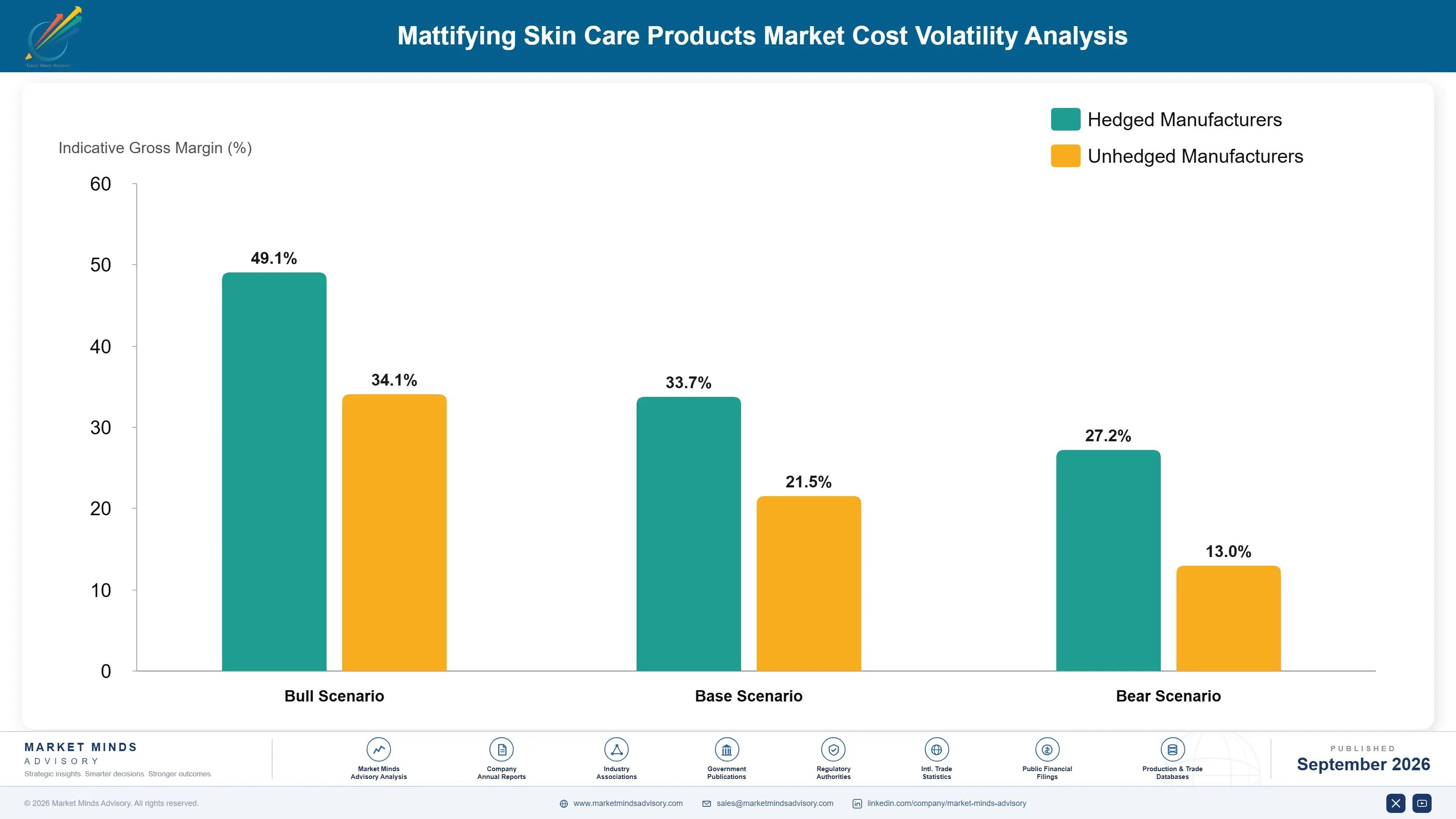
The competitive disadvantage mechanism runs through formulation development rather than ingredient purchasing. Every manufacturer can buy the same actives, and the difference is whether a product was developed for the climate it will be used in. Exposure varies sharply by manufacturer type: those with local development capability formulate natively, while those adapting temperate ranges produce results consumers in humid markets identify as inferior immediately.
mattifying-skin-care-products-market-cost-volatility-analysis-1790012045989

Develop Locally Rather Than Adapting Temperate Ranges

Products formulated for mild conditions perform visibly worse where shine returns within an hour, and consumers there recognise it on first use rather than after a month. Local development capability costs more to establish and produces formulations that hold position against regional brands, which adapted ranges have consistently failed to do anywhere. Consumers notice on first use.

State Active Concentrations Rather Than Implying Them

Ingredient-literate consumers check what concentration is doing the work, and under-dosed actives listed prominently damage credibility more than omitting them entirely would have done. Stating levels openly costs nothing where formulations are honest and exposes competitors whose claims rest on ingredients present at token amounts. Token amounts are increasingly visible to anybody reading a label with any care at all.

Right-Size Packaging Against Actual Product Volume

Packaging, filling, and distribution consume more of the cost than the formulation itself, driven by containers designed for shelf presence rather than for what they hold. Reducing that overhead funds higher active concentration at the same retail price, which is a trade that ingredient-literate consumers reward directly and visibly. Shelf presence costs more than most buyers imagine.

Portfolio Architecture for Margin Defence

Margin follows whether the product does something durable. Absorbent cleansers and blotting products are close to commodity, competing on price and shelf presence in markets where ingredient discussion is limited. Mattifying moisturisers earn moderately. Sebum-regulating serums and mattifying sun protection earn most, because the first changes production measurably and the second carries a health claim cosmetic mattifiers cannot make. Durability of the effect rather than marketing decides this whole hierarchy.
The tension between volume and premium runs through consumer literacy. A price-sensitive buyer in a humid market wants immediate matte finish cheaply and reapplies without complaint, generating substantial volume at thin margin. An ingredient-literate buyer reads concentration, compares formulations publicly, and pays considerably more for something that alters production rather than masking it. The two buyers behave nothing alike at the shelf.

High-value pools concentrate where the product must genuinely work: sun protection used daily in hot climates, active treatments bought on measured improvement, and formulations that combine oil control with barrier support for consumers who found stripping products uncomfortable. Where the buyer wants three hours of matte finish at low cost, price decides and always will. Price decides that end permanently.

Volume / Commodity-Adjacent

Absorbent cleansers, toners, and blotting products competing on price and shelf presence where ingredient discussion is limited. The twelve-point range reflects packaging cost and distribution scale rather than any formulation difference between the competing products.
Gross Margin: 42% to 54%

Premium / Certified

Mattifying moisturisers and climate-specific formulations developed for the conditions they will be used in rather than adapted from temperate ranges. The twelve-point range separates locally developed products from adapted ones consumers identify as inferior.
Gross Margin: 58% to 70%

Sustainability / Regulatory / Next-Generation

Sebum-regulating serums and mattifying sun protection, where actives change production measurably and health claims support both price and daily frequency. The twelve-point range reflects active concentration and whether barrier support is included alongside.
Gross Margin: 68% to 80%
mattifying-skin-care-products-market-portfolio-architecture-1790012046486

High-value Sub-segments and Strategic Watch-out

Sebum Regulating Serums

Highest value and fastest growth at 10.8%, altering production over weeks rather than absorbing oil for a few hours. The twelve-point range reflects active concentration, which ingredient-literate consumers check and discuss openly before purchasing anything. Improvement over weeks sustains the price. Consumers check and discuss them openly.
Gross Margin: 70% to 82%

Mattifying Sun Protection

High value growing at 9.4%, removing the objection that keeps daily protection unused in hot climates rather than arguing against it. The twelve-point range reflects formulation quality, since a poor matte finish defeats the entire proposition immediately. A health claim supports both price and frequency.
Gross Margin: 62% to 74%

Climate Specific Moisturisers

Volume core in humid markets where adapted temperate products underperform visibly on first use. The twelve-point range separates locally developed formulations from adapted ranges, which regional brands have repeatedly beaten on exactly this dimension. Regional brands have beaten adapted ranges consistently. Adapted products underperform visibly on first use.
Gross Margin: 56% to 68%

Absorbent Cleansers And Blotting

The strategic watch-out. Effects last around 3.4 hours, barrier irritation affects a large minority of users, and ingredient-literate consumers are moving toward actives instead. The twelve-point range reflects packaging and distribution rather than product merit. Consumers are moving toward actives instead. Barrier irritation affects a large minority.
Gross Margin: 40% to 52%

How This Demand Repeats

Repeat purchase in this category comes from two quite different places. Absorbent products are repurchased because they wear off, which generates volume without generating attachment and leaves the consumer available to any competitor promising longer. Active formulations are repurchased because the user observed improvement over weeks, which is a considerably more durable reason and supports much higher prices. One reason leaves the consumer available to any competitor promising longer.
Attachment depth follows observed result rather than brand preference. A consumer whose skin genuinely changed over a month attributes that to the specific formulation and stays with it, frequently for years. A consumer applying powder that lasts until lunchtime has no attachment at all and switches on price, promotion, or a persuasive claim from anybody else on the shelf beside it.

The buyer has broadened considerably. This was a category bought largely by women concerned with appearance, and men now account for 31% of purchases, frequently entering skincare through oil control as their first product rather than through any broader interest. Younger consumers also arrive already ingredient-literate, comparing concentrations before purchase in a way earlier cohorts never did. That changes what marketing has to say.
mattifying-skin-care-products-market-end-use-penetration-index-1790012046984

Where This Market Rewards

These are among the four positions where our research anticipates prominent divergence between winners and laggards over the coming forecast period. Each is grounded in the demand model, the regulatory perimeter, and the announced capacity pipeline.
01 / COMBINED EFFECT FORMULATION

Three hours today, real change monthly

Absorbent products deliver about 3.4 hours and 68% of this category offers nothing beyond that, producing reapplication rather than any lasting relationship with a brand. Those combining immediate matte finish with actives that reduce production over weeks report repeat purchase 2.6 times higher than absorbent-only equivalents. It satisfies both expectations honestly, which is the only formulation approach that survives an ingredient-literate consumer reading the label, which is now a normal step before purchase rather than an unusual one, and label reading precedes most purchases now.
02 / BARRIER COMPATIBLE POSITIONING

Stripping harder loses the customer entirely

Around 42% of users report tightness or irritation, and the commercial risk is category abandonment rather than brand switching, since an uncomfortable consumer moves to gentle cleansing and simply accepts some shine. Brands pairing oil control with barrier ingredients report retention 31 to 44 points above those competing on stripping performance. Removing sebum more aggressively is the intuitive response and produces exactly the outcome a brand least wants, since the consumer leaves the category rather than switching within it, and that customer rarely returns to anybody.
03 / SUN PROTECTION FINISH

Matte finish sells the protection factor

Shine and heaviness are the principal reasons daily sun protection goes unused in hot climates, and a matte finish removes that objection rather than arguing that protection matters more than appearance does. Mattifying sun protection grows at 9.4% and carries a health claim no cosmetic mattifier can make. Brands leading with finish rather than protection factor report trial rates 2.9 times higher among lapsed daily users, and daily frequency is what any protection product ultimately depends upon, which appearance rather than argument decides.
04 / NATIVE CLIMATE DEVELOPMENT

Adapted products fail on first use

Formulations built for temperate conditions perform visibly worse where shine returns within an hour, and consumers in humid markets identify the difference immediately rather than after a month of use. Brands developing natively for those climates hold 2.4 times the share of adapted equivalents across South Asia and Pacific. Consumption per person there remains far below mature markets, which is where the volume opportunity actually sits, and that is where the category's volume growth is concentrated, and regional brands already hold much of it.

Engagement Snapshot From the Field

A live engagement with an industry participant carrying material or product regulatory and market exposure ahead of a defining policy shift, showing how our research translates into a defensible multi-year portfolio strategy.
MARKET MINDS ADVISORY · CLIENT ENGAGEMENT SUMMARY
Mattifying Skin Care Products Producer Strategic Portfolio Review and Transition Roadmap 2026·Investment Scenario on Mattifying Skin Care Products Exposure Evaluation 2025-26
CLIENT PROFILE
A personal care manufacturer selling oil-control skin care across eleven Asian markets with annual category revenue near USD 210 million (client-reported, unverified by MMA). The range had been developed in Europe and adapted for regional distribution, and share had declined against local competitors for four consecutive years. No product in the range had been tested under regional humidity conditions.
STRATEGIC CHALLENGE
Marketing attributed the decline to insufficient advertising investment and had requested a substantial budget increase. Nobody had tested whether the products actually performed as intended in the humid conditions where they were sold, and consumer complaints had never been analysed by market or by formulation. Nobody had asked lapsed buyers anything.
MMA APPROACH
MMA tested the range against leading local competitors under controlled humid conditions, analysed three years of consumer complaints by market and product, and surveyed lapsed buyers about why they had stopped purchasing rather than about brand perception. The single locally developed product in the range was compared against every adapted one.
KEY FINDINGS
  1. Under humid test conditions the adapted range lost visible matte effect in 1.9 hours against 3.6 hours for leading local competitors, a difference consumers described unprompted.
  2. Complaints citing tightness and irritation accounted for 47% of the total and concentrated in two cleansers using surfactant systems designed for European water hardness.
  3. Lapsed buyers cited product performance rather than price or availability in 71% of responses, and most had switched to a regional brand rather than leaving the category.
  4. The one locally developed product in the range, a clay treatment, had grown share every year while every adapted product in the same range had declined.
CLIENT PROFILE
A personal care manufacturer selling oil-control skin care across eleven Asian markets with annual category revenue near USD 210 million (client-reported, unverified by MMA). The range had been developed in Europe and adapted for regional distribution, and share had declined against local competitors for four consecutive years. No product in the range had been tested under regional humidity conditions.
STRATEGIC CHALLENGE
Marketing attributed the decline to insufficient advertising investment and had requested a substantial budget increase. Nobody had tested whether the products actually performed as intended in the humid conditions where they were sold, and consumer complaints had never been analysed by market or by formulation. Nobody had asked lapsed buyers anything.
MMA APPROACH
MMA tested the range against leading local competitors under controlled humid conditions, analysed three years of consumer complaints by market and product, and surveyed lapsed buyers about why they had stopped purchasing rather than about brand perception. The single locally developed product in the range was compared against every adapted one.
KEY FINDINGS
  1. Under humid test conditions the adapted range lost visible matte effect in 1.9 hours against 3.6 hours for leading local competitors, a difference consumers described unprompted.
  2. Complaints citing tightness and irritation accounted for 47% of the total and concentrated in two cleansers using surfactant systems designed for European water hardness.
  3. Lapsed buyers cited product performance rather than price or availability in 71% of responses, and most had switched to a regional brand rather than leaving the category.
  4. The one locally developed product in the range, a clay treatment, had grown share every year while every adapted product in the same range had declined.
RECOMMENDED STRATEGY
Phase 1: Phase one: halt the proposed advertising increase, since additional promotion of a product that underperforms in testing accelerates trial and then loss. Phase 2: Phase two: reformulate the two cleansers away from surfactant systems producing most complaints, and test under regional conditions before any launch. Phase 3: Phase three: establish local formulation capability rather than adapting European ranges, using the successful clay treatment as the template. Adaptation had failed repeatedly.
OUTCOME
Share stabilised within three quarters of the reformulated cleansers launching (client-reported, unverified by MMA). Complaints citing irritation fell 58%. The proposed advertising increase was redirected into establishing regional formulation capability instead. Regional formulation capability was established during the following year, and the clay treatment template was applied across two further products.

Frequently Asked Questions

Foundational context covering the market sizes, CAGR, scope, country, region and competition that inform every finding below. This section is provided to cover basics and most often pre-purchase conversations, answered from the MMA Primary Research Dataset.

What is the current size of the Mattifying Skin Care Products Market?

The market was worth USD 6.4 billion in 2025 and reaches USD 6.9 billion in 2026. Value covers skin care products carrying oil-control or mattifying claims.

How large will the Mattifying Skin Care Products Market be by 2036?

MMA forecasts USD 13.8 billion by 2036, an increase of USD 6.9 billion across the forecast period. That represents 2.00 times the 2026 base of USD 6.9 billion.

What is the CAGR for the Mattifying Skin Care Products Market 2026 to 2036?

The base case compound annual growth rate is 7.2%, with a bull case at 8.4% and a bear case at 6.0%. Historical growth from 2020 to 2025 ran at 6.2%.

Which segment is growing fastest?

Sebum-regulating serums grow at 10.8%, half again the market rate of 7.2%. They alter production over weeks rather than absorbing oil for a few hours.

Who are the major companies in the Mattifying Skin Care Products Market?

L'Oreal, Beiersdorf, Unilever, Shiseido, and Amorepacific lead, together holding 34% of category revenue. Regional brands hold strong positions across the humid markets that drive growth.

Which country is growing fastest?

Indonesia grows at 12.4%, supported by a humid climate alongside a very large and young population entering the category earlier than any previous cohort did.

Report Segmentation Architecture

The full report scope spans multiple orthogonal segmentation dimensions, with cross-tabulated demand data provided for each dimension pair. Coverage extends further to regional breakdowns, trend trajectories, and the competitive detail needed to support segment-level decision-making.

By Product Form

  • Mattifying Moisturisers and Lotions
  • Oil-Control Cleansers and Toners
  • Sebum-Regulating Serums and Treatments
  • Clay Masks and Absorbing Treatments
  • Blotting and Touch-Up Products
  • Mattifying Sun Protection

By End-Use Industry

  • Mass Market Retail
  • Premium and Department Store
  • Pharmacy and Dermocosmetic
  • Direct to Consumer Brands
  • Men's Grooming
  • Professional and Salon Retail

By Commercial Dimension

  • Modern Trade Distribution
  • Online Marketplace and Social Commerce
  • Pharmacy Channel Supply
  • Regional Brand Licensing
  • Private Label Manufacture
  • Travel Retail and Duty Free

By Region

  • East Asia
  • North America
  • South Asia and Pacific
  • Western Europe
  • Latin America
  • Middle East and Africa
  • Eastern Europe

Scope, Methodology, and Coverage

Every figure in this report is reproducible from documented input assumptions. The scope below maps the historical period, the forecast horizon, the segmentation dimensions, and the countries covered, alongside the underlying primary and qualitative methodology.
Historical Period
2020 to 2025
Forecast Period
2026 to 2036
Base Year
2025 (USD billions; MMA Primary Research Dataset, September 2026)
Market Definition
This market covers skin care products formulated to reduce visible facial shine or control sebum, including mattifying moisturisers and lotions, oil-control cleansers and toners, sebum-regulating serums and treatments, clay masks and absorbing treatments, blotting and touch-up products, and mattifying sun protection. It excludes colour cosmetics, prescription acne medicines, clinical procedures, general skin care carrying no oil-control claim, and salon treatments.
Quantitative Units
USD billions, retail value at manufacturer selling price
Segmentation Dimensions
Product form, end-use industry, commercial dimension, region
Regions Covered
East Asia, North America, South Asia and Pacific, Western Europe, Latin America, Middle East and Africa, Eastern Europe
Countries Covered
China, Japan, South Korea, Taiwan, India, Indonesia, Philippines, Thailand, Vietnam, Malaysia, United States, Canada, Mexico, France, Germany, United Kingdom, Italy, Spain, Netherlands, Poland, Brazil, Colombia, Chile, Argentina, Saudi Arabia, United Arab Emirates, Egypt, Nigeria, Kenya, South Africa
Key Companies Profiled
L'Oreal, Beiersdorf, Unilever, Shiseido, Amorepacific, Estee Lauder, Kao, Procter & Gamble, Kenvue, DECIEM, Cosrx, Innisfree, Wardah, Mandom, Rohto, Galderma, Pierre Fabre, Natura, Himalaya, Bioderma
Quantitative Methodology
Primary survey, n=3,800 respondents, Q4 2025, six countries; demand-side model with trade association cross-validation
Qualitative Methodology
47 expert interviews, Q4 2025; applied to validate demand model assumptions, identify emerging dynamics, and assess competitive positioning
Report Format
PDF and XLSX data workbook (Word format preview document)
Publisher
Market Minds Advisory
Report Code
MMA-2026-CHM-911
Published
September 2026
Contact
sales@marketmindsadvisory.com | www.marketmindsadvisory.com

Purchase the full Mattifying Skin Care Products Market Report (2026 to 2036).

The full report sizes the mattifying skin care market across six product forms, seven regions, and thirty countries, with forecasts to 2036 under base, bull, and bear cases. It examines the difference between absorbing oil and reducing its production, why oil-stripping routines generate consumption without satisfaction, and how climate rather than fashion determines where this category grows. Competitive analysis covers twenty participants evaluated consistently on category revenue, with detailed treatment of formulation credibility and climate-specific development. Cost structure, margin architecture, and regional climate drivers are analysed throughout. Primary research includes 3,800 survey responses and 47 expert interviews.
Six product forms sized and forecast separately
Twenty participants evaluated on category revenue consistently
Regional climate and literacy drivers across seven distinct geographies
Margin architecture by form and formulation durability
Effect duration and barrier irritation benchmarked across product types
Climate-specific formulation performance compared against adapted temperate ranges

Built For The People Who Decide

From boardroom strategy to bench-side execution, this report is read cover-to-cover by leaders shaping the next decade of their industry, turning demand scenarios, market dynamics and valuation benchmarks into decisions.
CXOs/ Presidents/ VPs/ Managers
M&A and Corporate Development
Strategy Teams and R&D Heads
Procurement and Product Directors
Regulatory and Compliance Leaders
Investor Relations and Equity Analysts