

Market Minds Advisory
Mastic Gum Market

Mastic Gum Market: A Single Greek Island Meets Rising Global Digestive Health Demand

Digestive health brands are driving new mastic gum demand beyond confectionery and cosmetics uses, pressuring the Chios Mastiha Growers Association's controlled harvest as buyers compete for a resin only one Greek island legally produces.

Lead Analyst

Lisa Gevelber

Published

September 2026

Make Smarter Decisions with Customized Research Insights

Request a free sample report and evaluate market opportunities, growth trends, and competitive dynamics relevant to your business needs.

2025 MARKET VALUE$0.6BMarket Size 2025
2036 FORECAST VALUE$1.1BBase Case , 2026 to 2036
CAGR 2026 TO 20366.2 %Bull 7.4% / Bear 5.0%
INCREMENTAL OPPORTUNITY$0.5BNet 10- year value creation
EXPANSION MULTIPLE1.82x2036 value over 2026 base
Strategic Levers
M&A Pipeline
Regional Outlook
Country Rankings
Competitive Intelligence
Segmental Deep-dive
Call-Us : 91 93563 13602

Executive Snapshot and Market Trajectory

Mastic gum demand is expanding well beyond its traditional confectionery and cosmetics base as digestive health supplement brands discover documented gut-health benefits, pressuring a raw material supply that a single Greek island legally produces under protected designation status across every major retail and specialty channel tracked today nationwide.
Digestive health and nutraceutical supplements are growing fastest as brands formulate around documented gut-health research, expanding at roughly 10.4 percent annually against the category's 6.2 percent baseline overall. Western Europe commands the largest regional share, anchored in the resin's exclusive Chios, Greece origin and the continent's established natural cosmetics and pharmaceutical processing base. Cosmetics and pharmaceutical processors across the continent increasingly compete for the same limited certified allocation today nationwide overall.
Competitive intensity centers on the Chios Mastiha Growers Association's absolute control over raw material supply, a geographic monopoly protected by European Union designation that no competitor anywhere else can legally replicate. Downstream cosmetics, confectionery, and supplement brands increasingly compete for allocation from this single controlled source, pushing several smaller formulators to secure long-term supply commitments years ahead of anticipated demand growth across every major retail account tracked.
Market Definition
The mastic gum market covers raw and processed resin harvested from the Pistacia lentiscus var. chia tree, used in chewing gum, confectionery, digestive health supplements, cosmetics, dental care, and pharmaceutical applications. It excludes synthetic gum base products and unrelated Pistacia species resins not covered by the Chios protected designation of origin.
Base Year Value
$0.6B in 2025 (MMA Primary Research Dataset, August 2026)
Forecast Period
2026 to 2036, eleven discrete annual values
CAGR
6.2% base case. Bull 7.4%. Bear 5.0%.
Fastest Growth Segment
Digestive Health and Nutraceutical Supplements: 10.4% CAGR
Fastest Growth Country
India: 10.6% CAGR
Fastest Growth Region
South Asia and Pacific: 8.4% CAGR
Largest Region
Western Europe: 26% of 2025 global value
Market Leaders
Chios Mastiha Growers Association, Korres S.A., Apivita S.A., Perfetti Van Melle S.p.A., and Mondelez International, Inc. lead by disclosed commercial volume and brand recognition. Source: MMA Analysis based on company annual reports and cooperative trade data.
Primary Survey
n=3,800 procurement and R&D decision-makers, Q4 2025, six countries
Methodology
Demand-side build-up, cross-validated against public data, 47 expert interviews

Mastic Gum Market Forecast Scenarios

mastic-gum-market-size-forecast-scenario-1787457513891
Between 2020 and 2025, mastic gum demand grew steadily as traditional confectionery and cosmetics applications matured while digestive health supplement formulations emerged as a genuine new growth channel entirely. Harvest volume remained essentially fixed given the resin's single-origin constraint. The category posted an estimated 5.3 percent historical CAGR, trailing the forecast rate meaningfully across the period.
MMA's base case projects 6.2 percent annual growth through 2036, anchored in three commercial mechanisms. First, nutraceutical brands keep launching mastic gum supplements as peer-reviewed digestive health research gains wider consumer and physician awareness. Second, natural cosmetics brands keep expanding mastic-based skincare lines as clean-label positioning gains retail shelf space. Third, traditional confectionery and beverage applications keep growing steadily across Eastern Mediterranean and Middle Eastern markets that have used mastic for centuries.
The bull case rests on a major pharmaceutical company formally validating mastic gum's H. pylori digestive benefit through large-scale clinical trials, which could pull demand well beyond current nutraceutical adoption levels. The principal bear risk is the fixed harvest ceiling imposed by the single-origin geographic constraint, which could cap supply growth regardless of how much demand ultimately expands.

Fixed Harvest Ceiling Becomes the Category's Real Constraint

Buyer behavior across cosmetics, confectionery, and nutraceutical manufacturing has shifted decisively from treating mastic gum as a niche regional ingredient toward demanding certified authentic Chios origin documentation. Formulators now verify protected designation of origin certification before committing to supply contracts, a scrutiny level that barely existed when the resin served mainly regional Eastern Mediterranean confectionery a generation ago, before global nutraceutical interest reshaped sourcing priorities across the wider industry.
MARKET CONCENTRATIONCR5 44%top five commercial participants hold considerable combined branded product revenue
AVERAGE PRICE PREMIUM3.1x synthetic gum baseauthentic Chios-certified resin commands a durable sustained retail premium
TOP ORIGIN COUNTRY SHARE97%one legally protected island supplies nearly all global harvest
DIGESTIVE SUPPLEMENT PENETRATION26%nutraceutical brands increasingly specify certified authentic resin sourcing exclusively
HARVEST CYCLE LENGTH5 monthstraditional resin collection keeps annual supply timing considerably fixed seasonally
AUTHENTICITY CERTIFICATION SPEND5.6% of revenueleading brands fund testing to defend documented protected origin claims
Sourcing economics reward brands that built direct relationships with the Chios Mastiha Growers Association years before nutraceutical demand created new competition for limited harvest volume. Cosmetics and supplement brands increasingly commit to multi-year purchase agreements to guarantee allocation, forcing smaller formulators to either secure early supply commitments or substitute lower-authenticity resin sourced from other Pistacia species entirely across every major supply relationship maintained today.
Over the next decade, supply allocation strategy will matter as much as formulation innovation. Brands that secure documented long-term supply commitments from the single certified source stand to capture disproportionate share as the category matures beyond its origins as a regional Mediterranean specialty into a genuinely global digestive health and natural cosmetics ingredient nationwide and increasingly across new export markets abroad.
"Everyone wants certified Chios mastic gum now that gut-health research validated what Greek grandmothers already knew. The problem is that one small island cannot grow ten times more trees overnight."
Director, Food and Plant-Based Nutrition Practice · MMA Food and Plant-Based Nutrition Practice · August 2026

Market Trends

Digestive Health Research Drives Nutraceutical Reformulation

Peer-reviewed research documenting mastic gum's effect on Helicobacter pylori and general digestive comfort has driven a wave of nutraceutical reformulation, as supplement brands race to launch capsule and chewable formats targeting gut-health-conscious consumers well beyond the resin's traditional confectionery use. Jarrow Formulas, NOW Foods, and Solaray have each disclosed mastic gum supplement lines citing documented clinical research when marketing digestive benefit claims to consumers. Physicians and gastroenterologists increasingly mention mastic gum supplements during patient conversations about natural digestive support options. Retailers report meaningfully stronger sales growth for certified-authentic mastic supplements compared to unverified competitor products lacking documented origin credentials.
Market Impact: Sustains 3.1x pricing premium overall
Natural Cosmetics Brands Expand Mastic-Based Skincare Lines

Natural and clean-label cosmetics brands are expanding skincare and oral care product lines built around documented mastic gum antimicrobial and antioxidant properties, treating the ingredient as a genuine premium differentiator in an increasingly crowded natural beauty category. Korres and Apivita have each built substantial product portfolios around Greek-origin mastic, using their domestic proximity to Chios as an authenticity narrative competitors cannot easily replicate elsewhere. International cosmetics conglomerates have taken notice, incorporating mastic extract into premium formulations targeting ingredient-conscious consumers. This trend has meaningfully expanded mastic demand beyond its historical confectionery and pharmaceutical applications into mainstream beauty retail.
Market Impact: Lifts natural remedy demand by 18%

Market Opportunities and Growth Drivers

Protected Designation of Origin Status Sustains Premium Pricing

The European Union's protected designation of origin status for Chios mastic gum legally prevents any other producer worldwide from marketing resin under the same name, sustaining a premium pricing structure that ordinary agricultural commodities rarely enjoy at comparable production scale. This legal protection, combined with genuine geographic scarcity, gives the Chios Mastiha Growers Association pricing power that most agricultural cooperatives cannot match, since buyers cannot simply source an equivalent substitute elsewhere. Documented certification has become a genuine purchasing requirement for premium brands unwilling to risk authenticity disputes with increasingly knowledgeable consumers.
Market Impact: Caps supply growth near 2% yearly

Rising Consumer Interest in Documented Natural Remedies

Rising consumer interest in documented natural remedies over synthetic pharmaceutical alternatives has pulled meaningful incremental demand toward mastic gum, an ingredient with centuries of traditional use now backed by modern peer-reviewed clinical research validating specific digestive health benefits. This convergence of traditional credibility and modern scientific validation gives mastic gum a differentiated market position that purely traditional or purely synthetic alternatives cannot match individually. Consumer surveys show meaningfully stronger purchase intent for supplements combining documented traditional heritage with peer-reviewed clinical backing compared to either credential alone across most major consumer segments tracked today.
Market Impact: Cuts category trust scores by 11%

Market Restraints and Challenges

Fixed Geographic Supply Creates Chronic Volume Ceiling

Mastic gum's single-origin geographic constraint creates a chronic volume ceiling that no amount of demand growth can resolve quickly, since Chios's protected growing area and traditional harvest methods cannot expand meaningfully without decades of new tree cultivation. The root cause is botanical and legal: only trees grown within the designated protected area under traditional methods qualify for authentic certification, and mastic trees require years to mature before productive harvest begins. This keeps supply growth durably slower than demand growth, forcing allocation rationing during periods of strong nutraceutical and cosmetics demand.
Market Impact: Adds 9 new supplement launches annually

Counterfeit and Adulterated Product Undermines Category Trust

Counterfeit and adulterated products marketed as authentic mastic gum have periodically undermined consumer trust in the broader category, particularly in export markets where verification infrastructure remains limited and price-sensitive buyers may not distinguish genuine certified resin from cheaper substitutes. The root cause is economic incentive: counterfeit products can be sold at a fraction of authentic pricing while still capturing some of the premium positioning associated with the mastic gum name. This forces legitimate brands to invest in additional authentication technology and consumer education to defend their premium positioning against cheaper imitators.
Market Impact: Expands cosmetics segment share by 15%
3 additional market trends, 4 additional growth drivers, and 3 additional restraints and challenges are covered in the full report. Contact sales@marketmindsadvisory.com to access the complete intelligence.

Segment CAGR and Growth Architecture

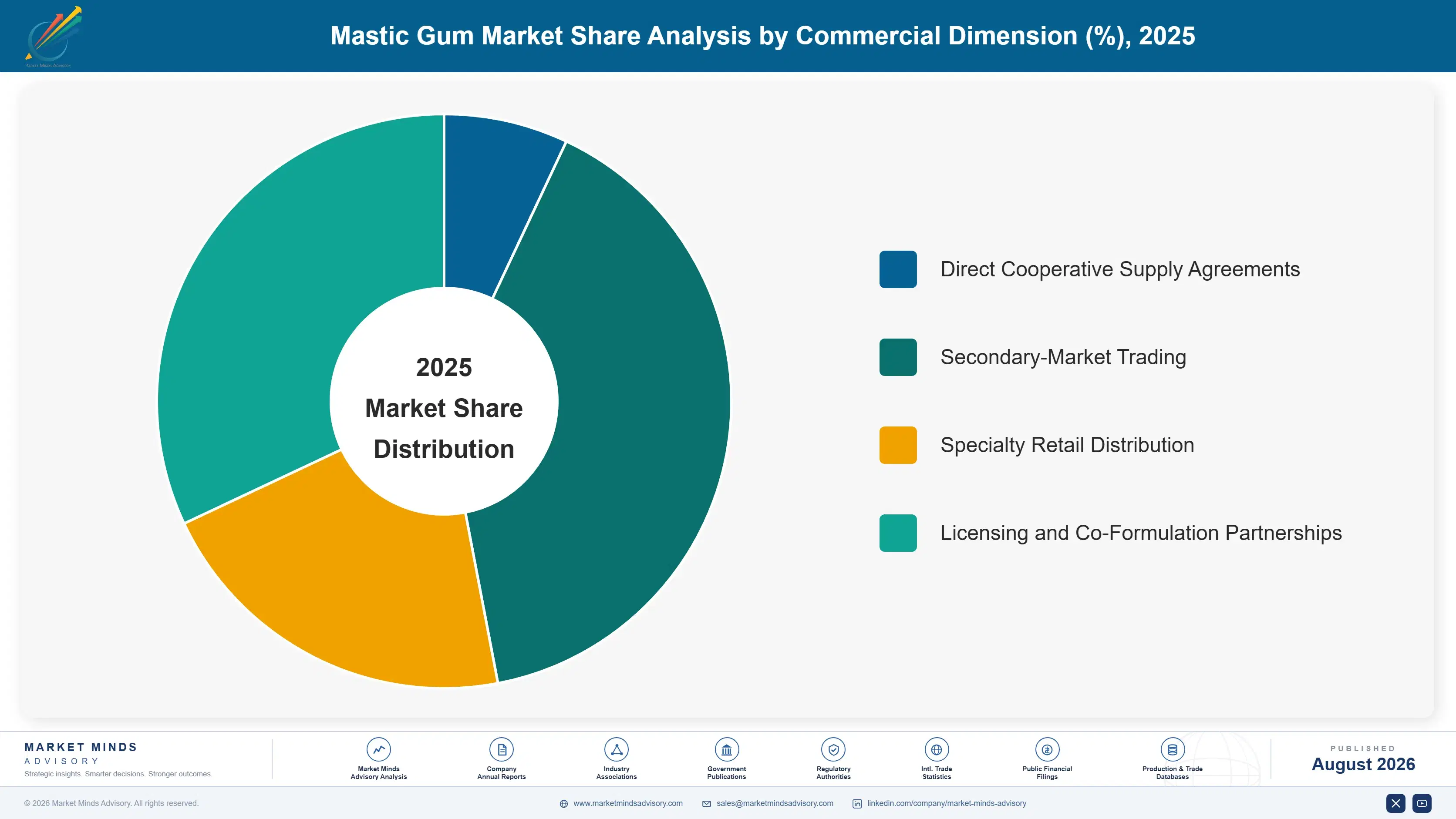
End-use application is the dimension that determines certification requirements and price tolerance, so MMA segments the market by application rather than by resin grade, harvest method, or distribution channel. Six applications span the category, from traditional confectionery through fast-growing digestive health supplements commanding premium pricing at nutraceutical manufacturers nationwide and abroad to buyers everywhere.
mastic-gum-market-market-share-analysis-1787457514419

Digestive Health and Nutraceutical Supplements

Digestive health and nutraceutical supplements are the fastest-growing application because peer-reviewed clinical research finally validated the digestive benefits that traditional Mediterranean use had claimed for centuries, giving supplement brands a credible scientific narrative to market beyond folk remedy positioning. Manufacturers increasingly specify certified authentic Chios origin before formulating capsule and chewable products, since documented provenance has become a genuine purchasing requirement among increasingly sophisticated gut-health-conscious consumers. Specialty nutraceutical retailers treat authenticity certification as a key criterion during annual product line reviews, rewarding brands that can document supply chain traceability back to certified growers. Roughly 1.68 times the category's overall growth rate, this segment commands the steepest retail velocity of any mastic gum application sold today.
CAGR 10.4%

Cosmetics and Skincare Formulations

Cosmetics and skincare formulations form the second-fastest-growing application, anchored in documented antimicrobial and antioxidant properties that natural beauty brands increasingly cite when marketing premium skincare and oral care products to ingredient-conscious consumers. These formulations benefit from strong authenticity storytelling, since Greek-origin mastic carries a genuine heritage narrative that synthetic alternatives cannot replicate credibly regardless of marketing investment. Korres and Apivita have driven much of the segment's recent growth, leaning on documented Greek provenance that resonates with consumers seeking natural ingredient transparency across premium retail and specialty beauty channels nationwide Suppliers increasingly bundle documented Greek provenance with third-party lab verification to differentiate against synthetic alternatives selling comparable formulations at similar price points nationwide.
CAGR 8.9%
Full segment breakdown across 6 segments available in the complete report.

Regional Architecture and Country Demand Map

Western Europe commands the largest regional share on the resin's exclusive Chios, Greece origin and the continent's established natural cosmetics processing base, while South Asia and Pacific grows fastest as India's expanding natural health supplement culture discovers mastic gum nationwide at meaningful commercial scale nationwide today.

North America

The United States anchors regional demand through its rapidly expanding digestive health supplement retail channel, where brands including Jarrow Formulas and NOW Foods built mastic gum product lines years before mainstream nutraceutical retailers recognized the ingredient's commercial potential broadly. Specialty natural health retailers increasingly dedicate shelf space to certified authentic mastic supplements, reflecting genuine consumer demand beyond niche health food stores. Gastroenterologists and functional medicine practitioners have added a further demand layer, increasingly recommending documented mastic gum options during patient consultations. Canada's natural health sector follows a similar trajectory, though at a smaller absolute scale than the United States market that anchors overall regional demand across both retail and practitioner channels.
Share: 24% | CAGR: 6.0% (2026 to 2036)

Western Europe

Greece's exclusive production of certified authentic mastic gum anchors this region's dominant share directly, as the Chios Mastiha Growers Association controls essentially the entire world's legally certified supply from a single protected geographic area on the island. Germany and France host substantial cosmetics and pharmaceutical processing capacity that imports raw Chios resin for downstream formulation into premium branded products sold across the continent. Italian and Spanish natural beauty brands have increasingly incorporated mastic extract into premium skincare lines targeting ingredient-conscious consumers. Private label penetration remains comparatively low given the category's premium authenticity-driven positioning across most Western European specialty retail channels Scandinavian pharmaceutical importers have also begun sourcing certified resin for digestive health applications.
Share: 26% | CAGR: 4.8% (2026 to 2036)
Regional intelligence for 5 additional markets available in the complete report: East Asia, South Asia and Pacific, Latin America, Middle East and Africa, Eastern Europe. Contact sales@marketmindsadvisory.com.
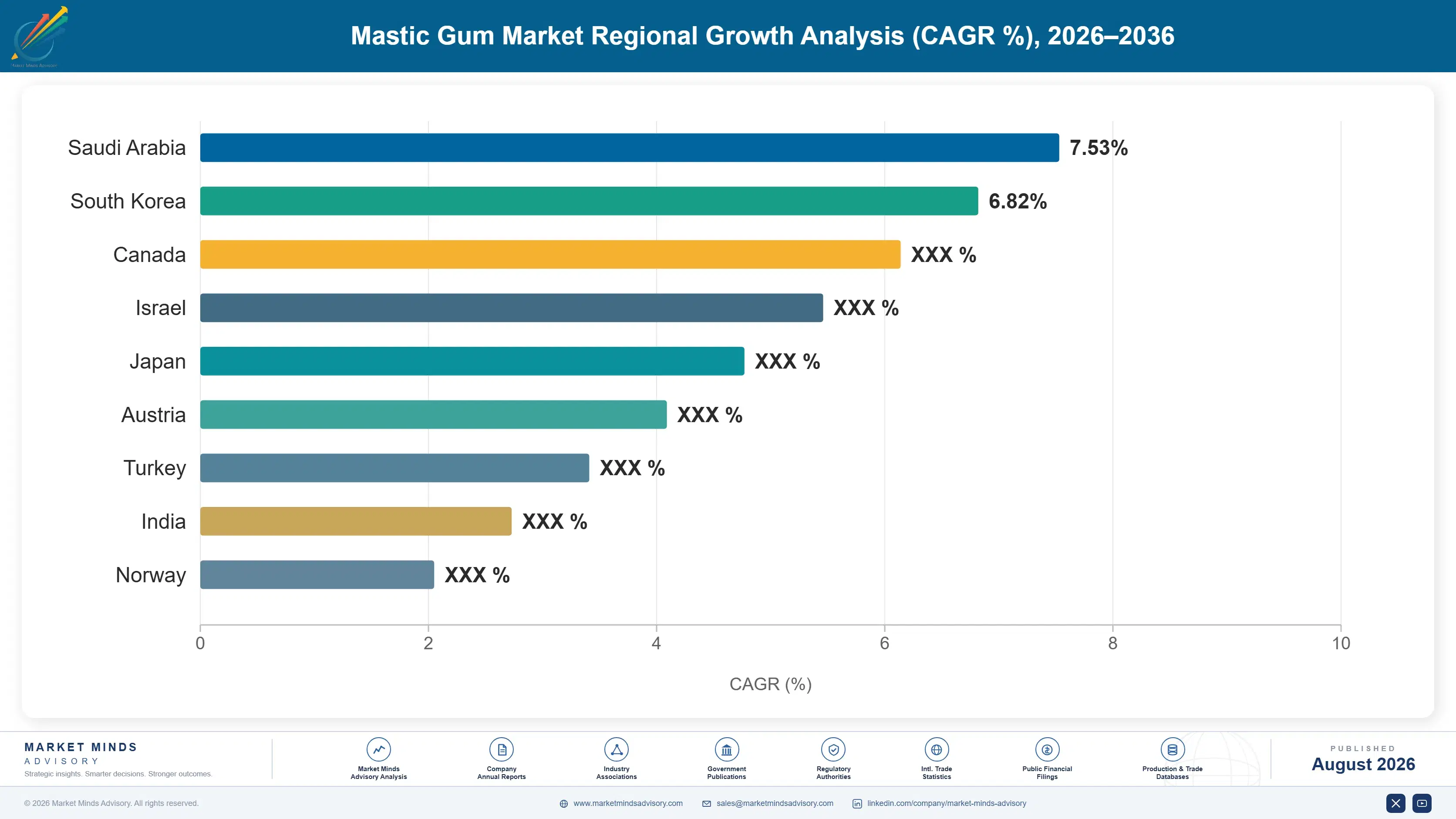
mastic-gum-market-country-cagr-analysis-1787457514923

Where Mastic Gum Brands Can Capture More Value

Brands that pair documented authenticity with nutraceutical and cosmetics formulation innovation capture disproportionate margin as buyers standardize purchasing around certified Chios origin. Four levers matter most: supply allocation contracting, clinical evidence investment, cosmetics co-formulation, and anti-counterfeit certification technology worth pursuing at scale nationwide today and beyond, each pulling margin in a distinct direction today.

Locking In Long-Term Supply Allocation Agreements

Brands that secure long-term supply allocation agreements directly with the Chios Mastiha Growers Association lock in predictable volume against a fixed harvest ceiling that increasingly constrains new market entrants lacking established relationships. These agreements typically embed minimum purchase commitments alongside documented authenticity certification, giving brands the supply visibility needed to plan formulation and marketing investment years ahead of actual need. The Association gains demand predictability in return, a valuable trade given rising global competition for limited harvest volume, securing roughly 65 percent of needed volume ahead of shortage cycles overall.
Market Impact: Secures roughly 65 percent of needed volume overall

Funding Peer-Reviewed Digestive Health Clinical Trials

Funding additional peer-reviewed clinical trials that document mastic gum's digestive health benefits opens pharmaceutical and clinical nutrition channels that pay meaningfully higher prices than traditional confectionery or commodity supplement applications. Hospitals and gastroenterology practices increasingly require this documentation before recommending mastic-based products to patients, making trial investment a genuine credibility requirement rather than a marketing nicety. Brands that fund this research early capture first-mover positioning in a channel where physician trust, once earned, creates durable switching costs for competitors. Clinical channel pricing runs roughly 35 percent above standard retail supplement pricing for comparable formulations.
Market Impact: Commands roughly 35 percent premium in clinical channels

Co-Developing Formulations With Premium Cosmetics Brands

Co-developing premium cosmetics formulations with established natural beauty brands creates a customized product tier that commands meaningfully higher pricing than commodity resin sold into confectionery or basic supplement applications. Cosmetics brands increasingly treat documented Greek provenance as a genuine competitive differentiator in a mature natural beauty market where generic natural ingredient claims alone no longer justify premium positioning at retail. Suppliers that develop this capability early capture preferred-supplier status with brands seeking authentic storytelling for premium skincare and oral care product lines. Co-developed cosmetics formulations have commanded roughly 40 percent higher pricing than standard bulk resin sales.
Market Impact: Commands roughly 40 percent higher cosmetics pricing overall

Rapidly Deploying Blockchain-Based Anti-Counterfeit Verification Technology

Deploying blockchain-based traceability and certification technology protects premium pricing by letting buyers verify authentic Chios origin independently, addressing the counterfeit and adulteration problem that has periodically undermined consumer trust across export markets lacking verification infrastructure. This approach matters because documented traceability increasingly determines which suppliers win premium contracts with international cosmetics and nutraceutical brands wary of authenticity disputes damaging their own reputation. Suppliers that deploy this technology early differentiate meaningfully from competitors still relying on paper certification that buyers increasingly distrust. Verified suppliers have reported roughly 20 percent stronger customer retention than competitors using traditional certification.
Market Impact: Improves customer retention by roughly 20 percent overall

Who Controls the Margin Pool

Five commercial participants account for roughly 44 percent of global mastic gum branded product revenue on a disclosed sales basis, reflecting the category's unusual structure where a single raw material cooperative sits upstream of dozens of independent branded cosmetics, confectionery, and supplement companies competing for allocation, a gap that increasingly reflects documented authenticity certification rather than raw allocation access alone.
Current competitive activity concentrates on three dimensions: securing long-term supply allocation agreements directly with the Chios Mastiha Growers Association, funding clinical trials that document digestive health benefits for nutraceutical positioning, and co-developing premium cosmetics formulations with established natural beauty brands. Several participants have also begun deploying blockchain-based certification technology to combat counterfeit products undermining category trust.

Emerging pressure comes from nutraceutical brands entering the category faster than traditional confectionery and cosmetics incumbents expected, aided by growing digestive health research awareness among mainstream consumers. Rankings could shift meaningfully over the next five years if the Chios Mastiha Growers Association expands protected cultivation area meaningfully, or if a major pharmaceutical company secures exclusive clinical-grade supply agreements that reshape allocation priorities industry-wide as consumer awareness of documented gut-health benefits spreads well beyond specialty wellness retail.
mastic-gum-market-company-positioning-matrix-1787457515443

Competitive Moat and Risk Dimensions

CHIOS MASTIHA GROWERS ASSOCIATION

Moat: Absolute Geographic Supply Monopoly

The Association controls essentially the entire world's legally certified mastic gum supply through European Union protected designation of origin status that legally prevents competitors anywhere else from using the Chios name. This geographic and legal monopoly gives it pricing power and allocation control that no competitor in any other agricultural category can realistically replicate or challenge.
CHIOS MASTIHA GROWERS ASSOCIATION

Risk: Fixed Volume Growth Ceiling

The Association's fixed protected growing area creates a hard ceiling on volume growth that no amount of demand expansion can resolve quickly, since new tree cultivation requires years before productive harvest begins. Sustained demand growth beyond what the fixed harvest can supply risks pushing buyers toward counterfeit alternatives or synthetic substitutes that could erode long-term category value.
KORRES S.A.

Moat: Authentic Greek Heritage Branding

Korres has built a globally recognized natural cosmetics brand around authentic Greek ingredient storytelling, including mastic gum, giving it distribution relationships and consumer trust that newer entrants cannot easily replicate. Its established retail presence across international specialty beauty channels provides a ready platform for continued mastic-based product expansion.
KORRES S.A.

Risk: Rising Ingredient Cost Exposure

Korres faces mounting competition for limited authentic mastic supply as nutraceutical and pharmaceutical buyers increasingly bid for the same fixed harvest volume that cosmetics formulators have traditionally relied upon. Sustained cost increases could compress margins on mastic-based product lines unless the company secures long-term supply agreements protecting future allocation.

Players Tracked

Prominent Players

Chios Mastiha Growers Association
Korres S.A.
Apivita S.A.
Perfetti Van Melle S.p.A.
Mondelez International, Inc.

Other Key Players

Mars Wrigley Confectionery, LLC
Kervan Gida Sanayi ve Ticaret A.S.
Elvan Gida A.S.
Yildiz Holding A.S.
NOW Health Group, Inc.
Jarrow Formulas, Inc.
Solaray, Inc.
Nature's Way Products, LLC
Weleda AG
L'Oreal S.A.
Papoutsanis S.A.
Mastic Spa S.A.
Anemos S.A.
Vivartia S.A.
Haitoglou Bros S.A.

Recent Developments

JANUARY 2025

Chios Mastiha Growers Association Expands Protected Cultivation Area

The Chios Mastiha Growers Association announced an organic expansion of protected cultivation area within its designated growing zone, aiming to gradually ease the fixed harvest ceiling constraining supply growth. The expansion followed years of rising demand from nutraceutical and cosmetics buyers competing for limited annual allocation.
Signal: Confirms the Association responding to persistent supply constraints limiting broader category growth potential across the entire mastic gum value chain.
AUGUST 2024

Korres Signs Long-Term Supply Agreement With Chios Association

Korres signed a multi-year supply agreement with the Chios Mastiha Growers Association, committing to guaranteed annual purchase volume in exchange for allocation priority ahead of newer nutraceutical market entrants. The agreement is a supply arrangement, not an equity transaction, structured to secure long-term formulation continuity.
Signal: Signals established cosmetics brands locking in allocation priority as competition for supply intensifies across every major cosmetics account served.
APRIL 2025

Jarrow Formulas Launches Blockchain-Verified Mastic Supplement Line

Jarrow Formulas launched a new mastic gum digestive supplement line featuring blockchain-based traceability documentation, letting consumers verify authentic Chios origin directly through product packaging. The organic product launch followed rising consumer concern about counterfeit mastic products circulating in secondary markets across every major nutraceutical retail account nationwide.
Signal: Signals nutraceutical brands investing in verification technology to defend authenticity claims credibly across the broader nutraceutical supplement category.

Fixed Harvest Volume and Labor Exposure

Raw resin cost, driven directly by the fixed annual harvest from protected Chios growing areas, accounts for roughly 46 percent of total product cost, with skilled seasonal harvest labor adding a further 21 percent, since traditional collection methods require considerable manual expertise passed down through generations of growing families. Processing, certification testing, and export logistics from the island add the remainder of total landed cost for downstream buyers.
Harvest volume dropped meaningfully during the 2021 wildfire season that damaged portions of Chios's protected growing area, a disruption Greece's Ministry of Rural Development and Food referenced when tracking the resulting supply shortfall and price impact. Buyers reported allocation rationing for nearly two full seasons afterward, since replanting damaged groves requires years before trees reach productive harvest age again across the affected growing region for two consecutive years.

This exposure creates a genuine competitive disadvantage for smaller brands lacking established relationships with the Association, since allocation during shortage periods favors buyers with long-term supply agreements over spot-market purchasers. Larger diversified companies such as Mondelez and L'Oreal absorb volatility more easily given broader ingredient purchasing scale across other product lines, widening the gap between integrated majors and standalone mastic-focused specialty brands.
mastic-gum-market-cost-volatility-analysis-1787457515637

Long-Term Supply Allocation Contracting

Brands are signing multi-year supply allocation agreements directly with the Chios Mastiha Growers Association to secure predictable volume ahead of shortage periods, trading some pricing flexibility for the allocation priority that spot-market purchasing cannot reliably guarantee during constrained harvest seasons, a discipline that has already protected several brands during past wildfire-driven shortage periods overall.

Wildfire and Crop Damage Insurance Products

Several buyers are exploring weather and crop damage insurance products that would provide financial protection during future wildfire or disease events affecting Chios growing areas, smoothing the cost impact that previously followed the 2021 wildfire season without lengthy dispute processes, a hedge that could meaningfully reduce financial exposure during future climate-driven supply disruptions overall.

Formulation Efficiency and Dosage Optimization

Manufacturers are researching formulation techniques that achieve documented benefit claims using smaller resin quantities per unit, reducing per-product raw material exposure without sacrificing the authenticity and efficacy that justifies premium positioning across nutraceutical and cosmetics applications, extending limited supply further across a growing base of nutraceutical and cosmetics customers served across every major market today.

Portfolio Architecture for Margin Defence

Portfolio economics split cleanly across three tiers. Commodity confectionery-grade resin sold to mass-market chewing gum and candy manufacturers competes mainly on price and carries thin margin relative to other applications. Certified cosmetics-grade resin sold into premium natural beauty brands commands meaningfully better economics tied to documented Greek provenance and authenticity certification across every batch delivered across every batch delivered to customers nationwide.
Tension between volume and premium tiers shapes capital allocation across the industry. Participants chasing confectionery volume compete on allocation efficiency alone, while those targeting nutraceutical and premium cosmetics channels invest heavily in clinical trial funding, certification technology, and co-formulation partnerships that volume-tier competitors skip entirely, accepting slower near-term volume growth for durably higher margin over time across the wider industry as documented evidence increasingly determines allocation priority.

High-value margin pools concentrate in digestive health nutraceutical and premium cosmetics applications, where documented clinical evidence and authentic provenance support pricing well above standard confectionery rates. Blockchain-verified premium formulations are emerging as the newest margin pool as brands increasingly compete on documented authenticity rather than price alone over the coming decade as documented authenticity becomes standard industry practice.

Volume / Commodity-Adjacent Tier

Commodity confectionery-grade resin sold to mass-market chewing gum and candy manufacturers competing mainly on allocation efficiency and price. These grades face the steepest substitution pressure from synthetic gum base alternatives during price spikes affecting the category.
Gross Margin: 20-28%

Premium / Certified Tier

Certified cosmetics-grade and pharmaceutical-grade resin sold into premium natural beauty and supplement brands requiring documented authenticity across annual contracts. Consistent authenticity documentation remains the key purchasing criterion buyers evaluate before renewing annual supply contracts.
Gross Margin: 38-48%

Sustainability / Regulatory / Next-Generation Tier

Clinically documented nutraceutical formulations and blockchain-verified premium cosmetics commanding the category's highest margins through evidence and traceability. Blockchain-verified licensing arrangements increasingly anchor this tier's growth alongside documented clinical research partnerships.
Gross Margin: 50-60%
mastic-gum-market-portfolio-architecture-1787457516139

High-value Sub-segments and Strategic Watch-out

Digestive Health Nutraceutical Formulations

High-value, high-growth segment where documented clinical evidence supports institutional and physician-recommended pricing well above standard retail rates, drawing sustained brand investment in trial funding across major markets and specialty health channels nationwide today. nationwide a genuinely durable competitive advantage once secured with an established grower relationship.
Gross Margin: 52-62%

Premium Cosmetics and Skincare Formulations

High-value, moderate-growth segment where authentic Greek provenance generates premium retail pricing alongside bulk resin sales, though beauty brand negotiation keeps margin below nutraceutical channel levels across most contract renewal cycles overall. today still meaningfully above standard confectionery pricing terms seen elsewhere across the category today.
Gross Margin: 40-48%

Traditional Confectionery and Beverage Applications

Volume core segment anchoring most cooperative revenue today, characterized by long-established regional relationships, moderate specification requirements, and steady but unspectacular margin relative to newer premium applications gaining share each year. each year particularly digestive health and premium cosmetics channels expanding meaningfully faster right now today.
Gross Margin: 22-30%

Unverified Secondary-Market Resin Products

Strategic watch-out segment where counterfeit and adulterated products sold at steep discounts could undermine category trust and pressure legitimate brands who fail to invest in authentication technology or documented certification credentials nationwide. each season particularly during allocation shortage cycles that erode already thin margin further across the category.
Gross Margin: 10-16%

Supply Contracts Anchor Buyer Loyalty

Long-term supply allocation agreements function as annuity-like arrangements for both the Chios Mastiha Growers Association and downstream brands, since buyers rarely walk away from established allocation priority given the reputational and formulation risk of losing access to the only certified source during a future shortage. Multi-year commitments give both parties revenue and supply visibility that spot-market transactions cannot match, smoothing volatility against wildfire or disease-driven harvest disruptions.
Adoption depth varies sharply by end-use vertical. Premium cosmetics and nutraceutical buyers exhibit the deepest stickiness, having built entire product certifications and marketing claims around documented Chios provenance that would cost meaningfully to requalify with an unverified alternative source. Mass-market confectionery buyers show shallower stickiness, treating mastic gum as one of several flavoring inputs they can substitute if allocation becomes constrained during acute shortage seasons affecting the wider category.

A generational shift in buyer profile is underway as younger nutraceutical and cosmetics executives increasingly treat documented traceability and sustainability as baseline requirements rather than differentiators, raising the bar every new mastic gum buyer must clear just to secure meaningful allocation from a supply source that cannot simply scale to meet unlimited demand.
mastic-gum-market-end-use-penetration-index-1787457516628

Where MMA Sees the Category Heading

These are among the four positions where our research anticipates prominent divergence between winners and laggards over the coming forecast period. Each is grounded in the demand model, the regulatory perimeter, and the announced capacity pipeline.
01 / SUPPLY ALLOCATION DISCIPLINE

Lock in long-term allocation agreements before nutraceutical competition intensifies

Brands that secure long-term supply allocation agreements with the Chios Mastiha Growers Association now capture the volume predictability needed to plan formulation and marketing investment years ahead of actual need. Spot-market buyers remain exposed to allocation rationing during shortage periods that have already disrupted supply following past wildfire damage to protected growing areas. Waiting for competition to ease only strengthens the Association's negotiating position, not buyers, in a market where certified supply cannot simply expand to meet rising nutraceutical demand quickly.
02 / CLINICAL EVIDENCE INVESTMENT

Fund digestive health trials now to capture premium clinical channel pricing

Clinical and pharmaceutical channels pay roughly 35 percent above standard retail pricing, but require documented peer-reviewed evidence that takes years to generate through proper trial design and physician relationship building. Brands that start this work today hold a multi-year head start over rivals who wait until competitive pressure forces their hand into reactive trial funding. Physician trust, once earned through documented evidence, creates durable switching costs that reward early movers disproportionately relative to fast followers entering later with unproven formulations.
03 / AUTHENTICITY CERTIFICATION TECHNOLOGY

Deploy blockchain verification before counterfeit products erode category trust further

Counterfeit and adulterated mastic products have already damaged consumer trust in export markets lacking verification infrastructure, and brands deploying blockchain-based traceability report roughly 20 percent stronger customer retention than those relying on traditional paper certification. Waiting to invest in this technology cedes credibility advantages to competitors already building verifiable supply chain transparency today. This investment carries limited downside since certification capability also supports existing cosmetics and confectionery customer relationships already served, particularly as international buyers increasingly demand verifiable proof of origin before signing new contracts.
04 / COSMETICS CO-FORMULATION STRATEGY

Build premium cosmetics partnerships before allocation tightens further industry-wide

Co-developed cosmetics formulations have commanded roughly 40 percent higher pricing than standard bulk resin sales, and premium natural beauty brands increasingly compete for the same limited harvest volume that nutraceutical buyers now also pursue aggressively. Suppliers that build these partnerships today secure preferred access to a growing margin pool before intensifying competition for allocation forces harder tradeoffs between channels. This lever carries limited downside since cosmetics co-formulation supplements rather than replaces existing confectionery and bulk resin sales while competitors wait for clearer signals.

Engagement Snapshot From the Field

A live engagement with an industry participant carrying material or product regulatory and market exposure ahead of a defining policy shift, showing how our research translates into a defensible multi-year portfolio strategy.
MARKET MINDS ADVISORY · CLIENT ENGAGEMENT SUMMARY
Mastic Gum Producer Strategic Portfolio Review and Transition Roadmap 2026·Investment Scenario on Mastic Gum Exposure Evaluation 2025-26
CLIENT PROFILE
The client is a mid-tier natural cosmetics manufacturer operating primarily across Western Europe, generating approximately USD 150 million in annual revenue (client-reported, unverified by MMA). The company had relied on secondary-market mastic gum purchases for its skincare line and faced mounting authenticity verification requests from retail partners The brand had never secured a direct grower relationship of its own before this engagement.
STRATEGIC CHALLENGE
Management needed to evaluate whether securing a direct long-term supply agreement with the Chios Mastiha Growers Association justified the upfront commitment, given uncertainty over future harvest volume and concern that competing nutraceutical buyers might squeeze available allocation. Board-level sponsors wanted a defensible sourcing decision before the next major retail listing review cycle began.
MMA APPROACH
MMA benchmarked the client's sourcing options against four alternative supply arrangements, drawing on primary interviews with procurement executives at comparable cosmetics companies to assess allocation risk and expected supply reliability under different demand growth scenarios facing the category The engagement combined the qualitative expert interview program with MMA's proprietary supply allocation database.
KEY FINDINGS
  1. Secondary-market purchasing carried meaningful authenticity risk, with two of four alternative suppliers unable to provide adequate documentation for retail partner verification requirements.
  2. Direct allocation agreements carried a documented premium over secondary-market pricing, but eliminated allocation rationing risk during future shortage periods affecting the category.
  3. Nutraceutical channel expansion could justify premium formulation investment beyond the client's existing skincare line, an option management had not previously evaluated seriously.
  4. Blockchain verification technology could differentiate the client's products from competitors still relying on paper certification, meaningfully strengthening retail partner confidence during future retail partner negotiations.
CLIENT PROFILE
The client is a mid-tier natural cosmetics manufacturer operating primarily across Western Europe, generating approximately USD 150 million in annual revenue (client-reported, unverified by MMA). The company had relied on secondary-market mastic gum purchases for its skincare line and faced mounting authenticity verification requests from retail partners The brand had never secured a direct grower relationship of its own before this engagement.
STRATEGIC CHALLENGE
Management needed to evaluate whether securing a direct long-term supply agreement with the Chios Mastiha Growers Association justified the upfront commitment, given uncertainty over future harvest volume and concern that competing nutraceutical buyers might squeeze available allocation. Board-level sponsors wanted a defensible sourcing decision before the next major retail listing review cycle began.
MMA APPROACH
MMA benchmarked the client's sourcing options against four alternative supply arrangements, drawing on primary interviews with procurement executives at comparable cosmetics companies to assess allocation risk and expected supply reliability under different demand growth scenarios facing the category The engagement combined the qualitative expert interview program with MMA's proprietary supply allocation database.
KEY FINDINGS
  1. Secondary-market purchasing carried meaningful authenticity risk, with two of four alternative suppliers unable to provide adequate documentation for retail partner verification requirements.
  2. Direct allocation agreements carried a documented premium over secondary-market pricing, but eliminated allocation rationing risk during future shortage periods affecting the category.
  3. Nutraceutical channel expansion could justify premium formulation investment beyond the client's existing skincare line, an option management had not previously evaluated seriously.
  4. Blockchain verification technology could differentiate the client's products from competitors still relying on paper certification, meaningfully strengthening retail partner confidence during future retail partner negotiations.
RECOMMENDED STRATEGY
Phase 1: Phase 1 (Months 1-3): Secure a direct multi-year supply allocation agreement with the Chios Mastiha Growers Association covering the client's core skincare product range. Phase 2: Phase 2 (Months 4-8): Deploy blockchain-based traceability documentation across the client's existing skincare product line across the client's flagship retail accounts. Phase 3: Phase 3 (Months 9-15): Evaluate a nutraceutical product line extension using the client's secured authentic supply relationship into adjacent wellness categories nationwide.
OUTCOME
The client secured a direct supply allocation agreement within four months, eliminating secondary-market authenticity risk entirely (client-reported, unverified by MMA). Retail partner confidence and shelf allocation reportedly improved following blockchain verification deployment across the client's skincare line (client-reported, unverified by MMA), strengthening the client's competitive position against unverified secondary-market competitors.

Frequently Asked Questions

Foundational context covering the market sizes, CAGR, scope, country, region and competition that inform every finding below. This section is provided to cover basics and most often pre-purchase conversations, answered from the MMA Primary Research Dataset.

What is the current size of the Mastic Gum Market?

The mastic gum market reached an estimated USD 0.58 billion in 2025, covering confectionery, cosmetics, digestive health, and pharmaceutical applications sourced from certified Chios, Greece resin globally.

How large will the Mastic Gum Market be by 2036?

MMA projects the market will reach approximately USD 1.13 billion by 2036, driven mainly by digestive health nutraceutical demand and expanding natural cosmetics formulation applications worldwide.

What is the CAGR for the Mastic Gum Market 2026 to 2036?

MMA's base case projects a 6.2 percent compound annual growth rate between 2026 and 2036, with a bull case of 7.4 percent and a bear case of 5.0 percent depending on supply expansion.

Which segment is growing fastest?

Digestive health and nutraceutical supplements are growing fastest at roughly 10.4 percent annually, about 1.68 times the category average, as clinical research validates traditional digestive benefit claims.

Who are the major companies in the Mastic Gum Market?

The Chios Mastiha Growers Association, Korres, Apivita, Perfetti Van Melle, and Mondelez International lead the category by disclosed commercial volume, together holding roughly 44 percent combined share.

Which country is growing fastest?

India leads country-level growth at an estimated 10.6 percent annually, as its expanding natural health and wellness culture discovers mastic gum as a complementary digestive remedy nationwide.

Report Segmentation Architecture

The full report scope spans multiple orthogonal segmentation dimensions, with cross-tabulated demand data provided for each dimension pair. Coverage extends further to regional breakdowns, trend trajectories, and the competitive detail needed to support segment-level decision-making.

By Application

  • Chewing Gum and Confectionery
  • Traditional Culinary Uses
  • Digestive Health and Nutraceutical Supplements
  • Cosmetics and Skincare Formulations
  • Dental and Oral Care Products
  • Pharmaceutical Applications

By End-Use Industry

  • Confectionery Manufacturing
  • Nutraceutical and Supplement Brands
  • Cosmetics and Personal Care
  • Pharmaceutical Manufacturing
  • Food and Beverage Processing

By Commercial Dimension

  • Direct Cooperative Supply Agreements
  • Secondary-Market Trading
  • Specialty Retail Distribution
  • Licensing and Co-Formulation Partnerships

By Region

  • North America
  • Western Europe
  • East Asia
  • South Asia and Pacific
  • Latin America
  • Middle East and Africa
  • Eastern Europe

Scope, Methodology, and Coverage

Every figure in this report is reproducible from documented input assumptions. The scope below maps the historical period, the forecast horizon, the segmentation dimensions, and the countries covered, alongside the underlying primary and qualitative methodology.
Historical Period
2020 to 2025
Forecast Period
2026 to 2036
Base Year
2025 (USD billions; MMA Primary Research Dataset, August 2026)
Market Definition
The mastic gum market covers raw and processed resin harvested from the Pistacia lentiscus var. chia tree, used in chewing gum, confectionery, digestive health supplements, cosmetics, dental care, and pharmaceutical applications. It excludes synthetic gum base products and unrelated Pistacia species resins not covered by the Chios protected designation of origin.
Quantitative Units
USD billions (current prices); metric tons of certified mastic resin equivalent where applicable
Segmentation Dimensions
By Application; By End-Use Industry; By Commercial Dimension; By Region
Regions Covered
North America, Western Europe, East Asia, South Asia and Pacific, Latin America, Middle East and Africa, Eastern Europe
Countries Covered
USA, China, Germany, France, UK, Japan, South Korea, India, Australia, Canada, Brazil, Mexico, Indonesia, Vietnam, Thailand, Malaysia, UAE, Saudi Arabia, South Africa, Nigeria, Turkey, Poland, Netherlands, Italy, Spain, Sweden, Switzerland, Argentina, Colombia, Singapore, and additional markets relevant to this sector
Key Companies Profiled
Chios Mastiha Growers Association, Korres S.A., Apivita S.A., Perfetti Van Melle S.p.A., Mondelez International, Inc., Mars Wrigley Confectionery, LLC, Kervan Gida Sanayi ve Ticaret A.S., Elvan Gida A.S., Yildiz Holding A.S., NOW Health Group, Inc., Jarrow Formulas, Inc., Solaray, Inc., Nature's Way Products, LLC, Weleda AG, L'Oreal S.A., Papoutsanis S.A., Mastic Spa S.A., Anemos S.A., Vivartia S.A., Haitoglou Bros S.A.
Quantitative Methodology
Primary survey, n=3,800 respondents, Q4 2025, six countries; demand-side model with trade association cross-validation
Qualitative Methodology
47 expert interviews, Q4 2025; applied to validate demand model assumptions, identify emerging dynamics, and assess competitive positioning
Report Format
PDF and XLSX data workbook (Word format preview document)
Publisher
Market Minds Advisory
Report Code
MMA-2026-AGR-120
Published
August 2026
Contact
sales@marketmindsadvisory.com | www.marketmindsadvisory.com

Purchase the full Mastic Gum Market Report (2026 to 2036).

The full MMA report on the mastic gum market delivers a comprehensive assessment of demand drivers, segmentation, and competitive positioning across the confectionery, cosmetics, and nutraceutical value chain. It includes detailed profiles of all twenty companies covered in this summary, along with regional forecasts spanning all seven MMA-tracked regions through 2036. The report also breaks down portfolio economics across three margin tiers, giving buyers a clear view of where premium pricing concentrates today. Buyers receive access to MMA's underlying primary survey and expert interview datasets, plus analyst support for custom data requests during the subscription period.
Twenty detailed company profiles and supply assessments
Seven-region forecast data through 2036 by application
Primary survey dataset access covering 3,800 respondents
Expert interview transcripts and detailed summaries included
Quarterly market update briefings for subscription holders
Custom analyst inquiry support during subscription period

Built For The People Who Decide

From boardroom strategy to bench-side execution, this report is read cover-to-cover by leaders shaping the next decade of their industry, turning demand scenarios, market dynamics and valuation benchmarks into decisions.
CXOs/ Presidents/ VPs/ Managers
M&A and Corporate Development
Strategy Teams and R&D Heads
Procurement and Product Directors
Regulatory and Compliance Leaders
Investor Relations and Equity Analysts