Market Minds Advisory
Massoia Bark Essential Oil Market

Massoia Bark Essential Oil Market: Lactone Isolation, Destructive Harvest Economics and Fermentation Routes That Remove The Tree

Harvesting massoia bark kills the tree it comes from, which is the fact this trade has avoided discussing and precisely the reason fermentation-derived lactone is now taking share from wild-harvested oil.

Lead Analyst

Lisa Gevelber

Published

September 2026

Make Smarter Decisions with Customized Research Insights

Request a free sample report and evaluate market opportunities, growth trends, and competitive dynamics relevant to your business needs.

2025 MARKET VALUE$0.1BMarket Size 2025
2036 FORECAST VALUE$0.2BBase Case , 2026 to 2036
CAGR 2026 TO 20368.6 %Bull 9.8% / Bear 7.4%
INCREMENTAL OPPORTUNITY$0.1BNet 10- year value creation
EXPANSION MULTIPLE2.28x2036 value over 2026 base
Strategic Levers
M&A Pipeline
Regional Outlook
Country Rankings
Competitive Intelligence
Segmental Deep-dive
Call-Us : 91 93563 13602

Executive Snapshot and Market Trajectory

Harvesting massoia bark kills the tree, which is the fact this trade has spent decades not discussing openly. The species grows in Papua and regenerates slowly, so sustained commercial extraction is genuinely difficult to defend to a sourcing committee. Several sourcing committees have said exactly that.
Isolated C10 lactone carries the growth because the lactone is the entire functional payload and everything else in whole bark oil is variability a flavourist has to work around. Fermentation-derived lactone grows nearly as fast and removes the tree from the equation completely. South Asia and Pacific holds the largest supply share by an enormous margin, since Indonesia is effectively the only place the species grows commercially.
Concentration reads at 72% for the top five, which is high and reflects how few companies handle a material this specialised. Fragrance authority sensitisation limits apply to the lactone specifically, so documented purity is a regulatory requirement rather than a preference, and suppliers who cannot demonstrate it are not competing for serious flavour house business at all. Suppliers who cannot demonstrate documented purity are not competing for serious flavour house business at any price.
Market Definition
This market covers massoia bark oil and its principal lactone constituent supplied into flavour, fragrance and cosmetic formulation, spanning isolated high-purity C10 lactone, fermentation and synthesis-derived lactone, crude and whole massoia bark oil, standardised flavour-grade oil blends, and cosmetic and fragrance-grade preparations. Other Cryptocarya species oils, coconut and dairy flavour compounds not containing massoia lactone, and massoia bark sold as a raw botanical are excluded.
Base Year Value
$0.1B in 2025 (MMA Primary Research Dataset, August 2026)
Forecast Period
2026 to 2036, eleven discrete annual values
CAGR
8.6% base case. Bull 9.8%. Bear 7.4%.
Fastest Growth Segment
Isolated High-Purity C10 Lactone: 12.9% CAGR
Fastest Growth Country
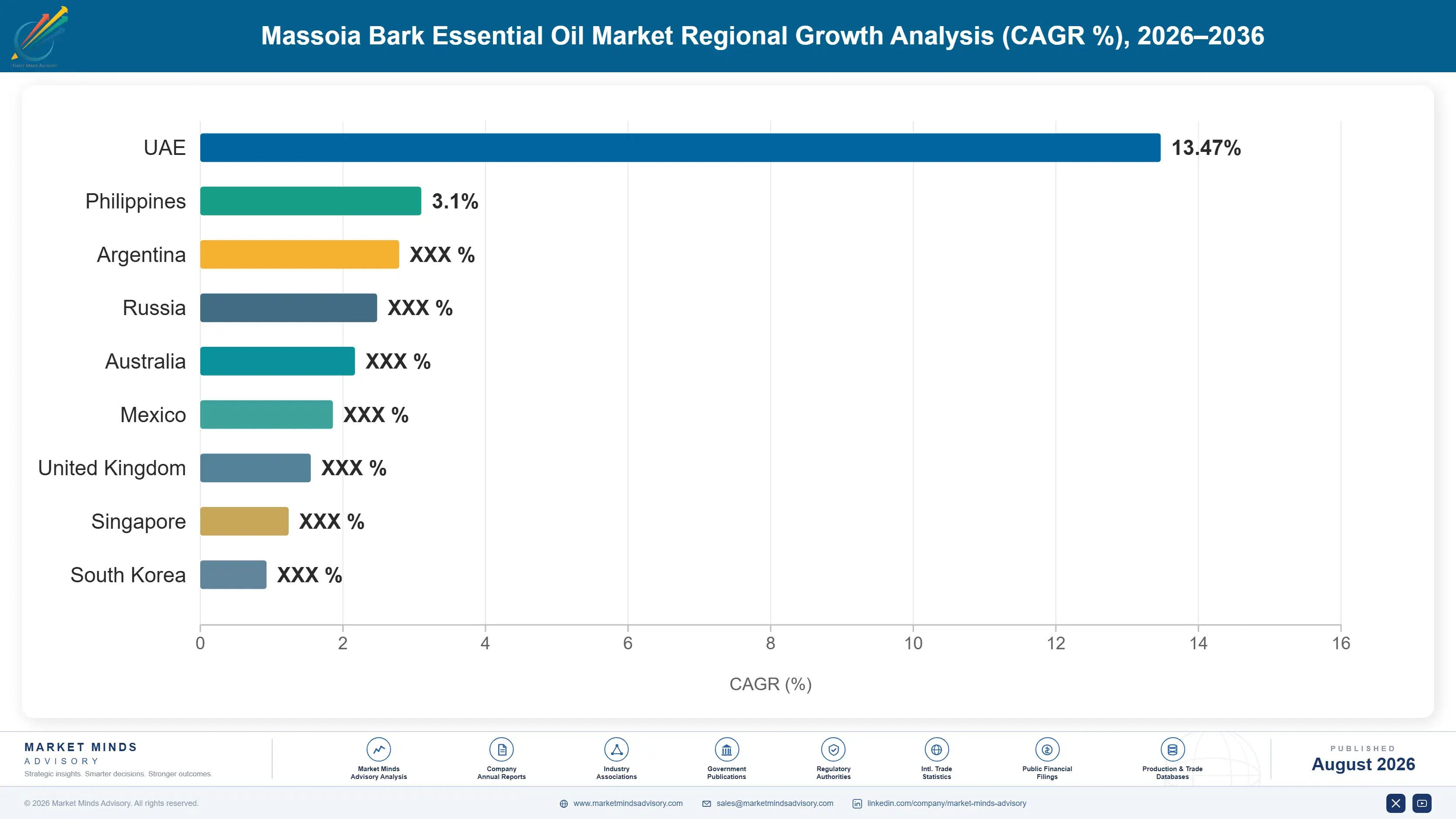
Indonesia: 10.9% CAGR
Fastest Growth Region
South Asia and Pacific: 11.0% CAGR
Largest Region
South Asia and Pacific: 63% of 2025 global value
Market Leaders
Givaudan, Firmenich, International Flavors and Fragrances, Symrise and Van Aroma lead on massoia lactone and bark oil supply. Source: MMA Primary Research Dataset, July 2026.
Primary Survey
n=3,800 procurement and R&D decision-makers, Q4 2025, six countries
Methodology
Demand-side build-up, cross-validated against public data, 47 expert interviews

Massoia Bark Essential Oil Market Forecast Scenarios

massoia-bark-essential-oil-market-trends-size-forecast-scenario-1787458022253
Growth ran at 7.3% annually between 2020 and 2025, and sourcing policy rather than flavour demand set most of the direction. Flavour houses began examining supply chains for materials that could not be sustainably harvested, and massoia came up immediately once anybody looked at how the bark is obtained. That scrutiny pushed development toward isolation and eventually toward fermentation routes.
The base case at 8.6% rests on three mechanisms. Isolated lactone keeps replacing whole bark oil because flavourists want a specification rather than a variable natural material. Fermentation-derived lactone continues taking share on sourcing policy grounds even where it costs more. And dairy and coconut flavour demand keeps growing across Asian and Latin American food manufacturing, which is where the lactone actually gets used at volume. None of the three depends on cost parity arriving.
The bull case at 9.8% turns on fermentation capacity scaling far enough to reach cost parity with wild-harvested oil, which would end the trade-off flavour houses currently manage between cost and sourcing defensibility. The bear case at 7.4% reflects tightened sensitisation limits from fragrance authorities, which would cut permitted inclusion levels and reduce volume across every application at once.

The Harvest Kills The Tree It Comes From

Every commercial fact about this market follows from one uncomfortable detail. Massoia bark is harvested by felling the tree and stripping it, and the species grows commercially only in Papua and West Papua where regeneration is slow. A flavour house sourcing committee that examines this supply chain does not usually like what it finds, and several have said so.
TOP FIVE CONCENTRATION72%High, since very few companies handle a material this specialised
LACTONE CONTENT64%Typical lactone proportion of crude massoia bark oil
FERMENTATION COST PREMIUM1.8 timesFermentation cost relative to wild-harvested extracted lactone material
ISOLATED GRADE SHARE58%Portion of volume supplied as isolated lactone rather than oil
TYPICAL INCLUSION LEVEL8 parts per millionCommon dosing in dairy and coconut flavour system applications
SENSITISATION LIMIT0.01%Fragrance authority ceiling for leave-on cosmetic product applications
That drove the shift toward isolation first. C10 massoia lactone is the entire functional payload, and everything else in whole bark oil is variability a flavourist has to formulate around batch by batch. Isolating it lets somebody dose precisely against a specification. Roughly 58% of volume now moves as isolated lactone rather than as whole oil, and that share keeps climbing. Batch by batch adjustment is work nobody wants to keep doing.
Fermentation went further and removed the tree entirely. Fermentation-derived lactone costs around 1.8 times wild-harvested material and delivers consistent purity as a secondary benefit, and several flavour houses committed to it on sourcing policy grounds alone rather than waiting for cost parity. The gap narrows as capacity scales, and nobody in this trade expects wild harvesting to remain the primary route indefinitely.
"This is a tiny market with a very large problem sitting inside it. Once a sourcing committee understands that the harvest kills the tree, the conversation stops being about price and becomes about whether they should be buying it at all."
Director, Flavour and Fragrance Ingredients Practice · MMA Flavour and Fragrance Ingredients Practice · August 2026

Market Trends

Fermentation Routes Remove The Destructive Harvest Entirely

Massoia bark is obtained by felling the tree and stripping it, and the species grows commercially only in Papua where regeneration is slow, which makes sustained extraction difficult to defend to any sourcing committee that examines it properly. Fermentation-derived lactone removes that problem completely and delivers consistent purity as a secondary benefit. Cost sits around 1.8 times wild-harvested material and narrows as capacity scales. Several flavour houses committed on policy grounds without waiting for parity at all. Sourcing commitments are considerably harder to reverse than procurement preferences ever are. Nobody expects wild harvesting to remain primary.
Market Impact: Shifts 58% toward isolated grades
Isolation Replaces Whole Oil As The Traded Form

C10 massoia lactone is the entire functional payload and everything else in whole bark oil is variability a flavourist must formulate around batch by batch, which is work nobody wants to do repeatedly. Isolation lets a formulator dose precisely against a specification instead. Roughly 58% of volume now moves as isolated lactone rather than as whole oil and that share keeps climbing. Fragrance authority sensitisation limits also apply to the lactone specifically, which makes documented purity a regulatory matter. Suppliers who cannot document purity are excluded from cosmetic applications entirely.
Market Impact: Indonesia grows at 10.9% annually

Market Opportunities and Growth Drivers

Sourcing Policy Scrutiny Drives Demand Toward Defensible Material

Flavour houses began examining supply chains for materials that cannot be harvested sustainably, and massoia surfaced immediately once anybody looked at how the bark is actually obtained. That scrutiny pushed development toward isolation and then toward fermentation, and it continues to move volume even where the alternative costs more. Corporate sourcing commitments are considerably harder to reverse than a procurement preference, which makes this demand unusually durable for such a small market. Massoia surfaced immediately once anybody examined how the bark is actually obtained from the tree. Corporate commitments are durable in a way preferences are not.
Market Impact: Regeneration takes over 10 years

Asian Dairy And Coconut Flavour Demand Grows Steadily

Massoia lactone delivers a creamy coconut character at inclusion levels measured in parts per million, which makes it valuable in dairy, confectionery and beverage flavour systems where coconut and cream notes matter. Asian and Latin American food manufacturing growth is where that demand actually sits, since coconut flavour profiles are culturally central across much of Southeast Asia. Indonesian demand grows near 10.9% annually as domestic food manufacturing scales alongside the extraction industry. Coconut flavour profiles are culturally central across much of Southeast Asia and beyond it. Parts per million inclusion makes cost almost irrelevant downstream.
Market Impact: Limits leave-on use to 0.01%

Market Restraints and Challenges

Destructive Harvest Limits Supply And Invites Restriction

Felling a slow-regenerating tree to obtain bark is not a supply model that survives scrutiny indefinitely, and Indonesian forestry regulation could restrict it at any point without much warning to buyers. The root cause is biological rather than commercial, since the lactone concentrates in bark that cannot be taken without killing the tree. Commercially this caps sustainable volume and creates supply risk nobody can hedge. Participants are responding with fermentation investment, cultivation trials and isolated grade positioning. Cultivation trials are underway though nothing has reached commercial scale yet. No mechanism exists to hedge that supply risk.
Market Impact: Costs 1.8 times wild-harvested material

Sensitisation Limits Cap Inclusion Across Cosmetic Applications

Fragrance authority restrictions limit massoia lactone in leave-on cosmetic products to very low concentrations because of skin sensitisation potential, which caps volume in an application that would otherwise absorb considerably more material. The root cause is a documented dermatological effect rather than any regulatory overreach. Commercially this confines cosmetic use to rinse-off and low-inclusion applications. Participants are responding with derivative chemistry, blended systems reducing lactone proportion, and concentration on flavour rather than fragrance applications. Flavour applications absorb considerably more volume than cosmetic ones can. Derivative chemistry is one route participants are exploring.
Market Impact: Isolated grades reach 58% of volume
3 additional market trends, 4 additional growth drivers, and 2 additional restraints and challenges are covered in the full report. Contact sales@marketmindsadvisory.com to access the complete intelligence.

Segment CAGR and Growth Architecture

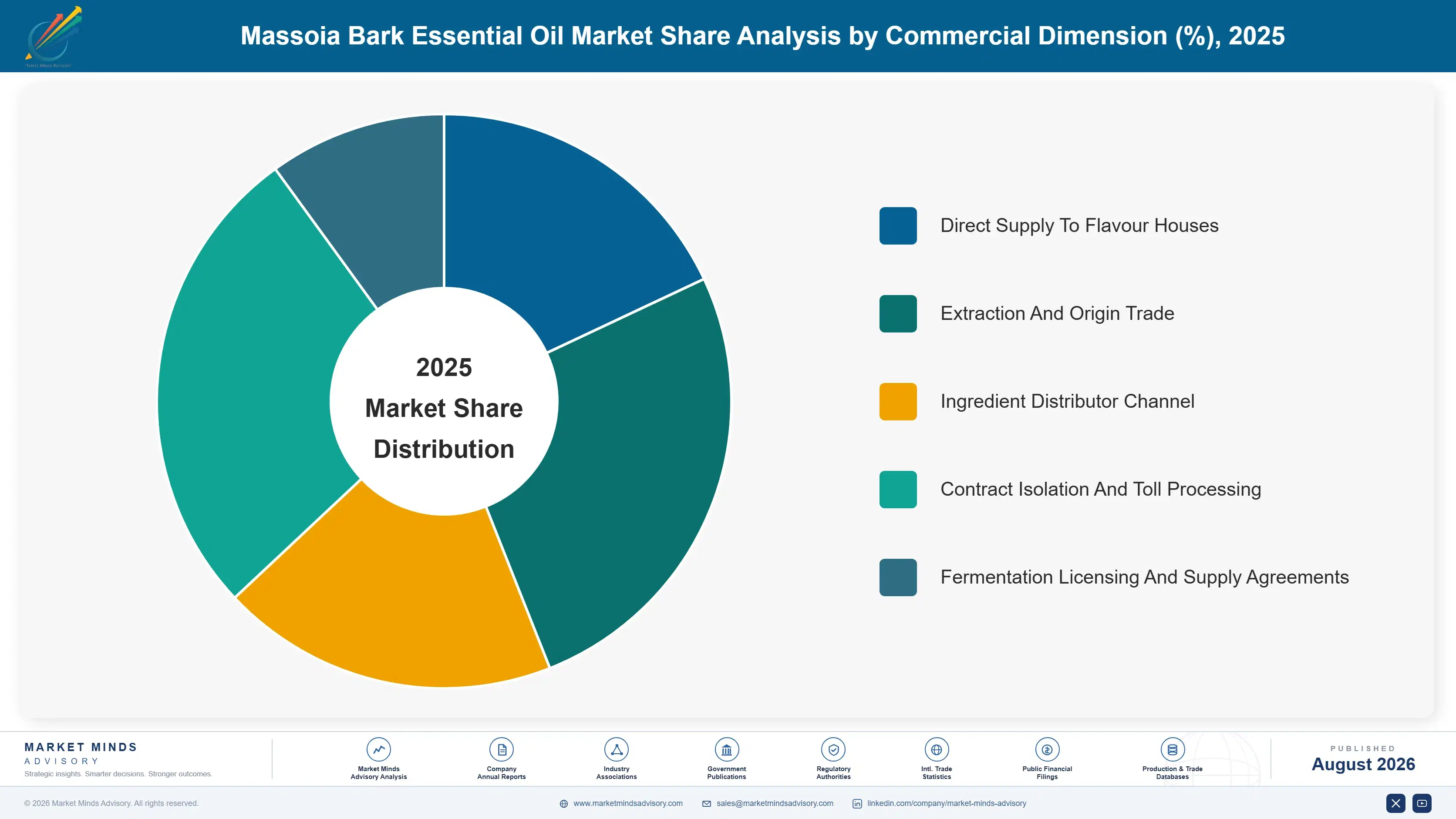
Five product forms divide this market on production route and purity rather than on the application each one serves. That reflects how buyers genuinely purchase, since a flavour house specifies lactone content, sourcing route and documentation depth, and the same material then goes into dairy, confectionery or cosmetic systems without the specification changing at all.
massoia-bark-essential-oil-market-trends-market-share-analysis-1787458022781

Isolated High-Purity C10 Lactone

Growing at 12.9% and the fastest part of this market. C10 massoia lactone isolated to high purity rather than sold as whole bark oil is what flavour houses actually want, because the lactone is the entire functional payload and everything else in the oil is variability they have to formulate around. Isolation lets a flavourist dose precisely against a specification instead of adjusting batch by batch. Dairy and coconut flavour systems take most of the volume, since the lactone delivers a creamy coconut character at inclusion levels measured in parts per million. Skin sensitisation limits set by fragrance authorities apply to the lactone specifically, which makes documented purity a regulatory requirement rather than a preference.
CAGR 12.9%

Fermentation And Synthesis-Derived Lactone

Growing at 11.0% on massoia lactone produced by fermentation or synthesis rather than extracted from bark, which addresses the problem nobody in this trade likes discussing: harvesting massoia bark kills the tree. The species grows in Papua and West Papua and regeneration is slow, so sustained extraction at commercial volume is genuinely difficult to defend. Fermentation-derived material removes that entirely and delivers consistent purity as a secondary benefit. Cost still sits above wild-harvested oil, though the gap narrows as capacity scales, and several flavour houses have already committed to it on sourcing policy grounds alone. Sourcing policy is moving volume ahead of any cost parity arriving. Consistency comes as a secondary benefit.
CAGR 11.0%
Full segment breakdown across 5 segments available in the complete report.

Regional Architecture and Country Demand Map

South Asia and Pacific holds 63% of global value because Indonesia is effectively the only place massoia grows commercially, which puts every region outside the standard bands. Western Europe follows at 17% on flavour house isolation and fermentation capability rather than on any raw material position.

South Asia and Pacific

Note: this region holds 63% because Cryptocarya massoy grows commercially only in Papua and West Papua, and no allocation reflecting the real market can avoid concentrating value where the material physically originates. Indonesian collectors and distillers supply essentially the entire wild-harvested world volume through a supply chain that remains informal in many places. Van Aroma and several Indonesian distillers hold the primary extraction positions. Traceability is the recurring commercial difficulty, since bark reaches distillers through collector networks that documentation struggles to follow. Domestic flavour manufacturing is also growing, which adds demand alongside the extraction industry rather than competing with it. Regeneration across harvested stands is slow enough to make sustained extraction genuinely difficult.
Share: 63% | CAGR: 11.0% (2026 to 2036)

Western Europe

Note: Western Europe registers at 17% on isolation, fermentation and formulation capability rather than on any raw material position, since no massoia grows anywhere in the region. Givaudan, Firmenich and Symrise hold the technical positions that convert crude oil into isolated lactone and formulate it into flavour systems. Fermentation development has concentrated here and in North America, driven by sourcing policy commitments that European flavour houses made earlier than most. Fragrance authority sensitisation limits originate from European bodies and shape cosmetic application globally. Regulatory documentation carried as standard also satisfies buyer requirements in other markets without additional work. Sourcing policy commitments were made earlier here than in most other markets.
Share: 17% | CAGR: 7.0% (2026 to 2036)
Regional intelligence for 5 additional markets available in the complete report: North America, East Asia, Latin America, Middle East and Africa, Eastern Europe. Contact sales@marketmindsadvisory.com.
massoia-bark-essential-oil-market-trends-country-cagr-analysis-1787458023310

Where Massoia Lactone Value Concentrates

Four positions separate suppliers with durable business from those trading wild-harvested oil on price: investing in fermentation routes ahead of restriction, isolating lactone rather than selling whole oil, building traceability through informal collector networks, and holding documentation that satisfies sensitisation limits in cosmetic applications. Only the first requires capital a small market struggles to justify.

Invest In Fermentation Routes Ahead Of Restriction

Felling a slow-regenerating tree to obtain bark is not a supply model that survives scrutiny indefinitely, and Indonesian forestry regulation could restrict it without warning. Fermentation-derived lactone costs around 1.8 times wild-harvested material and several flavour houses committed to it on sourcing policy grounds without waiting for parity. Suppliers holding fermentation capacity when restriction arrives inherit demand competitors cannot serve at all, which is a considerably better position than being cheap. Restriction could arrive without much warning to anybody buying it. Being cheap has never protected anybody in this particular trade.
Market Impact: Costs roughly 1.8 times the wild-harvested bark equivalent

Isolate Lactone Rather Than Selling Whole Oil

C10 lactone is the entire functional payload and everything else in whole bark oil is variability a flavourist has to formulate around batch by batch. Isolation lets a formulator dose precisely against a specification, and roughly 58% of volume has already moved that way. Suppliers offering isolated material realise 40% to 50% higher margin than crude oil traders, and the isolation capability is what actually separates a technical supplier from a commodity intermediary in this trade. Isolation is what separates a technical supplier from a commodity intermediary. Formulation work absorbs the value otherwise.
Market Impact: Realises up to 50% higher margin than crude

Build Traceability Through Informal Collector Networks

Bark reaches Indonesian distillers through collector networks that documentation struggles to follow, which is exactly the gap a flavour house sourcing committee asks about first. Suppliers investing in collector registration, volume reconciliation and origin documentation command 25% to 33% premiums over untraceable material and reach buyers who will not otherwise purchase at all. The work is administrative and persistent rather than capital-intensive, and competitors have generally declined to attempt it. Competitors have generally declined to attempt any of this work. Sourcing committees ask about the network before anything else at all.
Market Impact: Commands premiums of as much as 33% higher

Hold Documentation Satisfying Cosmetic Sensitisation Limits

Fragrance authority restrictions cap massoia lactone in leave-on cosmetic products at 0.01% because of skin sensitisation, which makes documented purity and concentration control a regulatory requirement rather than a quality preference. Suppliers who cannot demonstrate it are excluded from cosmetic applications entirely regardless of price. The documentation burden is modest against the applications it opens, and it transfers directly into flavour house requirements that increasingly mirror the same standards. Flavour house requirements increasingly mirror the same documentation standards anyway. Exclusion from cosmetic applications applies regardless of price offered. Price offers nothing here.
Market Impact: Opens applications capped at only 0.01% by concentration

Who Controls the Margin Pool

Concentration reads at 72% for the top five measured on massoia lactone and bark oil supply, the basis used throughout this section, and it is high because very few companies handle a material this specialised. Givaudan, Firmenich, International Flavors and Fragrances and Symrise hold isolation and formulation capability. Van Aroma holds a primary Indonesian extraction position that none of them replicate directly.
Competition runs on three fronts. Fermentation capability is the first and increasingly the decisive one, since sourcing policy moves volume regardless of cost. Isolation capability is the second, separating technical suppliers from commodity intermediaries. Traceability through Indonesian collector networks is the third, and it determines which buyers will purchase wild-harvested material at all. None of the three is a price argument, which is unusual in an ingredient trade.

Pressure arrives from two directions. Sourcing policy commitments are moving flavour house demand away from wild-harvested oil faster than Indonesian suppliers can respond to. Separately, Chinese synthesis capacity for related lactones could extend into this molecule and reshape supply if pursued. Rankings will shift toward participants holding fermentation routes and isolation capability rather than raw material access alone.
massoia-bark-essential-oil-market-trends-company-positioning-matrix-1787458023842

Competitive Moat and Risk Dimensions

GIVAUDAN

Moat: Isolation and fermentation capability

Technical capability to isolate lactone to specification and to develop fermentation routes gives the group a position that raw material access alone does not confer, and sourcing policy commitments made early mean customers already expect defensible material from it. Formulation depth also means the lactone sells inside a solution rather than as a standalone ingredient.
GIVAUDAN

Risk: Small material, large scrutiny

Massoia is a tiny part of a very large portfolio and attracts sourcing scrutiny out of all proportion to its commercial value, which makes the reputational risk asymmetric against the revenue involved. Fermentation development also costs more than the material justifies on any narrow financial view, which makes internal funding arguments harder than the strategic case suggests.
VAN AROMA

Moat: Indonesian extraction and origin

Direct Indonesian extraction and established relationships through collector networks give the business origin access that international flavour houses buy rather than hold themselves, and proximity supports traceability work that distant buyers cannot conduct. Breadth across Indonesian botanical oils also spreads collection infrastructure and compliance cost across considerably more volume than massoia alone would ever justify.
VAN AROMA

Risk: Wild harvest dependence entirely

A business built on wild-harvested bark faces both Indonesian forestry restriction risk and the steady migration of flavour house demand toward fermentation-derived material on sourcing policy grounds. Fermentation capability requires capital and organism development experience that a botanical extraction business has had no reason at all to build so far.

Players Tracked

Prominent Players

Givaudan
Firmenich
International Flavors and Fragrances
Symrise
Van Aroma

Other Key Players

Takasago International
Mane SA
Robertet Group
Sensient Technologies
Kerry Group
Berjé
Ultra International
Elixens
Indesso Aroma
Aroma Aromatics and Flavours
Treatt
Bell Flavors and Fragrances
Ventos
Frey and Lau
Citrus and Allied Essences

Recent Developments

FEBRUARY 2025

Fermentation-derived massoia lactone reaches commercial supply volume

A flavour house began commercial supply of fermentation-derived massoia lactone to food manufacturing customers, removing the destructive bark harvest from that portion of its supply chain and delivering consistent purity that wild-harvested oil has never reliably provided. Transition timelines were published for existing products. Purity improved measurably.
Signal: Sourcing policy rather than cost parity is what moved fermentation from development into commercial supply here
JUNE 2025

Traceability programme launched across Indonesian collector networks

An Indonesian extraction business launched a collector registration and volume reconciliation programme aimed at the traceability gap that flavour house sourcing committees examine first, addressing informal supply chains that documentation had never been able to follow properly. Volume reconciliation to origin became possible for the first time.
Signal: Traceability through informal collector networks is what wild-harvested material now needs to remain purchasable at all
OCTOBER 2025

Sourcing policy excludes wild-harvested massoia at major flavour house

A flavour house adopted a sourcing policy excluding wild-harvested massoia bark oil from new formulations, citing the destructive harvest and slow regeneration of the species, and committing existing products to fermentation-derived material over a defined transition. Existing products were committed to fermentation-derived material. A defined transition period applies.
Signal: Corporate sourcing commitments are considerably harder to reverse than any ordinary procurement preference has ever been

What Drives Massoia Lactone Cost

For wild-harvested material, bark collection and transport account for roughly 41% of cost and reflect both the labour involved and the distances across Papua that material travels. Distillation contributes around 17%. Isolation and purification add about 21% where applied, packaging and freight roughly 12%, and documentation, testing and traceability work close to 9% and rising as buyer requirements tighten across the trade.
Indonesian bark collection costs rose through 2023 and 2024 as accessible stands became scarcer and collectors travelled further, which is the predictable consequence of a destructive harvest rather than any market event. Fermentation feedstock costs followed agricultural sugar markets tracked in United States Department of Agriculture data, and European fermentation energy remained elevated according to International Energy Agency figures. Collection costs rise every season regardless.

The disadvantage mechanism is that wild-harvest cost rises steadily as accessible stands deplete, and it falls on extraction-based suppliers rather than on fermentation producers. Each season pushes collectors further and raises the collection share of cost again, with no mechanism available to reverse it. Exposure therefore varies by production route entirely, since fermentation costs fall as capacity scales while wild-harvest costs move steadily in the opposite direction.
massoia-bark-essential-oil-market-trends-cost-volatility-analysis-1787458024044

Commit fermentation capacity before restriction forces it

Wild-harvest costs rise as accessible stands deplete while fermentation costs fall as capacity scales, and those two curves are moving toward each other without any intervention. Committing capacity early captures demand that sourcing policy is already moving. The capital is substantial against a small market, which is exactly why so few have committed and why the position holds.

Invest in collector traceability to keep material purchasable

Flavour house sourcing committees examine the collector network first and informal supply chains fail that examination immediately, which removes material from consideration regardless of quality or price. Registration and volume reconciliation keep wild-harvested oil purchasable while fermentation capacity builds. The work is administrative and persistent rather than capital-intensive, and most competitors have simply declined to attempt it at all.

Shift volume toward isolated lactone rather than crude oil

Crude oil competes on price against other crude oil and carries all the variability a flavourist must formulate around, which earns nothing for the supplier who produced it. Isolation captures the value that formulation work would otherwise absorb downstream. Equipment and analytical capability are both required, and volume here is small enough that the investment needs careful sizing.

Portfolio Architecture for Margin Defence

Portfolio economics here divide on production route and traceability rather than on lactone content, which is straightforward to measure and roughly comparable between suppliers. Untraceable crude oil sold on price is increasingly unsaleable to serious flavour houses, because a sourcing committee examining the collector network finds nothing it can document and stops there. Quality and price stop mattering at that point.
The middle tier is traceable wild-harvested oil with collector registration behind it. Documentation keeps the material purchasable while fermentation capacity builds elsewhere, and buyers who have not yet committed to synthetic routes will pay for it. Margins reach the low thirties, though the position is transitional rather than permanent and everybody involved understands that. The window is narrowing rather than merely under discussion.

Above both sits isolated or fermentation-derived lactone with full documentation. Isolation captures value that downstream formulation would otherwise absorb, fermentation removes the harvest question entirely, and margins reach the high forties. The position requires technical capability and capital that a small market struggles to justify, which is precisely why so few participants hold it and why it stays defensible. Very few participants hold either capability properly.

Volume / Commodity-Adjacent

Untraceable crude bark oil sold on price into intermediary trade. The range reflects collection cost and freight rather than commercial skill, and serious flavour houses increasingly will not buy it.
Gross Margin: 12 to 20%

Premium / Certified

Traceable wild-harvested oil with collector registration and origin documentation. The range reflects traceability depth, and the position is transitional while fermentation capacity builds elsewhere in the trade. The position is temporary.
Gross Margin: 28 to 36%

Sustainability / Regulatory / Next-Generation

Isolated or fermentation-derived lactone with full purity and sourcing documentation. The wide range reflects production route, since fermentation costs fall with scale while isolation costs stay broadly fixed. Very few participants hold it.
Gross Margin: 42 to 52%
massoia-bark-essential-oil-market-trends-portfolio-architecture-1787458024559

High-value Sub-segments and Strategic Watch-out

Fermentation-Derived Lactone Supply

High value and high growth together, removing the destructive harvest that sourcing committees examine first. The wide range reflects capacity scale, since fermentation costs fall as volume rises while wild-harvest costs move steadily the other way. Sourcing policy moves volume ahead of price. Capital is the barrier.
Gross Margin: 42 to 52%

Isolated High-Purity Lactone

High value on strong growth as flavourists move from variable natural oil to a specification they can dose against. The range reflects purity achieved and whether documentation satisfies cosmetic sensitisation requirements alongside flavour applications. Isolation separates technical suppliers from intermediaries entirely. Specification beats variability every time.
Gross Margin: 38 to 47%

Traceable Wild-Harvested Oil

A transitional position keeping material purchasable while fermentation capacity builds. The range reflects traceability depth through collector networks, and everybody in the trade understands this position is temporary rather than durable. Fermentation capacity is building elsewhere meanwhile. The window narrows each year. Documentation keeps it purchasable.
Gross Margin: 28 to 36%

Untraceable Crude Oil Trade

The strategic watch-out. Volumes exist but serious flavour houses increasingly refuse the material, sourcing committees find nothing documentable, and forestry restriction risk sits entirely on this position. The range reflects collection cost alone. Forestry restriction risk sits entirely here. Nothing about it is defensible. Committees find nothing documentable.
Gross Margin: 12 to 20%

How Massoia Lactone Demand Repeats

Flavour ingredient demand repeats through formulations rather than through purchasing decisions, which makes it unusually durable once established. A lactone written into a dairy or coconut flavour system stays there for as long as that system is sold, because reformulating a flavour means resubmitting sensory approval to every customer using it. That happens rarely and reluctantly, and only when something forces it.
Stickiness varies sharply by what secured the position. Fermentation-derived material holds best, since sourcing policy commitments are harder to reverse than procurement preferences and a flavour house that switched will not switch back. Isolated lactone holds well because the specification is written into the formulation. Traceable wild-harvested oil holds only until fermentation capacity reaches the buyer. Untraceable crude holds nothing.

The buyer profile has changed decisively. Massoia was once bought by flavour purchasing functions selecting on lactone content and price, with origin barely discussed. Sourcing and sustainability committees now examine the supply chain before purchasing approves anything, which rewards suppliers with traceability and fermentation routes and disadvantages those whose commercial argument was a competitive quotation and a certificate of analysis. Certificates of analysis convince nobody now.
massoia-bark-essential-oil-market-trends-end-use-penetration-index-1787458025049

Where To Compete And Why

These are among the four positions where our research anticipates prominent divergence between winners and laggards over the coming forecast period. Each is grounded in the demand model, the regulatory perimeter, and the announced capacity pipeline.
01 / FERMENTATION ROUTE COMMITMENT

The harvest kills the tree

Felling a slow-regenerating species to obtain bark is not a supply model that survives sourcing scrutiny indefinitely, and Indonesian forestry regulation could restrict it without much warning to anybody buying. Fermentation-derived lactone costs around 1.8 times wild-harvested material and flavour houses have committed on policy grounds without waiting for parity. Suppliers holding fermentation capacity when restriction arrives inherit demand competitors cannot serve, which is a considerably better commercial position than being cheap has ever been anywhere in this particular trade.
02 / LACTONE ISOLATION CAPABILITY

Everything else is just variability

C10 lactone is the entire functional payload and everything else in whole bark oil is variability that a flavourist has to formulate around batch after batch, which is work nobody wants to keep repeating. Isolation lets a formulator dose against a specification instead, and roughly 58% of volume has already moved that way. Suppliers offering isolated material realise 40% to 50% higher margin than crude oil traders operating in the same trade, and the capability itself is what actually distinguishes them.
03 / COLLECTOR TRACEABILITY INVESTMENT

Committees examine the network first

Bark reaches Indonesian distillers through collector networks that documentation has never followed properly, and that is precisely the gap a flavour house sourcing committee asks about before anything else. Suppliers investing in collector registration and volume reconciliation command 25% to 33% premiums and reach buyers who would not otherwise purchase at all. The work is administrative and persistent rather than capital-intensive, and competitors have mostly declined to attempt it, which is precisely why the premium has persisted at all so far.
04 / SENSITISATION DOCUMENTATION HOLDING

Cosmetic access requires demonstrated purity

Fragrance authority restrictions cap massoia lactone in leave-on cosmetic products at 0.01% because of documented skin sensitisation, which makes purity and concentration control a regulatory requirement rather than any quality preference. Suppliers who cannot demonstrate that control are excluded from cosmetic applications entirely, regardless of what they happen to charge. The documentation burden is genuinely modest against the applications it opens and it transfers directly into flavour house requirements that increasingly mirror exactly the same purity and documentation standards anyway.

Engagement Snapshot From the Field

A live engagement with an industry participant carrying material or product regulatory and market exposure ahead of a defining policy shift, showing how our research translates into a defensible multi-year portfolio strategy.
MARKET MINDS ADVISORY · CLIENT ENGAGEMENT SUMMARY
Massoia Bark Essential Oil Producer Strategic Portfolio Review and Transition Roadmap 2026·Investment Scenario on Massoia Bark Essential Oil Exposure Evaluation 2025-26
CLIENT PROFILE
An Indonesian botanical extraction business with annual revenue near $31 million (client-reported, unverified by MMA), producing massoia bark oil alongside several other tropical botanical extracts for international flavour and fragrance customers. Massoia represented roughly 22% of revenue, sold as crude oil through collector networks with no formal traceability documentation anywhere in the supply chain at all.
STRATEGIC CHALLENGE
Two international customers had raised sourcing questions the client could not answer, and one had signalled it would exclude wild-harvested massoia from new formulations entirely. Management needed to decide between building traceability to keep the material purchasable, investing in isolation capability, or accepting that the massoia business would decline as fermentation capacity built elsewhere.
MMA APPROACH
MMA mapped the client's collector network and the documentation gaps within it, benchmarked realised pricing against traceable and isolated material, and assessed isolation capability against required capital and realistic demand. Nineteen expert interviews with flavour house sourcing leads, sustainability committees and fermentation developers established what buyers would genuinely accept from a supplier.
KEY FINDINGS
  1. Every flavour house sourcing lead interviewed examined the collector network before anything else, and none could approve material where volume reconciliation to origin was unavailable to them.
  2. Traceable wild-harvested oil realised roughly 29% higher pricing than untraceable material in the same period, with the difference resting entirely on documentation rather than on any quality distinction.
  3. Isolation capability was assessed as achievable within the client's technical capacity but required capital difficult to justify against massoia volume alone, unless applied across other extracts too.
  4. Fermentation-derived lactone was already being supplied commercially by two flavour houses, which meant the wild-harvest window was narrowing rather than merely under discussion.
CLIENT PROFILE
An Indonesian botanical extraction business with annual revenue near $31 million (client-reported, unverified by MMA), producing massoia bark oil alongside several other tropical botanical extracts for international flavour and fragrance customers. Massoia represented roughly 22% of revenue, sold as crude oil through collector networks with no formal traceability documentation anywhere in the supply chain at all.
STRATEGIC CHALLENGE
Two international customers had raised sourcing questions the client could not answer, and one had signalled it would exclude wild-harvested massoia from new formulations entirely. Management needed to decide between building traceability to keep the material purchasable, investing in isolation capability, or accepting that the massoia business would decline as fermentation capacity built elsewhere.
MMA APPROACH
MMA mapped the client's collector network and the documentation gaps within it, benchmarked realised pricing against traceable and isolated material, and assessed isolation capability against required capital and realistic demand. Nineteen expert interviews with flavour house sourcing leads, sustainability committees and fermentation developers established what buyers would genuinely accept from a supplier.
KEY FINDINGS
  1. Every flavour house sourcing lead interviewed examined the collector network before anything else, and none could approve material where volume reconciliation to origin was unavailable to them.
  2. Traceable wild-harvested oil realised roughly 29% higher pricing than untraceable material in the same period, with the difference resting entirely on documentation rather than on any quality distinction.
  3. Isolation capability was assessed as achievable within the client's technical capacity but required capital difficult to justify against massoia volume alone, unless applied across other extracts too.
  4. Fermentation-derived lactone was already being supplied commercially by two flavour houses, which meant the wild-harvest window was narrowing rather than merely under discussion.
RECOMMENDED STRATEGY
Phase 1: Phase one: build collector registration and volume reconciliation immediately, since this is administrative work that keeps existing material purchasable while other options are assessed. Phase 2: Phase two: size isolation capability against the full botanical portfolio rather than massoia alone, which changes the capital justification materially. Phase 3: Phase three: plan for declining wild-harvest volume rather than defending it, redirecting collection infrastructure toward other extracts as fermentation takes share.
OUTCOME
The client completed collector registration across its primary supply area within eight months and recovered one customer that had suspended purchasing (client-reported, unverified by MMA). Realised pricing on traceable material rose by roughly 24%, isolation capital was approved on the wider portfolio case, and massoia volume was planned down deliberately rather than defended.

Frequently Asked Questions

Foundational context covering the market sizes, CAGR, scope, country, region and competition that inform every finding below. This section is provided to cover basics and most often pre-purchase conversations, answered from the MMA Primary Research Dataset.

What is the current size of the Massoia Bark Essential Oil Market?

The global massoia bark essential oil market was valued at $0.10 billion in 2025, reaching an estimated $0.11 billion in 2026. That covers bark oil and its principal lactone constituent across flavour, fragrance and cosmetic use.

How large will the Massoia Bark Essential Oil Market be by 2036?

MMA forecasts the market reaching $0.25 billion by 2036, an increase of $0.14 billion over the 2026 base. That represents an expansion multiple of 2.28 times across the forecast period.

What is the CAGR for the Massoia Bark Essential Oil Market 2026 to 2036?

The base case compound annual growth rate is 8.6%, with a bull case of 9.8% and a bear case of 7.4%. Historical growth between 2020 and 2025 ran at 7.3% annually.

Which segment is growing fastest?

Isolated high-purity C10 lactone grows at 12.9%, a full 1.50 times the market rate, as flavourists move to a specification they can dose against. Fermentation-derived lactone follows at 11.0%.

Who are the major companies in the Massoia Bark Essential Oil Market?

Givaudan, Firmenich, International Flavors and Fragrances, Symrise and Van Aroma lead on massoia lactone and bark oil supply. Together they account for roughly 72% of global value.

Which country is growing fastest?

Indonesia grows fastest at 10.9% annually, combining the only commercial source of the species with domestic food manufacturing that is scaling alongside the extraction industry itself.

Report Segmentation Architecture

The full report scope spans multiple orthogonal segmentation dimensions, with cross-tabulated demand data provided for each dimension pair. Coverage extends further to regional breakdowns, trend trajectories, and the competitive detail needed to support segment-level decision-making.

By Product Form

  • Isolated High-Purity C10 Lactone
  • Fermentation And Synthesis-Derived Lactone
  • Crude And Whole Massoia Bark Oil
  • Standardised Flavour-Grade Oil Blends
  • Cosmetic And Fragrance-Grade Preparations

By End-Use Industry

  • Dairy And Cream Flavour Systems
  • Coconut And Tropical Flavour Applications
  • Confectionery And Bakery Flavouring
  • Beverage Flavour Systems
  • Fine Fragrance And Personal Care
  • Rinse-Off Cosmetic Formulation

By Commercial Dimension

  • Direct Supply To Flavour Houses
  • Extraction And Origin Trade
  • Ingredient Distributor Channel
  • Contract Isolation And Toll Processing
  • Fermentation Licensing And Supply Agreements

By Region

  • South Asia and Pacific
  • Western Europe
  • North America
  • East Asia
  • Latin America
  • Middle East and Africa
  • Eastern Europe

Scope, Methodology, and Coverage

Every figure in this report is reproducible from documented input assumptions. The scope below maps the historical period, the forecast horizon, the segmentation dimensions, and the countries covered, alongside the underlying primary and qualitative methodology.
Historical Period
2020 to 2025
Forecast Period
2026 to 2036
Base Year
2025 (USD billions; MMA Primary Research Dataset, August 2026)
Market Definition
This report covers massoia bark oil and its principal lactone constituent supplied into flavour, fragrance and cosmetic formulation, spanning isolated high-purity C10 lactone, fermentation and synthesis-derived lactone, crude and whole massoia bark oil, standardised flavour-grade oil blends, and cosmetic and fragrance-grade preparations, across direct flavour house supply, origin trade, distribution, toll isolation and licensing channels. Other Cryptocarya species oils, coconut and dairy flavour compounds containing no massoia lactone, massoia bark sold as a raw botanical, and unrelated delta-lactone chemistry are excluded from the sizing.
Quantitative Units
USD billions at supplier realised value; volume in tonnes; realised pricing in USD per kilogram.
Segmentation Dimensions
By product form; by end-use industry; by commercial dimension; by region.
Regions Covered
South Asia and Pacific, Western Europe, North America, East Asia, Latin America, Middle East and Africa, Eastern Europe
Countries Covered
Indonesia, Malaysia, Singapore, India, Australia, China, Japan, South Korea, United States, Canada, Mexico, Brazil, Argentina, Switzerland, France, Germany, Netherlands, United Kingdom, Turkey and South Africa.
Key Companies Profiled
Givaudan, Firmenich, International Flavors and Fragrances, Symrise, Van Aroma, Takasago International, Mane SA, Robertet Group, Sensient Technologies, Kerry Group, Indesso Aroma, Treatt, Bell Flavors and Fragrances and others.
Quantitative Methodology
Primary survey, n=3,800 respondents, Q4 2025, six countries; demand-side model with trade association cross-validation
Qualitative Methodology
47 expert interviews, Q4 2025; applied to validate demand model assumptions, identify emerging dynamics, and assess competitive positioning
Report Format
PDF and XLSX data workbook (Word format preview document)
Publisher
Market Minds Advisory
Report Code
MMA-2026-CHM-208
Published
August 2026
Contact
sales@marketmindsadvisory.com | www.marketmindsadvisory.com

Purchase the full Massoia Bark Essential Oil Market Report (2026 to 2036).

The full report sizes the massoia bark essential oil market across five product forms, six end-use categories and seven regions, with tonnage and per kilogram pricing detail behind every value estimate. It profiles twenty companies on isolation capability, fermentation development and origin access. Regional chapters cover extraction geography, flavour manufacturing demand and regulatory treatment by market. Cost analysis quantifies collection, distillation and isolation exposure by production route. Sustainability analysis assesses harvest economics, regeneration rates and the traceability gaps that sourcing committees examine first of all.
Tonnage and per kilogram pricing by product form
Wild-harvest against fermentation cost economics compared directly
Sensitisation limits and regulatory treatment across major jurisdictions
Indonesian collector network structure and traceability gaps mapped
Competitive position assessments across twenty companies
Sourcing policy commitments and transition timelines tracked by company

Built For The People Who Decide

From boardroom strategy to bench-side execution, this report is read cover-to-cover by leaders shaping the next decade of their industry, turning demand scenarios, market dynamics and valuation benchmarks into decisions.
CXOs/ Presidents/ VPs/ Managers
M&A and Corporate Development
Strategy Teams and R&D Heads
Procurement and Product Directors
Regulatory and Compliance Leaders
Investor Relations and Equity Analysts