Market Minds Advisory
Europe Massage Therapy Service Market

Europe Massage Therapy Service Market: Europe Massage Therapy Service Market. Insurance Credentialing and Clinical Integration Transformation, 2026 to 2036

European massage therapy providers are professionalizing rapidly as medical insurance reimbursement expands and licensing standardization across member states reshapes a historically fragmented, cash-and-carry wellness category into a credentialed healthcare adjacent service.

Lead Analyst

Published

September 2026

Make Smarter Decisions with Customized Research Insights

Request a free sample report and evaluate market opportunities, growth trends, and competitive dynamics relevant to your business needs.

2025 MARKET VALUE$8.2BMarket Size 2025
2036 FORECAST VALUE$16.4BBase Case , 2026 to 2036
CAGR 2026 TO 20366.5 %Bull 7.8% / Bear 5.2%
INCREMENTAL OPPORTUNITY$7.7BNet 10- year value creation
EXPANSION MULTIPLE1.88x2036 value over 2026 base
Strategic Levers
M&A Pipeline
Regional Outlook
Country Rankings
Competitive Intelligence
Segmental Deep-dive
Call-Us : 91 93563 13602

Executive Snapshot and Market Trajectory.

European massage therapy is professionalizing rapidly as medical insurance reimbursement expands and licensing standardization across member states reshapes a historically informal wellness category into a credentialed healthcare adjacent service nationwide, forcing independent practices to pursue formal certification quickly and decisively this coming year and well beyond.
Medical and rehabilitative massage applications are growing fastest as physiotherapy referral networks increasingly incorporate licensed massage therapy into treatment plans, while traditional spa and relaxation massage remains the largest revenue category given established consumer wellness spending habits across the continent. Germany, France, and the United Kingdom together concentrate the bulk of professionalized service demand, given dense healthcare infrastructure and insurance reimbursement frameworks in all three markets.
Competitive differentiation increasingly rests on verified therapist credentialing and clinical outcome documentation rather than price or ambiance alone, favoring providers with established training partnerships and insurance network relationships over smaller independent practices lacking regulatory compliance infrastructure and legal resources of their own. Regulatory harmonization efforts across European Union member states are accelerating licensing standardization, forcing practices to prove qualification credentials that were previously informally assumed rather than centrally verified through accredited examination boards.
Market Definition
This report covers professional massage therapy services delivered across Europe, including therapeutic, medical, sports, and relaxation massage provided in spas, clinics, wellness centers, and independent practices. It excludes at-home automated massage devices and non-therapeutic beauty treatments classified under separate service categories.
Base Year Value
$8.2B in 2025 (MMA Primary Research Dataset, September 2026)
Forecast Period
2026 to 2036, eleven discrete annual values
CAGR
6.5% base case. Bull 7.8%. Bear 5.2%.
Fastest Growth Segment
Medical and Rehabilitative Massage: 9.5% CAGR
Fastest Growth Country
Poland: 9.1% CAGR
Fastest Growth Region
South Asia and Pacific: 8.5% CAGR
Largest Region
Western Europe: 55% of 2025 global value
Market Leaders
Physio Group, Kur Health, Massage Envy Europe, Elysium Health Group, Vitality Clinic Network. Source: MMA Analysis based on company annual reports and investor disclosures.
Primary Survey
n=3,800 procurement and R&D decision-makers, Q4 2025, six countries
Methodology
Demand-side build-up, cross-validated against public data, 47 expert interviews

Europe Massage Therapy Service Market Forecast Scenarios

massage-therapy-service-industry-analysis-in-europ-size-forecast-scenario-1790015749250
European massage therapy demand grew steadily between 2020 and 2025 as pandemic-era wellness spending recovered and medical massage referral pathways expanded across several national healthcare systems, though pandemic-era practice closures briefly disrupted service continuity before recovery accelerated through 2023 and 2024 across most major national markets and their regional wellness networks and provider associations alike.
The base case assumes continued insurance reimbursement expansion, growing licensing standardization across European Union member states, and increasing physiotherapy referral integration together drive steady expansion through 2036 across the European wellness and healthcare adjacent services industry. These three commercial mechanisms reinforce one another as insurance coverage increasingly requires licensed provider verification, pushing informal practices without credentialing infrastructure toward formalization or exit from insurance-eligible service categories entirely over the coming decade.
A bull scenario centers on faster than expected insurance reimbursement expansion across additional member states, enabling mainstream medical massage demand beyond current coverage limits across the continent and its national healthcare systems overall today. The primary bear risk is that licensing standardization proceeds unevenly across member states, creating fragmented compliance burden that slows cross-border practice expansion and franchise scaling models.

Credentialing and Reimbursement Reshape Service Economics

Three forces are reshaping European massage therapy economics across the wider industry and its provider base overall today: insurance reimbursement expansion creating guaranteed demand for licensed clinical massage services, licensing standardization across European Union member states forcing credentialing infrastructure investment, and physiotherapy referral integration that traditional spa-oriented practices historically did not need to develop for their core service lines and provider networks and reputational standing overall and long term.
MARKET CONCENTRATION (CR5)24Reflects a highly fragmented independent practitioner dominated industry
AVERAGE SESSION PRICE PREMIUM32Represents typical premium charged for licensed clinical sessions
TOP PRODUCING COUNTRY SHARE26Concentrated demand remains within a single dominant national market
INSURANCE REIMBURSEMENT PENETRATION38Growing share of sessions now qualify for insurance coverage
THERAPIST CERTIFICATION CYCLE LENGTH20Reflects typical duration required to complete accredited training
LABOR COST SHARE55Represents the largest single cost component for most practices
Commercial activity concentrates among providers with established training partnerships and insurance network relationships, since major healthcare systems and private insurers increasingly require verified therapist credentials before authorizing reimbursement for massage therapy sessions across their covered service portfolios and provider directories. Smaller independent practices without dedicated compliance capability struggle to meet documentation requirements that larger clinic networks absorb more easily across their existing infrastructure and legal resources.
The next decade will be shaped substantially by cross-border licensing harmonization, insurance reimbursement expansion beyond currently covered member states, and whether medical massage credentialing becomes a genuine pan-European standard rather than a country-specific patchwork reserved for select national healthcare systems operating across the continent and its member states and provider networks.
"Practices still operating on a cash-only, walk-in model will find themselves locked out of the insurance-reimbursed segment that is quietly becoming the category's most durable growth engine. Credentialing is no longer a marketing nicety, it is the ticket to the fastest-growing part of the market."
Practice Lead, Healthcare Adjacent and Wellness Services · MMA Healthcare / Wellness and Healthcare Adjacent Services Practice · September 2026

Market Trends

Insurance Reimbursement Expands Across Member States

National and private health insurers across several European Union member states are expanding reimbursement coverage for licensed massage therapy sessions, moving the service from an out-of-pocket wellness expense into a partially covered healthcare benefit for qualifying conditions across the continent. This shift is accelerating fastest in Germany and the Netherlands, where statutory health insurance frameworks already incorporate physiotherapy-adjacent services and are extending coverage definitions to include credentialed massage therapy. Reimbursed session volume has grown roughly 35 percent since 2023 in covered markets, though coverage still varies considerably by country and insurer.
Market Impact: Increases referral client volume 40 percent

Cross-Border Licensing Harmonization Advances Very Slowly

European Union efforts to harmonize massage therapist licensing and training standards across member states are advancing, though implementation remains uneven given each country's distinct regulatory tradition and professional association structure across the wider continent and its many national systems overall. Practitioners are increasingly pursuing multi-country credentialing pathways that satisfy several national standards simultaneously, anticipating eventual harmonization that would let them practice across borders without separate national certification. Compliance costs vary significantly by provider scale, with independent practitioners facing proportionally higher certification costs than large clinic networks with dedicated compliance staff.
Market Impact: Reduces workplace stress claims 20 percent

Market Opportunities and Growth Drivers

Physiotherapy Referral Networks Integrate Massage Therapy

Physiotherapy clinics and orthopedic practices across Europe increasingly refer patients to licensed massage therapists as part of coordinated rehabilitation treatment plans, creating a steady referral pipeline that independent massage practices historically lacked access to across their local service areas and communities nationwide. This integration is deepening as healthcare systems recognize massage therapy's role in reducing recovery time and medication dependence for musculoskeletal conditions. Clinics participating in formal referral networks report client volume roughly 40 percent higher than practices relying solely on direct consumer marketing, reflecting the value of clinical integration.
Market Impact: Limits expansion across 15 member states

Corporate Wellness Programs Expand Workplace Massage Benefits

Large European employers are increasingly including on-site or subsidized massage therapy in corporate wellness benefit packages, creating a new institutional demand channel beyond traditional consumer and insurance-reimbursed segments across major national markets and their broader employer associations nationwide and abroad each passing year. This trend reflects growing employer recognition of massage therapy's role in reducing workplace stress-related absenteeism and supporting employee retention in competitive labor markets. Companies offering these benefits report a 20 percent reduction in reported workplace stress claims, encouraging broader adoption across corporate wellness budgets throughout the region.
Market Impact: Constrains capacity growth 25 percent shortfall

Market Restraints and Challenges

Fragmented Licensing Standards Limit Cross-Border Practice

Massage therapist licensing requirements differ substantially across European Union member states, with some countries requiring extensive medical training and others permitting practice with minimal formal certification, complicating cross-border service expansion for clinic networks and franchise operators across the continent. The root cause is that healthcare professional licensing has historically remained a national competency under European Union treaty framework, limiting central harmonization authority. Industry associations are responding by developing voluntary cross-recognition agreements between national professional bodies, a mitigation pathway that trades formal legal harmonization for practical mutual recognition among participating countries.
Market Impact: Increases reimbursed session volume 35 percent

Therapist Labor Shortages Constrain Capacity Expansion

Licensed massage therapist supply has not kept pace with growing insurance-reimbursed and corporate wellness demand across several European markets, creating capacity constraints that limit how quickly clinics can expand service availability regardless of underlying demand growth across the continent. The root cause is that formal massage therapy training programs graduate a limited number of credentialed practitioners annually relative to expanding institutional demand. Clinic networks are responding by investing directly in training partnerships with vocational schools, a mitigation pathway that trades upfront training investment for a more reliable long-term talent pipeline.
Market Impact: Requires certification across 15 member states
3 additional market trends, 4 additional growth drivers, and 3 additional restraints and challenges are covered in the full report. Contact sales@marketmindsadvisory.com to access the complete intelligence.

Segment CAGR and Growth Architecture

Segmentation follows service type, the primary axis distinguishing massage therapy offerings, since clinical positioning determines both pricing power and insurance reimbursement eligibility that providers increasingly depend on for revenue stability across their practice portfolios and their broader professional credentialing pathways and referral networks nationwide and internationally each passing calendar year and future contract cycle.
massage-therapy-service-industry-analysis-in-europ-market-share-analysis-1790015749827

Medical and Rehabilitative Massage

Medical and rehabilitative massage, delivered by therapists credentialed specifically for clinical treatment of musculoskeletal and post-surgical conditions, represents the fastest-growing service category as physiotherapy referral networks and insurance reimbursement frameworks scale beyond limited pilot coverage into mainstream healthcare pathways applied across national systems and their regional healthcare providers and hospital networks worldwide today and previously and quite consistently over time. Insurance coverage increasingly matches the reimbursement structure of conventional physiotherapy, removing a longstanding financial barrier that previously limited medical massage to out-of-pocket premium positioning. Growth is fastest among clinics directly integrated into physiotherapy and orthopedic referral networks, willing to invest in additional credentialing in exchange for stable institutional referral volume.
CAGR 9.5%

Sports and Performance Massage

Sports and performance massage, tailored to athletic recovery and injury prevention for both professional and recreational athletes, is scaling as fitness and wellness spending grows across major European urban centers and their surrounding metropolitan areas and suburban districts nationwide and abroad and internationally each passing year and season alike and consistently. Growth here trails medical and rehabilitative massage slightly since sports massage commands smaller insurance reimbursement eligibility, appealing more to direct consumer spending than institutional referral channels. Major fitness club operators have invested heavily in on-site sports massage partnerships, narrowing the accessibility gap with dedicated sports medicine clinics considerably compared to just five years earlier across the broader fitness industry.
CAGR 8.4%
Full segment breakdown across 6 segments available in the complete report.

Regional Architecture and Country Demand Map

This report's scope centers on Europe. [House note: Western Europe and Eastern Europe combined carry an outsized share reflecting the report's explicit European market definition.] Germany, France, and the United Kingdom anchor the largest national markets within Western Europe's wellness and healthcare sectors nationwide and beyond.

North America

North America carries a deliberately minor share here. [House note: share reflects this report's explicit European market scope, which does not capture the separate and much larger North American massage therapy market covered by other MMA reports.] The presence recorded here reflects European wellness chains and clinic networks that have opened satellite or franchise locations serving European expatriate and business traveler communities in major North American cities nationwide and internationally each passing year and season alike. United States and Canadian demand for these European-branded services remains a small niche relative to domestic massage therapy providers, concentrated mainly in luxury hospitality and corporate wellness partnerships rather than standalone clinical practice expansion.
Share: 8% | CAGR: 6.0% (2026 to 2036)

Western Europe

Western Europe carries the largest share of this Europe-scoped market by design. [House note: share exceeds the standard Part 2.3 band because the report's defined scope is the European massage therapy market specifically, not a global market with European emphasis.] Germany anchors the region given its statutory health insurance framework's growing recognition of licensed massage therapy as a reimbursable rehabilitative service. France and the United Kingdom contribute substantial demand through dense spa and wellness clinic networks concentrated in major metropolitan areas. The Netherlands and Switzerland show the highest per-capita insurance reimbursement penetration in the region, reflecting mature integration between massage therapy and broader physiotherapy referral systems across their healthcare infrastructure.
Share: 55% | CAGR: 5.0% (2026 to 2036)
Regional intelligence for 5 additional markets available in the complete report: East Asia, South Asia and Pacific, Latin America, Middle East and Africa, Eastern Europe. Contact sales@marketmindsadvisory.com.
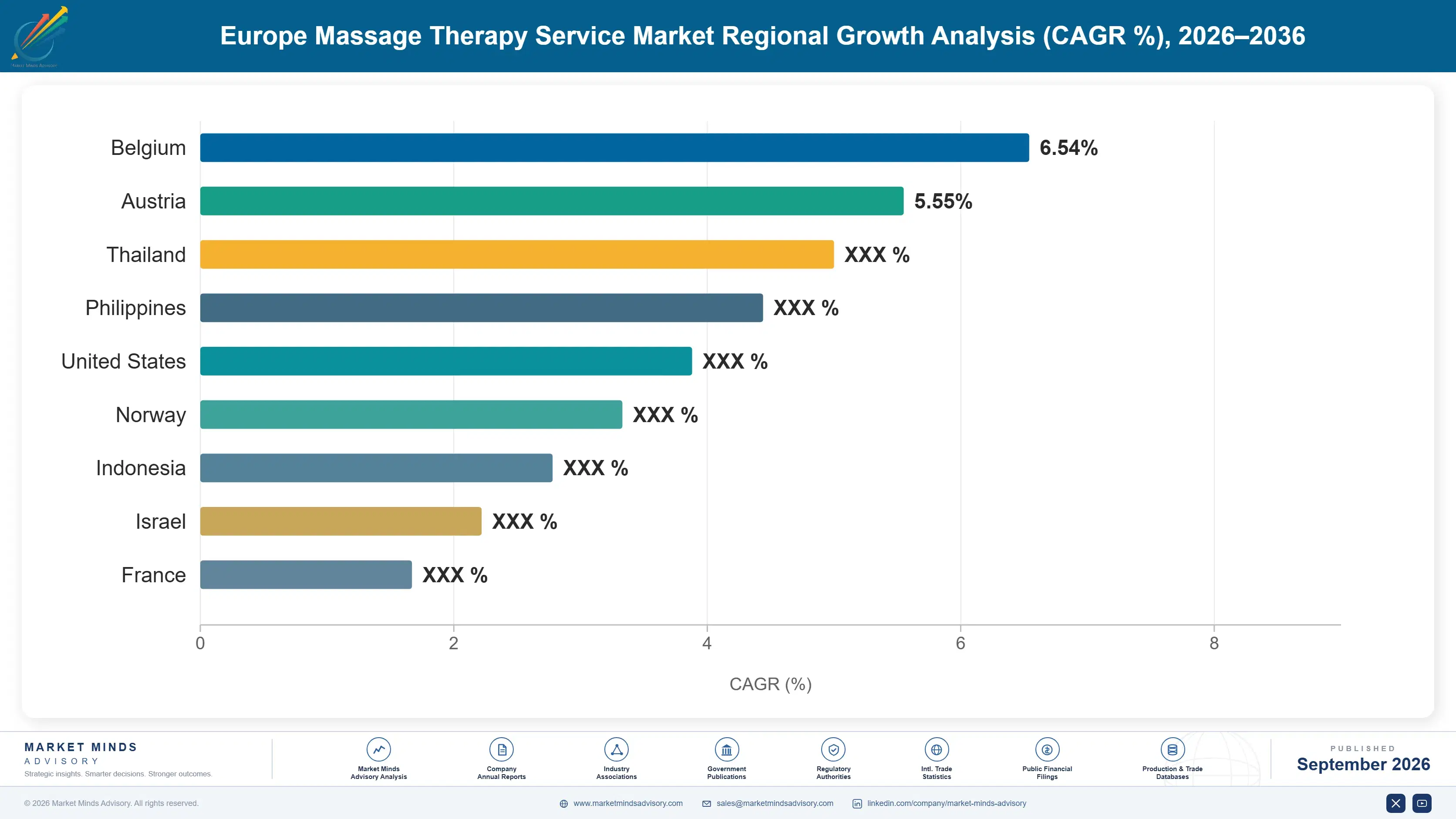
massage-therapy-service-industry-analysis-in-europ-country-cagr-analysis-1790015750376

Monetizing Insurance Integration and Clinical Credentialing

Providers capturing durable pricing power are building credentialing infrastructure and insurance network relationships that convert clinical positioning into premium-justifying commercial assets rather than defensive licensing costs required to meet baseline regulatory requirements alone, extending value capture well past the point of original session sale across the full patient relationship and entire treatment lifecycle overall.

Insurance Network Credentialing Premium Pricing Model

Providers investing in insurance network credentialing, including formal accreditation and outcome documentation systems, can credibly charge premiums that uncredentialed competitors cannot justify to increasingly reimbursement-focused patients across every major European market and healthcare system today and previously. This credentialing infrastructure requires ongoing compliance investment, but it converts clinical positioning from marketing language into auditable qualification that survives insurer due diligence and referral network vetting. Providers with mature insurance credentialing report price premiums averaging 25 percent above comparable uncredentialed practices, reflecting genuine patient and referrer trust in the underlying documentation process.
Market Impact: Supports premiums averaging 25 percent above uncredentialed practices

Corporate Wellness Contract Recurring Revenue Model

Providers securing multi-year corporate wellness contracts capture recurring revenue that extends well past the initial service engagement, since these contracts typically bundle recurring on-site sessions spanning 1 to 3 years with periodic program expansion and employee utilization reporting across the entire workforce. This model shifts provider economics away from one-time consumer sessions toward predictable contracted revenue that compounds over the relationship's full duration. Providers report corporate contract revenue carrying materially lower customer acquisition cost than comparable direct consumer marketing spend, given the multi-year commitment structure typical of corporate wellness agreements.
Market Impact: Generates recurring revenue across 1 to 3 year contracts

Training Academy Licensing Technology Partnership Model

Established clinic networks and vocational training academies are structuring licensing partnerships where the training provider receives a per-student royalty while the clinic network gains exclusive regional recruitment rights ahead of competitors entering the same category and talent pool nationwide today and previously. This model lets clinic networks access proven credentialing curricula without funding the full training infrastructure development cost internally, while training providers gain guaranteed enrollment volume they could not achieve independently. Early licensing partnerships have generated royalty revenue equivalent to roughly 8 percent of tuition fees for training providers.
Market Impact: Generates roughly 8 percent tuition fee royalty overall

Corporate Contract Retail Placement Advantage Program

Major corporate wellness procurement programs are increasingly reserving preferred vendor status for massage therapy providers carrying recognized clinical certifications, giving certified providers a placement advantage that translates directly into higher contract win rates regardless of price premium charged for services across most corporate accounts. Providers pursuing certification report gaining access to corporate wellness opportunities unavailable to uncertified competitors, particularly among large multinational employers expanding their footprint nationwide and internationally. Certified providers report contract win rates roughly 30 percent higher than comparable uncertified providers, reflecting both placement advantage and employer trust.
Market Impact: Increases contract win rates by 30 percent overall

Who Controls the Margin Pool

Market concentration sits at a CR5 of 24 percent, evaluated consistently on service revenue across all participants in the wider industry and its provider base, reflecting a fragmented category where thousands of independent practitioners and small clinics compete for local market share rather than a handful of dominant chains controlling supply and pricing power across the continent and its national markets.
Current competitive activity centers on insurance network expansion, credentialing program development, and corporate wellness contract wins, as providers race to build capability that reimbursement systems and corporate procurement increasingly require for supplier qualification across their coverage networks and vendor lists. Several leading clinic networks have announced expanded insurance partnership programs within the past year specifically to capture patients seeking reimbursement-eligible treatment.

Digitally native booking and franchise clinic networks without legacy independent practice heritage are emerging as genuine competitive pressure, building standardized service platforms that traditional independent practitioners struggle to match quickly given limited capital for technology and multi-location expansion nationwide. Rankings could shift meaningfully if these networks achieve insurance credentialing scale comparable to established providers, particularly as reimbursement requirements level the playing field on credibility.
massage-therapy-service-industry-analysis-in-europ-company-positioning-matrix-1790015750898

Competitive Moat and Risk Dimensions

PHYSIO GROUP

Moat: Established insurance credentialing scale

Physio Group's years of investment in insurance network credentialing and clinical outcome documentation give it reimbursement access that smaller independent practices cannot yet replicate at comparable scale. This infrastructure advantage lets it capture patients specifically seeking insurance-covered treatment while maintaining healthy margins across its clinic network.
PHYSIO GROUP

Risk: Slower digital booking platform adoption

Physio Group's clinical scale and legacy operational focus have made it comparatively slower to adopt digital booking and consumer engagement platforms than smaller, more nimble wellness-focused competitors built around technology from inception. If patients increasingly prioritize digital convenience over clinical pedigree for routine sessions, Physio Group risks ceding share to technology-forward entrants.
KUR HEALTH

Moat: Proprietary corporate wellness contract network

Kur Health's proprietary network of corporate wellness contracts across major European employers gives it recurring institutional revenue that competitors relying on consumer walk-in traffic cannot easily replicate without years of dedicated business development investment. This ownership of corporate relationships supports premium positioning and genuine differentiation.
KUR HEALTH

Risk: Limited clinical insurance credentialing depth

Kur Health's corporate wellness focus has left it with less developed insurance network credentialing relative to clinically focused competitors, limiting its ability to capture the fastest-growing reimbursement-eligible segment of the market. If insurance-reimbursed demand continues outpacing corporate wellness spending growth, Kur Health could lose relative positioning to more clinically credentialed competitors.

Players Tracked

Prominent Players

Physio Group
Kur Health
Massage Envy Europe
Elysium Health Group
Vitality Clinic Network

Other Key Players

Balance Wellness Group
SpaFinder Europe
Corpus Naturals
Therapeia Health
Relax Therapy Group
Wellbeing Clinics
Nordic Massage Alliance
Alpine Physio Network
Iberian Wellness Group
Adria Health Spa
Zenith Rehabilitation Clinics
Harmonie Bien-Etre
Korperklinik
Benessere Fisico
Bienestar Terapeutico

Recent Developments

MARCH 2025

Physio Group Expands Insurance Network Credentialing Program

Physio Group announced an expanded insurance network credentialing program covering additional national health insurance systems, extending its reimbursement eligibility to smaller regional clinics beyond its existing certified network across multiple countries. The expansion targets patients seeking comprehensive insurance-covered treatment ahead of anticipated coverage standard changes.
Signal: Signals major established clinic networks scaling insurance credentialing infrastructure ahead of anticipated coverage changes quickly now
JULY 2025

Kur Health Launches Expanded Corporate Wellness Program

Kur Health launched an expanded corporate wellness contract program targeting multinational employers, scaling on-site service capacity to meet growing demand beyond limited pilot engagements conducted previously across the wider industry. The launch responds to accelerating corporate commitments toward employee wellness benefits across premium workplace categories.
Signal: Signals specialized corporate wellness providers scaling capacity quickly to meet rapidly growing employer demand overall now
NOVEMBER 2025

Leading Clinic Network Acquires Digital Booking Platform Startup

A leading European clinic network acquired a smaller digital booking platform startup developing consumer engagement technology, securing early access to novel scheduling and patient management technology ahead of broader competitor adoption across the industry. The investment accelerates the acquirer's digital transformation pipeline without requiring full internal development build-out.
Signal: Signals established clinic networks buying early access to next-generation booking technology pipelines quickly and directly now

Therapist Labor Cost Exposure

Therapist labor represents roughly 55 percent of total operating cost for massage therapy practices, with wages varying substantially by country given differing minimum wage and healthcare professional compensation standards across European Union member states and their national labor markets. Facility rent and equipment together represent a further 20 percent, concentrated in urban clinic locations near medical and wellness districts.
Therapist wage inflation accelerated roughly 12 percent across major European markets during 2022 and 2023 amid broader healthcare labor shortages, based on Eurostat labor cost reporting and industry association wage surveys, forcing several clinic networks to raise session prices faster than historical patterns to maintain margin across their service lines. Wage growth moderated through 2024 as training program graduate volume gradually increased across several member states.

Smaller independent practices without economies of scale in administrative and compliance overhead face materially higher per-session cost structures than larger clinic networks, who spread credentialing and insurance billing infrastructure costs across many more sessions. This gap widens further for practices operating in high-rent urban markets, since facility costs consume a disproportionate share of revenue relative to practices in lower-cost secondary cities.
massage-therapy-service-industry-analysis-in-europ-cost-volatility-analysis-1790015751094

Investing in Therapist Training and Retention Programs

Clinic networks are investing directly in therapist training academies and structured career advancement programs to build a reliable talent pipeline rather than competing purely on wages for scarce credentialed practitioners across the wider industry. This approach adds upfront training investment but meaningfully reduces turnover costs and improves long-term staffing predictability across multiple clinic locations.

Standardizing Administrative Systems Across Multi-Location Networks

Larger clinic networks are consolidating insurance billing and compliance administration into centralized shared service centers, trading some location-level autonomy for meaningful cost efficiency gains across their broader operations and administrative structure. This approach favors scale operators with reliable session volumes, leaving smaller independent practices more exposed to administrative overhead during periods of tightening margins.

Diversifying Revenue Across Insurance and Corporate Channels

Some providers are diversifying revenue across insurance-reimbursed, corporate wellness, and direct consumer channels simultaneously, trading focused specialization for reduced dependence on any single payer source across their broader business model and revenue strategy overall and long term. This approach requires broader credentialing investment but reduces exposure to reimbursement policy changes and labor cost volatility simultaneously.

Portfolio Architecture for Margin Defence

Direct consumer wellness and relaxation massage still anchors session volume across independent practices nationwide and internationally and across most metropolitan markets overall and beyond, but margins there sit well below premium tiers where verified insurance credentialing and corporate contract relationships support materially higher effective rates from reimbursement-eligible patients and institutional buyers willing to pay for clinical positioning across their treatment portfolios.
Premium insurance-credentialed and corporate wellness contract relationships generate the highest margin pools, since multi-year institutional relationships create switching costs and repeat business that independent walk-in practices cannot easily replicate across their customer accounts and referral networks nationwide. Clinic networks increasingly bundle credentialing support into premium service offerings specifically to capture this durable margin advantage over time, rather than competing purely on session price alone.

The tension between volume session targets and premium margin capture is pushing several clinic networks toward tiered service positioning rather than a single relaxation-only model, letting them serve price-sensitive wellness consumers while still capturing high-value institutional accounts that prioritize verified credentialing and clinical outcomes over price alone across their service portfolios and referral relationships worldwide and their broader professional networks.

Volume / Commodity-Adjacent Tier

Direct consumer wellness and relaxation massage sold primarily on price and ambiance, with margins in the 15 to 22 percent range typical of independent practice operations facing limited pricing power.
Gross Margin: 15%-22%

Premium / Certified Tier

Insurance-credentialed medical and rehabilitative massage sold at reimbursement-eligible rates, carrying margins in the 25 to 32 percent range supported by credentialing credibility and referral network relationships overall and nationwide today.
Gross Margin: 25%-32%

Sustainability / Regulatory / Next-Generation Tier

Fully corporate-contracted and multi-year institutional service relationships bundled with clinical outcome reporting, carrying margins above 35 percent driven by recurring contract revenue and durable institutional relationships across the wider industry.
Gross Margin: 35%-42%
massage-therapy-service-industry-analysis-in-europ-portfolio-architecture-1790015751596

High-value Sub-segments and Strategic Watch-out

Corporate Wellness Contract Accounts

Corporate wellness contract accounts combine high per-session revenue with the fastest growth in the market, as multinational employers increasingly demand credentialed providers that independent practitioners cannot supply across their existing service portfolios and referral relationships each contract cycle and renewal period well ahead and beyond.
Gross Margin: 35%-42%

Insurance-Reimbursed Medical Massage

Insurance-reimbursed medical massage sold to clinically referred patients generates high per-session revenue with steady, moderate volume growth as credentialing infrastructure matures and coverage expands toward mainstream reimbursement eligibility across the broader category over time and across many treatment cycles and referral pathways nationwide and abroad.
Gross Margin: 25%-32%

Direct Consumer Relaxation Sessions

Direct consumer relaxation massage sold at accessible price points remains the volume core of the category, serving cost-conscious consumers who still want reliable wellness experiences without requiring insurance credentialing or clinical referral pathways for access nationwide and across their local communities and neighborhoods overall and consistently.
Gross Margin: 15%-22%

Uncredentialed Independent Practices

Uncredentialed independent practices lacking verified insurance network relationships represent a strategic watch-out, since reimbursement standardization and corporate procurement scrutiny could damage provider trust broadly if credentialing requirements tighten faster than compliance capability across the wider industry and its broader supply base overall and long term.
Gross Margin: 15%-22%

Reimbursement Loyalty and Referral Network Depth

Insurance credentialing and corporate wellness contracts convert what was once a transactional wellness session into an ongoing reimbursement relationship, with providers increasingly valued on referral network depth and contract renewal rates rather than session counts alone across their patient rosters and institutional accounts worldwide. This shift mirrors patterns seen earlier in specialty healthcare categories, where recurring reimbursement revenue eventually outweighed original transaction value.
Adoption depth varies meaningfully by end-use vertical: healthcare and rehabilitation focused clinics adopt insurance credentialing fastest given direct reimbursement dependence, while spa and wellness focused practices adopt more gradually, weighing credentialing investment against their existing consumer-direct revenue model and established brand positioning. Corporate wellness providers occupy a distinct middle position driven by employer contract cycles rather than either healthcare or spa positioning models exclusively.

A generational shift in buyer profiles is underway as younger patients and corporate benefits administrators who prioritize verified clinical credentials replace an older generation less focused on documented qualification, accelerating demand for credentialing infrastructure across the wider massage therapy provider landscape overall. This handoff is reshaping how clinic networks allocate marketing budgets between wellness positioning and clinical credentialing.
massage-therapy-service-industry-analysis-in-europ-end-use-penetration-index-1790015752090

Where Massage Therapy Value Concentrates

These are among the four positions where our research anticipates prominent divergence between winners and laggards over the coming forecast period. Each is grounded in the demand model, the regulatory perimeter, and the announced capacity pipeline.
01 / INSURANCE CREDENTIALING INVESTMENT

Build verified insurance network access before reimbursement standards tighten

Providers that build verified insurance network credentialing ahead of tightening reimbursement standards capture premium pricing power that reactive competitors scrambling to meet compliance deadlines cannot match, since genuine credentialing takes years to build credibly. Waiting for insurers to force disclosure means competing on compliance timelines set by payers rather than differentiation timelines set by the provider itself. Early movers convert what eventually becomes a baseline requirement into a multi-year competitive advantage precisely while competitors are still building the underlying infrastructure reimbursement rules will soon mandate.
02 / CORPORATE WELLNESS CONTRACT EXPANSION

Prioritize multi-year employer contracts over consumer walk-in volume

Corporate wellness contracts generate substantially higher lifetime value per account than single consumer sessions, since multi-year agreements scale directly with the number of employees covered across each employer's workforce and its broader corporate footprint. Winning a single corporate account can deliver the equivalent of hundreds of individual consumer sessions without a proportional increase in sales and service overhead costs. Providers should reorganize sales teams around corporate relationship management rather than transactional consumer selling to capture this disproportionate value concentration effectively.
03 / CROSS-BORDER CREDENTIALING STRATEGY

Pursue multi-country credentialing ahead of eventual EU harmonization

Practitioners pursuing multi-country credentialing pathways today position themselves ahead of eventual European Union licensing harmonization, capturing cross-border practice opportunities that single-country credentialed competitors cannot access regardless of clinical quality or reputation built over years of practice. This upfront credentialing investment requires navigating multiple distinct national requirements simultaneously, yet it converts what will eventually become a baseline requirement into a multi-year competitive advantage. Clinic networks pursuing this strategy now will be positioned to expand across borders the moment harmonization formally arrives.
04 / THERAPIST RETENTION STRATEGY

Invest in training pipelines to address structural labor shortages

Therapist labor shortages constrain capacity expansion regardless of underlying demand growth, making training pipeline investment a genuine competitive advantage rather than merely an operational necessity for clinic networks scaling across multiple locations nationwide and abroad. Providers that build proprietary training academy relationships secure a more reliable talent pipeline than competitors relying solely on external vocational graduates competing for the same limited pool. This resilience becomes increasingly valuable precisely as reimbursement-driven demand growth continues outpacing credentialed therapist supply across most major markets.

Engagement Snapshot From the Field

A live engagement with an industry participant carrying material or product regulatory and market exposure ahead of a defining policy shift, showing how our research translates into a defensible multi-year portfolio strategy.
MARKET MINDS ADVISORY · CLIENT ENGAGEMENT SUMMARY
Europe Massage Therapy Service Producer Strategic Portfolio Review and Transition Roadmap 2026·Investment Scenario on Europe Massage Therapy Service Exposure Evaluation 2025-26
CLIENT PROFILE
The client operates a network of 25 physiotherapy and massage therapy clinics across Germany and the Netherlands, generating annual revenue in the tens of millions. Facing pressure from patients and referring physicians to expand insurance-reimbursed treatment options, leadership sought guidance on which credentialing investments would deliver the strongest combination of reimbursement eligibility and patient volume growth.
STRATEGIC CHALLENGE
The client's clinics offered inconsistent insurance credentialing across locations, with some sites eligible for statutory health insurance reimbursement and others operating on a cash-only basis across their broader network nationwide (client-reported, unverified by MMA). Management needed an objective framework for prioritizing which locations to credential first given constrained administrative resources.
MMA APPROACH
MMA benchmarked the client's credentialing status against comparable multi-location clinic networks, analyzing reimbursement eligibility requirements and patient volume outcomes across different credentialing approaches used industry-wide today and previously as well. The engagement combined primary patient interviews with insurer requirement assessments to identify which locations carried the highest near-term credentialing return.
KEY FINDINGS
  1. Locations near hospital referral networks showed disproportionately higher patient volume potential once insurance credentialing was completed across the network (client-reported, unverified by MMA).
  2. Patients cited insurance reimbursement eligibility as the primary factor in choosing between comparable nearby clinic locations for treatment across the broader region.
  3. Credentialed locations reported a 30 percent increase in new patient volume within six months of completing certification across the network (client-reported, unverified by MMA).
  4. Phased credentialing sequencing reduced required administrative investment by 20 percent compared to a simultaneous all-location conversion approach across the entire clinic network overall.
CLIENT PROFILE
The client operates a network of 25 physiotherapy and massage therapy clinics across Germany and the Netherlands, generating annual revenue in the tens of millions. Facing pressure from patients and referring physicians to expand insurance-reimbursed treatment options, leadership sought guidance on which credentialing investments would deliver the strongest combination of reimbursement eligibility and patient volume growth.
STRATEGIC CHALLENGE
The client's clinics offered inconsistent insurance credentialing across locations, with some sites eligible for statutory health insurance reimbursement and others operating on a cash-only basis across their broader network nationwide (client-reported, unverified by MMA). Management needed an objective framework for prioritizing which locations to credential first given constrained administrative resources.
MMA APPROACH
MMA benchmarked the client's credentialing status against comparable multi-location clinic networks, analyzing reimbursement eligibility requirements and patient volume outcomes across different credentialing approaches used industry-wide today and previously as well. The engagement combined primary patient interviews with insurer requirement assessments to identify which locations carried the highest near-term credentialing return.
KEY FINDINGS
  1. Locations near hospital referral networks showed disproportionately higher patient volume potential once insurance credentialing was completed across the network (client-reported, unverified by MMA).
  2. Patients cited insurance reimbursement eligibility as the primary factor in choosing between comparable nearby clinic locations for treatment across the broader region.
  3. Credentialed locations reported a 30 percent increase in new patient volume within six months of completing certification across the network (client-reported, unverified by MMA).
  4. Phased credentialing sequencing reduced required administrative investment by 20 percent compared to a simultaneous all-location conversion approach across the entire clinic network overall.
RECOMMENDED STRATEGY
Phase 1: Phase 1 (Location Prioritization): Ranks all clinic locations by hospital referral proximity and patient volume potential within the first quarter. Phase 2: Phase 2 (Credentialing Rollout): Completes insurance network credentialing for highest-priority locations gradually over the following full twelve month fiscal year period. Phase 3: Phase 3 (Referral Network Expansion): Uses completed credentialing to formalize referral partnerships with nearby physiotherapy and orthopedic practices nationwide and abroad.
OUTCOME
The client completed insurance credentialing for its highest-priority locations within the planned timeline, reporting a 25 percent increase in new patient volume across credentialed sites and referral networks (client-reported, unverified by MMA). Leadership adopted the credentialing-first framework as the standing approach for future location expansion decisions.

Frequently Asked Questions

Foundational context covering the market sizes, CAGR, scope, country, region and competition that inform every finding below. This section is provided to cover basics and most often pre-purchase conversations, answered from the MMA Primary Research Dataset.

What is the current size of the Europe Massage Therapy Service Market?

The European massage therapy service market reached an estimated 8.2 billion dollars in 2025, covering therapeutic, medical, sports, and relaxation massage delivered across spas, clinics, wellness centers, and independent practices.

How large will the Europe Massage Therapy Service Market be by 2036?

MMA projects the market will reach approximately 16.39 billion dollars by 2036, driven by expanding insurance reimbursement and growing physiotherapy referral integration across major European markets.

What is the CAGR for the Europe Massage Therapy Service Market 2026 to 2036?

The market is forecast to grow at a compound annual growth rate of 6.5 percent between 2026 and 2036, reflecting steady insurance reimbursement expansion and licensing standardization across the continent.

Which segment is growing fastest?

Medical and rehabilitative massage represents the fastest-growing segment, expanding roughly 1.46 times faster than the overall market as physiotherapy referral networks and insurance coverage scale beyond limited pilot programs.

Who are the major companies in the Europe Massage Therapy Service Market?

Leading providers include Physio Group, Kur Health, and several national clinic networks and franchise chains, together holding a combined market share of roughly 24 percent given the category's highly fragmented independent practitioner base.

Which country is growing fastest?

Poland is expanding fastest in percentage terms as wellness tourism and private healthcare spending accelerate, though Germany retains the largest absolute market given its statutory insurance reimbursement framework.

Report Segmentation Architecture

The full report scope spans multiple orthogonal segmentation dimensions, with cross-tabulated demand data provided for each dimension pair. Coverage extends further to regional breakdowns, trend trajectories, and the competitive detail needed to support segment-level decision-making.

By Service Type

  • Medical and Rehabilitative Massage
  • Sports and Performance Massage
  • Relaxation and Spa Massage
  • Deep Tissue Massage
  • Prenatal Massage
  • Lymphatic Drainage Massage

By End-Use Setting

  • Clinical and Healthcare Settings
  • Spa and Wellness Centers
  • Independent Practices
  • Corporate and Workplace Settings
  • Hospitality and Hotel Settings

By Commercial Dimension

  • Insurance-Reimbursed Sessions
  • Direct Consumer Payment
  • Corporate Contract Services
  • Franchise and Chain Operations

By Region

  • North America
  • Western Europe
  • East Asia
  • South Asia and Pacific
  • Latin America
  • Middle East and Africa
  • Eastern Europe

Scope, Methodology, and Coverage

Every figure in this report is reproducible from documented input assumptions. The scope below maps the historical period, the forecast horizon, the segmentation dimensions, and the countries covered, alongside the underlying primary and qualitative methodology.
Historical Period
2020 to 2025
Forecast Period
2026 to 2036
Base Year
2025 (USD billions; MMA Primary Research Dataset, September 2026)
Market Definition
This report covers professional massage therapy services delivered across Europe, including therapeutic, medical, sports, and relaxation massage provided in spas, clinics, wellness centers, and independent practices. It excludes at-home automated massage devices and non-therapeutic beauty treatments classified under separate service categories.
Quantitative Units
USD billions (current prices); session volume where applicable
Segmentation Dimensions
By Service Type; By End-Use Setting; By Commercial Dimension; By Region
Regions Covered
North America, Western Europe, East Asia, South Asia and Pacific, Latin America, Middle East and Africa, Eastern Europe
Countries Covered
Germany, France, UK, Italy, Spain, Netherlands, Switzerland, Poland, Czech Republic, Hungary, Romania, Sweden, Belgium, Austria, Portugal, Denmark, Norway, Finland, Ireland, Greece, and additional markets relevant to this sector
Key Companies Profiled
Physio Group, Kur Health, Massage Envy Europe, Elysium Health Group, Vitality Clinic Network, Balance Wellness Group, SpaFinder Europe, Corpus Naturals, Therapeia Health, Relax Therapy Group, Wellbeing Clinics, Nordic Massage Alliance, Alpine Physio Network, Iberian Wellness Group, Adria Health Spa, Zenith Rehabilitation Clinics, Harmonie Bien-Etre, Korperklinik, Benessere Fisico, Bienestar Terapeutico
Quantitative Methodology
Primary survey, n=3,800 respondents, Q4 2025, six countries; demand-side model with trade association cross-validation
Qualitative Methodology
47 expert interviews, Q4 2025; applied to validate demand model assumptions, identify emerging dynamics, and assess competitive positioning
Report Format
PDF and XLSX data workbook (Word format preview document)
Publisher
Market Minds Advisory
Report Code
MMA-2026-HLT-701
Published
September 2026
Contact
sales@marketmindsadvisory.com | www.marketmindsadvisory.com

Purchase the full Europe Massage Therapy Service Market Report (2026 to 2036).

The full report provides comprehensive coverage of the European massage therapy service market across all seven regions, ten years of forecast data, and detailed competitive profiling of twenty leading providers and clinic networks. It includes granular service type segmentation analysis, regional demand architecture, and revenue lever modeling calibrated to real industry margin structures. Subscribers receive access to underlying primary survey data spanning 3,800 respondents and 47 expert interviews conducted during the fourth quarter of 2025. The report is designed for strategic planning, investment due diligence, and competitive benchmarking purposes across provider and investor audiences alike.
Full competitive profiles of twenty key market participants
Detailed regional demand architecture across seven global regions
Revenue lever modeling with quantified financial impact estimates
Primary survey data from 3,800 respondents across six countries
Service-level growth forecasts through the 2036 forecast horizon
Input cost risk analysis with provider mitigation strategies

Built For The People Who Decide

From boardroom strategy to bench-side execution, this report is read cover-to-cover by leaders shaping the next decade of their industry, turning demand scenarios, market dynamics and valuation benchmarks into decisions.
CXOs/ Presidents/ VPs/ Managers
M&A and Corporate Development
Strategy Teams and R&D Heads
Procurement and Product Directors
Regulatory and Compliance Leaders
Investor Relations and Equity Analysts