Market Minds Advisory
Mason Jars & Canning Supplies Market

Mason Jars & Canning Supplies Market: Mason Jars and Canning Supplies Market. Home Preservation Habits Outlast the Pandemic Spike.

Home food preservation is settling into a durable habit rather than fading as a pandemic-era trend, as rising grocery prices and homesteading culture keep first-time canners returning for jars, lids, and equipment each harvest season.

Lead Analyst

Published

September 2026

Make Smarter Decisions with Customized Research Insights

Request a free sample report and evaluate market opportunities, growth trends, and competitive dynamics relevant to your business needs.

2025 MARKET VALUE$2.9BMarket Size 2025
2036 FORECAST VALUE$4.8BBase Case , 2026 to 2036
CAGR 2026 TO 20364.6 %Bull 5.8% / Bear 3.4%
INCREMENTAL OPPORTUNITY$1.7BNet 10- year value creation
EXPANSION MULTIPLE1.57x2036 value over 2026 base
Strategic Levers
M&A Pipeline
Regional Outlook
Country Rankings
Competitive Intelligence
Segmental Deep-dive
Call-Us : 91 93563 13602

Executive Snapshot and Market Trajectory.

Home food preservation has settled into a durable post-pandemic habit rather than fading as a temporary trend, with rising grocery prices sustaining first-time canner retention across most major markets today and beyond current inflationary pressure, seasonal fluctuations, and shifting household budgets nationwide and abroad.
Wide-mouth reusable glass jars are pulling growth ahead of traditional regular-mouth formats, as homesteading culture and social media canning tutorials drive younger buyers toward versatile jar sizes usable for both preservation and everyday storage year-round. Eastern Europe's deep-rooted home preservation culture anchors a disproportionate share of global unit volume relative to regional market value, while North America commands the largest dollar share through established retail infrastructure and brand recognition built over a century.
Competitive intensity concentrates among a handful of legacy glass manufacturers with century-old brand recognition, leaving limited room for new entrants without significant capital investment in glass production capacity and distribution relationships across every major region and retail channel worldwide. Sustainability messaging around reusable jars versus single-use packaging is increasingly shaping purchasing decisions, pushing manufacturers to emphasize durability and multi-season reuse in marketing rather than one-time preservation utility alone.
Market Definition
The Mason Jars and Canning Supplies Market covers glass jars, lids, bands, and associated tools used for home food preservation, canning, and fermentation. It excludes commercial food packaging jars, industrial canning equipment, and non-glass storage containers.
Base Year Value
$2.9B in 2025 (MMA Primary Research Dataset, September 2026)
Forecast Period
2026 to 2036, eleven discrete annual values
CAGR
4.6% base case. Bull 5.8%. Bear 3.4%.
Fastest Growth Segment
Wide-Mouth Reusable Glass Jars: 6.8% CAGR
Fastest Growth Country
Poland: 7.2% CAGR
Fastest Growth Region
South Asia and Pacific: 6.5% CAGR
Largest Region
North America: 30% of 2025 global value
Market Leaders
Newell Brands Inc, Le Parfait SAS, Weck GmbH u Co KG, Bormioli Rocco SpA, O-I Glass Inc. Source: MMA Analysis, company annual reports.
Primary Survey
n=3,800 procurement and R&D decision-makers, Q4 2025, six countries
Methodology
Demand-side build-up, cross-validated against public data, 47 expert interviews

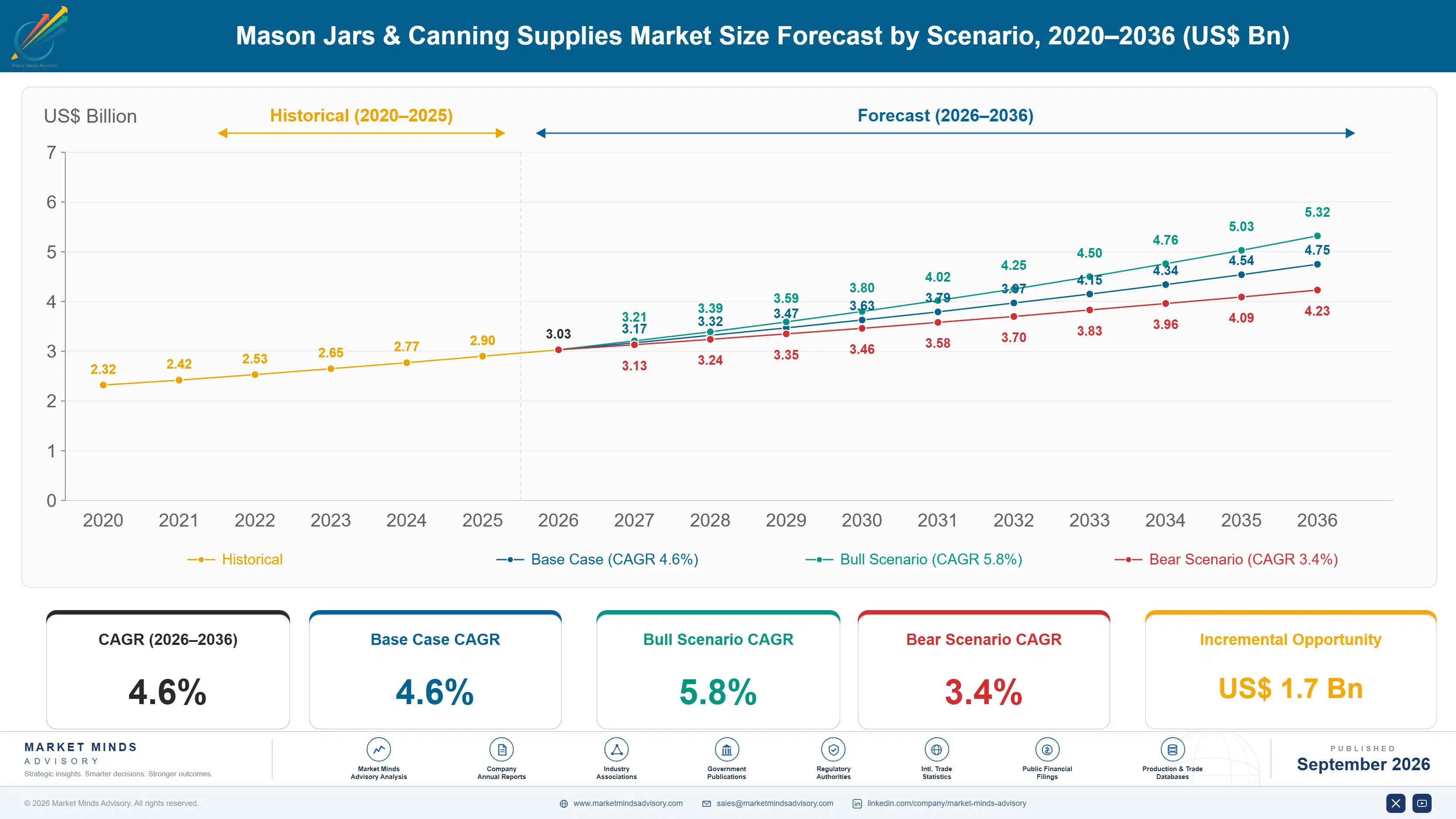
Mason Jars & Canning Supplies Market Forecast Scenarios

mason-jars-and-canning-supplies-market-size-forecast-scenario-1790023814604
Canning supply volume spiked sharply in 2020 and 2021 as pandemic-era home preservation surged nationwide, then moderated through 2023 before stabilizing at a level meaningfully above pre-pandemic baseline, reflecting genuine habit retention among a meaningful share of new canners rather than a purely temporary spike tied to lockdown conditions alone or short-term panic buying behavior.
The base case assumes continued grocery price pressure sustaining first-time canner conversion, steady replacement demand from existing canners, and gradual premiumization toward reusable and decorative jar formats across most retail channels. Three mechanisms drive the forecast specifically: rising produce and grocery costs pushing cost-conscious households toward preservation as a genuine savings strategy, homesteading and self-sufficiency culture normalizing canning among younger demographics entering the category for the first time, and social media tutorial content lowering the skill barrier to entry for first-time buyers.
A bull scenario turns on sustained grocery inflation keeping home preservation economically attractive well beyond current levels, meaningfully expanding first-time canner conversion across most demographics. The bear risk centers on a broader economic recovery reducing cost-driven motivation for home canning, which could slow new canner acquisition back toward pre-pandemic baseline growth rates over the following several years.

Legacy Brands Anchor a Maturing Preservation Category

Mason jar and canning supply economics center on a durable-goods-meets-consumable hybrid model, since reusable jars generate one-time purchases while lids and bands require annual repurchase, creating a predictable recurring revenue stream distinct from most kitchenware categories entirely. This dual purchase pattern shapes how manufacturers price and market each product line separately across most retail channels and seasons, from peak summer harvest through the quieter winter months.
MARKET CONCENTRATIONCR5 42%top five companies hold combined global revenue share
AVERAGE RETAIL PRICE$1.20 per jartypical per-unit price across standard glass jar formats
TOP PRODUCING COUNTRYUSA 26%leads global glass jar manufacturing and canning supply volume
REUSABLE JAR CYCLE COUNT18 usesaverage number of canning cycles per reusable glass jar
SEASONAL SALES CONCENTRATION58%share of annual revenue occurring during peak harvest months
LID REPLACEMENT FREQUENCYAnnualtypical purchase cycle for single-use canning lids and bands
Manufacturing economics favor established glass producers with century-old furnace infrastructure, since glass manufacturing carries meaningful capital barriers that new entrants rarely clear profitably without substantial outside investment and years of accumulated production expertise. Scale matters considerably here, since production runs must be large enough to justify furnace operating costs across seasonal demand swings that vary meaningfully between peak harvest and off-season months throughout the calendar year.
The next decade will likely see continued premiumization toward decorative and gift-style jars alongside steady utilitarian demand, as manufacturers increasingly market preservation as a lifestyle choice rather than purely a cost-saving necessity, particularly among younger, sustainability-minded buyers entering the category through social media and homesteading communities online and across most developed markets worldwide.
"This category doesn't need a new trend. It needs grocery prices to stay high enough that people keep opening the jars they already bought."
Practice Lead, Home and Kitchenware Practice · MMA Home Preservation and Kitchenware Practice · September 2026

Market Trends

Homesteading Culture Normalizes Canning Among Younger Buyers

Social media platforms have turned home canning into visible, shareable content, with homesteading and self-sufficiency creators regularly posting tutorials that reach millions of younger viewers who previously had no exposure to the practice through family tradition or generational knowledge transfer. This content pipeline functions as an informal training channel that retailers increasingly reference in marketing, since the skill barrier that once required learning from an older relative now has a searchable video alternative. First-time buyer conversion rates have risen measurably in markets with strong homesteading content communities compared to those without such visibility.
Market Impact: Lifts unit sales 9% year-over-year
Grocery Inflation Sustains Cost-Driven Canning Adoption

Persistent grocery price increases across fresh produce categories have kept home preservation economically attractive well beyond the initial pandemic-driven spike, as households calculate genuine savings from canning seasonal produce at lower per-unit cost than retail alternatives available at supermarkets and specialty grocers alike nationwide today. This cost calculation particularly favors households with access to home gardens or farmers market surplus, where raw ingredient cost approaches zero. Retailers report canning supply sales correlating closely with regional grocery price indices rather than tracking purely seasonal patterns alone across most major markets studied.
Market Impact: Grows non-canner buyer share 14%

Market Opportunities and Growth Drivers

Rising Grocery Prices Push Cost-Conscious Preservation Decisions

Households facing sustained increases in fresh produce and packaged food prices increasingly view home canning as a genuine cost-avoidance strategy rather than a hobby, particularly for seasonal produce purchased in bulk at reduced per-unit prices during peak harvest windows each year and beyond. This calculation strengthens further for households with home gardens, where raw ingredient cost drops close to zero and canning supplies represent the primary remaining expense. Retailers in regions with steeper grocery inflation consistently report stronger canning supply sales growth than those in more stable pricing environments nationwide.
Market Impact: Excludes 24% of potential buyers

Reusable Jar Sustainability Messaging Expands Buyer Base

Marketing emphasizing multi-season jar reuse over single-use packaging has broadened the buyer base considerably beyond traditional canners toward environmentally-motivated consumers seeking to reduce household plastic and packaging waste across daily routines and grocery habits generally and consistently over time and across seasons. This positioning has proven particularly effective among younger buyers who may never actually can produce but purchase reusable jars for general food storage, meal prep, and reduced household waste overall. Retailers increasingly stock decorative and general-purpose jar lines alongside traditional canning products to capture this growing adjacent buyer segment nationwide.
Market Impact: Compresses margins by 6pp

Market Restraints and Challenges

Skill Barrier Deters Casual First-Time Buyers

Food safety concerns around improper canning technique, particularly botulism risk in low-acid foods requiring pressure canning, genuinely deter casual buyers who might otherwise try preservation but fear making a dangerous mistake without proper training. The root cause traces to a genuine knowledge gap: safe canning requires specific technique that varies by food type, and misinformation circulates widely online alongside legitimate tutorial content. Manufacturers and extension services are responding by publishing standardized safety guides and partnering with tutorial creators to improve technique accuracy, though inconsistent enforcement across informal content remains a genuine ongoing concern.
Market Impact: Adds 2.1M first-time canners

Glass Supply Cost Volatility Pressures Manufacturer Margins

Glass manufacturing requires substantial energy input for furnace operation, leaving producers exposed to natural gas and electricity price volatility that periodically compresses margins meaningfully, particularly during broader energy market disruptions and seasonal demand spikes across most producing regions. The root cause is physical: glass furnaces cannot easily cycle production up and down in response to short-term price swings without risking equipment damage, forcing manufacturers to absorb cost volatility rather than pausing output entirely. Some producers are investing in more energy-efficient furnace technology and renewable power contracts to reduce this exposure over time.
Market Impact: Correlates with 6% sales lift
3 additional market trends, 4 additional growth drivers, and 3 additional restraints and challenges are covered in the full report. Contact sales@marketmindsadvisory.com to access the complete intelligence.

Segment CAGR and Growth Architecture

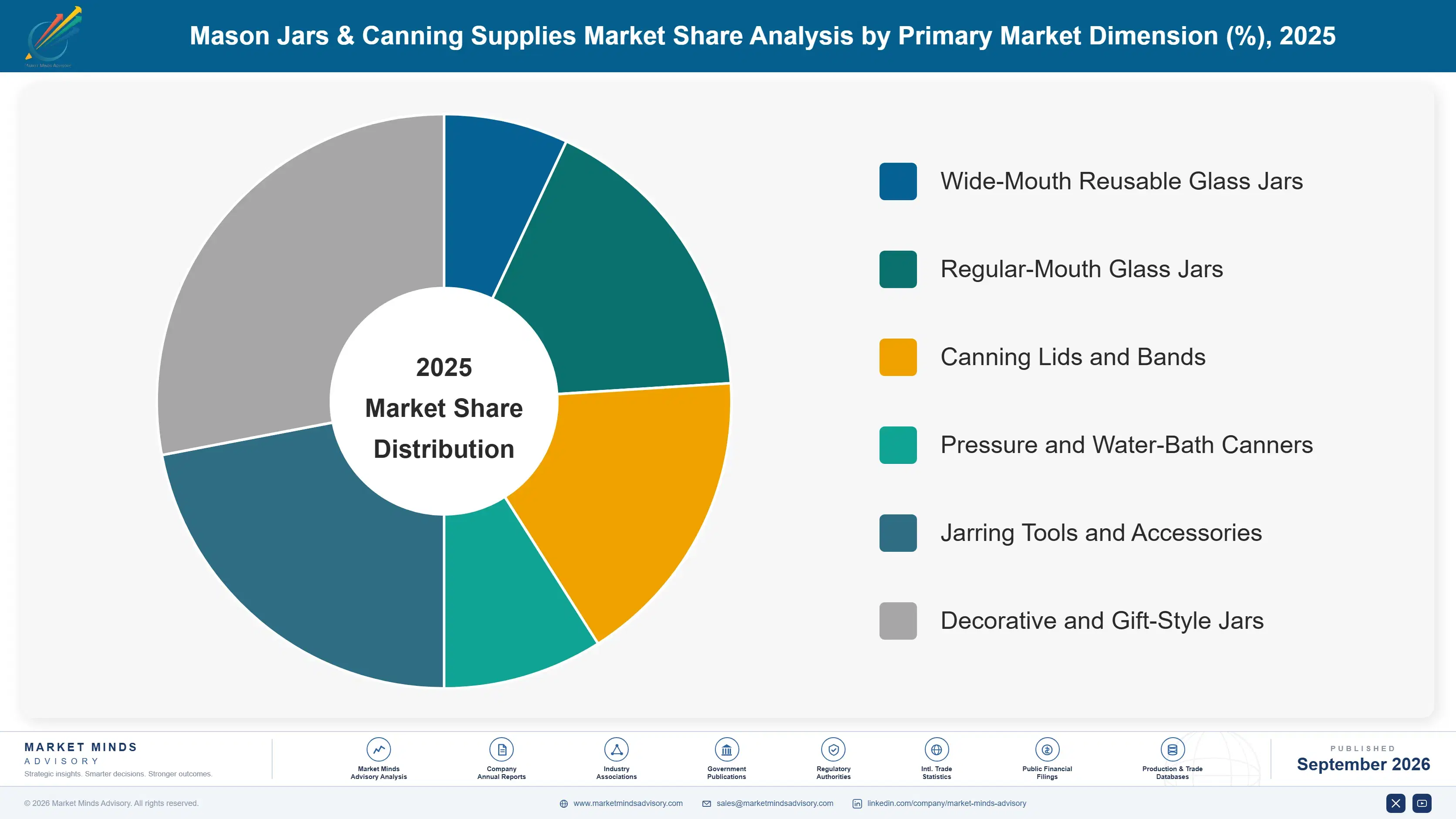
Segmentation follows product type across the canning workflow, the dimension buyers and retailers actually use to organize purchases and shelf placement throughout the buying journey and seasonal calendar each year. Six categories span jars, lids, equipment, and accessories used across the complete preservation process, from initial purchase through repeat seasonal use each year and beyond.
mason-jars-and-canning-supplies-market-market-share-analysis-1790023815165

Wide-Mouth Reusable Glass Jars

Wide-mouth reusable glass jars have overtaken traditional regular-mouth formats as the fastest-growing segment, driven by versatility that extends beyond canning into general food storage, meal prep, and decorative use across the whole kitchen and household routine each day and every season of the year. Their broader opening accommodates whole fruits and vegetables more easily during packing, reducing preparation time that deters casual buyers from attempting the process at all in the first place. Younger buyers entering the category through social media tutorials disproportionately favor this format, since most current tutorial content demonstrates wide-mouth techniques as the more approachable entry point for first-time canners still learning basic technique and safety practices from scratch.
CAGR 6.8%

Canning Lids and Bands

Canning lids and bands represent the category's genuine consumable segment, requiring annual repurchase since safe canning practice mandates new lids for each preservation cycle while bands and jars remain reusable across many seasons of continued use and repeated canning cycles year after year without fail or interruption of any kind whatsoever at all. This recurring purchase requirement generates the category's most predictable revenue stream, insulated somewhat from the durable-goods purchase cycles governing jars and equipment more broadly across the wider category. Reusable lid alternatives have emerged as a smaller but growing niche among cost-conscious and sustainability-minded canners seeking to reduce this recurring expense over time and across future seasons and years.
CAGR 5.5%
Full segment breakdown across 6 segments available in the complete report.

Regional Architecture and Country Demand Map

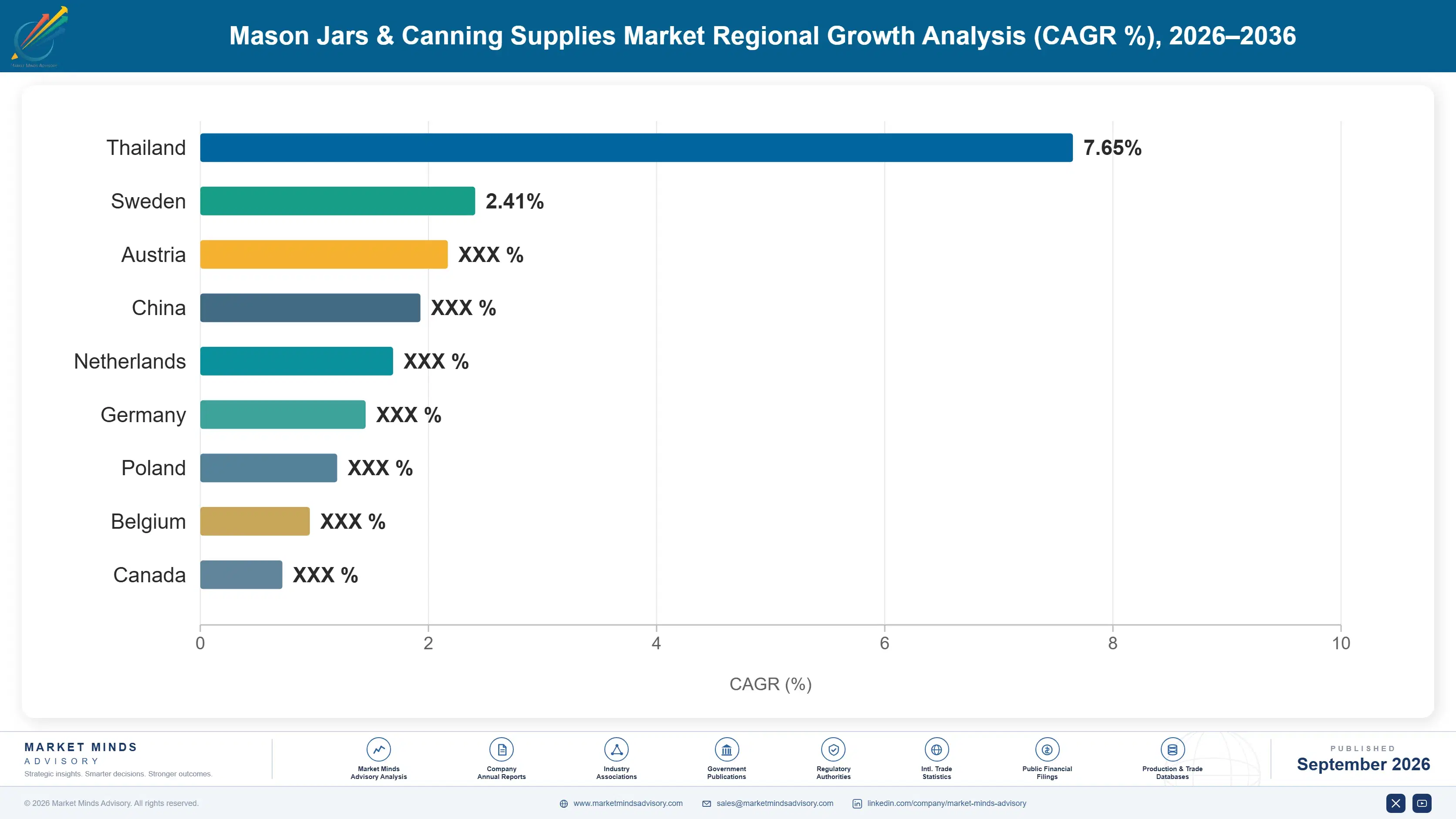
Regional distribution reflects home preservation culture depth more than raw market value overall, with Eastern Europe deep-rooted canning tradition anchoring outsized unit volume relative to its share of global market spend, while North America commands the largest dollar value across the entire category and every major channel.

North America

North America commands the largest dollar share through established retail infrastructure, with Newell Brands' Ball and Kerr labels carrying century-old recognition across grocery, hardware, and specialty retail channels nationwide and beyond most competing regions. American consumers show renewed interest in homesteading and self-sufficiency culture, particularly following pandemic-era supply chain anxiety that persists among a meaningful share of buyers today and continues shaping purchase behavior. Rural and suburban households with garden access represent the deepest consumer base, though urban apartment dwellers increasingly participate through community garden and farmers market produce access. Growth here tracks moderately above the category average, reflecting sustained rather than accelerating demand across most demographic segments and income levels.
Share: 30% | CAGR: 5.0% (2026 to 2036)

Western Europe

Western Europe's canning market centers on French and German household preservation traditions, with Le Parfait maintaining particularly strong brand recognition across French retail and specialty channels nationwide and beyond. European consumers show steadier, less trend-driven canning behavior than North American buyers, reflecting preservation practices passed down through generations rather than newly rediscovered through social media exposure or influencer marketing campaigns. Regulatory standards around food safety labeling run stricter here than in most regions, favoring established manufacturers with existing compliance infrastructure and testing capability built over decades of operation. Growth trails the category average meaningfully, reflecting an already mature, saturated market with limited first-time buyer expansion remaining across most member states and demographics.
Share: 22% | CAGR: 3.0% (2026 to 2036)
Regional intelligence for 5 additional markets available in the complete report: East Asia, South Asia and Pacific, Latin America, Middle East and Africa, Eastern Europe. Contact sales@marketmindsadvisory.com.
mason-jars-and-canning-supplies-market-country-cagr-analysis-1790023815704

Ways Manufacturers Can Expand Recurring Revenue

Margin expansion in canning supplies concentrates on deepening the recurring lid and band purchase relationship and expanding jar use beyond seasonal canning into everyday storage, since jars themselves sell only once per household for many years at a time and rarely need replacement. Four distinct levers address this from different commercial angles across the buyer relationship.

Subscription Lid Replacement Programs for Regular Canners

Offering annual subscription delivery of replacement lids and bands timed to peak canning season locks in recurring revenue while reducing the friction of remembering to repurchase before harvest begins each year and every season nationwide and abroad. Brands piloting this model report subscription consignors showing roughly 35% higher lifetime value than one-time purchasers, since the subscription relationship itself builds habitual repurchase behavior that resists competitive switching to store-brand alternatives over time. This approach also smooths seasonal demand forecasting considerably, reducing inventory risk across the sharply peaked harvest selling window each year.
Market Impact: Lifts consignor lifetime value roughly 35% overall today

General Storage Positioning Beyond Seasonal Canning Use

Marketing jars explicitly for pantry organization, meal prep, and general food storage year-round expands the addressable buyer base well beyond dedicated canners toward the much larger population of home organization enthusiasts across most demographics and age groups nationwide. This positioning captures purchase occasions throughout the year rather than concentrating sales entirely in peak harvest months, smoothing revenue by an estimated 20% across the calendar and reducing seasonal cash flow strain. Brands with strong year-round positioning report meaningfully steadier quarterly revenue than those marketing purely as canning equipment for seasonal use.
Market Impact: Smooths quarterly revenue by roughly 20% overall today

Tutorial Content Partnerships to Lower Skill Barriers

Partnering directly with homesteading and canning tutorial creators to co-develop branded educational content reduces the skill barrier that deters casual buyers while building brand loyalty among first-time canners discovering the practice for the first time through trusted voices and established channels nationwide and beyond current reach and audience. Brands with active tutorial partnerships report roughly 27% higher first-purchase-to-repeat-purchase conversion than those relying solely on traditional advertising and retail placement alone. This channel also generates authentic product usage content that traditional marketing cannot replicate as credibly or affordably at comparable scale.
Market Impact: Lifts repeat-purchase conversion by roughly 27% overall today

Premium Decorative Jar Lines for Gift Occasions

Developing decorative jar lines specifically for gift-giving occasions, including homemade jam and preserve gifting, commands roughly 40% higher per-unit margins than standard utilitarian jars sold for canning alone across most retail channels and price points nationwide and abroad each season and year without exception. This premium tier captures buyers willing to pay for aesthetic appeal even without active canning practice, expanding the addressable market considerably beyond dedicated preservationists nationwide and internationally. Seasonal gift-giving windows around major holidays create concentrated demand spikes that manufacturers increasingly plan production capacity around specifically each year.
Market Impact: Lifts per-unit margins by roughly 40% overall today

Who Controls the Margin Pool

The Mason Jars and Canning Supplies Market carries a CR5 near 42%, moderate-high concentration reflecting legacy glass manufacturer scale and century-old brand recognition across most major markets and retail channels worldwide today. Newell Brands leads by a substantial margin through its Ball and Kerr labels, with a clear gap separating it from European challengers still building comparable North American distribution and retail relationships across most regions.
Current competitive activity centers on reusable jar sustainability positioning, tutorial content partnerships, and decorative jar line expansion into gift-giving occasions across most price tiers and retail formats nationwide and abroad. Players increasingly differentiate through brand heritage and retail relationship depth rather than pure price competition, since glass manufacturing cost structures leave limited room for aggressive undercutting industry-wide across most operators.

Emerging pressure comes from reusable lid manufacturers offering alternatives to the annual lid repurchase requirement that has historically anchored recurring revenue for established players across the category and its major brands worldwide and domestically. Rankings could shift meaningfully if sustainability-minded buyers increasingly adopt these reusable alternatives at scale, eroding a revenue stream legacy manufacturers have relied on for decades of steady operation and growth.
mason-jars-and-canning-supplies-market-company-positioning-matrix-1790023816240

Competitive Moat and Risk Dimensions

NEWELL BRANDS INC

Moat: Century-Old Brand Recognition

Newell Brands' Ball and Kerr labels carry brand recognition built over more than a century, giving it retail shelf placement and consumer trust that newer entrants cannot replicate regardless of product quality or price positioning offered, especially among older, brand-loyal North American consumers with strong generational purchase habits.
NEWELL BRANDS INC

Risk: Concentrated North American Revenue

A substantial share of Newell's canning supply revenue concentrates in North America, leaving the company more exposed to regional demand softness than European competitors with more geographically diversified revenue bases across multiple continents and consumer segments. This concentration became especially visible during recent regional grocery price corrections.
LE PARFAIT SAS

Moat: French Household Heritage

Le Parfait's deep association with French household preservation tradition gives it a trust advantage in its home market that international competitors struggle to replicate, particularly among older, brand-loyal consumers who inherited the practice from prior generations and continue purchasing the same brand out of habit and trust.
LE PARFAIT SAS

Risk: Limited Scale Outside Europe

Le Parfait's distribution and brand recognition remain concentrated in Europe, leaving it meaningfully smaller than Newell Brands globally and less able to compete for shelf space in North American and Asian retail channels where Newell already dominates through long-standing retailer relationships and decades of accumulated brand trust.

Players Tracked

Prominent Players

Newell Brands Inc
Le Parfait SAS
Weck GmbH u Co KG
Bormioli Rocco SpA
O-I Glass Inc

Other Key Players

Anchor Hocking LLC
Libbey Inc
National Presto Industries Inc
Leifheit AG
Groupe SEB SA
Consol Glass Pty Ltd
Vigor Manufacturing Inc
Tattler Reusable Canning Lids LLC
Fillmore Container Inc
Norpro Inc
Cuisinart LLC
All American Canner Co
Kilner Rayware Group Ltd
Luigi Bormioli SpA
Fowlers Vacola Pty Ltd

Recent Developments

JANUARY 2026

Newell Brands Launches Wide-Mouth Jar Line With Recycled Glass Content

Newell Brands launched a new wide-mouth jar line manufactured with 30% recycled glass content, targeting sustainability-conscious buyers while maintaining the Ball brand's established safety certification and dimensional standards across its full product range, packaging, and retail distribution network nationwide and internationally across most major channels.
Signal: Signals legacy manufacturers responding directly to reusable-jar sustainability positioning championed by smaller, newer independent entrants industry-wide.
SEPTEMBER 2025

Weck Expands North American Distribution Through Specialty Retail Partnership

Weck signed a specialty retail distribution agreement expanding its North American presence beyond niche kitchenware stores into mainstream grocery chains, aiming to capture buyers seeking premium European jar aesthetics for both canning and general everyday storage use across the household and beyond into gift-giving occasions.
Signal: Signals European premium brands actively targeting North American market share expansion and deeper retail penetration nationwide.
APRIL 2025

Tattler Reports Surge in Reusable Lid Demand Amid Sustainability Interest

Tattler Reusable Canning Lids reported a significant year-over-year sales increase as sustainability-minded buyers sought alternatives to single-use metal lids, positioning reusable lids as a genuine long-term cost-saving and waste-reduction alternative for regular canners across most price-sensitive segments and demographic groups nationwide and increasingly abroad as well.
Signal: Signals reusable lid technology gaining genuine mainstream traction beyond niche early adopters and dedicated enthusiasts nationwide.

Managing Glass and Energy Input Cost Risk

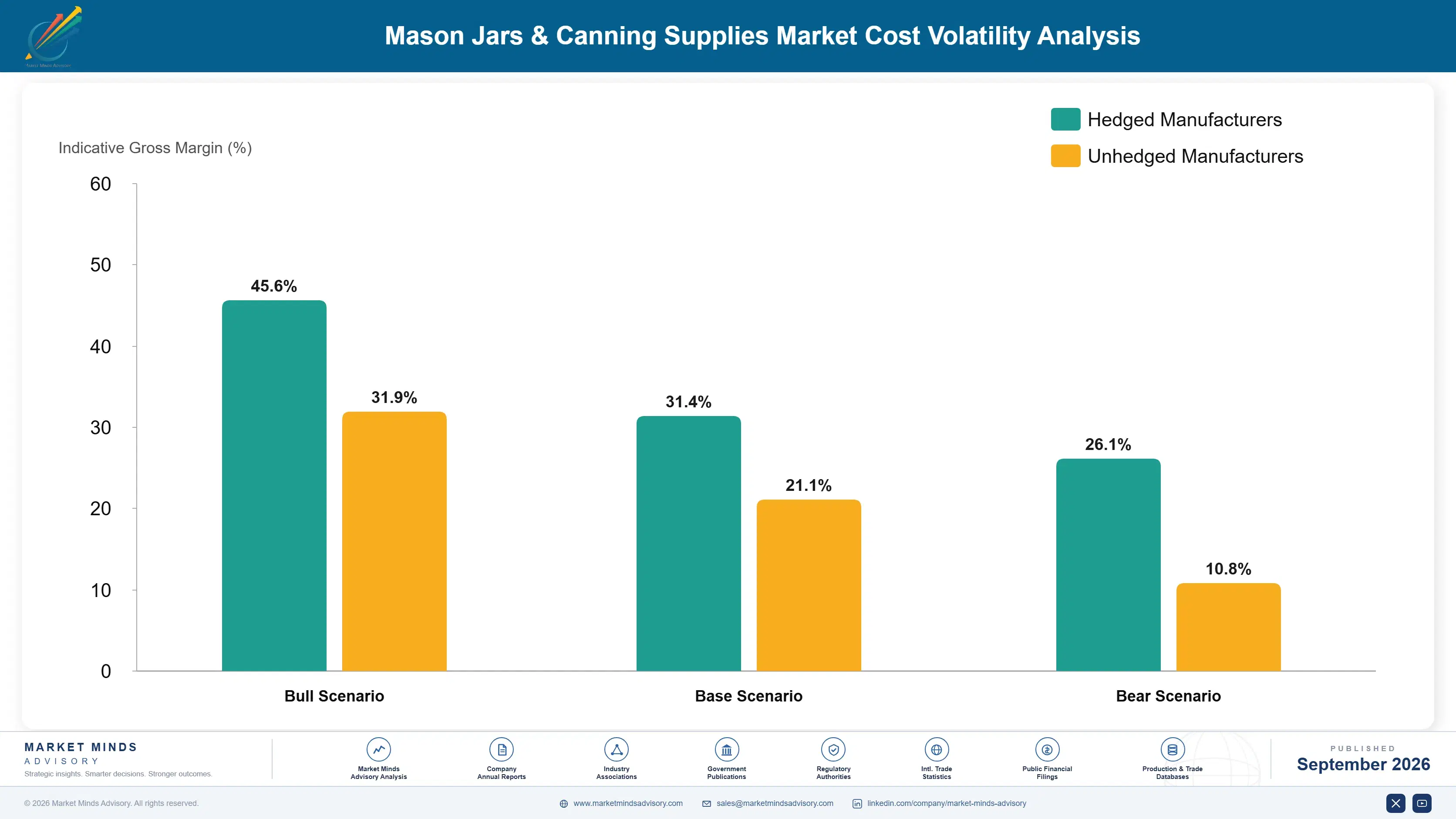
Silica sand, soda ash, and furnace energy together represent roughly 45% to 55% of total cost of goods sold for glass jar manufacturers, a substantially higher share than metal lid and band production carries in comparison. Silica and soda ash sourcing concentrates among specialty mineral suppliers based primarily in the United States, Turkey, and China, with limited substitution flexibility across most producing regions.
A notable volatility event occurred when natural gas prices spiked sharply in Europe during 2022 amid regional energy supply disruptions, according to industry trade reporting on glass manufacturing energy costs across the continent and its major producers, forcing several European glass manufacturers to temporarily idle furnace capacity rather than absorb unsustainable energy costs, a decision that took months to reverse given furnace restart requirements and safety protocols.

Smaller regional glass manufacturers face disproportionate cost exposure here, since they lack the purchasing volume needed to negotiate favorable long-term energy contracts that larger multinational producers secure routinely across multiple supplier relationships. This creates a genuine competitive disadvantage for independents attempting to compete on price against manufacturers with more diversified, hedged energy exposure and stronger balance sheets.
mason-jars-and-canning-supplies-market-cost-volatility-analysis-1790023816436

Diversify Silica and Soda Ash Sourcing

Sourcing silica sand and soda ash from multiple mineral suppliers across different regions and continents reduces exposure to any single supply disruption or geopolitical event, letting manufacturers maintain production continuity during localized mining or processing shortages that would otherwise halt operations entirely and delay shipments by several months at minimum, eroding competitive position considerably.

Lock In Long-Term Energy Contracts

Negotiating multi-year energy supply agreements well ahead of anticipated demand growth locks in favorable pricing before volatility hits the broader energy market and specialty mineral supply chain simultaneously and consistently, giving manufacturers with sufficient scale and creditworthiness meaningful cost predictability over multi-year planning horizons that smaller producers typically cannot access as easily or affordably.

Invest in Furnace Energy Efficiency

Upgrading furnace technology to reduce energy consumption per unit of glass produced lowers exposure to price volatility considerably over time and across market cycles and shifting business conditions, though the upfront capital investment required limits this option primarily to larger, better-capitalized manufacturers with longer investment horizons and greater risk tolerance for multi-year payback periods.

Portfolio Architecture for Margin Defence

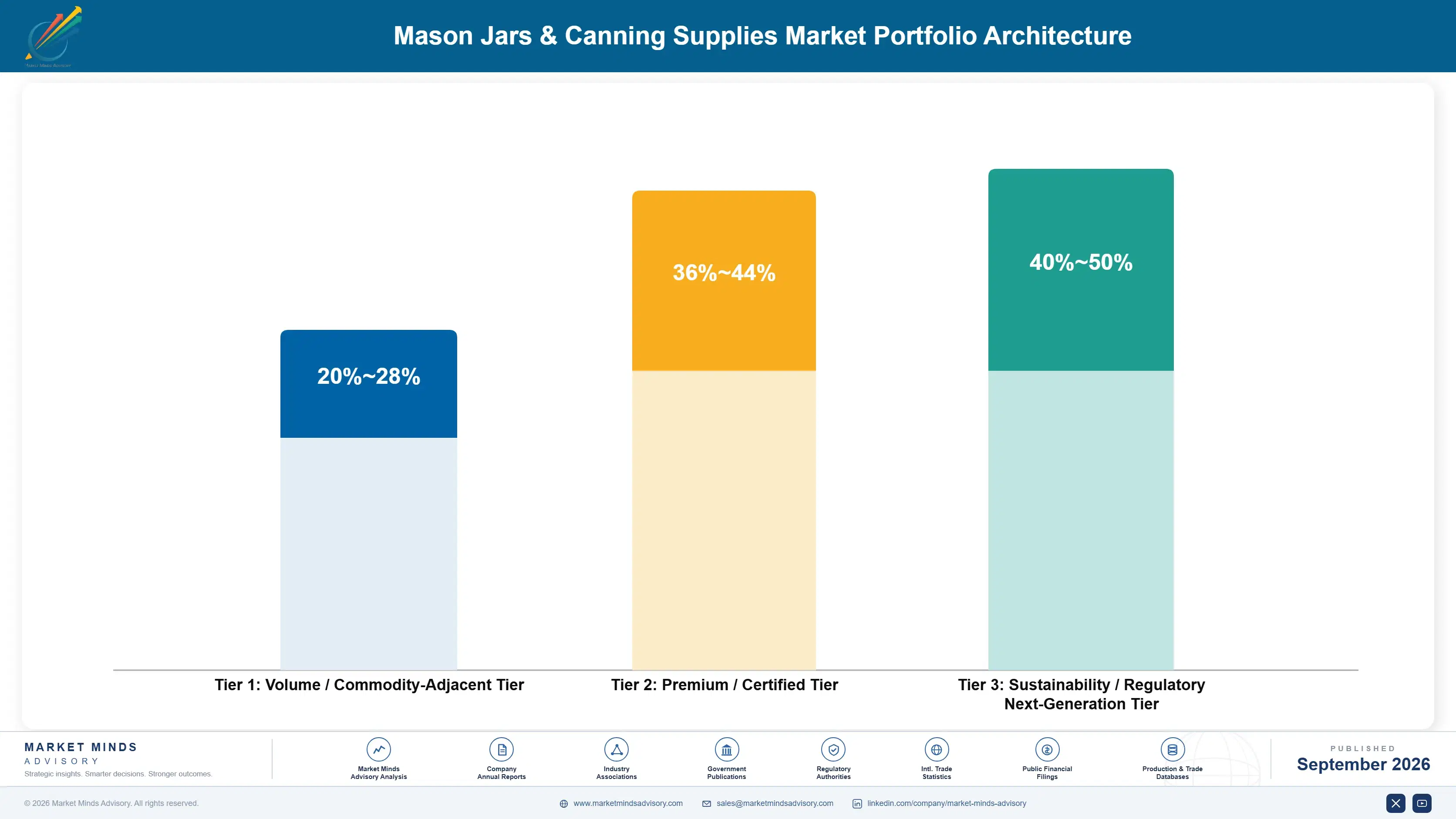
Portfolio economics split across three tiers by material sourcing, brand heritage, and use occasion rather than simple price point, since a mid-priced decorative jar can command margins rivaling far pricier standard formats lacking comparable gift-market positioning and brand recognition entirely. Volume-tier jars and lids carry thin per-unit margins offset by consistent seasonal transaction counts across most mainstream retail channels nationwide and internationally.
Premium and heritage-brand tiers carry meaningfully higher margins justified by brand trust and decorative appeal, creating real tension with volume-tier economics that depend on shelf turnover speed rather than per-unit margin to sustain overall profitability across the full product range and channel mix. Manufacturers increasingly segment product lines internally to serve both models without compromising either positioning, building distinct marketing approaches for each customer segment.

High-value margin pools concentrate in decorative and gift-occasion jar lines, where aesthetic appeal and brand heritage command premiums unmatched anywhere else in the category, well above what standard utilitarian formats can support even at meaningfully higher unit volume across comparable transaction counts and price points throughout the year and across most major retail channels worldwide and well beyond.

Volume / Commodity-Adjacent Tier

Standard regular-mouth jars and single-use lids with minimal branding, competing mainly on price at mass grocery and hardware retail outlets nationwide during peak harvest season, targeting price-sensitive first-time and casual canners.
Gross Margin: 20%-28%

Premium / Certified Tier

Heritage-brand wide-mouth jars with documented safety certification and established consumer trust, targeting buyers seeking measurable quality assurance beyond generic store-brand alternatives sold broadly at standard mass retail outlets nationwide and internationally.
Gross Margin: 36%-44%

Sustainability / Regulatory / Next-Generation Tier

Recycled-content and reusable-lid systems meeting the strictest emerging sustainability standards available in the market today, targeting values-driven consumers and export-oriented retail channels seeking maximum environmental credentials and supporting documentation of origin and process.
Gross Margin: 40%-50%
mason-jars-and-canning-supplies-market-portfolio-architecture-1790023816939

High-value Sub-segments and Strategic Watch-out

Recycled-Content Premium Jars

Recycled-content premium jars command the highest margins in the category as sustainability-minded buyers pay meaningful premiums for verified recycled glass content, representing the fastest-growing high-value niche within the broader premium tier and drawing growing manufacturer investment industry-wide today and into the coming years and decades.
Gross Margin: 40%-50%

Heritage-Brand Wide-Mouth Jars

Heritage-brand wide-mouth jars command strong margins through established consumer trust and brand recognition, generating solid per-unit value with steady growth as manufacturers expand wide-mouth product lines to capture buyers migrating away from traditional regular-mouth formats over time and across most retail channels nationwide and abroad.
Gross Margin: 36%-44%

Standard Regular-Mouth Jars and Lids

The largest unit-volume segment by far, standard regular-mouth jars and lids generate steady revenue at thinner margins, forming the foundation of category economics even as growth concentrates in higher-margin premium and decorative tiers positioned well above this core volume segment across nearly every major platform and retail channel worldwide.
Gross Margin: 20%-26%

Energy and Glass Input Cost Volatility

Rising natural gas and energy input cost volatility represents a genuine strategic watch-out, since sustained price spikes could compress manufacturer margins meaningfully if smaller regional producers cannot secure the supplier diversification and hedging capacity that larger competitors maintain consistently today and across future planning cycles.
Gross Margin: N/A

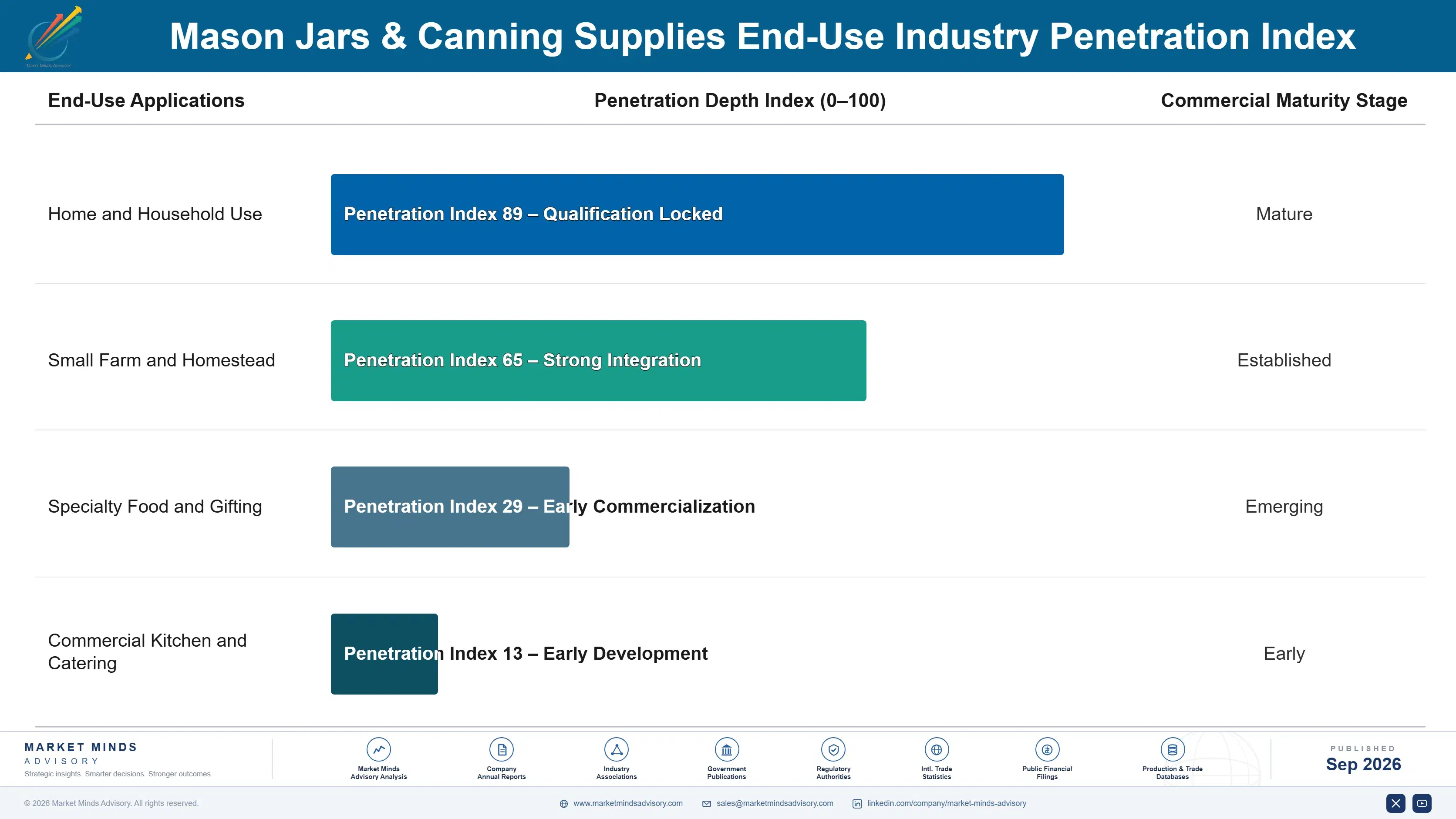
Seasonal Repurchase Economics Across Canner Types

Canning supplies carry a genuine annual repurchase annuity through lid and band replacement, distinct from the one-time jar purchase that anchors most households for many years without needing replacement or repair of any kind whatsoever at all. This recurring lid demand generates steadier revenue than a pure durable-goods model would provide, concentrated heavily around peak harvest season each year across most markets.
Adoption depth varies sharply by end-use vertical: dedicated home preservationists engage most deeply, canning multiple batches across an entire growing season and purchasing supplies well ahead of need each year to avoid running short. Casual buyers attempting canning once or twice a year transact more sporadically, often purchasing starter kits rather than building a supply inventory over time or across multiple seasons and years.

Generational buyer shifts favor younger consumers discovering canning through social media who treat jars as general storage purchases rather than dedicated seasonal equipment, contrasting with older buyers who maintain established seasonal purchase routines tied to family preservation traditions passed down over multiple decades of practice. This split is gradually reshaping how retailers merchandise the category across most channels and seasons.
mason-jars-and-canning-supplies-market-end-use-penetration-index-1790023817447

Where Manufacturers Should Focus Next

These are among the four positions where our research anticipates prominent divergence between winners and laggards over the coming forecast period. Each is grounded in the demand model, the regulatory perimeter, and the announced capacity pipeline.
01 / RECURRING REVENUE INVESTMENT

Build subscription models around annual lid and band repurchase

Lid and band replacement represents the category's most predictable recurring revenue stream, and manufacturers that formalize this into subscription or pre-order programs will capture consignor loyalty before store-brand alternatives do so first across most markets and price tiers nationwide. Waiting until competitors establish subscription relationships first costs considerably more in lost recurring revenue than proactive investment does today. Smaller manufacturers should seriously consider retail partnership subscription programs rather than building standalone platforms entirely alone and unassisted, which few can afford.
02 / SUSTAINABILITY POSITIONING PRIORITY

Expand recycled-content and reusable-lid product lines now

Sustainability-minded buyers increasingly favor recycled glass content and reusable lid systems over conventional single-use alternatives, and manufacturers building credible sustainability credentials now will capture disproportionate share as this preference continues strengthening across most demographics and price tiers nationwide and abroad. This positioning also expands the addressable buyer base toward consumers who may never actually can but purchase jars for general storage and reduced household waste. Brands delaying this investment risk ceding this growing segment to more responsive competitors already expanding.
03 / TUTORIAL PARTNERSHIP INVESTMENT

Partner with homesteading content creators to lower entry barriers

Social media tutorial content functions as an informal training channel that increasingly determines which brands first-time canners choose when entering the category for the first time without family guidance. Manufacturers with active tutorial partnerships capture disproportionate early brand loyalty among younger buyers who previously had no family tradition of canning to draw on for guidance or reassurance. This channel investment costs meaningfully less than traditional advertising while generating more credible, authentic product demonstration content that resonates with skeptical first-time buyers.
04 / EASTERN EUROPE MARKET FOCUS

Deepen distribution in Eastern Europe's deeply-rooted canning culture

Eastern Europe sustains some of the world's highest per-capita canning rates, yet regional manufacturers remain underrepresented among globally recognized brands relative to this deep cultural entrenchment and long-standing practice across most households and generations there. International manufacturers expanding distribution and local partnerships here access a large, price-competitive but highly loyal consumer base that most Western brands currently underserve considerably despite the clear opportunity. Early investment in this region offers durable volume advantage over the full forecast period and well beyond it.

Engagement Snapshot From the Field

A live engagement with an industry participant carrying material or product regulatory and market exposure ahead of a defining policy shift, showing how our research translates into a defensible multi-year portfolio strategy.
MARKET MINDS ADVISORY · CLIENT ENGAGEMENT SUMMARY
Mason Jars & Canning Supplies Producer Strategic Portfolio Review and Transition Roadmap 2026·Investment Scenario on Mason Jars & Canning Supplies Exposure Evaluation 2025-26
CLIENT PROFILE
The client is a mid-sized North American glass jar manufacturer with an established regional presence but limited national retail distribution outside its home market and neighboring states. Revenue growth had plateaued as national brands captured share through broader retail placement, prompting leadership to seek an outside assessment of expansion options before committing significant capital to national distribution.
STRATEGIC CHALLENGE
Leadership needed to decide whether to invest in national retail distribution expansion or instead pursue a sustainability-focused recycled-content product line targeting a narrower but growing buyer segment, without clear visibility into which approach would generate stronger returns given the company's limited capital budget for the coming two fiscal years and beyond.
MMA APPROACH
MMA combined primary survey data across regional canning buyers with a competitive benchmarking exercise against national brands and smaller sustainability-focused competitors operating in adjacent regional markets nationwide. The team modeled both national expansion and recycled-content product development paths against projected customer acquisition cost and margin retention over a three-year planning horizon.
KEY FINDINGS
  1. National retail distribution expansion required an estimated 40% larger capital outlay than recycled-content product development alone, internal financial analysis clearly and definitively showed.
  2. Sustainability-focused buyers showed 22% higher price tolerance for verified recycled glass content compared to standard formulations sold regionally at most local retailers.
  3. Regional brand loyalty remained strong, with 65% of surveyed buyers citing local sourcing as a genuine purchase factor influencing their final purchase decision.
  4. Recycled-content positioning showed a projected payback period roughly 30% faster than national distribution expansion given current capital constraints and prevailing market conditions.
CLIENT PROFILE
The client is a mid-sized North American glass jar manufacturer with an established regional presence but limited national retail distribution outside its home market and neighboring states. Revenue growth had plateaued as national brands captured share through broader retail placement, prompting leadership to seek an outside assessment of expansion options before committing significant capital to national distribution.
STRATEGIC CHALLENGE
Leadership needed to decide whether to invest in national retail distribution expansion or instead pursue a sustainability-focused recycled-content product line targeting a narrower but growing buyer segment, without clear visibility into which approach would generate stronger returns given the company's limited capital budget for the coming two fiscal years and beyond.
MMA APPROACH
MMA combined primary survey data across regional canning buyers with a competitive benchmarking exercise against national brands and smaller sustainability-focused competitors operating in adjacent regional markets nationwide. The team modeled both national expansion and recycled-content product development paths against projected customer acquisition cost and margin retention over a three-year planning horizon.
KEY FINDINGS
  1. National retail distribution expansion required an estimated 40% larger capital outlay than recycled-content product development alone, internal financial analysis clearly and definitively showed.
  2. Sustainability-focused buyers showed 22% higher price tolerance for verified recycled glass content compared to standard formulations sold regionally at most local retailers.
  3. Regional brand loyalty remained strong, with 65% of surveyed buyers citing local sourcing as a genuine purchase factor influencing their final purchase decision.
  4. Recycled-content positioning showed a projected payback period roughly 30% faster than national distribution expansion given current capital constraints and prevailing market conditions.
RECOMMENDED STRATEGY
Phase 1: Phase one: launch a recycled-content jar line targeting regional sustainability-focused buyers first before expanding into adjacent new geographic retail markets. Phase 2: Phase two: use recycled-content brand credibility to negotiate expanded regional retail placement and additional shelf space nationwide immediately and consistently. Phase 3: Phase three: pursue national distribution only after establishing sustainability credentials regionally and building sufficient capital reserves for full national expansion.
OUTCOME
Within eighteen months of the recycled-content line launch, the client reported (client-reported, unverified by MMA) a 24% increase in regional market share and meaningfully improved retail negotiating position. The client subsequently began national distribution discussions with two major retail chains using its sustainability positioning as a key differentiator.

Frequently Asked Questions

Foundational context covering the market sizes, CAGR, scope, country, region and competition that inform every finding below. This section is provided to cover basics and most often pre-purchase conversations, answered from the MMA Primary Research Dataset.

What is the current size of the Mason Jars & Canning Supplies Market?

The Mason Jars and Canning Supplies Market was valued at 2.9 billion dollars in 2025. This figure reflects global retail sales of jars, lids, bands, and canning equipment.

How large will the Mason Jars & Canning Supplies Market be by 2036?

The market is projected to reach 4.8 billion dollars by 2036. This represents roughly a 1.57 times expansion from 2026 value over the ten-year forecast period.

What is the CAGR for the Mason Jars & Canning Supplies Market 2026 to 2036?

The market is forecast to grow at a 4.6% compound annual rate between 2026 and 2036. Growth is faster in wide-mouth reusable jars than in standard regular-mouth formats.

Which segment is growing fastest?

Wide-Mouth Reusable Glass Jars are growing fastest, at a 6.8% CAGR. That is roughly 1.5 times the overall market growth rate through the full 2036 forecast horizon.

Who are the major companies in the Mason Jars & Canning Supplies Market?

Major companies include Newell Brands Inc, Le Parfait SAS, Weck GmbH u Co KG, Bormioli Rocco SpA, and O-I Glass Inc, together holding a moderate-high combined revenue share.

Which country is growing fastest?

Poland is the fastest-growing country market, expanding at a 7.2% CAGR. Deep home preservation culture and younger generations rediscovering canning are the primary growth drivers there.

Report Segmentation Architecture

The full report scope spans multiple orthogonal segmentation dimensions, with cross-tabulated demand data provided for each dimension pair. Coverage extends further to regional breakdowns, trend trajectories, and the competitive detail needed to support segment-level decision-making.

By Primary Market Dimension

  • Wide-Mouth Reusable Glass Jars
  • Regular-Mouth Glass Jars
  • Canning Lids and Bands
  • Pressure and Water-Bath Canners
  • Jarring Tools and Accessories
  • Decorative and Gift-Style Jars

By End-Use Industry

  • Home and Household Use
  • Small Farm and Homestead
  • Specialty Food and Gifting
  • Commercial Kitchen and Catering

By Commercial Dimension

  • Mass Grocery and Hardware Retail
  • Specialty Kitchenware Retail
  • Direct-to-Consumer Online
  • Subscription and Pre-Order

By Region

  • North America
  • Western Europe
  • East Asia
  • South Asia and Pacific
  • Latin America
  • Middle East and Africa
  • Eastern Europe

Scope, Methodology, and Coverage

Every figure in this report is reproducible from documented input assumptions. The scope below maps the historical period, the forecast horizon, the segmentation dimensions, and the countries covered, alongside the underlying primary and qualitative methodology.
Historical Period
2020 to 2025
Forecast Period
2026 to 2036
Base Year
2025 (USD billions; MMA Primary Research Dataset, September 2026)
Market Definition
The Mason Jars and Canning Supplies Market covers glass jars, lids, bands, and associated tools used for home food preservation, canning, and fermentation. It excludes commercial food packaging jars, industrial canning equipment, and non-glass storage containers.
Quantitative Units
USD billions (current prices); unit shipment volume in millions where applicable
Segmentation Dimensions
By Product Type and Use; By End-Use Industry; By Commercial Dimension; By Region
Regions Covered
North America, Western Europe, East Asia, South Asia and Pacific, Latin America, Middle East and Africa, Eastern Europe
Countries Covered
USA, China, Germany, France, UK, Japan, South Korea, India, Australia, Canada, Brazil, Mexico, Indonesia, Vietnam, Thailand, Malaysia, UAE, Saudi Arabia, South Africa, Nigeria, Turkey, Poland, Netherlands, Italy, Spain, Sweden, Switzerland, Argentina, Colombia, Singapore, and additional markets relevant to this sector
Key Companies Profiled
Newell Brands Inc, Le Parfait SAS, Weck GmbH u Co KG, Bormioli Rocco SpA, O-I Glass Inc, Anchor Hocking LLC, Libbey Inc, National Presto Industries Inc, Leifheit AG, Groupe SEB SA, Consol Glass Pty Ltd, Vigor Manufacturing Inc, Tattler Reusable Canning Lids LLC, Fillmore Container Inc, Norpro Inc, Cuisinart LLC, All American Canner Co, Kilner Rayware Group Ltd, Luigi Bormioli SpA, Fowlers Vacola Pty Ltd
Quantitative Methodology
Primary survey, n=3,800 respondents, Q4 2025, six countries; demand-side model with trade association cross-validation
Qualitative Methodology
47 expert interviews, Q4 2025; applied to validate demand model assumptions, identify emerging dynamics, and assess competitive positioning
Report Format
PDF and XLSX data workbook (Word format preview document)
Publisher
Market Minds Advisory
Report Code
MMA-2026-CON-207
Published
September 2026
Contact
sales@marketmindsadvisory.com | www.marketmindsadvisory.com

Purchase the full Mason Jars & Canning Supplies Market Report (2026 to 2036).

This report provides a comprehensive assessment of the global Mason Jars and Canning Supplies Market, covering market sizing, segmentation, regional dynamics, and competitive positioning through 2036. It draws on primary survey data across 3,800 respondents in six countries and 47 expert interviews conducted in Q4 2025, combined with company disclosures and MMA proprietary analysis across every major product category. The report is designed to support strategic decisions on sustainability positioning, recurring revenue strategy, and competitive positioning across the forecast period. Readers gain a clear view of where margin pools concentrate and how seasonal demand economics are likely to shift.
Detailed segmentation by product type and use
Seven-region market sizing with growth forecasts
Competitive benchmarking of twenty leading companies
Glass and energy input cost risk analysis
Revenue lever and margin expansion strategies
Anonymized client case study with outcomes

Built For The People Who Decide

From boardroom strategy to bench-side execution, this report is read cover-to-cover by leaders shaping the next decade of their industry, turning demand scenarios, market dynamics and valuation benchmarks into decisions.
CXOs/ Presidents/ VPs/ Managers
M&A and Corporate Development
Strategy Teams and R&D Heads
Procurement and Product Directors
Regulatory and Compliance Leaders
Investor Relations and Equity Analysts