

Market Minds Advisory
Marketing Transcription Market

Marketing Transcription Market: Marketing Transcription Market. Content Repurposing Demand Forces an AI Transcription Upgrade

Podcast, webinar, and video marketing volume are outpacing what manual transcription teams can process, pushing content marketers relying on outsourced human transcription toward AI-automated platforms that turn raw audio into searchable, repurposable text within minutes.

Lead Analyst

Published

September 2026

Make Smarter Decisions with Customized Research Insights

Request a free sample report and evaluate market opportunities, growth trends, and competitive dynamics relevant to your business needs.

2025 MARKET VALUE$1.6BMarket Size 2025
2036 FORECAST VALUE$6.2BBase Case , 2026 to 2036
CAGR 2026 TO 203613.2 %Bull 14.5% / Bear 11.9%
INCREMENTAL OPPORTUNITY$4.4BNet 10- year value creation
EXPANSION MULTIPLE3.45x2036 value over 2026 base
Strategic Levers
M&A Pipeline
Regional Outlook
Country Rankings
Competitive Intelligence
Segmental Deep-dive
Call-Us : 91 93563 13602

Executive Snapshot and Market Trajectory.

A single hour-long podcast episode now generates a blog post, a dozen social clips, and an SEO landing page, and transcription is the unglamorous step that makes every one of those repurposed marketing assets possible at meaningful scale across an entire quarterly content calendar.
Podcast networks, webinar platforms, and video marketing teams together drive most demand, each pushing vendors toward faster turnaround and tighter integration with content management and SEO workflows rather than standalone transcript delivery alone as a finished product for clients. North America's outsized podcast advertising industry and concentrated MarTech spending give the region an outsized role in global demand that exceeds its share of overall digital marketing budgets alone.
Five vendors hold under half of global revenue, a fragmented landscape reflecting how many buyers still choose between pure AI transcription tools and hybrid services blending automated output with human editing for accuracy-sensitive content types like legal disclaimers and executive quotes. Rising multilingual content marketing and accessibility compliance requirements are pushing buyers toward vendors offering broader language coverage, a shift that favors platforms investing in automated speech recognition over legacy manual transcription shops.
Market Definition
The marketing transcription market covers software and services that convert audio and video marketing content, including podcasts, webinars, customer interviews, and ad recordings, into searchable, editable text for content repurposing and SEO purposes. It excludes general-purpose consumer dictation software and legal or medical transcription services sold for compliance rather than marketing use.
Base Year Value
$1.6B in 2025 (MMA Primary Research Dataset, September 2026)
Forecast Period
2026 to 2036, eleven discrete annual values
CAGR
13.2% base case. Bull 14.5%. Bear 11.9%.
Fastest Growth Segment
AI-Automated Real-Time Transcription: 19.8% CAGR
Fastest Growth Country
India: 16.4% CAGR
Fastest Growth Region
South Asia and Pacific: 15.1% CAGR
Largest Region
North America: 31% of 2025 global value
Market Leaders
Rev, Otter.ai, Descript, Trint, and Sonix lead the market. Source: MMA Primary Research Dataset, July 2026.
Primary Survey
n=3,800 procurement and R&D decision-makers, Q4 2025, six countries
Methodology
Demand-side build-up, cross-validated against public data, 47 expert interviews

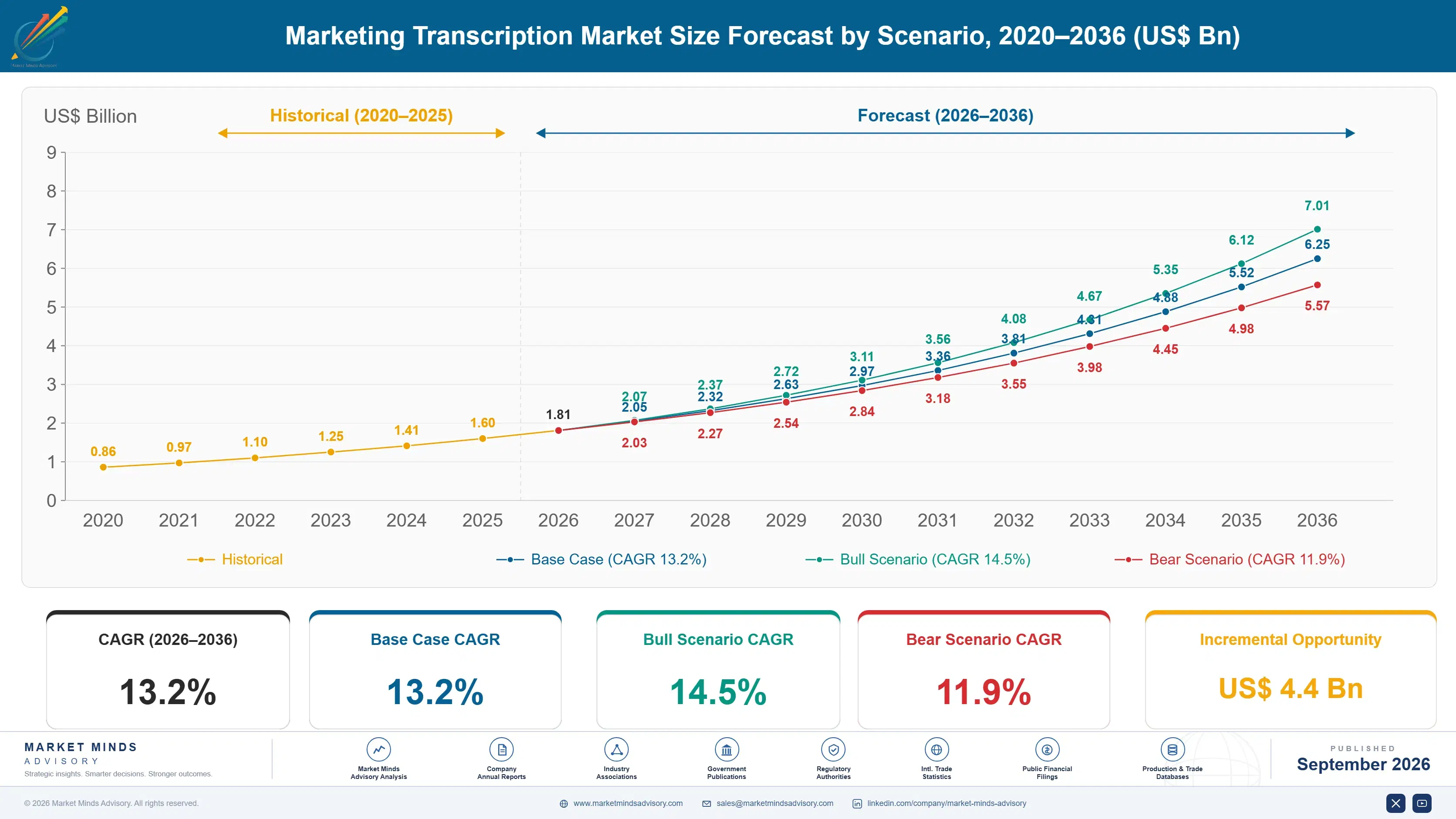
Marketing Transcription Market Forecast Scenarios

marketing-transcription-market-size-forecast-scenario-1790002672078
Between 2020 and 2025 the market grew at roughly 12.0% a year as pandemic-era webinar and podcast production surged before settling into a steadier growth pattern as automated speech recognition accuracy improved enough to displace much of the manual transcription workforce that dominated the market's very early years across most content categories and price tiers offered broadly.
The base case assumes 13.2% annual growth through 2036, built on three mechanisms: rapidly expanding podcast and video content production volume that outpaces manual transcription capacity across every single content category, improving automated speech recognition accuracy that makes AI-only transcription viable for a growing share of marketing use cases previously requiring human review, and rising demand for searchable, repurposable content archives that require accurate text transcripts as their essential foundation.
A bull case near 14.5% follows if automated speech recognition accuracy improves even further still, expanding the share of content marketers willing to skip human review entirely for routine content. The principal bear risk, a broad slowdown in podcast and webinar advertising spending that reduces overall content production volume across the industry, would instead pull growth toward 11.9%.

Marketing Transcription Market Overview

Marketing transcription sits at the point where raw audio either becomes a searchable content asset or stays locked inside a media file nobody can repurpose, and that intersection has turned a once-commodity service into a genuine content operations decision. Buyers no longer choose transcription purely on price per minute. They increasingly demand speaker identification, SEO-ready formatting, and direct integration with the content management systems their marketing teams already use daily.
MARKET CONCENTRATIONCR5 41%Top five vendors hold under half of global revenue
AVERAGE SELLING PRICE$0.10-2.50 per minutePrice spans automated-only output to fully human-edited transcripts
LEADING COUNTRY BY REVENUEUnited States, 38% shareAmerican podcast and MarTech spending concentrates demand domestically
TURNAROUND TIME STANDARDUnder 10 minutesAI-automated platforms now deliver near-instant transcript generation for buyers
TRADE INTENSITY22% cross-border service shareBuyers increasingly source transcription services from providers abroad
INPUT COST SHARE29%Compute infrastructure and human editor labor dominate total service cost
The United States hosts a disproportionate share of global demand, reflecting the country's outsized podcast advertising industry and concentrated marketing technology spending among enterprise buyers. North America more broadly is the largest single demand pool by revenue, driven by extensive webinar and video marketing activity alongside a growing accessibility compliance requirement pushing captioning and transcript generation into standard workflow.
Turnaround time has compressed dramatically as automated speech recognition accuracy improves, letting marketing teams publish repurposed content within hours of a live recording rather than waiting days for human transcription to finish. Cross-border service sourcing remains significant, since English-language transcription talent and increasingly capable multilingual AI models are not evenly distributed across every national market worldwide.
"Transcription used to be the boring line item nobody budgeted for properly. Now it's the thing that decides whether a podcast episode becomes ten pieces of content or just one."
Director, Marketing Technology Practice · MMA Technology Practice · September 2026

Market Trends

AI transcription accuracy reaches parity with human editors

Automated speech recognition models have improved to the point where accuracy on clean, single-speaker audio now matches or exceeds what a typical human transcriptionist delivers, particularly for standard American and British English content. This shift is letting marketing teams skip the human review step entirely for lower-stakes content such as internal meeting notes or social clip captions, reserving paid human editing for flagship content like investor calls or branded video series where accuracy errors carry real reputational risk. Vendors are responding with tiered pricing that charges a premium for the human review layer rather than bundling it into every order.
Market Impact: 5 million active podcasts tracked globally

Content repurposing workflows integrate transcription directly into platforms

Marketing teams increasingly demand transcription that plugs directly into their existing content management, social scheduling, and SEO platforms rather than delivering a standalone text file requiring manual copy and paste into other systems entirely by hand every single time. This integration trend is reshaping vendor product roadmaps toward API-first architecture and pre-built connectors for popular marketing software, since standalone transcript delivery increasingly reads as an incomplete product to sophisticated enterprise buyers. Vendors offering deep platform integration report meaningfully higher customer retention than those selling transcription as an isolated point solution.
Market Impact: 60 countries with accessibility mandates

Market Opportunities and Growth Drivers

Explosive podcast and video content production volume outpaces capacity

Brand and creator podcast launches continue accelerating across nearly every industry vertical, with marketing teams increasingly treating audio and video content as a primary channel rather than an experimental add-on to written content strategy. Each new show or video series generates a steady stream of episodes requiring transcription for accessibility compliance, SEO indexing, and content repurposing into blog posts and social clips across many platforms. Manual transcription capacity simply cannot scale at the pace new shows are launching, forcing marketing teams toward automated or hybrid solutions regardless of prior vendor preference.
Market Impact: 18% error rate on accented speech

Accessibility compliance mandates require captions and transcripts

Web accessibility regulations in the United States, the European Union, and several other jurisdictions increasingly require captions and transcripts for video and audio content published on commercial websites nationwide and abroad, extending compliance obligations that previously applied mainly to broadcast media into digital marketing content as well. Marketing teams publishing webinars, product videos, and branded podcasts now face genuine legal exposure if accessible transcripts are unavailable, converting what was once a nice-to-have feature into a mandatory publishing requirement. This regulatory pressure generates baseline transcription demand independent of content marketing strategy choices.
Market Impact: 27% of buyers cite privacy concerns

Market Restraints and Challenges

AI accuracy gaps persist for accented and multi-speaker audio

Automated speech recognition systems still struggle noticeably with heavily accented speech, overlapping multi-speaker conversations, and industry-specific jargon common in podcasts and interviews, producing transcripts that require substantial human correction before final publication in most typical cases across the industry. The root cause is that training data for most commercial models skews heavily toward standard American and British English audio, leaving other accents and languages comparatively underserved by current model architectures. Several vendors are investing in accent-specific fine-tuning and expanded multilingual training data to narrow this persistent accuracy gap over time.
Market Impact: 92% accuracy now standard

Data privacy concerns limit cloud transcription adoption for sensitive content

Marketing teams handling customer interviews, focus group recordings, or executive strategy discussions increasingly hesitate to send sensitive audio to cloud-based transcription platforms given data privacy and confidentiality concerns that vary considerably by industry, company size, and national jurisdiction across every market tracked. The underlying cause is that many transcription vendors process audio through third-party cloud infrastructure without offering enterprise customers full control over data residency or retention policies applied to their content. Several vendors now offer on-premise or private cloud deployment options specifically to address this concern for regulated industries.
Market Impact: 45% faster content publishing workflow
4 additional market trends, 3 additional growth drivers, and 3 additional restraints and challenges are covered in the full report. Contact sales@marketmindsadvisory.com to access the complete intelligence.

Segment CAGR and Growth Architecture

Marketing transcription segments cleanly by delivery method, the dimension that determines both turnaround time and price for any given buyer or content type. This framework separates fully human-transcribed services, hybrid AI-plus-human editing services, AI-automated real-time transcription, batch AI transcription for pre-recorded content, and specialized multilingual transcription, avoiding overlap between production method and content type.
Section default visual

AI-Automated Real-Time Transcription

AI-automated real-time transcription is pulling ahead of every other configuration as automated speech recognition accuracy reaches the point where marketing teams can publish transcripts immediately after a live recording without waiting for any human review at all across most content types today. Live podcast recordings, webinars, and streaming events increasingly generate transcripts in real time, letting marketers repurpose content into social clips and blog posts within hours rather than days after the original event concludes and airs publicly. Vendors offering this capability capture a growing share of enterprise contracts specifically because speed has become as commercially valuable as accuracy for time-sensitive marketing content in nearly every industry vertical tracked here.
CAGR 19.8%

Hybrid AI-Plus-Human Editing Services

Hybrid AI-plus-human editing services remain the largest single configuration by revenue worldwide today, continuing to serve marketing teams that need the speed of automated transcription combined with the accuracy assurance that only careful, deliberate human review can currently guarantee for flagship or compliance-sensitive content across every industry vertical served today by established vendors everywhere worldwide and across many borders alike. Their appeal lies in balancing cost against risk, a genuine consideration for brands publishing content where a transcription error could misquote an executive or misstate a product claim publicly and damage brand trust permanently. Enterprise buyers managing large content libraries continue generating steady demand for this established, proven delivery model.
CAGR 10.6%
Full segment breakdown across 7 segments available in the complete report.

Regional Architecture and Country Demand Map

North America leads on the strength of its outsized podcast advertising industry and heavily concentrated MarTech spending among many enterprise buyers nationwide today, while East Asia and Western Europe follow behind on rapidly expanding video content marketing and mature accessibility compliance regulation across the region.

North America

The United States hosts the world's largest podcast advertising industry and a deeply concentrated marketing technology sector, both generating substantial transcription demand tied directly to content repurposing workflows across nearly every industry vertical. American accessibility regulations, including web content accessibility guidelines increasingly enforced through litigation, push commercial websites toward mandatory captioning and transcript publication regardless of marketing strategy preference. Canadian enterprise demand adds meaningful incremental volume behind the much larger American market, growing at a broadly comparable pace overall driven by similar content marketing trends and platform adoption patterns. This trend is expected to continue as content marketing budgets keep expanding across most industry sectors. Federal accessibility enforcement actions have accelerated adoption significantly among mid-sized enterprises.
Share: 31% | CAGR: 12.9% (2026 to 2036)

East Asia

China's rapidly expanding short-video and livestream marketing industry generates transcription demand at a scale that dwarfs most Western markets on a per-platform basis, though language-specific automated speech recognition models remain less mature than their English-language counterparts overall. Japanese and South Korean enterprises favor hybrid AI-plus-human services given persistent accuracy gaps in automated Japanese and Korean language transcription models compared with English-language systems. Domestic transcription vendors are investing heavily in local language model training to close this gap over the coming several years across the region. Rising mobile video consumption across the region keeps expanding this demand pool steadily each year. Domestic platforms continue expanding native language transcription capability to serve this rapidly growing market.
Share: 23% | CAGR: 14.1% (2026 to 2036)
Regional intelligence for 5 additional markets available in the complete report: Western Europe, South Asia and Pacific, Latin America, Middle East and Africa, Eastern Europe. Contact sales@marketmindsadvisory.com.
marketing-transcription-market-market-share-analysis-1790002673037

Where Margin Concentrates in Transcription

Vendors capture the widest margins where transcription becomes an embedded workflow feature rather than a standalone commodity purchase, and where accuracy requirements justify a premium human review layer beyond automated output alone in every case that matters. Four levers stand out as the clearest paths to expanding gross margin over the coming decade ahead.

Bundle SEO and content repurposing tools with transcripts

Vendors that pair raw transcription output with automated SEO keyword tagging, blog post drafting, and social clip suggestion tools capture recurring subscription revenue well beyond the original per-minute transcription fee, transforming a commodity service into a genuine content operations platform used every day. Leading vendors have expanded these repurposing features specifically to increase customer lifetime value and reduce churn tied to price competition from cheaper standalone transcription tools available elsewhere. Enterprise customers adopting these bundled features report blended margin improvements of roughly 16 percentage points compared with pure transcription sales.
Market Impact: 16 percentage point blended margin uplift from bundling

Win exclusive integration status on major podcast platforms

Securing preferred-integration status directly within a major podcast hosting or webinar platform locks in a steady stream of new customers who discover the transcription service through the platform itself rather than independent marketing spend or outbound outreach efforts of its own. Platform partnerships increasingly route new customer acquisition through embedded product recommendations, and winning that placement delivers guaranteed customer flow that standalone competitors cannot match through paid advertising alone. Vendors that invest early in platform-specific integration typically hold their position for years, worth an estimated 20% revenue premium over acquiring customers independently.
Market Impact: 20% revenue premium earned on platform-sourced customers directly

Sell multilingual transcription as a premium add-on tier

Vendors offering accurate multilingual transcription beyond standard English, priced as a premium tier above baseline automated output, capture margin from enterprise customers expanding content marketing into new international markets and audiences worldwide each fiscal year consistently and reliably. This model rewards vendors that invest early in language-specific model training rather than offering uniformly mediocre multilingual accuracy across every supported language equally across the board without any meaningful differentiation between languages. Vendors operating dedicated multilingual tiers report gross margins on this revenue stream near 58%, meaningfully above blended average transcription margins overall.
Market Impact: 58% gross margin achieved on multilingual tier revenue

License content analytics and sentiment data to brand teams

Brand and market research teams increasingly pay transcription vendors for derived analytics products, including sentiment analysis, keyword frequency tracking, and competitive messaging comparison, built directly on top of transcript data already being generated for other purposes. This creates a software-like revenue stream layered on top of the original transcription sale, carrying margins that substantially exceed those available on raw transcription output alone. Early adopters of this model report that analytics licensing revenue, while still a modest share of total sales, carries gross margins above 66% and grows independently of new transcription volume.
Market Impact: 66% gross margin achieved on analytics licensing revenue

Who Controls the Margin Pool

Five vendors, measured by revenue, hold under half of global transcription market sales, leaving the remainder split among specialist AI transcription tools, hybrid service providers, and regional outsourced transcription shops. Rev and Otter.ai lead this group given their broad enterprise customer bases and established integration footprints within marketing technology stacks, and the gap to the third-ranked player is wide enough that challengers compete mainly for the remaining specialist and regional segments.
Current competitive activity centres on workflow integration and content repurposing features, with vendors racing to bundle SEO tools, social clip generation, and analytics directly into transcript delivery. Several producers have added multilingual capability and real-time transcription to previously batch-only, English-only platforms, letting a single sales relationship cover a broader share of an enterprise customer's global content needs.

Emerging pressure is coming from general-purpose AI platforms adding transcription as a bundled feature within broader productivity suites, testing whether specialized marketing transcription vendors can defend their workflow integration advantage against free or near-free generic alternatives. Rankings are most likely to shift among smaller buyers price-sensitive enough to accept generic transcription over marketing-specific features that larger enterprise customers still value highly.
marketing-transcription-market-country-cagr-analysis-1790002674067

Competitive Moat and Risk Dimensions

REV

Moat: Deep hybrid human network scale

Rev maintains one of the largest networks of trained freelance transcriptionists and editors globally, letting the company offer accuracy guarantees on complex, multi-speaker, or heavily accented audio that pure AI competitors cannot yet reliably match. This human network advantage is difficult and slow for AI-only competitors to replicate, since it requires years of recruiting and quality control processes.
REV

Risk: Higher cost than AI rivals

Rev's reliance on human labor for its accuracy guarantee creates a cost structure meaningfully higher than pure AI-automated competitors, limiting its ability to compete purely on price for lower-stakes, high-volume transcription work. Sustaining margin requires continued success positioning the human-quality guarantee as worth the price premium to enterprise buyers.
OTTER.AI

Moat: Broad meeting and workflow integration

Otter.ai has built deep integrations across popular meeting and collaboration platforms, positioning its transcription capability as an embedded feature within tools marketing teams already use every single day rather than a separate destination product requiring an entirely new workflow habit to adopt across the organization.
OTTER.AI

Risk: Limited accuracy for specialized content

Otter.ai's automated-only approach faces accuracy limitations on specialized marketing content requiring industry jargon recognition or heavy post-production editing capability across many use cases, leaving room for hybrid competitors to win contracts specifically requiring guaranteed accuracy on complex audio content types that demand careful human review before publication.

Players Tracked

Prominent Players

Rev
Otter.ai
Descript
Trint
Sonix

Other Key Players

GoTranscript
TranscribeMe
Scribie
Verbit
Happy Scribe
Speechmatics
AssemblyAI
Notta
Fireflies.ai
Casted
Amberscript
3Play Media
Verbal Ink
Way With Words
Cielo24

Recent Developments

MAY 2026

Rev acquired a multilingual speech recognition startup specializing in Southeast Asian language models, adding coverage for several languages Rev's existing platform previously handled poorly or not at all before this deal. The acquisition brings existing customer relationships across several regional outsourcing markets directly into Rev's distribution network.
Signal: Multilingual capability gaps are increasingly being closed through targeted acquisition rather than slower internal development efforts alone.
JANUARY 2026

Otter.ai and a major webinar platform signed a partnership agreement embedding Otter's transcription capability directly into the platform's native recording workflow, rather than requiring users to export recordings for separate processing elsewhere. The partnership targets enterprise customers seeking a single validated architecture spanning webinar hosting and transcription.
Signal: Embedded platform partnerships are steadily becoming a primary customer acquisition channel across this competitive market landscape.

Compute and Labor Cost Exposure

Cloud compute infrastructure for running automated speech recognition models and human editor labor together account for roughly 29% of service cost, with compute sourced from major cloud providers concentrated in the United States and human editing talent sourced through a mix of domestic staff and outsourced freelance networks across the Philippines, India, and Eastern Europe.
Cloud compute pricing increases during 2023 and 2024, documented in multiple public cloud provider pricing announcements and company annual reports covering that period, forced several transcription vendors to raise prices or absorb margin compression on high-volume automated transcription contracts across most product tiers offered to enterprise buyers. Vendors unable to negotiate favorable enterprise compute agreements faced a persistent cost disadvantage relative to competitors with larger negotiated cloud spending commitments.

Smaller vendors carry disproportionately more of this exposure because they lack the compute volume commitments and direct cloud provider relationships that larger competitors use to secure favorable pricing tiers and priority capacity access across peak demand periods. Vendors dependent on retail cloud pricing rather than negotiated enterprise agreements face persistently higher per-minute processing costs, a disadvantage that compounds as transcription volume scales.
marketing-transcription-market-company-positioning-matrix-1790002674386

Negotiate multi-year enterprise cloud compute agreements

Vendors increasingly negotiate multi-year committed-use cloud compute agreements rather than relying on retail pricing, locking in favorable rates in exchange for guaranteed minimum spending commitments over time and across multiple regions simultaneously and consistently. Rev and Otter.ai have both expanded these negotiated arrangements as transcription volume has scaled significantly in recent years across their platforms.

Diversify human editor sourcing across multiple regions

Some vendors now source human editing talent across multiple geographic regions rather than concentrating in a single outsourcing market, reducing exposure to wage inflation or currency fluctuation in any single country or economic environment entirely and permanently. This approach requires more complex quality control processes but reduces single-region cost concentration risk substantially over time.

Portfolio Architecture for Margin Defence

Vendors organize product portfolios across three margin tiers that mirror how buyers actually purchase transcription, ranging from basic automated-only output priced near commodity rates to fully human-reviewed, workflow-integrated services specified for flagship enterprise content regardless of cost. Volume tier products carry the thinnest margins but the highest transaction count, while certified premium services command significantly higher per-minute pricing from customers that prioritize accuracy and integration depth over sticker price.
The tension between volume and premium tiers shows up most clearly in small business purchasing behavior, where price sensitivity keeps basic automated transcription selling steadily even as larger enterprises push toward hybrid, workflow-integrated alternatives. High-value margin pools concentrate disproportionately in enterprise content marketing accounts, where compliance requirements and long-term platform contracts justify premium pricing that individual creators would resist paying out of pocket.

Next-generation product lines integrating real-time multilingual transcription with automated content repurposing are still a small share of total revenue but carry the highest margins in the entire portfolio, reflecting genuine software differentiation rather than transcription accuracy alone. Vendors investing here are positioning for a future where basic, standalone transcription becomes effectively commoditized and workflow integration becomes the primary axis of competition.

Basic automated-only transcription sold primarily on price to individual creators and small businesses with modest content volume and limited need for editing or workflow integration features beyond simple text export.
Gross Margin

Hybrid AI-plus-human services specified by enterprise marketing teams that must demonstrate accuracy on flagship content and integrate transcription directly into existing content management and publishing workflows consistently every single day.
Gross Margin

Real-time, multilingual, workflow-integrated platforms positioned for a content marketing environment that increasingly treats instant, repurposable transcription as standard rather than optional capability across every single content channel and media format.
Gross Margin
marketing-transcription-market-cost-volatility-analysis-1790002675317

High-value Sub-segments and Strategic Watch-out

AI-Automated Real-Time Transcription

High-value and high-growth simultaneously, this segment benefits from both improving speech recognition accuracy and rising demand for instant content repurposing, commanding growing revenue while adding volume faster than any other configuration in the entire market today across nearly every region. Manufacturers are prioritizing this configuration in future product roadmaps.

Hybrid AI-Plus-Human Editing Services

High-value with moderate but steady growth, hybrid services carry solid margins tied to guaranteed accuracy, expanding gradually as enterprise buyers continue prioritizing flagship content reliability over pure speed for sensitive material and executive communications. These services command a durable price premium across enterprise accounts. Pricing here holds firm despite competition.

Fully Human-Transcribed Services

The volume core of certain premium niches, generating steady revenue even as growth trails AI-driven alternatives, remaining essential for legal-sensitive or extremely high-accuracy marketing content where errors carry real reputational risk to the brand. Adoption remains concentrated among legal and highly regulated industry verticals. Growth here remains slow but predictable.

Batch AI Transcription for Pre-Recorded Content

A strategic watch-out segment where growth depends heavily on how quickly real-time alternatives displace batch processing entirely, creating demand that is real but sensitive to the pace of underlying technology improvement over time and vendor investment. Vendor investment decisions here carry outsized influence on segment trajectory.

Recurring Content Pipeline Economics

Marketing transcription generates something close to annuity economics once a content team adopts a platform subscription, because every new podcast episode, webinar, or video continues generating footage requiring transcription regardless of broader marketing budget cycles each quarter. Volume expansion follows content production cadence rather than discretionary upgrade decisions, giving vendors offering subscription pricing unusually predictable long-term revenue visibility across their customer base.
Adoption depth varies sharply by end-use vertical across the market. Enterprise content marketing teams exhibit the deepest stickiness, having standardized workflows around specific platforms tied directly to content management system integrations that discourage switching vendors mid-campaign. Individual creators and small businesses show comparatively looser loyalty, frequently choosing transcription based on price and trial availability rather than any fixed long-term platform commitment.

A generational shift in buyer profile is underway as younger content marketing managers, more comfortable evaluating API integrations and automated repurposing tools than raw transcription accuracy specifications, increasingly influence purchasing decisions once made almost entirely by production or editorial staff members. This shift favors vendors who can present a compelling workflow automation story alongside traditional accuracy claims that dominated buying conversations for years.
Section default visual

MMA Verdict on Marketing Transcription

These are among the four positions where our research anticipates prominent divergence between winners and laggards over the coming forecast period. Each is grounded in the demand model, the regulatory perimeter, and the announced capacity pipeline.
01 / WORKFLOW INTEGRATION STRATEGY

Build deep platform integrations before competitors lock in customers

Vendors selling transcription as a standalone product risk losing customers to competitors that embed directly within the podcast hosting, webinar, and content management platforms marketing teams already use every single day of the week. Winning a preferred-integration slot on a major platform generates a durable acquisition channel that standalone competitors cannot easily replicate through paid advertising alone or through outbound sales efforts. The window to secure these integration partnerships before rivals move first is closing fast within the next few years.
02 / HUMAN REVIEW POSITIONING STRATEGY

Reposition human editing as a premium tier, not a default cost

Vendors bundling human review into every order regardless of content sensitivity leave margin on the table by failing to charge appropriately for a service that low-stakes content genuinely does not require in most everyday cases. Restructuring pricing so human review becomes an explicit, separately priced premium tier captures additional revenue from customers who need it while letting price-sensitive buyers opt for cheaper automated-only output instead of the full package. This shift also clarifies value perception for customers evaluating competing vendors on price alone.
03 / MULTILINGUAL EXPANSION PRIORITY

Invest early in underserved language markets before rivals catch up

English-language transcription accuracy has largely plateaued at a competitive parity point among leading vendors, leaving limited room for further differentiation in that specific market segment going forward into the next decade and beyond. Investing in underserved languages, particularly across South Asia and Southeast Asia where content marketing is expanding rapidly, offers considerably more room for genuine differentiation than competing further on English accuracy alone. Vendors moving early will establish language-model advantages that are difficult for later entrants to close quickly.
04 / DATA MONETIZATION STRATEGY

Treat transcript analytics as a licensable product line

Sentiment analysis, keyword tracking, and competitive messaging comparisons built on transcript data carry genuine value to brand teams that extends well beyond the original transcription sale they were derived from in the first place. Vendors currently give this analytics capability away as a bundled feature rather than pricing it as a separate, high-margin product line worth real recurring revenue over time. Charging for analytics access, even modestly at first, converts an underused data asset into a durable, recurring revenue stream.

Engagement Snapshot From the Field

A live engagement with an industry participant carrying material or product regulatory and market exposure ahead of a defining policy shift, showing how our research translates into a defensible multi-year portfolio strategy.
MARKET MINDS ADVISORY · CLIENT ENGAGEMENT SUMMARY
Marketing Transcription Producer Strategic Portfolio Review and Transition Roadmap 2026·Investment Scenario on Marketing Transcription Exposure Evaluation 2025-26
CLIENT PROFILE
The client is a mid-sized B2B software company producing a weekly branded podcast as its primary content marketing channel, generating roughly fifty episodes annually across two shows. The company sought to expand its content repurposing output from podcast audio into blog posts, social clips, and SEO landing pages without proportionally expanding its small internal content marketing team.
STRATEGIC CHALLENGE
The company needed to scale content repurposing output significantly without adding any additional headcount, while ensuring transcript accuracy remained high enough that repurposed blog content did not require extensive manual correction before publication, a persistent workflow bottleneck under the company's prior manual transcription process across both of its branded shows.
MMA APPROACH
MMA conducted a comparative assessment of leading AI-automated and hybrid transcription platforms against the company's accuracy requirements, publishing cadence, and existing content management system integration needs across both branded shows and formats currently in use. The engagement included a phased rollout plan testing platforms against real episode content before full workflow commitment.
KEY FINDINGS
  1. The selected platform reduced average time from recording to published blog post by roughly 65%, based on client-reported workflow timing data collected during the trial.
  2. Automated content repurposing features generated usable first-draft blog posts requiring minimal editing, according to client-reported editorial review feedback shared during the engagement.
  3. Transcript accuracy on the company's technical B2B content reached a level requiring only light human review, per client-reported quality assessment data from the trial period.
  4. The company expanded social clip output per episode by roughly 300% without adding content team headcount, according to client-reported production volume figures.
CLIENT PROFILE
The client is a mid-sized B2B software company producing a weekly branded podcast as its primary content marketing channel, generating roughly fifty episodes annually across two shows. The company sought to expand its content repurposing output from podcast audio into blog posts, social clips, and SEO landing pages without proportionally expanding its small internal content marketing team.
STRATEGIC CHALLENGE
The company needed to scale content repurposing output significantly without adding any additional headcount, while ensuring transcript accuracy remained high enough that repurposed blog content did not require extensive manual correction before publication, a persistent workflow bottleneck under the company's prior manual transcription process across both of its branded shows.
MMA APPROACH
MMA conducted a comparative assessment of leading AI-automated and hybrid transcription platforms against the company's accuracy requirements, publishing cadence, and existing content management system integration needs across both branded shows and formats currently in use. The engagement included a phased rollout plan testing platforms against real episode content before full workflow commitment.
KEY FINDINGS
  1. The selected platform reduced average time from recording to published blog post by roughly 65%, based on client-reported workflow timing data collected during the trial.
  2. Automated content repurposing features generated usable first-draft blog posts requiring minimal editing, according to client-reported editorial review feedback shared during the engagement.
  3. Transcript accuracy on the company's technical B2B content reached a level requiring only light human review, per client-reported quality assessment data from the trial period.
  4. The company expanded social clip output per episode by roughly 300% without adding content team headcount, according to client-reported production volume figures.
RECOMMENDED STRATEGY
Phase 1: Phase one: pilot the platform against several recent episodes to validate accuracy on technical B2B terminology specifically used across shows. Phase 2: Phase two: integrate the selected platform directly into the existing content management and publishing workflow used every single day of the week. Phase 3: Phase three: expand repurposing output to additional content formats once initial accuracy and workflow fit are fully confirmed and validated.
OUTCOME
The company completed platform adoption and reported measurable improvements in publishing speed, content output volume, and required editorial review time, all figures client-reported and unverified by MMA. The engagement also established a repurposing workflow template applicable to additional content formats the company plans to launch.

Frequently Asked Questions

Foundational context covering the market sizes, CAGR, scope, country, region and competition that inform every finding below. This section is provided to cover basics and most often pre-purchase conversations, answered from the MMA Primary Research Dataset.

What is the current size of the Marketing Transcription Market?

The global marketing transcription market was valued at $1.6 billion in 2025. This figure covers software and services that convert audio and video marketing content into text.

How large will the Marketing Transcription Market be by 2036?

The market is projected to reach $6.25 billion by 2036, up from a 2026 base of $1.81 billion. That represents roughly a 3.45 times expansion over the forecast period.

What is the CAGR for the Marketing Transcription Market 2026 to 2036?

The market is expected to grow at a 13.2% compound annual growth rate over this period. Growth is driven primarily by rising content production volume and improving AI transcription accuracy.

Which segment is growing fastest?

AI-automated real-time transcription is the fastest-growing segment tracked, expanding at roughly 19.8% annually through 2036. That is about 1.5 times the overall market growth rate.

Who are the major companies in the Marketing Transcription Market?

Rev, Otter.ai, Descript, Trint, and Sonix lead the market by revenue among global vendors. Together these five vendors hold roughly 41% of global market revenue.

Which country is growing fastest?

India is the fastest-growing national market tracked in this report, expanding at roughly 16.4% annually. Growth is tied to expanding digital marketing and outsourced content production services.

Report Segmentation Architecture

The full report scope spans multiple orthogonal segmentation dimensions, with cross-tabulated demand data provided for each dimension pair. Coverage extends further to regional breakdowns, trend trajectories, and the competitive detail needed to support segment-level decision-making.

        By Region

        • North America
        • Western Europe
        • East Asia
        • South Asia and Pacific
        • Latin America
        • Middle East and Africa
        • Eastern Europe

        Scope, Methodology, and Coverage

        Every figure in this report is reproducible from documented input assumptions. The scope below maps the historical period, the forecast horizon, the segmentation dimensions, and the countries covered, alongside the underlying primary and qualitative methodology.
        Historical Period
        2020 to 2025
        Forecast Period
        2026 to 2036
        Base Year
        2025 (USD billions; MMA Primary Research Dataset, September 2026)
        Market Definition
        The marketing transcription market covers software and services that convert audio and video marketing content, including podcasts, webinars, customer interviews, and ad recordings, into searchable, editable text for content repurposing and SEO purposes. It excludes general-purpose consumer dictation software, legal or medical transcription services sold for compliance rather than marketing use, and closed captioning services sold independently of transcript text delivery.
        Quantitative Units
        USD billions
        Segmentation Dimensions
        Regions Covered
        North America, Western Europe, East Asia, South Asia and Pacific, Latin America, Middle East and Africa, Eastern Europe
        Countries Covered
        Key Companies Profiled
        Rev, Otter.ai, Descript, Trint, Sonix, GoTranscript, TranscribeMe, Scribie, Verbit, Happy Scribe, Speechmatics, AssemblyAI, Notta, Fireflies.ai, Casted, Amberscript, 3Play Media, Verbal Ink, Way With Words, Cielo24
        Quantitative Methodology
        Primary survey, n=3,800 respondents, Q4 2025, six countries; demand-side model with trade association cross-validation
        Qualitative Methodology
        47 expert interviews, Q4 2025; applied to validate demand model assumptions, identify emerging dynamics, and assess competitive positioning
        Report Format
        PDF and XLSX data workbook (Word format preview document)
        Publisher
        Market Minds Advisory
        Report Code
        MMA-2026-TEC-294
        Published
        September 2026
        Contact
        sales@marketmindsadvisory.com | www.marketmindsadvisory.com

        Purchase the full Marketing Transcription Market Report (2026 to 2036).

        This report provides a comprehensive analysis of the global marketing transcription market, covering market sizing, segmentation, competitive dynamics, and regional demand patterns through 2036. It examines the shift toward AI-automated and real-time transcription driven by rising content production volume and improving speech recognition accuracy worldwide. The analysis includes detailed profiles of leading transcription vendors, input cost exposure, and revenue diversification strategies available to providers operating in this space. Readers gain a structured view of where margin concentrates across product tiers and which regional markets offer the strongest growth opportunity over the coming decade.
        Full 2026 to 2036 forecast across all major segments
        Detailed competitive profiles of five leading vendors
        Regional demand analysis across all seven global regions
        Input cost exposure and mitigation strategy assessment
        Revenue lever analysis for margin expansion opportunities
        Anonymized client case study on content repurposing workflow

        Built For The People Who Decide

        From boardroom strategy to bench-side execution, this report is read cover-to-cover by leaders shaping the next decade of their industry, turning demand scenarios, market dynamics and valuation benchmarks into decisions.
        CXOs/ Presidents/ VPs/ Managers
        M&A and Corporate Development
        Strategy Teams and R&D Heads
        Procurement and Product Directors
        Regulatory and Compliance Leaders
        Investor Relations and Equity Analysts