Market Minds Advisory
Marine Mining Market Premium Report

Marine Mining Market Premium Report: Where Seabed Minerals Actually Earn Revenue Today

Polymetallic nodules dominate the seabed mining conversation, but marine diamonds off Namibia and offshore tin off Indonesia already earn real revenue, while nodule contractors remain years away from selling a single commercial tonne.

Lead Analyst

David Horsley

Published

September 2026

Make Smarter Decisions with Customized Research Insights

Request a free sample report and evaluate market opportunities, growth trends, and competitive dynamics relevant to your business needs.

2025 MARKET VALUE$2.9BMarket Size 2025
2036 FORECAST VALUE$10.6BBase Case , 2026 to 2036
CAGR 2026 TO 203612.5 %Bull 13.9% / Bear 11.0%
INCREMENTAL OPPORTUNITY$7.3BNet 10- year value creation
EXPANSION MULTIPLE3.25x2036 value over 2026 base
Strategic Levers
M&A Pipeline
Regional Outlook
Country Rankings
Competitive Intelligence
Segmental Deep-dive
Call-Us : 91 93563 13602

Executive Snapshot and Market Trajectory

Marine mining remains two distinct markets wearing one name, because Namibian marine diamond recovery already generates substantial annual revenue while the polymetallic nodule sector everyone actually debates has yet to sell a single commercial tonne. Investors routinely conflate the two, distorting how the category's near-term economics actually work.
Commercial demand concentrates around marine diamond recovery, offshore tin and heavy mineral dredging, and contracted nodule exploration spending, where revenue today sits almost entirely in deposits nobody legally disputes. Polymetallic nodules are pulling ahead of every other deposit type on exploration and pilot spending, even though that spending has yet to convert into a lawful commercial sale. Middle East and Africa dominates on Namibian diamond output, South Asia and Pacific follows on Indonesian tin.
Competitive character splits sharply between the handful of operators who mine and sell today and the much larger group of contractors who survey and spend without any near-term revenue. Regulatory pressure is the defining constraint here: the International Seabed Authority has negotiated exploitation regulations for the Area since 2017 without adopting them, and that unresolved regulatory gap, is what separates today's producers from tomorrow's hopeful contractors.
Market Definition
The marine mining market covers commercial recovery and first sale of minerals from the seabed below the low-water mark, spanning marine diamond deposits, offshore placer tin and heavy mineral deposits, marine phosphorites, polymetallic nodules, seafloor massive sulphides, and cobalt-rich ferromanganese crusts, together with contracted exploration spending on deposits not yet in production. It excludes offshore oil and gas, aggregate and beach-nourishment dredging, land-based mining, and downstream metal refining.
Base Year Value
$2.9B in 2025 (MMA Primary Research Dataset, August 2026)
Forecast Period
2026 to 2036, eleven discrete annual values
CAGR
12.5% base case. Bull 13.9%. Bear 11.0%.
Fastest Growth Segment
Polymetallic Nodules: 20.0% CAGR
Fastest Growth Country
Cook Islands: 22.0% CAGR
Fastest Growth Region
South Asia and Pacific: 14.5% CAGR
Largest Region
Middle East and Africa: 34% of 2025 global value
Market Leaders
Debmarine Namibia, PT Timah, The Metals Company, Allseas Group, Global Sea Mineral Resources. Source: MMA Analysis based on company annual reports.
Primary Survey
n=3,800 procurement and R&D decision-makers, Q4 2025, six countries
Methodology
Demand-side build-up, cross-validated against public data, 47 expert interviews

Marine Mining Market Forecast Scenarios

marine-mining-market-size-forecast-scenario-1787302952091
Between 2020 and 2025 the market grew at an 11.5% historical CAGR, anchored almost entirely by marine diamond recovery capacity additions and offshore tin dredging volume that swung with export policy. Nodule contractors spent heavily and sold nothing. That revenue split held consistently across every one of those five years. Reporting during that period remained genuinely difficult given the sector's fragmented, contractor-by-contractor disclosure practices.
The base case carries the market to a 12.5% CAGR through 2036 on three mechanisms. First, marine diamond recovery keeps compounding as vessel capacity and seabed sampling technology both continue improving steadily. Second, Indonesian offshore tin dredging expands as onshore alluvial ore grades continue declining. Third, nodule contractors convert exploration budgets into pilot recovery systems, so spending scales with vessel and steel commitments rather than with any lawful sales permit actually granted.
The bull case reaches 13.9% if a national licensing route, such as expedited domestic legislation outside the treaty framework, allows one contractor to sell nodule metal commercially before the International Seabed Authority adopts exploitation regulations. The bear case falls to 11.0% if sustained litigation and buyer refusal commitments keep nodule metal permanently unsellable regardless of any eventual regulatory outcome.

Why The Permit, Not The Machine, Decides This Market

Three forces converge on marine mining at once. Marine diamond recovery keeps compounding as vessel capacity and seabed sampling technology both continue improving steadily. Indonesian offshore tin dredging expands as onshore alluvial grades continue declining. And nodule contractors convert exploration budgets into pilot recovery systems, scaling spending against steel and vessel commitments rather than any lawful sales permit.
MARKET CONCENTRATIONCR5: 68%Namibian diamond recovery dominates a thinly populated commercial field
CONTRACTED SEABED AREA1.5 million km2Exploration acreage held under International Seabed Authority contracts
VESSEL DAY RATEUSD 120,000 to 250,000Specialised recovery vessels command rates above standard offshore support
PRE-REVENUE SPENDING SHAREAbout 30%Share of market value representing exploration spend, not actual sales
INPUT COST SHARE18 to 24% of COGSMarine fuel burn dominates continuously deployed vessel operating cost
CAPITAL PAYBACK PERIOD8 to 12 yearsRecovery vessel investment repays only across a long production life
Commercially, the market behaves like two entirely separate industries sharing one classification. Buyers of marine diamonds and offshore tin specify by grade, provenance, and delivery reliability exactly as they would for any established commodity, while the nodule sector has no buyers at all yet given the absence of a lawful sales route. That split means capital allocation discipline looks completely different depending on which side of the market a given operator actually sits on.
Over the next decade, the binding questions are legal and commercial rather than technical or geological. Whether the International Seabed Authority adopts an exploitation code, whether alternative national licensing routes survive legal challenge, and whether battery and metals buyers ever accept seabed nickel will decide the nodule sector's fate entirely. Today's actual revenue sits almost entirely in deposits nobody disputes.
"The engineering was solved years ago, and what remains unsolved is who signs the permit and whether anyone will actually buy the metal once it reaches the quay, which are the only two questions that genuinely matter here."
Director, Metals and Seabed Resources Practice · MMA Metals and Mining Practice

Market Trends

National Licensing Routes Emerge Outside The Treaty Framework

Several jurisdictions have moved to license seabed mineral recovery through domestic legislation rather than waiting on the International Seabed Authority's stalled exploitation code, creating a parallel legal pathway that bypasses the treaty process entirely for deposits within national jurisdiction or under alternative domestic statutes. That parallel route has split the industry into contractors who continue supporting the treaty process and those pursuing faster domestic alternatives instead, straining sponsoring-state relationships that took years to establish under the original framework. The Metals Company has filed applications through this alternative route specifically to pursue commercial recovery rights outside the Authority's regulatory gap.
Market Impact: Bundles 4 metals in one ore
Automakers And Battery Buyers Pre-Commit To Refusing Seabed Metal

More than sixty companies, including several major automakers and electronics manufacturers, have publicly committed to refusing minerals recovered from the deep seabed until independent science settles outstanding environmental questions, and several buyers have written that commitment directly into supplier codes rather than leaving it as a public statement alone. That conversion from reputational pressure into a contractual barrier lands at exactly the point where nodule metal would need to enter the supply chain to generate any revenue at all. A contractor can hold a valid permit and a working vessel and still find every cathode plant closed to it.
Market Impact: Generates royalty programmes worth

Market Opportunities and Growth Drivers

Battery Metal Demand Outpaces Approved Land-Based Nickel Supply

Clean energy technologies require considerably more nickel, cobalt, and manganese than current land-based permitted supply can comfortably deliver over the coming decade, and Indonesian laterite nickel now supplies over half of world output, concentrating both geopolitical and deforestation risk in a single dominant country that buyers increasingly want to diversify away from. A single polymetallic nodule carries nickel, copper, cobalt, and manganese together in one ore body, with no overburden removal and no tailings dam required at all. That combination keeps capital returning to nodule exploration despite two decades of regulatory delay.
Market Impact: Blocks sales across 1.5M km2

Pacific Sponsoring States Monetise Seabed Rights For Fiscal Revenue

Small Pacific island nations hold sponsorship rights over seabed areas worth many multiples of their annual national budgets, and treasuries with genuinely limited alternative revenue sources have real fiscal incentive to keep pursuing nodule contractor sponsorship despite the sector's unresolved regulatory status. Several Pacific nations have issued exploration licences over their own exclusive economic zones specifically to capture sponsorship fees, royalties, and equity participation that give these governments a direct fiscal stake in eventual commercial recovery. Their votes at the International Seabed Authority Council carry equal formal weight to any major economy's vote, which changes the underlying negotiation dynamics considerably.
Market Impact: Requires USD 1B+ before first reven

Market Restraints and Challenges

The ISA Exploitation Code Remains Unfinished After Nine Years

The International Seabed Authority has negotiated exploitation regulations for the Area since 2017 and has repeatedly missed its own adoption targets, with recent Council sessions again closing without a final agreed text, the root cause being genuine, substantive member-state disagreement over environmental thresholds, benefit sharing, and liability rather than any simple drafting delay. Without an adopted code there is no lawful route to sell metal recovered from the Area, so contractors carry mounting sunk exploration cost against no defined revenue horizon whatsoever. Some contractors are shifting focus toward national exclusive economic zones where enforceable rules already exist.
Market Impact: Opens a 25,000 km2 route

Recovery Vessel Capital Costs Exceed A Billion Dollars

A commercial-scale nodule recovery system requires a converted or purpose-built vessel, a riser string reaching several thousand metres, a seabed collector, and surface dewatering, with full programmes costed well above a billion dollars before any revenue arrives, the root cause being that every component must survive pressure and duty cycles offshore oil equipment was never designed for. Banks will not lend against an asset whose sales permit does not yet exist, so financing falls to equity investors accepting genuine regulatory risk. Contractors are chartering existing fleets and staging capital behind confirmed permitting milestones rather than building years ahead of approval.
Market Impact: Blocks 60+ buyers from sourcing nod
3 additional market trends, 3 additional growth drivers, and 2 additional restraints and challenges are covered in the full report. Contact sales@marketmindsadvisory.com to access the complete intelligence.

Segment CAGR and Growth Architecture

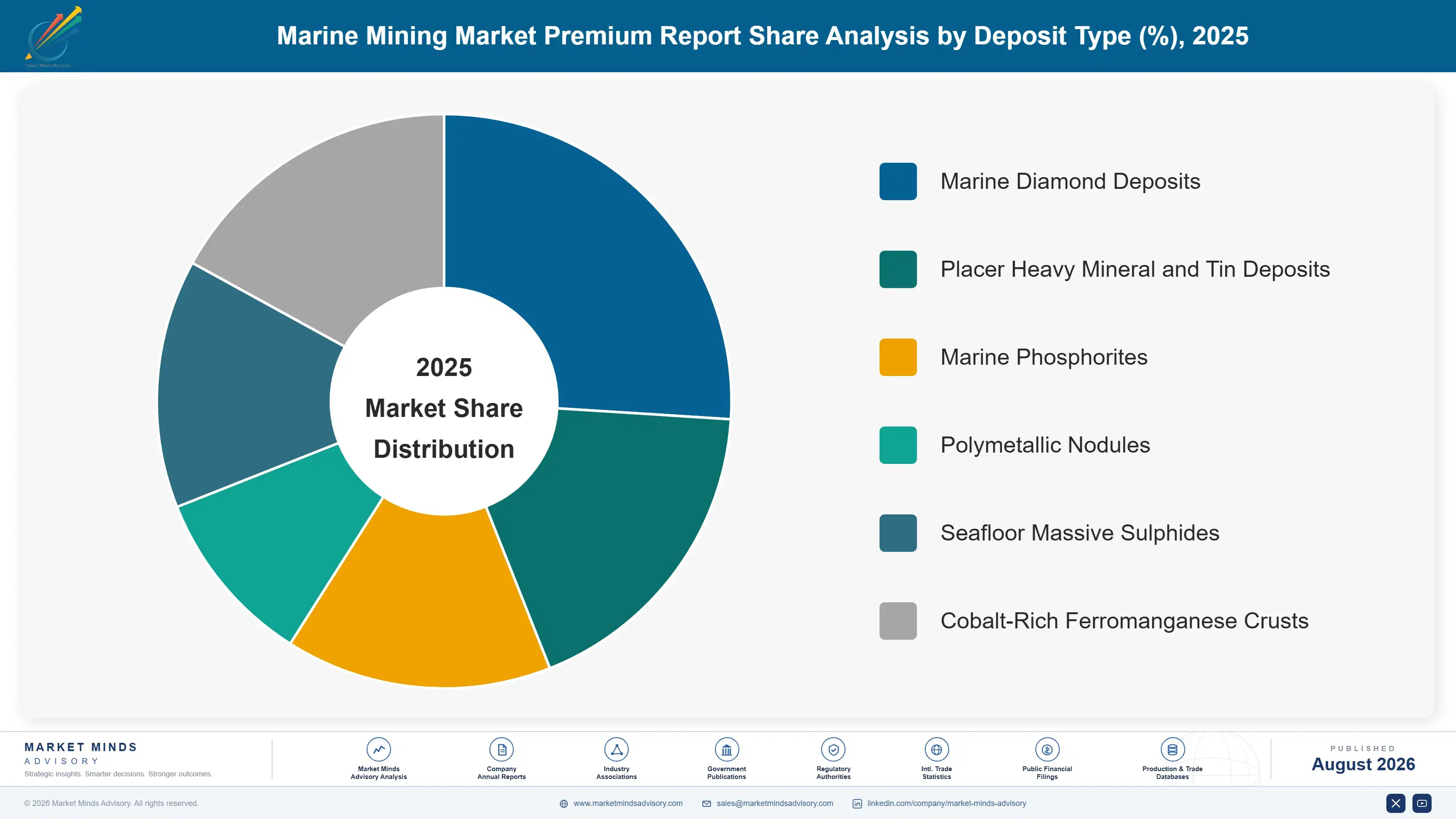
Segmentation follows deposit type, the single geological and metallurgical logic that determines water depth, recovery method, and buyer set. Marine diamonds, offshore placer tin, marine phosphorites, polymetallic nodules, seafloor massive sulphides, and cobalt-rich crusts each carry a genuinely distinct commercial and regulatory profile evaluated consistently throughout this report. Recovery vessels sit outside this hierarchy as a separate dimension.
marine-mining-market-market-share-analysis-1787302952622

Polymetallic Nodules

Polymetallic nodules grow fastest at 20.0%, about 1.60 times the market's 12.5% overall rate, though nearly all of that growth reflects exploration and pilot spending rather than actual metal revenue, since no lawful route exists yet to sell nodule metal recovered from the Area. These potato-sized concretions lie loose on abyssal plains between four and six thousand metres depth, richest in the Clarion-Clipperton Zone, carrying nickel, copper, cobalt, and manganese together in one ore body. Numerous exploration contracts cover that zone, sponsored by a range of Pacific island nations alongside China, Japan, Korea, and several European states. The Metals Company and Global Sea Mineral Resources have both continued investing heavily in nodule recovery technology despite the sector's unresolved regulatory status.
CAGR 20.0%

Seafloor Massive Sulphides

Seafloor massive sulphides grow second-fastest at 15.5%, covering copper, zinc, gold, and silver accumulations formed at hydrothermal vents at depths between one and four thousand metres, where grades run considerably above most land-based copper deposits. That grade advantage is the segment's core appeal, but it also carries the sector's worst commercial precedent, since an earlier Papua New Guinea seabed sulphide project collapsed after its sponsoring state took an equity loss on the venture. Interest has since shifted toward deposits inside national waters, where Japan has completed pilot recovery tests within its own exclusive economic zone. Active hydrothermal vent fields host distinctive biological communities, which makes environmental opposition considerably sharper here than for nodule deposits.
CAGR 15.5%
Full segment breakdown across 6 segments available in the complete report.

Regional Architecture and Country Demand Map

Global revenue concentrates where commercial-scale seabed mining actually operates today, not where exploration contracts sit. Middle East and Africa dominates on Namibian diamond output, South Asia and Pacific follows on Indonesian tin and sponsorship activity, and every other region holds mostly pre-revenue exploration contracts. Shares here reflect revenue, not acreage.

North America

Capital and corporate domicile, not actual seabed production, explain North America's regional presence, since the United States has no commercial seabed mine and is not party to the Law of the Sea Convention governing the treaty framework. The Metals Company runs from Vancouver and lists in New York, drawing most of the nodule sector's equity funding through American capital markets. North America's 14% share sits below the standard 22 to 32% band that applies to manufacturing-driven categories, reflecting that the region's role here is financial rather than geological. Growth of 13.5% is strong precisely because a domestic licensing route gives American-sponsored applicants a path that exists on paper today, which capital markets reward ahead of actual production.
Share: 14% | CAGR: 13.5% (2026 to 2036)

Western Europe

Contract holders here are governments and engineering groups rather than active miners, which is why the region's presence reflects sponsored exploration acreage rather than any meaningful metal sales. Belgium's Global Sea Mineral Resources holds a Clarion-Clipperton contract and has run collector trials, Germany sponsors a contract through its federal geosciences institute, and France operates through its national ocean research institute. Western Europe's 13% share sits below the standard 18 to 26% band, since almost none of that presence converts into actual metal revenue yet. Growth of 11.0% reflects continued exploration investment even as commercial permitting remains stalled across the region's sponsored contracts. Norway briefly opened its own continental shelf to licensing before shelving the process under domestic political pressure.
Share: 13% | CAGR: 11.0% (2026 to 2036)
Regional intelligence for 5 additional markets available in the complete report: East Asia, South Asia and Pacific, Latin America, Middle East and Africa, Eastern Europe. Contact sales@marketmindsadvisory.com.
marine-mining-market-country-cagr-analysis-1787302953148

Where Seabed Operators Can Actually Earn Today

Waiting for the exploitation code is not a viable strategy, and the contractors that have waited longest now carry the weakest balance sheets. The four levers below shift revenue toward assets that pay before any lawful commercial nodule permit ever arrives, rewarding operators who build genuine near-term commercial capability. That capability increasingly determines which operators survive the extended regulatory wait.

Sell Verified Traceability Before Selling A Single Tonne

The barrier facing seabed nickel is buyer refusal, not price, and that refusal softens considerably when provenance becomes genuinely auditable from collector through to cathode. Operators that build independently audited, published chain-of-custody verification convert a reputational liability into a genuine differentiator, and comparable traceability schemes in cobalt have carried price premiums of 3 to 8% over unverified material precisely because the underlying objection concerns provenance specifically. Building this system before production also gives regulators something concrete to license against directly. Building this system before production also gives regulators something concrete to license against directly.
Market Impact: Carries a genuine 3-8% verified pro

Anchor Entry Through Existing Offshore Dredging Fleets

Purpose-built recovery vessels cost well above 500 million dollars and simply cannot be financed against a sales permit that does not yet exist under current regulatory conditions. Established dredging contractors already own trailing suction hoppers, dynamic positioning, and offshore crews that transfer directly to shallow marine minerals work without requiring entirely new capital investment. Converting or chartering existing tonnage cuts entry capital by roughly 60% against a newbuild vessel and keeps the asset redeployable to conventional dredging if seabed permitting slips further. That optionality is worth more than raw efficiency in a market carrying this much genuine uncertainty.
Market Impact: Cuts entry capital by roughly 60% v

Convert Sponsoring State Relationships Into Royalty-Backed Access

Sponsorship remains the scarcest genuine asset in this market, since no contractor reaches the Area without a state actively backing its application, and small island governments have learned precisely what that sponsorship is worth financially. Structuring participation as royalty plus equity rather than a flat sponsorship fee aligns the state directly with eventual production and buys political durability through Council votes that a purely cash-based relationship cannot replicate. Operators offering downside protection alongside capacity building secure access a higher cash bid cannot match. Terms have hardened since one sponsoring state took a reported USD 120 million loss.
Market Impact: Secures royalty terms across 10+ sp

Price Environmental Baseline Data As A Standalone Product

Contractors have spent well over a decade surveying abyssal biology, sediment plumes, and seabed geochemistry, and that accumulated dataset carries genuine commercial value entirely independent of any eventual mining permit outcome. Regulators, insurers, cable operators, and academic research consortia all need this data, and the International Seabed Authority requires baseline data from every applicant it formally assesses under current rules. Selling or licensing curated survey data recovers a meaningful share of exploration spend while the underlying permit question remains genuinely unresolved. Two established contractors have both published extensively, recovering roughly 5 to 10% of exploration spend through licensing.
Market Impact: Recovers roughly 5-10% of total exp

Who Controls the Margin Pool

Concentration is severe at CR5 68%, and the gap between leader and challenger here is one of kind rather than degree. Debmarine Namibia mines and sells marine diamonds every year regardless of regulatory outcomes elsewhere, while most other participants survey and spend without comparable revenue. All participants are assessed on one consistent basis, active participation in seabed mineral recovery, meaning a held extraction contract, an exploration contract, or a contracted role delivering reco
Current competitive activity runs across three dimensions. Sponsorship security concentrates on securing a state willing to back an application, harder now that more governments back a precautionary moratorium. Recovery engineering concentrates among a small number of specialists whose collector and riser technology remains genuinely difficult to replicate. And offtake credibility increasingly separates contractors with named buyers from those still holding only a resource statement and a permit application.

Emerging pressure comes from national jurisdictions pulling activity away from the International Seabed Authority process, with several countries offering domestic rules that already exist, favouring contractors with domestic access over Area-only contractors. Meanwhile capital continues thinning as smaller, less capitalised contractors struggle to survive the wait. Rankings will shift toward participants whose producing assets fund frontier work.
marine-mining-market-company-positioning-matrix-1787302953682

Competitive Moat and Risk Dimensions

DEBMARINE NAMIBIA

Moat: Only proven commercial operation

Debmarine Namibia, the joint venture between De Beers and the Namibian government, runs the world's only seabed mining operation at genuinely commercial scale, recovering diamonds from Atlantic licence areas with a purpose-built fleet built on decades of accumulated sampling data that cannot be replicated quickly by any competitor.
DEBMARINE NAMIBIA

Risk: Single commodity, single coastline

Everything depends on one commodity in one jurisdiction, and rough diamond prices have weakened as laboratory-grown stones take meaningful share of the jewellery market. Licence areas are finite and grades decline as the richest ground is worked out first, requiring rising capacity investment just to hold current output steady.
THE METALS COMPANY

Moat: Largest defined nodule resource

The Metals Company holds rights through Pacific sponsoring states to Clarion-Clipperton areas containing one of the largest defined nickel resources under single-company control anywhere, alongside meaningful copper, cobalt, and manganese, and has completed an integrated pilot lift giving it operating data rivals genuinely lack. That operating data represents a genuine competitive advantage newer entrants cannot access.
THE METALS COMPANY

Risk: No revenue, contested legal route

The company has never sold commercial metal and funds itself through continuous equity issuance, making dilution an ongoing feature and available runway a standing investor question. Pursuing an alternative domestic licensing route drew formal compliance scrutiny from the International Seabed Authority and criticism from its own sponsoring states.

Players Tracked

Prominent Players

Debmarine Namibia
PT Timah
The Metals Company
Allseas Group
Global Sea Mineral Resources

Other Key Players

China Minmetals Corporation
Beijing Pioneer Hi-Tech Development Corporation
China Ocean Mineral Resources R&D Association
JOGMEC
Korea Institute of Ocean Science and Technology
Ifremer
Bundesanstalt für Geowissenschaften und Rohstoffe
Interoceanmetal Joint Organization
Ocean Mineral Singapore
Marawa Research and Exploration
Moana Minerals
Impossible Metals
Royal IHC
Odyssey Marine Exploration
Yuzhmorgeologiya

Recent Developments

FEBRUARY 2025

The Metals Company files commercial recovery application with NOAA

The Metals Company filed an application for commercial nodule recovery rights through an alternative domestic licensing route administered by NOAA, seeking approval to operate outside the stalled International Seabed Authority process. This was a regulatory filing, not a corporate transaction. opening a route pursued since it became available.
Signal: Contractors are increasingly willing to by
JULY 2025

Global Sea Mineral Resources signs vessel charter agreement with Allseas

Global Sea Mineral Resources entered a multi-year supply agreement with Allseas Group for continued charter of a nodule collector vessel across multiple upcoming exploration campaign seasons. The agreement was a commercial charter contract, not a joint venture or equity transaction, securing vessel access without requiring a full newbuild investment.
Signal: Chartering existing specialist vessels rem
NOVEMBER 2025

Debmarine Namibia commissions new marine diamond recovery vessel

Debmarine Namibia commissioned a new purpose-built recovery vessel, expanding its fleet capacity for marine diamond recovery across its established Namibian licence areas. This was an organic capacity expansion rather than an acquisition, adding meaningfully to the joint venture's existing recovery capability. directly, ahead of the coming campaign season.
Signal: The sector's only proven commercial operat

Fuel And Vessel Charter Exposure

Marine gasoil fuel burn runs 18 to 24% of COGS on continuously deployed recovery and support vessels, bunkered at ports across Namibia, Singapore, and Rotterdam and refined from globally priced crude oil. Vessel capital and charter costs take a further 25 to 35%, with crew costs and specialised steel and wear parts accounting for most of the remainder.
The 2022 fuel price shock showed directly how that exposure translates into margin pressure across the sector. The EIA recorded distillate prices reaching multi-year highs through mid-2022 as Russian supply was displaced, and marine gasoil pricing followed closely, lifting fuel cost per operating day sharply. Anglo American's 2022 Annual Report disclosed higher unit costs at De Beers marine operations, attributing part of that increase specifically to fuel and consumable price inflation during the period.

Exposure separates producers from applicants sharply. Operators actually running vessels absorb every fuel and day-rate movement immediately with no ability to defer the cost, while pre-revenue contractors carry engineering and survey spending that remains genuinely discretionary and can be paced against available capital. Geography matters, since fleets bunkering in West Africa pay a premium over Singapore, and that disadvantage falls hardest on smaller single-vessel operators.
marine-mining-market-cost-volatility-analysis-1787302953882

Hedge Marine Gasoil Exposure Against Distillate Futures

Fuel is the largest variable cost and the most genuinely hedgeable one available to operators. Continuously deployed operators can lock a substantial share of expected burn through distillate futures and swaps, matching hedge tenor to the survey and recovery season rather than leaving exposure entirely open. Several operators moved expected burn onto contract pricing after 2021's spike.

Charter Existing Tonnage Rather Than Commissioning Early

Committing to a newbuild vessel before a sales permit exists converts genuine regulatory risk into a financing crisis almost immediately. Chartering dynamically positioned vessels from the existing offshore dredging fleet keeps commitments reversible and preserves capital for the collector and riser, where real engineering difficulty actually sits. Reversibility matters more than efficiency given genuine regulatory uncertainty.

Stage Engineering Spend Behind Confirmed Permitting Milestones

Contractors that built recovery capacity ahead of confirmed regulatory approval have consistently been the ones to fail financially. Tying each engineering spending tranche to a specific confirmed milestone keeps burn proportional to actual regulatory progress rather than optimistic assumptions about eventual approval timing. Milestone-based staging has become the difference between raising capital and entering administration for several contractors.

Portfolio Architecture for Margin Defence

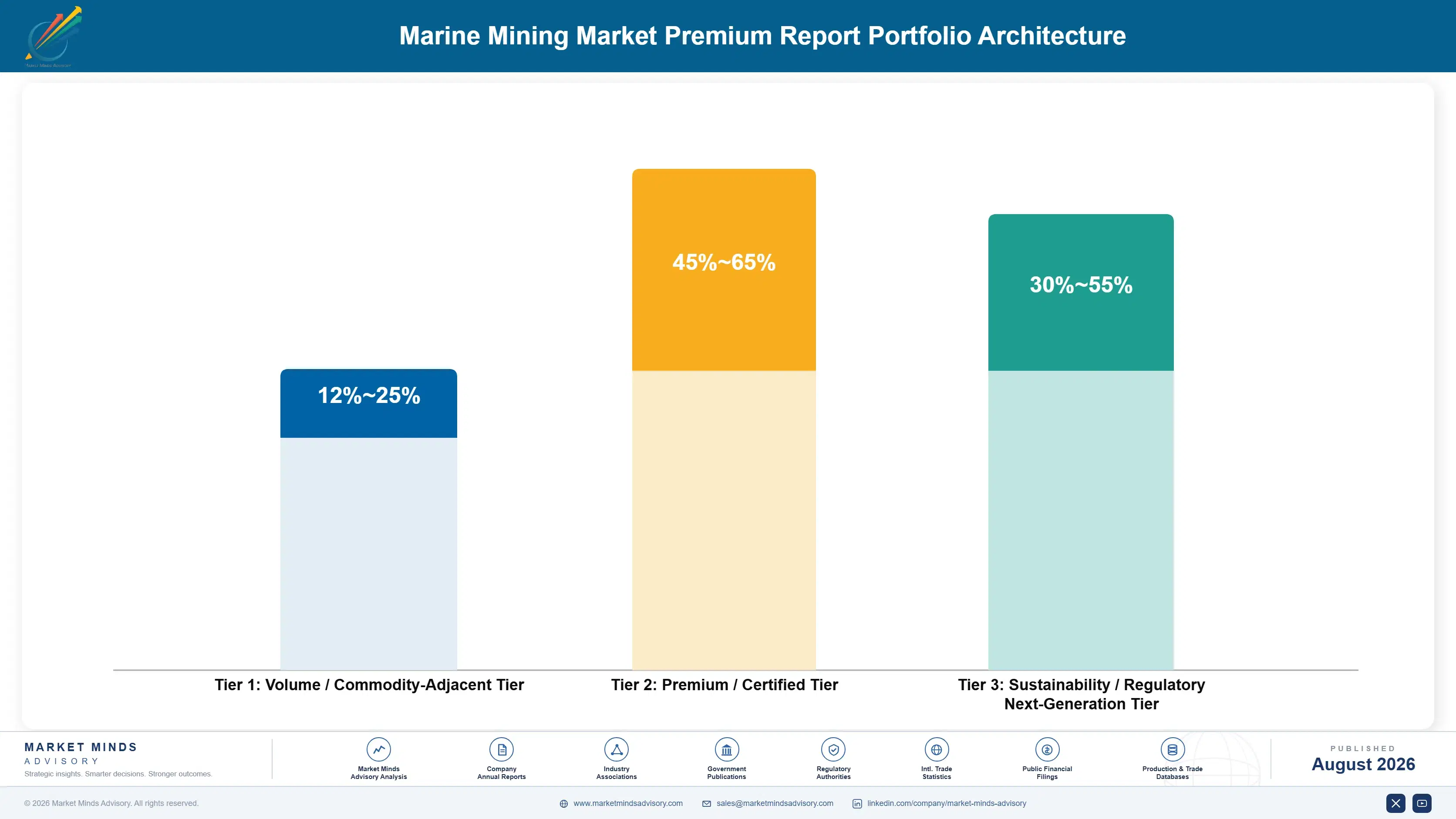
The portfolio splits into three tiers with genuinely wide margin separation, and the gap reflects regulatory status as much as geology itself. Volume-tier placer tin and heavy mineral dredging competes against land-based supply on cost and earns modestly after that competition. Premium certified marine diamond recovery earns considerably more because deposits are proven, permits are secure, and buyers already exist without any regulatory uncertainty attached.
The tension is between cash flow today and speculative position tomorrow. Placer and diamond operations fund the fleets, crews, and offshore competence that transfer directly to frontier work, yet they grow slowly and face ordinary commodity pressure like any established industry. Frontier nodule and sulphide ventures carry the growth narrative and the headline valuations but consume capital for years without any certainty of an eventual permit ever arriving.

High-value pools concentrate where the legal position is genuinely settled and the deposit is proven: marine diamonds inside secure national licences, and increasingly cobalt-rich nodules within exclusive economic zones where the coastal state writes its own enforceable rules. Anything dependent on the International Seabed Authority eventually adopting an exploitation code remains a call option, not a real asset, however large the defined resource statement looks on paper.

Volume / Commodity-Adjacent Tier

Offshore placer tin and heavy mineral sands competing against land-based supply on cost. Margin varies widely between near-cost contract dredging and higher-grade alluvial recovery during strong metal price periods. Buyers rarely differentiate between operators on anything beyond delivered cost and reliability.
Gross Margin: 12-25%

Premium / Certified Tier

Marine diamond recovery under established national licences, where deposits are proven and permits are secure. Margin reflects genuine grade variation across licence areas and jewellery-market rough diamond pricing. Buyers pay for secure permits and proven deposits rather than for recovery capability alone.
Gross Margin: 45-65%

Sustainability / Regulatory / Next-Generation Tier

Polymetallic nodules, seafloor massive sulphides, and cobalt-rich crusts, all genuinely pre-revenue today. Margin range depends entirely on assumed future metal prices and eventual regulatory outcomes. Few ventures currently combine both proven reserves and lawful sales access at any scale.
Gross Margin: 30-55%
marine-mining-market-portfolio-architecture-1787302954386

Permit-Anchored Commercial Demand

Demand behaves through long instruments rather than repeat orders, since exploration contracts run fifteen years with renewal rights. Once a fleet is deployed against a licence area it works that ground for a decade or more, making revenue predictable for producers and sunk cost unavoidable elsewhere. Nobody buys seabed minerals casually, and that patience shapes how every serious participant plans capital deployment.
Adoption depth varies sharply by end-use vertical. Jewellery buyers take marine diamonds without hesitation, since state-partnered provenance functions as a selling point rather than a liability in that market specifically. Solder, tinplate, and electronics buyers absorb offshore tin without distinguishing it from onshore metal at all. Battery and cathode buyers sit at the opposite extreme, where dozens of automakers and electronics groups have publicly refused seabed nickel outright.

Buyer profiles have shifted decisively over the past several years. Procurement decisions that once sat with metals traders now route through sustainability committees and board-level risk functions weighing reputational exposure alongside price. Younger procurement leaders in automotive and electronics increasingly treat supply chain provenance as a genuine career risk rather than a policy preference, which explains why a technically proven resource still cannot find a buyer.
marine-mining-market-end-use-penetration-index-1787302954880

Our Call On Seabed Minerals

These are among the four positions where our research anticipates prominent divergence between winners and laggards over the coming forecast period. Each is grounded in the demand model, the regulatory perimeter, and the announced capacity pipeline.
01 / REGULATORY ACCESS STRATEGY

Permits Beat Engineering As The Real Asset Under Management

Collector systems, riser strings, and surface processing have all been demonstrated at pilot scale, so technical capability no longer genuinely separates competitors in any meaningful sense today. What separates them is whether a lawful route exists to sell what they recover, and for Area contracts that route still does not exist after nine years of continuous negotiation. Operators should treat regulatory access as the primary asset under management, staging every engineering commitment behind a confirmed permitting milestone rather than building capability years ahead of approval.
02 / OFFTAKE REFUSAL POSITIONING

Buyer Refusal Now Constrains The Market More Than Regulators Do

More than sixty companies have publicly undertaken not to source deep seabed minerals, and several have written that undertaking directly into their own supplier codes rather than leaving it as a public statement alone. A contractor can hold a permit, a working vessel, and a defined resource and still find every cathode plant closed to it entirely. Operators should therefore invest in auditable provenance and named offtake relationships well before first production, because financing a recovery vessel against an unsold product remains genuinely unachievable on reasonable terms.
03 / NATIONAL WATERS STRATEGY

Exclusive Economic Zones Now Offer Rules The Treaty Cannot

Several Pacific nations have issued licences over their own seabed while the International Seabed Authority remains deadlocked, Japan has tested sulphide recovery inside its own waters, and other jurisdictions have revived domestic statutes to license recovery outright under separate legal authority. Coastal states write their own rules and can move without waiting for consensus among the Authority's full membership. Operators holding only Area contracts should pursue national jurisdiction access deliberately and early, because the first genuinely commercial seabed metal will almost certainly emerge from inside somebody's exclusive economic zone.
04 / PRODUCING ASSET STRATEGY

Cash From Established Deposits Outlasts Frontier Equity Funding

Several equity-funded frontier ventures pursuing purely speculative permits have collapsed or entered financial distress in recent years, funded entirely against future permits that never actually arrived, with no producing asset behind them at all. Debmarine Namibia, meanwhile, mines and sells diamonds every single year regardless of what the International Seabed Authority Council eventually decides. Entrants should therefore build from a genuinely producing marine base, whether diamonds or tin, using its cash flow and offshore competence to carry frontier exploration through a permitting timetable nobody actually controls.

Engagement Snapshot From the Field

A live engagement with an industry participant carrying material or product regulatory and market exposure ahead of a defining policy shift, showing how our research translates into a defensible multi-year portfolio strategy.
MARKET MINDS ADVISORY · CLIENT ENGAGEMENT SUMMARY
Marine Mining Premium Report Producer Strategic Portfolio Review and Transition Roadmap 2026·Investment Scenario on Marine Mining Premium Report Exposure Evaluation 2025-26
CLIENT PROFILE
A cathode active material producer supplying several European and Korean battery manufacturers approached MMA while evaluating an approach from a nodule contractor seeking a future offtake commitment. The client reported annual revenue near USD 4.1 billion, with nickel accounting for roughly 38% of input cost and two of its largest customers already signatories to a public deep seabed moratorium commitment (client-reported, unverified by MMA).
STRATEGIC CHALLENGE
Management saw a genuine supply argument for nodule nickel given land-based supply concentration risk, and an equally genuine risk of losing customers who had already pledged not to source it under any circumstances. The commercial team wanted early access, the sustainability function wanted no association at all, and the board needed a defensible position before the next renewal cycle.
MMA APPROACH
MMA assessed permitting timelines across both the International Seabed Authority and alternative domestic licensing routes, then modelled realistic first-metal dates under each regulatory scenario. We mapped the client's customer base against published moratorium commitments and supplier code language to size genuinely at-risk revenue precisely, and priced alternative supply options including Indonesian laterite and recycled feedstock against the nodule proposition on delivered cost and carbon intensity.
KEY FINDINGS
  1. Roughly 44% of the client's revenue sat with customers whose supplier codes already prohibited seabed-sourced material outright, a materially larger exposure than the commercial team had originally assumed before the review.
  2. No realistic permitting pathway delivered commercial nodule metal in volume before several years out at the earliest, meaning any offtake commitment made in 2025 would sit unused across multiple contract renewal cycles regardless.
  3. Indonesian laterite nickel remained cheaper on delivered cost but carried deforestation and coal-power carbon exposure that three of the client's own customers were separately beginning to screen against directly.
  4. A conditional option structure, priced but not exercised, preserved future access at a small fraction of a firm commitment's cost while keeping the client entirely outside any public contractor announcement (client-reported, unverified by MMA).
CLIENT PROFILE
A cathode active material producer supplying several European and Korean battery manufacturers approached MMA while evaluating an approach from a nodule contractor seeking a future offtake commitment. The client reported annual revenue near USD 4.1 billion, with nickel accounting for roughly 38% of input cost and two of its largest customers already signatories to a public deep seabed moratorium commitment (client-reported, unverified by MMA).
STRATEGIC CHALLENGE
Management saw a genuine supply argument for nodule nickel given land-based supply concentration risk, and an equally genuine risk of losing customers who had already pledged not to source it under any circumstances. The commercial team wanted early access, the sustainability function wanted no association at all, and the board needed a defensible position before the next renewal cycle.
MMA APPROACH
MMA assessed permitting timelines across both the International Seabed Authority and alternative domestic licensing routes, then modelled realistic first-metal dates under each regulatory scenario. We mapped the client's customer base against published moratorium commitments and supplier code language to size genuinely at-risk revenue precisely, and priced alternative supply options including Indonesian laterite and recycled feedstock against the nodule proposition on delivered cost and carbon intensity.
KEY FINDINGS
  1. Roughly 44% of the client's revenue sat with customers whose supplier codes already prohibited seabed-sourced material outright, a materially larger exposure than the commercial team had originally assumed before the review.
  2. No realistic permitting pathway delivered commercial nodule metal in volume before several years out at the earliest, meaning any offtake commitment made in 2025 would sit unused across multiple contract renewal cycles regardless.
  3. Indonesian laterite nickel remained cheaper on delivered cost but carried deforestation and coal-power carbon exposure that three of the client's own customers were separately beginning to screen against directly.
  4. A conditional option structure, priced but not exercised, preserved future access at a small fraction of a firm commitment's cost while keeping the client entirely outside any public contractor announcement (client-reported, unverified by MMA).
RECOMMENDED STRATEGY
Phase 1: Phase 1 (0 to 6 months): Decline any firm offtake commitment and negotiate a priced, confidential option exercisable only once recovery is lawfully permitted. Phase 2: Phase 2 (6 to 18 months): Build auditable provenance capability across the existing nickel supply book to prepare for any future verified sourcing. Phase 3: Phase 3 (18 to 36 months): Reassess annually against permitting progress and customer code language, exercising the option only if at-risk revenue falls below a defined threshold.
OUTCOME
The client took the conditional option rather than a firm commitment, retaining future access without any public association with the sector. Both moratorium-signatory customers renewed their contracts on schedule, and the provenance system built during the engagement was subsequently applied across the client's whole nickel book (client-reported, unverified by MMA).

Frequently Asked Questions

Foundational context covering the market sizes, CAGR, scope, country, region and competition that inform every finding below. This section is provided to cover basics and most often pre-purchase conversations, answered from the MMA Primary Research Dataset.

What is the current size of the Marine Mining Market?

The market was valued at USD 2.9 billion in 2025, with revenue concentrated almost entirely in Namibian marine diamonds and Indonesian offshore tin production today.

How large will the Marine Mining Market be by 2036?

The market is projected to reach USD 10.59 billion by 2036, an expansion multiple of 3.25 times its 2026 value. Most of that growth remains exploration spending.

What is the CAGR for the Marine Mining Market 2026 to 2036?

The base case CAGR is 12.5%, with a bull case of 13.9% and a bear case of 11.0%. The range reflects uncertainty around nodule permitting outcomes.

Which segment is growing fastest?

Polymetallic nodules grow fastest at 20.0%, about 1.60 times the overall market rate, though nearly all of that growth reflects exploration spending rather than sales.

Who are the major companies in the Marine Mining Market?

Debmarine Namibia, PT Timah, The Metals Company, Allseas Group, and Global Sea Mineral Resources together lead this market at CR5 68%, reflecting severe concentration overall.

Which country is growing fastest?

The Cook Islands grows fastest at 22.0%, driven by rapidly expanding sponsorship and licensing programmes. Namibia remains the largest market by actual revenue generated today.

Report Segmentation Architecture

The full report scope spans multiple orthogonal segmentation dimensions, with cross-tabulated demand data provided for each dimension pair. Coverage extends further to regional breakdowns, trend trajectories, and the competitive detail needed to support segment-level decision-making.

By Deposit Type

  • Marine Diamond Deposits
  • Placer Heavy Mineral and Tin Deposits
  • Marine Phosphorites
  • Polymetallic Nodules
  • Seafloor Massive Sulphides
  • Cobalt-Rich Ferromanganese Crusts

By End-Use Industry

  • Battery and Cathode Manufacturing
  • Stainless Steel and Specialty Alloys
  • Jewellery and Luxury Goods
  • Agricultural Fertiliser Production
  • Electronics and Semiconductor Assembly

By Commercial Dimension

  • ISA Exploration Contracts
  • National Exclusive Economic Zone Licences
  • State Joint Venture Participation
  • Contracted Recovery Services and Vessel Charter

By Region

  • North America
  • Western Europe
  • East Asia
  • South Asia and Pacific
  • Latin America
  • Middle East and Africa
  • Eastern Europe

Scope, Methodology, and Coverage

Every figure in this report is reproducible from documented input assumptions. The scope below maps the historical period, the forecast horizon, the segmentation dimensions, and the countries covered, alongside the underlying primary and qualitative methodology.
Historical Period
2020 to 2025
Forecast Period
2026 to 2036
Base Year
2025 (USD billions; MMA Primary Research Dataset, August 2026)
Market Definition
The marine mining market comprises the commercial recovery and first sale of minerals extracted from the seabed below the low-water mark, together with contracted exploration spending on deposits not yet in production, spanning marine diamond deposits, offshore placer tin and heavy mineral deposits, marine phosphorites, polymetallic nodules, seafloor massive sulphides, and cobalt-rich ferromanganese crusts. Offshore oil and gas, aggregate and beach-nourishment dredging, land-based mining, and downstream metal refining are excluded.
Quantitative Units
USD billions (current prices); contracted seabed area and recovered tonnage where applicable
Segmentation Dimensions
By Deposit Type; By End-Use Industry; By Commercial Dimension; By Region
Regions Covered
North America, Western Europe, East Asia, South Asia and Pacific, Latin America, Middle East and Africa, Eastern Europe
Countries Covered
USA, China, Germany, France, UK, Japan, South Korea, India, Australia, Canada, Brazil, Mexico, Indonesia, Vietnam, Thailand, Malaysia, UAE, Saudi Arabia, South Africa, Nigeria, Turkey, Poland, Netherlands, Italy, Spain, Sweden, Switzerland, Argentina, Colombia, Singapore, and additional markets relevant to this sector
Key Companies Profiled
Debmarine Namibia, PT Timah, The Metals Company, Allseas Group, Global Sea Mineral Resources, China Minmetals Corporation, Beijing Pioneer Hi-Tech Development Corporation, China Ocean Mineral Resources R&D Association, JOGMEC, Korea Institute of Ocean Science and Technology, Ifremer, Bundesanstalt für Geowissenschaften und Rohstoffe, Interoceanmetal Joint Organization, Ocean Mineral Singapore, Marawa Research and Exploration, Moana Minerals, Impossible Metals, Royal IHC, Odyssey Marine Exploration, Yuzhmorgeologiya
Quantitative Methodology
Primary survey, n=3,800 respondents, Q4 2025, six countries; demand-side model with trade association cross-validation
Qualitative Methodology
47 expert interviews, Q4 2025; applied to validate demand model assumptions, identify emerging dynamics, and assess competitive positioning
Report Format
PDF and XLSX data workbook (Word format preview document)
Publisher
Market Minds Advisory
Report Code
MMA-2026-CHM-106
Published
August 2026
Contact
sales@marketmindsadvisory.com | www.marketmindsadvisory.com

Purchase the full Marine Mining Market Premium Report Report (2026 to 2036).

The full MMA Marine Mining report sizes the market across six deposit types, five end-use industries, four commercial dimensions, and seven regions through 2036. It profiles twenty participants on a consistent active seabed mineral recovery participation basis, scoring each on sponsorship security, recovery capability, offtake credibility, and permitting exposure. Scenario models quantify how ISA code adoption, alternative national licensing routes, and published buyer refusal commitments move both demand and realisable pricing. The report also includes delivered-cost modelling by deposit type and a sponsoring-state risk screen built for investment, procurement, and strategy teams.
Deposit type cost and revenue status benchmarking
Sponsoring-state risk and royalty structure screen
ISA and national licensing pathway tracker
Buyer refusal commitment exposure and risk model
Vessel and consumable supply chain risk screen
Offtake refusal exposure assessment and forecasting tool

Built For The People Who Decide

From boardroom strategy to bench-side execution, this report is read cover-to-cover by leaders shaping the next decade of their industry, turning demand scenarios, market dynamics and valuation benchmarks into decisions.
CXOs/ Presidents/ VPs/ Managers
M&A and Corporate Development
Strategy Teams and R&D Heads
Procurement and Product Directors
Regulatory and Compliance Leaders
Investor Relations and Equity Analysts