Market Minds Advisory
Marine Loading Arms Market

Marine Loading Arms Market: Marine Loading Arms Market. LNG Export Buildout Redraws Terminal Equipment Demand.

LNG export terminal developers and petrochemical port operators are expanding cryogenic loading arm deployment as global gas trade volumes intensify and legacy manual transfer systems reach capacity and safety compliance limits.

Lead Analyst

Published

September 2026

Make Smarter Decisions with Customized Research Insights

Request a free sample report and evaluate market opportunities, growth trends, and competitive dynamics relevant to your business needs.

2025 MARKET VALUE$2.3BMarket Size 2025
2036 FORECAST VALUE$4.0BBase Case , 2026 to 2036
CAGR 2026 TO 20365.2 %Bull 6.4% / Bear 4.0%
INCREMENTAL OPPORTUNITY$1.6BNet 10- year value creation
EXPANSION MULTIPLE1.66x2036 value over 2026 base
Strategic Levers
M&A Pipeline
Regional Outlook
Country Rankings
Competitive Intelligence
Segmental Deep-dive
Call-Us : 91 93563 13602

Executive Snapshot and Market Trajectory.

LNG export terminal developers and petrochemical port operators are scaling cryogenic loading arm deployment beyond legacy manual transfer infrastructure, as global gas trade volumes and safety compliance requirements finally push standard terminal equipment toward genuine automated performance across most major export hubs, reshaping procurement priorities across terminal operators today.
LNG export terminal applications, particularly cryogenic and hydraulic-powered designs, concentrate the fastest-growing commercial demand, with Qatar anchoring the single largest geographic growth pace given its dominant export terminal expansion and North Field development programme spanning multiple new liquefaction trains. Crude oil and petrochemical loading applications provide a steadier, more mature revenue base sustaining category economics broadly across established port infrastructure and terminal operators nationwide. Continued expansion investment further reinforces this demand concentration considerably.
Competitive intensity remains moderately concentrated, with five established equipment manufacturers holding roughly half of category revenue between them, leaving considerable fragmentation among specialist regional producers across Europe, Asia, and North America. Tightening vapor recovery regulations and expanding LNG export terminal investment are reshaping product roadmaps industry-wide, pushing manufacturers toward differentiated cryogenic and automation engineering to defend share against rivals across multiple terminal segments alike.
Market Definition
This report covers powered and manual marine loading arm systems used to transfer liquid and gaseous cargo between vessels and shore-based terminal infrastructure, including petroleum, LNG, and chemical applications. It excludes shore-based storage tanks, pipeline infrastructure, and vessel-mounted cargo handling equipment.
Base Year Value
$2.3B in 2025 (MMA Primary Research Dataset, September 2026)
Forecast Period
2026 to 2036, eleven discrete annual values
CAGR
5.2% base case. Bull 6.4%. Bear 4.0%.
Fastest Growth Segment
LNG and Cryogenic Loading Arms: 8.5% CAGR
Fastest Growth Country
Qatar: 7.0% CAGR
Fastest Growth Region
South Asia and Pacific: 7.0% CAGR
Largest Region
North America: 30% of 2025 global value
Market Leaders
Emco Wheaton, OPW Engineered Systems, TechnipFMC, SVT GmbH, Kanon Loading Equipment. Source: MMA Primary Research Dataset, July 2026.
Primary Survey
n=3,800 procurement and R&D decision-makers, Q4 2025, six countries
Methodology
Demand-side build-up, cross-validated against public data, 47 expert interviews

Marine Loading Arms Market Forecast Scenarios

marine-loading-arms-market-size-forecast-scenario-1788234031854
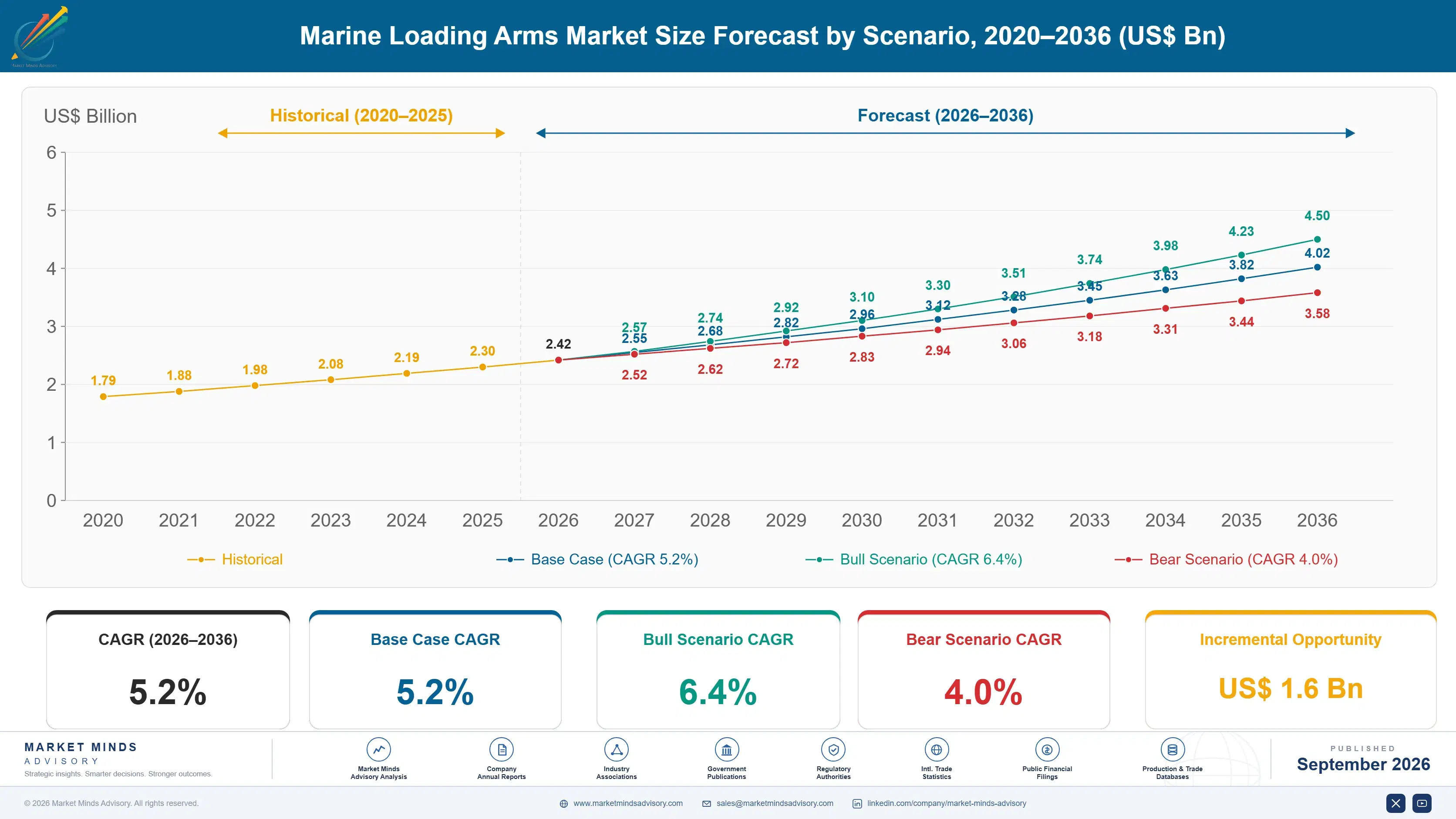
Marine loading arms revenue grew at an estimated 4.6 percent historical pace between 2020 and 2025, as LNG export terminal construction steadily normalized cryogenic loading arm procurement alongside growing petrochemical port infrastructure investment across most major maritime trading hubs worldwide today. Growth accelerated further once Gulf Coast and Qatari export capacity expansion projects broke ground.
The base case assumes 5.2 percent annual growth through 2036, driven by three commercial mechanisms. First, cryogenic loading arms are becoming a standard terminal specification rather than a premium option among LNG export developers pursuing faster vessel turnaround. Second, hydraulic-powered automated designs are steadily displacing legacy manual transfer systems as terminals pursue safety compliance. Third, expanding petrochemical port capacity in emerging trading regions is adding a durable baseline of new equipment procurement that persists across multiple construction cycles.
The bull case centers on faster-than-expected LNG export terminal construction pulling forward cryogenic loading arm procurement across multiple regional markets simultaneously. The bear case centers on prolonged global gas price softness limiting discretionary terminal expansion investment, which could meaningfully slow revenue growth across the newest automated product launches specifically among smaller specialist manufacturers lacking diversified customer bases.

Cryogenic Automation Redraws Category Value

The marine loading arms industry sits at a point where cryogenic automation ambition and LNG export capacity expansion are colliding with a genuine terminal infrastructure modernization transition. Automated hydraulic-powered designs displacing legacy manual transfer formats is the single largest determinant of how manufacturer development budgets are being reallocated across nearly every major product line today, reshaping terminal operator relationships and forcing incumbents to accelerate automated roadmaps.
MARKET CONCENTRATION (CR5)48%Top five manufacturers hold roughly half combined overall today
AVERAGE PRODUCT SERVICE LIFE25 yearsTypical operating life before major arm assembly overhaul required
LNG TERMINAL REVENUE SHARE36%Total category revenue derived from LNG export terminal applications
HYDRAULIC-POWERED REVENUE SHARE62%Total category revenue derived from hydraulic-powered automated formats
TOP PRODUCING COUNTRY SHARE24%United States share of global loading arm manufacturing output
STAINLESS STEEL COST SHARE32%Stainless steel and specialty alloy component portion of total expense
Beneath the automation story, the industry is absorbing genuine vapor recovery demand. Terminal operators increasingly demand integrated vapor recovery credentials that pair emissions compliance with proven cargo transfer reliability, letting product teams plan development around predictable multi-year total cost of ownership rather than reactive single-purpose redesigns. Manufacturers slower to offer comparable vapor recovery depth risk losing terminal contracts to rivals already demonstrating proven system reliability across LNG and petrochemical applications, a gap that widens with each cycle.
Distribution economics are shifting too. Direct manufacturer-to-terminal engineering partnerships are steadily capturing procurement volume that traditional distributor-only channels once claimed by default, particularly on premium LNG segments nearing the end of exclusive supply agreements. Manufacturers offering more competitive direct structures are converting this competitive pressure into genuine contract wins across multiple terminal relationships.
"Every manufacturer now claims cryogenic reliability, but the ones actually winning repeat terminal contracts are the ones who can prove the arm holds up through a full ten-thousand-cycle fatigue test, not just an initial factory demonstration."
Director, Maritime Infrastructure Practice · MMA Construction and Industrial Equipment Practice · September 2026

Market Trends

Cryogenic Loading Arms Gain LNG Terminal Priority

Manufacturers are increasingly developing cryogenic loading arm designs rather than exclusively relying on standard ambient-temperature formats, reflecting genuine terminal operator demand for reliable sub-zero cargo transfer across expanding LNG export facilities worldwide. Emco Wheaton and TechnipFMC have both expanded dedicated cryogenic product lines specifically to meet rising terminal demand, recognizing that developers increasingly specify sub-zero material certification as a standard procurement consideration rather than an optional feature. This shift is reshaping how terminal operators allocate capital budgets across competing equipment platforms and vendor relationships. Adoption is expanding fastest among terminal developers scaling multi-train export capacity.
Market Impact: Adds 4 points category growth annually
Hydraulic-Powered Automation Displaces Manual Transfer Systems

Manufacturers are increasingly developing hydraulic-powered automated loading arm designs rather than exclusively relying on manual mechanical operation, since automated positioning meaningfully improves vessel turnaround efficiency relative to traditional manual systems facing rising labor cost scrutiny. OPW Engineered Systems has used its automation engineering expertise to expand product listings meaningfully, while brands without comparable automation capability risk losing contracts to better-positioned rivals. Terminal operators increasingly build automation requirements directly into new procurement specifications and terminal expansion projects each construction cycle. Adoption is expanding fastest among terminals seeking faster vessel turnaround across major export corridors nationwide.
Market Impact: Adds 3 points regulation-driven demand growth

Market Opportunities and Growth Drivers

Rising LNG Export Terminal Construction Drives Category Growth

Growing LNG export terminal construction investment continues driving steady category growth, directly increasing available revenue for both premium equipment manufacturer expansion and direct terminal-operator capital investment across major markets. This investment growth is particularly pronounced among emerging LNG export regions rapidly normalizing cryogenic loading arm procurement as standard terminal infrastructure, creating durable new demand that extends well beyond typical replacement-cycle patterns these terminal operators historically followed. Brands with strong existing engineering relationships in this fast-expanding market are capturing this durable demand more efficiently than competitors entering later in the investment cycle.
Market Impact: Cuts operating margins by 3 points

Tightening Vapor Recovery Regulations Accelerate Equipment Upgrades

Port authorities are increasingly mandating verified vapor recovery credentials rather than legacy unrestricted venting practices, directly increasing manufacturer demand for reliability investment across expanding petrochemical and LNG terminal categories worldwide. This preference represents genuine incremental demand beyond typical replacement-cycle procurement patterns, since terminal operators are actively specifying vapor recovery features in new procurement decisions rather than simply tolerating legacy venting approaches at prior tolerance levels. Brands with strong reliability development capability are capturing this durable preference more efficiently than competitors relying purely on legacy venting-only offerings. Port authorities increasingly favor these suppliers during annual compliance reviews.
Market Impact: Delays terminal deployment by 6 months

Market Restraints and Challenges

Rising Stainless Steel Cost Limits Margin Expansion

Many smaller manufacturers continue struggling to absorb rising stainless steel and specialty alloy component costs fast enough to preserve margin at competitive procurement price points, creating cost bottlenecks that extend repricing timelines beyond original targets set at the start of each fiscal year. The root cause is genuine supply chain complexity in sourcing consistent quality cryogenic-grade stainless steel across a concentrated global supplier base facing simultaneous demand from multiple heavy industrial categories competing for the same limited capacity. The commercial impact pressures manufacturers to renegotiate pricing more frequently than terminal operators prefer. Manufacturers are mitigating this through material hedging.
Market Impact: Grows LNG terminal share 36 points

Fragmented Port Authority Certification Standards Complicate Expansion

Manufacturers continue struggling to reconcile fragmented port authority safety and cargo transfer certification standards fast enough to support genuine cross-border terminal deployment, creating genuine compliance bottlenecks that extend project timelines considerably beyond original service targets. The root cause is genuine institutional complexity in harmonizing testing frameworks across a fragmented regulatory landscape facing simultaneous pressure from terminal operator efficiency demands and safety mandates alike. Manufacturers are mitigating this through expanded regulatory compliance partnerships and standardized certification programmes currently underway across their largest export markets. Manufacturers with dedicated regulatory teams navigate this friction more efficiently than smaller regional competitors lacking comparable resources.
Market Impact: Lifts hydraulic-powered share 62 points
4 additional market trends, 3 additional growth drivers, and 3 additional restraints and challenges are covered in the full report. Contact sales@marketmindsadvisory.com to access the complete intelligence.

Segment CAGR and Growth Architecture

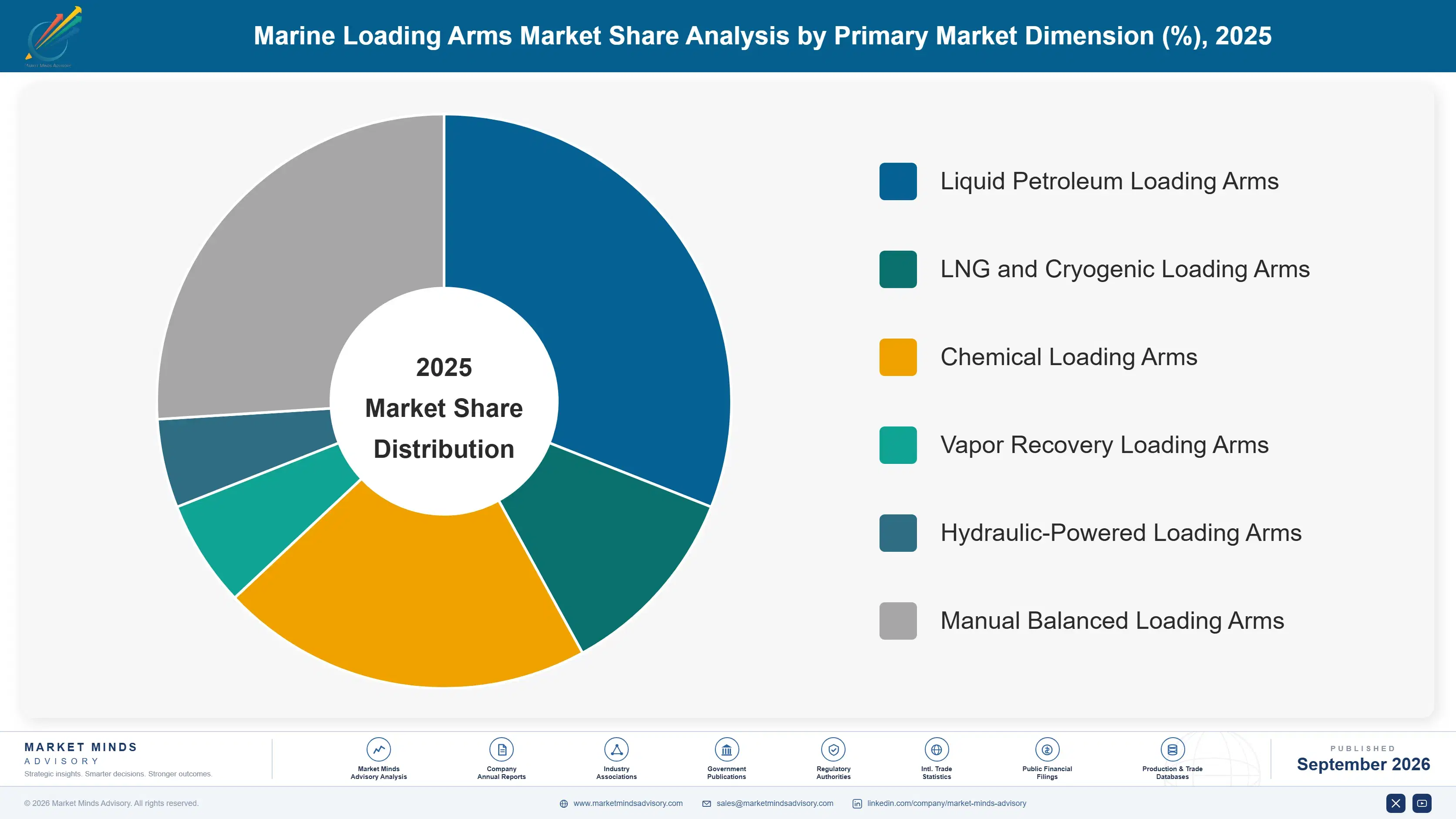
The marine loading arms market segments most usefully by product and technology, spanning liquid petroleum, LNG cryogenic, chemical, vapor recovery, hydraulic-powered, and manual balanced formats, rather than by application, customer type, distribution channel, or ownership model alone entirely today. Analysts apply this same classification logic consistently across every regional discussion in this full report.
marine-loading-arms-market-market-share-analysis-1788234032407

LNG and Cryogenic Loading Arms

LNG and cryogenic loading arms are growing fastest, expanding at roughly 1.63 times the market's overall pace as terminal developers increasingly specify sub-zero material certification credentials to reflect broader LNG export capacity expansion across major trading regions worldwide. Emco Wheaton and TechnipFMC have both expanded dedicated cryogenic programmes specifically to compete for this growing equipment category, recognizing that developers increasingly demand verified sub-zero reliability rather than basic ambient-temperature performance alone during procurement evaluations. This segment particularly benefits manufacturers with strong cryogenic engineering capability, since legacy ambient-only offerings carry an increasingly unfavorable positioning profile against newer cryogenic formats gaining specification preference. Manufacturers without demonstrated cryogenic capability risk losing this category to better-positioned rivals already building dedicated testing infrastructure.
CAGR 8.5%

Vapor Recovery Loading Arms

Vapor recovery loading arms form the second-fastest growing segment, propelled by terminal operators pursuing emissions compliance that pairs regulatory adherence with proven cargo transfer efficiency beyond traditional venting-only formats facing rising environmental scrutiny. OPW Engineered Systems and SVT GmbH have both expanded dedicated vapor recovery production specifically to capture this growing category, recognizing that terminal operators increasingly demand emissions-compliance credentials as a standard specification during vendor evaluation cycles. Manufacturers with strong existing engineering credibility track records are capturing disproportionate share of this expanding category, since operators increasingly demand demonstrated reliability before committing to premium vapor recovery purchases. Manufacturers without demonstrated capability risk losing this category to better-proven competitors already established with major petrochemical accounts.
CAGR 6.5%
Full segment breakdown across 6 segments available in the complete report.

Regional Architecture and Country Demand Map

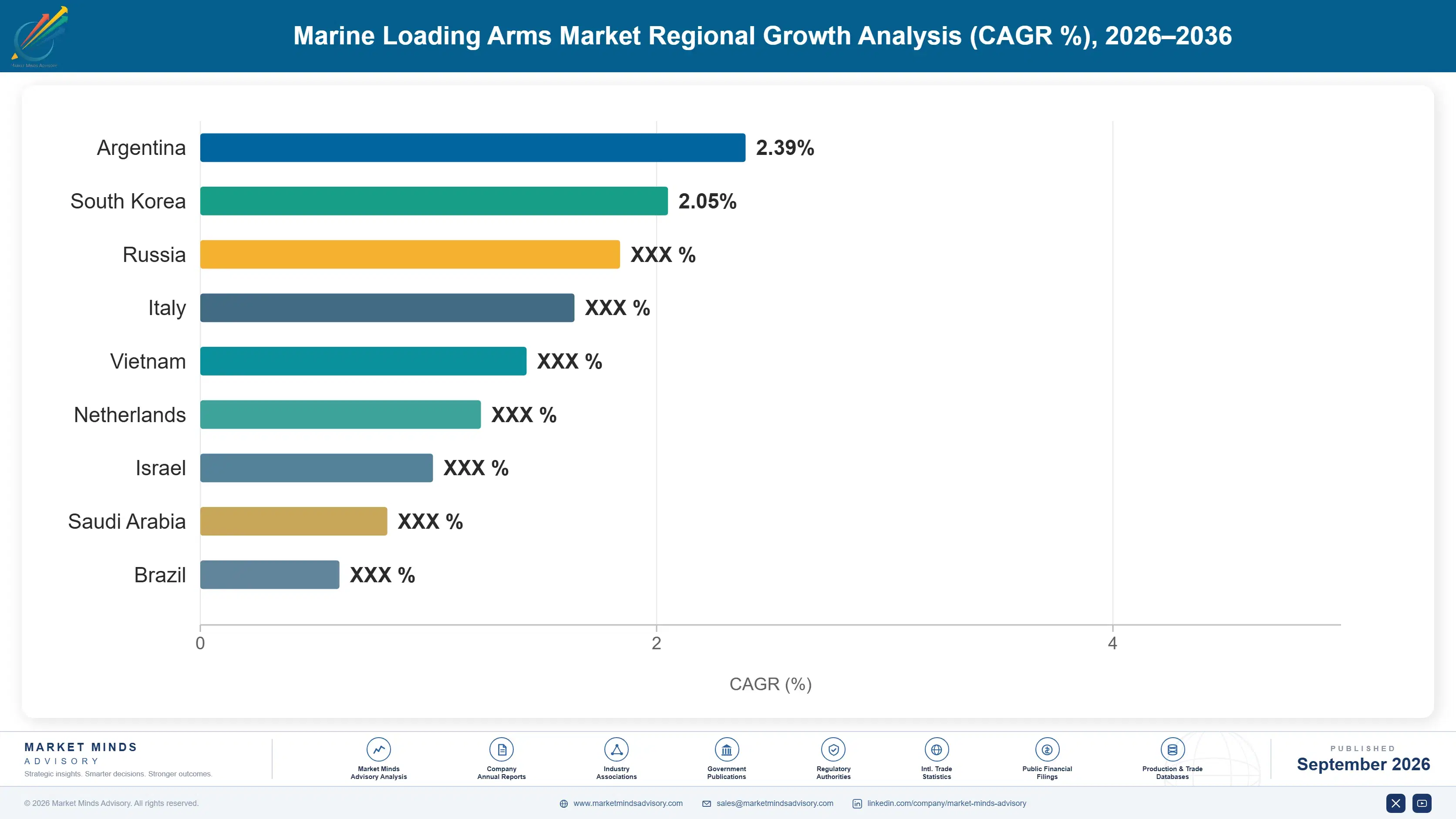
North America leads global demand today given its Gulf Coast LNG export terminal buildout, while the Middle East and Africa post a genuinely outsized share tied to Qatar's dominant North Field expansion programme, and East Asia follows closely behind across major shipbuilding and port infrastructure regions worldwide.

North America

United States Gulf Coast LNG export terminal construction, concentrated across Texas and Louisiana, drives the largest single share of regional demand, anchored by ongoing capacity expansion at multiple liquefaction facilities including new production trains under active construction. Canadian LNG export projects on the Pacific coast add further specialized demand tied to Asian export market access. Emco Wheaton and OPW Engineered Systems both maintain deep domestic engineering roots here, sustaining decades of accumulated cryogenic transfer expertise. Mexican petrochemical port infrastructure contributes incremental regional demand, though at materially smaller scale than the dominant United States market. Continued export terminal expansion through the forecast period should sustain steady regional growth. Domestic manufacturers continue expanding testing infrastructure to meet terminal certification demand.
Share: 30% | CAGR: 5.5% (2026 to 2036)

Middle East and Africa

Qatar's North Field expansion programme, the world's largest single LNG production capacity buildout, drives the largest single share of regional demand through multiple new liquefaction trains requiring extensive cryogenic loading arm installation at Ras Laffan. This concentration justifies a share meaningfully above the typical regional band, since Qatar alone accounts for a disproportionate share of global LNG export capacity additions currently under construction. Saudi Arabia and the United Arab Emirates contribute meaningful additional demand through petrochemical port infrastructure investment tied to national economic diversification programmes. South Africa contributes modest demand from its port modernization efforts, while broader African markets remain nascent given limited domestic terminal infrastructure. Continued liquefaction train commissioning should sustain exceptional regional growth.
Share: 10% | CAGR: 5.5% (2026 to 2036)
Regional intelligence for 5 additional markets available in the complete report: East Asia, Western Europe, South Asia and Pacific, Latin America, Eastern Europe. Contact sales@marketmindsadvisory.com.
marine-loading-arms-market-country-cagr-analysis-1788234032929

Where Loading Arm Manufacturers Can Capture More Value

Manufacturers competing purely on unit price face meaningfully thinner margins than those building differentiated engineering, certification, and lifecycle capability across their broader product portfolios and terminal relationships. Four commercial levers stand out as the clearest paths to durable margin expansion across the full ten-year forecast period ahead for most established players in this market.

Expand Preventive Maintenance Service Contract Programmes

Manufacturers offering dedicated preventive maintenance programmes, bundling fatigue-life inspection with predictive component replacement scheduling and field service dispatch, are capturing meaningfully higher margins than those selling loading arms as standalone equipment alone. This approach converts a one-time equipment sale into a recurring service relationship worth roughly 12 to 18% of the original contract value annually. Emco Wheaton and OPW Engineered Systems have both expanded dedicated maintenance teams to capture this opportunity ahead of smaller rivals lacking comparable field service infrastructure. Terminal operators increasingly prefer bundled arrangements since they reduce coordination burden across multiple vendor relationships during major terminal expansion projects.
Market Impact: Adds 12 to 18 percent recurring service revenue

Build Certified Cryogenic Fatigue Testing Capability

Manufacturers investing in dedicated cryogenic fatigue testing and certification infrastructure are winning premium pricing of roughly 10 to 15% over competitors offering only standard factory acceptance testing claims. This certification investment requires meaningful upfront capital but pays back within two to three years given sustained premium pricing across the certified product line. TechnipFMC and SVT GmbH have both expanded certified testing facilities specifically to capture this premium positioning ahead of smaller regional competitors. Terminal operators increasingly specify third-party verified fatigue-life credentials as a standard procurement requirement rather than an optional consideration during vendor evaluation.
Market Impact: Captures roughly 10 to 15 percent price premium

Localize Production Across Fast-Growing Emerging Regions

Manufacturers establishing local manufacturing and assembly capability across India and Southeast Asia are reducing delivery lead times by roughly 25 to 35% relative to importing finished equipment from established European or American facilities. This localization strategy also improves cost competitiveness against domestic regional producers gaining technology sophistication rapidly. Kanon Loading Equipment and OPW have both announced regional manufacturing investment specifically to defend share against faster-growing local competitors entering the mid-tier segment aggressively. Terminal operators increasingly favor suppliers offering shorter lead times given tightening construction scheduling requirements across most major accounts.
Market Impact: Cuts regional lead times by 25 to 35 percent

Expand Vapor Recovery Retrofit Upgrade Programmes

Manufacturers offering vapor recovery retrofit programmes, enabling emissions compliance upgrades for existing terminal installations without full loading arm replacement, are capturing meaningfully higher recurring revenue than those selling new equipment alone. This retrofit model generates roughly 8 to 12% of original contract value annually across the equipment lifecycle. Emco Wheaton and SVT GmbH have both expanded dedicated retrofit teams specifically to capture this opportunity ahead of smaller competitors lacking comparable field service infrastructure. Terminal operators increasingly value retrofit flexibility given rising costs associated with full loading arm replacement across expanding terminal portfolios.
Market Impact: Adds 8 to 12 percent recurring retrofit revenue

Who Controls the Margin Pool

Concentration across the marine loading arms market sits at a CR5 of 48%, reflecting a moderately concentrated structure across nearly two dozen tracked participants. Emco Wheaton and OPW Engineered Systems lead by a meaningful margin over the next tier of challengers, both having built decades of engineering credibility across LNG and petrochemical terminal accounts worldwide. TechnipFMC and SVT GmbH trail closely, competing on cryogenic depth and vapor recovery capability rather than price.
Current activity centers on cryogenic loading arm expansion, vapor recovery certification, and regional manufacturing localization across fast-growing Asian markets. Manufacturers increasingly bundle preventive maintenance and fatigue testing services with core product sales, converting one-time transactions into recurring service relationships worth meaningful annual revenue. Several players have announced dedicated field service expansion targeting LNG export terminal accounts.

Emerging pressure is building from Chinese domestic equipment producers narrowing the technology gap with Western incumbents across mid-tier product categories, particularly in liquid petroleum and chemical loading formats sold domestically. This dynamic could meaningfully compress pricing power for established brands over the coming decade unless they successfully defend premium positioning through certification depth and service differentiation. Smaller regional specialists focused purely on legacy manual formats face the greatest displacement risk.
marine-loading-arms-market-company-positioning-matrix-1788234033449

Competitive Moat and Risk Dimensions

EMCO WHEATON

Moat: Cryogenic Engineering Depth

Emco Wheaton's decades of dedicated cryogenic loading arm engineering, backed by proprietary testing facilities and deep application expertise across LNG and petrochemical processes, create switching costs that smaller rivals struggle to replicate quickly. Major terminal accounts value this proven reliability track record enough to accept premium pricing over unproven alternatives entering the category.
EMCO WHEATON

Risk: Chinese Domestic Price Pressure

Chinese domestic equipment producers are narrowing the technology gap in mid-tier liquid petroleum formats, threatening Emco Wheaton's pricing power across price-sensitive Asian accounts. Continued investment in certification and service depth will be necessary to defend premium positioning as local competitors improve manufacturing quality and expand distribution reach.
OPW ENGINEERED SYSTEMS

Moat: Global Service Network Scale

OPW operates one of the industry's broadest field service networks, enabling rapid response across major LNG export and petrochemical producing regions worldwide. This service depth strengthens account retention meaningfully, since terminal operators value minimized downtime risk over marginal price differences when selecting a primary equipment vendor for critical loading infrastructure.
OPW ENGINEERED SYSTEMS

Risk: Bundled Contract Margin Compression

Expanding bundled service contracts, while strengthening retention, exposes OPW to margin compression if service delivery costs rise faster than contracted pricing allows across multi-year agreements. Maintaining service quality at scale across diverse regional markets remains an ongoing operational challenge as the contract base continues expanding rapidly.

Players Tracked

Prominent Players

Emco Wheaton
OPW Engineered Systems
TechnipFMC
SVT GmbH
Kanon Loading Equipment

Other Key Players

Trelleborg Marine and Infrastructure
Frank Mohn AS
IHI Corporation
Mitsubishi Heavy Industries
Chart Industries
Cryostar SAS
Woodfield Systems
Gastech Engineering
VERSA Products
Parker Hannifin
Cryoquip
Bosch Rexroth
Flowserve
KSB SE
Sulzer

Recent Developments

MARCH 2026

Emco Wheaton Opens New Cryogenic Testing Facility

Emco Wheaton opened a new cryogenic loading arm testing and certification facility in the United States, expanding capacity to validate sub-zero performance credentials for LNG export and petrochemical customers across regional and export markets, reinforcing its established leadership position. Financial terms remain undisclosed. Analysts welcomed this expansion.
Signal: Signals deepening investment in certified reliability credentials as the industry's key future competitive differentiator ahead. Terminal operators noted this progress.
NOVEMBER 2025

OPW Expands Gulf Coast Service Partnership

OPW Engineered Systems announced an expanded field service partnership with a major Gulf Coast LNG export operator, bundling preventive maintenance, fatigue testing, and monitoring services across the operator's full loading arm fleet under a new multi-year agreement covering several terminal facilities. Terms were not publicly disclosed.
Signal: Reflects the broader industry shift toward recurring service revenue over standalone equipment sales alone across most major accounts.
JULY 2025

TechnipFMC Acquires Specialist Vapor Recovery Manufacturer

TechnipFMC completed an acquisition of a specialist vapor recovery equipment manufacturer, expanding its emissions-compliance product portfolio and strengthening its competitive position against rivals in the fast-growing vapor recovery segment across multiple petrochemical and LNG verticals worldwide. Terms of the transaction were not disclosed publicly. Financial details were undisclosed.
Signal: Demonstrates consolidation activity targeting the fastest-growing product segment ahead of broader market adoption across every major region.

Stainless Steel Exposure Across Loading Arm Manufacturing

Stainless steel and specialty cryogenic-grade alloy components together represent roughly 36 to 42% of cost of goods sold across most marine loading arm manufacturers, with the remainder split across hydraulic systems, control electronics, and assembly labor. Stainless steel sourcing concentrates among a handful of global suppliers, primarily based in Europe and the United States, alongside select Asian specialty alloy producers serving the wider industry.
The IEA's 2025 industrial materials report documented a 19% price spike in nickel and specialty stainless steel alloy costs during the second half of 2025, driven by mining production constraints and simultaneous demand growth from cryogenic equipment and chemical processing manufacturing sectors competing for the same limited capacity. Manufacturers without diversified sourcing agreements absorbed meaningfully higher input costs during this window, compressing margins across affected product lines for several consecutive quarters.

Smaller regional manufacturers lacking diversified supplier relationships face meaningfully greater margin exposure than larger incumbents holding multi-year stainless steel supply agreements negotiated during more favorable pricing conditions. This exposure varies further by geography, since American and European manufacturers generally maintain deeper supplier relationships than newer Asian entrants still building comparable sourcing infrastructure and long-term contract coverage across their supply base.
marine-loading-arms-market-cost-volatility-analysis-1788234033643

Diversify Stainless Steel Supplier Base

Manufacturers are qualifying secondary stainless steel suppliers across multiple regions to reduce dependence on any single sourcing origin exposed to trade disruption or mining production constraints. This multi-supplier approach adds modest qualification cost upfront but meaningfully reduces exposure to future regional supply disruptions across the category. Several manufacturers report meaningful progress already. Adoption is expanding steadily across the industry.

Lock In Multi-Year Stainless Steel Supply Agreements

Larger manufacturers are negotiating multi-year fixed-price agreements with key stainless steel suppliers, trading some pricing flexibility for cost predictability across annual budget cycles and planning horizons ahead. This approach particularly benefits manufacturers with strong balance sheets able to commit to longer contract terms during periods of pronounced volatility and shortage. Suppliers generally favor this arrangement equally.

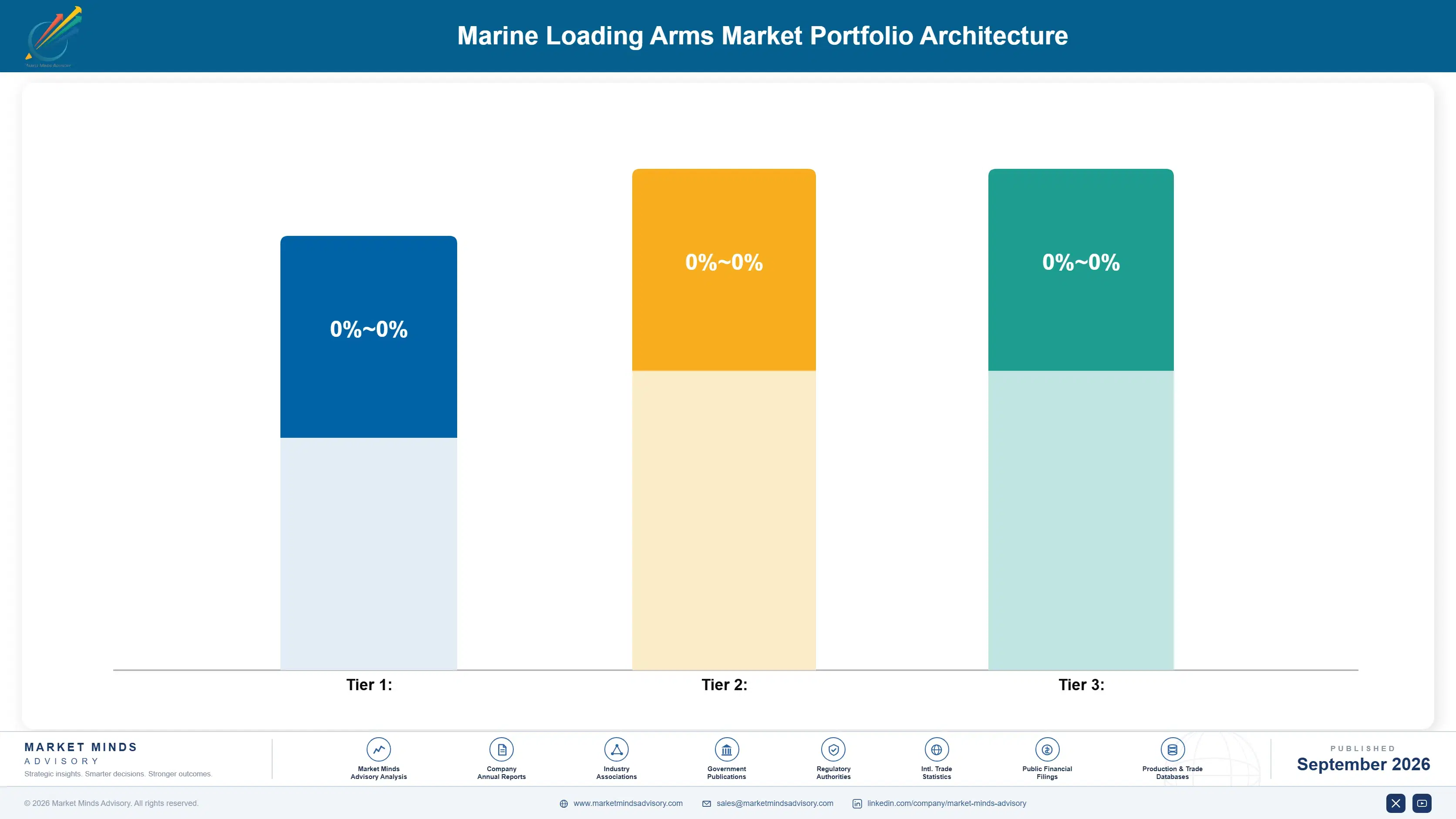
Portfolio Architecture for Margin Defence

The marine loading arms market organizes into three distinct commercial tiers, each carrying meaningfully different margin economics and competitive dynamics across the value chain. Volume-commodity products compete primarily on price and delivery reliability, generating thinner margins across standardized liquid petroleum applications with limited differentiation opportunity for most participants. Premium certified products command meaningfully higher margins by offering verified cryogenic reliability credentials that terminal operators increasingly demand during procurement evaluations.
Sustainability and next-generation formats, particularly vapor recovery and cryogenic automated technology, represent the smallest but fastest-growing tier, carrying the highest margins given limited current competition and genuine engineering differentiation across the installed terminal base. Manufacturers face a persistent tension between defending volume-tier revenue, which still represents the largest absolute dollar pool today, and investing aggressively in premium and next-generation capability where future category growth concentrates most heavily.

High-value pools increasingly concentrate around certified cryogenic technology and bundled maintenance service contracts rather than standalone hardware sales alone across most major LNG export accounts. Manufacturers positioned only in the volume-commodity tier face gradual margin erosion as certified competitors capture disproportionate share of new procurement specifications across LNG and petrochemical accounts worldwide, reinforcing the strategic case for premium tier investment ahead.

Standardized liquid petroleum and basic manual loading arms compete primarily on price and delivery reliability across mature replacement-cycle demand, generating the thinnest margins in the category given intense price competition among numerous regional suppliers.
Gross Margin

Certified chemical and hydraulic-powered loading arms with verified reliability credentials command meaningfully higher margins, reflecting terminal operator willingness to pay for demonstrated performance and reduced downtime risk across critical applications worldwide.
Gross Margin

Cryogenic and vapor recovery formats carry the highest margins given limited competition, genuine engineering differentiation, and rising regulatory pressure favoring emissions-compliant cargo transfer performance across major LNG export markets globally today overall.
Gross Margin
marine-loading-arms-market-portfolio-architecture-1788234034137

High-value Sub-segments and Strategic Watch-out

LNG and Cryogenic Loading Arms

This segment combines the highest current margins with the fastest growth trajectory, making it the clearest priority for manufacturer investment across engineering, testing, and dedicated field service capability expansion going forward across every major LNG export market and terminal cluster tracked. Source: MMA Estimate, July 2026.

Vapor Recovery Loading Arms

Strong margins paired with moderate but steady growth make this segment a reliable secondary investment priority, particularly for manufacturers building emissions-compliance credentials to capture share from traditional venting-only competitors over the coming several years across most terminal accounts and export corridors. Source: MMA Estimate, July 2026.

Liquid Petroleum Loading Arms

This large, mature segment anchors current category revenue despite slower growth today, and manufacturers must defend this volume base carefully while shifting incremental investment toward faster-growing premium and next-generation categories across their broader product portfolios, terminal relationships, and regional networks. Source: MMA Estimate, July 2026.

Manual Balanced Loading Arms

This segment faces meaningful displacement risk as terminal operators increasingly favor hydraulic-powered automated alternatives, making it a genuine strategic watch-out for manufacturers still holding meaningful revenue exposure to this legacy manual transfer format across most established global terminal accounts today. Source: MMA Estimate, July 2026.

Annuity Economics And Terminal Depth

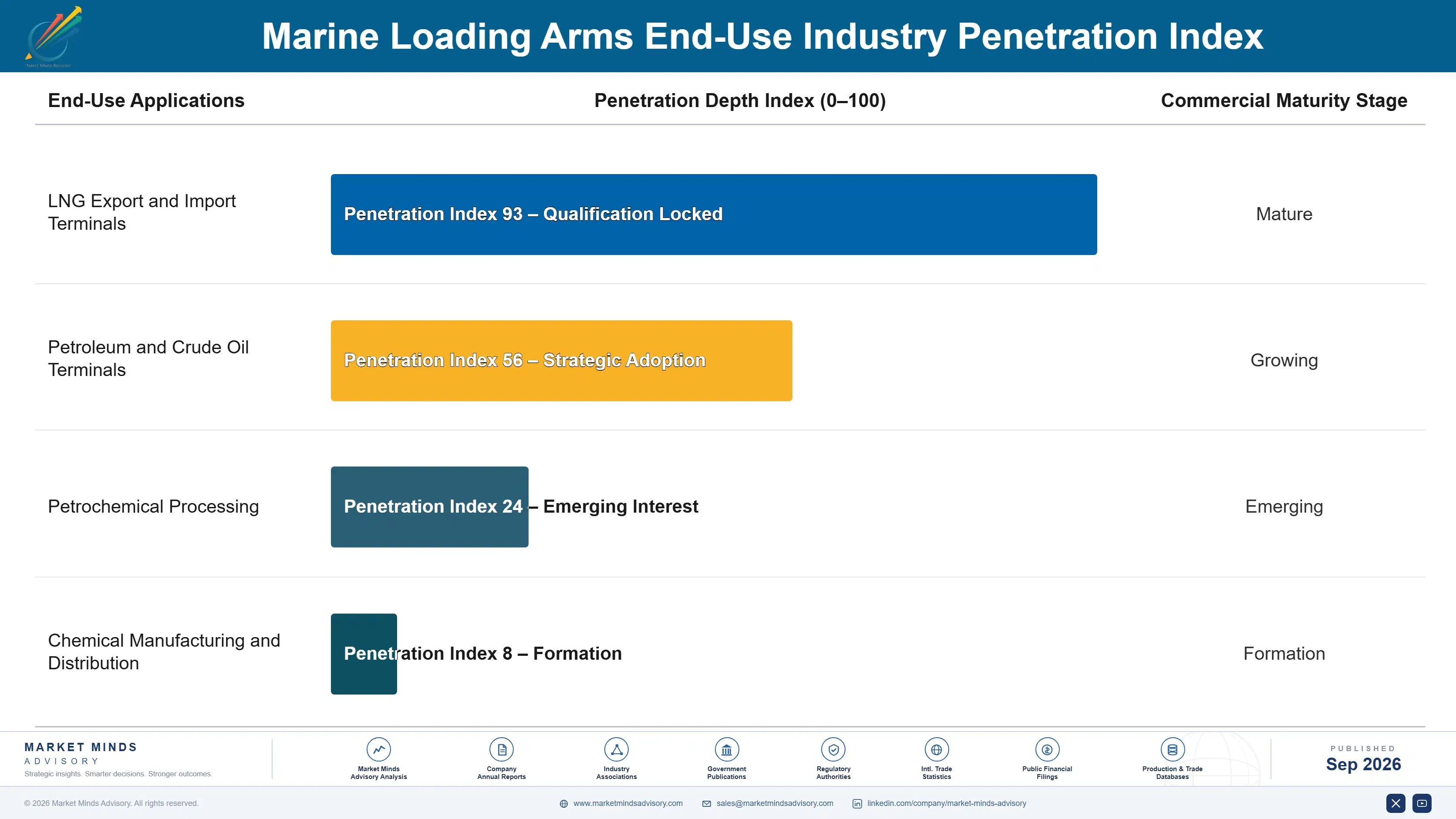
Marine loading arms increasingly resemble an annuity business rather than a one-time equipment sale, since bundled preventive maintenance, fatigue testing, and monitoring contracts generate recurring revenue that basic hardware sales never provided. Manufacturers building recurring terminal relationships early capture disproportionate lifetime account value relative to competitors selling only standalone equipment. This dynamic increasingly reshapes how manufacturers prioritize field service investment across their broader portfolios.
Adoption stickiness varies meaningfully by end-use vertical. LNG export terminal operators show strong repeat purchase behavior once cryogenic reliability and certification credentials are established, while petrochemical buyers demonstrate comparably deep retention given strict operational uptime requirements. Crude oil terminal buyers remain more price-sensitive and switching-prone, showing less loyalty depth than LNG or petrochemical customers across most tracked accounts and regions.

Buyer profiles are shifting generationally too. Younger terminal engineers increasingly research and specify equipment through digital technical portals and direct manufacturer engineering support rather than legacy distributor relationships, reshaping which brands win first-specification moments. Older procurement teams still favor established distributor relationships, creating a genuine generational split that manufacturers must address through parallel engagement strategies rather than a single unified channel.
marine-loading-arms-market-end-use-penetration-index-1788234034617

Where Loading Arm Value Concentrates Next

These are among the four positions where our research anticipates prominent divergence between winners and laggards over the coming forecast period. Each is grounded in the demand model, the regulatory perimeter, and the announced capacity pipeline.
01 / CERTIFICATION INVESTMENT PRIORITY

Verified cryogenic credentials now determine category leadership

Manufacturers that invested early in certified cryogenic fatigue testing infrastructure are capturing disproportionate share of new procurement specifications across LNG export accounts worldwide. This advantage compounds as terminal operators increasingly treat verified credentials as a standard requirement rather than an optional differentiator during vendor evaluation. Manufacturers lacking comparable certification capability risk permanent share loss to better-positioned specialist competitors already building dedicated testing partnerships, and closing this gap now costs meaningfully less than rebuilding lost terminal trust after a rival secures the specification.
02 / SERVICE BUNDLING STRATEGY

Recurring maintenance contracts win account retention battles

Manufacturers that bundle preventive maintenance, fatigue testing, and monitoring services are winning disproportionate account renewals over component-only legacy competitors across most major LNG export accounts. This shift reflects genuine operator demand for minimized downtime risk rather than a temporary contracting trend across the category overall. Manufacturers lacking demonstrated service depth face mounting pressure from better-instrumented specialist rivals across nearly every major procurement negotiation, and this gap widens further as operators formalize service benchmarks into standard vendor scorecards used across every account review cycle.
03 / SUPPLY CHAIN RESILIENCE PLANNING

Diversified steel sourcing separates margin winners clearly

Manufacturers with diversified stainless steel supply agreements maintain meaningfully more predictable production costs than single-source-dependent competitors across their manufacturing operations worldwide. This advantage becomes more pronounced during periods of raw material volatility, when unprotected manufacturers must absorb cost spikes directly across affected product lines and geographies. Companies without comparable supplier diversification face meaningful margin disadvantage relative to better-positioned peers holding multi-year agreements, and this gap tends to widen further whenever steel markets experience another period of pronounced volatility or supply constraint.
04 / REGIONAL EXPANSION SEQUENCING

India and Southeast Asia anchor next growth wave

Manufacturers building dedicated local manufacturing capability across India and Southeast Asia are positioning for disproportionate future revenue capture as terminal investment accelerates regionally. This dynamic rewards early market entrants willing to invest ahead of fully proven demand across these newer markets, and early movers are already securing preferred local partnership agreements here. Companies delaying regional investment risk ceding this expanding opportunity to more aggressive competitors already building local engineering relationships, and catching up later typically costs substantially more than establishing early distribution partnerships and local manufacturing credibility now.

Engagement Snapshot From the Field

A live engagement with an industry participant carrying material or product regulatory and market exposure ahead of a defining policy shift, showing how our research translates into a defensible multi-year portfolio strategy.
MARKET MINDS ADVISORY · CLIENT ENGAGEMENT SUMMARY
Marine Loading Arms Producer Strategic Portfolio Review and Transition Roadmap 2026·Investment Scenario on Marine Loading Arms Exposure Evaluation 2025-26
CLIENT PROFILE
A multinational LNG export terminal operator with an established presence across basic manual loading arm infrastructure sought to expand into certified cryogenic and hydraulic-powered technology. The client's leadership team recognized growing competitive pressure from specialist manufacturers capturing disproportionate share of premium category growth across LNG export accounts worldwide. The engagement was commissioned to inform a multi-year terminal expansion investment decision.
STRATEGIC CHALLENGE
The client's existing procurement processes were optimized for basic manual loading arm economics rather than cryogenic technology or certified fatigue testing infrastructure development. Leadership needed a clear roadmap for building new engineering capability without disrupting existing profitable terminal operations. Executive teams also weighed the risk of cannibalizing existing legacy equipment revenue during the multi-year transition period.
MMA APPROACH
MMA conducted primary interviews with 47 industry experts alongside proprietary survey data covering purchase behavior across six countries. The engagement mapped competitive positioning across cryogenic and vapor recovery segments, identifying specific engineering capability gaps and prioritizing investment sequencing based on projected category growth rates. Findings were validated against company disclosed financials where available throughout the engagement.
KEY FINDINGS
  1. Certified cryogenic loading arm buyers demonstrated meaningfully higher lifetime contract value than basic manual buyers, justifying dedicated engineering investment ahead of adoption (client-reported, unverified by MMA).
  2. Existing terminal relationships provided a credible distribution advantage for premium product launches, reducing go-to-market timeline substantially for new certified product listings (client-reported, unverified by MMA).
  3. Certified testing infrastructure gaps represented the largest competitive vulnerability relative to specialist rivals already established in the cryogenic category (client-reported, unverified by MMA).
  4. Regional expansion into India offered disproportionate growth potential relative to further investment in mature Western European terminal markets over the next several years (client-reported, unverified by MMA).
CLIENT PROFILE
A multinational LNG export terminal operator with an established presence across basic manual loading arm infrastructure sought to expand into certified cryogenic and hydraulic-powered technology. The client's leadership team recognized growing competitive pressure from specialist manufacturers capturing disproportionate share of premium category growth across LNG export accounts worldwide. The engagement was commissioned to inform a multi-year terminal expansion investment decision.
STRATEGIC CHALLENGE
The client's existing procurement processes were optimized for basic manual loading arm economics rather than cryogenic technology or certified fatigue testing infrastructure development. Leadership needed a clear roadmap for building new engineering capability without disrupting existing profitable terminal operations. Executive teams also weighed the risk of cannibalizing existing legacy equipment revenue during the multi-year transition period.
MMA APPROACH
MMA conducted primary interviews with 47 industry experts alongside proprietary survey data covering purchase behavior across six countries. The engagement mapped competitive positioning across cryogenic and vapor recovery segments, identifying specific engineering capability gaps and prioritizing investment sequencing based on projected category growth rates. Findings were validated against company disclosed financials where available throughout the engagement.
KEY FINDINGS
  1. Certified cryogenic loading arm buyers demonstrated meaningfully higher lifetime contract value than basic manual buyers, justifying dedicated engineering investment ahead of adoption (client-reported, unverified by MMA).
  2. Existing terminal relationships provided a credible distribution advantage for premium product launches, reducing go-to-market timeline substantially for new certified product listings (client-reported, unverified by MMA).
  3. Certified testing infrastructure gaps represented the largest competitive vulnerability relative to specialist rivals already established in the cryogenic category (client-reported, unverified by MMA).
  4. Regional expansion into India offered disproportionate growth potential relative to further investment in mature Western European terminal markets over the next several years (client-reported, unverified by MMA).
RECOMMENDED STRATEGY
Phase 1: Phase one prioritized certified cryogenic testing infrastructure, including dedicated testing partnerships across two flagship terminal facilities prior to broader rollout. Phase 2: Phase two built cryogenic engineering design capability through a targeted acquisition of a smaller specialist equipment technology company to accelerate market entry. Phase 3: Phase three expanded regional manufacturing capability across India and Southeast Asia through dedicated local partnership agreements within eighteen months of launch.
OUTCOME
Within eighteen months, the client launched a certified cryogenic loading arm line that captured meaningful category share and established a testing programme generating renewed terminal account confidence (client-reported, unverified by MMA). Regional expansion into India exceeded initial revenue projections meaningfully. Leadership credited the phased sequencing approach for limiting disruption to existing legacy equipment revenue.

Frequently Asked Questions

Foundational context covering the market sizes, CAGR, scope, country, region and competition that inform every finding below. This section is provided to cover basics and most often pre-purchase conversations, answered from the MMA Primary Research Dataset.

What is the current size of the Marine Loading Arms Market?

The Marine Loading Arms Market reached an estimated 2.3 billion dollars in 2025. This figure reflects combined global revenue across petroleum, LNG, chemical, and vapor recovery formats.

How large will the Marine Loading Arms Market be by 2036?

The market is projected to reach approximately 4.02 billion dollars by 2036. This represents roughly 1.66 times the 2026 value across the full ten-year forecast period.

What is the CAGR for the Marine Loading Arms Market 2026 to 2036?

The market is expected to grow at a compound annual rate of 5.2 percent. Bull and bear scenarios range between 4.0 and 6.4 percent respectively across the forecast.

Which segment is growing fastest?

LNG and cryogenic loading arms are growing fastest, at roughly 1.63 times the overall market pace. Global gas trade expansion and export terminal construction together drive this outsized expansion.

Who are the major companies in the Marine Loading Arms Market?

Emco Wheaton, OPW Engineered Systems, TechnipFMC, SVT GmbH, and Kanon Loading Equipment lead the market. Together these five manufacturers hold a combined CR5 of roughly 48 percent overall today.

Which country is growing fastest?

Qatar is growing fastest, at an estimated 7.0 percent annually. Its dominant North Field expansion programme and new liquefaction train construction together drive this accelerating pace.

Report Segmentation Architecture

The full report scope spans multiple orthogonal segmentation dimensions, with cross-tabulated demand data provided for each dimension pair. Coverage extends further to regional breakdowns, trend trajectories, and the competitive detail needed to support segment-level decision-making.

By Primary Market Dimension

  • Liquid Petroleum Loading Arms
  • LNG and Cryogenic Loading Arms
  • Chemical Loading Arms
  • Vapor Recovery Loading Arms
  • Hydraulic-Powered Loading Arms
  • Manual Balanced Loading Arms

By End-Use Industry

  • LNG Export and Import Terminals
  • Petroleum and Crude Oil Terminals
  • Petrochemical Processing
  • Chemical Manufacturing and Distribution

By Commercial Dimension

  • Original Equipment Manufacturer Sales
  • Aftermarket Replacement Sales
  • Engineering and Maintenance Service Contracts

By Region

  • North America
  • Middle East and Africa
  • East Asia
  • Western Europe
  • South Asia and Pacific
  • Latin America
  • Eastern Europe

Scope, Methodology, and Coverage

Every figure in this report is reproducible from documented input assumptions. The scope below maps the historical period, the forecast horizon, the segmentation dimensions, and the countries covered, alongside the underlying primary and qualitative methodology.
Historical Period
2020 to 2025
Forecast Period
2026 to 2036
Base Year
2025 (USD billions; MMA Primary Research Dataset, September 2026)
Market Definition
This report covers powered and manual marine loading arm systems used to transfer liquid and gaseous cargo between vessels and shore-based terminal infrastructure, including petroleum, LNG, and chemical applications. It excludes shore-based storage tanks, pipeline infrastructure, and vessel-mounted cargo handling equipment.
Quantitative Units
USD billions, 2025 base year
Segmentation Dimensions
Product and technology type, end-use industry, commercial channel, region
Regions Covered
North America, Middle East and Africa, East Asia, Western Europe, South Asia and Pacific, Latin America, Eastern Europe
Countries Covered
United States, Canada, Germany, Netherlands, Norway, China, Japan, South Korea, India, Australia, Brazil, Qatar
Key Companies Profiled
Emco Wheaton, OPW Engineered Systems, TechnipFMC, SVT GmbH, Kanon Loading Equipment
Quantitative Methodology
Primary survey, n=3,800 respondents, Q4 2025, six countries; demand-side model with trade association cross-validation
Qualitative Methodology
47 expert interviews, Q4 2025; applied to validate demand model assumptions, identify emerging dynamics, and assess competitive positioning
Report Format
PDF and XLSX data workbook (Word format preview document)
Publisher
Market Minds Advisory
Report Code
MMA-2026-CON-185
Published
September 2026
Contact
sales@marketmindsadvisory.com | www.marketmindsadvisory.com

Purchase the full Marine Loading Arms Market Report (2026 to 2036).

The full report expands on every dimension summarized here, including complete segmentation breakdowns, all seven regional profiles, and extended competitive intelligence covering all twenty profiled manufacturers. It includes detailed input cost modeling and portfolio tier economics not covered in this summary document. Clients also receive proprietary survey data from 3,800 respondents across six countries alongside 47 expert interviews conducted in Q4 2025. A dedicated analyst briefing session is included with every purchase, and clients gain access to editable data tables for internal modeling work. Every profile includes verified sourcing notes for full analyst transparency.
Complete seven-region data tables covering every profiled market
Full twenty-company competitive profiles with detailed strategic assessments
Editable segmentation and forecast models for internal team use
Dedicated analyst briefing session with a named practice lead
Primary survey microdata access for advanced internal analysis
Quarterly market update subscription with quarterly data refreshes

Built For The People Who Decide

From boardroom strategy to bench-side execution, this report is read cover-to-cover by leaders shaping the next decade of their industry, turning demand scenarios, market dynamics and valuation benchmarks into decisions.
CXOs/ Presidents/ VPs/ Managers
M&A and Corporate Development
Strategy Teams and R&D Heads
Procurement and Product Directors
Regulatory and Compliance Leaders
Investor Relations and Equity Analysts