Market Minds Advisory
Marine Hatch Covers Market

Marine Hatch Covers Market: Design, Certification, and Regional Demand to 2036

Shipyards building bulk carriers and container ships increasingly specify hydraulic direct-pull hatch covers over older folding designs, while steel price swings and stricter weathertight certification rules reshape how yards source safety-critical deck equipment.

Lead Analyst

David Horsley

Published

September 2026

Make Smarter Decisions with Customized Research Insights

Request a free sample report and evaluate market opportunities, growth trends, and competitive dynamics relevant to your business needs.

2025 MARKET VALUE$1.9BMarket Size 2025
2036 FORECAST VALUE$3.1BBase Case , 2026 to 2036
CAGR 2026 TO 20364.6 %Bull 5.8% / Bear 3.3%
INCREMENTAL OPPORTUNITY$1.1BNet 10- year value creation
EXPANSION MULTIPLE1.57x2036 value over 2026 base
Strategic Levers
M&A Pipeline
Regional Outlook
Country Rankings
Competitive Intelligence
Segmental Deep-dive
Call-Us : 91 93563 13602

Executive Snapshot and Market Trajectory

Marine hatch cover selection has shifted from a routine deck equipment order into a specification decision shipyards make early in the design process, as owners increasingly weigh long-term weathertight reliability and crew safety against the lower upfront cost of older folding and pontoon designs across newbuild programmes.
Hydraulic direct-pull covers are growing fastest as larger bulk carriers and container ships favor fewer, heavier panels that automated systems can open in minutes rather than the manual chain-and-wire operation folding designs require. East Asia's dominant shipbuilding output, concentrated in China and South Korea, absorbs the overwhelming majority of global hatch cover demand, even as European and Japanese specialist makers retain the deepest engineering expertise in weathertight sealing and classification society certification built over decades.
Competition sits between Cargotec's MacGregor division, the clear scale leader across most vessel classes, and specialist regional fabricators competing on delivery lead time and price for standard bulk carrier designs. Tightening classification society weathertight certification requirements following several high-profile cargo hold flooding incidents are pushing yards toward hydraulic systems with better sealing verification, while steel price volatility is forcing fabricators to rethink sourcing amid persistent skilled welding labor shortages at yards.
Market Definition
Marine hatch covers are the steel structures and mechanical or hydraulic actuation systems that seal cargo holds on bulk carriers, container ships, and general cargo vessels against weather and seawater ingress. The market excludes cargo hold structural steelwork, hatch coamings sold separately from the cover system, and container lashing equipment.
Base Year Value
$1.9B in 2025 (MMA Primary Research Dataset, August 2026)
Forecast Period
2026 to 2036, eleven discrete annual values
CAGR
4.6% base case. Bull 5.8%. Bear 3.3%.
Fastest Growth Segment
Folding Hatch Covers: 5.8% CAGR
Fastest Growth Country
China: 6.0% CAGR
Fastest Growth Region
South Asia and Pacific: 6.6% CAGR
Largest Region
East Asia: 42% of 2025 global value
Market Leaders
MacGregor (Cargotec Corporation), TTS Group, Hatlapa Uetersen, Kanasashi Corporation, and Jiangsu Rainbow Heavy Industries lead the field. Source: MMA Analysis based on company annual reports.
Primary Survey
n=3,800 procurement and R&D decision-makers, Q4 2025, six countries
Methodology
Demand-side build-up, cross-validated against public data, 47 expert interviews

Marine Hatch Covers Market Forecast Scenarios

marine-hatch-covers-market-size-forecast-scenario-1787556203231
Between 2020 and 2025 marine hatch cover demand grew at roughly 3.8 percent a year, held back by a pandemic-era shipbuilding order slowdown before recovering as global newbuild orders rebounded on strong dry bulk and containership charter rates. Steel price spikes during 2021 and 2022 pushed some yards to delay hatch cover procurement until later in the build cycle, temporarily distorting order timing without changing underlying vessel delivery volumes.
The base case assumes continued growth as three mechanisms compound: newbuild order volume tracking global dry bulk and containership fleet renewal cycles as older tonnage reaches scrapping age; a gradual shift toward hydraulic direct-pull covers on larger vessel classes that carry higher unit value than manual folding systems; and tightening classification society weathertight certification requirements that favor established manufacturers with proven sealing verification processes over smaller fabricators still building to older design standards.
The bull case turns on a faster-than-expected wave of dry bulk fleet renewal driven by upcoming vessel emissions regulation forcing early retirement of older tonnage. The bear case centers on a prolonged shipbuilding order slowdown, which has historically pushed yards to defer hatch cover procurement and compressed fabricator margins industry-wide, a pattern last seen in 2016.

Newbuild Cycles and Weathertight Certification Economics

Marine hatch covers sit at the intersection of shipbuilding cycles, steel cost volatility, and tightening safety regulation. As classification societies raise weathertight certification standards following cargo hold flooding incidents, shipyards increasingly specify covers from manufacturers with proven sealing verification track records, even where certified systems carry a meaningful price premium over unverified regional fabrication. That certification premium is becoming a standard line item in newbuild budgets.
MARKET CONCENTRATIONCR5: 48%Ownership concentrates among a handful of established makers
AVERAGE SELLING PRICE$180,000 per vessel setPricing scales with vessel size and cover complexity
CAPACITY UTILISATION68%Fabrication yards run well below full order capacity
TOP PRODUCER SHARETop 3 countries: 61%Production concentrates near the largest global shipbuilding centers
TRADE INTENSITY52% cross-borderFinished covers ship directly to yards worldwide regularly
STEEL COST SHARE58% of COGSSteel plate pricing drives most manufacturing cost swings
Commercially the category splits between global scale leaders bundling hatch covers into broader deck equipment packages and regional fabricators competing on delivery lead time and price for standard bulk carrier designs. Established makers compete on engineering depth and classification society relationships, while regional fabricators win on proximity to shipyards and faster delivery, since hatch covers are heavy, costly to ship internationally, and typically installed late in the build schedule.
The next decade will be shaped by tightening weathertight certification requirements, the shift toward hydraulic direct-pull systems on larger vessel classes, and dry bulk fleet renewal driven by emissions regulation. Makers that can pair certified sealing performance with faster hydraulic installation stand to capture share from fabricators still building older manual folding designs. Laggards risk losing share on the largest, most profitable vessel orders.
"Nobody notices a hatch cover until it fails in heavy weather, and that's exactly why classification societies are tightening certification faster than almost any other piece of deck equipment right now."
Director, Marine Equipment and Shipbuilding Practice · MMA Construction and Industrial Equipment Practice · August 2026

Market Trends

Hydraulic Direct-Pull Systems Displace Manual Folding Designs

Shipyards building larger bulk carriers and container ships are increasingly specifying hydraulic direct-pull hatch covers over traditional chain-and-wire folding systems, since hydraulic actuation opens and closes fewer, heavier panels in a fraction of the time manual operation requires and reduces crew exposure to heavy moving deck machinery. Adoption is fastest on vessels above 80,000 deadweight tonnes, where panel weight makes manual chain operation increasingly impractical for standard crew sizes. Several major yards in South Korea and China have shifted new bulk carrier orders almost entirely toward hydraulic systems, while smaller general cargo vessel orders still favor lower-cost manual folding designs.
Market Impact: Adds 3 to 4 years visibility

Classification Societies Tighten Weathertight Certification After Flooding Incidents

Following several high-profile cargo hold flooding incidents linked to hatch cover sealing failures, major classification societies have tightened weathertight certification testing requirements, mandating more rigorous hose and ultrasonic leak testing before vessel delivery and at periodic survey intervals thereafter. Compliance has raised manufacturing and testing costs for fabricators by an estimated six to ten percent per unit, disproportionately affecting smaller regional makers without in-house testing capability who must now outsource certification verification. Established manufacturers with existing classification society relationships and proven testing infrastructure are capturing share from smaller fabricators struggling to absorb the added compliance cost and documentation burden.
Market Impact: Lifts per-vessel value 25 percent

Market Opportunities and Growth Drivers

Dry Bulk And Containership Fleet Renewal Cycles

Global dry bulk and containership fleets are aging past typical scrapping thresholds, and newbuild orders tied to fleet renewal directly drive hatch cover demand, since every new vessel requires a full hatch cover set specified early in the design process. Upcoming vessel emissions regulation is accelerating scrapping of older, less efficient tonnage, pulling forward newbuild orders that would otherwise have been deferred several more years under normal fleet replacement timing. Shipyards in China and South Korea report order books extending several years forward, giving manufacturers unusually strong forward revenue visibility compared with most industrial equipment categories.
Market Impact: Adds up to 15 percent cost

Larger Vessel Classes Require Higher-Value Cover Systems

Shipowners ordering larger bulk carriers and container ships to capture economies of scale are specifying larger, more complex hatch cover systems with higher per-vessel value than the smaller covers required on older, smaller vessel classes still in service. Larger covers increasingly require hydraulic actuation rather than manual operation, pushing owners toward higher-margin systems from established manufacturers with proven engineering track records on large-panel designs. Average vessel size across new dry bulk orders has increased steadily, and manufacturers report per-vessel hatch cover revenue growing faster than unit shipment volume as a direct result.
Market Impact: Extends order lead time 3 years

Market Restraints and Challenges

Steel Price Volatility Compresses Fabrication Margins

Steel plate accounts for the majority of hatch cover manufacturing cost, and its price tracks global steel markets rather than shipbuilding demand, creating volatility that fabricators cannot pass through easily on fixed-price newbuild contracts negotiated months or years before delivery. Root causes include swings in Chinese steel production policy and periodic trade restrictions affecting cross-border steel plate flows. When steel prices spike between contract signing and delivery, fabricators either absorb margin compression or attempt contract renegotiation, which shipyards often resist given their own fixed-price vessel contracts with owners. Larger manufacturers mitigate exposure through steel price escalation clauses and multi-origin sourcing.
Market Impact: Cuts hatch operating time 70 percent

Long Sales Cycles Tied To Shipyard Order Books

Hatch cover orders are locked in years ahead of vessel delivery, tied directly to shipyard newbuild order books, which means manufacturers face limited ability to respond quickly to short-term demand shifts and instead must forecast capacity investment against multi-year shipbuilding cycles that can turn sharply. The root cause is that hatch covers are specified early in vessel design, well before construction begins, leaving manufacturers exposed to order cancellations or delays if shipowners defer newbuild decisions after contracts are placed. Manufacturers manage the risk through diversified customer bases spanning multiple vessel types and geographies.
Market Impact: Adds 6 to 10 percent cost
3 additional market trends, 4 additional growth drivers, and 3 additional restraints and challenges are covered in the full report. Contact sales@marketmindsadvisory.com to access the complete intelligence.

Segment CAGR and Growth Architecture

Marine hatch covers segment most usefully by mechanical design type, since folding, hydraulic direct-pull, piggyback, side-rolling, pontoon, and single-panel lift-away systems carry distinct engineering complexity, actuation cost, and vessel class suitability. This framework mirrors how shipyards specify covers during vessel design and how manufacturers organise their product and engineering lines. Fabricators organise engineering teams and pricing around these same distinctions.
marine-hatch-covers-market-market-share-analysis-1787556203824

Folding Hatch Covers

Folding hatch covers are the fastest-growing segment, remaining the versatile default choice across a broad range of bulk carrier and general cargo vessel sizes where full hydraulic automation is not yet cost-justified. Growth is driven primarily by continued newbuild volume in the mid-size bulk carrier class, the single largest category of new vessel orders globally, rather than share gains against other cover types. Manufacturers are increasingly offering hybrid folding designs with partial hydraulic assistance, capturing some of the operating speed benefits of full hydraulic systems while retaining the lower upfront cost that makes folding covers attractive on cost-sensitive newbuild contracts. Growth concentrates heavily in Chinese and South Korean shipyards building for international dry bulk shipowners across most vessel size classes.
CAGR 5.8%

Hydraulic Direct-Pull Hatch Covers

Hydraulic direct-pull covers form the second-fastest-growing segment as larger bulk carriers and container ships increasingly specify automated systems that reduce crew exposure to heavy moving deck machinery and cut hatch opening time dramatically compared with manual chain-and-wire operation. Adoption concentrates on vessels above eighty thousand deadweight tonnes, where panel weight makes manual operation increasingly impractical, and several major shipyards have shifted new large bulk carrier orders almost entirely toward hydraulic systems. Established manufacturers with proven hydraulic engineering and classification society certification hold a durable advantage, since hydraulic system reliability is safety-critical and shipowners strongly prefer proven suppliers with established maintenance and spare parts support networks across major ports worldwide. That expectation continues shaping purchasing decisions on the largest vessel orders.
CAGR 5.3%
Full segment breakdown across 6 segments available in the complete report.

Regional Architecture and Country Demand Map

Marine hatch cover demand concentrates overwhelmingly where global shipbuilding activity is concentrated. East Asia's dominant shipyard base accounts for the large majority of global demand, while North America's minimal commercial shipbuilding sector represents a comparatively small demand base, reflecting where vessels are actually built rather than owned.

East Asia

China and South Korea together build most of the world's bulk carriers and container ships, and hatch cover demand follows shipbuilding output almost mechanically, since every vessel requires a cover set specified during initial design. This concentration reflects where vessels are physically built, not a demand preference: combined newbuild tonnage share for these two countries exceeds eighty percent of global gross tonnage, which is why East Asia is assigned a share meaningfully above the standard regional band used elsewhere, a deviation justified by shipbuilding output data rather than estimation error. Japan contributes demand from its smaller, technically sophisticated sector. Domestic Chinese fabricators are expanding to capture volume previously served by Japanese and Korean suppliers, compressing pricing as order volume climbs.
Share: 42% | CAGR: 5.5% (2026 to 2036)

North America

North American shipyards build only a small fraction of global commercial cargo tonnage, since Jones Act cabotage requirements protect a limited domestic coastal and inland fleet rather than supporting export-oriented bulk carrier or container ship construction at meaningful scale. That policy-driven limit on export shipbuilding, not weak regional demand for shipping generally, keeps North America's hatch cover share well below the standard regional band applied elsewhere in this report, a deliberate deviation reflecting where vessels are actually built rather than an estimation error. Canadian shipyards contribute modest additional volume from smaller coastal and Great Lakes vessel construction. Repair and retrofit demand for existing vessels calling at North American ports provides a secondary, more stable demand stream.
Share: 12% | CAGR: 3.9% (2026 to 2036)
Regional intelligence for 5 additional markets available in the complete report: Western Europe, South Asia and Pacific, Latin America, Middle East and Africa, Eastern Europe. Contact sales@marketmindsadvisory.com.
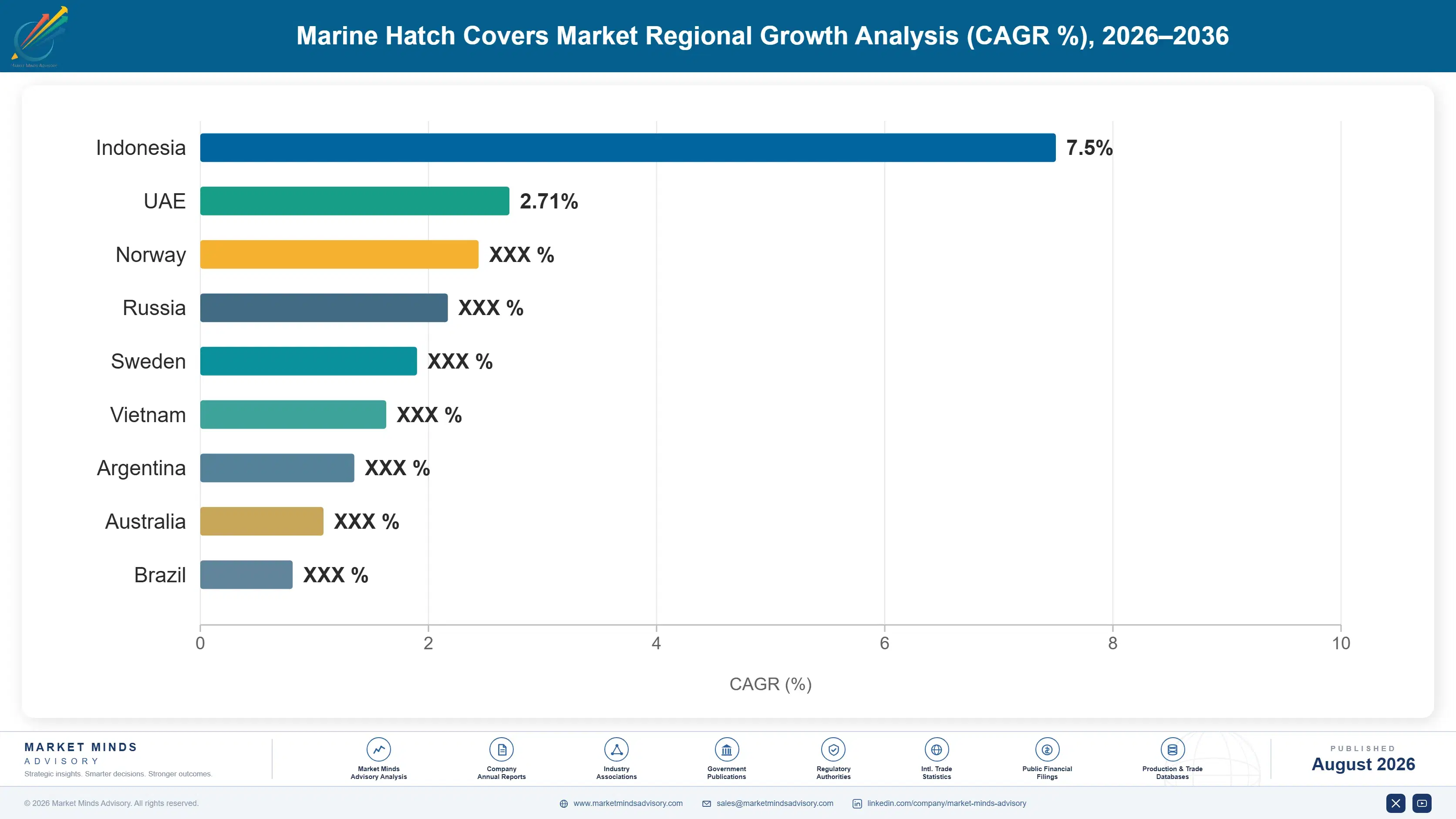
marine-hatch-covers-market-country-cagr-analysis-1787556204346

Certification Services and Hydraulic System Upgrades

Manufacturers can grow revenue per vessel even where newbuild volume is cyclical by pushing shipyards toward higher-value hydraulic systems, bundling classification certification and testing services with hardware sales, and capturing recurring spare parts and retrofit revenue across the existing global fleet. The most durable gains come from deepening relationships into multi-decade fleet support. across a vessel's decades of service.

Bundling Classification Certification Services With Hardware Sales

Manufacturers are increasingly bundling classification society certification support and hose leak testing services directly with hatch cover hardware sales, capturing revenue that previously went to independent testing and survey firms while simplifying compliance for shipyards facing tightening weathertight requirements. This bundled approach raises average contract value by an estimated 8 to 12 percent per vessel set compared with hardware-only sales, and shipyards increasingly prefer suppliers who can guarantee certification outcomes rather than managing testing and hardware procurement separately across different vendors. The approach works best on larger vessel orders where certification complexity is highest.
Market Impact: Adds 8 to 12 percent contract value overall

Upselling Hydraulic Systems On Larger Vessel Class Orders

Manufacturers are actively steering shipowners and yards toward hydraulic direct-pull systems on vessel classes where manual folding designs remain technically viable but increasingly impractical given crew size and safety considerations, capturing meaningfully higher per-vessel revenue since hydraulic systems typically carry a price premium of 40 to 60 percent over comparable folding designs. Sales engineers increasingly present total cost of ownership comparisons emphasising reduced crew injury risk and faster port turnaround time rather than competing purely on upfront hardware price. The lever works best on newbuild orders above medium vessel size classes where the economics most clearly favor automation.
Market Impact: Commands 40 to 60 percent price premium consistently

Capturing Recurring Spare Parts And Retrofit Revenue

Manufacturers with large installed fleets are building dedicated aftermarket divisions selling replacement seals, hydraulic components, and full retrofit upgrade packages to vessel operators years after initial delivery, converting a one-time hardware sale into a recurring revenue stream that can extend across a vessel's entire 20-year-plus operating life. This aftermarket revenue carries meaningfully higher margins than newbuild hardware sales, since operators facing an in-service vessel with limited downtime tolerance pay a premium for fast parts availability and certified installation support. Manufacturers with global service networks and parts inventory hold a durable advantage over newbuild-focused competitors lacking aftermarket infrastructure.
Market Impact: Extends recurring revenue across a full 20-year vessel life

Offering Retrofit Upgrades From Manual To Hydraulic Systems

As classification society requirements tighten and crew safety expectations rise, manufacturers are marketing retrofit conversion packages that upgrade existing manual folding covers to hydraulic operation on vessels still years from scheduled scrapping, opening a substantial addressable market beyond newbuild orders alone. These retrofit projects typically require dry-dock scheduling coordination and carry meaningfully higher installation complexity than newbuild fitting, supporting premium service pricing for manufacturers with proven retrofit engineering experience. Early adopters report retrofit project volume growing roughly 15 percent faster than newbuild volume as owners of mid-life vessels seek to extend operating life while improving safety.
Market Impact: Grows retrofit orders roughly 15 percent every year

Who Controls the Margin Pool

The marine hatch cover market is moderately concentrated, with an estimated CR5 near 48 percent, reflecting a category where classification society relationships and proven engineering track records matter as much as manufacturing scale. MacGregor, part of Cargotec Corporation, leads decisively on combined product breadth and installed base, but the gap to specialist regional fabricators is narrower on standard folding designs than on higher-complexity hydraulic systems.
Competitive activity centers on three fronts: hydraulic system engineering aimed at capturing share on larger vessel classes, bundling of certification and testing services to simplify shipyard compliance, and geographic expansion of manufacturing and service capacity in China and South Korea to stay close to concentrated shipbuilding demand. Acquisitions of specialist regional fabricators have picked up as global leaders seek local manufacturing presence.

Emerging pressure comes from Chinese domestic fabricators rapidly closing the engineering gap on hydraulic systems, threatening established Japanese and European makers on price in the fastest-growing vessel size segments. Aftermarket service providers focused purely on retrofit and repair are also gaining share against newbuild-focused competitors less invested in fleet support infrastructure. Rankings could shift meaningfully if a Chinese fabricator achieves classification society certification parity with established global leaders.
marine-hatch-covers-market-company-positioning-matrix-1787556204869

Competitive Moat and Risk Dimensions

MACGREGOR

Moat: Combined Scale And Certification Depth

MacGregor's position inside Cargotec Corporation gives it manufacturing scale, established classification society relationships across every major registry, and decades of accumulated engineering data on hatch cover failure modes that smaller fabricators cannot easily replicate. That combined advantage lets MacGregor win the largest, most complex vessel orders where certification depth and proven reliability matter most to risk-conscious shipowners.
MACGREGOR

Risk: Slower Response To Price Competition

MacGregor's scale and established engineering processes make it slower to compete purely on price against nimble Chinese fabricators willing to accept thinner margins to win standard bulk carrier orders. This has cost MacGregor share on smaller, less complex vessel classes where certification depth matters less and shipyards prioritise the lowest delivered cost above supplier reputation or service network breadth.
HATLAPA UETERSEN

Moat: Specialised Hydraulic Engineering Reputation

Hatlapa's long-standing reputation for hydraulic deck machinery engineering gives it credibility on the highest-complexity hydraulic hatch cover orders, where shipowners are willing to pay a premium for proven reliability on systems that are difficult and costly to repair once a vessel is in service far from a home port. That reputation supports premium pricing on large hydraulic system orders.
HATLAPA UETERSEN

Risk: Limited Scale Against Larger Rivals

Hatlapa's comparatively smaller manufacturing scale limits its ability to compete for the largest fleet-wide supply contracts that bundle hatch covers with broader deck equipment packages, where scale competitors like MacGregor can offer more comprehensive bundled pricing. Hatlapa has occasionally lost large multi-vessel contracts to bundled competitors despite superior hydraulic engineering reputation on individual system performance.

Players Tracked

Prominent Players

MacGregor (Cargotec Corporation)
TTS Group
Hatlapa Uetersen
Kanasashi Corporation
Jiangsu Rainbow Heavy Industries

Other Key Players

JFE Engineering
Nantong CIMC Sinopacific
Zhenjiang Marine Equipment
Fukuoka Marine Machinery
Nakata Manufacturing
Wartsila Marine Systems
Kongsberg Maritime
STX Heavy Industries
Guangzhou Wenchong Shipyard
Chengxi Shipyard
Dalian Shipbuilding Equipment
Taiyo Kogyo Corporation
Shin Kurushima Dockyard
Zhoushan Xinya Marine Equipment
Hyundai Marine Machinery

Recent Developments

MAY 2026

MacGregor Expands Hydraulic Hatch Cover Production Capacity In China

MacGregor announced expanded hydraulic hatch cover manufacturing capacity at its Chinese production facility, aimed at meeting rising demand from Chinese and South Korean shipyards building larger bulk carriers and container ships specifying hydraulic direct-pull systems over traditional manual folding designs on new vessel orders. Local production also shortens lead times.
Signal: Signals established manufacturers prioritising local Asian manufacturing presence over exporting finished systems from Europe to key customers.
OCTOBER 2025

Jiangsu Rainbow Heavy Industries Achieves Major Classification Society Certification

Jiangsu Rainbow Heavy Industries received expanded classification society certification covering its hydraulic hatch cover systems across multiple major registries, positioning the fabricator to compete for larger vessel orders previously reserved for established Japanese and European manufacturers with longer certification track records. The move directly targets larger, higher-value export vessel orders.
Signal: Confirms Chinese fabricators are closing the certification gap that historically protected established manufacturers from price competition.
JANUARY 2026

Hatlapa Launches Retrofit Conversion Package For Aging Bulk Carriers

Hatlapa introduced a standardised retrofit package converting manual folding covers to hydraulic operation on mid-life bulk carriers, targeting shipowners extending vessel life while meeting tightening crew safety expectations without ordering an entirely new vessel. Hatlapa expects strong uptake among owners of mid-2000s tonnage. Interest is already strong.
Signal: Marks growing manufacturer focus on aftermarket retrofit revenue as newbuild order cycles remain volatile. as fleets age past midlife.

Steel Plate And Fabrication Cost Exposure

Steel plate accounts for roughly 58 percent of cost of goods sold across most hatch cover manufacturing, with hydraulic components, seals, and fabrication labor making up most of the remainder. Steel sourcing concentrates heavily in China, Japan, and South Korea, tying hatch cover manufacturing costs directly to global steel market dynamics and, increasingly, trade policy affecting cross-border steel plate flows.
Chinese steel export restrictions and domestic production policy shifts during 2021 pushed global steel plate prices up by more than 40 percent within several months, according to World Trade Organization reporting on global steel trade disruption, forcing fabricators with fixed-price newbuild contracts signed before the spike to absorb significant margin compression. Manufacturers without flexible sourcing agreements faced the sharpest impact, and several smaller fabricators reported delayed deliveries.

Exposure varies sharply by player type: larger manufacturers like MacGregor, with diversified multi-country steel sourcing agreements, weather price spikes with meaningfully less margin disruption than smaller regional fabricators reliant on single-country plate purchases. Geographic exposure also differs, since fabricators sourcing primarily from Chinese mills face different risk timing than those dependent on Japanese or Korean steel production, meaning cost impact varies considerably across the manufacturing base.
marine-hatch-covers-market-cost-volatility-analysis-1787556205064

Diversifying Steel Plate Sourcing Across Multiple Countries

Manufacturers are increasingly qualifying steel suppliers across China, Japan, and South Korea simultaneously rather than relying on a single country's mills, so a disruption or policy shift in one market does not halt production entirely. This diversification raises logistics complexity modestly but reduces the risk of the sharp price spikes that hit under-diversified fabricators hardest during recent disruption.

Negotiating Steel Price Escalation Clauses Into Contracts

Manufacturers are increasingly including steel price escalation clauses in newbuild supply contracts, allowing partial cost pass-through if steel prices rise materially between contract signing and delivery, shifting some volatility risk back toward shipyards and vessel owners. This approach requires negotiating leverage most smaller fabricators lack when competing for price-sensitive standard orders against larger rivals.

Pre-Purchasing Steel Plate Ahead Of Confirmed Orders

Larger manufacturers with stronger balance sheets are pre-purchasing steel plate inventory ahead of confirmed order volume, locking in pricing before contract signing and capturing margin that would otherwise erode during a subsequent price spike. This approach requires working capital most smaller fabricators cannot commit, reinforcing a durable cost advantage for scale players during periods of steel price volatility.

Portfolio Architecture for Margin Defence

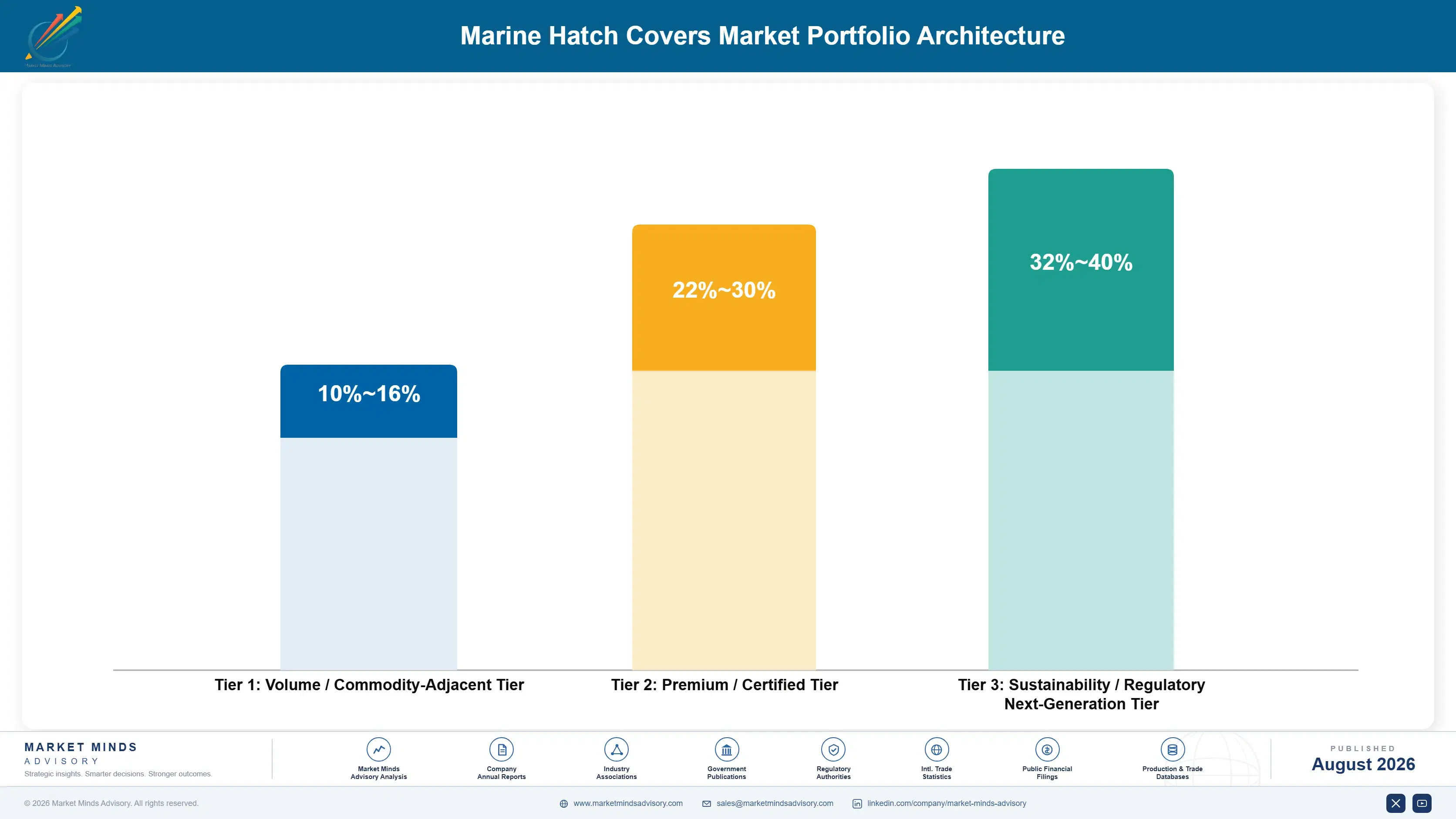
Marine hatch covers organise into three commercial tiers running from standard manual folding systems through certified hydraulic direct-pull systems to next-generation retrofit and aftermarket service programmes. Gross margins widen sharply moving up the tiers, since standard folding hardware competes largely on steel cost and fabrication price, while certified hydraulic systems and aftermarket services capture value from engineering depth, certification track record, and fleet support infrastructure rather than raw material cost alone.
The tension between newbuild volume and aftermarket premium shapes manufacturer strategy: standard folding hardware generates the installed fleet base that creates future aftermarket opportunity, but retrofit and spare parts revenue generates the steadier, higher margin that smooths cyclical newbuild order volume. Manufacturers overweighted toward newbuild-only sales face intensifying price competition from lower-cost regional fabricators, while aftermarket-forward manufacturers carry more stable profitability across shipbuilding cycles.

High-value pools concentrate among hydraulic system orders on large vessel classes with certification requirements, and among aftermarket retrofit and spare parts revenue serving the large existing global fleet independent of newbuild cycles. Both pools reward manufacturers who can pair certified engineering with fleet support infrastructure rather than competing purely on standard hardware price.

Volume / Commodity-Adjacent Tier

Standard manual folding and pontoon hatch covers sold largely on steel cost and fabrication price, competing on delivery lead time, serving cost-sensitive newbuild orders across smaller and mid-size vessel classes.
Gross Margin: 10-16%

Premium / Certified Tier

Certified hydraulic direct-pull systems backed by classification society testing and proven engineering track records, sold at a meaningful premium to yards building larger, more complex vessel classes requiring automated operation.
Gross Margin: 22-30%

Sustainability / Regulatory / Next-Generation Tier

Retrofit conversion packages and aftermarket spare parts and service programmes sold to vessel operators across the existing global fleet, priced on installation complexity and fast parts availability rather than raw hardware cost.
Gross Margin: 32-40%
marine-hatch-covers-market-portfolio-architecture-1787556205564

High-value Sub-segments and Strategic Watch-out

Certified Hydraulic Systems For Large Vessel Classes

Hydraulic direct-pull systems on the largest bulk carrier and container ship classes command the category's highest margins and fastest growth, concentrated among manufacturers with proven classification society certification and established engineering track records on complex, safety-critical hydraulic actuation systems. Vendors compete primarily on certification breadth and proven hydraulic reliability records.
Gross Margin: 26-32%

Retrofit Conversion Revenue From Mid-Life Fleet Upgrades

Retrofit packages converting manual covers to hydraulic operation on mid-life vessels carry strong margins tied to installation complexity, though growth is more moderate than newbuild hydraulic orders since adoption depends on individual shipowner capital allocation decisions across a fragmented global fleet. Manufacturers with existing service networks capture this revenue efficiently.
Gross Margin: 30-38%

Standard Manual Folding Hatch Covers

Manual folding covers remain the largest volume category by vessel count, generating steady fabrication revenue across cost-sensitive newbuild orders, even as growth increasingly shifts toward hydraulic systems and aftermarket services elsewhere in the broader manufacturer portfolio. Price competition here is intensifying fastest among smaller Asian fabricators.
Gross Margin: 10-15%

Chinese Fabricator Certification Parity Risk

Rapidly improving Chinese fabricator certification and engineering capability threatens to compress hydraulic system margins for established Japanese and European manufacturers, representing a meaningful competitive pressure point that scale players must monitor closely as certification gaps continue narrowing. Established makers must close the certification gap or cede volume.
Gross Margin: n/a

Multi-Decade Fleet Support Economics

Marine hatch cover demand behaves like a multi-decade annuity once a vessel is delivered, since the original manufacturer typically retains a durable advantage supplying spare parts, seals, and retrofit upgrades across a vessel's twenty-plus year operating life. Switching suppliers for major system components carries real technical and certification risk that most shipowners prefer to avoid across an operating fleet. That advantage compounds over successive vessel generations.
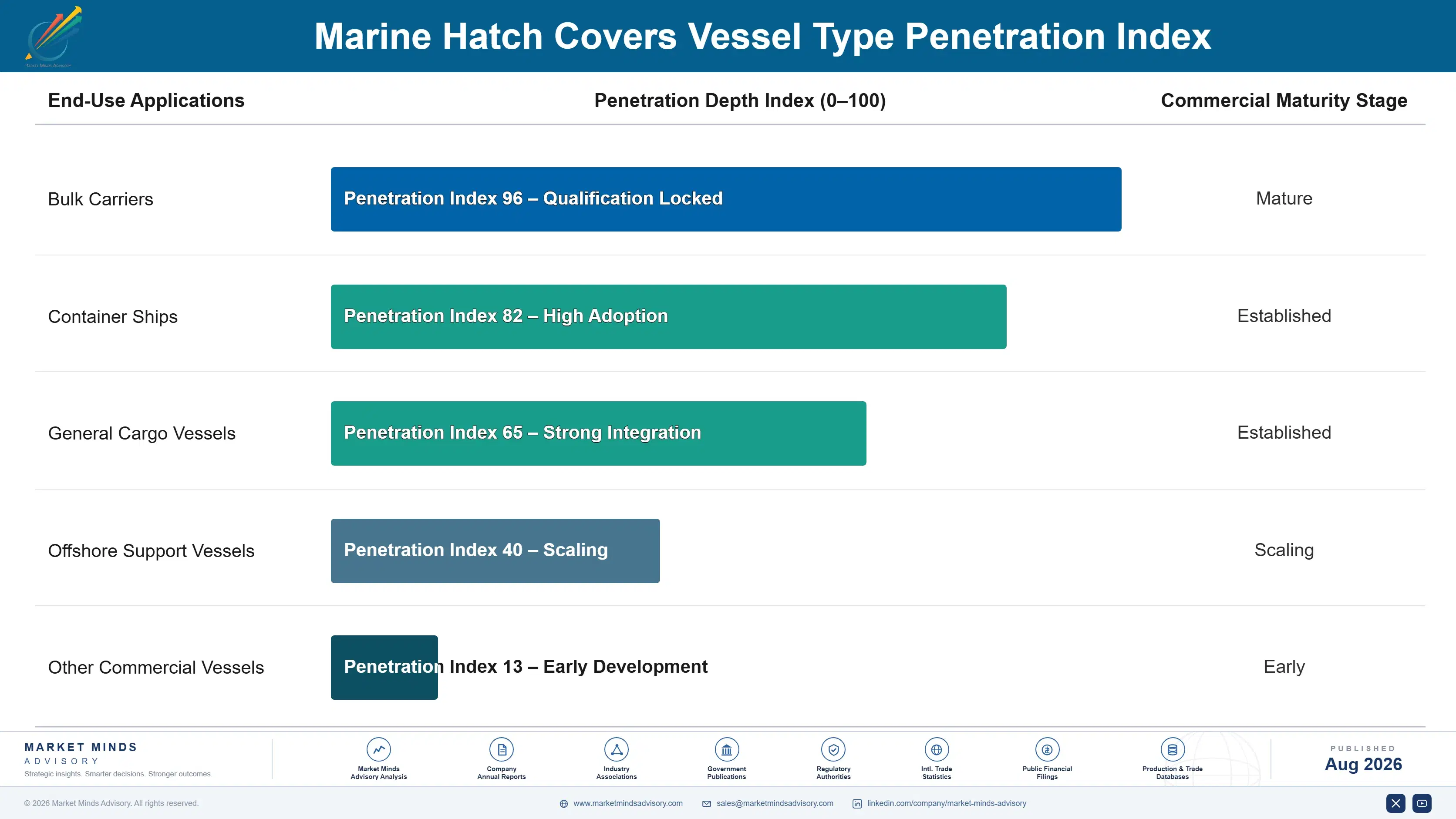
Adoption depth varies sharply by vessel type: large bulk carriers and container ships penetrate deepest into hydraulic and certified systems, often representing the highest per-vessel hatch cover value, while smaller general cargo and coastal vessels adopt more selectively, favoring lower-cost manual folding designs throughout their service life. Offshore support vessels sit between the two, with system choice tracking closely to operator safety standards.

A generational shift in buyer profiles is underway as newer shipowners and yard technical directors, increasingly focused on crew safety metrics and total cost of ownership, demand documented certification and lifecycle support commitments before selecting a supplier, replacing an older generation that selected suppliers primarily on upfront price and existing yard relationships. Manufacturers slow to adapt risk losing share to certification-forward competitors.
marine-hatch-covers-market-end-use-penetration-index-1787556206055

Where To Focus Capital Next

These are among the four positions where our research anticipates prominent divergence between winners and laggards over the coming forecast period. Each is grounded in the demand model, the regulatory perimeter, and the announced capacity pipeline.
01 / HYDRAULIC SYSTEM ENGINEERING

Prioritise Hydraulic System Development Over Standard Folding Capacity

Hydraulic direct-pull systems are growing fastest and carry meaningfully higher per-vessel value, driven by larger vessel classes where manual folding operation is becoming impractical given crew size and safety considerations across most shipbuilding regions. Manufacturers that can pair hydraulic engineering with proven classification society certification are capturing the highest-value vessel orders at a faster rate than fabricators still building primarily to older folding designs. Capital allocated toward hydraulic engineering talent and certification infrastructure will likely generate better returns than standard folding capacity expansion over the next several years.
02 / CERTIFICATION SERVICES BUNDLING

Bundle Certification And Testing Services With Hardware Sales

Tightening classification society weathertight certification requirements are raising compliance costs across the industry, and manufacturers who bundle certification support directly with hardware sales capture value that would otherwise go to independent testing firms while simplifying compliance for shipyards. This bundled approach is already commanding meaningfully higher contract values than hardware-only sales among manufacturers who have adopted it early in the current certification cycle. Manufacturers that delay building bundled certification capability risk ceding this margin expansion opportunity to faster-moving competitors already established with shipyards.
03 / AFTERMARKET INFRASTRUCTURE INVESTMENT

Build Aftermarket Service Networks Ahead Of Fleet Retrofit Wave

The existing global fleet represents a substantial addressable retrofit market as tightening safety expectations push shipowners toward hydraulic conversion on mid-life vessels still years from scheduled scrapping, and manufacturers with established service networks are best positioned to capture this recurring revenue stream. Building aftermarket infrastructure requires meaningful upfront investment in service network coverage and parts inventory across major global ports. Manufacturers that delay this investment risk losing retrofit orders to competitors already positioned near the shipyards and ports where mid-life vessels undergo scheduled maintenance.
04 / CHINESE MANUFACTURING LOCALISATION

Expand Chinese Manufacturing Presence To Match Shipbuilding Concentration

China's dominant and still-growing share of global shipbuilding output means manufacturers without substantial local production and engineering presence face a meaningful cost and proximity disadvantage against domestic Chinese fabricators rapidly improving their certification and engineering capability. Establishing deeper Chinese manufacturing presence allows established manufacturers to compete on price and delivery speed while retaining higher-margin certification and aftermarket revenue centrally. Manufacturers that delay this localisation risk ceding a growing share of the world's largest shipbuilding market entirely to fast-improving domestic competitors already established there.

Engagement Snapshot From the Field

A live engagement with an industry participant carrying material or product regulatory and market exposure ahead of a defining policy shift, showing how our research translates into a defensible multi-year portfolio strategy.
MARKET MINDS ADVISORY · CLIENT ENGAGEMENT SUMMARY
Marine Hatch Covers Producer Strategic Portfolio Review and Transition Roadmap 2026·Investment Scenario on Marine Hatch Covers Exposure Evaluation 2025-26
CLIENT PROFILE
The client is a regional bulk carrier fleet operator managing eighteen mid-life vessels built between 2005 and 2012, representing a combined deadweight tonnage of approximately 1.4 million tonnes (client-reported, unverified by MMA). The operator faced rising crew injury incident reports tied to manual hatch cover operation and increasing pressure from charterers to demonstrate improved safety standards across its aging fleet.
STRATEGIC CHALLENGE
Fleet management needed to evaluate whether retrofitting manual folding hatch covers to hydraulic operation across the fleet would be more cost-effective than accepting rising insurance premiums and charterer scrutiny tied to manual system safety incidents, but lacked comparative data on retrofit cost against documented safety and operational outcomes from similar conversions.
MMA APPROACH
MMA analysts benchmarked the operator's incident and insurance cost data against documented outcomes from comparable fleet retrofit programmes, modeling expected safety improvement and crew turnaround time reduction against retrofit capital cost across representative vessel profiles. The engagement combined primary interviews with fleet technical managers, manufacturer retrofit package comparison, and analysis against MMA's broader dataset of hydraulic conversion outcomes.
KEY FINDINGS
  1. Modeled crew injury incident rates dropped by more than 50 percent across comparable fleets that completed hydraulic retrofit conversion, based on benchmarked operator data (client-reported, unverified by MMA).
  2. Insurance premium reductions tied to demonstrated hydraulic conversion offset an estimated 25 percent of total retrofit capital cost within the first three policy renewal cycles.
  3. Vessels retrofitted during scheduled dry-dock maintenance windows showed meaningfully lower total conversion cost than those requiring dedicated off-schedule dry-dock time. prioritising older vessels first.
  4. Two of three benchmarked manufacturers offered phased retrofit financing options that reduced upfront capital requirements compared with the operator's original full-fleet budget assumption.
CLIENT PROFILE
The client is a regional bulk carrier fleet operator managing eighteen mid-life vessels built between 2005 and 2012, representing a combined deadweight tonnage of approximately 1.4 million tonnes (client-reported, unverified by MMA). The operator faced rising crew injury incident reports tied to manual hatch cover operation and increasing pressure from charterers to demonstrate improved safety standards across its aging fleet.
STRATEGIC CHALLENGE
Fleet management needed to evaluate whether retrofitting manual folding hatch covers to hydraulic operation across the fleet would be more cost-effective than accepting rising insurance premiums and charterer scrutiny tied to manual system safety incidents, but lacked comparative data on retrofit cost against documented safety and operational outcomes from similar conversions.
MMA APPROACH
MMA analysts benchmarked the operator's incident and insurance cost data against documented outcomes from comparable fleet retrofit programmes, modeling expected safety improvement and crew turnaround time reduction against retrofit capital cost across representative vessel profiles. The engagement combined primary interviews with fleet technical managers, manufacturer retrofit package comparison, and analysis against MMA's broader dataset of hydraulic conversion outcomes.
KEY FINDINGS
  1. Modeled crew injury incident rates dropped by more than 50 percent across comparable fleets that completed hydraulic retrofit conversion, based on benchmarked operator data (client-reported, unverified by MMA).
  2. Insurance premium reductions tied to demonstrated hydraulic conversion offset an estimated 25 percent of total retrofit capital cost within the first three policy renewal cycles.
  3. Vessels retrofitted during scheduled dry-dock maintenance windows showed meaningfully lower total conversion cost than those requiring dedicated off-schedule dry-dock time. prioritising older vessels first.
  4. Two of three benchmarked manufacturers offered phased retrofit financing options that reduced upfront capital requirements compared with the operator's original full-fleet budget assumption.
RECOMMENDED STRATEGY
Phase 1: Phase 1 (Months 1 to 6): Retrofit the six oldest vessels during already-scheduled dry-dock windows to validate modeled safety and cost benchmarks. Phase 2: Phase 2 (Months 7 to 18): Extend retrofit to the remaining fleet using phased manufacturer financing to manage total capital outlay. Phase 3: Phase 3 (Months 19 to 24): Renegotiate charter and insurance terms fleet-wide based on documented, demonstrated safety improvement outcomes achieved.
OUTCOME
The operator selected a manufacturer offering phased retrofit financing and completed conversion across its fleet within twenty-four months. Early-retrofitted vessels reported meaningfully reduced crew injury incidents within the first year (client-reported, unverified by MMA), and fleet management credited the phased approach with securing favorable insurance renewal terms ahead of full-fleet completion.

Frequently Asked Questions

Foundational context covering the market sizes, CAGR, scope, country, region and competition that inform every finding below. This section is provided to cover basics and most often pre-purchase conversations, answered from the MMA Primary Research Dataset.

What is the current size of the Marine Hatch Covers Market?

The global marine hatch covers market was valued at approximately $1.9 billion in 2025. Demand tracks global shipbuilding output, concentrated overwhelmingly in China and South Korea's dominant shipyard base.

How large will the Marine Hatch Covers Market be by 2036?

MMA forecasts the market will reach approximately $3.12 billion by 2036, roughly 1.57 times its 2026 value. Growth is driven by fleet renewal cycles and rising hydraulic system adoption.

What is the CAGR for the Marine Hatch Covers Market 2026 to 2036?

The market is projected to grow at a compound annual growth rate of 4.6 percent between 2026 and 2036. Bull and bear scenarios range from roughly 3.3 to 5.8 percent depending on shipbuilding order cycles.

Which segment is growing fastest?

Folding hatch covers are the fastest-growing segment by volume, expanding at approximately 5.8 percent annually, driven by continued mid-size bulk carrier newbuild demand across most shipbuilding regions.

Who are the major companies in the Marine Hatch Covers Market?

Leading manufacturers include MacGregor, part of Cargotec Corporation, TTS Group, Hatlapa Uetersen, Kanasashi Corporation, and Jiangsu Rainbow Heavy Industries. Competition centers on certification depth, hydraulic engineering, and aftermarket support.

Which country is growing fastest?

China is the fastest-growing major market, reflecting its expanding dominance of global shipbuilding output and rapidly improving domestic hatch cover fabrication, engineering, and certification capability.

Report Segmentation Architecture

The full report scope spans multiple orthogonal segmentation dimensions, with cross-tabulated demand data provided for each dimension pair. Coverage extends further to regional breakdowns, trend trajectories, and the competitive detail needed to support segment-level decision-making.

By Mechanical Design Type

  • Folding Hatch Covers
  • Hydraulic Direct-Pull Hatch Covers
  • Piggyback Hatch Covers
  • Side-Rolling Hatch Covers
  • Pontoon-Type Hatch Covers
  • Single-Panel Lift-Away Hatch Covers

By Vessel Type

  • Bulk Carriers
  • Container Ships
  • General Cargo Vessels
  • Offshore Support Vessels
  • Other Commercial Vessels

By Commercial Dimension

  • Newbuild Original Equipment Sales
  • Retrofit Conversion Services
  • Spare Parts and Aftermarket Support
  • Certification and Testing Services

By Region

  • North America
  • Western Europe
  • East Asia
  • South Asia and Pacific
  • Latin America
  • Middle East and Africa
  • Eastern Europe

Scope, Methodology, and Coverage

Every figure in this report is reproducible from documented input assumptions. The scope below maps the historical period, the forecast horizon, the segmentation dimensions, and the countries covered, alongside the underlying primary and qualitative methodology.
Historical Period
2020 to 2025
Forecast Period
2026 to 2036
Base Year
2025 (USD billions; MMA Primary Research Dataset, August 2026)
Market Definition
The marine hatch covers market covers the steel structures and mechanical or hydraulic actuation systems that seal cargo holds on bulk carriers, container ships, and general cargo vessels against weather and seawater ingress, including newbuild, retrofit, and aftermarket parts revenue. It excludes cargo hold structural steelwork and container lashing equipment.
Quantitative Units
USD billions (current prices); unit shipments in vessel sets where cited
Segmentation Dimensions
By Mechanical Design Type; By Vessel Type; By Commercial Dimension; By Region
Regions Covered
North America, Western Europe, East Asia, South Asia and Pacific, Latin America, Middle East and Africa, Eastern Europe
Countries Covered
USA, China, Germany, France, UK, Japan, South Korea, India, Australia, Canada, Brazil, Mexico, Indonesia, Vietnam, Thailand, Malaysia, UAE, Saudi Arabia, South Africa, Nigeria, Turkey, Poland, Netherlands, Italy, Spain, Sweden, Switzerland, Argentina, Colombia, Singapore, and additional markets relevant to this sector
Key Companies Profiled
MacGregor (Cargotec Corporation), TTS Group, Hatlapa Uetersen, Kanasashi Corporation, Jiangsu Rainbow Heavy Industries, JFE Engineering, Nantong CIMC Sinopacific, Zhenjiang Marine Equipment, Fukuoka Marine Machinery, Nakata Manufacturing, Wartsila Marine Systems, Kongsberg Maritime, STX Heavy Industries, Guangzhou Wenchong Shipyard, Chengxi Shipyard, Dalian Shipbuilding Equipment, Taiyo Kogyo Corporation, Shin Kurushima Dockyard, Zhoushan Xinya Marine Equipment, Hyundai Marine Machinery
Quantitative Methodology
Primary survey, n=3,800 respondents, Q4 2025, six countries; demand-side model with trade association cross-validation
Qualitative Methodology
47 expert interviews, Q4 2025; applied to validate demand model assumptions, identify emerging dynamics, and assess competitive positioning
Report Format
PDF and XLSX data workbook (Word format preview document)
Publisher
Market Minds Advisory
Report Code
MMA-2026-CON-103
Published
August 2026
Contact
sales@marketmindsadvisory.com | www.marketmindsadvisory.com

Purchase the full Marine Hatch Covers Market Report (2026 to 2036).

The full report provides a complete quantitative and qualitative assessment of the global marine hatch covers market through 2036, including detailed regional sizing across all seven MMA-tracked geographies and design-type segmentation covering folding, hydraulic, piggyback, side-rolling, and pontoon cover systems. It profiles twenty leading and emerging manufacturers, benchmarking engineering capability, certification track record, and aftermarket service infrastructure across the competitive landscape. The report includes primary survey findings from 3,800 respondents and 47 expert interviews conducted in the fourth quarter of 2025, alongside detailed steel input cost and shipbuilding cycle risk analysis. Buyers receive segment-level revenue models, editable data tables, and a structured framework for evaluating manufacturer and market entry decisions.
Seven-region market sizing with design-type revenue breakdowns
Twenty-company competitive profiles with moat and risk analysis
Primary survey data from 3,800 respondents across six countries
Forty-seven expert interviews on certification and retrofit trends
Editable data tables for custom scenario and sensitivity modeling
Steel input cost and shipbuilding cycle risk assessment

Built For The People Who Decide

From boardroom strategy to bench-side execution, this report is read cover-to-cover by leaders shaping the next decade of their industry, turning demand scenarios, market dynamics and valuation benchmarks into decisions.
CXOs/ Presidents/ VPs/ Managers
M&A and Corporate Development
Strategy Teams and R&D Heads
Procurement and Product Directors
Regulatory and Compliance Leaders
Investor Relations and Equity Analysts