Market Minds Advisory
Marine Fin Stabilizer Market

Marine Fin Stabilizer Market: Zero-speed capability, gyroscopic competition and Korean equipment localisation to 2036

Korean yards build roughly a quarter of the world's ship tonnage and buy almost every stabiliser system that goes into those hulls from somebody else, which government policy is now trying to change.

Lead Analyst

David Horsley

Published

September 2026

Make Smarter Decisions with Customized Research Insights

Request a free sample report and evaluate market opportunities, growth trends, and competitive dynamics relevant to your business needs.

2025 MARKET VALUE$0.7BMarket Size 2025
2036 FORECAST VALUE$1.6BBase Case , 2026 to 2036
CAGR 2026 TO 20367.6 %Bull 8.8% / Bear 6.3%
INCREMENTAL OPPORTUNITY$0.8BNet 10- year value creation
EXPANSION MULTIPLE2.08x2036 value over 2026 base
Strategic Levers
M&A Pipeline
Regional Outlook
Country Rankings
Competitive Intelligence
Segmental Deep-dive
Call-Us : 91 93563 13602

Executive Snapshot and Market Trajectory

Fin stabilisers used to work only when a vessel was moving, which made them a seakeeping device for passages. Zero-speed systems flap the fins to generate lift while stationary, cutting roll at anchor by around 85%,. That turned marine engineering into a luxury amenity.
Zero-speed capable fin systems grow at 11.4%, half again the market rate of 7.6%, because owners spend far more time anchored than under way and nobody had solved comfort at rest before. East Asia holds 28% of value on Korean, Chinese and Japanese shipbuilding volume together. Korean yards construct roughly 27% of global tonnage and import about 71% of these systems. Almost none are built there. That gap is what policy is aimed at closing.
Five manufacturers hold 63% of system supply and the concentration follows control engineering rather than mechanical capability, since making a fin move is easy and making it move correctly against a sea state is not. Korean equipment localisation policy is targeting exactly this kind of high-value imported component. Whether it succeeds depends on control software rather than on any manufacturing question at all. Software is the whole barrier.
Market Definition
This report covers marine motion control systems supplied for commercial, naval and recreational vessels, spanning underway-only retractable fin systems, zero-speed capable fin systems, non-retractable fixed fin systems, gyroscopic stabiliser units, anti-roll tank systems, and interceptor and trim tab systems. The Korean market is the analytical centre throughout, with global demand covered for context. Value is measured at manufacturer level. Excluded are propulsion and steering systems, dynamic positioning, hull structures, and vessel construction itself.
Base Year Value
$0.7B in 2025 (MMA Primary Research Dataset, August 2026)
Forecast Period
2026 to 2036, eleven discrete annual values
CAGR
7.6% base case. Bull 8.8%. Bear 6.3%.
Fastest Growth Segment
Zero-Speed Capable Fin Systems: 11.4% CAGR
Fastest Growth Country
India: 10.4% CAGR
Fastest Growth Region
South Asia and Pacific: 9.8% CAGR
Largest Region
East Asia: 28% of 2025 global value
Market Leaders
Naiad Dynamics, Quantum Marine Stabilizers, CMC Marine, Seakeeper and Humphree lead the market. Source: MMA Primary Research Dataset, July 2026.
Primary Survey
n=3,800 procurement and R&D decision-makers, Q4 2025, six countries
Methodology
Demand-side build-up, cross-validated against public data, 47 expert interviews

Marine Fin Stabilizer Market Forecast Scenarios

marine-fin-stabilizer-industry-analysis-in-korea-size-forecast-scenario-1787555441982
Growth ran at 6.4% between 2020 and 2025 and superyacht construction carried most of it, since that segment specifies stabilisation universally and pays for the most capable systems available. Commercial newbuild demand tracked shipbuilding cycles and contributed little growth. Zero-speed capability moved from an expensive option to an expected feature across large yachts during the period, which lifted value per installation considerably faster than unit volumes rose.
The 7.6% base case rests on three mechanisms. Zero-speed capability keeps spreading downward through vessel sizes at 11.4% as owners discover the difference it makes at anchor rather than under way. Offshore wind crew transfer requires motion control for safe personnel transfer, which is a genuinely new commercial application growing with turbine installation. And naval programmes across Asia keep expanding, where stabilisation enables helicopter operations and weapon accuracy in higher sea states.
The 8.8% bull case is Korean equipment localisation succeeding and creating a domestic supply industry that competes on price into commercial newbuild globally. The 6.3% bear case is gyroscopic systems continuing to move upward through vessel sizes, since they need no hull penetration, no appendage drag and retrofit into existing hulls far more easily than fins.

The Device That Changed Its Job

A conventional fin stabiliser generates lift by moving through water, which means it does nothing whatever when a vessel stops. For most of this product's history that was accepted as physics, and stabilisation meant making crossings tolerable. Zero-speed systems flap the fins actively to generate lift from still water, cutting roll at anchor by around 85%. That changed what the product is for, because a yacht owner spends the overwhelming majority of their time at anchor rather than under way.
TOP-FIVE CONCENTRATION63%Combined position across stabiliser system supply held by leaders
ROLL REDUCTION AT ANCHOR85%Motion reduction zero-speed systems deliver while a vessel sits still
GYROSCOPE SIZE CEILING30 mVessel length above which internal gyroscopic units stop scaling
KOREAN NEWBUILD SHARE27%Portion of global vessel tonnage constructed in Korean yards
IMPORTED EQUIPMENT SHARE71%Portion of stabiliser systems Korean yards source from abroad
RETROFIT INSTALLATION SHARE34%Share of systems fitted to vessels already in service
Gyroscopic units compete from below and the boundary between the two technologies is genuinely technical rather than commercial. An internal gyroscope needs no hull penetration, adds no drag and retrofits in a way fins never will, which makes it obvious on smaller craft. Its mass scales badly against the righting moment a larger hull requires, which puts a practical ceiling near 30 metres. Above that, fins win by default rather than by argument.
Korean yards build roughly 27% of global tonnage and import around 71% of these systems, which is the kind of gap industrial policy notices. The technology is mature, the value per system is substantial and the manufacturing is unremarkable. The control software is not.
"The zero-speed patent did more for this industry than fifty years of hydrodynamic refinement, because it stopped selling seasickness prevention and started selling a quiet evening at anchor. One of those is a grudge purchase and the other is not."
Director, Marine Systems and Vessel Equipment Practice · MMA Construction and Industrial Practice · August 2026

Market Trends

Zero-speed capability spreads downward through vessel sizes

Active flapping generates lift from still water rather than from forward motion, which cuts roll at anchor by around 85% and addresses the condition owners actually experience most of the time. That capability began on large superyachts where cost was irrelevant and has moved steadily down through vessel sizes as control hardware got cheaper and hydraulic power requirements fell. Growth at 11.4% follows that descent rather than any expansion in the vessel population. The commercial consequence is that value per installation rises faster than unit volume, and buyers who once treated stabilisation as optional now specify it first.
Market Impact: Targets 71% imported system share

Gyroscopic systems press upward against the fin segment

An internal gyroscopic unit needs no hull penetration, generates no appendage drag and installs into a finished vessel without any underwater work, which makes it dramatically easier to retrofit than fins. Those advantages have taken most of the market below roughly 30 metres and manufacturers keep pushing the ceiling upward with larger units. The physics resists, since gyroscope mass scales badly against the righting moment a bigger hull needs and the weight penalty becomes unacceptable. Fin manufacturers treating that boundary as permanent are relying on a limit that engineering has moved twice already.
Market Impact: Extends workable sea states 30%

Market Opportunities and Growth Drivers

Korean equipment localisation targets high-value imported systems

Korean yards construct roughly 27% of global vessel tonnage while importing around 71% of the stabilisation systems fitted into those hulls, and government industrial policy has identified marine equipment localisation as a priority across exactly this kind of component. The value per system is substantial, the mechanical manufacturing is well within Korean capability and the domestic customer base is captive. What stands in the way is control engineering, since the difficulty in this product is software responding to a sea state rather than hydraulics moving a fin. Several Korean programmes are addressing that directly.
Market Impact: Excludes most of 34% retrofit

Offshore wind transfer vessels require motion control for safety

Transferring technicians from a moving vessel to a fixed turbine ladder is the most dangerous routine operation in offshore wind, and vessel motion decides whether it happens at all on a given day. Motion control extends the workable sea state window, which converts directly into turbine availability and maintenance throughput. That makes stabilisation a revenue calculation for the vessel operator rather than a comfort preference. Crew transfer vessel construction keeps expanding with turbine installation across Europe and increasingly Asia, and every one of those vessels carries a motion control specification the previous generation lacked.
Market Impact: Keeps 63% with five suppliers

Market Restraints and Challenges

Fin installation requires hull penetration and dry docking

Fitting fins means cutting the hull, installing housings and actuators below the waterline, and doing all of it with the vessel out of the water. The root cause is that the fin has to be in the water to work, which no design revision changes. Commercially this excludes fins from most retrofit opportunities and hands that 34% of installations largely to gyroscopic and interceptor systems that install internally. Manufacturers are responding with lighter housings and simplified fits that reduce dry dock time, though none of it removes the fundamental requirement to lift the vessel out.
Market Impact: Cuts roll at anchor by 85%

Control software rather than hardware limits new entrants

Moving a fin is straightforward hydraulics and any competent engineering company can build the mechanism, which is why the concentration in this market surprises people who look only at the hardware. The root cause of the barrier is the control algorithm, which must predict vessel response across sea states, headings and loading conditions and act before the roll develops rather than after. Commercially this has kept the field narrow despite unremarkable manufacturing. Entrants including Korean programmes are addressing it through sea trial data accumulation, which takes years and cannot be shortened by capital alone.
Market Impact: Holds below a 30 metre ceiling
3 additional market trends, 4 additional growth drivers, and 2 additional restraints and challenges are covered in the full report. Contact sales@marketmindsadvisory.com to access the complete intelligence.

Segment CAGR and Growth Architecture

Systems are classified here by stabilisation mechanism, since that determines the vessel sizes served, the installation requirements and whether retrofit is possible at all. Vessel type, application sector and supply arrangement are handled separately in the framework, because one mechanism serves commercial, naval and recreational vessels without any change in how it works. Mechanism decides reach.
marine-fin-stabilizer-industry-analysis-in-korea-market-share-analysis-1787555442520

Zero-Speed Capable Fin Systems

Growing at 11.4%, half again the market rate, zero-speed capability rewrote what this product does. Conventional fins generate lift from forward motion and therefore do nothing at anchor, which was accepted as physics for decades. Active flapping generates lift from still water and cuts roll at rest by around 85%, addressing the condition that owners spend most of their time in rather than the passage they occasionally make. The capability started on large superyachts where cost did not matter and has descended steadily through vessel sizes as control hardware cheapened and hydraulic power requirements fell. Buyers who once treated stabilisation as an option now specify it before the interior. Nothing else moved demand.
CAGR 11.4%

Gyroscopic Stabiliser Units

A spinning gyroscope inside the hull produces a righting moment without touching the water, which means no hull penetration, no appendage drag and no dry docking to install. Those advantages make retrofit straightforward where fins make it nearly impossible, and they have given gyroscopes most of the market below roughly 30 metres. Growth at 9.8% follows both new construction and the retrofit business fins cannot reach. The constraint is physics rather than engineering ambition: gyroscope mass scales badly against the righting moment larger hulls demand, and the weight becomes unacceptable. Manufacturers keep pushing that ceiling upward and have moved it twice already. Fin manufacturers treating that ceiling as fixed are relying on an assumption engineering keeps disproving.
CAGR 9.8%
Full segment breakdown across 6 segments available in the complete report.

Regional Architecture and Country Demand Map

East Asia holds 28% of value on Korean, Chinese and Japanese shipbuilding volume, though most systems fitted there are imported. Western Europe follows at 26% because that is where the technology and the superyacht construction both sit. Building hulls and building stabilisers happen in different places.

East Asia

Korea is the analytical centre of this report and the reason is a gap rather than a strength: Korean yards build roughly 27% of global vessel tonnage while importing around 71% of the stabilisation systems fitted into those hulls. Government marine equipment localisation policy has identified exactly this kind of high-value component, and several domestic programmes are working on the control engineering that constitutes the actual barrier. Chinese shipbuilding volume is larger still and follows a similar import pattern with domestic substitution advancing faster. Japanese manufacturers hold genuine capability in marine control systems. Growth at 8.6% is the fastest large-region figure here and combines construction volume with domestic capability building.
Share: 28% | CAGR: 8.6% (2026 to 2036)

Western Europe

The technology and the highest-value customers both sit here, which is unusual and explains a 26% share against modest shipbuilding tonnage. Italian, Dutch and German superyacht construction specifies stabilisation universally and pays for the most capable systems available, which funds the development everybody else eventually benefits from. Italian and Northern European stabiliser manufacture holds the deepest control engineering capability anywhere. Cruise ship construction across Italy, France, Germany and Finland consumes large fin systems that no other vessel type requires. Growth at 6.0% is the weakest of the seven regions and reflects mature construction volumes rather than any technology position weakening. Development funded here eventually reaches every other market listed. Nobody else funds it.
Share: 26% | CAGR: 6.0% (2026 to 2036)
Regional intelligence for 5 additional markets available in the complete report: North America, South Asia and Pacific, Latin America, Middle East and Africa, Eastern Europe. Contact sales@marketmindsadvisory.com.
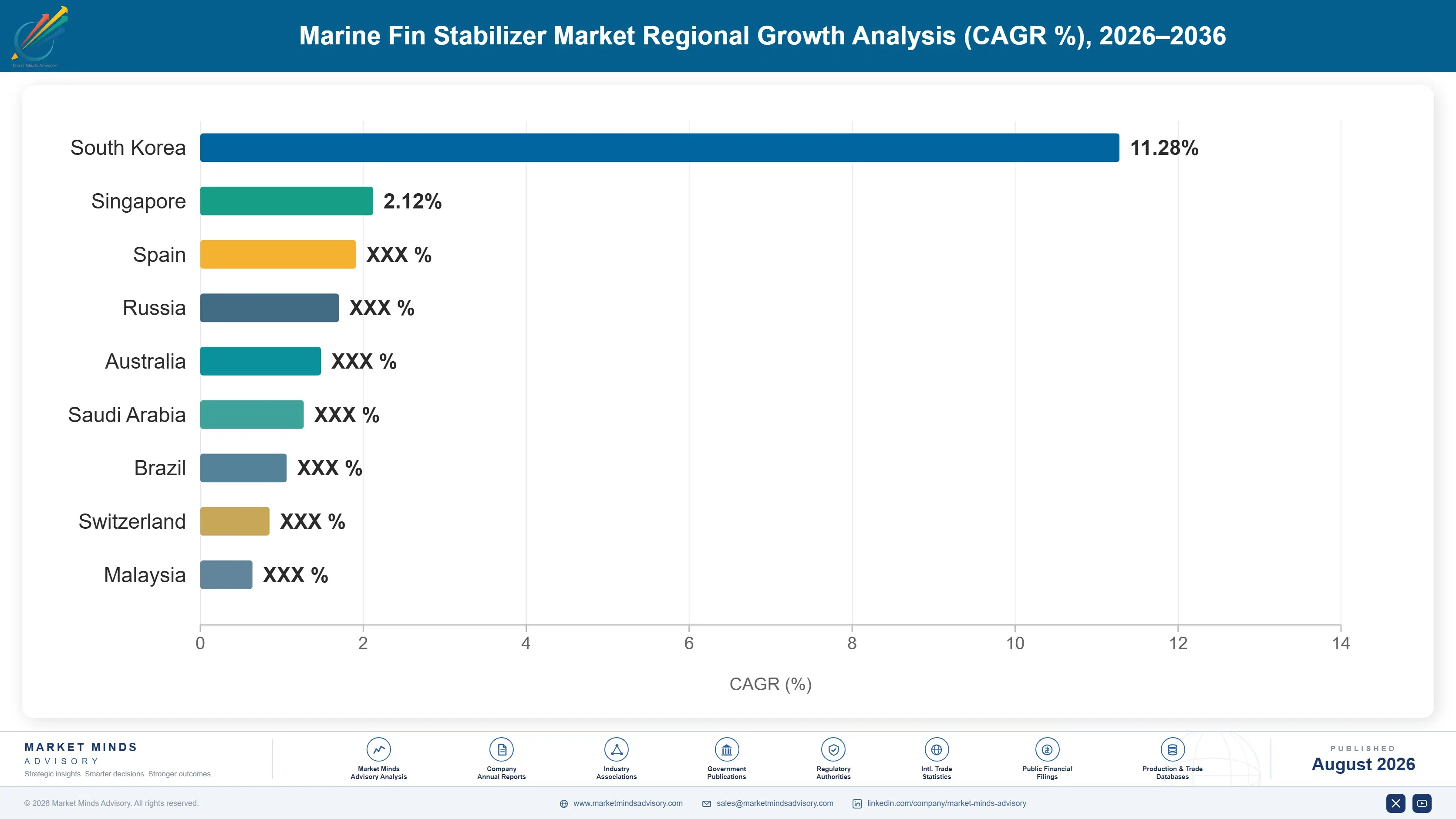
marine-fin-stabilizer-industry-analysis-in-korea-country-cagr-analysis-1787555443043

Where Stabiliser Margin Actually Sits

Four moves matter in a market where the hardware is straightforward, the software is not, and a quarter of the world's hulls get built somewhere that buys almost every system from abroad. Two are about defending the control engineering barrier, and two are about the installations fins currently cannot reach. Competing on mechanical cost is not among them.

Defend the control barrier with sea trial data

Making a fin move is ordinary hydraulics and any competent engineering firm can do it, which is why concentration at 63% surprises anybody examining only the hardware. The barrier is the control algorithm predicting vessel response across sea states, headings and loading conditions and acting before roll develops. That capability comes from accumulated sea trial data across vessel types and cannot be purchased or shortened with capital. Manufacturers treating their advantage as mechanical are defending the wrong asset entirely, and the ones investing in data accumulation are widening a gap competitors cannot close quickly.
Market Impact: Protects the full 63% held by 5 suppliers

Sell comfort at anchor rather than passage seakeeping

Zero-speed systems cut roll at rest by around 85%, and owners spend the overwhelming majority of their time anchored rather than under way. Manufacturers still presenting seakeeping performance on passage are describing a condition the customer rarely experiences and never enjoys anyway. Presenting a quiet evening at anchor reaches an emotional purchase rather than a technical comparison, which is why zero-speed compounds at 11.4% while conventional systems grow at a fraction of that. The specification decision has moved from the naval architect to the owner, and remarkably few manufacturers have adjusted how they sell.
Market Impact: Delivers a full 85% roll reduction while stationary

Build a retrofit route that avoids dry docking

Retrofit accounts for 34% of installations and fins reach almost none of it, because fitting them means cutting the hull below the waterline with the vessel out of the water. Gyroscopic and interceptor systems take that business by default rather than by being better. Manufacturers developing externally mounted, lighter or partially internal fin arrangements that reduce or remove dry dock time would contest a third of the market they currently concede without a fight. The engineering is difficult and the commercial prize is a segment growing steadily where fin manufacturers currently have no product at all.
Market Impact: Contests a full 34% of all system installations

Establish Korean naval and commercial specification presence

Korean yards build roughly 27% of global tonnage and import around 71% of these systems, and government localisation policy is actively working to close that. Suppliers currently selling into those yards face a domestic substitution programme aimed directly at them and have limited time to establish positions that survive it. Local partnership, technology arrangements or manufacturing presence convert a threatened import position into a durable one. Suppliers waiting to see whether the policy succeeds will find the decision made without them, since localisation programmes rarely reverse once capability exists. Timing decides everything here.
Market Impact: Protects access to 27% of world vessel tonnage

Who Controls the Margin Pool

Five manufacturers hold 63% of stabiliser system supply, measured on system revenue at manufacturer level, the basis used throughout this section. That concentration follows control engineering rather than manufacturing, since moving a fin is ordinary hydraulics while making it act correctly against a developing sea state requires algorithms built on years of accumulated trial data. The gap between leaders and everybody else is software and validation rather than any mechanical advantage.
Competition runs on three dimensions. Control performance, which owners judge subjectively and naval architects judge on measured roll reduction. Installation practicality, since anything requiring dry docking loses the retrofit business entirely. And service network reach, because a stabiliser failure in a remote anchorage is a serious problem. Price competes hardest in commercial newbuild tenders. Service reach decides more than most manufacturers admit.

Rankings shift where gyroscopic systems push upward through vessel sizes, which has already taken most of the market below 30 metres from fin manufacturers. Korean localisation would redistribute commercial newbuild positions considerably if the control engineering succeeds. Superyacht positions hold longest, since owners buy on reputation and reference vessels rather than on specification. Reputation travels between owners.
marine-fin-stabilizer-industry-analysis-in-korea-company-positioning-matrix-1787555443565

Competitive Moat and Risk Dimensions

NAIAD DYNAMICS

Moat: Control algorithm and validation

Naiad holds control engineering and sea trial validation data accumulated across decades and across vessel types from patrol craft to cruise ships, which cannot be bought or accelerated with capital. A competitor builds the hydraulics in a year and cannot replicate the response data in ten.
NAIAD DYNAMICS

Risk: Fin technology segment erosion

The business is built on fin systems, and gyroscopic units have taken most of the market below 30 metres while manufacturers keep pushing that ceiling upward with larger designs. Fins also reach almost none of the 34% retrofit business because of dry docking requirements. Both pressures narrow the addressable vessel population rather than merely increasing competition within it.
SEAKEEPER

Moat: Retrofit installation simplicity

A gyroscopic unit installs inside a finished vessel with no hull penetration and no dry docking, which opens the entire retrofit market that fin systems cannot physically reach. That makes it the default for owners upgrading existing boats, a decision made quickly rather than through any specification process.
SEAKEEPER

Risk: Physics limits vessel scaling

Gyroscope mass scales badly against the righting moment larger hulls require, which puts a practical ceiling near 30 metres that engineering has moved twice and cannot move indefinitely. The highest-value vessels sit above it entirely. Competitors serving large yachts, cruise ships and naval vessels operate in a segment this technology may never reach at acceptable weight.

Players Tracked

Prominent Players

Naiad Dynamics
Quantum Marine Stabilizers
CMC Marine
Seakeeper
Humphree

Other Key Players

Sleipner Motor
Wesmar
Kongsberg Maritime
Mitsubishi Heavy Industries
Kawasaki Heavy Industries
Tokyo Keiki
HD Hyundai Heavy Industries
Samsung Heavy Industries
Hanwha Ocean
Wuxi Baoyi Machinery
DMS Holland
Veth Propulsion
Smartgyro
ARG Marine
Nakashima Propeller

Recent Developments

MARCH 2025

A Korean programme targeted domestic stabiliser control development

A Korean marine equipment programme directed funding toward domestic development of stabiliser control systems, addressing the software capability that constitutes the genuine barrier rather than the hydraulic hardware. This was a government-supported development initiative rather than any commercial transaction between companies. Hardware was never the obstacle.
Signal: The programme targets control software rather than mechanical manufacture, which suggests somebody correctly identified where the difficulty sits
AUGUST 2025

A gyroscopic manufacturer released a larger unit for bigger vessels

A gyroscopic stabiliser manufacturer introduced a larger unit extending the technology further up the vessel size range, pressing against the practical ceiling that mass scaling imposes. This was a product launch rather than any acquisition or partnership arrangement between the parties. Mass scaling remains the limit.
Signal: The size ceiling keeps moving upward, which means fin manufacturers treating 30 metres as permanent are relying on an assumption
JANUARY 2026

An offshore wind operator specified motion control across a vessel fleet

An offshore wind operator specified motion control systems across a crew transfer vessel fleet, citing personnel transfer safety and workable sea state windows rather than crew comfort. This was a fleet procurement specification rather than any transaction between equipment manufacturers. Turbine availability drove it. Comfort was never mentioned.
Signal: Motion control is bought as an operability calculation rather than a comfort feature, which is a far stronger position

What Moves System Cost

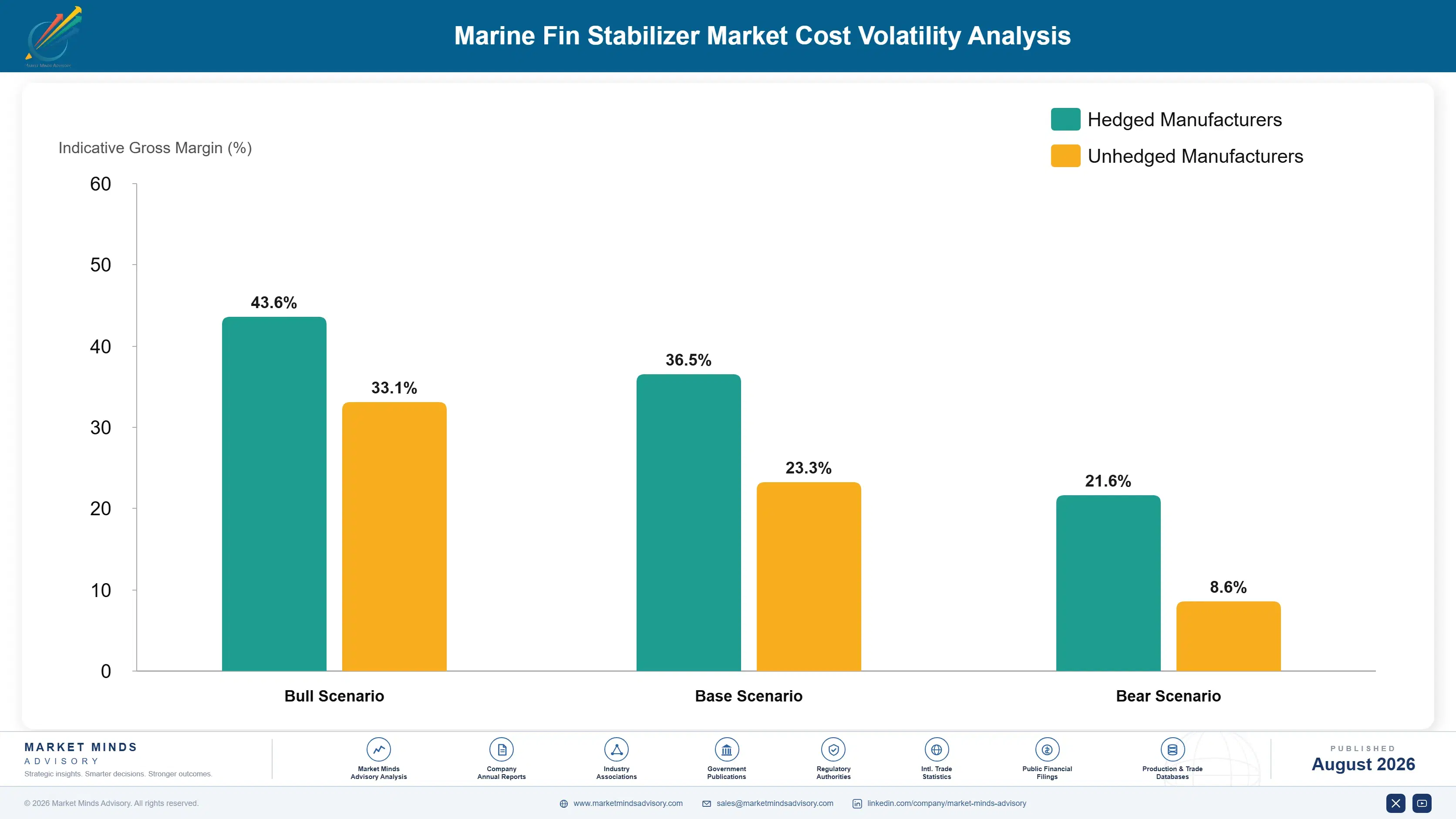
Hydraulic components, actuators and control electronics account for around 46% of system cost, purchased from industrial suppliers serving many sectors. Fin castings and machined housings in stainless or bronze make up a substantial further share. Control software development is amortised across units rather than appearing as a direct cost. Installation engineering and commissioning labour is significant and frequently underestimated.
Stainless steel and bronze prices moved sharply through 2021 and 2022 alongside broader metals inflation, and hydraulic component lead times extended severely across the same period as industrial supply chains failed. Kongsberg recorded component availability and cost pressure across its maritime operations in its Annual Report 2022. Manufacturers holding fixed-price newbuild contracts against multi-year construction schedules absorbed most of the movement, since a shipyard does not reopen equipment pricing mid-build.

Lead time rather than price is the genuine exposure here. A stabiliser system delivered late holds up a vessel delivery worth far more than the system itself, and yards impose penalties reflecting that. Manufacturers carrying component inventory against long-lead hydraulic and electronic items protect a schedule commitment that matters considerably more than any margin point. Those relying on just-in-time supply discovered the difference expensively.
marine-fin-stabilizer-industry-analysis-in-korea-cost-volatility-analysis-1787555443760

Hold inventory against long lead hydraulic components

A stabiliser arriving late delays a vessel delivery worth many times the system value, and yards write penalties reflecting that asymmetry directly into contracts. Carrying inventory on long-lead actuators, valves and control electronics costs working capital and protects a schedule commitment that dwarfs it. Manufacturers who relied on just-in-time supply through recent disruptions generally rebuilt their inventory policy afterwards.

Index newbuild contracts against published metals benchmarks

Stainless and bronze castings represent a substantial share of system cost and vessel construction schedules run across several years, which makes a fixed equipment price a bet on metals markets nobody chose to place. Indexing to published benchmarks with periodic reset removes it. Yards resist because their own vessel pricing is fixed, which makes this a real negotiation.

Amortise control development across the whole product range

Control software is the actual product and it is developed once and deployed across every system size, which means treating it as a per-project cost misprices the entire range. Manufacturers charging development to individual programmes discourage exactly the investment that defends their position. Recognising it as a platform asset amortised across units reflects how the technology genuinely behaves commercially.

Portfolio Architecture for Margin Defence

Margin here tracks control capability and vessel value rather than system size, which is not how the hardware would suggest. Commercial newbuild fin systems run at gross margins in the low twenties against tender competition where yards buy on price and specification compliance. Naval and offshore systems run considerably better on validation requirements and service obligations. Superyacht zero-speed systems and retrofit installations run higher again, because the buyer is an owner rather than a purchasing department.
The tension is that commercial newbuild fills the order book while yacht and retrofit business earns the returns, and the two reach entirely different buyers through entirely different channels. A shipyard purchasing manager and a yacht owner share no decision criteria at all. Manufacturers serving both from one commercial organisation have generally found the tender business consuming the engineering attention that owner-facing products needed, which shows up as slower product development where margin actually lives.

High-value pools sit in zero-speed superyacht systems, retrofit installations and naval validation positions. None of the three is where the tonnage is. Manufacturing capacity by itself defends nothing in a market where the difficult part is software.

Volume / Commodity-Adjacent

Commercial newbuild fin systems supplied into shipyard tenders where purchasing departments buy on price and specification compliance rather than on performance nuance. The eight-point range separates manufacturers with component inventory protecting schedule from those exposed to lead time penalties.
Gross Margin: 18%-26%

Premium / Certified

Naval, patrol and offshore systems where validation records, service obligations and sea state performance requirements narrow the qualified supplier field considerably. The ten-point spread reflects depth of accumulated trial data, which no capital investment substitutes for.
Gross Margin: 30%-40%

Sustainability / Regulatory / Next-Generation

Zero-speed superyacht systems and retrofit installations sold to owners rather than to purchasing departments. The eighteen-point range is wide because an owner buying comfort at anchor is making an emotional decision that no tender process constrains at all.
Gross Margin: 38%-56%
marine-fin-stabilizer-industry-analysis-in-korea-portfolio-architecture-1787555444267

High-value Sub-segments and Strategic Watch-out

Zero-Speed Superyacht Systems

Compounding at 11.4% by cutting roll at anchor around 85%, which addresses where owners actually spend their time rather than the passages they occasionally make. The buyer is an owner rather than a purchasing department, and prices accordingly. Nothing about the passage argument sells this.
Gross Margin: 40%-56%

Retrofit Installation Access

Thirty-four percent of installations go into existing vessels, and fins reach almost none of it because fitting them requires dry docking. Gyroscopic systems take that business by default rather than by merit, which fin manufacturers concede without contest. Contesting it requires engineering nobody has funded properly.
Gross Margin: 34%-50%

Commercial Newbuild Tenders

The order book volume, bought by shipyard purchasing departments on price and compliance, and now the direct target of Korean localisation policy. Manage it for capacity utilisation rather than margin, and expect the competition to intensify. Localisation policy is aimed squarely at it. Expect it to intensify.
Gross Margin: 18%-26%

Naval Validation Positions

Helicopter operation and weapon accuracy in higher sea states make stabilisation a capability requirement rather than a comfort one. Validation records take decades to accumulate and cannot be purchased, which keeps this segment unusually well defended. Fleet standardisation compounds the position further still. Procurement savings rarely outweigh it.
Gross Margin: 32%-46%

How Stabiliser Demand Renews

Demand renews on the vessel rather than on any repurchasing cycle, and vessels last thirty years. A system specified into a new build is installed once and serviced for decades, which makes the initial specification decision effectively permanent and the aftermarket service relationship considerably more valuable than the equipment sale. Retrofit is the only mechanism by which a manufacturer reaches an existing vessel at all, and fins are largely excluded from it.
Stickiness runs through service rather than through product. An owner whose stabiliser failed in a remote anchorage and was recovered quickly will specify that manufacturer on the next vessel without comparing anything. Naval positions are stickier still, since validation records attach to specific systems and fleet standardisation is worth more than any procurement saving. Commercial newbuild tenders reset completely at every vessel with no relationship surviving them.

The decision-maker differs entirely by segment and manufacturers frequently address the wrong one. Commercial systems are chosen by yard purchasing departments comparing compliant offers on price. Yacht systems are chosen by owners who have felt the difference at anchor and by captains they trust, and neither of those reads a specification comparison at all.
marine-fin-stabilizer-industry-analysis-in-korea-end-use-penetration-index-1787555444756

Where To Place The Bet

These are among the four positions where our research anticipates prominent divergence between winners and laggards over the coming forecast period. Each is grounded in the demand model, the regulatory perimeter, and the announced capacity pipeline.
01 / CONTROL DATA ACCUMULATION

Defend the software, not the hydraulics

Making a fin move is ordinary hydraulic engineering that any competent industrial company could deliver within a year, which is why concentration at 63% among five suppliers puzzles anybody who examines only the hardware involved. The genuine barrier is the control algorithm predicting vessel response across sea states, headings and loading conditions and acting before roll develops rather than reacting after it. That capability comes from accumulated sea trial data across vessel types, cannot be purchased and cannot be shortened by spending more money on it.
02 / ANCHOR COMFORT POSITIONING

Sell the evening at anchor, not seakeeping

Zero-speed systems cut roll at rest by roughly 85%, and an owner spends the overwhelming majority of their time anchored rather than making the passages that conventional stabilisation was designed around. Manufacturers still presenting seakeeping performance on passage are describing a condition their customer experiences rarely and enjoys never. Presenting comfort at anchor reaches an emotional purchase rather than a technical comparison, which is precisely why zero-speed compounds at 11.4% while conventional systems grow at a small fraction of that rate.
03 / RETROFIT ACCESS ENGINEERING

Reach the third of installations fins cannot

Retrofit accounts for 34% of installations and fin systems reach almost none of it, because fitting them requires cutting the hull below the waterline with the vessel lifted out of the water entirely. Gyroscopic and interceptor systems take that business by default rather than by being better at stabilising anything. Manufacturers developing externally mounted or partially internal arrangements that cut or remove dry dock time would contest a third of the market they currently concede without ever putting up a fight.
04 / KOREAN POSITION DEFENCE

Localise in Korea before the policy succeeds

Korean yards construct roughly 27% of global vessel tonnage while importing around 71% of the stabilisation systems fitted into those hulls, and government industrial policy has identified exactly this component category for domestic substitution. Suppliers currently serving those yards face a programme aimed directly at replacing them and have a limited window to establish positions capable of surviving it. Local partnership, technology arrangements or manufacturing presence convert a threatened import position into a durable one, and localisation programmes rarely reverse once real capability exists.

Engagement Snapshot From the Field

A live engagement with an industry participant carrying material or product regulatory and market exposure ahead of a defining policy shift, showing how our research translates into a defensible multi-year portfolio strategy.
MARKET MINDS ADVISORY · CLIENT ENGAGEMENT SUMMARY
Marine Fin Stabilizer Producer Strategic Portfolio Review and Transition Roadmap 2026·Investment Scenario on Marine Fin Stabilizer Exposure Evaluation 2025-26
CLIENT PROFILE
A European marine stabiliser manufacturer with annual revenue around EUR 72 million (client-reported, unverified by MMA), producing fin systems for commercial, naval and yacht customers. Roughly 55% of revenue came from commercial newbuild tenders, much of it into Korean and Chinese yards. The business held no retrofit product and no local presence in any Asian shipbuilding market.
STRATEGIC CHALLENGE
Commercial tender win rates had fallen across two years (client-reported, unverified by MMA) and management attributed the decline to Chinese price competition. A proposal to reduce manufacturing cost was under consideration. Nobody had examined whether the losses were price-driven at all, or what Korean equipment localisation policy would mean for the remaining tender business.
MMA APPROACH
MMA reconstructed the client's lost tenders through the expert interview programme rather than accepting the price explanation, establishing what yards actually weighed in each decision. Korean localisation policy scope and timing were assessed against the client's exposure. Retrofit market economics were modelled against the client's fin architecture, and yacht channel access was benchmarked against competitors selling to owners directly.
KEY FINDINGS
  1. Roughly half the lost tenders turned on local service presence rather than on price, which the client had never provided in any Asian market and could not offer at any cost level.
  2. Korean localisation policy targeted the client's exact product category, putting a substantial share of remaining commercial revenue at risk within roughly five years.
  3. The client had no product addressing the 34% of installations that are retrofits, conceding that entire segment to gyroscopic competitors without any contest at all.
  4. Yacht customers reached through yards rather than directly were generating materially lower margins than competitors selling to owners were achieving on comparable systems.
CLIENT PROFILE
A European marine stabiliser manufacturer with annual revenue around EUR 72 million (client-reported, unverified by MMA), producing fin systems for commercial, naval and yacht customers. Roughly 55% of revenue came from commercial newbuild tenders, much of it into Korean and Chinese yards. The business held no retrofit product and no local presence in any Asian shipbuilding market.
STRATEGIC CHALLENGE
Commercial tender win rates had fallen across two years (client-reported, unverified by MMA) and management attributed the decline to Chinese price competition. A proposal to reduce manufacturing cost was under consideration. Nobody had examined whether the losses were price-driven at all, or what Korean equipment localisation policy would mean for the remaining tender business.
MMA APPROACH
MMA reconstructed the client's lost tenders through the expert interview programme rather than accepting the price explanation, establishing what yards actually weighed in each decision. Korean localisation policy scope and timing were assessed against the client's exposure. Retrofit market economics were modelled against the client's fin architecture, and yacht channel access was benchmarked against competitors selling to owners directly.
KEY FINDINGS
  1. Roughly half the lost tenders turned on local service presence rather than on price, which the client had never provided in any Asian market and could not offer at any cost level.
  2. Korean localisation policy targeted the client's exact product category, putting a substantial share of remaining commercial revenue at risk within roughly five years.
  3. The client had no product addressing the 34% of installations that are retrofits, conceding that entire segment to gyroscopic competitors without any contest at all.
  4. Yacht customers reached through yards rather than directly were generating materially lower margins than competitors selling to owners were achieving on comparable systems.
RECOMMENDED STRATEGY
Phase 1: Phase one: abandon the manufacturing cost reduction programme entirely and establish local service presence across both Korea and China instead. Phase 2: Phase two: open a technology or manufacturing arrangement with a Korean partner ahead of localisation policy rather than waiting for it. Phase 3: Phase three: develop a reduced dry dock retrofit fin arrangement to contest the segment currently conceded entirely to gyroscopic systems.
OUTCOME
Local service presence is established in Korea with China following. A Korean technology arrangement is under negotiation with one partner. Retrofit development is funded and running, and the client reports commercial tender win rates recovering without any price reduction (client-reported, unverified by MMA). Retrofit launch follows in 2027.

Frequently Asked Questions

Foundational context covering the market sizes, CAGR, scope, country, region and competition that inform every finding below. This section is provided to cover basics and most often pre-purchase conversations, answered from the MMA Primary Research Dataset.

What is the current size of the Marine Fin Stabilizer Market?

The market was valued at USD 0.72 billion in 2025, rising to an estimated USD 0.77 billion in 2026. East Asia holds the largest regional share at 28% of value.

How large will the Marine Fin Stabilizer Market be by 2036?

MMA forecasts USD 1.61 billion by 2036 under the base case, an expansion multiple of 2.08 times the 2026 value. That represents USD 0.84 billion of incremental value.

What is the CAGR for the Marine Fin Stabilizer Market 2026 to 2036?

The base case runs at 7.6% compound annual growth between 2026 and 2036, with a bull case at 8.8% and a bear case at 6.3%. Historical growth from 2020 to 2025 was 6.4%.

Which segment is growing fastest?

Zero-speed capable fin systems lead at 11.4%, half again the market rate, by cutting roll at anchor around 85%. Gyroscopic units follow closely at 9.8%.

Who are the major companies in the Marine Fin Stabilizer Market?

Naiad Dynamics, Quantum Marine Stabilizers, CMC Marine, Seakeeper and Humphree hold 63% of supply between them. Control engineering rather than mechanical manufacture sustains those positions.

Which country is growing fastest?

India leads at 10.4%, driven by naval and coast guard construction expanding alongside a growing ferry and recreational market. Stabilisation systems are almost entirely imported.

Report Segmentation Architecture

The full report scope spans multiple orthogonal segmentation dimensions, with cross-tabulated demand data provided for each dimension pair. Coverage extends further to regional breakdowns, trend trajectories, and the competitive detail needed to support segment-level decision-making.

By Stabilisation Mechanism

  • Underway-Only Retractable Fin Systems
  • Zero-Speed Capable Fin Systems
  • Non-Retractable Fixed Fin Systems
  • Gyroscopic Stabiliser Units
  • Anti-Roll Tank Systems
  • Interceptor and Trim Tab Systems

By End-Use Industry

  • Superyachts and Large Recreational Vessels
  • Cruise and Passenger Ships
  • Naval and Patrol Vessels
  • Offshore Support and Wind Transfer Vessels
  • Ferries and Coastal Transport
  • Commercial Cargo and Fishing Vessels

By Supply Arrangement

  • Shipyard Newbuild Tender
  • Direct Owner Specification
  • Refit Yard Installation
  • Dealer and Distributor Channel
  • Naval Programme Procurement

By Region

  • North America
  • Western Europe
  • East Asia
  • South Asia and Pacific
  • Latin America
  • Middle East and Africa
  • Eastern Europe

Scope, Methodology, and Coverage

Every figure in this report is reproducible from documented input assumptions. The scope below maps the historical period, the forecast horizon, the segmentation dimensions, and the countries covered, alongside the underlying primary and qualitative methodology.
Historical Period
2020 to 2025
Forecast Period
2026 to 2036
Base Year
2025 (USD billions; MMA Primary Research Dataset, August 2026)
Market Definition
The market comprises marine motion control systems supplied for commercial, naval and recreational vessels, covering underway-only retractable fin systems, zero-speed capable fin systems, non-retractable fixed fin systems, gyroscopic stabiliser units, anti-roll tank systems, and interceptor and trim tab systems. The Korean market is treated as the analytical centre throughout, with global demand and supply covered for comparative context. Value is measured at manufacturer level across newbuild and retrofit channels. Propulsion and steering systems, dynamic positioning equipment, hull structures and vessel construction fall outside scope.
Quantitative Units
USD billions (current prices); thousand systems supplied annually; USD per system by stabilisation mechanism
Segmentation Dimensions
By Stabilisation Mechanism; By End-Use Industry; By Supply Arrangement; By Region
Regions Covered
North America, Western Europe, East Asia, South Asia and Pacific, Latin America, Middle East and Africa, Eastern Europe
Countries Covered
South Korea, Japan, China, Taiwan, India, Singapore, Vietnam, Australia, New Zealand, United States, Canada, Mexico, Italy, Netherlands, Germany, France, United Kingdom, Norway, Finland, Denmark, Poland, Croatia, Romania, Turkey, Brazil, Chile, Peru, United Arab Emirates, Saudi Arabia, South Africa
Key Companies Profiled
Naiad Dynamics, Quantum Marine Stabilizers, CMC Marine, Seakeeper, Humphree, Sleipner Motor, Wesmar, Kongsberg Maritime, Mitsubishi Heavy Industries, Kawasaki Heavy Industries, Tokyo Keiki, HD Hyundai Heavy Industries, Samsung Heavy Industries, Hanwha Ocean, Wuxi Baoyi Machinery, DMS Holland, Veth Propulsion, Smartgyro, ARG Marine, Nakashima Propeller
Quantitative Methodology
Primary survey, n=3,800 respondents, Q4 2025, six countries; demand-side model with trade association cross-validation
Qualitative Methodology
47 expert interviews, Q4 2025; applied to validate demand model assumptions, identify emerging dynamics, and assess competitive positioning
Report Format
PDF and XLSX data workbook (Word format preview document)
Publisher
Market Minds Advisory
Report Code
MMA-2026-CON-297
Published
August 2026
Contact
sales@marketmindsadvisory.com | www.marketmindsadvisory.com

Purchase the full Marine Fin Stabilizer Market Report (2026 to 2036).

The full report sizes the global marine stabiliser market to 2036 across six stabilisation mechanisms and seven regions, with Korea as the analytical centre and global demand covered for context. It treats control software rather than mechanical manufacture as the governing competitive barrier and assesses Korean localisation policy against that. Competitive analysis covers 20 participants evaluated on system revenue, with moat and risk assessment for the two leaders. The gyroscopic size ceiling and the retrofit installations fins cannot reach are quantified as separate segment boundaries. Four quantified revenue levers close the analysis.
Six-mechanism segment sizing with segment-level growth rates
Seven-region share and growth breakdown to 2036
Twenty-participant competitive map on one revenue basis
Korean equipment localisation policy assessed against import exposure
Gyroscopic size ceiling and retrofit access quantified separately
Four quantified revenue levers with commercial impact ranges

Built For The People Who Decide

From boardroom strategy to bench-side execution, this report is read cover-to-cover by leaders shaping the next decade of their industry, turning demand scenarios, market dynamics and valuation benchmarks into decisions.
CXOs/ Presidents/ VPs/ Managers
M&A and Corporate Development
Strategy Teams and R&D Heads
Procurement and Product Directors
Regulatory and Compliance Leaders
Investor Relations and Equity Analysts