Market Minds Advisory
Marine Communication Market

Marine Communication Market: Marine Communication Market: Onboard Functions, Mandate Economics and Crew Retention Demand 2026 to 2036

Most of this equipment is fitted because a regulator says so, and the vessel cannot legally sail without it. The growth is in the one part nobody mandates for the ship at all.

Lead Analyst

Published

September 2026

Make Smarter Decisions with Customized Research Insights

Request a free sample report and evaluate market opportunities, growth trends, and competitive dynamics relevant to your business needs.

2025 MARKET VALUE$3.6BMarket Size 2025
2036 FORECAST VALUE$8.9BBase Case , 2026 to 2036
CAGR 2026 TO 20368.6 %Bull 9.9% / Bear 7.4%
INCREMENTAL OPPORTUNITY$5.0BNet 10- year value creation
EXPANSION MULTIPLE2.28x2036 value over 2026 base
Strategic Levers
M&A Pipeline
Regional Outlook
Country Rankings
Competitive Intelligence
Segmental Deep-dive
Call-Us : 91 93563 13602

Executive Snapshot and Market Trajectory.

Around 58% of equipment revenue here exists because a regulator requires it. A vessel cannot legally sail without distress radio, identification transponders and beacons, and every supplier meets the identical written standard. That makes most of this market stable, unexciting and thoroughly price competitive by design.
The market reaches USD 3.91 billion in 2026 and USD 8.92 billion by 2036, a 2.28 times expansion at 8.6%. Crew welfare connectivity grows at 12.9%, half again the market rate of 8.6%, because seafarer retention has become the binding constraint on the whole industry. East Asia holds 36% of revenue on shipbuilding rather than shipowning, and China grows at 13.6%. The yard rather than the owner decides what actually gets fitted aboard.
Five suppliers hold 54% of equipment and service revenue, concentrated by relationships with the yards where equipment is specified. Furuno Electric and Japan Radio Company built positions across decades of Asian construction. Kongsberg Maritime and Cobham Satcom hold European bridge and satellite strength. Intellian Technologies took maritime antennas from Korea. Retrofit suppliers compete on price against all of them, with no design influence over anything at all.
Market Definition
This report covers communication equipment and services fitted aboard commercial vessels: maritime satellite broadband terminals, GMDSS distress and safety radio, automatic identification system and VDES transponders, crew welfare connectivity services, VHF and MF/HF voice radio, and emergency beacons with search and rescue transponders. It excludes navigation and radar systems, engine and vessel monitoring, port and shore infrastructure, recreational boating electronics, and naval or military communication systems.
Base Year Value
$3.6B in 2025 (MMA Primary Research Dataset, September 2026)
Forecast Period
2026 to 2036, eleven discrete annual values
CAGR
8.6% base case. Bull 9.9%. Bear 7.4%.
Fastest Growth Segment
Crew Welfare Connectivity Services: 12.9% CAGR
Fastest Growth Country
China: 13.6% CAGR
Fastest Growth Region
South Asia and Pacific: 10.6% CAGR
Largest Region
East Asia: 36% of 2025 global value
Market Leaders
Furuno Electric, Japan Radio Company, Kongsberg Maritime, Cobham Satcom and Intellian Technologies lead on shipborne communication equipment and service revenue. Source: MMA Analysis.
Primary Survey
n=3,800 procurement and R&D decision-makers, Q4 2025, six countries
Methodology
Demand-side build-up, cross-validated against public data, 47 expert interviews

Marine Communication Market Forecast Scenarios

marine-communication-market-size-forecast-scenario-1789990635795
Between 2020 and 2025 the category compounded at 7.5%, and the pattern was less smooth than that number suggests. Equipment revenue in this industry arrives in waves a regulator schedules, since replacement follows compliance deadlines rather than failure. An enormous number of vessels retrofit inside an eighteen month window and then very little happens for several years afterwards.
The base case holds 8.6% on three mechanisms. Crew retention has become the binding constraint across shipping, and Maritime Labour Convention amendments now require reasonable seafarer internet access, which converted welfare spending into recruitment spending. Newbuild construction remains concentrated and strong across East Asian yards, where around 64% of equipment is specified. And low earth orbit constellations made shipboard broadband affordable for vessel classes that previously carried voice radio only.
The bull case at 9.9% assumes VDES deployment moves from pilot to mandate, which would trigger a fleet-wide transponder replacement across the entire merchant register. The bear case at 7.4% is a newbuild ordering slowdown: with 64% of equipment fitted at construction, a drop in yard order books removes demand that retrofit volume cannot come close to replacing at any price.

The Regulator Writes The Order Book

Roughly 58% of equipment revenue in this market exists because the International Maritime Organization requires it. Distress radio, identification transponders and emergency beacons are conditions of a vessel sailing at all, and every approved supplier meets the identical written standard. Differentiation in that half of the market is difficult by design, since the regulator specified the product. Price and shipyard relationship decide almost everything that follows.
TOP FIVE CONCENTRATION54%Concentrated among marine electronics makers holding shipyard relationships
MANDATED EQUIPMENT SHARE58%Portion of equipment revenue driven directly by regulatory requirement
NEWBUILD FIT SHARE64%Equipment specified at construction rather than fitted afterwards
EQUIPMENT SERVICE LIFE14 yearsTypical replacement interval for bridge communication hardware aboard
CREW CONNECTIVITY ALLOWANCE12 gigabytesMonthly data provided per seafarer under welfare arrangements now
VESSEL RETROFIT PERIOD18 monthsCompliance window in which most fleet upgrades actually occur
The growth sits in the one category nobody mandates for the vessel, because it is mandated for the people aboard it. Maritime Labour Convention amendments require reasonable seafarer access to the internet, and crew retention became the binding constraint on shipping some years ago. A seafarer choosing between two employers on identical pay picks the one where calls home work. Welfare spending became recruitment spending.
Where a vessel is built decides who supplies it. Around 64% of communication equipment is specified and fitted at construction, and more than half of global newbuild tonnage is built across three East Asian countries. A supplier without a yard relationship sells into retrofit, a smaller market with worse pricing and no design influence. Regional shape follows construction rather than ownership.
"Shipowners will argue about the price of a distress radio for a fortnight and approve crew broadband in a morning. One of those keeps the vessel legal and the other one keeps the crew, and right now the crew is considerably harder to replace than the certificate."
Director, Maritime Systems and Vessel Technology Practice · MMA Technology Practice · September 2026

Market Trends

Crew Retention Turned Welfare Spending Into Recruitment Spending

Maritime Labour Convention amendments now require reasonable seafarer access to the internet, and the industry complied faster than any welfare requirement in its history. The reason was not the rule. Officer shortages across most vessel classes made retention the binding operational constraint, and a seafarer choosing between two employers on identical terms picks the one where calls home connect reliably. Typical allowances run around 12 gigabytes per person monthly. Crew connectivity compounds at 12.9% against 8.6% for the market, funded from crewing budgets rather than from technical ones. The technical department never signed for any of it.
Market Impact: About 64% fitted at newbuild
Constellations Reached Vessel Classes That Carried Voice Only

Shipboard broadband was economically confined to large commercial tonnage for decades, because geostationary capacity and stabilised antennas together cost more than smaller vessels could justify. Low earth orbit capacity and cheaper terminals changed that arithmetic across coastal shipping, fishing fleets, offshore support and inland vessels that previously carried VHF voice and nothing more. Maritime satellite broadband terminals compound at 11.2% on a fleet that was never addressable before. The installed base expanding downward matters more here than any increase in consumption aboard the ships already connected. Volume manufacturers benefit and specialists do not, which is a real shift.
Market Impact: Retrofits compress into 18 months

Market Opportunities and Growth Drivers

Newbuild Concentration Decides Who Supplies The Fleet

Around 64% of shipborne communication equipment is specified and installed during construction rather than fitted afterwards, and more than half of global newbuild tonnage is delivered by yards in China, South Korea and Japan. That gives suppliers with established yard relationships a position competitors cannot reach through owners directly, since the owner frequently accepts the yard's standard package. China compounds at 13.6% on construction share alone. Retrofit remains available to everybody else and carries thinner margins, less design influence and a customer who is buying on price. Owners accept the standard package to avoid cost and delay.
Market Impact: Standards govern 58% of revenue

Compliance Deadlines Concentrate Demand Into Short Windows

Communication equipment aboard a vessel lasts around fourteen years and gets replaced when regulation obliges it rather than when it fails. A new International Maritime Organization requirement produces a fleet-wide retrofit compressed into roughly eighteen months as vessels reach survey, followed by several quiet years. Suppliers who forecast smoothly are consistently wrong in both directions. Reading the regulatory calendar accurately is worth more than any sales forecast, and the dates are published well in advance for anybody paying attention to them. Suppliers forecasting smoothly are consistently wrong in both directions.
Market Impact: Newbuild drives 64% of demand

Market Restraints and Challenges

Mandated Equipment Is Specified By Somebody Else

Around 58% of equipment revenue covers products whose function, performance and approval criteria are written by the International Maritime Organization rather than by any customer or supplier. The root cause is that safety equipment must be interoperable across every flag and every rescue coordination centre, which requires a single standard and leaves very little design freedom. Commercially this makes differentiation nearly impossible across most of the market. Mitigation runs through installation quality, service network reach and bundling mandated products with the discretionary ones that actually carry margin. Very little else is available to work with here.
Market Impact: Allowances run 12 gigabytes monthly

Newbuild Cycles Swing Demand Beyond Anybody's Control

With roughly 64% of equipment fitted during construction, this market rises and falls with shipyard order books that respond to freight rates, financing conditions and vessel oversupply years earlier. The root cause is that a ship ordered today delivers in two or three years, so equipment demand reflects decisions taken in a completely different market environment. Commercially this makes capacity planning genuinely difficult. Mitigation runs through building retrofit and service revenue that does not depend on construction, which most suppliers describe as a priority and few actually fund. Cyclicality never actually improves for anybody as a result.
Market Impact: Broadband terminals compound at 11.2%
3 additional market trends, 4 additional growth drivers, and 2 additional restraints and challenges are covered in the full report. Contact sales@marketmindsadvisory.com to access the complete intelligence.

Segment CAGR and Growth Architecture

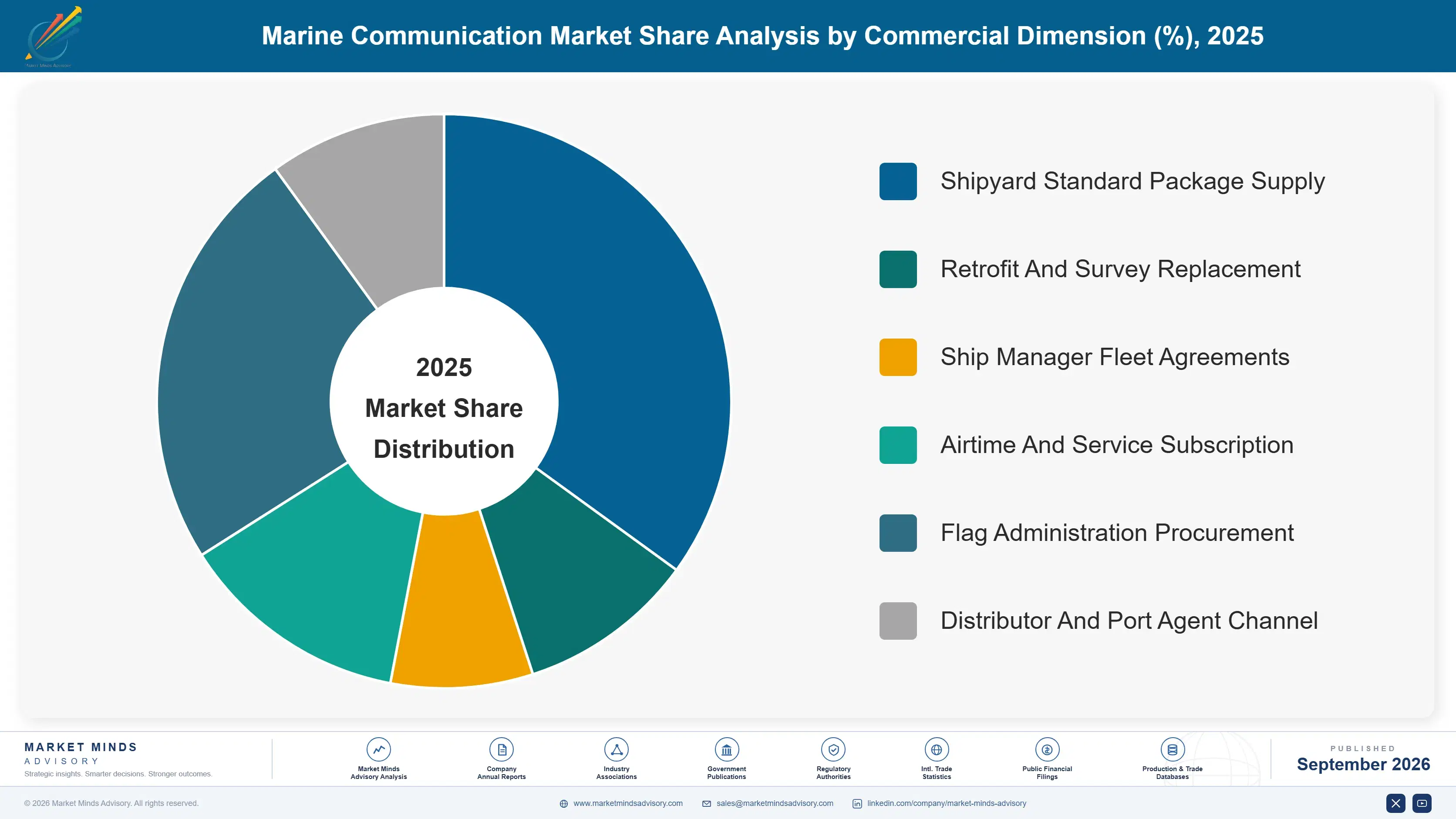
Segmentation follows the communication function performed aboard the vessel, since what a system does determines whether a regulator specifies it, who buys it and what margin it carries. Six functions cover the market: crew welfare connectivity, maritime satellite broadband terminals, identification transponders, emergency beacons, distress and safety radio, and voice radio. Vessel type and fitting stage are separate dimensions.
marine-communication-market-market-share-analysis-1789990636338

Crew Welfare Connectivity Services

Crew welfare connectivity grows at 12.9%, half again the market rate of 8.6%, and it is the only substantial part of this market that no regulator specifies for the vessel itself. Maritime Labour Convention amendments require reasonable seafarer internet access, and the industry complied unusually quickly because officer shortages had already made retention the binding operational constraint. A seafarer choosing between two employers on identical pay takes the one where video calls home actually connect. Typical allowances run around 12 gigabytes per person each month, funded from crewing budgets rather than from technical ones, which means a completely different approver signs for it. Technical superintendents were never involved in the decision.
CAGR 12.9%

Maritime Satellite Broadband Terminals

Maritime satellite broadband terminals compound at 11.2% on fleet classes that were never addressable before rather than on rising consumption aboard connected ships. Stabilised antennas and geostationary capacity together priced shipboard broadband out of reach for anything smaller than large commercial tonnage for three decades. Low earth orbit capacity and cheaper terminals changed that across coastal shipping, fishing fleets, offshore support and inland vessels carrying VHF voice and nothing else. The commercial consequence is that terminal volume is now growing considerably faster than the value of any individual installation, which suits high volume manufacturers and disadvantages specialists. Terminal volume growth and installation value growth have genuinely decoupled here, and specialists are feeling that first. Scale now matters more than sophistication.
CAGR 11.2%
Full segment breakdown across 6 segments available in the complete report.

Regional Architecture and Country Demand Map

East Asia leads at 36% of equipment and service revenue, above the standard band, because most communication equipment is fitted at construction and most construction happens in China, South Korea and Japan. The market here follows the shipyard rather than the shipowner, which is unusual for any equipment category.

East Asia

East Asia holds 36% of equipment and service revenue, above the 30% band ceiling, because around 64% of this equipment is specified during construction and most of the world's tonnage is built here. Chinese, Korean and Japanese yards deliver more than half of global newbuild output between them, and the standard equipment package a yard offers frequently becomes what the owner accepts. Furuno Electric and Japan Radio Company built their positions on exactly that relationship across decades. Intellian Technologies took maritime antennas from Korea. China compounds at 13.6% on construction share. The yard rather than the owner decides here. Owners accept yard packages to avoid cost and delay, which compounds the advantage every year.
Share: 36% | CAGR: 9.8% (2026 to 2036)

Western Europe

Twenty-four percent of equipment and service revenue reaches Western Europe, where shipowning rather than shipbuilding drives the demand. Greek, Norwegian, Danish and German owners control an enormous share of world tonnage and specify equipment for fleets built elsewhere, which gives European suppliers influence disproportionate to regional construction. Kongsberg Maritime and Cobham Satcom hold genuine bridge and satellite positions, and Marlink operates from Norway. European crew welfare standards ran ahead of the international requirement rather than behind it. Growth at 7.2% is the slowest of any region on mature fleets and limited local construction volume. Influence here runs far ahead of construction volume, because owners specify for fleets built somewhere else entirely.
Share: 24% | CAGR: 7.2% (2026 to 2036)
Regional intelligence for 5 additional markets available in the complete report: North America, South Asia and Pacific, Latin America, Middle East and Africa, Eastern Europe. Contact sales@marketmindsadvisory.com.
marine-communication-market-country-cagr-analysis-1789990636881

Where Marine Suppliers Earn Margin

A regulator writes the specification for most of this market, a shipyard chooses the supplier for most of the volume, and the fastest growing product is funded by a department that has never bought electronics before. Each of the four levers below responds to one of those three facts rather than to any product argument.

Sell Connectivity To The Crewing Department

Crew welfare connectivity compounds at 12.9% against 8.6% for the market and it is funded from crewing budgets rather than technical ones, which means an entirely different approver with different priorities and considerably less price sensitivity. A crewing manager losing officers to competitors will approve 12 gigabytes per seafarer monthly without the procurement argument a technical superintendent would run. Suppliers calling on technical departments are reaching the person who buys mandated equipment on price, and missing the person funding the only segment growing quickly. Two departments, two budgets, two entirely different conversations.
Market Impact: Crew connectivity compounds at 12.9% each single year

Win The Shipyard Standard Package Position

Around 64% of communication equipment is specified during construction, and yards offer standard packages that owners frequently accept without amendment. Holding that position means selling once to a yard rather than repeatedly to owners, across every hull that yard delivers for years afterwards. Reaching it requires engineering support, integration work and commercial terms that suit a builder rather than an operator. Suppliers competing in retrofit are addressing the remaining third of the market at worse pricing and with no design influence over anything. Design influence follows the yard relationship rather than the owner.
Market Impact: Yard packages decide fully 64% of all fittings

Read The Compliance Calendar Years Ahead

Equipment lasts around fourteen years and gets replaced when a regulator requires it rather than when it fails, producing fleet-wide retrofit waves compressed into roughly eighteen months followed by several very quiet years. Those dates are published years in advance in International Maritime Organization documents that almost nobody in a commercial function actually reads. Equipment lasting 14 years turns over exactly once per regulatory cycle. A supplier with inventory, approvals and installation capacity ready when the window opens captures a disproportionate share, and one scaling up afterwards arrives to find the fleet already fitted.
Market Impact: An 18 month window decides all fleet share

Build Service Revenue Independent Of Construction

With roughly 64% of equipment fitted at newbuild, revenue swings on shipyard order books responding to freight rates and financing conditions decided years earlier and entirely outside anybody's influence. Airtime, monitoring, maintenance contracts and connectivity subscriptions attach to vessels already sailing and continue regardless of what the yards are doing. Most suppliers describe service revenue as a strategic priority and fund it as an afterthought, which is why the cyclicality never actually improves for any of them. Vessels already sailing generate revenue that yard order books cannot remove, and 64% exposure to construction is a choice rather than a condition.
Market Impact: Services offset the entire 64% newbuild demand swing

Who Controls the Margin Pool

Five suppliers hold 54% of shipborne communication equipment and service revenue, concentrated by relationships with the yards where around 64% of equipment gets specified. Furuno Electric and Japan Radio Company built positions across decades of Asian construction. Kongsberg Maritime and Cobham Satcom hold European bridge and satellite strength through shipowner relationships instead. Intellian Technologies took maritime antennas from Korea. All participants are assessed on equipment and service revenue.
Competition in mandated equipment runs on price and service network, because the regulator wrote the specification and every approved product meets it identically. Differentiation appears in installation quality, spare part availability at the ports vessels actually call at, and how quickly an engineer reaches a ship in Singapore or Rotterdam. That service footprint takes decades to build and is what genuinely separates the leaders.

Rankings shift on crew connectivity, since that segment is bought by a different department and served increasingly by connectivity providers rather than by marine electronics manufacturers. The second pressure is newbuild concentration: as construction share consolidates further into fewer yards, the value of each yard relationship rises and the number of suppliers holding one falls.
marine-communication-market-company-positioning-matrix-1789990637408

Competitive Moat and Risk Dimensions

FURUNO ELECTRIC

Moat: Shipyard And Service Network

Furuno holds relationships with Asian yards built across decades alongside a service network reaching virtually every commercial port, which matters enormously when a vessel needs an engineer aboard before it sails. Mandated equipment is specified by regulators, so support rather than product decides the purchase. Comparable port coverage cannot be created quickly.
FURUNO ELECTRIC

Risk: Crew Connectivity Displacement

The fastest growing segment is bought by crewing departments from connectivity providers rather than by technical superintendents from marine electronics manufacturers. A supplier organised around bridge equipment and yard relationships is calling on the wrong person entirely. Crew welfare connectivity compounds at 12.9% while mandated voice radio grows at 2.3%, and the customer for each is different.
KONGSBERG MARITIME

Moat: Integrated Bridge Systems Position

Kongsberg supplies integrated bridge systems where communication equipment sits alongside navigation, automation and vessel management from the same supplier, which owners value because integration problems aboard a ship are expensive and hard to diagnose at sea. That breadth is difficult to assemble from a communication position alone. European shipowner relationships extend across whole fleets rather than individual vessels.
KONGSBERG MARITIME

Risk: Limited Asian Yard Access

With around 64% of equipment specified at construction and most construction in East Asia, a supplier whose strength lies in European shipowner relationships depends on owners overriding a yard standard package. Owners often accept the standard package to avoid cost and delay. That distance from the specification point caps addressable volume regardless of product quality.

Players Tracked

Prominent Players

Furuno Electric
Japan Radio Company
Kongsberg Maritime
Cobham Satcom
Intellian Technologies

Other Key Players

Icom
Jotron
McMurdo Group
Danelec
Marlink
Speedcast
KVH Industries
Viasat
Iridium Communications
Navico
Saab
Thales
Sperry Marine
Navtor
SRT Marine Systems

Recent Developments

MARCH 2025

Marlink Expands Crew Connectivity Packages For Managed Fleets

Marlink extended crew welfare connectivity packages across additional managed fleets, an organic service expansion rather than an acquisition or joint venture. Allowances of around 12 gigabytes per seafarer monthly are now standard where operators compete for officers, and the spending comes from crewing budgets rather than from technical departments.
Signal: The department funding the fastest growing segment here has never previously bought marine electronics from anybody.
SEPTEMBER 2024

Intellian Expands Maritime Antenna Production For Constellation Demand

Intellian Technologies expanded maritime antenna manufacturing capacity serving low earth orbit constellation demand, an organic capacity expansion rather than any transaction or partnership. Cheaper terminals brought shipboard broadband within reach of coastal, fishing and offshore support vessels that previously carried voice radio and nothing beyond it.
Signal: Unit volume is now growing considerably faster than the value of each individual shipboard installation is.
JUNE 2025

Furuno Extends VDES Transponder Development Ahead Of Requirements

Furuno Electric advanced development of VDES capable transponders ahead of anticipated International Maritime Organization requirements, an organic engineering programme rather than a partnership or merger. Compliance deadlines produce fleet-wide retrofit waves compressed into roughly eighteen months, and suppliers ready when the window opens capture disproportionate share.
Signal: Reading the regulatory calendar accurately is worth considerably more than any commercial sales forecast in this industry.

What Shipborne Equipment Costs

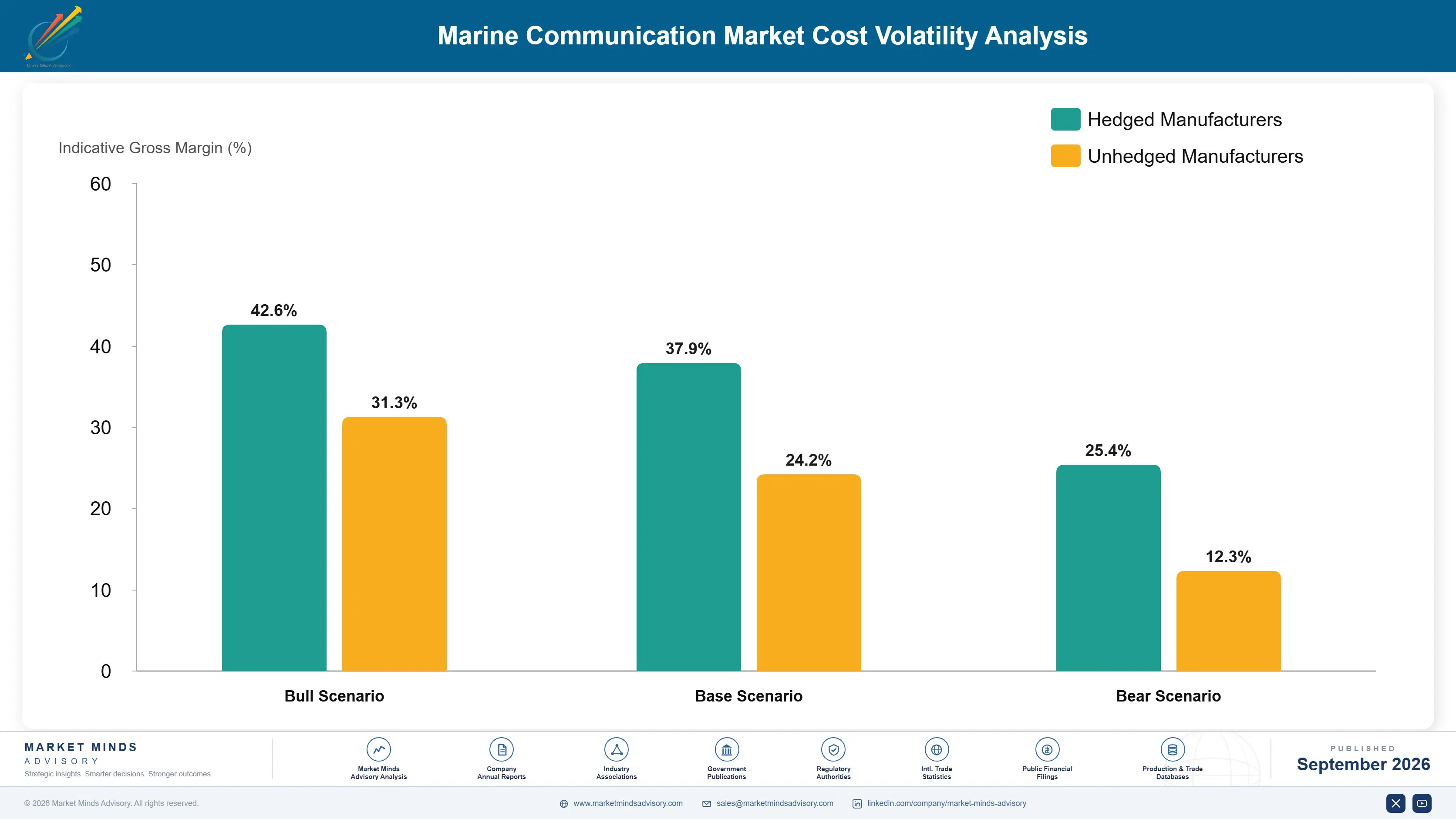
Electronic components and assemblies account for roughly 36% of equipment cost, weighted toward radio frequency parts and the ruggedised housings marine approval demands. Type approval and certification carry around 14%, which is unusually high because every product needs approval from multiple flag administrations. Service network operation absorbs about 22%, since engineers must reach vessels in ports worldwide. Manufacturing and assembly take the balance.
Semiconductor availability tightened through 2022 and 2023 across radio frequency components, and marine electronics competed for the same parts as automotive and industrial customers ordering far larger volumes. Furuno Electric Annual Report 2024 and Kongsberg Annual Report 2024 both record component availability and certification cost as operating variables. Suppliers holding fixed price shipyard contracts absorbed increases directly, since a package priced when a hull was ordered does not reprice on delivery two years later.

The competitive disadvantage mechanism is service network geography rather than manufacturing cost. Reaching a vessel with an engineer before it sails requires presence at ports worldwide, and that network runs around 22% of cost whether a supplier has a hundred customers or a thousand. Broad port coverage amortises across far more equipment, which is why leaders defend on service reach.
marine-communication-market-cost-volatility-analysis-1789990637605

Share Port Service Coverage Through Partner Networks

Service network operation runs around 22% of cost and requires presence at ports a supplier's customers actually call at, which is an expensive footprint for anybody without scale. Accredited partner arrangements at secondary ports deliver acceptable response times at a fraction of owning the presence directly. Suppliers building coverage everywhere are solving a control problem, not a commercial one.

Consolidate Type Approvals Across Product Families

Certification runs about 14% of equipment cost because every product requires approval from multiple flag administrations, each with its own process and timetable. Designing product families around a common approved platform lets one certification effort cover several variants rather than repeating it for each. The discipline is architectural, and most teams treat approval as a downstream task.

Index Shipyard Contracts To Component Pricing

A package priced when a hull is ordered ships two or three years later, and component costs move considerably across that period as marine electronics competes with automotive volumes. Most yard agreements carry fixed pricing with no indexation whatsoever. Negotiating indexation at signature costs nothing and removes an exposure nobody can hedge across a build cycle.

Portfolio Architecture for Margin Defence

Margin architecture separates on who wrote the specification. VHF voice radio and GMDSS distress equipment earn least, since the regulator defined the product and every approved supplier meets the same standard identically. Beacons and identification transponders sit slightly above on approval barriers. Crew connectivity, satellite broadband terminals and managed services earn most, because nobody specified them and the buyer is choosing rather than complying.
The volume versus premium tension is about which department a supplier is organised to reach. Mandated equipment goes to technical superintendents who buy on price against an identical standard, which requires a service network and thin margins. Crew connectivity goes to crewing managers losing officers, who approve quickly and negotiate lightly. Suppliers built for the first customer keep struggling to sell to the second one at all.

High-value pools concentrate in crew connectivity and in managed service arrangements, and neither is reached by improving mandated equipment. Crew connectivity requires a commercial relationship with crewing departments that marine electronics suppliers have never had. Managed services require operating a network rather than shipping hardware. Both sit outside what a bridge equipment manufacturer was built to do, which is exactly why the margin has moved there.

Volume / Commodity-Adjacent

VHF and MF/HF voice radio and GMDSS distress equipment, where the regulator wrote the specification and every approved product meets it identically. The eight point spread separates suppliers with broad port service networks amortised across volume from those buying coverage through partners.
Gross Margin: 22% to 30%

Premium / Certified

Identification transponders and emergency beacons sold on approval breadth and installation quality across multiple flag administrations. The ten point spread tracks how much of a supplier's volume arrives through shipyard standard packages rather than through retrofit sales negotiated vessel by vessel.
Gross Margin: 36% to 46%

Sustainability / Regulatory / Next-Generation

Crew welfare connectivity, satellite broadband terminals and managed service arrangements, where nobody wrote a specification and the buyer is choosing rather than complying. The twelve point spread reflects whether the supplier operates the service or resells somebody else's capacity onward.
Gross Margin: 52% to 64%
marine-communication-market-portfolio-architecture-1789990638103

High-value Sub-segments and Strategic Watch-out

Crew Welfare Connectivity Services

Grows at 12.9% because officer retention became the binding constraint and allowances near 12 gigabytes monthly are now a recruitment argument. The twelve point spread reflects service ownership. Crewing budgets fund this rather than technical ones, which changes who signs entirely. Retention is the argument, not welfare.
Gross Margin: 52% to 64%

Maritime Satellite Broadband Terminals

Grows at 11.2% on coastal, fishing and offshore vessels that carried voice radio and nothing else until terminal costs fell. The twelve point spread reflects manufacturing scale. Unit volume is rising considerably faster than the value of each individual installation. Scale beats sophistication in this segment now.
Gross Margin: 52% to 64%

AIS And VDES Transponders

Grows at 9.4% on fisheries monitoring requirements and anticipated VDES adoption that would trigger fleet-wide replacement across the register. The ten point spread reflects yard access. A mandate here would compress demand into roughly eighteen months of very concentrated activity. A mandate would change everything quickly.
Gross Margin: 36% to 46%

VHF And MF/HF Voice Radio

Grows at 2.3%, slowest of the six functions, on replacement of equipment lasting around fourteen years against a specification the regulator wrote decades ago. The eight point spread reflects service reach. Every approved product meets the identical standard, so price decides it. Nothing differentiates one unit from another.
Gross Margin: 22% to 30%

How Fleet Demand Actually Recurs

The annuity is the vessel itself rather than any contract. Equipment fitted at construction stays aboard for around fourteen years and gets serviced, certified and eventually replaced by whoever can reach the ship in port, which is usually the original supplier's network. Nobody changes a distress radio brand mid-life, since re-approval and retraining cost more than the hardware. Winning at the yard usually holds that hull for life.
Depth varies by how much the equipment is tied to certification. GMDSS distress radio and beacons are surveyed, logged and inspected by flag administrations, which makes changing supplier an administrative exercise nobody undertakes voluntarily. Satellite terminals are less bound and switch when service contracts expire. Crew connectivity is shallowest, since a manager moves the fleet to a better package with a month of notice.

The buyer split in two and most suppliers still address only one half. A technical superintendent buys mandated equipment on price against a specification somebody else wrote. A crewing manager buys connectivity to keep officers who would otherwise leave. The second budget grows at 12.9% and the first at low single digits, so suppliers organised around technical departments cover the wrong half.
marine-communication-market-end-use-penetration-index-1789990638596

What Decides Position Here

These are among the four positions where our research anticipates prominent divergence between winners and laggards over the coming forecast period. Each is grounded in the demand model, the regulatory perimeter, and the announced capacity pipeline.
01 / CREWING BUDGET ACCESS

Call On The People Losing Officers

Crew welfare connectivity compounds at 12.9% against 8.6% for the market, and it is funded from crewing budgets rather than technical ones, which means an entirely different approver with very different priorities and far less price sensitivity than a superintendent. A crewing manager losing officers to a competitor will approve 12 gigabytes per seafarer monthly without the procurement argument a technical department would insist on running. Suppliers calling on technical superintendents reach the person buying mandated equipment on price and miss the growth entirely.
02 / SHIPYARD SPECIFICATION POSITION

Sell Once To The Yard, Not Repeatedly

Around 64% of shipborne communication equipment is specified during construction, and yards offer standard packages that owners frequently accept without amendment because changing them costs money and delays delivery. Holding that position means selling once to a builder rather than repeatedly to owners, across every hull that yard delivers for years afterwards. Reaching it takes engineering support and commercial terms suited to a builder, and suppliers competing only in retrofit address a smaller market at considerably worse pricing than that.
03 / REGULATORY CALENDAR READING

Have Stock Before The Window Opens

Equipment aboard a vessel lasts around fourteen years and is replaced when a regulator obliges it rather than when it fails, which produces fleet-wide retrofit waves compressed into roughly eighteen months and then several very quiet years afterwards. Those compliance dates are published well in advance in International Maritime Organization documents that almost nobody in a commercial function actually reads. A supplier with inventory, approvals and installation capacity ready when the window opens takes a disproportionate share of it, while anybody scaling up afterwards finds the fleet already fitted.
04 / SERVICE REVENUE BUILDING

Earn From Ships Already At Sea

With roughly 64% of equipment fitted during construction, revenue swings on shipyard order books that respond to freight rates and financing conditions settled years earlier and entirely outside any supplier's influence or forecasting ability. Airtime, monitoring, maintenance contracts and connectivity subscriptions attach to vessels already sailing and continue regardless of what the yards happen to be doing. Most suppliers describe service revenue as a strategic priority and then fund it as an afterthought every single year, which is why the cyclicality never improves for any of them.

Engagement Snapshot From the Field

A live engagement with an industry participant carrying material or product regulatory and market exposure ahead of a defining policy shift, showing how our research translates into a defensible multi-year portfolio strategy.
MARKET MINDS ADVISORY · CLIENT ENGAGEMENT SUMMARY
Marine Communication Producer Strategic Portfolio Review and Transition Roadmap 2026·Investment Scenario on Marine Communication Exposure Evaluation 2025-26
CLIENT PROFILE
An Asian ship management company operating 118 vessels for third party owners across bulk, tanker and container tonnage, with communication equipment inherited from whichever yard built each hull. Officer retention had deteriorated for three consecutive years and exit interviews repeatedly cited connectivity aboard. Technical and crewing departments held separate budgets and had never discussed the subject with each other at all.
STRATEGIC CHALLENGE
The technical department was negotiating equipment and airtime contracts on price against a fragmented installed base from four suppliers. Crewing wanted better connectivity and had no budget line for hardware. Neither had costed what officer turnover was actually costing the business, and the fleet contract renewal was scheduled before anybody produced that number for the board.
MMA APPROACH
MMA costed officer turnover across three years including recruitment, familiarisation and vessel performance during handover periods, and compared it against the cost of upgrading crew connectivity fleet wide. We normalised the four inherited equipment estates to cost per vessel and assessed which contracts could be consolidated. The work drew on 47 expert interviews conducted in Q4 2025 with managers, suppliers and crewing agencies.
KEY FINDINGS
  1. Officer turnover was costing roughly 6 times the annual cost of upgrading crew connectivity across the entire fleet (client-reported, unverified by MMA).
  2. Connectivity was cited in 71% of officer exit interviews, ahead of pay, and nobody at board level had ever seen that figure.
  3. The four inherited equipment estates varied by about 3 times on cost per vessel for functionally identical mandated equipment across the fleet.
  4. Consolidating airtime across all 118 vessels rather than negotiating by owner group would have cut unit pricing substantially at no service cost.
CLIENT PROFILE
An Asian ship management company operating 118 vessels for third party owners across bulk, tanker and container tonnage, with communication equipment inherited from whichever yard built each hull. Officer retention had deteriorated for three consecutive years and exit interviews repeatedly cited connectivity aboard. Technical and crewing departments held separate budgets and had never discussed the subject with each other at all.
STRATEGIC CHALLENGE
The technical department was negotiating equipment and airtime contracts on price against a fragmented installed base from four suppliers. Crewing wanted better connectivity and had no budget line for hardware. Neither had costed what officer turnover was actually costing the business, and the fleet contract renewal was scheduled before anybody produced that number for the board.
MMA APPROACH
MMA costed officer turnover across three years including recruitment, familiarisation and vessel performance during handover periods, and compared it against the cost of upgrading crew connectivity fleet wide. We normalised the four inherited equipment estates to cost per vessel and assessed which contracts could be consolidated. The work drew on 47 expert interviews conducted in Q4 2025 with managers, suppliers and crewing agencies.
KEY FINDINGS
  1. Officer turnover was costing roughly 6 times the annual cost of upgrading crew connectivity across the entire fleet (client-reported, unverified by MMA).
  2. Connectivity was cited in 71% of officer exit interviews, ahead of pay, and nobody at board level had ever seen that figure.
  3. The four inherited equipment estates varied by about 3 times on cost per vessel for functionally identical mandated equipment across the fleet.
  4. Consolidating airtime across all 118 vessels rather than negotiating by owner group would have cut unit pricing substantially at no service cost.
RECOMMENDED STRATEGY
Phase 1: Phase one: fund the crew connectivity upgrade from the crewing budget as a retention measure, not from technical capital where it competes badly. Phase 2: Phase two: consolidate airtime across all 118 vessels into one agreement rather than negotiating separately by owner group as at present. Phase 3: Phase three: standardise mandated equipment at the next survey cycle for each vessel, rather than attempting a fleet-wide retrofit in one go.
OUTCOME
The manager funded connectivity from crewing and consolidated airtime across the fleet (client-reported, unverified by MMA). Officer retention improved measurably within three quarters and total communication spend fell despite the upgrade. Connectivity is now reported as a retention metric rather than a technical cost, which is the change that outlasted the engagement itself.

Frequently Asked Questions

Foundational context covering the market sizes, CAGR, scope, country, region and competition that inform every finding below. This section is provided to cover basics and most often pre-purchase conversations, answered from the MMA Primary Research Dataset.

What is the current size of the Marine Communication Market?

Global value reaches USD 3.91 billion in 2026, measured as shipborne communication equipment and service revenue across all six functions. The 2025 base is USD 3.6 billion.

How large will the Marine Communication Market be by 2036?

Equipment and service revenue reaches USD 8.92 billion by 2036, an increase of USD 5.01 billion over the forecast period. That represents 2.28 times expansion from the 2026 base.

What is the CAGR for the Marine Communication Market 2026 to 2036?

The base case runs at 8.6% annually, with a bull case at 9.9% if VDES moves from pilot to mandate and a bear case at 7.4% if newbuild ordering slows materially.

Which segment is growing fastest?

Crew welfare connectivity services grow at 12.9%, half again the market rate of 8.6%. Officer retention became the binding constraint on shipping, and allowances near 12 gigabytes monthly are now a recruitment argument.

Who are the major companies in the Marine Communication Market?

Furuno Electric, Japan Radio Company, Kongsberg Maritime, Cobham Satcom and Intellian Technologies lead on equipment and service revenue, together holding 54%. Marlink, KVH Industries and Jotron hold smaller positions.

Which country is growing fastest?

China leads at 13.6%, because around 64% of this equipment is specified during construction and Chinese yards deliver a very large share of global newbuild tonnage. India and Indonesia follow.

Report Segmentation Architecture

The full report scope spans multiple orthogonal segmentation dimensions, with cross-tabulated demand data provided for each dimension pair. Coverage extends further to regional breakdowns, trend trajectories, and the competitive detail needed to support segment-level decision-making.

By Onboard Communication Function

  • Crew Welfare Connectivity Services
  • Maritime Satellite Broadband Terminals
  • AIS And VDES Transponders
  • Emergency Beacons And Search And Rescue Transponders
  • GMDSS Distress And Safety Radio
  • VHF And MF/HF Voice Radio

By End-Use Industry

  • Bulk And Dry Cargo Shipping
  • Tanker And Gas Carriers
  • Container And Liner Shipping
  • Offshore Energy Support
  • Fishing And Aquaculture Fleets
  • Passenger And Cruise Vessels

By Commercial Dimension

  • Shipyard Standard Package Supply
  • Retrofit And Survey Replacement
  • Ship Manager Fleet Agreements
  • Airtime And Service Subscription
  • Flag Administration Procurement
  • Distributor And Port Agent Channel

By Region

  • North America
  • Western Europe
  • East Asia
  • South Asia and Pacific
  • Latin America
  • Middle East and Africa
  • Eastern Europe

Scope, Methodology, and Coverage

Every figure in this report is reproducible from documented input assumptions. The scope below maps the historical period, the forecast horizon, the segmentation dimensions, and the countries covered, alongside the underlying primary and qualitative methodology.
Historical Period
2020 to 2025
Forecast Period
2026 to 2036
Base Year
2025 (USD billions; MMA Primary Research Dataset, September 2026)
Market Definition
This report covers communication equipment and services fitted aboard commercial vessels: maritime satellite broadband terminals, GMDSS distress and safety radio, automatic identification system and VDES transponders, crew welfare connectivity services, VHF and MF/HF voice radio, and emergency beacons with search and rescue transponders. It excludes navigation and radar systems, engine and vessel monitoring, port and shore infrastructure, recreational boating electronics, and naval or military communication systems.
Quantitative Units
USD millions, shipborne equipment and service revenue basis; fitted vessels; equipment service life in years; crew data allowance in gigabytes per month; retrofit compliance windows in months.
Segmentation Dimensions
Onboard communication function; vessel type; commercial supply route; geography across seven regions.
Regions Covered
North America, Western Europe, East Asia, South Asia and Pacific, Latin America, Middle East and Africa, Eastern Europe
Countries Covered
China, South Korea, Japan, India, Indonesia, Philippines, Australia, Singapore, Norway, Denmark, Germany, Greece, Netherlands, United Kingdom, Poland, Romania, United States, Brazil, Chile, United Arab Emirates.
Key Companies Profiled
Furuno Electric, Japan Radio Company, Kongsberg Maritime, Cobham Satcom, Intellian Technologies, Icom, Jotron, McMurdo Group, Danelec, Marlink, KVH Industries, Iridium Communications, Saab, Sperry Marine, SRT Marine Systems.
Quantitative Methodology
Primary survey, n=3,800 respondents, Q4 2025, six countries; demand-side model with trade association cross-validation
Qualitative Methodology
47 expert interviews, Q4 2025; applied to validate demand model assumptions, identify emerging dynamics, and assess competitive positioning
Report Format
PDF and XLSX data workbook (Word format preview document)
Publisher
Market Minds Advisory
Report Code
MMA-2026-TEC-521
Published
September 2026
Contact
sales@marketmindsadvisory.com | www.marketmindsadvisory.com

Purchase the full Marine Communication Market Report (2026 to 2036).

This report sizes the global marine communication market from 2026 to 2036 across six onboard functions, six vessel types and seven regions. It explains why around 58% of equipment revenue is written by a regulator rather than chosen by a customer, how officer retention turned crew connectivity into the fastest growing segment, and why 64% newbuild fitting makes the shipyard the decisive commercial relationship. Cost composition is sourced to company annual reports, with port service network reach analysed as the margin driver. Regional analysis explains why East Asia leads at 36% while China grows at 13.6%. Competitive assessment covers 20 named suppliers.
Six onboard communication functions sized through to 2036
Mandate economics modelled across the whole equipment base
Service network cost composition from company annual filings
Twenty named suppliers assessed on equipment revenue
Four revenue levers with quantified commercial impact
Anonymised Asian ship manager sourcing engagement included fully

Built For The People Who Decide

From boardroom strategy to bench-side execution, this report is read cover-to-cover by leaders shaping the next decade of their industry, turning demand scenarios, market dynamics and valuation benchmarks into decisions.
CXOs/ Presidents/ VPs/ Managers
M&A and Corporate Development
Strategy Teams and R&D Heads
Procurement and Product Directors
Regulatory and Compliance Leaders
Investor Relations and Equity Analysts