Market Minds Advisory
Marine Bearings Market

Marine Bearings Market: Where Regulation Now Decides the Lubrication Choice

A commercial reading of marine bearings, where IMO oil discharge rules push owners toward water-lubricated systems, offshore wind installation vessels pull thruster bearing demand forward, and shipbuilding concentration in East Asia sets first-fit procurement patterns.

Lead Analyst

David Horsley

Published

September 2026

Make Smarter Decisions with Customized Research Insights

Request a free sample report and evaluate market opportunities, growth trends, and competitive dynamics relevant to your business needs.

2025 MARKET VALUE$1.9BMarket Size 2025
2036 FORECAST VALUE$3.1BBase Case , 2026 to 2036
CAGR 2026 TO 20364.6 %Bull 5.8% / Bear 3.3%
INCREMENTAL OPPORTUNITY$1.1BNet 10- year value creation
EXPANSION MULTIPLE1.57x2036 value over 2026 base
Strategic Levers
M&A Pipeline
Regional Outlook
Country Rankings
Competitive Intelligence
Segmental Deep-dive
Call-Us : 91 93563 13602

Executive Snapshot and Market Trajectory

A vessel owner deferring bearing replacement to the next dry-docking window is not being careless, since every extra day off-hire costs more than the part itself, and that single fact shapes almost the entire commercial rhythm of this market from procurement through service.
The market stands at USD 1.9 billion in 2025 and reaches USD 3.12 billion by 2036 at a 4.6% CAGR. Thruster bearings grow fastest at 6.5%, about 1.41 times the overall rate, pulled forward by offshore wind installation vessel orders requiring heavy-duty azimuth thruster bearings specifically. East Asia holds 38% of value on regional newbuild dominance, while India posts the fastest growth at 7.0% on naval shipbuilding expansion.
Concentration sits at a moderate 45% among the top five, led by Thordon Bearings' water-lubricated technology leadership and Wärtsilä's integrated propulsion system position built over several decades of shipyard trust. Two forces reshape the field now. IMO environmental regulation is pushing owners toward oil-free, water-lubricated stern tube bearings to avoid discharge penalties, and offshore wind installation vessel orders are driving unprecedented demand for large-diameter thruster bearings that few manufacturers can currently engineer at scale.
Market Definition
The marine bearings market covers stern tube, rudder, thruster, deck machinery, and shaft line bearings sold for commercial, naval, and offshore vessel propulsion and steering systems, including both original equipment and aftermarket replacement units. General industrial bearings not designed for marine shaft or propulsion applications, and the propulsion machinery itself, are excluded.
Base Year Value
$1.9B in 2025 (MMA Primary Research Dataset, August 2026)
Forecast Period
2026 to 2036, eleven discrete annual values
CAGR
4.6% base case. Bull 5.8%. Bear 3.3%.
Fastest Growth Segment
Thruster and Propulsion Bearings: 6.5% CAGR
Fastest Growth Country
India: 7.0% CAGR
Fastest Growth Region
South Asia and Pacific: 6.5% CAGR
Largest Region
East Asia: 38% of 2025 global value
Market Leaders
Thordon Bearings, Wärtsilä, SKF, Schaeffler, Duramax Marine. Source: MMA Analysis based on company annual reports and industry association data.
Primary Survey
n=3,800 procurement and R&D decision-makers, Q4 2025, six countries
Methodology
Demand-side build-up, cross-validated against public data, 47 expert interviews

Marine Bearings Market Forecast Scenarios

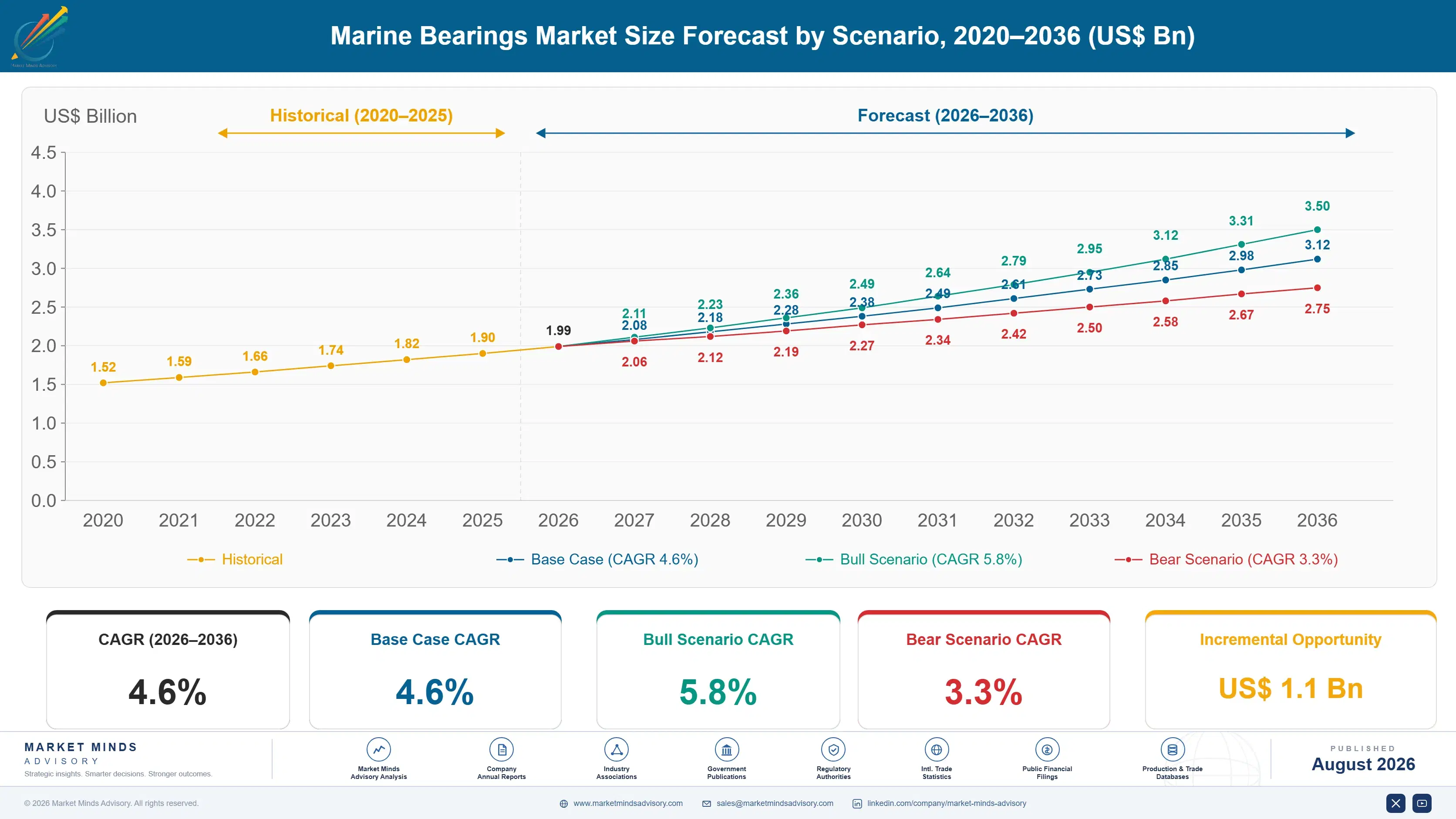
marine-bearings-market-size-forecast-scenario-1787325498108
Growth from 2020 to 2025 compounded near 4.0%, reflecting steady newbuild order volume interrupted by pandemic-era shipyard slowdowns before recovering from 2022 onward as global orderbooks rebuilt considerably and offshore wind vessel demand began emerging as a distinct new growth driver for the category specifically, alongside gradually tightening environmental discharge enforcement across several major flag states.
Three mechanisms carry the base case to 4.6%. First, IMO environmental regulation, which pushes owners toward oil-free water-lubricated bearing systems ahead of tightening discharge enforcement deadlines across major flag states. Second, offshore wind installation vessel orders, which require large-diameter thruster bearings that few manufacturers can currently engineer at meaningful scale. Third, global newbuild orderbook expansion, particularly LNG carriers and container ships, which sustains steady first-fit procurement volume across major East Asian shipyards.
The bull case at 5.8% assumes offshore wind installation vessel orders accelerate faster than current shipyard capacity suggests and IMO enforcement tightens sooner than currently scheduled. The bear case at 3.3% assumes long vessel retrofit cycles continue deferring aftermarket bearing replacement and highly customized specifications keep limiting the manufacturing scale economies smaller competitors need to compete on cost.

Why Dry-Docking Windows Still Set the Replacement Clock

Three forces set demand. Newbuild orderbook volume provides the steadiest layer, since every commercial and naval vessel delivered requires a full complement of stern tube, rudder, and shaft line bearings at first fit. Aftermarket replacement adds a second layer, tied tightly to scheduled dry-docking windows rather than continuous wear-driven demand. Offshore wind installation vessel orders add a third layer, requiring thruster bearings engineered at a scale few manufacturers currently offer.
MARKET CONCENTRATIONCR5: 45%Moderately fragmented behind a handful of specialised technology leaders
AVERAGE SELLING PRICEUSD 8,000 to 65,000 per unitVaries considerably by vessel size and bearing type specification
TOP PRODUCING REGIONEast Asia: 38% of global valueReflects concentrated newbuild vessel tonnage delivered across regional shipyards
AFTERMARKET REPLACEMENT CYCLE2.5 to 5 years typicalTied directly to scheduled dry-docking and classification survey timing
WATER-LUBRICATED ADOPTION RATERoughly 35% of new installationsRising steadily as environmental discharge regulation tightens globally
COGS FEEDSTOCK SHAREAbout 40 to 52%Reflects specialty alloy and polymer input costs varying by grade
The commercial character rewards engineering reliability and classification approval over price competition alone. An owner or shipyard choosing a bearing supplier weighs field failure history and warranty support as heavily as unit price, since a stern tube bearing failure at sea can force an unscheduled dry-docking costing far more than any price difference between suppliers. Thordon Bearings' technology and Wärtsilä's propulsion relationships give both a trust advantage newer entrants must earn.
The next decade turns on two things. Whether IMO enforcement of oil discharge rules tightens quickly enough to accelerate the shift toward water-lubricated systems across the existing global fleet. And whether specialist manufacturers can scale thruster bearing production fast enough to match the offshore wind installation vessel orderbook now building steadily across several major shipyards.
"Nobody replaces a stern tube bearing because the calendar says so. They replace it because the ship is already in dry dock for something else, and that changes how you sell into this market entirely."
Director, Marine Propulsion Components Practice · MMA Construction and Industria

Market Trends

Offshore Wind Installation Vessels Drive Thruster Demand

Offshore wind installation vessels require azimuth thruster bearings engineered for continuous dynamic positioning duty far beyond what conventional cargo vessel thrusters demand, and orders for this vessel class have expanded considerably as offshore wind construction programmes scale globally. Few manufacturers currently offer thruster bearings at the diameter and load rating these vessels require, concentrating this opportunity among a small number of specialist suppliers with proven dynamic positioning experience. Berg Propulsion and Wärtsilä have both expanded thruster bearing production capacity in direct response. The commercial consequence is that manufacturers without dynamic positioning credentials increasingly cannot compete for this fast-growing category.
Market Impact: Discharge rules cover 90% of tonnag

Water-Lubricated Bearings Gain Share Over Oil Systems

Shipowners increasingly specify water-lubricated stern tube bearings over traditional oil-lubricated systems to avoid oil discharge penalties and reduce environmental compliance risk under tightening international regulation. Water-lubricated adoption has reached roughly 35 percent of new installations, a share that has risen steadily as classification societies expand approved water-lubricated bearing designs across more vessel classes and shaft configurations. Thordon Bearings holds a particularly strong position here, given its decades of water-lubricated technology development ahead of most oil-lubricated incumbents. The commercial consequence is that oil-lubricated system specialists increasingly must develop water-lubricated alternatives or cede growing categories of newbuild specification entirely.
Market Impact: LNG orders rose over 25% recently

Market Opportunities and Growth Drivers

IMO Rules Push Adoption of Oil-Free Bearing Systems

International Maritime Organization environmental regulation, including MARPOL Annex I oil discharge provisions and expanding regional vessel general permit requirements, increasingly penalises oil-lubricated stern tube bearing systems that risk lubricant leakage into ocean waters during normal operation. Shipowners face meaningful compliance cost and reputational risk from any documented discharge incident, making water-lubricated or fully sealed oil-lubricated alternatives an increasingly standard specification choice on new vessel orders. Enforcement has tightened considerably across several major flag states and port authorities in recent years. This driver continues expanding as more jurisdictions adopt comparable discharge restrictions and inspection regimes.
Market Impact: Cycles run 2.5 to 5 years

Global Newbuild Orderbook Expansion Sustains Demand

Rising newbuild orders for LNG carriers, container ships, and bulk carriers sustain steady first-fit bearing procurement volume across major shipyards in China, South Korea, and Japan specifically. Every vessel delivered requires a full complement of stern tube, rudder, thruster, and shaft line bearings regardless of vessel type, making orderbook volume the single most reliable demand indicator for the category overall. LNG carrier orders have grown particularly strongly given expanding global gas trade infrastructure investment. This driver operates largely independent of aftermarket replacement cycles, reflecting pure newbuild delivery volume across the global fleet.
Market Impact: Lead times run 8-20 weeks

Market Restraints and Challenges

Long Retrofit Cycles Slow Aftermarket Replacement

Vessel owners typically replace bearings only during scheduled dry-docking windows occurring every two and a half to five years, rather than on a continuous wear-driven replacement schedule that would generate steadier aftermarket demand. The root cause is that owners defer non-critical maintenance deliberately to minimise off-hire time, since every day out of service costs considerably more in lost charter revenue than any bearing replacement itself. Commercially this concentrates aftermarket revenue into discrete, unpredictable windows rather than smooth recurring demand. Manufacturers are responding with condition monitoring and predictive maintenance offerings that help owners plan replacement around already-scheduled dry-docking specifically.
Market Impact: WTIV orders add 40 new vessels

Custom Specifications Limit Manufacturing Scale Economies

Each vessel class and shaft diameter combination requires bespoke bearing engineering, since shipyards and vessel designers have not converged on standardized specifications the way other industrial equipment categories often have over time. The root cause is genuine design diversity across vessel types, operators, and classification society requirements that resist simple standardization efforts. Commercially this raises unit manufacturing cost and extends lead times considerably compared with mass-produced industrial bearing categories elsewhere. Manufacturers are responding with modular bearing platform designs that share core components across a narrower range of standardized shaft diameter bands.
Market Impact: Adoption reaches 35% of new install
3 additional market trends, 4 additional growth drivers, and 3 additional restraints and challenges are covered in the full report. Contact sales@marketmindsadvisory.com to access the complete intelligence.

Segment CAGR and Growth Architecture

Segmentation follows bearing application location aboard the vessel, a single product logic describing where each bearing type physically operates within the propulsion and steering system. Each application carries distinct load, lubrication, and classification requirements, so commercial position tracks application rather than lubrication technology, which appears separately within the framework below. Two applications lead growth here.
marine-bearings-market-market-share-analysis-1787325498643

Thruster and Propulsion Bearings

Thruster and propulsion bearings grow fastest at 6.5%, about 1.41 times the overall 4.6% rate, pulled forward by offshore wind installation vessel orders requiring azimuth thruster bearings engineered for continuous dynamic positioning duty. This category demands considerably higher load ratings and duty cycles than conventional cargo vessel thrusters typically require, a technical distinction that favours manufacturers with proven dynamic positioning engineering credentials over generalist bearing suppliers. Berg Propulsion and Wärtsilä have both expanded production capacity considerably in response to this emerging orderbook building across several major shipyards. Dynamic positioning drilling vessels and cable-laying ships add further demand alongside the offshore wind installation vessel category specifically. Few manufacturers currently offer bearings at the diameter and load rating this category increasingly requires.
CAGR 6.5%

Engine and Shaft Line Bearings

Engine and shaft line bearings grow at 5.8%, the second-fastest application, as fuel efficiency retrofit programmes and larger, more powerful engines on newbuild vessels both drive demand for higher-precision shaft line bearing engineering. This category benefits from rising engine power density trends, since larger engines transmit greater torque loads through the shaft line, requiring bearings engineered to tighter tolerances than earlier vessel generations needed. SKF and Schaeffler both maintain meaningful positions here given established relationships with major engine manufacturers supplying newbuild shipyards globally. Retrofit demand adds a further layer as owners upgrade ageing shaft line bearings to reduce fuel consumption through improved alignment and reduced friction losses across the propulsion train.
CAGR 5.8%
Full segment breakdown across 5 segments available in the complete report.

Regional Architecture and Country Demand Map

Shipbuilding delivery location and fleet ownership patterns together set this distribution, since first-fit bearing procurement tracks where vessels are physically constructed and maintained globally. East Asia dominates on newbuild tonnage concentration, while South Asia and Pacific posts the fastest regional growth of all seven regions.

North America

Naval shipbuilding programmes and offshore support vessel demand anchor North American value more than commercial newbuild tonnage does. North America holds 24% of value, with United States Navy and Coast Guard vessel programmes sustaining steady specialist bearing procurement through established defence shipyard relationships. Offshore wind installation vessel interest is growing along the Atlantic coast, though from a smaller base than European offshore wind markets currently support. Aftermarket replacement across the region's large commercial and fishing fleet adds a steady secondary demand layer throughout the year. Growth of 4.4% reflects mature fleet dynamics tempered by emerging offshore wind vessel opportunity. Canadian Arctic and naval vessel demand follows a broadly similar pattern regionally.
Share: 24% | CAGR: 4.4% (2026 to 2036)

Western Europe

Offshore wind installation vessel orders and naval shipbuilding programmes together define this market above commercial newbuild volume specifically. Western Europe holds 18% of value, with Norwegian, German, and Dutch shipyards building a meaningful share of the world's offshore wind installation and support vessel fleet requiring specialised thruster bearings. Naval vessel programmes across several major navies sustain steady specialist bearing demand through established defence supply relationships. Environmental regulation enforcement runs considerably stricter here than in most other regions, accelerating water-lubricated bearing adoption specifically. Growth of 3.0%, the slowest of the seven, reflects mature commercial shipbuilding decline offset partly by offshore wind vessel growth. Aftermarket demand remains substantial given the region's large existing commercial fleet.
Share: 18% | CAGR: 3.0% (2026 to 2036)
Regional intelligence for 5 additional markets available in the complete report: East Asia, South Asia and Pacific, Latin America, Middle East and Africa, Eastern Europe. Contact sales@marketmindsadvisory.com.
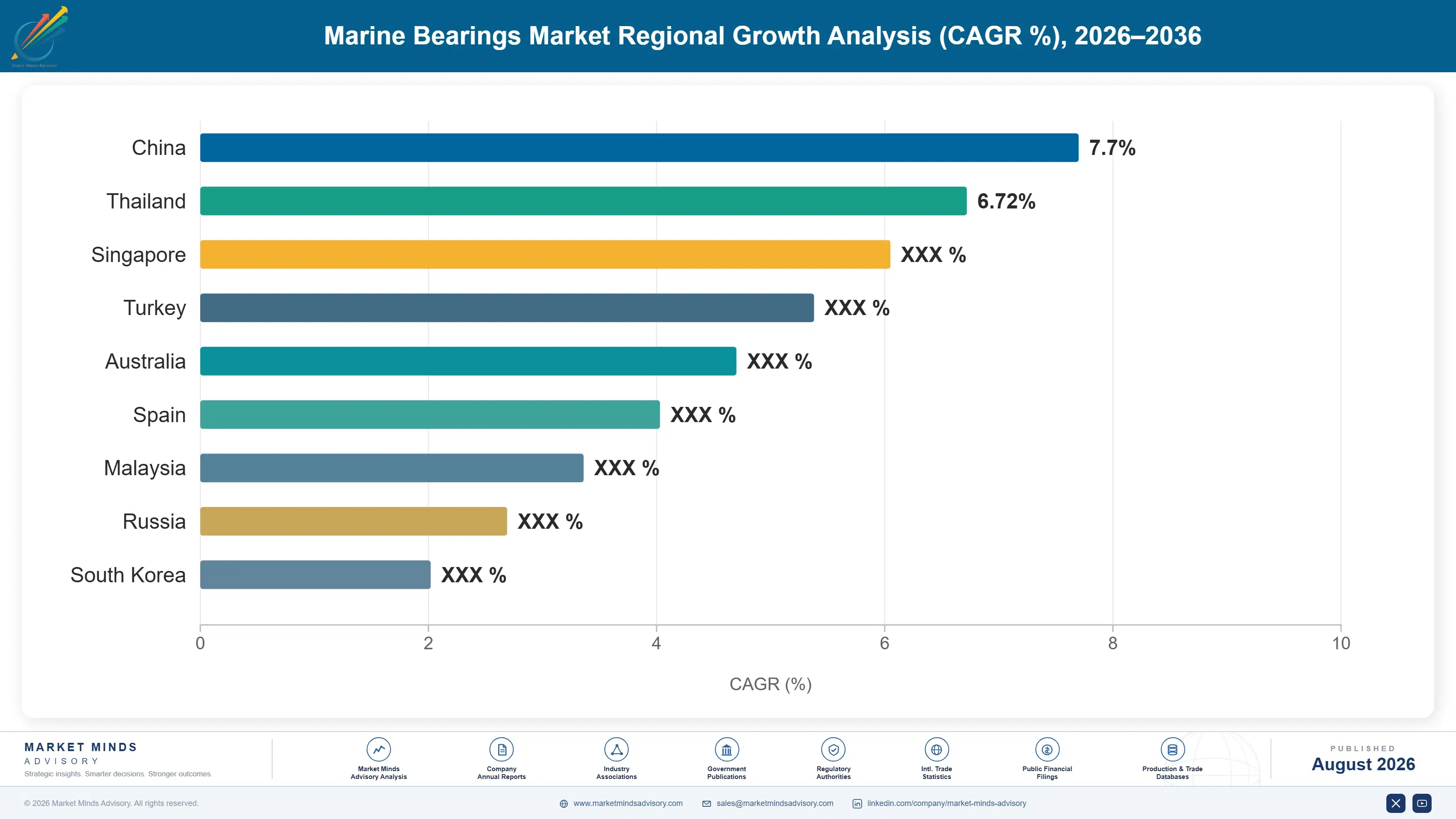
marine-bearings-market-country-cagr-analysis-1787325499160

Where Marine Bearing Manufacturer Margin Concentrates

Competing purely on unit price per bearing concentrates margin in exactly the commodity aftermarket segment where regional machine shops undercut established manufacturers easily and repeatedly. The four moves below shift value toward positions engineering depth and regulatory positioning genuinely protect: water-lubricated technology leadership, thruster bearing engineering scale, condition monitoring services, and classification society relationships.

Lead the Water-Lubricated Bearing Technology Transition

Water-lubricated adoption has reached roughly 35 percent of new installations, a share that has risen steadily as classification societies expand approved designs across more vessel classes and IMO discharge enforcement tightens considerably across major flag states and port authorities worldwide. Manufacturers with mature water-lubricated engineering capability capture specification that oil-lubricated specialists retrofitting compliance solutions increasingly cannot match reliably or quickly enough in most competitive tenders. Building this capability requires sustained materials science investment in polymer bearing compounds beyond conventional white-metal engineering expertise entirely, a multi-year commitment most smaller competitors deliberately avoid making.
Market Impact: Adoption now reaches roughly 35% of

Scale Thruster Bearing Engineering Capacity Now

Offshore wind installation vessel orders have expanded considerably, and few manufacturers currently offer thruster bearings at the diameter and load rating this vessel class increasingly requires, concentrating opportunity among a small number of specialist suppliers with proven dynamic positioning experience across major shipyards worldwide. Manufacturers investing in large-diameter thruster bearing production capacity now capture specification on an orderbook that has grown by over 40 vessels recently and continues expanding steadily each quarter. This capability requires sustained capital investment in precision manufacturing equipment few smaller competitors can justify at current production volumes.
Market Impact: WTIV orderbook has grown by over 40

Build Condition Monitoring Service Offerings Now

Owners defer bearing replacement to scheduled dry-docking windows occurring every two and a half to five years, and manufacturers offering condition monitoring services that help owners plan replacement around existing schedules capture recurring service revenue that pure hardware suppliers cannot access at all in most cases across the fleet. This service layer, once established, generates margin roughly 15 percent higher than transactional hardware sales alone and deepens the owner relationship over the full vessel lifecycle considerably. Manufacturers should treat monitoring as a genuine revenue stream, not a bundled hardware sales incentive.
Market Impact: Monitoring adds roughly 15% to serv

Deepen Classification Society Approval Relationships Now

Classification society approval gates market access for any new bearing design, since shipyards and owners will not specify unapproved products regardless of technical merit or competitive pricing offered anywhere in the market currently available. Manufacturers with deep classification society relationships secure faster approval timelines, often 8 to 20 weeks quicker, for new water-lubricated and thruster bearing designs, capturing first-mover advantage in categories where enforcement and vessel orders are both accelerating considerably across most flag states. This relationship depth compounds over years as approved product catalogues expand across more vessel classes.
Market Impact: Approval delays run roughly 8 to 20

Who Controls the Margin Pool

Concentration sits at a moderate 45% among the top five, led by Thordon Bearings' water-lubricated technology leadership and Wärtsilä's integrated propulsion position built over decades of shipyard relationships. The gap between leaders and challengers is engineering depth and classification approval breadth rather than price, which regional machine shops undercut easily in commodity categories. All participants are assessed on global marine bearing unit shipment volume as disclosed in company r
Competition runs along four lines. First, water-lubricated technology maturity, increasingly the fastest-growing purchase consideration under tightening environmental regulation. Second, thruster bearing engineering scale for the emerging offshore wind installation vessel category. Third, condition monitoring service depth that extends manufacturer relationships across the full vessel lifecycle. Fourth, classification society approval breadth that gates access to new vessel specifications entirely.

Pressure is building from two directions. Regional machine shops and smaller specialist manufacturers continue competing aggressively on price in commodity aftermarket categories where engineering differentiation matters least. Meanwhile established leaders are defending position through sustained water-lubricated and thruster bearing engineering investment that smaller competitors struggle to match. Rankings should favour manufacturers combining regulatory-driven technology leadership with genuine offshore wind engineering credentials over pure commodity aftermarket suppliers.
marine-bearings-market-company-positioning-matrix-1787325499677

Competitive Moat and Risk Dimensions

THORDON BEARINGS

Moat: Water-lubricated technology leadership

Thordon Bearings holds decades of water-lubricated polymer bearing development experience ahead of most oil-lubricated incumbents now scrambling to develop comparable alternatives. Its classification society approval catalogue spans more vessel classes and configurations than most competitors currently offer. Strong installer and shipyard relationships built through its independent, propulsion-neutral positioning support sustained specification wins globally.
THORDON BEARINGS

Risk: Independent scale versus integrators

Thordon Bearings lacks the integrated propulsion system relationships that Wärtsilä and similar competitors use to bundle bearings with broader equipment packages. Its independent positioning, while valuable for neutrality, limits access to some original equipment specification decisions made at the propulsion system level. Chinese manufacturers are increasingly developing competing water-lubricated designs at lower price points.
WÄRTSILÄ

Moat: Integrated propulsion system position

Wärtsilä's broader propulsion and thruster system business gives it direct specification access that standalone bearing suppliers cannot easily replicate across newbuild vessel orders. Its scale supports sustained thruster bearing engineering investment for the emerging offshore wind installation vessel category specifically. Established shipyard relationships across multiple vessel categories provide considerable specification leverage.
WÄRTSILÄ

Risk: Broad portfolio dilutes focus

Wärtsilä's bearing business competes for engineering and capital investment against its considerably larger engine and broader propulsion system divisions internally. Specialist competitors focused purely on bearings can sometimes out-innovate on niche technical requirements more quickly. Independent water-lubricated specialists increasingly challenge its position in environmentally driven specification decisions specifically.

Players Tracked

Prominent Players

Thordon Bearings
Wärtsilä
SKF
Schaeffler
Duramax Marine

Other Key Players

John Crane
Blohm+Voss Industries
R&D Bearing Company
Michell Bearings
Simplex Marine
Waukesha Bearings
Kingsbury Inc
Miba Bearing Group
Zollern
RENK Group
NSK
NTN Corporation
Timken Company
Cathelco
Berg Propulsion

Recent Developments

MAY 2025

Thordon Bearings expands water-lubricated bearing production capacity

Thordon Bearings expanded manufacturing capacity for its water-lubricated stern tube bearing lines to meet rising newbuild specification demand under tightening environmental regulation across multiple flag states and port authorities. This was an organic capacity expansion rather than any acquisition, reflecting confidence in sustained regulatory-driven demand.
Signal: Water-lubricated specialists are scaling p
NOVEMBER 2024

Wärtsilä acquires specialist thruster bearing engineering firm

Wärtsilä acquired a specialist thruster bearing engineering firm to strengthen its large-diameter bearing design capability for the offshore wind installation vessel category specifically and its wider propulsion portfolio. This was an acquisition rather than a joint venture, adding proprietary engineering talent directly into Wärtsilä's existing propulsion systems division.
Signal: Integrated propulsion suppliers are buying
FEBRUARY 2025

SKF signs supply agreement with major LNG carrier shipyard

SKF signed a multi-year supply agreement with a major East Asian shipyard to provide shaft line bearings across an expanding LNG carrier newbuild programme through the end of the decade. This was a supply agreement rather than a joint venture, securing volume without shared ownership or new capital investment.
Signal: Established suppliers are locking in newbu

Specialty Alloys and Polymer Compounds

Specialty bronze, white-metal alloys, and engineered polymer compounds together account for 40% to 52% of cost of goods sold, reflecting the precision materials engineering marine bearings require for saltwater exposure and sustained high-load duty. These materials are sourced predominantly from specialty metal producers and polymer compounders in East Asia, Western Europe, and North America directly.
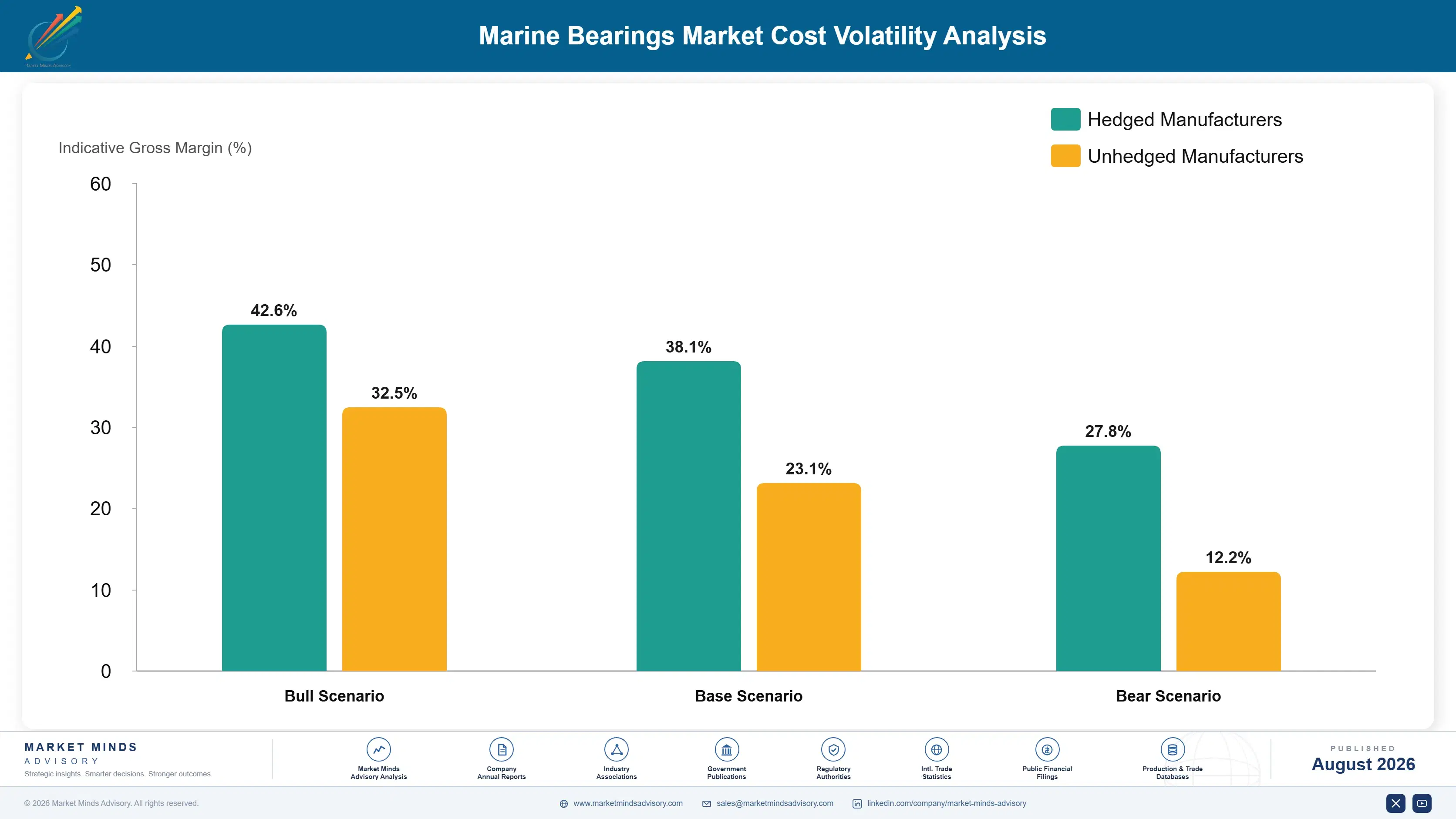
Copper and tin prices rose sharply through 2021 and 2022 amid broader commodity market volatility, with several bearing manufacturers disclosing meaningfully higher input costs during that period, per IEA and company annual report commentary on the same cycle. Several manufacturers passed through a portion of this cost increase to shipyard customers with a lag of several months, compressing margin temporarily during the transition. Prices have since moderated, though they remain above pre-2021 levels for several key alloy inputs specifically.

Exposure separates clearly by materials sourcing strategy and inventory management practice. Larger manufacturers with hedged metal procurement contracts absorbed less disruption than smaller competitors purchasing alloys on the spot market during the tightest volatility periods specifically. Water-lubricated polymer bearing manufacturers face somewhat different exposure than traditional white-metal producers, since their input basket weights specialty polymer compounds more heavily than base metal content.
marine-bearings-market-cost-volatility-analysis-1787325499875

Hedge specialty metal procurement contracts

Spot-market copper and tin purchasing exposed several manufacturers to meaningful cost spikes during the 2021 and 2022 volatility period specifically and repeatedly across the supply chain. Longer-term hedged procurement contracts reduce this exposure considerably across future commodity price cycles ahead. The trade-off is reduced flexibility to benefit from price declines when metal markets soften unexpectedly.

Diversify polymer compound supplier base

Water-lubricated bearing manufacturers dependent on single-source polymer compound suppliers faced meaningful disruption risk during recent supply tightness across the sector broadly and unpredictably in several regions. Qualifying multiple polymer compound suppliers reduces this concentration risk considerably over time. This requires additional testing and classification society requalification cost that smaller manufacturers sometimes cannot justify economically at current volumes.

Pass through costs via longer-term supply agreements

Multi-year supply agreements with shipyards increasingly include indexed pricing clauses tied to underlying metal and polymer costs, reducing the margin compression manufacturers previously absorbed during volatility periods. This shifts commodity price risk more transparently onto the broader supply chain rather than concentrating it entirely on manufacturers. Shipyards accepting indexed pricing gain more predictable long-term supplier relationships in return.

Portfolio Architecture for Margin Defence

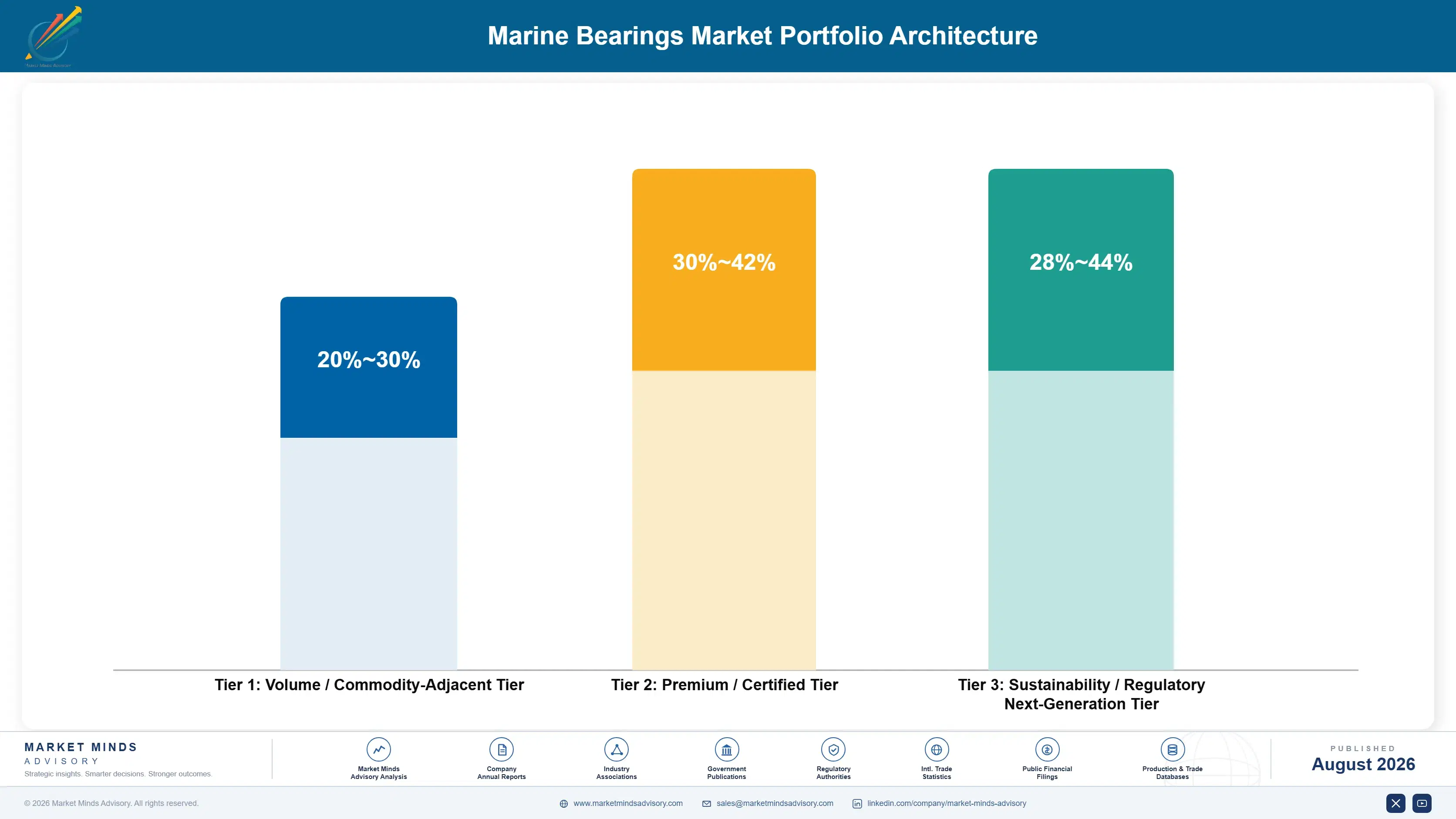
The portfolio splits into three tiers with distinct economics. Standard white-metal stern tube and shaft line bearings form the volume tier, competing increasingly on price against regional machine shops with margin set by material cost and production efficiency. Water-lubricated and large-diameter thruster bearings earn considerably more since materials engineering depth and classification approval breadth deter competitors lacking comparable technical investment. Condition monitoring services
The tension runs between standard bearing revenue that funds the business today and water-lubricated and thruster engineering investment that positions it for the next decade. A manufacturer defending standard bearing volume too aggressively against regional machine shop competition cedes the highest-margin segments to competitors investing there directly. Companies managing this well use standard bearing cash flow to fund engineering investment rather than treating them as competing priorities.

High-value pools concentrate where materials engineering depth, classification approval breadth, or dynamic positioning credentials limit competition: water-lubricated stern tube systems, large-diameter thruster bearings, and condition monitoring service relationships. Standard white-metal bearings sold without differentiated capability sit at the other end, competing almost entirely on price against every regional machine shop now serving established shipyard aftermarket demand.

Volume / Commodity-Adjacent Tier

Standard white-metal stern tube and shaft line bearings competing increasingly on price against regional machine shops, with margin set overwhelmingly by material cost and production efficiency across most categories tracked.
Gross Margin: 20-30%

Premium / Certified Tier

Water-lubricated and large-diameter thruster bearings supporting meaningfully stronger margin than standard white-metal production, reflecting genuine materials engineering and classification approval differentiation earned over years of field testing and shipyard trust.
Gross Margin: 30-42%

Sustainability / Regulatory / Next-Generation Tier

Fully oil-free water-lubricated systems, condition monitoring service platforms, and offshore wind thruster bearing designs developed ahead of tightening IMO discharge enforcement across multiple flag states currently under active regulatory review and revision.
Gross Margin: 28-44%
marine-bearings-market-portfolio-architecture-1787325500374

High-value Sub-segments and Strategic Watch-out

Thruster and Propulsion Bearings

High value and high growth at 6.5%, the fastest category in the market, driven by offshore wind installation vessel orders requiring large-diameter thruster bearings that few manufacturers can currently engineer at meaningful scale or acceptable lead time across major shipyards worldwide right now, a genuine capacity bottleneck.
Gross Margin: 30-42%

Engine and Shaft Line Bearings

High value with strong growth at 5.8%, the second-fastest category, driven by fuel efficiency retrofit programmes and higher engine power density requiring tighter shaft line tolerances across most newbuild vessel classes currently on order at major East Asian shipyards building larger, more powerful engines today.
Gross Margin: 30-42%

Stern Tube Bearings

The volume core by revenue, growing near 4.3% as this remains the largest and most established application across nearly every vessel type tracked currently worldwide, though growth has moderated meaningfully as water-lubricated conversion matures gradually across the existing global commercial fleet over the coming decade.
Gross Margin: 20-30%

Deck Machinery and Winch Bearings

The strategic watch-out, growing near 4.5% and facing commoditization pressure from regional machine shops offering comparable specifications at lower prices across most standard vessel deck equipment configurations currently deployed across the global commercial and naval fleet today, eroding margin steadily each year across most established shipyards.
Gross Margin: 20-30%

How Dry-Docking Windows Anchor Revenue

Revenue depends on dry-docking scheduling and specification loyalty, and a manufacturer's default status with a shipyard or fleet operator generates years of repeat procurement across every vessel that operator maintains and services. Switching suppliers requires requalification through classification approval processes, a cost and delay that deters displacement even when a competitor offers marginally better pricing on paper.
Adoption depth varies sharply by application. Thruster bearing buyers commit hardest, given the engineering integration complexity and classification approval interdependence with the broader propulsion system once installed. Stern tube bearing buyers sit in the middle, balancing established supplier relationships against periodic competitive retendering during major refit projects. Standard deck machinery bearing buyers switch most readily, since specification differentiation between qualified manufacturers remains genuinely minimal across comparable products.

Buyer profiles have shifted from purchasing officers evaluating unit price alone toward technical superintendents weighing lifecycle cost, classification compliance, and environmental risk together. Water-lubricated adoption has introduced a new buyer consideration around discharge liability that traditional bearing economics never required previously. Younger fleet technical managers also weigh condition monitoring data access more heavily than predecessors did, favouring manufacturers offering genuinely integrated digital service platforms.
marine-bearings-market-end-use-penetration-index-1787325500863

Our Call on Marine Bearings

These are among the four positions where our research anticipates prominent divergence between winners and laggards over the coming forecast period. Each is grounded in the demand model, the regulatory perimeter, and the announced capacity pipeline.
01 / WATER-LUBRICATED REGULATORY SHIFT

Regulation now decides the lubrication choice

Water-lubricated adoption has reached roughly 35 percent of new installations, a share that has risen steadily as classification societies expand approved designs and IMO discharge enforcement tightens considerably across major flag states and port authorities globally. Manufacturers with mature water-lubricated engineering capability capture specification that oil-lubricated specialists retrofitting compliance solutions increasingly cannot match reliably or quickly enough across most competitive tenders. Companies should build water-lubricated capability now, since this technical requirement increasingly gates access to the fastest-growing regulatory-driven specification category in the market.
02 / THRUSTER ENGINEERING SCALE

Offshore wind orders reward specialist scale

Offshore wind installation vessel orders have expanded considerably, and few manufacturers currently offer thruster bearings at the diameter and load rating this vessel class increasingly requires, concentrating opportunity among a small number of specialist suppliers with proven dynamic positioning experience across major global shipyards. Manufacturers investing in large-diameter thruster bearing production capacity now capture specification on an orderbook that continues expanding across several major shipyards worldwide. Companies should scale engineering capacity deliberately, since this capability increasingly determines participation in the category's fastest-growing segment.
03 / CLASSIFICATION APPROVAL DEPTH

Approval breadth gates new specification access

Classification society approval gates market access for any new bearing design, since shipyards and owners will not specify unapproved products regardless of technical merit or competitive pricing offered anywhere in the market. Manufacturers with deep classification society relationships secure faster approval timelines for new water-lubricated and thruster bearing designs, capturing first-mover advantage as enforcement and vessel orders both accelerate considerably. Companies should invest in approval relationships early, since delays of eight to twenty weeks can determine which supplier wins a newbuild programme.
04 / SERVICE REVENUE GROWTH

Condition monitoring opens recurring revenue

Owners defer bearing replacement to scheduled dry-docking windows occurring every two and a half to five years, and manufacturers offering condition monitoring services that help owners plan replacement around existing schedules capture recurring service revenue that pure hardware suppliers cannot access at all. This service layer, once established, generates considerably higher margin than transactional hardware sales alone and deepens the operator relationship over time. Companies should treat monitoring as a genuine revenue stream worth building deliberately, not a bundled sales incentive.

Engagement Snapshot From the Field

A live engagement with an industry participant carrying material or product regulatory and market exposure ahead of a defining policy shift, showing how our research translates into a defensible multi-year portfolio strategy.
MARKET MINDS ADVISORY · CLIENT ENGAGEMENT SUMMARY
Marine Bearings Producer Strategic Portfolio Review and Transition Roadmap 2026·Investment Scenario on Marine Bearings Exposure Evaluation 2025-26
CLIENT PROFILE
A mid-sized bulk carrier fleet operator managing roughly 35 vessels engaged MMA ahead of consolidating its bearing supplier base from six regional vendors down to a smaller, more strategic group across its full operating fleet. The client reported inconsistent quality and unpredictable lead times across its existing fragmented supplier relationships spanning multiple regions (client-reported, unverified by MMA).
STRATEGIC CHALLENGE
Leadership faced pressure from rising dry-docking costs and wanted to reduce the administrative burden of managing six separate bearing suppliers across its fleet's varied vessel classes and shaft configurations. The board worried that consolidating too aggressively could reduce negotiating leverage and create single-supplier dependency risk during future dry-docking schedules. Balancing consolidation against continued price competition proved genuinely difficult.
MMA APPROACH
MMA benchmarked quality, lead time, and pricing performance across the client's six existing suppliers over the prior three years of procurement records. We modelled total cost of ownership under several consolidation scenarios ranging from two to four strategic suppliers retained. We then assessed classification approval overlap to identify which suppliers could serve the broadest share of the client's vessel classes.
KEY FINDINGS
  1. Two of the six existing suppliers accounted for over 70 percent of quality-related delays across the fleet's dry-docking schedule during the review period.
  2. Consolidating to three strategic suppliers was projected to reduce administrative procurement cost by roughly 18 percent within the first full year of implementation.
  3. A three-supplier structure preserved sufficient negotiating leverage while meaningfully simplifying classification approval and inventory management processes across the fleet's varied vessel classes.
  4. Lead time variability was projected to fall by approximately 30 percent under the consolidated three-supplier structure compared with the prior fragmented six-vendor arrangement.
CLIENT PROFILE
A mid-sized bulk carrier fleet operator managing roughly 35 vessels engaged MMA ahead of consolidating its bearing supplier base from six regional vendors down to a smaller, more strategic group across its full operating fleet. The client reported inconsistent quality and unpredictable lead times across its existing fragmented supplier relationships spanning multiple regions (client-reported, unverified by MMA).
STRATEGIC CHALLENGE
Leadership faced pressure from rising dry-docking costs and wanted to reduce the administrative burden of managing six separate bearing suppliers across its fleet's varied vessel classes and shaft configurations. The board worried that consolidating too aggressively could reduce negotiating leverage and create single-supplier dependency risk during future dry-docking schedules. Balancing consolidation against continued price competition proved genuinely difficult.
MMA APPROACH
MMA benchmarked quality, lead time, and pricing performance across the client's six existing suppliers over the prior three years of procurement records. We modelled total cost of ownership under several consolidation scenarios ranging from two to four strategic suppliers retained. We then assessed classification approval overlap to identify which suppliers could serve the broadest share of the client's vessel classes.
KEY FINDINGS
  1. Two of the six existing suppliers accounted for over 70 percent of quality-related delays across the fleet's dry-docking schedule during the review period.
  2. Consolidating to three strategic suppliers was projected to reduce administrative procurement cost by roughly 18 percent within the first full year of implementation.
  3. A three-supplier structure preserved sufficient negotiating leverage while meaningfully simplifying classification approval and inventory management processes across the fleet's varied vessel classes.
  4. Lead time variability was projected to fall by approximately 30 percent under the consolidated three-supplier structure compared with the prior fragmented six-vendor arrangement.
RECOMMENDED STRATEGY
Phase 1: Phase 1 (0 to 4 months): Benchmark all six existing suppliers on quality, lead time, and total cost of ownership metrics. Phase 2: Phase 2 (4 to 9 months): Transition procurement volume gradually toward the three highest-performing suppliers identified through the benchmarking exercise conducted earlier. Phase 3: Phase 3 (9 to 18 months): Formalise multi-year supply agreements with the retained suppliers to lock in pricing and priority.
OUTCOME
The client consolidated to three strategic suppliers, reducing administrative procurement cost and improving lead time predictability across its dry-docking schedule considerably within the first full year of implementation and beyond. Quality-related delays fell meaningfully following the transition to higher-performing suppliers across the fleet (client-reported, unverified by MMA).

Frequently Asked Questions

Foundational context covering the market sizes, CAGR, scope, country, region and competition that inform every finding below. This section is provided to cover basics and most often pre-purchase conversations, answered from the MMA Primary Research Dataset.

What is the current size of the Marine Bearings Market?

The global marine bearings market is valued at USD 1.9 billion in 2025, covering stern tube, rudder, thruster, deck machinery, and shaft line bearings for commercial, naval, and offshore vessels. General industrial bearings are excluded.

How large will the Marine Bearings Market be by 2036?

The market is forecast to reach USD 3.12 billion by 2036 in the base case, about 1.57 times the 2026 level. That represents incremental value of roughly USD 1.13 billion across the decade.

What is the CAGR for the Marine Bearings Market 2026 to 2036?

The market grows at a 4.6% CAGR in the base case, with bull and bear scenarios at 5.8% and 3.3%. The spread turns mainly on offshore wind vessel orders and IMO enforcement timing.

Which segment is growing fastest?

Thruster and propulsion bearings grow fastest at 6.5%, about 1.41 times the overall rate, pulled forward by offshore wind installation vessel orders. Engine and shaft line bearings follow at 5.8%.

Who are the major companies in the Marine Bearings Market?

Leading companies include Thordon Bearings, Wärtsilä, SKF, Schaeffler, and Duramax Marine. Concentration sits at a moderate 45%, led by Thordon's water-lubricated technology position across most vessel classes.

Which country is growing fastest?

India grows fastest at a 7.0% CAGR, driven by expanding naval shipbuilding programmes and rising commercial vessel construction. Southeast Asian ship repair capacity follows closely.

Report Segmentation Architecture

The full report scope spans multiple orthogonal segmentation dimensions, with cross-tabulated demand data provided for each dimension pair. Coverage extends further to regional breakdowns, trend trajectories, and the competitive detail needed to support segment-level decision-making.

By Bearing Application Type

  • Stern Tube Bearings
  • Rudder and Steering Gear Bearings
  • Thruster and Propulsion Bearings
  • Deck Machinery and Winch Bearings
  • Engine and Shaft Line Bearings

By End-Use Vessel Category

  • Commercial Cargo and Container Vessels
  • Offshore and Support Vessels
  • Naval and Defence Vessels
  • Passenger and Cruise Vessels

By Commercial Dimension

  • Original Equipment First-Fit Supply
  • Aftermarket Replacement Supply
  • Condition Monitoring and Service Contracts
  • Retrofit and Upgrade Programmes

By Region

  • North America
  • Western Europe
  • East Asia
  • South Asia and Pacific
  • Latin America
  • Middle East and Africa
  • Eastern Europe

Scope, Methodology, and Coverage

Every figure in this report is reproducible from documented input assumptions. The scope below maps the historical period, the forecast horizon, the segmentation dimensions, and the countries covered, alongside the underlying primary and qualitative methodology.
Historical Period
2020 to 2025
Forecast Period
2026 to 2036
Base Year
2025 (USD billions; MMA Primary Research Dataset, August 2026)
Market Definition
The marine bearings market comprises stern tube, rudder, thruster, deck machinery, and shaft line bearings sold for commercial, naval, and offshore vessel propulsion and steering systems, valued at manufacturer revenue for original equipment and aftermarket replacement units. General industrial bearings not designed for marine shaft or propulsion duty, and the propulsion machinery itself, are excluded.
Quantitative Units
USD billions (current prices); unit shipment volume by bearing category where applicable
Segmentation Dimensions
By Bearing Application Type; By End-Use Vessel Category; By Commercial Dimension; By Region
Regions Covered
North America, Western Europe, East Asia, South Asia and Pacific, Latin America, Middle East and Africa, Eastern Europe
Countries Covered
China, South Korea, Japan, USA, Norway, Germany, Netherlands, UK, India, Vietnam, Indonesia, Australia, Brazil, Mexico, Chile, UAE, Saudi Arabia, Turkey, South Africa, Nigeria, Poland, Romania, Ukraine, Singapore, Philippines, Canada, France, Italy, Spain, and additional markets relevant to this sector
Key Companies Profiled
Thordon Bearings, Wärtsilä, SKF, Schaeffler, Duramax Marine, John Crane, Blohm+Voss Industries, R&D Bearing Company, Michell Bearings, Simplex Marine, Waukesha Bearings, Kingsbury Inc, Miba Bearing Group, Zollern, RENK Group, NSK, NTN Corporation, Timken Company, Cathelco, Berg Propulsion
Quantitative Methodology
Primary survey, n=3,800 respondents, Q4 2025, six countries; demand-side model with trade association cross-validation
Qualitative Methodology
47 expert interviews, Q4 2025; applied to validate demand model assumptions, identify emerging dynamics, and assess competitive positioning
Report Format
PDF and XLSX data workbook (Word format preview document)
Publisher
Market Minds Advisory
Report Code
MMA-2026-CON-203
Published
August 2026
Contact
sales@marketmindsadvisory.com | www.marketmindsadvisory.com

Purchase the full Marine Bearings Market Report (2026 to 2036).

The full MMA Marine Bearings report sizes the market across five bearing application types, four vessel categories, four commercial channels, and seven regions through 2036. It profiles 20 companies on a consistent unit shipment volume basis, scoring each on water-lubricated technology maturity, thruster bearing engineering scale, condition monitoring service depth, and classification society approval breadth. Scenario models quantify how IMO environmental regulation, offshore wind vessel orders, and newbuild orderbook trends move both procurement volume and achievable margin by application. The report also includes classification approval mapping and fleet operator procurement benchmarking for manufacturer and investor strategy teams.
Five-application and four-channel market sizing to 2036
Twenty-company benchmark on unit shipment volume basis
Water-lubricated technology competitive positioning analysis in depth
Thruster bearing engineering capacity benchmarking across suppliers
Classification society approval and compliance mapping
Fleet operator procurement and dry-docking cycle analysis

Built For The People Who Decide

From boardroom strategy to bench-side execution, this report is read cover-to-cover by leaders shaping the next decade of their industry, turning demand scenarios, market dynamics and valuation benchmarks into decisions.
CXOs/ Presidents/ VPs/ Managers
M&A and Corporate Development
Strategy Teams and R&D Heads
Procurement and Product Directors
Regulatory and Compliance Leaders
Investor Relations and Equity Analysts