Market Minds Advisory
Marine Base Steering Gear Market

Marine Base Steering Gear Market: Newbuild Orderbook Cycles and the Electric Retrofit Transition

South Korean and Chinese shipyards are pulling steering gear orders into shorter delivery windows as the orderbook swells, forcing makers to choose between newbuild allocation and the retrofit fleet classification societies push toward electric systems.

Lead Analyst

David Horsley

Published

September 2026

Make Smarter Decisions with Customized Research Insights

Request a free sample report and evaluate market opportunities, growth trends, and competitive dynamics relevant to your business needs.

2025 MARKET VALUE$2.9BMarket Size 2025
2036 FORECAST VALUE$4.7BBase Case , 2026 to 2036
CAGR 2026 TO 20364.6 %Bull 5.8% / Bear 3.4%
INCREMENTAL OPPORTUNITY$1.7BNet 10- year value creation
EXPANSION MULTIPLE1.57x2036 value over 2026 base
Strategic Levers
M&A Pipeline
Regional Outlook
Country Rankings
Competitive Intelligence
Segmental Deep-dive
Call-Us : 91 93563 13602

Executive Snapshot and Market Trajectory

Steering gear is a forced-fitment purchase, not a discretionary one, so demand tracks the newbuild orderbook almost mechanically. Every hull under contract carries an already-specified steering gear order, which makes shipyard scheduling the real demand signal component makers watch closely, well before any published orderbook data confirms it.
South Korean and Chinese yards are absorbing the bulk of new orders as LNG carrier and large container ship contracting stays elevated, while classification society pressure under IMO's efficiency rules is pulling retrofit demand toward electric and electro-hydraulic systems on the existing fleet. Hydraulic ram-type gear still dominates installed base, but newbuild specification is shifting quickly toward electric actuation on larger, more complex vessel classes.
Competition concentrates among a handful of marine equipment specialists with classification society type approval across multiple flag states, a certification barrier that keeps new entrants out regardless of manufacturing cost advantage. Rolling orderbook cycles, tightening efficiency regulation, and slow but steady electrification of actuation technology are together reshaping which suppliers hold long-term shipyard framework agreements versus one-off spot orders. That barrier is quietly becoming steeper as societies tighten testing requirements for electric systems.
Market Definition
The marine base steering gear market covers hydraulic, electro-hydraulic, electric, rotary vane, rack and pinion, and ram-type steering gear systems for commercial merchant vessels, including original equipment fitment and aftermarket retrofit and overhaul. It excludes naval vessel steering systems, small recreational craft outboard steering, and unrelated rudder and propulsion hardware.
Base Year Value
$2.9B in 2025 (MMA Primary Research Dataset, August 2026)
Forecast Period
2026 to 2036, eleven discrete annual values
CAGR
4.6% base case. Bull 5.8%. Bear 3.4%.
Fastest Growth Segment
Electric Steering Gear: 8.5% CAGR
Fastest Growth Country
South Korea: 7.2% CAGR
Fastest Growth Region
South Asia and Pacific: 6.6% CAGR
Largest Region
East Asia: 38% of 2025 global value
Market Leaders
Kongsberg Maritime, Wartsila Corporation, Hanla IMS Co. Ltd., Nabtesco Corporation, Steering Gears (India) Limited. Source: MMA Analysis based on company annual reports.
Primary Survey
n=3,800 procurement and R&D decision-makers, Q4 2025, six countries
Methodology
Demand-side build-up, cross-validated against public data, 47 expert interviews

Marine Base Steering Gear Market Forecast Scenarios

marine-base-steering-gear-market-trends-size-forecast-scenario-1787554859024
Between 2020 and 2025 the category grew near a 3.8% annual pace, held back through 2020 and 2021 by a pandemic-disrupted orderbook before container ship and LNG carrier contracting rebounded sharply from 2022 onward, pulling steering gear orders with it on a roughly two-year construction lag behind contract signing. That lag means today's orderbook strength already previews demand roughly two years out.
The base case carries the market to a 4.6% CAGR on three mechanisms: a sustained large-vessel newbuild orderbook across LNG carriers, container ships, and bulk carriers that locks in multi-year steering gear demand well ahead of delivery, tightening IMO efficiency rules pushing retrofit fleets toward electric and electro-hydraulic actuation, and shipyard consolidation in South Korea and China concentrating framework agreements among fewer, larger equipment suppliers able to guarantee delivery at scale.
The bull case at 5.8% assumes newbuild contracting stays elevated longer than currently modelled as owners front-load orders ahead of tightening emissions rules. The bear case at 3.4% assumes a freight-rate downturn cuts newbuild contracting sharply, since shipowners defer vessel orders first when charter rates soften. Both scenarios assume classification society efficiency rules stay on their currently published implementation timeline.

Orderbook Cycles and the Electric Actuation Shift

Three forces converge on this category. Shipyards need steering gear delivered against fixed construction schedules with no tolerance for delay, classification societies require type approval that takes years to earn and cannot be shortcut, and shipowners increasingly specify electric actuation to meet tightening efficiency rules on both newbuild and retrofit contracts alike. Reconciling those demands is harder than it looks.
TOP PRODUCER SHARESouth Korea, 24%Share of global output based in South Korean yards
AVERAGE SELLING PRICEUSD 185,000Blended price across large commercial vessel classes worldwide
STEEL AND HYDRAULICS SHARE42% of COGSForged steel and hydraulic component share of cost
NEWBUILD FITMENT SHARE68% of unitsVolume sold directly into original new vessel construction
REPLACEMENT CYCLE18 to 22 yearsTypical service life before major overhaul or replacement
MARKET CONCENTRATIONCR5: 38%Combined share held by five largest equipment suppliers
Commercially, the category rewards certification depth and delivery reliability over raw manufacturing cost. Type approval across multiple flag states and classification societies takes years to earn, which is why shipyards default to a small pool of qualified suppliers rather than opening every contract to the lowest bidder, even when cheaper alternatives exist on paper. That preference holds even more tightly for complex vessel classes like LNG carriers. That preference rarely changes once a relationship is established.
Over the next decade, orderbook composition, classification society efficiency mandates, and the pace of electric actuation adoption will decide which suppliers hold durable shipyard framework agreements. Suppliers without type approval for electric systems risk losing newbuild specification entirely as owners shift purchasing criteria toward efficiency credentials rather than price alone. Suppliers slow to adapt will find their addressable tender pool shrinking steadily.
"Everyone treats steering gear as a commodity bracket item. It is actually one of the few components on a ship where certification, not price, decides who gets the purchase order."
Director, Marine Equipment and Machinery Practice · MMA Marine Equipment and Machinery Practice · August 2026

Market Trends

Classification Societies Push Electric Actuation on Retrofit Fleet

Classification societies including DNV, ClassNK, and Lloyd's Register have expanded type approval programmes for electric steering gear actuation, responding to shipowner demand for systems that eliminate hydraulic fluid leakage risk and cut auxiliary power draw under IMO's Carbon Intensity Indicator framework. Owners retrofitting older hydraulic ram-type systems increasingly specify electric replacement during scheduled dry-docking rather than like-for-like hydraulic overhaul, since the efficiency gain counts directly toward CII compliance scoring. Hanla IMS and Kongsberg Maritime have both expanded electric actuation product lines specifically to capture this retrofit conversion demand ahead of competitors still selling primarily hydraulic replacement parts.
Market Impact: Orderbook backlog exceeds 4 years
Remote Monitoring Sensors Enter Standard Steering Gear Specification

Shipowners and technical managers are increasingly specifying condition-monitoring sensors as a standard steering gear fitment feature, tracking hydraulic pressure, actuator temperature, and bearing wear to predict failure before it strands a vessel at sea. Wartsila and Kongsberg Maritime both now offer integrated remote monitoring as a factory-fitted option rather than a bolt-on retrofit, feeding data into fleet-wide predictive maintenance platforms that technical managers use to schedule dry-docking work more efficiently. This shift is turning a one-time equipment sale into a recurring data service relationship between supplier and shipowner across the vessel's operating life.
Market Impact: CII pressure adds 6% to retrofits

Market Opportunities and Growth Drivers

LNG Carrier and Container Ship Orderbook Stays Elevated

Global LNG carrier contracting has stayed elevated as buyers lock in long-term liquefied natural gas supply agreements requiring dedicated shipping capacity, while container ship owners continue ordering larger tonnage to capture per-slot efficiency gains. Clarksons Research data tracked by shipbuilders shows South Korean and Chinese yards holding multi-year orderbooks that lock in steering gear demand well ahead of actual vessel delivery, since steering gear specification is finalised early in the design and classification approval process. That lead time gives qualified suppliers unusually clear multi-year revenue visibility compared with most other marine equipment categories.
Market Impact: Orders can swing 25% per cycle

IMO Carbon Intensity Rules Push Retrofit Fleet Toward Efficiency Upgrades

The International Maritime Organization's Carbon Intensity Indicator framework, phased in from 2023, rates existing vessels annually and threatens operational restrictions on chronically underperforming ships, giving owners a direct commercial reason to upgrade auxiliary systems including steering gear during scheduled maintenance windows. Electric and electro-hydraulic steering gear draws meaningfully less auxiliary power than older hydraulic ram-type systems, a measurable efficiency gain that counts toward CII compliance scoring. Owners facing a poor CII rating increasingly bundle steering gear upgrades into broader efficiency retrofit packages rather than replacing components individually. That bundling approach also simplifies dry-docking scheduling for technical managers overall.
Market Impact: Approval adds 2 to 4 years

Market Restraints and Challenges

Newbuild Demand Tracks a Highly Cyclical Freight Market

Steering gear demand follows the newbuild shipbuilding orderbook almost mechanically, and that orderbook itself swings sharply with freight rate cycles that shipowners cannot control or smooth. The root cause is that vessel ordering is a discretionary, long-lead capital decision shipowners defer immediately when charter rates soften, unlike the steering gear purchase itself which is a forced fitment once a hull contract is signed. This leaves component makers exposed to demand swings originating well outside their own market. Larger suppliers are mitigating this by building longer-term shipyard framework agreements that smooth order flow across multiple vessel programmes.
Market Impact: Electric retrofit orders top 15% share

Classification Society Type Approval Slows New Technology Adoption

Earning classification society type approval for a new steering gear design, particularly electric actuation systems intended for large commercial vessels, routinely takes several years of testing and documentation across multiple societies and flag states before a supplier can bid on qualified contracts. The root cause is that steering gear failure at sea creates genuine safety risk, so societies apply conservative, thorough qualification standards that cannot be shortened regardless of a supplier's manufacturing readiness. Smaller manufacturers are mitigating this by partnering with already-approved suppliers on joint qualification programmes rather than pursuing full independent type approval alone.
Market Impact: Monitoring-equipped units exceed 30% of newbuilds
3 additional market trends, 3 additional growth drivers, and 3 additional restraints and challenges are covered in the full report. Contact sales@marketmindsadvisory.com to access the complete intelligence.

Segment CAGR and Growth Architecture

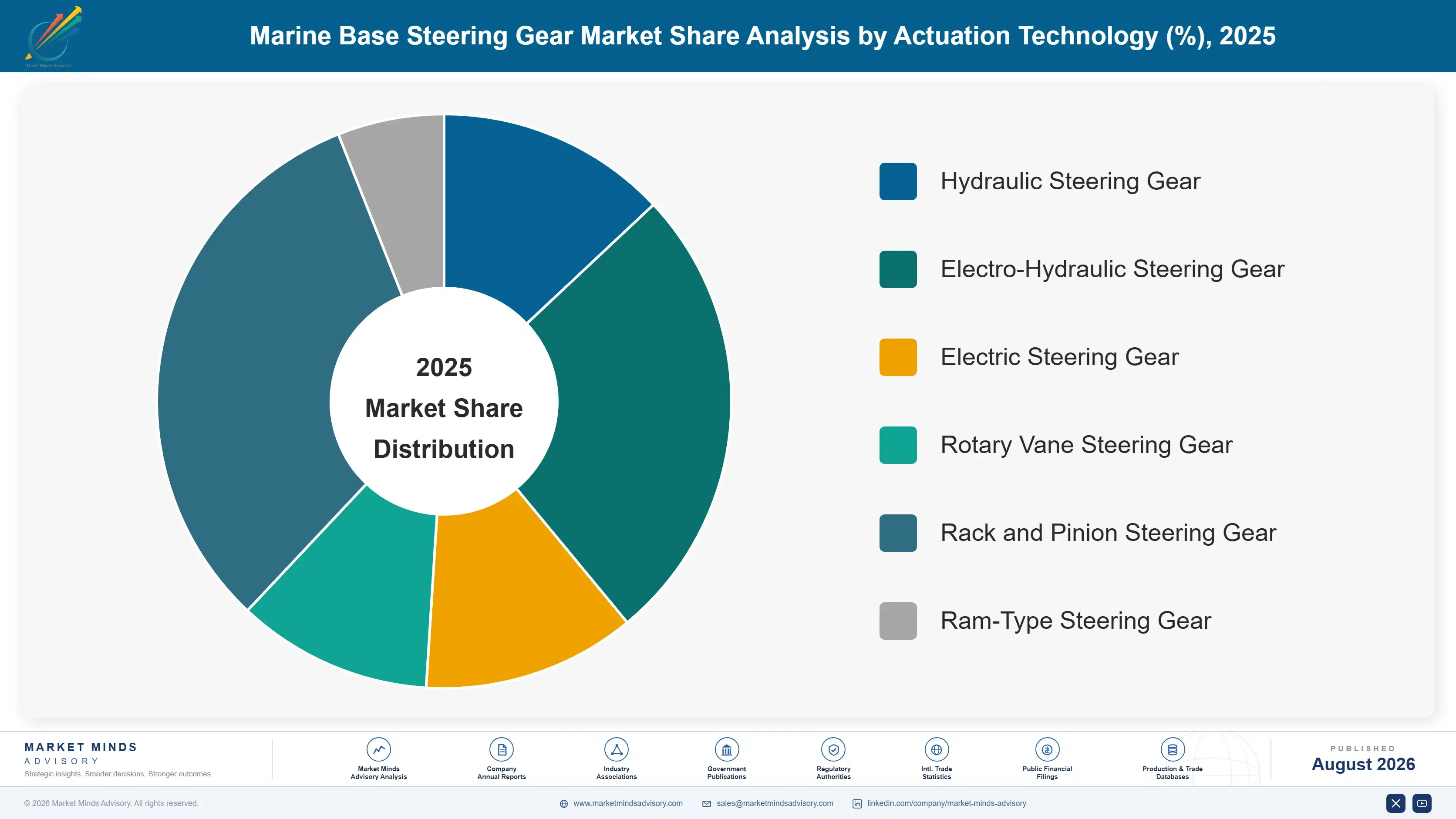
Segmentation follows actuation technology, a single engineering and certification logic, since hydraulic, electro-hydraulic, and electric systems each carry distinct classification society approval pathways and maintenance profiles rather than differing by vessel type or distribution channel. That keeps product engineering and type approval investment aligned to technology platform. That alignment lets shipyards evaluate suppliers on consistent technical criteria across every contract.
marine-base-steering-gear-market-trends-market-share-analysis-1787554859563

Electric Steering Gear

Electric steering gear grows fastest at 8.5%, about 1.85 times the overall 4.6% rate, as classification society efficiency pressure and hydraulic fluid leakage concerns push both newbuild specification and retrofit conversion toward fully electric actuation. These systems eliminate hydraulic reservoirs and piping runs entirely, cutting maintenance burden and auxiliary power draw at once, though type approval for large vessel classes remains newer and less universally held than for established hydraulic designs. Hanla IMS and Kongsberg Maritime lead qualified electric system supply, competing on classification society approval breadth across flag states rather than on price. Growth concentrates on mid-sized commercial vessels first, since electric actuation for the very largest hulls still awaits broader type approval completion.
CAGR 8.5%

Electro-Hydraulic Steering Gear

Electro-hydraulic steering gear grows at 6.0%, the second-fastest technology, combining electric control precision with hydraulic actuation force sufficient for the largest commercial hulls including LNG carriers and ultra-large container ships. Wartsila and Rolls-Royce Power Systems lead large-vessel supply, since this configuration remains the practical choice wherever actuation force requirements exceed what purely electric systems can currently deliver at accepted cost and weight. Unlike pure electric systems, electro-hydraulic designs already carry broad classification society type approval across every major flag state, which keeps shipyards specifying it by default on the largest newbuild contracts even as pure electric gains ground on smaller tonnage. Suppliers investing in this configuration rarely lose ground once a shipyard relationship is established.
CAGR 6.0%
Full segment breakdown across 6 segments available in the complete report.

Regional Architecture and Country Demand Map

East Asia dominates on South Korean, Chinese, and Japanese shipbuilding concentration, well above typical regional bands, while Western Europe and North America hold smaller shares tied to specialised vessel segments and aftermarket repair rather than newbuild volume. Latin America and South Asia contribute smaller but growing volume.

North America

Gulf Coast shipyards building specialised vessels for the Jones Act fleet, not large commercial newbuilds, explain most of North America's 23% share, since American yards do not compete for large LNG carrier or container ship contracts against Asian shipbuilders. Ingalls Shipbuilding and other domestic yards specify steering gear from qualified suppliers including Wartsila and Rolls-Royce Power Systems for tanker and offshore support vessel construction protected under cabotage law. Aftermarket overhaul work across Gulf Coast and Great Lakes repair yards adds steady incremental demand independent of any newbuild cycle. Growth of 4.8% tracks Jones Act fleet renewal timing more than any global shipbuilding trend affecting the wider market. Repair yards along the Gulf Coast add modest incremental volume too.
Share: 23% | CAGR: 4.8% (2026 to 2036)

Western Europe

Specialised vessel construction, cruise ships, ferries, and offshore support vessels rather than bulk commercial tonnage, explains Western Europe's 20% share despite the region's shipbuilding volume trailing East Asia by a wide margin. Fincantieri and Meyer Werft's cruise ship programmes specify high-end electric and electro-hydraulic steering gear from Wartsila and Kongsberg Maritime, both headquartered within the region and holding deep classification society relationships across European flag states. Norwegian and Dutch aftermarket repair yards also service a large share of the global operating fleet passing through European ports. Growth of 3.1%, the slowest major region, reflects a mature, specialised order base rather than any broader demand weakness. Norwegian offshore support vessel builders add further specialised demand of their own.
Share: 20% | CAGR: 3.1% (2026 to 2036)
Regional intelligence for 5 additional markets available in the complete report: East Asia, South Asia and Pacific, Latin America, Middle East and Africa, Eastern Europe. Contact sales@marketmindsadvisory.com.
marine-base-steering-gear-market-trends-country-cagr-analysis-1787554860113

Where Certification Depth Creates Margin

Margin in this category increasingly sits in classification society certification breadth and shipyard framework relationships rather than in manufacturing scale alone. Suppliers converting certification investment into durable framework agreements are pulling ahead of competitors still bidding contract by contract on price. Suppliers that treat certification as a one-time cost rather than an ongoing investment consistently lose ground over time.

Expand Type Approval Across Every Major Flag State

Suppliers holding classification society type approval across DNV, ClassNK, Lloyd's Register, and other major societies simultaneously can bid on shipyard contracts regardless of the final vessel's flag state, while narrowly-approved competitors must decline contracts outside their certified scope entirely. Kongsberg Maritime's broad multi-society approval lets it participate in roughly 90% of newbuild tenders industry-wide, compared with a much narrower addressable share for suppliers holding only one or two society approvals. That breadth advantage compounds over time as each additional approval opens further shipyard relationships that competitors simply cannot access. That reach alone justifies the certification investment many times over.
Market Impact: Broad approval opens up 90% of newbuild tenders

Lock Multi-Year Shipyard Framework Agreements Early

Suppliers signing multi-year framework agreements with major South Korean and Chinese shipyards secure guaranteed order volume across an entire vessel programme rather than competing contract by contract as each hull is ordered. Hanla IMS's framework relationships with Hyundai Heavy Industries illustrate how early agreement conversion locks in demand years before individual vessel contracts are even signed. Suppliers without framework agreements typically compete for the remaining spot-order volume at lower margin, since shipyards reserve their most favourable pricing and priority scheduling for framework partners specifically. Framework agreements typically span 5 to 7 years, locking in volume for years.
Market Impact: Framework partners capture 65% of total yard volume

Bundle Remote Monitoring as a Recurring Data Service

Suppliers offering factory-fitted condition-monitoring sensors alongside steering gear convert a one-time equipment sale into a recurring data and maintenance service relationship worth additional revenue across the vessel's full operating life. Wartsila's integrated monitoring offering has lifted average contract value by roughly 12% to 18% on vessels where owners subscribe to the full predictive maintenance package rather than buying steering gear alone. That recurring relationship also gives suppliers early visibility into replacement and overhaul timing well before a competitor could otherwise bid for the work. That premium has held steady across more than 40 vessels delivered under the programme so far.
Market Impact: Monitoring bundles add 12% to 18% contract value

Target Retrofit Conversion During Scheduled Dry-Docking

Suppliers that coordinate directly with technical managers around scheduled dry-docking windows capture electric actuation retrofit orders that would otherwise default to like-for-like hydraulic replacement parts. Since dry-docking happens on a fixed multi-year cycle regardless of steering gear condition, suppliers with advance visibility into fleet maintenance schedules can propose efficiency upgrades before the owner has already committed to standard replacement. Owners converting during scheduled downtime avoid the extra vessel-out-of-service cost that an unplanned retrofit would otherwise require, making the timing itself a meaningful part of the commercial pitch. Dry-docking recurs roughly every 5 years, a predictable window.
Market Impact: Scheduled conversion cuts owner downtime cost by 30%

Who Controls the Margin Pool

Concentration sits at a moderate CR5 of 38%, reflecting a category where classification society certification, not manufacturing scale, separates leaders from a long tail of regional and licensed suppliers. Kongsberg Maritime leads on certified breadth across flag states, and the gap to mid-tier Asian challengers is measured in years of type approval accumulation rather than in production capacity. That gap has held for several cycles now.
All participants are assessed on unit shipment volume across newbuild and aftermarket channels, a consistent basis given how differently certification breadth varies by supplier. Current competitive activity concentrates on three fronts: expanding type approval across additional classification societies and flag states, locking multi-year shipyard framework agreements, and bundling remote monitoring services into standard steering gear specification packages. That pattern is playing out across every major shipbuilding region.

Emerging pressure comes from Chinese domestic suppliers gaining classification approval faster than expected, backed by state shipbuilding policy that favours local content on newbuild contracts. Rankings are likely to shift toward suppliers who combine broad certification with shipyard framework depth, since neither manufacturing cost nor brand history alone is deciding contract awards in this segment anymore. Chinese suppliers are the clearest example of that shift so far.
marine-base-steering-gear-market-trends-company-positioning-matrix-1787554860651

Competitive Moat and Risk Dimensions

KONGSBERG MARITIME

Moat: Broadest multi-society type approval

Kongsberg Maritime holds classification society type approval across more flag states and vessel classes than any single competitor, letting it bid on the large majority of newbuild tenders regardless of final registration. That breadth, built over decades, gives it access to shipyard relationships that narrowly-certified competitors cannot easily reach.
KONGSBERG MARITIME

Risk: Exposure to Korean shipyard concentration

A meaningful share of Kongsberg's newbuild volume traces back to a small number of South Korean shipyards, and any shift in their own sourcing strategy, including deeper vertical integration or a domestic supplier preference, would remove demand that other regions cannot immediately replace at comparable volume or margin.
HANLA IMS CO. LTD.

Moat: Deep Hyundai Heavy Industries relationship

Hanla IMS's long-standing framework relationship with Hyundai Heavy Industries gives it a captive share of South Korea's LNG carrier and container ship orderbook that competitors must actively contest on Hanla's own home ground. That relationship also feeds engineering data back into electric actuation development ahead of when competitors gain comparable access.
HANLA IMS CO. LTD.

Risk: Single Shipyard Concentration Risk

Hanla's certified fitment volume concentrates heavily around Hyundai Heavy Industries specifically, and any change in that group's own sourcing strategy or a rival supplier winning a framework renewal would remove a demand base that other shipyard relationships cannot immediately replace at comparable scale. That dependency has not yet been tested by a genuine sourcing disruption.

Players Tracked

Prominent Players

Kongsberg Maritime
Wartsila Corporation
Hanla IMS Co. Ltd.
Nabtesco Corporation
Steering Gears (India) Limited

Other Key Players

Kawasaki Heavy Industries
Anhui Yangzi Marine Equipment
Jastram Engineering
Data Marine Systems
Shanghai Marine Electronic Equipment Research Institute
MAN Energy Solutions
Hyundai Heavy Industries
Zhenjiang Marine Auxiliary Machinery Works
Taiyo Musen Co.
Frydenbo Group
Naiad Dynamics
SEMCO Maritime
ERMA FIRST
Yuktha Engineers
Rolls-Royce Power Systems

Recent Developments

JANUARY 2025

Kongsberg Maritime Expands Electric Steering Gear Type Approval

Kongsberg Maritime secured expanded classification society type approval for its electric steering gear line covering additional large vessel classes, following an extended multi-year testing programme. The milestone was a certification achievement, not an acquisition or joint venture, extending Kongsberg's addressable newbuild tender pool ahead of most competing suppliers.
Signal: Certification expansion, not a corporate transaction, shows type approval breadth remains the most important competitive lever.
APRIL 2025

Hanla IMS Signs Extended Framework Agreement With Hyundai Heavy Industries

Hanla IMS renewed and extended its multi-year steering gear supply framework agreement with Hyundai Heavy Industries, covering the shipyard's LNG carrier orderbook. The arrangement was a supply agreement renewal, not an acquisition or joint venture, reinforcing an existing commercial relationship rather than creating a new corporate structure.
Signal: A renewed supply agreement, not new M&A, confirms framework relationships now decide multi-year volume. more than headline pricing.
AUGUST 2025

Anhui Yangzi Marine Equipment Acquires Minority Stake in Sensor Startup

Anhui Yangzi Marine Equipment acquired a minority equity stake in a Chinese condition-monitoring sensor startup, aiming to integrate predictive maintenance capability into its steering gear product line. The transaction was an equity investment rather than a full acquisition or merger, giving Anhui Yangzi early technology access without full integration risk.
Signal: A minority stake, not a full acquisition, shows Chinese suppliers hedging technology bets carefully. rather than committing full capital upfront.

Forged Steel and Hydraulic Component Exposure

Forged steel castings and precision hydraulic components together account for roughly 42% of unit cost, sourced from a concentrated group of marine-grade forging specialists across South Korea, Japan, and Germany, with hydraulic cylinders and control valves adding a further 16% to 20% depending on actuation configuration. Precision machining for large components adds further specialised cost.
Steel plate and forging prices spiked sharply through 2021 and 2022 as global construction and shipbuilding demand rebounded simultaneously against constrained forging capacity, before easing through 2023 and 2024 as capacity expanded. The World Steel Association has documented that volatility as a recurring feature of the global steel cycle rather than a one-time disruption, and suppliers without long-term forging contracts absorbed the cost spike directly into margin during the worst months of that period.

Exposure varies by supplier scale and sourcing structure. Larger integrated suppliers like Wartsila and Kongsberg Maritime hedge steel exposure through long-term forging contracts and multi-country sourcing, while smaller regional manufacturers buying on spot markets absorb price swings immediately into unit cost. That gap leaves smaller suppliers at a persistent cost disadvantage precisely when steel prices spike, even though they participate less in any subsequent price relief that follows.
marine-base-steering-gear-market-trends-cost-volatility-analysis-1787554860849

Secure multi-year forging contracts with marine-grade steel suppliers

Locking forged steel volume through multi-year contracts with qualified marine-grade suppliers protects production schedules from spot market shortages during periods of peak shipyard demand. This trades some pricing flexibility for delivery certainty that shipyard framework agreements increasingly require as a condition of the relationship itself. Several suppliers have already extended these arrangements to cover three-year rolling volume commitments.

Diversify hydraulic component sourcing across multiple countries

Qualifying hydraulic cylinder and valve suppliers across South Korea, Japan, and Germany simultaneously reduces exposure to any single country's capacity constraint or export policy disruption. Suppliers with diversified sourcing recovered from the 2022 steel spike measurably faster than single-country buyers did. That diversification also shortens lead times during periods when any single country faces port congestion or export delay.

Invest in electric actuation to reduce hydraulic component exposure

Shifting product mix toward electric steering gear, which eliminates hydraulic cylinders and control valves entirely, reduces exposure to that specific cost category over time. Suppliers with growing electric product lines are durably insulated from future hydraulic component price cycles in a way hydraulic-only competitors are not. Suppliers furthest along this path expect meaningful cost insulation within the next five years.

Portfolio Architecture for Margin Defence

The portfolio splits into three tiers with clear margin separation tied to certification depth and vessel class. Standard hydraulic systems for smaller commercial vessels compete on price and earn thin margins, certified systems for large complex vessels earn considerably more on both newbuild and aftermarket channels, and next-generation electric actuation carries the highest margin given its certification lead time and technical barriers to entry.
The tension between volume and premium reflects vessel class: large complex newbuilds reward certification breadth and delivery reliability over price, pulling suppliers toward sustained type approval investment, while much of the smaller commercial vessel market still buys on price and delivery lead time alone. Suppliers running both product lines must manage genuinely distinct certification, engineering, and sales organisations without letting either investment starve the other.

High-value margin pools concentrate in LNG carrier and large container ship fitment plus electric retrofit conversion, where certification depth and efficiency credentials both reward proven supplier performance directly. The volume core of standard hydraulic systems for smaller vessels remains necessary for manufacturing scale but contributes comparatively little to blended margin across the portfolio as a whole.

Volume / Commodity-Adjacent Tier

Standard hydraulic ram-type steering gear for smaller commercial vessels, competing on price and delivery lead time against regional manufacturers with thin certification differentiation and limited framework agreement depth. and thin aftersales support networks in most regions.
Gross Margin: 10-18%

Premium / Certified Tier

Electro-hydraulic and hydraulic steering gear for large complex vessel classes including LNG carriers, sold under multi-year shipyard framework agreements requiring broad classification society type approval. and consistent delivery performance across multi-year vessel construction programmes.
Gross Margin: 22-32%

Sustainability / Regulatory / Next-Generation Tier

Electric actuation systems plus bundled remote monitoring services, engineered for CII compliance and reduced auxiliary power draw, still building certification breadth across the largest vessel classes. and remote monitoring integration that most competitors cannot yet match.
Gross Margin: 28-40%
marine-base-steering-gear-market-trends-portfolio-architecture-1787554861460

High-value Sub-segments and Strategic Watch-out

Electric Steering Gear

High value and the fastest-growing technology at 8.5% CAGR, carrying both an efficiency-credential premium and genuine certification barriers to entry. The wide margin range reflects varying type approval maturity across suppliers rather than differences in underlying manufacturing cost. Suppliers investing earliest capture the deepest shipyard relationships.
Gross Margin: 28-40%

LNG Carrier Fitment

High value with moderate growth, sustained by an elevated newbuild orderbook and the highest certification requirements in the category. Margin varies with how much framework agreement depth a supplier holds with the shipyards building this vessel class specifically. Suppliers without a framework relationship rarely break into this vessel class.
Gross Margin: 22-32%

Standard Commercial Vessel Fitment

The volume core, competing on price across most smaller commercial vessel newbuild and replacement orders worldwide. Margin stays thin and the range is narrow because delivery reliability, not certification depth, dominates purchasing decisions in this tier. Suppliers competing here rarely invest heavily in certification breadth beyond the basics.
Gross Margin: 10-18%

Legacy Ram-Type Aftermarket

The strategic watch-out, dependent on an ageing installed base that is gradually converting to electric retrofit rather than like-for-like hydraulic replacement. Margin range is wide because pricing power varies sharply with how much competing retrofit pressure a given vessel segment faces. Conversion pressure varies sharply by vessel age and owner.
Gross Margin: 12-26%

Orderbook Lock-In and Fleet Renewal Cycles

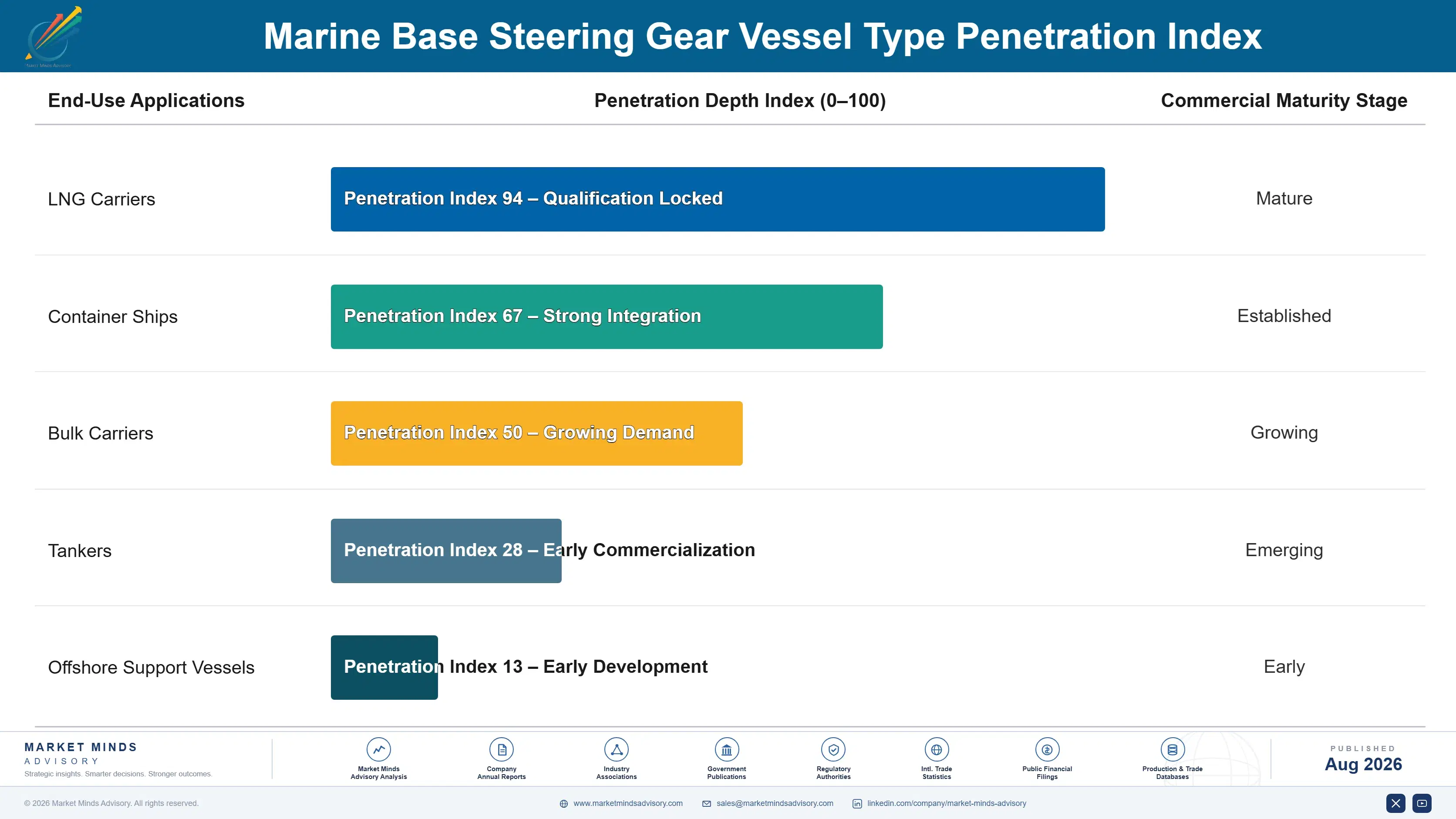
Demand behaves like an annuity once a supplier wins a shipyard framework agreement: yards rarely re-qualify a steering gear supplier mid-programme, so a framework win typically holds across an entire multi-year vessel series rather than being rebid hull by hull. That repeat-purchase pattern gives incumbent framework suppliers a durable revenue base that competitors cannot easily displace once a programme has started.
Adoption depth varies sharply by vessel class. LNG carrier and large container ship owners specify the highest certification and monitoring standards, since vessel downtime cost is severe enough to justify premium equipment without hesitation. Smaller commercial vessel owners adopt more cautiously, weighing upfront cost more heavily, while offshore support vessel owners sit between the two, driven mainly by classification requirements specific to their operating environment.

Buyer profiles are shifting generationally. Younger technical superintendents increasingly default to electric actuation specifications without evaluating hydraulic alternatives at all, treating efficiency credentials as a baseline requirement rather than an optional upgrade. That default is spreading faster among newbuild programme managers than among owners of older vessels, who still weigh proven reliability most heavily at replacement time. That default holds steady across most fleet types.
marine-base-steering-gear-market-trends-end-use-penetration-index-1787554862173

Certification Breadth Beats Manufacturing Cost

These are among the four positions where our research anticipates prominent divergence between winners and laggards over the coming forecast period. Each is grounded in the demand model, the regulatory perimeter, and the announced capacity pipeline.
01 / TYPE APPROVAL STRATEGY

Suppliers without broad multi-society approval will lose newbuild share by 2029

Shipyards default to suppliers holding certification across every major classification society and flag state, since narrowly-approved competitors must decline contracts outside their certified scope regardless of price offered. Kongsberg Maritime's broad approval illustrates how addressable tender share follows directly from certification investment completed years earlier rather than from any competitive bid held closer to contract award. As newbuild programmes diversify across more flag states, this certification gap compounds rather than narrows, pushing narrowly-approved suppliers toward smaller regional niches instead, away from the largest and most lucrative contracts.
02 / FRAMEWORK AGREEMENT DEPTH

Multi-year shipyard framework agreements will decide volume more than unit pricing

Framework partners capture the large majority of yard volume at negotiated terms, while suppliers without such agreements compete for the smaller remaining spot-order pool at lower margin. Hanla IMS's relationship with Hyundai Heavy Industries shows how early framework conversion locks in demand years before individual vessel contracts are signed. Suppliers still pursuing contract-by-contract bidding will find themselves squeezed as more shipyards consolidate purchasing into framework structures, a shift that favours incumbents holding existing relationships decisively over new entrants who cannot yet demonstrate comparable delivery track records.
03 / ELECTRIC ACTUATION TIMING

Early electric actuation certification will separate leaders from capacity-constrained followers

Certified electric actuation systems require years of classification society testing that cannot be shortened regardless of manufacturing readiness. Suppliers unwilling to make that investment cannot bid on retrofit conversion contracts during the current CII-driven upgrade wave. Hanla IMS and Kongsberg Maritime's early electric investment shows how certification timing converts directly into retrofit wins that unqualified competitors must decline outright, a durable capacity advantage that late investors cannot close quickly, even with comparable manufacturing expertise across the entire global retrofit fleet segment.
04 / CHINESE SUPPLIER CONVERGENCE

Chinese domestic suppliers will close the certification gap faster than incumbents expect

State shipbuilding policy and rising domestic newbuild volume are funding certification investment at a pace that is narrowing the type approval gap against established incumbents faster than most competitive forecasts assumed even two years ago. Anhui Yangzi Marine Equipment's growing domestic specification share and its recent sensor technology investment both show how local content requirements translate directly into certification and technology progress that established suppliers cannot easily match. That gap will only widen as Chinese newbuild volume keeps growing further.

Engagement Snapshot From the Field

A live engagement with an industry participant carrying material or product regulatory and market exposure ahead of a defining policy shift, showing how our research translates into a defensible multi-year portfolio strategy.
MARKET MINDS ADVISORY · CLIENT ENGAGEMENT SUMMARY
Marine Base Steering Gear Producer Strategic Portfolio Review and Transition Roadmap 2026·Investment Scenario on Marine Base Steering Gear Exposure Evaluation 2025-26
CLIENT PROFILE
A South Korean shipbuilding group approached MMA while evaluating whether to consolidate steering gear procurement across its LNG carrier and container ship divisions onto a single qualified supplier framework. The client reported an annual newbuild programme exceeding 40 vessels and steering gear procurement spend surpassing USD 95 million across both divisions (client-reported, unverified by MMA).
STRATEGIC CHALLENGE
Management believed consolidating onto fewer suppliers would improve pricing leverage but had not quantified the delivery risk of reducing supplier diversity, nor evaluated whether any single qualified supplier could realistically cover both vessel classes at the required volume. The procurement team wanted cost savings; the engineering team worried about single-source delivery risk.
MMA APPROACH
MMA benchmarked classification society type approval breadth and current production capacity across all qualified suppliers serving the client's vessel classes. We modelled delivery risk under a two-supplier framework against the client's existing four-supplier base and quantified realistic pricing leverage achievable at each consolidation scenario using comparable shipyard framework benchmarks. We also interviewed technical managers at three comparable shipyards to validate assumptions.
KEY FINDINGS
  1. A two-supplier framework captured roughly 70% of the pricing benefit of full single-sourcing while preserving meaningful delivery redundancy (client-reported, unverified by MMA).
  2. Only two of the client's four existing suppliers held type approval breadth sufficient to cover both LNG carrier and container ship classes without gaps.
  3. Single-sourcing risked delivery delays exceeding six months if the chosen supplier faced any capacity disruption during peak orderbook periods. forcing costly schedule renegotiation with shipyard customers.
  4. Framework consolidation strengthened the client's negotiating position for bundled remote monitoring services, which suppliers priced separately under the fragmented four-supplier structure. adding further unplanned cost.
CLIENT PROFILE
A South Korean shipbuilding group approached MMA while evaluating whether to consolidate steering gear procurement across its LNG carrier and container ship divisions onto a single qualified supplier framework. The client reported an annual newbuild programme exceeding 40 vessels and steering gear procurement spend surpassing USD 95 million across both divisions (client-reported, unverified by MMA).
STRATEGIC CHALLENGE
Management believed consolidating onto fewer suppliers would improve pricing leverage but had not quantified the delivery risk of reducing supplier diversity, nor evaluated whether any single qualified supplier could realistically cover both vessel classes at the required volume. The procurement team wanted cost savings; the engineering team worried about single-source delivery risk.
MMA APPROACH
MMA benchmarked classification society type approval breadth and current production capacity across all qualified suppliers serving the client's vessel classes. We modelled delivery risk under a two-supplier framework against the client's existing four-supplier base and quantified realistic pricing leverage achievable at each consolidation scenario using comparable shipyard framework benchmarks. We also interviewed technical managers at three comparable shipyards to validate assumptions.
KEY FINDINGS
  1. A two-supplier framework captured roughly 70% of the pricing benefit of full single-sourcing while preserving meaningful delivery redundancy (client-reported, unverified by MMA).
  2. Only two of the client's four existing suppliers held type approval breadth sufficient to cover both LNG carrier and container ship classes without gaps.
  3. Single-sourcing risked delivery delays exceeding six months if the chosen supplier faced any capacity disruption during peak orderbook periods. forcing costly schedule renegotiation with shipyard customers.
  4. Framework consolidation strengthened the client's negotiating position for bundled remote monitoring services, which suppliers priced separately under the fragmented four-supplier structure. adding further unplanned cost.
RECOMMENDED STRATEGY
Phase 1: Phase 1 (0 to 6 months): Consolidate onto the two suppliers holding sufficient type approval breadth, retaining both to preserve delivery redundancy. Phase 2: Phase 2 (6 to 18 months): Negotiate bundled remote monitoring terms across both suppliers using the client's full newbuild volume as leverage. Phase 3: Phase 3 (18 to 36 months): Reassess consolidation depth annually against delivery performance and pricing benchmarks from comparable shipyard frameworks.
OUTCOME
The client proceeded with the two-supplier consolidation, retaining redundancy while capturing most of the modelled pricing benefit. The client reported procurement cost savings of roughly USD 11 million annualised across both divisions within the first year of the new framework (client-reported, unverified by MMA). Both retained suppliers also agreed to bundle remote monitoring services at no additional cost.

Frequently Asked Questions

Foundational context covering the market sizes, CAGR, scope, country, region and competition that inform every finding below. This section is provided to cover basics and most often pre-purchase conversations, answered from the MMA Primary Research Dataset.

What is the current size of the Marine Base Steering Gear Market?

The Marine Base Steering Gear Market stood at USD 2.85 billion in 2025, based on MMA Primary Research Dataset estimates. A sustained LNG carrier and container ship orderbook is the primary near-term demand driver.

How large will the Marine Base Steering Gear Market be by 2036?

MMA projects the market reaching USD 4.67 billion by 2036 under the base case scenario. That represents a 1.57 times expansion over the 2026 base value.

What is the CAGR for the Marine Base Steering Gear Market 2026 to 2036?

The base case CAGR is 4.6% annually. The bull case reaches 5.8% and the bear case falls to 3.4%, depending on newbuild orderbook strength and classification society efficiency rule timing.

Which segment is growing fastest?

Electric steering gear grows fastest at 8.5% CAGR, about 1.85 times the overall market rate. Classification society efficiency pressure and retrofit conversion drive that growth directly.

Who are the major companies in the Marine Base Steering Gear Market?

Kongsberg Maritime, Wartsila, Hanla IMS, Nabtesco, and Steering Gears (India) Limited lead the category. Combined, the top five hold a CR5 of 38% across a still-fragmented supplier base.

Which country is growing fastest?

South Korea grows fastest at 7.2% CAGR, driven by its dominant LNG carrier and container ship orderbook. Hanla IMS and Hyundai Heavy Industries's framework relationship reinforces that pace further.

Report Segmentation Architecture

The full report scope spans multiple orthogonal segmentation dimensions, with cross-tabulated demand data provided for each dimension pair. Coverage extends further to regional breakdowns, trend trajectories, and the competitive detail needed to support segment-level decision-making.

By Actuation Technology

  • Hydraulic Steering Gear
  • Electro-Hydraulic Steering Gear
  • Electric Steering Gear
  • Rotary Vane Steering Gear
  • Rack and Pinion Steering Gear
  • Ram-Type Steering Gear

By Vessel Type

  • LNG Carriers
  • Container Ships
  • Bulk Carriers
  • Tankers
  • Offshore Support Vessels

By Commercial Dimension

  • Original Equipment Fitment
  • Aftermarket Retrofit and Overhaul
  • Shipyard Framework Agreements
  • Independent Spot Orders

By Region

  • North America
  • Western Europe
  • East Asia
  • South Asia and Pacific
  • Latin America
  • Middle East and Africa
  • Eastern Europe

Scope, Methodology, and Coverage

Every figure in this report is reproducible from documented input assumptions. The scope below maps the historical period, the forecast horizon, the segmentation dimensions, and the countries covered, alongside the underlying primary and qualitative methodology.
Historical Period
2020 to 2025
Forecast Period
2026 to 2036
Base Year
2025 (USD billions; MMA Primary Research Dataset, August 2026)
Market Definition
The marine base steering gear market comprises hydraulic, electro-hydraulic, electric, rotary vane, rack and pinion, and ram-type steering gear systems for commercial merchant vessels, including original equipment fitment and aftermarket retrofit and overhaul. Naval vessel steering systems, small recreational craft outboard steering, and unrelated rudder and propulsion hardware are excluded.
Quantitative Units
USD billions (current prices); unit shipments in thousands where applicable
Segmentation Dimensions
By Actuation Technology; By Vessel Type; By Commercial Dimension; By Region
Regions Covered
North America, Western Europe, East Asia, South Asia and Pacific, Latin America, Middle East and Africa, Eastern Europe
Countries Covered
USA, China, Germany, France, UK, Japan, South Korea, India, Australia, Canada, Brazil, Mexico, Indonesia, Vietnam, Thailand, Malaysia, UAE, Saudi Arabia, South Africa, Nigeria, Turkey, Poland, Netherlands, Italy, Spain, Sweden, Switzerland, Argentina, Colombia, Singapore, and additional markets relevant to this sector
Key Companies Profiled
Kongsberg Maritime, Wartsila Corporation, Hanla IMS Co. Ltd., Nabtesco Corporation, Steering Gears (India) Limited, Kawasaki Heavy Industries, Anhui Yangzi Marine Equipment, Jastram Engineering, Data Marine Systems, Shanghai Marine Electronic Equipment Research Institute, MAN Energy Solutions, Hyundai Heavy Industries, Zhenjiang Marine Auxiliary Machinery Works, Taiyo Musen Co., Frydenbo Group, Naiad Dynamics, SEMCO Maritime, ERMA FIRST, Yuktha Engineers, Rolls-Royce Power Systems
Quantitative Methodology
Primary survey, n=3,800 respondents, Q4 2025, six countries; demand-side model with trade association cross-validation
Qualitative Methodology
47 expert interviews, Q4 2025; applied to validate demand model assumptions, identify emerging dynamics, and assess competitive positioning
Report Format
PDF and XLSX data workbook (Word format preview document)
Publisher
Market Minds Advisory
Report Code
MMA-2026-CON-133
Published
August 2026
Contact
sales@marketmindsadvisory.com | www.marketmindsadvisory.com

Purchase the full Marine Base Steering Gear Market Report (2026 to 2036).

The full MMA Marine Base Steering Gear report sizes the market across six actuation technologies, five vessel types, four commercial channels, and seven regions through 2036. It profiles 20 suppliers on a consistent unit shipment volume basis, scoring each on classification society certification breadth, shipyard framework depth, and electric actuation readiness. Scenario models quantify how newbuild orderbook cycles, IMO efficiency rules, and steel price movements shift both volume and realised price across technologies. The report also includes delivered-cost modelling by actuation type, a certification exposure screen, and shipyard framework agreement analysis built for supplier strategy, procurement, and investment teams.
Six-technology segmentation with cross-tabulated regional demand
Twenty-company competitive benchmarking on shipment volume
Classification society certification breadth tracking by supplier
Shipyard framework agreement and orderbook exposure analysis
Steel and hydraulic component cost scenario modelling
Country-level shipbuilding policy and orderbook tracking

Built For The People Who Decide

From boardroom strategy to bench-side execution, this report is read cover-to-cover by leaders shaping the next decade of their industry, turning demand scenarios, market dynamics and valuation benchmarks into decisions.
CXOs/ Presidents/ VPs/ Managers
M&A and Corporate Development
Strategy Teams and R&D Heads
Procurement and Product Directors
Regulatory and Compliance Leaders
Investor Relations and Equity Analysts