Market Minds Advisory
Margarine Market

Margarine Market: Plant-Based Reformulation Meets a Century-Old Commodity Category

Margarine manufacturers are reformulating around plant-based and clean-label positioning to fend off butter's premium comeback, pushing legacy commodity brands toward vegan certification and traceable palm oil sourcing that a decade ago barely mattered.

Lead Analyst

Lisa Gevelber

Published

September 2026

Make Smarter Decisions with Customized Research Insights

Request a free sample report and evaluate market opportunities, growth trends, and competitive dynamics relevant to your business needs.

2025 MARKET VALUE$42.5BMarket Size 2025
2036 FORECAST VALUE$68.2BBase Case , 2026 to 2036
CAGR 2026 TO 20364.4 %Bull 5.6% / Bear 3.2%
INCREMENTAL OPPORTUNITY$23.9BNet 10- year value creation
EXPANSION MULTIPLE1.54x2036 value over 2026 base
Strategic Levers
M&A Pipeline
Regional Outlook
Country Rankings
Competitive Intelligence
Segmental Deep-dive
Call-Us : 91 93563 13602

Executive Snapshot and Market Trajectory

Margarine manufacturers are reformulating around documented plant-based and clean-label positioning as butter's premium image continues eroding margarine's historical value proposition, forcing legacy commodity brands to compete on certification rather than price alone nationwide today, a shift few in the category anticipated moving this quickly overall.
Plant-based and vegan margarine is growing fastest as manufacturers pursue dairy-free certification well beyond the category's traditional health-conscious buyer base, expanding at roughly 7.8 percent annually against the category's 4.4 percent baseline overall. East Asia commands the largest regional share behind Western Europe, anchored in expanding industrial bakery demand across China's growing commercial food manufacturing sector. Retailers increasingly treat certified sustainable sourcing as a baseline listing requirement rather than a marketing bonus.
Competitive intensity centers on a small group of global fats and oils processors capable of running integrated palm and vegetable oil supply chains at commercial scale, a capability requiring considerable upstream investment that smaller regional blenders cannot easily replicate. Retailers increasingly demand documented sustainable palm oil certification before renewing private label contracts, pushing several smaller manufacturers to either invest in traceability or exit certain premium retail channels entirely.
Market Definition
The margarine market covers table, spreadable, industrial, bakery, puff pastry, and plant-based margarine products manufactured from vegetable and plant oils blended with water, emulsifiers, and flavoring agents for retail and foodservice use. It excludes dairy butter and butter blend products containing more than 10 percent dairy fat by weight.
Base Year Value
$42.5B in 2025 (MMA Primary Research Dataset, August 2026)
Forecast Period
2026 to 2036, eleven discrete annual values
CAGR
4.4% base case. Bull 5.6%. Bear 3.2%.
Fastest Growth Segment
Plant-Based and Vegan Margarine: 7.8% CAGR
Fastest Growth Country
India: 8.9% CAGR
Fastest Growth Region
South Asia and Pacific: 6.5% CAGR
Largest Region
Western Europe: 26% of 2025 global value
Market Leaders
Upfield Holdings B.V., Bunge Limited, Vandemoortele NV, Wilmar International Limited, and Associated British Foods plc lead by disclosed production volume and brand portfolio. Source: MMA Analysis based on company annual reports and retail scan data.
Primary Survey
n=3,800 procurement and R&D decision-makers, Q4 2025, six countries
Methodology
Demand-side build-up, cross-validated against public data, 47 expert interviews

Margarine Market Forecast Scenarios

margarine-market-trends-forecast-2024-2034-size-forecast-scenario-1787457495234
Between 2020 and 2025, margarine demand grew modestly as the category faced sustained competitive pressure from butter's premium repositioning and rising consumer interest in less-processed spread alternatives. Plant-based reformulation investment accelerated meaningfully across the period as brands sought new differentiation. The category posted an estimated 3.6 percent historical CAGR, trailing the forecast rate ahead of continued reformulation.
MMA's base case projects 4.4 percent annual growth through 2036, anchored in three commercial mechanisms. First, plant-based and vegan-certified formulations keep converting dairy-free households at a meaningfully higher rate than traditional margarine formulations ever achieved on their own. Second, industrial bakery and foodservice demand keeps expanding as commercial food manufacturers favor margarine's cost and functional performance advantages over butter. Third, emerging market household penetration keeps rising as retail infrastructure expands into previously underserved regions.
The bull case rests on sustained global cooking oil price volatility pushing budget-conscious households back toward margarine's cost advantage over butter at scale. The principal bear risk is continued premiumization of butter marketing, which could keep eroding margarine's mainstream retail positioning among health and taste-conscious consumers willing to pay more for dairy alternatives, a risk that would force renewed marketing investment across the entire category.

Certification Becomes the Category's Real Battleground

Household purchasing behavior for margarine has shifted decisively from viewing the category as a simple butter substitute toward evaluating documented sourcing credentials and formulation transparency. Consumers now compare palm oil sustainability certification, ingredient simplicity, and plant-based positioning before choosing a brand, a scrutiny level that barely existed when margarine competed purely on price against butter a generation ago across the wider industry.
MARKET CONCENTRATIONCR5 48%top five manufacturers hold considerable combined global production capacity today
AVERAGE PRICE DISCOUNT0.6x premium buttermargarine retains a durable sustained cost advantage over dairy butter
PALM OIL COST SHARE38% of COGSvegetable oil feedstock dominates total margarine production cost structure
SUSTAINABLE SOURCING CERTIFICATION61%leading manufacturers certify palm oil sourcing through recognized programs
PRIVATE LABEL PENETRATION44%retailers increasingly favor store-brand margarine over legacy national brands
INDUSTRIAL BAKERY CHANNEL SHARE34%commercial food manufacturing increasingly drives category volume beyond retail
Manufacturing economics reward companies that invested in integrated vegetable oil supply chains years before sustainability certification became a retail requirement. Mass retailers increasingly favor manufacturers that can document sustainable palm oil sourcing, forcing smaller regional blenders to either invest in certification infrastructure or compete purely on price for undifferentiated private label volume lacking documentation across every major retail account tracked in this report.
Over the next decade, plant-based reformulation and sustainable sourcing will matter as much as manufacturing cost efficiency. Manufacturers that solve documented sustainability while preserving margarine's traditional cost advantage stand to capture disproportionate share as the category defends its position against butter's premium resurgence nationwide and increasingly across emerging retail markets abroad each year, reshaping how the category defends its long-standing cost advantage.
"Margarine used to win on price alone. Now it has to win on price, sustainability documentation, and a plant-based label all at once, or butter simply takes the shelf space back."
Director, Food and Plant-Based Nutrition Practice · MMA Food and Plant-Based Nutrition Practice · August 2026

Market Trends

Plant-Based Certification Expands Beyond Traditional Vegan Buyers

Margarine manufacturers are pursuing formal plant-based and vegan certification well beyond the category's traditional health-conscious buyer base, treating documented dairy-free credentials as a mainstream retail differentiator rather than a niche positioning choice. Upfield's Flora and Blue Band brands have each disclosed reformulation programs targeting certified vegan status across core product lines sold in major markets. Retailers increasingly favor margarine brands carrying documented plant-based labeling on packaging, reinforcing the certification trend at shelf level across premium and mainstream tiers alike This shift has meaningfully blurred the historical line between margarine and dedicated plant-based butter alternatives.
Market Impact: Expands bakery channel volume by 14%
Sustainable Palm Oil Certification Becomes Standard Retail Requirement

Major retailers across Western Europe and North America have made sustainable palm oil certification a standard requirement for margarine listing, forcing manufacturers to document supply chain traceability back to certified plantations before renewing annual contracts. This shift followed years of consumer advocacy campaigns highlighting deforestation concerns tied to conventional palm oil production methods. Manufacturers holding Roundtable on Sustainable Palm Oil certification report meaningfully stronger retail listing renewal rates than competitors lacking documented certification. Smaller regional manufacturers increasingly struggle to absorb certification compliance costs, accelerating industry consolidation toward larger, better-capitalized producers able to fund traceability infrastructure.
Market Impact: Sustains 40% cost advantage overall

Market Opportunities and Growth Drivers

Industrial Bakery Demand Sustains Steady Volume Growth

Industrial bakery and commercial food manufacturing demand continues sustaining steady margarine volume growth, as commercial bakers favor margarine's documented functional performance advantages, including superior lamination properties for puff pastry and consistent shelf stability, over butter's higher cost and variability. This demand channel has proven considerably more resilient to consumer sentiment shifts than retail table margarine, since commercial buyers prioritize documented functional performance and cost predictability over marketing positioning. Bakery chains and food service operators increasingly specify margarine formulations by exact functional specification rather than brand name alone nationwide overall today.
Market Impact: Cuts premium segment share by 13%

Cost Advantage Over Butter Persists Amid Dairy Price Volatility

Margarine's persistent cost advantage over butter has widened during recent periods of dairy commodity price volatility, as milk fat costs rose meaningfully faster than vegetable oil feedstock costs across several recent seasons. This cost gap keeps margarine attractive to budget-conscious households and commercial buyers managing tight food cost margins, even as premium butter marketing continues eroding margarine's positioning among higher-income consumers. Retailers report meaningfully stronger margarine sales growth during periods of elevated dairy pricing, confirming the category's role as a genuine value alternative. Emerging market households, in particular, continue favoring margarine's documented cost advantage over premium dairy alternatives.
Market Impact: Compresses margins by roughly 8%

Market Restraints and Challenges

Butter's Premium Repositioning Erodes Mainstream Retail Share

Butter's sustained premium repositioning, emphasizing natural ingredient simplicity and culinary authenticity, has eroded margarine's mainstream retail share among higher-income and health-conscious consumers who increasingly view butter as the less-processed option despite margarine's documented cost and functional advantages. The root cause is perception: margarine's decades-old association with hydrogenated fats and artificial processing persists even though most modern formulations have eliminated trans fats entirely through reformulation. This perception gap keeps margarine confined to more price-sensitive retail segments in several developed markets. Manufacturers are investing in ingredient transparency marketing to address these lingering perception concerns directly with skeptical consumers.
Market Impact: Adds 12 certified product launches yearly

Volatile Vegetable Oil Feedstock Pricing Compresses Margins

Volatile vegetable oil feedstock pricing, driven by palm and soybean oil commodity cycles tied to weather, export policy, and biofuel demand competition, periodically compresses manufacturer margins in ways that retail pricing cannot always immediately offset. The root cause is feedstock concentration: palm and soybean oils together account for the large majority of margarine's raw material base, leaving limited diversification options during simultaneous price spikes across both commodities. This volatility disproportionately affects smaller manufacturers lacking hedging capability or diversified feedstock sourcing relationships Larger manufacturers increasingly use forward contracting to manage this exposure more predictably across planning cycles.
Market Impact: Lifts certified sourcing share by 19%
3 additional market trends, 4 additional growth drivers, and 3 additional restraints and challenges are covered in the full report. Contact sales@marketmindsadvisory.com to access the complete intelligence.

Segment CAGR and Growth Architecture

Product type is the dimension that determines formulation cost and price tier, so MMA segments the market by product type rather than by packaging format, distribution channel, or fat content specification alone. Six product types span the category, from established table margarine through fast-growing plant-based formulations commanding premium pricing at retailers nationwide and abroad.
margarine-market-trends-forecast-2024-2034-market-share-analysis-1787457495772

Plant-Based and Vegan Margarine

Plant-based and vegan margarine is the fastest-growing product type because manufacturers finally solved the taste and texture parity problem that limited earlier dairy-free formulations from reaching mainstream retail acceptance beyond dedicated vegan shoppers. Manufacturers now pursue formal third-party vegan certification as a genuine mainstream differentiator rather than a niche positioning choice, mirroring the broader plant-based movement already established across dairy alternative categories. Retailers treat certified plant-based labeling as a key criterion during annual shelf reset decisions, rewarding brands that invest in genuine reformulation rather than simple relabeling. Roughly 1.77 times the category's overall growth rate, this segment commands the steepest retail velocity of any margarine product type sold today, ahead of every other segment tracked in this report.
CAGR 7.8%

Low-Fat and Light Margarine

Low-fat and light margarine forms the second-fastest-growing product type, anchored in documented reduced-calorie positioning that appeals to health-conscious consumers managing weight or cardiovascular health concerns without abandoning spreadable fat products entirely. These formulations benefit from strong nutrition-label differentiation, since calorie and fat content per serving has become a genuine competitive battleground across the broader spread aisle rather than a secondary formulation detail. Retail dietitians and health-focused brands have driven much of the segment's recent growth, leaning on documented reduced-fat formulation claims that resonate with calorie-conscious buyers managing household nutrition decisions nationwide nationwide across every major grocery retail channel served today Manufacturers increasingly bundle low-fat positioning with plant-based certification to capture both health-conscious and dairy-free shopper segments simultaneously.
CAGR 6.5%
Full segment breakdown across 6 segments available in the complete report.

Regional Architecture and Country Demand Map

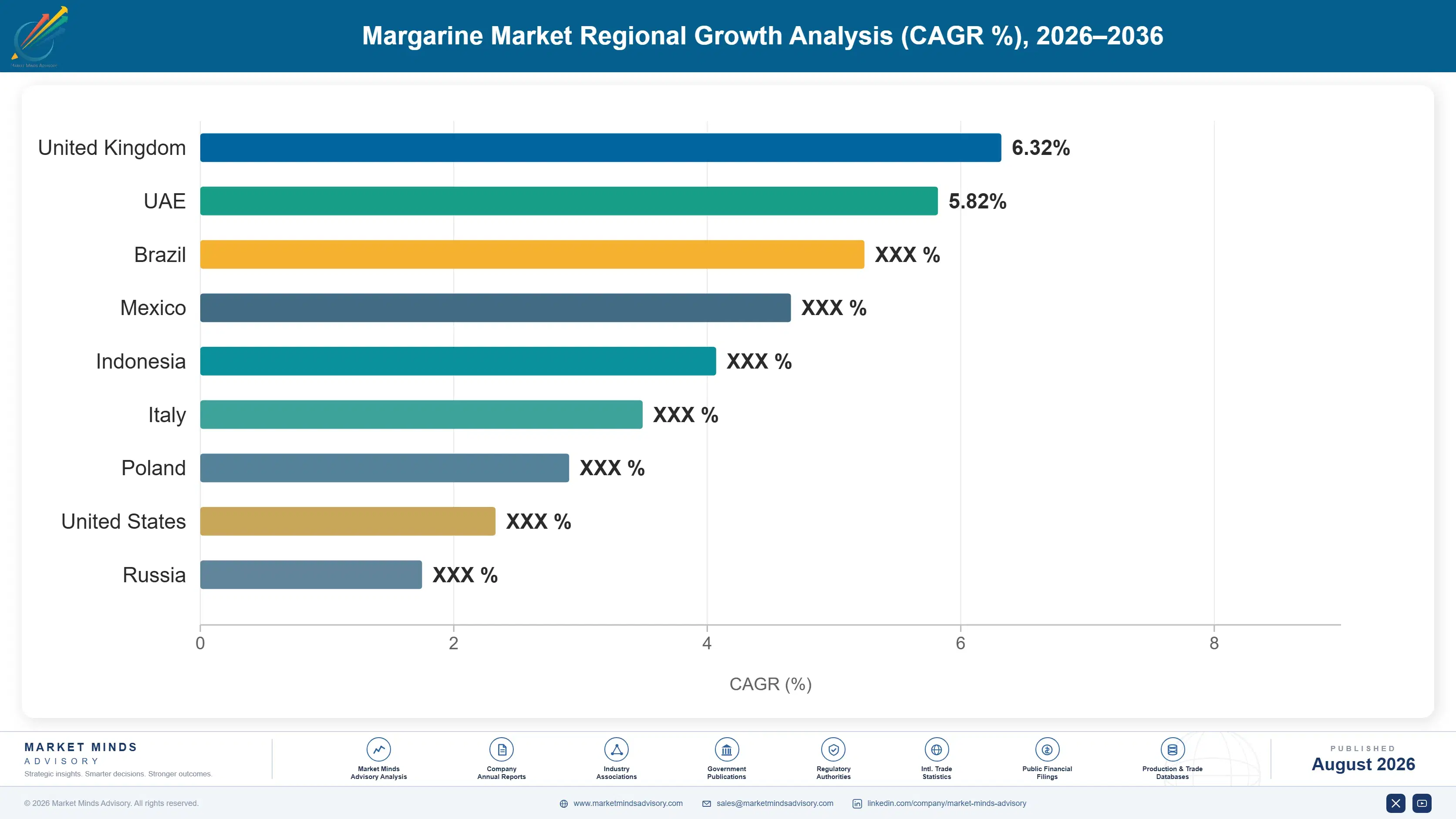
Western Europe commands the largest regional share on the category's historical Dutch and Belgian origin and Europe's deepest per-capita branded margarine consumption, while South Asia and Pacific grows fastest as India's expanding commercial bakery sector adopts margarine nationwide at meaningful commercial scale nationwide today nationwide.

North America

The United States anchors regional demand through its large industrial bakery and foodservice manufacturing base, where margarine's documented cost and functional performance advantages continue supporting steady commercial volume even as retail table margarine faces sustained competitive pressure from premium butter marketing. Established brands including Upfield's Country Crock and Conagra's various spread portfolios maintain deep retail distribution relationships built over decades of category presence. Private label penetration has grown considerably as retailers favor store-brand margarine over legacy national brands competing on price alone. Canada's margarine sector follows a similar trajectory, though at a smaller absolute scale than the United States market that anchors overall regional demand across both retail and industrial channels.
Share: 23% | CAGR: 4.1% (2026 to 2036)

Western Europe

The Netherlands and Belgium anchor this region's dominant regional share directly, reflecting margarine's historical origin and Unilever's continued global headquarters presence supporting deep brand loyalty across Benelux and Scandinavian markets with among the world's highest per-capita margarine consumption. Growth has slowed considerably as premium butter marketing and clean-label consumer sentiment erode mainstream retail volume across the region's mature markets. German and French manufacturers have responded by accelerating plant-based reformulation to defend shelf space against both butter and newer dairy-free spread competitors. Private label penetration remains comparatively high across the region's mainstream grocery retail channel specifically Scandinavian manufacturers have led regional innovation in plant-based formulation refinement across the entire continent and beyond.
Share: 26% | CAGR: 2.9% (2026 to 2036)
Regional intelligence for 5 additional markets available in the complete report: East Asia, South Asia and Pacific, Latin America, Middle East and Africa, Eastern Europe. Contact sales@marketmindsadvisory.com.
margarine-market-trends-forecast-2024-2034-country-cagr-analysis-1787457496282

Where Margarine Manufacturers Can Capture More Value

Manufacturers that pair sustainable sourcing certification with plant-based formulation innovation capture disproportionate margin as buyers standardize purchasing around documented sustainability credentials. Four levers matter most: certification investment, industrial bakery partnerships, feedstock diversification, and premium plant-based product development worth pursuing at scale nationwide, each pulling margin in a distinct, measurable direction over time nationwide today.

Investing in Sustainable Palm Oil Certification Infrastructure

Manufacturers that invest early in Roundtable on Sustainable Palm Oil certification and supply chain traceability infrastructure secure retail listing renewals that competitors lacking documentation increasingly lose during annual contract negotiations. This certification requires considerable upfront investment in supplier auditing and traceability technology, but protects against the growing retailer requirement that has already excluded several smaller manufacturers from premium shelf space entirely. Manufacturers holding recognized certification report meaningfully stronger retail listing renewal rates than competitors lacking documented sourcing credentials, with certified sourcing now covering roughly 61 percent of category volume among leading brands.
Market Impact: Covers roughly 61 percent of category volume overall

Building Dedicated Industrial Bakery Supply Partnerships

Building dedicated supply partnerships with industrial bakery and foodservice manufacturers captures a demand channel considerably more resilient to consumer sentiment shifts than retail table margarine, since commercial buyers prioritize documented functional performance and cost predictability over marketing positioning entirely. These partnerships typically embed exact functional specifications and multi-year volume commitments that provide manufacturers with revenue visibility retail sales cannot match. Manufacturers with strong industrial bakery relationships report considerably steadier revenue than those relying primarily on volatile retail table margarine sales, with this channel now representing roughly 34 percent of total category volume.
Market Impact: Captures roughly 34 percent of category volume overall

Diversifying Vegetable Oil Feedstock Sourcing Portfolios

Manufacturers that diversify vegetable oil feedstock sourcing across palm, soybean, sunflower, and canola oil reduce exposure to the commodity price volatility that periodically compresses margins when a single feedstock source spikes in price simultaneously across global markets. This diversification requires more complex formulation and supply chain management but protects margin more durably than single-feedstock dependency during commodity price cycles tied to weather and biofuel demand competition. Companies pursuing diversified sourcing strategies have reported meaningfully steadier quarter-over-quarter margins than peers dependent on a single dominant feedstock source, cutting cost volatility by roughly 22 percent.
Market Impact: Cuts feedstock cost volatility by roughly 22 percent

Developing Premium Plant-Based Butter Alternative Formulations

Developing premium plant-based formulations that directly target consumers seeking butter-like taste and texture without dairy content captures a growing margin pool that commodity table margarine cannot access at comparable pricing. Manufacturers increasingly treat documented plant-based certification and premium ingredient sourcing as genuine differentiators in a mature market where basic vegetable oil formulation alone no longer justifies premium positioning at retail. Companies that develop this capability early capture preferred shelf placement ahead of slower-moving competitors, with premium plant-based lines commanding roughly 45 percent higher pricing than standard commodity margarine formulations overall.
Market Impact: Commands roughly 45 percent higher pricing overall today

Who Controls the Margin Pool

Five manufacturers account for roughly 48 percent of global margarine production capacity on a disclosed volume basis, leaving a meaningful gap between established multinational processors and dozens of smaller regional manufacturers competing mainly on price for undifferentiated private label volume, a gap that increasingly reflects documented sustainability certification rather than legacy brand scale alone.
Current competitive activity concentrates on three dimensions: securing sustainable palm oil certification ahead of tightening retailer requirements, building dedicated industrial bakery supply partnerships, and developing premium plant-based formulations targeting butter-alternative positioning. Several manufacturers have also begun diversifying vegetable oil feedstock sourcing to reduce exposure to single-commodity price volatility affecting the broader category.

Emerging pressure comes from dedicated plant-based butter alternative brands entering the category from outside traditional margarine manufacturing, aided by venture capital funding and premium positioning that legacy commodity brands historically avoided. Rankings could shift meaningfully over the next five years if a major retailer formally standardizes sustainable sourcing requirements across its entire private label margarine range, or if continued butter premiumization accelerates further mainstream retail share loss as investor capital increasingly favors dedicated dairy-free brands over legacy commodity positioning.
margarine-market-trends-forecast-2024-2034-company-positioning-matrix-1787457496801

Competitive Moat and Risk Dimensions

UPFIELD HOLDINGS B.V.

Moat: Global Brand Portfolio Scale

Upfield operates the industry's largest branded margarine and spreads portfolio, including Flora, Becel, Rama, and Blue Band, built over decades since separating from Unilever's original spreads business. Its scale allows continued investment in plant-based reformulation and sustainability certification that smaller regional competitors cannot match financially across comparable product breadth.
UPFIELD HOLDINGS B.V.

Risk: Legacy Brand Perception Risk

Upfield's brands carry decades of legacy commodity positioning that persists in consumer perception even as reformulation has eliminated trans fats and improved sustainability credentials considerably. Any continued erosion of margarine's mainstream image relative to premium butter risks compressing volume across Upfield's core portfolio faster than reformulation investment can offset.
BUNGE LIMITED

Moat: Integrated Vegetable Oil Supply Chain

Bunge's integrated global vegetable oil origination, processing, and trading operations give it feedstock cost and supply security advantages that narrower margarine-only competitors cannot replicate, letting it supply both branded and private label manufacturers efficiently. Its scale supports continued investment in sustainable sourcing certification across its entire feedstock supply chain.
BUNGE LIMITED

Risk: Commodity Price Exposure

Bunge's margarine-adjacent business remains exposed to broader vegetable oil commodity price cycles that affect its entire agricultural trading operation, giving it less pricing insulation during simultaneous feedstock price spikes than dedicated margarine brand competitors. Sustained commodity volatility could compress margins across this segment relative to Bunge's other business lines.

Players Tracked

Prominent Players

Upfield Holdings B.V.
Bunge Limited
Vandemoortele NV
Wilmar International Limited
Associated British Foods plc

Other Key Players

Conagra Brands, Inc.
Land O'Lakes, Inc.
Fuji Oil Holdings Inc.
IOI Corporation Berhad
Sime Darby Plantation Berhad
Cargill, Incorporated
Archer-Daniels-Midland Company
Musim Mas Holdings Pte. Ltd.
Zeelandia Group
Puratos Group
CHS Inc.
Richardson International Limited
Emmi AG
Savencia Fromage & Dairy
Sigma Alimentos, S.A. de C.V.

Recent Developments

FEBRUARY 2025

Upfield Launches Certified Vegan Reformulation of Blue Band

Upfield completed a reformulation of its Blue Band margarine brand across several African and Asian markets, achieving formal third-party vegan certification for the entire product line. The organic reformulation followed rising retailer demand for documented plant-based labeling across mainstream retail accounts across additional international retail accounts nationwide.
Signal: Confirms manufacturers extending plant-based certification beyond premium Western retail markets across every major emerging retail market served.
OCTOBER 2024

Bunge Signs Long-Term Sustainable Palm Oil Supply Agreement

Bunge signed a long-term supply agreement with a major certified palm oil plantation operator, committing to expanded traceable sourcing volume to meet growing manufacturer certification requirements. The agreement is a supply arrangement, not an acquisition or joint venture, structured to secure documented sustainable feedstock nationwide.
Signal: Signals feedstock suppliers expanding certified capacity ahead of tightening retailer requirements ahead of the next major certification deadline cycle.
MAY 2025

Vandemoortele Expands Industrial Bakery Margarine Capacity

Vandemoortele completed an organic capacity expansion at its European industrial bakery margarine facility, adding production lines dedicated to puff pastry and lamination-grade formulations. The expansion addressed persistent order backlogs reported by commercial bakery customers across multiple European markets across the broader European industrial bakery customer base.
Signal: Signals producers racing to meet growing industrial bakery demand across the region across every major European commercial bakery account served.

Vegetable Oil Feedstock and Certification Exposure

Vegetable oil feedstock, primarily palm and soybean oil, accounts for roughly 38 percent of total production cost, with sustainable sourcing certification and traceability compliance adding a further 9 percent as retailers increasingly require documented supply chain verification. Feedstock sourcing depends heavily on Southeast Asian and South American agricultural production, leaving manufacturers exposed to weather and export policy cycles largely outside their direct control.
Palm oil prices spiked sharply during the 2021 to 2022 period as Indonesian export restrictions and adverse weather reduced available global supply, a disruption Indonesia's Ministry of Trade export data reflected when tracking the resulting price increase across affected commodity markets. Several manufacturers reported margin compression during the spike, since retail pricing typically adjusts more slowly than commodity feedstock costs, leaving a timing mismatch that concentrated cost pressure onto manufacturers during the affected quarters.

This mismatch creates a genuine competitive disadvantage for smaller manufacturers lacking the balance sheet to absorb feedstock price spikes without immediately passing cost to retail customers. Larger diversified players such as Bunge and Wilmar absorb volatility more easily given broader vegetable oil trading scale across other business lines, widening the cost gap between integrated majors and standalone margarine-focused manufacturers.
margarine-market-trends-forecast-2024-2034-cost-volatility-analysis-1787457496998

Multi-Origin Feedstock Diversification Programs

Manufacturers are diversifying vegetable oil feedstock sourcing across palm, soybean, sunflower, and canola oil simultaneously, so a single-commodity weather or export policy disruption no longer determines the full season's cost exposure across their entire feedstock supply base, a discipline that has already protected several manufacturers during past simultaneous commodity price spikes today each season.

Long-Term Certified Supply Contracts

Manufacturers are signing multi-year supply agreements with certified plantation operators to smooth input cost volatility, trading some pricing flexibility for predictability that protects margin during commodity price spikes tied to weather and export policy shifts overall, a hedge that increasingly determines which manufacturers retain premium retail listings during volatile pricing periods overall each season.

Forward Hedging and Commodity Risk Management

Larger manufacturers increasingly use forward hedging contracts and commodity risk management programs to lock in feedstock pricing ahead of anticipated volatility, a discipline that has already protected several manufacturers during past palm oil price spikes affecting the category, protecting margin without requiring immediate retail price adjustments that could damage customer relationships nationwide each season.

Portfolio Architecture for Margin Defence

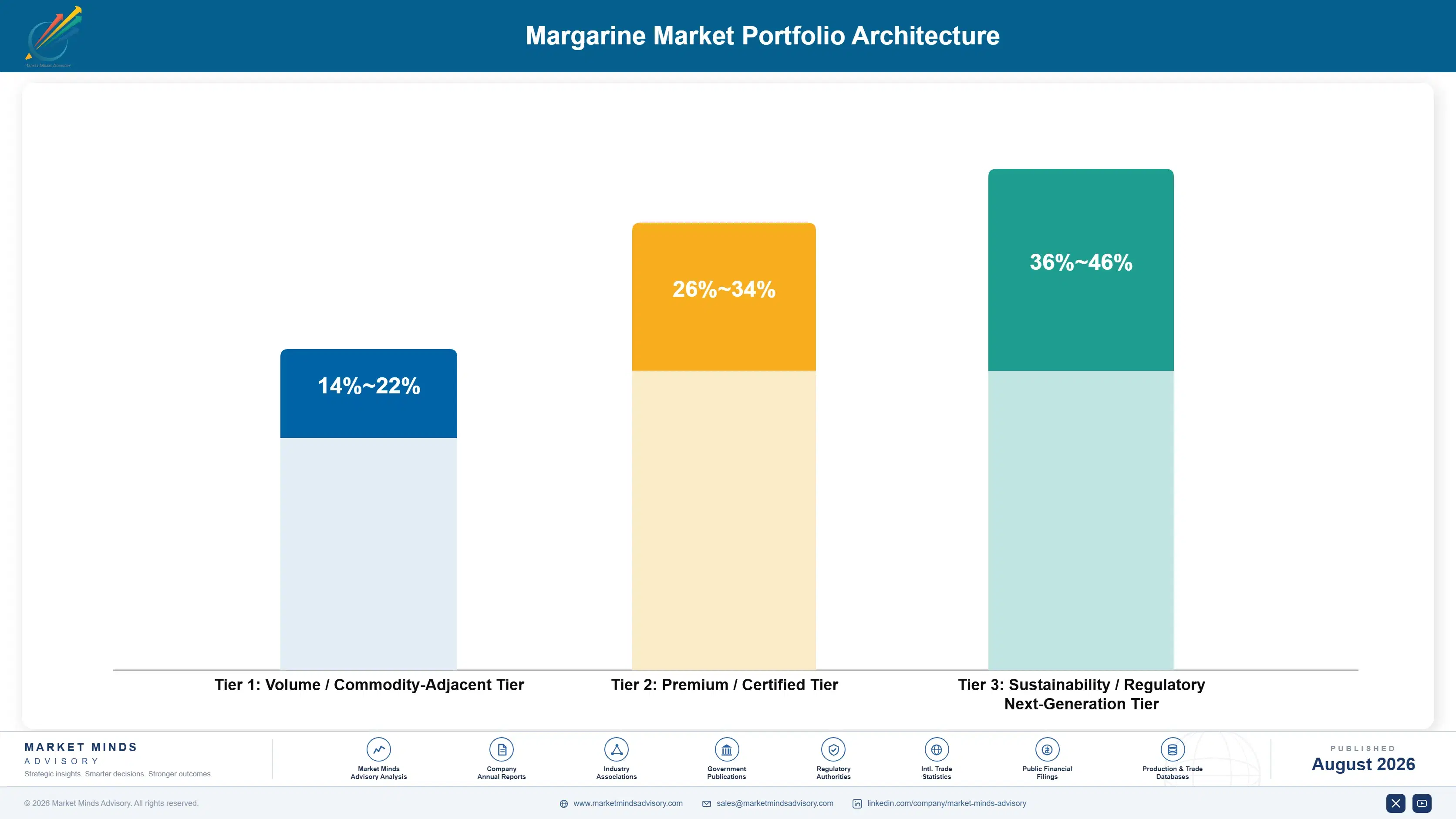
Portfolio economics split cleanly across three tiers. Commodity table margarine sold to mass-market retailers and private label programs competes mainly on price and carries thin margin against store-brand alternatives and butter substitution. Certified sustainable and plant-based formulations sold into premium retail and industrial bakery channels command meaningfully better economics tied to documented sourcing credentials across every batch delivered across every batch delivered to customers nationwide and abroad.
Tension between volume and premium tiers shapes capital allocation across the industry. Manufacturers chasing commodity table margarine volume compete on production cost efficiency alone, while those targeting certified premium and industrial bakery channels invest heavily in sustainability certification, feedstock diversification, and plant-based reformulation that volume-tier competitors skip entirely, accepting slower near-term volume growth for durably higher margin over time.

High-value margin pools concentrate in plant-based and certified sustainable formulations sold into premium retail channels, where documented credentials support pricing well above standard commodity rates. Industrial bakery specification contracts are emerging as an increasingly important stable margin pool as commercial food manufacturing demand continues outpacing volatile retail table margarine sales as documented sustainability becomes standard practice across the industry.

Volume / Commodity-Adjacent Tier

Commodity table margarine sold to mass-market retailers and private label programs competing mainly on price against store-brand alternatives and butter substitution. These grades face the steepest substitution pressure from butter during periods of premium marketing campaigns.
Gross Margin: 14-22%

Premium / Certified Tier

Sustainably certified and functionally specified industrial bakery margarine sold into premium retail and commercial food manufacturing channels requiring documented sourcing. Consistent functional performance documentation remains the key purchasing criterion buyers evaluate before renewing contracts.
Gross Margin: 26-34%

Sustainability / Regulatory / Next-Generation Tier

Certified plant-based and vegan formulations commanding the category's highest margins through documented dairy-free credentials and premium ingredient sourcing. Co-branded packaging programs increasingly anchor this tier's growth alongside documented plant-based certification claims.
Gross Margin: 36-46%
margarine-market-trends-forecast-2024-2034-portfolio-architecture-1787457497499

High-value Sub-segments and Strategic Watch-out

Certified Plant-Based Butter Alternative Formulations

High-value, high-growth segment where documented vegan certification supports premium retail pricing well above standard commodity margarine rates, drawing sustained manufacturer investment in reformulation across major retail accounts and export markets nationwide today. a genuinely durable competitive advantage once secured through established retail brand recognition nationwide.
Gross Margin: 38-48%

Sustainably Certified Industrial Bakery Formulations

High-value, moderate-growth segment where documented sustainable sourcing generates premium pricing alongside stable commercial volume, though industrial buyer negotiation keeps margin below premium plant-based retail levels across most contract renewal cycles overall. still meaningfully above standard commodity margarine pricing terms seen elsewhere across the category nationwide.
Gross Margin: 28-36%

Standard Table Margarine Formulations

Volume core segment anchoring most manufacturer revenue today, characterized by established retail relationships, moderate specification requirements, and steady but unspectacular margin relative to newer premium applications gaining share each year. particularly plant-based and industrial bakery channels expanding meaningfully faster right now each year across the industry.
Gross Margin: 16-24%

Uncertified Commodity Private Label Products

Strategic watch-out segment where thin margins and intense price competition from store-brand alternatives could pressure manufacturers who over-invest in bulk capacity lacking sustainability certification or premium differentiation credentials nationwide. particularly during feedstock cost spikes that erode already thin margin further across the industry each season nationwide.
Gross Margin: 8-14%

Bakery Contracts Anchor Manufacturer Revenue

Multi-year industrial bakery supply contracts function as annuity-like revenue for margarine manufacturers, since commercial bakers rarely switch suppliers mid-contract given the cost and quality-consistency risk of requalifying a new formulation source across every affected recipe and product line. Fixed functional specifications give manufacturers revenue visibility that volatile retail table margarine sales cannot match, smoothing quarterly earnings against feedstock cost swings affecting the wider category.
Adoption depth varies sharply by end-use vertical. Industrial bakery and foodservice buyers exhibit the deepest stickiness, having built entire product formulations and quality specifications around a specific manufacturer's documented functional performance that would cost meaningfully to requalify elsewhere. Retail household buyers show shallower stickiness, treating margarine as one of several spreadable fat options they can swap toward butter if pricing or perception shifts unfavorably during changing consumer sentiment cycles.

A generational shift in buyer profile is underway as younger household shoppers increasingly treat documented plant-based certification and sustainable sourcing as baseline requirements rather than differentiators, raising the bar every legacy margarine brand must clear just to remain relevant against newer dedicated dairy-free spread competitors entering the category regardless of legacy brand recognition or historical shelf presence maintained.
margarine-market-trends-forecast-2024-2034-end-use-penetration-index-1787457497985

Where MMA Sees the Category Heading

These are among the four positions where our research anticipates prominent divergence between winners and laggards over the coming forecast period. Each is grounded in the demand model, the regulatory perimeter, and the announced capacity pipeline.
01 / SUSTAINABLE CERTIFICATION INVESTMENT

Complete palm oil certification now before retailer requirements tighten further

Manufacturers that complete sustainable palm oil certification today secure retail listing renewals that competitors lacking documentation increasingly lose during annual contract negotiations across major markets. Retailers continue tightening certification requirements as consumer advocacy pressure around deforestation intensifies, making certification a defensive necessity rather than an optional differentiator going forward. Waiting for requirements to formalize further only cedes shelf space to manufacturers that invested in traceability infrastructure ahead of the deadline pressure now facing the entire category, a deadline that will not extend for manufacturers unprepared when it finally arrives.
02 / PLANT-BASED REFORMULATION STRATEGY

Pursue vegan certification broadly rather than confining it to niche product lines

Plant-based and vegan margarine is growing at roughly 7.8 percent annually, nearly 1.8 times the category average, and certification increasingly determines shelf placement across both premium and mainstream retail tiers rather than niche health food sections alone. Manufacturers that confine certification to a single flagship product line cede broader category growth to competitors pursuing certification across their entire portfolio systematically. This expansion carries limited downside since certification supplements rather than replaces existing commodity product lines already serving price-sensitive segments across every affected retail account served.
03 / INDUSTRIAL BAKERY PARTNERSHIP DEVELOPMENT

Deepen industrial bakery relationships to offset volatile retail demand cycles

Industrial bakery demand now represents roughly 34 percent of total category volume and has proven considerably more resilient to shifting consumer sentiment than retail table margarine sales exposed to butter's premium repositioning. Manufacturers that deepen these commercial relationships through dedicated supply partnerships gain revenue predictability that purely retail-focused competitors lack during periods of volatile consumer sentiment by design. This channel diversification reduces dependence on retail marketing trends that manufacturers cannot fully control on their own across every major commercial account maintained.
04 / FEEDSTOCK DIVERSIFICATION DISCIPLINE

Diversify vegetable oil sourcing before the next commodity price cycle turns

Vegetable oil feedstock represents roughly 38 percent of production cost, and the mismatch between volatile commodity pricing and slower-adjusting retail pricing has already compressed margins meaningfully during past palm oil price spikes tied to export policy and weather disruptions. Manufacturers lacking diversified feedstock sourcing should prioritize this discipline over further capacity expansion in the near term. This single practice separates manufacturers who protect margin from those forced into reactive pricing changes that damage retailer relationships that erode margin further with each passing season.

Engagement Snapshot From the Field

A live engagement with an industry participant carrying material or product regulatory and market exposure ahead of a defining policy shift, showing how our research translates into a defensible multi-year portfolio strategy.
MARKET MINDS ADVISORY · CLIENT ENGAGEMENT SUMMARY
Margarine Producer Strategic Portfolio Review and Transition Roadmap 2026·Investment Scenario on Margarine Exposure Evaluation 2025-26
CLIENT PROFILE
The client is a mid-tier private label margarine manufacturer supplying several major European grocery retailers, generating approximately USD 320 million in annual revenue (client-reported, unverified by MMA). The company had relied on uncertified palm oil sourcing for over a decade and faced mounting retailer pressure to document sustainable sourcing credentials The company had never previously pursued formal third-party sustainability certification for its supply chain.
STRATEGIC CHALLENGE
Management needed to evaluate whether completing full Roundtable on Sustainable Palm Oil certification justified the considerable upfront investment, given uncertainty over whether retail partners would actually reward certification with improved contract terms or simply treat it as a baseline requirement without additional compensation Board-level sponsors wanted a defensible timeline before the next major retailer contract renewal cycle began.
MMA APPROACH
MMA benchmarked the client's certification options against five competitor sourcing programs, drawing on primary interviews with retail category buyers to assess how certification status actually influenced listing decisions and contract renewal terms across major grocery accounts The engagement combined the qualitative expert interview program with MMA's proprietary retail buyer sentiment database.
KEY FINDINGS
  1. Three of five competitor manufacturers had already achieved full certification, creating a competitive gap that increasingly threatened the client's existing retail contract renewals.
  2. Retail buyers confirmed that certification had become a baseline listing requirement rather than a premium differentiator, though uncertified suppliers faced active delisting risk within eighteen months.
  3. Certified feedstock cost premiums proved smaller than initially projected once the client secured direct plantation relationships rather than purchasing through intermediary traders.
  4. Bundling certification investment with a parallel plant-based reformulation initiative could justify additional retail shelf space beyond simple certification compliance alone across the client's broader product portfolio.
CLIENT PROFILE
The client is a mid-tier private label margarine manufacturer supplying several major European grocery retailers, generating approximately USD 320 million in annual revenue (client-reported, unverified by MMA). The company had relied on uncertified palm oil sourcing for over a decade and faced mounting retailer pressure to document sustainable sourcing credentials The company had never previously pursued formal third-party sustainability certification for its supply chain.
STRATEGIC CHALLENGE
Management needed to evaluate whether completing full Roundtable on Sustainable Palm Oil certification justified the considerable upfront investment, given uncertainty over whether retail partners would actually reward certification with improved contract terms or simply treat it as a baseline requirement without additional compensation Board-level sponsors wanted a defensible timeline before the next major retailer contract renewal cycle began.
MMA APPROACH
MMA benchmarked the client's certification options against five competitor sourcing programs, drawing on primary interviews with retail category buyers to assess how certification status actually influenced listing decisions and contract renewal terms across major grocery accounts The engagement combined the qualitative expert interview program with MMA's proprietary retail buyer sentiment database.
KEY FINDINGS
  1. Three of five competitor manufacturers had already achieved full certification, creating a competitive gap that increasingly threatened the client's existing retail contract renewals.
  2. Retail buyers confirmed that certification had become a baseline listing requirement rather than a premium differentiator, though uncertified suppliers faced active delisting risk within eighteen months.
  3. Certified feedstock cost premiums proved smaller than initially projected once the client secured direct plantation relationships rather than purchasing through intermediary traders.
  4. Bundling certification investment with a parallel plant-based reformulation initiative could justify additional retail shelf space beyond simple certification compliance alone across the client's broader product portfolio.
RECOMMENDED STRATEGY
Phase 1: Phase 1 (Months 1-6): Complete Roundtable on Sustainable Palm Oil certification across the client's full production volume across the client's entire production footprint. Phase 2: Phase 2 (Months 7-12): Negotiate direct plantation sourcing relationships to reduce certified feedstock cost premiums meaningfully to reduce ongoing feedstock cost exposure. Phase 3: Phase 3 (Months 13-20): Launch a certified plant-based product line using the newly established sustainable sourcing infrastructure targeting health-conscious retail consumers nationwide.
OUTCOME
The client completed certification within seven months and retained all existing retail contracts through the subsequent renewal cycle (client-reported, unverified by MMA). The parallel plant-based line reportedly captured incremental shelf space at two major retail accounts following certification completion (client-reported, unverified by MMA), strengthening the client's competitive position against uncertified regional competitors.

Frequently Asked Questions

Foundational context covering the market sizes, CAGR, scope, country, region and competition that inform every finding below. This section is provided to cover basics and most often pre-purchase conversations, answered from the MMA Primary Research Dataset.

What is the current size of the Margarine Market?

The margarine market reached an estimated USD 42.5 billion in 2025, covering table, industrial, bakery, and plant-based margarine products sold globally across retail and foodservice channels.

How large will the Margarine Market be by 2036?

MMA projects the market will reach approximately USD 68.25 billion by 2036, driven mainly by plant-based reformulation and expanding industrial bakery demand across emerging markets.

What is the CAGR for the Margarine Market 2026 to 2036?

MMA's base case projects a 4.4 percent compound annual growth rate between 2026 and 2036, with a bull case of 5.6 percent and a bear case of 3.2 percent depending on butter competition.

Which segment is growing fastest?

Plant-based and vegan margarine is growing fastest at roughly 7.8 percent annually, about 1.77 times the category average, as manufacturers pursue mainstream dairy-free certification beyond the category's traditional health-conscious buyer base.

Who are the major companies in the Margarine Market?

Upfield, Bunge, Vandemoortele, Wilmar International, and Associated British Foods lead the category by disclosed production volume, together holding roughly 48 percent combined share across the global margarine manufacturing landscape.

Which country is growing fastest?

India leads country-level growth at an estimated 8.9 percent annually, as its expanding commercial bakery sector adopts margarine at meaningful commercial scale nationwide across its expanding commercial food manufacturing sector.

Report Segmentation Architecture

The full report scope spans multiple orthogonal segmentation dimensions, with cross-tabulated demand data provided for each dimension pair. Coverage extends further to regional breakdowns, trend trajectories, and the competitive detail needed to support segment-level decision-making.

By Product Type

  • Table and Spreadable Margarine
  • Industrial and Bakery Margarine
  • Puff Pastry Margarine
  • Plant-Based and Vegan Margarine
  • Low-Fat and Light Margarine
  • Liquid and Squeeze Margarine

By End-Use Industry

  • Retail and Household Consumption
  • Industrial Bakery Manufacturing
  • Foodservice and Hospitality
  • Confectionery Manufacturing
  • Processed Food Manufacturing

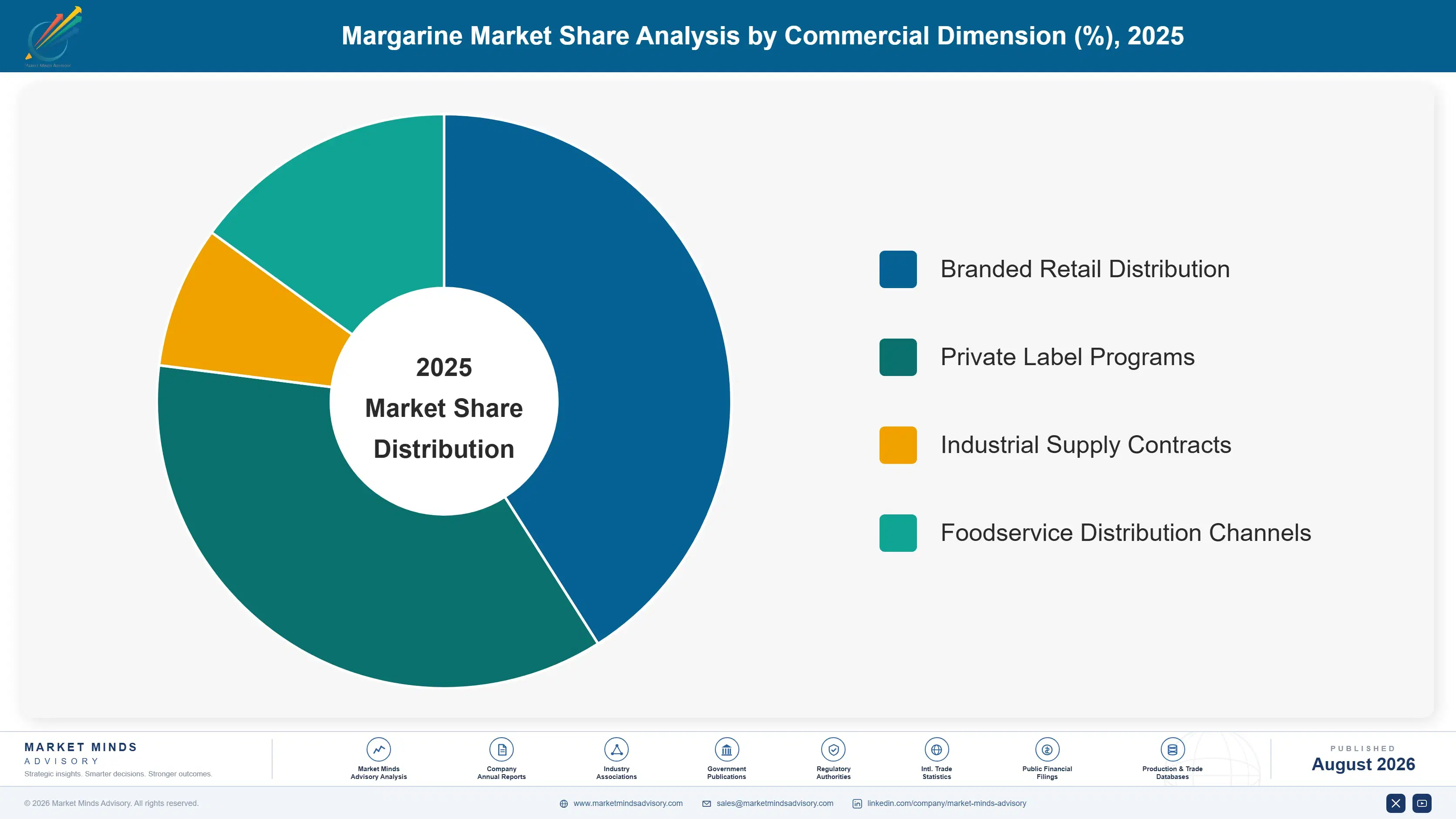
By Commercial Dimension

  • Branded Retail Distribution
  • Private Label Programs
  • Industrial Supply Contracts
  • Foodservice Distribution Channels

By Region

  • North America
  • Western Europe
  • East Asia
  • South Asia and Pacific
  • Latin America
  • Middle East and Africa
  • Eastern Europe

Scope, Methodology, and Coverage

Every figure in this report is reproducible from documented input assumptions. The scope below maps the historical period, the forecast horizon, the segmentation dimensions, and the countries covered, alongside the underlying primary and qualitative methodology.
Historical Period
2020 to 2025
Forecast Period
2026 to 2036
Base Year
2025 (USD billions; MMA Primary Research Dataset, August 2026)
Market Definition
The margarine market covers table, spreadable, industrial, bakery, puff pastry, and plant-based margarine products manufactured from vegetable and plant oils blended with water, emulsifiers, and flavoring agents for retail and foodservice use. It excludes dairy butter and butter blend products containing more than 10 percent dairy fat by weight.
Quantitative Units
USD billions (current prices); metric tons of margarine product where applicable
Segmentation Dimensions
By Product Type; By End-Use Industry; By Commercial Dimension; By Region
Regions Covered
North America, Western Europe, East Asia, South Asia and Pacific, Latin America, Middle East and Africa, Eastern Europe
Countries Covered
USA, China, Germany, France, UK, Japan, South Korea, India, Australia, Canada, Brazil, Mexico, Indonesia, Vietnam, Thailand, Malaysia, UAE, Saudi Arabia, South Africa, Nigeria, Turkey, Poland, Netherlands, Italy, Spain, Sweden, Switzerland, Argentina, Colombia, Singapore, and additional markets relevant to this sector
Key Companies Profiled
Upfield Holdings B.V., Bunge Limited, Vandemoortele NV, Wilmar International Limited, Associated British Foods plc, Conagra Brands, Inc., Land O'Lakes, Inc., Fuji Oil Holdings Inc., IOI Corporation Berhad, Sime Darby Plantation Berhad, Cargill, Incorporated, Archer-Daniels-Midland Company, Musim Mas Holdings Pte. Ltd., Zeelandia Group, Puratos Group, CHS Inc., Richardson International Limited, Emmi AG, Savencia Fromage & Dairy, Sigma Alimentos, S.A. de C.V.
Quantitative Methodology
Primary survey, n=3,800 respondents, Q4 2025, six countries; demand-side model with trade association cross-validation
Qualitative Methodology
47 expert interviews, Q4 2025; applied to validate demand model assumptions, identify emerging dynamics, and assess competitive positioning
Report Format
PDF and XLSX data workbook (Word format preview document)
Publisher
Market Minds Advisory
Report Code
MMA-2026-AGR-121
Published
August 2026
Contact
sales@marketmindsadvisory.com | www.marketmindsadvisory.com

Purchase the full Margarine Market Report (2026 to 2036).

The full MMA report on the margarine market delivers a comprehensive assessment of demand drivers, segmentation, and competitive positioning across the global fats and spreads value chain. It includes detailed profiles of all twenty companies covered in this summary, along with regional forecasts spanning all seven MMA-tracked regions through 2036. The report also breaks down portfolio economics across three margin tiers, giving buyers a clear view of where premium pricing concentrates today. Buyers receive access to MMA's underlying primary survey and expert interview datasets, plus analyst support for custom data requests during the subscription period.
Twenty detailed company profiles and capacity assessments
Seven-region forecast data through 2036 by product type
Primary survey dataset access covering 3,800 respondents
Expert interview transcripts and detailed summaries included
Quarterly market update briefings for subscription holders
Custom analyst inquiry support during subscription period

Built For The People Who Decide

From boardroom strategy to bench-side execution, this report is read cover-to-cover by leaders shaping the next decade of their industry, turning demand scenarios, market dynamics and valuation benchmarks into decisions.
CXOs/ Presidents/ VPs/ Managers
M&A and Corporate Development
Strategy Teams and R&D Heads
Procurement and Product Directors
Regulatory and Compliance Leaders
Investor Relations and Equity Analysts