Market Minds Advisory
Mannitol Market

Mannitol Market: Particle Engineering For Direct Compression, Laxation Limits And Fermentation Capacity Concentration

Formulators pay several times commodity pricing for a granule shape rather than a molecule, because direct compression grade removes a wet granulation step along with its equipment and validation burden entirely.

Lead Analyst

Lisa Gevelber

Published

September 2026

Make Smarter Decisions with Customized Research Insights

Request a free sample report and evaluate market opportunities, growth trends, and competitive dynamics relevant to your business needs.

2025 MARKET VALUE$0.5BMarket Size 2025
2036 FORECAST VALUE$1.0BBase Case , 2026 to 2036
CAGR 2026 TO 20366.2 %Bull 7.4% / Bear 5.0%
INCREMENTAL OPPORTUNITY$0.4BNet 10- year value creation
EXPANSION MULTIPLE1.82x2036 value over 2026 base
Strategic Levers
M&A Pipeline
Regional Outlook
Country Rankings
Competitive Intelligence
Segmental Deep-dive
Call-Us : 91 93563 13602

Executive Snapshot and Market Trajectory

Buyers in this market pay several times commodity pricing for a particle shape rather than for a molecule. Direct compression grade mannitol is spray-dried into granules that flow and compress properly, and that engineering removes an entire wet granulation step from a tablet line. Nobody pays that for a molecule.
Direct compression grades carry the growth on exactly that, since removing wet granulation removes a drying stage, a piece of equipment and a validation burden all at once. Food and confectionery grades grow more slowly on gum applications where mannitol's refusal to absorb moisture keeps it competitive against cheaper sorbitol. East Asia holds the largest share on Chinese fermentation capacity supplying most world volume.
Concentration reads at 71% for the top five, high because particle engineering and pharmaceutical documentation are both genuinely difficult and commodity fermentation capability alone does not deliver either. Laxation thresholds requiring labelling above defined intake caps inclusion across food applications, which formulators design around rather than ignore, and it limits how far the food side can ever grow. Chinese producers are moving toward engineered grades, and documentation depth is the other genuine defence against them.
Market Definition
This market covers mannitol supplied into pharmaceutical, food, confectionery and industrial applications, spanning direct compression pharmaceutical grades, food and confectionery grades, standard pharmaceutical excipient powder, injectable and parenteral grades, and industrial and technical grades. Sorbitol, xylitol, erythritol and other polyols, mannitol used as a diagnostic or therapeutic drug substance under prescription, and seaweed-derived mannitol sold as a raw extract are excluded.
Base Year Value
$0.5B in 2025 (MMA Primary Research Dataset, August 2026)
Forecast Period
2026 to 2036, eleven discrete annual values
CAGR
6.2% base case. Bull 7.4%. Bear 5.0%.
Fastest Growth Segment
Direct Compression Pharmaceutical Grades: 9.3% CAGR
Fastest Growth Country
India: 8.5% CAGR
Fastest Growth Region
South Asia and Pacific: 8.4% CAGR
Largest Region
East Asia: 34% of 2025 global value
Market Leaders
Roquette, Cargill, SPI Pharma, Merck KGaA and Shandong Tianli lead on mannitol supply revenue. Source: MMA Primary Research Dataset, July 2026.
Primary Survey
n=3,800 procurement and R&D decision-makers, Q4 2025, six countries
Methodology
Demand-side build-up, cross-validated against public data, 47 expert interviews

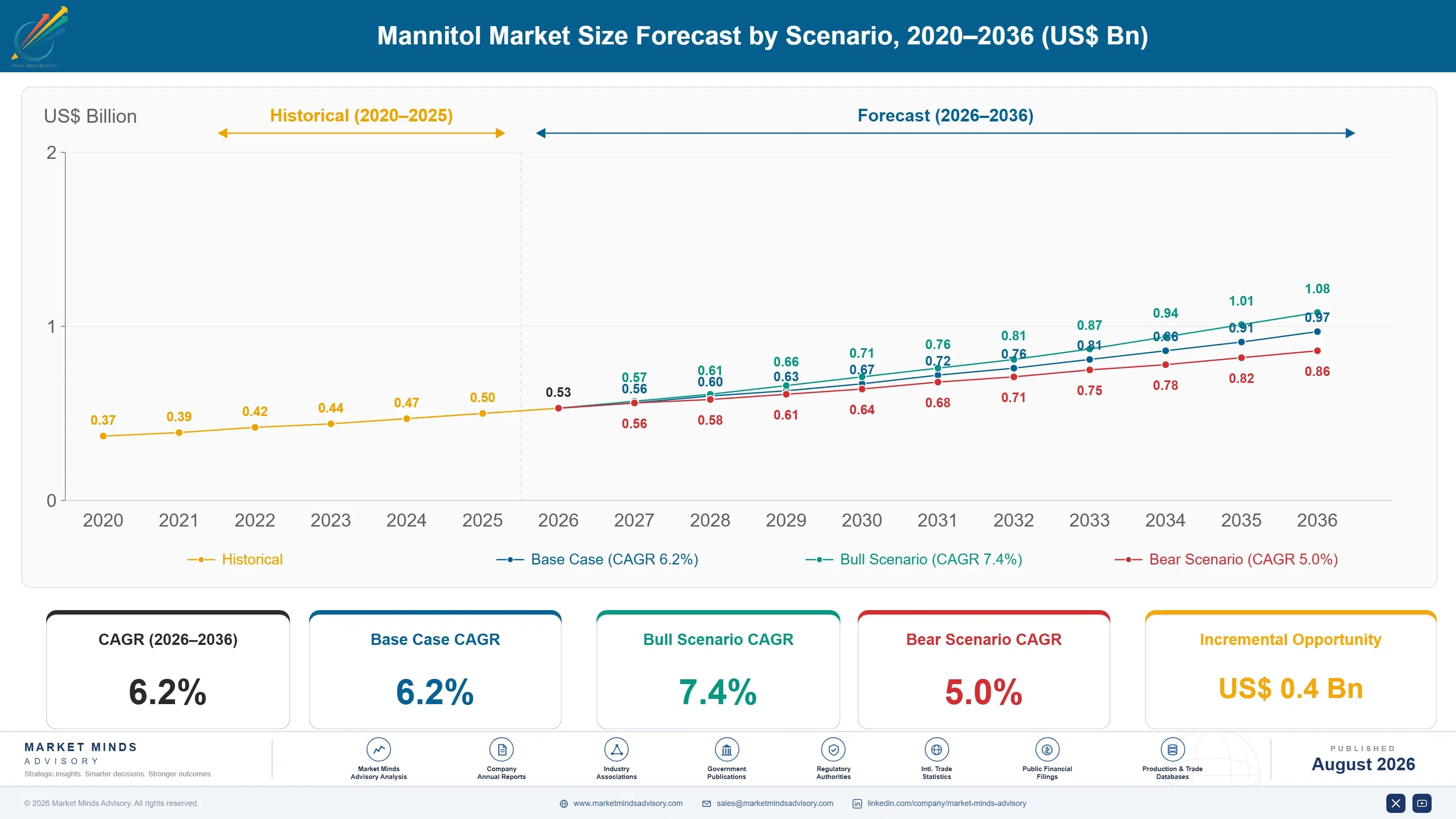
Mannitol Market Forecast Scenarios

mannitol-market-trends-forecast-2024-2034-size-forecast-scenario-1787458001775
Growth ran at 5.2% annually between 2020 and 2025, and pharmaceutical formulation practice rather than volume expansion did most of the work. Generic manufacturers moved toward direct compression to cut processing steps and validation burden, which shifted demand from commodity powder into engineered granules at considerably higher realised pricing. Food and confectionery volume grew slowly underneath that and contributed far less value.
The base case at 6.2% rests on three mechanisms. Direct compression adoption keeps spreading through generic tablet manufacturing as formulators recognise what removing wet granulation actually saves. Orally disintegrating tablet formats continue growing, and mannitol's cooling sensation and bitterness masking suit them better than any alternative excipient does. And Indian pharmaceutical manufacturing expands quickly, with generic export volume pulling excipient demand along behind it. None of the three depends on a new application appearing.
The bull case at 7.4% turns on orally disintegrating formats reaching wider adoption across chronic therapy areas, which would pull direct compression grade demand up sharply. The bear case at 5.0% reflects Chinese capacity expansion compressing pricing across commodity and food grades, since fermentation capability is widely held even where particle engineering is not. Fermentation capability itself is widely held.

Buyers Pay For Granule Shape Not Molecule

The commercially interesting thing about mannitol is that the molecule is straightforward and cheap to make while the valuable product is a particular granule. Direct compression grade is spray-dried into a shape that flows and compresses on a tablet press, and that engineering lets a manufacturer skip wet granulation entirely. Removing that step removes a drying stage, equipment and validation work together.
TOP FIVE CONCENTRATION71%High, since particle engineering and documentation are both genuinely difficult
DIRECT COMPRESSION PREMIUM3.4 timesEngineered granule pricing against comparable commodity mannitol powder
PHARMACEUTICAL SHARE56%Portion of value entering pharmaceutical rather than food applications
LAXATION LABELLING THRESHOLD20 gramsDaily intake above which most jurisdictions require warning labelling
FERMENTATION COST SHARE34% of COGSFermentation and downstream processing contribution to manufactured cost
QUALIFICATION CYCLE13 monthsTypical time to qualify an excipient into a tablet formulation
Formulators pay roughly 3.4 times commodity pricing for it, which sounds excessive until somebody prices out a wet granulation suite and the validation that accompanies it. Orally disintegrating tablets are the anchor application, since mannitol dissolves with a negative heat of solution that produces a cooling sensation and masks bitterness better than any competing excipient manages at comparable cost.
The food side is capped by physiology rather than by competition. Mannitol above defined daily intake causes laxation, and most jurisdictions require warning labelling beyond roughly twenty grams, which formulators design around rather than ignore. Gum survives as the anchor food application because mannitol does not absorb moisture and therefore does not make a gum base sticky, which is why it holds against cheaper sorbitol there.
"People look at mannitol pricing and assume somebody is being taken advantage of. Then they cost out a wet granulation suite, the drying step and the validation, and the excipient premium turns out to be the cheapest part of the decision."
Director, Pharmaceutical Excipients and Specialty Ingredients Practice · MMA Specialty Chemicals Practice · August 2026

Market Trends

Direct Compression Adoption Shifts Value From Molecule To Granule

Generic tablet manufacturers moved toward direct compression to cut processing steps, and that shifted demand from commodity mannitol powder into spray-dried granules engineered to flow and compress properly. Removing wet granulation removes a drying stage, a piece of equipment and a validation burden simultaneously, which is why formulators pay roughly 3.4 times commodity pricing without much argument. Particle engineering rather than fermentation chemistry now separates suppliers, and commodity capability alone reaches none of that value. Costing out a wet granulation suite makes the excipient premium look like the cheapest part of the decision.
Market Impact: India grows at 8.5% annually
Orally Disintegrating Formats Suit Mannitol Better Than Alternatives

Mannitol dissolves with a negative heat of solution, which produces a cooling sensation in the mouth and masks the bitterness that orally disintegrating tablets otherwise expose directly to the tongue. No competing excipient delivers that combination at comparable cost, which makes mannitol close to a default rather than a choice in the format. Orally disintegrating adoption keeps growing across paediatric, geriatric and travel-friendly presentations, and it pulls direct compression grade demand along with it. Paediatric, geriatric and travel-friendly presentations all favour the format for entirely practical reasons. It is close to a default rather than a choice.
Market Impact: Holds 34% of food grade volume

Market Opportunities and Growth Drivers

Indian Generic Manufacturing Pulls Excipient Demand Behind It

Indian pharmaceutical manufacturing serves export markets across the regulated world and continues expanding, and every additional tablet line pulls excipient demand behind it whether the formulation is developed locally or transferred in. Indian demand grows near 8.5% annually as a result. Direct compression adoption there follows the same logic as everywhere, since removing a wet granulation suite matters more when capital is being deployed into new capacity rather than retrofitted into existing plants. Documentation expectations are high because Indian manufacturers export into inspected markets everywhere. New capacity favours it more than retrofits do.
Market Impact: Labelling required above 20 grams

Non-Hygroscopic Behaviour Keeps Mannitol In Chewing Gum

Mannitol does not absorb atmospheric moisture, which means it does not make a gum base sticky the way sorbitol can under humid conditions, and that single physical property is why it survives commercially in an application where a cheaper polyol otherwise dominates. Gum manufacturers use it as an anti-sticking agent and rolling compound rather than purely as a sweetener. The property cannot be replicated by cheaper alternatives, which protects the position durably. Gum manufacturers use it as an anti-sticking agent and rolling compound rather than purely as a sweetener. That property protects the position durably.
Market Impact: Compresses pricing 18% since 2020

Market Restraints and Challenges

Laxation Thresholds Cap Inclusion Across Every Food Application

Mannitol consumed above roughly twenty grams daily causes laxation, and most jurisdictions require warning labelling beyond that threshold, which caps how much a formulator can include in any product a consumer might eat several of. The root cause is physiological rather than regulatory, since the polyol is poorly absorbed by design. Commercially this limits how far food applications can ever grow. Participants are responding with blended polyol systems, portion guidance and concentration on pharmaceutical applications instead. A consumer who eats several units of a product reaches the threshold quickly. Blended polyol systems are one partial answer.
Market Impact: Commands 3.4 times commodity pricing

Chinese Fermentation Capacity Compresses Commodity Grade Pricing

Fermentation capability for mannitol is widely held and Chinese producers have built capacity at costs Western operations cannot match, which compresses pricing across commodity powder and food grades continuously. The root cause is that the fermentation itself is not technically difficult once established. Commercially this squeezes anybody without particle engineering or pharmaceutical documentation to differentiate on. Participants are responding by weighting toward direct compression grades, injectable specifications, and documentation depth that commodity supply cannot match. Particle engineering is the only genuine differentiation available against it. Documentation depth is the other genuine defence available.
Market Impact: Anchors 41% of compression demand
4 additional market trends, 2 additional growth drivers, and 3 additional restraints and challenges are covered in the full report. Contact sales@marketmindsadvisory.com to access the complete intelligence.

Segment CAGR and Growth Architecture

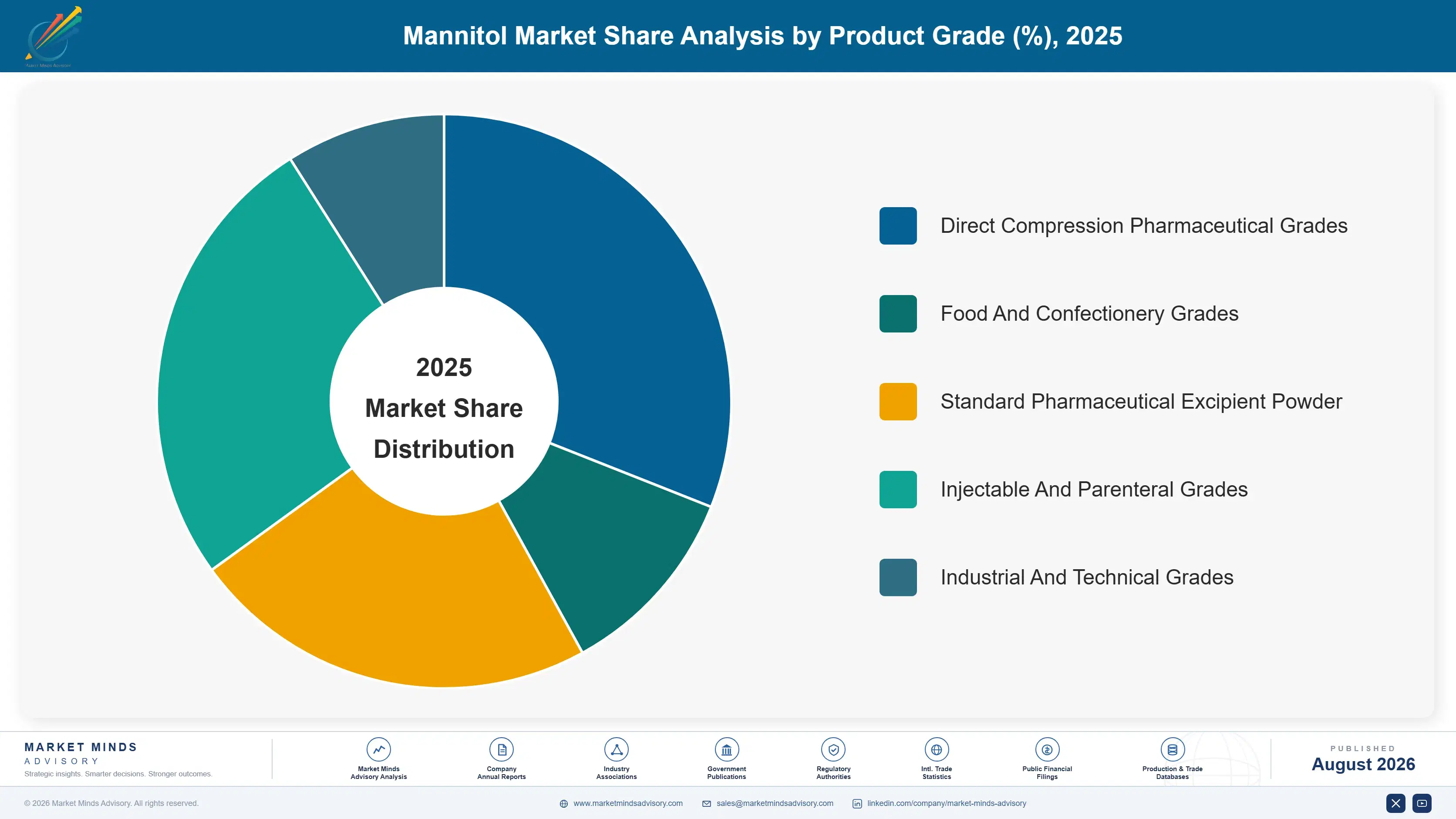
Five product grades divide this market on particle specification and documentation rather than on the production route behind them, which is fermentation in almost every case. Grade determines pricing, qualification burden and application access simultaneously, and the same molecule sells at several times the price depending purely on what shape it arrives in. Shape decides the price entirely.
mannitol-market-trends-forecast-2024-2034-market-share-analysis-1787458002302

Direct Compression Pharmaceutical Grades

Growing at 9.3% and the fastest part of this market. Direct compression grade mannitol is engineered as spray-dried granules rather than milled powder, which gives it the flowability and compressibility a tablet press needs without any wet granulation step at all. Removing wet granulation removes a drying stage, a piece of equipment and a validation burden, which is why formulators pay several times commodity mannitol pricing for it. Orally disintegrating tablets are the anchor application, since mannitol's negative heat of solution produces a cooling sensation that masks bitterness. Particle engineering rather than chemistry is what separates suppliers here. Particle engineering separates suppliers far more than fermentation chemistry does. Formulators build tablet processes around specific granule behaviour.
CAGR 9.3%

Food And Confectionery Grades

Growing at 7.7% on mannitol supplied into chewing gum, confectionery and sugar-free foods where it functions as a bulk sweetener and anti-sticking agent. Gum is the anchor and always has been, because mannitol does not absorb moisture and therefore does not make a gum base sticky the way sorbitol can. That single property is why it survives in an application sorbitol otherwise dominates on cost. Laxation thresholds require labelling above defined intake levels across most jurisdictions, which caps inclusion in a way formulators have to design around rather than ignore. Chinese fermentation capacity supplies most of the volume. Cheaper polyols cannot replicate that property. Chinese capacity supplies most of the volume at costs Western producers cannot match.
CAGR 7.7%
Full segment breakdown across 5 segments available in the complete report.

Regional Architecture and Country Demand Map

East Asia holds 34% of global value on Chinese fermentation capacity supplying most world volume alongside substantial domestic pharmaceutical and confectionery demand. Western Europe follows at 24% on particle engineering and excipient documentation capability rather than on any raw production position. Documentation decides pharmaceutical supply.

East Asia

Note: East Asia sits above the standard share band because Chinese fermentation capacity supplies most of the world's mannitol volume alongside substantial domestic demand, and no allocation reflecting the real market avoids that concentration. Shandong Tianli and several other Chinese producers operate at costs Western operations cannot match on commodity and food grades. Particle engineering and pharmaceutical documentation are less developed among those producers, which is where Western suppliers retain position. Japanese and Korean demand is smaller and weighted toward pharmaceutical grades with demanding purity and documentation expectations. Chinese domestic pharmaceutical manufacturing is also adopting direct compression steadily as generic export ambitions grow. Generic export ambitions are driving that adoption steadily.
Share: 34% | CAGR: 7.3% (2026 to 2036)

Western Europe

Particle engineering and excipient documentation define this region rather than any production advantage, since fermentation capability is widely held and Chinese capacity undercuts European cost on commodity grades continuously. Roquette and Merck hold the deepest technical positions in spray-dried direct compression grades and injectable specifications. European Pharmacopoeia compliance and drug master file support carried as standard satisfy formulator requirements across export markets without additional work. France and Germany carry most of the production. Energy costs weigh on fermentation and spray drying, which is why European supply concentrates in grades where technical premium absorbs that disadvantage. Energy costs weigh heavily on fermentation and spray drying together here. Technical premium absorbs that disadvantage.
Share: 24% | CAGR: 4.7% (2026 to 2036)
Regional intelligence for 5 additional markets available in the complete report: North America, South Asia and Pacific, Latin America, Middle East and Africa, Eastern Europe. Contact sales@marketmindsadvisory.com.
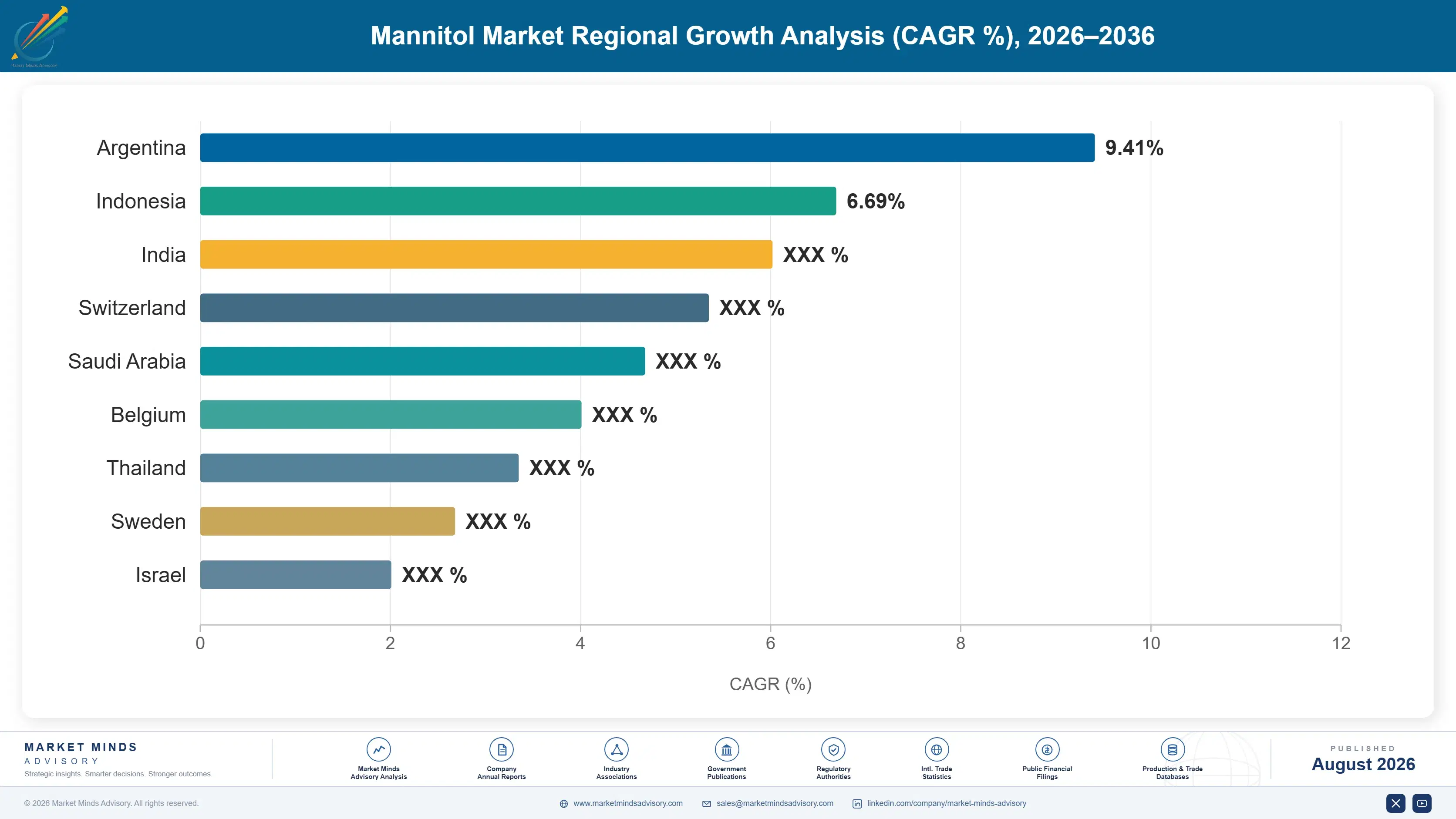
mannitol-market-trends-forecast-2024-2034-country-cagr-analysis-1787458002817

Where Mannitol Value Actually Concentrates

Four positions separate producers earning specialty returns from those selling fermented powder by the tonne: mastering particle engineering for direct compression, carrying pharmaceutical documentation formulators require, qualifying into tablet formulations early, and holding injectable specification capability that almost nobody else can supply. Only the last requires facility investment on any real scale. Everything else is capability.

Master Particle Engineering For Direct Compression Grades

Spray-drying mannitol into granules that flow and compress properly removes an entire wet granulation step from a tablet line, along with its drying stage, equipment and validation burden. Formulators pay roughly 3.4 times commodity pricing for that without much argument, and producers holding the capability realise 45% to 55% higher margin than commodity suppliers. The fermentation itself is straightforward; the granule is not, which is precisely why the premium survives competition. Commodity fermentation capability alone reaches none of that value at all. Fermentation is straightforward; the granule is not. Nobody argues much about it.
Market Impact: Commands roughly 3.4 times the commodity powder pricing

Carry Pharmaceutical Documentation Formulators Actually Require

Generic manufacturers exporting into inspected markets need excipients whose documentation survives an inspection at a plant the regulator has never visited, and drug master file support removes months of their own regulatory work. Suppliers carrying it reach the 56% of value in pharmaceutical applications while commodity producers do not. Maintaining files across jurisdictions costs roughly 5% of revenue annually, and it is a permanent obligation rather than any single investment. Commodity producers reach none of that value whatever their delivered pricing looks like. Inspectors rather than buyers decide this outcome.
Market Impact: Reaches the 56% pharmaceutical share of total value

Qualify Into Tablet Formulations Before Competitors Do

Excipient qualification with a pharmaceutical formulator takes around 13 months of compatibility, stability and documentation work, and once inside a validated formulation nobody revisits it because requalification triggers regulatory work the manufacturer gains nothing from. Qualified suppliers realise 28% to 35% higher pricing than spot material on volumes repeating for years. The contest happens at new product development, which makes timing considerably more important than any commercial offer. Requalification triggers regulatory work the manufacturer gains nothing at all from. Development timing decides the whole contest here. Displacement afterwards is genuinely rare.
Market Impact: Realises 35% higher pricing once the formulation qualifies

Hold Injectable Specification Capability Few Can Supply

Parenteral grade mannitol requires endotoxin control, particulate specification and sterility assurance that ordinary pharmaceutical excipient production does not approach, and very few producers worldwide can supply it consistently. That narrows the field to a handful before price enters any conversation. Injectable grades realise 60% to 75% premiums over standard pharmaceutical powder, and the capability requires facility investment that a small application volume struggles to justify without other products alongside. Very few producers worldwide supply it consistently enough to be relied upon. The field narrows before price is discussed at all.
Market Impact: Realises premiums of as much as 75% higher

Who Controls the Margin Pool

Concentration reads at 71% for the top five measured on mannitol supply revenue, the basis used throughout this section, and it reflects particle engineering and documentation rather than fermentation capacity, which is widely held. Roquette holds the deepest position across grades. Cargill and Merck bring pharmaceutical breadth. SPI Pharma specialises in engineered excipients, and Shandong Tianli operates Chinese fermentation at considerable scale.
Competition runs on three fronts. Particle engineering is the first and by a wide margin the most decisive, since it separates a three-times-priced granule from commodity powder. Pharmaceutical documentation is the second, determining which formulators will evaluate a supplier at all. Injectable capability is the third, and it narrows the field to a handful of producers worldwide. None of the three is a fermentation argument.

Pressure arrives from two directions. Chinese fermentation capacity compresses commodity and food grade pricing continuously and is beginning to move toward engineered grades. Separately, alternative direct compression excipients including co-processed systems compete for the same formulation slots. Rankings will shift toward producers holding particle engineering and documentation together rather than fermentation scale alone. Scale alone stopped being a defensible position some time ago.
mannitol-market-trends-forecast-2024-2034-company-positioning-matrix-1787458003334

Competitive Moat and Risk Dimensions

ROQUETTE

Moat: Particle engineering and grade breadth

Spray-dried direct compression grades developed over decades give the group specification consistency that formulators build tablet processes around and are reluctant to disturb once validated. Breadth across polyols and excipients also means a formulator can source several materials from one qualified supplier, which reduces the documentation burden they carry across a whole formulation.
ROQUETTE

Risk: European energy and fermentation cost

Fermentation and spray drying are both energy-intensive and European costs have stayed elevated, which weighs on grades where technical premium is thinner. Chinese producers moving toward engineered specifications also threaten the differentiation that has justified pricing, and they do so from a considerably lower underlying cost base than European operations carry.
SPI PHARMA

Moat: Engineered excipient specialisation depth

Specialisation in engineered excipients for direct compression and orally disintegrating formats produces application knowledge that broader chemical producers do not accumulate, and formulators developing those formats consult specialists first. Co-processed systems combining mannitol with other functional materials also create positions that single-ingredient competitors cannot match on performance alone.
SPI PHARMA

Risk: Narrow product and application base

Concentration in a small number of engineered excipient applications leaves the business exposed to formulation trends moving away from orally disintegrating formats or toward alternative excipient chemistries. Scale is also modest against diversified chemical groups, which limits the fermentation and facility investment the business can reasonably fund itself.

Players Tracked

Prominent Players

Roquette
Cargill
SPI Pharma
Merck KGaA
Shandong Tianli

Other Key Players

Ingredion
Archer Daniels Midland
B Food Science
Mitsubishi Corporation Life Sciences
JMC Corporation
Qingdao Bright Moon Seaweed
Zhejiang Huakang Pharmaceutical
Shandong Futaste
Gujarat Ambuja Exports
Sunwin Stevia
DFE Pharma
Meggle Group
JRS Pharma
Kerry Group
Sigachi Industries

Recent Developments

MARCH 2025

Co-processed direct compression system launched for disintegrating tablets

An excipient specialist launched a co-processed system combining mannitol with disintegrant and lubricant functionality in a single engineered granule, reducing the number of materials a formulator must qualify separately for orally disintegrating tablet development work. Two formulators adopted the system during development work that year.
Signal: Co-processed systems reduce the qualification burden that formulators carry across an entire tablet formulation at once
JULY 2025

Chinese producer submits pharmaceutical documentation for engineered grade

A Chinese mannitol producer submitted drug master file documentation for a spray-dried direct compression grade, moving beyond the commodity and food positions Chinese capacity has historically held and into the specification band where Western suppliers retain pricing. Western suppliers had assumed this would not happen quickly.
Signal: Chinese producers entering engineered grades directly threatens the differentiation that has long justified all Western pricing
NOVEMBER 2025

Injectable grade capacity expanded following supply tightness

A pharmaceutical excipient producer expanded parenteral grade mannitol capacity after supply tightness left formulators short, reflecting how few producers worldwide can meet endotoxin, particulate and sterility requirements consistently enough to serve injectable applications. Formulators had been short of qualified supply for several months beforehand. Capacity comes on stream shortly.
Signal: Injectable specification narrows the supplier field to a handful before price enters any conversation at all

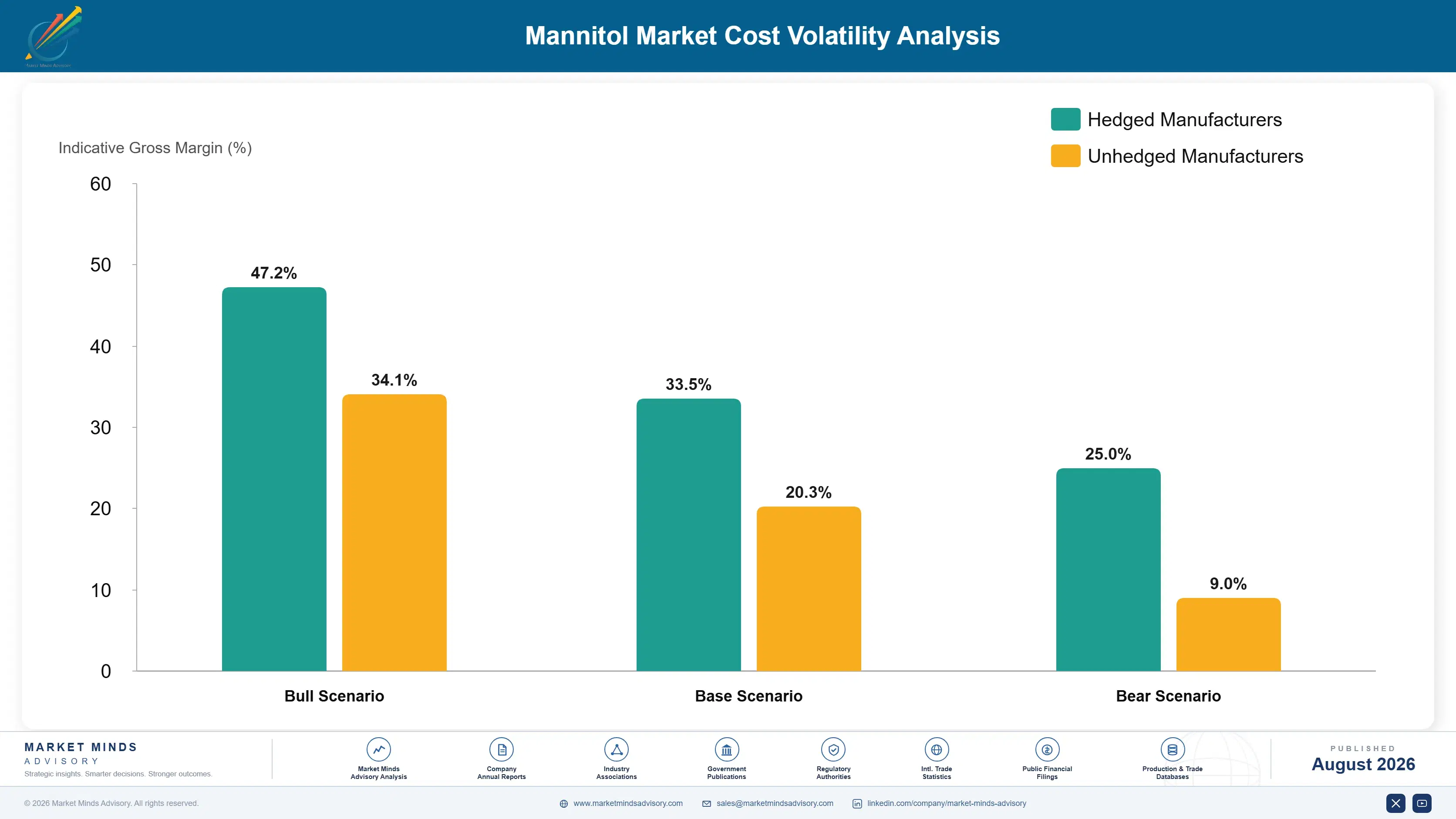
What Drives Mannitol Production Cost

Fermentation and downstream processing account for roughly 34% of manufactured cost, covering media, vessel time, separation and crystallisation across a process that is well established rather than technically difficult. Feedstock sugars contribute around 18%. Spray drying and particle engineering add about 14% where applied, energy roughly 15%, packaging and freight close to 11%, and documentation and quality systems near 8% of the total.
European industrial energy pricing rose sharply through 2022 and has stayed above the previous decade's baseline according to International Energy Agency data, which hit fermentation and spray drying together. Feedstock sugar costs moved separately on sugar market conditions tracked in United States Department of Agriculture data. European producers absorbed a considerable share of both against Chinese pricing that did not move comparably. Chinese pricing did not move comparably at all.

The disadvantage mechanism is energy exposure on an energy-intensive process, and it separates producers by location rather than by capability. European operations carry elevated costs across fermentation and spray drying while Chinese producers do not, which is sustainable in engineered grades where the premium absorbs it and impossible in commodity powder. Exposure also varies by grade, since particle engineering adds processing energy that commodity production avoids entirely.
mannitol-market-trends-forecast-2024-2034-cost-volatility-analysis-1787458003529

Weight production toward engineered and injectable grades

Commodity powder competes on delivered cost against Chinese capacity with better energy economics, which is a contest European producers cannot win. Engineered and injectable grades support pricing that absorbs those disadvantages comfortably. The constraint is particle engineering and facility capability, which takes years to build and cannot be added to existing equipment on a short timeline.

Invest in fermentation and drying energy efficiency

Fermentation and spray drying together account for most of the energy in mannitol production, and heat recovery and drying optimisation cut consumption materially against European pricing that has stayed elevated since 2022. Payback runs several years at current costs. Producers who invested before energy rose hold a position competitors are now spending capital trying to reach from behind.

Contract feedstock sugars on annual committed volume

Feedstock represents close to a fifth of manufactured cost and prices on sugar markets that pay no attention to excipient demand at all. Annual committed volume secures predictable cost and allocation through the tightness that periodically follows a poor harvest somewhere. The commitment carries volume risk if demand softens, which is the honest price of the predictability it delivers.

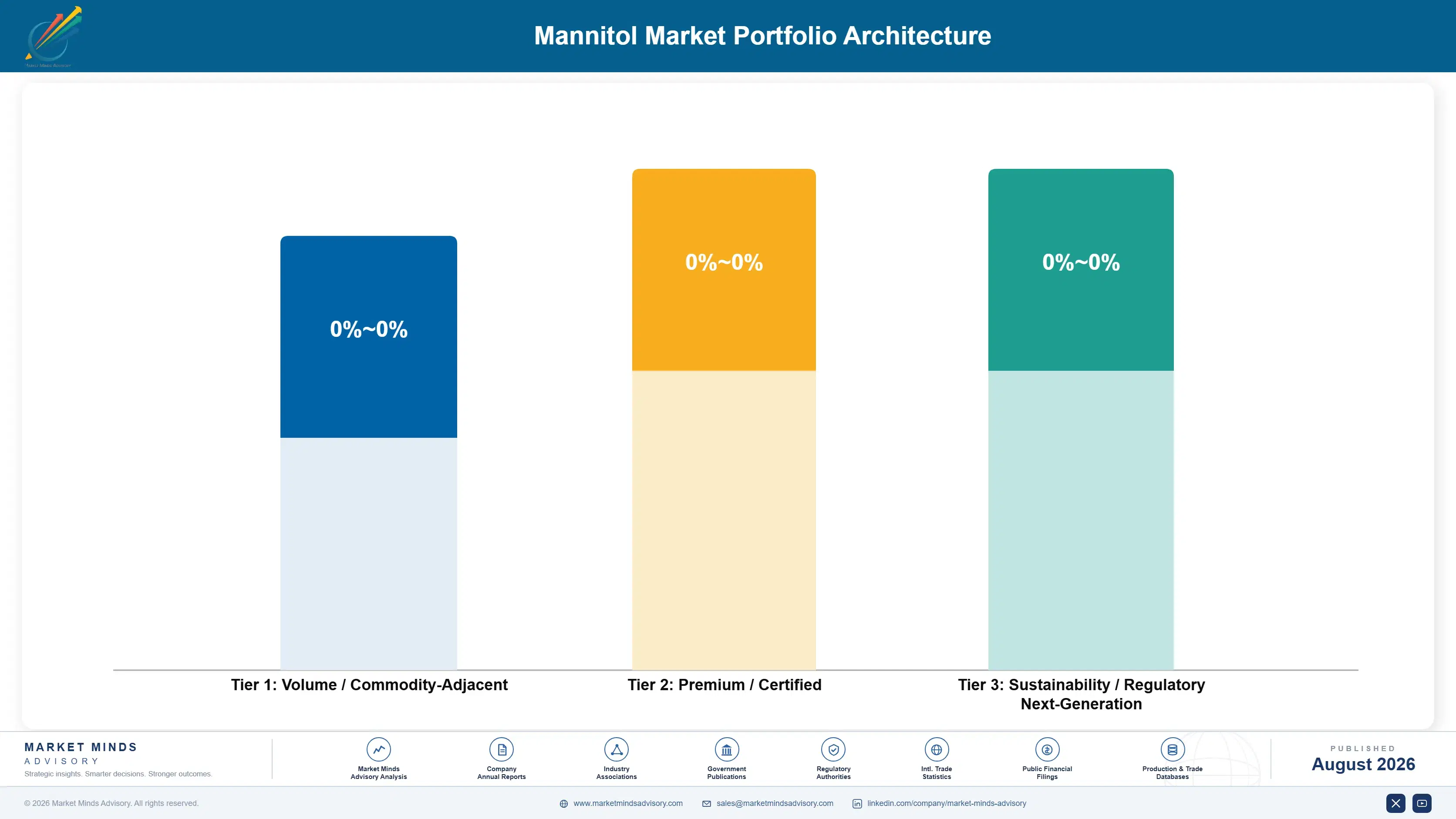
Portfolio Architecture for Margin Defence

Portfolio economics here divide on particle specification and documentation rather than on the molecule, which is identical in every grade and cheap to produce. Commodity powder sold on delivered cost competes against Chinese fermentation with better energy economics, and a Western producer entering that contest loses it on geography rather than on any capability. Geography rather than skill decides that contest entirely.
The middle tier is food and confectionery grade with established application positions. Gum anchors it because mannitol does not absorb moisture and therefore does not make a base sticky, which cheaper polyols cannot replicate. Margins reach the high twenties, though laxation labelling thresholds cap how far food applications can ever grow. Anti-sticking performance is the whole argument here.

Above both sit engineered direct compression and injectable grades. Spray-dried granules command roughly 3.4 times commodity pricing by removing a wet granulation step, injectable specification narrows the field to a handful of producers worldwide, and margins reach the mid fifties. Both positions require capability that takes years to build and cannot be assembled quickly when a competitor appears. Very few producers hold either position properly.

Volume / Commodity-Adjacent

Commodity mannitol powder sold on delivered cost per tonne. The range reflects fermentation energy and freight position rather than commercial skill, and geography decides the outcome more than capability does.
Gross Margin: 13 to 21%

Premium / Certified

Food and confectionery grade with established application positions in gum and sugar-free products. The range reflects application specificity and whether anti-sticking performance is documented against the customer's own process. Laxation limits cap growth.
Gross Margin: 26 to 34%

Sustainability / Regulatory / Next-Generation

Engineered direct compression and injectable parenteral grades. The wide range reflects whether injectable capability is held alongside particle engineering, since injectable specification narrows the field considerably further. Both take years to build properly.
Gross Margin: 48 to 60%
mannitol-market-trends-forecast-2024-2034-portfolio-architecture-1787458004028

High-value Sub-segments and Strategic Watch-out

Injectable Parenteral Grade Supply

High value on steady growth where endotoxin, particulate and sterility requirements narrow the supplier field to a handful worldwide. The wide range reflects facility capability and whether other parenteral products share the investment behind it. Supply tightness has already occurred once. Very few producers qualify at all.
Gross Margin: 52 to 64%

Engineered Direct Compression Grades

High value and high growth together, commanding roughly 3.4 times commodity pricing for removing a wet granulation step. The range reflects particle engineering consistency and whether co-processed functionality accompanies the mannitol itself. Chinese producers are beginning to enter here. Wet granulation removal is the argument.
Gross Margin: 44 to 55%

Food And Gum Application Volume

The steady core of food demand, anchored by non-hygroscopic behaviour that cheaper polyols cannot replicate in a gum base. The range reflects application documentation and whether anti-sticking performance is proven against the customer's process. Laxation labelling caps how far it grows. Gum anchors the whole segment durably.
Gross Margin: 26 to 34%

Commodity Powder Supply

The strategic watch-out. Volumes are real but Chinese fermentation capacity with better energy economics decides the contest, and particle engineering earns nothing at this specification. The range reflects geography rather than any commercial decision. Energy economics decide the whole contest. Particle engineering earns nothing at all.
Gross Margin: 13 to 21%

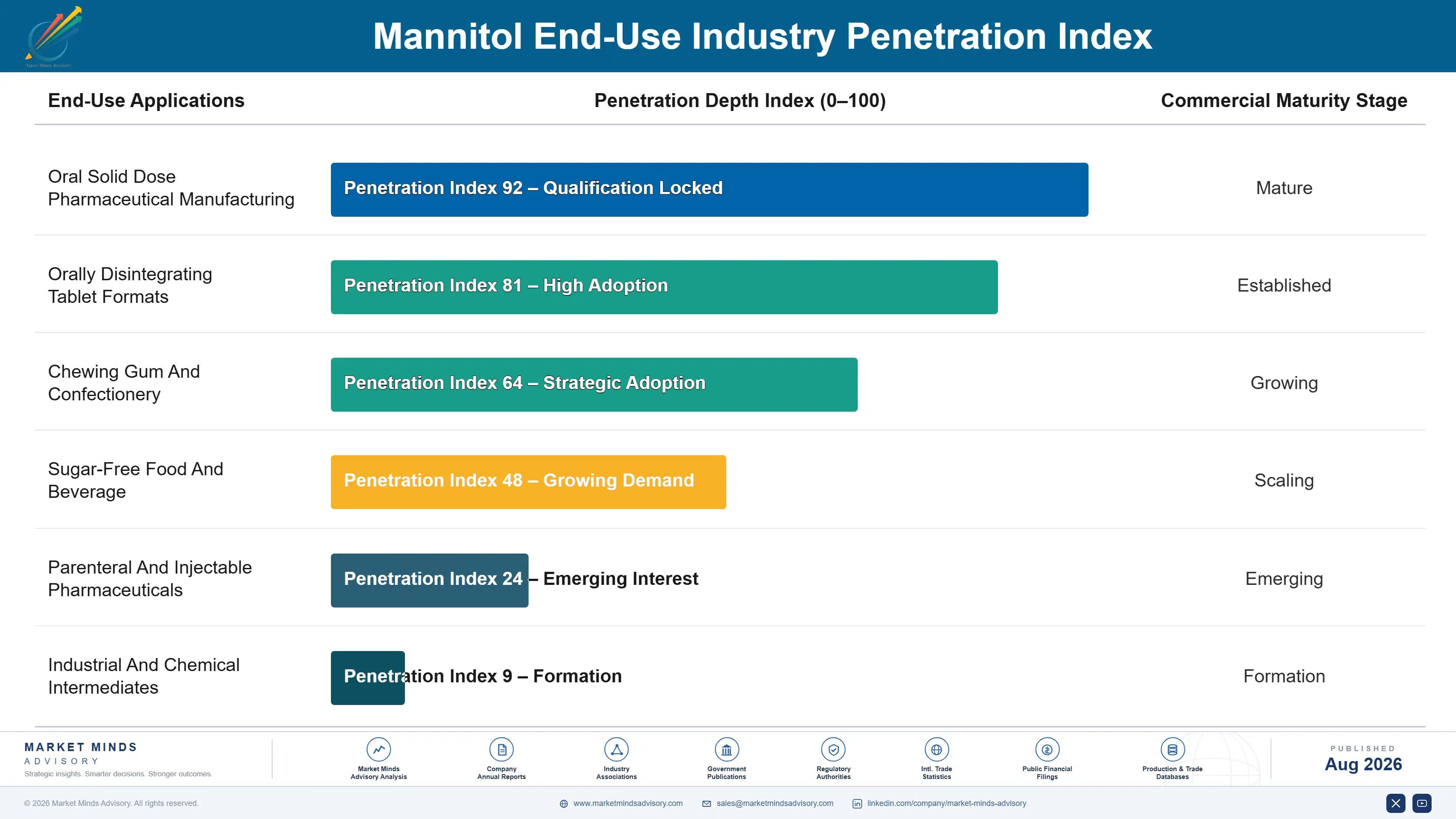
How Mannitol Demand Actually Repeats

Pharmaceutical positions repeat with unusual reliability because an excipient named in a validated formulation is not changed casually. Requalification triggers stability work, documentation updates and potentially regulatory notification, none of which the manufacturer gains anything from, so the volume repeats annually for as long as the product is made. Food grade supply repeats until a purchasing manager notices a cheaper quotation.
Stickiness varies sharply by grade and application. Injectable positions hold best, since so few producers can supply the specification that a formulator has almost nowhere else to go. Direct compression grades hold well because the tablet process was developed around a specific granule behaviour. Gum applications hold moderately on the non-hygroscopic property. Commodity powder holds worst, moving on delivered price at every tender.

The buyer profile has shifted noticeably. Mannitol purchasing once ran through procurement functions treating it as a polyol commodity bought on price per tonne. Direct compression adoption moved the decision toward formulation development teams weighing granule behaviour and processing savings, which rewards suppliers with application capability and disadvantages those whose commercial argument was a competitive quotation and a certificate. Certificates of analysis convince nobody now.
mannitol-market-trends-forecast-2024-2034-end-use-penetration-index-1787458004512

Where To Compete And Why

These are among the four positions where our research anticipates prominent divergence between winners and laggards over the coming forecast period. Each is grounded in the demand model, the regulatory perimeter, and the announced capacity pipeline.
01 / PARTICLE ENGINEERING MASTERY

They buy the granule, not molecule

Spray-drying mannitol into granules that flow and compress properly removes an entire wet granulation step from a tablet line, taking its drying stage, its equipment and its validation burden along with it. Formulators pay roughly 3.4 times commodity pricing without much argument, and producers holding the capability realise 45% to 55% higher margin than commodity suppliers do. The fermentation is straightforward and the granule is not, which is exactly why this premium survives competition rather than steadily eroding under it.
02 / PHARMACEUTICAL DOCUMENTATION DEPTH

Inspectors decide the supplier here

Generic manufacturers exporting into regulated markets need excipients whose documentation survives inspection at a plant the regulator has never visited, and drug master file support removes months of their own regulatory work. Suppliers carrying it reach the 56% of value sitting in pharmaceutical applications while commodity producers reach none of it. Maintaining files across jurisdictions costs roughly 5% of revenue annually and is a permanent obligation rather than any single investment that a producer completes once and then forgets about.
03 / FORMULATION QUALIFICATION TIMING

Thirteen months buys many years

Excipient qualification with any pharmaceutical formulator takes around 13 months of compatibility, stability and documentation work, and once inside a validated formulation nobody revisits it because requalification triggers regulatory work that delivers the manufacturer nothing at all. Qualified suppliers realise 28% to 35% higher pricing than spot material on volumes that then repeat annually for years afterwards. The contest happens at new product development, which makes commercial timing considerably more important than any offer that a supplier could realistically put forward instead.
04 / INJECTABLE CAPABILITY HOLDING

Sterility narrows the field decisively

Parenteral grade mannitol requires endotoxin control, particulate specification and sterility assurance that ordinary excipient production does not approach, and very few producers anywhere in the world supply it consistently enough to be relied upon. That narrows the field to a mere handful of them before price enters any conversation at all. Injectable grades realise 60% to 75% premiums over standard pharmaceutical powder, though the facility investment genuinely needs other parenteral products alongside it before the capital makes any sense at all.

Engagement Snapshot From the Field

A live engagement with an industry participant carrying material or product regulatory and market exposure ahead of a defining policy shift, showing how our research translates into a defensible multi-year portfolio strategy.
MARKET MINDS ADVISORY · CLIENT ENGAGEMENT SUMMARY
Mannitol Producer Strategic Portfolio Review and Transition Roadmap 2026·Investment Scenario on Mannitol Exposure Evaluation 2025-26
CLIENT PROFILE
A European polyol producer with annual revenue near $196 million (client-reported, unverified by MMA), supplying mannitol alongside sorbitol and related products to pharmaceutical, food and industrial customers. Roughly 63% of mannitol volume was commodity powder and food grade, with a small engineered direct compression range and no injectable specification capability anywhere in the business at all.
STRATEGIC CHALLENGE
European energy costs had eliminated contribution on commodity grades while Chinese producers competed hard on delivered cost, and one had begun submitting pharmaceutical documentation for engineered grades. Management needed to decide between defending commodity volume, expanding particle engineering capacity, or investing in injectable specification the business had never previously attempted at all.
MMA APPROACH
MMA modelled contribution by grade and customer across four years of the client's own data, benchmarked energy and fermentation cost against Chinese and European competitors, and assessed injectable facility requirements against realistic demand. Twenty-two expert interviews with pharmaceutical formulators, procurement leads and excipient regulatory consultants tested each of the available routes properly.
KEY FINDINGS
  1. Commodity powder delivered negative contribution after energy costs rose, and the client had defended that volume across three years for reasons of capacity utilisation rather than economics.
  2. Engineered direct compression grades realised roughly 34 percentage points more margin, and the client had never marketed them actively because the sales team sold on tonnage rather than application.
  3. Formulators interviewed valued application support on tablet process development above delivered price, and the client employed the technical people but had never deployed them commercially.
  4. Injectable capability required facility investment justifiable only if other parenteral excipients shared it, which the client's portfolio could support but had never been assessed as a combined case.
CLIENT PROFILE
A European polyol producer with annual revenue near $196 million (client-reported, unverified by MMA), supplying mannitol alongside sorbitol and related products to pharmaceutical, food and industrial customers. Roughly 63% of mannitol volume was commodity powder and food grade, with a small engineered direct compression range and no injectable specification capability anywhere in the business at all.
STRATEGIC CHALLENGE
European energy costs had eliminated contribution on commodity grades while Chinese producers competed hard on delivered cost, and one had begun submitting pharmaceutical documentation for engineered grades. Management needed to decide between defending commodity volume, expanding particle engineering capacity, or investing in injectable specification the business had never previously attempted at all.
MMA APPROACH
MMA modelled contribution by grade and customer across four years of the client's own data, benchmarked energy and fermentation cost against Chinese and European competitors, and assessed injectable facility requirements against realistic demand. Twenty-two expert interviews with pharmaceutical formulators, procurement leads and excipient regulatory consultants tested each of the available routes properly.
KEY FINDINGS
  1. Commodity powder delivered negative contribution after energy costs rose, and the client had defended that volume across three years for reasons of capacity utilisation rather than economics.
  2. Engineered direct compression grades realised roughly 34 percentage points more margin, and the client had never marketed them actively because the sales team sold on tonnage rather than application.
  3. Formulators interviewed valued application support on tablet process development above delivered price, and the client employed the technical people but had never deployed them commercially.
  4. Injectable capability required facility investment justifiable only if other parenteral excipients shared it, which the client's portfolio could support but had never been assessed as a combined case.
RECOMMENDED STRATEGY
Phase 1: Phase one: redirect commercial effort from tonnage selling toward application support on tablet process development, since the technical people already exist and only the deployment is missing. Phase 2: Phase two: expand particle engineering capacity for direct compression grades, entering the specification band where margin actually sits before Chinese competitors qualify there. Phase 3: Phase three: assess injectable capability as a combined parenteral portfolio case rather than as a mannitol decision, which changes the capital justification considerably.
OUTCOME
The client lifted engineered grades from 21% to 44% of mannitol volume within fifteen months and exited commodity supply in three accounts (client-reported, unverified by MMA). Blended gross margin improved by roughly twelve points, application support recovered two formulators previously lost on price, and the injectable case was approved for 2027 investment.

Frequently Asked Questions

Foundational context covering the market sizes, CAGR, scope, country, region and competition that inform every finding below. This section is provided to cover basics and most often pre-purchase conversations, answered from the MMA Primary Research Dataset.

What is the current size of the Mannitol Market?

The global mannitol market was valued at $0.50 billion in 2025, reaching an estimated $0.53 billion in 2026. That covers mannitol supplied into pharmaceutical, food, confectionery and industrial applications.

How large will the Mannitol Market be by 2036?

MMA forecasts the market reaching $0.97 billion by 2036, an increase of $0.44 billion over the 2026 base. That represents an expansion multiple of 1.82 times across the forecast period.

What is the CAGR for the Mannitol Market 2026 to 2036?

The base case compound annual growth rate is 6.2%, with a bull case of 7.4% and a bear case of 5.0%. Historical growth between 2020 and 2025 ran at 5.2% annually.

Which segment is growing fastest?

Direct compression pharmaceutical grades grow at 9.3%, a full 1.50 times the market rate, on particle engineering that removes wet granulation. Food and confectionery grades follow at 7.7% annually.

Who are the major companies in the Mannitol Market?

Roquette, Cargill, SPI Pharma, Merck KGaA and Shandong Tianli lead on mannitol supply revenue. Together they account for roughly 71%, high because particle engineering is genuinely difficult.

Which country is growing fastest?

India grows fastest at 8.5% annually as generic pharmaceutical manufacturing expands and pulls excipient demand behind it. China follows on domestic pharmaceutical and confectionery growth.

Report Segmentation Architecture

The full report scope spans multiple orthogonal segmentation dimensions, with cross-tabulated demand data provided for each dimension pair. Coverage extends further to regional breakdowns, trend trajectories, and the competitive detail needed to support segment-level decision-making.

By Product Grade

  • Direct Compression Pharmaceutical Grades
  • Food And Confectionery Grades
  • Standard Pharmaceutical Excipient Powder
  • Injectable And Parenteral Grades
  • Industrial And Technical Grades

By End-Use Industry

  • Oral Solid Dose Pharmaceutical Manufacturing
  • Orally Disintegrating Tablet Formats
  • Chewing Gum And Confectionery
  • Sugar-Free Food And Beverage
  • Parenteral And Injectable Pharmaceuticals
  • Industrial And Chemical Intermediates

By Commercial Dimension

  • Direct Supply To Pharmaceutical Formulators
  • Food Manufacturer Direct Supply
  • Excipient Distributor Channel
  • Contract Manufacturer Supply
  • Co-Processed System Licensing

By Region

  • North America
  • Western Europe
  • East Asia
  • South Asia and Pacific
  • Latin America
  • Middle East and Africa
  • Eastern Europe

Scope, Methodology, and Coverage

Every figure in this report is reproducible from documented input assumptions. The scope below maps the historical period, the forecast horizon, the segmentation dimensions, and the countries covered, alongside the underlying primary and qualitative methodology.
Historical Period
2020 to 2025
Forecast Period
2026 to 2036
Base Year
2025 (USD billions; MMA Primary Research Dataset, August 2026)
Market Definition
This report covers mannitol supplied into pharmaceutical, food, confectionery and industrial applications, spanning direct compression pharmaceutical grades, food and confectionery grades, standard pharmaceutical excipient powder, injectable and parenteral grades, and industrial and technical grades, across direct pharmaceutical and food supply, distribution, contract manufacturing and licensing channels. Sorbitol, xylitol, erythritol, maltitol and other polyols, mannitol supplied as a prescription drug substance for diagnostic or therapeutic use, and seaweed-derived mannitol sold as a raw extract are excluded from the sizing.
Quantitative Units
USD billions at producer realised value; volume in thousand tonnes; realised pricing in USD per kilogram.
Segmentation Dimensions
By product grade; by end-use industry; by commercial dimension; by region.
Regions Covered
North America, Western Europe, East Asia, South Asia and Pacific, Latin America, Middle East and Africa, Eastern Europe
Countries Covered
China, Japan, South Korea, India, Thailand, Indonesia, Vietnam, Australia, United States, Canada, Mexico, Brazil, Argentina, France, Germany, Netherlands, Italy, Poland, Turkey, Egypt.
Key Companies Profiled
Roquette, Cargill, SPI Pharma, Merck KGaA, Shandong Tianli, Ingredion, Archer Daniels Midland, Mitsubishi Corporation Life Sciences, Shandong Futaste, Gujarat Ambuja Exports, DFE Pharma, Meggle Group, JRS Pharma, Sigachi Industries and others.
Quantitative Methodology
Primary survey, n=3,800 respondents, Q4 2025, six countries; demand-side model with trade association cross-validation
Qualitative Methodology
47 expert interviews, Q4 2025; applied to validate demand model assumptions, identify emerging dynamics, and assess competitive positioning
Report Format
PDF and XLSX data workbook (Word format preview document)
Publisher
Market Minds Advisory
Report Code
MMA-2026-CHM-215
Published
August 2026
Contact
sales@marketmindsadvisory.com | www.marketmindsadvisory.com

Purchase the full Mannitol Market Report (2026 to 2036).

The full report sizes the mannitol market across five product grades, six end-use categories and seven regions, with tonnage and per kilogram pricing detail behind every value estimate. It profiles twenty companies on particle engineering capability, pharmaceutical documentation and injectable specification access. Regional chapters cover fermentation capacity, pharmaceutical manufacturing scale and confectionery demand by market. Cost analysis quantifies fermentation, drying energy and documentation exposure by grade and location. Application analysis compares direct compression economics against wet granulation across a range of realistic tablet manufacturing scenarios.
Tonnage and per kilogram pricing by product grade
Direct compression against wet granulation economics compared directly
Fermentation capacity and energy cost mapped by production region
Laxation thresholds and labelling requirements across major jurisdictions
Competitive position assessments across twenty companies
Injectable specification capability and supplier availability assessed globally

Built For The People Who Decide

From boardroom strategy to bench-side execution, this report is read cover-to-cover by leaders shaping the next decade of their industry, turning demand scenarios, market dynamics and valuation benchmarks into decisions.
CXOs/ Presidents/ VPs/ Managers
M&A and Corporate Development
Strategy Teams and R&D Heads
Procurement and Product Directors
Regulatory and Compliance Leaders
Investor Relations and Equity Analysts