Market Minds Advisory
Managed File Transfer (MFT) Market

Managed File Transfer (MFT) Market: Managed File Transfer (MFT) Market. Secure, Compliant, and Cloud-Based Enterprise File Transfer Platforms, 2026 to 2036

Regulators fining companies over insecure ad hoc file transfers are pushing enterprises off email attachments and FTP scripts toward managed platforms with audit trails, forcing legacy vendors to add compliance features quickly.

Lead Analyst

Published

September 2026

Make Smarter Decisions with Customized Research Insights

Request a free sample report and evaluate market opportunities, growth trends, and competitive dynamics relevant to your business needs.

2025 MARKET VALUE$4.6BMarket Size 2025
2036 FORECAST VALUE$12.5BBase Case , 2026 to 2036
CAGR 2026 TO 20369.5 %Bull 10.7% / Bear 8.3%
INCREMENTAL OPPORTUNITY$7.5BNet 10- year value creation
EXPANSION MULTIPLE2.48x2036 value over 2026 base
Strategic Levers
M&A Pipeline
Regional Outlook
Country Rankings
Competitive Intelligence
Segmental Deep-dive
Call-Us : 91 93563 13602

Executive Snapshot and Market Trajectory.

Enterprises are abandoning ad hoc file transfer methods like email attachments and unmanaged FTP scripts en masse, driven less by IT modernization ambition than by regulators imposing genuine financial penalties for data exposure incidents traced back to exactly these unmanaged channels across multiple heavily regulated industries worldwide today.
Cloud-based and SaaS MFT platforms are growing fastest as enterprises favor subscription pricing and vendor-managed infrastructure over on-premises deployments requiring dedicated internal maintenance staff and specialized security patching expertise, a shift accelerated by financial services and healthcare organizations facing the strictest data handling compliance requirements currently in force globally. North America leads adoption given its concentration of regulated industries and Fortune 500 headquarters managing complex, high-volume partner file exchange relationships across many industries.
Competitive intensity is rising as established on-premises vendors race to add cloud-native capability and automated compliance reporting features that smaller cloud-first challengers built in from the outset, while consolidation continues among legacy point solutions unable to match the security certification depth larger vendors now offer as standard, a shift accelerating meaningfully since 2024 across most enterprise IT procurement cycles worldwide and increasingly well beyond.
Market Definition
The Managed File Transfer Market covers on-premises, cloud, and hybrid software platforms that automate, secure, and audit the transfer of files between enterprise systems, partners, and customers. It excludes consumer file-sharing applications, general-purpose cloud storage services, and network infrastructure hardware unrelated to the managed transfer software layer itself.
Base Year Value
$4.6B in 2025 (MMA Primary Research Dataset, September 2026)
Forecast Period
2026 to 2036, eleven discrete annual values
CAGR
9.5% base case. Bull 10.7%. Bear 8.3%.
Fastest Growth Segment
Cloud-Based and SaaS MFT Platforms: 14.0% CAGR
Fastest Growth Country
Singapore: 15.0% CAGR
Fastest Growth Region
South Asia and Pacific: 11.5% CAGR
Largest Region
North America: 28% of 2025 global value
Market Leaders
IBM Sterling, Progress MOVEit, Fortra GoAnywhere, Axway, and OpenText lead by enterprise deployment volume. Source: MMA Primary Research Dataset, July 2026.
Primary Survey
n=3,800 procurement and R&D decision-makers, Q4 2025, six countries
Methodology
Demand-side build-up, cross-validated against public data, 47 expert interviews

Managed File Transfer (MFT) Market Forecast Scenarios

managed-file-transfer-software-and-service-market-size-forecast-scenario-1789989947985
Between 2020 and 2025, MFT adoption accelerated as remote work expanded the volume of sensitive files moving between employees, partners, and third-party vendors, exposing gaps in ad hoc transfer methods that several high-profile breaches, including widely publicized incidents affecting large managed file transfer platforms themselves, made impossible for enterprises to ignore any longer across most affected industries.
The base case assumes continued migration from on-premises to cloud and SaaS MFT platforms as enterprises prioritize vendor-managed security patching over internal maintenance burden, sustained regulatory pressure toward documented data handling compliance across financial services and healthcare, and steady consolidation among smaller point solutions unable to match larger vendors' certification depth. Together these three mechanisms sustain solid growth through 2036, with cloud-native platforms capturing a growing share of net-new enterprise deployment.
A bull scenario assumes accelerated regulatory enforcement action against ad hoc file transfer practices pulls forward enterprise migration timelines considerably faster than currently planned across most regulated sectors simultaneously. A bear scenario assumes enterprise IT budget constraints delay planned MFT modernization projects, extending the useful life of legacy on-premises deployments well beyond vendors' original replacement cycle expectations.

Where Compliance Requirements Now Drive Platform Choice

Managed file transfer has moved from an IT infrastructure line item to a compliance-driven procurement category with its own budget justification tied directly to regulatory penalty avoidance, reflecting how consistently enterprises now cite documented audit trail capability as the primary purchase driver rather than raw transfer speed or file size limits that once dominated vendor selection criteria entirely.
MARKET CONCENTRATION (CR5)48%Top five vendors hold roughly half of enterprise deployments
AVERAGE ANNUAL CONTRACT VALUE$62,000Typical yearly subscription cost for a mid-sized enterprise deployment
CLOUD AND SAAS SHARE44%Portion of new deployments now delivered as cloud-based platforms
DOCUMENTED BREACH COST AVOIDANCE$3.2MAverage penalty avoided per enterprise adopting managed transfer software
COMPLIANCE COST OF COGS22%Portion of software development cost tied to audit capability
AVERAGE IMPLEMENTATION TIMELINE3 monthsTypical time from contract signing to full production deployment
Cloud and SaaS deployment now accounts for a substantial and growing share of new implementations, as enterprises increasingly prefer vendor-managed security patching over the internal maintenance burden on-premises deployments require of dedicated IT staff. Financial services and healthcare organizations, facing the strictest data handling compliance requirements, drive a disproportionate share of premium-tier deployment given their genuine regulatory exposure and audit obligations.
Vendor consolidation has accelerated as smaller point solutions struggle to match the security certification depth larger platforms now offer as standard, forcing many enterprises to migrate away from legacy vendors during scheduled contract renewal cycles rather than waiting for organic replacement to occur naturally over time. This consolidation trend shows few signs of reversing given the capital investment certification depth genuinely requires from every serious competitor.
"Nobody buys managed file transfer software because they love file transfer. They buy it because the auditor asked a question last quarter nobody in the room could answer confidently."
Director, Enterprise Data Governance and Compliance Practice · MMA Technology Practice · September 2026

Market Trends

Regulators Impose Direct Penalties for Insecure Transfers

Multiple national and regional regulators have levied direct financial penalties against enterprises for data exposure incidents traced specifically to unmanaged file transfer channels since 2024, formalizing a risk that previously existed mostly as reputational rather than immediate financial exposure. This shift has created urgent procurement pressure among enterprises previously treating MFT adoption as a discretionary IT modernization project rather than a genuine compliance requirement with hard deadlines. Legal and compliance teams increasingly drive MFT procurement decisions directly, a departure from the IT-led purchasing process that historically governed this category exclusively.
Market Impact: Partner relationships grew 28% since 2023
Cloud-Native Platforms Rapidly Displace On-Premises Deployment

Enterprises are increasingly favoring cloud-native and SaaS MFT platforms over traditional on-premises deployments, drawn by vendor-managed security patching that eliminates the internal maintenance burden and specialized expertise on-premises systems require to keep current against evolving threats. This shift has accelerated considerably since 2023 as enterprises grew more comfortable trusting cloud vendors with sensitive file transfer infrastructure, a comfort level that took years to develop following early skepticism about cloud security for genuinely sensitive data categories. Vendors without a credible cloud offering increasingly lose competitive tenders entirely to cloud-native challengers built specifically for this preference.
Market Impact: These verticals drive 38% of revenue

Market Opportunities and Growth Drivers

Third-Party Partner File Exchange Complexity Grows

Enterprises increasingly exchange large volumes of sensitive files with an expanding network of third-party partners, suppliers, and contractors, each relationship carrying its own security and compliance requirements that ad hoc transfer methods simply cannot track or enforce consistently across dozens or hundreds of distinct partner relationships. Managed file transfer platforms centralize this complexity into a single auditable system, letting compliance teams demonstrate consistent security posture across every partner relationship rather than relying on scattered, undocumented email exchanges. This capability has become essential as partner networks grow larger and more distributed across most industries.
Market Impact: Legacy contracts average 4 years remaining

Financial Services and Healthcare Drive Premium Adoption

Financial services and healthcare organizations face the strictest data handling compliance requirements of any industry vertical, and both sectors have driven disproportionate adoption of premium-tier MFT platforms with the deepest audit trail and encryption certification capability currently available anywhere in the broader market today. Regulatory examinations in both sectors increasingly scrutinize file transfer practices specifically, rather than treating data handling as a general IT security consideration folded into broader security assessments conducted less frequently. This scrutiny has pushed these two verticals toward faster MFT modernization timelines than most other industries currently pursue.
Market Impact: Delays add 6 to 10 weeks

Market Restraints and Challenges

Legacy On-Premises Contracts Slow Cloud Migration

Many enterprises remain locked into multi-year on-premises MFT contracts signed before cloud alternatives matured into credible options, and the root cause is that early contract terms rarely anticipated the cloud migration wave now underway across the broader software industry. The commercial impact leaves enterprises paying for on-premises maintenance and licensing while cloud alternatives sit unused until contract expiration, delaying the realization of vendor-managed security benefits cloud platforms genuinely offer. Vendors are mitigating this by offering hybrid deployment options and contract buyout incentives that ease the transition before natural renewal dates arrive.
Market Impact: Penalties averaged $3.2 million per incident

Integration Complexity With Legacy Enterprise Systems

Enterprises with deeply embedded legacy systems built decades ago face genuine integration complexity when connecting modern MFT platforms to these older environments, and the root cause is that many legacy systems predate the standardized APIs modern MFT platforms expect to interface with directly and cleanly. The commercial impact extends implementation timelines considerably beyond vendor-quoted estimates, frustrating enterprises expecting a straightforward deployment comparable to simpler cloud software categories. Vendors are mitigating this by building specialized legacy connector libraries and offering dedicated implementation services for the most common older enterprise system combinations.
Market Impact: Cloud share reached 44% in 2025
3 additional market trends, 4 additional growth drivers, and 3 additional restraints and challenges are covered in the full report. Contact sales@marketmindsadvisory.com to access the complete intelligence.

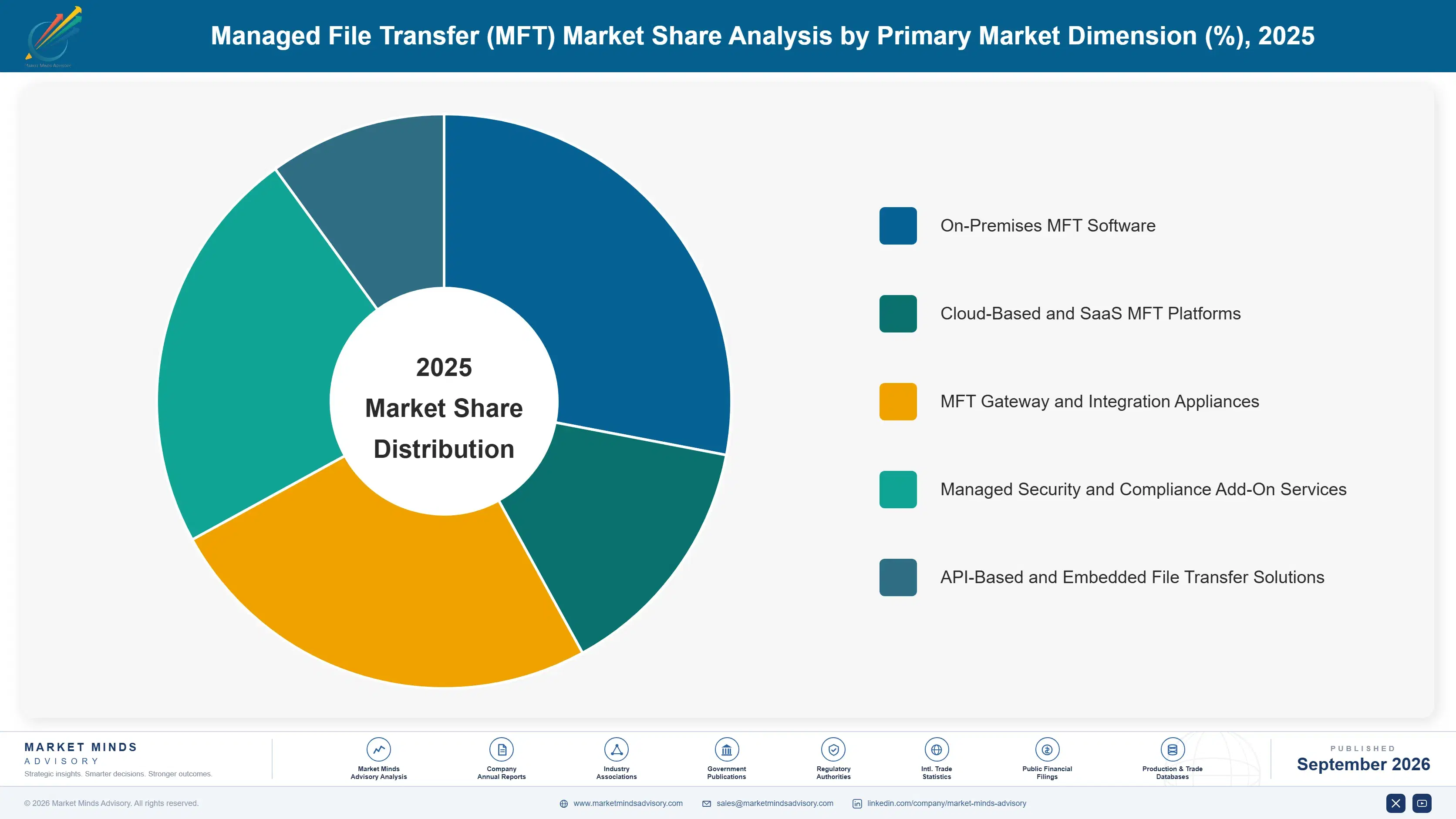
Segment CAGR and Growth Architecture

Managed file transfer divides into five categories distinguished by deployment model and commercial structure, from traditional on-premises software through cloud-native platforms and embedded solutions across the industry. On-premises MFT, cloud-based and SaaS platforms, gateway and integration appliances, managed security and compliance add-on services, and API-based embedded solutions each carry distinct margin profiles and buyer relationships.
managed-file-transfer-software-and-service-market-market-share-analysis-1789989948537

Cloud-Based and SaaS MFT Platforms

Cloud-based and SaaS MFT platforms have become the fastest-growing category because they eliminate the internal maintenance burden and specialized security patching expertise on-premises deployments require, a genuinely attractive proposition for enterprises facing chronic IT staffing shortages in security-specialized roles across most industries and regions today. Financial services and healthcare organizations, once the most cautious adopters of cloud-based sensitive data infrastructure, have increasingly embraced cloud MFT platforms as vendor security certifications matured to meet their strict compliance requirements over the past several years. Vendors report cloud deployment now converting the majority of new enterprise contracts, a reversal from just a few years earlier when on-premises deployment still dominated most competitive tenders decisively.
CAGR 14.0%

API-Based and Embedded File Transfer Solutions

API-based and embedded file transfer solutions have grown quickly as enterprises increasingly build custom applications requiring programmatic file transfer capability rather than a traditional standalone MFT interface accessed by human operators directly through a standard web browser interface each and every day. These solutions let software developers embed secure, compliant file transfer functionality directly into internal applications and customer-facing products without building the underlying security and audit infrastructure entirely from scratch themselves each time. Adoption concentrates heavily among technology companies and financial services firms building proprietary customer-facing platforms, though adoption is expanding steadily into other verticals as low-code development tools make embedded integration increasingly accessible to non-specialist development teams working today.
CAGR 13.0%
Full segment breakdown across 5 segments available in the complete report.

Regional Architecture and Country Demand Map

North America accounts for the largest share of managed file transfer revenue, reflecting its concentration of regulated industries and Fortune 500 headquarters managing complex partner file exchange relationships. East Asia posts the fastest growth outside South Asia and Pacific as manufacturing and financial services digitization accelerates.

North America

North America's dominance reflects the sheer concentration of regulated industries headquartered in the region, including financial services, healthcare, and insurance companies facing among the strictest data handling compliance requirements found anywhere in the world today or in the recent past. Regulatory enforcement actions specifically targeting insecure file transfer practices have intensified considerably since 2024, pushing enterprises previously treating MFT as discretionary IT spending toward mandatory compliance budgets with dedicated line items and staff. Vendors headquartered in this region also benefit from proximity to their largest enterprise customer base, supporting faster product iteration cycles informed by direct customer feedback than vendors serving the region primarily through international sales channels and distant partner networks.
Share: 28% | CAGR: 9.5% (2026 to 2036)

Western Europe

Western Europe's managed file transfer revenue reflects some of the world's most stringent data protection regulation, with mandatory breach disclosure and data handling requirements shaping vendor product roadmaps directly for platforms serving this region specifically and its many member states across the entire continent today. German, French, and British financial services and manufacturing enterprises drive the bulk of regional demand, often specifying data residency requirements that keep sensitive file transfer infrastructure within regional data centers rather than global cloud infrastructure operated elsewhere entirely. European Union digital sovereignty initiatives have further reinforced this regional data residency preference, creating genuine differentiation opportunity for vendors offering region-specific hosting infrastructure and dedicated local support.
Share: 22% | CAGR: 8.0% (2026 to 2036)
Regional intelligence for 5 additional markets available in the complete report: East Asia, South Asia and Pacific, Latin America, Middle East and Africa, Eastern Europe. Contact sales@marketmindsadvisory.com.
managed-file-transfer-software-and-service-market-country-cagr-analysis-1789989949086

Where MFT Vendors Are Building Margin

Vendors are testing new commercial structures to capture more value as basic file transfer functionality becomes increasingly commoditized across the industry today, pushing differentiation toward compliance, integration, and managed service capability instead of raw transfer speed. The levers below reflect where the industry is actively investing to build recurring, higher-margin revenue beyond basic licensing fees.

Bundling Automated Compliance Reporting Into Core Pricing

Vendors are packaging automated, audit-ready compliance reporting directly into core subscription pricing rather than selling it as a separate add-on module, commanding a price premium of 18 to 22 percent given the direct regulatory penalty avoidance value this capability provides enterprise compliance teams facing genuine audit deadlines each and every fiscal year. This bundled approach shortens sales cycles considerably, since compliance-driven buyers value pre-built reporting over building custom audit processes internally from available raw transfer logs alone each time. Vendors without this capability increasingly lose competitive tenders to bundled competitors.
Market Impact: Commands a premium of 18 to 22 percent

Selling Managed Migration Services for Legacy Contracts

Vendors are increasingly offering managed migration services to help enterprises transition off legacy on-premises platforms and expiring competitor contracts, adding a service revenue stream worth roughly 15 to 20 percent of the total first-year contract value negotiated directly with the enterprise customer involved directly. This approach also accelerates displacement of competing vendors, since enterprises facing a complex migration project value having the receiving vendor manage the transition directly rather than coordinating it internally with limited specialized migration expertise available in-house. Adoption has grown fastest among enterprises approaching legacy contract expiration.
Market Impact: Migration services add 15 to 20 percent value

Charging Data Residency Premiums for Regional Hosting

Vendors offering region-specific hosting infrastructure to satisfy data residency and sovereignty requirements charge meaningfully more than for standard global cloud deployment, reflecting the genuine infrastructure cost of maintaining separate regional data center capacity rather than a single global platform serving every customer identically everywhere. This residency premium typically runs 20 to 30 percent above standard global pricing, and enterprises facing genuine regulatory data residency mandates generally accept it given the absence of a compliant alternative available elsewhere. Vendors with the broadest regional hosting footprint command the strongest pricing power specifically.
Market Impact: Residency premiums run 20 to 30 percent higher

Licensing Embedded Transfer APIs to Software Vendors

Larger MFT vendors with mature, well-documented transfer APIs are increasingly licensing that capability to smaller software vendors and platform builders seeking to embed compliant file transfer functionality without developing the underlying security and audit infrastructure independently themselves from scratch each time. This licensing arrangement typically returns 12 to 18 percent of the licensee's resulting embedded feature revenue, a meaningful ongoing royalty stream for the API provider requiring minimal incremental cost to sustain once the underlying infrastructure already exists. Licensing revenue has grown steadily as more software vendors embed compliant transfer capability.
Market Impact: Licensing returns 12 to 18 percent in royalties

Who Controls the Margin Pool

Managed file transfer vendor revenue concentrates fairly heavily at the top, with the five leading providers holding roughly 48 percent combined share, reflecting decades of enterprise relationship depth and certification investment newer entrants struggle to match quickly. IBM Sterling and Progress MOVEit lead by this measure, drawing on long-standing enterprise contracts across financial services and healthcare. Fortra GoAnywhere trails the two leaders somewhat in pure enterprise revenue, though it holds a strong position among mid-market buyers seeking simpler deployment.
Current competitive activity centers on cloud migration capability and automated compliance reporting, as vendors race to match the ease-of-deployment advantages smaller cloud-native challengers offer. Several established vendors have announced managed migration service offerings targeting enterprises approaching legacy contract renewal. Consolidation continues as smaller point solutions unable to match larger vendors' certification depth exit the market.

Emerging pressure comes from cloud-native and API-first challengers offering simpler deployment and lower entry pricing than established enterprise vendors built around complex, feature-heavy on-premises platforms. Rankings among established vendors are likely to shift as legacy contract renewal cycles create natural switching opportunities, favoring vendors with the strongest migration support capability over those relying primarily on customer inertia to retain accounts.
managed-file-transfer-software-and-service-market-company-positioning-matrix-1789989949615

Competitive Moat and Risk Dimensions

IBM STERLING

Moat: Decades of Enterprise Relationship Depth

IBM Sterling draws on decades of established enterprise relationships across financial services and healthcare, giving it deep institutional knowledge of complex compliance requirements that newer, less experienced vendors cannot easily replicate. This relationship depth makes IBM Sterling a default renewal choice for the most conservative, compliance-sensitive enterprise buyers evaluating vendors.
IBM STERLING

Risk: Perceived as Legacy Platform Architecture

IBM Sterling's association with traditional enterprise software architecture makes it a less obvious default for enterprises specifically seeking cloud-native, modern deployment models, who increasingly consider more agile alternatives from newer challengers. This risks ceding the fastest-growing cloud-first segment of new enterprise contracts to competitors perceived as better suited to modern deployment preferences.
PROGRESS MOVEIT

Moat: Strong Mid-Market Brand Recognition

Progress MOVEit holds strong brand recognition among mid-market enterprises seeking a balance between enterprise-grade compliance capability and simpler deployment than the largest legacy platforms require. This positioning lets Progress MOVEit compete effectively against both larger legacy vendors and smaller cloud-native challengers simultaneously across different competitive fronts.
PROGRESS MOVEIT

Risk: High-Profile Security Incident Legacy

Progress MOVEit's association with a widely publicized security incident affecting its platform continues to weigh on enterprise buyer perception in the most security-sensitive procurement evaluations, despite substantial remediation investment since the incident occurred. This reputational legacy may continue constraining its share of the most compliance-sensitive enterprise contracts for years.

Players Tracked

Prominent Players

IBM Sterling
Progress MOVEit
Fortra GoAnywhere
Axway
OpenText

Other Key Players

Cleo
JSCAPE
SolarWinds Serv-U
Tresorit
Thru
Kiteworks
SFTP.com
Diplomat MFT
Cerberus FTP Server
Titan MFT
SmartFile
Coviant Software
ExaVault
Data443 Risk Mitigation
Files.com

Recent Developments

FEBRUARY 2026

IBM Sterling Launches Managed Migration Service

IBM Sterling launched an expanded managed migration service specifically targeting enterprises transitioning off competitor platforms approaching contract renewal, bundling migration support directly into new customer onboarding rather than charging as a separate consulting engagement afterward. The service targets the largest enterprise accounts specifically across most regulated industries.
Signal: Signals migration services are becoming a standard competitive tool for displacing legacy vendor relationships during renewal windows
OCTOBER 2025

Progress MOVEit Bundles Compliance Reporting

Progress MOVEit announced expanded automated compliance reporting capability bundled directly into core subscription pricing, responding to enterprise demand for audit-ready documentation without a separate consulting purchase required each time. The update targets financial services and healthcare customers facing intensifying regulatory scrutiny across most major markets.
Signal: Signals bundled compliance reporting is moving from a premium add-on into standard core product functionality broadly
MAY 2025

Fortra Expands European Data Residency Hosting

Fortra GoAnywhere expanded its regional data hosting infrastructure to satisfy European Union data residency requirements, adding dedicated regional data centers rather than relying solely on global cloud infrastructure shared across all customer regions worldwide today. The expansion targets European enterprise customers specifically across multiple industries.
Signal: Signals data residency infrastructure investment is becoming a genuine competitive requirement for serving European enterprise customers

What Drives MFT Development and Compliance Cost

Security and compliance engineering labor represents the dominant input cost for managed file transfer software, typically running 45 to 55 percent of total development cost, sourced primarily from specialized encryption, audit logging, and regulatory certification engineers concentrated in North America and Western Europe. Cloud infrastructure hosting and third-party security certification fees round out the remaining major cost categories.
Compliance certification costs rose meaningfully during 2023 and 2024 as multiple new regional data protection regulations took effect simultaneously, requiring vendors to pursue separate certification processes for each jurisdiction rather than a single unified global standard covering all markets at once. Vendors serving multiple regions absorbed considerably higher certification overhead during this period, particularly those expanding into newly regulated Asian and Middle Eastern markets for the first time.

Smaller vendors without dedicated compliance engineering teams absorb certification cost increases directly into product pricing, pricing them out of competing for the largest regulated enterprise contracts against better-capitalized rivals with deeper compliance budgets. This dynamic favors vendors like IBM Sterling and Progress with substantial existing compliance engineering organizations, while smaller specialized firms face considerably thinner margins on comparable certification depth.
managed-file-transfer-software-and-service-market-cost-volatility-analysis-1789989949811

Pursuing Unified Multi-Jurisdiction Certification Frameworks

Vendors are investing in unified compliance frameworks designed to satisfy multiple jurisdictions' requirements simultaneously rather than pursuing entirely separate certification processes for each region individually, reducing duplicate compliance engineering effort considerably across the entire product portfolio and customer base. This approach requires upfront framework design investment but lowers per-jurisdiction certification cost meaningfully over time and scale.

Building Compliance Engineering Talent Pipelines

Vendors are partnering with universities and professional certification bodies to build dedicated compliance engineering talent pipelines, addressing the specialized talent shortage at its source rather than competing purely on compensation for a small existing pool of qualified professionals available in the wider market today. This produces considerably more loyal compliance talent over time and at lower cost.

Sharing Certification Costs Across Product Lines

Vendors are designing compliance capability as a shared architectural layer usable across multiple product lines and deployment models rather than certifying each product variant separately, spreading certification cost across a considerably broader revenue base and customer segment found nationwide today. This lowers effective per-product certification cost meaningfully over time each year across the industry.

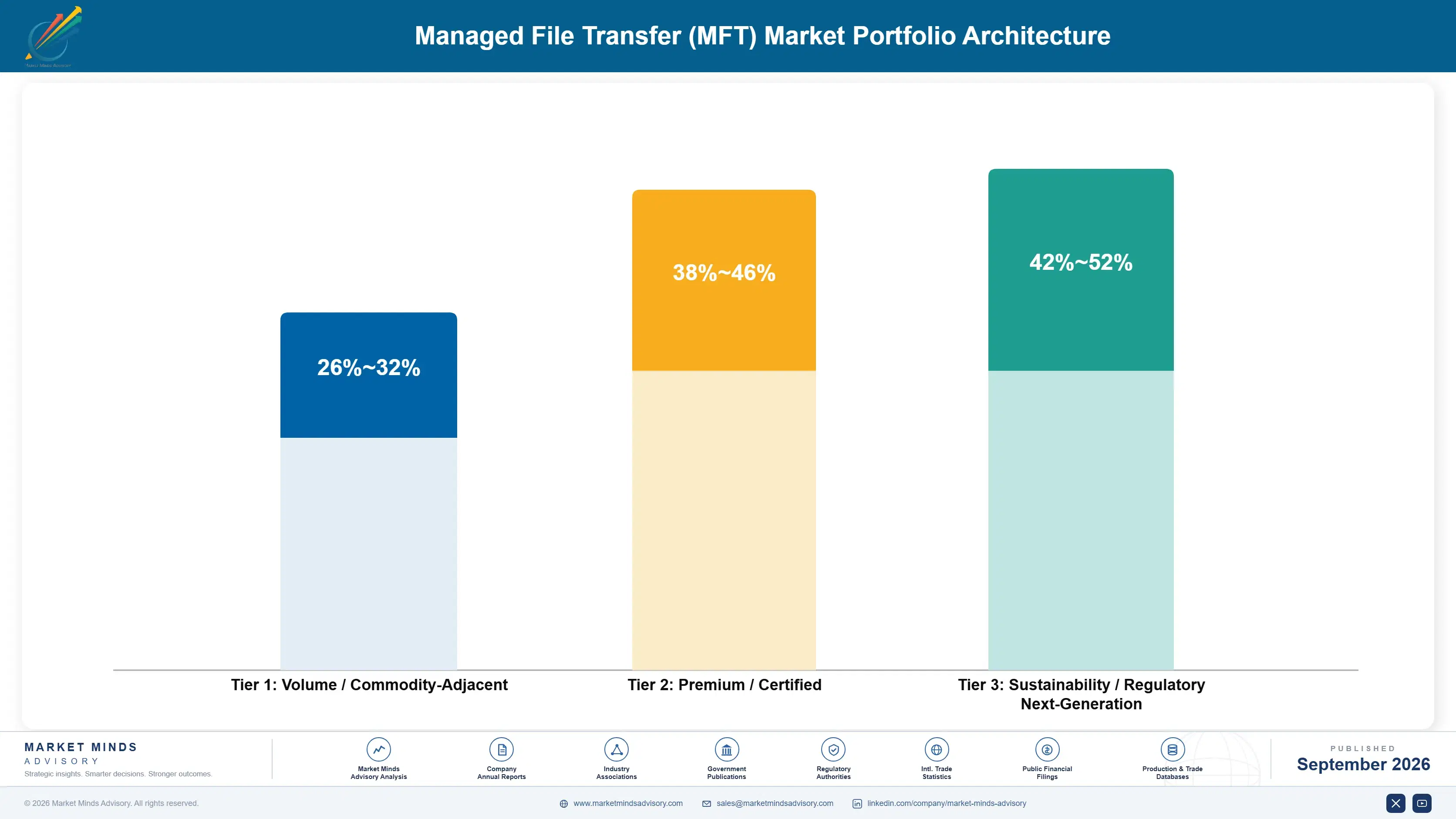
Portfolio Architecture for Margin Defence

Managed file transfer splits into three margin tiers reflecting compliance depth and deployment sophistication across the industry today. Standardized on-premises and basic cloud file transfer run on volume economics with thinner per-unit margins, while managed security add-ons and API-based embedded solutions command materially higher margins given their specialized engineering and integration complexity.
Tension between volume and premium tiers shows up in how vendors allocate compliance engineering investment, since managed security services and embedded API solutions require ongoing specialized capability that standardized transfer products no longer need at the same intensity as before across most product lines. Vendors increasingly treat mature transfer products as a stable volume generator, funding premium compliance and integration development from that steadier baseline revenue stream.

High-value margin pools concentrate specifically in managed security and compliance add-on services, API-based embedded solutions, and data residency hosting, all of which combine strong pricing power with meaningful barriers to entry from specialized regulatory and integration expertise across the broader industry today. Standardized on-premises and basic cloud transfer products represent the largest volume pool but the thinnest margins, having become increasingly commoditized as vendors compete primarily on price alone.

Volume / Commodity-Adjacent

Standardized on-premises and basic cloud file transfer sold at accessible pricing across high-volume enterprise deployment programs to maximize protected file transfer volume broadly across the entire market and its many sectors.
Gross Margin: 26-32%

Premium / Certified

Gateway and integration appliances and mid-tier cloud platforms sold as differentiated products commanding stronger per-unit pricing power than commodity transfer alternatives available broadly across the wider market and industry today.
Gross Margin: 38-46%

Sustainability / Regulatory / Next-Generation

Managed security and compliance add-on services, API-based embedded solutions, and data residency hosting addressing the industry's most demanding regulatory requirements across most sectors, geographies, and enterprise types found across the world.
Gross Margin: 42-52%
managed-file-transfer-software-and-service-market-portfolio-architecture-1789989950325

High-value Sub-segments and Strategic Watch-out

Cloud-Based and SaaS MFT Platforms

Cloud-based and SaaS MFT platforms combine strong growth with strong margins, driven by enterprises favoring vendor-managed security patching over internal maintenance burden and specialized security expertise on-premises deployments require of dedicated staff, a burden growing more acute as security threats and compliance mandates evolve continuously.
Gross Margin: 44-52%

API-Based and Embedded File Transfer Solutions

API-based and embedded file transfer solutions post healthy margins and strong growth as enterprises increasingly build custom applications requiring programmatic file transfer capability, though absolute revenue remains smaller than core platform categories given its still-developing market and comparatively narrower current customer base across most industries.
Gross Margin: 40-48%

On-Premises MFT Software

Standardized on-premises MFT software remains the volume core of the market, deployed across the majority of long-tenured enterprise contracts at accessible pricing, and vendors rely heavily on this segment for stable baseline revenue even as margins continue to compress steadily each and every calendar year.
Gross Margin: 26-32%

MFT Gateway and Integration Appliances

Gateway and integration appliances warrant close monitoring as cloud-native architectures increasingly displace dedicated hardware appliances entirely, threatening to shrink a segment that once provided steady, dependable revenue without requiring major ongoing product differentiation from competing vendors nationwide or internationally across most enterprise IT markets worldwide.
Gross Margin: 30-38%

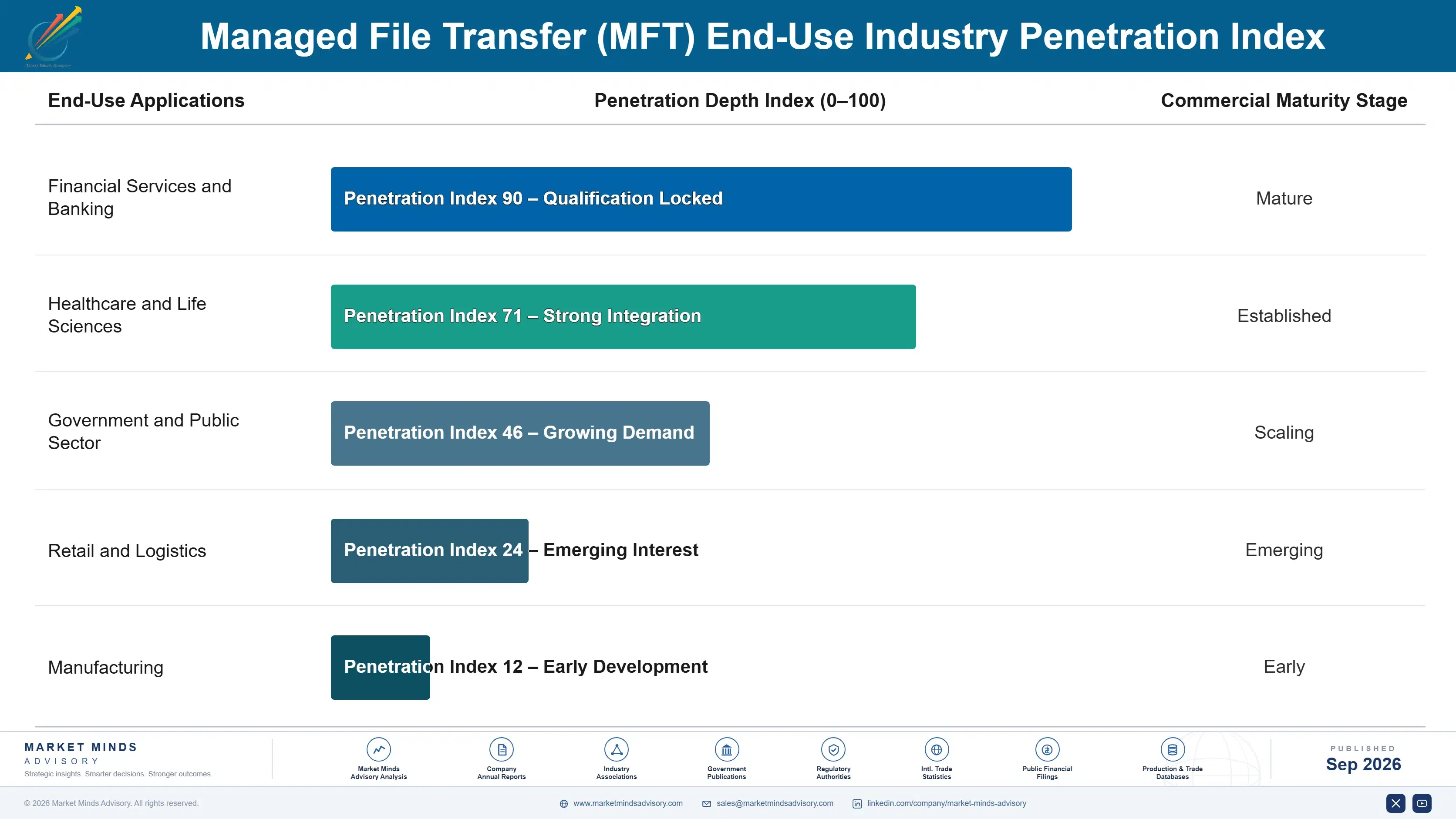
Why MFT Contracts Rarely Get Displaced

Managed file transfer behaves like a genuine annuity business once a platform is embedded into an enterprise's core partner and customer data exchange workflows, since migrating away requires re-establishing dozens or hundreds of integration points across every connected partner and internal system that would need coordinated cutover scheduling. Repeat enterprise clients account for a meaningfully larger share of vendor revenue than first-time buyers, and switching costs alone keep renewal rates unusually high for enterprise software.
Adoption stickiness varies considerably by end-use vertical: financial services and healthcare enterprises with the most extensive partner networks and strictest compliance requirements exhibit the highest renewal rates, while smaller enterprises with simpler transfer needs show greater willingness to switch vendors during contract renewal. This uneven stickiness shapes which vendors compete most aggressively for which customer segment.

Buyer profiles are shifting generationally as procurement decisions increasingly involve dedicated data governance and compliance specialists rather than relying solely on traditional IT infrastructure leadership, pushing vendors to demonstrate compliance sophistication alongside basic transfer reliability during evaluation. This generational shift favors vendors who can speak credibly to both regulatory requirements and traditional IT infrastructure needs simultaneously.
managed-file-transfer-software-and-service-market-end-use-penetration-index-1789989950819

Priorities for Managed File Transfer Vendors

These are among the four positions where our research anticipates prominent divergence between winners and laggards over the coming forecast period. Each is grounded in the demand model, the regulatory perimeter, and the announced capacity pipeline.
01 / CLOUD MIGRATION CAPABILITY INVESTMENT

Build Genuine Cloud-Native Deployment Options Now

Enterprises increasingly favor cloud-native and SaaS MFT platforms over traditional on-premises deployments, and vendors without a credible cloud offering are losing competitive tenders entirely to cloud-native challengers built around this preference from inception across most enterprise segments and geographies today. Vendors who invest in genuine cloud-native architecture now, rather than simply hosting legacy on-premises code in the cloud, capture the fastest-growing segment of new enterprise deployment nationwide. Waiting risks permanent exclusion from the majority of new contracts being awarded currently.
02 / COMPLIANCE DOCUMENTATION BUNDLING STRATEGY

Bundle Automated Compliance Reporting Into Core Pricing

Enterprises increasingly cite documented audit trail capability as their primary purchase driver, and vendors bundling automated compliance reporting directly into core pricing win deals faster than those requiring a separate consulting engagement to produce equivalent documentation each and every single time without any exception. This capability has become a genuine competitive differentiator as regulatory enforcement action against insecure file transfer practices spreads rapidly across most jurisdictions and industries worldwide. Vendors without this capability increasingly lose renewal negotiations to better-prepared competitors.
03 / LEGACY CONTRACT DISPLACEMENT STRATEGY

Offer Managed Migration Services During Renewal Windows

Legacy on-premises contracts create natural switching opportunities during scheduled renewal cycles, and vendors offering managed migration services to ease the transition win a disproportionate share of these displacement opportunities against competitors requiring customers to manage migration entirely internally on their own without any dedicated support staff available. This approach directly addresses the integration complexity that otherwise discourages enterprises from switching vendors even when a competitor offers superior technology overall. Vendors without migration support risk losing displacement opportunities to better-prepared rivals.
04 / REGIONAL DATA RESIDENCY INFRASTRUCTURE

Build Regional Hosting Infrastructure Ahead of Mandates

Data residency and sovereignty requirements increasingly shape enterprise procurement decisions, particularly across the European Union and other jurisdictions with strict data handling regulation, and vendors without regional hosting infrastructure cannot realistically compete for these contracts regardless of product quality or feature depth otherwise offered to customers. Vendors who build regional hosting capability ahead of mandatory requirements position themselves to capture this demand before competitors catch up on infrastructure investment. This positioning advantage compounds as more jurisdictions introduce comparable residency requirements.

Engagement Snapshot From the Field

A live engagement with an industry participant carrying material or product regulatory and market exposure ahead of a defining policy shift, showing how our research translates into a defensible multi-year portfolio strategy.
MARKET MINDS ADVISORY · CLIENT ENGAGEMENT SUMMARY
Managed File Transfer (MFT) Producer Strategic Portfolio Review and Transition Roadmap 2026·Investment Scenario on Managed File Transfer (MFT) Exposure Evaluation 2025-26
CLIENT PROFILE
The client is a mid-size regional insurer processing claims and policy documentation for roughly 400,000 policyholders spread across three separate states, relying heavily on a mix of email attachments and an aging on-premises file transfer system installed over a full decade ago without significant compliance capability upgrades since its original deployment across the entire company.
STRATEGIC CHALLENGE
The insurer faced a state regulatory examination finding that its file transfer practices lacked adequate audit trail documentation, requiring remediation within a defined compliance deadline while minimizing disruption to claims processing operations already running near full capacity during an unusually high-volume claims period affecting the entire company for that quarter.
MMA APPROACH
MMA evaluated four MFT vendors against the specific regulatory finding's documentation requirements, modeling implementation timeline and migration risk against the insurer's compliance deadline and ongoing claims processing continuity needs across every department, ultimately recommending a cloud-based platform with pre-built regulatory reporting templates specific to insurance industry examination requirements and standards.
KEY FINDINGS
  1. The cloud-based platform's pre-built compliance reporting templates reduced implementation timeline by roughly six weeks compared to a custom-configured on-premises alternative under consideration.
  2. Claims processing continuity was maintained throughout migration by running the new and legacy systems in parallel during a four-week transition period before full cutover.
  3. The regulatory examination follow-up accepted the new platform's audit trail documentation without requiring any additional remediation steps beyond the migration itself and its documentation.
  4. Total implementation cost came in under the insurer's original budget estimate by avoiding a costly custom on-premises compliance module development project entirely.
CLIENT PROFILE
The client is a mid-size regional insurer processing claims and policy documentation for roughly 400,000 policyholders spread across three separate states, relying heavily on a mix of email attachments and an aging on-premises file transfer system installed over a full decade ago without significant compliance capability upgrades since its original deployment across the entire company.
STRATEGIC CHALLENGE
The insurer faced a state regulatory examination finding that its file transfer practices lacked adequate audit trail documentation, requiring remediation within a defined compliance deadline while minimizing disruption to claims processing operations already running near full capacity during an unusually high-volume claims period affecting the entire company for that quarter.
MMA APPROACH
MMA evaluated four MFT vendors against the specific regulatory finding's documentation requirements, modeling implementation timeline and migration risk against the insurer's compliance deadline and ongoing claims processing continuity needs across every department, ultimately recommending a cloud-based platform with pre-built regulatory reporting templates specific to insurance industry examination requirements and standards.
KEY FINDINGS
  1. The cloud-based platform's pre-built compliance reporting templates reduced implementation timeline by roughly six weeks compared to a custom-configured on-premises alternative under consideration.
  2. Claims processing continuity was maintained throughout migration by running the new and legacy systems in parallel during a four-week transition period before full cutover.
  3. The regulatory examination follow-up accepted the new platform's audit trail documentation without requiring any additional remediation steps beyond the migration itself and its documentation.
  4. Total implementation cost came in under the insurer's original budget estimate by avoiding a costly custom on-premises compliance module development project entirely.
RECOMMENDED STRATEGY
Phase 1: Phase one: select a cloud-based MFT platform with pre-built compliance reporting templates matching the specific regulatory finding requirements identified during examination. Phase 2: Phase two: run new and legacy systems in parallel during a four-week transition period to maintain claims processing continuity throughout. Phase 3: Phase three: complete full cutover and submit updated audit trail documentation to state regulators well ahead of the compliance deadline set.
OUTCOME
The insurer met its regulatory compliance deadline with the new platform's audit trail documentation accepted without additional remediation required by state examiners overseeing the case (client-reported, unverified by MMA). The insurer has since expanded the platform to cover additional document workflows beyond the original claims processing scope.

Frequently Asked Questions

Foundational context covering the market sizes, CAGR, scope, country, region and competition that inform every finding below. This section is provided to cover basics and most often pre-purchase conversations, answered from the MMA Primary Research Dataset.

What is the current size of the Managed File Transfer (MFT) Market?

The Managed File Transfer Market was valued at $4.6 billion in 2025. This figure covers on-premises, cloud, and hybrid software platforms that automate, secure, and audit enterprise file transfers.

How large will the Managed File Transfer (MFT) Market be by 2036?

MMA projects the market will reach $12.49 billion by 2036, up from $5.04 billion in 2026. This represents a 2.48-times expansion over the forecast decade.

What is the CAGR for the Managed File Transfer (MFT) Market 2026 to 2036?

The market is projected to grow at a 9.5% compound annual growth rate between 2026 and 2036. This compares to a historical CAGR of roughly 8.5% between 2020 and 2025.

Which segment is growing fastest?

Cloud-based and SaaS MFT platforms lead all segments at a 14.0% CAGR, roughly 1.47 times the overall market rate. API-based embedded solutions follow closely at 13.0%.

Who are the major companies in the Managed File Transfer (MFT) Market?

IBM Sterling, Progress MOVEit, Fortra GoAnywhere, Axway, and OpenText lead by enterprise deployment volume. Cleo and Kiteworks hold strong positions in specific vertical software markets.

Which country is growing fastest?

Singapore is the fastest-growing major market at a 15.0% CAGR, driven by its role as a regional financial hub subject to strict data handling requirements. Adoption is accelerating quickly.

Report Segmentation Architecture

The full report scope spans multiple orthogonal segmentation dimensions, with cross-tabulated demand data provided for each dimension pair. Coverage extends further to regional breakdowns, trend trajectories, and the competitive detail needed to support segment-level decision-making.

By Primary Market Dimension

  • On-Premises MFT Software
  • Cloud-Based and SaaS MFT Platforms
  • MFT Gateway and Integration Appliances
  • Managed Security and Compliance Add-On Services
  • API-Based and Embedded File Transfer Solutions

By End-Use Industry

  • Financial Services and Banking
  • Healthcare and Life Sciences
  • Government and Public Sector
  • Retail and Logistics
  • Manufacturing

By Commercial Dimension

  • Direct Enterprise Licensing
  • Managed Migration and Implementation Services
  • Embedded API Licensing

By Region

  • North America
  • Western Europe
  • East Asia
  • South Asia and Pacific
  • Latin America
  • Middle East and Africa
  • Eastern Europe

Scope, Methodology, and Coverage

Every figure in this report is reproducible from documented input assumptions. The scope below maps the historical period, the forecast horizon, the segmentation dimensions, and the countries covered, alongside the underlying primary and qualitative methodology.
Historical Period
2020 to 2025
Forecast Period
2026 to 2036
Base Year
2025 (USD billions; MMA Primary Research Dataset, September 2026)
Market Definition
The Managed File Transfer Market covers on-premises, cloud, and hybrid software platforms that automate, secure, and audit the transfer of files between enterprise systems, partners, and customers. It excludes consumer file-sharing applications, general-purpose cloud storage services, and network infrastructure hardware unrelated to the managed transfer software layer itself.
Quantitative Units
USD Billion, Average Annual Contract Value, CAGR %
Segmentation Dimensions
Deployment Category, End-Use Industry, Commercial Dimension, Region
Regions Covered
North America, Western Europe, East Asia, South Asia and Pacific, Latin America, Middle East and Africa, Eastern Europe
Countries Covered
United States, Canada, Germany, France, United Kingdom, China, Japan, South Korea, India, Singapore, Australia, Brazil, Mexico, United Arab Emirates, South Africa
Key Companies Profiled
IBM Sterling, Progress MOVEit, Fortra GoAnywhere, Axway, OpenText, Cleo, JSCAPE, SolarWinds Serv-U, Tresorit, Thru, Kiteworks, SFTP.com, Diplomat MFT, Cerberus FTP Server, Titan MFT, SmartFile, Coviant Software, ExaVault, Data443 Risk Mitigation, Files.com
Quantitative Methodology
Primary survey, n=3,800 respondents, Q4 2025, six countries; demand-side model with trade association cross-validation
Qualitative Methodology
47 expert interviews, Q4 2025; applied to validate demand model assumptions, identify emerging dynamics, and assess competitive positioning
Report Format
PDF and XLSX data workbook (Word format preview document)
Publisher
Market Minds Advisory
Report Code
MMA-2026-TEC-198
Published
September 2026
Contact
sales@marketmindsadvisory.com | www.marketmindsadvisory.com

Purchase the full Managed File Transfer (MFT) Market Report (2026 to 2036).

This report examines the Managed File Transfer Market across five deployment categories and seven demand regions worldwide. It analyzes the competitive dynamics reshaping how vendors price and deliver secure, compliant file transfer platforms to regulated enterprises. The analysis quantifies market size, growth, and segment-level trends through 2036, drawing on primary survey data covering three thousand eight hundred respondents and forty-seven expert interviews conducted in the fourth quarter of 2025. It also covers input cost pressure and revenue strategies available to vendors navigating this compliance-driven category.
Ten-Year Market Sizing and Forecast Model
Five-Segment MECE Deployment Category Classification Taxonomy
Seven-Region Demand Breakdown and Growth Analysis
Competitive Benchmarking of Twenty Named Vendors
Revenue Lever and Margin Economics Analysis
Anonymized Client Engagement Case Study Review

Built For The People Who Decide

From boardroom strategy to bench-side execution, this report is read cover-to-cover by leaders shaping the next decade of their industry, turning demand scenarios, market dynamics and valuation benchmarks into decisions.
CXOs/ Presidents/ VPs/ Managers
M&A and Corporate Development
Strategy Teams and R&D Heads
Procurement and Product Directors
Regulatory and Compliance Leaders
Investor Relations and Equity Analysts