Market Minds Advisory
Malonic Acid Market

Malonic Acid Market: Cyanide route dependence, fermentation alternatives and reactive monomer demand to 2036

Almost all of this chemical still comes from a process that begins with sodium cyanide, and the commercial argument for the fermentation alternative turns out to be permitting rather than carbon at all.

Lead Analyst

Bilal Shaikh

Published

September 2026

Make Smarter Decisions with Customized Research Insights

Request a free sample report and evaluate market opportunities, growth trends, and competitive dynamics relevant to your business needs.

2025 MARKET VALUE$0.2BMarket Size 2025
2036 FORECAST VALUE$0.5BBase Case , 2026 to 2036
CAGR 2026 TO 20367.8 %Bull 9.0% / Bear 6.5%
INCREMENTAL OPPORTUNITY$0.2BNet 10- year value creation
EXPANSION MULTIPLE2.12x2036 value over 2026 base
Strategic Levers
M&A Pipeline
Regional Outlook
Country Rankings
Competitive Intelligence
Segmental Deep-dive
Call-Us : 91 93563 13602

Executive Snapshot and Market Trajectory

Around 88% of malonate supply comes from a route that starts with sodium cyanide, which has worked for a century and which almost nobody can permit a new plant for today. That constraint decides more about this market's future than any demand forecast anybody has published about it.
Methylene malonate monomers grow at 11.7%, half again the market rate of 7.8%, because they polymerise at room temperature without initiators and give adhesive and coating formulators a cure speed nothing conventional matches. East Asia holds 30% of value on Chinese production capacity, which accounts for roughly 71% of global manufacturing. Pharmaceutical intermediates take 46% of volume. That application still consumes far more tonnage than anything newer does.
Five producers hold 57% of supply and the concentration follows cyanide handling capability rather than any scale advantage or patent position. Fermentation routes converting sugar directly to malonate at around 62% yield cost more per tonne today and can be built in jurisdictions where the conventional process would never receive consent. The commercial argument for biology here is permitting rather than carbon, and very few people have said so plainly. It is the stronger argument.
Market Definition
This report covers malonic acid and its principal derivatives supplied for chemical synthesis, spanning malonic acid, diethyl malonate, dimethyl malonate, methylene malonate monomers, substituted malonate esters, and malonate salts and chelates. Value is measured at producer level on malonic acid equivalent tonnage. Excluded are other dicarboxylic acids, cyanoacetic acid and chloroacetic acid sold as products in their own right, finished pharmaceutical actives, formulated adhesives and coatings, and downstream polymer products.
Base Year Value
$0.2B in 2025 (MMA Primary Research Dataset, August 2026)
Forecast Period
2026 to 2036, eleven discrete annual values
CAGR
7.8% base case. Bull 9.0%. Bear 6.5%.
Fastest Growth Segment
Methylene Malonate Monomers: 11.7% CAGR
Fastest Growth Country
India: 10.8% CAGR
Fastest Growth Region
South Asia and Pacific: 10.0% CAGR
Largest Region
East Asia: 30% of 2025 global value
Market Leaders
Lonza Group, Tateyama Kasei, Lygos, Merck KGaA and Shanghai Yuanye Bio-Technology lead the market. Source: MMA Primary Research Dataset, July 2026.
Primary Survey
n=3,800 procurement and R&D decision-makers, Q4 2025, six countries
Methodology
Demand-side build-up, cross-validated against public data, 47 expert interviews

Malonic Acid Market Forecast Scenarios

malonic-acid-market-trends-size-forecast-scenario-1787555404191
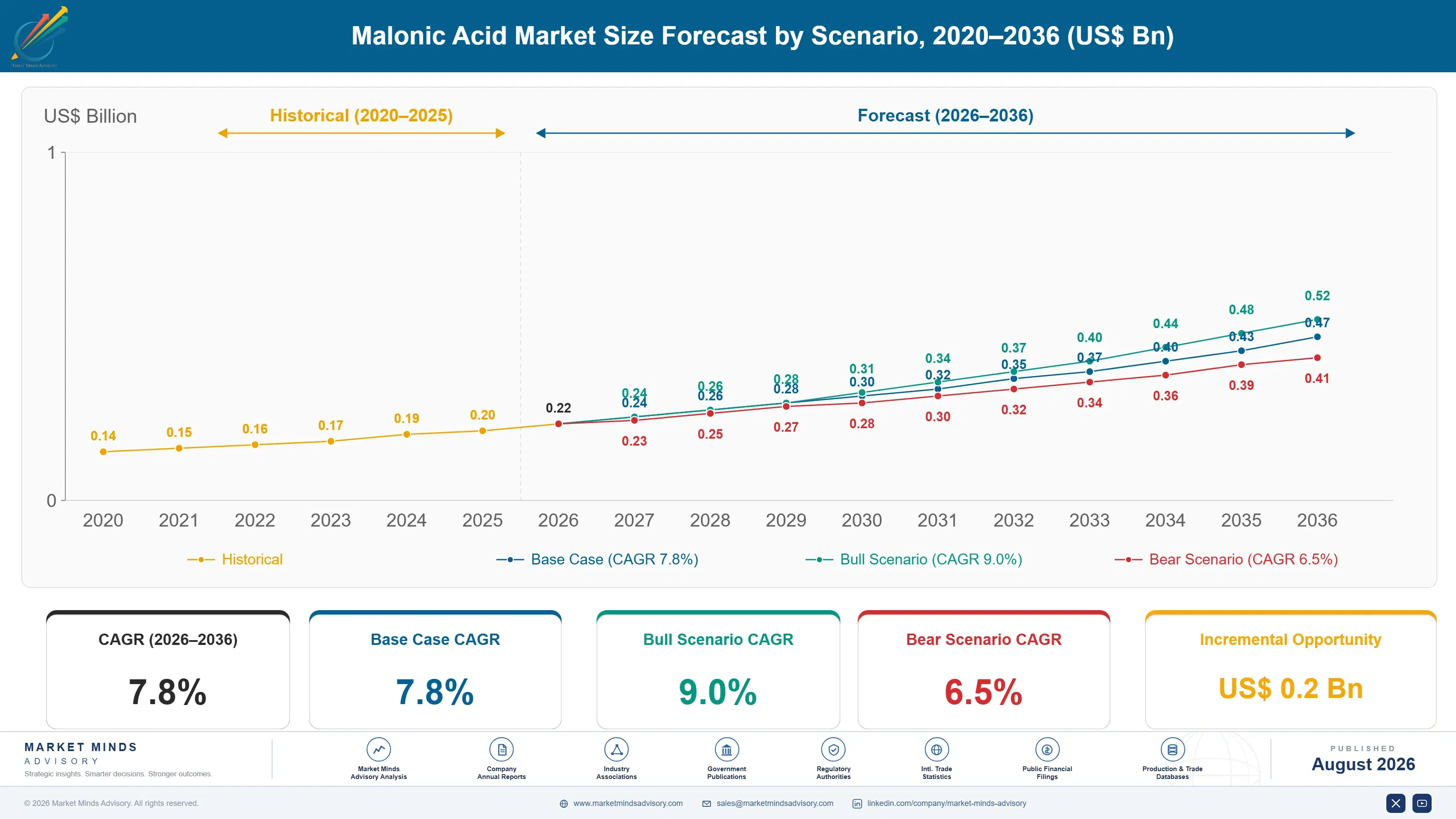
Growth ran at 6.6% between 2020 and 2025 and pharmaceutical intermediate demand carried most of it, particularly from Indian and Chinese active ingredient manufacture expanding through the period. Chinese chemical park consolidation following industrial safety incidents removed some cyanide handling capacity and tightened supply intermittently. Fermentation-derived material reached commercial availability during the period at modest volumes and considerably higher prices than the conventional route.
The 7.8% base case rests on three mechanisms. Pharmaceutical intermediate demand keeps expanding with Indian and Chinese active ingredient manufacture, which consumes 46% of volume and grows with global medicine production rather than with anything cyclical. Methylene malonate monomers keep taking adhesive and coating applications at 11.7% on room temperature cure that formulators cannot get elsewhere. And electronics chelation demand grows steadily with semiconductor and plating chemistry consumption. None of that depends on cyanide capacity.
The 9.0% bull case is fermentation cost falling to parity with the cyanide route, which would open production geographies and customer segments that currently refuse the conventional supply chain outright. The 6.5% bear case is further Chinese cyanide capacity closure without replacement, since 71% of global manufacturing sits there and no Western producer is positioned to fill a genuine shortfall.

A Century Of Cyanide Chemistry

The conventional route to malonic acid has not changed meaningfully in a hundred years. Chloroacetic acid reacts with sodium cyanide to give cyanoacetate, which hydrolyses to the malonate. It works, the yields are good and the economics excellent, and it requires storing sodium cyanide at industrial scale. That last requirement is the reason 71% of global capacity sits in China and the reason no Western company has built a new conventional plant in decades.
TOP-FIVE CONCENTRATION57%Combined position across global supply held by leading producers
CYANIDE ROUTE DEPENDENCE88%Portion of supply produced through the conventional cyanide pathway
PHARMACEUTICAL APPLICATION SHARE46%Portion of volume consumed in medicine and intermediate synthesis
FERMENTATION ROUTE YIELD62%Conversion achieved from sugar feedstock in biological production
FEEDSTOCK COST SHARE48%Portion of production cost attributable to purchased raw chemicals
CHINESE PRODUCTION SHARE71%Portion of global manufacturing capacity located within China
Fermentation changes the constraint rather than the chemistry. Engineered yeast converts sugar to malonate directly at around 62% yield with no cyanide involved at any point, which costs more per tonne today and can be permitted, insured and sited in places the conventional process cannot approach. Most commentary frames this as a sustainability story. The commercial argument is that biology is buildable where cyanide chemistry is not.
Demand sits mostly in pharmaceutical synthesis at 46% of volume, where malonate esters serve as versatile building blocks for barbiturates, B vitamins and a wide range of intermediates. Methylene malonate monomers are the genuinely new application, compounding at 11.7% on room temperature cure. Very few producers have commercialised it.
"Everybody discussing bio-based malonate talks about renewable carbon, and the actual value is that you can get a permit for it. A cyanide plant in Europe or North America is a conversation nobody wants to have with a regulator or an insurer twice."
Director, Fine Chemicals and Synthetic Intermediates Practice · MMA Chemicals and Materials Practice · August 2026

Market Trends

Fermentation routes compete on permitting rather than carbon

Engineered yeast converting sugar directly to malonate at around 62% yield removes sodium cyanide from the process entirely, and the industry keeps presenting that as a renewable feedstock argument. The commercially decisive point is different: a fermentation plant can be permitted, insured and sited near customers in Europe or North America, while a conventional cyanide plant realistically cannot be built in either place. That converts a cost disadvantage into a supply chain position for any buyer who wants Western-sourced material. Pharmaceutical customers concerned about supply concentration in a single geography value that considerably more than renewable carbon content.
Market Impact: Consumes 46% of total volume
Methylene malonates deliver cure speed nothing conventional matches

Methylene malonate monomers polymerise at room temperature without initiators, catalysts or heat, which gives adhesive and coating formulators a cure profile that acrylates and epoxies cannot reach without adding energy or chemistry. Growth at 11.7% follows applications where assembly speed decides throughput: electronics, medical device assembly and industrial bonding. The chemistry has taken longer to commercialise than its advocates expected, because monomer stability and shelf life are genuinely difficult to control. Producers who solved the stabilisation problem hold positions that the underlying malonate supply position does not by itself confer on anybody.
Market Impact: Requires trace purity below 10 ppb

Market Opportunities and Growth Drivers

Pharmaceutical intermediate demand expands with Asian active manufacture

Malonate esters are among the most versatile building blocks in synthetic organic chemistry, appearing in barbiturate synthesis, B vitamin production and a wide range of active pharmaceutical ingredient routes that have used them for decades. That application takes 46% of volume and grows with global medicine manufacture rather than with any cycle. Indian active ingredient production in particular expands at rates nothing else on this table approaches, and it buys intermediates on price and reliability rather than on origin. The demand is unglamorous, predictable and considerably larger than any of the newer applications attracting attention.
Market Impact: Affects 88% of supply route

Electronics chemistry consumes malonate chelation at rising specification

Malonate functions as a chelating agent in electroplating baths, chemical mechanical planarisation slurries and semiconductor cleaning chemistry, where it binds metal ions with the selectivity those processes demand. Semiconductor and advanced packaging investment across Taiwan, Korea, China and increasingly the United States consumes these chemistries in growing volume and at tightening purity specifications. Trace metal content requirements exclude producers whose process leaves residues, which narrows the qualified supply base considerably. The commercial attraction is that electronics buyers pay for specification rather than negotiating on tonnage, and qualification positions there last for years.
Market Impact: Costs above 62% yield economics

Market Restraints and Challenges

Cyanide handling capacity keeps closing without replacement

Chinese chemical park consolidation following industrial safety incidents has removed cyanide handling capacity across several provinces, and 88% of malonate supply depends on exactly that capability. The root cause is that sodium cyanide at industrial scale carries community, regulatory and insurance exposure that authorities are progressively less willing to accept anywhere. Commercially this produces intermittent supply tightness and price spikes that buyers cannot forecast or hedge. Producers are responding by consolidating into approved chemical parks with better containment, and a small number are developing fermentation capacity that avoids the issue entirely rather than managing it.
Market Impact: Achieves 62% fermentation yield

Fermentation costs remain above the conventional route

Biological production reaches around 62% conversion from sugar and carries fermentation, separation and purification costs that the cyanide route does not incur, which leaves bio-derived material priced meaningfully above conventional supply. The root cause is scale and yield together, since fermentation capacity operates far below the volumes petrochemical processes achieve and the conversion has room to improve. Commercially this confines bio-derived material to buyers paying for supply security or origin rather than to price-sensitive tonnage. Producers are pursuing strain improvement and larger fermenters, and the gap is closing at a rate that suggests parity is reachable.
Market Impact: Segment compounds at 11.7% annually
3 additional market trends, 4 additional growth drivers, and 2 additional restraints and challenges are covered in the full report. Contact sales@marketmindsadvisory.com to access the complete intelligence.

Segment CAGR and Growth Architecture

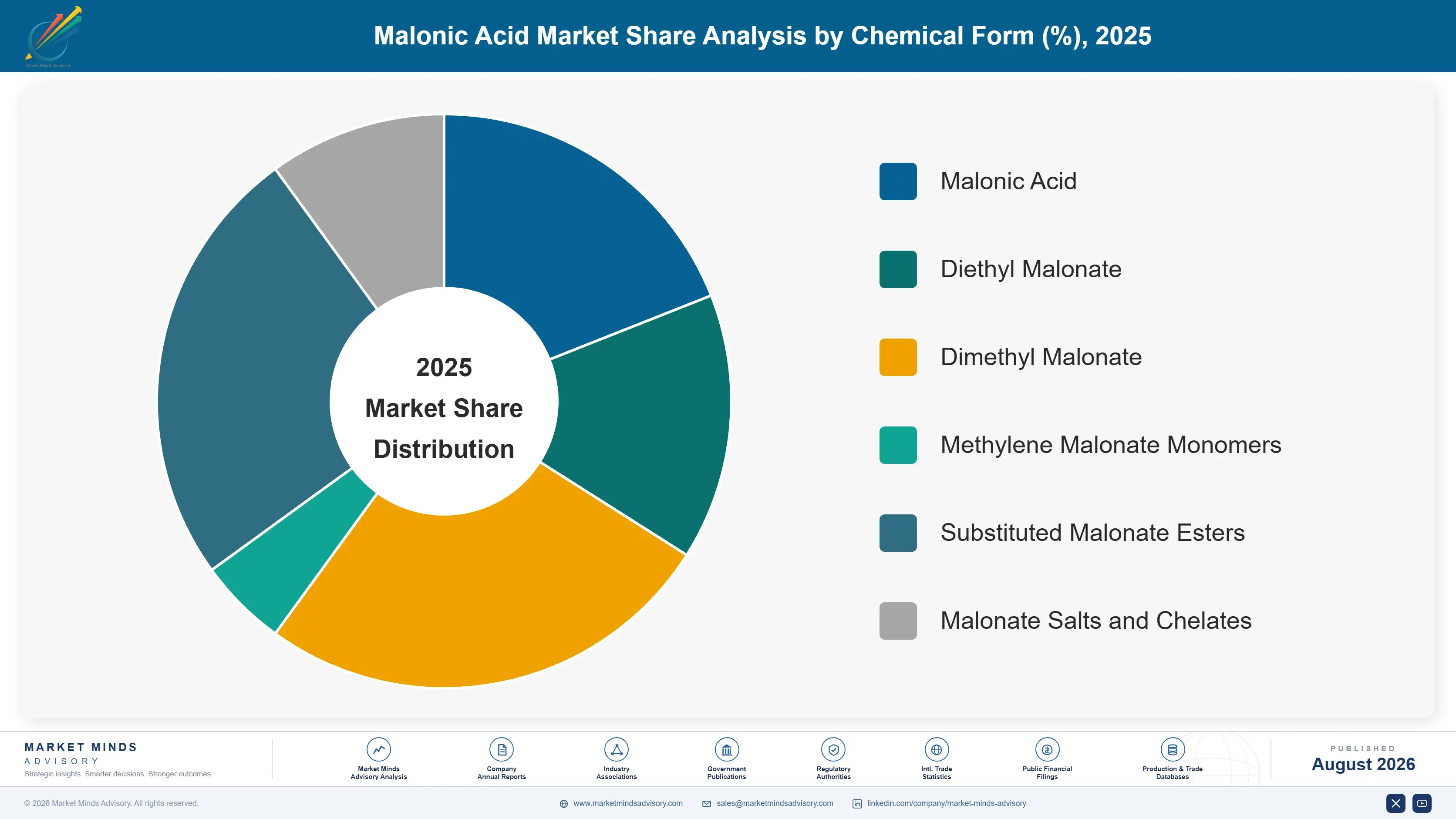
Products are classified here by chemical form, since that determines the synthesis it serves, the purity required and what a customer will pay per tonne. Production route, end industry and supply arrangement are handled separately in the framework, because a single ester reaches pharmaceutical, electronics and adhesive customers without any change to the molecule itself.
malonic-acid-market-trends-market-share-analysis-1787555404735

Methylene Malonate Monomers

Growing at 11.7%, half again the market rate, this is the genuinely new application built on old chemistry. Methylene malonates polymerise at room temperature without initiators, catalysts or applied heat, which gives adhesive and coating formulators a cure profile acrylates and epoxies cannot reach without adding energy or a second component. Applications concentrate where assembly speed decides throughput: electronics, medical device manufacture and industrial bonding lines. Commercialisation took considerably longer than its advocates promised, because monomer stability and shelf life are genuinely hard problems and premature polymerisation destroys the product. Producers who solved stabilisation hold positions that access to malonate feedstock does not confer on anybody by itself. Stabilisation is the whole business.
CAGR 11.7%

Substituted Malonate Esters

Substituted malonates carry alkyl or aryl groups on the central carbon and serve as tailored building blocks where the unsubstituted ester would require an extra synthetic step. Growth at 9.4% follows pharmaceutical route optimisation, since removing a step from an active ingredient synthesis saves yield, solvent, time and waste treatment simultaneously across every batch afterwards. The commercial position is unusually defensible because each substituted ester serves specific customer routes, which means qualification is per-molecule and per-customer rather than generic. Producers holding several such positions have a portfolio that competitors must attack one synthesis at a time rather than displacing at once. Customers rarely revisit a synthetic route once it works reliably, which makes each position unusually durable.
CAGR 9.4%
Full segment breakdown across 6 segments available in the complete report.

Regional Architecture and Country Demand Map

East Asia holds 30% of value because roughly 71% of global manufacturing capacity sits in China, where cyanide handling remains permissible at industrial scale. North America follows at 25% on pharmaceutical and electronics consumption rather than production. Production and consumption barely overlap here. That separation is the whole story.

North America

Consumption rather than production defines this region, with pharmaceutical intermediate demand, electronics chemistry and adhesive formulation all substantial while domestic conventional manufacturing is minimal. The reason is straightforward: nobody is going to permit a new industrial cyanide plant here, and the existing capacity was built under regulatory conditions that no longer apply anywhere. Fermentation production changes that arithmetic completely and the first commercial bio-derived capacity sits in this region for exactly that reason. Methylene malonate development is concentrated here as well. Growth at 8.6% is the second fastest on this table and reflects supply chain concerns driving buyers toward domestic sourcing at a premium. Premium pricing follows origin rather than any product difference here.
Share: 25% | CAGR: 8.6% (2026 to 2036)

Western Europe

European pharmaceutical and fine chemical manufacture consumes substantial malonate volume and produces very little of it, having exited conventional production progressively as cyanide handling requirements and community expectations tightened across the continent. Regulatory frameworks on hazardous substance handling are the strictest anywhere and effectively preclude any new conventional capacity. Buyers here have been among the most vocal about supply concentration risk, which favours fermentation-derived material despite the price premium. Speciality ester production for pharmaceutical routes remains meaningful. Growth at 6.2% is the weakest of the seven regions and reflects mature pharmaceutical manufacture rather than any lack of interest in alternative supply. Buyers here raise concentration risk more loudly than anywhere else does.
Share: 22% | CAGR: 6.2% (2026 to 2036)
Regional intelligence for 5 additional markets available in the complete report: East Asia, South Asia and Pacific, Latin America, Middle East and Africa, Eastern Europe. Contact sales@marketmindsadvisory.com.
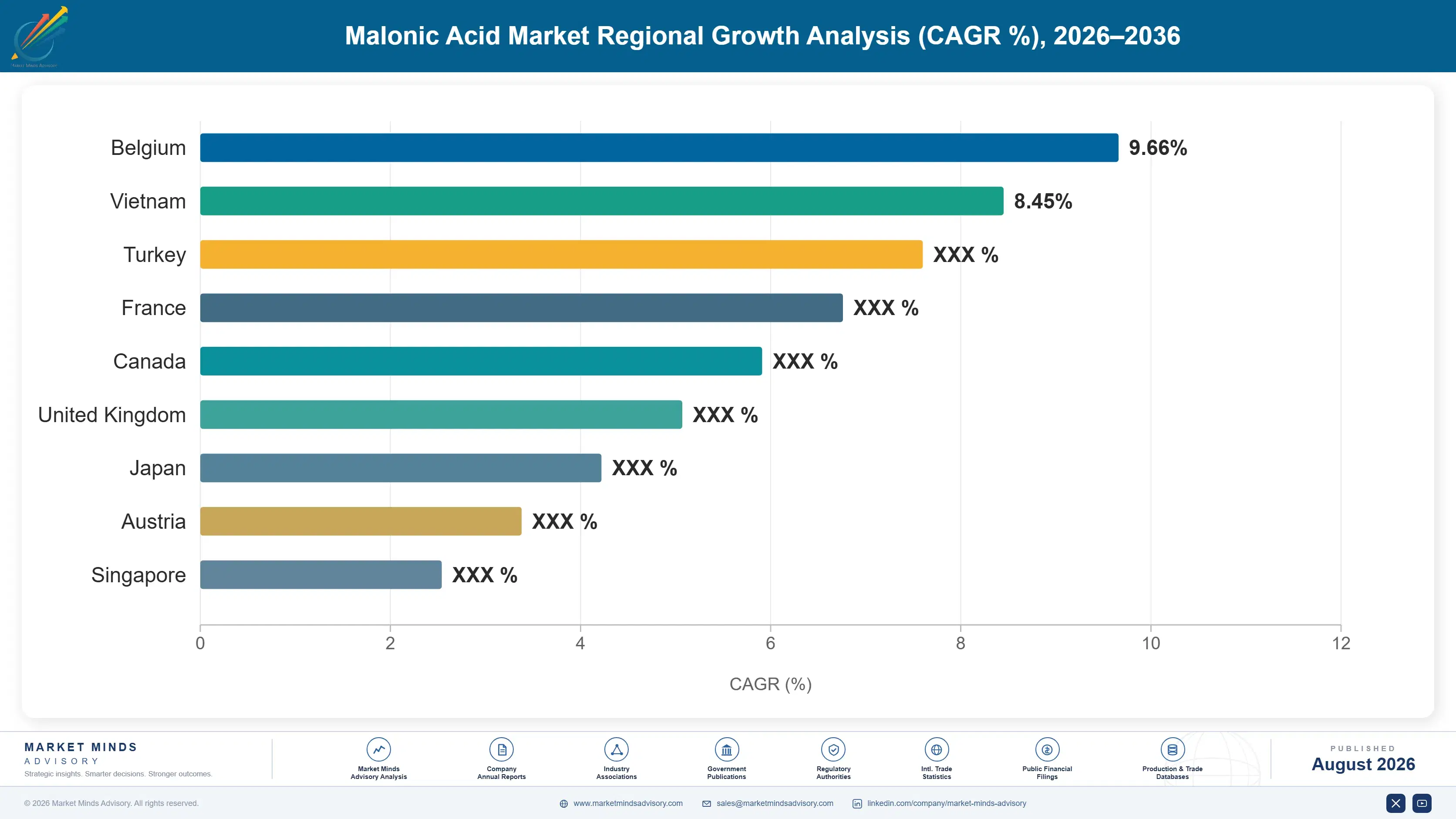
malonic-acid-market-trends-country-cagr-analysis-1787555405269

Where Malonate Margin Actually Sits

Four moves matter in a market where the dominant production route cannot be built anywhere new and the alternative costs more but can be permitted. Two are about the supply position that geography and regulation created, and two are about the applications paying for specification rather than tonnage. Competing on conventional route cost is not among them.

Sell fermentation supply on permitting, not renewability

Bio-derived malonate reaching around 62% yield costs more per tonne than the cyanide route and can be permitted, insured and built in Europe or North America where the conventional process realistically cannot. Producers marketing it as renewable carbon are competing against a sustainability budget that most fine chemical buyers barely have. Producers marketing it as Western-sourced supply free of single-geography concentration risk are addressing a concern pharmaceutical procurement functions raise in every review. The second argument justifies the premium and the first one does not, and almost everybody is making the first.
Market Impact: Justifies a premium above 62% yield cost economics

Build substituted ester positions one synthesis at a time

Substituted malonates serve specific customer routes where the unsubstituted ester would need an extra synthetic step, and removing a step saves yield, solvent, time and waste treatment on every batch thereafter. Growth at 9.4% follows pharmaceutical route optimisation directly. Each position qualifies per molecule and per customer, which means competitors must attack them individually rather than displacing a generic product. A producer holding several such positions has a portfolio that erodes far more slowly than any commodity ester business does, and the customers rarely revisit a working route. That durability is worth paying for.
Market Impact: Enters a segment now compounding at 9.4% annually

Qualify electronics grade before fabrication capacity arrives

Malonate chelation in plating baths, planarisation slurries and semiconductor cleaning demands trace metal content below 10 parts per billion, which excludes producers whose process leaves residues no purification economically removes. Semiconductor investment across Taiwan, Korea, China and the United States keeps expanding this consumption at tightening specification. Electronics buyers pay for specification rather than negotiating tonnage, and qualification positions last for years once established. Producers approaching new fabrication capacity before it starts running secure positions that competitors arriving afterwards cannot displace without a requalification nobody wants. Requalification deters every later entrant.
Market Impact: Meets a strict 10 ppb trace metal specification

Serve Indian pharmaceutical manufacture directly instead

Indian active ingredient production compounds at 10.8% and consumes malonate esters across a wide range of synthetic routes, while sourcing almost entirely from China with the concentration exposure that implies. Those manufacturers raise supply security concerns constantly and have very few alternatives available to them. Establishing direct supply, local stockholding or regional production addresses a genuine problem for a customer base growing faster than any other on this table. The commercial requirement is reliability and technical service rather than price leadership, which is a cheaper capability to build than a cost position would be.
Market Impact: Serves customer demand now growing at 10.8% annually

Who Controls the Margin Pool

Five producers hold 57% of malonate supply, measured on malonic acid equivalent tonnage at producer level, the basis used throughout this section. That concentration follows cyanide handling capability rather than scale or patents, since 88% of supply runs through a route requiring industrial sodium cyanide storage that few jurisdictions permit. The gap between leaders and everybody else is production geography rather than any chemistry advantage. Chemistry advantage explains almost none of it.
Competition runs on three dimensions. Production route and the permitting position it confers, which decides where a producer can operate at all. Purity capability, since electronics and pharmaceutical grades demand trace metal control that ordinary process chemistry does not deliver. And ester portfolio breadth across the substituted products customers qualify individually. Price competes hardest in commodity diethyl and dimethyl malonate.

Rankings shift as fermentation capacity comes online outside China, which redistributes supply on geography rather than on any product improvement. Chinese park consolidation keeps removing conventional capacity unpredictably. Methylene malonate positions depend on stabilisation know-how that malonate supply access does not confer, which has kept that segment separate from the base business. Stabilisation know-how travels separately.
malonic-acid-market-trends-company-positioning-matrix-1787555405818

Competitive Moat and Risk Dimensions

LONZA GROUP

Moat: Pharmaceutical qualification depth

Lonza sits inside pharmaceutical customer supply chains with documentation, audit history and regulatory filings that took years to establish and that a customer will not repeat casually. For an intermediate feeding a registered active ingredient route, changing supplier means regulatory variation work nobody undertakes to save a few percent. That embeddedness is worth considerably more than any manufacturing cost advantage.
LONZA GROUP

Risk: Conventional route exposure

Positions built on conventional production carry the same cyanide handling dependence as everybody else, and capacity keeps closing in the geography where most of it sits. A pharmaceutical supply relationship is only as good as the material behind it, and intermittent tightness damages exactly the reliability that justified the position. Fermentation-based competitors carry none of that particular exposure at all.
LYGOS

Moat: Fermentation route ownership

Lygos developed biological malonate production from sugar, which produces material with no cyanide anywhere in the process and can therefore be built in jurisdictions that would refuse a conventional plant outright. That is a supply chain position rather than a cost position, and it answers a concentration question competitors cannot address at any price.
LYGOS

Risk: Cost gap against incumbents

Fermentation at around 62% conversion carries cultivation, separation and purification costs the cyanide route never incurs, which leaves the material priced meaningfully above conventional supply. Buyers unmoved by origin or supply security simply pay less elsewhere. Closing that gap depends on strain improvement and larger fermenters, both of which take time and capital that incumbents do not need to spend.

Players Tracked

Prominent Players

Lonza Group
Tateyama Kasei
Lygos
Merck KGaA
Shanghai Yuanye Bio-Technology

Other Key Players

Trimer Technologies
Tokyo Chemical Industry
Thermo Fisher Scientific
Jiangsu Hualun Chemical
Anhui Zhongke Duling
Hubei Xinjing New Material
Chongqing Chuandong Chemical
Weifang Hongyuan Chemical
Nippon Shokubai
Daicel Corporation
Solvay
Evonik Industries
Otto Chemie
Hangzhou Keying Chem
Taizhou Volsen Chemical

Recent Developments

MARCH 2025

Lygos expanded fermentation-derived malonate production capacity

Lygos increased biological malonate production capacity, targeting pharmaceutical and speciality customers seeking supply outside the concentrated conventional manufacturing base. The expansion was organic capital investment rather than any joint venture or acquisition, and it addresses supply chain concentration rather than any product performance requirement. Buyers had asked repeatedly.
Signal: Capacity is being built for geography rather than for cost, which is the correct reading of what buyers actually want
AUGUST 2025

Chinese authorities consolidated cyanide handling into approved parks

Chinese provincial authorities required cyanide-handling chemical production to consolidate into approved industrial parks with enhanced containment, closing capacity that could not meet the standard. This was a regulatory requirement rather than any commercial transaction, and it affects the route producing most global malonate supply. Replacement capacity has not appeared.
Signal: Conventional capacity keeps leaving without replacement anywhere, which puts a floor under prices that demand alone would not
DECEMBER 2025

An adhesive formulator qualified methylene malonate for electronics assembly

An industrial adhesive formulator completed qualification of methylene malonate chemistry for electronics assembly bonding, where room temperature cure without applied heat suits temperature-sensitive components. This was a formulation qualification rather than any commercial transaction between the parties involved. Assembly line throughput drove that decision entirely.
Signal: Room temperature cure is winning applications on throughput rather than on chemistry preference, which is a durable argument

What Moves Producer Cost

Purchased raw chemicals account for around 48% of conventional production cost, principally chloroacetic acid and sodium cyanide, both bought from a limited number of suppliers. Energy for reaction, hydrolysis and distillation is meaningful. Waste treatment costs are unusually high because cyanide-containing streams require destruction rather than ordinary handling. Fermentation routes substitute sugar feedstock and fermentation energy for that entire cost structure.
Chloroacetic acid and cyanide pricing moved sharply through 2021 and 2022 on chlorine and energy costs, and IEA data show European industrial gas far above Asian levels throughout the period. Lonza recorded raw material and energy cost pressure across its operations in its Annual Report 2022. Producers holding annual pharmaceutical supply contracts absorbed most of the movement, since a customer running a registered synthesis route cannot switch supplier when input costs rise.

Waste treatment is the cost line that separates production geographies more than raw materials do. Destroying cyanide-bearing effluent to Western regulatory standards costs multiples of what it costs where standards are looser, and that difference alone explains part of why capacity concentrated where it did. Fermentation producers avoid the cost entirely and pay instead for energy and separation.
malonic-acid-market-trends-cost-volatility-analysis-1787555406022

Contract chloroacetic acid supply across multiple producers

Chloroacetic acid comes from a limited supplier base and an interruption stops conventional malonate production entirely rather than merely raising cost. Qualifying two or three sources takes commercial effort rather than capital and delivers continuity worth considerably more than any single-source discount. Producers who discovered this during recent interruptions restructured their purchasing afterwards. Exposure here is availability rather than price.

Index pharmaceutical contracts to published chlorine benchmarks

Feedstock at 48% of cost prices on chlorine and energy that move for reasons entirely unconnected to pharmaceutical demand, and annual fixed contracts against that transfer the exposure to the producer. Indexing to published benchmarks with quarterly reset removes it cleanly. Pharmaceutical buyers resist because tender pricing is fixed, which makes it a real negotiation.

Price waste treatment into any Western production case

Destroying cyanide-bearing effluent to Western regulatory standards costs multiples of the equivalent elsewhere, and that difference alone has driven capacity concentration more than labour or energy ever did. Any case for returning conventional production westward that omits it will not survive a permit application. Fermentation routes avoid the line entirely, which is most of their case.

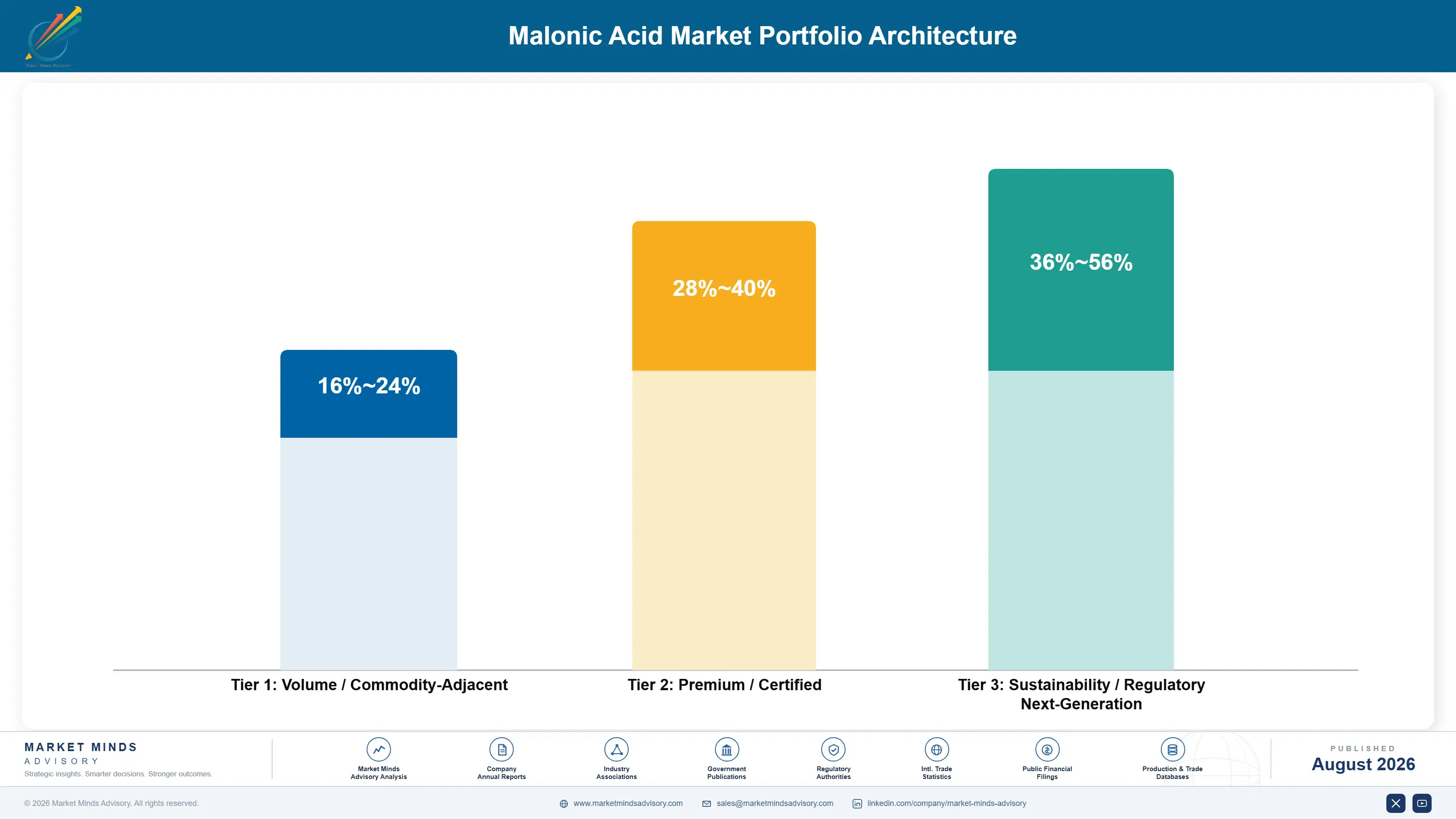
Portfolio Architecture for Margin Defence

Margin here tracks qualification depth rather than production efficiency, because the chemistry is old and well understood and many producers can make an acceptable ester. Commodity diethyl and dimethyl malonate run at gross margins in the high teens against Chinese pricing that Western producers cannot approach. Pharmaceutical and substituted esters run considerably better, since each position qualifies per customer and per synthesis. Electronics grade and methylene malonate monomers run higher again, on purity and stabilisation capability respectively.
The tension is that commodity esters carry the tonnage while qualified positions carry the margin, and building qualified positions requires customer-specific development work that generates nothing until it succeeds. Producers organised for volume production find that development effort competing against throughput for the same technical staff. Several have discovered the commodity schedule consuming the chemistry attention that customer qualification needed, which shows up as lost development programmes rather than as any visible failure.

High-value pools sit in substituted esters, electronics grade purity and methylene malonate monomers. None of the three is defended by malonate production capability alone. Access to feedstock defends very little in a market where the chemistry has been public for a century.

Volume / Commodity-Adjacent

Commodity diethyl and dimethyl malonate sold into general synthesis against Chinese pricing that reflects both scale and looser waste treatment standards. The eight-point range separates producers with integrated chloroacetic acid positions from those buying every input on merchant terms.
Gross Margin: 16%-24%

Premium / Certified

Pharmaceutical grade material and substituted esters qualified into specific customer synthetic routes where changing supplier means regulatory variation work. The twelve-point spread reflects how deeply a position sits inside a registered route rather than any manufacturing difference.
Gross Margin: 28%-40%

Sustainability / Regulatory / Next-Generation

Electronics grade purity below 10 parts per billion trace metals, methylene malonate monomers and fermentation-derived supply. The twenty-point range is wide because each prices against a different scarcity and none benchmarks against conventional ester pricing at all.
Gross Margin: 36%-56%
malonic-acid-market-trends-portfolio-architecture-1787555406547

High-value Sub-segments and Strategic Watch-out

Fermentation-Derived Supply

Costs more per tonne at around 62% conversion and can be permitted and built where cyanide chemistry cannot, which is a supply chain position rather than a cost one. Producers selling it as renewable carbon are making comfortably the weaker argument available. Permitting is the real product here.
Gross Margin: 34%-52%

Substituted Ester Positions

Compounding at 9.4% and defended per molecule and per customer, since removing a synthetic step saves yield, solvent and waste on every batch afterwards. Competitors must attack these individually, which erodes a portfolio very slowly indeed. Removing a step is worth more than any price concession.
Gross Margin: 32%-44%

Commodity Malonate Esters

The tonnage that fills reactors, competed on Chinese pricing that reflects scale and waste treatment standards Western producers cannot match. Manage it for utilisation rather than for margin, because margin was never genuinely available in it. Utilisation is the only lever left, and Chinese producers hold the cost position permanently.
Gross Margin: 16%-24%

Methylene Malonate Monomers

Growing at 11.7% on room temperature cure without initiators, and defended by stabilisation know-how that access to malonate feedstock confers on nobody. Monomer shelf life is the hard problem, and very few producers have solved it properly. Premature polymerisation destroys the product, which stops most producers.
Gross Margin: 38%-56%

How Malonate Demand Renews

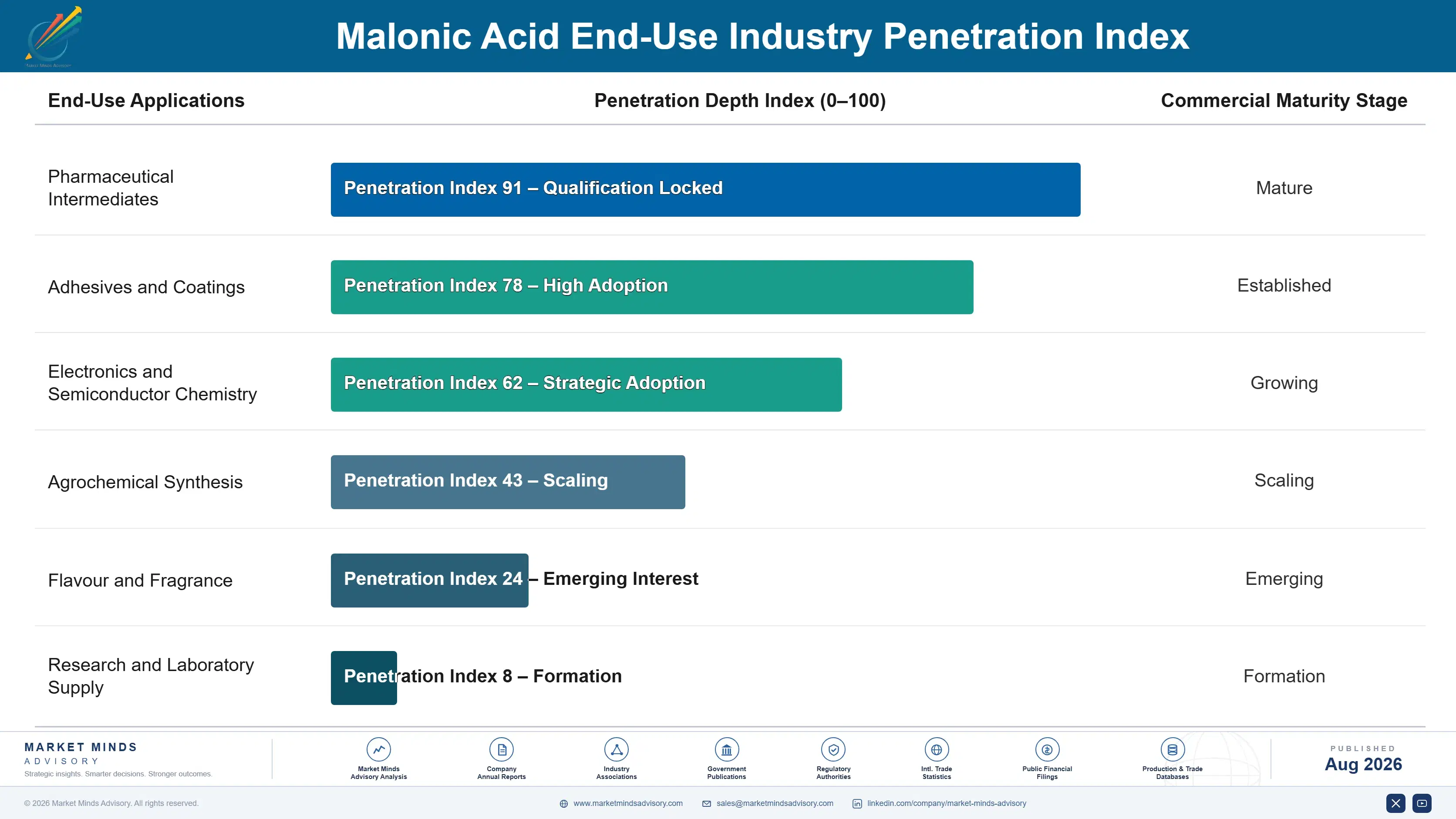
Demand renews through the synthetic route rather than through any purchasing cycle. Once a malonate ester is written into a registered pharmaceutical process, it ships continuously for as long as that medicine is manufactured, and changing supplier means regulatory variation filings nobody undertakes to save a small percentage. The renewal decision was made when the route was developed, often years before commercial production, and it is effectively permanent afterwards. Nothing reopens it afterwards.
Stickiness varies enormously across applications. Pharmaceutical positions inside registered routes are the stickiest thing in fine chemicals, since the regulatory cost of change exceeds any plausible price saving. Electronics qualifications hold nearly as well on requalification cost. Commodity ester supply into general synthesis and research changes hands on price at every order, because nothing at all protects it.

The buyer profile is shifting toward procurement functions with concerns chemistry cannot answer. Malonate was bought by process chemists comparing purity and price. It increasingly involves supply chain risk functions asking where material originates and whether a single geography holding 71% of capacity is acceptable, which is a question no specification sheet addresses. Chemists cannot answer it either.
malonic-acid-market-trends-end-use-penetration-index-1787555407044

Where To Place The Bet

These are among the four positions where our research anticipates prominent divergence between winners and laggards over the coming forecast period. Each is grounded in the demand model, the regulatory perimeter, and the announced capacity pipeline.
01 / FERMENTATION POSITIONING ARGUMENT

Sell the permit, not the renewable carbon

Bio-derived malonate reaching around 62% conversion from sugar costs more per tonne than the cyanide route and can be permitted, insured and sited in Europe or North America where a conventional plant realistically cannot be built at all. Producers presenting this as a renewable feedstock story are competing for sustainability budgets that most fine chemical buyers do not genuinely have. Producers presenting it as supply outside a geography holding 71% of capacity are answering a question pharmaceutical procurement raises in every single review.
02 / REGISTERED ROUTE EMBEDDING

Get written into the synthesis, then stay

A malonate ester specified inside a registered pharmaceutical process ships continuously for as long as that medicine is manufactured, because changing supplier requires regulatory variation filings that nobody undertakes to save a small percentage on an intermediate. Substituted esters strengthen that position further, since each one serves a specific route where the unsubstituted product would need an extra step. Competitors must attack such a portfolio one synthesis at a time rather than displacing a generic product, which erodes positions extraordinarily slowly.
03 / ELECTRONICS PURITY QUALIFICATION

Reach the fabs before they start running

Malonate chelation in plating baths, planarisation slurries and semiconductor cleaning demands trace metal content below 10 parts per billion, which excludes producers whose process leaves residues that purification cannot economically remove afterwards. Semiconductor investment across Taiwan, Korea, China and the United States keeps expanding this consumption at specifications that keep tightening rather than settling. Electronics buyers pay for specification instead of negotiating tonnage, and qualification positions established before a fabrication plant starts running are extremely difficult for anybody to displace later on.
04 / INDIAN SUPPLY DEVELOPMENT

Solve the concentration problem Indian manufacturers face

Indian active pharmaceutical ingredient manufacture compounds at 10.8% and consumes malonate esters across a wide range of synthetic routes while sourcing almost entirely from Chinese capacity, which leaves it exposed to precisely the concentration risk every procurement function now discusses. Those manufacturers raise the concern regularly and have very few practical alternatives available to them at present. Establishing direct supply, regional stockholding or local production answers a genuine and unsolved problem for the fastest-growing customer base anywhere on this table.

Engagement Snapshot From the Field

A live engagement with an industry participant carrying material or product regulatory and market exposure ahead of a defining policy shift, showing how our research translates into a defensible multi-year portfolio strategy.
MARKET MINDS ADVISORY · CLIENT ENGAGEMENT SUMMARY
Malonic Acid Producer Strategic Portfolio Review and Transition Roadmap 2026·Investment Scenario on Malonic Acid Exposure Evaluation 2025-26
CLIENT PROFILE
A European fine chemical producer with annual revenue around EUR 64 million (client-reported, unverified by MMA), supplying malonate esters and related intermediates to pharmaceutical and speciality customers. Production depended entirely on imported malonic acid from Chinese suppliers. The business held several pharmaceutical qualifications and no electronics grade capability at all. Waste treatment capacity was limited.
STRATEGIC CHALLENGE
Two supply interruptions in eighteen months had caused delivery failures to pharmaceutical customers (client-reported, unverified by MMA), and management proposed building conventional malonic acid capacity to secure supply. Nobody had established whether a cyanide-handling plant could realistically be permitted at the client's site, which made the entire proposal conditional on an answer no one had sought.
MMA APPROACH
MMA assessed permitting feasibility for conventional cyanide-based production at the client's location before any economic modelling, since consent rather than economics was the binding question. Fermentation-derived supply availability and pricing were established through the expert interview programme. Customer willingness to pay for European-origin material was tested directly, and electronics grade purity requirements were benchmarked against the client's existing process capability.
KEY FINDINGS
  1. Conventional cyanide-based production was assessed as effectively unpermittable at the client's site under current regulatory and community conditions, which ended the proposal before any economics mattered.
  2. Three of the client's pharmaceutical customers indicated willingness to pay a meaningful premium for European-origin material, which nobody in the business had ever asked them about.
  3. Fermentation-derived malonic acid was available at a premium the client's customers had already signalled they would absorb, converting a cost problem into a positioning one.
  4. Existing purification capability sat within reach of electronics grade specification, requiring modest investment rather than the new plant management had been contemplating.
CLIENT PROFILE
A European fine chemical producer with annual revenue around EUR 64 million (client-reported, unverified by MMA), supplying malonate esters and related intermediates to pharmaceutical and speciality customers. Production depended entirely on imported malonic acid from Chinese suppliers. The business held several pharmaceutical qualifications and no electronics grade capability at all. Waste treatment capacity was limited.
STRATEGIC CHALLENGE
Two supply interruptions in eighteen months had caused delivery failures to pharmaceutical customers (client-reported, unverified by MMA), and management proposed building conventional malonic acid capacity to secure supply. Nobody had established whether a cyanide-handling plant could realistically be permitted at the client's site, which made the entire proposal conditional on an answer no one had sought.
MMA APPROACH
MMA assessed permitting feasibility for conventional cyanide-based production at the client's location before any economic modelling, since consent rather than economics was the binding question. Fermentation-derived supply availability and pricing were established through the expert interview programme. Customer willingness to pay for European-origin material was tested directly, and electronics grade purity requirements were benchmarked against the client's existing process capability.
KEY FINDINGS
  1. Conventional cyanide-based production was assessed as effectively unpermittable at the client's site under current regulatory and community conditions, which ended the proposal before any economics mattered.
  2. Three of the client's pharmaceutical customers indicated willingness to pay a meaningful premium for European-origin material, which nobody in the business had ever asked them about.
  3. Fermentation-derived malonic acid was available at a premium the client's customers had already signalled they would absorb, converting a cost problem into a positioning one.
  4. Existing purification capability sat within reach of electronics grade specification, requiring modest investment rather than the new plant management had been contemplating.
RECOMMENDED STRATEGY
Phase 1: Phase one: abandon the conventional capacity proposal entirely and contract fermentation-derived malonic acid supply as the security answer instead of building. Phase 2: Phase two: reposition commercially around European-origin supply chain security with the three customers who indicated willingness to pay for it. Phase 3: Phase three: upgrade purification toward electronics grade specification and approach semiconductor chemistry formulators directly rather than working through chemical distributors.
OUTCOME
The conventional plant proposal was abandoned and fermentation supply contracted from 2026. European-origin positioning is agreed with two of the three customers at improved pricing. Purification upgrade is under way, and the client reports no further delivery failures since the supply change (client-reported, unverified by MMA).

Frequently Asked Questions

Foundational context covering the market sizes, CAGR, scope, country, region and competition that inform every finding below. This section is provided to cover basics and most often pre-purchase conversations, answered from the MMA Primary Research Dataset.

What is the current size of the Malonic Acid Market?

The market was valued at USD 0.21 billion in 2025, rising to an estimated USD 0.23 billion in 2026. East Asia holds the largest regional share at 30% of value.

How large will the Malonic Acid Market be by 2036?

MMA forecasts USD 0.48 billion by 2036 under the base case, an expansion multiple of 2.12 times the 2026 value. That represents USD 0.25 billion of incremental value.

What is the CAGR for the Malonic Acid Market 2026 to 2036?

The base case runs at 7.8% compound annual growth between 2026 and 2036, with a bull case at 9.0% and a bear case at 6.5%. Historical growth from 2020 to 2025 was 6.6%.

Which segment is growing fastest?

Methylene malonate monomers lead at 11.7%, half again the market rate, on room temperature cure without initiators or applied heat. Substituted esters follow at 9.4%.

Who are the major companies in the Malonic Acid Market?

Lonza, Tateyama Kasei, Lygos, Merck KGaA and Shanghai Yuanye hold 57% between them. Cyanide handling capability rather than manufacturing scale sustains most of those positions.

Which country is growing fastest?

India leads at 10.8%, driven by active pharmaceutical ingredient manufacture that uses malonate esters across many synthetic routes. Almost all of that supply currently arrives from China.

Report Segmentation Architecture

The full report scope spans multiple orthogonal segmentation dimensions, with cross-tabulated demand data provided for each dimension pair. Coverage extends further to regional breakdowns, trend trajectories, and the competitive detail needed to support segment-level decision-making.

By Chemical Form

  • Malonic Acid
  • Diethyl Malonate
  • Dimethyl Malonate
  • Methylene Malonate Monomers
  • Substituted Malonate Esters
  • Malonate Salts and Chelates

By End-Use Industry

  • Pharmaceutical Intermediates
  • Adhesives and Coatings
  • Electronics and Semiconductor Chemistry
  • Agrochemical Synthesis
  • Flavour and Fragrance
  • Research and Laboratory Supply

By Supply Arrangement

  • Direct Pharmaceutical Supply
  • Custom Synthesis Contract
  • Chemical Distributor Channel
  • Research Reagent Supply
  • Bulk Export Trading

By Region

  • North America
  • Western Europe
  • East Asia
  • South Asia and Pacific
  • Latin America
  • Middle East and Africa
  • Eastern Europe

Scope, Methodology, and Coverage

Every figure in this report is reproducible from documented input assumptions. The scope below maps the historical period, the forecast horizon, the segmentation dimensions, and the countries covered, alongside the underlying primary and qualitative methodology.
Historical Period
2020 to 2025
Forecast Period
2026 to 2036
Base Year
2025 (USD billions; MMA Primary Research Dataset, August 2026)
Market Definition
The market comprises malonic acid and its principal derivatives supplied for chemical synthesis across pharmaceutical, adhesive, electronics, agrochemical and flavour applications, covering malonic acid, diethyl malonate, dimethyl malonate, methylene malonate monomers, substituted malonate esters, and malonate salts and chelates, produced through both conventional cyanide-based and fermentation routes. Value is measured at producer level on malonic acid equivalent tonnage. Other dicarboxylic acids, cyanoacetic and chloroacetic acid sold as products, finished pharmaceutical actives, formulated adhesives and coatings, and downstream polymer products fall outside scope.
Quantitative Units
USD billions (current prices); thousand tonnes malonic acid equivalent supplied annually; USD per kilogram by chemical form
Segmentation Dimensions
By Chemical Form; By End-Use Industry; By Supply Arrangement; By Region
Regions Covered
North America, Western Europe, East Asia, South Asia and Pacific, Latin America, Middle East and Africa, Eastern Europe
Countries Covered
China, Japan, South Korea, Taiwan, India, Singapore, Thailand, Australia, United States, Canada, Mexico, Germany, Switzerland, France, United Kingdom, Netherlands, Italy, Spain, Ireland, Belgium, Poland, Hungary, Slovenia, Czechia, Brazil, Argentina, Colombia, Israel, United Arab Emirates, South Africa
Key Companies Profiled
Lonza Group, Tateyama Kasei, Lygos, Merck KGaA, Shanghai Yuanye Bio-Technology, Trimer Technologies, Tokyo Chemical Industry, Thermo Fisher Scientific, Jiangsu Hualun Chemical, Anhui Zhongke Duling, Hubei Xinjing New Material, Chongqing Chuandong Chemical, Weifang Hongyuan Chemical, Nippon Shokubai, Daicel Corporation, Solvay, Evonik Industries, Otto Chemie, Hangzhou Keying Chem, Taizhou Volsen Chemical
Quantitative Methodology
Primary survey, n=3,800 respondents, Q4 2025, six countries; demand-side model with trade association cross-validation
Qualitative Methodology
47 expert interviews, Q4 2025; applied to validate demand model assumptions, identify emerging dynamics, and assess competitive positioning
Report Format
PDF and XLSX data workbook (Word format preview document)
Publisher
Market Minds Advisory
Report Code
MMA-2026-CHM-613
Published
August 2026
Contact
sales@marketmindsadvisory.com | www.marketmindsadvisory.com

Purchase the full Malonic Acid Market Report (2026 to 2036).

The full report sizes the global malonic acid market to 2036 across six chemical forms and seven regions, measured on malonic acid equivalent tonnage at producer level. It treats production route permitting rather than cost as the governing competitive variable and quantifies exposure to cyanide-handling capacity closure. Competitive analysis covers 20 participants evaluated on tonnage supplied, with moat and risk assessment for the two leaders. Fermentation-derived supply is assessed on where it can be built rather than on renewable carbon content. Four quantified revenue levers close the analysis.
Six-form segment sizing with segment-level growth rates
Seven-region share and growth breakdown to 2036
Twenty-participant competitive map on one tonnage basis
Cyanide route permitting exposure quantified by production geography
Fermentation economics compared against conventional route costs
Four quantified revenue levers with commercial impact ranges

Built For The People Who Decide

From boardroom strategy to bench-side execution, this report is read cover-to-cover by leaders shaping the next decade of their industry, turning demand scenarios, market dynamics and valuation benchmarks into decisions.
CXOs/ Presidents/ VPs/ Managers
M&A and Corporate Development
Strategy Teams and R&D Heads
Procurement and Product Directors
Regulatory and Compliance Leaders
Investor Relations and Equity Analysts