Market Minds Advisory
Magnetoresistive Sensors Market

Magnetoresistive Sensors Market: Magnetoresistive Sensors Market. TMR Adoption Reshapes Automotive Sensing Sourcing Economics.

Electric-vehicle position sensing demand and industrial current-monitoring buildout collide with legacy Hall-effect sensor technology, forcing OEMs to weigh sensitivity accuracy against integration cost from a manufacturing base concentrated among established East Asian producers.

Lead Analyst

Published

September 2026

Make Smarter Decisions with Customized Research Insights

Request a free sample report and evaluate market opportunities, growth trends, and competitive dynamics relevant to your business needs.

2025 MARKET VALUE$3.9BMarket Size 2025
2036 FORECAST VALUE$10.1BBase Case , 2026 to 2036
CAGR 2026 TO 20369.0 %Bull 10.3% / Bear 7.7%
INCREMENTAL OPPORTUNITY$5.8BNet 10- year value creation
EXPANSION MULTIPLE2.37x2036 value over 2026 base
Strategic Levers
M&A Pipeline
Regional Outlook
Country Rankings
Competitive Intelligence
Segmental Deep-dive
Call-Us : 91 93563 13602

Executive Snapshot and Market Trajectory.

Magnetoresistive sensor demand keeps climbing steadily as OEMs weigh sensitivity accuracy against integration cost, rewarding manufacturers with proven TMR fabrication scale and engineering depth over legacy AMR-only producers lacking comparable precision breadth across every sensing application, pricing tier, and design-win category tracked closely worldwide today.
Automotive position and speed sensing applications grow fastest as EV and ADAS programs chase higher accuracy and reduced power consumption, while industrial current and motor control sensing follows closely behind on rising demand for automation reliability across commercial and industrial platforms worldwide today. East Asia accounts for the largest share of global value, reflecting concentrated semiconductor fabrication capacity and automotive-electronics manufacturing density that keeps sensor production physically anchored near existing supply infrastructure and allied networks.
A moderately concentrated field of semiconductor manufacturers competes for automotive design-win contracts, industrial supply agreements, and consumer-electronics licensing revenue, with genuine TMR fabrication depth increasingly deciding which manufacturers win design-in loyalty over legacy AMR producers across nearly every regulated sensing category served today across the wider industry. Sensitivity depth is now the more durable force reshaping category economics across the entire industry today and its allied markets.
Market Definition
This report covers magnetoresistive sensors, AMR, GMR, and TMR formats used in automotive, industrial, and consumer-electronics sensing applications worldwide. It excludes standalone Hall-effect sensor products and general-purpose accelerometer devices.
Base Year Value
$3.9B in 2025 (MMA Primary Research Dataset, September 2026)
Forecast Period
2026 to 2036, eleven discrete annual values
CAGR
9.0% base case. Bull 10.3%. Bear 7.7%.
Fastest Growth Segment
Automotive Position and Speed Sensing: 13.0% CAGR
Fastest Growth Country
India: 14.5% CAGR
Fastest Growth Region
South Asia and Pacific: 11.5% CAGR
Largest Region
East Asia: 36% of 2025 global value
Market Leaders
Honeywell, Infineon, Allegro MicroSystems, TDK, NVE Corporation. Source: MMA Analysis based on company annual reports and semiconductor manufacturer filings.
Primary Survey
n=3,800 procurement and R&D decision-makers, Q4 2025, six countries
Methodology
Demand-side build-up, cross-validated against public data, 47 expert interviews

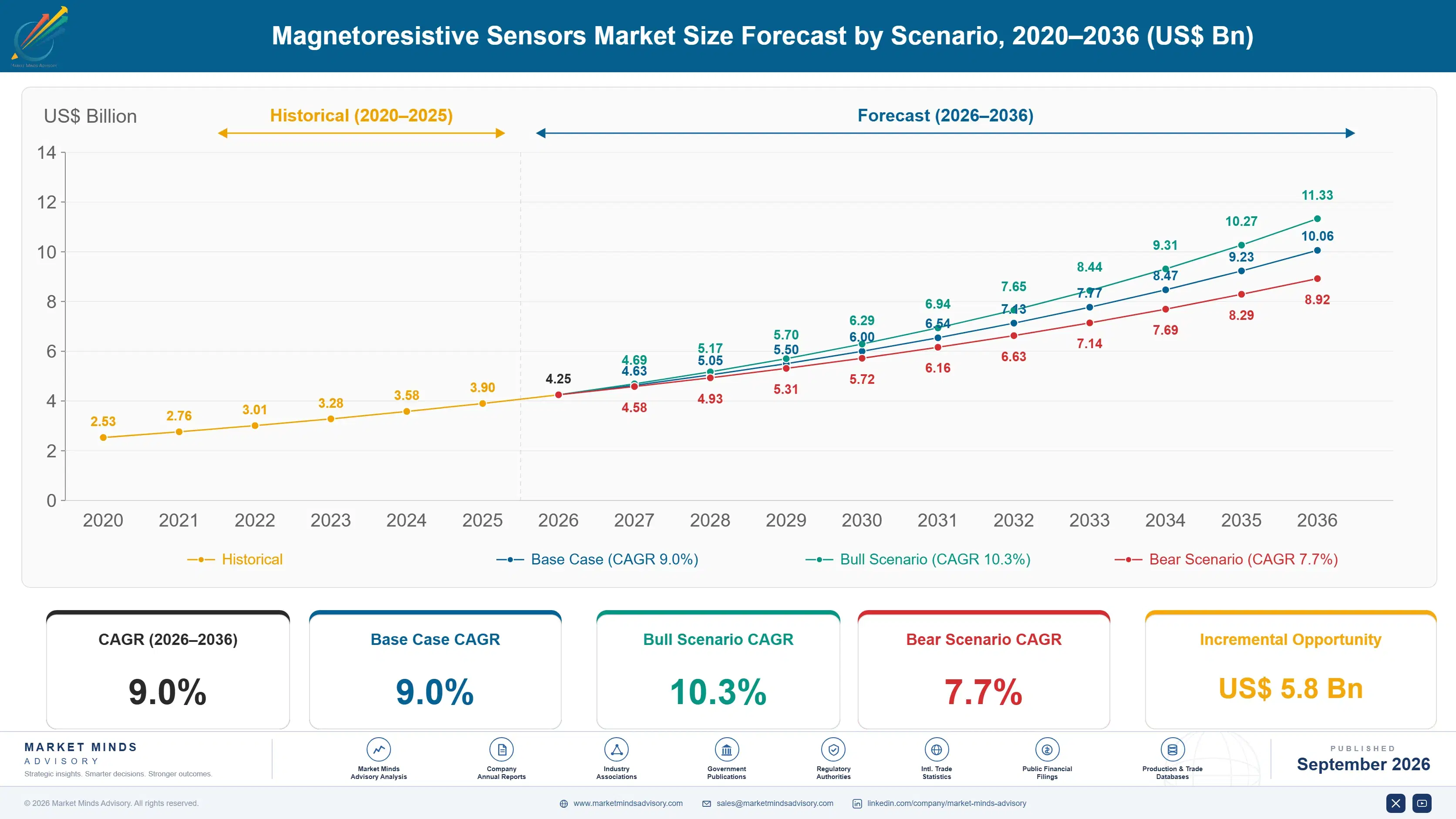
Magnetoresistive Sensors Market Forecast Scenarios

magnetoresistive-sensors-market-size-forecast-scenario-1788420517857
Demand grew steadily from 2020 to 2025 as EV position-sensing buildout broadened and manufacturers scaled dedicated TMR procurement across most major electronics markets worldwide, with industrial current-sensing deployment accelerating meaningfully through the final two years of the historical window as sensitivity accuracy became a genuine design requirement across nearly every sensing category served. Historical growth held near 8.1% annually.
The base case assumes continued expansion driven by three mechanisms: OEMs specifying TMR and extreme-sensitivity capability across new automotive design-win launches worldwide, industrial buyers in developing categories still adopting standard AMR sensors at meaningful scale, and current-sensing applications that raise per-unit contract value even as total legacy AMR-only volume growth stays comparatively modest across most mature distribution channels and their established manufacturer partner relationships built over years of steady investment.
The bull case centers on faster-than-expected TMR adoption requiring genuine sensitivity across additional sensing categories worldwide. The bear case rests on wafer-capacity pressure and automotive-demand slowdown reducing base sensor volume, even as TMR and industrial-current coverage continues commanding steady pricing across most served product segments, electronics categories, and pricing tiers tracked closely in this report today.

Demand Thesis Behind the TMR Shift

Three forces converge on this market today. OEMs increasingly specify TMR and extreme-sensitivity capability, removing legacy AMR-only manufacturers from consideration on premium automotive contracts regardless of channel mix. Industrial buyers keep expanding standard adoption across developing categories still building current-sensing infrastructure. Automotive applications raise per-unit contract value even as buyers demand stronger accuracy data from every manufacturer engaged across the entire design lifecycle and renewal cycle.
MARKET CONCENTRATIONCR5 54%top five manufacturers hold a dominant combined market share overall
AVERAGE SELLING PRICEUSD 1.20 per unitpremium TMR devices command a meaningfully higher pricing tier overall
TOP PRODUCING COUNTRYChina 24%concentrated wafer fabrication and automotive-electronics assembly drives dominant supply
TMR ATTACH RATE31% of new automotive designshigh-sensitivity architecture attachment keeps expanding steadily across major OEMs
REPLACEMENT CYCLE LENGTH10 yearstypical component replacement interval running near conventional electronics standards
WAFER COST SHARE36% of input costspecialized magnetic-tunnel-junction substrate dependency remains meaningfully high overall
The commercial character sits closer to a precision-and-trust business than a simple component trade, since genuine TMR depth and sensitivity speed increasingly determine which manufacturers win designer and OEM loyalty more than pure production breadth alone ever did historically. That dynamic keeps fabrication power concentrated among manufacturers with genuine wafer-engineering depth rather than pure marketing scale or shelf presence alone.
The next decade turns on how quickly TMR adoption broadens across additional sensing categories, and on whether wafer-capacity cycles meaningfully constrain new sensor volume growth overall. Both outcomes shape how aggressively manufacturers invest in industrial-current capacity versus conventional AMR production across every major electronics market this report tracks and its many served product segments and design-win tiers worldwide today.
"Precision credibility has become the real differentiator in this category, not production breadth alone. Manufacturers that treated sensors as an interchangeable commodity are now discovering OEMs genuinely will not compromise on documented TMR depth."
Director, Automotive Electronics and Semiconductor Sensors Practice · MMA Technology Practice · September 2026

Market Trends

TMR Capability Reshapes Premium Automotive Sensor Design Worldwide

Manufacturers increasingly reformulate premium sensor lines toward genuine TMR and extreme-sensitivity capability rather than conventional AMR design, since precision credibility genuinely requires the magnetic-tunnel-junction integration older standard formats cannot provide across nearly every premium regulated automotive application tracked in this report. Roughly 25% of new sensor launches now feature documented TMR or advanced extreme-sensitivity construction, up meaningfully from a decade ago when standard AMR formats alone remained the unquestioned default across nearly every sensing category. This shift raises average selling price while locking OEMs into manufacturer relationships smaller regional producers cannot easily contest.
Market Impact: Broadened across 18% more categories
Electric Vehicle Programs Drive Global Sensor Demand

OEMs and sensor manufacturers increasingly track electric-vehicle trends to differentiate their component decisions, since documented position-sensing capability has become a genuine design-win signal across nearly every premium automotive licensing category tracked especially closely in this report today and well beyond current program scope. EV concepts now influence an estimated 22% of new global sensor launches, up meaningfully from a decade ago when AMR-only designs alone remained the unquestioned default across most terminal categories. This shift creates a durable higher-margin component stream tied directly to precision credibility rather than conventional AMR volume alone.
Market Impact: Targets 16% higher sensitivity coverage

Market Opportunities and Growth Drivers

Rising EV Production Expands Magnetoresistive Sensor Demand

Escalating EV production across major automotive markets keeps expanding demand for advanced magnetoresistive sensor specification, since documented position-sensing and power-efficiency performance increasingly represents a mandatory design consideration rather than an optional convenience choice across nearly every premium automotive and licensing category tracked in this report. Production-driven specification broadened across roughly 18% more automotive categories over the past three years according to industry disclosures, outpacing growth in conventional AMR-only segments considerably across every channel. This production-driven shift, more than any single design innovation, continues pulling category demand upward across every major electronics market this report covers.
Market Impact: Cuts launch volume by 6%

Rising Industrial Automation Investment Expands Global Demand

Rising industrial-automation infrastructure investment across developing regional manufacturing programs keeps expanding demand for dedicated sensor consumption, treating documented current-sensing transparency as a genuine reliability requirement rather than a purely price-driven purchasing decision across every applicable product category, sensor type, and distribution channel worldwide today, tomorrow, and well beyond entirely. Several major manufacturers have announced fabrication spending targeting 16% or more additional sensitivity coverage within the next five years, according to public industry disclosures issued regularly. This automation-driven growth creates durable demand that conventional legacy AMR systems alone cannot fully replace.
Market Impact: Compresses margin on 21% of volume

Market Restraints and Challenges

Specialized Wafer Supply Constraints Limit Production Growth

Persistent magnetic-tunnel-junction wafer and specialized thin-film deposition supply constraints across major semiconductor fabrication facilities reduce product launch velocity regardless of underlying demand or sensitivity testing capability. The root cause is that specialized wafer sourcing has not scaled alongside OEM demand, so qualification cycles create genuine launch volatility that design innovation alone cannot fully offset. The commercial impact falls hardest on manufacturers with concentrated exposure to specific wafer categories facing near-term sourcing constraints and reduced launch schedules today. Manufacturers are responding by diversifying across AMR, TMR, and hybrid tiers to reduce single-source risk considerably.
Market Impact: Covers 25% of new launches

Commodity AMR Sensors Face Persistent Price Erosion

A wide population of legacy AMR-only sensor manufacturers compete for commodity volume largely on unit price, since conventional AMR formulations carry minimal differentiation and few switching costs for budget-conscious buyers purchasing non-discretionary sensing replacements. The root cause is that basic AMR access has become widely accessible and commoditized across most developing and mature distribution channels alike. The impact shows up as compressed margins across roughly 21% of unit volume still using conventional mass-distributed formats without TMR upgrade. Leading manufacturers are responding by concentrating investment in TMR and automotive-sensing categories where technology barriers remain durable.
Market Impact: Influences 22% of global launches
4 additional market trends, 3 additional growth drivers, and 2 additional restraints and challenges are covered in the full report. Contact sales@marketmindsadvisory.com to access the complete intelligence.

Segment CAGR and Growth Architecture

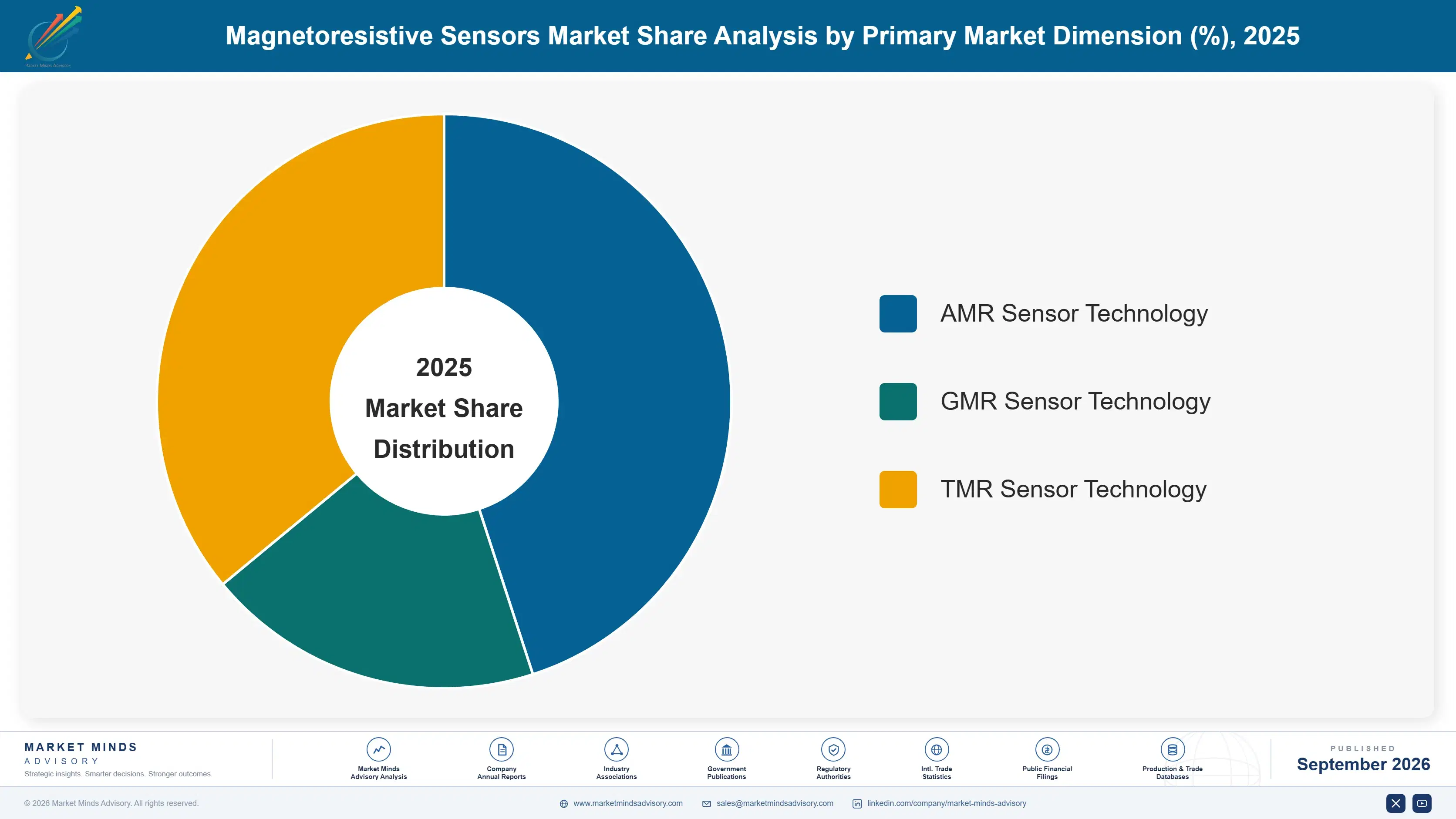
The market segments by end-use application, the dimension that determines both sensitivity economics and design-integration pathway most directly across every OEM decision made across the wider industry today, rather than by sensing technology alone, which cuts evenly across every application category regardless of the specific manufacturer, region, or contract decision made anywhere worldwide today.
magnetoresistive-sensors-market-market-share-analysis-1788420518411

Automotive Position and Speed Sensing

Automotive position and speed sensing represents the fastest-growing segment, expanding well above the overall market rate as EV and ADAS programs specify documented TMR precision to reflect genuine accuracy and power-efficiency demand against conventional AMR alternatives across nearly every premium regulated category served today worldwide. Pricing runs meaningfully above conventional AMR formats, reflecting the specialized magnetic-tunnel-junction integration and sensitivity-testing investment smaller regional manufacturers cannot easily replicate without substantial capital commitment and engineering expertise. Adoption has expanded rapidly across automotive specification programs, an application reserved mainly for specialized premium vehicles a decade ago before precision demand broadened its scope worldwide considerably today across the industry. Honeywell and Infineon both supply this segment at growing volume today.
CAGR 13.0%

Industrial Current and Motor Control Sensing

Industrial current and motor control sensing forms the second-fastest-growing segment, driven by rising expanding demand for proven reliability accuracy that increasingly extends across nearly every major commercial distribution channel and specialty procurement category served today across most developed and developing electronics markets alike worldwide today and tomorrow across many years ahead entirely. Major industrial buyers now require documented current-sensing certification and reliability-transparency data across nearly every new specification decision, creating demand that extends meaningfully beyond conventional legacy volume alone into genuine automation-grade territory across every major producing region, product category, and format available. This segment's underlying growth gives it considerably more durable momentum than categories dependent on marketing demand alone.
CAGR 11.5%
Full segment breakdown across 6 segments available in the complete report.

Regional Architecture and Country Demand Map

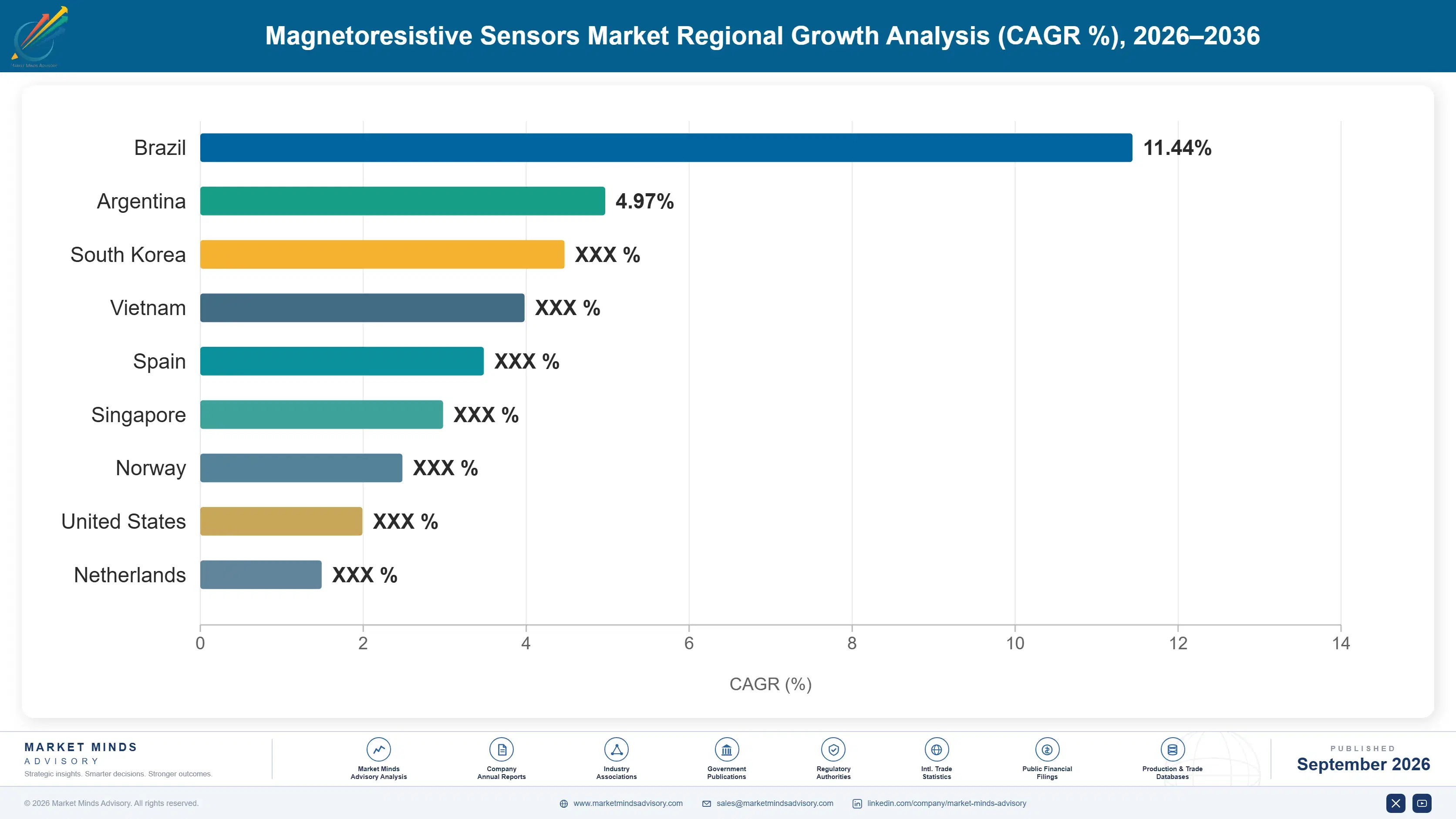
East Asia leads decisively given concentrated wafer fabrication capacity and automotive-electronics manufacturing density anchored near production, while North America follows on automotive design-win concentration and engineering depth, and South Asia and Pacific grows fastest as rising Indian automotive-electronics investment expands demand, engineering depth, and category breadth.

North America

The United States' established automotive design-win concentration and Canadian industrial sensing demand keep North America within its 22 to 32% band at 24% of value, near the middle of that typical range given the region's genuine role as a design and specification market rather than a wafer-fabrication market for this category, since Honeywell and Allegro MicroSystems together operate several of the largest single sensor design programs under development anywhere in the region today across the wider industry. NVE Corporation and Everspin Technologies both operate meaningful engineering capacity serving domestic and allied OEMs directly and reliably. Mexican demand contributes additional volume tied to nearshoring structures. Growth of 9.0% tracks continued adoption regionally and nationwide.
Share: 24% | CAGR: 9.0% (2026 to 2036)

Western Europe

Germany's established automotive engineering base and France's concentrated industrial sensing research capacity keep Western Europe within its 18 to 26% band at 18% of value, at the floor of that typical range given the region's genuine role as a design-headquarters market rather than a wafer-fabrication-volume market for this category, since Germany and France together operate several of the largest single sensor design programs under development anywhere in the region today across the wider industry. Infineon and Sensitec both operate meaningful engineering capacity serving European and allied OEMs directly and reliably. Nordic demand contributes meaningful additional volume tied to established regulatory-driven structures. Growth of 7.5% tracks continued adoption regionally and nationwide.
Share: 18% | CAGR: 7.5% (2026 to 2036)
Regional intelligence for 5 additional markets available in the complete report: East Asia, South Asia and Pacific, Latin America, Middle East and Africa, Eastern Europe. Contact sales@marketmindsadvisory.com.
magnetoresistive-sensors-market-country-cagr-analysis-1788420518913

Where Magnetoresistive Sensor Margins Concentrate

Margin expansion in this market comes less from raw shipment volume growth and more from shifting mix toward TMR and industrial-current products, where engineering precision and sensitivity-testing barriers support meaningfully higher pricing than conventional AMR manufacturing ever commanded, alongside several operational levers manufacturers control directly regardless of overall wafer cost cycle volatility across this coming decade ahead.

Shift Product Mix Toward TMR Formats

Manufacturers that reallocate design investment toward documented TMR and extreme-sensitivity circuitry capture pricing that runs 25% to 33% above conventional AMR manufacturing, since engineering precision and sensitivity-testing investment carry genuine operational barriers that smaller regional manufacturers cannot easily replicate at comparable scale or wafer sourcing access efficiently. This mix shift also positions manufacturers favorably against tightening wafer sourcing constraints that will only grow stricter through the coming decade across every major electronics market this report tracks. Manufacturers that move early on TMR formats secure long-term OEM relationships before competitors catch up meaningfully.
Market Impact: Commands a 25% to 33% pricing premium overall

Expand Long-Term Automotive Design-Win Supply Agreements

Locking in multi-year framework agreements with major automotive OEM customers converts what would otherwise be individual unit sale volume into predictable annuity-like renewal revenue, typically covering 45% to 55% of a manufacturer's total product base under agreements running two years or longer at a considerable stretch. These agreements reduce distribution cost volatility and give manufacturers visibility needed to justify TMR and industrial-current investment with genuine confidence. OEM buyers increasingly favor manufacturers offering integrated precision documentation alongside products, since it simplifies their own certification planning considerably across every reporting period they must satisfy fully.
Market Impact: Covers 45% to 55% of total product base

Expand Design Consultation and Sensitivity Verification Services

Manufacturers offering dedicated design consultation and documented sensitivity verification services alongside base product supply capture incremental fee revenue worth roughly 5% to 9% of total category value on top of standard unit sale revenue earned separately across every TMR and AMR product and market. This service layer deepens OEM relationships considerably beyond a pure commodity transaction, since OEMs rely on manufacturer expertise to navigate certification without risking operational complaint. It also raises switching costs for OEMs already invested in a manufacturer's proprietary sensitivity-testing protocols across multiple channel relationships built over time.
Market Impact: Adds 5% to 9% of annual verification revenue

Consolidate Wafer Fabrication Through Internal Investment

Manufacturers that acquire or build dedicated wafer fabrication capacity rather than depending on third-party foundry providers capture the manufacturing margin themselves, worth an estimated 6% to 10% additional gross margin versus licensing switching technology from third-party providers at prevailing revenue-share arrangements routinely and consistently. This vertical integration also secures product continuity during periods when third-party fabrication capacity tightens against rising OEM demand volumes. Scale players pursuing this path gain a durable cost advantage over manufacturers still dependent entirely on external technology relationships and revenue-share arrangements across every channel served worldwide.
Market Impact: Captures 6% to 10% additional gross margin annually

Who Controls the Margin Pool

The competitive field is moderately concentrated, with a CR5 near 54% reflecting a solid leadership tier among five scaled semiconductor manufacturers and a longer tail of regional and specialist producers competing mainly on precision credibility and OEM-trust depth across most served product segments. Honeywell and Infineon lead on combined fabrication scale and TMR depth, while challengers below them lack comparable worldwide OEM relationships built over many years of steady investment.
Current competitive activity centers on three dimensions: TMR investment, industrial-current service expansion, and long-term multi-year OEM framework agreements locking in design-win volume. Leading manufacturers are also investing in dedicated wafer-fabrication facility development to deepen customer relationships beyond commodity product sale, while mid-tier manufacturers increasingly pursue regional distribution partnerships to close the technology gap against larger, better-capitalized rivals across every served channel and world region.

Emerging pressure comes from Chinese challenger manufacturers scaling fabrication transparency faster than expected, threatening to erode the historical advantage held by established American and European incumbents. Rankings shift most where TMR and industrial-current demand accelerates fastest, since manufacturers without documented precision depth risk losing repeat OEM loyalty to rivals that invested earlier and now hold a durable fabrication and testing advantage worldwide.
magnetoresistive-sensors-market-company-positioning-matrix-1788420519441

Competitive Moat and Risk Dimensions

HONEYWELL

Moat: Deep Fabrication and OEM Depth

Honeywell operates dedicated fabrication and sensitivity-testing infrastructure across nearly every major global OEM qualification program, giving it distribution depth and OEM trust that smaller regional manufacturers cannot replicate without years of comparable capital investment and careful relationship building across multiple product categories, platforms, and formats.
HONEYWELL

Risk: Legacy AMR Cost Exposure

Honeywell's substantial legacy exposure to conventional AMR product lines means its financial performance tracks wafer price competition risk more directly than diversified competitors with broader TMR revenue, an exposure that smaller pure-play manufacturers concentrating entirely on premium categories carry to a much lesser degree currently.
INFINEON

Moat: Deep OEM Loyalty Network

Infineon holds long-standing OEM and distributor relationships across nearly every major global distribution and automotive retail and specialty program category, generating recurring volume that gives it demand visibility and genuine negotiating advantage most standalone manufacturers, dependent on shorter distribution-cycle relationships, simply cannot match consistently. This relationship depth took years of consistent investment to build.
INFINEON

Risk: Slower Emerging-Market Category Buildout

Infineon's historical focus on premium European formulations left it with less dedicated emerging-market category capacity than some established competitors worldwide and their broader networks, a gap that constrains its ability to capture the fastest-growing budget-conscious segment of this market as quickly as rivals already positioned there.

Players Tracked

Prominent Players

Honeywell
Infineon
Allegro MicroSystems
TDK
NVE Corporation

Other Key Players

MagnaChip Semiconductor
Melexis
Asahi Kasei Microdevices
Sensitec
Crocus Technology
MultiDimension Technology
Voltafield Technology
STMicroelectronics
Bosch Sensortec
ams OSRAM
Diodes Incorporated
ROHM Semiconductor
MEMSIC
Everspin Technologies
QST Corporation

Recent Developments

MAY 2025

Honeywell Opens TMR Fabrication Center in Plymouth

Honeywell opened a new TMR fabrication center in Plymouth, expanding wafer capacity to accelerate next-generation automotive sensing development for global OEM customers across major regional facilities. The facility adds meaningful dedicated capacity focused entirely on precision development. The site employs 50 technical staff working closely together.
Signal: Organic capacity expansion signaling continued investment in fabrication depth ahead of accelerating OEM demand nationwide and across allied markets.
OCTOBER 2025

Infineon Signs Multi-Year North American Automotive Framework Agreement

Infineon signed a multi-year framework agreement with a major North American automotive OEM covering product volume across several key TMR sensor platforms and distribution hubs serving international markets today. The agreement locks in predictable long-term shelf volume for both parties involved over multiple years ahead and renewal cycles.
Signal: Framework agreement, not an acquisition, reflecting the industry's broader shift toward long-term OEM volume commitments regionally and internationally.
FEBRUARY 2026

Allegro MicroSystems Acquires Current Sensing Technology Provider in Manchester

Allegro MicroSystems acquired a regional current-sensing technology provider in Manchester, adding certified processing capacity that secures precision-driven demand for its TMR product lines across the region and well beyond it entirely today. The acquisition strengthens Allegro MicroSystems' regional engineering position considerably going forward. Terms were not disclosed.
Signal: Acquisition of current-sensing technology signals accelerating consolidation among leading manufacturers pursuing TMR lines internally and at scale.

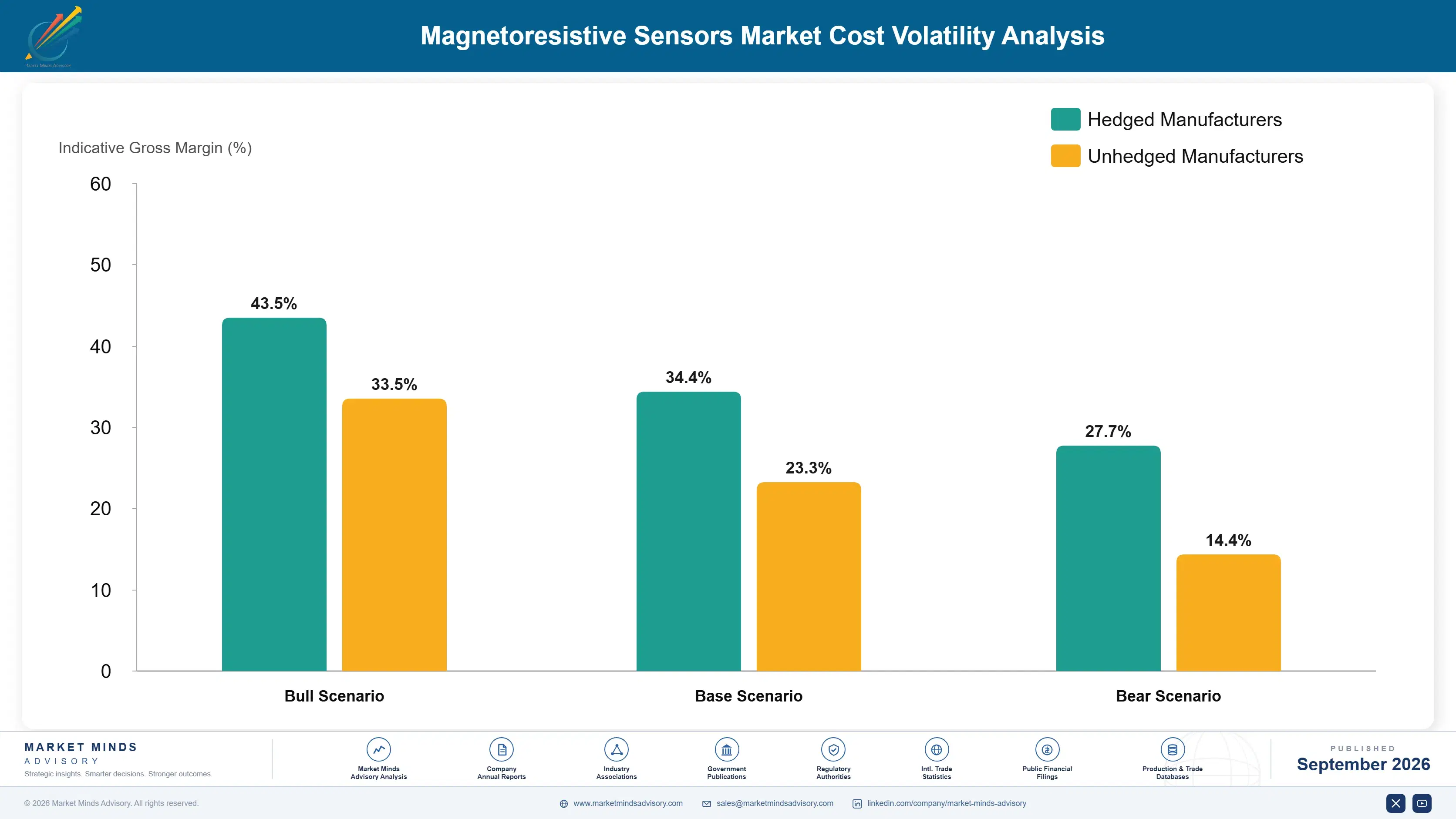
Magnetic Tunnel Junction Wafer Cost Volatility

Magnetic tunnel junction substrate wafers and specialized thin-film deposition materials together represent roughly 36% of production cost for a typical sensor manufacturer operating at scale, with substrates sourced primarily from concentrated East Asian and North American crystal-growth supply chains, while deposition capacity depends on foundry capacity concentrated among a smaller number of specialized semiconductor suppliers, leaving smaller manufacturers exposed to genuine allocation constraints.
Substrate price volatility through 2024 pushed wafer-input costs up by roughly 15% within a single quarter, according to Honeywell Annual Report 2024, forcing manufacturers without hedging programs or flexible reserve strategies to absorb margin compression they could not immediately pass through to OEM customers under existing fixed-price supply contracts signed months earlier under considerably calmer supply conditions than manufacturers faced by the year's closing weeks and beyond.

This volatility disadvantages smaller regional manufacturers lacking the reserve scale to negotiate favorable substrate supply contracts or the balance sheet depth to hedge deposition-component exposure through actuarial reserve positions available to larger competitors. Scale players with integrated direct crystal-growth operations feel considerably less exposure, since captive supply relationships track internally negotiated pricing rather than open market swings, giving them a cost advantage over peers.
magnetoresistive-sensors-market-cost-volatility-analysis-1788420519636

Diversify Substrate Supply Chain Relationships Broadly

Manufacturers increasingly qualify multiple magnetic-tunnel-junction substrate supply chain partnerships across different regions rather than depending on a single East Asian source, reducing exposure to any one supplier's pricing swings or capacity disruptions during periods of genuine crystal-growth manufacturing volatility that regularly disrupts smaller, less diversified competitors across the wider industry considerably over time and geography.

Expand In-House Deposition Manufacturing Capacity

Building dedicated thin-film deposition manufacturing and finishing capacity reduces dependence on open-market third-party licensing pricing entirely, giving manufacturers more predictable operating costs tied to internal development rather than component benchmark price movements over time, while also meaningfully strengthening overall product consistency during periods of tightening OEM demand across every served market, channel, and region worldwide.

Negotiate Supply Cost Pass-Through Clauses

Supply agreements increasingly include indexed price adjustment clauses that pass a defined share of substrate and deposition component cost swings through to OEM customers automatically, protecting manufacturer margins during periods of sharp cost movement across every served market while still carefully preserving the underlying OEM relationship and long-term shelf volume commitments negotiated well in advance.

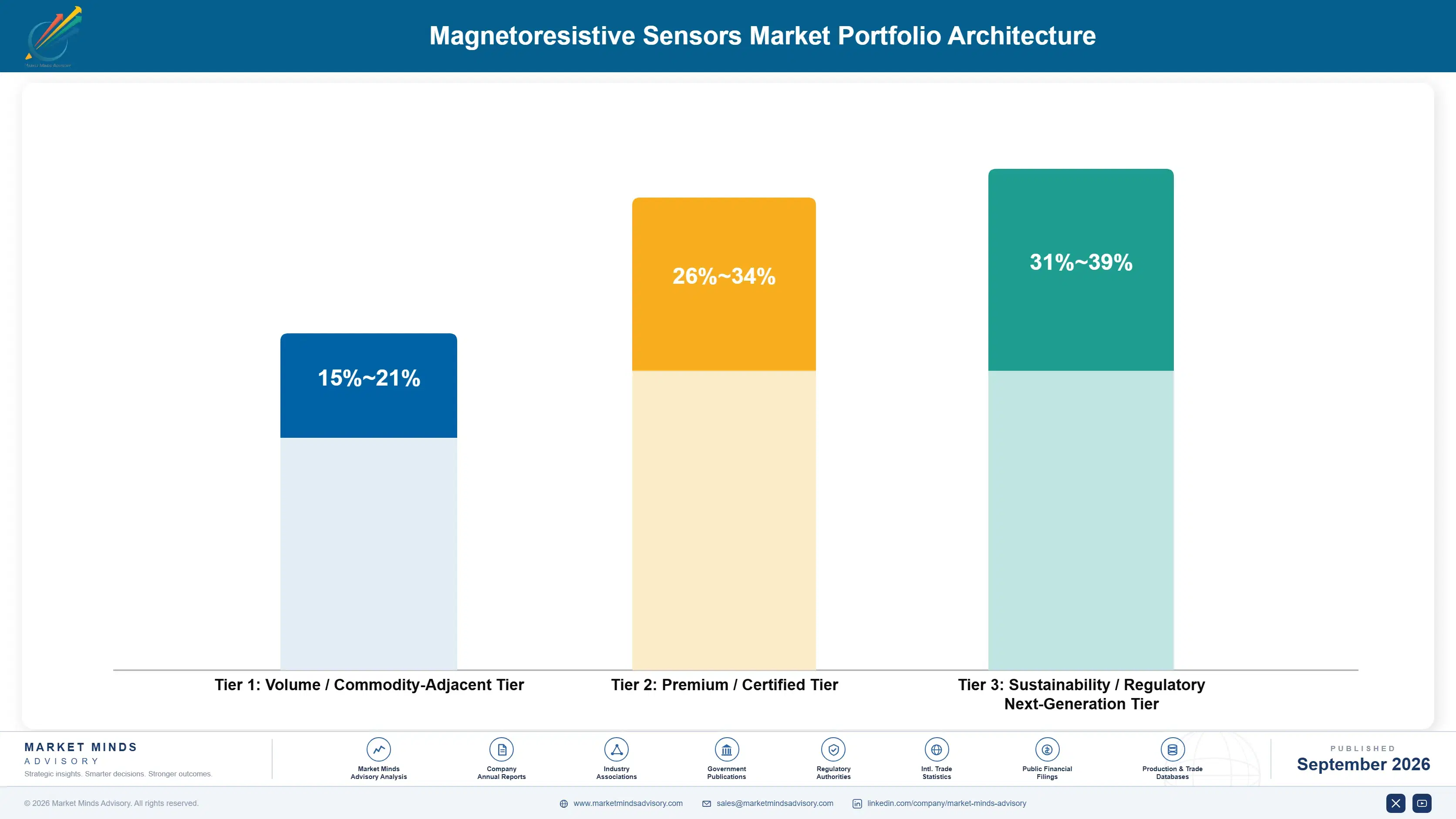
Portfolio Architecture for Margin Defence

Three tiers structure this market's economics from bottom to top. Volume and commodity-adjacent AMR sensors carry thin margins under intense price competition from widely accessible production capacity, premium hybrid formulations command meaningfully better economics through TMR and testing barriers, and next-generation extreme-sensitivity formats sit at the very top, still scaling but already commanding the strongest pricing of any tier tracked closely in this report and across the wider industry.
The volume versus premium tension defines manufacturer strategy today across the entire industry: chasing commodity AMR volume keeps production running at meaningful scale but caps margin upside permanently and predictably, while premium TMR contracts require substantial upfront capital in wafer research and testing development before the considerably better economics materialize meaningfully for any given manufacturer pursuing that particular strategic path forward into the coming decade ahead.

High-value margin pools concentrate overwhelmingly in TMR and extreme-sensitivity formulations, where documented precision depth and accuracy both support genuine pricing power that commodity AMR sensors simply cannot access under any realistic competitive scenario across the wider industry, leaving manufacturers without wafer depth increasingly confined to the thinnest margin tier available today.

Volume / Commodity-Adjacent Tier

AMR sensors sold primarily on unit price into cost-sensitive mainstream OEM segments, competing against widely available commoditized production capacity across most regions worldwide with minimal differentiation between manufacturers. Margins stay thin industry-wide across most served channels.
Gross Margin: 15%-21%

Premium / Certified Tier

Premium hybrid formulations meeting documented precision and accuracy thresholds, commanding meaningful pricing premiums tied to wafer complexity, TMR-integration depth, and technical support that few smaller regional manufacturers can realistically replicate at comparable scale.
Gross Margin: 26%-34%

Sustainability / Regulatory / Next-Generation Tier

Next-generation extreme-sensitivity formats combining certification precision with genuine accuracy innovation, serving OEMs and manufacturers chasing both large-deployment requirements and real extreme-sensing performance gains across every premium product application, category, and formulation tier available.
Gross Margin: 31%-39%
magnetoresistive-sensors-market-portfolio-architecture-1788420520130

High-value Sub-segments and Strategic Watch-out

TMR Integration, Precision Depth Enforcement

TMR integration for precision depth enforcement combines the fastest segment growth in this report with strong pricing power today, as wafer barriers keep competition limited to brands with proven testing depth built over years of steady investment. OEMs and manufacturers increasingly favor these brands over rivals lacking comparable depth.
Gross Margin: 29%-37%

Industrial Current Sensing, Large OEM Assessment

Industrial current sensing for large-OEM assessment pairs strong growth with genuinely solid margins, driven by reliability-accuracy requirements that extend demand meaningfully beyond conventional legacy volume alone across nearly every major electronics channel, regulatory regime, product type, and brand network tracked closely. Adoption keeps broadening steadily worldwide.
Gross Margin: 25%-33%

Conventional AMR Sensor Applications

Conventional AMR sensor applications remain the dependable volume core of this entire market, generating steady, predictable cash flow even as margins stay meaningfully compressed under persistent price competition across most served channels and every major brand segment worldwide today and well beyond current forecast expectations entirely.
Gross Margin: 15%-20%

TMR Hybrid Applications Watch Category

Next-generation TMR hybrid applications warrant especially close monitoring going forward, since persistent extreme-precision demand and rising OEM requirements could either accelerate their growth trajectory quite meaningfully or instead spur genuine design innovation across the category within the coming decade ahead. Regulators watch this category closely.

Why OEM Loyalty Endures for Years

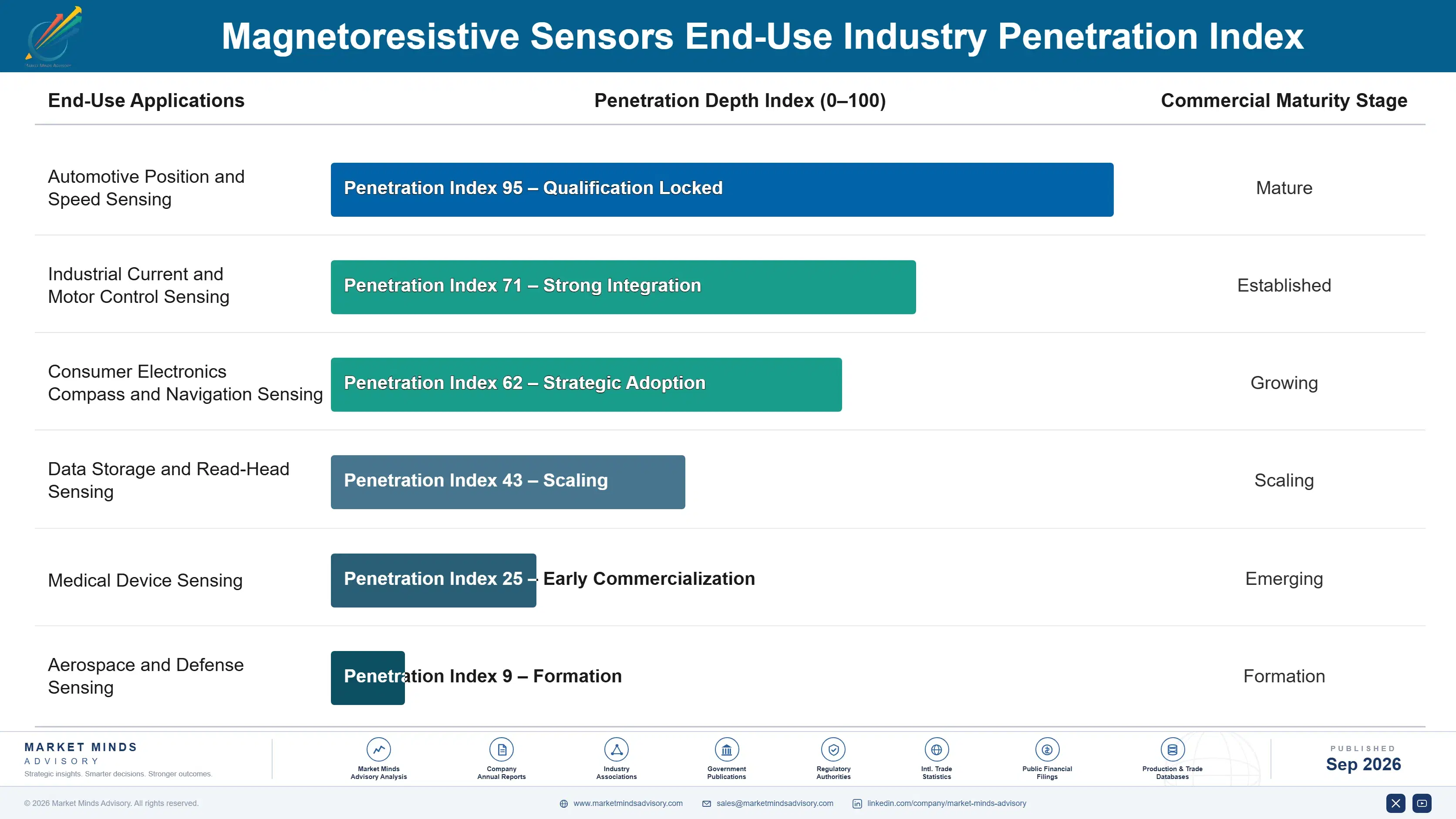
Magnetoresistive sensor demand behaves like an annuity once a manufacturer wins an OEM's initial design-in qualification and precision trust, since OEMs rarely switch manufacturers mid-product-cycle given the considerable cost and time of requalifying accuracy certification and TMR continuity on a new supplier. Contracted shelf volume persists across multi-year manufacturer relationships as long as component performance stays reliable and precision results remain compliant, giving incumbent manufacturers a durable revenue base new entrants find genuinely difficult to displace over time.
Adoption depth varies meaningfully by end-use vertical: premium TMR integration demands the deepest wafer depth given severe precision complexity pressure, industrial-current segments follow closely behind on similar accuracy pressure, while basic legacy AMR applications adopt more gradually since certification treatment represents a smaller share of their overall purchase cost relative to premium formats precision-focused OEMs genuinely require.

A genuine generational shift is underway among automotive procurement managers and design engineers, who increasingly weight wafer depth and precision data alongside unit cost in manufacturer selection decisions. This marks a real departure from purchasing criteria dominated almost entirely by unit cost and AMR simplicity a decade ago, before TMR and industrial-current expectations reshaped priorities meaningfully across the industry.
magnetoresistive-sensors-market-end-use-penetration-index-1788420520621

Where to Compete in Magnetoresistive Sensors

These are among the four positions where our research anticipates prominent divergence between winners and laggards over the coming forecast period. Each is grounded in the demand model, the regulatory perimeter, and the announced capacity pipeline.
01 / WAFER INVESTMENT PRIORITY

Prioritize TMR depth over conventional AMR expansion

Manufacturers that build genuine wafer depth now capture the pricing premiums and long-term OEM relationships that TMR formulations increasingly require across every major electronics market this report tracks in careful detail. Pure conventional AMR-only manufacturers, without wafer investment, compete purely on unit cost against widely accessible commoditized products that offer no durable differentiation and steadily erode margin over time. The window to secure wafer depth ahead of tightening substrate constraints is narrowing steadily across the industry, rewarding manufacturers who move decisively now.
02 / REGIONAL DISTRIBUTION FOOTPRINT

Weight East Asian and South Asian programs ahead of Western Europe

Concentrated wafer fabrication capacity and automotive-electronics manufacturing density give East Asia the strongest position of any region tracked in this report, while India's rapidly rising automotive-electronics investment pushes South Asia and Pacific to the fastest growth rate among the seven regions this report covers. Western Europe's design-headquarters role genuinely limits its manufacturing-volume demand within this scope relative to East Asia. Manufacturers expanding fabrication capacity should weight East Asian and South Asian programs more heavily than uniform allocation would otherwise suggest.
03 / COMMERCIAL PARTNERSHIP DEPTH

Deepen OEM relationships through integrated precision documentation support

OEMs increasingly prefer manufacturers who handle sensitivity testing and certification documentation directly rather than managing multiple separate laboratory vendors, systems, and contracts negotiated independently across regional facilities. This integration simplifies certification planning considerably while giving manufacturers multi-year shelf volume that behaves like a genuine annuity revenue stream rather than volatile, unpredictable purchase-cycle business subject to sudden swings. Manufacturers that fail to offer this integrated service risk losing meaningful share to competitors who already do so profitably and at genuine, durable scale.
04 / TECHNOLOGY INVESTMENT TIMING

Move on substrate capacity before OEM demand outpaces supply

Magnetic tunnel junction substrate and deposition manufacturing capacity has not scaled fast enough to meet accelerating precision and TMR-verification demand, and certification-ready assets are becoming considerably more valuable as scarcity intensifies across nearly every major electronics market this report tracks in careful and sustained detail. Manufacturers that acquire or build sourcing capacity now lock in production costs and product continuity before competitors bid valuations meaningfully higher across the sector. Waiting risks paying a substantial premium for the exact same strategic capability within just a few years.

Engagement Snapshot From the Field

A live engagement with an industry participant carrying material or product regulatory and market exposure ahead of a defining policy shift, showing how our research translates into a defensible multi-year portfolio strategy.
MARKET MINDS ADVISORY · CLIENT ENGAGEMENT SUMMARY
Magnetoresistive Sensors Producer Strategic Portfolio Review and Transition Roadmap 2026·Investment Scenario on Magnetoresistive Sensors Exposure Evaluation 2025-26
CLIENT PROFILE
The client, a regional North American automotive tier-one supplier managing sensor programs across more than 7 vehicle platforms, engaged MMA to assess how its magnetoresistive sensor sourcing strategy should evolve ahead of expanding precision compliance expectations across its largest deployment segments. The client's existing sourcing relied predominantly on conventional AMR sensors, and leadership needed an independent view of transition timing before committing capital to new manufacturer relationships.
STRATEGIC CHALLENGE
Expanding precision compliance expectations across several of the client's largest deployment segments increasingly required documented TMR stability with reliable accuracy certification, but the client's existing manufacturer relationships lacked broad wafer depth across all relevant deployment formats. Leadership needed to decide whether to transition through existing manufacturers or shift sourcing toward providers with proven fabrication capability at meaningfully larger scale.
MMA APPROACH
MMA conducted a manufacturer capability audit across the client's top six magnetoresistive sensor providers, benchmarked wafer depth against deployment timelines, and modeled the cost and margin impact of transition under three different manufacturer scenarios. The analysis drew on primary interviews with manufacturer engineering teams and precision-test data to size genuine capability gaps.
KEY FINDINGS
  1. Only two of the client's six largest manufacturers held certified TMR capability sufficient to meet deployment expectations reliably across every relevant format.
  2. Transition costs ran 13% to 17% above budget estimates initially prepared by internal category teams ahead of the engagement (client-reported, unverified by MMA).
  3. Switching manufacturers mid-project carried meaningful certification continuity risk, but delaying transition risked missing deployment deadlines across several key vehicle platforms simultaneously and without warning.
  4. Manufacturers with in-house wafer fabrication offered pricing roughly 6% below manufacturers relying on third-party foundry intermediaries over a full two-year contract horizon overall.
CLIENT PROFILE
The client, a regional North American automotive tier-one supplier managing sensor programs across more than 7 vehicle platforms, engaged MMA to assess how its magnetoresistive sensor sourcing strategy should evolve ahead of expanding precision compliance expectations across its largest deployment segments. The client's existing sourcing relied predominantly on conventional AMR sensors, and leadership needed an independent view of transition timing before committing capital to new manufacturer relationships.
STRATEGIC CHALLENGE
Expanding precision compliance expectations across several of the client's largest deployment segments increasingly required documented TMR stability with reliable accuracy certification, but the client's existing manufacturer relationships lacked broad wafer depth across all relevant deployment formats. Leadership needed to decide whether to transition through existing manufacturers or shift sourcing toward providers with proven fabrication capability at meaningfully larger scale.
MMA APPROACH
MMA conducted a manufacturer capability audit across the client's top six magnetoresistive sensor providers, benchmarked wafer depth against deployment timelines, and modeled the cost and margin impact of transition under three different manufacturer scenarios. The analysis drew on primary interviews with manufacturer engineering teams and precision-test data to size genuine capability gaps.
KEY FINDINGS
  1. Only two of the client's six largest manufacturers held certified TMR capability sufficient to meet deployment expectations reliably across every relevant format.
  2. Transition costs ran 13% to 17% above budget estimates initially prepared by internal category teams ahead of the engagement (client-reported, unverified by MMA).
  3. Switching manufacturers mid-project carried meaningful certification continuity risk, but delaying transition risked missing deployment deadlines across several key vehicle platforms simultaneously and without warning.
  4. Manufacturers with in-house wafer fabrication offered pricing roughly 6% below manufacturers relying on third-party foundry intermediaries over a full two-year contract horizon overall.
RECOMMENDED STRATEGY
Phase 1: Phase 1 (Months 1 to 3): Audit the full manufacturer base and benchmark wafer depth against deployment timelines carefully before engaging manufacturers. Phase 2: Phase 2 (Months 4 to 8): Qualify additional TMR-capable manufacturers while carefully renegotiating existing AMR contract terms and evaluating pricing. Phase 3: Phase 3 (Months 9 to 15): Lock in multi-year framework agreements with manufacturers holding proven wafer depth and production capacity.
OUTCOME
The client qualified two additional TMR-capable manufacturers within the engagement window, meeting deployment deadlines across every planned vehicle-platform rollout entirely. Reported transition costs rose by 10% during the shift, below the client's original 17% contingency estimate (client-reported, unverified by MMA), while avoiding deployment delay entirely.

Frequently Asked Questions

Foundational context covering the market sizes, CAGR, scope, country, region and competition that inform every finding below. This section is provided to cover basics and most often pre-purchase conversations, answered from the MMA Primary Research Dataset.

What is the current size of the Magnetoresistive Sensors Market?

The Magnetoresistive Sensors Market reached USD 3.9 billion in 2025, spanning AMR, GMR, and TMR formats across every regulated automotive and industrial distribution channel worldwide today.

How large will the Magnetoresistive Sensors Market be by 2036?

The market is forecast to reach USD 10.06 billion by 2036, expanding steadily as TMR and industrial-current formats displace conventional AMR sensors across major electronics markets.

What is the CAGR for the Magnetoresistive Sensors Market 2026 to 2036?

The market is projected to grow at a 9.0% CAGR between 2026 and 2036, with a bull case near 10.3% and a bear case closer to 7.7%.

Which segment is growing fastest?

Automotive position and speed sensing grows fastest, expanding at roughly 13.0% CAGR as EV and ADAS programs reflect genuine accuracy and power-efficiency demand across every applicable sensing category.

Who are the major companies in the Magnetoresistive Sensors Market?

Leading manufacturers include Honeywell, Infineon, Allegro MicroSystems, TDK, and NVE Corporation, evaluated on fabrication scale, wafer depth, and precision credibility across every major electronics market worldwide.

Which country is growing fastest?

India shows the fastest underlying growth trajectory given its rapidly rising automotive-electronics investment, while China leads absolute value given its concentrated wafer fabrication network overall.

Report Segmentation Architecture

The full report scope spans multiple orthogonal segmentation dimensions, with cross-tabulated demand data provided for each dimension pair. Coverage extends further to regional breakdowns, trend trajectories, and the competitive detail needed to support segment-level decision-making.

By Primary Market Dimension

  • AMR Sensor Technology
  • GMR Sensor Technology
  • TMR Sensor Technology

By End-Use Industry

  • Automotive Position and Speed Sensing
  • Industrial Current and Motor Control Sensing
  • Consumer Electronics Compass and Navigation Sensing
  • Data Storage and Read-Head Sensing
  • Medical Device Sensing
  • Aerospace and Defense Sensing

By Commercial Dimension

  • Direct OEM Design-In Channel
  • Distributor and Wholesale Channel
  • Contract Manufacturer Channel
  • Aftermarket Replacement Channel

By Region

  • North America
  • Western Europe
  • East Asia
  • South Asia and Pacific
  • Latin America
  • Middle East and Africa
  • Eastern Europe

Scope, Methodology, and Coverage

Every figure in this report is reproducible from documented input assumptions. The scope below maps the historical period, the forecast horizon, the segmentation dimensions, and the countries covered, alongside the underlying primary and qualitative methodology.
Historical Period
2020 to 2025
Forecast Period
2026 to 2036
Base Year
2025 (USD billions; MMA Primary Research Dataset, September 2026)
Market Definition
This report covers magnetoresistive sensors, AMR, GMR, and TMR formats used in automotive, industrial, and consumer-electronics sensing applications worldwide. It excludes standalone Hall-effect sensor products and general-purpose accelerometer devices.
Quantitative Units
USD billions (current prices); unit shipments (millions) where applicable
Segmentation Dimensions
By Primary Market Dimension; By End-Use Industry; By Commercial Dimension; By Region
Regions Covered
North America, Western Europe, East Asia, South Asia and Pacific, Latin America, Middle East and Africa, Eastern Europe
Countries Covered
USA, UK, France, Germany, China, Japan, South Korea, India, Australia, Canada, Brazil, Mexico, Indonesia, Vietnam, Thailand, UAE, Saudi Arabia, Qatar, South Africa, Nigeria, Turkey, Poland, Netherlands, Italy, Spain, Sweden, Taiwan, and additional markets relevant to this sector
Key Companies Profiled
Honeywell, Infineon, Allegro MicroSystems, TDK, NVE Corporation, MagnaChip Semiconductor, Melexis, Asahi Kasei Microdevices, Sensitec, Crocus Technology, MultiDimension Technology, Voltafield Technology, STMicroelectronics, Bosch Sensortec, ams OSRAM, Diodes Incorporated, ROHM Semiconductor, MEMSIC, Everspin Technologies, QST Corporation
Quantitative Methodology
Primary survey, n=3,800 respondents, Q4 2025, six countries; demand-side model with trade association cross-validation
Qualitative Methodology
47 expert interviews, Q4 2025; applied to validate demand model assumptions, identify emerging dynamics, and assess competitive positioning
Report Format
PDF and XLSX data workbook (Word format preview document)
Publisher
Market Minds Advisory
Report Code
MMA-2026-TEC-110
Published
September 2026
Contact
sales@marketmindsadvisory.com | www.marketmindsadvisory.com

Purchase the full Magnetoresistive Sensors Market Report (2026 to 2036).

The full report delivers a complete quantitative and qualitative assessment of the Magnetoresistive Sensors Market. It covers detailed segmentation by end-use application, sensing technology, and commercial dimension across all seven regions in this analysis. The report provides ten-year forecasts to 2036 alongside competitive benchmarking of twenty profiled manufacturers and wafer-fabrication depth tracking across every major electronics market addressed directly in careful and sustained detail. Buyers also receive primary survey data alongside expert interview findings gathered specifically for this engagement, plus detailed supply chain cost and portfolio margin analysis by region.
Ten-year quantitative category forecasts through 2036
Regional breakdowns across all seven covered regions
Competitive benchmarking of twenty profiled manufacturers
Precision and sensitivity tracking by region
Segment-level CAGR and margin economics analysis
Primary survey and expert interview data

Built For The People Who Decide

From boardroom strategy to bench-side execution, this report is read cover-to-cover by leaders shaping the next decade of their industry, turning demand scenarios, market dynamics and valuation benchmarks into decisions.
CXOs/ Presidents/ VPs/ Managers
M&A and Corporate Development
Strategy Teams and R&D Heads
Procurement and Product Directors
Regulatory and Compliance Leaders
Investor Relations and Equity Analysts