Market Minds Advisory
Magnetic Ballast Market

Magnetic Ballast Market: Magnetic Ballast Market: Fewer Units, Higher Prices, Better Margins

Units have been falling for fifteen years and prices have been rising for five, because most producers left and the buyers who remain cannot afford to replace the whole fitting.

Lead Analyst

Published

September 2026

Make Smarter Decisions with Customized Research Insights

Request a free sample report and evaluate market opportunities, growth trends, and competitive dynamics relevant to your business needs.

2025 MARKET VALUE$1.4BMarket Size 2025
2036 FORECAST VALUE$2.0BBase Case , 2026 to 2036
CAGR 2026 TO 20363.4 %Bull 4.6% / Bear 2.2%
INCREMENTAL OPPORTUNITY$0.6BNet 10- year value creation
EXPANSION MULTIPLE1.40x2036 value over 2026 base
Strategic Levers
M&A Pipeline
Regional Outlook
Country Rankings
Competitive Intelligence
Segmental Deep-dive
Call-Us : 91 93563 13602

Executive Snapshot and Market Trajectory.

This is a harvest market and the pricing has inverted, which is the part nobody expects. Some 61% of manufacturers have left the category since its peak, and the buyers still here have no retrofit budget, so unit volumes fall while prices and margins both climb.
High-pressure sodium ballasts grow at 5.1%, half again the market rate of 3.4%, because street lighting columns and high-bay industrial fittings are expensive to reach and cheap to repair, so the ballast gets replaced and the fitting does not. South Asia holds 26% of demand, far outside any normal band, because Indian installed lighting was never covered by the efficiency rules that removed this product from Europe. Regulation moved the market rather than ending it.
Concentration is low at 29% of replacement shipments, and it is falling in an unusual direction: as producers exit, the survivors are increasingly regional specialists rather than the global names that once dominated. The commercially decisive capability is not manufacturing scale at all. It is holding inventory of obsolete specifications that nobody else still makes. Scarcity, not scale, is what earns money in a market that is quietly finishing.
Market Definition
The magnetic ballast market covers electromagnetic and inductive current-limiting devices that regulate power to gas discharge lamps, spanning fluorescent T8 and T12 ballasts, high-pressure sodium HID ballasts, metal halide HID ballasts, mercury vapour ballasts, low-pressure sodium and specialty discharge ballasts, and induction and ultraviolet germicidal ballasts. Scope is measured as replacement and original equipment unit value across all voltage classes. Excluded are electronic and high-frequency ballasts, LED drivers and power supplies, complete luminaires, lamps themselves, and lighting control systems.
Base Year Value
$1.4B in 2025 (MMA Primary Research Dataset, August 2026)
Forecast Period
2026 to 2036, eleven discrete annual values
CAGR
3.4% base case. Bull 4.6%. Bear 2.2%.
Fastest Growth Segment
High-Pressure Sodium HID Ballasts: 5.1% CAGR
Fastest Growth Country
India: 5.8% CAGR
Fastest Growth Region
South Asia and Pacific: 5.8% CAGR
Largest Region
South Asia and Pacific: 26% of 2025 global value
Market Leaders
Havells India, Signify, ams-OSRAM, Shanghai Feilo Acoustics and Surya Roshni. Source: MMA Analysis, July 2026.
Primary Survey
n=3,800 procurement and R&D decision-makers, Q4 2025, six countries
Methodology
Demand-side build-up, cross-validated against public data, 47 expert interviews

Magnetic Ballast Market Forecast Scenarios

magnetic-ballast-market-size-forecast-scenario-1788193710080
Between 2020 and 2025 the value line compounded at 2.4% while units fell throughout, which is a combination that confuses anybody reading only one of the two numbers. European and North American demand collapsed under efficiency regulation and concentrated into markets with no retrofit capital. Prices rose as manufacturers withdrew, and those who stayed found margins improving as the market shrank around them.
The 3.4% base case rests on three mechanisms. Replacement demand from an installed base averaging 17 years is inelastic, because a failed ballast in a working fitting must be replaced or the light stays off. Producer exits keep tightening supply against that demand and lifting price. And HID applications in street lighting and high-bay industry sit in fittings that cost far more to replace than to repair. None of the three depends on new installation.
The bull case at 4.6% turns on further manufacturer exits tightening supply faster than demand declines, which would push scarcity pricing beyond what the model assumes. The bear case at 2.2% is capital reaching the buyers: LED retrofit pays back in 38 months, and any development finance programme that funds municipal or industrial conversion removes that demand permanently and quickly.

A Market Worth More As It Shrinks

Two lines have been moving in opposite directions for years and most commentary follows only one of them. Unit shipments have fallen continuously since efficiency regulation removed European and North American demand. Average selling price has risen, because 61% of manufacturers left the category and the demand that remains cannot substitute. A shrinking market with rising prices is unusual and it is not an accident.
TOP FIVE CONCENTRATION29%Share of replacement unit shipments held by five suppliers
AVERAGE SELLING PRICEUSD 11.40Mean price per unit across surviving replacement demand
COPPER COST SHARE34%Portion of unit cost accounted for by winding metal
INSTALLED BASE AGE17 yearsMedian service age of fittings still requiring replacement parts
PRODUCER EXIT RATE61%Portion of manufacturers that left the category since peak
RETROFIT PAYBACK PERIOD38 monthsTime for an LED conversion to recover its installation cost
The demand that survives is inelastic in a way new-installation demand never is. A working fitting with a failed ballast produces no light, and the alternative to a USD 11 component is a luminaire replacement nobody has budgeted for. The installed base averages 17 years of service and continues to fail at a predictable rate. Nobody chooses this product; they choose not to spend forty times as much.
LED retrofit is the whole story on the other side and its economics are entirely clear. Payback runs 38 months on typical industrial and street lighting conversions, which any organisation with capital finds compelling. The buyers still purchasing magnetic ballasts are the ones without that capital, which makes this market a function of financing availability in developing economies rather than of anything technical.
"The interesting thing about a dying category is that the last people standing often make more money than anybody did at the peak. Half this industry exited on the volume decline and never noticed the price line going the other way."
Director, Electrical Components Practice · MMA Energy Practice · August 2026

Market Trends

Producer exits inverted the pricing dynamic entirely

Some 61% of manufacturers have left this category since its peak, withdrawing on volume decline without examining what withdrawal would do to price. The demand that remains cannot substitute, because the alternative to a failed ballast is a luminaire replacement costing many times more, so tightening supply meets inelastic demand and average selling price has risen for five consecutive years. Survivors are earning better gross margins than anybody earned when the market was several times larger. It is the classic terminal industry pattern and remarkably few boards recognise it while it is happening.
Market Impact: Costs 1 fortieth of a luminaire

Regulation relocated demand rather than ending it

European efficiency rules removed magnetic ballasts from that market almost entirely, and North American efficiency standards did much the same on a slower timetable. Neither instrument reached the far larger installed base across South Asia, Africa and Latin America, where the fittings were never covered and the capital to replace them does not exist. South Asia now holds 26% of demand and Middle East and Africa 17%, both far outside what those regions would ordinarily represent. The product did not become obsolete. It became geographically specific, which is a different commercial problem entirely.
Market Impact: Serves a base averaging 17 years

Market Opportunities and Growth Drivers

High fittings cost far more to replace than repair

A high-pressure sodium street light sits on a column requiring a lift vehicle and a traffic closure, and a metal halide high-bay hangs twelve metres above a working factory floor. Reaching either is the expensive part, and once a crew is there a ballast costs a fraction of a luminaire. That arithmetic keeps HID replacement demand alive long after fluorescent demand has gone, which is why high-pressure sodium ballasts grow at 5.1% against a market rate of 3.4%. The height of the fitting turns out to predict demand better than any efficiency argument.
Market Impact: Pays back in 38 months

Replacement demand does not respond to price

A failed ballast in a working fitting means no light, and the buyer is a facilities manager with a fault ticket rather than a procurement team running a tender. Price sensitivity in that situation is close to zero within any realistic range, since the comparison is against a capital project nobody has approved. The installed base averages 17 years of service and fails at a rate that is genuinely predictable from age alone. That predictability is why the surviving participants can plan inventory precisely, and it is worth considerably more than growth would be.
Market Impact: Exposes 34% of unit cost

Market Restraints and Challenges

LED retrofit removes demand permanently once funded

An LED conversion pays back in 38 months on typical street lighting and industrial installations, and once a fitting is converted it never returns to this market under any circumstances. The root cause is that the competing technology is simply better on every operating measure, and the only thing preventing conversion is the capital to do it. Commercial impact is that each development finance lighting programme permanently removes a block of demand. Participants are responding by tracking retrofit funding announcements, concentrating on unfunded geographies, holding inventory tightly and pricing for a finite remaining life.
Market Impact: Removed 61% of manufacturers since peak

Copper pricing hits a product that cannot absorb it

Copper winding is 34% of unit cost and the price moves on global demand entirely unconnected to lighting, while the buyer is a facilities manager comparing an unexpected invoice against a maintenance budget set a year earlier. The root cause is that a magnetic ballast is essentially a transformer, and there is no design route to using less metal without failing the specification. Commercial impact is margin compression in the periods that matter most. Mitigation runs through forward copper purchasing, aluminium winding for lower-duty applications, larger production batches and inventory built ahead of price movements.
Market Impact: Moved 43% of demand
3 additional market trends, 4 additional growth drivers, and 2 additional restraints and challenges are covered in the full report. Contact sales@marketmindsadvisory.com to access the complete intelligence.

Segment CAGR and Growth Architecture

Segmentation follows lamp type served, the dimension on which fitting height, replacement economics and regulatory exposure all move together. Fluorescent ballasts are disappearing fastest because the fittings are reachable and the tubes are already banned in several markets. HID ballasts carry what growth exists, because reaching those fittings costs more than the part. Height decides survival here.
magnetic-ballast-market-market-share-analysis-1788193710661

High-Pressure Sodium HID Ballasts

High-pressure sodium ballasts grow at 5.1%, half again the market rate of 3.4%, and the reason is access cost rather than lighting performance. These serve street lighting columns and high-mast installations where reaching the fitting requires a lift vehicle, a road closure and a crew, so the marginal cost of replacing a ballast once somebody is up there is trivial against replacing the luminaire. Municipal budgets across South Asia, Africa and Latin America fund maintenance readily and capital conversion rarely. The orange light output is poor by any modern standard and completely irrelevant to the purchase decision, which is made by a maintenance department responding to an outage report rather than by anybody comparing technologies.
CAGR 5.1%

Metal Halide HID Ballasts

Metal halide ballasts at 4.2% serve industrial high-bay, warehouse and sports lighting, where fittings hang ten to fifteen metres above a floor that has to keep working. Access requires scaffolding or a lift and often a production stoppage, which makes a full conversion a project with a business case rather than a maintenance action. Manufacturing plants across Asia, Latin America and Africa run these installations continuously and replace components as they fail. Colour rendering is better than sodium, which matters in warehouses where goods are inspected. Demand here declines more slowly than most participants forecast, because the conversion decision keeps being deferred to a capital cycle that keeps not arriving.
CAGR 4.2%
Full segment breakdown across 6 segments available in the complete report.

Regional Architecture and Country Demand Map

South Asia takes 26% and Middle East and Africa 17%, both far outside their usual bands, because neither region adopted the efficiency rules that removed this product from Europe and North America. Regulation relocated this market rather than ending it, and very few participants followed the demand across.

South Asia and Pacific

A 26% share far outside the usual band follows from two things that have nothing to do with lighting technology. India holds an enormous installed base of high-pressure sodium street lighting and metal halide industrial fittings that no efficiency regulation ever covered, and municipal and industrial budgets fund maintenance far more readily than capital conversion. Domestic manufacturers serve that demand at price points imported product cannot approach, and several have gained share as global names withdrew. Growth at 5.8% is the fastest of any country covered. National LED programmes have converted substantial street lighting volume and have barely touched the industrial base at all. The industrial base is where this demand actually lives now.
Share: 26% | CAGR: 5.8% (2026 to 2036)

East Asia

China dominates this region on both sides of the transaction, which is an unusual position to hold in a declining category. Domestic manufacturers supply most of the world's surviving magnetic ballast production, including the volume that ends up in Africa and Latin America, while the domestic installed base of industrial and street lighting remains very large despite substantial LED conversion. Japanese and Korean demand has effectively ended under efficiency standards and consumer preference. The manufacturing position matters more than the consumption position here, because as Western producers exit, Chinese output increasingly sets the world price for what remains of this product. Nobody outside China really influences that price any longer.
Share: 23% | CAGR: 4.4% (2026 to 2036)
Regional intelligence for 5 additional markets available in the complete report: North America, Western Europe, Latin America, Middle East and Africa, Eastern Europe. Contact sales@marketmindsadvisory.com.
magnetic-ballast-market-country-cagr-analysis-1788193711178

Four Moves While It Lasts

None of these four involves growth, because there is not going to be any, and pretending otherwise has cost several participants their exit value. Each works on what a terminal market actually rewards: scarcity, inventory discipline, precise geographic focus and knowing exactly when to stop. Finishing well is a discipline, and not the one that built these businesses.

Stock the specifications nobody else makes

Some 61% of manufacturers have left this category, and every exit orphans a set of specifications that installed fittings still require. A distributor or manufacturer holding obsolete wattages, voltages and form factors faces no competition at all on those lines and a buyer with no alternative, which produces pricing that bears no relation to manufacturing cost. Inventory carrying cost is the only real constraint and it is small against the margin. The participants who mapped competitor exits against their own catalogue found the opportunity immediately, and almost nobody did that work.
Market Impact: Covers the specifications that 61% of makers abandoned

Price against the luminaire, not the component

A facilities manager comparing a ballast price against last year's price will resist an increase, and the same manager comparing it against a full luminaire replacement at 40 times the cost will not. That is the actual alternative and almost nobody in this sector frames the conversation around it. Price sensitivity in a fault-driven purchase is close to zero within any realistic range, and average selling price has already risen for five consecutive years without demand response. The remaining headroom is considerably larger than most participants assume, and testing it costs nothing.
Market Impact: Prices against a 40 times more costly alternative

Follow the capital, then avoid it

LED retrofit pays back in 38 months and every development finance lighting programme permanently removes a block of demand from a specific geography on a schedule that is announced in advance. Tracking those announcements tells a participant which markets have eighteen months left and which have a decade. Concentrating inventory and distribution on unfunded geographies while withdrawing from funded ones protects margin and avoids stranded stock. It requires reading development bank pipelines rather than lighting industry publications, which is why nobody does it. It is the cheapest forecasting available to anybody here.
Market Impact: Avoids markets facing a 38 month LED payback

Plan the exit before the volume forces it

This market ends, and the participants who choose their exit point earn considerably more than those whose exit is chosen for them by an inventory write-off. A planned withdrawal sells the customer list, the obsolete inventory and the specification library to a remaining participant who values all three, at a price that a distressed exit never achieves. The window for that is while volumes still support a buyer's business case. Some 61% have already left and very few of them ran that process properly, which is a lesson available free.
Market Impact: Exits before that 61% figure becomes 80% instead

Who Controls the Margin Pool

CR5 stands at 29% of replacement unit shipments, which is the only basis on which these participants compare since none reports ballast revenue separately. Concentration has fallen rather than risen as the market shrank, because the global names withdrew first and regional specialists took the volume. That is the opposite of what usually happens in a declining category, and it reflects who could still make money at the remaining scale.
Competition runs on inventory breadth, distribution reach and cost position. Inventory breadth decides who can supply an orphaned specification at a price nobody can contest. Distribution reach decides who is present in the informal channels through which most of this product now moves. Cost position decides the commodity lines. Product development decides nothing at all, since the design has not meaningfully changed in decades.

Rankings will move as remaining participants exit and their specifications become somebody else's monopoly. Every withdrawal transfers a catalogue of orphaned lines to whoever stays, which is worth more than the volume that left with it. The pressure comes from competitor exits rather than competitor aggression, which is a genuinely unfamiliar dynamic and most managements read it as decline rather than opportunity.
magnetic-ballast-market-company-positioning-matrix-1788193711699

Competitive Moat and Risk Dimensions

HAVELLS INDIA

Moat: Domestic reach into replacement channels

Distribution across Indian electrical wholesale and contractor channels reaches the fault-driven replacement purchase where it actually happens, which is a small hardware transaction rather than a procurement process. That network took decades to build and serves many product lines beyond this one. A withdrawing global competitor cannot replicate it and an importer cannot reach past it.
HAVELLS INDIA

Risk: National retrofit programmes accelerate decline

Indian street lighting conversion programmes have already removed substantial volume and the industrial base is the obvious next target for any funded scheme. The group's strongest position sits in the geography most likely to receive that funding, which turns a market leadership into a concentrated exposure. Diversification within lighting is the answer and the timing of it is genuinely difficult.
SHANGHAI FEILO ACOUSTICS

Moat: Manufacturing scale sets world price

Chinese production increasingly supplies what remains of world magnetic ballast demand, including the volumes reaching Africa and Latin America through export channels, which means the group's cost position effectively sets the price everybody else must meet. Scale in a shrinking market is unusual and it is genuinely defensible. Western competitors withdrew rather than attempt to match it.
SHANGHAI FEILO ACOUSTICS

Risk: Export demand concentrates dangerously

The export volume flows to regions whose demand exists precisely because retrofit capital is absent, which makes it vulnerable to development finance decisions the group has no visibility into and no influence over. A funded conversion programme removes an export market on a schedule set elsewhere. Manufacturing scale offers no protection at all against that particular risk.

Players Tracked

Prominent Players

Havells India
Signify
ams-OSRAM
Shanghai Feilo Acoustics
Surya Roshni

Other Key Players

Bajaj Electricals
Crompton Greaves Consumer Electricals
Halonix Technologies
NVC Lighting
Opple Lighting
Zhejiang Yankon
Venture Lighting
Robertson Worldwide
Keystone Technologies
Universal Lighting Technologies
Acuity Brands
Hubbell
Eaton
TCP International
Wipro Enterprises

Recent Developments

JANUARY 2025

Further European manufacturer withdrew from magnetic ballast production

Another European manufacturer ceased magnetic ballast production entirely, orphaning a catalogue of industrial and specialty specifications that installed fittings across several markets still require. Distributors holding remaining stock of those lines reported pricing well above previous levels within two quarters of the announcement reaching the trade.
Signal: Each withdrawal quietly hands the departing producer's specifications over to whoever is patient enough to stay.
JUNE 2025

Development bank funded African municipal lighting conversion

A development finance institution committed funding to municipal street lighting conversion across several African cities, replacing high-pressure sodium installations with LED fittings. Component demand in those municipalities will end permanently once installation completes, on a schedule published well in advance of any of the work.
Signal: Development finance announcements now forecast this market considerably better than any lighting industry data ever does.
OCTOBER 2025

Copper price movement lifted ballast prices across distribution

Copper price movement fed through to magnetic ballast pricing across distribution channels, since winding metal represents roughly 34% of unit cost and the design offers no route to using less of it. Buyers absorbed the increase without measurable demand response, which confirmed what several participants had suspected about price sensitivity.
Signal: A fault-driven purchase does not shop around, and this sector is only starting to price accordingly.

Copper, Steel Laminations And Labour

Copper winding accounts for roughly 34% of unit cost, silicon steel laminations for the core around 26%, and assembly labour with impregnation a further 17%. Both metals are exchange-traded commodities priced entirely independently of lighting demand. The rest sits in housings, terminals and testing. None of it offers room for design reduction, because a magnetic ballast is a transformer and physics sets the metal content.
Copper movement through 2021 and 2022 tested this cost structure directly. Exchange pricing rose sharply on demand unconnected to lighting, and US Geological Survey mineral commodity reporting recorded the movement. Manufacturers holding forward positions and inventory built ahead of the rise protected their margins through it. Those buying on spot against distributor price lists set annually absorbed the whole increase, and two smaller producers exited the category as a direct result.

The disadvantage falls on production scale rather than on purchasing sophistication. A participant running large batches buys metal at prices a small assembler never sees, and can hold inventory across a cycle. In a shrinking market most participants have cut batch sizes, which raises unit cost exactly when volumes are falling. That trap has ended more of these businesses than the demand decline has.
magnetic-ballast-market-cost-volatility-analysis-1788193711894

Buy copper forward against known replacement demand

Copper is 34% of unit cost and replacement demand from an installed base averaging 17 years is genuinely predictable from failure rates rather than from any market forecast. That combination allows forward purchasing with unusual confidence, which almost no other declining category permits. Participants matching metal purchases to modelled failure curves held margin through the last copper cycle intact.

Run fewer, larger production batches

Shrinking volumes tempt manufacturers into smaller and more frequent batches, which raises setup cost per unit and reduces metal purchasing power at exactly the wrong moment. Producing a year of demand in two runs rather than eight costs inventory carrying and buys back both. In a market with predictable demand and no obsolescence risk, that inventory carries almost no danger.

Substitute aluminium winding where duty allows

Lower-duty applications tolerate aluminium winding at a meaningful cost reduction against copper, though not at the same size or thermal performance for demanding installations. Qualifying the substitution costs testing and a specification variant rather than any capital. Most participants never examined it because copper was cheap when the product was designed and nobody has revisited the question since.

Portfolio Architecture for Margin Defence

Margin here follows scarcity rather than product, which is the defining feature of a terminal market and the one most participants miss. A commodity ballast four manufacturers still make earns almost nothing. An orphaned specification one manufacturer makes earns whatever the seller asks, because the alternative is a luminaire at forty times the price. Participants costing by competitive position rather than by product line run a different business entirely.
Volume and premium pull against each other through manufacturing economics rather than through the customer. Commodity lines carry the batch volume that keeps metal purchasing power sensible, and losing them raises the cost of everything else on the line. The orphaned specifications earn the margin and cannot support a factory alone. Abandoning volume to chase margin has ended several of these businesses faster than the demand decline would have.

High-value pools sit in orphaned specifications, in refurbishment and reclaimed stock, and in the exit itself, which almost nobody treats as an asset. A planned withdrawal sells a customer list, an inventory position and a specification library at a price no distressed exit achieves. The exit is the last product this business will ever sell and it deserves the same preparation.

Volume / Commodity-Adjacent

Standard fluorescent and common HID wattages that several manufacturers still produce, sold through distribution on price. Margins are thin and the volume keeps the factory economics working. The 8 point spread reflects batch size and metal purchasing power rather than any product difference.
Gross Margin: 11 to 19%

Premium / Certified

Industrial HID specifications, high-wattage units and applications requiring certification for hazardous or outdoor duty. Fewer producers remain in these lines and the buyer has limited alternatives. The 8 point spread reflects how many competitors still make the specific specification concerned.
Gross Margin: 28 to 36%

Sustainability / Regulatory / Next-Generation

Orphaned specifications abandoned by exiting manufacturers, germicidal and specialty discharge ballasts, and refurbished or reclaimed stock. Margins are high because no competing supply exists at all. The 24 point spread separates genuinely single-source lines from those with one remaining competitor.
Gross Margin: 44 to 68%
magnetic-ballast-market-portfolio-architecture-1788193712404

High-value Sub-segments and Strategic Watch-out

High-Pressure Sodium HID Ballasts

High value and high growth at 5.1%. Street lighting columns cost a lift vehicle and a road closure to reach, so replacing the ballast beats replacing the luminaire by a wide margin. The 8 point spread reflects wattage and how many producers still supply that particular rating.
Gross Margin: 32 to 40%

Metal Halide HID Ballasts

High value with strong growth at 4.2%. Industrial high-bay fittings hang above working floors, which makes conversion a project with a business case rather than a maintenance action. The 8 point spread reflects whether the specification is common or has already been orphaned by exits.
Gross Margin: 28 to 36%

Fluorescent T8 and T12 Ballasts

The volume core, and a declining one. It earns very little and it carries the batch volume that keeps metal purchasing and unit costs viable across everything else. The 8 point spread reflects production scale, since nothing else differentiates these units at all. Scale is everything here.
Gross Margin: 10 to 18%

Mercury Vapour Ballasts

The strategic watch-out. Mercury restrictions are removing these lamps market by market on published timetables, and the ballast demand ends with the lamp rather than with the fitting. The 34 point spread separates orphaned specifications earning scarcity pricing from the commodity lines now earning almost nothing at all.
Gross Margin: 18 to 52%

A Failure Rate, Not A Market

The annuity here is a failure curve rather than a customer relationship, which makes it unusually predictable and completely finite. An installed base averaging 17 years fails at a rate following from age and duty cycle rather than anything commercial, so demand models precisely years ahead. Nothing a supplier does changes the number. The only question is who supplies the units that a physical process was always going to require.
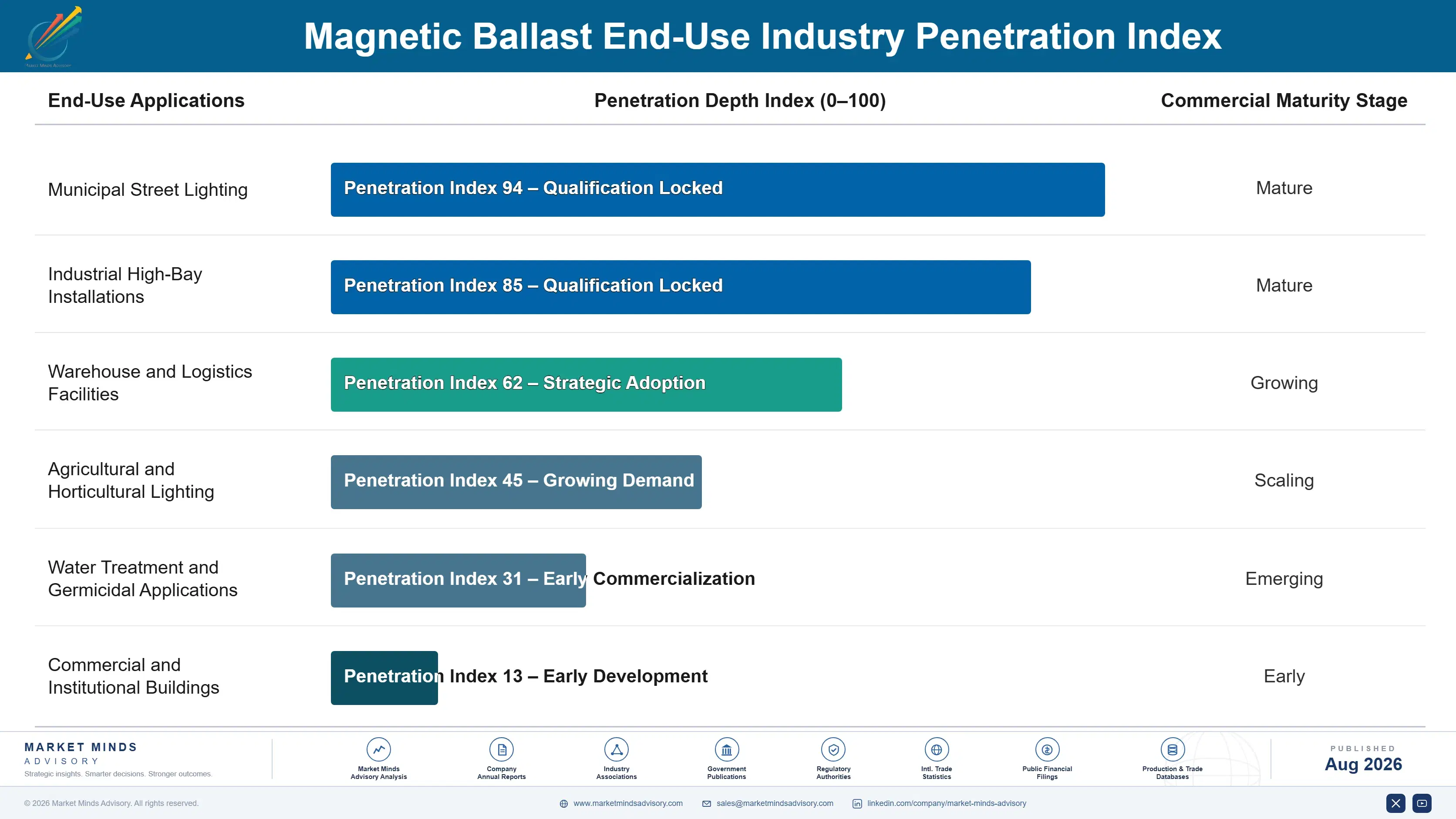
Stickiness varies enormously by fitting height rather than by customer type or geography. A ceiling fluorescent fitting is reachable, cheap to convert and gone within a capital cycle. A high-mast sodium light or a twelve-metre industrial high-bay stays for as long as somebody keeps paying to maintain it, because conversion needs scaffolding, a stoppage and an approved project. Height predicts remaining life better than any other variable.

Buyer profiles have shifted from procurement toward maintenance, and the sector's commercial approach has not followed. A procurement buyer ran tenders and negotiated annually. A maintenance technician holding a fault ticket wants a part today from whoever has it, and does not care what it cost last year. Availability beats price comprehensively in that transaction, and most participants still lead with price.
magnetic-ballast-market-end-use-penetration-index-1788193712899

How To Finish Well Here

These are among the four positions where our research anticipates prominent divergence between winners and laggards over the coming forecast period. Each is grounded in the demand model, the regulatory perimeter, and the announced capacity pipeline.
01 / ORPHANED SPECIFICATION CAPTURE

Stock what the leavers stopped making

Some 61% of manufacturers have left this category since its peak, and every one of those exits orphaned a set of wattages, voltages and form factors that installed fittings still physically require to work. A participant holding those lines faces no competition at all and a buyer whose alternative is a luminaire replacement costing forty times as much, which produces pricing unconnected to manufacturing cost. Mapping competitor exits against your own catalogue is a morning's work and remarkably few participants have ever done it.
02 / ALTERNATIVE BASED PRICING

Compare against the luminaire, not last year

A facilities manager comparing a ballast against last year's invoice resists any increase, and the same person comparing it against the full luminaire replacement that is the genuine alternative does not resist at all. Price sensitivity in a fault-driven purchase is close to zero within any realistic range, and average selling price has risen for five consecutive years without producing any measurable demand response anywhere. The remaining headroom is considerably larger than most participants assume and testing it costs nothing but nerve.
03 / RETROFIT FUNDING TRACKING

Read the development bank pipeline, not the trade press

LED conversion pays back in 38 months and every funded lighting programme permanently removes a defined block of demand from a specific geography, on a schedule that is published well before any installation work begins anywhere. Tracking those commitments tells a participant precisely which markets hold eighteen months of demand and which hold a decade of it. It requires reading development finance pipelines rather than lighting industry publications, which is exactly why almost nobody in this particular sector does it at all.
04 / PLANNED EXIT TIMING

Choose the ending before it chooses you

This market finishes, and participants who select their own exit point realise considerably more value than those whose timing is dictated by an inventory write-off and a collapsed order book. A planned withdrawal sells the customer list, the remaining inventory and the specification library to a surviving participant who genuinely values all three of them together. That window stays open only while volumes still support a buyer's business case, and 61% of participants have already left without ever running any such process.

Engagement Snapshot From the Field

A live engagement with an industry participant carrying material or product regulatory and market exposure ahead of a defining policy shift, showing how our research translates into a defensible multi-year portfolio strategy.
MARKET MINDS ADVISORY · CLIENT ENGAGEMENT SUMMARY
Magnetic Ballast Producer Strategic Portfolio Review and Transition Roadmap 2026·Investment Scenario on Magnetic Ballast Exposure Evaluation 2025-26
CLIENT PROFILE
A European electrical component manufacturer producing magnetic ballasts alongside transformers and reactors, with ballast revenue in the low tens of millions of euros and falling at roughly 9% annually in units (client-reported, unverified by MMA). The board had scheduled a decision on closing the ballast line within the following financial year. Nobody had questioned that assumption.
STRATEGIC CHALLENGE
Unit volumes had declined for a decade and management had assumed the business was worth closing, without examining what had happened to prices or to competitor supply. The board wanted a defensible view on whether to close immediately, run the line down slowly, or sell it, and nobody had prepared any analysis supporting one over the others.
MMA APPROACH
MMA reconstructed competitor supply by specification across five years, identifying every line abandoned by an exiting manufacturer and every line where the client had become one of very few remaining sources. Forty-seven expert interviews with distributors, facilities managers, wholesalers and competing producers established what buyers actually paid, what alternatives they considered and how they made the purchase.
KEY FINDINGS
  1. Gross margin on the ballast line had risen from 14% to 31% across five years while units fell, and nobody inside the business had noticed the trend.
  2. The client was the sole remaining producer of 23 specifications, and had been pricing every one of them off the same standard list as commodity lines.
  3. Buyers interviewed compared the purchase against a full luminaire replacement rather than against any competing ballast, and were not measurably price sensitive at any level tested.
  4. Two remaining competitors would credibly value the specification library and customer list, but only for as long as the client still held meaningful volume.
CLIENT PROFILE
A European electrical component manufacturer producing magnetic ballasts alongside transformers and reactors, with ballast revenue in the low tens of millions of euros and falling at roughly 9% annually in units (client-reported, unverified by MMA). The board had scheduled a decision on closing the ballast line within the following financial year. Nobody had questioned that assumption.
STRATEGIC CHALLENGE
Unit volumes had declined for a decade and management had assumed the business was worth closing, without examining what had happened to prices or to competitor supply. The board wanted a defensible view on whether to close immediately, run the line down slowly, or sell it, and nobody had prepared any analysis supporting one over the others.
MMA APPROACH
MMA reconstructed competitor supply by specification across five years, identifying every line abandoned by an exiting manufacturer and every line where the client had become one of very few remaining sources. Forty-seven expert interviews with distributors, facilities managers, wholesalers and competing producers established what buyers actually paid, what alternatives they considered and how they made the purchase.
KEY FINDINGS
  1. Gross margin on the ballast line had risen from 14% to 31% across five years while units fell, and nobody inside the business had noticed the trend.
  2. The client was the sole remaining producer of 23 specifications, and had been pricing every one of them off the same standard list as commodity lines.
  3. Buyers interviewed compared the purchase against a full luminaire replacement rather than against any competing ballast, and were not measurably price sensitive at any level tested.
  4. Two remaining competitors would credibly value the specification library and customer list, but only for as long as the client still held meaningful volume.
RECOMMENDED STRATEGY
Phase 1: Phase one: reprice the 23 sole-source specifications against the luminaire alternative rather than the standard list, before making any closure decision. Phase 2: Phase two: run the line for a further defined period rather than closing, funding it from the repriced margin rather than from any group support. Phase 3: Phase three: open a structured sale process while volumes still support a buyer's case, rather than waiting for the decline to remove it.
OUTCOME
Within four quarters repricing had lifted ballast line contribution above where it stood when the business was twice the size, with no measurable loss of volume (client-reported, unverified by MMA). The closure decision was withdrawn and a sale process opened instead. Two of the three buyers approached submitted offers.

Frequently Asked Questions

Foundational context covering the market sizes, CAGR, scope, country, region and competition that inform every finding below. This section is provided to cover basics and most often pre-purchase conversations, answered from the MMA Primary Research Dataset.

What is the current size of the Magnetic Ballast Market?

The global magnetic ballast market was valued at USD 1.4 billion in 2025, covering electromagnetic current-limiting devices for gas discharge lamps. The 2026 figure reaches USD 1.45 billion.

How large will the Magnetic Ballast Market be by 2036?

MMA forecasts USD 2.03 billion by 2036, an increase of USD 0.58 billion over the 2026 base. That represents an expansion multiple of 1.40 times across the forecast period.

What is the CAGR for the Magnetic Ballast Market 2026 to 2036?

The base case value growth rate is 3.4%, with a bull case at 4.6% and a bear case at 2.2%. Unit volumes decline throughout while scarcity pricing carries the value line.

Which segment is growing fastest?

High-pressure sodium HID ballasts grow at 5.1%, half again the market rate of 3.4%, because street lighting columns cost far more to convert than to repair. Metal halide follows at 4.2%.

Who are the major companies in the Magnetic Ballast Market?

Havells India, Signify, ams-OSRAM, Shanghai Feilo Acoustics and Surya Roshni lead on replacement unit shipments, with combined CR5 of 29%. Concentration has fallen as global names withdrew.

Which country is growing fastest?

India grows fastest at 5.8%, holding an enormous installed base of street and industrial lighting that efficiency regulation never covered. South Asia and Pacific leads regionally at 5.8%.

Report Segmentation Architecture

The full report scope spans multiple orthogonal segmentation dimensions, with cross-tabulated demand data provided for each dimension pair. Coverage extends further to regional breakdowns, trend trajectories, and the competitive detail needed to support segment-level decision-making.

By Lamp Type Served

  • Fluorescent T8 and T12 Ballasts
  • High-Pressure Sodium HID Ballasts
  • Metal Halide HID Ballasts
  • Mercury Vapour Ballasts
  • Low-Pressure Sodium and Specialty Discharge Ballasts
  • Induction and UV Germicidal Ballasts

By End-Use Industry

  • Municipal Street Lighting
  • Industrial High-Bay Installations
  • Warehouse and Logistics Facilities
  • Agricultural and Horticultural Lighting
  • Water Treatment and Germicidal Applications
  • Commercial and Institutional Buildings

By Commercial Dimension

  • Electrical Wholesale Distribution
  • Maintenance Contractor Supply
  • Original Equipment Manufacture
  • Informal and Open Market Channels
  • Refurbished and Reclaimed Stock
  • Direct Municipal Tenders

By Region

  • North America
  • Western Europe
  • East Asia
  • South Asia and Pacific
  • Latin America
  • Middle East and Africa
  • Eastern Europe

Scope, Methodology, and Coverage

Every figure in this report is reproducible from documented input assumptions. The scope below maps the historical period, the forecast horizon, the segmentation dimensions, and the countries covered, alongside the underlying primary and qualitative methodology.
Historical Period
2020 to 2025
Forecast Period
2026 to 2036
Base Year
2025 (USD billions; MMA Primary Research Dataset, August 2026)
Market Definition
The magnetic ballast market covers electromagnetic and inductive current-limiting devices that regulate power to gas discharge lamps, spanning fluorescent T8 and T12 ballasts, high-pressure sodium HID ballasts, metal halide HID ballasts, mercury vapour ballasts, low-pressure sodium and specialty discharge ballasts, and induction and ultraviolet germicidal ballasts. Scope is measured as replacement and original equipment unit value across all voltage classes. Excluded are electronic and high-frequency ballasts, LED drivers and power supplies, complete luminaires, lamps themselves, and lighting control systems.
Quantitative Units
USD billion, 2025 base year, 2026 to 2036 forecast period
Segmentation Dimensions
Lamp type served, end-use installation, commercial channel, region
Regions Covered
North America, Western Europe, East Asia, South Asia and Pacific, Latin America, Middle East and Africa, Eastern Europe
Countries Covered
United States, Canada, Germany, United Kingdom, Italy, Spain, Poland, Romania, China, Japan, Indonesia, India, Australia, Brazil, Mexico, Saudi Arabia, Nigeria, South Africa
Key Companies Profiled
20 companies across component manufacturers, lighting groups and regional specialists
Quantitative Methodology
Primary survey, n=3,800 respondents, Q4 2025, six countries; demand-side model with trade association cross-validation
Qualitative Methodology
47 expert interviews, Q4 2025; applied to validate demand model assumptions, identify emerging dynamics, and assess competitive positioning
Report Format
PDF and XLSX data workbook (Word format preview document)
Publisher
Market Minds Advisory
Report Code
MMA-2026-ENE-351
Published
August 2026
Contact
sales@marketmindsadvisory.com | www.marketmindsadvisory.com

Purchase the full Magnetic Ballast Market Report (2026 to 2036).

The full MMA report on the magnetic ballast market runs to detailed lamp type and regional models across the 2026 to 2036 forecast period, separating unit volume decline from the value line that scarcity pricing supports. It profiles 20 companies on a consistent replacement unit shipment basis, covering component manufacturers, lighting groups and regional specialists. Manufacturer exits are mapped by specification to identify orphaned lines and remaining sole-source positions. Regional chapters cover the seven MMA regions with country-level detail on the eighteen markets surveyed. Primary research draws on a quantitative survey of 3,800 respondents across six countries and 47 expert interviews conducted in Q4 2025.
Unit volume and value lines modelled separately by region
Manufacturer exits mapped by specification to identify orphaned lines
Installed base age and failure rate modelling by application
Twenty company profiles on consistent replacement shipment basis
Retrofit funding pipelines mapped against remaining demand by market
Seven regional chapters with eighteen country detail tables

Built For The People Who Decide

From boardroom strategy to bench-side execution, this report is read cover-to-cover by leaders shaping the next decade of their industry, turning demand scenarios, market dynamics and valuation benchmarks into decisions.
CXOs/ Presidents/ VPs/ Managers
M&A and Corporate Development
Strategy Teams and R&D Heads
Procurement and Product Directors
Regulatory and Compliance Leaders
Investor Relations and Equity Analysts