Market Minds Advisory
Magnesium Chloride Market

Magnesium Chloride Market: Chloride runoff regulation, anhydrous premiums and the supplement escape route to 2036

The largest application spent twenty years selling itself as the environmentally responsible alternative to rock salt, and regulators have now decided the problem was chloride rather than sodium all along.

Lead Analyst

Bilal Shaikh

Published

September 2026

Make Smarter Decisions with Customized Research Insights

Request a free sample report and evaluate market opportunities, growth trends, and competitive dynamics relevant to your business needs.

2025 MARKET VALUE$1.9BMarket Size 2025
2036 FORECAST VALUE$3.5BBase Case , 2026 to 2036
CAGR 2026 TO 20365.6 %Bull 6.8% / Bear 4.4%
INCREMENTAL OPPORTUNITY$1.4BNet 10- year value creation
EXPANSION MULTIPLE1.72x2036 value over 2026 base
Strategic Levers
M&A Pipeline
Regional Outlook
Country Rankings
Competitive Intelligence
Segmental Deep-dive
Call-Us : 91 93563 13602

Executive Snapshot and Market Trajectory

De-icing takes 38% of volume and it is the application under regulatory attack. Chloride limits near 230 milligrammes per litre in receiving waters catch magnesium chloride exactly as they catch rock salt, which removes the environmental argument this product was sold on. Nobody prepared a second one.
Food and pharmaceutical grade compounds at 8.4%, half again the market rate of 5.6%, because consumer magnesium supplementation for sleep and anxiety has become a genuinely large category rather than a niche one. East Asia holds 30% of value on Qinghai salt lake production, tofu coagulant demand and oxychloride cement together. Anhydrous material for magnesium metal electrolysis requires 99.5% purity. Few producers reach it. That barrier is real.
Five producers hold 41% of supply and the concentration reflects brine resources rather than plants, since usable brine sits in a few salt lakes, seas and deposits. The commercially awkward development is that the Great Salt Lake has dropped far enough to threaten extraction there, and nobody in this industry treats resource risk as seriously as they treat price. Water levels decide supply. Levels keep falling. Nobody in this industry prices that risk properly.
Market Definition
This report covers magnesium chloride supplied in all commercial specifications from brine, seawater bittern and magnesite sources, spanning technical grade flake, technical grade solution and brine, anhydrous magnesium chloride, food and pharmaceutical grade, high-purity construction grade, and agricultural and feed grade. Value is measured at producer level on magnesium chloride equivalent tonnage. Excluded are magnesium oxide and magnesia refractories, magnesium metal, magnesium sulphate and other magnesium salts, and finished supplement or construction products.
Base Year Value
$1.9B in 2025 (MMA Primary Research Dataset, August 2026)
Forecast Period
2026 to 2036, eleven discrete annual values
CAGR
5.6% base case. Bull 6.8%. Bear 4.4%.
Fastest Growth Segment
Food and Pharmaceutical Grade: 8.4% CAGR
Fastest Growth Country
India: 8.8% CAGR
Fastest Growth Region
South Asia and Pacific: 7.8% CAGR
Largest Region
East Asia: 30% of 2025 global value
Market Leaders
ICL Group, Compass Minerals, K+S Group, Nedmag and Qinghai Salt Lake Industry lead the market. Source: MMA Primary Research Dataset, July 2026.
Primary Survey
n=3,800 procurement and R&D decision-makers, Q4 2025, six countries
Methodology
Demand-side build-up, cross-validated against public data, 47 expert interviews

Magnesium Chloride Market Forecast Scenarios

magnesium-chloride-market-trends-size-forecast-scenario-1787555385756
Growth ran at 4.4% between 2020 and 2025 and winter weather explains more of that variation than any commercial development. De-icing demand swings enormously between mild and severe seasons and it dominates volume, which makes the historical series noisier than the underlying market. Underneath that noise, food and pharmaceutical grade grew steadily on consumer supplementation, and Chinese construction grade demand expanded with oxychloride board manufacture.
The 5.6% base case rests on three mechanisms. Consumer magnesium supplementation keeps expanding at 8.4% on sleep and anxiety positioning that shows no sign of exhausting itself, and that application pays multiples of technical grade pricing. Chinese and Indian construction grade demand keeps rising with oxychloride board and flooring manufacture. And anhydrous demand grows with electrolytic magnesium metal capacity being built outside China for the first time in years. None of that helps de-icing.
The 6.8% bull case is carbon pressure pushing magnesium metal production away from the coal-fired silicothermic route toward electrolysis, which would step-change anhydrous demand rather than merely grow it. The 4.4% bear case is chloride runoff regulation spreading across more jurisdictions and cutting into the 38% of volume that winter road treatment currently represents. Neither outcome is remotely under producer control.

When The Environmental Argument Failed

Magnesium chloride built its largest business on being the better chloride. It works at lower temperatures than sodium chloride, corrodes infrastructure less aggressively and needs less material for the same result, which made it the responsible choice for road authorities. Regulators have since concluded that the problem in receiving waters is chloride itself rather than which cation accompanies it, and limits near 230 milligrammes per litre apply regardless. Twenty years of positioning stopped working roughly at once.
TOP-FIVE CONCENTRATION41%Combined position across global supply held by leading producers
DE-ICING APPLICATION SHARE38%Portion of volume consumed on winter road and dust treatment
BRINE EVAPORATION CYCLE18 monthsTime solar ponds need to concentrate brine to specification
CHLORIDE RUNOFF LIMIT230 mg/LWater quality threshold regulators apply to receiving watercourses
ENERGY COST SHARE34%Portion of production cost consumed by drying and evaporation
ANHYDROUS PURITY REQUIREMENT99.5%Specification electrolytic magnesium metal production demands from feedstock
The escape route is going in an entirely different direction. Consumer magnesium supplementation has become a substantial category on sleep and anxiety positioning, and magnesium chloride serves it directly in topical and oral forms and as feedstock for other salts. Food and pharmaceutical grade compounds at 8.4% and prices at multiples of technical grade. It consumes a fraction of the tonnage road treatment does, which makes it attractive and volumetrically small at once.
Supply concentration follows geology rather than capital. Usable magnesium chloride comes from a few salt lakes, inland seas and mineral deposits, and one of the most important is running out of water. Great Salt Lake levels have fallen far enough to put extraction operations at genuine risk.
"This industry spent two decades explaining why its chloride was the good chloride, and a regulator eventually read the water quality data and disagreed. Nobody had a second argument prepared, which is why everybody is suddenly very interested in supplements."
Director, Industrial Minerals and Speciality Salts Practice · MMA Chemicals and Materials Practice · August 2026

Market Trends

Chloride runoff limits catch every de-icer equally

Road authorities across Minnesota, Wisconsin, Ontario and parts of Northern Europe are operating under water quality limits near 230 milligrammes per litre of chloride in receiving watercourses, and those limits make no distinction at all between sodium and magnesium salts. Magnesium chloride had been positioned for twenty years as the environmentally preferable option on corrosion and application rate, and that argument does not address the parameter now being regulated. Commercially this threatens 38% of volume in the affected jurisdictions and pushes road authorities toward brine pre-wetting, abrasives and reduced application rather than toward a different chloride.
Market Impact: Requires 99.5% anhydrous purity

Consumer magnesium supplementation became a genuinely large category

Magnesium supplementation moved from a specialist nutritional concern to a mainstream consumer purchase on sleep quality and anxiety positioning, and the volumes involved are now substantial across North America, Europe and increasingly Asia. Magnesium chloride participates directly through topical and oral formats and indirectly as feedstock for glycinate, citrate and other salts commanding higher prices still. Food and pharmaceutical grade compounds at 8.4% and prices at several multiples of technical material. The tonnage is small against road treatment and the margin is not, which makes this the most commercially attractive demand in the market.
Market Impact: Grows construction grade at 6.5%

Market Opportunities and Growth Drivers

Carbon pressure could move magnesium metal toward electrolysis

Most magnesium metal is produced by the silicothermic route using coal-fired reduction of dolomite, which carries a carbon intensity among the worst of any commercial metal and produces no magnesium chloride demand whatever. Electrolytic production consumes anhydrous magnesium chloride at 99.5% purity and carries a considerably lower footprint where the electricity is clean. Carbon border adjustment mechanisms and customer supply chain reporting are both pushing metal buyers to ask questions the silicothermic route answers badly. Any meaningful shift toward electrolysis would step-change anhydrous demand rather than growing it incrementally. Very few suppliers are ready.
Market Impact: Threatens 2 major brine sources

Oxychloride cement demand rises with fire-resistant board manufacture

Magnesium oxychloride binds without the limestone calcination that gives Portland cement its carbon problem, and it produces board with fire resistance, dimensional stability and surface hardness that gypsum products cannot match. Chinese and increasingly Indian manufacture of fire-resistant wall and flooring board consumes construction grade magnesium chloride in growing quantity. Building code tightening on fire performance across residential and commercial construction supports the application directly. The commercial attraction is that it consumes real tonnage rather than the small volumes speciality applications take, which matters in a market losing its largest outlet.
Market Impact: Consumes 34% of production cost

Market Restraints and Challenges

Brine resource availability is deteriorating at key sources

Great Salt Lake water levels have fallen far enough to expose lakebed and raise salinity beyond what extraction operations were designed around, and Dead Sea levels continue declining year on year. The root cause is upstream water diversion for agriculture and municipal supply, which no producer influences and no price signal reverses. Commercially this puts genuine supply risk under operations that everybody treats as permanent fixtures. Producers are responding by developing magnesite-derived routes, seawater bittern recovery and inland brine resources elsewhere, all of which cost considerably more per tonne than a solar pond does.
Market Impact: Threatens 38% of total volume

Drying to anhydrous specification is technically difficult and costly

Heating magnesium chloride hexahydrate to remove water causes hydrolysis, producing magnesium oxide and hydrogen chloride rather than the anhydrous salt required, which makes reaching 99.5% purity a genuinely hard process problem rather than a drying exercise. The root cause is the chemistry of the hydrate itself and no producer has engineered it away. Commercially this consumes energy at 34% of production cost and limits how many producers can serve electrolytic metal customers. Producers use hydrogen chloride atmospheres, ammonium carnallite routes and staged dehydration, each of which works and none of which is cheap.
Market Impact: Segment compounds at 8.4% annually
3 additional market trends, 4 additional growth drivers, and 2 additional restraints and challenges are covered in the full report. Contact sales@marketmindsadvisory.com to access the complete intelligence.

Segment CAGR and Growth Architecture

Magnesium chloride is classified here by product specification, since purity and physical form determine which applications a producer can serve and what the material earns per tonne. Source geology, end application and distribution arrangement are handled separately in the framework, because one specification reaches several industries without any change to how it was made.
magnesium-chloride-market-trends-market-share-analysis-1787555386288

Food and Pharmaceutical Grade

Growing at 8.4%, half again the market rate, this grade serves an application that barely existed as a consumer category ten years ago. Magnesium supplementation moved from specialist nutrition into mainstream purchasing on sleep and anxiety positioning, and the volumes across North America, Europe and Asia are now substantial. Magnesium chloride participates directly in topical and oral formats and as feedstock for glycinate and citrate salts commanding higher prices still. Traditional tofu coagulant demand across East Asia adds a stable base underneath the growth. Purity, heavy metal control and pharmacopoeial documentation are the qualification barrier, and producers whose brine carries awkward trace elements cannot reach this grade at all. Resource rather than plant decides it.
CAGR 8.4%

High-Purity Construction Grade

Magnesium oxychloride cement sets without the limestone calcination that gives Portland cement its carbon problem, and it produces board with fire resistance, hardness and dimensional stability gypsum cannot match. Growth at 6.5% follows fire-resistant wall and flooring board manufacture across China and increasingly India, where building codes on fire performance keep tightening. The specification matters more than most buyers expect, since sulphate and alkali contamination interfere with the setting reaction and produce board that fails in service months later. That failure mode has damaged the material's reputation in several markets, which makes consistent purity a commercial argument rather than merely a technical one for producers who can hold it. Reputation follows consistency here directly.
CAGR 6.5%
Full segment breakdown across 6 segments available in the complete report.

Regional Architecture and Country Demand Map

East Asia holds 30% of value on Qinghai salt lake production, tofu coagulant consumption and oxychloride board manufacture together, which is three unrelated demand sources in one region. North America follows at 24% almost entirely on winter road treatment. Geology sets supply and climate sets demand.

North America

Winter road treatment dominates regional consumption and it is exactly the application chloride runoff regulation is now constraining, with Minnesota, Wisconsin and Ontario applying water quality limits that no chloride de-icer satisfies at current application rates. Great Salt Lake brine extraction supplies a substantial share of domestic production and lake levels have fallen far enough to raise genuine questions about its continuity, which nobody in the industry discusses as openly as the situation warrants. Dust control on unpaved roads and mine haul roads adds meaningful volume across the western states. Growth at 4.8% sits below the market average because the largest application is under pressure that will not ease. Resource risk compounds regulatory risk.
Share: 24% | CAGR: 4.8% (2026 to 2036)

Western Europe

Northern European road authorities apply magnesium chloride for winter treatment under environmental scrutiny at least as strict as North America, and several have shifted toward brine pre-wetting specifically to cut total chloride applied. Dutch production from the Veendam salt deposit is significant and supplies high-purity material across the continent. Food and pharmaceutical grade demand is growing strongly with consumer supplementation, and European pharmacopoeial documentation requirements are the strictest anywhere. Construction grade demand is modest, since oxychloride board has never displaced gypsum here. Growth at 4.0% is the weakest of the seven regions and reflects a mature market with its largest application constrained. Pharmaceutical documentation requirements are the strictest anywhere, which favours established purity producers.
Share: 19% | CAGR: 4.0% (2026 to 2036)
Regional intelligence for 5 additional markets available in the complete report: East Asia, South Asia and Pacific, Latin America, Middle East and Africa, Eastern Europe. Contact sales@marketmindsadvisory.com.
magnesium-chloride-market-trends-country-cagr-analysis-1787555386803

Where Magnesium Chloride Margin Sits

Four moves matter for a producer whose largest application is under regulatory pressure that no product reformulation answers. Two are about the higher-value grades that pay multiples for purity, and two are about the resource and process positions that decide who can supply them at all. Defending de-icing volume is not among them. That case is finished.

Qualify food and pharmaceutical grade before competitors do

Consumer magnesium supplementation has become a substantial category on sleep and anxiety positioning, and food and pharmaceutical grade compounds at 8.4% while pricing at several multiples of technical material. The barrier is genuine: heavy metal control, pharmacopoeial documentation and consistent purity exclude producers whose brine carries awkward trace elements, and no amount of processing fixes an unsuitable resource. Producers with clean brine who have not qualified are leaving the highest-margin demand in the market to competitors. The tonnage is small and the contribution per tonne is several times anything road treatment ever paid.
Market Impact: Enters a segment now compounding at 8.4% annually

Build anhydrous capability ahead of electrolytic metal demand

Reaching 99.5% anhydrous purity is genuinely difficult, because heating the hexahydrate hydrolyses it into magnesium oxide and hydrogen chloride rather than drying it, and solving that consumes energy at 34% of production cost. That difficulty is precisely why the grade commands a premium and why few producers serve it. Carbon pressure on the coal-fired silicothermic magnesium route is pushing metal production toward electrolysis, which consumes anhydrous feedstock and currently has very few qualified suppliers. Building that capability now positions a producer for a step change rather than an increment. Almost nobody has built it.
Market Impact: Serves a demanding 99.5% anhydrous feedstock purity specification

Stop defending de-icing and start managing its decline

Chloride limits near 230 milligrammes per litre apply to magnesium chloride exactly as they apply to rock salt, which means the environmental positioning that built this application for twenty years no longer addresses what regulators measure. Producers still funding that argument are spending against a case already lost in the affected jurisdictions. The commercially useful response is to serve dust control, mining and unregulated geographies where the same product faces no equivalent constraint, while moving capital toward grades that pay more. Managing 38% of volume downward beats defending it upward.
Market Impact: Manages a full 38% of tonnage downward deliberately

Secure resource position against brine decline

Great Salt Lake levels have fallen far enough to threaten extraction and Dead Sea levels continue dropping, and neither responds to anything a producer does. Solar pond operations that everybody treats as permanent carry real resource risk, and an 18 month evaporation cycle means the response time to any disruption is measured in years rather than months. Producers developing magnesite-derived routes, seawater bittern recovery or alternative inland brines are buying continuity at higher unit cost. That cost looks expensive until the primary resource fails, at which point it looks like the only decision that mattered.
Market Impact: Covers a full 18 month brine evaporation cycle

Who Controls the Margin Pool

Five producers hold 41% of magnesium chloride supply, measured on magnesium chloride equivalent tonnage at producer level, the basis used throughout this section. That concentration reflects geology rather than capital, since usable resources sit in a small number of salt lakes, inland seas and mineral deposits and nobody builds a new one. The gap between leaders and everybody else is resource quality and purity capability rather than production scale.
Competition runs on three dimensions. Resource purity, since trace element content in the source brine decides which grades a producer can ever reach regardless of processing investment. Anhydrous capability, which is genuinely difficult and serves the highest-specification customers. And freight position, because magnesium chloride is heavy relative to value and travels badly. Price competes hardest in technical and de-icing grades.

Rankings shift as chloride regulation erodes de-icing volume unevenly across jurisdictions, which hurts producers weighted toward affected road markets more than others. Chinese salt lake producers hold a cost position nothing outside the region matches. Resource decline at two major sources will redistribute positions in ways nobody is currently pricing. Nobody is pricing that risk yet.
magnesium-chloride-market-trends-company-positioning-matrix-1787555387321

Competitive Moat and Risk Dimensions

ICL GROUP

Moat: Dead Sea resource integration

ICL extracts magnesium chloride as part of an integrated Dead Sea operation producing potash, bromine and magnesium metal from the same brine, which means the magnesium chloride carries shared extraction cost rather than standing alone. Competitors running dedicated operations cannot match that economics, and the resource itself is among the most concentrated magnesium brines anywhere.
ICL GROUP

Risk: Dead Sea level decline

Dead Sea water levels continue falling year on year through upstream diversion the company does not control, which progressively raises extraction cost and eventually threatens the operating basis entirely. Engineering responses buy time rather than solving anything. Competitors drawing from replenished or mineral-derived sources carry none of that long-term resource question over their operations.
COMPASS MINERALS

Moat: North American logistics network

Compass Minerals operates distribution, storage and delivery infrastructure serving winter road authorities across North America, and magnesium chloride is heavy relative to value and useless if it arrives after the storm. That network is expensive to replicate and directly determines who can bid on road authority contracts at all, which competitors with better product and worse logistics discover repeatedly.
COMPASS MINERALS

Risk: De-icing regulatory concentration

The business is weighted heavily toward winter road treatment in exactly the jurisdictions applying chloride runoff limits most strictly, which puts regulatory pressure directly onto the largest revenue source. Great Salt Lake resource decline compounds the exposure from the supply side simultaneously. Competitors with speciality grade positions or unaffected geographies carry far less of both risks together.

Players Tracked

Prominent Players

ICL Group
Compass Minerals
K+S Group
Nedmag
Qinghai Salt Lake Industry

Other Key Players

Nikomag
Weifang Yuze Chemical
Weifang Haibin Chemical
Tianjin Changlu Haijing Group
Grecian Magnesite
Premier Magnesia
RHI Magnesita
Ube Material Industries
Konoshima Chemical
Baymag
Sinomag Technology
Magnesium Elektron
Intrepid Potash
Kali Extraktion
SQM

Recent Developments

FEBRUARY 2025

A road authority reduced chloride application under water quality limits

A North American road authority cut total winter chloride application and shifted toward brine pre-wetting and abrasives, following water quality monitoring that showed receiving watercourses exceeding regulatory chloride thresholds. This was a regulatory compliance decision rather than any commercial transaction between suppliers. Total application fell rather than shifting.
Signal: Total chloride reduction rather than substitution between salts is the response, which no magnesium chloride producer benefits from
JULY 2025

Nedmag expanded high-purity magnesium chloride production capacity

Nedmag increased production capacity for high-purity magnesium chloride aimed at pharmaceutical and food grade applications, where consumer supplementation demand has grown substantially. The expansion was organic capital investment rather than any acquisition or partnership arrangement between parties. Consumer supplementation demand drove the decision, and pharmacopoeial capability was already in place.
Signal: Capacity is following the highest margin application rather than the largest one, which is the correct reading of this market
NOVEMBER 2025

Great Salt Lake extraction operators reported rising salinity constraints

Operators extracting minerals from the Great Salt Lake reported salinity and water level conditions affecting brine chemistry and extraction economics, following sustained declines in lake volume. This was a reported operating condition rather than any commercial announcement or transaction. Extraction economics have deteriorated alongside. Nobody has a remedy.
Signal: Resource risk at a major source is being disclosed rather than managed quietly, which suggests the situation has become material

What Moves Producer Cost

Energy for drying and evaporation accounts for around 34% of production cost, which is unusually high and reflects how much water has to leave the product. Solar evaporation is nearly free and takes 18 months. Thermal drying is fast, expensive and technically difficult because heating the hydrate causes hydrolysis rather than clean dehydration. Brine extraction, pumping and pond maintenance make up most of the remainder.
European energy costs through 2021 and 2022 hit thermal drying operations hard, and IEA data show European industrial gas far above American and Asian levels throughout that period. K plus S recorded energy cost pressure across its operations in its Annual Report 2022. Producers relying on solar evaporation were largely unaffected, which widened an already substantial cost gap between operations that dry with sunshine and operations that dry with gas.

The genuine cost divide here is between solar and thermal rather than between efficient and inefficient producers. A solar pond operation carries almost no drying energy and cannot respond quickly to demand. A thermal operation responds immediately and pays continuously for the privilege. Producers holding both have flexibility competitors lack. Thermal-only capacity in a high energy geography faces a disadvantage no operational improvement addresses.
magnesium-chloride-market-trends-cost-volatility-analysis-1787555387516

Combine solar concentration with thermal finishing

Solar evaporation removes the bulk of the water at almost no energy cost across an 18 month cycle, and thermal drying finishes to specification quickly. Producers running one route exclusively pay either in energy or in response time. Combining them captures most of the cost advantage while retaining the ability to serve demand a pond cannot answer.

Route anhydrous production through carnallite intermediates

Direct thermal dehydration of the hexahydrate hydrolyses into magnesium oxide and hydrogen chloride rather than producing the anhydrous salt, which is why reaching 99.5% purity defeats most producers. Ammonium carnallite and hydrogen chloride atmosphere routes both avoid the hydrolysis and cost more per tonne. In a grade commanding substantial premiums that cost is comfortably recovered.

Locate thermal capacity where industrial energy is cheap

European industrial gas has sat far above American and Asian levels since 2021 with no convergence in sight, and thermal drying at 34% of production cost translates that gap directly into an uncompetitive position. No amount of process improvement closes an energy price difference of that size. Producers placing thermal capacity near cheap energy get the arithmetic right.

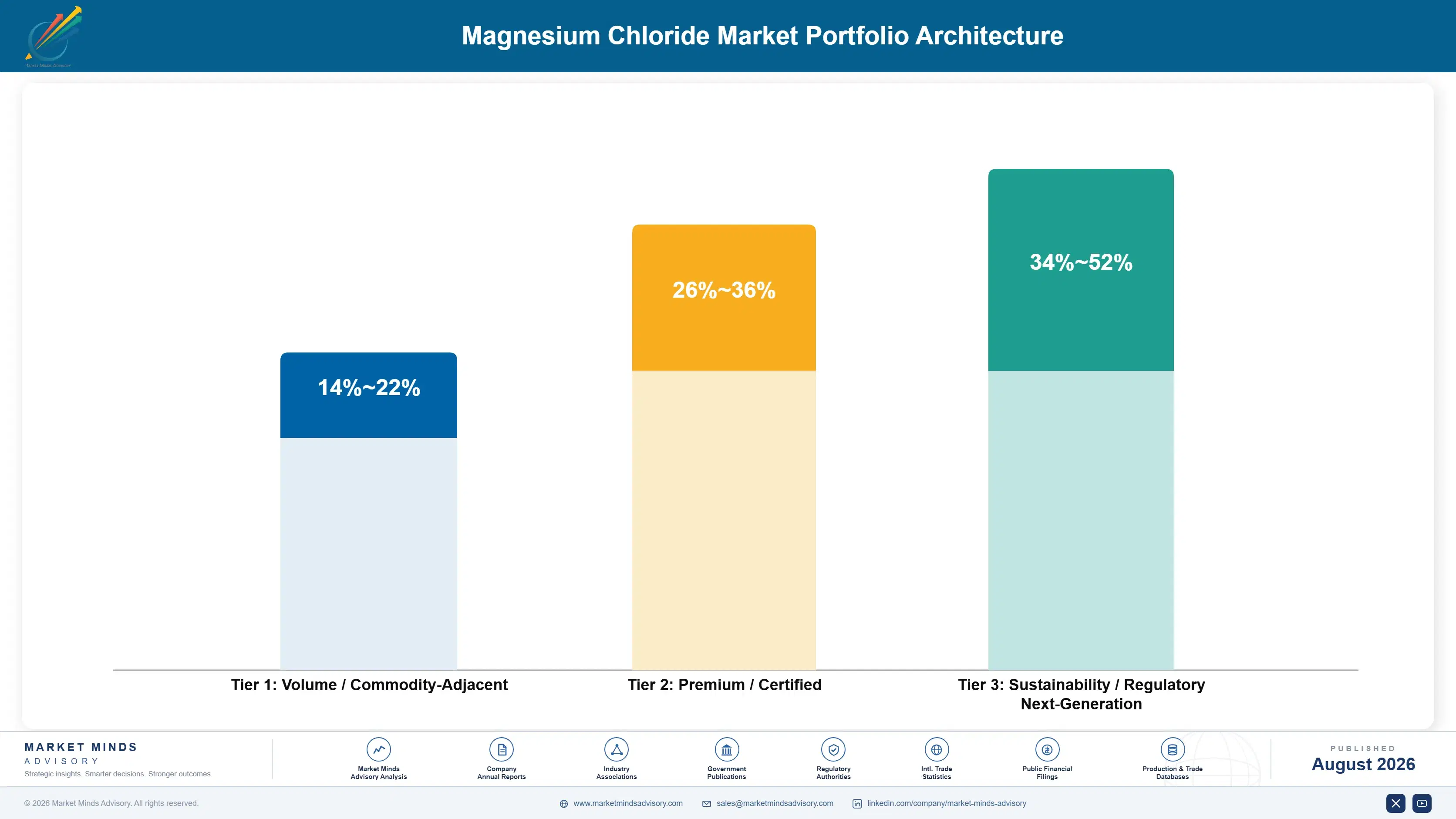
Portfolio Architecture for Margin Defence

Margin here tracks purity capability rather than production volume, and purity is decided by the resource more than by the plant. Technical grade flake and de-icing solution run at gross margins in the mid teens against every producer inside the freight radius, which is not far given how heavy the product is. Construction and agricultural grades run somewhat better on specification consistency. Food, pharmaceutical and anhydrous grades run considerably higher, because the resource and process barriers exclude most producers entirely.
The tension is that de-icing volume fills the ponds and speciality grades earn the returns, and the two demand completely different qualification and customer relationships. A producer serving road authorities on annual tenders has no obvious route into pharmacopoeial documentation and heavy metal control. Several have found the seasonal road business consuming the technical attention that speciality qualification required, which shows up as failed audits on exactly the grades carrying the margin.

High-value pools sit in food and pharmaceutical grade, anhydrous material for electrolysis and consistent construction grade. None of the three is where the tonnage is. Pond capacity by itself defends nothing as the largest application comes under regulatory pressure.

Volume / Commodity-Adjacent

Technical grade flake, de-icing solution and dust control material competed on delivered price within a short freight radius, since the product is heavy relative to its value. The eight-point range separates solar evaporation operations from thermal producers paying continuously for drying energy.
Gross Margin: 14%-22%

Premium / Certified

Construction and agricultural grades where sulphate and alkali control determine whether oxychloride board sets properly and holds up in service. The ten-point spread reflects resource purity, since contaminated brine limits what any amount of processing can deliver reliably.
Gross Margin: 26%-36%

Sustainability / Regulatory / Next-Generation

Food and pharmaceutical grade for consumer supplementation, and anhydrous material at 99.5% purity for electrolytic magnesium metal. The eighteen-point range is wide because both grades price against qualification scarcity rather than against any production cost benchmark.
Gross Margin: 34%-52%
magnesium-chloride-market-trends-portfolio-architecture-1787555388023

High-value Sub-segments and Strategic Watch-out

Food And Pharmaceutical Grade

Compounding at 8.4% on consumer supplementation that moved from niche nutrition to mainstream purchasing, and pricing at several multiples of technical material. Resource trace elements decide who can qualify, which no processing investment overcomes at all. Very few producers hold suitable brine chemistry. Plant investment cannot fix it.
Gross Margin: 38%-52%

Anhydrous Electrolytic Feedstock

Reaching 99.5% purity defeats most producers because heating the hydrate hydrolyses it, and carbon pressure on silicothermic magnesium metal could step-change this demand. Very few qualified suppliers exist, which is precisely the point of building it. Carbon pressure decides the timing rather than any demand forecast.
Gross Margin: 34%-50%

De-Icing And Dust Control Volume

Thirty-eight percent of tonnage under chloride runoff limits that no de-icer satisfies, with the environmental positioning of two decades no longer addressing what regulators measure. Manage this downward rather than defending it upward against a lost argument. Unregulated dust control demand is the honest replacement here.
Gross Margin: 14%-22%

Brine Resource Continuity

Great Salt Lake and Dead Sea levels are both falling for reasons no producer influences, and an 18 month evaporation cycle means responses take years. Alternative sourcing costs more per tonne and looks cheap the moment a primary resource fails. Alternative sourcing looks expensive right up until it does not.
Gross Margin: 20%-38%

How Chloride Demand Renews

Demand renews on three clocks that share nothing. Road treatment renews annually through tender and swings enormously with winter severity, which makes it both the largest application and the least predictable. Construction and agricultural grades renew with building and planting activity on multi-year patterns. Food, pharmaceutical and anhydrous grades renew through qualification, which locks a supplier in for years once documentation and audit history are established. Nothing connects the three.
Stickiness varies accordingly and inversely to volume. Pharmaceutical and anhydrous positions are close to permanent, since requalifying a supplier means repeating documentation and audit work nobody undertakes casually. Construction grade holds on performance history, because oxychloride board that fails in service is expensive and memorable. Road authority contracts change hands on delivered price at almost every tender without any relationship surviving it.

The buyer has diversified in a way most producers have not followed. This was a business selling to procurement officers at road authorities and industrial buyers weighing delivered cost. It increasingly includes supplement brand formulators checking heavy metal certificates and metal producers checking anhydrous specification, and neither of those has ever attended a de-icing tender. Neither buyer overlaps with the other at all.
magnesium-chloride-market-trends-end-use-penetration-index-1787555388512

Where To Place The Bet

These are among the four positions where our research anticipates prominent divergence between winners and laggards over the coming forecast period. Each is grounded in the demand model, the regulatory perimeter, and the announced capacity pipeline.
01 / SPECIALITY GRADE QUALIFICATION

Qualify pharmaceutical grade while it stays open

Consumer magnesium supplementation moved from a specialist nutritional concern into genuinely mainstream purchasing on sleep and anxiety positioning, and food and pharmaceutical grade now compounds at 8.4% while pricing at several multiples of technical material. The barrier is the resource rather than the plant, since brine carrying awkward trace elements cannot reach the grade regardless of how much processing gets applied to it. Producers holding clean resources who have not yet completed pharmacopoeial qualification are handing the highest-margin demand in this market straight to their competitors.
02 / ANHYDROUS PROCESS INVESTMENT

Build the difficult grade before demand arrives

Reaching 99.5% anhydrous purity is hard because heating the hexahydrate hydrolyses it into magnesium oxide and hydrogen chloride instead of drying it cleanly, which is exactly why the grade commands a premium and why very few producers serve it at all. Carbon pressure on the coal-fired silicothermic magnesium route is pushing metal production toward electrolysis, which consumes anhydrous feedstock and has almost no qualified supply base ready for it. Building the capability now positions a producer for a step change rather than for an incremental gain.
03 / DE-ICING DECLINE MANAGEMENT

Stop defending an argument already lost

Chloride runoff limits near 230 milligrammes per litre apply identically to magnesium chloride and to rock salt, which means the corrosion and application rate positioning that built this application over twenty years does not address the parameter regulators actually measure. Road authorities in affected jurisdictions are cutting total chloride applied rather than switching between salts, so no producer gains from the change. The useful response is serving dust control, mining and unregulated geographies while moving capital deliberately toward the grades that pay considerably more.
04 / RESOURCE CONTINUITY PLANNING

Assume the lake keeps falling and plan accordingly

Great Salt Lake levels have dropped far enough to affect brine chemistry and extraction economics, Dead Sea levels continue declining, and neither responds to anything a producer decides or spends. Solar pond operations that this industry treats as permanent infrastructure carry genuine resource risk, and an 18 month evaporation cycle means any response is measured in years rather than in months. Developing magnesite routes, bittern recovery or alternative inland brines costs more per tonne and becomes the only decision that mattered if a primary source fails.

Engagement Snapshot From the Field

A live engagement with an industry participant carrying material or product regulatory and market exposure ahead of a defining policy shift, showing how our research translates into a defensible multi-year portfolio strategy.
MARKET MINDS ADVISORY · CLIENT ENGAGEMENT SUMMARY
Magnesium Chloride Producer Strategic Portfolio Review and Transition Roadmap 2026·Investment Scenario on Magnesium Chloride Exposure Evaluation 2025-26
CLIENT PROFILE
A North American magnesium chloride producer with annual revenue around USD 118 million (client-reported, unverified by MMA), extracting from inland brine and supplying de-icing, dust control and technical grades. Roughly 70% of revenue came from winter road authority contracts. The business held no food or pharmaceutical qualification and no anhydrous capability whatever. Distribution served road authorities directly.
STRATEGIC CHALLENGE
Two state road authorities had cut chloride application volumes under water quality requirements (client-reported, unverified by MMA), and management proposed intensifying the environmental positioning that had historically won those contracts. Nobody had established that the regulation targets chloride itself rather than the cation, which made the proposed argument technically irrelevant to what was being measured.
MMA APPROACH
MMA established what the applicable water quality regulations actually measure rather than accepting the internal environmental positioning, and mapped exposure across the client's road authority customer base. Brine trace element composition was tested against pharmacopoeial requirements for food and pharmaceutical grade. Supplement formulator demand was sized through the expert interview programme, and dust control and mining demand was assessed as an unregulated alternative outlet.
KEY FINDINGS
  1. The applicable regulation limits total chloride in receiving waters without distinguishing cation, which meant the client's twenty year environmental positioning addressed nothing the regulator was measuring at all.
  2. Roughly half the road authority revenue sat in jurisdictions with active or proposed chloride limits, putting a materially larger share at risk than management had assumed.
  3. The client's brine trace element profile met pharmacopoeial requirements without additional purification, which meant food and pharmaceutical qualification was achievable within eighteen months.
  4. Mining and unpaved road dust control demand in the western states faced no equivalent chloride restriction and was growing steadily without any commercial attention from the client.
CLIENT PROFILE
A North American magnesium chloride producer with annual revenue around USD 118 million (client-reported, unverified by MMA), extracting from inland brine and supplying de-icing, dust control and technical grades. Roughly 70% of revenue came from winter road authority contracts. The business held no food or pharmaceutical qualification and no anhydrous capability whatever. Distribution served road authorities directly.
STRATEGIC CHALLENGE
Two state road authorities had cut chloride application volumes under water quality requirements (client-reported, unverified by MMA), and management proposed intensifying the environmental positioning that had historically won those contracts. Nobody had established that the regulation targets chloride itself rather than the cation, which made the proposed argument technically irrelevant to what was being measured.
MMA APPROACH
MMA established what the applicable water quality regulations actually measure rather than accepting the internal environmental positioning, and mapped exposure across the client's road authority customer base. Brine trace element composition was tested against pharmacopoeial requirements for food and pharmaceutical grade. Supplement formulator demand was sized through the expert interview programme, and dust control and mining demand was assessed as an unregulated alternative outlet.
KEY FINDINGS
  1. The applicable regulation limits total chloride in receiving waters without distinguishing cation, which meant the client's twenty year environmental positioning addressed nothing the regulator was measuring at all.
  2. Roughly half the road authority revenue sat in jurisdictions with active or proposed chloride limits, putting a materially larger share at risk than management had assumed.
  3. The client's brine trace element profile met pharmacopoeial requirements without additional purification, which meant food and pharmaceutical qualification was achievable within eighteen months.
  4. Mining and unpaved road dust control demand in the western states faced no equivalent chloride restriction and was growing steadily without any commercial attention from the client.
RECOMMENDED STRATEGY
Phase 1: Phase one: stop funding the environmental positioning campaign and redirect that spend toward pharmacopoeial qualification of the existing brine stream. Phase 2: Phase two: build direct commercial presence with supplement formulators and contract manufacturers, who have never been approached by this business. Phase 3: Phase three: pursue mining and unpaved road dust control demand in unregulated geographies to replace road authority volume as it declines.
OUTCOME
The positioning campaign was cancelled and pharmacopoeial qualification is under way with completion expected in 2027. Two supplement formulator relationships are in development. Dust control revenue has grown materially, and the client reports total volume holding despite road authority declines (client-reported, unverified by MMA). Road exposure keeps shrinking.

Frequently Asked Questions

Foundational context covering the market sizes, CAGR, scope, country, region and competition that inform every finding below. This section is provided to cover basics and most often pre-purchase conversations, answered from the MMA Primary Research Dataset.

What is the current size of the Magnesium Chloride Market?

The market was valued at USD 1.9 billion in 2025, rising to an estimated USD 2.01 billion in 2026. East Asia holds the largest regional share at 30% of value.

How large will the Magnesium Chloride Market be by 2036?

MMA forecasts USD 3.46 billion by 2036 under the base case, an expansion multiple of 1.72 times the 2026 value. That represents USD 1.45 billion of incremental value.

What is the CAGR for the Magnesium Chloride Market 2026 to 2036?

The base case runs at 5.6% compound annual growth between 2026 and 2036, with a bull case at 6.8% and a bear case at 4.4%. Historical growth from 2020 to 2025 was 4.4%.

Which segment is growing fastest?

Food and pharmaceutical grade leads at 8.4%, half again the market rate, on consumer magnesium supplementation for sleep and anxiety. Construction grade follows at 6.5%.

Who are the major companies in the Magnesium Chloride Market?

ICL Group, Compass Minerals, K plus S Group, Nedmag and Qinghai Salt Lake Industry hold 41% between them. Resource quality rather than production scale sustains those positions.

Which country is growing fastest?

India leads at 8.8%, driven by oxychloride board manufacture expanding with construction volume and rising urban magnesium supplementation. Domestic bittern supply keeps input costs low.

Report Segmentation Architecture

The full report scope spans multiple orthogonal segmentation dimensions, with cross-tabulated demand data provided for each dimension pair. Coverage extends further to regional breakdowns, trend trajectories, and the competitive detail needed to support segment-level decision-making.

By Product Specification

  • Technical Grade Flake
  • Technical Grade Solution and Brine
  • Anhydrous Magnesium Chloride
  • Food and Pharmaceutical Grade
  • High-Purity Construction Grade
  • Agricultural and Feed Grade

By End-Use Industry

  • Winter Road and Dust Control
  • Oxychloride Cement and Board
  • Magnesium Metal Production
  • Food Processing and Supplements
  • Agriculture and Animal Feed
  • Oilfield and Industrial Processing

By Distribution Arrangement

  • Direct Industrial Supply
  • Road Authority Tender Contract
  • Chemical Distributor Channel
  • Bulk Trading and Export
  • Contract Manufacturing Supply

By Region

  • North America
  • Western Europe
  • East Asia
  • South Asia and Pacific
  • Latin America
  • Middle East and Africa
  • Eastern Europe

Scope, Methodology, and Coverage

Every figure in this report is reproducible from documented input assumptions. The scope below maps the historical period, the forecast horizon, the segmentation dimensions, and the countries covered, alongside the underlying primary and qualitative methodology.
Historical Period
2020 to 2025
Forecast Period
2026 to 2036
Base Year
2025 (USD billions; MMA Primary Research Dataset, August 2026)
Market Definition
The market comprises magnesium chloride supplied in all commercial specifications from salt lake brine, seawater bittern, inland deposits and magnesite sources across road treatment, construction, metal production, food, agricultural and industrial applications, covering technical grade flake, technical grade solution and brine, anhydrous magnesium chloride, food and pharmaceutical grade, high-purity construction grade, and agricultural and feed grade. Value is measured at producer level on magnesium chloride equivalent tonnage. Magnesium oxide and magnesia refractories, magnesium metal, magnesium sulphate and other magnesium salts, and finished supplement or construction products fall outside scope.
Quantitative Units
USD billions (current prices); million tonnes magnesium chloride equivalent supplied annually; USD per tonne by product specification
Segmentation Dimensions
By Product Specification; By End-Use Industry; By Distribution Arrangement; By Region
Regions Covered
North America, Western Europe, East Asia, South Asia and Pacific, Latin America, Middle East and Africa, Eastern Europe
Countries Covered
China, Japan, South Korea, Taiwan, India, Indonesia, Thailand, Australia, New Zealand, United States, Canada, Mexico, Germany, Netherlands, France, United Kingdom, Norway, Sweden, Finland, Austria, Poland, Czechia, Estonia, Latvia, Brazil, Chile, Peru, Israel, Jordan, South Africa
Key Companies Profiled
ICL Group, Compass Minerals, K plus S Group, Nedmag, Qinghai Salt Lake Industry, Nikomag, Weifang Yuze Chemical, Weifang Haibin Chemical, Tianjin Changlu Haijing Group, Grecian Magnesite, Premier Magnesia, RHI Magnesita, Ube Material Industries, Konoshima Chemical, Baymag, Sinomag Technology, Magnesium Elektron, Intrepid Potash, Kali Extraktion, SQM
Quantitative Methodology
Primary survey, n=3,800 respondents, Q4 2025, six countries; demand-side model with trade association cross-validation
Qualitative Methodology
47 expert interviews, Q4 2025; applied to validate demand model assumptions, identify emerging dynamics, and assess competitive positioning
Report Format
PDF and XLSX data workbook (Word format preview document)
Publisher
Market Minds Advisory
Report Code
MMA-2026-CHM-602
Published
August 2026
Contact
sales@marketmindsadvisory.com | www.marketmindsadvisory.com

Purchase the full Magnesium Chloride Market Report (2026 to 2036).

The full report sizes the global magnesium chloride market to 2036 across six product specifications and seven regions, measured on magnesium chloride equivalent tonnage at producer level. It treats chloride runoff regulation as an application-level threat rather than a competitive one and quantifies exposure by jurisdiction. Competitive analysis covers 20 participants evaluated on tonnage supplied, with moat and risk assessment for the two leaders. Brine resource decline at the Great Salt Lake and Dead Sea is assessed as a supply variable rather than treated as permanent infrastructure. Four quantified revenue levers close the analysis.
Six-specification segment sizing with segment-level growth rates
Seven-region share and growth breakdown to 2036
Twenty-participant competitive map on one tonnage basis
Chloride runoff exposure quantified by regulatory jurisdiction
Brine resource decline assessed as a supply variable
Four quantified revenue levers with commercial impact ranges

Built For The People Who Decide

From boardroom strategy to bench-side execution, this report is read cover-to-cover by leaders shaping the next decade of their industry, turning demand scenarios, market dynamics and valuation benchmarks into decisions.
CXOs/ Presidents/ VPs/ Managers
M&A and Corporate Development
Strategy Teams and R&D Heads
Procurement and Product Directors
Regulatory and Compliance Leaders
Investor Relations and Equity Analysts