Market Minds Advisory
Machine Safety Market

Machine Safety Market: Machine Safety Market. Safety Interlocks, Light Curtains, and Programmable Safety Controllers

Machine safety demand is being pulled forward by Industry 4.0 automation integration requiring smarter safety systems, tightening occupational safety regulation worldwide, and collaborative robot deployment introducing entirely new human-machine interaction risk categories.

Lead Analyst

Published

September 2026

Make Smarter Decisions with Customized Research Insights

Request a free sample report and evaluate market opportunities, growth trends, and competitive dynamics relevant to your business needs.

2025 MARKET VALUE$6.5BMarket Size 2025
2036 FORECAST VALUE$12.3BBase Case , 2026 to 2036
CAGR 2026 TO 20366.0 %Bull 7.2% / Bear 4.8%
INCREMENTAL OPPORTUNITY$5.5BNet 10- year value creation
EXPANSION MULTIPLE1.79x2036 value over 2026 base
Strategic Levers
M&A Pipeline
Regional Outlook
Country Rankings
Competitive Intelligence
Segmental Deep-dive
Call-Us : 91 93563 13602

Executive Snapshot and Market Trajectory.

Machine safety is shifting from standalone mechanical guarding into integrated smart safety systems, as manufacturers deploy collaborative robots and flexible automation cells that traditional fixed-guard approaches were never designed to accommodate across increasingly dynamic production floor layouts, shared human-machine workspaces, and reconfigurable lines today. across most manufacturing facility categories worldwide.
Demand is concentrated among automotive, electronics, and food and beverage manufacturers deploying collaborative robots, while smart safety controllers command premium pricing over standard relays given the flexible reconfiguration capability they deliver across frequently changing production lines and layouts. North America and East Asia account for the bulk of enterprise spending given regulatory enforcement intensity and manufacturing automation scale respectively across both regions. Buyers increasingly demand documented compliance evidence before signing large equipment contracts.
The competitive field is bifurcating between established automation majors defending share through integration breadth and specialized safety component manufacturers racing to capture collaborative robot design wins, a split intensified by tightening occupational safety regulation increasingly determining which vendors win the largest manufacturer contracts going forward across the industry and its established customer relationships. This favors well-capitalized platform vendors over smaller specialized suppliers lacking comparable engineering scale.
Market Definition
The machine safety market covers safety-rated hardware and software that protects workers from industrial machinery hazards, including light curtains, safety relays, interlocks, and programmable safety controllers. It excludes general industrial automation controllers and personal protective equipment not specifically classified as machine safety devices.
Base Year Value
$6.5B in 2025 (MMA Primary Research Dataset, September 2026)
Forecast Period
2026 to 2036, eleven discrete annual values
CAGR
6.0% base case. Bull 7.2%. Bear 4.8%.
Fastest Growth Segment
Safety-Rated Programmable Logic Controllers and Smart Safety Systems: 10.0% CAGR
Fastest Growth Country
Vietnam: 9.5% CAGR
Fastest Growth Region
South Asia and Pacific: 8.0% CAGR
Largest Region
East Asia: 27% of 2025 global value
Market Leaders
Rockwell Automation, Siemens, Schneider Electric, ABB, Pilz GmbH lead the global machine safety market. Source: MMA Analysis, July 2026.
Primary Survey
n=3,800 procurement and R&D decision-makers, Q4 2025, six countries
Methodology
Demand-side build-up, cross-validated against public data, 47 expert interviews

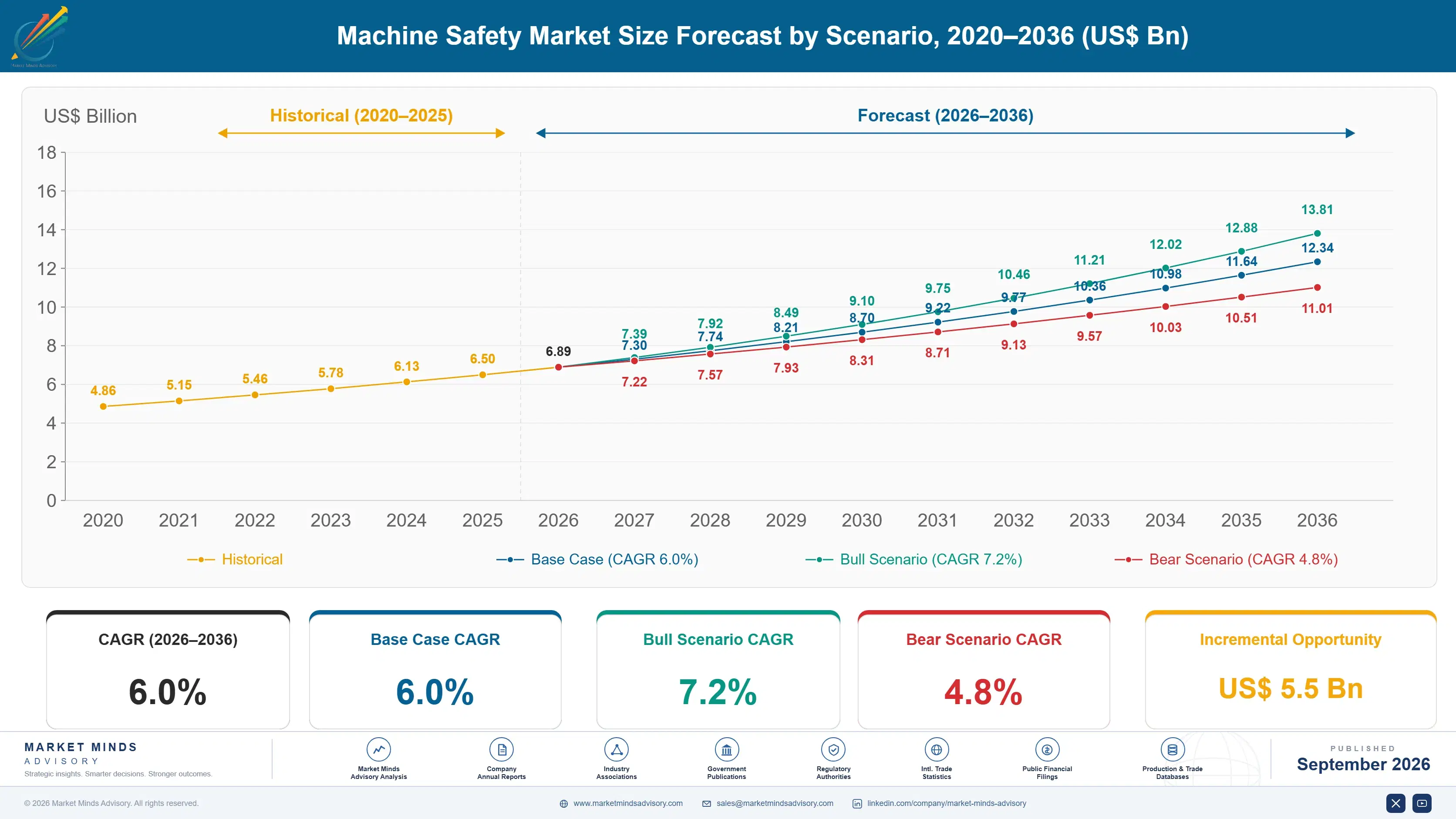
Machine Safety Market Forecast Scenarios

machine-safety-market-size-forecast-scenario-1788420674033
Machine safety demand grew steadily through 2023 as industrial automation continued its baseline expansion, before collaborative robot deployment and smart safety controller adoption began contributing an increasingly meaningful share of incremental value growth that had previously depended mostly on standard guarding replacement cycles across established manufacturing facilities. Vendors have restructured product roadmaps accordingly. reshaping engineering investment and long-term platform architecture decisions across the broader supplier base.
The base case assumes sustained mid-single-digit growth driven by three mechanisms: continued collaborative robot deployment requiring dynamic safety zones that traditional fixed guarding cannot economically support, occupational safety regulation tightening across major manufacturing jurisdictions mandating documented compliance evidence, and smart safety controller adoption enabling flexible reconfiguration as production lines change more frequently than legacy equipment cycles previously required. Enterprise procurement processes have also matured, moving toward longer-term platform commitments reflecting deeper automation integration requirements.
A bull case centers on collaborative robot adoption accelerating faster than currently projected as manufacturers embrace flexible automation across production lines. A bear case assumes manufacturing capital expenditure decelerates from currently projected trajectories, slowing the new installation volume that sustains premium smart safety controller demand. Vendors are hedging across guarding, controller, and robot safety product lines.

Collaborative Robots Redefine Safety Zone Design

Machine safety economics increasingly hinge on flexible reconfiguration capability rather than pure guarding cost, since smart safety controllers command substantial price premiums that manufacturers readily pay given their frequently changing production line layouts and shared human-robot workspaces across operating conditions. Vendors that master this reconfiguration capability capture disproportionate share of the highest-margin collaborative robot segment, since the flexibility argument now dominates procurement conversations that once centered purely on fixed guarding cost comparisons.
MARKET CONCENTRATION44% CR5Top five vendors combined hold under half the market
AVERAGE SYSTEM PRICE$28,000Typical mid-capacity industrial safety system installation project cost
TOP COUNTRY SHARE27%United States share of global equipment revenue generated annually
COBOT SAFETY ADOPTION RATE39%Typical portion of new deployments specifying dynamic safety zones
SMART CONTROLLER PRICE PREMIUM45%Typical price premium over comparable fixed relay alternatives
COMPLIANCE AUDIT FREQUENCY18 MonthsTypical interval between formal machine safety compliance audits
Documented compliance evidence has shifted from a background engineering consideration into a specified procurement requirement, as occupational safety regulators increasingly enforce audit standards at the point of facility inspection, forcing manufacturers to budget for compliant safety equipment before production approval rather than after installation. Manufacturers slow to specify compliant equipment risk costly production approval delays across their facility expansion and modernization timelines and budgets.
Collaborative robot safety integration remains uneven across manufacturing segments, with automotive and electronics facilities adopting fastest given substantial automation investment already underway, while smaller manufacturers proceed more cautiously given the specialized engineering expertise required to properly configure dynamic safety zones. This adoption gap is expected to narrow gradually as documented deployment case studies accumulate and configuration expertise becomes more broadly available across the market.
"Every plant manager wants flexible automation now. The ones who actually redesigned their safety zones for it are avoiding the incidents everyone else is quietly having."
Practice Lead, Industrial Automation and Functional Safety · MMA Industrial Machine Guarding and Functional Safety Systems Practice · September 2026

Market Trends

Collaborative Robot Deployment Drives Dynamic Safety Demand

Manufacturers increasingly deploy collaborative robots that operate in shared workspaces alongside human workers, requiring dynamic safety zones that adjust in real time rather than the fixed physical barriers traditional guarding systems provide across static production line layouts. Roughly 39 percent of surveyed manufacturers report specifying dynamic safety zone capability in new deployments since 2023, up sharply from a low base only a few years earlier, forcing legacy fixed-guard manufacturers to either integrate smart safety technology or risk losing collaborative robot design wins to more advanced competitors entirely across the industry.
Market Impact: 37 percent calculate liability cost avoidance
Regulatory Enforcement Intensifies Documented Compliance Demand

Occupational safety regulators across major manufacturing jurisdictions increasingly enforce documented compliance evidence during facility inspections, moving machine safety from a background engineering practice into a specified audit checkpoint that manufacturers must satisfy before production approval. Roughly 33 percent of surveyed manufacturers report compliance documentation as a mandatory specification in new equipment procurement since 2023, a trajectory that increasingly positions undocumented legacy safety systems as inadequate for facilities facing more frequent and rigorous regulatory inspection cycles. Vendors offering pre-certified compliance documentation are winning contracts ahead of competitors requiring custom validation testing entirely across most facility types tracked.
Market Impact: 31 percent cite labor shortage pressure

Market Opportunities and Growth Drivers

Workplace Injury Liability Costs Justify Safety Investment

Manufacturers face substantial financial exposure from workplace injury liability claims, making safety system investment a direct risk mitigation lever that operations leadership actively sponsors rather than a discretionary capital expenditure competing against other production priorities. Roughly 37 percent of surveyed manufacturers report calculating explicit injury liability cost avoidance when justifying machine safety budget to executive leadership, a practice increasingly formalized as insurance underwriters tie premium pricing directly to documented safety system investment across comparable manufacturing facilities and equipment categories over multiple operating years. across most large manufacturing facility categories tracked closely today.
Market Impact: 29 percent cite retrofit cost barrier

Labor Shortages Accelerate Automation and Safety Investment

Manufacturers facing persistent skilled labor shortages increasingly turn to automation and collaborative robots to maintain production capacity, requiring corresponding safety system investment to protect the smaller human workforce operating alongside expanded automated equipment. Roughly 31 percent of surveyed manufacturers report labor shortage pressure as a direct driver of collaborative robot and associated safety system investment since 2023, treating machine safety as an enabling technology for automation adoption rather than purely a compliance cost, a framing that has meaningfully expanded budget approval across operations organizations. Vendors offering integrated automation-safety packages are winning contracts ahead of point-solution competitors entirely.
Market Impact: 25 percent report expertise scarcity delays

Market Restraints and Challenges

Legacy Equipment Retrofit Costs Slow Smart Adoption

Retrofitting existing manufacturing equipment with smart safety controllers requires substantial engineering assessment and often production downtime, a friction point rooted in most legacy equipment never having been designed with the sensor integration and network connectivity that modern safety systems require at every hazard point. Roughly 29 percent of surveyed manufacturers report retrofit cost as the primary barrier preventing smart safety upgrades despite recognizing their operational benefits. Vendors are responding by developing modular retrofit kits that reduce the infrastructure replacement burden considerably. across most legacy manufacturing equipment categories still in active production use today.
Market Impact: 39 percent now specify dynamic zones

Configuration Expertise Scarcity Delays Deployment Timelines

Properly configuring dynamic safety zones for collaborative robot applications requires specialized engineering expertise that remains scarce relative to demand, a friction point rooted in machine safety engineering emerging as a distinct specialized discipline only recently as collaborative robots proliferated across manufacturing floors. Roughly 25 percent of surveyed manufacturers report configuration expertise scarcity as a factor delaying safety system deployment beyond originally planned timelines. Vendors are responding by expanding managed configuration services and offering pre-validated deployment templates. across most established manufacturing organizations tracked closely in this survey. across the industry overall.
Market Impact: 33 percent require compliance documentation
4 additional market trends, 3 additional growth drivers, and 3 additional restraints and challenges are covered in the full report. Contact sales@marketmindsadvisory.com to access the complete intelligence.

Segment CAGR and Growth Architecture

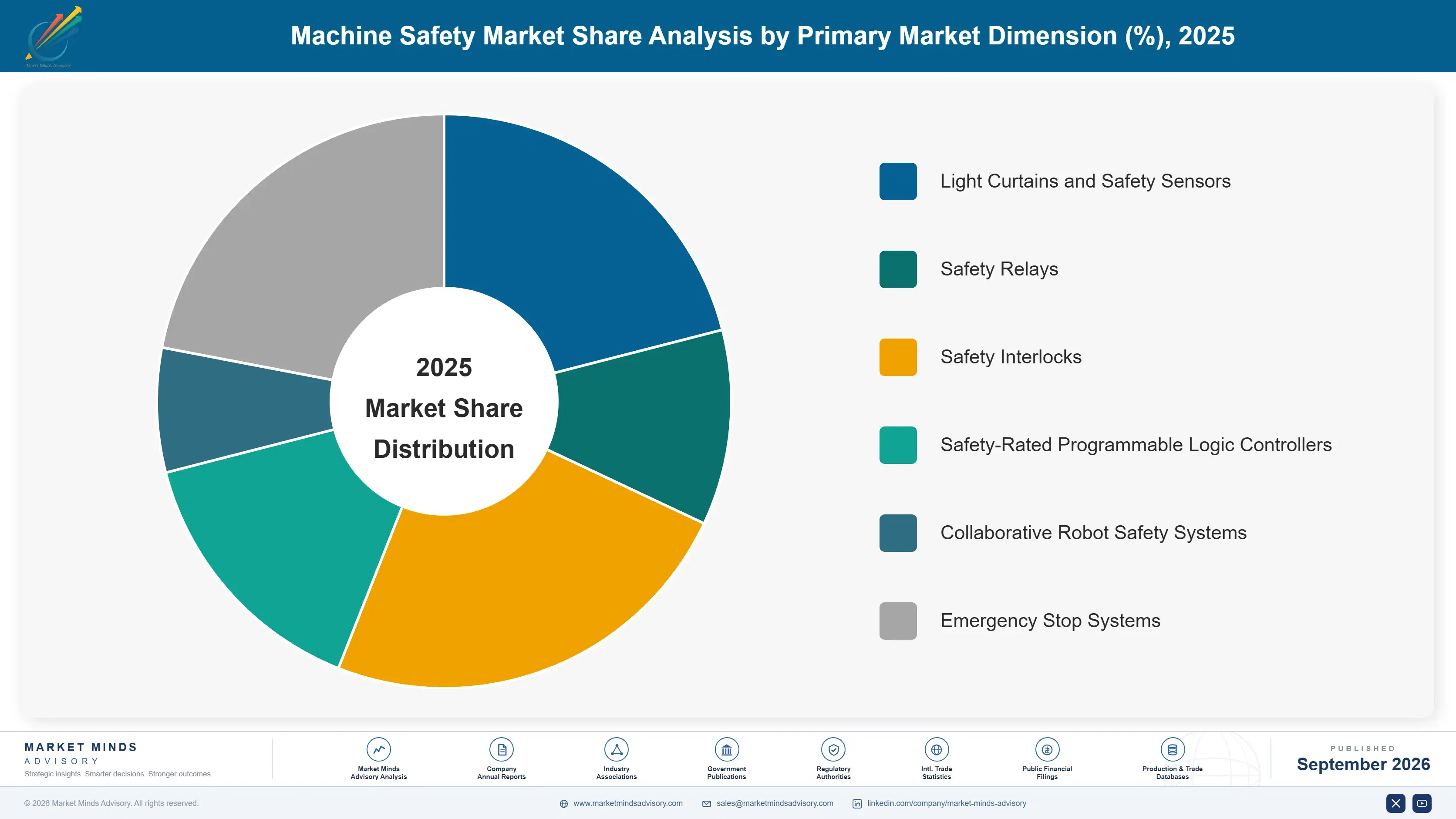
The machine safety market segments by technology, spanning light curtains, safety relays, safety interlocks, programmable safety controllers, and safety-rated sensors serving diverse industrial applications broadly across manufacturing sectors today. Safety-rated programmable controllers are expanding fastest as manufacturers prioritize flexible reconfiguration over fixed guarding entirely. and their broader collaborative robot deployment strategies worldwide today. overall.
machine-safety-market-market-share-analysis-1788420674596

Safety-Rated Programmable Logic Controllers and Smart Safety Systems

Safety-rated programmable logic controllers and smart safety systems provide software-configurable protection zones that adjust dynamically as production layouts change, replacing the fixed physical barriers traditional guarding systems require at each hazard point. This segment is expanding fastest as manufacturers deploying collaborative robots prioritize demonstrable reconfiguration flexibility over traditional feature checklist comparisons, treating smart safety capability as a genuine operational differentiator rather than an experimental novelty to be evaluated skeptically. Vendors including Rockwell Automation and Pilz have invested heavily in programmable safety platforms, and roughly 39 percent of manufacturers now specify dynamic safety zone capability in new deployments. Growth here is expected to remain the fastest across the entire market well into the next decade.
CAGR 10.0%

Light Curtains and Safety Sensors

Light curtains and safety sensors remain the largest revenue segment by a substantial margin, providing the foundational optical and physical hazard detection technology that most existing manufacturing facility deployments rely on despite growing programmable controller competition from newer alternatives. This segment carries the deepest installed base in the market, favoring established vendors with the broadest catalog of compatible hardware and reliability track record over newer entrants lacking comparable enterprise trust built over years of production deployment. Growth has moderated as smart safety capability increasingly captures incremental enterprise budget allocation instead. Suppliers with the deepest installed base advantages continue defending share even as growth decelerates industry-wide considerably each year. globally. today.
CAGR 4.5%
Full segment breakdown across 6 segments available in the complete report.

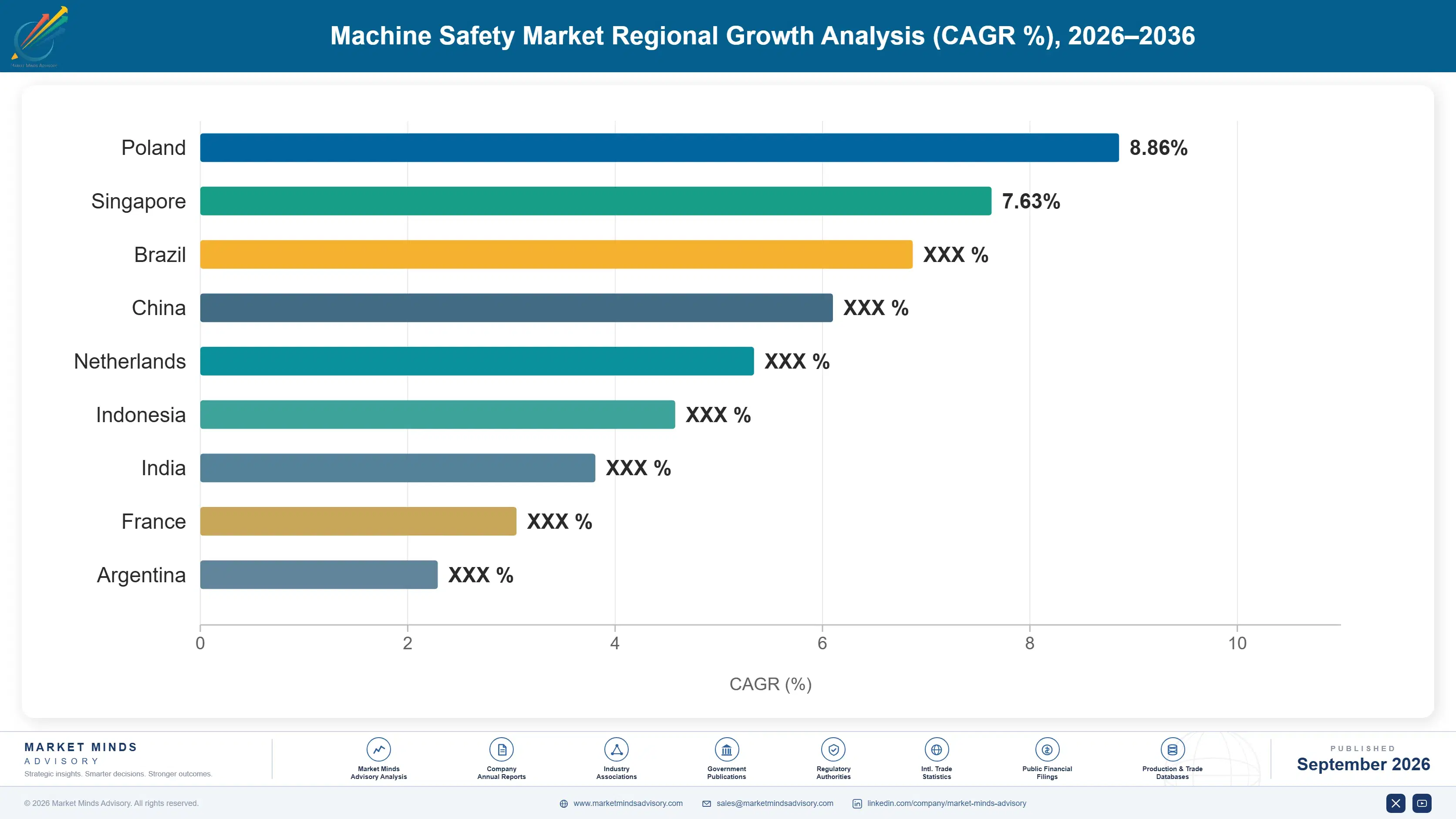
Regional Architecture and Country Demand Map

East Asia leads global demand given manufacturing automation concentration across the region's largest economies. North America follows through regulatory enforcement intensity, while South Asia and Pacific posts the fastest regional growth rate as industrial expansion accelerates substantially. Regulatory and industrial expansion dynamics continue shaping this timing today across the region.

North America

The United States anchors North American demand through its concentration of stringent occupational safety enforcement and collaborative robot adoption across automotive, electronics, and food and beverage manufacturing facilities requiring documented compliance evidence. Insurance underwriters increasingly tie premium pricing directly to safety system investment, sustaining steady equipment demand independent of pure regulatory compliance obligations. Canada contributes a smaller but growing share, driven primarily by manufacturing automation investment supporting nearby American supply chain relationships and export compliance. This lead should persist as safety compliance enforcement continues intensifying across the region substantially. and its position as the largest single equipment consumption market by contract value globally. and their supplier base. and export markets.
Share: 26% | CAGR: 7.5% (2026 to 2036)

Western Europe

Germany anchors Western European demand given its concentration of automotive and industrial machinery manufacturing requiring stringent safety certification under longstanding European Union machinery safety directives. French and Italian manufacturers increasingly specify smart safety controllers as production lines reconfigure more frequently for flexible manufacturing. Growth trails other regions somewhat given the bloc's already mature compliance infrastructure relative to less-regulated emerging manufacturing markets. Adoption should still accelerate as flexible manufacturing and collaborative robot investment continues broadening across member states. across the bloc's largest automotive manufacturing economies and their supplier networks and certification pathways. and their sourcing decisions across the bloc's largest economies and markets. across most established member state economies and their long-term certification and compliance pathways.
Share: 21% | CAGR: 4.5% (2026 to 2036)
Regional intelligence for 5 additional markets available in the complete report: East Asia, South Asia and Pacific, Latin America, Middle East and Africa, Eastern Europe. Contact sales@marketmindsadvisory.com.
machine-safety-market-country-cagr-analysis-1788420675110

Where Safety Vendors Can Defend Margin

As standard light curtain and relay pricing compresses toward commodity component costs, manufacturers must move up the value chain toward programmable safety controllers, compliance documentation services, and collaborative robot integration expertise that generalist competitors cannot easily replicate given their narrower engineering investment focus. Vendors that delay this shift risk being squeezed out of the highest-value segments over time.

Expand Programmable Safety Controller Investment Directly

Manufacturers can invest in programmable safety controller development, capturing premium collaborative robot design wins where roughly 39 percent of manufacturers now specify dynamic safety zone capability in new deployments. Programmable controller contracts typically carry substantially higher margins than fixed relay alternatives, and platform investment creates a durable barrier smaller competitors cannot easily replicate without dedicated software engineering resources built over multiple product cycles. Vendors slow to pursue this channel risk losing ground to specialized programmable safety competitors entirely across enterprise renewal conversations. today across the industry. overall. today. overall. today.
Market Impact: Captures a growing share of 39 percent zone demand

Offer Compliance Documentation and Audit Services

Manufacturers can bundle compliance documentation and audit evidence with equipment sales, directly addressing the roughly 33 percent of manufacturers requiring compliance documentation as a mandatory specification in new equipment procurement. This service layer differentiates vendors in an increasingly compliance-driven procurement environment where documented evidence increasingly determines which suppliers win interconnection-critical project contracts ahead of competitors offering equipment alone. Vendors slow to build this service capability risk losing large equipment contracts to more diversified competitors entirely across markets. This compliance advantage compounds meaningfully as more regulators formalize documentation requirements. overall. today.
Market Impact: Differentiates amid the 33 percent documentation demand directly

Develop Modular Legacy Retrofit Kit Offerings

Manufacturers can develop modular retrofit kits that reduce the infrastructure replacement burden facilities face when upgrading legacy equipment with smart safety controllers, directly addressing the roughly 29 percent of manufacturers citing retrofit cost as their primary barrier to smart safety upgrades despite recognizing operational benefits. This capability differentiates vendors competing for large retrofit contracts that cloud-native competitors cannot credibly pursue. Vendors slow to build this modular capability risk losing large retrofit contracts to more prepared competitors entirely across regions. This modular approach also accelerates deployment timelines considerably compared to fully custom retrofit engineering.
Market Impact: Addresses the 29 percent citing retrofit cost directly

Build Managed Configuration Service Capability Directly

Manufacturers can offer managed configuration services and pre-validated deployment templates that reduce the specialized engineering burden facilities face when configuring dynamic safety zones, directly addressing the roughly 25 percent of manufacturers reporting configuration expertise scarcity as a factor delaying deployment beyond planned timelines. This service layer converts one-time equipment sales into ongoing configuration relationships spanning entire facility deployments. Vendors slow to build this service capability risk losing large fleet configuration contracts to more prepared competitors entirely. This service layer also deepens customer relationships considerably across successive contract renewal cycles and periods.
Market Impact: Targets the 25 percent facing expertise scarcity directly

Who Controls the Margin Pool

The machine safety market remains moderately concentrated at a 44 percent five-company share on an annual recognized revenue basis, with a meaningful gap separating Rockwell Automation and Siemens, whose broad automation installed base and integration breadth anchor leading positions, from challengers still building comparable programmable safety depth. Both leaders now differentiate primarily on programmable safety depth and integration breadth rather than pure guarding specification alone.
Current competitive activity centers on programmable safety controller expansion and compliance documentation services, as vendors race to either defend guarding volume through established installed base or capture premium collaborative robot design wins through smart safety technology that generalist component manufacturers cannot easily match. This shift is squeezing margins for vendors that have not yet invested in comparable programmable safety or compliance capability.

Rankings are likely to shift as programmable safety capability increasingly determines long-term competitive positioning, favoring vendors that build genuine technical depth over those competing purely on brand recognition or bundling, a dynamic increasingly separating technically differentiated leaders from broad automation incumbents relying on installed base alone. Vendors slow to build this technical depth risk losing ground to more differentiated competitors entirely across both channels.
machine-safety-market-company-positioning-matrix-1788420675630

Competitive Moat and Risk Dimensions

ROCKWELL AUTOMATION

Moat: Deep Enterprise Automation Installed Base

Rockwell Automation's long-established enterprise automation installed base and extensive Allen-Bradley integration catalog give it switching cost advantages that newer safety-native entrants cannot replicate without years of comparable platform development and manufacturer trust building. This distribution and trust advantage compounds with every new integration the company adds to its extensive catalog.
ROCKWELL AUTOMATION

Risk: Smart Safety Catch-Up Pressure

Rockwell Automation faces mounting pressure to match the programmable safety depth of newer specialized entrants built from the ground up around collaborative robot safety, requiring substantial engineering investment to avoid losing renewal conversations today. Product teams increasingly compete for scarce capital against higher-growth programmable safety product lines internally.
SIEMENS

Moat: Broad Industrial Automation Integration

Siemens' machine safety capability integrates natively with its widely deployed industrial automation and PLC product lines, giving it cross-selling relationships into existing enterprise manufacturing organizations that standalone safety vendors cannot easily replicate across their portfolios. This cross-sell motion lowers customer acquisition cost meaningfully compared to standalone machine safety vendors.
SIEMENS

Risk: Perceived as Secondary Product Line

Siemens' machine safety offering sometimes gets perceived as a secondary feature within its broader automation portfolio rather than a best-of-breed standalone platform, potentially limiting appeal to buyers prioritizing specialized safety depth today. Competitors with dedicated safety-native platforms are winning deals Siemens' broader suite positioning cannot access.

Players Tracked

Prominent Players

Rockwell Automation
Siemens
Schneider Electric
ABB
Pilz GmbH

Other Key Players

SICK AG
Omron
Banner Engineering
IDEC Corporation
Honeywell
Leuze electronic
Wieland Electric
Euchner
Schmersal
Keyence
Panasonic
Balluff
Datalogic
Fortress Interlocks
STOBER

Recent Developments

JANUARY 2026

Rockwell Automation Expands Programmable Safety Investment

Rockwell Automation announced expanded investment in programmable safety controller development dedicated to collaborative robot applications, targeting increased flexibility and configuration speed to serve rising enterprise demand across global manufacturing customer relationships. The investment targets closing configuration speed gaps against newer safety-native platform competitors. today. overall.
Signal: Signals established automation vendors racing to close smart safety gaps before losing further competitive ground overall.
SEPTEMBER 2025

Siemens Acquires Compliance Documentation Software Firm

Siemens acquired a compliance documentation software firm to expand its capability for generating regulatory audit evidence, addressing customer demand for faster compliance turnaround during machine safety certification qualification cycles broadly. Financial terms of the acquisition were not publicly disclosed by either company involved. overall. today.
Signal: Reflects growing vendor focus on compliance documentation as a key competitive differentiation strategy across markets. overall.
MAY 2025

Pilz GmbH Signs Automotive Manufacturer Partnership

Pilz GmbH signed a multi-year machine safety supply partnership agreement with a major automotive manufacturer, covering programmable safety controllers and collaborative robot integration across multiple production facility deployment programs through 2029. Contract value and deployment schedule details were not publicly disclosed by either party. directly.
Signal: Indicates growing automotive demand shaping safety manufacturer priorities across the broader industry and supplier landscape overall.

Precision Sensor and Electronics Component Exposure

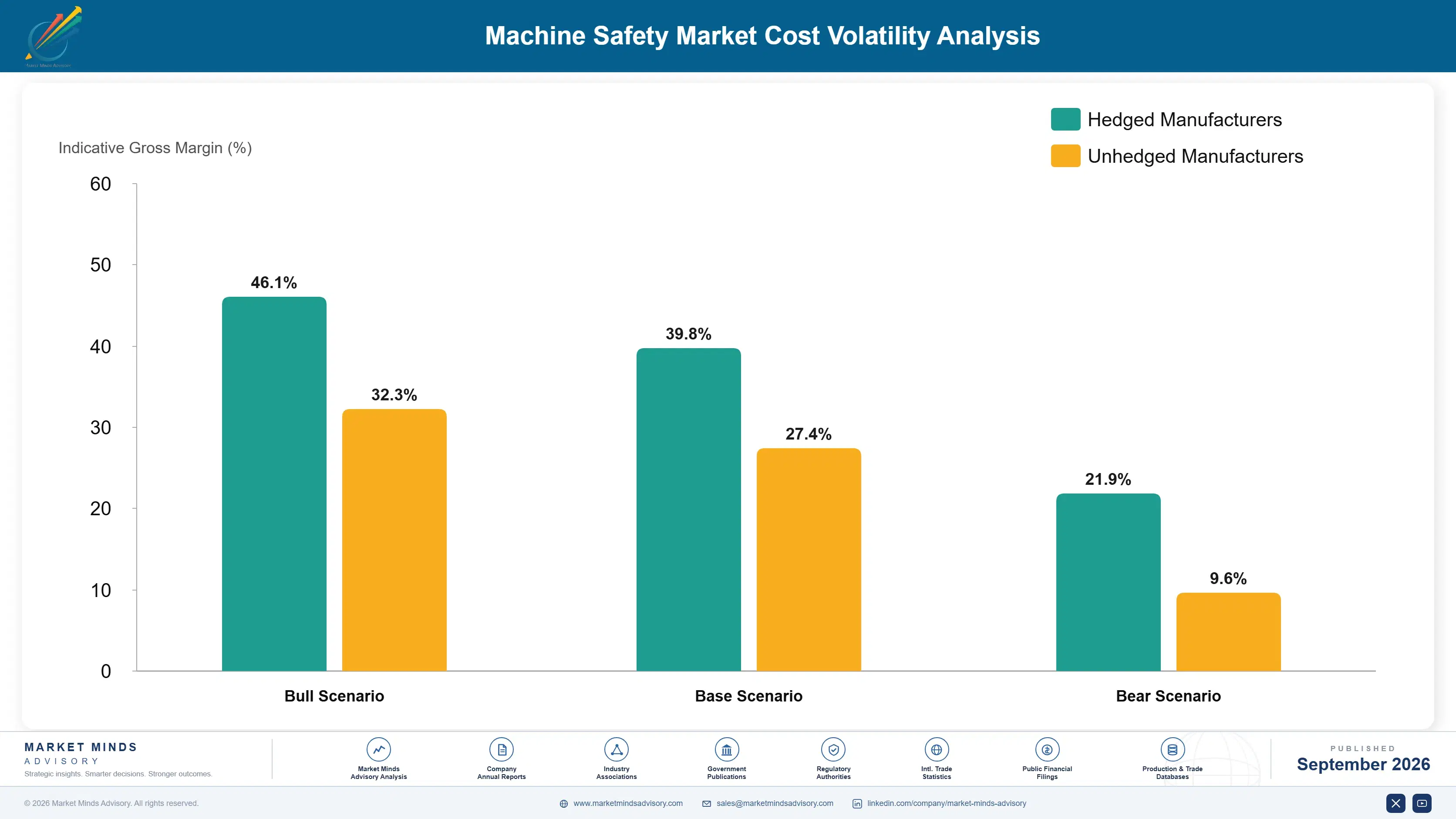
Precision optical sensors and electronic control components together represent roughly 39 percent of total cost of goods sold for machine safety manufacturers, sourced through specialized electronics supply chains and precision manufacturing facilities concentrated among a small number of established suppliers primarily located across East Asia and North America. across every active manufacturing facility and product line the company operates internationally today.
Semiconductor component prices rose meaningfully during 2023 as global chip demand surged alongside broader electronics manufacturing recovery, according to company annual reports and public industry pricing disclosures, squeezing margins for manufacturers running high production volumes across global safety controller and sensor manufacturing operations and supply chains. particularly during peak production cycles ahead of major automotive and electronics manufacturing deployment milestones worldwide overall. today. overall. overall.

This exposure disadvantages smaller independent manufacturers lacking long-term supply agreements far more than platform leaders like Rockwell Automation and Siemens, which negotiate materials pricing directly with suppliers at meaningfully larger scale, allowing them to absorb cost increases without passing them through to customers as aggressively as smaller competitors must. and existing long-term customer relationships built over multiple product generations and years of collaboration.
machine-safety-market-cost-volatility-analysis-1788420675827

Long-Term Component Supply Agreement Strategy

Manufacturers increasingly lock long-term supply agreements with semiconductor and precision sensor suppliers rather than relying on spot market purchasing, reducing exposure to price volatility and improving negotiating leverage during annual contract renewal cycles across their combined manufacturing footprint and production planning cycles worldwide. This proactive sourcing strategy also improves production planning predictability across multi-year manufacturing roadmaps and budgets.

Multi-Source Component Procurement Strategy

Manufacturers qualify sensor and electronic control components from multiple regional suppliers rather than relying on a single source, reducing exposure to localized production disruptions and price spikes while improving negotiating leverage during periods of tight materials allocation across the broader supply chain network globally. This diversification also improves overall supply resilience during periods of geopolitical trade disruption or tariff changes.

Design Standardization for Component Efficiency

Manufacturers increasingly invest in design standardization across product lines that reduces the number of unique components required per unit, lowering the specialized materials dependency that has historically constrained scaling and margin expansion across the broader machine safety vendor landscape and customer base worldwide. This standardization also accelerates product development cycles across the manufacturer's broader safety product portfolio.

Portfolio Architecture for Margin Defence

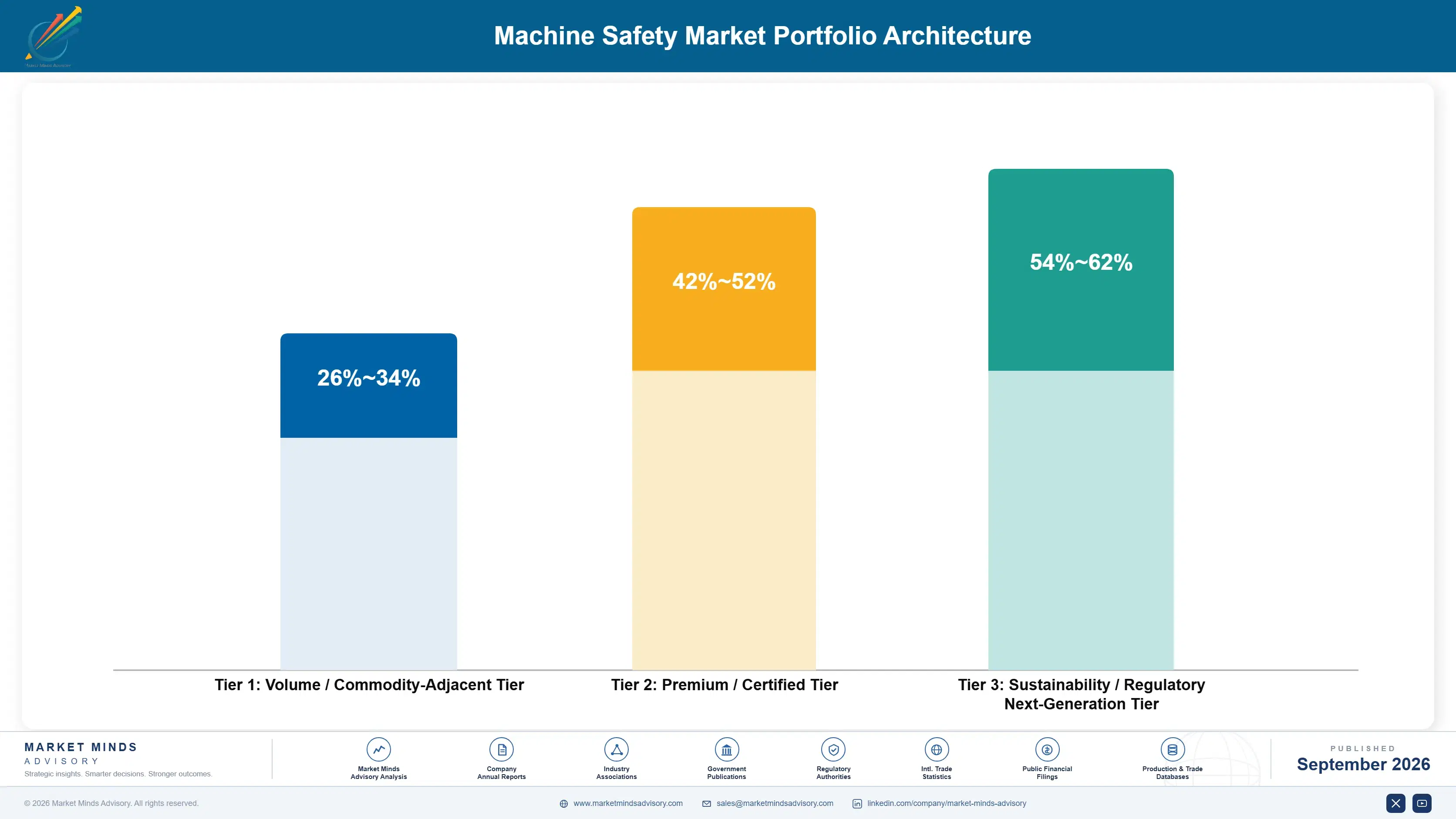
Machine safety margins split across a three-tier architecture shaped heavily by reconfiguration capability rather than pure guarding volume alone. Volume commodity-adjacent light curtains and relays compete largely on price against established installed base leaders, while premium certified programmable safety platforms command meaningful margin premiums tied to demonstrable flexibility and collaborative robot integration capability. This distribution-driven split increasingly determines who wins the largest collaborative robot deployment contracts.
The sustainability and next-generation tier, anchored by programmable safety controllers and compliance documentation bundles, now captures a disproportionate share of gross profit dollars relative to its current deployment volume, reflecting how manufacturers pay durable premiums for measurable flexibility that commodity guarding tools cannot easily replicate. This pattern strengthens further as more manufacturers formalize flexible reconfiguration as a procurement criterion.

Volume tier light curtains and relays still anchor installed base and revenue scale for most established vendors, but the real strategic tension now sits between defending that commodity revenue base and investing in the programmable safety and compliance documentation capability where growth and profitability both concentrate most heavily going forward through the current forecast period. Vendors that delay this shift risk losing relevance entirely within a few product cycles.

Volume / Commodity-Adjacent Tier

Standard light curtains and safety relays competing primarily on price and existing installed base, serving established manufacturing applications with predictable, well-characterized hazard profiles and minimal reconfiguration requirements. Margins remain thin given intense price competition and limited differentiation across most comparable guarding offerings.
Gross Margin: 26-34%

Premium / Certified Tier

Programmable safety controllers and collaborative robot integration systems carrying reliability certification that justify premium pricing above commodity guarding alternatives across automotive and electronics customer segments and applications. Contract sizes here run meaningfully larger than commodity tier deals given demonstrable reconfiguration flexibility evidence.
Gross Margin: 42-52%

Sustainability / Regulatory / Next-Generation Tier

Compliance documentation bundles and managed configuration service platforms commanding the highest margins on regulatory audit evidence, dynamic reconfiguration capability, and documented facility safety certification support. This tier increasingly attracts the largest enterprise contracts as compliance requirements shape procurement decisions directly.
Gross Margin: 54-62%
machine-safety-market-portfolio-architecture-1788420676331

High-value Sub-segments and Strategic Watch-out

Programmable Safety Controller and Compliance Bundles

The highest-value pool in the market, capturing premium collaborative robot design wins through dynamic reconfiguration capability that generalist guarding competitors cannot match regardless of their underlying component quality claims today. Vendors positioned early here could capture disproportionate share as collaborative robot adoption continues accelerating steadily.
Gross Margin: 56-64%

Managed Configuration and Deployment Services

A high-value pool growing at a rapid pace as manufacturers prioritize specialized configuration expertise over in-house engineering capability, converting service contracts directly into premium renewal pricing across enterprise customer segments overall. Growth here is expected to accelerate further as manufacturers scale configuration service requirements across facilities.
Gross Margin: 48-56%

Standard Light Curtains and Safety Relays

The volume core of the market, generating predictable installed base expansion even as growth rates moderate relative to newer programmable safety categories gaining enterprise budget share steadily each year across most sectors. Vendors here increasingly compete on manufacturing scale rather than differentiated programmable or configuration service capability.
Gross Margin: 26-34%

Legacy Mechanical Guarding Systems

A strategic watch-out segment where dynamic safety zone technology and programmable controller adoption could materially reshape competitive positioning for suppliers still dependent on legacy mechanical guarding revenue across their portfolios. Vendors overexposed here risk sudden revenue disruption as smart safety accelerates across most manufacturing categories.
Gross Margin: 18-26%

Compliance Cycles Build Recurring Service Revenue

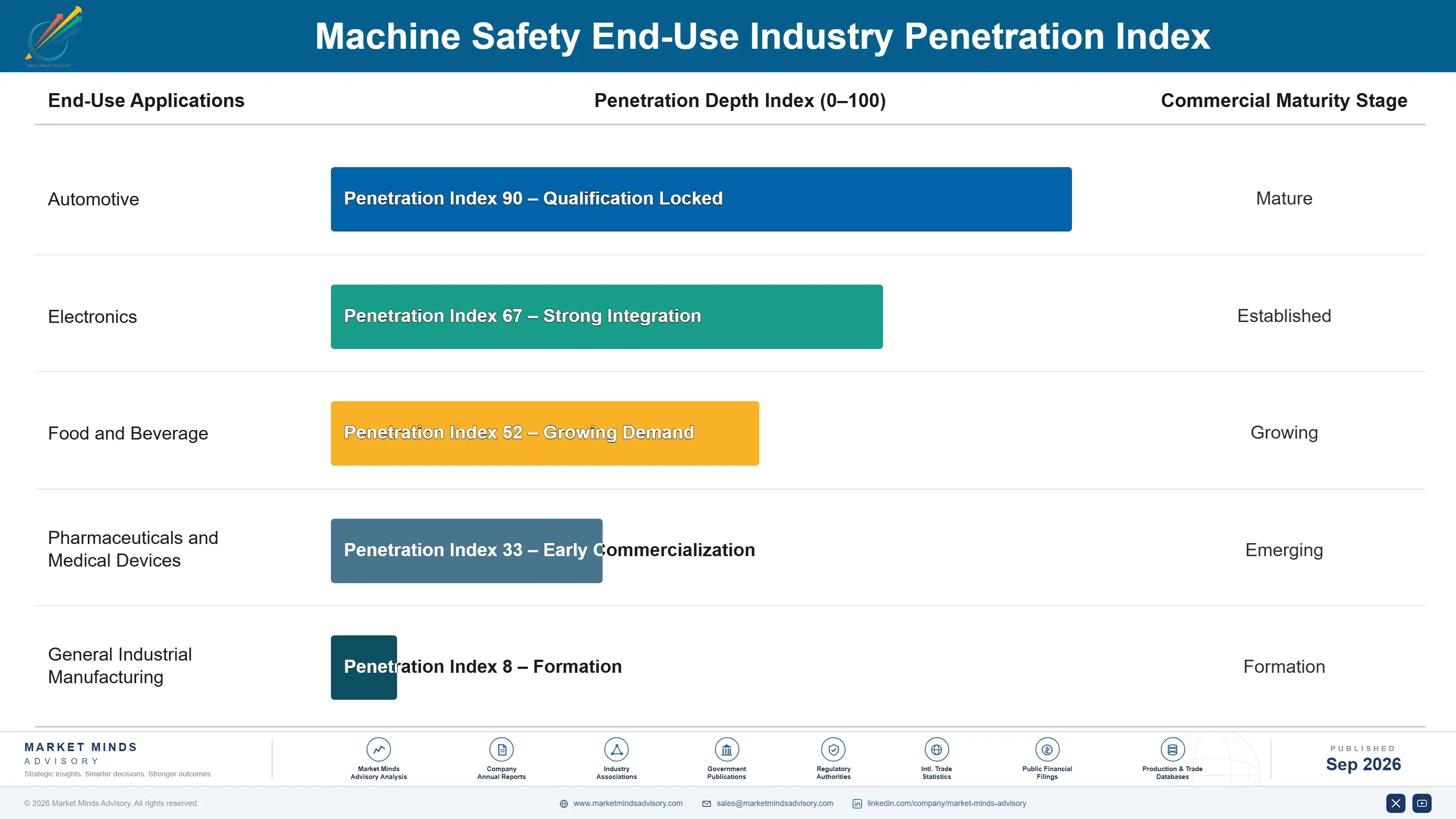
Machine safety vendors generate durable annuity-like economics once compliance documentation and configuration relationships lock in a facility across its operating lifecycle, since re-validating an alternative vendor mid-cycle requires substantial engineering review cost and testing time that most facility operators avoid absent a compelling reliability or cost failure, giving established vendors a renewal advantage over competitors lacking equivalent proven compliance track records across contested regulatory conditions.
Adoption depth varies sharply by end-use vertical. Automotive and electronics manufacturers embed vendor relationships deepest, treating certified suppliers as strategic compliance partners across multi-year facility lifecycles, while general industrial buyers remain more price-sensitive and switch readily whenever a competitor offers comparable specifications at a meaningfully lower price point each procurement cycle. Food and beverage manufacturers sit between these extremes, valuing reliability but remaining more cost-conscious than automotive procurement teams.

A generational shift in buyer profile is underway as automation engineers increasingly influence procurement decisions over traditional facility safety managers who historically favored established guarding vendors, a technical requirement shift accelerating programmable safety adoption at automotive and electronics manufacturers well ahead of general industrial buyers still optimizing for unit cost. Technical evaluators increasingly outrank cost-focused procurement officers.
machine-safety-market-end-use-penetration-index-1788420676824

Where MMA Sees Machine Safety Heading

These are among the four positions where our research anticipates prominent divergence between winners and laggards over the coming forecast period. Each is grounded in the demand model, the regulatory perimeter, and the announced capacity pipeline.
01 / PROGRAMMABLE SAFETY PRIORITY

Programmable safety investment deserves priority as collaborative robots proliferate

Roughly 39 percent of surveyed manufacturers now specify dynamic safety zone capability in new deployments, making programmable safety depth a genuine competitive moat rather than a background engineering function most vendors historically treated as secondary. Manufacturers that build genuine programmable safety capability now will win the largest collaborative robot contracts before competitors catch up, since platform development cycles take years to replicate credibly. This gap widens further as more manufacturers formalize dynamic zone requirements into standard procurement processes across the industry.
02 / COMPLIANCE DOCUMENTATION FOCUS

Bundled audit evidence services differentiate suppliers in a scrutiny-driven market

Roughly 33 percent of surveyed manufacturers now require compliance documentation as a mandatory specification in new equipment procurement, treating certification as a compliance necessity rather than purely a technical engineering consideration across their broader facility risk framework. Vendors that bundle audit documentation with equipment sales differentiate meaningfully from competitors treating regulatory evidence as the customer's separate responsibility entirely. This service layer increasingly determines which suppliers win the largest facility contracts ahead of rivals across the broader industry sector overall today.
03 / RETROFIT SIMPLIFICATION STRATEGY

Modular retrofit kits capture underserved legacy upgrade demand efficiently

Roughly 29 percent of surveyed manufacturers cite retrofit cost as the primary barrier preventing smart safety upgrades despite recognizing operational benefits, representing a substantial opportunity for vendors offering modular retrofit kits that reduce infrastructure replacement burden. Manufacturers that simplify retrofit installation reduce customer decision friction and capture project timelines competitors dependent on full infrastructure replacement cannot match at comparable speed or cost. This capability increasingly separates efficient suppliers from slower, more disruptive competitors across the broader manufacturing industry overall today.
04 / CONFIGURATION SERVICE EXPANSION

Managed configuration services address the deployment expertise bottleneck constraining growth

Roughly 25 percent of surveyed manufacturers report configuration expertise scarcity as a factor delaying safety system deployment beyond originally planned timelines, reflecting a persistent shortage of engineers who understand both automation systems and safety compliance well enough to configure dynamic zones properly. Vendors investing in managed configuration services and pre-validated templates reduce this dependency and expand addressable market among smaller manufacturers lacking specialized staff. This operational discipline increasingly separates growth leaders from vendors constrained by talent bottlenecks alone entirely across the market.

Engagement Snapshot From the Field

A live engagement with an industry participant carrying material or product regulatory and market exposure ahead of a defining policy shift, showing how our research translates into a defensible multi-year portfolio strategy.
MARKET MINDS ADVISORY · CLIENT ENGAGEMENT SUMMARY
Machine Safety Producer Strategic Portfolio Review and Transition Roadmap 2026·Investment Scenario on Machine Safety Exposure Evaluation 2025-26
CLIENT PROFILE
A mid-tier automotive parts manufacturer with roughly $130 million in annual capital equipment spending (client-reported, unverified by MMA) approached MMA after planning a collaborative robot expansion program and requesting a structured safety vendor evaluation before finalizing its facility modernization budget. The engagement carried added urgency given the compressed timeline before the committed facility modernization budget was finalized with stakeholders.
STRATEGIC CHALLENGE
The client's existing fixed guarding systems could not economically support the flexible production layouts its collaborative robot expansion required, yet selecting a programmable safety vendor without adequate configuration expertise risked deployment delays that would push back the committed modernization timeline. Operations leadership required a resolution before the modernization budget was formally submitted for executive approval.
MMA APPROACH
MMA benchmarked five candidate vendors against programmable safety depth, configuration service capability, and total cost of ownership over a three-year horizon, supplementing vendor claims with structured interviews of peer automotive manufacturers that had already completed comparable collaborative robot safety transitions without deployment delays. MMA also modeled deployment timeline risk explicitly, given the client's committed modernization schedule at engagement start.
KEY FINDINGS
  1. The client's existing fixed guarding systems would require complete replacement rather than incremental upgrade to support the planned flexible production layout changes.
  2. Vendors offering managed configuration services reduced projected deployment timeline by roughly 38 percent (client-reported, unverified by MMA) compared to in-house configuration approaches initially considered.
  3. A phased line-by-line transition approach avoided disrupting active production while validating new safety system reliability under real manufacturing conditions before full commitment.
  4. Facility safety audit results following the transition showed measurable compliance improvement, with documented evidence cited as a positive factor by the regulatory inspector.
CLIENT PROFILE
A mid-tier automotive parts manufacturer with roughly $130 million in annual capital equipment spending (client-reported, unverified by MMA) approached MMA after planning a collaborative robot expansion program and requesting a structured safety vendor evaluation before finalizing its facility modernization budget. The engagement carried added urgency given the compressed timeline before the committed facility modernization budget was finalized with stakeholders.
STRATEGIC CHALLENGE
The client's existing fixed guarding systems could not economically support the flexible production layouts its collaborative robot expansion required, yet selecting a programmable safety vendor without adequate configuration expertise risked deployment delays that would push back the committed modernization timeline. Operations leadership required a resolution before the modernization budget was formally submitted for executive approval.
MMA APPROACH
MMA benchmarked five candidate vendors against programmable safety depth, configuration service capability, and total cost of ownership over a three-year horizon, supplementing vendor claims with structured interviews of peer automotive manufacturers that had already completed comparable collaborative robot safety transitions without deployment delays. MMA also modeled deployment timeline risk explicitly, given the client's committed modernization schedule at engagement start.
KEY FINDINGS
  1. The client's existing fixed guarding systems would require complete replacement rather than incremental upgrade to support the planned flexible production layout changes.
  2. Vendors offering managed configuration services reduced projected deployment timeline by roughly 38 percent (client-reported, unverified by MMA) compared to in-house configuration approaches initially considered.
  3. A phased line-by-line transition approach avoided disrupting active production while validating new safety system reliability under real manufacturing conditions before full commitment.
  4. Facility safety audit results following the transition showed measurable compliance improvement, with documented evidence cited as a positive factor by the regulatory inspector.
RECOMMENDED STRATEGY
Phase 1: Phase 1 (Months 1 to 3): Select the programmable safety vendor and begin configuration alongside the first collaborative robot production line. Phase 2: Phase 2 (Months 3 to 8): Extend deployment to additional production lines sequentially, validating configuration accuracy at each stage. Document configuration outcomes. Phase 3: Phase 3 (Months 8 to 12): Complete full facility transition and formally document compliance posture ahead of the next scheduled audit.
OUTCOME
The client completed the safety system transition within the recommended twelve-month window, supporting its collaborative robot expansion on schedule with documented compliance evidence cited favorably during the subsequent regulatory audit (client-reported, unverified by MMA). The phased transition framework is now the client's standard approach for future safety system deployment decisions.

Frequently Asked Questions

Foundational context covering the market sizes, CAGR, scope, country, region and competition that inform every finding below. This section is provided to cover basics and most often pre-purchase conversations, answered from the MMA Primary Research Dataset.

What is the current size of the Machine Safety Market?

The global machine safety market reached an estimated $6.5 billion in 2025. Growth is concentrated in programmable safety controllers and collaborative robot integration systems requiring flexible reconfiguration.

How large will the Machine Safety Market be by 2036?

MMA projects the market will reach $12.34 billion by 2036, roughly a 1.79 times expansion from its 2026 base value, driven primarily by collaborative robot deployment and regulatory enforcement intensity.

What is the CAGR for the Machine Safety Market 2026 to 2036?

The market is projected to grow at a 6.0 percent compound annual growth rate between 2026 and 2036, with a bull case of 7.2 percent and a bear case of 4.8 percent.

Which segment is growing fastest?

Safety-rated programmable logic controllers and smart safety systems are the fastest-growing segment, expanding at roughly 10.0 percent annually as manufacturers increasingly prioritize dynamic reconfiguration capability.

Who are the major companies in the Machine Safety Market?

Leading companies include Rockwell Automation, Siemens, Schneider Electric, ABB, and Pilz GmbH, together holding an estimated 44 percent of the total global market share overall.

Which country is growing fastest?

Vietnam is the fastest-growing major country market, expanding at approximately 9.5 percent annually as its electronics and automotive manufacturing base scales substantially and consistently nationwide overall.

Report Segmentation Architecture

The full report scope spans multiple orthogonal segmentation dimensions, with cross-tabulated demand data provided for each dimension pair. Coverage extends further to regional breakdowns, trend trajectories, and the competitive detail needed to support segment-level decision-making.

By Primary Market Dimension

  • Light Curtains and Safety Sensors
  • Safety Relays
  • Safety Interlocks
  • Safety-Rated Programmable Logic Controllers
  • Collaborative Robot Safety Systems
  • Emergency Stop Systems

By End-Use Industry

  • Automotive
  • Electronics
  • Food and Beverage
  • Pharmaceuticals and Medical Devices
  • General Industrial Manufacturing

By Commercial Dimension

  • Direct Equipment Sales
  • Original Equipment Manufacturer Supply
  • Managed Configuration Services
  • Compliance Documentation Services

By Region

  • North America
  • Western Europe
  • East Asia
  • South Asia and Pacific
  • Latin America
  • Middle East and Africa
  • Eastern Europe

Scope, Methodology, and Coverage

Every figure in this report is reproducible from documented input assumptions. The scope below maps the historical period, the forecast horizon, the segmentation dimensions, and the countries covered, alongside the underlying primary and qualitative methodology.
Historical Period
2020 to 2025
Forecast Period
2026 to 2036
Base Year
2025 (USD billions; MMA Primary Research Dataset, September 2026)
Market Definition
The machine safety market covers safety-rated hardware and software that protects workers from industrial machinery hazards, including light curtains, safety relays, interlocks, and programmable safety controllers. It excludes general industrial automation controllers and personal protective equipment not specifically classified as machine safety devices.
Quantitative Units
USD billions (current prices); unit shipment volume where disclosed
Segmentation Dimensions
By Primary Market Dimension; By End-Use Industry; By Commercial Dimension; By Region
Regions Covered
North America, Western Europe, East Asia, South Asia and Pacific, Latin America, Middle East and Africa, Eastern Europe
Countries Covered
USA, China, Germany, France, UK, Japan, South Korea, India, Australia, Canada, Brazil, Mexico, Indonesia, Vietnam, Thailand, Malaysia, UAE, Saudi Arabia, South Africa, Nigeria, Turkey, Poland, Netherlands, Italy, Spain, Sweden, Switzerland, Argentina, Colombia, Singapore, and additional markets relevant to this sector
Key Companies Profiled
Rockwell Automation, Siemens, Schneider Electric, ABB, Pilz GmbH, SICK AG, Omron, Banner Engineering, IDEC Corporation, Honeywell, Leuze electronic, Wieland Electric, Euchner, Schmersal, Keyence, Panasonic, Balluff, Datalogic, Fortress Interlocks, STOBER
Quantitative Methodology
Primary survey, n=3,800 respondents, Q4 2025, six countries; demand-side model with trade association cross-validation
Qualitative Methodology
47 expert interviews, Q4 2025; applied to validate demand model assumptions, identify emerging dynamics, and assess competitive positioning
Report Format
PDF and XLSX data workbook (Word format preview document)
Publisher
Market Minds Advisory
Report Code
MMA-2026-CON-284
Published
September 2026
Contact
sales@marketmindsadvisory.com | www.marketmindsadvisory.com

Purchase the full Machine Safety Market Report (2026 to 2036).

The full report provides comprehensive market sizing, ten-year forecasts, and segment-level analysis across all six machine safety categories and seven global regions. It includes detailed competitive profiling of twenty companies, input cost and materials supply chain risk assessment, and portfolio margin analysis by technology tier. Readers gain access to primary survey data spanning 3,800 respondents and forty-seven expert interviews conducted across six countries during the fourth quarter of 2025. The report also includes a proprietary revenue lever framework identifying specific commercial actions manufacturers can take to defend margin.
Ten-year market size and CAGR forecasts
Segment-level growth rates and share analysis
Seven-region demand, pricing, and share breakdown
Twenty-company competitive benchmarking and positioning profiles
Input cost and materials supply chain risk mapping
Portfolio margin tier analysis and watch segments

Built For The People Who Decide

From boardroom strategy to bench-side execution, this report is read cover-to-cover by leaders shaping the next decade of their industry, turning demand scenarios, market dynamics and valuation benchmarks into decisions.
CXOs/ Presidents/ VPs/ Managers
M&A and Corporate Development
Strategy Teams and R&D Heads
Procurement and Product Directors
Regulatory and Compliance Leaders
Investor Relations and Equity Analysts