Market Minds Advisory
Machine Condition Monitoring Market

Machine Condition Monitoring Market: Sensor, Analytics, and Regional Demand to 2036

Unplanned downtime on rotating industrial equipment can cost manufacturers tens of thousands of dollars per hour, pushing plant operators toward wireless vibration and IIoT sensor platforms that predict bearing and motor failures weeks in advance.

Lead Analyst

David Horsley

Published

September 2026

Make Smarter Decisions with Customized Research Insights

Request a free sample report and evaluate market opportunities, growth trends, and competitive dynamics relevant to your business needs.

2025 MARKET VALUE$3.8BMarket Size 2025
2036 FORECAST VALUE$9.7BBase Case , 2026 to 2036
CAGR 2026 TO 20368.9 %Bull 10.2% / Bear 7.6%
INCREMENTAL OPPORTUNITY$5.6BNet 10- year value creation
EXPANSION MULTIPLE2.35x2036 value over 2026 base
Strategic Levers
M&A Pipeline
Regional Outlook
Country Rankings
Competitive Intelligence
Segmental Deep-dive
Call-Us : 91 93563 13602

Executive Snapshot and Market Trajectory

Machine condition monitoring has shifted from a specialist maintenance discipline into a standard capital expenditure line as manufacturers quantify unplanned downtime in direct dollar terms, pushing plant operators to replace periodic manual inspection rounds with continuous, sensor-based monitoring across critical rotating equipment fleets.
Wireless IIoT sensor platforms are growing fastest as retrofit costs fall and cloud-based analytics make predictive maintenance viable on equipment that never justified permanently wired monitoring before. China's expanding manufacturing base and its automation push are absorbing a growing share of global sensor deployments, even as North American oil, gas, and power generation operators retain the deepest installed base of vibration and thermography monitoring programs built over three decades.
Competition sits between diversified industrial automation majors bundling monitoring into broader control system sales and specialist sensor and analytics vendors competing purely on diagnostic accuracy. Rising machine complexity and tightening safety regulation in process industries are accelerating a shift toward AI-driven anomaly detection that flags developing faults automatically, while a wave of venture-backed software entrants is pushing legacy hardware vendors to rebuild their offerings around subscription analytics rather than one-time equipment sales alone.
Market Definition
Machine condition monitoring covers sensor hardware, data acquisition systems, and analytics software used to continuously or periodically assess the operating health of rotating and reciprocating industrial equipment, including vibration, thermography, oil analysis, acoustic emission, and ultrasonic techniques. The market excludes general industrial IoT platforms not focused on equipment health and standalone SCADA control systems.
Base Year Value
$3.8B in 2025 (MMA Primary Research Dataset, August 2026)
Forecast Period
2026 to 2036, eleven discrete annual values
CAGR
8.9% base case. Bull 10.2%. Bear 7.6%.
Fastest Growth Segment
Wireless IIoT Sensor Platforms: 12.8% CAGR
Fastest Growth Country
China: 10.4% CAGR
Fastest Growth Region
South Asia and Pacific: 10.9% CAGR
Largest Region
East Asia: 29% of 2025 global value
Market Leaders
Emerson Electric, SKF, Honeywell, Baker Hughes, and Parker Hannifin lead the field. Source: MMA Analysis based on company annual reports.
Primary Survey
n=3,800 procurement and R&D decision-makers, Q4 2025, six countries
Methodology
Demand-side build-up, cross-validated against public data, 47 expert interviews

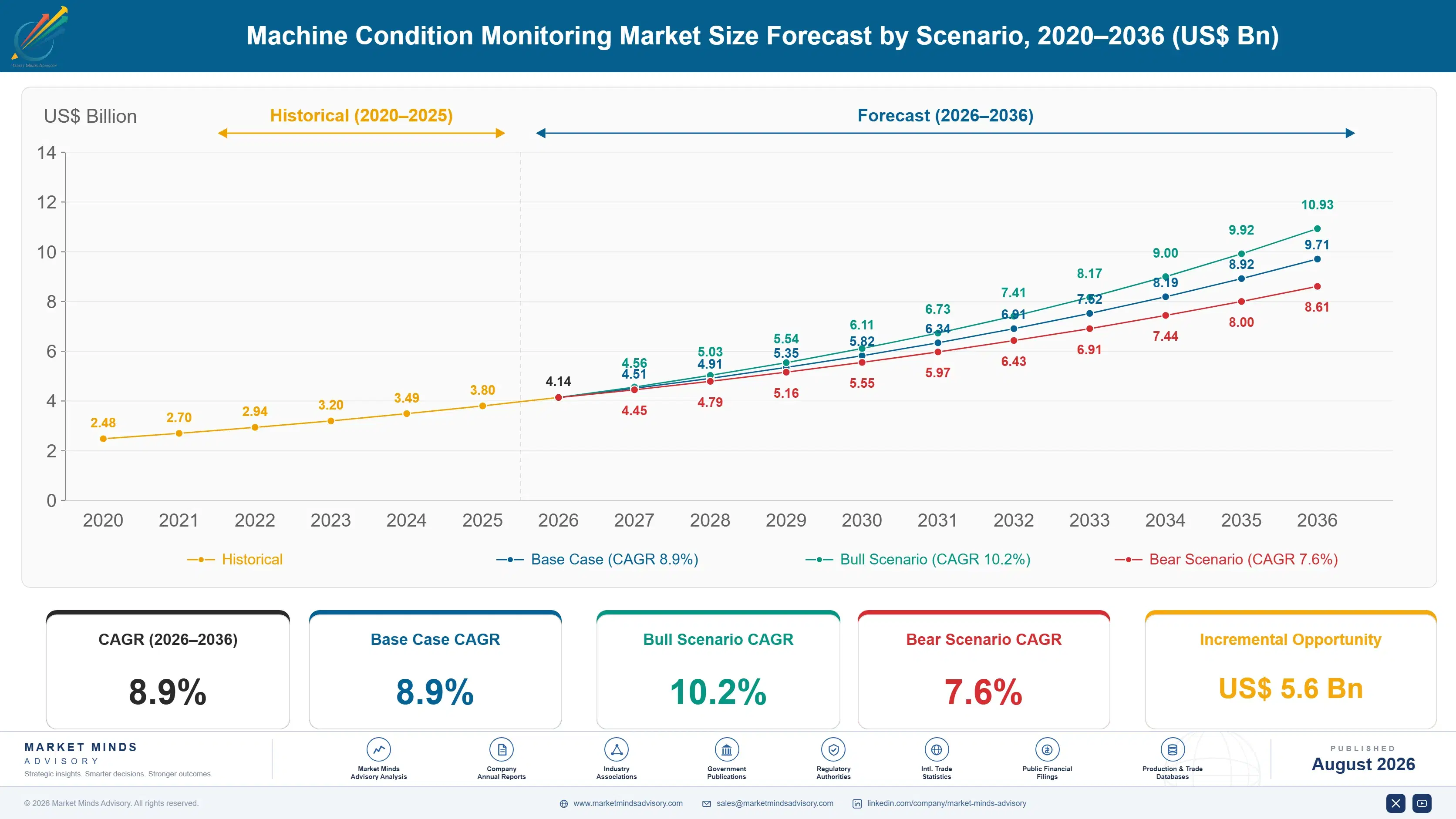
Machine Condition Monitoring Market Forecast Scenarios

machine-condition-monitoring-market-size-forecast-scenario-1787556180289
Between 2020 and 2025 machine condition monitoring demand grew at roughly 7.9 percent a year, held back early by pandemic-era capital spending freezes before accelerating sharply as manufacturers rebuilding supply chains prioritised uptime and labor-constrained plants shifted maintenance work from manual inspection rounds toward continuous sensor-based monitoring that requires fewer technician hours per asset. That shift accelerated further as skilled technician shortages deepened across most regions.
The base case assumes continued growth as three mechanisms compound: falling wireless sensor hardware costs that make monitoring economically viable on lower-criticality equipment previously left unmonitored; cloud-based analytics platforms that convert raw vibration and thermal data into actionable failure predictions without dedicated in-house reliability engineers; and expanding manufacturing capacity across China and Southeast Asia, where new plants increasingly specify sensor-based monitoring at construction rather than retrofitting legacy equipment years later.
The bull case turns on faster-than-expected adoption of AI-driven anomaly detection that eliminates the need for skilled vibration analysts to interpret raw data manually. The bear case centers on a prolonged industrial capital spending slowdown, which has historically pushed plant operators back toward reactive, run-to-failure maintenance and delayed sensor retrofit projects until budgets recover, a pattern last seen during the 2020 downturn.

Predictive Maintenance Economics and Sensor Retrofit Momentum

Machine condition monitoring sits at the intersection of industrial automation, labor economics, and rising intolerance for unplanned downtime. As skilled maintenance technicians become harder to hire and retain, plants are replacing periodic manual inspection rounds with continuous, sensor-based monitoring that flags developing faults automatically, even where the upfront cost of wireless sensor networks exceeds simple vibration meters used for spot checks.
MARKET CONCENTRATIONCR5: 38%Ownership spans diversified automation majors and specialist vendors
AVERAGE SELLING PRICE$2,400 per nodeWireless sensor pricing keeps falling each product generation
CAPACITY UTILISATION76%Sensor manufacturing plants run close to full output
TOP PRODUCER SHARETop 3 countries: 52%Sensor and analytics production concentrates in few countries
TRADE INTENSITY44% cross-borderSensor hardware ships globally from concentrated manufacturing hubs
INSTALLED BASEEst. 40M monitored assetsMillions of rotating machines still lack continuous monitoring
Commercially the category splits between diversified automation majors bundling monitoring into broader control and reliability platforms and specialist vendors competing purely on sensing accuracy and analytics quality. Global players compete on breadth of technique coverage and software integration, while smaller specialists win on deployment speed and price in retrofit projects, since large manufacturers increasingly standardise on a single monitoring platform across an entire plant network.
The next decade will be shaped by falling wireless sensor costs, the spread of AI-driven anomaly detection that reduces reliance on skilled vibration analysts, and expanding manufacturing capacity across China and Southeast Asia. Vendors that can pair affordable hardware with cloud analytics and clear failure predictions stand to capture share from suppliers still selling standalone sensors without integrated software.
"The vendors winning right now aren't selling sensors, they're selling avoided downtime hours, and plant managers increasingly buy on that number alone rather than sensor specifications."
Director, Industrial Automation and Reliability Practice · MMA Construction and Industrial Equipment Practice · August 2026

Market Trends

AI-Driven Anomaly Detection Replaces Manual Vibration Analysis

Cloud-based analytics platforms are increasingly using machine learning models trained on large fleets of historical failure data to flag developing faults automatically, reducing dependence on scarce, highly trained vibration analysts who traditionally interpreted raw spectral data by hand. Adoption is fastest among manufacturers running large, geographically distributed asset fleets where hiring enough qualified analysts locally is impractical, and several major automation vendors now offer subscription-based diagnostic services rather than selling analysis as a one-time consulting engagement. Early deployments report meaningfully fewer missed early-stage faults compared with periodic manual inspection rounds, though accuracy still depends heavily on training data volume.
Market Impact: Avoids up to $100,000 per hour
Wireless Retrofit Programs Extend Monitoring To Lower-Criticality Assets

Falling wireless sensor hardware costs are letting manufacturers extend condition monitoring beyond the small set of critical, high-value machines that historically justified permanently wired systems, down to pumps, fans, and conveyors previously monitored only through periodic manual rounds or not at all. Battery life improvements and simplified installation, often requiring no wiring or plant shutdown, have cut deployment time from days to hours per asset on typical retrofit projects. Manufacturers report that extending coverage to lower-criticality equipment surfaces failure modes that manual inspection rounds routinely missed until a breakdown occurred.
Market Impact: Manages 2x more assets per analyst

Market Opportunities and Growth Drivers

Rising Cost Of Unplanned Downtime In Continuous Process Industries

Manufacturers across automotive, chemicals, and power generation increasingly quantify unplanned downtime in direct dollar terms, with continuous process plants reporting losses that can exceed one hundred thousand dollars per hour of unplanned stoppage on critical production lines. That financial visibility has turned condition monitoring from a discretionary maintenance expense into a capital project with a clearly modeled return, and several large manufacturers now require documented monitoring coverage before approving new production line investment. Insurance providers covering industrial property have also begun offering premium reductions for plants demonstrating comprehensive monitoring coverage, adding a second financial incentive beyond direct downtime avoidance.
Market Impact: Adds $2,000 to $4,000 per node

Skilled Maintenance Labor Shortage Accelerates Automation Adoption

Manufacturing plants across North America, Western Europe, and increasingly East Asia report growing difficulty hiring and retaining experienced vibration analysts and reliability engineers as an aging maintenance workforce retires faster than replacements enter the field. Condition monitoring software that automates fault diagnosis and prioritises maintenance work orders reduces dependence on scarce specialist headcount, letting a smaller reliability team manage a larger asset base than periodic manual inspection would allow. Several large manufacturers report reliability team headcount holding flat even as monitored asset counts have roughly doubled over five years, crediting automated diagnostics for absorbing the added workload.
Market Impact: Cuts alert response 25 percent slower

Market Restraints and Challenges

High Upfront Cost Of Comprehensive Wireless Sensor Networks

Deploying comprehensive wireless sensor coverage across an entire plant remains expensive relative to simple periodic manual inspection using a handheld vibration meter, particularly for smaller manufacturers with limited capital budgets and many monitoring points to cover. The root cause is that sensor, gateway, and software licensing costs scale roughly linearly with asset count, while the financial benefit concentrates heavily on a smaller subset of truly critical machines. When capital budgets tighten, plants often defer sensor rollout to lower-criticality equipment first, keeping only flagship production-critical assets on continuous monitoring. Vendors are mitigating the barrier through tiered subscription pricing and leasing models.
Market Impact: Cuts missed faults 40 percent

Data Overload Without Sufficient Reliability Engineering Capacity

Many manufacturers deploy sensor networks faster than they build the internal reliability engineering capacity to act on the resulting data, generating alert volumes that overwhelm maintenance teams and erode trust in the system when false positives go uninvestigated. The root cause is that sensor deployment is a straightforward capital purchase, while building a functioning reliability workflow around that data requires organisational change that takes considerably longer. Plants that experience early alert fatigue often revert partially toward manual inspection for decision-making, undermining the return on their sensor investment. Vendors are addressing the gap with managed analytics and pre-triaged alerts.
Market Impact: Expands monitored assets 3x per plant
3 additional market trends, 4 additional growth drivers, and 2 additional restraints and challenges are covered in the full report. Contact sales@marketmindsadvisory.com to access the complete intelligence.

Segment CAGR and Growth Architecture

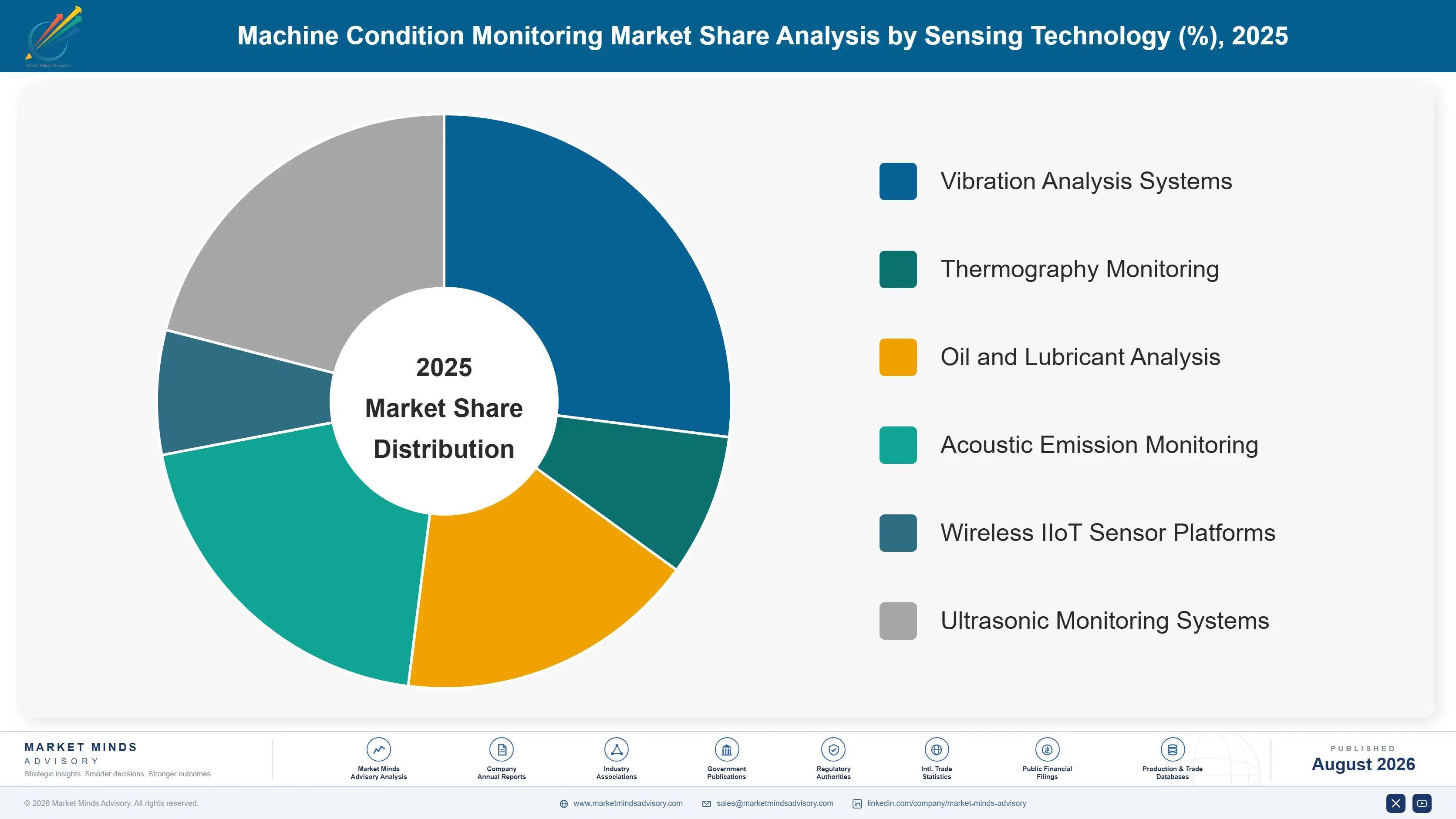
Machine condition monitoring segments most usefully by sensing technology, since vibration, thermography, oil analysis, acoustic emission, ultrasonic, and integrated wireless IIoT platforms carry distinct hardware costs, deployment models, and analytics maturity. This framework mirrors how vendors organise product lines and compete, separating legacy wired techniques from newer wireless and software-centric offerings reshaping the category.
machine-condition-monitoring-market-market-share-analysis-1787556180826

Wireless IIoT Sensor Platforms

Wireless IIoT sensor platforms are the fastest-growing segment as falling hardware costs and simplified, wireless installation extend condition monitoring economics to lower-criticality equipment that never justified permanently wired systems. Cloud-based analytics bundled with these platforms increasingly replace manual spectral analysis with automated fault detection, appealing to manufacturers facing skilled reliability engineer shortages. Growth concentrates among manufacturers running large, distributed asset fleets across multiple plants, where centralised cloud analytics let a small reliability team monitor equipment across many sites simultaneously rather than requiring on-site specialists at each facility. Subscription-based pricing models are also accelerating adoption among smaller manufacturers previously unable to justify large upfront capital purchases for comprehensive monitoring coverage across their full equipment base.
CAGR 12.8%

Vibration Analysis Systems

Vibration analysis remains the largest and second-fastest-growing segment, the established default technique for rotating equipment health assessment across manufacturing, oil and gas, and power generation. Growth is increasingly driven by wireless retrofit programs extending vibration monitoring to equipment previously covered only by periodic manual rounds, rather than by adoption of vibration analysis itself, which is already near-universal on critical machinery. Established vendors with decades of spectral analysis expertise and large historical failure databases hold a durable advantage in the segment, since accurate fault diagnosis depends heavily on pattern-matching against known failure signatures. Growth is fastest in Asia's expanding manufacturing base, where new plants are specifying vibration monitoring at construction rather than retrofitting it into completed facilities years later.
CAGR 9.5%
Full segment breakdown across 6 segments available in the complete report.

Regional Architecture and Country Demand Map

Machine condition monitoring demand concentrates where large-scale manufacturing and process industry capacity is most developed. East Asia's expanding factory base and North America's mature process industry installed base together account for well over half of global demand, while South Asia and Latin America represent the fastest-growing but developing demand bases.

East Asia

China's manufacturing base is automating faster than anywhere else, with national industrial policy explicitly pushing factories toward predictive maintenance and continuous condition monitoring as part of broader smart factory upgrades. New plants increasingly specify wireless sensor networks at construction, avoiding the retrofit costs that slow adoption elsewhere. South Korea and Japan contribute stable demand from mature automotive and electronics manufacturing sectors with long-established reliability engineering practices. Rising domestic sensor and analytics production, led by Chinese automation vendors competing directly with Western incumbents on price, is compressing hardware margins even as overall deployment volume continues climbing across the region's expanding industrial base. Domestic sensor makers are also investing heavily in analytics software to close the gap with Western incumbents.
Share: 29% | CAGR: 10.0% (2026 to 2036)

North America

Oil, gas, and power generation operators across the United States and Canada built the condition monitoring category over three decades, and the region still carries the deepest installed base of wired vibration and thermography systems anywhere in the world. Reshoring of manufacturing capacity and persistent skilled maintenance labor shortages are pushing plants toward automated diagnostics that reduce dependence on scarce reliability engineers. Insurance-linked incentives for demonstrated monitoring coverage are gaining traction among large industrial property owners. Growth trails the fastest-growing regions because the market is already mature, with expansion coming mostly from wireless retrofit of lower-criticality equipment rather than new critical-asset installations. Large industrial insurers headquartered in the region are further normalising monitoring coverage as a underwriting requirement.
Share: 26% | CAGR: 9.6% (2026 to 2036)
Regional intelligence for 5 additional markets available in the complete report: Western Europe, South Asia and Pacific, Latin America, Middle East and Africa, Eastern Europe. Contact sales@marketmindsadvisory.com.
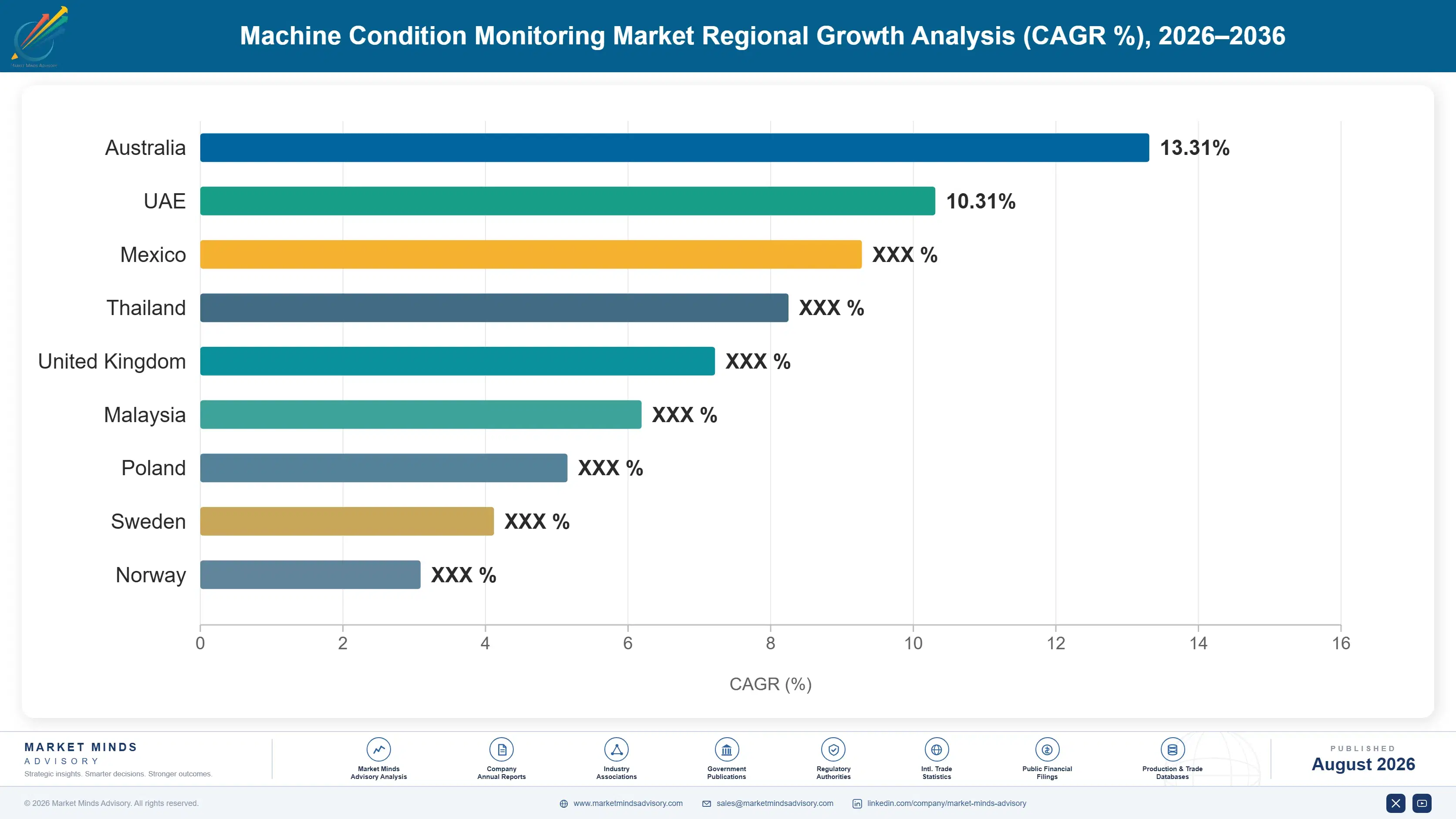
machine-condition-monitoring-market-country-cagr-analysis-1787556181373

Subscription Analytics and Managed Reliability Services

Vendors can grow revenue per deployed sensor even where hardware unit prices keep falling by shifting customers toward subscription analytics, bundling managed reliability services with hardware sales, and extending monitoring coverage to previously unmonitored lower-criticality assets. The most durable gains come from converting a one-time hardware sale into a lasting recurring relationship. built around data, not just equipment.

Converting Hardware Sales Into Subscription Analytics Revenue

Vendors are increasingly pricing cloud-based analytics and fault detection as a recurring per-sensor subscription rather than a one-time software license bundled with hardware, converting what was historically a capital equipment sale into an annuity revenue stream worth an estimated 15 to 20 percent of hardware value annually. Customers accept the recurring cost because subscription pricing includes continuous model updates and access to expanding historical failure databases that improve diagnostic accuracy over time, value a static, purchased license cannot match. The approach also raises switching costs meaningfully, since abandoning a subscription means losing accumulated site-specific failure history.
Market Impact: Adds 15 to 20 percent recurring revenue annually

Bundling Managed Reliability Services With Sensor Deployment

Rather than selling sensors alone, several vendors now bundle managed reliability engineering services, including alert triage and prioritised work order generation, directly with hardware deployment, capturing revenue that previously went to third-party reliability consultants or internal maintenance staff. This approach appeals strongly to manufacturers facing skilled reliability engineer shortages, since it delivers actionable maintenance recommendations rather than raw sensor data requiring in-house interpretation. Vendors offering bundled managed services report contract values roughly 2 times higher than hardware-only deployments, and bundled customers show meaningfully lower churn since switching means retraining an outsourced workflow.
Market Impact: Lifts contract value 2 times higher than hardware alone

Extending Coverage To Previously Unmonitored Lower-Criticality Assets

Falling wireless sensor costs let vendors sell additional monitoring coverage into the same facility by targeting pumps, fans, and conveyors that never justified permanently wired systems, expanding the addressable sensor count per plant substantially beyond the small set of historically monitored critical assets. Vendors report that expanding coverage within an existing customer account costs meaningfully less to sell than acquiring a new customer, since the relationship, network infrastructure, and analytics platform are already established. Several vendors now run structured account expansion programmes explicitly targeting a 3 to 4 times increase in monitored asset count within existing customer facilities.
Market Impact: Expands monitored assets 3 to 4 times per account

Monetising Aggregated Fleet Failure Data Across Customer Base

Vendors with large installed sensor bases are increasingly monetising aggregated, anonymised failure pattern data across their entire customer fleet, selling benchmarking and predictive model improvements as a premium tier layered on top of standard monitoring subscriptions. Because model accuracy improves with data volume, vendors with the largest installed base gain a compounding advantage that smaller specialist competitors struggle to replicate, reinforcing market position over time beyond simple hardware competition. Early adopters of this benchmarking tier report customers willing to pay a meaningful premium, roughly 10 percent above standard subscription pricing, for fleet-wide benchmarking access.
Market Impact: Commands roughly 10 percent premium pricing on subscriptions

Who Controls the Margin Pool

The machine condition monitoring market is moderately concentrated, with an estimated CR5 near 38 percent, reflecting a category where diversified automation majors compete directly against focused sensor and analytics specialists. Emerson Electric and SKF lead on combined hardware breadth and installed base, but the gap to specialist software-centric challengers is narrowing as analytics quality increasingly matters more than sensor hardware alone in customer purchasing decisions.
Competitive activity centers on three fronts: AI-driven analytics development aimed at reducing dependence on skilled vibration analysts, subscription pricing models that convert hardware sales into recurring revenue, and geographic expansion into China and Southeast Asia through local manufacturing and distribution partnerships. Acquisitions of specialist software analytics vendors have picked up sharply as hardware-focused incumbents seek to close the gap with software-native challengers.

Emerging pressure comes from venture-backed software entrants offering cloud analytics that work across multiple vendors' sensor hardware, threatening to commoditise the hardware layer while capturing the higher-margin analytics relationship directly. Chinese automation vendors are also gaining share on price in cost-sensitive retrofit projects, constrained less by brand loyalty than by proven reliability track record. Rankings could shift if a hardware-agnostic analytics platform achieves broad adoption as a de facto industry standard.
machine-condition-monitoring-market-company-positioning-matrix-1787556182007

Competitive Moat and Risk Dimensions

EMERSON ELECTRIC

Moat: Integrated Automation Platform Breadth

Emerson's condition monitoring offering sits inside a much broader industrial automation and control systems portfolio, letting it bundle monitoring into large plant-wide automation contracts that pure-play sensor vendors cannot easily match. That integrated position gives Emerson deep, established customer relationships across process industries, reinforcing renewal rates on monitoring subscriptions tied to broader automation service agreements.
EMERSON ELECTRIC

Risk: Slower Software Innovation Pace

Emerson's large, hardware-centric organisational structure moves more slowly on cloud-native analytics development than venture-backed software specialists unencumbered by legacy product architecture and existing installed base considerations. This has occasionally cost Emerson share among younger, software-forward manufacturers who prioritise analytics user experience over Emerson's broader automation platform integration advantages.
SKF

Moat: Decades Of Bearing Failure Data

SKF's century-long history manufacturing bearings gives it an unmatched historical database of failure signatures tied to its own hardware, supporting diagnostic accuracy that newer entrants without comparable failure data cannot easily replicate. That data advantage is particularly strong on bearing-related faults, the single most common failure mode across rotating industrial equipment globally.
SKF

Risk: Limited Presence Outside Bearings Niche

SKF's diagnostic strength concentrates heavily on bearing-related failure modes, leaving it comparatively less differentiated on other fault types such as electrical or process-related anomalies where broader automation platform vendors offer more comprehensive coverage. Customers seeking a single monitoring platform across all fault types sometimes choose broader competitors over SKF's more narrowly focused, if deeply expert, offering.

Players Tracked

Prominent Players

Emerson Electric
SKF
Honeywell
Baker Hughes
Parker Hannifin

Other Key Players

Fluke Corporation
National Instruments
Rockwell Automation
Siemens
ABB
GE Vernova
Schaeffler
Meggitt
Analog Devices
PCB Piezotronics
MISTRAS Group
Azima DLI
Trelleborg
Petasense
Augury

Recent Developments

APRIL 2026

Emerson Launches AI-Driven Fleet-Wide Anomaly Detection Platform

Emerson introduced a cloud-based analytics platform using machine learning trained across its global installed sensor base to detect developing equipment faults automatically, reducing dependence on manual spectral analysis and targeting manufacturers operating large, geographically distributed asset fleets seeking centralised reliability oversight. The move follows demand for centralised, multi-site reliability dashboards.
Signal: Signals major automation vendors racing to reduce customer dependence on scarce, specialist vibration analysts through automation.
NOVEMBER 2025

SKF Acquires Wireless Sensor Startup To Expand IIoT Portfolio

SKF acquired an early-stage wireless vibration sensor startup with proprietary low-power battery technology, extending SKF's monitoring portfolio beyond its traditional wired bearing-focused offerings into lower-criticality asset coverage previously served mainly by smaller specialist competitors. The acquisition extends SKF's addressable market to lower-value equipment previously served by third-party retrofit specialists.
Signal: Confirms established vendors are buying wireless capability rather than building it organically at comparable speed. across a broader equipment base.
FEBRUARY 2026

Baker Hughes Expands Bently Nevada Subscription Analytics Tier

Baker Hughes expanded its Bently Nevada subscription analytics offering to include fleet-wide benchmarking data across its oil and gas customer base, allowing operators to compare asset reliability performance against anonymised industry peers within the same subscription tier. The expansion targets operators seeking to justify continued monitoring investment through peer comparison.
Signal: Marks growing monetisation of aggregated fleet data as a distinct revenue layer beyond core monitoring. within a single subscription platform.

Sensor Component and Semiconductor Cost Exposure

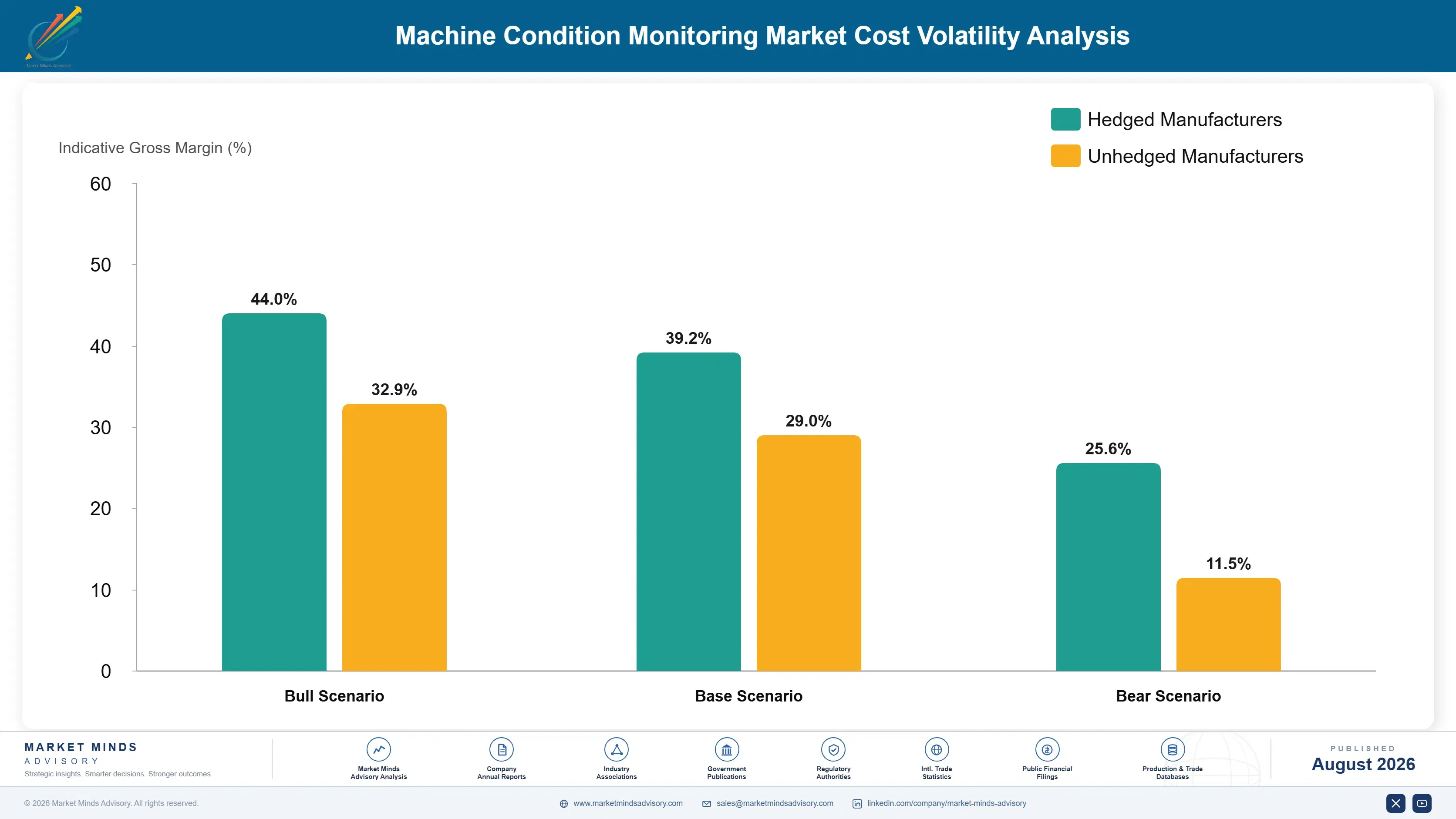
Semiconductor components, including MEMS accelerometers and wireless radio chips, account for roughly 35 percent of cost of goods sold across wireless sensor hardware, with enclosures, batteries, and assembly making up most of the remainder. Component sourcing concentrates heavily in Taiwan, South Korea, and China, tying sensor hardware costs directly to broader semiconductor supply and pricing cycles.
The 2021-2022 global semiconductor shortage pushed lead times for MEMS accelerometer components out to over forty weeks in some cases, according to IEA reporting on global electronics supply chain disruption, forcing several sensor vendors to redesign products around alternative, less optimal chip suppliers. Vendors without diversified component sourcing agreements faced the sharpest delivery delays, and some lost retrofit project bids to competitors able to maintain shorter lead times through multi-supplier contracts.

Exposure varies by player type: large diversified vendors like Emerson and Honeywell, with substantial procurement scale and multi-year semiconductor supply agreements, weather shortages with meaningfully less disruption than smaller specialist sensor vendors reliant on spot-market component purchases. Geographic exposure differs too, since vendors sourcing primarily from Taiwan face different risk timing than those dependent on Chinese or Korean semiconductor fabrication capacity.
machine-condition-monitoring-market-cost-volatility-analysis-1787556182213

Diversifying Semiconductor Component Sourcing Across Suppliers

Vendors are increasingly qualifying multiple semiconductor suppliers for critical components like MEMS accelerometers rather than relying on a single source, so a shortage or disruption at one supplier does not halt production entirely. This diversification raises qualification and testing costs but significantly reduces the risk of the extended lead time delays that hit under-diversified vendors hardest during the 2021-2022 shortage.

Securing Multi-Year Component Supply Agreements

Larger vendors are signing multi-year supply agreements directly with semiconductor manufacturers, securing guaranteed allocation ahead of the open market and capturing pricing stability that smaller vendors cannot access. This approach requires committed volume most smaller vendors cannot guarantee, reinforcing a durable advantage for scale players. Smaller vendors pool orders through distributor networks for similar terms.

Redesigning Products Around More Available Chip Architectures

Some vendors are redesigning sensor circuit boards to accommodate multiple interchangeable chip options rather than a single specified component, trading modest engineering complexity for meaningfully greater sourcing flexibility during future shortages. This approach reduces exposure to any single component's availability but requires ongoing engineering investment. Larger vendors absorb this cost more easily than smaller competitors.

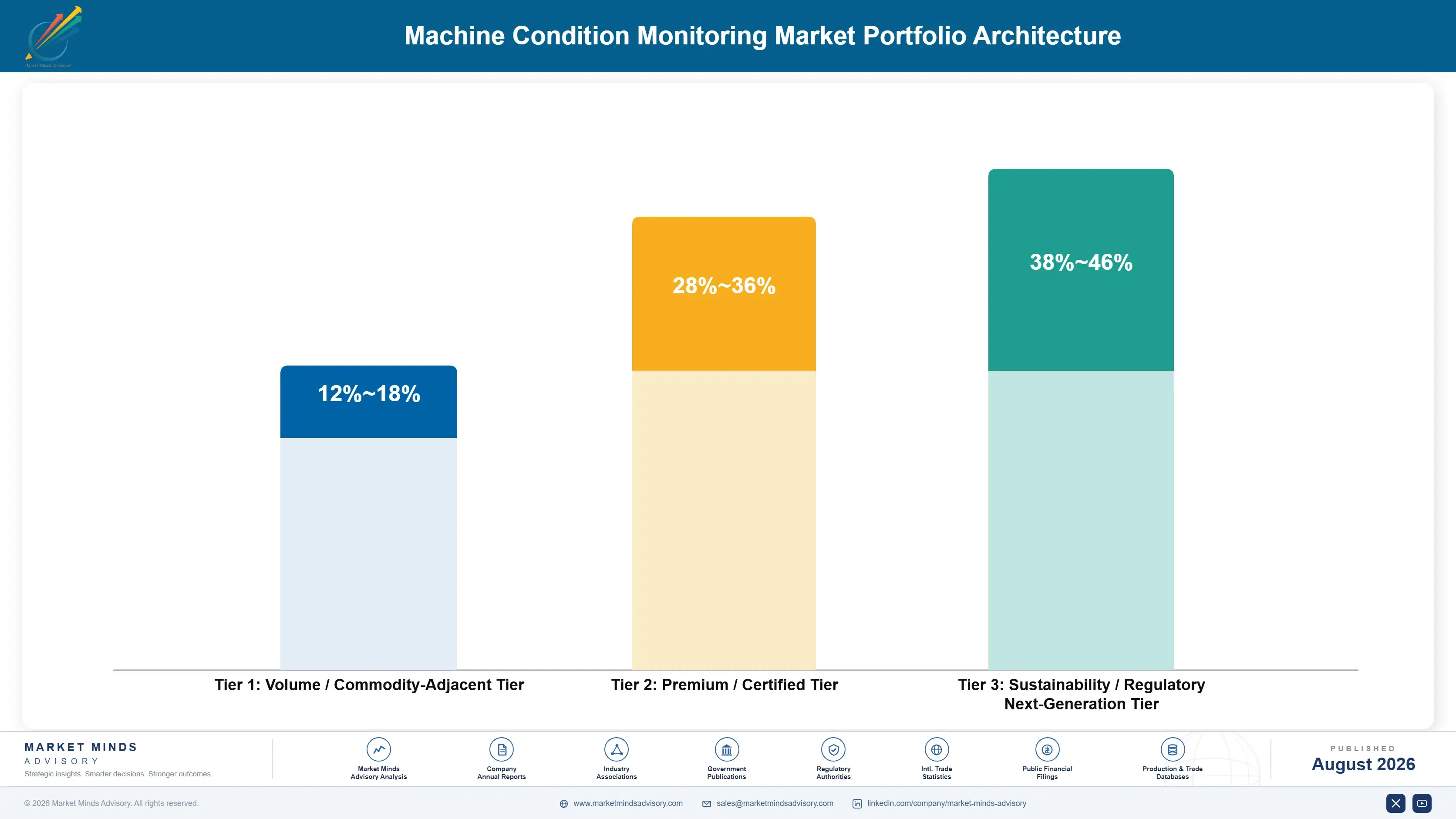
Portfolio Architecture for Margin Defence

Machine condition monitoring organises into three commercial tiers running from basic periodic handheld monitoring through continuous wired and wireless sensor networks to next-generation AI-driven predictive analytics platforms. Gross margins widen sharply moving up the tiers, since handheld and basic wireless hardware compete largely on unit price, while integrated analytics platforms capture value from software subscriptions, managed services, and diagnostic accuracy rather than hardware cost alone. Hardware alone rarely commands premium pricing on its own anymore.
The tension between hardware volume and software premium shapes vendor strategy: basic sensor hardware generates the installed base that creates the opportunity for analytics upsell, but subscription analytics generates the margin that justifies continued platform investment. Vendors overweighted toward hardware-only sales face intensifying price competition from lower-cost entrants, while analytics-forward vendors carry steadier, recurring profitability less exposed to hardware commoditisation. That divergence keeps widening.

High-value pools concentrate among subscription analytics platforms sold to manufacturers with large, distributed asset fleets, and among managed reliability services sold to manufacturers facing skilled reliability engineer shortages. Both pools reward vendors who can pair sensor hardware with software and services rather than competing purely on sensor unit price. Vendors without a credible services layer increasingly struggle to defend pricing.

Volume / Commodity-Adjacent Tier

Basic handheld and entry-level wired vibration or thermography tools sold largely on unit price, competing on measurement accuracy and ease of use, serving smaller manufacturers and periodic inspection programmes. Replacement cycles are long and buyers rarely switch suppliers once trained on a given tool.
Gross Margin: 12-18%

Premium / Certified Tier

Wireless sensor networks with cloud-based analytics dashboards sold to mid-to-large manufacturers seeking continuous coverage beyond periodic manual inspection, priced above basic hardware for integrated software capability. These deployments typically anchor a multi-year account relationship spanning several plant sites.
Gross Margin: 28-36%

Sustainability / Regulatory / Next-Generation Tier

AI-driven predictive analytics and managed reliability service platforms sold to manufacturers with large distributed asset fleets facing skilled reliability engineer shortages, priced on subscription terms reflecting diagnostic accuracy. Adoption concentrates among manufacturers already facing acute reliability staffing constraints today.
Gross Margin: 38-46%
machine-condition-monitoring-market-portfolio-architecture-1787556182731

High-value Sub-segments and Strategic Watch-out

AI-Driven Predictive Analytics Subscriptions

Subscription analytics platforms using machine learning to automate fault detection command the category's highest margins and fastest growth, concentrated among manufacturers with large distributed fleets willing to pay recurring fees for reduced reliability engineer dependence. Vendors compete on model accuracy and breadth of supported equipment types.
Gross Margin: 40-48%

Managed Reliability Services For Labor-Constrained Plants

Bundled reliability engineering services sold alongside hardware carry strong margins tied to skilled labor scarcity, though growth is more moderate than pure analytics subscriptions since adoption depends on manufacturers outsourcing core maintenance decision-making functions entirely. Adoption is strongest among manufacturers already outsourcing other maintenance functions.
Gross Margin: 32-40%

Standard Wireless Vibration Sensor Networks

Wireless vibration sensor deployments remain the largest volume category by far, generating steady hardware revenue across price-sensitive retrofit projects, even as growth increasingly shifts toward bundled analytics and services elsewhere in the broader portfolio. Price competition here is intensifying fastest among smaller regional hardware vendors.
Gross Margin: 20-28%

Hardware Commoditisation From Low-Cost Chinese Entrants

Rising competition from low-cost Chinese sensor manufacturers threatens to compress hardware margins industry-wide, representing a pressure point on vendors who have not yet shifted revenue mix toward defensible software and services that low-cost entrants cannot easily replicate. Vendors without a clear software roadmap face the greatest long-term margin pressure.
Gross Margin: n/a

Recurring Economics Of Fleet Reliability

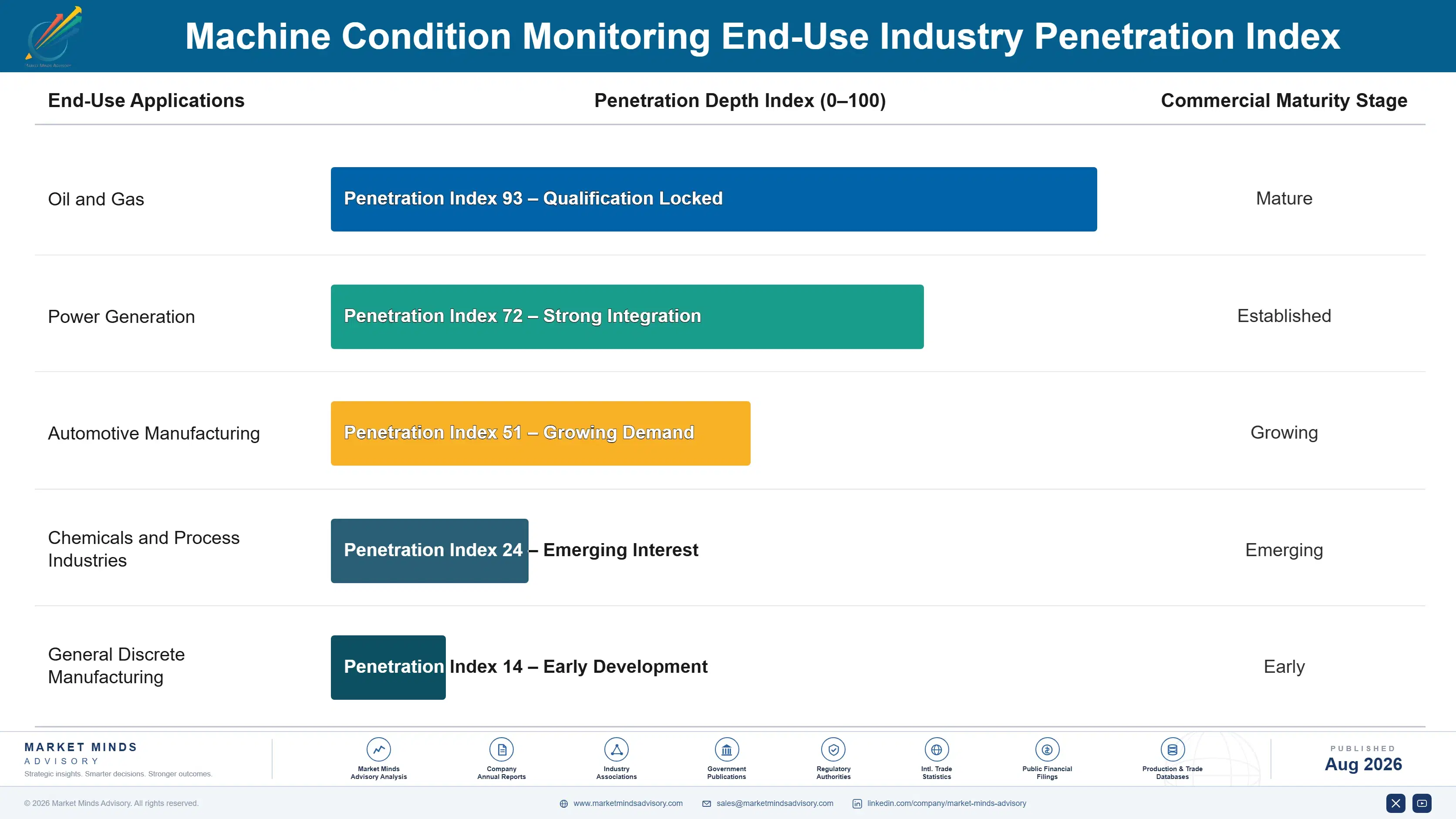
Machine condition monitoring demand behaves increasingly like an annuity once a plant standardises on a monitoring platform, since switching vendors mid-deployment means losing accumulated site-specific failure history and retraining maintenance workflows around a new system entirely. That durability shapes how vendors structure long-term account relationships and pricing. Vendors that win the initial deployment typically hold the account for years.
Adoption depth varies sharply by vertical: continuous process industries like oil, gas, and chemicals penetrate deepest, often monitoring the large majority of critical rotating equipment, while discrete manufacturing adopts more selectively, prioritising equipment tied directly to production line uptime. Power generation sits between the two, with adoption depth tracking closely to asset criticality and regulatory requirements. Utilities show a similar mid-tier pattern shaped by asset age.

A generational shift in buyer profiles is underway as younger reliability engineers, often trained on data analytics platforms rather than manual spectral interpretation, increasingly demand integrated software dashboards and automated alerts before accepting a monitoring vendor, replacing an older generation that selected vendors primarily on hardware reputation. Vendors slow to adapt risk losing share to software-forward challengers in the years ahead. Procurement teams increasingly involve data science staff in vendor selection.
machine-condition-monitoring-market-end-use-penetration-index-1787556183243

Where To Focus Capital Next

These are among the four positions where our research anticipates prominent divergence between winners and laggards over the coming forecast period. Each is grounded in the demand model, the regulatory perimeter, and the announced capacity pipeline.
01 / ANALYTICS PLATFORM INVESTMENT

Prioritise AI-Driven Analytics Over Standalone Sensor Hardware Sales

AI-driven analytics platforms are growing fastest and carry the category's widest margins, driven by manufacturers seeking reduced dependence on scarce, skilled vibration analysts amid a persistent industrial labor shortage across most regions. Vendors that pair sensor hardware with credible automated diagnostics are converting hardware-only customers into subscription relationships at a faster rate than competitors selling sensors alone. Capital allocated toward machine learning model development and historical failure data collection will likely generate better returns than pure hardware capacity expansion over the next several years.
02 / WIRELESS RETROFIT EXPANSION

Extend Coverage To Lower-Criticality Assets Ahead Of Competitors

Falling wireless sensor costs are opening a substantial addressable market among lower-criticality equipment that never justified permanently wired monitoring systems, and vendors moving first into this expansion within existing customer accounts capture share before competitors recognise the opportunity clearly. Selling into an existing account costs meaningfully less than acquiring new customers, since the relationship and analytics platform already exist. Vendors that delay this expansion risk ceding the fastest-growing coverage segment entirely to more aggressive account expansion programmes run by better-prepared rivals.
03 / MANAGED SERVICE BUNDLING

Bundle Reliability Services With Hardware To Raise Retention

Bundling managed reliability engineering services with sensor deployment meaningfully raises customer switching costs, since abandoning a bundled provider means retraining an outsourced reliability workflow rather than simply replacing hardware components across a facility. Vendors that have adopted this approach report materially higher contract values and lower churn than hardware-only competitors, turning a commodity equipment relationship into a lasting operational partnership. The approach requires reliability engineering staffing investment, favoring larger vendors able to absorb that cost against multi-year contracted revenue streams.
04 / GEOGRAPHIC MANUFACTURING LOCALISATION

Localise Manufacturing In China To Compete On Price

Chinese domestic sensor manufacturers are gaining share on price in cost-sensitive retrofit projects, and Western vendors without local manufacturing capacity face a lasting cost disadvantage on hardware pricing in this fast-growing regional market, tied to labor and component sourcing costs. Establishing local production and component sourcing allows vendors to compete on price while still retaining higher-margin analytics and services revenue centrally. Vendors that delay localisation risk ceding the region's substantial retrofit volume entirely to lower-cost domestic competitors already established there.

Engagement Snapshot From the Field

A live engagement with an industry participant carrying material or product regulatory and market exposure ahead of a defining policy shift, showing how our research translates into a defensible multi-year portfolio strategy.
MARKET MINDS ADVISORY · CLIENT ENGAGEMENT SUMMARY
Machine Condition Monitoring Producer Strategic Portfolio Review and Transition Roadmap 2026·Investment Scenario on Machine Condition Monitoring Exposure Evaluation 2025-26
CLIENT PROFILE
The client is a multi-site industrial manufacturer operating twelve production facilities across North America, representing approximately 3,200 monitored rotating assets (client-reported, unverified by MMA). The manufacturer had relied on periodic manual vibration inspection rounds performed quarterly and faced escalating unplanned downtime costs as experienced reliability technicians retired faster than replacements could be trained across its facility network.
STRATEGIC CHALLENGE
Reliability leadership needed to justify a substantial capital investment in continuous wireless sensor monitoring across the full facility network but lacked internal data quantifying expected downtime reduction against the upfront hardware and software subscription cost. The manufacturer also needed to determine whether existing reliability staff could manage the resulting data volume without significant additional headcount.
MMA APPROACH
MMA analysts benchmarked the manufacturer's current downtime costs against documented outcomes from comparable multi-site deployments, modeling expected downtime reduction and required reliability staffing levels across representative facility profiles. The engagement combined primary interviews with plant reliability managers, vendor platform capability comparison, and analysis against MMA's broader dataset of continuous monitoring deployment outcomes across similarly sized manufacturers.
KEY FINDINGS
  1. Modeled downtime reduction from continuous monitoring exceeded 30 percent across the manufacturer's highest-criticality production lines, based on comparable deployment benchmarks (client-reported, unverified by MMA).
  2. Existing reliability staffing was projected to be sufficient if paired with automated alert triage software, avoiding an estimated six additional full-time hires the manufacturer had budgeted for.
  3. Facilities with the oldest equipment showed the largest projected downtime reduction, suggesting a phased rollout prioritising older facilities would outperform simultaneous full-network deployment.
  4. Two of three benchmarked vendors offered subscription pricing models that reduced upfront capital requirements meaningfully compared with the manufacturer's original outright-purchase budget assumption.
CLIENT PROFILE
The client is a multi-site industrial manufacturer operating twelve production facilities across North America, representing approximately 3,200 monitored rotating assets (client-reported, unverified by MMA). The manufacturer had relied on periodic manual vibration inspection rounds performed quarterly and faced escalating unplanned downtime costs as experienced reliability technicians retired faster than replacements could be trained across its facility network.
STRATEGIC CHALLENGE
Reliability leadership needed to justify a substantial capital investment in continuous wireless sensor monitoring across the full facility network but lacked internal data quantifying expected downtime reduction against the upfront hardware and software subscription cost. The manufacturer also needed to determine whether existing reliability staff could manage the resulting data volume without significant additional headcount.
MMA APPROACH
MMA analysts benchmarked the manufacturer's current downtime costs against documented outcomes from comparable multi-site deployments, modeling expected downtime reduction and required reliability staffing levels across representative facility profiles. The engagement combined primary interviews with plant reliability managers, vendor platform capability comparison, and analysis against MMA's broader dataset of continuous monitoring deployment outcomes across similarly sized manufacturers.
KEY FINDINGS
  1. Modeled downtime reduction from continuous monitoring exceeded 30 percent across the manufacturer's highest-criticality production lines, based on comparable deployment benchmarks (client-reported, unverified by MMA).
  2. Existing reliability staffing was projected to be sufficient if paired with automated alert triage software, avoiding an estimated six additional full-time hires the manufacturer had budgeted for.
  3. Facilities with the oldest equipment showed the largest projected downtime reduction, suggesting a phased rollout prioritising older facilities would outperform simultaneous full-network deployment.
  4. Two of three benchmarked vendors offered subscription pricing models that reduced upfront capital requirements meaningfully compared with the manufacturer's original outright-purchase budget assumption.
RECOMMENDED STRATEGY
Phase 1: Phase 1 (Months 1 to 4): Deploy wireless monitoring across the three oldest, highest-downtime-risk facilities to validate modeled reduction benchmarks. Phase 2: Phase 2 (Months 5 to 12): Extend deployment to remaining facilities using subscription pricing to manage capital outlay across the network. Phase 3: Phase 3 (Months 13 to 18): Implement automated alert triage software network-wide to confirm existing staffing sufficiency at full scale.
OUTCOME
The manufacturer selected a subscription-priced vendor and completed phased deployment across its facility network within eighteen months. Early-adopting facilities reported meaningful unplanned downtime reduction within the first year (client-reported, unverified by MMA), and reliability leadership credited the phased approach with building internal confidence before committing to full-network investment.

Frequently Asked Questions

Foundational context covering the market sizes, CAGR, scope, country, region and competition that inform every finding below. This section is provided to cover basics and most often pre-purchase conversations, answered from the MMA Primary Research Dataset.

What is the current size of the Machine Condition Monitoring Market?

The global machine condition monitoring market was valued at approximately $3.8 billion in 2025. Growth is concentrated among manufacturers replacing periodic manual inspection with continuous, sensor-based monitoring.

How large will the Machine Condition Monitoring Market be by 2036?

MMA forecasts the market will reach approximately $9.71 billion by 2036, roughly 2.35 times its 2026 value. Growth is driven by falling sensor costs and rising AI-driven analytics adoption.

What is the CAGR for the Machine Condition Monitoring Market 2026 to 2036?

The market is projected to grow at a compound annual growth rate of 8.9 percent between 2026 and 2036. Bull and bear scenarios range from roughly 7.6 to 10.2 percent depending on industrial capital spending cycles.

Which segment is growing fastest?

Wireless IIoT sensor platforms are the fastest-growing segment, expanding at approximately 12.8 percent annually. Growth is driven by falling hardware costs and cloud-based analytics extending coverage to lower-criticality equipment.

Who are the major companies in the Machine Condition Monitoring Market?

Leading vendors include Emerson Electric, SKF, Honeywell, Baker Hughes, and Parker Hannifin. Competition centers on analytics quality, subscription pricing, and managed reliability services rather than hardware alone.

Which country is growing fastest?

China is the fastest-growing major market, driven by an aggressive national automation push and new manufacturing plants specifying wireless sensor networks at construction rather than retrofitting them later.

Report Segmentation Architecture

The full report scope spans multiple orthogonal segmentation dimensions, with cross-tabulated demand data provided for each dimension pair. Coverage extends further to regional breakdowns, trend trajectories, and the competitive detail needed to support segment-level decision-making.

By Sensing Technology

  • Vibration Analysis Systems
  • Thermography Monitoring
  • Oil and Lubricant Analysis
  • Acoustic Emission Monitoring
  • Wireless IIoT Sensor Platforms
  • Ultrasonic Monitoring Systems

By End-Use Industry

  • Oil and Gas
  • Power Generation
  • Automotive Manufacturing
  • Chemicals and Process Industries
  • General Discrete Manufacturing

By Commercial Dimension

  • Hardware-Only Sales
  • Subscription Analytics
  • Managed Reliability Services
  • Hardware-as-a-Service Leasing

By Region

  • North America
  • Western Europe
  • East Asia
  • South Asia and Pacific
  • Latin America
  • Middle East and Africa
  • Eastern Europe

Scope, Methodology, and Coverage

Every figure in this report is reproducible from documented input assumptions. The scope below maps the historical period, the forecast horizon, the segmentation dimensions, and the countries covered, alongside the underlying primary and qualitative methodology.
Historical Period
2020 to 2025
Forecast Period
2026 to 2036
Base Year
2025 (USD billions; MMA Primary Research Dataset, August 2026)
Market Definition
The machine condition monitoring market covers sensor hardware, data acquisition systems, and analytics software used to assess the operating health of rotating and reciprocating industrial equipment, spanning vibration, thermography, oil analysis, acoustic emission, and ultrasonic techniques. It excludes general industrial IoT platforms not focused on equipment health and standalone SCADA control systems.
Quantitative Units
USD billions (current prices); unit shipments in monitored sensor nodes where cited
Segmentation Dimensions
By Sensing Technology; By End-Use Industry; By Commercial Dimension; By Region
Regions Covered
North America, Western Europe, East Asia, South Asia and Pacific, Latin America, Middle East and Africa, Eastern Europe
Countries Covered
USA, China, Germany, France, UK, Japan, South Korea, India, Australia, Canada, Brazil, Mexico, Indonesia, Vietnam, Thailand, Malaysia, UAE, Saudi Arabia, South Africa, Nigeria, Turkey, Poland, Netherlands, Italy, Spain, Sweden, Switzerland, Argentina, Colombia, Singapore, and additional markets relevant to this sector
Key Companies Profiled
Emerson Electric, SKF, Honeywell, Baker Hughes, Parker Hannifin, Fluke Corporation, National Instruments, Rockwell Automation, Siemens, ABB, GE Vernova, Schaeffler, Meggitt, Analog Devices, PCB Piezotronics, MISTRAS Group, Azima DLI, Trelleborg, Petasense, Augury
Quantitative Methodology
Primary survey, n=3,800 respondents, Q4 2025, six countries; demand-side model with trade association cross-validation
Qualitative Methodology
47 expert interviews, Q4 2025; applied to validate demand model assumptions, identify emerging dynamics, and assess competitive positioning
Report Format
PDF and XLSX data workbook (Word format preview document)
Publisher
Market Minds Advisory
Report Code
MMA-2026-CON-102
Published
August 2026
Contact
sales@marketmindsadvisory.com | www.marketmindsadvisory.com

Purchase the full Machine Condition Monitoring Market Report (2026 to 2036).

The full report provides a complete quantitative and qualitative assessment of the global machine condition monitoring market through 2036, including detailed regional sizing across all seven MMA-tracked geographies and technology-level segmentation covering vibration, thermography, wireless IIoT, and analytics-driven monitoring categories. It profiles twenty leading and emerging vendors, benchmarking hardware capability, analytics maturity, and managed service offerings across the competitive landscape. The report includes primary survey findings from 3,800 respondents and 47 expert interviews conducted in the fourth quarter of 2025, alongside detailed input cost and semiconductor supply chain risk analysis. Buyers receive segment-level revenue models, editable data tables, and a structured framework for evaluating platform and vendor selection decisions.
Seven-region market sizing with technology-level revenue breakdowns
Twenty-company competitive profiles with moat and risk analysis
Primary survey data from 3,800 respondents across six countries
Forty-seven expert interviews on analytics and adoption trends
Editable data tables for custom scenario and sensitivity modeling
Semiconductor input cost and supply chain risk assessment

Built For The People Who Decide

From boardroom strategy to bench-side execution, this report is read cover-to-cover by leaders shaping the next decade of their industry, turning demand scenarios, market dynamics and valuation benchmarks into decisions.
CXOs/ Presidents/ VPs/ Managers
M&A and Corporate Development
Strategy Teams and R&D Heads
Procurement and Product Directors
Regulatory and Compliance Leaders
Investor Relations and Equity Analysts