

Market Minds Advisory
Lyophilized Injectable Market

Lyophilized Injectable Market: A Formulation Failure Everyone Pays To Live With

Freeze-drying exists because a molecule cannot survive in solution. It ties up a chamber for two days, adds forty percent to fill cost, and hands reconstitution to a nurse. Everyone would rather not.

Lead Analyst

Alice Ballenger

Published

September 2026

Make Smarter Decisions with Customized Research Insights

Request a free sample report and evaluate market opportunities, growth trends, and competitive dynamics relevant to your business needs.

2025 MARKET VALUE$48.0BMarket Size 2025
2036 FORECAST VALUE$111.9BBase Case , 2026 to 2036
CAGR 2026 TO 20368.0 %Bull 9.2% / Bear 6.8%
INCREMENTAL OPPORTUNITY$60.1BNet 10- year value creation
EXPANSION MULTIPLE2.16x2036 value over 2026 base
Strategic Levers
M&A Pipeline
Regional Outlook
Country Rankings
Competitive Intelligence
Segmental Deep-dive
Call-Us : 91 93563 13602

Executive Snapshot and Market Trajectory

Nobody actually chooses to freeze-dry a drug. Lyophilisation happens only because a molecule will not survive in solution, and the consequences run right through the chain: a chamber occupied for two full days, roughly 40% added to fill-finish cost, and a nurse reconstituting the dose at the bedside.
The market reaches USD 48.0 billion in 2025 and compounds at 8.0% to USD 111.92 billion by 2036, an expansion multiple of 2.16 times. Antibody drug conjugates and complex biologics grow fastest at 12.0%, exactly 1.50 times the market rate. North America holds 32% of value on oncology and biologic pricing, though East Asia at 23% leads comfortably on units and would lead on value at Western prices.
Concentration is genuinely low at 27% across the top five, splitting originators, generic injectable fillers, and contract manufacturers who barely compete with one another for the same work at all. The industry is now actively converting legacy products out of freeze-dried presentation altogether, and this market grows anyway, because every new complex molecule now arriving is less stable in solution than the ones being converted away from it, and the pipeline behind them is dense.
Market Definition
The lyophilized injectable market covers finished parenteral drug products presented as a freeze-dried powder or cake requiring reconstitution before administration, across originator, generic, and contract-manufactured supply. Scope spans antibody drug conjugates and complex biologics, monoclonal antibodies, peptides and small protein therapeutics, small molecule oncology agents, anti-infectives, and vaccines and biological preparations. Lyophilisation equipment, excipients and formulation inputs, ready-to-use liquid and frozen presentations, diluents supplied separately, and lyophilised diagnostic reagents are excluded.
Base Year Value
$48.0B in 2025 (MMA Primary Research Dataset, August 2026)
Forecast Period
2026 to 2036, eleven discrete annual values
CAGR
8.0% base case. Bull 9.2%. Bear 6.8%.
Fastest Growth Segment
Antibody Drug Conjugates And Complex Biologics: 12.0% CAGR
Fastest Growth Country
India: 11.4% CAGR
Fastest Growth Region
South Asia and Pacific: 10.2% CAGR
Largest Region
North America: 32% of 2025 global value
Market Leaders
Pfizer, Fresenius Kabi, Baxter International, Merck and Co, Novartis. Source: MMA Primary Research Dataset, July 2026.
Primary Survey
n=3,800 procurement and R&D decision-makers, Q4 2025, six countries
Methodology
Demand-side build-up, cross-validated against public data, 47 expert interviews

Lyophilized Injectable Market Forecast Scenarios

lyophilized-injectable-market-size-forecast-scenario-1787298480209
Between 2020 and 2025 this market was pulled by molecule mix and squeezed by capacity. Vaccine programmes absorbed enormous sterile fill capacity through 2021, generic injectable anti-infectives went in and out of shortage repeatedly, and antibody drug conjugate approvals accelerated from 2022 onward. A 6.9% historical CAGR averages a commoditised generic base against a complex biologic tier growing at multiples of it.
Three mechanisms carry the 8.0% base case. Complex biologic approvals are the largest, since antibody drug conjugates, bispecifics, and engineered proteins are almost all too unstable for liquid presentation and arrive lyophilised by necessity. Peptide therapeutic expansion is the second, driven by metabolic and oncology programmes. And Asian capacity build-out is the third, as Indian and Chinese fill-finish operations add chambers at a pace and cost Western manufacturers cannot match at all.
The 9.2% bull case rests on antibody drug conjugate approvals accelerating further, since each one consumes chamber hours at high value and there is no liquid alternative for most of them. The 6.8% bear case is ready-to-use conversion succeeding faster than expected on established biologics, since every molecule reformulated into a stable liquid presentation leaves this market permanently rather than switching supplier within it.

Two Days Of Chamber Time

Freeze-drying is a workaround rather than a choice. A molecule unstable in aqueous solution has its water removed under vacuum so it can sit on a shelf for two years, and everything downstream pays for it. A cycle occupies a chamber for around 48 hours, fill cost runs roughly 40% above liquid filling for an identical vial, and the reconstitution step transfers a preparation error risk of about 6% to whoever is at the bedside.
TOP FIVE CONCENTRATION27%Fragmented between originators, generic fillers and contract manufacturers
TYPICAL CYCLE DURATION48 hoursTime a chamber is occupied by one freeze-drying run
FILL FINISH PREMIUM40%Additional cost over liquid filling for the same vial
CHAMBER LEAD TIME24 monthsDelay between ordering a large lyophiliser and using it
RECONSTITUTION ERROR RATE6%Share of doses prepared incorrectly at the point of care
READY-TO-USE CONVERSION18%Portion of legacy products moved out of freeze-dried presentation
Chamber capacity is the constraint nobody outside manufacturing appreciates. A large lyophiliser takes around 24 months from order to qualified use, and contract manufacturers price the asset by chamber hour rather than by vial. That means a cycle on a generic anti-infective and one on an antibody drug conjugate occupy the same asset for the same time at wildly different revenue, and allocation follows the arithmetic.
That allocation logic explains the shortages. Generic injectable anti-infectives compete for chamber hours against oncology biologics worth several hundred times more per vial, and they lose consistently. The industry has converted legacy products to ready-to-use liquid where formulation allows, moving roughly 18% of the older portfolio out entirely. New molecules still arrive faster than conversion removes old ones.
"Everyone models this off drug approvals. The number that actually decides supply is how many chamber hours exist and what each hour earns, and a generic cephalosporin loses that comparison every single time."
Director, Sterile Manufacturing And Injectables Practice · MMA Healthcare Practi

Market Trends

Chamber Hour Economics Push Low-Value Products Out

Contract sterile manufacturers price lyophilisation by chamber hour because that is the asset being consumed, and a 48-hour cycle earns identically in time whether it produces generic ceftriaxone or an antibody drug conjugate. Revenue per cycle differs by orders of magnitude. Allocation decisions follow that arithmetic without much sentiment, which systematically pushes low-value generics out of scarce capacity and creates the recurring anti-infective shortages that regulators keep investigating. Nobody involved is behaving badly here; the asset simply cannot be in two places at once, and something has to lose, and no regulator has yet found a mechanism to change it.
Market Impact: Value exceeds 100 times per vial
Ready-To-Use Conversion Removes Legacy Products Permanently

Where formulation science allows a stable liquid or frozen presentation, manufacturers convert products out of lyophilisation to remove chamber cost, reconstitution error, and preparation time at the point of care. Roughly 18% of the legacy portfolio has already moved. That is a permanent departure rather than a supplier switch, since a converted product never returns to freeze-drying. New complex molecules arriving lyophilised by necessity have so far comfortably outpaced that conversion, though the balance is by no means guaranteed to hold across the whole forecast period, and reconstitution error is the argument payers keep returning to.
Market Impact: Build queues run 12 months shorter

Market Opportunities and Growth Drivers

Complex Biologics Arrive Lyophilised By Necessity

Antibody drug conjugates, bispecific antibodies, engineered proteins, and conjugated peptides are substantially less stable in aqueous solution than the monoclonal antibodies that preceded them, and most reach approval in freeze-dried presentation because no liquid formulation survives the required shelf life. There is no commercial choice being exercised here. Each approval adds high-value chamber demand that displaces something considerably cheaper, and the approval pipeline across these classes is the densest anywhere in the industry today. Value per vial runs into the thousands, and none of it can be filled without dedicated chamber time booked well in advance.
Market Impact: Chambers take 24 months to build

Asian Fill-Finish Capacity Expands Against Western Cost

Indian and Chinese sterile fill-finish operations have added lyophilisation chambers at a pace and cost Western manufacturers cannot approach, and regulatory inspection outcomes at leading sites are now broadly comparable. That capacity serves domestic markets and increasingly Western sponsors seeking chamber hours their existing partners cannot supply. Gland Pharma and comparable operations have built genuine scale. Capacity availability rather than price is what actually drives sponsors there now, which is a genuinely unusual position for Asian pharmaceutical manufacturing to occupy, and several Western sponsors have moved entire launch programmes there for that reason alone.
Market Impact: Errors affect 6% of doses

Market Restraints and Challenges

Chamber Capacity Cannot Be Added Quickly At Any Price

A large production lyophiliser runs around 24 months from order to qualified operation, covering fabrication, installation, commissioning, and validation, and the specialist builders have their own backlogs. The root cause is that these are complex vacuum and refrigeration systems built in small numbers by very few suppliers. Commercially this means that capacity shortages persist for years at a time rather than for quarters. Participants are mitigating through cycle optimisation that shortens run time, through capacity reservation agreements signed years ahead, and through Asian partners whose build queues are considerably shorter than European ones.
Market Impact: Cycles occupy 48 chamber hours

Reconstitution Error Undermines The Whole Presentation

Roughly 6% of lyophilised doses are prepared incorrectly at the point of care through wrong diluent, wrong volume, incomplete dissolution, or contamination during transfer. The root cause is that freeze-drying moves a manufacturing step into a clinical environment never designed for it. Commercially this drives payers, hospital pharmacies, and health systems toward ready-to-use alternatives wherever any such alternative actually exists. Mitigation runs toward dual-chamber and prefilled reconstitution devices, toward clearer preparation instructions and staff training, and ultimately toward liquid reformulation wherever the molecule actually permits it, and hospital pharmacy directors raise it in every supply discussion now.
Market Impact: Conversion has removed 18% already
3 additional market trends, 4 additional growth drivers, and 2 additional restraints and challenges are covered in the full report. Contact sales@marketmindsadvisory.com to access the complete intelligence.

Segment CAGR and Growth Architecture

Segmentation follows molecule class, because the molecule determines whether liquid presentation is even possible, how long a freeze-drying cycle must run, what a vial is worth against the chamber hours it consumes, and which manufacturers hold the relevant capability. Therapy area, care setting, and supply route are handled in the framework and in commentary instead of here.
lyophilized-injectable-market-market-share-analysis-1787298480742

Antibody Drug Conjugates And Complex Biologics

Complex biologics grow fastest at 12.0% annually, exactly 1.50 times the market rate, and almost none of them had any realistic alternative to freeze-drying. Antibody drug conjugates carry a cytotoxic payload attached through a linker that hydrolyses in aqueous solution, bispecific constructs aggregate, and engineered proteins unfold. Each of these reaches approval in lyophilised form because nothing else survives the shelf life required of a commercial product. Value per vial runs several hundred times a generic anti-infective while consuming identical chamber hours, which is exactly why capacity allocation flows toward them so reliably across the whole industry. Sponsors in this class now reserve chamber hours years ahead of launch, often before the chamber itself has been built.
CAGR 12.0%

Peptides And Small Protein Therapeutics

Peptides and small proteins grow at 10.2%, pulled along by metabolic, oncology, and endocrine programmes that have all expanded enormously over the past five years. Many peptides are chemically unstable in aqueous solution through hydrolysis, oxidation, or aggregation, and lyophilisation extends their usable shelf life from months out to years. Some newer products have converted to stable liquid pen presentations wherever formulation permits it, which removes them from this market entirely and permanently. The remainder stay freeze-dried, and the segment grows because approval volume is running well ahead of any conversion activity. Metabolic peptide programmes alone account for a substantial share of new chamber demand, and device-integrated presentations are beginning to appear in this class too.
CAGR 10.2%
Full segment breakdown across 6 segments available in the complete report.

Regional Architecture and Country Demand Map

Value share and unit share diverge sharply in this market, more so than in most. North America leads on value through oncology and biologic pricing while East Asia leads comfortably on vials filled, and any reading of the table below should keep those two measures firmly separate.

North America

North America holds 32% of total value, the largest share of any region, and pricing rather than volume explains most of that position. Oncology biologics and antibody drug conjugates command prices no other market approaches, and almost all of them are lyophilised by necessity rather than by choice. Domestic sterile fill capacity is substantial but heavily committed already, which pushes sponsors toward European and increasingly Asian chamber hours instead. Generic injectable anti-infective shortages recur here more visibly and more politically than anywhere else. Ready-to-use conversion is being pushed hardest by health systems here. Growth at 7.4% trails the global rate on a large and already well established installed base, and several sponsors now hold reserved capacity abroad as standard practice.
Share: 32% | CAGR: 7.4% (2026 to 2036)

East Asia

Twenty-three percent of total value sits in East Asia while unit volume comfortably exceeds any other region, and volume-based procurement in China explains the gap between those two figures. Chinese hospitals administer enormous quantities of lyophilised powder injections, including anti-infectives and traditional preparations, at prices that generate a fraction of the equivalent Western value. Domestic manufacturers including Qilu and CSPC comfortably dominate that supply. Japanese and Korean biologic manufacturing is technically sophisticated and heavily export-oriented, and it operates at prices closer to Western levels. Chamber capacity has expanded substantially across Chinese contract manufacturing. Growth at 9.2% exceeds the global rate on domestic biologic development rather than on any pricing recovery.
Share: 23% | CAGR: 9.2% (2026 to 2036)
Regional intelligence for 5 additional markets available in the complete report: Western Europe, South Asia and Pacific, Latin America, Middle East and Africa, Eastern Europe. Contact sales@marketmindsadvisory.com.
lyophilized-injectable-market-country-cagr-analysis-1787298481301

Making Chamber Hours Earn More

Everything in this business reduces to what an occupied chamber earns during the two days it is running. Cycle shortening, molecule mix, capacity reservation, and reconstitution device integration each change that number directly. Four levers follow from that, and three of them are worth more than any pricing negotiation a contract manufacturer will ever win.

Shorten Cycles Through Formulation And Process Work

A typical freeze-drying cycle occupies a chamber for around 48 hours, and cycle design rather than any physical constraint accounts for a substantial part of that duration. Annealing steps, controlled nucleation, and optimised shelf ramp profiles routinely cut run time by 20% to 30% without affecting cake quality or product stability at all. On a capacity-constrained asset that translates directly into additional batches every year at essentially zero capital cost, which makes it the single highest return investment available anywhere in a sterile fill operation, and it remains chronically underfunded.
Market Impact: Cuts cycle time by 20% to 30% typically

Weight Chamber Allocation Toward High-Value Molecules

A 48-hour cycle earns the same chamber time whether it fills generic ceftriaxone or an antibody drug conjugate, and revenue per cycle differs by orders of magnitude between them. Contract manufacturers pricing by vial rather than by chamber hour are systematically mispricing the scarcest asset they own, and most of them do exactly that. Shifting the mix toward complex biologics raises revenue per chamber hour by somewhere between 4 and 8 times, and it is precisely the reason generic anti-infectives keep falling out of available capacity right across the industry.
Market Impact: Raises hourly revenue by 4 to 8 times

Sell Reserved Capacity Years Ahead Of Requirement

A large lyophiliser takes roughly 24 months from order through to qualified operation, so any sponsor approaching launch with no reserved chamber hours has no realistic route to commercial supply. Multi-year capacity reservation agreements with take-or-pay terms convert an uncertain order book into committed revenue, and they let a manufacturer build new capacity against contracted demand rather than against any forecast. Reservation fees of USD 2 million to USD 8 million per programme are now routinely accepted by sponsors who resisted the very idea of them a few years ago.
Market Impact: Fees run USD 2 to 8 million each

Integrate Reconstitution Devices Into The Presentation

Roughly 6% of all lyophilised doses are prepared incorrectly at the point of care each year, and every one of those errors argues for a ready-to-use competitor that would remove the product from this market permanently and finally. Dual-chamber syringes and integrated reconstitution systems eliminate most of that preparation risk entirely while keeping the molecule itself freeze-dried. They also add 25% to 40% to realised value per unit, which more than covers the device cost and simultaneously defends the presentation against the conversion pressure building behind it, Payers have begun asking about preparation error explicitly in tender documents.
Market Impact: Adds 25% to 40% of realised unit value

Who Controls the Margin Pool

Concentration at 27% across the top five reflects a market where originators, generic injectable fillers, and contract manufacturers coexist without competing directly for the same work. All participants here are compared on measured global revenue from lyophilised finished injectable products and the contract filling of them, which requires apportioning multi-presentation portfolios and is the only basis putting an originator and a contract sterile manufacturer on comparable terms.
Competition happens over chamber hours rather than over customers. Pfizer and Merck fill their own complex biologics alongside substantial contract work. Fresenius Kabi and Baxter hold large generic injectable positions where anti-infectives increasingly struggle for capacity. Vetter and Catalent compete purely as contract manufacturers on capability, quality reputation, and available capacity, which sponsors now value above price in a way they did not a decade ago.

Pressure is arriving from Asian capacity and from ready-to-use conversion simultaneously. Indian and Chinese fill-finish operations have added chambers faster than anywhere else with inspection outcomes now broadly comparable, and Western sponsors go there for availability rather than for cost. Rankings shift on capacity commissioning and on which manufacturer holds reserved hours when a complex biologic reaches launch, since neither can be arranged quickly.
lyophilized-injectable-market-company-positioning-matrix-1787298481896

Competitive Moat and Risk Dimensions

PFIZER

Moat: Owned Capacity Across Complex Presentations

Pfizer operates substantial internal sterile fill and lyophilisation capacity alongside a large complex biologic portfolio, which removes the capacity availability constraint that shapes every sponsor without owned chambers. Internal allocation also lets it prioritise launch supply without competing for contract slots. Sponsors dependent on third-party capacity have no equivalent control over their own timelines.
PFIZER

Risk: Legacy Portfolio Conversion Exposure

A meaningful part of the company's lyophilised volume sits in older products where ready-to-use liquid reformulation is technically feasible and commercially attractive to payers and health systems. Every product converted leaves this market permanently rather than switching supplier. Defending the presentation requires device integration investment that competes internally against newer programmes.
FRESENIUS KABI

Moat: Generic Injectable Scale And Reach

Fresenius Kabi holds one of the largest generic injectable portfolios and hospital supply relationships worldwide, with fill capacity across several continents supporting it. That scale gives it purchasing and regulatory leverage no regional filler matches, and hospital customers value breadth of supply from a single relationship highly.
FRESENIUS KABI

Risk: Anti-Infectives Losing Chamber Priority

Generic lyophilised anti-infectives earn a small fraction of what complex biologics generate per chamber hour, and every capacity allocation decision across the industry runs against them. The company's largest volumes sit in exactly that category. Defending margin means either owning the capacity outright or accepting recurring shortage risk on products hospitals genuinely need.

Players Tracked

Prominent Players

Pfizer
Fresenius Kabi
Baxter International
Merck and Co
Novartis

Other Key Players

Sandoz
Teva Pharmaceutical Industries
Hikma Pharmaceuticals
Sun Pharmaceutical Industries
Cipla
Dr Reddys Laboratories
Aurobindo Pharma
Zydus Lifesciences
Gland Pharma
Vetter Pharma
Catalent
Recipharm
Jubilant Pharmova
Qilu Pharmaceutical
CSPC Pharmaceutical Group

Recent Developments

JANUARY 2025

Contract Manufacturer Commissions Additional Large Lyophilisation Capacity

A European contract sterile manufacturer brought additional large-scale lyophilisation chambers into qualified operation, following a build programme that ran for over two years. The capacity was contracted substantially in advance under multi-year reservation agreements with biologic sponsors rather than being commissioned speculatively against any forecast.
Signal: Chamber capacity is now sold years before it exists, which tells you how scarce it is
APRIL 2025

Regulators Investigate Recurring Generic Injectable Anti-Infective Shortages

Regulatory authorities examined persistent shortages across generic lyophilised anti-infectives, identifying sterile capacity allocation rather than active ingredient supply as the principal underlying cause. The review is an assessment rather than any policy action, and no mechanism currently exists anywhere to reserve chamber capacity for low-value essential products.
Signal: Shortages here are purely an allocation outcome rather than any failure of active ingredient supply anywhere
AUGUST 2025

Indian Sterile Manufacturer Expands Lyophilisation Chamber Count

An Indian sterile fill-finish manufacturer commissioned further lyophilisation chambers serving both domestic supply and Western sponsors seeking capacity that their existing partners simply could not provide. The expansion was funded internally and followed regulatory inspection outcomes that supported supply into regulated Western markets without restriction.
Signal: Western sponsors now travel to Asian capacity for availability rather than for any lower cost at all

Energy, Vials And Chamber Time

Electricity and refrigeration account for roughly 18% to 26% of lyophilisation conversion cost, since a chamber runs deep vacuum and low shelf temperatures continuously across a two day cycle. Sterile vials, stoppers, and seals add 14% to 22%, sourced from a narrow glass and elastomer supplier base. Active ingredient dominates cost on complex biologics and is almost irrelevant on generic anti-infectives, which is the whole commercial divide.
European energy pricing through 2022 hit lyophilisation harder than most pharmaceutical processes, because chambers cannot be run intermittently and a cycle once started must complete. The IEA documented the scale of that gas price shock across the period. Vetter and comparable European contract manufacturers absorbed substantial cost increases before contract renewal allowed repricing, and several sponsors moved marginal programmes toward lower energy cost geographies as a result.

Exposure separates by energy pricing and by whether capacity is owned. A manufacturer running its own chambers in a low energy cost geography competes on a conversion cost base that European contract sites cannot match on identical equipment. Sponsors buying chamber hours face whatever their contract partner passes through. Glass and stopper supply affects everybody equally and has repeatedly constrained the industry independently of anything else.
lyophilized-injectable-market-cost-volatility-analysis-1787298482192

Optimise Cycle Design To Cut Energy And Chamber Time Together

Annealing, controlled nucleation, and optimised shelf ramp profiles routinely shorten a freeze-drying cycle by a fifth to a third without affecting cake quality or product stability. That reduces energy consumption and frees chamber hours simultaneously, which makes process development the highest return investment available in a sterile fill operation and considerably cheaper than adding capacity.

Contract Energy Supply On Multi-Year Terms For Chamber Sites

A lyophilisation chamber cannot be run intermittently to chase favourable pricing, and a cycle once started must complete regardless of what the spot market does that afternoon. Multi-year energy supply contracts and on-site generation both reduce an exposure that behaves quite differently from ordinary manufacturing load, and neither is genuinely optional at any meaningful scale of operation.

Dual-Source Sterile Vials, Stoppers And Seals

Glass vials and elastomeric closures come from a narrow supplier base that has constrained the entire injectable industry more than once, and a qualified component cannot simply be substituted inside a validated product. Qualifying alternates at development costs modest additional stability and compatibility work, and it converts a supply failure into a documented change.

Portfolio Architecture for Margin Defence

Margin architecture in this market is decided by what a vial is worth against the chamber hours it consumes, which is an unusual basis. Generic lyophilised anti-infectives and legacy small molecules earn 8% to 18%, and they lose capacity allocation contests continuously. Complex biologics, antibody drug conjugates, and device-integrated presentations earn 46% to 64%, because value per vial dwarfs the identical chamber time they occupy.
The tension is that the low tier contains products health systems genuinely need and the industry keeps failing to supply. Generic injectable anti-infectives are essential, cheap, and systematically displaced from scarce chambers by oncology biologics worth hundreds of times more per vial. Nobody is behaving unreasonably and the outcome is recurring shortage, which regulators keep investigating without any mechanism to fix it.

High-value pools concentrate in complex biologic filling, reserved capacity agreements, and device-integrated reconstitution presentations. The first two exploit scarcity directly and the third defends against conversion to liquid. Contract capacity carries the widest margin range anywhere in this market, because a reserved chamber hour and a spot-filled generic batch share the same physical asset and share almost nothing at all commercially.

Volume / Commodity-Adjacent

Generic lyophilised anti-infectives, legacy small molecule injectables, and commodity hospital products supplied on tender. The ten-point range separates manufacturers with owned low-cost chamber capacity from those buying contract fill hours at prevailing market rates.
Gross Margin: 8% to 18%

Premium / Certified

Complex biologics, antibody drug conjugates, peptides, and branded oncology agents where value per vial dwarfs the chamber time consumed. The eighteen-point range separates established biologics facing biosimilar pressure from newly launched conjugates with no comparable alternative.
Gross Margin: 46% to 64%

Sustainability / Regulatory / Next-Generation

Reserved capacity agreements, device-integrated reconstitution presentations, and cycle optimisation services sold to sponsors. The thirty-six point range reflects real divergence: process development work carries service economics while reserved capacity prices purely on scarcity.
Gross Margin: 32% to 68%
lyophilized-injectable-market-portfolio-architecture-1787298482714

High-value Sub-segments and Strategic Watch-out

Complex Biologic Filling

Highest value and strongest growth, because antibody drug conjugates and engineered proteins have no liquid alternative and consume identical chamber hours to products worth a fraction as much. Capacity allocation flows here almost automatically, which is exactly why generic injectable shortages keep recurring everywhere else.
Gross Margin: 52% to 64%

Reserved Capacity Agreements

Growing quickly as sponsors realise that a chamber takes two years to build and cannot simply be conjured up at launch. Reservation fees between two and eight million dollars per programme are now routinely accepted by sponsors who resisted the idea entirely only five years ago.
Gross Margin: 48% to 68%

Generic Anti-Infective Filling

The volume core of this whole market, and the part that keeps failing to supply reliably, because it loses every single chamber allocation contest against oncology biologics. Health systems genuinely need these products, and the economics of the underlying asset argue relentlessly against ever making them.
Gross Margin: 8% to 18%

Conversion-Vulnerable Legacy Products

Strategic watch-out here. Around eighteen percent of of the legacy portfolio has already moved to ready-to-use liquid, and every single conversion removes a product permanently rather than merely switching its supplier. Anything technically reformulable into a stable liquid should simply be assumed to leave this market eventually.
Gross Margin: 14% to 26%

What The Chamber Actually Sells

The recurring unit in this business is the chamber hour rather than the vial, and understanding that reframes almost everything. A 48-hour cycle occupies a fixed asset for a fixed time regardless of what it produces, so the relevant question is never how many vials a contract is worth but how many chamber hours it consumes. Contract manufacturers pricing per vial systematically misprice the scarcest thing they own.
Depth varies by whether an alternative presentation exists. Complex biologics with no liquid formulation are the stickiest, since the sponsor has nowhere else to go and switching filler means technology transfer and regulatory variation. Reserved capacity relationships are nearly as durable, because they were signed years ahead specifically to secure supply. Generic anti-infectives are shallowest, moving between fillers on price and dropping out whenever something better arrives.

Buyer profiles have changed in a way that favours capacity holders. Sponsors once selected fill partners on price and quality reputation, and now select primarily on whether chamber hours will be available when a launch date arrives. Procurement functions have learned that a two year build queue cannot be negotiated away at any price. Both shifts reward manufacturers who built capacity ahead of contracted demand.
lyophilized-injectable-market-end-use-penetration-index-1787298483201

Where We Come Out

These are among the four positions where our research anticipates prominent divergence between winners and laggards over the coming forecast period. Each is grounded in the demand model, the regulatory perimeter, and the announced capacity pipeline.
01 / CHAMBER HOUR PRICING

Price the asset you actually run out of, not the vial

A forty-eight hour freeze-drying cycle consumes exactly the same scarce chamber time whether it produces generic ceftriaxone or an antibody drug conjugate worth several hundred times more per unit. Contract manufacturers quoting per vial are pricing the output rather than the constraint, and they consistently underprice their own bottleneck as a result. Repricing on chamber hours raises realised revenue per asset by a multiple rather than a margin, and it makes internal capacity allocation decisions considerably more honest than they usually are.
02 / CYCLE OPTIMISATION INVESTMENT

Shortening the cycle beats building another chamber

Annealing steps, controlled nucleation, and optimised shelf ramp profiles routinely cut a freeze-drying cycle by a fifth to a third without touching cake quality or product stability, and every hour saved is an hour of capacity created at essentially zero capital cost. A new large lyophiliser takes around twenty-four months and considerable investment to deliver the same outcome. Process development is therefore the highest return activity available in a sterile fill operation, and it remains chronically underfunded across the industry.
03 / CAPACITY RESERVATION SELLING

Sell chamber hours two years before they exist

A large lyophiliser runs roughly twenty-four months from order to qualified operation, so a sponsor approaching launch without reserved capacity has no realistic route to commercial supply at all. Reservation agreements with take-or-pay terms convert an uncertain order book into committed revenue and let a manufacturer build against contracted demand rather than against forecast. Fees of two to eight million dollars per programme are now routinely accepted by sponsors who flatly refused to discuss them only a few years ago.
04 / CONVERSION DEFENCE PLANNING

Assume every reformulable product eventually leaves this market

Roughly eighteen percent of the legacy portfolio has already converted to ready-to-use liquid presentation, and each conversion removes a product permanently rather than transferring it to a competing filler. Reconstitution error affecting about six percent of doses gives payers and health systems a genuine clinical reason to keep pushing for it. Device-integrated reconstitution defends the presentation and adds twenty-five to forty percent to realised value, which is the only credible commercial answer available for any product where liquid reformulation is technically achievable.

Engagement Snapshot From the Field

A live engagement with an industry participant carrying material or product regulatory and market exposure ahead of a defining policy shift, showing how our research translates into a defensible multi-year portfolio strategy.
MARKET MINDS ADVISORY · CLIENT ENGAGEMENT SUMMARY
Lyophilized Injectable Producer Strategic Portfolio Review and Transition Roadmap 2026·Investment Scenario on Lyophilized Injectable Exposure Evaluation 2025-26
CLIENT PROFILE
A European contract sterile fill-finish manufacturer operating eleven lyophilisation chambers across two sites, with roughly EUR 290 million in annual revenue (client-reported, unverified by MMA). Pricing was quoted per vial across the whole portfolio, capacity was allocated broadly on order sequence, and around 44% of chamber hours were consumed by generic anti-infective and legacy small molecule programmes.
STRATEGIC CHALLENGE
Chambers ran near full utilisation while margins fell for three consecutive years, and the company had repeatedly declined complex biologic enquiries because no capacity was available when sponsors needed it. The board could not reconcile high utilisation with deteriorating returns, and a decision on whether to fund two additional chambers was overdue.
MMA APPROACH
MMA rebuilt revenue and margin per chamber hour across every programme rather than per vial, modelled the effect of reallocating capacity by value density, and assessed cycle optimisation potential across the twelve largest running programmes. Sponsor willingness to pay reservation fees was tested through interviews with nineteen biologic development and supply chain leads.
KEY FINDINGS
  1. Revenue per chamber hour varied by 31 times across the client's running programmes, and the allocation process had never considered that measure in any form.
  2. Generic anti-infective programmes consumed 44% of chamber hours and generated 9% of gross margin, while occupying the capacity that declined biologic enquiries required.
  3. Cycle optimisation modelling on the twelve largest programmes indicated 24% average run time reduction achievable, equivalent to roughly two and a half additional chambers.
  4. Seventeen of nineteen sponsors said they would pay reservation fees for guaranteed capacity, and eleven had already done so with other manufacturers.
CLIENT PROFILE
A European contract sterile fill-finish manufacturer operating eleven lyophilisation chambers across two sites, with roughly EUR 290 million in annual revenue (client-reported, unverified by MMA). Pricing was quoted per vial across the whole portfolio, capacity was allocated broadly on order sequence, and around 44% of chamber hours were consumed by generic anti-infective and legacy small molecule programmes.
STRATEGIC CHALLENGE
Chambers ran near full utilisation while margins fell for three consecutive years, and the company had repeatedly declined complex biologic enquiries because no capacity was available when sponsors needed it. The board could not reconcile high utilisation with deteriorating returns, and a decision on whether to fund two additional chambers was overdue.
MMA APPROACH
MMA rebuilt revenue and margin per chamber hour across every programme rather than per vial, modelled the effect of reallocating capacity by value density, and assessed cycle optimisation potential across the twelve largest running programmes. Sponsor willingness to pay reservation fees was tested through interviews with nineteen biologic development and supply chain leads.
KEY FINDINGS
  1. Revenue per chamber hour varied by 31 times across the client's running programmes, and the allocation process had never considered that measure in any form.
  2. Generic anti-infective programmes consumed 44% of chamber hours and generated 9% of gross margin, while occupying the capacity that declined biologic enquiries required.
  3. Cycle optimisation modelling on the twelve largest programmes indicated 24% average run time reduction achievable, equivalent to roughly two and a half additional chambers.
  4. Seventeen of nineteen sponsors said they would pay reservation fees for guaranteed capacity, and eleven had already done so with other manufacturers.
RECOMMENDED STRATEGY
Phase 1: Phase one: reprice the entire portfolio on chamber hours rather than per vial, and rebuild the allocation process around revenue per hour. Phase 2: Phase two: fund cycle optimisation across the twelve largest programmes before committing capital to any additional chamber construction at all. Phase 3: Phase three: introduce take-or-pay reservation agreements for biologic sponsors and exit generic anti-infective programmes below a defined value density floor.
OUTCOME
The client repriced on chamber hours within two quarters and completed optimisation work on nine programmes. Effective capacity rose by the equivalent of two chambers without capital expenditure, generic hours fell from 44% to 19%, and gross margin improved by eleven points on 4% lower vial volume (client-reported, unverified by MMA).

Frequently Asked Questions

Foundational context covering the market sizes, CAGR, scope, country, region and competition that inform every finding below. This section is provided to cover basics and most often pre-purchase conversations, answered from the MMA Primary Research Dataset.

What is the current size of the Lyophilized Injectable Market?

The global lyophilized injectable market reached USD 48.0 billion in 2025, covering finished parenteral products presented as a freeze-dried powder requiring reconstitution. Lyophilisation equipment and ready-to-use liquid presentations are excluded.

How large will the Lyophilized Injectable Market be by 2036?

MMA forecasts USD 111.92 billion by 2036, up from USD 51.84 billion in 2026, an increase of USD 60.08 billion. That represents an expansion multiple of 2.16 times across the forecast period.

What is the CAGR for the Lyophilized Injectable Market 2026 to 2036?

The base case CAGR is 8.0%, with a bull case of 9.2% and a bear case of 6.8%. Historical growth between 2020 and 2025 ran at 6.9%, averaging a commoditised generic base against a rapidly growing complex biologic tier.

Which segment is growing fastest?

Antibody drug conjugates and complex biologics grow fastest at 12.0%, exactly 1.50 times the market rate, because almost none of them can be presented as a stable liquid. Peptides and small proteins follow at 10.2%.

Who are the major companies in the Lyophilized Injectable Market?

Pfizer, Fresenius Kabi, Baxter International, Merck and Co, and Novartis lead, together holding 27% of the market. Originators, generic fillers, and contract manufacturers barely compete with one another directly.

Which country is growing fastest?

India grows fastest at 11.4%, driven by sterile fill-finish capacity expanding faster than anywhere else and by very large domestic generic injectable consumption. Western sponsors increasingly go there for availability.

Report Segmentation Architecture

The full report scope spans multiple orthogonal segmentation dimensions, with cross-tabulated demand data provided for each dimension pair. Coverage extends further to regional breakdowns, trend trajectories, and the competitive detail needed to support segment-level decision-making.

By Molecule Class

  • Antibody Drug Conjugates And Complex Biologics
  • Monoclonal Antibodies
  • Peptides And Small Protein Therapeutics
  • Small Molecule Oncology Agents
  • Anti-Infectives
  • Vaccines And Biological Preparations

By End-Use Industry

  • Hospital Oncology Services
  • Acute Hospital Inpatient Care
  • Ambulatory Infusion Centres
  • Specialty And Retail Pharmacy Dispensing
  • Clinical Trial Supply

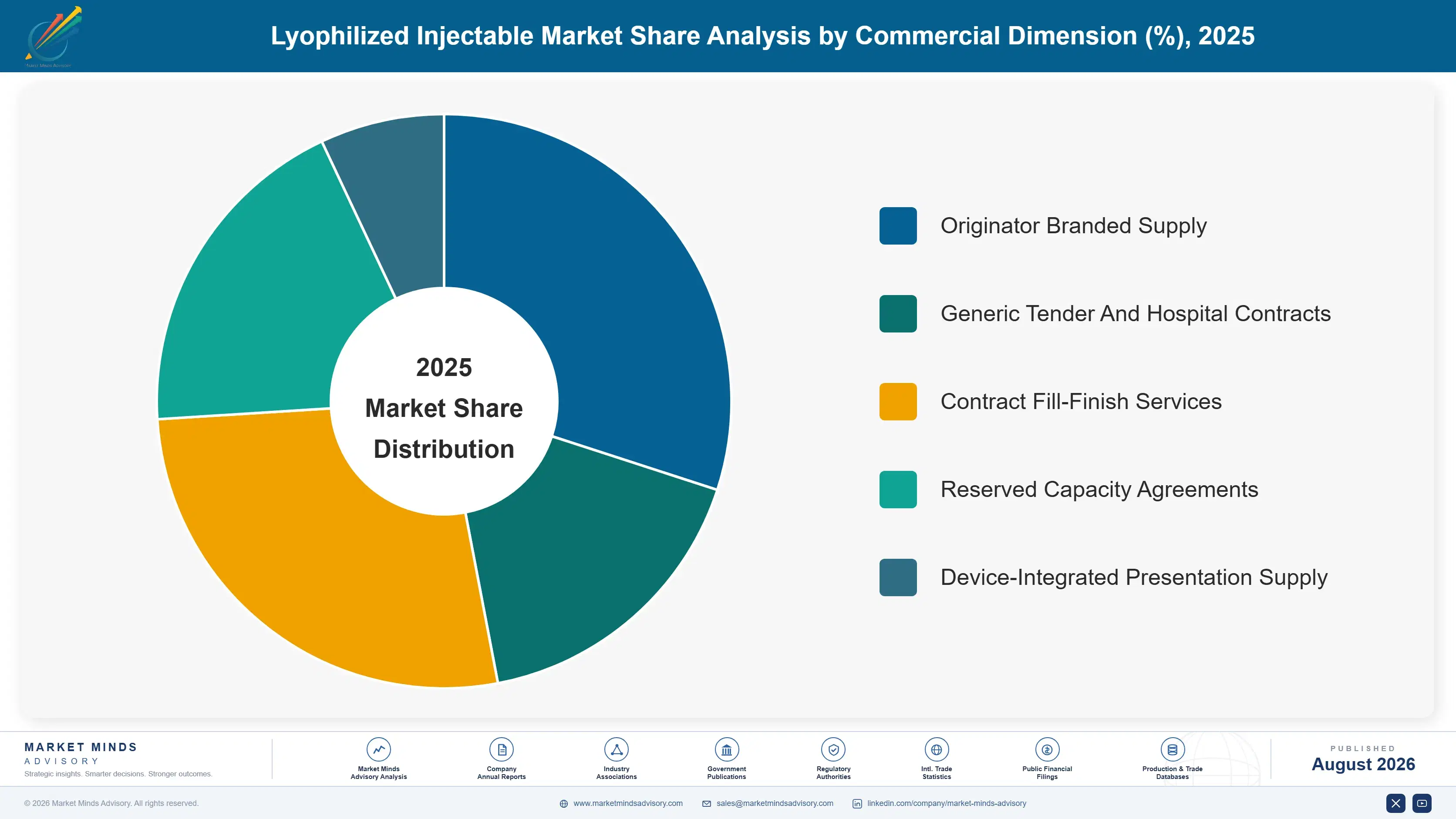
By Commercial Dimension

  • Originator Branded Supply
  • Generic Tender And Hospital Contracts
  • Contract Fill-Finish Services
  • Reserved Capacity Agreements
  • Device-Integrated Presentation Supply

By Region

  • North America
  • East Asia
  • Western Europe
  • South Asia and Pacific
  • Latin America
  • Middle East and Africa
  • Eastern Europe

Scope, Methodology, and Coverage

Every figure in this report is reproducible from documented input assumptions. The scope below maps the historical period, the forecast horizon, the segmentation dimensions, and the countries covered, alongside the underlying primary and qualitative methodology.
Historical Period
2020 to 2025
Forecast Period
2026 to 2036
Base Year
2025 (USD billions; MMA Primary Research Dataset, August 2026)
Market Definition
The lyophilized injectable market covers finished parenteral drug products presented as a freeze-dried powder or cake requiring reconstitution before administration, across originator, generic, and contract-manufactured supply and across hospital, ambulatory, and dispensed settings. Scope spans antibody drug conjugates and complex biologics, monoclonal antibodies, peptides and small protein therapeutics, small molecule oncology agents, anti-infectives, and vaccines and biological preparations, together with device-integrated reconstitution presentations. Lyophilisation equipment, excipients, ready-to-use liquid and frozen presentations, separately supplied diluents, and lyophilised diagnostic reagents are excluded.
Quantitative Units
USD billions at manufacturer revenue level; vials filled annually; revenue per lyophilisation chamber hour.
Segmentation Dimensions
By molecule class; by end-use industry; by commercial dimension; by region.
Regions Covered
North America, East Asia, Western Europe, South Asia and Pacific, Latin America, Middle East and Africa, Eastern Europe
Countries Covered
United States, Canada, Germany, Switzerland, Italy, France, United Kingdom, Spain, Poland, Hungary, China, Japan, South Korea, India, Singapore, Australia, Brazil, Mexico, Saudi Arabia, South Africa.
Key Companies Profiled
Pfizer, Fresenius Kabi, Baxter International, Merck and Co, Novartis, Sandoz, Teva Pharmaceutical Industries, Hikma Pharmaceuticals, Sun Pharmaceutical Industries, Cipla, Dr Reddys Laboratories, Aurobindo Pharma, Zydus Lifesciences, Gland Pharma, Vetter Pharma, Catalent, Recipharm, Jubilant Pharmova, Qilu Pharmaceutical, CSPC Pharmaceutical Group.
Quantitative Methodology
Primary survey, n=3,800 respondents, Q4 2025, six countries; demand-side model with trade association cross-validation
Qualitative Methodology
47 expert interviews, Q4 2025; applied to validate demand model assumptions, identify emerging dynamics, and assess competitive positioning
Report Format
PDF and XLSX data workbook (Word format preview document)
Publisher
Market Minds Advisory
Report Code
MMA-2026-HLT-890
Published
August 2026
Contact
sales@marketmindsadvisory.com | www.marketmindsadvisory.com

Purchase the full Lyophilized Injectable Market Report (2026 to 2036).

The full MMA report on lyophilized injectables covers molecule class, regional, and competitive analysis in detail, with separate treatment of the chamber hour economics that govern capacity allocation and therefore supply across the whole category. It includes revenue per chamber hour benchmarking by molecule class, cycle optimisation potential assessment, global lyophilisation capacity mapping with commissioning timelines, and ready-to-use conversion risk screening across the legacy portfolio. Regional chapters cover twenty countries with value and unit share assessed separately. Competitive profiling spans twenty companies on a consistent revenue basis throughout.
Twenty country value and unit share demand chapters
Revenue per chamber hour benchmarking by molecule class
Cycle optimisation potential assessment across programme types
Global lyophilisation capacity mapping with commissioning timelines
Twenty company competitive profiles compared consistently
Ready-to-use conversion risk screening across legacy portfolios

Built For The People Who Decide

From boardroom strategy to bench-side execution, this report is read cover-to-cover by leaders shaping the next decade of their industry, turning demand scenarios, market dynamics and valuation benchmarks into decisions.
CXOs/ Presidents/ VPs/ Managers
M&A and Corporate Development
Strategy Teams and R&D Heads
Procurement and Product Directors
Regulatory and Compliance Leaders
Investor Relations and Equity Analysts