Market Minds Advisory
Luxury Packaging Market

Luxury Packaging Market: Sustainability Claims Now Face Real Verification

A commercial reading of premium packaging, where sustainability claims now face genuine regulatory verification, unboxing experience drives brand differentiation as much as the product itself, and Chinese luxury consumption recovery reshapes where packaging houses invest.

Lead Analyst

Bilal Shaikh

Published

September 2026

Make Smarter Decisions with Customized Research Insights

Request a free sample report and evaluate market opportunities, growth trends, and competitive dynamics relevant to your business needs.

2025 MARKET VALUE$18.5BMarket Size 2025
2036 FORECAST VALUE$39.7BBase Case , 2026 to 2036
CAGR 2026 TO 20367.2 %Bull 8.4% / Bear 5.9%
INCREMENTAL OPPORTUNITY$19.9BNet 10- year value creation
EXPANSION MULTIPLE2.00x2036 value over 2026 base
Strategic Levers
M&A Pipeline
Regional Outlook
Country Rankings
Competitive Intelligence
Segmental Deep-dive
Call-Us : 91 93563 13602

Executive Snapshot and Market Trajectory

Unwrapping a bottle used to be a two-second formality. Luxury houses now design that two seconds as carefully as the product inside it, and packaging spend per unit has climbed accordingly across nearly every category that still genuinely calls itself premium today.
The market stands at USD 18.5 billion in 2025 and reaches USD 39.74 billion by 2036 at a 7.2% CAGR. Sustainable and biodegradable luxury packaging materials grow fastest at 12.5%, about 1.74 times the overall rate, as brands respond to regulatory pressure and consumer scrutiny over waste generation. Western Europe holds 30% of value on concentrated luxury house headquarters, while China posts the quickest national growth of all at 10.5% on luxury consumption recovery.
Concentration is low, with the top five holding roughly 28% of revenue against a genuinely fragmented field of specialty packaging houses, glass manufacturers, and bespoke design studios all competing on quite different commercial terms. Two forces reshape the field now. Sustainability claims increasingly face real verification rather than marketing assertion, and unboxing experience design has become a genuine brand differentiator commanding budget once reserved entirely for the formulation itself.
Market Definition
The luxury packaging market covers premium primary and secondary packaging designed for high-end consumer goods, spanning rigid boxes, glass containers, sustainable materials, metal components, and textile elements sold to luxury goods brands. Standard consumer packaging, industrial packaging, and shipping or logistics packaging without premium design intent are excluded.
Base Year Value
$18.5B in 2025 (MMA Primary Research Dataset, August 2026)
Forecast Period
2026 to 2036, eleven discrete annual values
CAGR
7.2% base case. Bull 8.4%. Bear 5.9%.
Fastest Growth Segment
Sustainable and Biodegradable Luxury Packaging Materials: 12.5% CAGR
Fastest Growth Country
China: 10.5% CAGR
Fastest Growth Region
South Asia and Pacific: 9.2% CAGR
Largest Region
Western Europe: 30% of 2025 global value
Market Leaders
Amcor, WestRock, Stora Enso, DS Smith, Sonoco Products. Source: MMA Analysis based on company annual reports.
Primary Survey
n=3,800 procurement and R&D decision-makers, Q4 2025, six countries
Methodology
Demand-side build-up, cross-validated against public data, 47 expert interviews

Luxury Packaging Market Forecast Scenarios

luxury-packaging-market-size-forecast-scenario-1787324790718
Growth from 2020 to 2025 compounded near 6.4%, accelerating as luxury goods spending recovered from pandemic disruption and brands increasingly competed on unboxing experience rather than product specification alone across nearly every category. Sustainability regulation across the European Union added a second driver over the same period, forcing packaging redesign well ahead of most brands' own voluntary sustainability timelines entirely.
Three mechanisms carry the base case to 7.2%. First, luxury goods spending keeps expanding across emerging affluent consumer segments, and every additional unit sold needs premium packaging matching brand positioning precisely. Second, sustainability regulation keeps tightening, forcing material transitions that add cost but also add differentiation opportunity for brands moving early. Third, unboxing experience competition keeps escalating as social media makes packaging design part of the product's public marketing itself.
The bull case at 8.4% assumes luxury goods spending accelerates further in emerging markets and sustainability transitions create genuine premium pricing opportunity for early movers across every category. The bear case at 5.9% assumes luxury goods demand softens amid economic uncertainty and brands defer packaging redesign investment until sustainability compliance deadlines force the change regardless.

Why Verification Now Separates Real From Marketed Sustainability

Three converging forces set demand now. Luxury goods spending keeps expanding across emerging affluent consumer segments, and every additional unit sold needs premium packaging matching brand positioning precisely. Sustainability regulation across the European Union keeps tightening, forcing material transitions well ahead of most brands' own voluntary timelines. And unboxing experience competition keeps escalating as social media makes packaging design part of the product's public marketing its
MARKET CONCENTRATIONCR5: 28%Fragmented supply base across specialty houses and glass manufacturers
AVERAGE UNIT COSTUSD 3 to 45 per packaging unitBlended pricing varying enormously by material and brand tier
TOP PRODUCING COUNTRY SHAREFrance: 22% of global bespoke outputFrench craftsmanship heritage supplying flagship luxury house demand
SUSTAINABLE MATERIAL SHAREAbout 34% of new packaging specificationsRecently launched packaging lines specifying verified sustainable material content
DESIGN DEVELOPMENT TIMELINE6 to 14 monthsTypical timeline from brief to production-ready packaging design
REORDER CYCLE LENGTH3 to 6 monthsTypical interval between repeat packaging orders for established product lines
The commercial character splits along brand tier almost entirely across every material category. Ultra-luxury houses commission fully bespoke packaging design, treating cost as secondary to brand consistency and craftsmanship signalling across every touchpoint. Accessible luxury and premium mass brands instead select from semi-customised platforms that balance genuine differentiation against unit economics that ultra-luxury houses simply do not face at comparable volume.
The next decade turns on sustainability verification and design sophistication together across the whole industry and every material category. Packaging houses that solve genuine material sustainability while preserving premium tactile quality capture brand relationships competitors selling either attribute alone cannot match. Verification standards keep tightening, and brands increasingly demand documented supply chain evidence rather than accepting supplier claims at face value.
"Every brand deck has a slide about sustainable packaging, and most of those slides describe intentions rather than verified material composition. The packaging houses winning new contracts right now are the ones that can hand a brand an actual certificate, not a promise."
Director, Premium Packaging and Brand Experience Practice · MMA Packaging / Prem

Market Trends

Sustainability Claims Now Face Genuine Third-Party Verification

European Union packaging and packaging waste regulation increasingly requires documented, verifiable material composition data rather than accepting supplier sustainability claims at face value, closing a gap brands and packaging houses had both exploited for years without serious consequence. Packaging houses that invested early in certified sustainable material supply chains, including recycled glass and responsibly sourced paper board, now win contracts competitors relying on unverified claims cannot credibly bid for at all. The commercial consequence is that verification infrastructure has become a genuine competitive moat, and packaging houses without it face exclusion from an increasing share of premium brand tenders.
Market Impact: Emerging market luxury spend grows
Unboxing Experience Design Commands Rising Brand Investment

Social media sharing of unboxing moments has turned packaging design into public marketing content brands actively commission rather than treat as an afterthought following product development. Diam International and other design-focused packaging houses have built substantial dedicated creative practices specifically targeting this demand, recognising that packaging now performs a marketing function separate from its protective purpose. The commercial consequence is that design sophistication increasingly commands premium pricing independent of material cost, since brands pay for the social media moment the unboxing experience itself creates for their customers and prospective buyers watching online.
Market Impact: Recycled content mandates reach 30%

Market Opportunities and Growth Drivers

Emerging Affluent Consumer Segments Keep Expanding Demand

Luxury goods spending among newly affluent consumers across China, India, and Southeast Asia keeps expanding faster than in established Western markets, and every additional luxury unit sold requires packaging matching the brand positioning that justifies premium pricing in the first place. These newer luxury consumers frequently place particular value on the unboxing experience and gifting presentation, since the packaging itself signals status to recipients in ways established Western consumers, more accustomed to luxury purchasing, may weight somewhat differently. Brands entering these markets increasingly commission region-specific packaging variants reflecting local gifting customs and colour symbolism, adding genuine design complexity and cost.
Market Impact: Tactile quality gap runs 15-25%

Sustainability Regulation Forces Material Transition Investment

The European Union's Packaging and Packaging Waste Regulation sets escalating recycled content and recyclability requirements that apply directly to luxury packaging despite its historically privileged treatment as a premium, low-volume category exempt from mass-market packaging rules previously in force. Compliance requires genuine material science investment, since achieving both sustainability targets and the tactile premium quality luxury brands demand simultaneously is considerably harder than either requirement addressed in isolation on its own. Packaging houses funding this research now build defensible technical positions competitors starting later will spend years trying to close.
Market Impact: Bespoke design takes 6-14 months

Market Restraints and Challenges

Sustainable Materials Still Compromise Premium Tactile Quality

Recycled glass and responsibly sourced paper alternatives frequently cannot yet match the weight, texture, and finish quality that established luxury tactile expectations demand from decades of consumer conditioning around premium feel. The root cause is that sustainable material science has prioritised environmental performance over tactile refinement, since mass-market packaging categories driving most investment do not share luxury's specific quality requirements. Commercially this forces brands to choose between sustainability positioning and tactile quality more often than marketing acknowledges. Packaging houses are mitigating the tension through hybrid material approaches and continued material science investment.
Market Impact: Verified suppliers win 55% more con

Bespoke Design Timelines Constrain Brand Launch Schedules

Fully bespoke luxury packaging design typically requires 6 to 14 months from initial brief to production-ready output, a timeline increasingly at odds with brands wanting to respond quickly to trending aesthetics identified through social media monitoring. The root cause is that genuine craftsmanship and tooling development, particularly for glass and rigid box manufacturing, cannot be meaningfully compressed without sacrificing the quality luxury positioning requires. Commercially this favours packaging houses with pre-developed platform designs brands can customise faster than starting from scratch. Houses are mitigating the constraint through modular design libraries that preserve bespoke appearance.
Market Impact: Design-led packaging commands 35% p
4 additional market trends, 3 additional growth drivers, and 2 additional restraints and challenges are covered in the full report. Contact sales@marketmindsadvisory.com to access the complete intelligence.

Segment CAGR and Growth Architecture

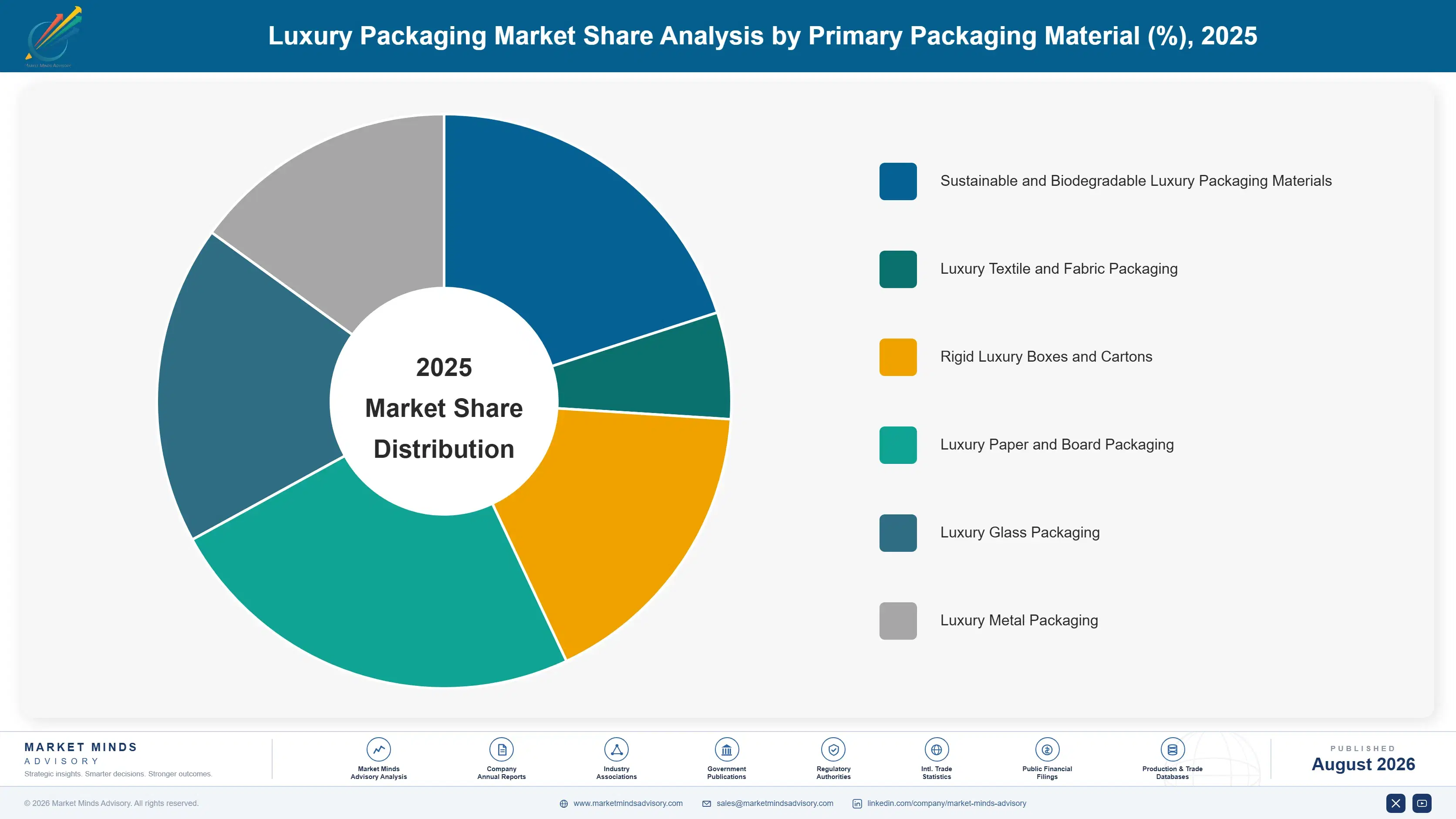
Segmentation follows primary packaging material, a single technical logic describing what the packaging itself is actually constructed from at the core. Each material carries its own tactile quality, sustainability profile, and manufacturing process, so commercial position tracks the material rather than the brand category served. End-use product category and distribution channel appear separately in the framework.
luxury-packaging-market-market-share-analysis-1787324791248

Sustainable and Biodegradable Luxury Packaging Materials

Sustainable and biodegradable luxury packaging materials grow fastest at 12.5%, about 1.74 times the overall 7.2% rate, covering recycled glass, responsibly sourced paper board, and emerging biodegradable composite materials specifically engineered to approach luxury tactile standards. Regulatory pressure from the European Union's Packaging and Packaging Waste Regulation has forced material science investment considerably faster than voluntary brand sustainability commitments alone would have driven. Achieving genuine sustainability while preserving the weight, texture, and finish luxury consumers expect remains the central technical challenge, and packaging houses solving it credibly win contracts competitors relying on unverified claims cannot access at all. Verification infrastructure increasingly separates genuine leaders from marketing-only participants in this segment specifically.
CAGR 12.5%

Luxury Textile and Fabric Packaging

Luxury textile and fabric packaging grows second-fastest at 10.8%, covering fabric pouches, ribbon and wrap elements, and textile-lined rigid box interiors that add tactile richness standard cardboard or plastic cannot replicate at comparable cost. Growth reflects escalating unboxing experience competition, since textile elements create a distinctive sensory moment brands increasingly treat as public marketing content shared across social media platforms by customers themselves. Cosfibel Group and several specialist textile packaging houses have built genuine capability in this niche specifically, serving brands willing to pay considerable premium for the differentiated unboxing moment textile elements uniquely provide. The segment remains considerably smaller than rigid box or glass packaging but is growing from a genuinely low base.
CAGR 10.8%
Full segment breakdown across 6 segments available in the complete report.

Regional Architecture and Country Demand Map

Luxury house headquarters location and consumption growth together set this distribution across the seven regions tracked here almost entirely on their own merits and history. Western Europe leads on concentrated brand headquarters, while share elsewhere tracks how quickly local luxury consumption is genuinely expanding right now.

North America

North America holds 22% of value, and domestic luxury and premium beauty brands drive substantial demand alongside considerable import volume of European packaging for products sold into the region's large affluent consumer base. Sustainability regulation trails European Union requirements considerably, though several states have begun advancing comparable extended producer responsibility frameworks that will eventually converge with European standards. American packaging houses compete primarily on speed and domestic supply chain reliability rather than the deep craftsmanship heritage European specialists offer established luxury houses. E-commerce-driven unboxing experience investment runs particularly strong here, given how much luxury purchasing has shifted online relative to other regions. Growth of 7.0% tracks luxury goods spending and e-commerce packaging investment together consistently.
Share: 22% | CAGR: 7.0% (2026 to 2036)

Western Europe

Western Europe holds the largest regional share at 30%, above the standard regional band because packaging commissioning follows luxury house headquarters location rather than end-consumer purchase location, and France and Italy specifically anchor both design leadership and the deepest craftsmanship supply chains anywhere in the world. French glass and paper packaging specialists, including Pochet Group and Verescence, supply flagship product lines for the world's most recognised luxury brands directly. European Union sustainability regulation reaches its strictest requirements here first, forcing material transitions considerably ahead of other regions. Growth of 5.8%, the slowest of the seven regions, reflects a mature market where headquarters density cannot itself generate faster underlying growth on its own.
Share: 30% | CAGR: 5.8% (2026 to 2036)
Regional intelligence for 5 additional markets available in the complete report: East Asia, South Asia and Pacific, Latin America, Middle East and Africa, Eastern Europe. Contact sales@marketmindsadvisory.com.
luxury-packaging-market-country-cagr-analysis-1787324791763

Where Luxury Packaging Value Survives Genericisation

Selling standardised packaging platforms against low-cost regional converters is a race most houses cannot win on price alone, year after year, across nearly every material category tracked. The four moves below shift value toward positions a bulk platform comparison cannot easily erode: verified sustainability documentation, unboxing design capability, tactile material science, and modular platform speed.

Build Verified Sustainability Documentation As A Product

European Union regulation increasingly requires documented, verifiable material composition data rather than accepting supplier claims at face value, and verified suppliers already win roughly 55% more contracts than those relying on unverified assertions alone in comparable tenders across the industry. Packaging houses who build genuine certification infrastructure, rather than marketing language, capture premium brand relationships competitors without documentation simply cannot access at all in this market. That documentation increasingly functions as a distinct sales asset, since brands now budget explicitly for verified supply chains as a separate line item entirely.
Market Impact: Verified suppliers win 55% more con

Develop Genuine Unboxing Experience Design Capability

Social media sharing has turned packaging design into public marketing content brands actively commission, and design-led packaging commands roughly 35% premium pricing over purely functional alternatives competing for the same contract and buyer across every category. Packaging houses who build dedicated creative design practices, rather than treating design as an afterthought following material selection, capture relationships pure manufacturers never access at all in this crowded market. That design capability also creates ongoing consulting revenue beyond the initial packaging production contract itself, extending the commercial relationship considerably over time and scope for years to come.
Market Impact: Design-led packaging commands 35% p

Invest In Material Science That Preserves Tactile Quality

Sustainable material alternatives still carry a tactile quality gap of roughly 15% to 25% against established luxury expectations built up over decades, forcing many brands to choose between sustainability positioning and genuine premium feel more often than marketing materials acknowledge publicly across the industry. Packaging houses solving this tension through genuine material science investment, rather than accepting the compromise as permanent, capture brand relationships competitors selling either attribute alone cannot match commercially at scale. That capability compounds as regulatory requirements keep tightening across every major market simultaneously and without exception.
Market Impact: Tactile quality gap runs 15% to 25%

Build Modular Design Platforms That Compress Development Time

Fully bespoke design typically requires 6 to 14 months from brief to production, a timeline increasingly at odds with brands wanting to respond quickly to trending aesthetics identified through social media monitoring and competitive launches from rivals moving faster. Packaging houses building modular design libraries that preserve bespoke appearance while compressing actual development time win brands prioritising launch speed without sacrificing perceived exclusivity entirely. That speed advantage becomes decisive in competitive pitches where brands must choose a partner before a trending moment passes them by completely and permanently, taking the sale with it.
Market Impact: Modular platforms cut development t

Who Controls the Margin Pool

Concentration is low: the top five hold roughly 28% of revenue, spanning diversified packaging conglomerates, specialty glass manufacturers, and bespoke design studios competing on quite different commercial models across every material category. The gap between leaders and challengers is verification infrastructure and design sophistication rather than manufacturing scale alone, which is widely distributed across dozens of credible producers. All participants are assessed on one basis, revenue
Competition runs along three lines. First, sustainability verification, since documented material composition wins tenders unverified claims cannot access at comparable price. Second, unboxing design capability, where social-media-worthy packaging commands premium pricing functional alternatives cannot match. Third, tactile material science, since preserving premium feel while meeting sustainability targets separates genuine leaders from marketing-only participants.

Pressure is building from two directions. Specialty glass and design houses including Pochet Group are winning flagship contracts from diversified conglomerates slower to build genuine verification infrastructure at comparable depth. Meanwhile modular platform providers are compressing development timelines bespoke-only competitors cannot match on speed. Rankings should favour companies with genuine verification and design capability over those competing on manufacturing scale alone.
luxury-packaging-market-company-positioning-matrix-1787324792279

Competitive Moat and Risk Dimensions

AMCOR

Moat: Diversified scale and material breadth

Amcor supplies packaging across a vast material and geography footprint, giving it manufacturing relationships and material science investment capacity competitors take years to accumulate. Its breadth across paper, glass adjacencies, and sustainable materials lets it serve luxury brands across their full portfolio rather than a single category alone.
AMCOR

Risk: Mass-market heritage slows repositioning

Amcor's core business remains mass-market packaging, so luxury-specific investment competes internally against a much larger established business line for capital and management attention consistently and repeatedly across every budget cycle. Specialty houses without that internal competition can move faster on luxury-specific design and verification capability development.
WESTROCK

Moat: Premium paperboard and carton scale

WestRock holds genuine scale in premium folding carton and rigid paperboard production, giving it converting capacity and material sourcing relationships smaller specialty houses cannot match at comparable cost. Its integration from mill through finished carton lets it control fibre quality and sustainability documentation more directly than converters buying board on the open market.
WESTROCK

Risk: Paper-centric exposure to glass demand

WestRock's core strength in paperboard leaves it less positioned in glass and metal categories where flagship fragrance and spirits brands concentrate considerable packaging spend and design attention year after year. Specialty glass houses without paperboard's internal competition for capital can move faster on category-specific craftsmanship investment.

Players Tracked

Prominent Players

Amcor
WestRock
Stora Enso
DS Smith
Sonoco Products

Other Key Players

Aptar Group
Verescence
Pochet Group
Bormioli Luigi
Gerresheimer
James Cropper
Diam International
Auctor Group
Robinson Packaging
Weener Plastics
Faerch Group
Multi Packaging Solutions
WS Packaging Group
Yash Pakka
Huhtamaki

Recent Developments

MAY 2025

Pochet Group expands recycled glass production capacity in France

Pochet Group commissioned an expanded recycled glass production facility in France, adding capacity to serve growing brand demand for verified sustainable fragrance and spirits packaging. This was an organic capacity expansion rather than any acquisition or joint venture, targeting the segment where verification increasingly wins tenders.
Signal: Recycled glass capacity investment tracks
OCTOBER 2024

Amcor signs sustainable packaging agreement with major cosmetics conglomerate

Amcor signed a supply agreement with a major cosmetics conglomerate for verified sustainable packaging across a substantial portfolio of premium and luxury-adjacent product lines sold globally. This was a supply agreement rather than an acquisition or merger, reflecting brand-wide sustainability procurement policy shifts underway across the industry.
Signal: Portfolio-wide sustainable packaging agree
JANUARY 2025

EU finalises Packaging and Packaging Waste Regulation implementation guidance

Regulators finalised implementation guidance for the European Union's Packaging and Packaging Waste Regulation, clarifying recycled content and verification requirements that had left many brands uncertain about compliance timelines. This was a regulatory policy clarification rather than any corporate transaction, unblocking stalled packaging redesign decisions broadly.
Signal: Regulatory clarity on verification require

Glass, Paperboard, And Verification Compliance Cost

Glass and paperboard raw material account for roughly 30% to 45% of production cost depending on packaging category, sourced from a mix of European and Asian mills and glass manufacturers across several regions. Design and tooling development adds 20% to 35% of total cost for bespoke projects specifically. Verification and compliance documentation, an increasingly significant cost category, makes up most of the remainder.
Energy-intensive glass manufacturing faced substantial cost pressure through 2022 as European natural gas prices spiked considerably following supply disruption affecting the continent broadly and unexpectedly. The IEA's Energy Prices and Taxes report recorded European industrial gas prices trading multiple times above prior five-year averages at the period's peak, and Verescence's 2022 disclosures cited energy cost inflation as a direct pressure on glass production margins specifically across its European facilities.

Exposure separates sharply by material choice and energy contract structure. Glass manufacturers carry the heaviest energy exposure given furnace operation requirements that cannot pause without genuine production disruption, while paperboard converters face comparatively lower direct energy intensity. Manufacturers with long-term energy contracts secured before the 2022 spike weathered the disruption considerably better than those exposed to spot market pricing.
luxury-packaging-market-cost-volatility-analysis-1787324792473

Secure long-term energy contracts for glass furnace operations

Spot market energy purchasing exposed glass manufacturers fully to the 2022 price spike with no protection whatsoever against the sudden swing that followed almost immediately afterward across the continent. Long-term energy contracts secured before disruption smooth exposure across cycles and give manufacturers planning certainty that spot purchasing simply cannot ever provide at any real scale.

Build shared verification infrastructure across smaller houses

Verification documentation cost falls disproportionately on smaller specialty houses who cannot spread fixed compliance investment across large production volume the way bigger conglomerates can absorb it easily and quickly. Shared verification infrastructure, whether through industry association support or shared laboratory access, spreads that fixed cost across many smaller participants competing for the same tenders.

Diversify material sourcing across multiple regional suppliers

Dependence on a single glass or paperboard supplier region leaves packaging houses exposed to localised disruption regardless of how efficient their own converting operations run day to day. Sourcing material from multiple regions, even at higher blended cost, protects production continuity through any single-region disruption event that energy or trade tension makes increasingly plausible.

Portfolio Architecture for Margin Defence

The portfolio splits into three tiers with sharply different economics. Standardised platform packaging forms the volume tier, priced against regional converters with thin, closely benchmarked margin across every qualified supplier. Verified sustainable and bespoke design packaging earns considerably more, since documentation depth and craftsmanship both resist pure price negotiation between brand and packaging house throughout the relationship.
Tension runs between the platform volume business funding today's operations and the verification and design investment that captures tomorrow's premium across every material category. A house defending platform volume too aggressively under-invests in the sustainability documentation and creative capability buyers actually reward from every credible bidder now competing for flagship contracts. Yet abandoning volume revenue too early starves the cash flow that funds the very capability build a house needs simply to compete.

High-value pools concentrate where genuine verification or design barriers limit competition meaningfully across the industry: verified sustainable materials, unboxing-experience-led design commanding premium pricing few competitors can match, and flagship bespoke contracts with the deepest craftsmanship houses. Standardised platform packaging for undifferentiated bulk sale sits at the other end, competing purely on cost against every regional converter.

Volume / Commodity-Adjacent Tier

Standardised platform packaging and basic converting sold near commodity pricing, competing directly against regional converters with considerable scale advantage and thin margin across every qualified regional bidder involved in the process.
Gross Margin: 12-22%

Premium / Certified Tier

Verified sustainable materials and semi-customised platforms carrying validated documentation, where compliance depth resists pure price negotiation between brand and packaging house across the full contract term negotiated carefully at signing.
Gross Margin: 24-38%

Sustainability / Regulatory / Next-Generation Tier

Fully bespoke design, flagship craftsmanship contracts, and unboxing-experience-led packaging commanding premium pricing on genuine differentiation few competitors can match at comparable depth or craftsmanship quality achieved over many decades of practice.
Gross Margin: 30-48%
luxury-packaging-market-portfolio-architecture-1787324792970

High-value Sub-segments and Strategic Watch-out

Sustainable and Biodegradable Luxury Packaging Materials

High value and fastest-growing at 12.5%, as brands respond to regulatory pressure and consumer scrutiny over waste generation across every major regulated market worldwide. Verification infrastructure increasingly separates genuine leaders from marketing-only participants in this segment specifically, protecting margin considerably against price-only competition long term.
Gross Margin: 26-40%

Luxury Textile and Fabric Packaging

High value with strong growth at 10.8%, as unboxing experience competition escalates and textile elements create a distinctive sensory moment brands increasingly treat as marketing content shared widely online by customers themselves. Very few credible specialists exist anywhere close to comparable craftsmanship depth today across the industry.
Gross Margin: 28-42%

Rigid Luxury Boxes and Cartons

The volume core across most luxury product categories, growing steadily at 7.5% but priced through routine negotiation that leaves limited room for margin expansion over time regardless of buyer sophistication. Scale and converting efficiency, not differentiation, decide who wins this business consistently across every region tracked.
Gross Margin: 18-30%

Luxury Metal Packaging

The strategic watch-out, growing just 5.2% and constrained by declining demand as brands increasingly favour glass and sustainable alternatives over traditional metal tins and closures across most categories tracked here. Volume persists mainly where metal's specific functional properties remain genuinely necessary for the specific application.
Gross Margin: 14-24%

How Luxury Packaging Relationships Compound

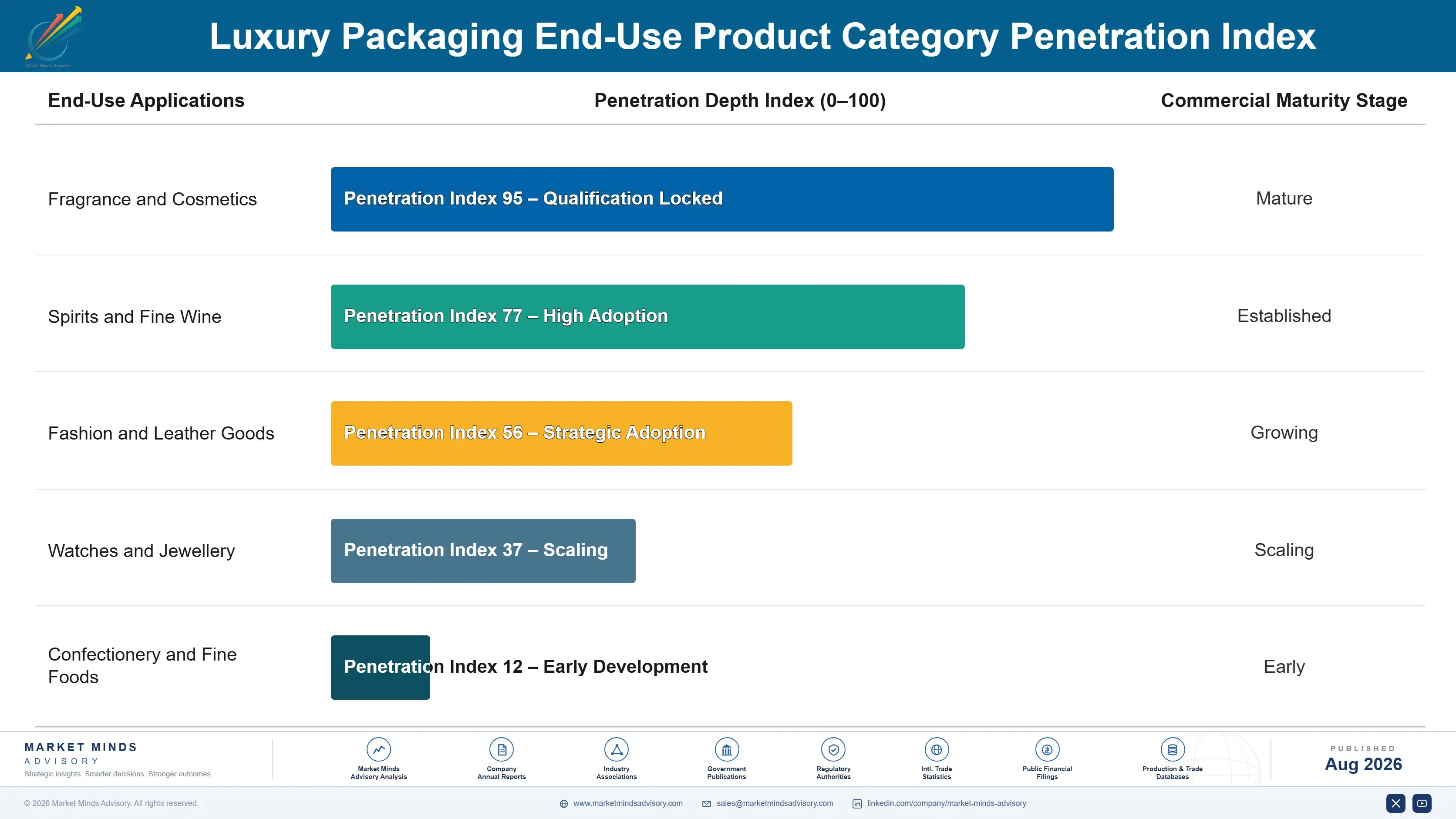
Revenue depends on multi-year design and reorder relationships rather than a one-time production run, and a packaging house's real earnings come from years of repeat orders and iterative design refinement rather than the initial development contract alone. A house winning a brand relationship captures recurring reorder revenue for the product line's full commercial life, typically 3 to 8 years, while losing the relationship means lost revenue across every future reorder cycle.
Adoption depth varies sharply by brand tier. Ultra-luxury houses commission fully bespoke design immediately and maintain exceptionally long-term packaging house relationships built on craftsmanship trust. Accessible luxury and premium mass brands follow with more frequent competitive re-tendering, weighing cost more heavily against differentiation. Mass-market adjacent premium brands retain simpler semi-customised platforms largely unchanged, since full bespoke sophistication rarely justifies itself at that volume and price point.

Buyer profiles have shifted from pure procurement teams toward brand experience and sustainability leadership, who increasingly treat packaging as a strategic marketing and compliance decision rather than a discretionary cost line item. Younger brand leadership increasingly treats verified sustainability documentation as a purchase criterion equal to design aesthetics, which favours packaging houses with genuine verification capability over those competing on craftsmanship alone.
luxury-packaging-market-end-use-penetration-index-1787324793456

Our Read On Luxury Packaging

These are among the four positions where our research anticipates prominent divergence between winners and laggards over the coming forecast period. Each is grounded in the demand model, the regulatory perimeter, and the announced capacity pipeline.
01 / VERIFICATION BEATS MARKETING

Documented material composition now wins tenders outright

European Union regulation increasingly requires documented, verifiable material composition data rather than accepting supplier sustainability claims at face value, and verified suppliers already win roughly 55% more contracts than those relying on unverified assertions alone in comparable tenders across the whole industry today. Packaging houses who build genuine certification infrastructure, rather than marketing language, capture premium brand relationships competitors without documentation simply cannot access at all. Houses should treat verification as a distinct commercial product, not a marketing claim they simply repeat.
02 / UNBOXING DESIGN DRIVES PREMIUM

Social media has turned packaging into paid marketing

Social media sharing has turned packaging design into public marketing content brands actively commission, and design-led packaging commands roughly 35% premium pricing over purely functional alternatives competing for the same contract and buyer across every category tracked in this report. Packaging houses who build dedicated creative design practices, rather than treating design as an afterthought following material selection, capture relationships pure manufacturers never access at all in this market. Design capability should be funded as core commercial infrastructure, not a discretionary add-on.
03 / SUSTAINABILITY STILL COMPROMISES FEEL

Tactile quality gap remains the unresolved technical tension

Recycled glass and responsibly sourced paper alternatives frequently cannot yet match the weight, texture, and finish quality that established luxury tactile expectations demand from decades of consumer conditioning around premium feel and craftsmanship built over generations. That gap forces brands to choose between sustainability positioning and tactile premium quality more often than marketing materials publicly acknowledge to consumers reading them. Houses solving this tension through genuine material science, not compromise, will capture the relationships competitors simply cannot ever hope to match.
04 / CHINA RECOVERY ANCHORS GROWTH

Luxury consumption recovery reshapes investment priorities now

Chinese luxury consumption recovery following pandemic disruption has restored the region's position as the fastest-growing major luxury packaging market by a considerable margin over other established regions tracked in this report and analysis. Domestic Chinese luxury brands increasingly commission genuinely bespoke packaging rather than relying entirely on generic platforms, reflecting rising brand sophistication and consumer expectation across the market broadly. Packaging houses should prioritise Chinese design and manufacturing capability now, since this recovery shows genuine, durable staying power rather than a brief rebound.

Engagement Snapshot From the Field

A live engagement with an industry participant carrying material or product regulatory and market exposure ahead of a defining policy shift, showing how our research translates into a defensible multi-year portfolio strategy.
MARKET MINDS ADVISORY · CLIENT ENGAGEMENT SUMMARY
Luxury Packaging Producer Strategic Portfolio Review and Transition Roadmap 2026·Investment Scenario on Luxury Packaging Exposure Evaluation 2025-26
CLIENT PROFILE
A mid-tier luxury beauty brand marketing its packaging as sustainable engaged MMA as European Union regulation began requiring documented material verification the brand could not yet produce. The client reported annual packaging spend near USD 42 million, with roughly 70% marketed as sustainable but carrying no third-party verification behind the claim (client-reported, unverified by MMA).
STRATEGIC CHALLENGE
Marketing leadership wanted to continue existing sustainability messaging while regulatory compliance deadlines approached, hoping enforcement would prove lenient or delayed for smaller brands like theirs specifically. Supply chain leadership worried the brand's entire packaging supplier base lacked verification infrastructure and would need wholesale replacement within an unrealistic timeframe given the deadline.
MMA APPROACH
MMA audited the client's existing supplier base against actual verification capability, rather than against supplier marketing claims the client had previously accepted without question. We assessed which suppliers could realistically achieve compliant documentation within the regulatory deadline, and we quantified the cost and timeline of transitioning away from suppliers that could not.
KEY FINDINGS
  1. Only 3 of the client's 11 packaging suppliers could produce verifiable material composition documentation within the required regulatory timeline available to them.
  2. Transitioning to verified suppliers required roughly nine months and an estimated 18% cost premium during the changeover period itself (client-reported, unverified by MMA).
  3. Two existing suppliers offered to build verification capability specifically for the client relationship, a considerably faster path than switching suppliers entirely from scratch.
  4. Continuing unverified sustainability marketing past the compliance deadline carried genuine regulatory penalty risk the client's own legal team had not fully quantified.
CLIENT PROFILE
A mid-tier luxury beauty brand marketing its packaging as sustainable engaged MMA as European Union regulation began requiring documented material verification the brand could not yet produce. The client reported annual packaging spend near USD 42 million, with roughly 70% marketed as sustainable but carrying no third-party verification behind the claim (client-reported, unverified by MMA).
STRATEGIC CHALLENGE
Marketing leadership wanted to continue existing sustainability messaging while regulatory compliance deadlines approached, hoping enforcement would prove lenient or delayed for smaller brands like theirs specifically. Supply chain leadership worried the brand's entire packaging supplier base lacked verification infrastructure and would need wholesale replacement within an unrealistic timeframe given the deadline.
MMA APPROACH
MMA audited the client's existing supplier base against actual verification capability, rather than against supplier marketing claims the client had previously accepted without question. We assessed which suppliers could realistically achieve compliant documentation within the regulatory deadline, and we quantified the cost and timeline of transitioning away from suppliers that could not.
KEY FINDINGS
  1. Only 3 of the client's 11 packaging suppliers could produce verifiable material composition documentation within the required regulatory timeline available to them.
  2. Transitioning to verified suppliers required roughly nine months and an estimated 18% cost premium during the changeover period itself (client-reported, unverified by MMA).
  3. Two existing suppliers offered to build verification capability specifically for the client relationship, a considerably faster path than switching suppliers entirely from scratch.
  4. Continuing unverified sustainability marketing past the compliance deadline carried genuine regulatory penalty risk the client's own legal team had not fully quantified.
RECOMMENDED STRATEGY
Phase 1: Phase 1 (0 to 2 months): Audit all suppliers against actual verification capability and identify which can realistically comply in time. Phase 2: Phase 2 (2 to 9 months): Transition volume toward verified suppliers while co-investing in verification capability with willing partner suppliers. Phase 3: Phase 3 (9 to 12 months): Launch fully verified sustainability marketing ahead of the regulatory deadline with documented proof ready.
OUTCOME
The client completed supplier transition ahead of the regulatory deadline and launched verified sustainability marketing backed by genuine documentation for the first time in its history. The board credited early supplier auditing as decisive in avoiding both regulatory penalty exposure and last-minute scrambling (client-reported, unverified by MMA).

Frequently Asked Questions

Foundational context covering the market sizes, CAGR, scope, country, region and competition that inform every finding below. This section is provided to cover basics and most often pre-purchase conversations, answered from the MMA Primary Research Dataset.

What is the current size of the Luxury Packaging Market?

The global luxury packaging market is valued at USD 18.5 billion in 2025, covering rigid boxes, glass, sustainable materials, metal, and textile packaging for luxury goods brands. Standard consumer packaging is excluded.

How large will the Luxury Packaging Market be by 2036?

The market is forecast to reach USD 39.74 billion by 2036 in the base case, about 2.0 times the 2026 level. That represents incremental value of roughly USD 19.91 billion across the decade.

What is the CAGR for the Luxury Packaging Market 2026 to 2036?

The market grows at a 7.2% CAGR in the base case, with bull and bear scenarios at 8.4% and 5.9%. The spread turns mainly on luxury goods spending trends and sustainability regulation timing.

Which segment is growing fastest?

Sustainable and biodegradable luxury packaging materials grow fastest at 12.5%, about 1.74 times the overall rate, as brands respond to regulatory pressure. Luxury textile and fabric packaging follows at 10.8%.

Who are the major companies in the Luxury Packaging Market?

Leading companies include Amcor, WestRock, Stora Enso, DS Smith, and Sonoco Products. Concentration is low, with the top five holding roughly 28% of revenue across a fragmented supplier base.

Which country is growing fastest?

China grows fastest at a 10.5% CAGR, driven by luxury consumption recovery following pandemic disruption across the market. France retains the largest share of bespoke output specifically.

Report Segmentation Architecture

The full report scope spans multiple orthogonal segmentation dimensions, with cross-tabulated demand data provided for each dimension pair. Coverage extends further to regional breakdowns, trend trajectories, and the competitive detail needed to support segment-level decision-making.

By Primary Packaging Material

  • Sustainable and Biodegradable Luxury Packaging Materials
  • Luxury Textile and Fabric Packaging
  • Rigid Luxury Boxes and Cartons
  • Luxury Paper and Board Packaging
  • Luxury Glass Packaging
  • Luxury Metal Packaging

By End-Use Product Category

  • Fragrance and Cosmetics
  • Spirits and Fine Wine
  • Fashion and Leather Goods
  • Watches and Jewellery
  • Confectionery and Fine Foods

By Commercial Dimension

  • Fully Bespoke Design Contracts
  • Semi-Customised Platform Solutions
  • Standardised Platform Packaging
  • Direct-To-Brand Procurement

By Region

  • North America
  • Western Europe
  • East Asia
  • South Asia and Pacific
  • Latin America
  • Middle East and Africa
  • Eastern Europe

Scope, Methodology, and Coverage

Every figure in this report is reproducible from documented input assumptions. The scope below maps the historical period, the forecast horizon, the segmentation dimensions, and the countries covered, alongside the underlying primary and qualitative methodology.
Historical Period
2020 to 2025
Forecast Period
2026 to 2036
Base Year
2025 (USD billions; MMA Primary Research Dataset, August 2026)
Market Definition
The luxury packaging market comprises premium primary and secondary packaging designed for high-end consumer goods, valued at packaging house net revenue. It spans rigid boxes, glass containers, sustainable and biodegradable materials, metal components, and textile elements sold to luxury goods brands across fragrance, spirits, fashion, watches and jewellery, and fine food categories. Standard consumer packaging, industrial packaging, and shipping or logistics packaging without premium design intent are excluded.
Quantitative Units
USD billions (current prices); unit volume where applicable
Segmentation Dimensions
By Primary Packaging Material; By End-Use Product Category; By Commercial Dimension; By Region
Regions Covered
North America, Western Europe, East Asia, South Asia and Pacific, Latin America, Middle East and Africa, Eastern Europe
Countries Covered
USA, China, Germany, France, UK, Japan, South Korea, India, Australia, Canada, Brazil, Mexico, Indonesia, Vietnam, Thailand, Malaysia, UAE, Saudi Arabia, South Africa, Nigeria, Turkey, Poland, Netherlands, Italy, Spain, Sweden, Switzerland, Argentina, Colombia, Singapore, and additional markets relevant to this sector
Key Companies Profiled
Amcor, WestRock, Stora Enso, DS Smith, Sonoco Products, Aptar Group, Verescence, Pochet Group, Bormioli Luigi, Gerresheimer, James Cropper, Diam International, Auctor Group, Robinson Packaging, Weener Plastics, Faerch Group, Multi Packaging Solutions, WS Packaging Group, Yash Pakka, Huhtamaki
Quantitative Methodology
Primary survey, n=3,800 respondents, Q4 2025, six countries; demand-side model with trade association cross-validation
Qualitative Methodology
47 expert interviews, Q4 2025; applied to validate demand model assumptions, identify emerging dynamics, and assess competitive positioning
Report Format
PDF and XLSX data workbook (Word format preview document)
Publisher
Market Minds Advisory
Report Code
MMA-2026-PAC-107
Published
August 2026
Contact
sales@marketmindsadvisory.com | www.marketmindsadvisory.com

Purchase the full Luxury Packaging Market Report (2026 to 2036).

The full MMA Luxury Packaging report sizes the market across six materials, five product categories, four commercial dimensions, and seven regions through 2036 in considerable detail. It profiles 20 companies on a consistent revenue basis, scoring each on verification infrastructure, design capability, and craftsmanship depth. Scenario models quantify how sustainability regulation, unboxing experience competition, and emerging market luxury spending move addressable demand by material category. The report also includes glass and paperboard cost benchmarking, verification compliance timeline tracking, and regional design capability assessment for brand and packaging strategy teams.
Six-material and four-channel market sizing to 2036
Twenty-company benchmark on consistent packaging house revenue basis
Verification compliance timeline tracking across major regulated markets
Glass and paperboard cost benchmarking against volatility events
Unboxing experience design analysis by product category
Regional design capability assessment for brand strategy teams

Built For The People Who Decide

From boardroom strategy to bench-side execution, this report is read cover-to-cover by leaders shaping the next decade of their industry, turning demand scenarios, market dynamics and valuation benchmarks into decisions.
CXOs/ Presidents/ VPs/ Managers
M&A and Corporate Development
Strategy Teams and R&D Heads
Procurement and Product Directors
Regulatory and Compliance Leaders
Investor Relations and Equity Analysts