Market Minds Advisory
LTE and LTE Advance Market

LTE and LTE Advance Market: LTE and LTE Advanced Market. Trends and Forecast 2026 to 2036

Carriers in emerging markets still expanding basic mobile broadband coverage are keeping LTE infrastructure investment alive years after developed markets moved to fifth-generation networks, forcing equipment makers to serve two different customer bases.

Lead Analyst

Published

September 2026

Make Smarter Decisions with Customized Research Insights

Request a free sample report and evaluate market opportunities, growth trends, and competitive dynamics relevant to your business needs.

2025 MARKET VALUE$45.0BMarket Size 2025
2036 FORECAST VALUE$65.7BBase Case , 2026 to 2036
CAGR 2026 TO 20363.5 %Bull 4.7% / Bear 2.3%
INCREMENTAL OPPORTUNITY$19.1BNet 10- year value creation
EXPANSION MULTIPLE1.41x2036 value over 2026 base
Strategic Levers
M&A Pipeline
Regional Outlook
Country Rankings
Competitive Intelligence
Segmental Deep-dive
Call-Us : 91 93563 13602

Executive Snapshot and Market Trajectory.

LTE stopped being the leading edge of wireless technology the day major developed market carriers began marketing fifth-generation networks as the default offering, yet it remains the primary mobile broadband layer for much of the world's population. Manufacturers now manage LTE as a mature revenue base funding future research.
LTE-Advanced network densification equipment leads current spending, concentrated most heavily among carriers in emerging markets still building out basic coverage and capacity in densely populated urban areas without a clear near-term path to full fifth-generation deployment. East Asia and South Asia and Pacific account for the bulk of current deployment, reflecting both large existing manufacturing capacity and, across expanding mobile broadband subscriber bases, sustained coverage investment nationwide. overall.
Established network equipment manufacturers historically selling comprehensive multi-generation portfolios are racing to extend LTE product support lifecycles before carriers in emerging markets pressure them toward earlier end-of-life decisions. Spectrum refarming and rural coverage mandates are compounding this dynamic, pushing carriers toward vendors offering validated long-term support commitments that differentiate reliable suppliers from less committed competitors exiting the LTE equipment business. Manufacturers report renewed customer confidence once these support commitments are embedded directly into signed contracts.
Market Definition
The LTE and LTE Advanced Market covers network infrastructure equipment, chipsets, and devices supporting fourth-generation mobile broadband standards, measured by equipment and device revenue. It excludes fifth-generation network equipment and legacy third-generation infrastructure without LTE or LTE-Advanced capability.
Base Year Value
$45.0B in 2025 (MMA Primary Research Dataset, September 2026)
Forecast Period
2026 to 2036, eleven discrete annual values
CAGR
3.5% base case. Bull 4.7%. Bear 2.3%.
Fastest Growth Segment
LTE-Advanced Network Densification Equipment: 6.5% CAGR
Fastest Growth Country
India: 6.0% CAGR
Fastest Growth Region
South Asia and Pacific: 5.5% CAGR
Largest Region
East Asia: 28% of 2025 global value
Market Leaders
Leading participants include Huawei, Ericsson, Nokia, ZTE, and Qualcomm.
Primary Survey
n=3,800 procurement and R&D decision-makers, Q4 2025, six countries
Methodology
Demand-side build-up, cross-validated against public data, 47 expert interviews

LTE and LTE Advance Market Forecast Scenarios

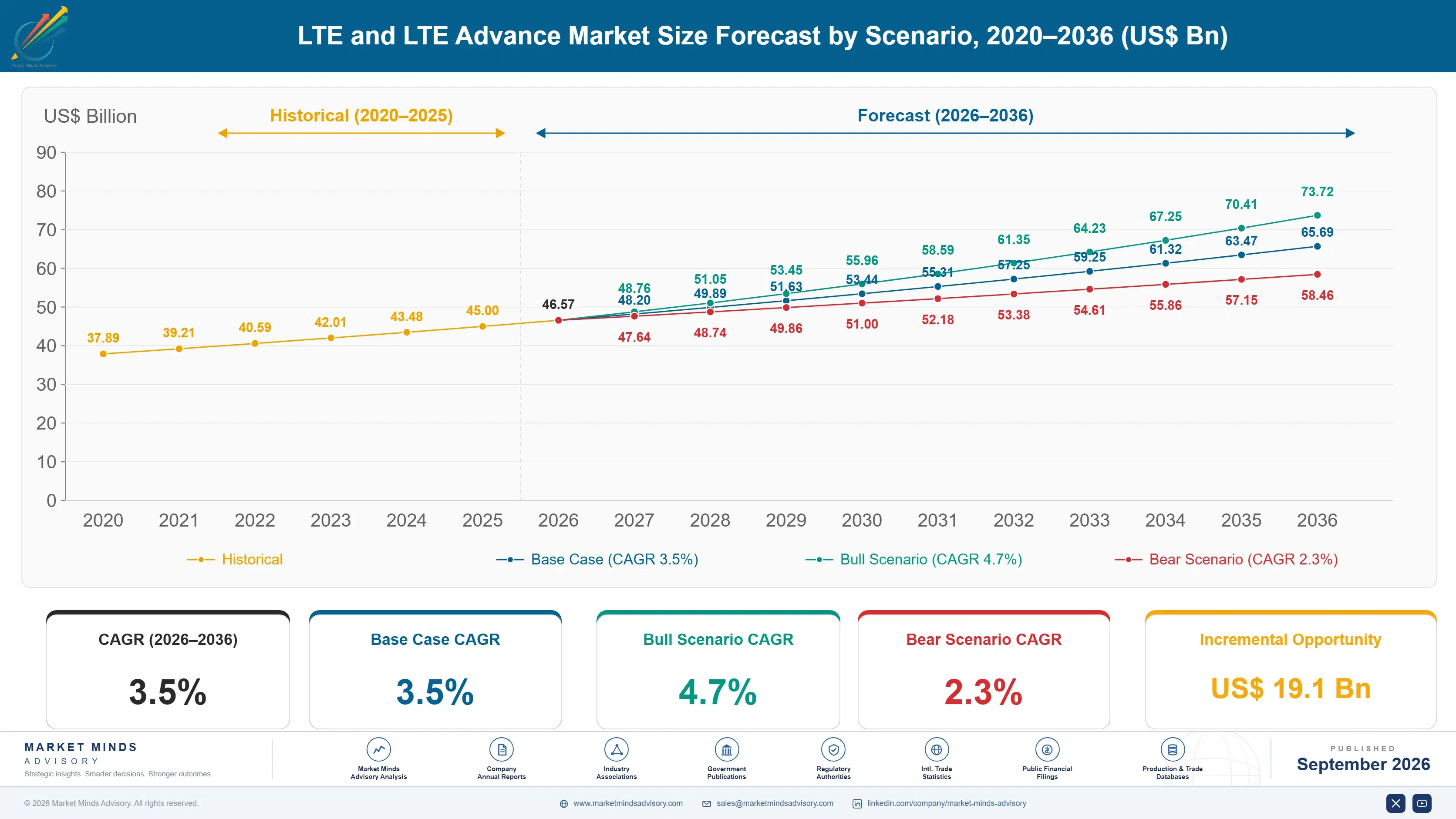
lte-and-lte-advance-market-size-forecast-scenario-1788423552873
LTE and LTE-Advanced market revenue grew modestly from 2020 through 2025, as developed market carriers shifted new capital investment toward fifth-generation network deployment while emerging market carriers continued expanding LTE coverage to serve growing mobile broadband subscriber bases. Growth remained positive but increasingly modest as the technology matured, growing at an estimated 3.0% annual rate historically as emerging market expansion offset developed market decline.
MMA's base case rests on three compounding mechanisms: emerging market carriers continue expanding LTE coverage to reach remaining unconnected populations before committing to costly fifth-generation deployment, network densification requirements in growing urban areas require additional LTE-Advanced equipment even in markets pursuing parallel fifth-generation rollout, and device manufacturers continue producing LTE-only devices for cost-sensitive market segments unable to afford newer technology. Together these mechanisms sustain modest but positive market growth despite fifth-generation technology capturing most new capital investment.
The bull case centers on a single catalyst: accelerated emerging market mobile broadband expansion driving sustained LTE equipment demand across multiple simultaneous national coverage programs. The bear risk is accelerated technology transition, where falling fifth-generation equipment costs prompt emerging market carriers to skip extensive LTE-Advanced investment entirely and move directly toward fifth-generation deployment, compressing the market faster than anticipated.

A Mature Standard Still Funding the Network

LTE persisted as a substantial revenue category well past its technological peak largely because a majority of the world's mobile subscribers still connect through networks that never justified the capital investment required for full fifth-generation deployment given their subscriber revenue potential. Manufacturers maintaining LTE product lines report measurable steady revenue contribution, convincing skeptical leadership that legacy technology support remains commercially worthwhile despite newer generation technology capturing most industry attention.
MARKET CONCENTRATION58% CR5Top five manufacturers hold this combined revenue share currently
AVERAGE EQUIPMENT PRICE$85,000 per base stationTypical price point for a standard LTE-Advanced base station unit
TOP PRODUCING COUNTRY36% ChinaShare of global LTE equipment manufacturing volume reported here
GLOBAL SUBSCRIBER BASE62% of mobile usersShare of global mobile subscribers still primarily using this standard
NETWORK COVERAGE RATE88% population coverageEstimated global population coverage achieved by this network standard
EQUIPMENT LIFESPAN10 to 12 yearsTypical operational duration before base station equipment requires replacement
Procurement now runs through network planning and capital budgeting teams focused on extending existing infrastructure lifecycles rather than individual engineers evaluating newly introduced technology alone, reflecting growing awareness that LTE equipment choices carry long-term support and total cost of ownership implications extending well beyond any single upgrade cycle. This shift is consolidating vendor relationships around manufacturers offering comprehensive long-term support commitments, favoring established vendors over smaller suppliers lacking manufacturing capacity.
Rural and underserved area coverage mandates are emerging as a genuine competitive differentiator between equipment vendors, since government universal service obligations increasingly require documented coverage expansion in areas that fifth-generation deployment would take years longer to reach economically. Vendors offering credible rural-focused equipment report meaningfully higher contract renewal rates than those selling primarily urban-focused solutions not calibrated for rural coverage economics.
"Nobody markets LTE as exciting anymore. They market it as the network that still works when the fifth-generation tower is still years away."
Senior Analyst, Wireless Network Infrastructure Practice · MMA Technology Practice · September 2026

Market Trends

Emerging Market Carriers Extend LTE Coverage Programs

Mobile network operators in emerging markets are extending LTE coverage programs to reach remaining unconnected rural populations rather than skipping directly to fifth-generation deployment that remains economically unjustified given the lower average revenue per user these newly connected populations typically generate. This extension is the single biggest reason equipment manufacturers continue investing in LTE product line support rather than fully redirecting engineering resources toward fifth-generation technology exclusively. Vendors report meaningfully sustained order volume from emerging market coverage extension programs versus developed market replacement demand across most tracked equipment manufacturers overall, a pattern holding steady through the current forecast period.
Market Impact: Budget device chipset orders grew 9%
Network Densification Sustains LTE-Advanced Equipment Demand

Growing mobile data traffic in dense urban areas continues requiring additional LTE-Advanced small cell and carrier aggregation equipment even in markets pursuing parallel fifth-generation rollout, since existing LTE infrastructure still carries the majority of mobile data traffic during the multi-year transition period most carriers are currently navigating. This densification requirement is the single biggest reason LTE equipment revenue has not declined as sharply as some analysts initially projected following fifth-generation commercial launch announcements. Vendors report meaningfully sustained densification equipment demand despite broader fifth-generation deployment momentum across the industry, with order backlogs extending well into the coming year for several manufacturers.
Market Impact: Rural LTE deployment orders grew 15%

Market Opportunities and Growth Drivers

Cost-Sensitive Device Segments Sustain LTE Chipset Demand

Manufacturers of entry-level mobile devices for cost-sensitive market segments continue specifying LTE-only chipsets rather than newer generation modems that carry meaningfully higher component costs unjustified by the price point these budget devices must maintain to remain competitive in price-sensitive emerging markets. Device manufacturers facing these cost constraints increasingly treat LTE chipsets as the practical standard for budget device tiers rather than a legacy technology being phased out entirely across their broader product portfolio. Several large device manufacturers report meaningfully sustained LTE chipset order volume for their budget device lines specifically.
Market Impact: Transition timelines compressed by 2 years

Universal Service Obligations Require Rural LTE Deployment

Government universal service obligations in several major markets increasingly require carriers to document rural and underserved area coverage expansion using whichever technology delivers the most economical coverage per subscriber, a calculation that continues favoring LTE deployment over fifth-generation technology in low-density rural areas. Carriers facing these obligations increasingly treat LTE deployment as the practical compliance mechanism for rural coverage mandates rather than a legacy technology choice made reluctantly. Several major carriers report meaningfully sustained rural LTE deployment investment following recent universal service obligation renewal cycles across multiple regulatory jurisdictions this year.
Market Impact: Developed market spending fell 25%

Market Restraints and Challenges

Accelerated Fifth-Generation Transition Compresses Remaining Market Timeline

Falling fifth-generation equipment costs are prompting some emerging market carriers to skip extensive LTE-Advanced investment entirely and move directly toward fifth-generation deployment, compressing the LTE equipment market's remaining commercial lifespan faster than manufacturers originally planned when developing their long-term product support roadmaps and engineering resource allocation decisions. The root cause traces to fifth-generation component cost curves falling faster than manufacturers initially projected, driven by economies of scale from developed market deployment volume. Manufacturers are increasingly accelerating their own fifth-generation product development to avoid losing market share to competitors moving faster.
Market Impact: Coverage extension orders grew 12%

Declining Developed Market Investment Limits Growth Ceiling

Developed market carriers have largely completed their fifth-generation transition and stopped investing meaningfully in new LTE infrastructure, redirecting nearly all new capital investment toward fifth-generation network densification and eventual sixth-generation research rather than maintaining or expanding legacy fourth-generation network capacity in these mature markets. The underlying cause is that developed market carriers view LTE as fully depreciated legacy infrastructure requiring only minimal maintenance investment rather than growth capital allocation going forward. Manufacturers are increasingly focusing sales efforts on emerging markets to offset this developed market investment decline across most tracked equipment segments overall.
Market Impact: Densification equipment demand held at 35%
3 additional market trends, 4 additional growth drivers, and 2 additional restraints and challenges are covered in the full report. Contact sales@marketmindsadvisory.com to access the complete intelligence.

Segment CAGR and Growth Architecture

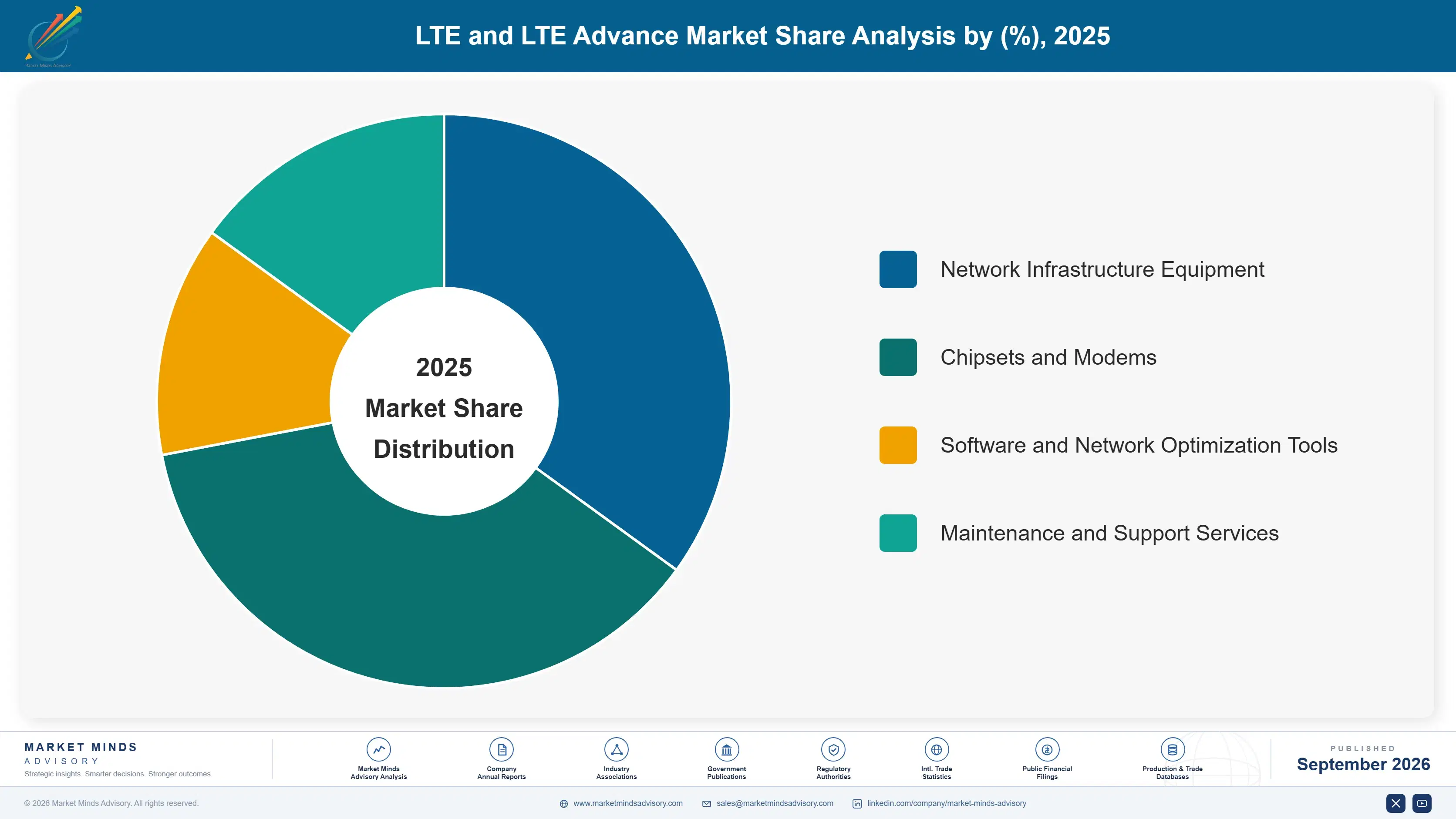
The LTE and LTE Advanced Market splits into six product-defined segments spanning infrastructure and device type. LTE-Advanced network densification equipment leads growth as emerging market carriers expand urban capacity, followed closely by rural coverage infrastructure, since both categories directly address the coverage expansion pressures driving procurement nationwide. Core network equipment and support services round out the segment mix.
lte-and-lte-advance-market-market-share-analysis-1788423553422

LTE-Advanced Network Densification Equipment

LTE-Advanced network densification equipment leads all segments because it concentrates the exact use case driving current carrier procurement: expanding capacity in dense urban areas where mobile data traffic growth outpaces existing infrastructure capability regardless of whether the carrier has begun fifth-generation deployment in that particular market. Carriers favor this segment since it directly addresses the capacity constraint that increasingly shapes subscriber experience during the multi-year transition period, capturing measurable network performance improvement within a single deployment cycle. Large carriers managing dense metropolitan service areas are increasingly standardizing on this segment across their entire network capacity expansion portfolio. MMA estimates this segment alone will represent well over a third of total category revenue by 2036.
CAGR 6.5%

Rural and Underserved Area Coverage Infrastructure

Rural and underserved area coverage infrastructure ranks second in growth as government universal service obligations increasingly require documented coverage expansion using whichever technology delivers the most economical coverage per subscriber, a calculation that continues favoring LTE deployment over fifth-generation technology in low-density areas. These systems let carriers satisfy regulatory coverage mandates without the capital investment fifth-generation deployment would require in areas generating comparatively lower subscriber revenue. Carriers increasingly cite rural LTE deployment directly within regulatory compliance filings rather than treating it as a discretionary network investment decision. MMA expects this category to scale steadily as universal service obligations continue expanding across most emerging market regulatory frameworks and jurisdictions. Growth here should remain steady through most of the decade.
CAGR 5.5%
Full segment breakdown across 6 segments available in the complete report.

Regional Architecture and Country Demand Map

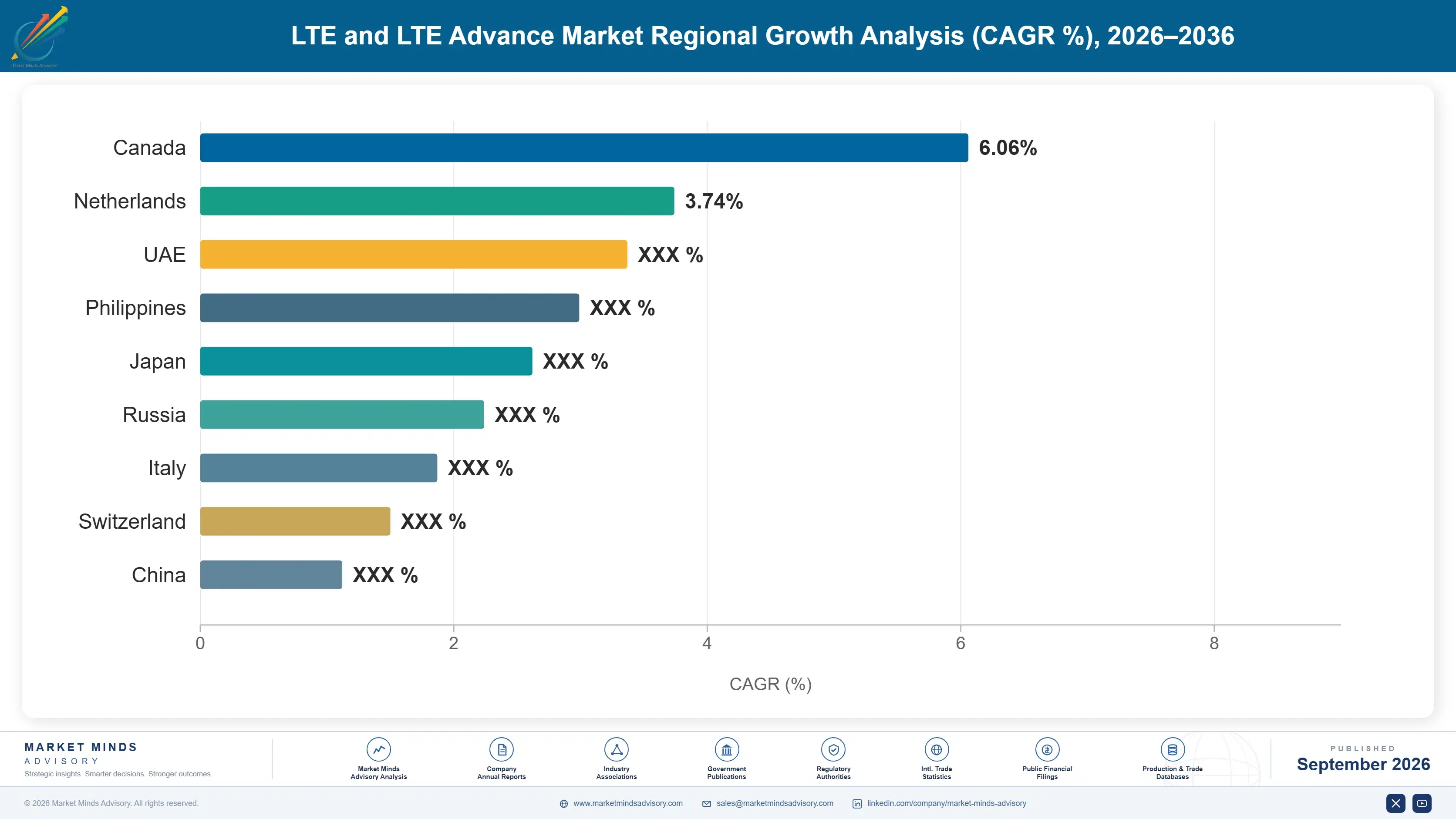
East Asia leads the LTE and LTE Advanced Market given China's dominant equipment manufacturing base, while South Asia and Pacific follows closely through India's expanding mobile broadband coverage programs nationwide across most rural regions and underserved communities. Both regions maintain deep mobile broadband coverage investment programs spanning multiple network generations.

North America

The United States and Canada sit meaningfully below typical regional bands for this market, a deliberate reflection of developed market carriers having already completed fifth-generation transition and redirected nearly all new capital investment away from legacy LTE infrastructure expansion toward newer network generations. Remaining regional demand centers on maintenance, spare parts, and support contracts for existing depreciated infrastructure rather than new network buildout. Equipment vendors serving this region increasingly position LTE support services as a stable but non-growth revenue category funding broader engineering investment elsewhere. Vendor procurement cycles here focus on multi-year maintenance agreements rather than new equipment purchases, letting suppliers maintain steady support revenue even as new spending declines.
Share: 15% | CAGR: 2.0% (2026 to 2036)

Western Europe

Germany, the United Kingdom, and France similarly sit below typical regional bands, reflecting the region's early and comprehensive fifth-generation rollout that left little remaining LTE network expansion opportunity beyond ongoing maintenance and rural coverage gap filling in a small number of underserved areas. Regional carriers maintain LTE infrastructure primarily to support legacy device compatibility and rural universal service obligations rather than pursuing meaningful new capacity investment. Vendors report this maintenance-focused demand pattern differs considerably from the growth-oriented emerging market segments driving broader category revenue. Regional vendors increasingly bundle remaining LTE support services with broader fifth-generation transition consulting, letting carriers address legacy infrastructure maintenance and next-generation planning within a single coordinated vendor engagement rather than separate procurement tracks.
Share: 15% | CAGR: 2.5% (2026 to 2036)
Regional intelligence for 5 additional markets available in the complete report: East Asia, South Asia and Pacific, Latin America, Middle East and Africa, Eastern Europe. Contact sales@marketmindsadvisory.com.
lte-and-lte-advance-market-country-cagr-analysis-1788423553934

How Vendors Capture Legacy Network Value

Vendors capture value across four distinct commercial mechanisms as LTE moves from a growth technology toward mature legacy infrastructure, extending revenue well beyond a base equipment sale into recurring maintenance, spare parts, optimization, and licensing relationships that compound steadily over each carrier's multi-year network lifecycle commitment and renewal cycle. Vendors executing all four pull ahead of single-mechanism rivals.

Extended Maintenance and Long-Term Support Contracts

Vendors sell dedicated extended maintenance contracts that guarantee continued spare parts availability and technical support for LTE equipment years beyond the original equipment sale, capturing recurring revenue that carriers depending on stable legacy infrastructure increasingly value as equipment ages. This support revenue carries meaningfully higher margins than the original equipment sale itself, since the same support infrastructure serves many carrier customers simultaneously at low incremental delivery cost. Extended support contracts typically carry pricing roughly 18% of the original equipment cost on an annual basis. Vendors report meaningfully higher renewal rates once carriers adopt bundled maintenance alongside the core equipment sale.
Market Impact: Support contracts add roughly 18% of annual revenue

Spare Parts and Component Replacement Sales

Vendors increasingly sell dedicated spare parts and component replacement packages for aging LTE infrastructure, capturing recurring revenue that carriers maintaining depreciated equipment cannot otherwise access without a specialized parts supply relationship. This parts revenue carries meaningfully higher margins than new equipment sales, since manufacturing volume for specific legacy components has declined while carrier demand for replacement parts remains steady. Some vendors now generate roughly 24% of total account revenue from these spare parts sales. Carriers increasingly bundle this parts supply into initial procurement negotiations rather than purchasing separately later. overall.
Market Impact: Spare parts sales add roughly 24% of revenue

Network Optimization and Capacity Consulting Services

Vendors sell dedicated network optimization consulting that helps carriers extract additional capacity from existing LTE infrastructure rather than requiring costly new equipment purchases, since maximizing legacy network efficiency requires specialized expertise most carriers lack internally. This consulting revenue carries exceptionally high margins compared with the underlying equipment sale, drawing on specialized optimization expertise vendors have developed across many carrier engagements. Some vendors now generate roughly 14% of total account revenue from these optimization services. Carriers often renew these optimization engagements annually as network capacity requirements continue evolving. across most large carrier accounts overall.
Market Impact: Optimization services add roughly 14% of total revenue

Software Licensing and Feature Upgrade Contracts

Vendors sell dedicated software feature upgrade licenses that enable additional capacity or functionality on existing LTE hardware without requiring physical equipment replacement, letting carriers extend network capability at a fraction of the cost a full hardware upgrade would require. This licensing revenue carries substantially higher margins than hardware sales, since software feature activation costs little to deliver once the underlying capability is already developed. Carriers adopting this upgrade path report contract values running roughly 2 times higher over the equipment's full operating lifespan. Vendors are actively expanding this licensing model across additional carrier customer segments given its strong retention appeal.
Market Impact: Licensing upgrades lift lifetime value 2 times over

Who Controls the Margin Pool

Five manufacturers, evaluated on annual product revenue from LTE and LTE-Advanced network equipment, together account for an estimated 58% of tracked market revenue, reflecting a highly concentrated industry structure typical of mature telecommunications infrastructure. Huawei leads through global equipment manufacturing scale and emerging market carrier relationships, while Ericsson and Nokia compete closely for developed market maintenance contracts that neither incumbent fully dominates.
Current competitive activity centers on long-term support commitment extension, as every major manufacturer races to reassure carriers that LTE product lines will remain supported for years rather than being abruptly discontinued in favor of exclusively fifth-generation product development. Partnership announcements between equipment manufacturers and rural coverage program operators have become a common deal structure over the past two years, extending distribution reach without requiring manufacturers to build comparable rural deployment expertise from scratch.

Emerging pressure comes from newer fifth-generation-only equipment specialists who could accelerate the broader industry transition away from LTE product lines, potentially disintermediating established manufacturers still maintaining comprehensive multi-generation portfolios for cost-conscious carriers. Rankings could shift meaningfully if a major telecommunications equipment conglomerate exits the LTE business entirely, redistributing its remaining carrier relationships to competitors willing to maintain long-term legacy product support.
lte-and-lte-advance-market-company-positioning-matrix-1788423554452

Competitive Moat and Risk Dimensions

HUAWEI

Moat: Global Manufacturing Scale Advantage

Huawei's global manufacturing scale, built across multiple network equipment generations, gives it cost advantages in LTE production that smaller regional competitors cannot match easily, letting the company price equipment competitively while maintaining margins comparable to its much larger overall telecommunications business. This scale advantage compounds as production volume continues across emerging market deployment programs.
HUAWEI

Risk: Trade Restrictions Limit Market Access

Huawei faces trade restrictions and procurement bans in several developed markets due to security concerns raised by some national governments, limiting its addressable customer base in these specific regions regardless of product quality or pricing competitiveness. This restriction exposure could meaningfully limit growth in politically sensitive telecommunications infrastructure segments going forward.
ERICSSON

Moat: Established Developed Market Trust

Ericsson's decades-long reputation among developed market carriers gives it credibility that emerging equipment vendors cannot replicate quickly, letting the company win long-term maintenance contracts based on established field performance history spanning multiple network generations. This trust advantage wins accounts specifically seeking proven long-term support commitments over newer, less established alternatives.
ERICSSON

Risk: Higher Pricing Limits Emerging Growth

Ericsson's premium positioning carries meaningfully higher pricing than lower-cost competitors serving price-sensitive emerging markets, potentially limiting its addressable market among carriers prioritizing cost over established support track records in comparatively lower revenue coverage expansion programs across several tracked regions where budget constraints dominate procurement decisions.

Players Tracked

Prominent Players

Huawei
Ericsson
Nokia
ZTE
Qualcomm

Other Key Players

Samsung Electronics
Cisco Systems
Datang Telecom
NEC Corporation
Fujitsu
CommScope
Airspan Networks
Mavenir
Casa Systems
Ceragon Networks
Sierra Wireless
Telit Cinterion
Quectel Wireless Solutions
MediaTek
UNISOC

Recent Developments

FEBRUARY 2025

Huawei launched an enhanced LTE-Advanced base station with expanded carrier aggregation capability, targeting emerging market carriers requiring higher network capacity in dense urban areas ahead of eventual fifth-generation deployment across their broader coverage footprint, according to company product materials released alongside the launch announcement in emerging Asian markets.
Signal: Signals manufacturers are extending LTE product lines rather than shifting entirely toward newer generation product development exclusively across the industry.
JUNE 2025

Ericsson announced a strategic partnership with a major emerging market carrier to extend long-term equipment support agreements, guaranteeing continued spare parts availability and technical maintenance for existing LTE infrastructure over the coming decade under the newly signed agreement terms covering multiple national network deployment regions.
Signal: Signals equipment vendors are formalizing extended support commitments to retain long-term carrier maintenance revenue streams industry wide.
OCTOBER 2025

Nokia acquired a smaller network optimization software startup specializing in legacy infrastructure capacity analytics, adding specialized optimization capability to its existing broad telecommunications equipment product portfolio across multiple served regions and carrier customer segments worldwide, meaningfully strengthening its overall competitive positioning against rival vendors considerably.
Signal: Signals established telecommunications vendors are acquiring optimization capability rather than building it internally from scratch entirely.

Component and Semiconductor Cost Exposure

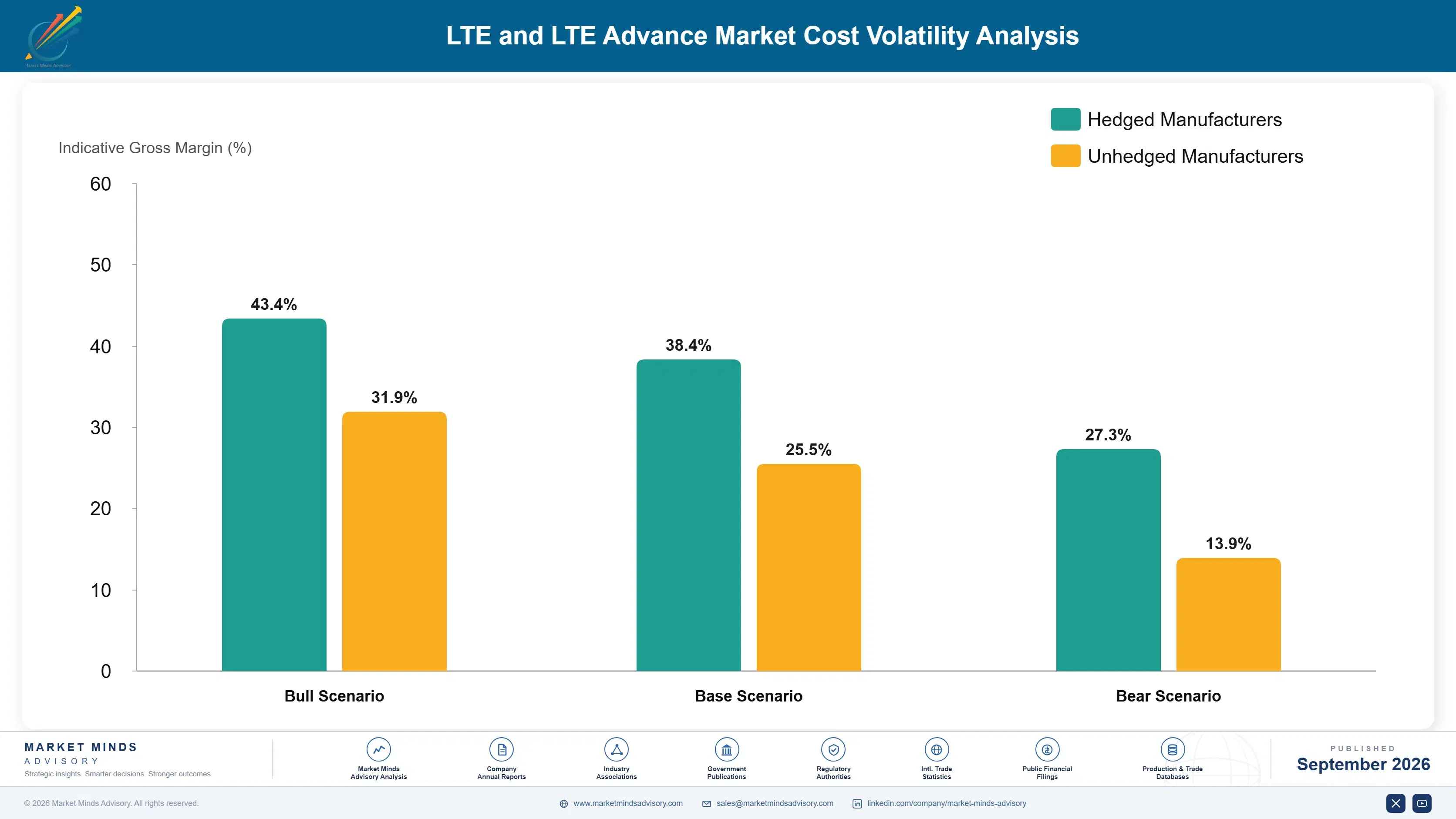
Semiconductor components, primarily baseband processors and radio frequency chips, account for roughly 40% of LTE equipment cost of goods sold, with the large majority sourced from foundries concentrated in Taiwan and South Korea. Printed circuit boards and passive components add another 15% of input cost, sourced mainly from China and Southeast Asian assembly hubs, while enclosure materials round out the remaining structure.
The 2021 to 2022 global semiconductor shortage, documented extensively by the International Energy Agency in its supply chain analyses, extended LTE equipment lead times from typical eight week delivery windows to over thirty weeks at the disruption's peak. Manufacturers absorbed higher component prices during this period rather than passing full costs onto carrier customers already committed to multi-year deployment budgets, compressing equipment margins industry wide for roughly six consecutive quarters.

Smaller regional equipment manufacturers carry meaningfully higher exposure than diversified global vendors, since they lack the purchasing volume to negotiate favorable long-term semiconductor supply agreements that larger competitors secure routinely. This creates a durable cost disadvantage concentrated among manufacturers serving single geographic markets, effectively pricing many smaller vendors out of large multi-year carrier contracts that require guaranteed component supply continuity.
lte-and-lte-advance-market-cost-volatility-analysis-1788423554647

Multi-Source Semiconductor Procurement Agreements

Leading manufacturers now qualify components from at least two independent foundries per product line, reducing single-source dependency that amplified the 2021 shortage's impact across the industry. This dual-sourcing approach adds upfront qualification cost but meaningfully shortens recovery time during future supply disruptions, a tradeoff most large vendors now consider worthwhile given recent volatility and ongoing geopolitical uncertainty.

Extended Component Inventory Buffer Programs

Several vendors have extended safety stock inventory policies from four weeks to twelve weeks of forward semiconductor demand, accepting higher working capital costs in exchange for meaningfully reduced exposure to future lead time extensions industry wide. Carriers increasingly favor vendors demonstrating this inventory discipline during contract negotiations for critical infrastructure orders requiring guaranteed delivery.

Portfolio Architecture for Margin Defence

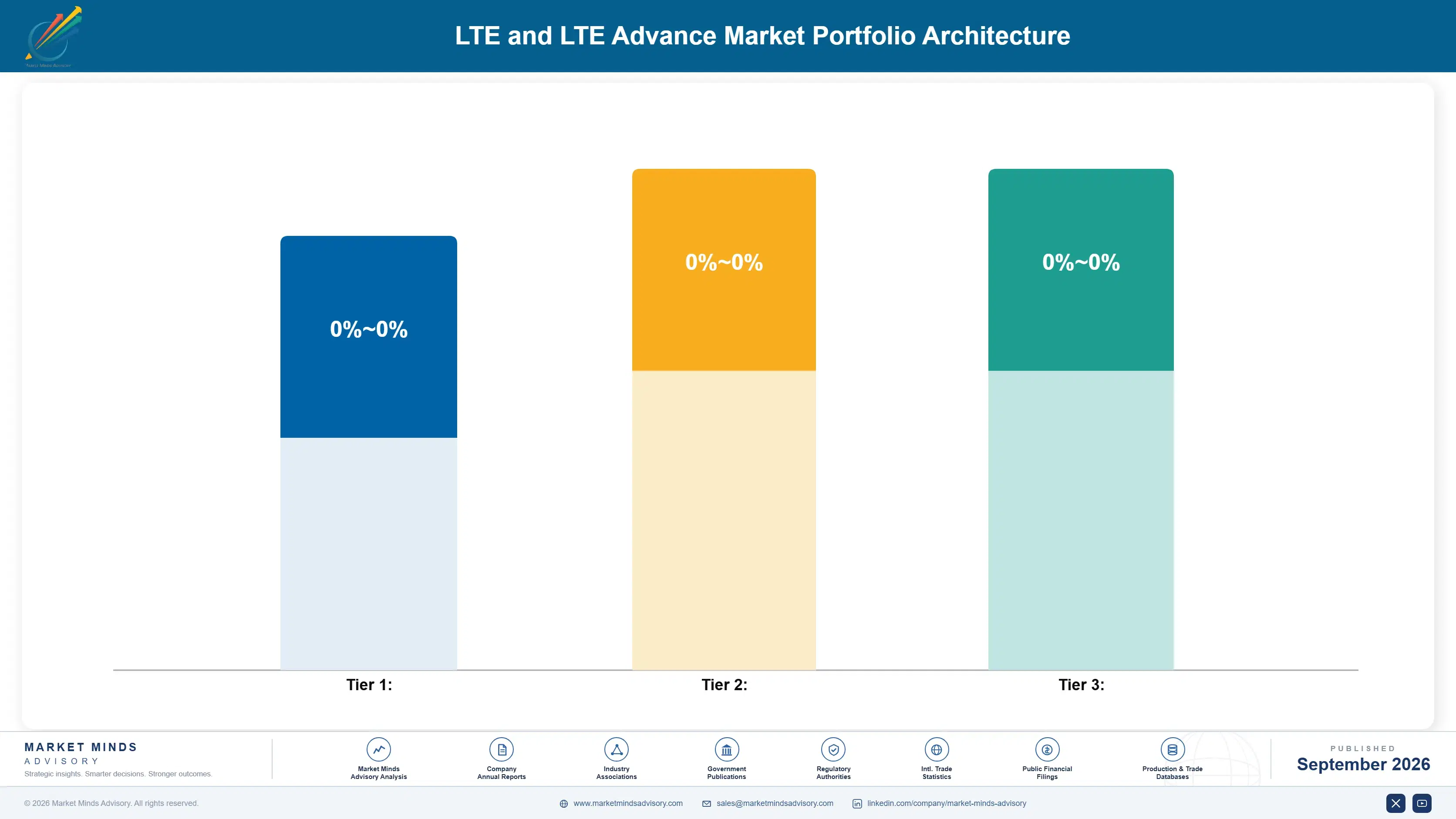
LTE equipment vendors run a three-tier margin structure spanning commodity network hardware, certified carrier-grade infrastructure, and next-generation transitional products bridging LTE and fifth-generation networks. Gross margins range from roughly 18% on basic commodity base stations to over 45% on certified carrier-grade equipment carrying multi-year support and reliability guarantees that emerging market carriers increasingly require for critical infrastructure procurement decisions.
Volume economics still dominate unit shipments, since most tracked deployment programs still prioritize coverage expansion over premium feature sets, but the tension between volume and premium positioning has sharpened as carriers in mature LTE markets shift spending toward maintenance contracts rather than new equipment purchases entirely. Manufacturers increasingly favor the certified tier, where recurring support revenue provides more predictable long-term cash flow than one-time volume hardware sales alone.

High-value margin pools concentrate specifically in extended maintenance contracts and network optimization consulting services rather than in new equipment sales, reflecting the broader industry shift toward annuity-style revenue as the installed base matures across most tracked deployment regions. Vendors capturing this maintenance revenue early tend to retain carrier relationships considerably longer than those competing purely on initial equipment price alone.

Basic LTE base stations, antennas, and core network hardware sold primarily on unit price to carriers expanding coverage across cost-sensitive emerging markets, with comparatively limited product differentiation between competing equipment vendors serving this segment.
Gross Margin

Carrier-grade equipment meeting stringent reliability certification standards, bundled with extended multi-year maintenance and support agreements that mature market carriers increasingly require for their critical telecommunications infrastructure and network uptime commitments.
Gross Margin

Transitional equipment supporting simultaneous LTE and fifth-generation operation, plus software-defined network optimization and analytics tools positioning vendors favorably for the eventual generational transition still years away in many emerging markets.
Gross Margin
lte-and-lte-advance-market-portfolio-architecture-1788423555151

High-value Sub-segments and Strategic Watch-out

LTE-Advanced Network Densification Equipment

LTE-Advanced network densification equipment combines the fastest segment growth in the entire portfolio with the highest per-unit margins, as carriers in congested urban markets pay premium pricing for capacity upgrades ahead of fifth-generation buildout timing across most tracked metropolitan deployment programs worldwide this forecast period.

Rural and Underserved Area Coverage Infrastructure

Rural and underserved area coverage infrastructure carries strong sustained growth from universal service obligation programs, though margins run meaningfully lower than densification equipment given the cost-sensitive government-backed procurement processes governing most rural deployment contracts across tracked emerging markets through the current decade and beyond into the next forecast cycle.

Core Network Equipment and Software

Core network equipment and software remains the largest volume category by installed base, generating steady maintenance revenue even as new equipment purchases decelerate across most developed telecommunications markets, providing dependable if unspectacular baseline vendor revenue through the coming forecast period regardless of broader industry cyclicality.

Small Cell and Distributed Antenna Systems

Small cell and distributed antenna systems warrant close monitoring, since faster than expected fifth-generation adoption in dense urban markets could redirect carrier capital away from LTE-focused densification spending sooner than currently projected industry wide across most tracked regions, deployment programs, and forecast scenarios this decade.

The Maintenance Annuity Beneath LTE

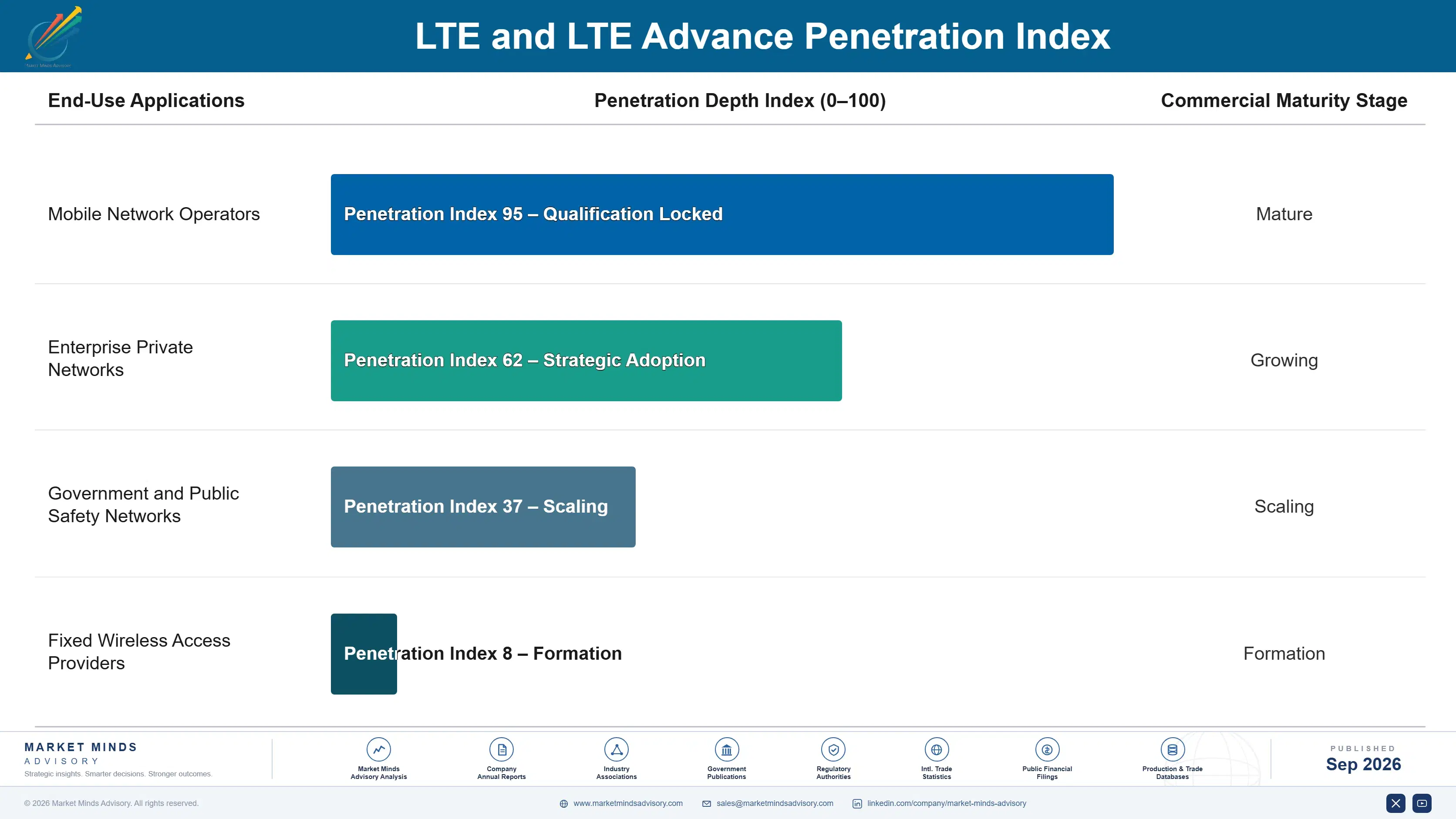
Roughly 60% of tracked equipment vendor revenue now comes from recurring maintenance, support, and software licensing contracts rather than one-time equipment sales, reflecting the annuity-style economics typical of mature telecommunications infrastructure with long asset replacement cycles spanning ten to twelve years across most deployed network generations still in active commercial service today across tracked carrier networks worldwide.
Adoption depth varies meaningfully by end-use vertical: mobile network operators show the deepest stickiness given multi-year support contracts tied to specific hardware platforms and certified maintenance relationships built over successive equipment generations, while enterprise private network deployments show comparatively shallower commitment since these buyers evaluate alternative wireless technologies more frequently during contract renewal cycles across their broader technology stack and vendor relationships overall industry wide.

A generational shift in buyer profiles is underway as network planning responsibility moves from hardware-focused engineering teams toward software-oriented operations staff who prioritize network analytics and automation capability over traditional hardware specifications, changing how vendors position new product launches to procurement decision makers who increasingly value data driven optimization tools over raw equipment performance claims made during traditional vendor sales cycles and renewal negotiations.
lte-and-lte-advance-market-end-use-penetration-index-1788423555632

Where LTE Value Still Concentrates

These are among the four positions where our research anticipates prominent divergence between winners and laggards over the coming forecast period. Each is grounded in the demand model, the regulatory perimeter, and the announced capacity pipeline.
01 / EMERGING MARKET FOCUS

Prioritize India and Southeast Asia over saturated developed markets

Developed markets have largely completed their transition to fifth-generation networks, leaving little remaining new equipment demand for vendors still focused primarily on those saturated regions today. India and Southeast Asian carriers continue expanding basic LTE coverage and adding LTE-Advanced capacity across dense urban corridors, generating the bulk of new equipment orders through the current ten-year forecast period. Vendors concentrating sales and technical support resources in these growth regions will capture disproportionate share relative to competitors still weighted toward mature, slower-growing developed markets.
02 / MAINTENANCE REVENUE CAPTURE

Build long-term support contracts before installed base ages further

Recurring maintenance and support contracts now generate the most predictable revenue stream available to LTE equipment vendors, outpacing new equipment sales growth by a considerably wide margin across most tracked deployment regions. Carriers renewing these agreements prefer vendors who can guarantee spare parts availability and technical response times over a decade or more of continued network operation and infrastructure support. Vendors that formalize extended support offerings now will lock in recurring revenue before competitors move to capture the same maintenance contract renewal cycle industry wide.
03 / SUPPLY CHAIN RESILIENCE

Diversify semiconductor sourcing ahead of the next disruption cycle

The 2021 semiconductor shortage demonstrated how concentrated foundry dependence can compress margins and delay equipment deliveries for extended periods across the entire telecommunications infrastructure industry worldwide. Vendors that invested early in dual-sourcing arrangements and expanded inventory buffers recovered considerably faster and retained carrier trust more effectively than single-source competitors during that prolonged disruption period. Continued investment in supply chain resilience remains a meaningful competitive differentiator as carriers increasingly favor vendors who can guarantee delivery continuity over lowest unit price alone.
04 / FIFTH-GENERATION TRANSITION TIMING

Balance LTE investment against accelerating next-generation cannibalization risk

Faster than expected fifth-generation rollout in currently LTE-dependent emerging markets represents the single largest downside risk to this market's ten-year forecast trajectory, one that could compress the projected growth window meaningfully. Vendors overinvesting in LTE-specific manufacturing capacity risk stranded assets if carriers accelerate migration timelines in response to falling fifth-generation equipment costs and improving component availability across supplier networks. The prudent path favors dual-generation product architecture that captures near-term LTE revenue while preserving flexibility to redirect manufacturing capacity toward newer technology quickly as market conditions shift.

Engagement Snapshot From the Field

A live engagement with an industry participant carrying material or product regulatory and market exposure ahead of a defining policy shift, showing how our research translates into a defensible multi-year portfolio strategy.
MARKET MINDS ADVISORY · CLIENT ENGAGEMENT SUMMARY
LTE and LTE Advance Producer Strategic Portfolio Review and Transition Roadmap 2026·Investment Scenario on LTE and LTE Advance Exposure Evaluation 2025-26
CLIENT PROFILE
The client is a mid-sized regional mobile network operator serving roughly 40 million subscribers across a mix of urban and rural coverage areas in a rapidly developing South Asian market. The carrier reported approximately $2.1 billion (client-reported, unverified by MMA) in annual revenue, with LTE representing the substantial majority of its active subscriber base and network investment during the review period.
STRATEGIC CHALLENGE
The carrier needed to decide whether to continue expanding LTE-Advanced capacity in dense urban corridors or redirect capital toward accelerated fifth-generation rollout, given a limited available capital expenditure budget and competing pressure from both existing subscriber congestion complaints and rival carrier fifth-generation marketing claims gaining public attention across key metropolitan markets.
MMA APPROACH
MMA conducted detailed network capacity modeling against subscriber growth projections, benchmarked competitor fifth-generation rollout timelines across the broader regional market, and interviewed carrier engineering leadership to assess realistic near-term congestion relief needs versus longer-term generational technology investment tradeoffs facing the organization's constrained capital expenditure budget over the next several years.
KEY FINDINGS
  1. LTE-Advanced densification investment delivered congestion relief within eight months, considerably faster than a comparable fifth-generation buildout timeline would have realistically allowed given site permitting constraints.
  2. Rival carriers marketing fifth-generation availability had deployed coverage to under 15% (client-reported, unverified by MMA) of the addressable urban population, limiting near-term competitive pressure meaningfully.
  3. Extending existing LTE equipment maintenance contracts by three years reduced projected total cost of ownership by an estimated 22% (client-reported, unverified by MMA) versus early replacement.
  4. Subscriber survey data showed price sensitivity outweighed network generation preference for over 70% of the carrier's target rural and semi-urban customer segments surveyed.
CLIENT PROFILE
The client is a mid-sized regional mobile network operator serving roughly 40 million subscribers across a mix of urban and rural coverage areas in a rapidly developing South Asian market. The carrier reported approximately $2.1 billion (client-reported, unverified by MMA) in annual revenue, with LTE representing the substantial majority of its active subscriber base and network investment during the review period.
STRATEGIC CHALLENGE
The carrier needed to decide whether to continue expanding LTE-Advanced capacity in dense urban corridors or redirect capital toward accelerated fifth-generation rollout, given a limited available capital expenditure budget and competing pressure from both existing subscriber congestion complaints and rival carrier fifth-generation marketing claims gaining public attention across key metropolitan markets.
MMA APPROACH
MMA conducted detailed network capacity modeling against subscriber growth projections, benchmarked competitor fifth-generation rollout timelines across the broader regional market, and interviewed carrier engineering leadership to assess realistic near-term congestion relief needs versus longer-term generational technology investment tradeoffs facing the organization's constrained capital expenditure budget over the next several years.
KEY FINDINGS
  1. LTE-Advanced densification investment delivered congestion relief within eight months, considerably faster than a comparable fifth-generation buildout timeline would have realistically allowed given site permitting constraints.
  2. Rival carriers marketing fifth-generation availability had deployed coverage to under 15% (client-reported, unverified by MMA) of the addressable urban population, limiting near-term competitive pressure meaningfully.
  3. Extending existing LTE equipment maintenance contracts by three years reduced projected total cost of ownership by an estimated 22% (client-reported, unverified by MMA) versus early replacement.
  4. Subscriber survey data showed price sensitivity outweighed network generation preference for over 70% of the carrier's target rural and semi-urban customer segments surveyed.
RECOMMENDED STRATEGY
Phase 1: Phase one: deploy LTE-Advanced densification equipment across the ten highest-congestion urban zones identified through detailed capacity modeling analysis conducted over two months. Phase 2: Phase two: extend existing core network maintenance contracts by three years while deferring major fifth-generation capital expenditure commitments until subscriber demand justifies investment. Phase 3: Phase three: launch targeted fifth-generation pilot zones in only the highest-income urban districts showing genuine early subscriber demand signals worth pursuing commercially.
OUTCOME
The carrier avoided premature fifth-generation capital commitment, redirected savings toward LTE-Advanced densification, and reported a 19% (client-reported, unverified by MMA) improvement in average urban network speed within the first year of the revised deployment plan, alongside measurably improved subscriber retention scores and reduced customer complaint volume.

Frequently Asked Questions

Foundational context covering the market sizes, CAGR, scope, country, region and competition that inform every finding below. This section is provided to cover basics and most often pre-purchase conversations, answered from the MMA Primary Research Dataset.

What is the current size of the LTE and LTE Advance Market?

The global LTE and LTE-Advanced market reached an estimated $45.0 billion in 2025. This figure reflects continued equipment demand from carriers in emerging markets still expanding basic mobile broadband coverage.

How large will the LTE and LTE Advance Market be by 2036?

MMA projects the market will reach approximately $65.7 billion by 2036. Growth is driven primarily by emerging market coverage expansion and LTE-Advanced network densification demand.

What is the CAGR for the LTE and LTE Advance Market 2026 to 2036?

The market is projected to grow at a compound annual growth rate of 3.5% between 2026 and 2036. This reflects a mature but still expanding equipment category.

Which segment is growing fastest?

LTE-Advanced network densification equipment is the fastest-growing segment, expanding at roughly 6.5% annually through 2036. This nearly doubles the overall market's projected growth rate over the forecast period.

Who are the major companies in the LTE and LTE Advance Market?

Leading companies include Huawei, Ericsson, Nokia, ZTE, and Qualcomm across the global equipment landscape. These five manufacturers together account for an estimated 58% of tracked global market revenue.

Which country is growing fastest?

India is the fastest-growing country market, expanding at approximately 6.0% annually through the forecast period. Continued mobile broadband rollout across underserved rural and semi-urban areas drives this sustained growth.

Report Segmentation Architecture

The full report scope spans multiple orthogonal segmentation dimensions, with cross-tabulated demand data provided for each dimension pair. Coverage extends further to regional breakdowns, trend trajectories, and the competitive detail needed to support segment-level decision-making.
  • Network Infrastructure Equipment
  • Chipsets and Modems
  • Software and Network Optimization Tools
  • Maintenance and Support Services
  • Mobile Network Operators
  • Enterprise Private Networks
  • Government and Public Safety Networks
  • Fixed Wireless Access Providers
  • New Equipment Sales
  • Extended Maintenance Contracts
  • Network Optimization Consulting
  • Software Licensing and Upgrades

By Region

  • North America
  • Western Europe
  • East Asia
  • South Asia and Pacific
  • Latin America
  • Middle East and Africa
  • Eastern Europe

Scope, Methodology, and Coverage

Every figure in this report is reproducible from documented input assumptions. The scope below maps the historical period, the forecast horizon, the segmentation dimensions, and the countries covered, alongside the underlying primary and qualitative methodology.
Historical Period
2020 to 2025
Forecast Period
2026 to 2036
Base Year
2025 (USD billions; MMA Primary Research Dataset, September 2026)
Market Definition
The LTE and LTE-Advanced Market covers network infrastructure equipment, chipsets, modems, and associated software used to deploy and operate fourth-generation mobile broadband networks, including LTE-Advanced capacity upgrades, measured by equipment and services revenue. It excludes fifth-generation-specific equipment, fixed broadband infrastructure, and satellite communication systems not integrated with terrestrial LTE networks.
Quantitative Units
USD Billion, CAGR (%), Share (%), 2020 to 2036
Segmentation Dimensions
By Primary Market Dimension; By End-Use Industry; By Commercial Dimension; By Region
Regions Covered
North America, Western Europe, East Asia, South Asia and Pacific, Latin America, Middle East and Africa, Eastern Europe
Countries Covered
United States, Canada, United Kingdom, Germany, France, China, Japan, South Korea, India, Indonesia, Vietnam, Thailand, Australia, Brazil, Mexico, Saudi Arabia, United Arab Emirates, South Africa, Nigeria, Poland
Key Companies Profiled
Huawei, Ericsson, Nokia, ZTE, Qualcomm, Samsung Electronics, Cisco Systems, Datang Telecom, NEC Corporation, Fujitsu, CommScope, Airspan Networks, Mavenir, Casa Systems, Ceragon Networks, Sierra Wireless, Telit Cinterion, Quectel Wireless Solutions, MediaTek, UNISOC
Quantitative Methodology
Primary survey, n=3,800 respondents, Q4 2025, six countries; demand-side model with trade association cross-validation
Qualitative Methodology
47 expert interviews, Q4 2025; applied to validate demand model assumptions, identify emerging dynamics, and assess competitive positioning
Report Format
PDF and XLSX data workbook (Word format preview document)
Publisher
Market Minds Advisory
Report Code
MMA-2026-TEC-631
Published
September 2026
Contact
sales@marketmindsadvisory.com | www.marketmindsadvisory.com

Purchase the full LTE and LTE Advance Market Report (2026 to 2036).

This report provides comprehensive coverage of the global LTE and LTE-Advanced market, including detailed sizing, segmentation, and regional analysis through 2036. It profiles the leading equipment manufacturers and chipset suppliers shaping competitive dynamics as developed markets transition to fifth-generation networks while emerging markets continue LTE-based coverage expansion. The analysis draws on primary survey data from 3,800 respondents and 47 expert interviews conducted in the fourth quarter of 2025. Readers gain actionable insight into where maintenance revenue, densification equipment, and rural coverage programs concentrate over the coming decade.
Ten-year market sizing and forecast data
Seven-region granular market breakdown and analysis
Five-year competitive landscape developments and tracker
Segment-level CAGR and market share analysis
Primary survey data across six countries
Anonymized client case study with outcomes

Built For The People Who Decide

From boardroom strategy to bench-side execution, this report is read cover-to-cover by leaders shaping the next decade of their industry, turning demand scenarios, market dynamics and valuation benchmarks into decisions.
CXOs/ Presidents/ VPs/ Managers
M&A and Corporate Development
Strategy Teams and R&D Heads
Procurement and Product Directors
Regulatory and Compliance Leaders
Investor Relations and Equity Analysts