Market Minds Advisory
Low Voltage Residential Switchgear Market

Low Voltage Residential Switchgear Market: Low Voltage Residential Switchgear Market: More Devices In The Same House

Every wiring regulation cycle adds a device that used to be optional and none has ever removed one. A house now carries three times what it did thirty years ago.

Lead Analyst

Published

September 2026

Make Smarter Decisions with Customized Research Insights

Request a free sample report and evaluate market opportunities, growth trends, and competitive dynamics relevant to your business needs.

2025 MARKET VALUE$12.5BMarket Size 2025
2036 FORECAST VALUE$31.6BBase Case , 2026 to 2036
CAGR 2026 TO 20368.8 %Bull 10.0% / Bear 7.6%
INCREMENTAL OPPORTUNITY$18.0BNet 10- year value creation
EXPANSION MULTIPLE2.32x2036 value over 2026 base
Strategic Levers
M&A Pipeline
Regional Outlook
Country Rankings
Competitive Intelligence
Segmental Deep-dive
Call-Us : 91 93563 13602

Executive Snapshot and Market Trajectory.

Housing completions grow slowly and this market does not, because the device count inside each dwelling keeps rising. A current new build carries 17 protective devices against roughly a third of that thirty years ago, and every regulation cycle has added a class rather than removing one.
Arc fault detection devices grow at 13.2%, half again the market rate of 8.8%, because wiring regulations across Europe and North America now require them in specific locations where they were previously optional or unheard of. East Asia holds 29% of demand on housing completion volume, though Western Europe carries the highest device count and the highest value per dwelling of anywhere. Volume and value point at two entirely different regions here.
Concentration is moderate at 53% of device units, and the customer is an electrician rather than a householder. Some 76% of volume moves through electrical wholesalers to installers who specify what they already know how to wire, which makes trade habit and shelf position worth considerably more than any product advantage anybody can demonstrate. Nobody in a house has ever once chosen a circuit breaker brand.
Market Definition
The low voltage residential switchgear market covers protective and switching devices operating below one thousand volts installed in dwellings, spanning miniature circuit breakers, residual current devices and combined RCBOs, arc fault detection devices, surge protective devices, consumer units and load centres, and isolators and main switches. Scope is measured as device units shipped into residential installation across new build and retrofit. Excluded are commercial and industrial switchgear, medium voltage equipment, wiring accessories such as sockets and switches, cable and containment, and metering and smart home control equipment.
Base Year Value
$12.5B in 2025 (MMA Primary Research Dataset, September 2026)
Forecast Period
2026 to 2036, eleven discrete annual values
CAGR
8.8% base case. Bull 10.0%. Bear 7.6%.
Fastest Growth Segment
Arc Fault Detection Devices: 13.2% CAGR
Fastest Growth Country
India: 11.0% CAGR
Fastest Growth Region
South Asia and Pacific: 11.0% CAGR
Largest Region
East Asia: 29% of 2025 global value
Market Leaders
Schneider Electric, ABB, Siemens, Legrand and Eaton. Source: MMA Analysis, July 2026.
Primary Survey
n=3,800 procurement and R&D decision-makers, Q4 2025, six countries
Methodology
Demand-side build-up, cross-validated against public data, 47 expert interviews

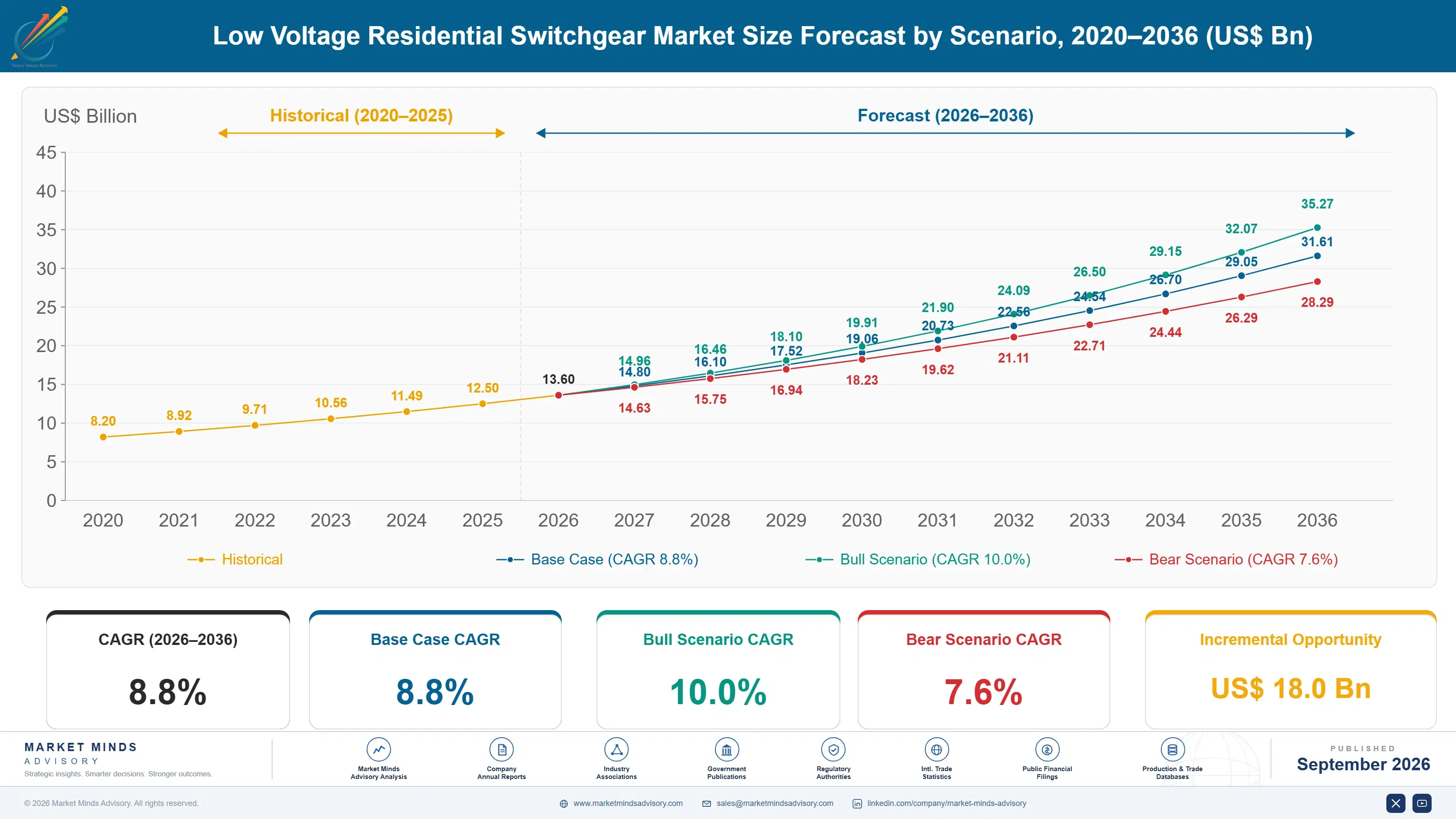
Low Voltage Residential Switchgear Market Forecast Scenarios

low-voltage-residential-switchgear-market-size-forecast-scenario-1788410811870
Between 2020 and 2025 the sector compounded at 7.4% while housing completions across most developed markets did nothing of the sort. Regulation added device classes, electrification added circuits, and consumer unit replacement accelerated as older boards failed to accommodate heat pumps or vehicle charging. The growth came from inside existing dwellings rather than from anybody building more of them.
The 8.8% base case rests on three mechanisms. Wiring regulations keep adding mandatory device classes on published amendment cycles, and no regulator has ever removed one. Electrification adds protected circuits for heat pumps, vehicle charging, solar and batteries, which frequently forces a full board replacement because older units have neither spare ways nor residual current protection. And retrofit already represents 58% of demand. None of the three depends on housebuilding recovering.
The bull case at 10.0% turns on arc fault detection requirements extending beyond specific locations to general application, which several regulators are considering and which would multiply the device count again. The bear case at 7.6% is regulatory pause: amendment cycles are slow and political, and a decade without a new mandatory device class would leave this market growing at housing completion rates.

Seventeen Devices Per House

The growth mechanism here is a device count rather than a dwelling count, which is why housing statistics forecast this market badly. A new build carries around 17 protective devices where a house wired three decades ago carried a third of that, because residual current protection became mandatory, moved to individual circuits, then surge protection and arc fault detection followed. Each amendment added a class and none removed one.
TOP FIVE CONCENTRATION53%Share of protective device units held by five manufacturers
DEVICES PER DWELLING17 devicesProtective devices installed in a current new build home
DEVICE COUNT GROWTH3.1 timesIncrease against a comparable dwelling wired three decades ago
WHOLESALER CHANNEL SHARE76%Portion of volume reaching installers through electrical trade distribution
BOARD REPLACEMENT AGE31 yearsMedian age at which a domestic board is fully replaced
RETROFIT DEMAND SHARE58%Portion of volume going into existing rather than new dwellings
Electrification is doing something regulation cannot, which is forcing whole boards out. A heat pump, a charge point, an inverter and a battery each need a protected circuit, and a board installed thirty years ago has neither spare ways nor the protection current rules require. That converts an addition into a full replacement, which is why 58% of demand is retrofit.
The purchase decision sits entirely with the installer. Some 76% of volume moves through electrical wholesalers to electricians who specify what they have wired before, because familiarity reduces the chance of a mistake on a job they are certifying with their own name. Householders neither know nor care what brand protects their circuits, and no manufacturer has ever successfully sold past the trade.
"The thing that grows this market is a committee amending a wiring regulation, not a builder starting houses. Anybody modelling it from construction data has been getting the answer wrong for a decade and will keep getting it wrong."
Director, Electrical Installation Products Practice · MMA Energy Practice · September 2026

Market Trends

Regulation adds device classes and never removes them

Wiring regulations across Europe, North America and increasingly Asia have added residual current protection, then individual circuit protection, then surge protective devices and then arc fault detection, each on an amendment cycle and each mandatory where it had previously been optional or absent. No regulator has withdrawn a protective requirement once introduced, because doing so means arguing that a safety device was unnecessary. Device count per dwelling has reached around 17 against roughly a third of that three decades ago, and the ratchet only turns one way. Housing statistics forecast this badly.
Market Impact: Grows at 13.2% against 8.8%
Electrification forces whole boards out, not additions

Heat pumps, vehicle charge points, solar inverters and home batteries each require a protected circuit, and a consumer unit installed decades ago typically has neither spare ways nor the residual current protection those circuits now require. The practical answer is a complete board replacement rather than an addition, which converts a small job into a substantial one and pulls forward a replacement that would otherwise have waited years. Retrofit already represents 58% of demand, and each electrification measure a household adopts accelerates it further. Every electrification measure a household adopts pulls that replacement forward again.
Market Impact: Moves 76% through trade distribution

Market Opportunities and Growth Drivers

Arc fault requirements are spreading across jurisdictions

Arc fault detection was a North American requirement for bedroom circuits two decades ago and has since extended across more circuit types there while European regulations introduced it for specific higher risk locations including sleeping accommodation and premises with vulnerable occupants. Each extension multiplies device count in the dwellings affected, and the devices cost several times a conventional circuit breaker. That segment grows at 13.2% against a market rate of 8.8%, and further extension toward general application is under consideration in several places. Device count rises without anybody building a house.
Market Impact: Costs 1 callback per incident

Installers specify from habit rather than comparison

Some 76% of volume reaches the installation through electrical wholesalers, where an electrician buys what they have fitted before because familiarity reduces the risk of an error on work they certify personally. Brand preference in this trade is a habit built over years of jobs rather than a comparison anybody runs, and the wholesaler shelf is where it is reinforced. That makes distribution position and installer training worth considerably more than product features, which manufacturers with better products have repeatedly discovered the hard way. Better products have lost to worse ones repeatedly.
Market Impact: Delays classes by 3 years

Market Restraints and Challenges

Nuisance tripping undermines the newest devices

Arc fault detection devices and sensitive residual current protection both trip on conditions that are not faults, and an electrician called back to a house with no discoverable problem will avoid that product on the next job regardless of what the regulation says. The root cause is that discriminating between an arc fault and ordinary switching transients is genuinely difficult. Commercial impact is installer resistance to the fastest growing segment. Participants are responding with improved discrimination algorithms, installer training, diagnostic indication showing why a device operated, and warranty support on callback visits.
Market Impact: Raises count 3.1 times over

Regulatory cycles are slow and politically contested

Wiring regulation amendments arrive every few years after consultation processes where cost to housebuilders is argued against safety benefit, and requirements are frequently narrowed or deferred before publication. The root cause is that each new device class adds cost to every dwelling and housebuilding lobbies resist it consistently. Commercial impact is a growth mechanism that manufacturers cannot influence or schedule. Mitigation runs through technical committee participation, evidence submission on fault statistics, voluntary specification with major housebuilders and product ranges that suit several possible outcomes. Nobody in this industry can schedule a regulatory amendment.
Market Impact: Replaces boards after 31 years
3 additional market trends, 4 additional growth drivers, and 2 additional restraints and challenges are covered in the full report. Contact sales@marketmindsadvisory.com to access the complete intelligence.

Segment CAGR and Growth Architecture

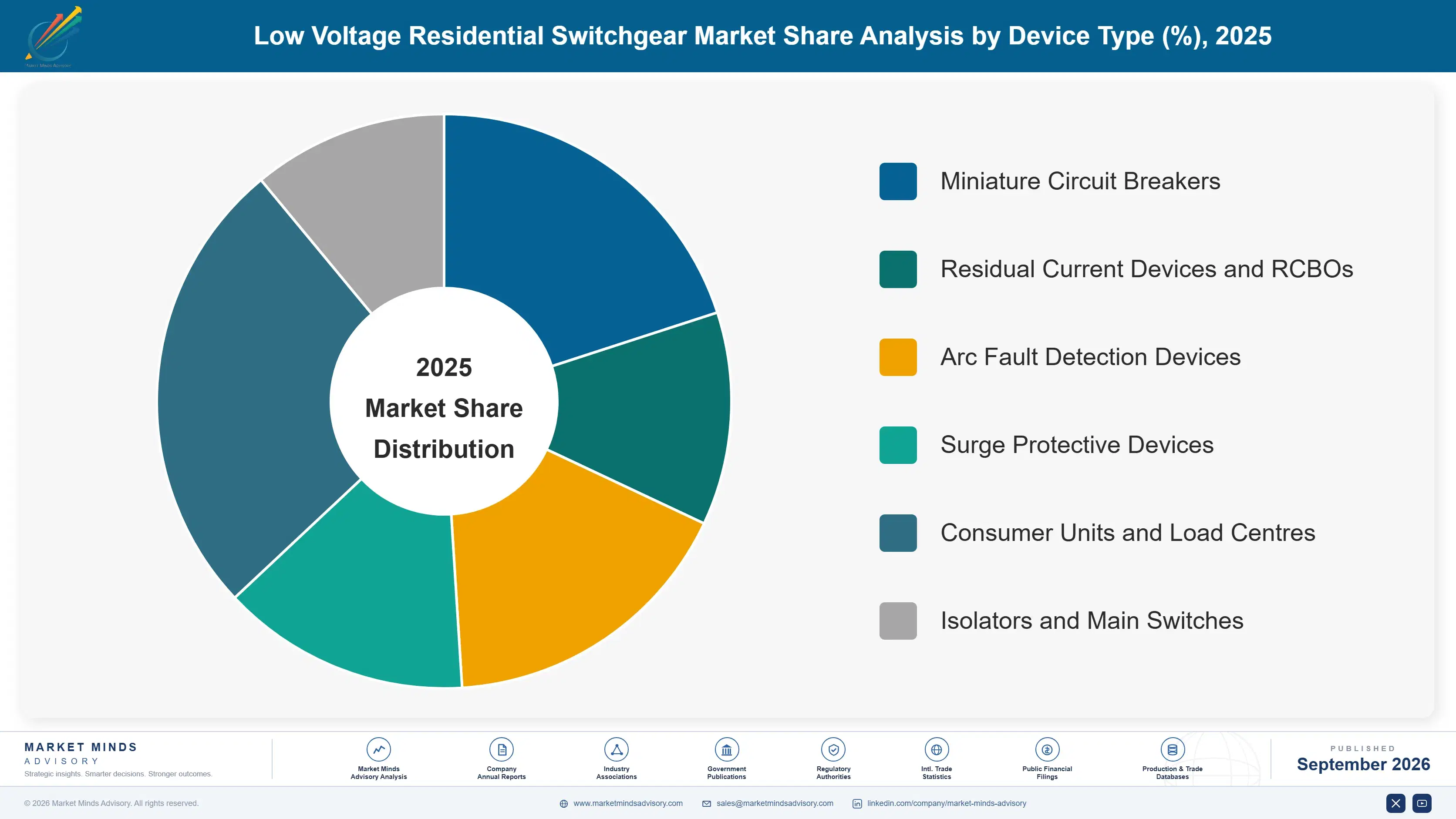
Segmentation follows device type, the dimension on which regulatory status, unit price and installation labour all move together. Circuit breakers and isolators carry the installed volume at commodity prices. Arc fault detection and surge protection carry the growth, because both were recently optional and are becoming mandatory on published amendment cycles. Amendment cycles decide this.
low-voltage-residential-switchgear-market-market-share-analysis-1788410812406

Arc Fault Detection Devices

Arc fault detection devices grow at 13.2%, half again the market rate of 8.8%, and a wiring regulation rather than any customer preference created the whole segment. These devices monitor current waveform signatures to identify the arcing that precedes an electrical fire, which a conventional circuit breaker cannot detect because the current never exceeds the rating. North American requirements have expanded across circuit types for two decades and European regulations introduced them for higher risk locations more recently. Unit prices run several times a standard breaker, installer resistance from nuisance tripping is genuine and unresolved, and further extension toward general application would multiply the segment again. Nobody has solved that resistance.
CAGR 13.2%

Surge Protective Devices

Surge protective devices at 10.2% moved from optional to effectively mandatory across most European installations within a single amendment cycle, on the reasoning that dwellings now contain electronics worth far more than the protection costs. Electrification strengthened that case considerably, since a heat pump controller or an inverter is expensive and vulnerable in a way a filament lamp never was. The devices are consumables with a finite surge capacity and an end of life indicator, which creates a replacement cycle nobody in the trade currently manages. That neglected replacement demand is worth more than the original installation volume across a dwelling's life. Nobody in this trade currently collects any of that at all.
CAGR 10.2%
Full segment breakdown across 6 segments available in the complete report.

Regional Architecture and Country Demand Map

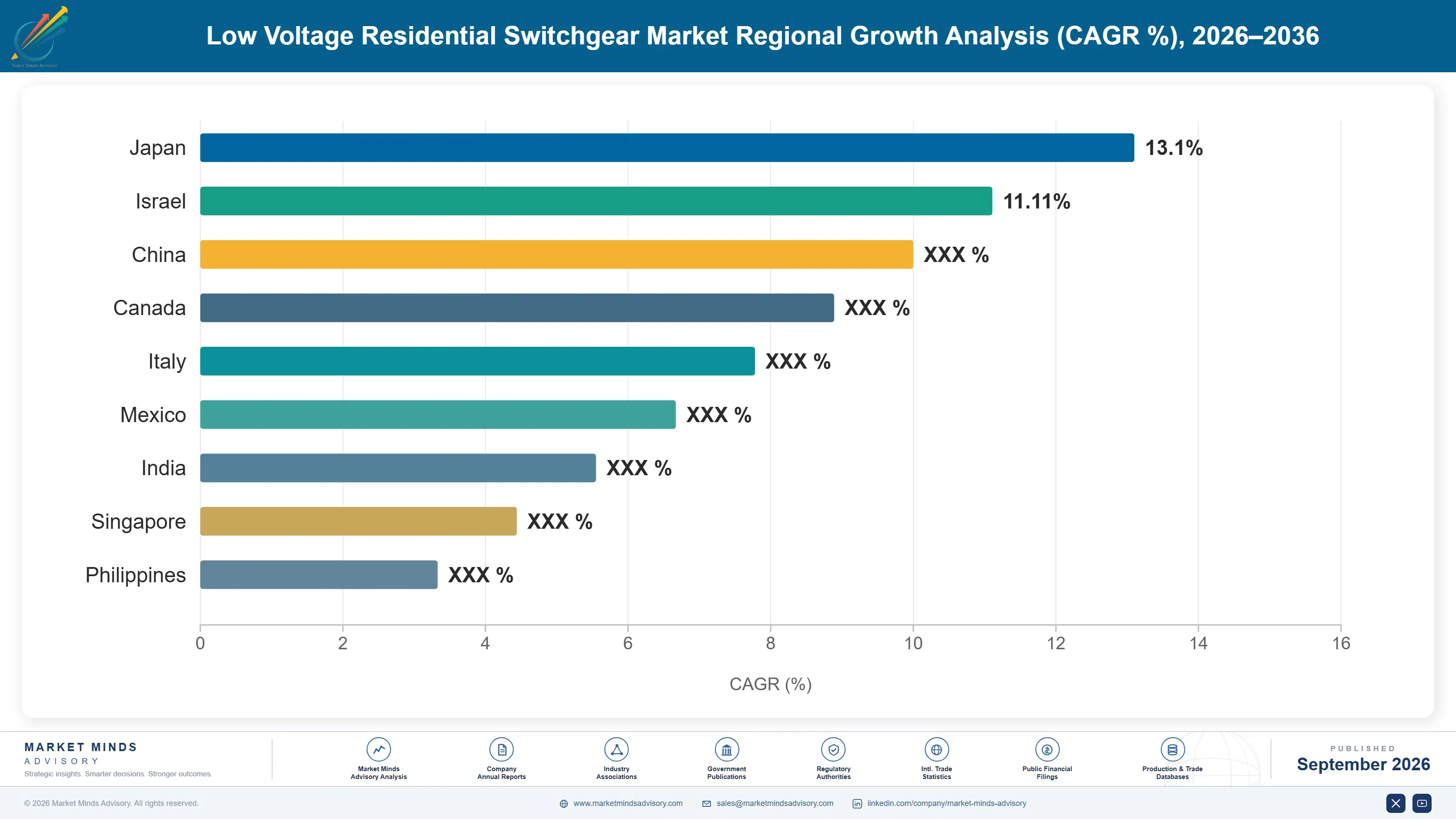
East Asia takes 29% on housing completion volume while Western Europe carries the highest device count and value per dwelling anywhere. South Asia sits above band on Indian construction. Device count and completion volume point at two different regions, which makes a single share figure misleading.

East Asia

Housing completion volume rather than device count per dwelling produces the largest regional position. Chinese residential construction remains enormous even after cooling from its peak, and Chinese manufacturers supply that demand alongside a substantial export business at prices European and American products cannot approach. Device counts per dwelling are lower than in Western Europe because requirements are less prescriptive, though standards are tightening steadily. Japanese and Korean housing is smaller in volume and higher in specification, with distinct national wiring conventions that limit product transferability. Growth at 9.4% reflects volume moderating while per-dwelling content rises to meet it. Volume moderates while per-dwelling content rises to meet it, which is an unusual combination anywhere.
Share: 29% | CAGR: 9.4% (2026 to 2036)

Western Europe

The highest device count and the highest value per dwelling anywhere sit in this region, which makes the 24% share considerably more valuable than the number suggests. Wiring regulations require residual current protection on individual circuits, surge protective devices in most installations and arc fault detection in higher risk locations, so a European consumer unit carries substantially more content than an equivalent dwelling elsewhere. Retrofit demand is strong as an older housing stock adopts heat pumps and vehicle charging. German, French and British manufacturers hold strong national positions built on regulatory familiarity. Growth at 7.4% is the slowest of the seven regions on limited housebuilding. Regulatory familiarity is what holds these national positions.
Share: 24% | CAGR: 7.4% (2026 to 2036)
Regional intelligence for 5 additional markets available in the complete report: North America, South Asia and Pacific, Latin America, Middle East and Africa, Eastern Europe. Contact sales@marketmindsadvisory.com.
low-voltage-residential-switchgear-market-country-cagr-analysis-1788410812928

Four Moves On Device Count

None of these four is about a better breaker, because these devices are type tested to standards that define what they do and every approved product does it. Each works on the two things that actually move volume: what a regulation makes mandatory, and what an electrician reaches for at a wholesaler counter. Neither is a product problem.

Sit on the technical committees writing the rules

Device count per dwelling has reached 17 and every increase came from a wiring regulation amendment rather than from any customer decision, which makes the committees drafting those amendments the most commercially significant audience in this market. Participating properly means submitting fault statistics, funding research and engaging through consultation over years rather than lobbying at the end. It costs technical staff time and produces no order in the quarter it is spent. The manufacturers who do it consistently have shaped requirements their products already satisfy. It produces no order this quarter.
Market Impact: Influences the next 17 devices in each dwelling

Train the installers who actually specify

Some 76% of volume reaches the installation through wholesalers to electricians who fit what they have fitted before, because familiarity reduces the risk of error on work they certify with their own name and licence. Training courses, on-counter support and clear installation guidance build that familiarity more reliably than any advertising, and they reach the person actually making the choice. It is an unglamorous investment in trade relationships. Manufacturers with better products and no installer programme have lost repeatedly to worse products that electricians already knew. It is unglamorous trade investment.
Market Impact: Reaches the installers choosing 76% of all volume

Solve nuisance tripping before extending the range

Arc fault devices grow at 13.2% and installer resistance from nuisance tripping is the single thing limiting adoption, because an electrician called back to a house with no discoverable fault will not fit that product again whatever the regulation requires. Better discrimination, diagnostic indication showing why a device operated, and warranty cover on callback visits address the actual objection. It is signal processing and commercial support rather than a new product. Manufacturers extending the range while ignoring the callbacks are building on resistance. Extending the range onto resistance builds nothing.
Market Impact: Removes 1 callback on every single installed device

Build the surge device replacement business

Surge protective devices are consumables with finite surge capacity and an end of life indicator that nobody in the trade currently monitors, which means an enormous installed population is sitting expended and unreplaced across dwellings that believe they are protected. Across a dwelling's 31 year board life that replacement demand exceeds the original installation volume. Capturing it needs inspection prompts, electrician awareness and a route to the householder that this industry has never built. Nobody is collecting revenue that already exists in the installed base. The revenue already exists. Nobody reads the indicators.
Market Impact: Exceeds the original volume across all 31 years

Who Controls the Margin Pool

CR5 stands at 53% of protective device units shipped, which is the only comparable basis since residential switchgear sits inside far larger electrical equipment reporting for every manufacturer. Concentration is moderate because national wiring conventions differ enough that product ranges do not transfer, and manufacturers strong in one regulatory world frequently have no position in another. Manufacturers strong in one wiring world frequently have nothing in another.
Competition runs on installer familiarity, wholesaler shelf position and regulatory approval. Familiarity decides what an electrician reaches for, which is where 76% of volume is determined. Shelf position decides what is available when they reach. Approval decides what may be installed at all in a given jurisdiction. Product performance differentiates almost nothing between type-tested devices meeting the same standard. Approved devices all meet the standard.

Rankings will move on arc fault adoption and on whether nuisance tripping is solved, because installer resistance rather than regulation now limits that segment. Chinese manufacturers are also gaining position in price-sensitive markets and increasingly in European retrofit through distribution. The pressure comes from trade acceptance rather than from any technical development, which is slow to build and slow to lose. Trade acceptance builds slowly and erodes slowly.
low-voltage-residential-switchgear-market-company-positioning-matrix-1788410813449

Competitive Moat and Risk Dimensions

SCHNEIDER ELECTRIC

Moat: Installer familiarity across many markets

Decades of installer training, wholesaler presence and product continuity across a wide range of national wiring conventions give the group habitual preference among electricians in markets that share almost nothing technically. That familiarity is built job by job over years and cannot be purchased. A competitor with a better device still has to persuade somebody to change what they fit.
SCHNEIDER ELECTRIC

Risk: Price competition in retrofit channels

Chinese manufacturers are gaining position in price-sensitive markets and increasingly in European retrofit through distribution, where a landlord or a cost-conscious homeowner is paying and the electrician is not defending a brand. Familiarity holds better in new build specification than in replacement work. The erosion is gradual, channel by channel, and difficult to reverse once a wholesaler stocks an alternative.
CHINT ELECTRIC

Moat: Cost position and distribution reach

Manufacturing scale serving the largest residential construction market in the world gives the company a cost position that European and American manufacturers cannot approach on comparable type-tested product, and export distribution has extended that into price-sensitive markets across several continents. Cost leadership in a device sold on trade habit rather than performance is a genuinely durable position.
CHINT ELECTRIC

Risk: Limited position in strict jurisdictions

The markets with the highest device count and value per dwelling are exactly those with the most prescriptive wiring regulations and the deepest installer loyalty to established national brands, which is where cost advantage counts for least. Approval and familiarity both take years to build. Growth means entering markets specifically structured to reward the incumbents already there.

Players Tracked

Prominent Players

Schneider Electric
ABB
Siemens
Legrand
Eaton

Other Key Players

Hager Group
CHINT Electric
Delixi Electric
Havells India
Panasonic
Mitsubishi Electric
Fuji Electric
LS Electric
Hubbell
Leviton
Gewiss
Doepke
Finder
Anchor Electricals
Polycab India

Recent Developments

FEBRUARY 2025

Wiring regulation amendment widened arc fault requirements

A national wiring regulation amendment extended arc fault detection requirements to additional installation types beyond the higher risk locations previously specified, adding devices to dwellings that would not otherwise have carried them. Device count per affected installation rose immediately on new work and on any board replacement.
Signal: One amendment paragraph moved more volume in this market than a decade of product development ever has.
JUNE 2025

Electrification retrofit drove full board replacement demand

Heat pump and vehicle charge point installation programmes across several European markets triggered widespread consumer unit replacement, because existing boards had neither spare ways nor the residual current protection current rules require for those circuits. The addition became a full replacement in the majority of cases surveyed.
Signal: A heat pump grant scheme turned out to be a consumer unit replacement programme in disguise.
OCTOBER 2025

Installer callback data highlighted arc fault nuisance tripping

Trade association callback data showed arc fault detection devices generating a disproportionate share of return visits where no fault could subsequently be identified, which electricians cited as a reason for avoiding the products where regulations permitted a choice. Manufacturers responded with improved discrimination and diagnostic indication.
Signal: The regulation makes them buy it and the callbacks decide whether they ever fit it again.

Copper, Silver And Moulding

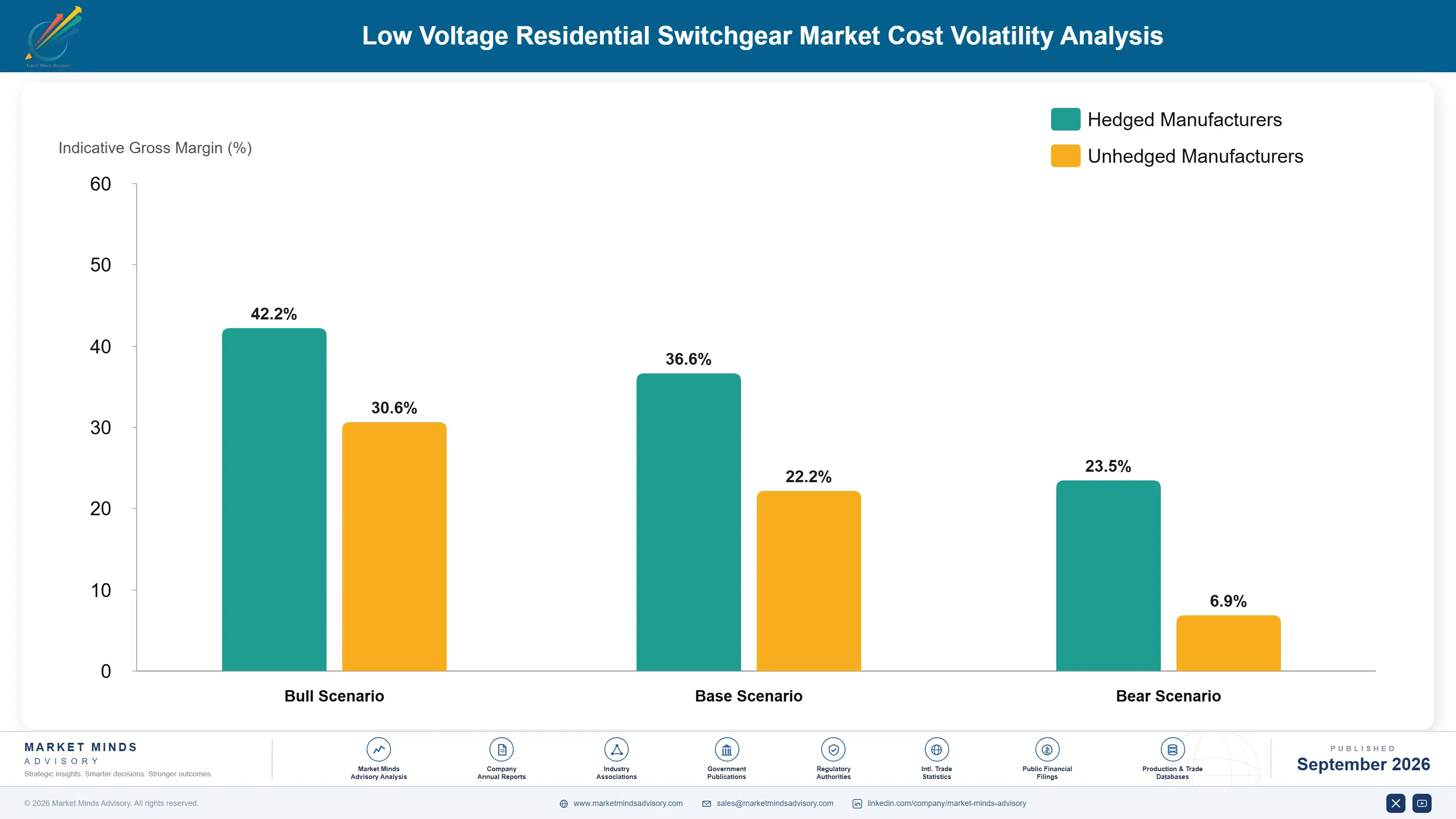
Copper conductor and current paths account for roughly 21% of device cost, silver contact material around 14%, and moulded thermoset and thermoplastic housings a further 19%. Electronics for arc fault and residual current sensing add materially where fitted. Type testing and certification are capital rather than unit costs and they are substantial per design and per national standard, which is why the participant count stays low.
Copper and silver pricing moved sharply through recent years on electrification demand across every sector at once, which US Geological Survey mineral commodity reporting recorded across the period. Manufacturers holding forward metal positions protected margin through the movement. Those buying on spot against wholesaler price lists fixed for a season absorbed the increase entirely, which on a device selling for a few units of currency is not recoverable.

The disadvantage falls on production volume rather than on purchasing capability. A manufacturer moulding and assembling tens of millions of devices annually buys metal and moulds housings at costs a smaller producer cannot approach, on an identical type-tested product. That volume gap explains most of the cost difference here, and it is why price-competitive positions belong to manufacturers serving the largest construction markets from within.
low-voltage-residential-switchgear-market-cost-volatility-analysis-1788410813643

Contract silver and copper across the price season

Copper and silver together are 35% of device cost and both move on electrification demand unconnected to residential construction, while wholesaler price lists are fixed for a season at a time. Forward metal positions cost a premium against spot and remove the exposure that a fixed price list creates. Manufacturers buying on spot absorbed the last movement entirely.

Standardise housings across the device range

Moulded housings are 19% of cost and most manufacturers carry more tool variants across a range than the standards genuinely require, which forfeits moulding volume and multiplies tooling capital. Consolidating onto fewer housing platforms with internal variation raises volume on each tool considerably. It costs some design optimisation once and returns on every device moulded afterwards.

Amortise type testing across national approvals

Certification is a substantial capital cost per design and per national standard, and manufacturers frequently develop separate designs for markets whose requirements overlap considerably more than the product ranges suggest. Designing to satisfy several standards from one platform spreads that testing cost across far more volume. It constrains optimisation for any single market and is worth it.

Portfolio Architecture for Margin Defence

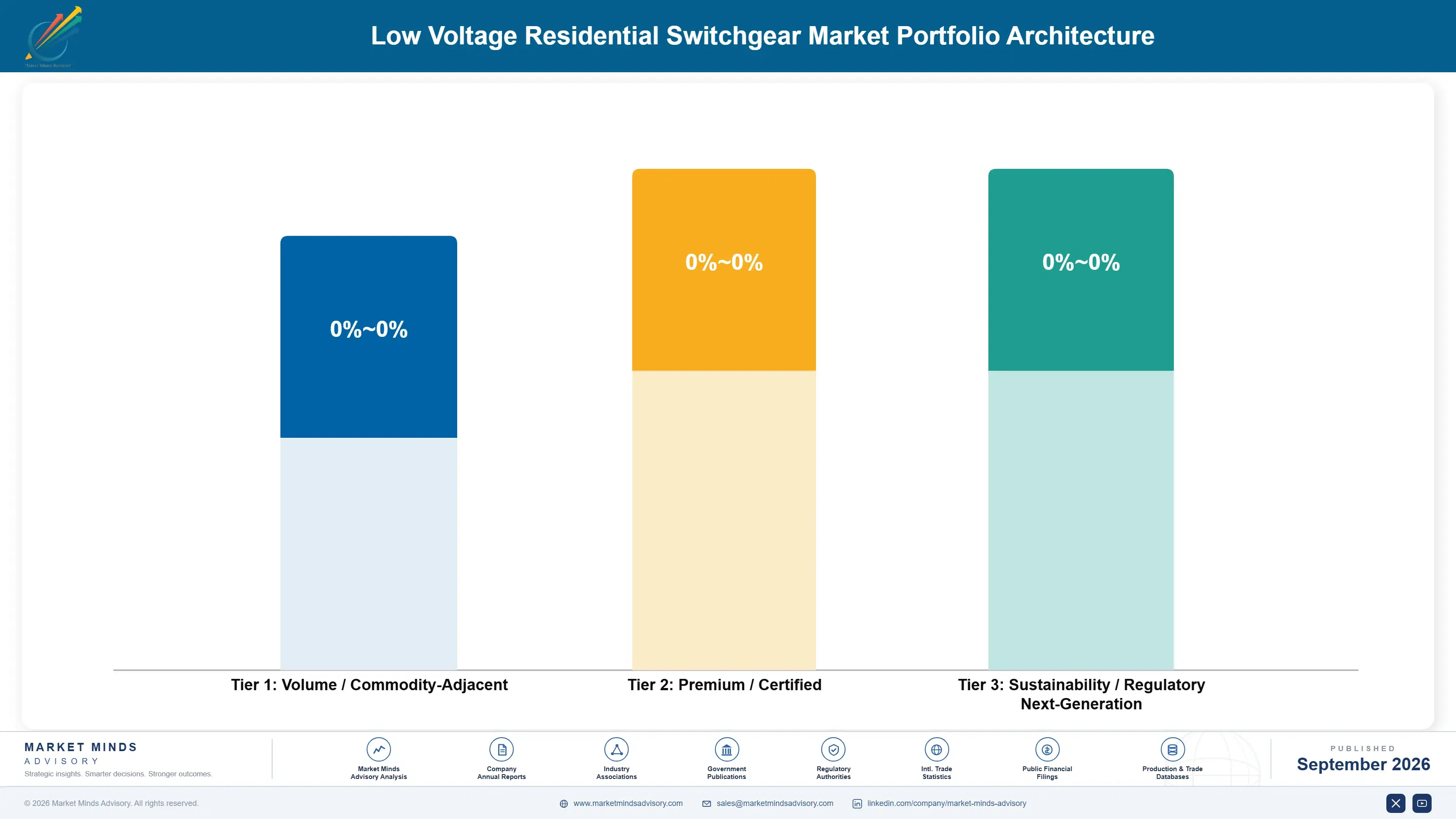
Margin here follows regulatory novelty rather than technical content, which is not how the range is usually presented. A miniature circuit breaker that every manufacturer has made for fifty years competes on price at a wholesaler counter and earns very little. An arc fault device that a regulation recently made mandatory earns several times as much on a manufacturing cost difference far smaller than the price gap suggests.
Volume and premium pull against each other through the wholesaler shelf rather than the factory. Commodity breakers carry the volume that justifies stocking depth at distribution and keeps the brand in front of electricians every working day, and that presence is what gets the newer devices fitted when a regulation requires one. Withdrawing from the commodity range saves margin and removes the shelf position everything else depends on.

High-value pools sit in arc fault devices, in surge protection and in the replacement business nobody collects. The third is genuinely unclaimed: surge devices expend themselves and indicate it, across an installed population that nobody inspects, and across a dwelling's life that replacement demand exceeds the original installation. It needs a route to the householder that this industry has never built at all.

Volume / Commodity-Adjacent

Miniature circuit breakers, isolators and main switches sold through wholesalers on price against type-tested equivalents from many manufacturers. Products are genuinely interchangeable within a standard. The 8 point spread reflects production volume and metal purchasing scale rather than design.
Gross Margin: 16 to 24%

Premium / Certified

Residual current devices, combined RCBOs and consumer units carrying assembly certification and manufacturer system approval. Familiarity and system compatibility rather than performance support the price. The 8 point spread reflects whether the manufacturer supplies the complete board assembly.
Gross Margin: 30 to 38%

Sustainability / Regulatory / Next-Generation

Arc fault detection devices, surge protection and connected devices reporting operation and status. Margins are high because regulation recently created the requirement and alternatives are limited. The 18 point spread separates newly mandated devices from connected products still finding their application.
Gross Margin: 40 to 58%
low-voltage-residential-switchgear-market-portfolio-architecture-1788410814135

High-value Sub-segments and Strategic Watch-out

Arc Fault Detection Devices

High value and high growth at 13.2%. A regulation created the segment and installer resistance from nuisance tripping is the only thing limiting how quickly it grows further. The 8 point spread reflects discrimination performance and whether any diagnostic indication is provided on the device itself.
Gross Margin: 44 to 52%

Surge Protective Devices

High value with strong growth at 10.2%. They became effectively mandatory within one amendment cycle and they expend themselves, creating a replacement cycle nobody currently manages. The 8 point spread reflects whether the manufacturer has any route to the replacement demand. Nobody chases the replacements.
Gross Margin: 36 to 44%

Residual Current Devices and RCBOs

The volume core. It earns solidly and it carries the wholesaler shelf presence that puts the newer mandated devices in front of electricians every working day. The 8 point spread reflects whether the device is sold individually or within a certified board assembly. Assemblies earn more.
Gross Margin: 28 to 36%

Miniature Circuit Breakers

The strategic watch-out. Every manufacturer makes them to the same standard, Chinese production sets the price, and combined RCBO devices increasingly replace them circuit by circuit. The 8 point spread separates integrated manufacturers from those assembling purchased components. Chinese production sets the price floor here.
Gross Margin: 14 to 22%

Thirty One Years In A Cupboard

The annuity here is a replacement cycle measured in decades and almost nobody manages it deliberately. A consumer unit stays in a cupboard for around 31 years before full replacement, generating no revenue in between except when a device fails or a circuit is added. That demand is predictable in aggregate and invisible at the individual dwelling, which is why nobody anticipates it.
Stickiness varies enormously by board rather than by customer. Devices must be compatible with the consumer unit they sit in and with the certification of that assembly, which means an electrician adding a circuit fits the same manufacturer's device without considering alternatives. That lock lasts the life of the board. A standalone device replacement carries no such constraint and is bought on whatever the wholesaler has in stock that morning.

Buyer profiles have shifted from electricians alone toward householders arranging electrification work, and manufacturers have not adjusted. An electrician asked about compatibility and rating. A householder arranging a heat pump grant asks why the quote includes a new consumer unit they had not expected and whether it is genuinely necessary. That conversation happens on many jobs and no manufacturer has given electricians anything to answer it with.
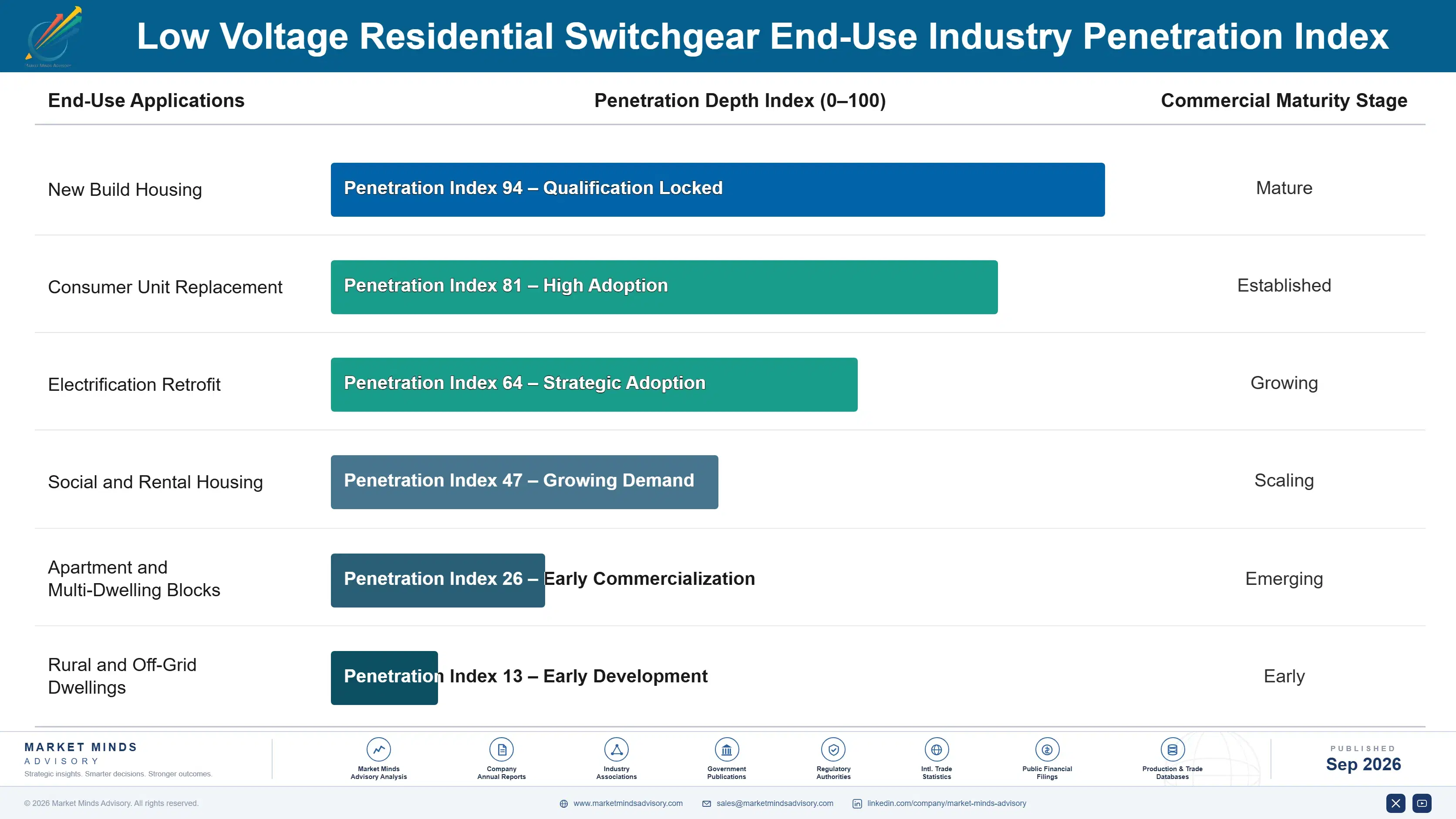
low-voltage-residential-switchgear-market-end-use-penetration-index-1788410814625

What Actually Grows This

These are among the four positions where our research anticipates prominent divergence between winners and laggards over the coming forecast period. Each is grounded in the demand model, the regulatory perimeter, and the announced capacity pipeline.
01 / TECHNICAL COMMITTEE PRESENCE

The rulebook is the product roadmap

Device count per dwelling has reached around 17 and every single increase came from a wiring regulation amendment rather than from any customer or installer asking for more protection. That makes the committees drafting those amendments the most commercially significant audience in the entire market, and participating properly means submitting fault statistics, funding research and engaging through consultation across years. It costs technical staff time and produces no order in the quarter, and the manufacturers doing it consistently have shaped requirements their products already meet.
02 / INSTALLER TRAINING INVESTMENT

Teach the person who actually chooses

Some 76% of volume reaches an installation through wholesalers to electricians who fit what they have fitted before, because familiarity reduces the risk of an error on work they certify with their own name and licence attached. Training courses, counter support and clear installation guidance build that familiarity far more reliably than advertising ever will, and they reach the person genuinely making the choice. Manufacturers with better products and no installer programme have lost repeatedly to worse products electricians already knew how to wire.
03 / NUISANCE TRIPPING RESOLUTION

Fix the callbacks before extending the range

Arc fault devices grow at 13.2% against a market rate of 8.8%, and installer resistance arising from nuisance tripping is the single thing limiting how much faster that could be. An electrician called back to a house where no fault can be found will avoid the product on the next job whatever the regulation happens to say about it. Better discrimination, diagnostic indication showing why a device operated and warranty cover on callbacks address the actual objection rather than the specification.
04 / SURGE REPLACEMENT CAPTURE

Somebody should read the indicator windows

Surge protective devices expend themselves over their working life and display an end of life indicator that nobody in the trade currently monitors, which means a very large installed population sits expended across dwellings whose occupants believe they remain protected. Across a dwelling's thirty one year board life that replacement demand exceeds the original installation volume comfortably. Capturing it needs inspection prompts, electrician awareness and a route to the householder that this whole industry has simply never built at all.

Engagement Snapshot From the Field

A live engagement with an industry participant carrying material or product regulatory and market exposure ahead of a defining policy shift, showing how our research translates into a defensible multi-year portfolio strategy.
MARKET MINDS ADVISORY · CLIENT ENGAGEMENT SUMMARY
Low Voltage Residential Switchgear Producer Strategic Portfolio Review and Transition Roadmap 2026·Investment Scenario on Low Voltage Residential Switchgear Exposure Evaluation 2025-26
CLIENT PROFILE
A European manufacturer of residential protective devices selling through electrical wholesalers across seven countries, with annual revenue in the low hundreds of millions of euros and a product range independently rated ahead of competitors on technical performance (client-reported, unverified by MMA). Share had nonetheless declined for four consecutive years. Nobody inside the business could explain why.
STRATEGIC CHALLENGE
The client made demonstrably better devices and kept losing volume to competitors whose products tested worse, which no amount of technical marketing had changed. Management wanted to understand what was actually deciding the purchase, since it clearly was not the specification they had spent years improving and promoting. Something else was deciding it.
MMA APPROACH
MMA traced how devices were selected across four hundred installations, identifying who made the choice and on what basis. Forty-seven expert interviews with electricians, wholesalers, housebuilders, regulators and competing manufacturers established what determined the product fitted and what the installer was actually optimising for on each job. The pattern was entirely consistent.
KEY FINDINGS
  1. Electricians selected on prior familiarity in 8 of every 10 installations, and had rarely compared any technical data on any of the devices they fitted.
  2. The client ran no installer training programme in 5 of its 7 markets, while the leading competitor ran courses reaching thousands of electricians annually.
  3. Arc fault callback rates on the client's devices were lower than competitors', and no electrician interviewed was aware of that difference at all.
  4. Two mandatory device classes had been added by amendment during the period, and the client had made no submission to either consultation process.
CLIENT PROFILE
A European manufacturer of residential protective devices selling through electrical wholesalers across seven countries, with annual revenue in the low hundreds of millions of euros and a product range independently rated ahead of competitors on technical performance (client-reported, unverified by MMA). Share had nonetheless declined for four consecutive years. Nobody inside the business could explain why.
STRATEGIC CHALLENGE
The client made demonstrably better devices and kept losing volume to competitors whose products tested worse, which no amount of technical marketing had changed. Management wanted to understand what was actually deciding the purchase, since it clearly was not the specification they had spent years improving and promoting. Something else was deciding it.
MMA APPROACH
MMA traced how devices were selected across four hundred installations, identifying who made the choice and on what basis. Forty-seven expert interviews with electricians, wholesalers, housebuilders, regulators and competing manufacturers established what determined the product fitted and what the installer was actually optimising for on each job. The pattern was entirely consistent.
KEY FINDINGS
  1. Electricians selected on prior familiarity in 8 of every 10 installations, and had rarely compared any technical data on any of the devices they fitted.
  2. The client ran no installer training programme in 5 of its 7 markets, while the leading competitor ran courses reaching thousands of electricians annually.
  3. Arc fault callback rates on the client's devices were lower than competitors', and no electrician interviewed was aware of that difference at all.
  4. Two mandatory device classes had been added by amendment during the period, and the client had made no submission to either consultation process.
RECOMMENDED STRATEGY
Phase 1: Phase one: build installer training and counter support in the 5 markets lacking it, since familiarity rather than specification decides most installations. Phase 2: Phase two: publish callback rate comparisons through trade channels, since the client's genuine advantage is invisible where it would actually matter. Phase 3: Phase three: staff technical committee participation properly, since every device class added has come from an amendment the client did not engage with.
OUTCOME
Within five quarters installer training reached a meaningful share of the trade in three additional markets and share decline stopped (client-reported, unverified by MMA). Callback comparisons are being circulated through wholesalers. Committee participation has begun and will take years to produce anything. Share has begun recovering in two of those markets.

Frequently Asked Questions

Foundational context covering the market sizes, CAGR, scope, country, region and competition that inform every finding below. This section is provided to cover basics and most often pre-purchase conversations, answered from the MMA Primary Research Dataset.

What is the current size of the Low Voltage Residential Switchgear Market?

The global low voltage residential switchgear market was valued at USD 12.5 billion in 2025, covering protective devices installed in dwellings below one thousand volts. The 2026 figure reaches USD 13.60 billion.

How large will the Low Voltage Residential Switchgear Market be by 2036?

MMA forecasts USD 31.59 billion by 2036, an increase of USD 17.99 billion over the 2026 base. That represents an expansion multiple of 2.32 times across the forecast period.

What is the CAGR for the Low Voltage Residential Switchgear Market 2026 to 2036?

The base case compound annual growth rate is 8.8%, with a bull case at 10.0% and a bear case at 7.6%. Historical growth between 2020 and 2025 ran at 7.4%.

Which segment is growing fastest?

Arc fault detection devices grow at 13.2%, half again the market rate of 8.8%, because wiring regulations now require them where they were previously optional. Surge protection follows at 10.2%.

Who are the major companies in the Low Voltage Residential Switchgear Market?

Schneider Electric, ABB, Siemens, Legrand and Eaton lead on protective device units shipped, with combined CR5 of 53%. Concentration is moderate because national wiring conventions differ considerably.

Which country is growing fastest?

India grows fastest at 11.0%, on residential construction volume alongside wiring standards tightening toward residual current protection requirements. South Asia and Pacific leads regionally at 11.0%.

Report Segmentation Architecture

The full report scope spans multiple orthogonal segmentation dimensions, with cross-tabulated demand data provided for each dimension pair. Coverage extends further to regional breakdowns, trend trajectories, and the competitive detail needed to support segment-level decision-making.

By Device Type

  • Miniature Circuit Breakers
  • Residual Current Devices and RCBOs
  • Arc Fault Detection Devices
  • Surge Protective Devices
  • Consumer Units and Load Centres
  • Isolators and Main Switches

By End-Use Industry

  • New Build Housing
  • Consumer Unit Replacement
  • Electrification Retrofit
  • Social and Rental Housing
  • Apartment and Multi-Dwelling Blocks
  • Rural and Off-Grid Dwellings

By Commercial Dimension

  • Electrical Wholesale Distribution
  • Housebuilder Direct Supply
  • Retail and Online Channels
  • Contractor Framework Agreements
  • Utility and Programme Procurement
  • Original Equipment Board Assembly

By Region

  • North America
  • Western Europe
  • East Asia
  • South Asia and Pacific
  • Latin America
  • Middle East and Africa
  • Eastern Europe

Scope, Methodology, and Coverage

Every figure in this report is reproducible from documented input assumptions. The scope below maps the historical period, the forecast horizon, the segmentation dimensions, and the countries covered, alongside the underlying primary and qualitative methodology.
Historical Period
2020 to 2025
Forecast Period
2026 to 2036
Base Year
2025 (USD billions; MMA Primary Research Dataset, September 2026)
Market Definition
The low voltage residential switchgear market covers protective and switching devices operating below one thousand volts installed in dwellings, spanning miniature circuit breakers, residual current devices and combined RCBOs, arc fault detection devices, surge protective devices, consumer units and load centres, and isolators and main switches. Scope is measured as device units shipped into residential installation across new build and retrofit. Excluded are commercial and industrial switchgear, medium voltage equipment, wiring accessories such as sockets and switches, cable and containment, and metering and smart home control equipment.
Quantitative Units
USD billion, 2025 base year, 2026 to 2036 forecast period
Segmentation Dimensions
Device type, installation application, commercial channel, region
Regions Covered
North America, Western Europe, East Asia, South Asia and Pacific, Latin America, Middle East and Africa, Eastern Europe
Countries Covered
United States, Canada, Germany, United Kingdom, France, Italy, Spain, Poland, China, Japan, South Korea, India, Australia, Brazil, Mexico, Saudi Arabia, United Arab Emirates, South Africa
Key Companies Profiled
20 companies across electrical equipment groups, regional manufacturers and device specialists
Quantitative Methodology
Primary survey, n=3,800 respondents, Q4 2025, six countries; demand-side model with trade association cross-validation
Qualitative Methodology
47 expert interviews, Q4 2025; applied to validate demand model assumptions, identify emerging dynamics, and assess competitive positioning
Report Format
PDF and XLSX data workbook (Word format preview document)
Publisher
Market Minds Advisory
Report Code
MMA-2026-ENE-431
Published
September 2026
Contact
sales@marketmindsadvisory.com | www.marketmindsadvisory.com

Purchase the full Low Voltage Residential Switchgear Market Report (2026 to 2036).

The full MMA report on the low voltage residential switchgear market runs to detailed device and regional models across the 2026 to 2036 forecast period, with cost benchmarks separated by metal content and moulding scale. It profiles 20 companies on a consistent protective device units basis, covering electrical equipment groups, regional manufacturers and device specialists. Device count per dwelling is modelled against wiring regulation amendment cycles by jurisdiction rather than against housing completions. Regional chapters cover the seven MMA regions with country-level detail on the eighteen markets surveyed. Primary research draws on a quantitative survey of 3,800 respondents across six countries and 47 expert interviews conducted in Q4 2025.
Cost benchmarks by metal content and moulding production scale
Device count per dwelling modelled against regulation amendment cycles
Installer selection behaviour analysed across wholesale distribution channels
Twenty company profiles on consistent protective device units basis
Electrification retrofit demand sized separately from new build volume
Seven regional chapters with eighteen country detail tables

Built For The People Who Decide

From boardroom strategy to bench-side execution, this report is read cover-to-cover by leaders shaping the next decade of their industry, turning demand scenarios, market dynamics and valuation benchmarks into decisions.
CXOs/ Presidents/ VPs/ Managers
M&A and Corporate Development
Strategy Teams and R&D Heads
Procurement and Product Directors
Regulatory and Compliance Leaders
Investor Relations and Equity Analysts