Low-Frequency Sound Absorbing Insulation Material Market
Low-Frequency Sound Absorbing Insulation Material Market: Metamaterial thickness reduction, data centre limits and heat pump regulation to 2036
Absorbing a hundred hertz with conventional material takes most of a metre of depth, which nobody has anywhere, and that single physical fact created every commercial opportunity in this market.
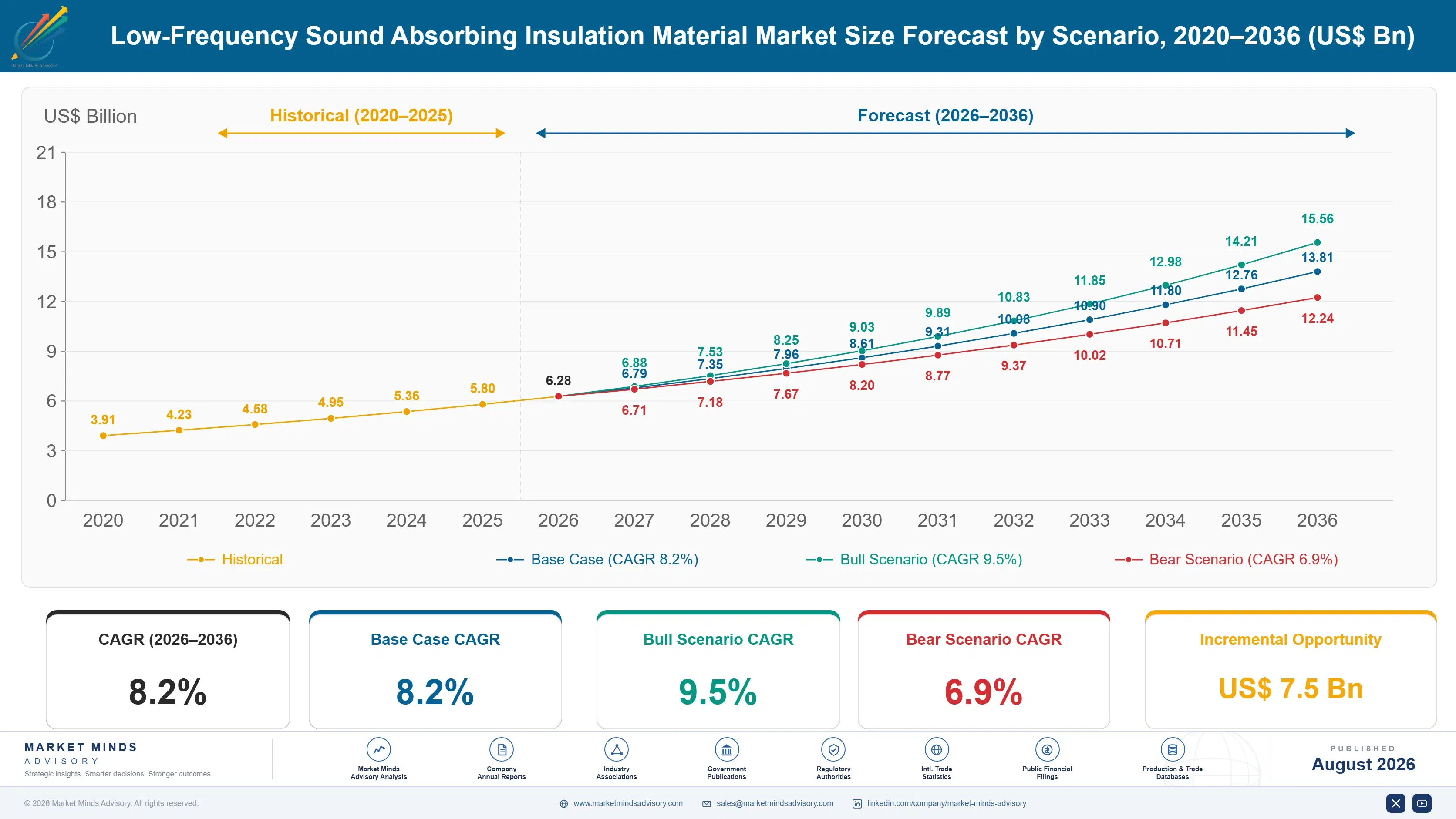
2025 MARKET VALUE$5.8BMarket Size 2025
2036 FORECAST VALUE$13.8BBase Case , 2026 to 2036
CAGR 2026 TO 20368.2 %Bull 9.5% / Bear 6.9%
INCREMENTAL OPPORTUNITY$7.5BNet 10- year value creation
EXPANSION MULTIPLE2.20x2036 value over 2026 base
Strategic Levers
M&A Pipeline
Regional Outlook
Country Rankings
Competitive Intelligence
Segmental Deep-dive
Executive Snapshot and Market Trajectory
A porous absorber needs roughly 850 millimetres of depth at a hundred hertz, because the physics demands a quarter wavelength. Nobody has that space in a wall cavity, a vehicle floor or a plant room. Everything commercially interesting here follows from that constraint. Nothing else does.
Acoustic metamaterial structures grow at 12.3%, half again the market rate of 8.2%, because a resonant sub-wavelength panel delivers comparable absorption at around 40 millimetres. East Asia holds 30% of value on construction volume, appliance manufacture and electric vehicle production together. Data centre planning consents commonly impose a 45 decibel boundary limit, which conventional insulation cannot deliver at the frequencies that actually carry. That gap is the whole opportunity. Nobody has closed it. Not yet.
Five manufacturers hold 34% of material supply and most of them sell mineral wool, which performs well above 500 hertz and poorly below 250. The commercially awkward fact is that absorption coefficient data gets quoted at frequencies where products perform, and buyers specifying acoustic insulation routinely install material that does nothing at the frequency generating the complaint. Very few purchasers understand that distinction. Most never will.
Market Definition
This report covers materials and engineered structures supplied specifically to absorb or attenuate low-frequency sound below approximately 500 hertz, spanning porous fibrous absorbers, membrane and panel absorbers, Helmholtz and cavity resonator systems, micro-perforated panel absorbers, acoustic metamaterial structures, and constrained-layer damping and mass-loaded barriers. Value is measured at manufacturer level. Excluded are general thermal insulation without an acoustic specification, active noise cancellation electronics, vibration isolation mounts, architectural finishes, and acoustic consulting services.
Base Year Value
$5.8B in 2025 (MMA Primary Research Dataset, August 2026)
Forecast Period
2026 to 2036, eleven discrete annual values
CAGR
8.2% base case. Bull 9.5%. Bear 6.9%.
Fastest Growth Segment
Acoustic Metamaterial Structures: 12.3% CAGR
Fastest Growth Country
India: 11.6% CAGR
Fastest Growth Region
South Asia and Pacific: 10.4% CAGR
Largest Region
East Asia: 30% of 2025 global value
Market Leaders
Saint-Gobain, Rockwool International, Knauf Insulation, Armacell International and Autoneum Holding lead the market. Source: MMA Primary Research Dataset, July 2026.
Primary Survey
n=3,800 procurement and R&D decision-makers, Q4 2025, six countries
Methodology
Demand-side build-up, cross-validated against public data, 47 expert interviews
Low-Frequency Sound Absorbing Insulation Material Market Forecast Scenarios

Growth ran at 6.8% between 2020 and 2025 and the character of demand changed more than the rate did. Building acoustic requirements tightened steadily across European and Asian codes, which supported conventional material volumes. What emerged late in the period was a set of new low-frequency problems: data centre plant noise, heat pump compressors and electric vehicle cabins where removing the engine exposed road boom.
The 8.2% base case rests on three mechanisms. Data centre construction keeps expanding and planning consent increasingly turns on boundary noise limits that conventional insulation cannot meet at the frequencies involved. Residential heat pump installation keeps scaling under decarbonisation policy, and compressor noise is low-frequency and regulated at the neighbour boundary. And metamaterial structures keep taking applications at 12.3% by delivering absorption in 40 millimetres that porous material needs 850 millimetres to achieve.
The 9.5% bull case is metamaterial manufacturing cost falling far enough for volume building applications, which would open a market currently limited to high-value industrial and vehicle uses. The 6.9% bear case is data centre construction slowing across the markets where planning objections have been fiercest, since that is the single fastest source of genuinely new low-frequency demand.
The 8.2% base case rests on three mechanisms. Data centre construction keeps expanding and planning consent increasingly turns on boundary noise limits that conventional insulation cannot meet at the frequencies involved. Residential heat pump installation keeps scaling under decarbonisation policy, and compressor noise is low-frequency and regulated at the neighbour boundary. And metamaterial structures keep taking applications at 12.3% by delivering absorption in 40 millimetres that porous material needs 850 millimetres to achieve.
The 9.5% bull case is metamaterial manufacturing cost falling far enough for volume building applications, which would open a market currently limited to high-value industrial and vehicle uses. The 6.9% bear case is data centre construction slowing across the markets where planning objections have been fiercest, since that is the single fastest source of genuinely new low-frequency demand.
The Physics Everybody Sells Around
Sound absorption obeys a rule nobody in this industry can negotiate with. A porous absorber works by converting air movement into heat through friction, which requires the material to sit where air velocity is highest, roughly a quarter wavelength from a reflecting surface. At a hundred hertz that distance is about 850 millimetres. No wall cavity, vehicle floor or plant room enclosure has anything approaching that depth available, which is why mineral wool and foam deliver excellent numbers above 500 hertz and very little where complaints originate.
TOP-FIVE CONCENTRATION34%Combined position across absorbing material supply held by leaders
POROUS ABSORBER THICKNESS REQUIREMENT850 mmDepth conventional material needs to absorb very low frequencies
DATA CENTRE NOISE LIMIT45 dBTypical boundary limit imposed by planning consent conditions
METAMATERIAL PANEL THICKNESS40 mmDepth a resonant structure needs for the same absorption
RAW MATERIAL COST SHARE44%Portion of manufacturer cost attributable to base substrate inputs
HEAT PUMP NOISE REQUIREMENT42 dBBoundary level residential installations must meet under permitted rules
Resonant structures escape the rule rather than defeating it. A membrane, a Helmholtz cavity, a micro-perforated panel or a metamaterial array absorbs by resonating at a tuned frequency rather than by intercepting a wavelength, which means required thickness has almost nothing to do with the frequency addressed. Metamaterial structures now deliver comparable absorption in around 40 millimetres, a twenty-fold reduction that changes what fits inside a building or a vehicle.
The commercial situation is uncomfortable. Absorption performance gets quoted as a single averaged coefficient across frequencies where porous products perform well, and most specifiers reading it are not acousticians. Material routinely gets installed that does nothing whatever at the frequency causing the problem.
"Most of what gets sold as acoustic insulation is thermal insulation with a test certificate attached, and it does almost nothing below two hundred hertz. The people buying it find that out after the neighbours complain and the material is already in the wall."
Market Trends
Cooling fans and transformers generate noise concentrated below 250 hertz, which travels considerably further than higher frequencies and passes through building fabric that stops everything else. Planning authorities across Virginia, Ireland and the Netherlands have imposed boundary limits around 45 decibels and refused consent where operators could not demonstrate compliance. Conventional insulation cannot deliver at those frequencies in the depths available around plant equipment. The commercial consequence is that acoustic treatment has moved from a fit-out consideration to a consent condition, which changes both the budget available and who makes the specification decision.
Market Impact: Meets a 42 decibel boundary limit
Metamaterial structures collapse the thickness the physics demands
A resonant sub-wavelength structure absorbs by tuned oscillation rather than by intercepting a quarter wavelength, which severs the relationship between panel depth and the frequency addressed. Metamaterial arrays now deliver low-frequency absorption in around 40 millimetres that porous material would need 850 millimetres to match. That is not an incremental improvement in a coefficient, it is a change in what fits inside an existing cavity or vehicle floor. Growth at 12.3% follows applications where space was the binding constraint rather than performance, which describes almost every genuinely difficult low-frequency problem.
Market Impact: Addresses 400 kg mass conflict
Market Opportunities and Growth Drivers
Residential heat pump deployment brings compressor noise into regulation
Heat pump compressors and fans produce noise concentrated at low frequencies, and permitted development rules across several European markets require installations to meet around 42 decibels at the neighbour boundary without planning application. That turns an acoustic specification into an installation permission rather than a comfort preference, which is a much stronger commercial driver. Deployment volumes are rising sharply under decarbonisation policy and the units sit outdoors close to property lines where the limit applies. Manufacturers and installers who treat the enclosure acoustically are avoiding a planning process that adds months to every job.
Market Impact: Hides performance below 250 hertz
Electric vehicles exposed noise the engine had been masking
Removing an internal combustion engine removed a broadband masking sound that had been covering road boom, tyre cavity resonance and motor tonal noise, all of which sit at low frequencies and all of which passengers now hear clearly. Vehicle manufacturers responded initially with mass-loaded barriers, which work and which cost range in a vehicle already carrying 400 kilogrammes of battery. That conflict between acoustic mass and vehicle mass is what pushes electric programmes toward resonant and metamaterial solutions that deliver attenuation without weight. Every electric platform now carries an acoustic specification the equivalent combustion vehicle never needed.
Market Impact: Costs 5 times mineral wool
Market Restraints and Challenges
Performance data conceals what products do at low frequency
Absorption is quoted as a single averaged coefficient across a standard frequency range, and porous products score well on that average because they perform strongly above 500 hertz where most of the measurement sits. The root cause is a testing convention designed for speech intelligibility in rooms rather than for the low-frequency problems now driving demand. Commercially this means specifiers install material that does nothing at the frequency generating the complaint, then blame the acoustic industry generally. Manufacturers with genuine low-frequency capability are pushing for octave-band disclosure, which would separate them from products that currently look comparable.
Market Impact: Meets a 45 decibel boundary limit
Metamaterial manufacturing cost keeps volume applications out of reach
Metamaterial structures deliver a twenty-fold thickness reduction and cost several times what mineral wool costs per square metre, which restricts them to applications where space carries a real price. The root cause is manufacturing: resonant geometries require precise dimensional control across an array, and the moulding, machining or additive processes involved have not reached the scale that commodity insulation enjoys. Commercially this caps the segment in volume building applications regardless of technical merit. Producers are pursuing injection moulding and thermoforming routes that would cut unit cost substantially, and several are close.
Market Impact: Cuts required thickness to 40 mm
3 additional market trends, 4 additional growth drivers, and 2 additional restraints and challenges are covered in the full report. Contact sales@marketmindsadvisory.com to access the complete intelligence.
Segment CAGR and Growth Architecture
Materials are classified here by absorption mechanism, since that determines the thickness required, the frequency range addressed and what a product physically cannot do. Application sector, installation position and supply channel are handled separately in the framework, because a single mechanism serves buildings, vehicles and industrial enclosures without changing how it works. Mechanism governs everything else.

Acoustic Metamaterial Structures
Growing at 12.3%, half again the market rate, metamaterials matter because they break the relationship between panel thickness and the frequency absorbed. A porous absorber must sit roughly a quarter wavelength from a reflecting surface, which at a hundred hertz means 850 millimetres nobody has available. A tuned resonant array delivers comparable absorption at around 40 millimetres, and that twenty-fold reduction changes what fits inside a wall cavity, a vehicle floor or a plant enclosure. Cost is the constraint rather than performance, since precise dimensional control across a resonant array costs several times what mineral wool costs per square metre. Injection moulding routes now under development would change that arithmetic considerably.
CAGR 12.3%
Micro-Perforated Panel Absorbers
A micro-perforated panel absorbs through viscous losses in sub-millimetre holes rather than through fibrous friction, which means it needs no porous material at all and works as a hard, cleanable, fire-resistant surface. Growth at 11.0% follows applications where hygiene, fire performance or durability rule out mineral wool entirely: food processing, healthcare, transport interiors and increasingly data centre plant rooms. Tuning the absorption to a specific frequency band is a matter of hole diameter, spacing and cavity depth behind the panel, which gives a designer control that porous material never offers. The manufacturing precision required narrows the supplier field usefully, and the products price accordingly. Very few manufacturers hold that precision capability at all.
CAGR 11.0%
Full segment breakdown across 6 segments available in the complete report.
Regional Architecture and Country Demand Map
East Asia holds 30% of value on construction volume, appliance manufacture and electric vehicle production together. North America follows at 26%, where data centre planning objections have been fiercest and generated the most genuinely new demand. Building codes and planning conditions decide this map. Physics decides the rest.
North America
Data centre construction at a scale nothing else approaches has made low-frequency noise a planning issue here before anywhere else, and Virginia in particular has seen consent refused and conditions imposed over boundary levels around 45 decibels. That has converted acoustic treatment from a fit-out line item into a condition of building at all, which changes both budget and decision-maker. Residential construction acoustic requirements are less demanding than European equivalents and vary considerably by jurisdiction. Electric vehicle manufacture adds a second demand curve entirely. Growth at 9.4% is the second fastest on this table and rests on data centres more than on any building code change. Building code changes explain very little of it.
Share: 26% | CAGR: 9.4% (2026 to 2036)
Western Europe
Building acoustic regulation here is the strictest anywhere and has been for decades, which means the conventional demand base is mature and grows slowly rather than rapidly. What is new is heat pumps: permitted development rules requiring around 42 decibels at the neighbour boundary have turned compressor noise into an installation permission across the United Kingdom, Germany and the Nordics. Data centre objections in Ireland and the Netherlands have delayed and refused projects on noise grounds. German and French manufacturers hold genuine capability in resonant and micro-perforated products. Growth at 6.6% is the weakest of the seven regions and reflects regulatory maturity rather than absence of demand. Heat pumps are the genuinely new demand here.
Share: 22% | CAGR: 6.6% (2026 to 2036)
Regional intelligence for 5 additional markets available in the complete report: East Asia, South Asia and Pacific, Latin America, Middle East and Africa, Eastern Europe. Contact sales@marketmindsadvisory.com.

Where Acoustic Margin Actually Sits
Four moves matter for a manufacturer in a market where the governing constraint is physics and the governing commercial habit is quoting around it. Two are about the new applications regulation created, and two are about the honesty gap that currently protects incumbents and will not last. Selling averaged coefficients is not among them.
Disclose octave-band data before regulators require it
Absorption gets quoted as a single averaged coefficient weighted toward frequencies above 500 hertz where porous products perform, which makes genuinely capable low-frequency materials look comparable to products doing almost nothing below 250 hertz. Manufacturers with real capability are competing against a measurement convention rather than against a competitor. Publishing octave-band performance separates them immediately and costs nothing but the testing. The convention will change eventually as specifiers get burned repeatedly, and whoever moved first will have spent several years being the only credible option in the room. Nobody else will have moved.
Market Impact: Reveals real performance below 250 hertz very clearly
Sell into planning consent, not fit-out budgets
Data centre boundary limits around 45 decibels and heat pump requirements around 42 decibels are consent conditions rather than comfort preferences, which means the acoustic specification decides whether a project proceeds at all. That moves the purchase from a fit-out contractor optimising cost to a developer avoiding a refused application, and those two buyers value the same product completely differently. Manufacturers still selling through the fit-out channel are reaching the wrong decision-maker on the fastest-growing applications. The budget available at consent stage is several times what fit-out allows. That difference is worth measuring.
Market Impact: Targets a hard 45 decibel planning consent condition
Solve the electric vehicle mass and noise conflict
Removing the engine exposed low-frequency road and motor noise that broadband engine sound had masked, and the obvious answer of mass-loaded barriers costs range in a vehicle already carrying 400 kilogrammes of battery. Every kilogramme of acoustic mass fights the lightweighting programme running in the next office. Resonant and metamaterial solutions deliver attenuation without the mass, which resolves a conflict vehicle manufacturers are currently managing rather than solving. Suppliers presenting the mass saving alongside the acoustic performance reach two engineering budgets at once instead of competing for one. Most suppliers still pick one.
Market Impact: Saves mass against a 400 kg battery pack
Push metamaterial production toward moulded volume processes
Metamaterials deliver a twenty-fold thickness reduction and cost several times mineral wool per square metre, which confines them to applications where space carries genuine value. The barrier is manufacturing rather than physics, since resonant geometries need dimensional precision across an array and current routes never approached commodity scale. Injection moulding and thermoforming would cut unit cost substantially and open volume building applications the segment cannot currently reach. Moulding would cut unit cost by roughly 60% against current machining routes, which is what opens volume building applications. Producers investing in tooling now hold the position when that crossing arrives.
Market Impact: Cuts unit cost by roughly 60% over time
Who Controls the Margin Pool
Five manufacturers hold 34% of low-frequency material supply, measured on material revenue at manufacturer level, the basis used throughout this section. Most of that share sits with companies whose core business is mineral wool and foam, products that perform strongly above 500 hertz and weakly below 250. The gap between leaders and everybody else is distribution and specification presence rather than any low-frequency capability advantage.
Competition runs on three dimensions and physics decides two of them. Genuine low-frequency performance, which resonant and metamaterial products deliver and porous products largely do not. Thickness available in the application, since space is the binding constraint in almost every difficult case. And specification access, because acoustic material gets chosen by consultants and designers rather than bought off a shelf. Price competes hardest in conventional building applications.
Rankings shift where metamaterial and micro-perforated capability arrives, since those products serve applications conventional material physically cannot. Automotive suppliers hold positions in vehicle acoustics that building material companies have never contested. Any move toward octave-band performance disclosure would redistribute positions considerably, which is presumably why incumbents have not pushed for it. Nobody benefits from raising it.

Competitive Moat and Risk Dimensions
Moat: Specification and distribution reach
Saint-Gobain reaches acoustic consultants, architects and specifiers across most developed markets through relationships built over decades and across an entire building materials portfolio. Acoustic material is chosen by a consultant rather than bought off a shelf, which makes that specification presence worth considerably more than any product advantage a smaller competitor could develop.
Risk: Porous product core exposure
The core acoustic portfolio is mineral wool and foam, which perform well above 500 hertz and poorly below 250, and the demand growth is entirely at the low frequencies those products cannot address in available thickness. Any move toward octave-band disclosure would expose that directly. Resonant and metamaterial specialists face none of the same problem.
Moat: Vehicle acoustic system depth
Autoneum designs vehicle acoustic packages as complete systems rather than supplying material, which means it works inside the vehicle programme on mass, packaging and noise targets simultaneously. That position is where the electric vehicle conflict between acoustic mass and range gets resolved, and building material companies have no route into that conversation at all.
Risk: Single sector concentration
The business depends almost entirely on vehicle production volumes, which are cyclical and currently unsettled by a powertrain transition that changes what an acoustic package has to do. Data centre and heat pump demand, the fastest genuinely new applications in this market, sit outside the company's channel entirely. Diversified competitors carry that exposure far more comfortably.
Players Tracked
Prominent Players
Saint-Gobain
Rockwool International
Knauf Insulation
Armacell International
Autoneum Holding
Other Key Players
Owens Corning
3M
BASF
Covestro
Nitto Denko
Sumitomo Riko
Kingspan Group
Johns Manville
Trelleborg
Recticel
Pyrotek
Adler Pelzer Group
Toyota Boshoku
Zhongding Sealing Parts
Acoustiblok
Recent Developments
A data centre operator specified metamaterial treatment for consent compliance
A hyperscale data centre operator specified metamaterial acoustic panels around cooling plant to satisfy a boundary noise condition that conventional insulation could not meet in the depth available. This was a project specification decision rather than any transaction, and it followed a planning objection that had delayed the consent substantially.
Signal: Metamaterials are being specified for consent compliance rather than for performance preference, which is a much stronger commercial position
Armacell expanded resonant absorber production in Europe
Armacell increased manufacturing capacity for resonant acoustic products aimed at heat pump enclosures and mechanical plant applications where boundary noise limits apply. The expansion was organic capital investment rather than any acquisition or partnership, and it responds to installation volumes rising under decarbonisation policy. Volumes are rising sharply.
Signal: Capacity is following regulation rather than construction volume, which tells you where demand growth is actually coming from
A vehicle manufacturer adopted mass-free low-frequency treatment across a platform
A vehicle manufacturer specified resonant low-frequency absorption rather than mass-loaded barriers across an electric platform, resolving a conflict between cabin noise targets and vehicle mass. This was a programme engineering decision rather than any commercial transaction, and it applied across the whole platform rather than one model.
Signal: Acoustic mass and lightweighting have been fighting inside vehicle programmes, and resonant products are how that argument gets settled
What Moves Manufacturer Cost
Base substrate inputs account for around 44% of manufacturer cost, and what they are depends entirely on the mechanism. Mineral wool consumes basalt, slag and coke at high furnace temperatures. Foam products consume polyol and isocyanate on petrochemical pricing. Resonant and metamaterial products consume engineering polymers and precision tooling amortisation. Energy is unusually heavy across mineral wool manufacture specifically.
European energy costs through 2021 and 2022 hit mineral wool production hard, since melting rock consumes gas at rates few building products approach, and IEA data show European industrial gas far above American and Asian levels. Rockwool recorded energy cost pressure across its operations in its Annual Report 2022. Polyol and isocyanate prices moved sharply over the same period on petrochemical feedstock, so both major mechanisms faced input inflation simultaneously.
Energy intensity divides this industry more than raw material purchasing does. A mineral wool furnace carries an energy cost that resonant polymer products simply do not incur, which is why European producers of conventional material face a disadvantage against Asian equivalents that no purchasing improvement addresses. Manufacturers of moulded resonant products compete on tooling amortisation and volume instead, which is a completely different cost conversation.

Shift portfolio weight toward lower energy intensity mechanisms
Melting basalt consumes gas at rates that no polymer moulding operation approaches, which permanently disadvantages European mineral wool against Asian production. Resonant and micro-perforated products carry a fraction of that energy burden and address the frequencies where demand is growing anyway. Manufacturers treating this as an environmental question are missing the urgent half. Cost is the more urgent argument here.
Index foam feedstock contracts to published petrochemical benchmarks
Polyol and isocyanate price on petrochemical feedstock that moves for reasons unconnected to building or vehicle demand, and annual fixed purchasing against that is a bet nobody chose to place. Indexing to published benchmarks with quarterly reset removes the exposure entirely. Suppliers accept it readily because their own upstream contracts already work that way.
Amortise metamaterial tooling across shared geometry families
Resonant array tooling is expensive and currently gets designed per application, which loads the whole cost onto a single programme volume. Designing families of geometries that share tooling across several tuned frequencies spreads that amortisation considerably and cuts unit cost without any manufacturing change. Producers treating each project as bespoke pay repeatedly for tooling design discipline would have reused.
Portfolio Architecture for Margin Defence
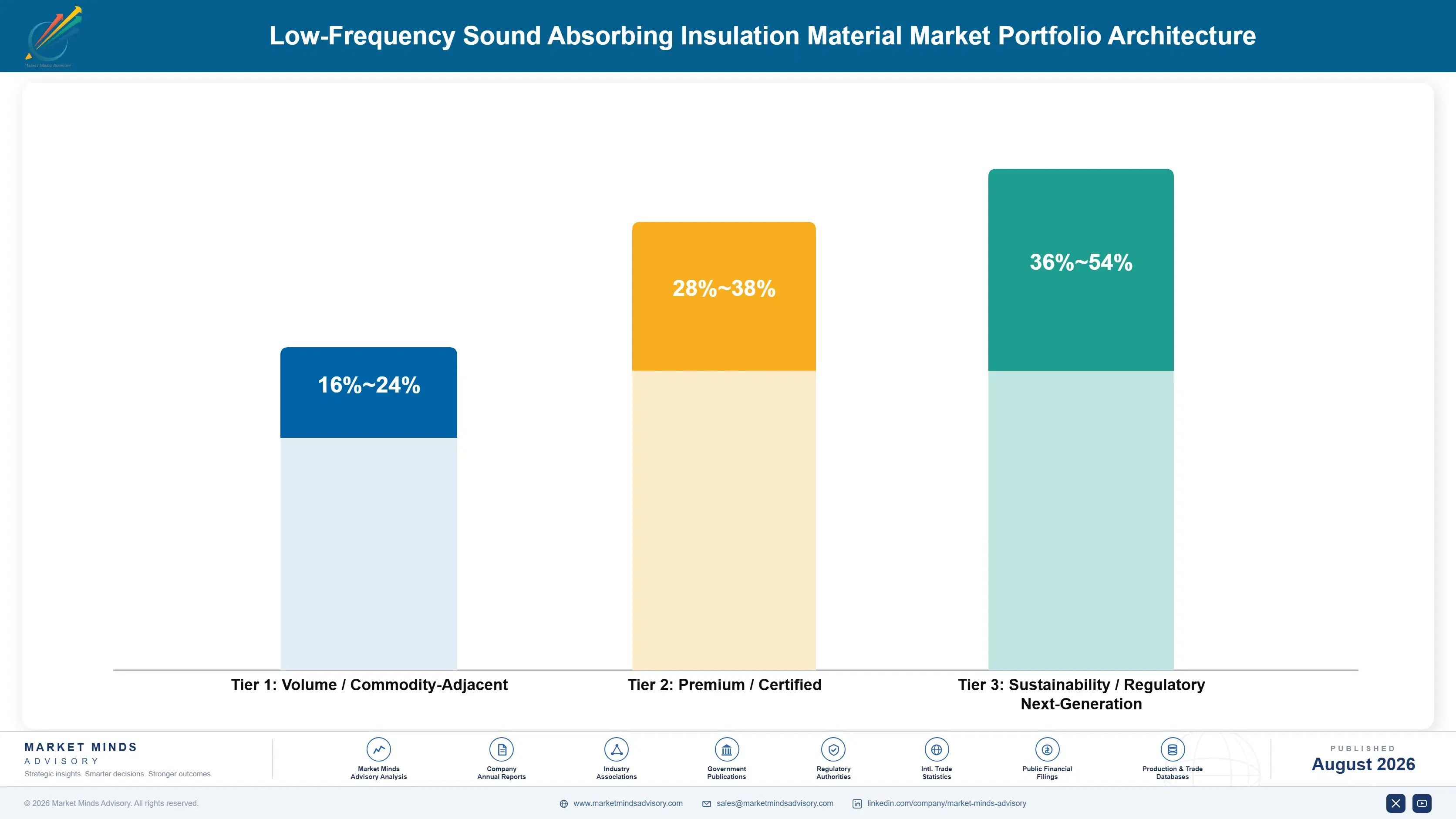
Margin here tracks whether a product solves a problem nothing else can rather than how well it performs generally. Conventional porous material for building applications runs at gross margins in the high teens against every insulation manufacturer inside the freight radius. Micro-perforated and membrane products run considerably better, since manufacturing precision narrows the field and the applications rule out mineral wool on hygiene or fire grounds. Metamaterial structures run higher again, because they address problems that have no alternative solution at all.
The tension is that conventional material fills the furnaces and the difficult products earn the returns, and the two need entirely different manufacturing assets. A mineral wool line and a precision moulding operation share no equipment, no process knowledge and no workforce skills. Manufacturers running both have generally found the volume business consuming the engineering attention that resonant product development required, which shows up as delayed launches on exactly the products carrying the margin.
High-value pools sit in metamaterial structures, consent-driven data centre applications and electric vehicle mass-free treatment. None of the three is where the tonnage is. Furnace capacity by itself defends nothing at the frequencies where demand is actually growing.
Volume / Commodity-Adjacent
Conventional porous fibrous absorbers and mass-loaded barriers for general building applications, competed on price by every insulation manufacturer inside the freight radius. The eight-point range separates producers with competitive energy costs from European furnaces carrying gas prices Asian competitors never see.
Gross Margin: 16%-24%
Premium / Certified
Micro-perforated panels, membrane and Helmholtz resonator systems where manufacturing precision and fire or hygiene performance narrow the supplier field considerably. The ten-point spread reflects tooling amortisation, since bespoke geometries cost far more per unit than shared families.
Gross Margin: 28%-38%
Sustainability / Regulatory / Next-Generation
Acoustic metamaterial structures and any product specified to satisfy a planning consent condition rather than a comfort preference. The eighteen-point range is wide because consent-driven purchases price against a refused application rather than against a competing material.
Gross Margin: 36%-54%

High-value Sub-segments and Strategic Watch-out
Metamaterial Structural Arrays
Compounding at 12.3% and defended by the only physics that delivers low-frequency absorption in 40 millimetres rather than 850. Cost restricts it to applications where space carries real value, and moulding routes now developing would change that arithmetic considerably. That crossing is closer than competitors assume.
Gross Margin: 38%-54%
Data Centre Consent Compliance
Boundary limits around 45 decibels have made acoustic treatment a condition of building rather than a fit-out choice, which changes both the budget available and who decides. Most manufacturers are still selling through the wrong channel entirely for this. Budgets at consent stage are several times larger.
Gross Margin: 34%-50%
Conventional Building Insulation
The tonnage that fills the furnaces, growing at 5.0% and competed by every insulation producer within freight distance. European energy costs make this permanently uncompetitive against Asian supply. Manage it for utilisation rather than for margin at all. Nobody wins this one on cost. Utilisation is the only lever.
Gross Margin: 16%-24%
Electric Vehicle Mass-Free Treatment
Removing the engine exposed low-frequency noise while lightweighting fights every kilogramme of acoustic mass added to fix it. Resonant products resolve that conflict, and suppliers presenting mass saving alongside attenuation reach two budgets at once. Most suppliers are still selling only one of those two benefits.
Gross Margin: 32%-46%
How Acoustic Demand Renews
Demand here renews on the project rather than on any repurchasing cycle. Material gets specified once, installed inside a wall, a vehicle floor or a plant enclosure, and never touched again for the life of the building or the platform. There is no replacement business worth the name, which makes specification the only commercial moment that matters and makes the relationship with acoustic consultants and designers considerably more valuable than any customer relationship.
Stickiness runs through the specification rather than the buyer. A consultant who has modelled a product's octave-band performance and seen it work will specify it repeatedly across unrelated projects and clients, which makes that consultant the real account. Vehicle programme positions are stickier still, since acoustic validation is expensive and nobody repeats it. Conventional building material changes supplier on delivered price at every tender without anybody noticing.
The decision-maker has moved and most manufacturers still call on the old one. Acoustic material was chosen by consultants and contractors optimising performance against cost inside an agreed budget. On the fastest-growing applications it is now chosen by developers and planning consultants trying to secure a consent, and that buyer is not comparing prices at all.

Where To Place The Bet
These are among the four positions where our research anticipates prominent divergence between winners and laggards over the coming forecast period. Each is grounded in the demand model, the regulatory perimeter, and the announced capacity pipeline.
Publish octave-band data and force the comparison
Absorption is quoted as a single averaged coefficient weighted heavily toward frequencies above 500 hertz, which makes genuinely capable low-frequency products look interchangeable with material doing almost nothing below 250 hertz. Manufacturers holding real capability are therefore competing against a measurement convention rather than against any actual competitor, and losing tenders to products that will not solve the customer's problem. Publishing octave-band performance costs only the testing and separates a capable supplier immediately, and the convention will change eventually as specifiers get burned repeatedly.
Sell to the developer, not the fit-out contractor
Data centre boundary limits around 45 decibels and residential heat pump requirements around 42 decibels are conditions of permission rather than preferences about comfort, which means the acoustic specification decides whether a project proceeds at all. A developer avoiding a refused application and a fit-out contractor optimising a budget value identical products in completely different ways. Manufacturers still routing the fastest-growing applications through fit-out channels are reaching the wrong decision-maker entirely, and the budget available at consent stage is several times what fit-out allows.
Deliver attenuation without adding any mass
Removing the internal combustion engine exposed road boom, tyre cavity resonance and motor tonal noise that broadband engine sound had always masked, and the obvious remedy of mass-loaded barriers costs range in a vehicle already carrying roughly 400 kilogrammes of battery. That puts the acoustic engineer and the lightweighting engineer in direct conflict inside every electric programme. Resonant and metamaterial products settle the argument by delivering attenuation without the weight, and suppliers presenting both benefits together reach two engineering budgets rather than fighting for one.
Move resonant production into volume moulding processes
Metamaterial structures deliver low-frequency absorption in around 40 millimetres where porous material needs 850, and they cost several times mineral wool per square metre, which confines them to applications where space carries genuine commercial value. The barrier is manufacturing rather than physics, since resonant geometries need dimensional precision across an array and current routes have never approached commodity scale. Injection moulding and thermoforming would cut unit cost enough to open volume building applications, and producers investing in tooling now hold the position when that crossing arrives.
Engagement Snapshot From the Field
A live engagement with an industry participant carrying material or product regulatory and market exposure ahead of a defining policy shift, showing how our research translates into a defensible multi-year portfolio strategy.
MARKET MINDS ADVISORY · CLIENT ENGAGEMENT SUMMARY
Low-Frequency Sound Absorbing Insulation Material Producer Strategic Portfolio Review and Transition Roadmap 2026·Investment Scenario on Low-Frequency Sound Absorbing Insulation Material Exposure Evaluation 2025-26
CLIENT PROFILE
A European acoustic insulation manufacturer with annual revenue around EUR 210 million (client-reported, unverified by MMA), producing mineral wool and foam absorbers across three plants for building and industrial applications. The business held a small micro-perforated panel line and no metamaterial capability. Distribution ran entirely through building materials merchants and fit-out contractors. No direct consultant relationships existed anywhere.
STRATEGIC CHALLENGE
Revenue had been flat for four years (client-reported, unverified by MMA) while the acoustic market grew, and management attributed the gap to price competition from Eastern European producers. Two large data centre projects in the client's home market had specified competitors' products. Nobody had established why, which meant the proposed response of cost reduction addressed the wrong question.
MMA APPROACH
MMA reconstructed both lost data centre specifications through the expert interview programme rather than accepting the price explanation, establishing what the specifier actually required. The client's product octave-band performance was tested independently against the frequencies driving those specifications. Channel access at planning consent stage was mapped against the client's existing merchant relationships, and metamaterial tooling economics were modelled against realistic application volumes.
KEY FINDINGS
- Neither data centre specification turned on price, and both required low-frequency performance in a depth the client's porous products could not physically deliver at all.
- Independent octave-band testing showed the client's headline absorption coefficient came almost entirely from performance above 500 hertz, which the sales material never disclosed.
- The client had no commercial relationship at planning consent stage, where the fastest-growing applications are specified, and its merchant channel reached that decision far too late.
- Its existing micro-perforated line was running well below capacity while serving applications where the client had never marketed its genuine low-frequency advantage.
CLIENT PROFILE
A European acoustic insulation manufacturer with annual revenue around EUR 210 million (client-reported, unverified by MMA), producing mineral wool and foam absorbers across three plants for building and industrial applications. The business held a small micro-perforated panel line and no metamaterial capability. Distribution ran entirely through building materials merchants and fit-out contractors. No direct consultant relationships existed anywhere.
STRATEGIC CHALLENGE
Revenue had been flat for four years (client-reported, unverified by MMA) while the acoustic market grew, and management attributed the gap to price competition from Eastern European producers. Two large data centre projects in the client's home market had specified competitors' products. Nobody had established why, which meant the proposed response of cost reduction addressed the wrong question.
MMA APPROACH
MMA reconstructed both lost data centre specifications through the expert interview programme rather than accepting the price explanation, establishing what the specifier actually required. The client's product octave-band performance was tested independently against the frequencies driving those specifications. Channel access at planning consent stage was mapped against the client's existing merchant relationships, and metamaterial tooling economics were modelled against realistic application volumes.
KEY FINDINGS
- Neither data centre specification turned on price, and both required low-frequency performance in a depth the client's porous products could not physically deliver at all.
- Independent octave-band testing showed the client's headline absorption coefficient came almost entirely from performance above 500 hertz, which the sales material never disclosed.
- The client had no commercial relationship at planning consent stage, where the fastest-growing applications are specified, and its merchant channel reached that decision far too late.
- Its existing micro-perforated line was running well below capacity while serving applications where the client had never marketed its genuine low-frequency advantage.
RECOMMENDED STRATEGY
Phase 1: Phase one: publish octave-band performance across the portfolio and stop quoting averaged coefficients, accepting that this will lose some conventional tenders. Phase 2: Phase two: build direct commercial presence with acoustic consultants and developers at planning consent stage rather than working through building merchants. Phase 3: Phase three: expand micro-perforated capacity and commit tooling for one shared-geometry metamaterial family covering three separate tuned low-frequency absorption bands.
OUTCOME
Octave-band disclosure published across the portfolio and used in two subsequent data centre bids, one of which was won. Direct consultant engagement operates from early 2026. Micro-perforated capacity is expanding, and the client reports specification enquiries rising sharply since disclosure (client-reported, unverified by MMA). Consultant relationships are being built directly.
Frequently Asked Questions
Foundational context covering the market sizes, CAGR, scope, country, region and competition that inform every finding below. This section is provided to cover basics and most often pre-purchase conversations, answered from the MMA Primary Research Dataset.
What is the current size of the Low-Frequency Sound Absorbing Insulation Material Market?
The market was valued at USD 5.8 billion in 2025, rising to an estimated USD 6.28 billion in 2026. East Asia holds the largest regional share at 30% of value.
How large will the Low-Frequency Sound Absorbing Insulation Material Market be by 2036?
MMA forecasts USD 13.80 billion by 2036 under the base case, an expansion multiple of 2.20 times the 2026 value. That represents USD 7.52 billion of incremental value.
What is the CAGR for the Low-Frequency Sound Absorbing Insulation Material Market 2026 to 2036?
The base case runs at 8.2% compound annual growth between 2026 and 2036, with a bull case at 9.5% and a bear case at 6.9%. Historical growth from 2020 to 2025 was 6.8%.
Which segment is growing fastest?
Acoustic metamaterial structures lead at 12.3%, half again the market rate, delivering in 40 millimetres what porous material needs 850 for. Micro-perforated panels follow at 11.0%.
Who are the major companies in the Low-Frequency Sound Absorbing Insulation Material Market?
Saint-Gobain, Rockwool, Knauf Insulation, Armacell and Autoneum hold 34% of supply between them. Specification presence rather than genuine low-frequency capability sustains most of those positions.
Which country is growing fastest?
India leads at 11.6%, driven by construction volume and a data centre buildout around Mumbai, Chennai and Hyderabad. International operators bring their own noise standards.
Report Segmentation Architecture
The full report scope spans multiple orthogonal segmentation dimensions, with cross-tabulated demand data provided for each dimension pair. Coverage extends further to regional breakdowns, trend trajectories, and the competitive detail needed to support segment-level decision-making.
By Absorption Mechanism
- Porous Fibrous Absorbers
- Membrane and Panel Absorbers
- Helmholtz and Cavity Resonator Systems
- Micro-Perforated Panel Absorbers
- Acoustic Metamaterial Structures
- Constrained-Layer Damping and Mass-Loaded Barriers
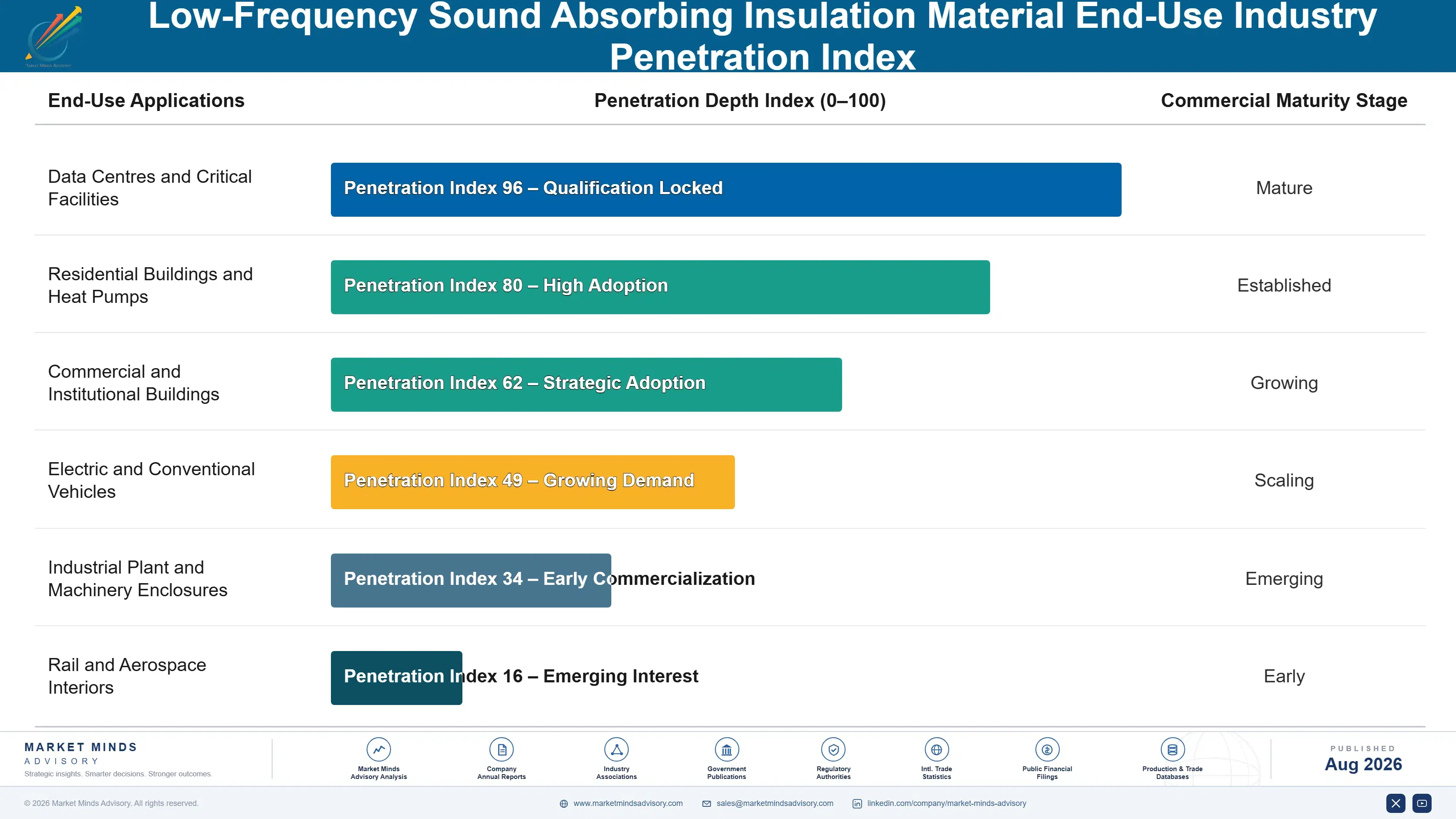
By End-Use Industry
- Data Centres and Critical Facilities
- Residential Buildings and Heat Pumps
- Commercial and Institutional Buildings
- Electric and Conventional Vehicles
- Industrial Plant and Machinery Enclosures
- Rail and Aerospace Interiors
By Supply Channel
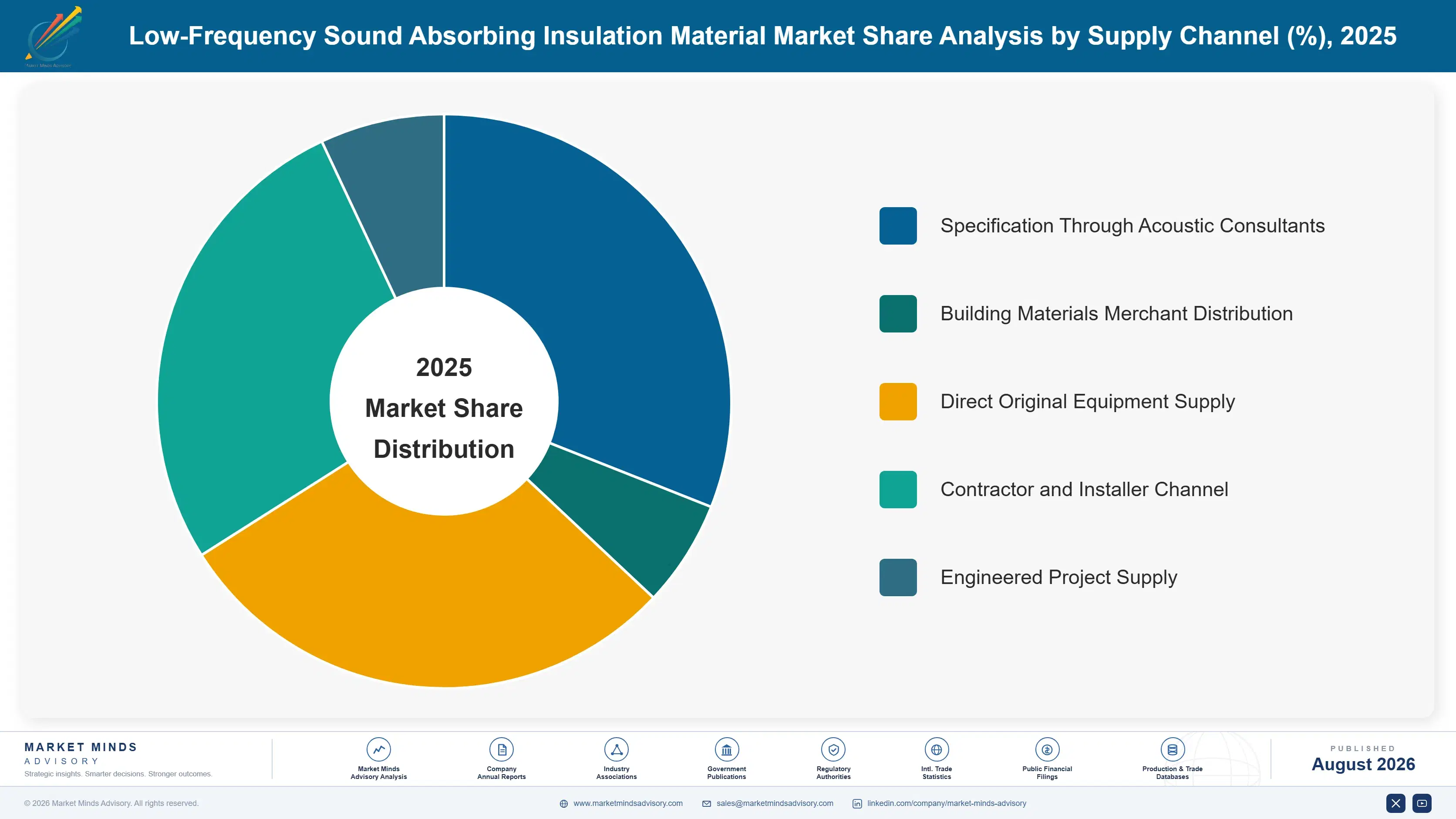
- Specification Through Acoustic Consultants
- Building Materials Merchant Distribution
- Direct Original Equipment Supply
- Contractor and Installer Channel
- Engineered Project Supply
By Region
- North America
- Western Europe
- East Asia
- South Asia and Pacific
- Latin America
- Middle East and Africa
- Eastern Europe
Scope, Methodology, and Coverage
Every figure in this report is reproducible from documented input assumptions. The scope below maps the historical period, the forecast horizon, the segmentation dimensions, and the countries covered, alongside the underlying primary and qualitative methodology.
Historical Period
2020 to 2025
Forecast Period
2026 to 2036
Base Year
2025 (USD billions; MMA Primary Research Dataset, August 2026)
Market Definition
The market comprises materials and engineered structures supplied specifically to absorb or attenuate sound below approximately 500 hertz across building, vehicle, industrial and data centre applications, covering porous fibrous absorbers, membrane and panel absorbers, Helmholtz and cavity resonator systems, micro-perforated panel absorbers, acoustic metamaterial structures, and constrained-layer damping and mass-loaded barriers. Value is measured at manufacturer level on material revenue. General thermal insulation without an acoustic specification, active noise cancellation electronics, vibration isolation mountings, decorative architectural finishes and acoustic consulting services fall outside scope.
Quantitative Units
USD billions (current prices); million square metres of material supplied annually; USD per square metre by absorption mechanism
Segmentation Dimensions
By Absorption Mechanism; By End-Use Industry; By Supply Channel; By Region
Regions Covered
North America, Western Europe, East Asia, South Asia and Pacific, Latin America, Middle East and Africa, Eastern Europe
Countries Covered
China, Japan, South Korea, Taiwan, India, Australia, Singapore, Thailand, Malaysia, United States, Canada, Mexico, Germany, France, United Kingdom, Netherlands, Ireland, Sweden, Denmark, Switzerland, Poland, Czechia, Romania, Hungary, Brazil, Chile, Colombia, United Arab Emirates, Saudi Arabia, Israel
Key Companies Profiled
Saint-Gobain, Rockwool International, Knauf Insulation, Armacell International, Autoneum Holding, Owens Corning, 3M, BASF, Covestro, Nitto Denko, Sumitomo Riko, Kingspan Group, Johns Manville, Trelleborg, Recticel, Pyrotek, Adler Pelzer Group, Toyota Boshoku, Zhongding Sealing Parts, Acoustiblok
Quantitative Methodology
Primary survey, n=3,800 respondents, Q4 2025, six countries; demand-side model with trade association cross-validation
Qualitative Methodology
47 expert interviews, Q4 2025; applied to validate demand model assumptions, identify emerging dynamics, and assess competitive positioning
Report Format
PDF and XLSX data workbook (Word format preview document)
Publisher
Market Minds Advisory
Report Code
MMA-2026-CON-289
Published
August 2026
Contact
sales@marketmindsadvisory.com | www.marketmindsadvisory.com
Purchase the full Low-Frequency Sound Absorbing Insulation Material Market Report (2026 to 2036).
The full report sizes the global low-frequency sound absorbing material market to 2036 across six absorption mechanisms and seven regions, measured on material revenue at manufacturer level. It treats the quarter-wavelength thickness constraint as the governing commercial fact and quantifies what each mechanism can physically deliver in the depths available. Competitive analysis covers 20 participants evaluated on material revenue, with moat and risk assessment for the two leaders. Consent-driven demand from data centre and heat pump regulation is sized separately from conventional building specification. Four quantified revenue levers close the analysis.
Six-mechanism segment sizing with segment-level growth rates
Seven-region share and growth breakdown to 2036
Twenty-participant competitive map on one revenue basis
Octave-band performance compared across every absorption mechanism
Consent-driven demand sized separately from conventional specification
Four quantified revenue levers with commercial impact ranges
Built For The People Who Decide
From boardroom strategy to bench-side execution, this report is read cover-to-cover by leaders shaping the next decade of their industry, turning demand scenarios, market dynamics and valuation benchmarks into decisions.
CXOs/ Presidents/ VPs/ Managers
M&A and Corporate Development
Strategy Teams and R&D Heads
Procurement and Product Directors
Regulatory and Compliance Leaders
Investor Relations and Equity Analysts