Market Minds Advisory
Low Dosage Hydrate Inhibitors Market

Low Dosage Hydrate Inhibitors Market: Subcooling limits, logistics economics and deepwater qualification

These chemicals replace methanol at roughly one percent of the dose rate, which removes storage tanks, supply vessels and topside weight from an offshore facility long before anybody counts the chemical cost itself.

Lead Analyst

Bilal Shaikh

Published

September 2026

Make Smarter Decisions with Customized Research Insights

Request a free sample report and evaluate market opportunities, growth trends, and competitive dynamics relevant to your business needs.

2025 MARKET VALUE$0.9BMarket Size 2025
2036 FORECAST VALUE$1.8BBase Case , 2026 to 2036
CAGR 2026 TO 20366.2 %Bull 7.5% / Bear 5.0%
INCREMENTAL OPPORTUNITY$0.8BNet 10- year value creation
EXPANSION MULTIPLE1.82x2036 value over 2026 base
Strategic Levers
M&A Pipeline
Regional Outlook
Country Rankings
Competitive Intelligence
Segmental Deep-dive
Call-Us : 91 93563 13602

Executive Snapshot and Market Trajectory

The commercial case here has almost nothing to do with chemistry cost. A kinetic inhibitor dosed at under one percent of a methanol rate removes storage tanks, supply boat trips and topside weight from an offshore facility altogether, and those savings dwarf the chemical spend every single year.
Growth here concentrates in high subcooling kinetic inhibitors, expanding at 9.3%, where extending protection beyond the twelve degree subcooling that conventional polymers manage opens deepwater tiebacks and cold restart scenarios that currently need methanol, or else nothing at all. East Asia holds 24% of value, the largest regional share, because Chinese and Southeast Asian offshore production has expanded steadily while regional deepwater development keeps commissioning entirely new subsea infrastructure across several countries.
The supplier base is very tightly concentrated, with the top five holding 62% of supply volume, and it divides between the major oilfield chemical houses and a small group of specialty polymer developers who hold the underlying chemistry. Competition here runs on qualified subcooling performance rather than on any dose rate comparison. Deepwater qualification is the barrier now separating genuinely defensible positions from opportunistic supply.
Market Definition
Low dosage hydrate inhibitors comprise flow assurance chemicals dosed at low concentration to prevent gas hydrate blockage, spanning kinetic hydrate inhibitor polymers, anti-agglomerant surfactants, high subcooling kinetic formulations, synergist and co-solvent blends, biodegradable and low toxicity grades, and combination flow assurance packages. Sizing covers chemicals sold to operators and service companies at realised delivered price. Thermodynamic inhibitors including methanol and monoethylene glycol, corrosion, scale and wax chemistry sold separately, chemical injection equipment and umbilicals, hydrate remediation services, and monoethylene glycol regeneration plant all fall outside scope.
Base Year Value
$0.9B in 2025 (MMA Primary Research Dataset, August 2026)
Forecast Period
2026 to 2036, eleven discrete annual values
CAGR
6.2% base case. Bull 7.5%. Bear 5.0%.
Fastest Growth Segment
High Subcooling Kinetic Inhibitors: 9.3% CAGR
Fastest Growth Country
India: 8.6% CAGR
Fastest Growth Region
South Asia and Pacific: 8.5% CAGR
Largest Region
East Asia: 24% of 2025 global value
Market Leaders
SLB, Halliburton, Baker Hughes, Clariant and Nouryon lead on low dosage hydrate inhibitor supply volume across kinetic and anti-agglomerant classes. Source: MMA Primary Research Dataset, July 2026.
Primary Survey
n=3,800 procurement and R&D decision-makers, Q4 2025, six countries
Methodology
Demand-side build-up, cross-validated against public data, 47 expert interviews

Low Dosage Hydrate Inhibitors Market Forecast Scenarios

low-dosage-hydrate-inhibitors-market-size-forecast-scenario-1787311138248
Growth of 5.0% across 2020 to 2025 tracked offshore capital discipline more than any change in flow assurance practice. Deepwater project sanctioning collapsed through 2020 and recovered from 2022 as oil prices strengthened, while operators running existing assets kept dosing regardless of the cycle because a blocked flowline stops production entirely. Several long tiebacks commissioned across the period converted to low dosage chemistry outright rather than expanding methanol storage.
The base case at 6.2% rests on three mechanisms. Subsea tieback distances keep extending as operators develop satellite fields through existing host facilities, and every additional kilometre makes methanol logistics worse while leaving low dosage economics unchanged. Deepwater and ultra-deepwater sanctioning continues across Brazil, West Africa and the Gulf of Mexico. And environmental discharge rules keep tightening in the North Sea and Norwegian sector, which favours biodegradable formulations over conventional chemistry.
The bull case at 7.5% turns on high subcooling formulations qualifying for the deep cold applications that currently default to methanol, since that would open a demand pool no existing product can address. The bear case at 5.0% turns on offshore capital. A sustained downturn in deepwater sanctioning would remove the new subsea developments driving most incremental demand here.

Hydrate inhibitors: logistics savings, not chemical cost

Nobody buys these products because the chemistry is cheap, because it is not. A kinetic inhibitor costs many times more per litre than methanol and is dosed at roughly half a percent of the volume, which is where the entire commercial argument sits. The saving arrives instead in storage tanks that were never built, supply vessel trips that were never made and around 180 tonnes of topside weight that is never carried at all.
TOP FIVE CONCENTRATION62%Share of global supply volume held collectively by leaders
DOSE RATE AGAINST METHANOL0.5% of volumeChemical volume required against a thermodynamic inhibitor rate
CONVENTIONAL SUBCOOLING LIMIT12 degreesProtection ceiling that standard kinetic polymers reliably achieve
OFFSHORE APPLICATION SHARE74% of volumeLargest single application by consumed inhibitor volume globally
TOPSIDE WEIGHT SAVED180 tonnesStorage and pumping mass removed from a typical facility
QUALIFICATION LEAD TIME18 monthsApproval cycle before any deepwater field application begins
That arithmetic gets better as tiebacks get longer. A satellite field twenty kilometres from a host platform needs methanol volumes that quickly become a serious offshore logistics problem, while the low dosage requirement barely changes at all. Operators developing satellite fields through existing facilities therefore reach for this chemistry almost by default now, and the trend keeps strengthening.
The binding constraint here is subcooling rather than anything commercial. Conventional kinetic polymers protect reliably to around twelve degrees below the hydrate formation temperature, and colder conditions still default to methanol, or to anti-agglomerants that carry their own awkward water cut limitations. That subcooling ceiling defines the addressable market here considerably more than delivered price ever has.
"Operators still evaluate these chemicals on cost per litre against methanol, which is the one comparison that makes them look expensive. Run the same analysis including deck space, marine logistics and the storage tank you did not build, and the answer reverses completely."
Director, Oilfield Chemicals and Flow Assurance Practice · MMA Chemicals and Mat

Market Trends

Extending tieback distances making methanol logistics progressively unworkable

Operators increasingly develop satellite fields through existing host facilities rather than building new platforms, and tieback distances have extended to twenty kilometres and beyond as a result. Methanol requirements scale with the water in the line and quickly demand storage, pumping and supply vessel capacity that a mature host facility does not have available. Low dosage requirements barely change with distance, which reverses the comparison entirely on longer tiebacks. That shift in field development practice is doing more for this market than any improvement in the chemistry itself has ever managed.
Market Impact: Drives 74% of global inhibitor volu

Environmental discharge rules favouring biodegradable inhibitor formulations

North Sea and Norwegian discharge regulation classifies production chemicals by biodegradation, bioaccumulation and toxicity, and operators face real permitting friction using substances that score poorly on any of the three. Conventional kinetic polymers based on vinyl caprolactam chemistry have historically classified awkwardly, which has pushed formulators toward biodegradable backbones even at some performance cost. That regulatory pressure has been spreading steadily beyond the North Sea into a number of other jurisdictions. Suppliers holding qualified biodegradable formulations reach fields that conventional chemistry simply cannot be permitted into at all, whatever it costs.
Market Impact: Avoids 180 tonnes of topside mass

Market Opportunities and Growth Drivers

Deepwater and subsea development commissioning new flow assurance requirements

Deepwater and ultra-deepwater project sanctioning has recovered across Brazil, West Africa, the Gulf of Mexico and increasingly the eastern Mediterranean, and every subsea development commissioned brings flowlines operating at seabed temperature where hydrate risk is permanent rather than occasional. Flow assurance chemistry is specified during front end engineering and then consumed for the field life, which makes each sanction a multi-decade demand commitment. Offshore applications already account for 74% of low dosage inhibitor volume worldwide. Sanctioning activity therefore translates into chemical demand with a lag of roughly three to four years.
Market Impact: Caps protection at 12 degrees subco

Topside weight and deck space constraints on mature host facilities

Host platforms taking satellite tiebacks are frequently mature assets with no spare deck space, limited crane capacity and weight budgets that were fixed at design. Adding methanol storage, pumping and injection to such a facility can require modification work costing more than the entire chemical programme, whereas low dosage injection needs a fraction of the footprint. Around 180 tonnes of topside mass is typically avoided on a facility making that choice. Operators facing brownfield constraints therefore adopt this chemistry for engineering reasons rather than for any chemical ones at all.
Market Impact: Runs 18 months per field qualificat

Market Restraints and Challenges

Subcooling ceiling excluding the coldest and deepest applications

Conventional kinetic hydrate inhibitors protect reliably to around twelve degrees of subcooling and become unreliable beyond it, which excludes deep cold flowlines, extended shut-in conditions and cold restart scenarios from the addressable market entirely. The root cause is mechanistic: these polymers delay nucleation rather than shifting the hydrate equilibrium, so protection is a function of time and driving force rather than an absolute barrier. Commercially this caps the market at applications within that window. Formulators are responding with higher subcooling polymer chemistries, synergist blends, anti-agglomerant combinations and hybrid strategies using reduced methanol.
Market Impact: Serves tiebacks beyond 20 kilometre

Deepwater qualification cycles slowing adoption at every new field

Operators qualify flow assurance chemistry through laboratory rocking cell testing, flow loop trials and often field trials before committing a subsea development, a process that typically runs eighteen months and sometimes considerably longer. The root cause is consequence severity rather than caution: a hydrate blockage in a subsea flowline can take weeks to clear and costs production throughout. Commercially this slows every new entrant and every new formulation regardless of laboratory performance. Suppliers are responding with earlier engagement during front end engineering, shared qualification data packages and joint industry testing programmes.
Market Impact: Governs discharge across 3 classifi
3 additional market trends, 2 additional growth drivers, and 4 additional restraints and challenges are covered in the full report. Contact sales@marketmindsadvisory.com to access the complete intelligence.

Segment CAGR and Growth Architecture

Segmentation follows the inhibition mechanism and performance class, because kinetic delay, anti-agglomeration and hybrid approaches address hydrate risk in fundamentally different ways and each one carries its own distinct subcooling limits, water cut constraints and qualification requirements. Six classes cover the whole market, from conventional kinetic polymers through anti-agglomerants to high subcooling and biodegradable formulations.
low-dosage-hydrate-inhibitors-market-market-share-analysis-1787311138820

High Subcooling Kinetic Inhibitors

Expanding at 9.3% annually, a full 1.50 times the market rate, on formulations extending reliable protection beyond the twelve degrees of subcooling that conventional kinetic polymers manage before they become genuinely unpredictable. That extension matters because it opens up deep cold flowlines, extended shut-in periods and cold restart scenarios that currently default to methanol, or to no chemical protection at all. Achieving it depends on polymer architecture and synergist selection rather than simply on dose rate, and the underlying development work is genuinely difficult to do. Qualification through rocking cell and flow loop testing runs around eighteen months at minimum, which is what keeps the qualified supplier field very narrow indeed.
CAGR 9.3%

Biodegradable and Low Toxicity Grades

Growing at 8.1% annually on formulations designed to satisfy the North Sea and Norwegian discharge classification requirements on biodegradation, bioaccumulation and toxicity together, where the conventional vinyl caprolactam chemistry has classified awkwardly for many years now. Operators in those jurisdictions face genuine permitting friction when using substances that score poorly, which converts environmental performance from a customer preference into an outright market access requirement. Achieving comparable subcooling performance with a biodegradable backbone is genuinely demanding technically and it usually costs some measurable performance along the way. Regulatory pressure keeps spreading steadily beyond the North Sea, which makes this particular capability considerably more valuable than its current volume share alone would ever suggest.
CAGR 8.1%
Full segment breakdown across 6 segments available in the complete report.

Regional Architecture and Country Demand Map

Low dosage inhibitor demand tends to follow new subsea flowline installation rather than tracking hydrocarbon production volume itself, and it concentrates wherever the long tiebacks, deep water and constrained host facilities all happen to coincide directly with a programme of genuinely active new field development.

East Asia

Twenty-four percent of global value here, comfortably the largest regional share of all, because Chinese offshore production across the South China Sea and Bohai Bay has expanded steadily, while Southeast Asian deepwater development keeps commissioning new subsea infrastructure across Malaysia, Indonesia and Vietnam. The Chinese national operators have adopted low dosage chemistry on the longer tiebacks where methanol logistics became genuinely impractical, and domestic formulators have themselves developed alongside that demand steadily. Qualification practice here follows international norms fairly closely, given the subsea equipment that is involved. Growth of 7.1% here runs comfortably above the global rate, supported by continued deepwater sanctioning and by tieback distances that keep extending steadily.
Share: 24% | CAGR: 7.1% (2026 to 2036)

North America

Twenty-two percent of global value here, weighted heavily toward the Gulf of Mexico deepwater sector where subsea tiebacks back to existing host facilities are now the dominant development model and topside constraints are genuinely binding on operators. Operators here qualify their chemistry rigorously and run some of the longest subsea tiebacks found anywhere in the world, which makes the region a genuine proving ground for the high subcooling formulations now emerging. Canadian east coast offshore operations add further demand at genuinely cold operating conditions year round. Growth of 5.6% here reflects that steady deepwater activity alongside brownfield tieback development that consistently keeps favouring low dosage chemistry over any methanol expansion.
Share: 22% | CAGR: 5.6% (2026 to 2036)
Regional intelligence for 5 additional markets available in the complete report: Western Europe, South Asia and Pacific, Latin America, Middle East and Africa, Eastern Europe. Contact sales@marketmindsadvisory.com.
low-dosage-hydrate-inhibitors-market-country-cagr-analysis-1787311139360

Where hydrate inhibitor margin genuinely sits

Four commercial positions separate the suppliers earning genuine flow assurance economics from those quoting litres against a methanol comparison that flatters nobody at all. Each one of them rests on something a competitor cannot assemble quickly: whole-system cost evidence, genuine subcooling performance, environmental classification, or else a qualified position secured during front end engineering design.

Sell the whole system cost, not the chemical price

Operators evaluating cost per litre against methanol reach the one conclusion that makes low dosage chemistry look expensive, and most suppliers simply let them go ahead and do it. Suppliers presenting whole-system economics, including storage tanks not built, supply vessel trips avoided and roughly 180 tonnes of topside mass removed, realise roughly 40% above competitors quoting chemical price. The analysis needs facility engineering data that the operator already holds on file. Very few suppliers employ anybody who can sit down with a topside weight budget and construct that case properly at all.
Market Impact: Realises roughly 40% above price-qu

Develop subcooling performance beyond the conventional ceiling

Conventional kinetic polymers become unreliable beyond roughly twelve degrees of subcooling, which excludes deep cold flowlines and cold restart scenarios from the addressable market entirely and sends all of that demand straight to methanol instead. Suppliers achieving qualified protection beyond that ceiling command roughly 2.5 times conventional inhibitor pricing, because the alternative is a thermodynamic system with all its logistics burden. The development involved is polymer architecture and synergist work rather than any simple reformulation. Nobody has solved it comprehensively yet, which is exactly why the position is worth pursuing seriously now.
Market Impact: Commands roughly 2.5 times conventi

Qualify biodegradable grades ahead of regulatory spread

North Sea and Norwegian discharge classification already decides which chemistries can be permitted at all, and that framework is spreading steadily into other jurisdictions as other regulators copy the framework that demonstrably works. Suppliers holding qualified biodegradable formulations hold roughly 3 times the addressable position of those relying on conventional chemistry once a jurisdiction adopts the classification. Achieving comparable subcooling with a biodegradable backbone costs real performance and takes genuine development time. Starting after a regulation lands means arriving eighteen months late into a market that somebody else has already qualified into.
Market Impact: Holds roughly 3 times the addressab

Engage during front end engineering rather than at tender

Flow assurance strategy is decided during front end engineering design, years before any chemical is purchased, and the decision between thermodynamic and low dosage approaches is effectively fixed as soon as the facility layout is set. Suppliers engaging at that early stage capture roughly 6 times the field life revenue of those bidding at the eventual supply tender. The engagement costs technical people attending design reviews rather than any capital investment at all. Most suppliers simply wait for a procurement enquiry on a decision that engineering settled three years earlier.
Market Impact: Captures roughly 6 times the field

Who Controls the Margin Pool

Concentration is high, with the top five holding 62% of global low dosage hydrate inhibitor supply volume, the basis on which every participant here is assessed. SLB, Halliburton and Baker Hughes lead through integrated production chemical positions and field service reach, while the challenger group divides between specialty chemical houses such as Clariant and Nouryon holding polymer chemistry, and a small number of independent formulators competing on specific performance claims.
Competition currently runs on qualified subcooling performance, environmental classification and front end engagement rather than on dose rate or price, which decide very little. Qualification positions secured at field sanction hold for the production life, which makes timing far more important than commercial terms. Biodegradable classification has become a genuine access requirement rather than a marketing point.

Emerging pressure comes from two directions at once. Specialty polymer developers holding genuine high subcooling chemistry can bypass the integrated service companies by qualifying directly with operators, since the decision sits with flow assurance engineering rather than procurement. And environmental classification is reordering positions built on conventional chemistry, because a formulation that cannot be permitted has no value however well it performs in a rocking cell.
low-dosage-hydrate-inhibitors-market-company-positioning-matrix-1787311139921

Competitive Moat and Risk Dimensions

SLB

Moat: Front end engineering access

Presence in subsea system design and flow assurance modelling gives SLB access to the front end engineering stage where the choice between thermodynamic and low dosage strategy is actually settled, years before any chemical tender exists. Competitors arriving at procurement are bidding into a decision that was effectively made without them, which is a position that no pricing can recover.
SLB

Risk: Limited proprietary polymer chemistry

Integrated service positions rest on access and delivery rather than on owning the underlying inhibitor chemistry, which leaves SLB exposed if a specialty developer achieves genuine high subcooling performance and qualifies directly with operators. Flow assurance engineers select on performance data rather than on service relationships when the subcooling requirement genuinely binds.
HALLIBURTON

Moat: Deepwater qualification track record

An accumulated record of qualified applications across deepwater fields gives Halliburton reference evidence that operators weigh heavily, because a hydrate blockage costs weeks of production and nobody experiments. That evidence base compounds with every successful field application and cannot be assembled quickly by a competitor whatever its laboratory performance data suggests.
HALLIBURTON

Risk: Environmental classification exposure

A portfolio weighted toward conventional kinetic chemistry faces discharge classification frameworks spreading beyond the North Sea into other jurisdictions, where a product that cannot be permitted has no commercial value at all. Reformulating onto biodegradable backbones costs subcooling performance and requires requalification through the same eighteen month cycle from the beginning.

Players Tracked

Prominent Players

SLB
Halliburton
Baker Hughes
Clariant
Nouryon

Other Key Players

Ashland
BASF
Championx
Innospec
Croda
Arkema
Dorf Ketal
Roemex
Impact Fluid Solutions
Multi-Chem
Italmatch Chemicals
Kemira
SNF Group
Deep Casing Tools
Flotek Industries

Recent Developments

JANUARY 2025

Operator selects low dosage chemistry over methanol storage expansion

A deepwater operator selected kinetic hydrate inhibition for a new satellite tieback rather than expanding the methanol storage on its mature host facility, citing the topside weight and deck space constraints that would have required steelwork modification costing considerably more than the entire chemical programme.
Signal: Brownfield topside constraints are now dec
MAY 2025

High subcooling formulation completes deepwater field qualification

A specialty chemical formulator completed full qualification of a kinetic inhibitor demonstrating reliable protection well beyond the conventional twelve degree subcooling ceiling itself, across rocking cell testing, extended flow loop trials and then a full field trial on an operating deepwater flowline system in service.
Signal: Subcooling performance beyond the conventi
SEPTEMBER 2025

Discharge classification excludes conventional inhibitor from field approval

An environmental regulator formally declined approval for a conventional kinetic hydrate inhibitor on both the biodegradation and bioaccumulation grounds together, thereby thereby requiring the operator to qualify a biodegradable alternative instead and thereby delaying the whole flow assurance programme by most of a development season.
Signal: Environmental classification is now decidi

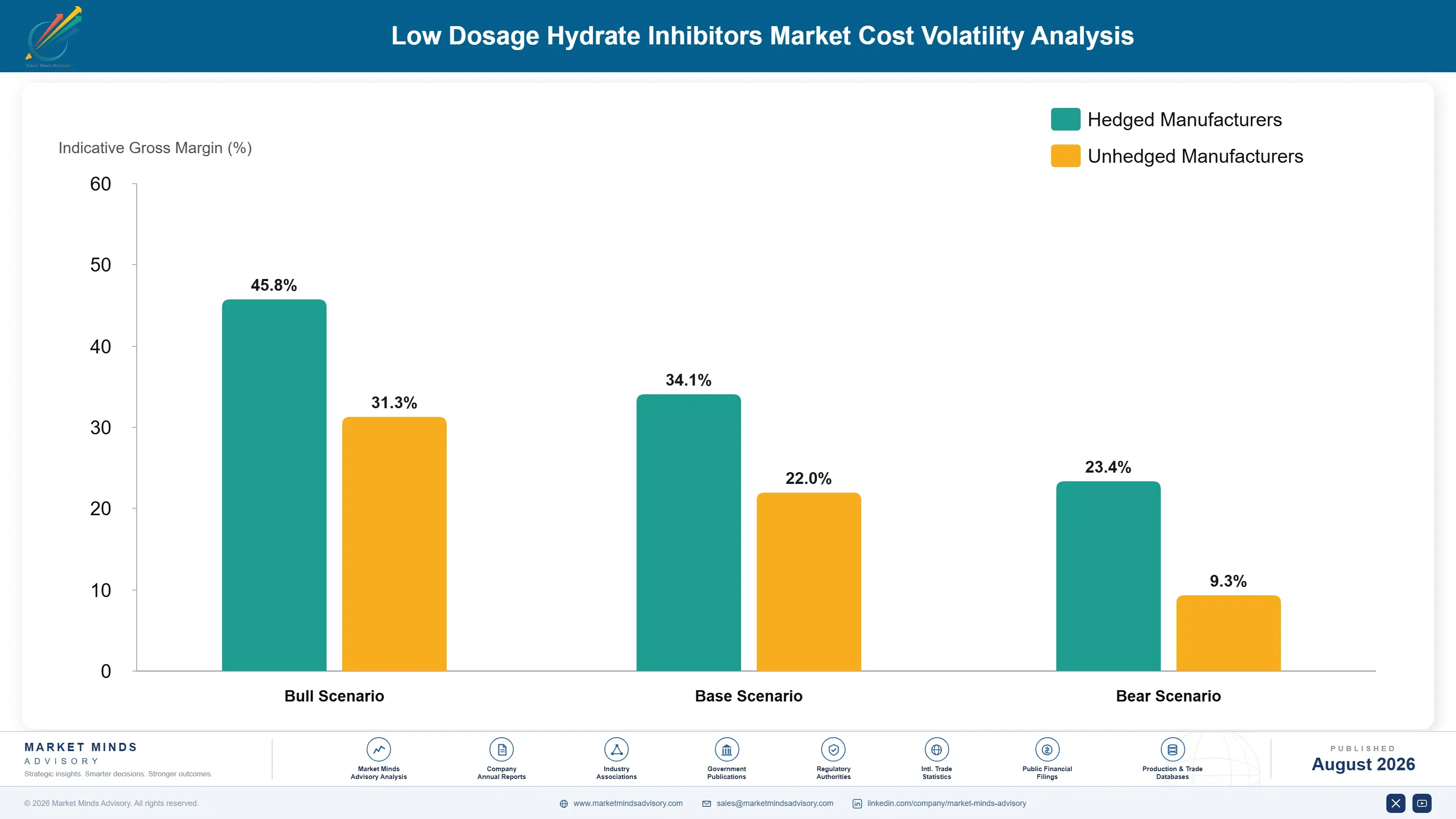
Monomer and solvent cost exposure

Speciality monomers, principally vinyl caprolactam and related lactam chemistry, account for roughly 39% of delivered inhibitor cost and come from a very narrow supplier base. Solvents and carrier fluids contribute about 18%, synergists and surfactants around 14%, polymerisation and blending energy 7%, qualification testing and technical support 9%, with offshore-rated packaging, freight and working capital carrying the remaining 13% of delivered cost.
Monomer availability rather than price has been the binding constraint. Vinyl caprolactam is produced by a small number of manufacturers and demand from hydrate inhibition competes with pharmaceutical and personal care applications for the same output, which tightened supply badly through 2021 and 2022. Clariant Annual Report 2023 recorded raw material availability and cost pressure across its oil services chemical operations, and Nouryon Annual Report 2023 noted specialty monomer cost movement across performance formulation lines.

The competitive disadvantage mechanism runs through monomer access and qualification capability rather than formulation cost. Formulators without secured monomer supply cannot commit to field programmes lasting decades, which operators notice. Those without rocking cell and flow loop testing capability cannot generate the evidence a qualification requires. Smaller formulators typically carry both limitations, which confines them to onshore and shallow water work.
low-dosage-hydrate-inhibitors-market-cost-volatility-analysis-1787311140242

Secure specialty monomer supply on multi-year field-life terms

A subsea field consumes inhibitor for decades and an operator will not qualify a supplier who cannot demonstrate supply security across that horizon, which makes monomer contracting a commercial requirement rather than a procurement detail. Multi-year arrangements with the narrow monomer supplier base cost nothing beyond negotiating discipline and open qualification conversations that would otherwise never begin at all.

Build rocking cell and flow loop testing capability in house

Qualification evidence comes from rocking cell and flow loop testing under representative conditions, and formulators relying on third party laboratories move slowly and reveal their development work to others. Building that capability costs a fraction of a field programme's value and it compresses qualification cycles that would otherwise run eighteen months or considerably longer.

Develop biodegradable backbones before regulation forces it

Discharge classification frameworks are spreading beyond the North Sea and a formulation that cannot be permitted has no value regardless of its subcooling performance. Beginning biodegradable development now costs development time, whereas starting after a jurisdiction adopts the framework means arriving eighteen months late into a market that competitors have already qualified into properly.

Portfolio Architecture for Margin Defence

Margin architecture separates by qualification barrier rather than by chemistry class, which is not at all how most oilfield chemical businesses present their own economics today. Conventional kinetic inhibitors supplied into shallow water and onshore applications earn only whatever service company procurement allows, because several formulations perform comparably there and the consequence of a poor choice is genuinely manageable.
Value climbs very steeply wherever the consequence of failure is severe and the qualified supplier field is narrow. Deepwater qualified conventional inhibitors defend real pricing through field application records that competitors cannot assemble quickly. High subcooling formulations sit far higher, since the alternative is a thermodynamic system carrying storage, pumping and marine logistics burdens that the facility may not be able to physically accommodate at all.

The highest value pools concentrate where high subcooling performance meets biodegradable classification, because deep cold fields in regulated jurisdictions need both at once and almost nothing available today delivers either comprehensively. Those pools are tiny in volume and quite disproportionate in realised margin. The commercial tension is that conventional volume funds the field service organisation which qualification itself genuinely requires.

Volume / Commodity-Adjacent Tier

Conventional kinetic inhibitors and standard anti-agglomerants supplied into onshore, shallow water and mild subcooling applications, where several formulations perform comparably and service company procurement decides most awards purely on price.
Gross Margin: 22-30%

Premium / Certified Tier

Deepwater qualified conventional inhibitors and combination flow assurance packages with field application records. Qualification evidence and service reach defend pricing here. The eleven-point range reflects standard supply against qualified deepwater positions.
Gross Margin: 34-45%

Sustainability / Regulatory / Next-Generation Tier

High subcooling formulations and biodegradable grades meeting discharge classification alongside performance requirements. Absent alternatives and permitting barriers defend pricing very strongly. The fifteen-point range reflects established biodegradable grades against emerging high subcooling economics.
Gross Margin: 48-63%
low-dosage-hydrate-inhibitors-market-portfolio-architecture-1787311140797

High-value Sub-segments and Strategic Watch-out

High subcooling formulations beyond conventional limits

High value and genuinely high growth together here, because the alternative is a thermodynamic system carrying storage and marine logistics burdens that a constrained host facility may not physically be able to accommodate at all. Qualification cycles also keep the qualified supplier field genuinely tiny.
Gross Margin: 48-63%

Biodegradable grades for regulated discharge jurisdictions

Strong realised value on genuinely steady underlying growth, because the discharge classification decides whether a chemistry can be permitted at all, and a product that cannot be permitted carries no commercial value whatsoever however well it performs. The regulation itself meanwhile keeps spreading steadily outward.
Gross Margin: 44-57%

Conventional inhibitors for mild subcooling duty

The volume core of this entire market here, funding the field service organisation that qualification genuinely requires, while earning whatever the service company procurement process happens to permit. Necessary for maintaining that whole capability, but this tier rarely contributes much realised margin of its own.
Gross Margin: 22-30%

Specialty monomer supply exposure across the portfolio

The strategic watch-out running right across the whole of this business, given that vinyl caprolactam comes from a very narrow supplier base and competes with pharmaceutical and personal care demand for exactly the same limited output. Supply security frequently decides whether qualification conversations even start.
Gross Margin: 18-48%

How hydrate inhibitor demand behaves

Demand is decided years before it appears and then persists for decades, an unusual combination that most suppliers handle badly. Flow assurance strategy is settled during front end engineering when facility layout is fixed, and the choice between thermodynamic and low dosage determines whether the chemical is bought at all. Once a subsea field is producing, the inhibitor is consumed continuously for field life.
Stickiness follows the qualification and the consequence of failure. Onshore and shallow water supply is loosest, substituted between contracts on price alone. Deepwater qualified positions sit far tighter, because a hydrate blockage takes weeks to clear and costs production throughout, which makes operators extremely reluctant to experiment at all. High subcooling and biodegradable positions are effectively locked, since no permitted alternative exists in those applications.

The buyer profile splits between operators and service companies in ways defeating any single commercial model. Operators decide flow assurance strategy through engineering during design, evaluate on qualification evidence and consequence risk, and then rarely revisit it. Service companies procure the chemical afterwards on commercial terms and treat it as a supply line, which is why a supplier engaging only at that stage competes on price for a decision already made.
low-dosage-hydrate-inhibitors-market-end-use-penetration-index-1787311141309

What we would actually do here

These are among the four positions where our research anticipates prominent divergence between winners and laggards over the coming forecast period. Each is grounded in the demand model, the regulatory perimeter, and the announced capacity pipeline.
01 / WHOLE SYSTEM COST SELLING

Show the tank you did not have to build

Operators evaluating cost per litre against methanol reach the one conclusion that makes low dosage chemistry look expensive, and most suppliers let them run exactly that comparison unchallenged. Suppliers presenting whole-system economics, including storage tanks avoided, supply vessel trips removed and roughly 180 tonnes of topside mass not carried, realise roughly 40% above competitors quoting chemical price. The analysis needs facility engineering data the operator already holds, and very few suppliers employ anybody at all who can actually build that case properly.
02 / SUBCOOLING PERFORMANCE DEVELOPMENT

Break the twelve degree ceiling and take methanol's work

Conventional kinetic hydrate polymers become unreliable beyond roughly twelve degrees of subcooling, which excludes deep cold flowlines and cold restart scenarios entirely and sends all of that demand straight to methanol instead. Suppliers achieving qualified protection beyond that ceiling command roughly 2.5 times conventional inhibitor pricing, because the only alternative carries the full thermodynamic logistics burden along with it. The work involved is polymer architecture and synergist selection rather than simple reformulation, and nobody has yet solved it comprehensively anywhere.
03 / ENVIRONMENTAL CLASSIFICATION QUALIFICATION

Qualify biodegradable before the regulation arrives

North Sea and Norwegian discharge classification already determines which chemistries can be permitted at all, and that framework keeps spreading steadily outward as other regulators copy what demonstrably works elsewhere. Suppliers holding qualified biodegradable formulations hold roughly 3 times the addressable field position of those still relying on conventional chemistry once a jurisdiction adopts it. Starting development after a regulation lands means arriving fully eighteen months late into a market that somebody else has already qualified into and comfortably secured.
04 / FRONT END ENGINEERING ENGAGEMENT

Be in the design review, not the tender

Flow assurance strategy is decided during front end engineering design, years before any chemical is purchased, and the choice between thermodynamic and low dosage approaches is effectively fixed once facility layout is set. Suppliers engaging at that stage capture roughly 6 times the field life revenue of those bidding at the eventual supply tender. The engagement costs technical people attending design reviews rather than capital, and most suppliers simply wait for a procurement enquiry that arrives three years too late.

Engagement Snapshot From the Field

A live engagement with an industry participant carrying material or product regulatory and market exposure ahead of a defining policy shift, showing how our research translates into a defensible multi-year portfolio strategy.
MARKET MINDS ADVISORY · CLIENT ENGAGEMENT SUMMARY
Low Dosage Hydrate Inhibitors Producer Strategic Portfolio Review and Transition Roadmap 2026·Investment Scenario on Low Dosage Hydrate Inhibitors Exposure Evaluation 2025-26
CLIENT PROFILE
An oilfield specialty chemical formulator producing kinetic hydrate inhibitors and anti-agglomerants at a single European site, supplying operators and service companies across the North Sea, West Africa and the Gulf of Mexico. Hydrate inhibitor revenue approached EUR 41 million annually (client-reported, unverified by MMA), roughly seventy percent of it conventional kinetic chemistry sold through service company procurement on annual terms.
STRATEGIC CHALLENGE
Growth had stalled for three years while the market expanded, and management attributed the gap to aggressive pricing by the integrated service companies. Two North Sea field opportunities had been lost without anybody establishing why. Specialty monomer supply rested entirely on a single source with no multi-year arrangement in place anywhere.
MMA APPROACH
We reconstructed six lost field opportunities through interviews with operator flow assurance and subsea engineering functions rather than the service company procurement contacts the client normally dealt with, tested achievable subcooling performance against deep cold requirements using actual rocking cell data, and quantified monomer supply concentration against field-life commitment requirements.
KEY FINDINGS
  1. Five of six lost opportunities had been decided during front end engineering years before tender, and the client had engaged at procurement stage in every single case.
  2. Both North Sea losses turned on discharge classification rather than performance, and no biodegradable formulation existed anywhere in the client's product portfolio.
  3. Single-source monomer supply had been raised as a concern by two operators during qualification discussions, and neither concern had been recorded internally as commercially significant.
  4. Achievable subcooling on existing chemistry sat close to the conventional ceiling, and no development programme targeting deeper protection had ever been formally scoped.
CLIENT PROFILE
An oilfield specialty chemical formulator producing kinetic hydrate inhibitors and anti-agglomerants at a single European site, supplying operators and service companies across the North Sea, West Africa and the Gulf of Mexico. Hydrate inhibitor revenue approached EUR 41 million annually (client-reported, unverified by MMA), roughly seventy percent of it conventional kinetic chemistry sold through service company procurement on annual terms.
STRATEGIC CHALLENGE
Growth had stalled for three years while the market expanded, and management attributed the gap to aggressive pricing by the integrated service companies. Two North Sea field opportunities had been lost without anybody establishing why. Specialty monomer supply rested entirely on a single source with no multi-year arrangement in place anywhere.
MMA APPROACH
We reconstructed six lost field opportunities through interviews with operator flow assurance and subsea engineering functions rather than the service company procurement contacts the client normally dealt with, tested achievable subcooling performance against deep cold requirements using actual rocking cell data, and quantified monomer supply concentration against field-life commitment requirements.
KEY FINDINGS
  1. Five of six lost opportunities had been decided during front end engineering years before tender, and the client had engaged at procurement stage in every single case.
  2. Both North Sea losses turned on discharge classification rather than performance, and no biodegradable formulation existed anywhere in the client's product portfolio.
  3. Single-source monomer supply had been raised as a concern by two operators during qualification discussions, and neither concern had been recorded internally as commercially significant.
  4. Achievable subcooling on existing chemistry sat close to the conventional ceiling, and no development programme targeting deeper protection had ever been formally scoped.
RECOMMENDED STRATEGY
Phase 1: Phase one: place technical people into operator front end engineering design reviews across the three most active development regions immediately. Phase 2: Phase two: secure multi-year specialty monomer supply arrangements and then develop a biodegradable formulation targeting North Sea discharge classification requirements. Phase 3: Phase three: scope and fund a high subcooling development programme with rocking cell capability built in house rather than contracted out.
OUTCOME
The client placed engineers into three operator design review processes and secured multi-year monomer supply. Two field qualifications were underway within eleven months, and realised margin on qualified deepwater volume improved by 24% (client-reported, unverified by MMA) against the prior year on comparable shipped volume.

Frequently Asked Questions

Foundational context covering the market sizes, CAGR, scope, country, region and competition that inform every finding below. This section is provided to cover basics and most often pre-purchase conversations, answered from the MMA Primary Research Dataset.

What is the current size of the Low Dosage Hydrate Inhibitors Market?

The market is valued at USD 0.9 billion in 2025, rising to USD 0.96 billion in 2026. Sizing covers chemicals sold to operators and service companies at realised delivered price.

How large will the Low Dosage Hydrate Inhibitors Market be by 2036?

The market reaches USD 1.75 billion by 2036, an increase of USD 0.79 billion across the forecast period. That represents an expansion multiple of 1.82 times the 2026 base.

What is the CAGR for the Low Dosage Hydrate Inhibitors Market 2026 to 2036?

The base case CAGR is 6.2% across 2026 to 2036. The bull case reaches 7.5% on high subcooling qualification, while the bear case sits at 5.0% under weaker deepwater sanctioning.

Which segment is growing fastest?

High subcooling kinetic inhibitors grow fastest at 9.3%, a full 1.50 times the market rate. They extend protection beyond the twelve degree ceiling that conventional polymers manage reliably.

Who are the major companies in the Low Dosage Hydrate Inhibitors Market?

SLB, Halliburton, Baker Hughes, Clariant and Nouryon lead on supply volume, holding 62% collectively. The remaining field spans specialty chemical houses and a few independent formulators.

Which country is growing fastest?

India grows fastest at 8.6%, driven by east coast and Krishna Godavari basin offshore development where methanol logistics out to remote offshore fields proved genuinely impractical.

Report Segmentation Architecture

The full report scope spans multiple orthogonal segmentation dimensions, with cross-tabulated demand data provided for each dimension pair. Coverage extends further to regional breakdowns, trend trajectories, and the competitive detail needed to support segment-level decision-making.

By Inhibition Mechanism and Performance Class

  • Kinetic Hydrate Inhibitor Polymers
  • Anti-Agglomerant Surfactants
  • High Subcooling Kinetic Inhibitors
  • Synergist and Co-Solvent Blends
  • Biodegradable and Low Toxicity Grades
  • Combination Flow Assurance Packages

By End-Use Industry

  • Deepwater Oil Production
  • Deepwater and Subsea Gas Production
  • Shallow Water Offshore Operations
  • Onshore Gas Gathering Systems
  • Gas Transmission Pipelines
  • Liquefied Natural Gas Feed Systems

By Customer Type and Channel

  • Integrated Oil and Gas Operators
  • National Oil Companies
  • Independent Exploration and Production Companies
  • Oilfield Service Company Procurement
  • Subsea Engineering Contractors
  • Chemical Distribution and Logistics

By Region

  • North America
  • Western Europe
  • East Asia
  • South Asia and Pacific
  • Latin America
  • Middle East and Africa
  • Eastern Europe

Scope, Methodology, and Coverage

Every figure in this report is reproducible from documented input assumptions. The scope below maps the historical period, the forecast horizon, the segmentation dimensions, and the countries covered, alongside the underlying primary and qualitative methodology.
Historical Period
2020 to 2025
Forecast Period
2026 to 2036
Base Year
2025 (USD billions; MMA Primary Research Dataset, August 2026)
Market Definition
The market comprises flow assurance chemicals dosed at low concentration to prevent gas hydrate blockage, spanning kinetic hydrate inhibitor polymers, anti-agglomerant surfactants, high subcooling kinetic formulations, synergist and co-solvent blends, biodegradable and low toxicity grades, and combination flow assurance packages. Sizing captures chemical revenue at realised delivered price across deepwater oil production, deepwater and subsea gas production, shallow water offshore operations, onshore gas gathering systems, gas transmission pipelines, and liquefied natural gas feed systems. Thermodynamic inhibitors including methanol and monoethylene glycol, corrosion, scale and wax chemistry sold separately, chemical injection equipment and umbilicals, hydrate remediation services, and monoethylene glycol regeneration plant all fall outside scope.
Quantitative Units
USD billions (current prices); inhibitor shipped annually in thousands of tonnes; USD per tonne at realised delivered price
Segmentation Dimensions
By Inhibition Mechanism and Performance Class; By End-Use Industry; By Customer Type and Channel; By Region
Regions Covered
North America, Western Europe, East Asia, South Asia and Pacific, Latin America, Middle East and Africa, Eastern Europe
Countries Covered
USA, Canada, Mexico, UK, Norway, Netherlands, Denmark, Germany, France, Italy, Poland, Romania, Turkey, China, Japan, South Korea, India, Malaysia, Indonesia, Vietnam, Thailand, Brunei, Australia, Brazil, Guyana, Suriname, Trinidad and Tobago, Argentina, Saudi Arabia, UAE, Qatar, Egypt, Israel, Angola, Nigeria, Ghana, Mozambique, and additional markets relevant to this sector
Key Companies Profiled
SLB, Halliburton, Baker Hughes, Clariant, Nouryon, Ashland, BASF, Championx, Innospec, Croda, Arkema, Dorf Ketal, Roemex, Impact Fluid Solutions, Multi-Chem, Italmatch Chemicals, Kemira, SNF Group, Deep Casing Tools, Flotek Industries.
Quantitative Methodology
Primary survey, n=3,800 respondents, Q4 2025, six countries; demand-side model with trade association cross-validation
Qualitative Methodology
47 expert interviews, Q4 2025; applied to validate demand model assumptions, identify emerging dynamics, and assess competitive positioning
Report Format
PDF and XLSX data workbook (Word format preview document)
Publisher
Market Minds Advisory
Report Code
MMA-2026-CHM-655
Published
August 2026
Contact
sales@marketmindsadvisory.com | www.marketmindsadvisory.com

Purchase the full Low Dosage Hydrate Inhibitors Market Report (2026 to 2036).

The full report sizes the low dosage hydrate inhibitors market across six mechanism and performance classes, six end-use applications, six customer channels and seven regions, with annual forecasts to 2036 in revenue and tonnage shipped. It builds whole-system cost comparisons against thermodynamic inhibition including storage, marine logistics and topside weight, which is the analysis that establishes what this chemistry is genuinely worth to an operator. Twenty participants are assessed on a consistent supply volume basis, with qualified subcooling performance and discharge classification mapped separately from portfolio breadth. Field qualification positions are identified development by development.
Six mechanism and performance classes sized and forecast annually
Whole-system cost built against thermodynamic inhibition including logistics
Twenty participants assessed on consistent supply volume basis
Subcooling performance and discharge classification mapped separately from breadth
Field qualification positions identified development by development throughout
Specialty monomer supply concentration quantified across the supplier base

Built For The People Who Decide

From boardroom strategy to bench-side execution, this report is read cover-to-cover by leaders shaping the next decade of their industry, turning demand scenarios, market dynamics and valuation benchmarks into decisions.
CXOs/ Presidents/ VPs/ Managers
M&A and Corporate Development
Strategy Teams and R&D Heads
Procurement and Product Directors
Regulatory and Compliance Leaders
Investor Relations and Equity Analysts