Market Minds Advisory
Low-Density Polyethylene Market

Low-Density Polyethylene Market: Feedstock Economics and Packaging Demand Through 2036

Low-density polyethylene splits along feedstock lines: ethane-advantaged American crackers undercut naphtha-based Asian and European producers, while flexible packaging volume keeps expanding even as extended producer responsibility rules push brand owners toward recycled content mandates.

Lead Analyst

Bilal Shaikh

Published

September 2026

Make Smarter Decisions with Customized Research Insights

Request a free sample report and evaluate market opportunities, growth trends, and competitive dynamics relevant to your business needs.

2025 MARKET VALUE$38.5BMarket Size 2025
2036 FORECAST VALUE$61.2BBase Case , 2026 to 2036
CAGR 2026 TO 20364.3 %Bull 5.5% / Bear 3.1%
INCREMENTAL OPPORTUNITY$21.0BNet 10- year value creation
EXPANSION MULTIPLE1.52x2036 value over 2026 base
Strategic Levers
M&A Pipeline
Regional Outlook
Country Rankings
Competitive Intelligence
Segmental Deep-dive
Call-Us : 91 93563 13602

Executive Snapshot and Market Trajectory

Feedstock cost, not demand, now decides who wins in low-density polyethylene. American ethane crackers hold a durable cost gap over naphtha-based rivals in Asia and Europe, and that gap is reshaping global trade flows faster than packaging volume growth or brand innovation ever could on their own.
Flexible packaging still absorbs most output, but agricultural film and specialty coatings are growing fastest as protected cultivation expands across Mediterranean, Chinese, and Southeast Asian growing regions. East Asia anchors global demand on sheer converter capacity concentrated in China, while the Middle East leans on subsidised gas pricing to chase export share into South Asian ports once reserved almost exclusively for American Gulf Coast exporters. Vietnam and India now add converting capacity of their own.
Twenty producers compete chiefly on cracker scale and feedstock integration rather than brand recognition, so the real contest sits upstream at the ethylene unit. Extended producer responsibility law in the European Union and a widening set of state-level rules across the United States are forcing recycled content commitments that squeeze virgin resin margins precisely where converters already have the least room left to absorb added cost across every producing region.
Market Definition
The market covers low-density polyethylene resin produced by high-pressure free-radical polymerisation of ethylene, sold as pellets or compounds into film, wire and cable, coating, injection moulding, and extrusion applications. Linear low-density polyethylene, high-density polyethylene, and downstream converted products such as finished bags are excluded.
Base Year Value
$38.5B in 2025 (MMA Primary Research Dataset, August 2026)
Forecast Period
2026 to 2036, eleven discrete annual values
CAGR
4.3% base case. Bull 5.5%. Bear 3.1%.
Fastest Growth Segment
Agricultural and Specialty Films: 6.9% CAGR
Fastest Growth Country
Vietnam: 7.4% CAGR
Fastest Growth Region
South Asia and Pacific: 6.2% CAGR
Largest Region
East Asia: 29% of 2025 global value
Market Leaders
ExxonMobil Chemical, LyondellBasell Industries, Dow Inc., SABIC, Sinopec. Source: MMA Analysis based on company annual reports.
Primary Survey
n=3,800 procurement and R&D decision-makers, Q4 2025, six countries
Methodology
Demand-side build-up, cross-validated against public data, 47 expert interviews

Low-Density Polyethylene Market Forecast Scenarios

low-density-polyethylene-market-trends-size-forecast-scenario-1787555069590
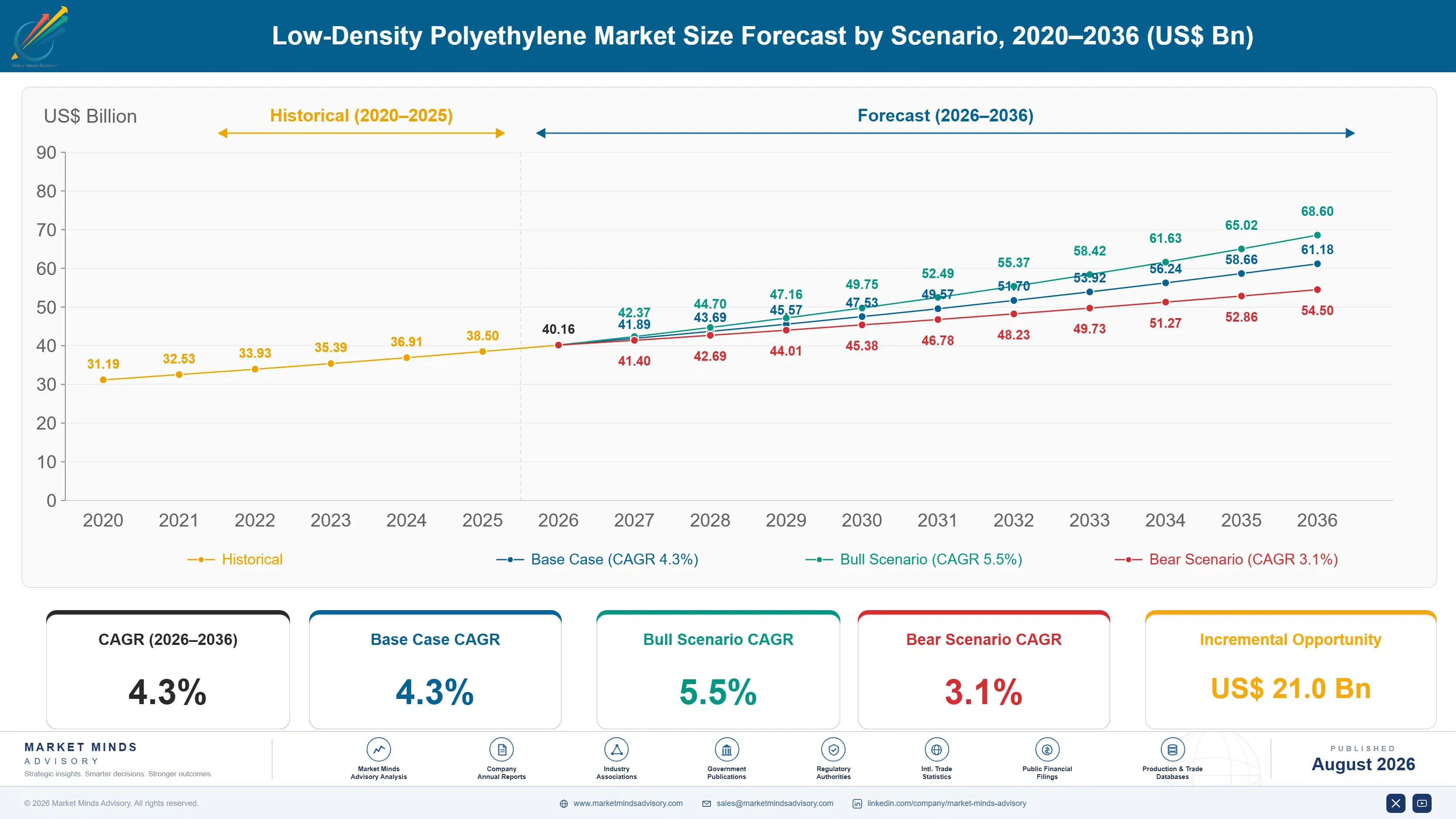
Between 2020 and 2025 the market grew near 3.5% a year, held back by pandemic-era converter destocking and a 2022 to 2023 European energy shock that shut several naphtha crackers for months at a stretch across the continent. Volume recovered unevenly across regions as American ethane capacity kept expanding steadily right through the very worst of that prolonged disruption.
The base case carries the market to 4.3% CAGR on three mechanisms: continued flexible packaging substitution for rigid formats in food and e-commerce, agricultural film expansion tied to protected cultivation acreage across three continents, and Middle Eastern capacity additions that redirect trade flows without adding much net new global demand. None of these depends on a single regulatory outcome, which is precisely what makes the base case durable across cycles.
The bull case at 5.5% assumes faster-than-expected phase-out of rigid packaging formats under European single-use rules, pulling volume toward flexible film well ahead of schedule across every major market. The bear case at 3.1% assumes recycled content mandates in the European Union and California tighten faster than virgin resin producers can build compliant capacity, eroding volume share to alternative materials over time.

Feedstock Arbitrage and the Packaging Demand Floor

Three forces converge on this market at once. Ethane-based American production keeps expanding on cheap shale gas, naphtha-based Asian and European crackers absorb crude oil price swings directly and immediately, and packaging converters keep substituting flexible film for rigid plastic and paperboard across food, agriculture, and e-commerce. Each force moves on its own separate schedule, which is why regional cycles rarely align across a single calendar year.
CAPACITY UTILISATION83%global nameplate rate across major producing regions today
AVERAGE SELLING PRICEUSD 1,180/tonnedelivered spot price across major global trade lanes
TOP PRODUCER SHARE17%China share of global nameplate production capacity base
FEEDSTOCK COST SHARE58% of COGSethylene input cost share across fully integrated producers
TRADE INTENSITY31%share of global output moving across a border
HHI CONCENTRATION412a moderately fragmented global producer landscape overall today
Commercially, the market behaves like a scale business wearing a specialty label. Grade differentiation genuinely exists, cling grades for stretch film, high-clarity grades for lamination, but margin still tracks cracker economics far more than product innovation ever does. A producer with an integrated ethylene cracker at a coastal export hub competes on cost structure long before it ever competes on formulation or brand.
Over the next decade, feedstock geography and recycled content law will decide winners more decisively than packaging volume growth alone ever will. Middle Eastern producers keep adding gas-advantaged capacity aimed squarely at Asian import demand, while European converters face the sharpest compliance cost of any region as extended producer responsibility rules continue to mature and tighten.
"Everyone talks about packaging demand, but the resin business is decided at the cracker gate. The producer with the cheapest ethylene wins the freight war before a single bag gets made."
Director, Petrochemicals and Polymers Practice · MMA Chemicals and Materials Practice · August 2026

Market Trends

Recycled Content Mandates Reshape Virgin Resin Demand

The European Union's Packaging and Packaging Waste Regulation sets a 30% recycled content floor for plastic packaging by 2030, and California's SB 54 carries a similar target on a shorter domestic timeline. Both rules apply directly to flexible film, the largest low-density polyethylene end use, forcing converters to qualify recycled feedstock streams that were never designed for food-contact applications. Producers without a recycling partnership now face a compliance gap. Compliance cost falls hardest on smaller converters lacking the scale to run parallel virgin and recycled lines, pushing consolidation toward integrated resin producers who can supply both grades under one contract.
Market Impact: Adds 2.1 million tonnes
Middle Eastern Gas Advantage Redirects Export Flows

Saudi Arabia and Qatar keep adding ethane-based polyethylene capacity priced against subsidised domestic gas well below international naphtha parity, and several new units reached full nameplate rate through 2025. That cost gap lets Gulf producers land resin into South and Southeast Asian ports below the delivered cost of Chinese naphtha-based output, reshaping trade patterns that held for a decade. Chinese producers are responding by pushing self-sufficiency policy harder, prioritising domestic ethane and coal-to-olefin routes over imported feedstock. The result is a widening two-speed cost structure between gas-advantaged and naphtha-based regions that no packaging cycle can fully offset.
Market Impact: Adds 1.4M tonnes by 2030

Market Opportunities and Growth Drivers

E-Commerce Packaging Volume Keeps Substituting for Rigid Formats

Parcel volume tied to online retail keeps growing across every major economy, and mailer bags, void-fill film, and protective wrap are almost entirely low-density polyethylene. The material's puncture resistance and print quality at thin gauge make it the default choice over paperboard mailers in cost-sensitive categories, and several large retailers have standardised packaging specifications around recyclable mono-material film rather than mixed-material alternatives. That standardisation favours resin producers who can supply consistent, certifiable recyclable grades at scale. Converters serving fulfilment centres report gauge-down programmes that reduce material use per parcel, which slows tonnage growth slightly even as unit volume keeps climbing.
Market Impact: Removes 1.6M tonnes of bag film

Protected Agriculture Expands Greenhouse and Mulch Film Demand

Mediterranean, Chinese, and Southeast Asian growers keep converting open-field acreage to greenhouse and tunnel cultivation to extend growing seasons and cut water use, and both structures rely on low-density polyethylene film for glazing and ground cover. Morocco's greenhouse acreage alone has expanded by several thousand hectares over the past five years under state-backed irrigation modernisation programmes. Multi-year UV-stabilised grades now command a premium over standard packaging film because replacement cycles run two to four years rather than months. That premium is drawing dedicated capacity from producers who previously treated agricultural film as a secondary outlet for packaging-grade resin.
Market Impact: Cuts non-integrated margin 300bps

Market Restraints and Challenges

Single-Use Plastic Bans Remove Volume in Key Categories

More than one hundred countries now restrict or ban lightweight plastic carrier bags, and the European Union's Single-Use Plastics Directive has pushed several member states toward outright bans on thin-gauge film beyond bags. The root cause is marine litter visibility, since thin film is the most commonly observed plastic waste in coastal cleanups, making it a political target regardless of its small share of total ocean plastic by weight. Converters have responded by shifting volume toward thicker bag formats and lobbying for extended producer responsibility schemes instead of bans, arguing funded collection addresses litter more directly than substitution to paper.
Market Impact: Adds 4.2 million tonnes recycled demand

Naphtha Price Volatility Compresses Non-Integrated Margins

Naphtha-based producers in Europe and East Asia lack the cost insulation that American ethane crackers enjoy, so every crude oil price swing passes through to resin margin within weeks. The 2022 European energy shock cut several crackers' operating rates below 70% for extended periods, and margin has never fully recovered at plants without long-term feedstock contracts. Non-integrated converters buying resin on spot terms carry the same exposure one step further down the chain. Producers are mitigating exposure through longer-dated feedstock hedges and, where regulation allows, blending increasing shares of recycled or bio-based feedstock priced independently of crude oil.
Market Impact: Gulf capacity adds 3.8M tonnes
3 additional market trends, 3 additional growth drivers, and 2 additional restraints and challenges are covered in the full report. Contact sales@marketmindsadvisory.com to access the complete intelligence.

Segment CAGR and Growth Architecture

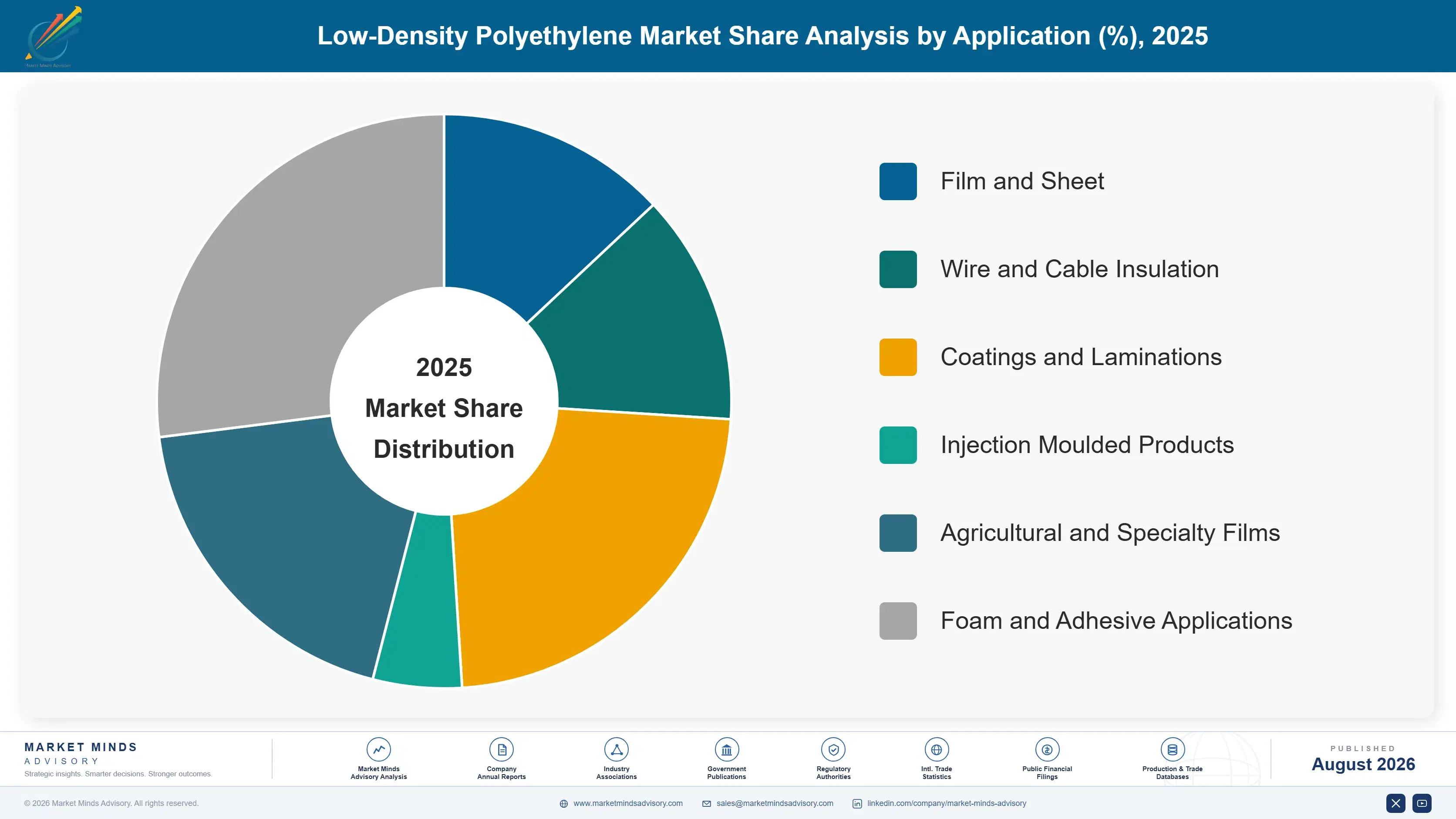
Segmentation follows end-use application, the single commercial logic that determines converter specification, gauge, and additive package for any given grade. Film and sheet dominates by volume, while wire and cable, coating, moulding, and specialty film applications each carry distinct grade requirements, buyer bases, and replacement cycles that shape margin quite differently across the whole portfolio.
low-density-polyethylene-market-trends-market-share-analysis-1787555070149

Agricultural and Specialty Films

Agricultural and specialty films grow fastest at 6.9%, about 1.60 times the overall 4.3% rate, as protected cultivation acreage expands across Mediterranean, Chinese, and Southeast Asian growing regions. Greenhouse glazing, mulch film, and silage wrap require multi-year UV stabilisation that standard packaging grades do not carry, and growers increasingly specify recyclable mono-material film to meet buyer sustainability requirements. Morocco, Spain, and Turkey anchor Mediterranean demand, while China's greenhouse vegetable sector remains the single largest consuming base worldwide by a wide margin. Producers serving this segment run dedicated compounding lines for UV and anti-fog additive packages, commanding premiums of 15% to 25% over standard packaging-grade resin because replacement cycles and field performance requirements differ so sharply from disposable film applications generally.
CAGR 6.9%

Foam and Adhesive Applications

Foam and adhesive applications grow second-fastest at 5.9%, driven by protective packaging foam for electronics and appliances alongside hot-melt adhesive formulations used in flexible packaging lamination. E-commerce fulfilment has expanded demand for foam cushioning that replaces expanded polystyrene under several state-level polystyrene restrictions in the United States, since low-density polyethylene foam recycles more easily within existing polyolefin streams than competing foam chemistries. Adhesive-grade resin, meanwhile, benefits directly from the same flexible packaging substitution trend driving film demand generally across every major end market. Both sub-segments remain small relative to film and sheet, but their growth rate draws increasing compounding investment from mid-sized specialty resin producers seeking margin above commodity packaging grades.
CAGR 5.9%
Full segment breakdown across 6 segments available in the complete report.

Regional Architecture and Country Demand Map

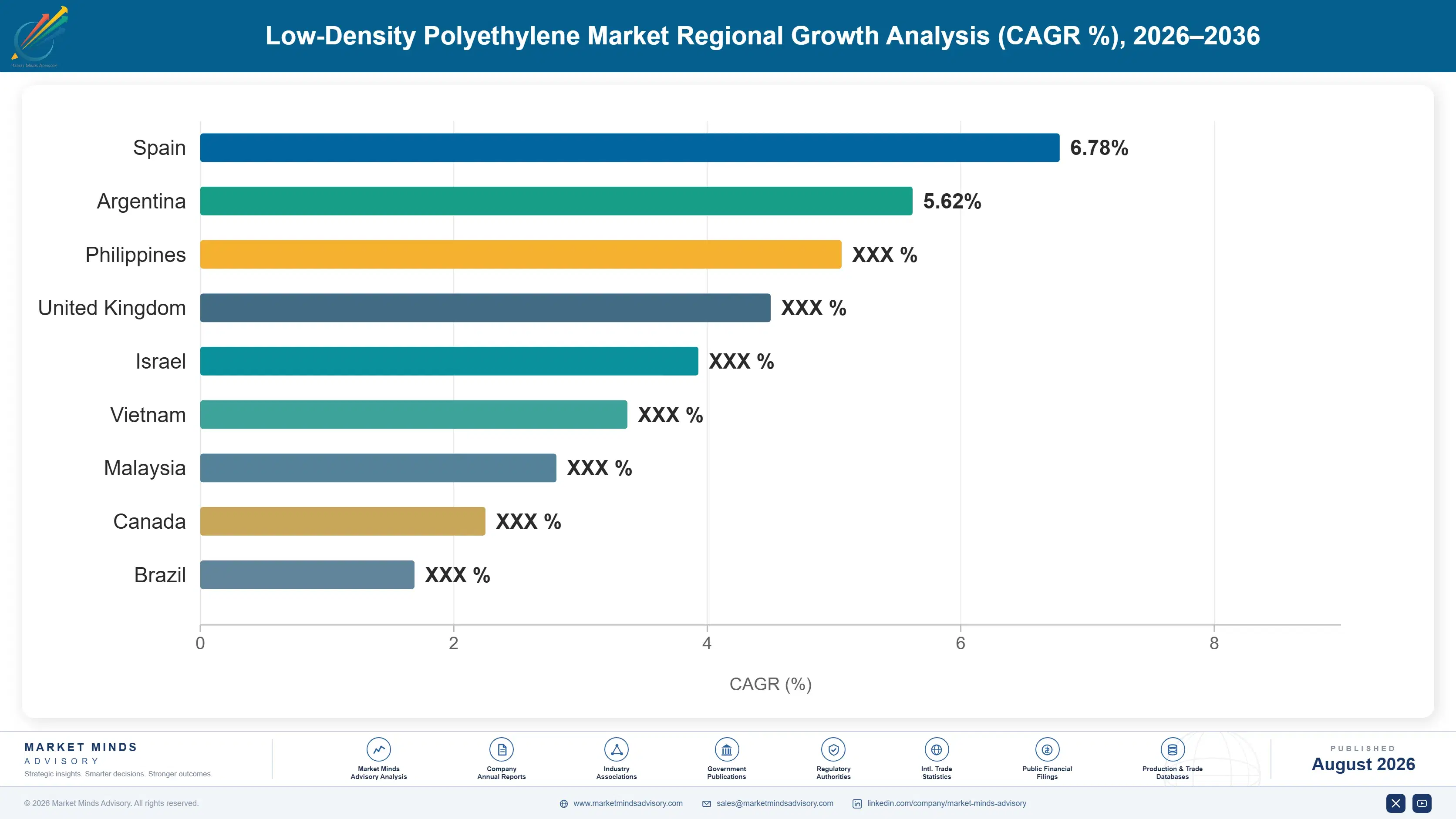
East Asia anchors global demand on sheer converter scale, North America holds a durable cost advantage on cheap ethane feedstock, and South Asia and Pacific posts the fastest regional growth on agricultural film and packaging conversion expanding fast from a much smaller starting base.

North America

Ethane feedstock economics, not packaging demand, explain North America's 24% share and its 5.0% growth rate. Gulf Coast crackers run on shale-sourced ethane priced well below naphtha, giving ExxonMobil's Baytown complex and Dow's Freeport operations a delivered cost advantage into both domestic and export markets. The United States has become a consistent net exporter of low-density polyethylene into Latin America and parts of Asia, a reversal from a decade ago when the region imported specialty grades outright. Growth here tracks new cracker startups more than end-use demand, since capacity additions at Gulf Coast sites through 2025 and 2026 continue lifting export volume ahead of domestic packaging consumption. Canada contributes a smaller integrated base tied to Alberta ethane.
Share: 24% | CAGR: 5.0% (2026 to 2036)

Western Europe

Regulation defines this region more than any commercial factor, and Western Europe's 20% share with 2.8% growth, the slowest of any region, reflects that directly. The Packaging and Packaging Waste Regulation's recycled content floor and a patchwork of national single-use restrictions have pushed converters toward volume caution even where demand exists. German, French, and Italian crackers run on naphtha feedstock with no lasting cost advantage, and several have cut operating rates below 75% since the 2022 energy shock rather than compete against Gulf and American imports on price. LyondellBasell and Borealis maintain integrated European capacity, but new investment increasingly targets recycling infrastructure rather than virgin resin lines. Growth here depends on compliance-driven recycled blending more than any packaging volume expansion.
Share: 20% | CAGR: 2.8% (2026 to 2036)
Regional intelligence for 5 additional markets available in the complete report: East Asia, South Asia and Pacific, Latin America, Middle East and Africa, Eastern Europe. Contact sales@marketmindsadvisory.com.
low-density-polyethylene-market-trends-country-cagr-analysis-1787555070679

Where Resin Producers Can Defend Margin

Cracker economics set the ceiling on margin in this market, but four commercial moves let producers capture more value above that ceiling regardless of which feedstock region they operate from, regardless of how packaging volume itself moves next, and regardless of where recycled content regulation ultimately lands across major consuming markets.

Qualify Recycled Content Streams Ahead of Mandates

Producers that build mechanical or chemical recycling partnerships now, ahead of the European Union's 2030 recycled content floor, capture converter contracts before compliance deadlines force a scramble across the industry. Certified recycled-content grades already command premiums of 8% to 14% over virgin resin in categories facing near-term mandates, and that premium should widen as compliant supply remains scarce relative to converter demand across every major market. Early movers also avoid the qualification lag converters face when switching feedstock sources under tight regulatory timelines, since food-contact approval alone can take twelve to eighteen months to complete.
Market Impact: Recycled grades add an 8% to 14% premium

Lock Long-Dated Ethane Contracts Over Spot Naphtha

Non-integrated producers exposed to spot naphtha pricing carry margin volatility that integrated ethane-based competitors simply do not face. Securing long-dated ethane supply contracts, even at a modest premium to current spot terms, removes the crude oil pass-through that cut several European crackers' operating rates below 70% during the 2022 energy shock. Producers that locked multi-year ethane terms before that shock preserved operating rates and margin that spot-exposed competitors simply could not match through the disruption. The approach requires capital commitment upfront but reduces earnings volatility across a full commodity price cycle.
Market Impact: Preserves 5 to 8 points of margin

Build Dedicated Agricultural Film Compounding Lines

Standard packaging-grade resin cannot meet the UV stabilisation and multi-year durability that greenhouse and mulch film buyers now specify, so producers serving this segment on dedicated compounding lines capture premiums of 15% to 25% that generic resin simply cannot access. Morocco, Turkey, and China's greenhouse sectors are expanding acreage steadily year after year, giving early entrants a growing buyer base with limited alternative suppliers to turn to. The capital requirement is modest relative to a new cracker, making this one of the more accessible margin levers available to mid-sized regional producers seeking differentiation.
Market Impact: Captures a 15% to 25% price premium

Offer Gauge-Down Engineering Services to Converters

Large retail and e-commerce customers increasingly specify reduced material use per package, and producers that offer technical support helping converters run thinner gauge without sacrificing puncture resistance win preferred-supplier status ahead of pure price competition on roughly 70% of large-account tenders. This service model deepens customer relationships and provides earlier visibility into specification changes than competitors relying on transactional sales alone ever achieve. It also positions the producer favourably when converters consolidate their supplier base, since a technical partnership built over several years is far harder to displace than any simple transactional price quote.
Market Impact: Lifts contract retention by 10 to 15 points

Who Controls the Margin Pool

Concentration sits at a moderate CR5 of 38%, reflecting a market where cracker scale matters enormously but no single producer approaches dominance. ExxonMobil Chemical and LyondellBasell lead on integrated capacity, and the gap to mid-tier challengers like Sinopec and Braskem is a matter of scale and feedstock access rather than any technology barrier a challenger cannot eventually close.
Competitive activity today runs along three lines: capacity expansion at ethane-advantaged Gulf Coast and Middle Eastern sites, recycled content partnership building ahead of European mandates, and long-term feedstock contracting that locks in cost position for a decade. Producers lacking integrated ethylene supply increasingly pursue joint ventures with cracker operators rather than building standalone units, given the capital intensity involved in any greenfield project.

Pressure is building from Middle Eastern and Chinese self-sufficiency policy simultaneously, both aimed at reducing dependence on the same import corridors American exporters have long relied on. Mid-tier Asian producers investing early in recycled content compliance stand to gain share from European incumbents that delay, while any producer still running non-integrated naphtha crackers without long-term feedstock contracts faces a widening cost disadvantage that pure operational efficiency cannot offset.
low-density-polyethylene-market-trends-company-positioning-matrix-1787555071203

Competitive Moat and Risk Dimensions

EXXONMOBIL CHEMICAL

Moat: Integrated Gulf Coast scale

ExxonMobil's Baytown and Mont Belvieu complexes combine ethane cracking with polyethylene production on one site, giving it a delivered cost position few naphtha-based competitors can match. Scale across multiple product lines also lets it absorb feedstock volatility better than smaller single-asset producers, reinforcing its position through commodity cycles that have forced competitors to idle capacity repeatedly.
EXXONMOBIL CHEMICAL

Risk: Export dependence on trade policy

A large share of Gulf Coast output moves into export markets across Asia and Latin America, exposing the company to tariff shifts and regional trade disputes that domestic-focused producers largely avoid. Any material disruption to seaborne trade routes or a countervailing duty action from a major import market would remove realised volume with limited near-term alternative outlets.
LYONDELLBASELL INDUSTRIES

Moat: Global grade and technology breadth

LyondellBasell operates across ethane and naphtha feedstock bases in multiple regions, giving it flexibility competitors tied to a single feedstock source lack. Its technology licensing business also generates revenue independent of resin sales cycles, and its early recycling infrastructure investment positions it ahead of several peers on European compliance timelines specifically.
LYONDELLBASELL INDUSTRIES

Risk: European naphtha cost exposure

A meaningful share of LyondellBasell's European capacity runs on naphtha feedstock with no lasting cost advantage, exposing margin directly to crude oil volatility the way the 2022 energy shock demonstrated clearly. Continued European regulatory tightening around recycled content and single-use restrictions also raises compliance cost specifically in the region where the company carries its least advantaged feedstock position overall.

Players Tracked

Prominent Players

ExxonMobil Chemical
LyondellBasell Industries
Dow Inc.
SABIC
Sinopec

Other Key Players

Braskem
Reliance Industries
LG Chem
Formosa Plastics Corporation
Borealis AG
INEOS Group
Chevron Phillips Chemical
Westlake Chemical Corporation
PTT Global Chemical
Hanwha TotalEnergies Petrochemical
Sasol
Qatar Chemical Company
NOVA Chemicals
Indorama Ventures
TotalEnergies Petrochemicals

Recent Developments

MARCH 2025

ExxonMobil completes Baytown polyethylene debottleneck

ExxonMobil Chemical completed a debottlenecking project at its Baytown, Texas polyethylene complex, adding incremental volume without a new unit. The project was an organic capacity expansion funded from cash flow, not an acquisition or joint venture, and targeted export-grade film resin for Asian and Latin American customers.
Signal: Organic Gulf Coast capacity growth keeps outpacing every new-build announcement from naphtha-based global competitors elsewhere.
NOVEMBER 2024

LyondellBasell signs multi-year ethylene supply agreement

LyondellBasell signed a multi-year ethylene supply agreement with an independent European cracker operator to secure feedstock volume for its Rotterdam polyethylene lines. The arrangement was a commercial supply contract, not an equity transaction or joint venture, and locks pricing terms structured to reduce exposure to naphtha spot volatility.
Signal: Feedstock security is fast becoming a negotiated contract term rather than an assumed integration benefit today.
JUNE 2025

SABIC and a regional partner form Gulf polyethylene joint venture

SABIC formed a genuine joint venture with a regional petrochemical partner to build a new ethane-based polyethylene unit in Saudi Arabia, with both parties holding equity stakes and sharing operating control. The unit targets export volume into South and Southeast Asian markets currently served partly by Chinese and Korean producers.
Signal: Gulf capacity keeps expanding specifically toward Asian import corridors rather than toward domestic Saudi consumption growth.

Ethylene Feedstock and the Cracker Cost Gap

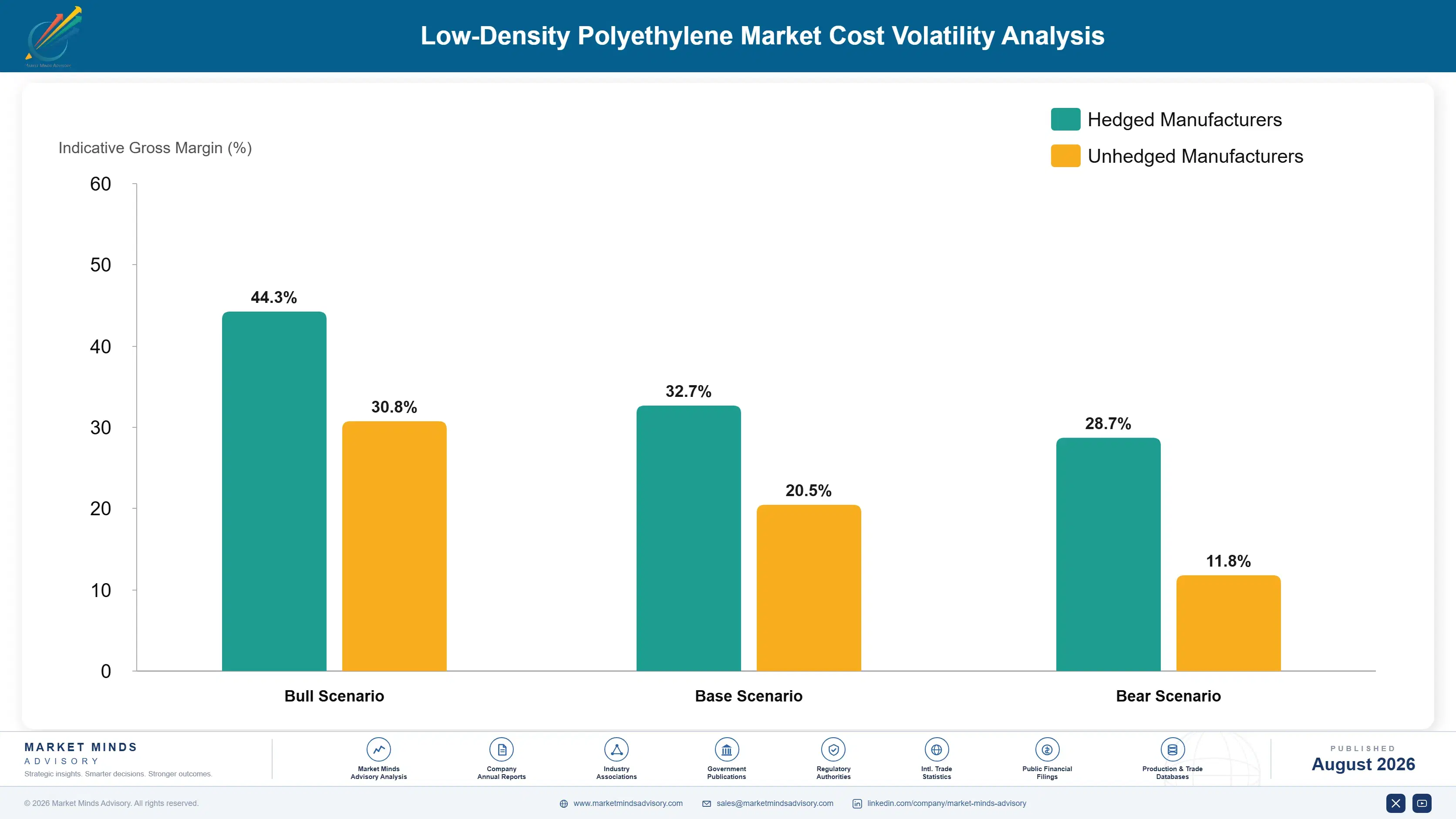
Ethylene feedstock runs 58% of cost of goods sold across integrated producers, sourced either from ethane cracking in North America and the Middle East or naphtha cracking in Asia and Europe. Energy and utilities add a further 12% to 16% depending on region, with catalysts, additives, and packaging materials making up the remainder of total input cost.
The 2022 European energy shock showed how directly that exposure translates into margin. Brent crude and European gas prices spiked together as Russian supply was curtailed, and IEA data recorded naphtha cracker margins across the region falling to multi-year lows through the second half of that year. Several European producers cut operating rates below 70% rather than run crackers at negative variable margin for months on end.

Exposure separates producers cleanly by feedstock base. Ethane-advantaged American and Gulf producers absorbed almost none of that shock, since domestic gas pricing remained largely insulated from the European crisis, while naphtha-based Asian and European competitors carried the full pass-through directly. That gap has hardened into a durable competitive disadvantage for any producer without ethane access or long-dated feedstock contracts in place.
low-density-polyethylene-market-trends-cost-volatility-analysis-1787555071402

Secure long-dated ethane or ethylene supply contracts

Locking multi-year feedstock pricing removes the spot crude oil pass-through that cut European operating rates sharply during the 2022 shock. The approach requires upfront capital commitment but has preserved margin for producers who signed contracts before the disruption hit, compared with competitors left fully exposed to spot pricing terms throughout the entire crisis period and its aftermath.

Diversify feedstock between ethane and naphtha cracking

Producers operating both ethane and naphtha crackers across different regions can shift production allocation toward whichever feedstock is cheaper at a given moment, capturing arbitrage that single-feedstock competitors simply cannot access at all. This flexibility partly explains why diversified global producers weathered the 2022 shock noticeably better than regionally concentrated peers did at the time.

Expand recycled feedstock blending where regulation allows

Mechanical and chemical recycling streams are priced independently of crude oil, giving producers that qualify recycled feedstock a partial hedge against naphtha volatility swings that pure virgin producers cannot replicate. Regulatory recycled content mandates are accelerating this shift regardless of cost motivation alone, making early investment a dual-purpose hedge and compliance tool at the same time.

Portfolio Architecture for Margin Defence

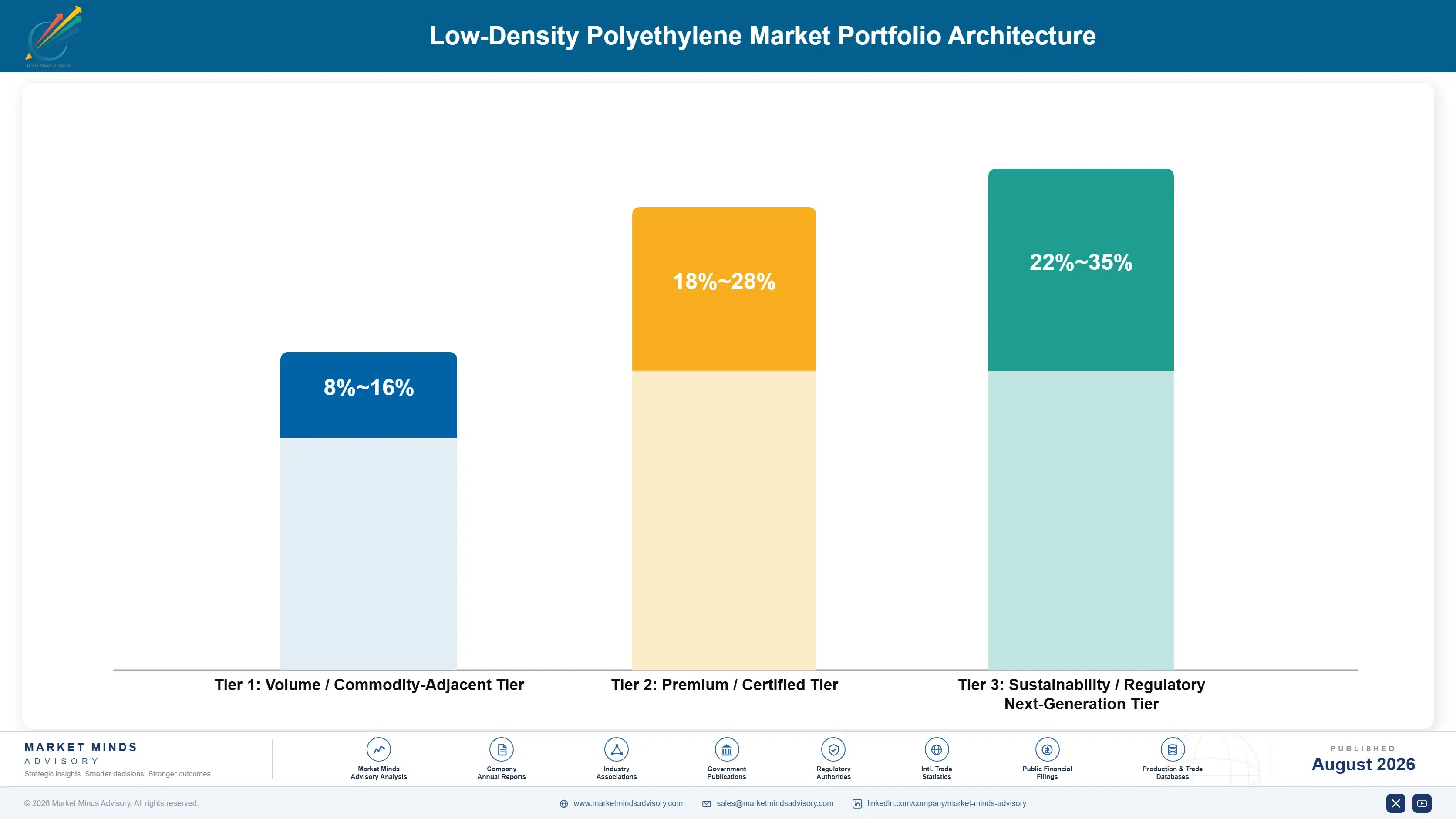
The portfolio splits into three tiers with clear margin separation tied directly to feedstock position and grade differentiation rather than brand strength alone. Volume packaging film competes almost entirely on delivered cost against regional benchmark pricing, while certified recyclable grades and agricultural film earn meaningfully more on specification depth and replacement-cycle economics that ordinary commodity film simply cannot access at any price point whatsoever.
The tension between volume and premium runs deep and shows little sign of easing any time soon. Packaging film volume dwarfs every specialty application and will keep doing so for years to come, yet margin increasingly concentrates in agricultural film, certified recyclable grades, and technical compounds that require dedicated compounding lines most volume-focused producers have never built and are unlikely to build in the near term.

High-value pools concentrate specifically where regulation or agronomic specification limits substitutable supply: certified recycled content grades racing ahead of firm European mandates, and multi-year UV-stabilised agricultural film serving steadily expanding greenhouse acreage across three continents. Both segments reward producers who invested ahead of demand rather than scrambling to respond once deadlines or shortages finally arrived in force.

Volume / Commodity-Adjacent Tier

Standard packaging film and general-purpose injection moulding grades sold largely on delivered cost against regional benchmark pricing, with thin margin and intense producer rivalry across every major trade lane worldwide.
Gross Margin: 8-16%

Premium / Certified Tier

Certified recyclable and food-contact grades meeting brand-owner sustainability specifications ahead of regulatory deadlines, commanding real premiums over standard commodity resin as compliant supply stays genuinely scarce across most major consuming markets today.
Gross Margin: 18-28%

Sustainability / Regulatory / Next-Generation Tier

Chemically recycled and bio-based feedstock grades qualifying for mandate compliance and premium brand-owner contracts across food and specialty packaging categories where virgin resin alone cannot satisfy buyer sustainability requirements or contractual specifications.
Gross Margin: 22-35%
low-density-polyethylene-market-trends-portfolio-architecture-1787555071903

High-value Sub-segments and Strategic Watch-out

Agricultural and Specialty Films

High value and the fastest-growing segment at 6.9% CAGR, carrying UV stabilisation and multi-year durability that standard packaging grades cannot replicate at any price point. Premiums of 15% to 25% reflect genuine agronomic specification rather than brand positioning, and expanding greenhouse acreage across three continents underpins continued demand growth.
Gross Margin: 20-30%

Certified Recyclable Packaging Film

High value with moderate but accelerating growth as European and Californian recycled content mandates approach binding deadlines across major markets. Compliant supply remains scarce relative to converter demand, sustaining premiums that should compress gradually once qualified capacity finally catches up to regulatory requirements across the industry.
Gross Margin: 18-28%

Standard Flexible Packaging Film

The volume core of the market, competing on delivered cost against regional benchmark pricing with thin margins and intense producer competition across every major trade lane. Growth tracks packaging consumption directly and offers limited differentiation beyond gauge control, delivery reliability, and service depth to key accounts.
Gross Margin: 8-16%

Non-Integrated Naphtha Converters

The strategic watch-out. Producers without ethane access or long-dated feedstock contracts carry a lasting cost disadvantage that the 2022 energy shock exposed sharply across Europe, and continued naphtha volatility threatens their long-term viability against gas-advantaged competitors that keep expanding capacity fast and adding fresh export volume every year.
Gross Margin: 5-14%

Contract Cycles and Converter Loyalty

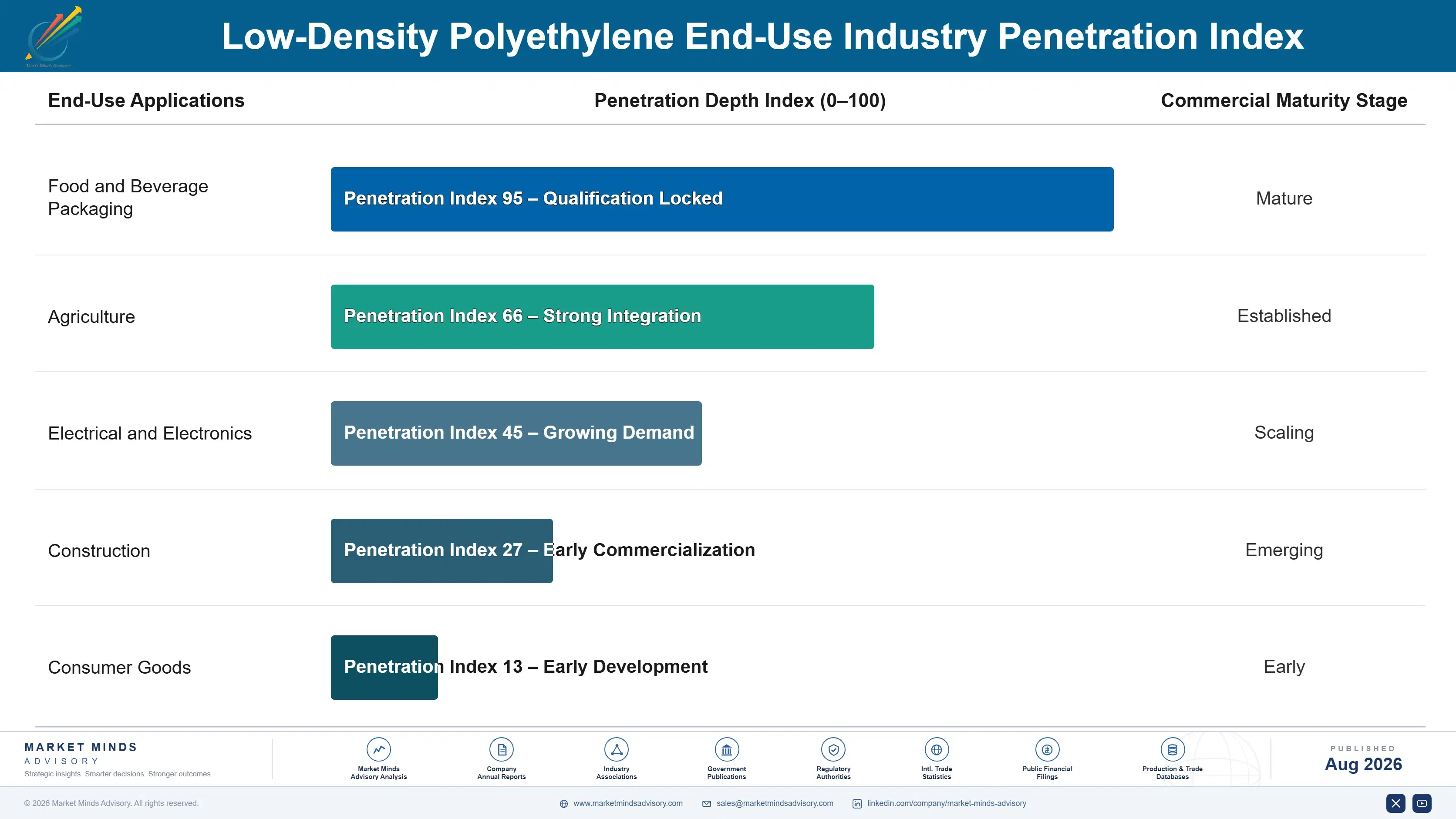
Demand here runs on annual and multi-year supply contracts rather than spot transactions for the majority of volume, since large packaging converters need feedstock security to plan production runs against retail and agricultural customer commitments made months in advance. Contract renewal typically comes up annually, giving incumbent producers a predictable but never fully guaranteed revenue base each cycle.
Adoption depth varies sharply by end-use vertical. Food and beverage packaging converters demand the tightest specification consistency and switch suppliers rarely given steep food-contact approval costs, while agricultural film buyers show stronger loyalty once a UV-stabilised grade proves field performance across a full growing season. Wire and cable insulation customers, by contrast, qualify multiple suppliers simultaneously to protect against single-source risk in long infrastructure projects.

Buyer profiles have shifted generationally as sustainability procurement moved from a compliance checkbox to a genuine board-level priority across most large accounts. Younger packaging engineers now weigh recycled content and end-of-life recyclability alongside cost and performance, a shift that clearly favours producers with credible recycling partnerships over those still competing purely on headline price.
low-density-polyethylene-market-trends-end-use-penetration-index-1787555072392

Where Feedstock Position Decides Outcomes

These are among the four positions where our research anticipates prominent divergence between winners and laggards over the coming forecast period. Each is grounded in the demand model, the regulatory perimeter, and the announced capacity pipeline.
01 / FEEDSTOCK INTEGRATION PRIORITY

Ethane access will separate winners from laggards over the next decade

Producers without ethane cracking access or long-dated feedstock contracts carry a lasting cost disadvantage that the 2022 European energy shock made visible to every buyer in the value chain, and that gap will not close through operational efficiency alone. It stems from geology and feedstock pricing rather than management execution, which means it persists regardless of how well a naphtha-based producer runs its plant. Expect continued consolidation toward integrated players and new joint ventures anchored specifically at gas-advantaged production sites.
02 / RECYCLED CONTENT COMPLIANCE

Early recycling investment will outcompete late compliance scrambles

European and Californian recycled content mandates carry binding deadlines that leave little room for producers who delay qualification until deadlines approach. Compliant capacity remains scarce today, sustaining meaningful premiums for early movers who invested ahead of the requirement, but that scarcity will not persist once mandated volume forces broad industry-wide investment in recycling infrastructure across every major producing region. Producers building genuine recycling partnerships now capture premium pricing well before the compliance rush compresses it for everyone else in the value chain.
03 / AGRICULTURAL FILM EXPANSION

Greenhouse cultivation growth sustains the fastest specialty segment

Protected cultivation acreage keeps expanding across Mediterranean, Chinese, and Southeast Asian growing regions, underpinning the fastest CAGR in the entire market at 6.9% for agricultural and specialty films specifically. This growth depends on agronomic economics and water scarcity trends rather than any single regulatory decision, making it considerably more durable than packaging volume tied to retail spending cycles and consumer sentiment. Dedicated compounding capacity remains the binding constraint on capturing this demand at scale, and producers without it will simply watch the premium pass them by.
04 / TRADE FLOW REALIGNMENT

Gulf and Chinese self-sufficiency will keep reshaping import corridors

Middle Eastern gas-advantaged capacity and Chinese self-sufficiency policy are both aimed at reducing dependence on the same historical import routes, and both are expanding simultaneously rather than sequentially as one might otherwise expect. That double pressure will keep compressing the addressable export market for American and European producers reliant on Asian import demand specifically for their growth. Producers with genuinely flexible export destinations will manage this coming shift far better than those committed to single-corridor trade relationships built years earlier.

Engagement Snapshot From the Field

A live engagement with an industry participant carrying material or product regulatory and market exposure ahead of a defining policy shift, showing how our research translates into a defensible multi-year portfolio strategy.
MARKET MINDS ADVISORY · CLIENT ENGAGEMENT SUMMARY
Low-Density Polyethylene Producer Strategic Portfolio Review and Transition Roadmap 2026·Investment Scenario on Low-Density Polyethylene Exposure Evaluation 2025-26
CLIENT PROFILE
A mid-sized flexible packaging converter supplying private-label food packaging to retailers across Germany, France, and the Netherlands approached MMA while facing rising resin cost and looming recycled content compliance deadlines. The client reported annual revenue near USD 340 million, with resin representing roughly 46% of cost of goods sold and no existing recycled feedstock supply relationship in place at all (client-reported, unverified by MMA).
STRATEGIC CHALLENGE
Management needed to secure recycled content supply ahead of the European Union's 2030 mandate while managing near-term margin pressure from naphtha price volatility following the 2022 energy shock. The commercial team wanted to lock long-term virgin resin contracts at current pricing, while sustainability argued any contract lacking a recycled content pathway would strand the company under upcoming compliance rules.
MMA APPROACH
MMA modelled the client's recycled content compliance timeline against currently available qualified recycling partnerships in Western Europe, then assessed feedstock cost trajectories under both naphtha and diversified ethane-linked supply scenarios. We also benchmarked the client's resin cost exposure against integrated competitors to quantify the lasting disadvantage of remaining purely naphtha-sourced going forward.
KEY FINDINGS
  1. Roughly 60% of the client's current resin volume had no qualified recycled content pathway, a materially larger compliance gap than management had assumed beforehand (client-reported, unverified by MMA).
  2. Locking a five-year virgin-only resin contract at 2025 pricing would have left the client short of the 2030 recycled content floor by a wide margin.
  3. Diversified suppliers offering both ethane-linked and recycled grades priced only modestly above the client's current naphtha-based virgin resin cost structure overall today.
  4. A blended supply strategy combining two separate producers reduced compliance risk without requiring the single-supplier consolidation the client had long resisted internally.
CLIENT PROFILE
A mid-sized flexible packaging converter supplying private-label food packaging to retailers across Germany, France, and the Netherlands approached MMA while facing rising resin cost and looming recycled content compliance deadlines. The client reported annual revenue near USD 340 million, with resin representing roughly 46% of cost of goods sold and no existing recycled feedstock supply relationship in place at all (client-reported, unverified by MMA).
STRATEGIC CHALLENGE
Management needed to secure recycled content supply ahead of the European Union's 2030 mandate while managing near-term margin pressure from naphtha price volatility following the 2022 energy shock. The commercial team wanted to lock long-term virgin resin contracts at current pricing, while sustainability argued any contract lacking a recycled content pathway would strand the company under upcoming compliance rules.
MMA APPROACH
MMA modelled the client's recycled content compliance timeline against currently available qualified recycling partnerships in Western Europe, then assessed feedstock cost trajectories under both naphtha and diversified ethane-linked supply scenarios. We also benchmarked the client's resin cost exposure against integrated competitors to quantify the lasting disadvantage of remaining purely naphtha-sourced going forward.
KEY FINDINGS
  1. Roughly 60% of the client's current resin volume had no qualified recycled content pathway, a materially larger compliance gap than management had assumed beforehand (client-reported, unverified by MMA).
  2. Locking a five-year virgin-only resin contract at 2025 pricing would have left the client short of the 2030 recycled content floor by a wide margin.
  3. Diversified suppliers offering both ethane-linked and recycled grades priced only modestly above the client's current naphtha-based virgin resin cost structure overall today.
  4. A blended supply strategy combining two separate producers reduced compliance risk without requiring the single-supplier consolidation the client had long resisted internally.
RECOMMENDED STRATEGY
Phase 1: Phase 1 (0 to 6 months): Qualify two recycled content suppliers in parallel rather than committing to a single long-term virgin resin contract. Phase 2: Phase 2 (6 to 18 months): Shift 30% of volume to blended recycled grades while monitoring mandate enforcement timelines across target markets. Phase 3: Phase 3 (18 to 36 months): Scale recycled content share toward the 2030 floor while renegotiating virgin resin terms from a stronger position.
OUTCOME
The client secured recycled content supply covering a majority of its compliance obligation well ahead of the 2030 deadline, avoiding the scramble several competitors faced closer to the mandate date. The blended sourcing strategy also reduced naphtha exposure by roughly 20% and won a three-year contract extension from its largest retail customer (client-reported, unverified by MMA).

Frequently Asked Questions

Foundational context covering the market sizes, CAGR, scope, country, region and competition that inform every finding below. This section is provided to cover basics and most often pre-purchase conversations, answered from the MMA Primary Research Dataset.

What is the current size of the Low-Density Polyethylene Market?

The low-density polyethylene market reached USD 38.5 billion in 2025. This figure reflects global resin sales across film, wire and cable, coating, and moulding applications.

How large will the Low-Density Polyethylene Market be by 2036?

The market is projected to reach USD 61.18 billion by 2036 under the base case scenario. That represents a 1.52 times expansion over the 2026 starting value.

What is the CAGR for the Low-Density Polyethylene Market 2026 to 2036?

The base case CAGR is 4.3%, with a bull case of 5.5% and a bear case of 3.1%. Feedstock cost and packaging regulation drive most of the variance between scenarios.

Which segment is growing fastest?

Agricultural and specialty films grow fastest at 6.9% CAGR, about 1.60 times the overall market rate. Expanding greenhouse cultivation acreage across three continents drives this growth.

Who are the major companies in the Low-Density Polyethylene Market?

Leading producers include ExxonMobil Chemical, LyondellBasell Industries, Dow Inc., SABIC, and Sinopec. These five together hold roughly 38% of combined global production capacity share today.

Which country is growing fastest?

Vietnam posts the fastest national growth at 7.4% CAGR, driven by export-oriented packaging conversion capacity additions. Domestic converter investment continues expanding from a small existing base.

Report Segmentation Architecture

The full report scope spans multiple orthogonal segmentation dimensions, with cross-tabulated demand data provided for each dimension pair. Coverage extends further to regional breakdowns, trend trajectories, and the competitive detail needed to support segment-level decision-making.

By Application

  • Film and Sheet
  • Wire and Cable Insulation
  • Coatings and Laminations
  • Injection Moulded Products
  • Agricultural and Specialty Films
  • Foam and Adhesive Applications

By End-Use Industry

  • Food and Beverage Packaging
  • Agriculture
  • Electrical and Electronics
  • Construction
  • Consumer Goods

By Commercial Dimension

  • Direct Producer Supply
  • Distributor and Trader Channel
  • Long-Term Contract Sales
  • Spot Market Sales

By Region

  • North America
  • Western Europe
  • East Asia
  • South Asia and Pacific
  • Latin America
  • Middle East and Africa
  • Eastern Europe

Scope, Methodology, and Coverage

Every figure in this report is reproducible from documented input assumptions. The scope below maps the historical period, the forecast horizon, the segmentation dimensions, and the countries covered, alongside the underlying primary and qualitative methodology.
Historical Period
2020 to 2025
Forecast Period
2026 to 2036
Base Year
2025 (USD billions; MMA Primary Research Dataset, August 2026)
Market Definition
This market comprises low-density polyethylene resin produced by high-pressure free-radical polymerisation of ethylene, sold into film, wire and cable, coating, moulding, and specialty applications. Linear low-density polyethylene, high-density polyethylene, and finished converted products are excluded from this scope.
Quantitative Units
USD billions (current prices); million metric tonnes of resin volume where applicable
Segmentation Dimensions
By Application; By End-Use Industry; By Commercial Dimension; By Region
Regions Covered
North America, Western Europe, East Asia, South Asia and Pacific, Latin America, Middle East and Africa, Eastern Europe
Countries Covered
USA, China, Germany, France, UK, Japan, South Korea, India, Australia, Canada, Brazil, Mexico, Indonesia, Vietnam, Thailand, Malaysia, UAE, Saudi Arabia, South Africa, Nigeria, Turkey, Poland, Netherlands, Italy, Spain, Sweden, Switzerland, Argentina, Colombia, Singapore, and additional markets relevant to this sector
Key Companies Profiled
ExxonMobil Chemical, LyondellBasell Industries, Dow Inc., SABIC, Sinopec, Braskem, Reliance Industries, LG Chem, Formosa Plastics Corporation, Borealis AG, INEOS Group, Chevron Phillips Chemical, Westlake Chemical Corporation, PTT Global Chemical, Hanwha TotalEnergies Petrochemical, Sasol, Qatar Chemical Company, NOVA Chemicals, Indorama Ventures, TotalEnergies Petrochemicals
Quantitative Methodology
Primary survey, n=3,800 respondents, Q4 2025, six countries; demand-side model with trade association cross-validation
Qualitative Methodology
47 expert interviews, Q4 2025; applied to validate demand model assumptions, identify emerging dynamics, and assess competitive positioning
Report Format
PDF and XLSX data workbook (Word format preview document)
Publisher
Market Minds Advisory
Report Code
MMA-2026-CHM-101
Published
August 2026
Contact
sales@marketmindsadvisory.com | www.marketmindsadvisory.com

Purchase the full Low-Density Polyethylene Market Report (2026 to 2036).

The full MMA Low-Density Polyethylene report sizes the market across six application segments, five end-use industries, four commercial channels, and seven regions through 2036. It profiles twenty producers on a consistent basis of nameplate polyethylene production capacity, scoring each on feedstock integration, recycled content readiness, and export exposure. Scenario models quantify how European recycled content mandates, Gulf capacity expansion, and Chinese self-sufficiency policy move both demand and realised pricing. The report also includes delivered-cost modelling by feedstock base, a recycled content compliance timeline screen, and agricultural film sub-segment economics built for procurement, strategy, and investment teams.
Six-segment global application demand breakdown detail
Feedstock delivered-cost bridge modelling and analysis
Recycled content compliance timeline screening tool
Producer nameplate capacity benchmarking data overview
Regional trade flow corridor mapping detail
Agricultural film sub-segment demand economics review

Built For The People Who Decide

From boardroom strategy to bench-side execution, this report is read cover-to-cover by leaders shaping the next decade of their industry, turning demand scenarios, market dynamics and valuation benchmarks into decisions.
CXOs/ Presidents/ VPs/ Managers
M&A and Corporate Development
Strategy Teams and R&D Heads
Procurement and Product Directors
Regulatory and Compliance Leaders
Investor Relations and Equity Analysts