Market Minds Advisory
Low-Carbon Hydrogen Solutions for Industrial Cluster Decarbonization Market

Low-Carbon Hydrogen Solutions for Industrial Cluster Decarbonization Market: Low-Carbon Hydrogen Solutions for Industrial Cluster Decarbonization Market: The Signature Is The Constraint

Hydrogen is expensive to move and expensive to make, so the only projects that work put the producer and the buyer inside the same fence and get a signature on the offtake.

Lead Analyst

Published

September 2026

Make Smarter Decisions with Customized Research Insights

Request a free sample report and evaluate market opportunities, growth trends, and competitive dynamics relevant to your business needs.

2025 MARKET VALUE$6.2BMarket Size 2025
2036 FORECAST VALUE$26.2BBase Case , 2026 to 2036
CAGR 2026 TO 203614.0 %Bull 15.3% / Bear 12.7%
INCREMENTAL OPPORTUNITY$19.1BNet 10- year value creation
EXPANSION MULTIPLE3.71x2036 value over 2026 base
Strategic Levers
M&A Pipeline
Regional Outlook
Country Rankings
Competitive Intelligence
Segmental Deep-dive
Call-Us : 91 93563 13602

Executive Snapshot and Market Trajectory.

Only 9% of announced capacity has reached a final investment decision, and the reason is never electrolyser cost. It is that somebody has to sign a fourteen year take-or-pay at 2.4 times the price of the hydrogen they buy today, and almost nobody can recover the premium.
Direct reduced iron and steelmaking grows at 21.0%, half again the market rate of 14.0%, because steel is the one industry where a green product commands a price premium that a customer will actually pay for. Western Europe holds 31% of demand, above its usual band, and the reason is a mandate rather than a subsidy: RED III requires 42% of industrial hydrogen from renewable sources, which removes the buyer's choice from the question altogether.
Concentration is low at 27% of contracted supply, because a cluster solution combines electrolysis, storage, distribution and offtake structuring, and no participant is strong across all four. The decisive capability is none of the engineering. It is arranging a bankable offtake from a buyer who cannot pass the cost on, and that is a financing skill rather than a technical one. Almost every participant here was built to engineer things.
Market Definition
The low-carbon hydrogen solutions for industrial cluster decarbonization market covers integrated supply of hydrogen produced by electrolysis or by reforming with carbon capture, together with the storage, distribution and offtake arrangements that deliver it to co-located industrial consumers, segmented by displaced application across refinery hydrotreating and hydrocracking, ammonia and fertiliser feedstock, methanol and chemical feedstock, direct reduced iron and steelmaking, high-temperature process heat, and port bunkering and heavy mobility offtake. Scope is measured as contracted supply value into cluster consumers. Excluded are standalone electrolyser equipment sales, hydrogen for distributed transport refuelling outside clusters, ammonia traded as a commodity, unabated fossil hydrogen, and grid electricity supply.
Base Year Value
$6.2B in 2025 (MMA Primary Research Dataset, August 2026)
Forecast Period
2026 to 2036, eleven discrete annual values
CAGR
14.0% base case. Bull 15.3%. Bear 12.7%.
Fastest Growth Segment
Direct Reduced Iron and Steelmaking: 21.0% CAGR
Fastest Growth Country
India: 16.2% CAGR
Fastest Growth Region
South Asia and Pacific: 16.2% CAGR
Largest Region
Western Europe: 31% of 2025 global value
Market Leaders
Air Liquide, Linde, Air Products, thyssenkrupp nucera and Plug Power. Source: MMA Analysis, July 2026.
Primary Survey
n=3,800 procurement and R&D decision-makers, Q4 2025, six countries
Methodology
Demand-side build-up, cross-validated against public data, 47 expert interviews

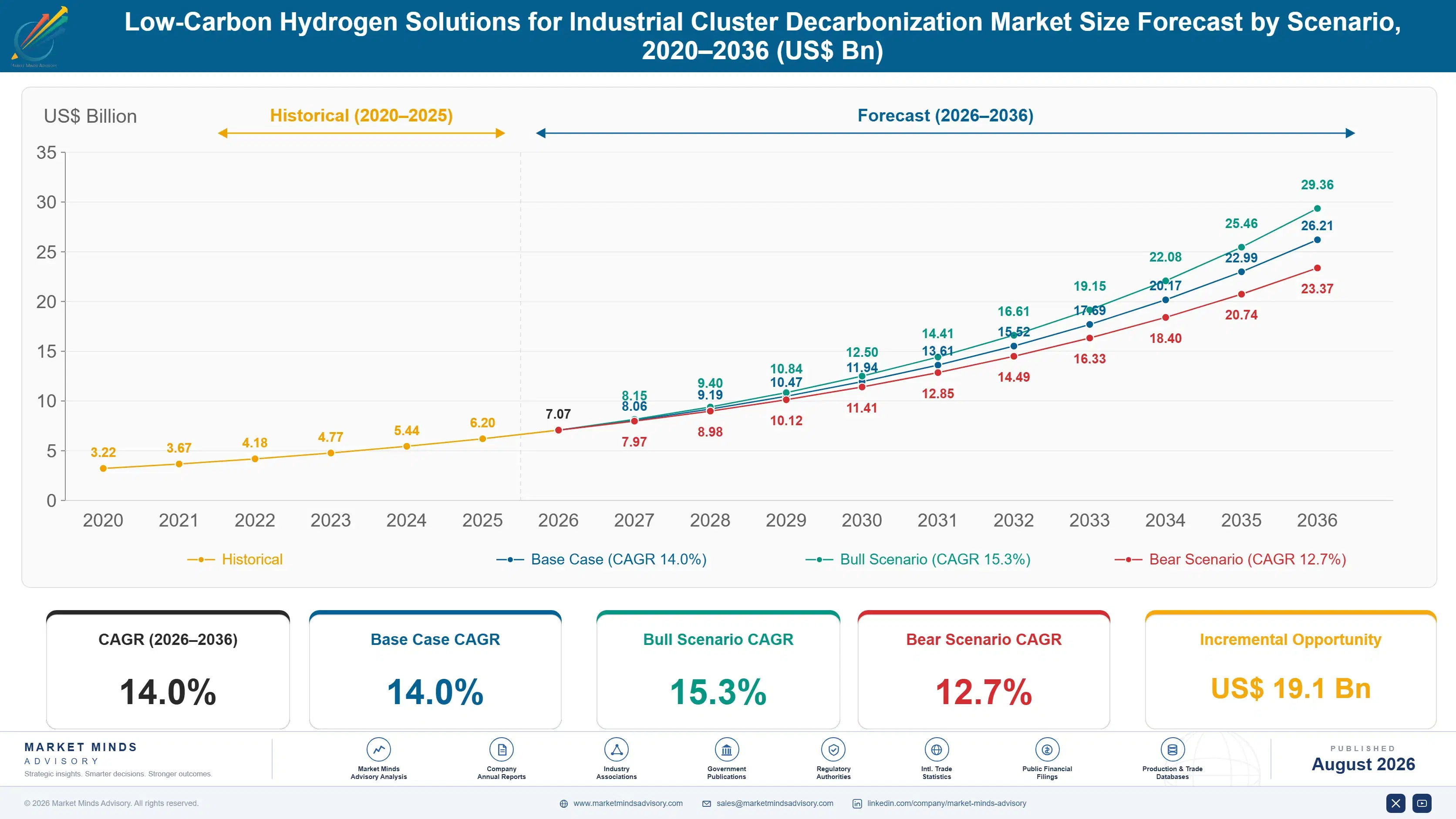
Low-Carbon Hydrogen Solutions for Industrial Cluster Decarbonization Market Forecast Scenarios

low-carbon-hydrogen-solutions-for-industrial-clust-size-forecast-scenario-1788193690348
Between 2020 and 2025 the sector compounded at 12.8% from a very small base, and announcement volume outran construction by an order of magnitude throughout. Project after project reached front-end engineering and stopped, because no buyer would sign the long take-or-pay a lender required at a price above conventional hydrogen. What was built came from clusters where a mandate or fixed premium removed that question.
The 14.0% base case rests on three mechanisms. European mandates require a defined share of hydrogen from renewable sources on published dates, which converts a preference into a compliance obligation nobody can defer. Green steel commands a genuine product premium that steelmakers have already contracted. And auction-based fixed premiums in Europe and production credits in North America close the gap on a per kilogram basis. None of the three depends on electrolyser costs falling further.
The bull case at 15.3% turns on a carbon border mechanism raising the cost of imported grey-hydrogen products enough to make substitution commercially rational without any support. The bear case at 12.7% is mandate softening: European industry targets are under sustained pressure from producers arguing competitiveness, and a weakened obligation removes the only thing making most of these contracts signable.

Why It Has To Be A Cluster

The cluster is not a policy fashion, it is a consequence of physics that most commentary skips over. Hydrogen carries little energy per unit of volume, needs compression or liquefaction to move, and embrittles pipeline steel built for natural gas. Beyond roughly 180 kilometres the transport cost overwhelms the production saving from a better renewable resource. So producer and consumer end up behind the same fence.
TOP FIVE CONCENTRATION27%Share of contracted supply volume held by five participants
GREEN PREMIUM MULTIPLE2.4 timesCost multiple against conventional hydrogen from unabated natural gas
OFFTAKE CONTRACT TERM14 yearsMedian duration required before a lender will fund
PIPELINE TRANSPORT LIMIT180 kmDistance beyond which co-location beats moving the molecule
ANNOUNCED TO OPERATING9%Portion of announced capacity that reached final investment decision
MANDATED INDUSTRY SHARE42%Portion of industrial hydrogen required from renewable sources
Everything else follows from a single unsigned document. A lender funding an electrolyser wants a fourteen year take-or-pay from a creditworthy buyer, and that buyer is a refiner or ammonia producer selling into a commodity market with no route to recovering 2.4 times its current hydrogen cost. Only 9% of announced capacity has cleared that hurdle. The engineering was never the problem and it still is not.
What breaks the deadlock is a mandate on the product rather than a subsidy on the molecule. European rules requiring 42% of industrial hydrogen from renewable sources by 2030 change the buyer's question from whether the premium is worth paying to whether non-compliance is worse. That is why European clusters lead and why softening those targets is the only genuine risk here.
"Every conference in this sector debates electrolyser efficiency and every stalled project died on an offtake term sheet. The developers who hired project financiers instead of another process engineer are the ones with plants under construction."
Director, Industrial Decarbonisation Practice · MMA Energy Practice · August 2026

Market Trends

Mandates on product replaced subsidies on production

European rules require industry to source 42% of its hydrogen from renewable sources by 2030 and a higher share by 2035, which converts a discretionary purchase into a compliance obligation with a date attached. That distinction matters more than any capital grant, because a buyer weighing a premium will defer indefinitely while a buyer facing non-compliance will sign. Western Europe holds 31% of category demand largely on that mechanism. Every other region is watching whether the obligation survives industrial lobbying, since the answer determines whether the model is copied anywhere else at all.
Market Impact: Limits transport to 180 km
Green steel found a customer willing to pay

Direct reduced iron using hydrogen instead of coal produces steel that automotive and construction buyers have contracted at a premium, which is the only industrial application in this category where the end customer visibly pays more for the low-carbon version. That single fact makes the offtake signable without relying entirely on regulation. Direct reduced iron grows at 21.0% against a market rate of 14.0% as a result. Whether the premium survives contact with a steel downturn is the question nobody in the sector wants to examine closely. It is the only honest doubt about the segment.
Market Impact: Substitutes into 100% existing demand

Market Opportunities and Growth Drivers

Transport economics force producer and consumer together

Hydrogen carries little energy per unit of volume, requires compression or liquefaction to move at any scale, and embrittles steel pipelines designed for natural gas, so transporting it destroys value quickly. Beyond roughly 180 kilometres the transport cost exceeds whatever saving a better renewable resource elsewhere would deliver. That arithmetic is why industrial clusters rather than optimal wind sites became the organising unit for this entire sector. Developers who sited production for resource quality rather than for proximity to offtake have generally discovered the point expensively and late. Proximity beats resource quality here.
Market Impact: Costs 2.4 times conventional hydrogen

Existing grey hydrogen demand needs no new market

Refineries, ammonia plants and methanol producers already consume enormous volumes of hydrogen made from unabated natural gas, which means substitution requires no new application, no equipment change at the consumer and no demand creation of any kind. The molecule is identical and the process does not notice. That makes these clusters the cheapest decarbonisation available in heavy industry per tonne avoided, and it is why refinery and ammonia substitution carry the volume while newer applications carry the growth. The buyer is already buying; only the source changes. Almost nothing else in decarbonisation works that way.
Market Impact: Demands 14 year contract terms

Market Restraints and Challenges

Nobody can pass the premium to a commodity customer

Low-carbon hydrogen costs around 2.4 times conventional supply and the buyers are refiners, ammonia producers and methanol makers selling into world commodity markets where no customer pays more for an identical product. The root cause is that these industries compete against imports made without any equivalent obligation, so the premium has nowhere to go but their margin. Commercial impact is that only 9% of announced capacity has reached a final investment decision. Participants are responding with mandates on product content, border carbon adjustment, fixed premium auctions and contracts indexed to compliance value rather than to energy prices.
Market Impact: Requires 42% renewable by 2030

Lenders require terms that buyers will not sign

Project finance for an electrolyser needs a take-or-pay contract running around fourteen years with a creditworthy counterparty, while industrial buyers plan on three to five year commercial horizons and resist committing volume beyond that. The root cause is a mismatch between asset life and commercial planning that neither side created and neither can resolve alone. Commercial impact is projects stalling at front-end engineering with everything complete except the contract. Mitigation runs through government offtake backstops, hydrogen bank fixed premiums, aggregated multi-buyer purchasing and staged contracts with volume ramps and reopener clauses.
Market Impact: Grows at 21.0% against 14.0%
3 additional market trends, 4 additional growth drivers, and 2 additional restraints and challenges are covered in the full report. Contact sales@marketmindsadvisory.com to access the complete intelligence.

Segment CAGR and Growth Architecture

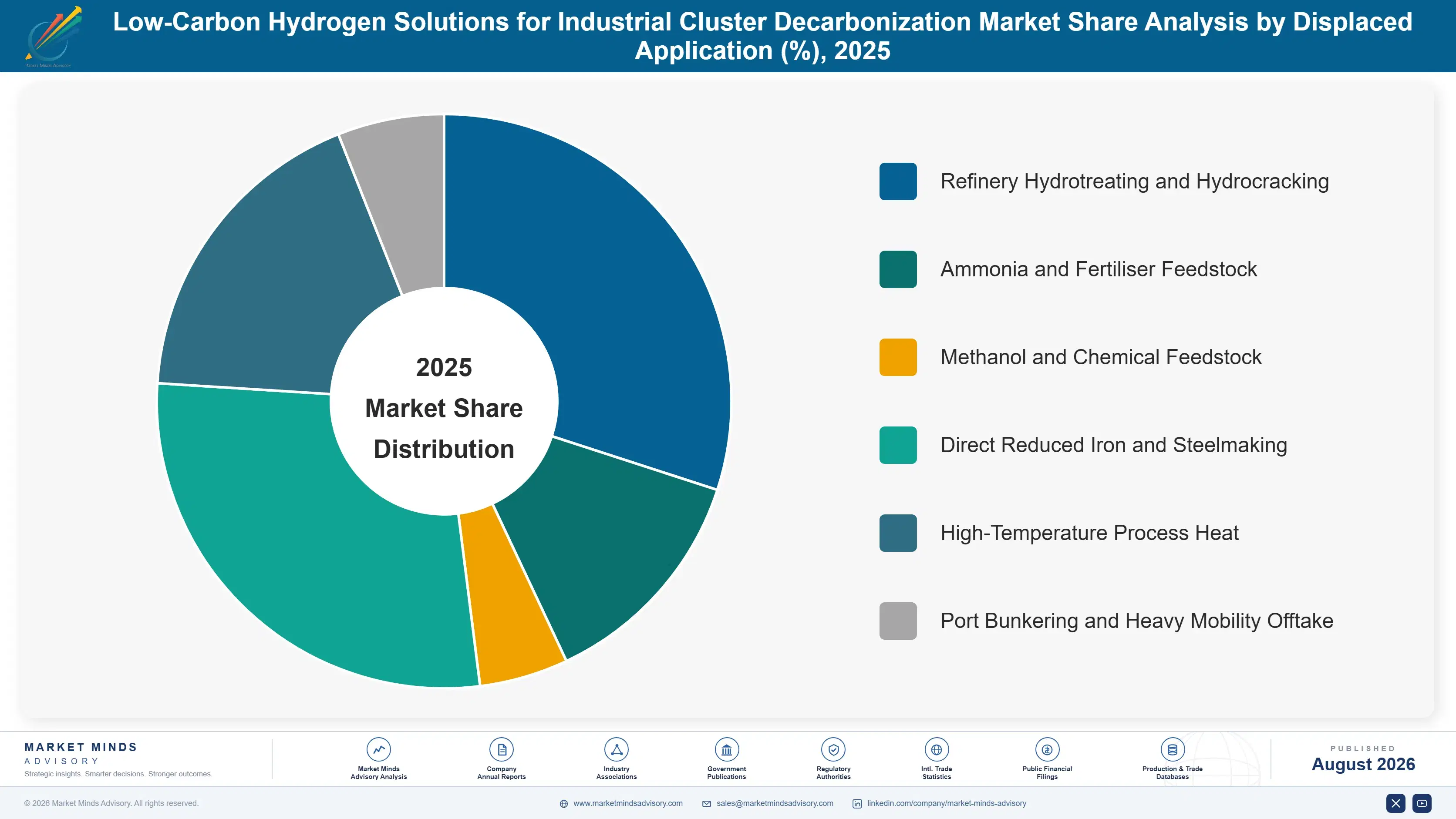
Segmentation follows displaced application, the dimension on which substitution cost, contract signability and regulatory exposure all move together. Refining and ammonia carry the volume, because the hydrogen demand already exists and only the source changes. Steel and chemicals carry the growth, because in both a customer further down the chain will actually pay the premium.
low-carbon-hydrogen-solutions-for-industrial-clust-market-share-analysis-1788193690913

Direct Reduced Iron and Steelmaking

Direct reduced iron and steelmaking grows at 21.0%, half again the market rate of 14.0%, and it is the only application here where somebody outside the cluster pays the premium. Replacing metallurgical coal with hydrogen in the reduction step produces steel that automotive manufacturers and construction buyers have already contracted at prices above conventional product, because their own emissions reporting depends on it. That transforms the offtake conversation completely, since the steelmaker is not absorbing a cost but passing one along. Hydrogen volumes per tonne of steel are enormous, which is why a single plant can anchor an entire cluster's production and justify infrastructure nothing else would. Nothing else in this sector anchors that much.
CAGR 21.0%

Methanol and Chemical Feedstock Substitution

Methanol and chemical feedstock substitution at 16.5% is driven by shipping fuel regulation rather than by chemical demand, which almost nobody expects. Maritime rules requiring falling greenhouse gas intensity have made green methanol a bunker fuel with contracted demand from container lines, and producing it requires low-carbon hydrogen combined with captured or biogenic carbon dioxide. That gives the chemical producer an offtake buyer with a regulatory obligation of its own, which is exactly what makes the contract signable. Conventional chemical feedstock substitution moves far more slowly, because those customers face no equivalent requirement and buy on price like everybody else. Shipping regulation turned out to be the demand signal that chemical policy never managed to provide.
CAGR 16.5%
Full segment breakdown across 6 segments available in the complete report.

Regional Architecture and Country Demand Map

Western Europe takes 31%, above its usual band, on the only binding industry mandate anywhere. Middle East and Africa reaches 12% on export ammonia rather than domestic use. India grows fastest. Nearly every position here is set by whether a mandate exists rather than by industrial size or renewable resource.

Western Europe

A 31% share above the usual band rests on one instrument that exists nowhere else: a binding requirement that industry source 42% of its hydrogen from renewable sources by 2030, rising further by 2035. That converts a discretionary premium into a compliance obligation with a date, which is the difference between a project stalling and a project signing. Rotterdam, Antwerp, the Humber and North Rhine clusters combine refining, chemicals and steel behind shared infrastructure at exactly the density the transport economics demand. Hydrogen bank auctions add a fixed premium per kilogram on top. Growth at 12.4% is the slowest of the seven regions and the base is by far the largest.
Share: 31% | CAGR: 12.4% (2026 to 2036)

East Asia

Import dependence shapes everything here and it produces a different commercial model from anywhere else. Japan and Korea have limited domestic renewable resource and have built policy around importing hydrogen and ammonia rather than producing it, with contract structures and co-financing designed to secure supply from Australia, the Middle East and Southeast Asia. Japanese contract-for-difference support covers the cost gap directly. Chinese activity is the largest by installed electrolyser capacity and concentrated in industrial parks in the north and west where renewable curtailment makes power close to free. Those are three separate markets sharing a regional label, and confusing them is a common and expensive error. Confusing them is a common and expensive error.
Share: 22% | CAGR: 15.0% (2026 to 2036)
Regional intelligence for 5 additional markets available in the complete report: North America, South Asia and Pacific, Latin America, Middle East and Africa, Eastern Europe. Contact sales@marketmindsadvisory.com.
low-carbon-hydrogen-solutions-for-industrial-clust-country-cagr-analysis-1788193691443

Four Moves On The Offtake

None of these four makes hydrogen cheaper, which is deliberate, because cost is not what has stalled 91% of announced capacity. Each addresses the signature: who can sign a fourteen year commitment, what makes them able to, and which buyers already have a reason of their own. All four are commercial rather than technical.

Hire financiers rather than another process engineer

Only 9% of announced capacity has reached a final investment decision and almost none of the failures were technical, because the engineering in this sector is well understood and broadly available. Projects die on offtake term sheets, credit support structures and the gap between a fourteen year lender requirement and a five year buyer horizon. A developer with genuine project finance capability inside the team resolves those questions during development rather than discovering them at the end. The developers with plants under construction made this hire years ago. Everybody else is still optimising a stack.
Market Impact: Addresses the 91% of projects that currently stall

Target buyers whose customers pay the premium

A refiner selling into a world commodity market cannot recover 2.4 times its hydrogen cost from anybody. A steelmaker supplying automotive manufacturers with emissions reporting obligations already contracts green steel at a premium, which is why that segment grows at 21.0% against a market rate of 14.0%. Green methanol for shipping works identically, because container lines face their own fuel intensity rules. Screening potential offtakers by whether their own customer has an obligation, rather than by volume or creditworthiness, changes which conversations are worth having entirely. It is the cheapest screen available.
Market Impact: Reaches the buyers behind a 21.0% growth segment

Aggregate several buyers into one contract

No single industrial consumer in most clusters will commit the volume and duration a lender needs, but 4 consumers each taking a quarter of the output on staggered terms reach the same place with far less individual exposure. Aggregation converts an impossible single signature into four manageable ones and diversifies counterparty risk in a way lenders reward with better terms. It requires somebody to structure and hold the aggregation, which is a commercial role nobody in these clusters has traditionally played. Port authorities and cluster bodies are the obvious candidates.
Market Impact: Splits a 14 year term across 4 buyers

Index the contract to compliance, not energy

Contracts priced against natural gas leave the buyer exposed whenever gas is cheap, which is precisely when a 14 year commitment looks worst and gets renegotiated. Pricing against the value of compliance instead, whether that is a mandate penalty, a carbon price or a certificate, aligns the contract with the reason the buyer is purchasing at all. It also removes the awkward conversation in which both parties quietly hope gas stays expensive. Very few contracts in this sector are written that way and the ones that are have survived better.
Market Impact: Indexes pricing across the full 14 year term

Who Controls the Margin Pool

CR5 stands at 27% of contracted low-carbon hydrogen supply volume, which is the only comparable basis across participants reporting in entirely different revenue categories. Concentration is low because a cluster solution combines electrolysis, storage, distribution and offtake structuring and nobody is strong across all four. The gap between leaders and the field is a gap in contracted volume rather than in capability.
Competition runs on offtake structuring, industrial gas incumbency and equipment supply position. Offtake structuring decides which projects reach a decision at all. Incumbency decides who already sits inside the cluster supplying conventional hydrogen and can convert an existing customer. Equipment position decides who captures the capital spending. Technology differentiation between alkaline and membrane electrolysis decides considerably less than either vendor claims.

Rankings will move as the industrial gas majors convert their existing cluster customers rather than as new entrants win them. A supplier already delivering conventional hydrogen over the fence holds the relationship, the pipeline and the metering, and substitution is a contract amendment rather than a competitive tender. The pressure comes from incumbency rather than technology, which is difficult for a well-funded newcomer to answer.
low-carbon-hydrogen-solutions-for-industrial-clust-company-positioning-matrix-1788193691972

Competitive Moat and Risk Dimensions

AIR LIQUIDE

Moat: Incumbency inside existing clusters

Existing pipelines, storage and long-standing supply contracts inside European and North American industrial clusters mean the group is already delivering hydrogen over the fence to the customers this market is trying to reach. Substitution becomes a contract amendment rather than a competitive tender. A newcomer must build infrastructure and win a relationship simultaneously, which few have managed anywhere.
AIR LIQUIDE

Risk: Mandate dependence concentrates the risk

The strongest position sits in European clusters where demand rests on an industry obligation currently under sustained pressure from producers arguing competitiveness. A softened mandate removes the reason many contracted volumes exist at all, and no amount of infrastructure compensates. Concentration in the region with the best policy is also concentration in the region with the most reversible policy.
THYSSENKRUPP NUCERA

Moat: Alkaline scale from chlor-alkali

Decades of large-scale alkaline electrolysis built for chlor-alkali production give the group manufacturing scale and operating references at cell areas that newer entrants are still demonstrating. Industrial buyers evaluating first-of-a-kind risk weight operating history heavily. That reference base was accumulated over decades in an adjacent industry and cannot be bought or shortened.
THYSSENKRUPP NUCERA

Risk: Equipment supply misses recurring revenue

Selling electrolysers into projects captures the capital spend once and none of the fifteen years of supply revenue that follows, while the participants structuring offtake hold the annuity. Equipment margins compress as Chinese manufacturers scale alkaline production aggressively. A supply position without a project position is the weaker end of this value chain over time.

Players Tracked

Prominent Players

Air Liquide
Linde
Air Products
thyssenkrupp nucera
Plug Power

Other Key Players

Siemens Energy
Nel ASA
ITM Power
Bloom Energy
Cummins
Sunfire
John Cockerill
Topsoe
Technip Energies
Wood Group
Shell
BP
TotalEnergies
Iberdrola
Yara International

Recent Developments

JANUARY 2025

European hydrogen bank auction awarded fixed premium contracts

A European auction round awarded fixed premium contracts per kilogram of renewable hydrogen produced, covering the gap between production cost and what industrial buyers would pay. Several awarded projects reached final investment decision within two quarters, having previously stalled at front-end engineering for several years without moving.
Signal: A fixed premium closed offtake gaps that a decade of capital grants had entirely failed to close.
JUNE 2025

Automotive buyer contracted hydrogen-reduced steel at premium

A European automotive manufacturer contracted multi-year supply of hydrogen-reduced steel at prices above conventional product, citing its own supply chain emissions reporting requirements. The steelmaker used that contracted premium to underwrite hydrogen offtake that lenders had previously declined to finance on any terms at all.
Signal: A premium two steps down the chain financed the hydrogen plant that everybody said was unfinanceable.
OCTOBER 2025

European industry sought relaxation of renewable hydrogen targets

European industrial associations formally sought relaxation of the binding renewable hydrogen share required of industry, arguing international competitiveness against overseas producers facing no equivalent obligation of any kind. Developers holding contracts written against that mandate began reassessing their positions immediately, while the review process remained open and unresolved.
Signal: The single mechanism making these contracts signable has now become the single largest risk to them.

Power, Electrolysers And Capital

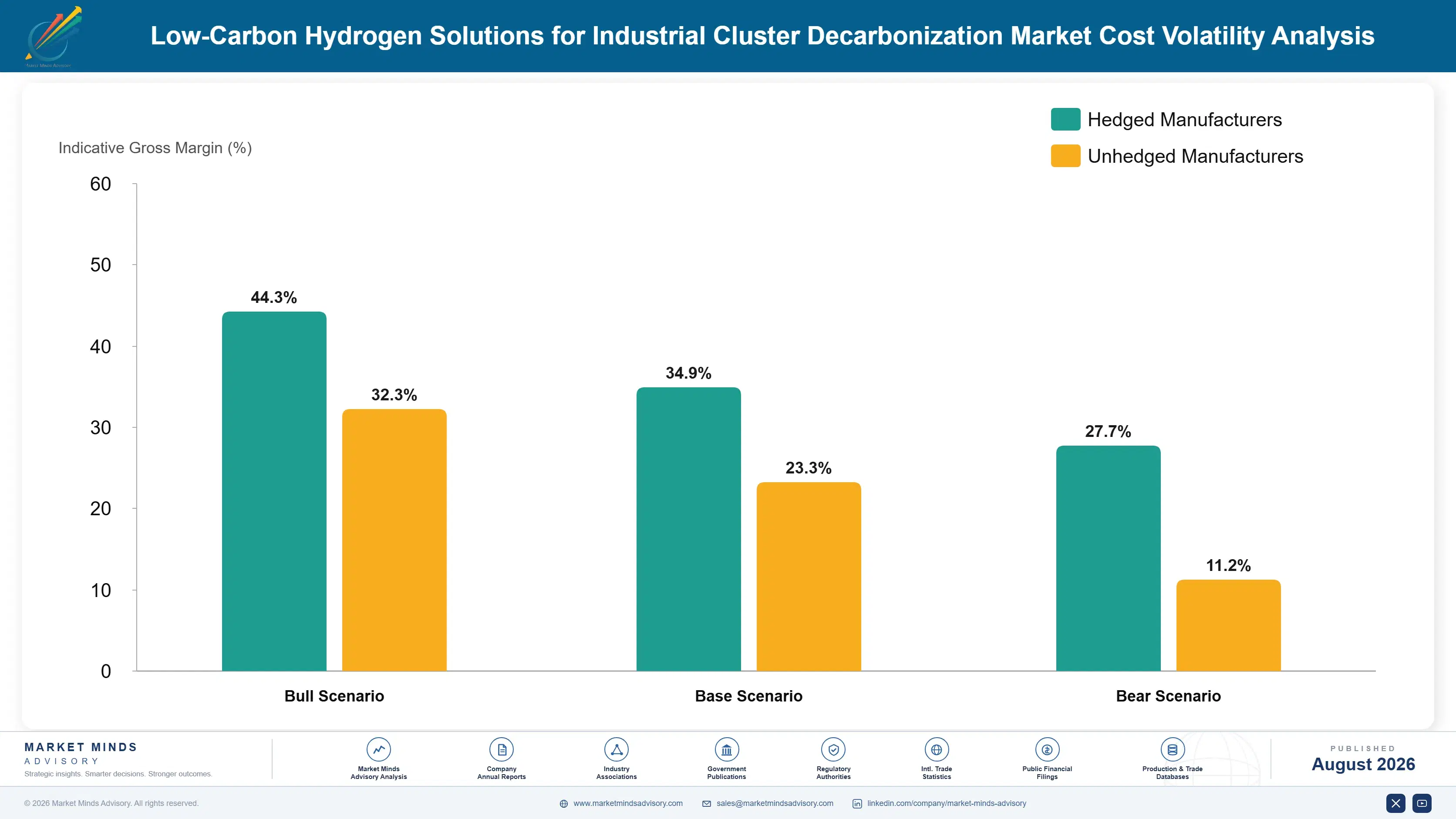
Renewable electricity accounts for roughly 61% of delivered hydrogen cost at typical utilisation, electrolyser capital charges around 21%, and compression, storage and distribution a further 11%. Power dominates everything else combined and its price depends on the contracted renewable supply rather than on any equipment decision. Water treatment, balance of plant and operations make up what remains, and none of it moves the total meaningfully.
European power pricing through 2022 tested every assumption in this sector at once. The International Energy Agency documented the movement, and projects modelled on grid electricity saw delivered hydrogen cost move far beyond anything an industrial buyer would contract. Developments holding dedicated renewable power purchase agreements at fixed prices were largely unaffected. That difference decided which projects survived the period, and it was a procurement decision taken years earlier.

The disadvantage falls on utilisation rather than on power price alone, which most participants understand too late. An electrolyser running at 40% utilisation on cheap intermittent power carries capital charges per kilogram that a unit running at 85% on firmer supply avoids entirely. Optimising for the cheapest electricity often produces the most expensive hydrogen. That trade-off is the most commonly misjudged calculation in this sector.
low-carbon-hydrogen-solutions-for-industrial-clust-cost-volatility-analysis-1788193692167

Contract dedicated renewable power at fixed prices

Electricity is 61% of delivered hydrogen cost and grid exposure destroyed the economics of every project that carried it through the last European power cycle. Long-term power purchase agreements at fixed prices cost a premium against spot and remove the largest uncontrolled variable from a fourteen year commitment. The projects that survived that period had made this decision years earlier.

Optimise for utilisation rather than cheapest power

An electrolyser at 40% utilisation carries capital charges per kilogram that a unit at 85% avoids, which frequently outweighs the saving from cheaper intermittent electricity. Firming supply through storage, grid balancing or hybrid renewable portfolios costs money and usually returns more than it costs. Most developers model power price carefully and utilisation casually, which is the wrong way round entirely.

Size the plant to contracted volume, not ambition

Capital charges are 21% of delivered cost and they accrue on installed capacity regardless of how much hydrogen anybody actually buys. Building to announced cluster demand rather than to signed offtake produces stranded capacity carrying full capital charges across every kilogram sold. Several early projects did exactly that and their delivered cost has never recovered from the decision at all.

Portfolio Architecture for Margin Defence

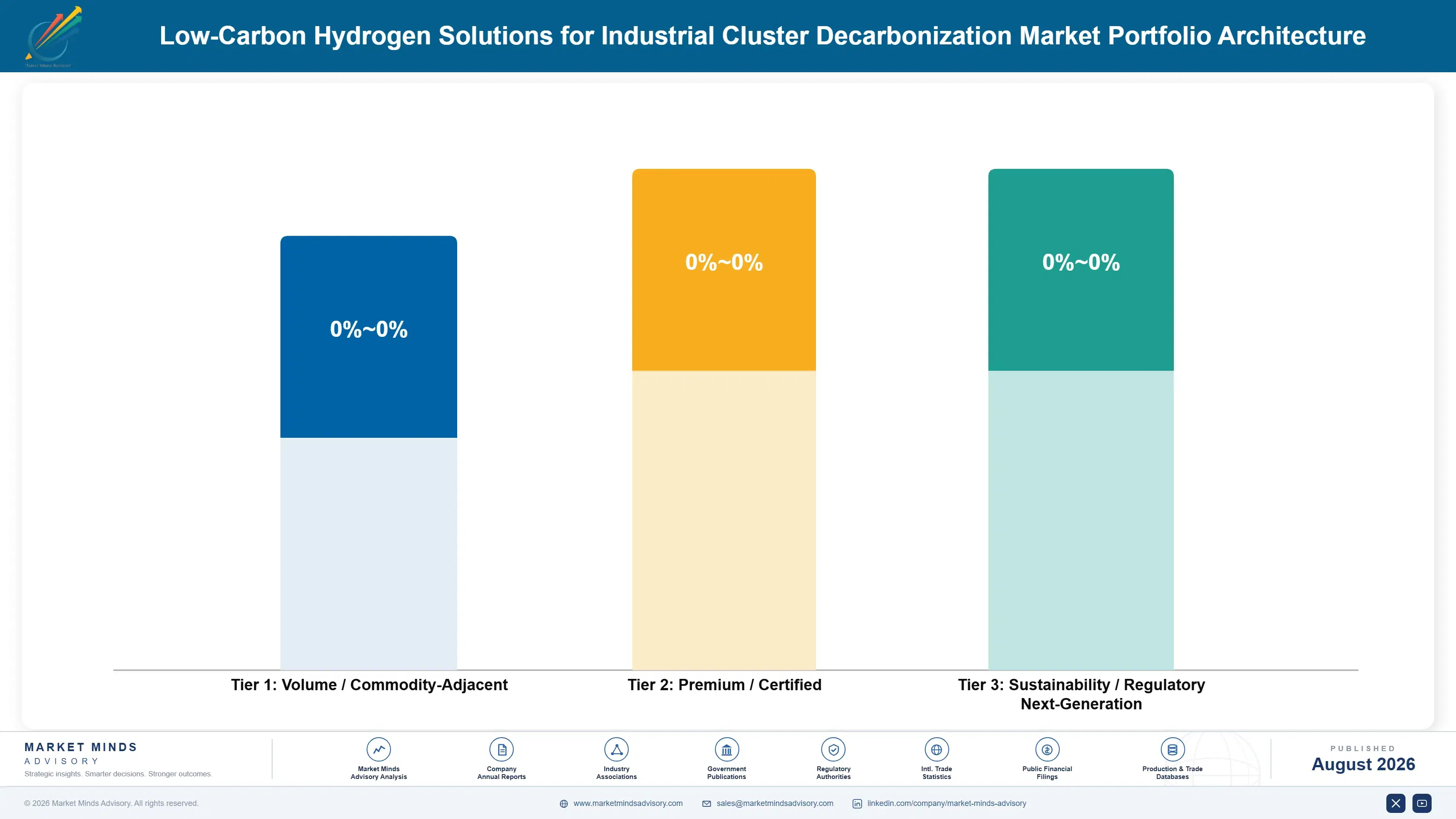
Margin here follows contract structure rather than production efficiency, which is not where the sector puts its attention. A project with a mandate-indexed fourteen year offtake earns a regulated-utility return with almost no volume risk, while an identical plant selling on merchant terms earns nothing dependable at all. Participants costing by contract quality rather than by production cost run a completely different business from the rest.
Volume and premium pull against each other through the cluster relationship rather than the plant. Refinery and ammonia substitution carries the volume that justifies shared pipelines, storage and compression, and that infrastructure is what makes the smaller high-value applications reachable at all. Serving only steel and methanol leaves the shared assets underused, and underused shared infrastructure raises delivered cost for everybody connected to it.

High-value pools sit in steel and green methanol offtake, in shared cluster infrastructure and in the offtake structuring service itself, which almost nobody charges for. The third is genuinely unpriced: aggregating buyers, structuring credit support and indexing to compliance value is what converts a stalled project into a financed one, and it is currently given away free inside development budgets.

Volume / Commodity-Adjacent

Refinery and ammonia feedstock substitution supplied on merchant or short-term terms into commodity industries competing against unabated imports. Margins are thin because the buyer cannot pass the premium anywhere. The 9 point spread reflects whether power is contracted long term or bought from the grid.
Gross Margin: 12 to 21%

Premium / Certified

Supply under long-term mandate-indexed offtake with certification of renewable origin, into buyers facing a compliance obligation with a published date. Contract quality rather than production cost supports the return. The 9 point spread reflects contract term and the credit support behind it.
Gross Margin: 28 to 37%

Sustainability / Regulatory / Next-Generation

Green steel and shipping methanol offtake where the premium is paid further down the chain, plus shared infrastructure and offtake structuring. Margins are high because the buyer has a paying customer. The 18 point spread separates molecule supply from infrastructure tariffs and structuring fees.
Gross Margin: 36 to 54%
low-carbon-hydrogen-solutions-for-industrial-clust-portfolio-architecture-1788193692674

High-value Sub-segments and Strategic Watch-out

Direct Reduced Iron and Steelmaking

High value and high growth at 21.0%. It is the only application where a customer further down the chain visibly pays the premium, which makes the offtake signable without leaning entirely on regulation. The 8 point spread reflects whether the steel premium is contracted or merely assumed in the model.
Gross Margin: 38 to 46%

Methanol and Chemical Feedstock

High value with strong growth at 16.5%. Shipping fuel rules rather than chemical demand drive it, giving the offtaker a regulatory obligation of its own that makes the contract work. The 8 point spread reflects whether the carbon dioxide feedstock is captured on site or purchased in.
Gross Margin: 34 to 42%

Refinery Hydrotreating and Hydrocracking

The volume core. It earns modestly and the tonnage justifies the shared pipelines, storage and compression that make every smaller application in the cluster affordable. The 8 point spread reflects whether the refiner faces a binding mandate or is substituting entirely voluntarily on its own account.
Gross Margin: 14 to 22%

High-Temperature Process Heat

The strategic watch-out. Burning hydrogen for heat competes against electrification and biomass on cost and loses in most applications where either is technically available. The 22 point spread separates genuinely hard-to-electrify processes from those where hydrogen is simply the more familiar answer to reach for.
Gross Margin: 8 to 30%

Fourteen Years Or Nothing

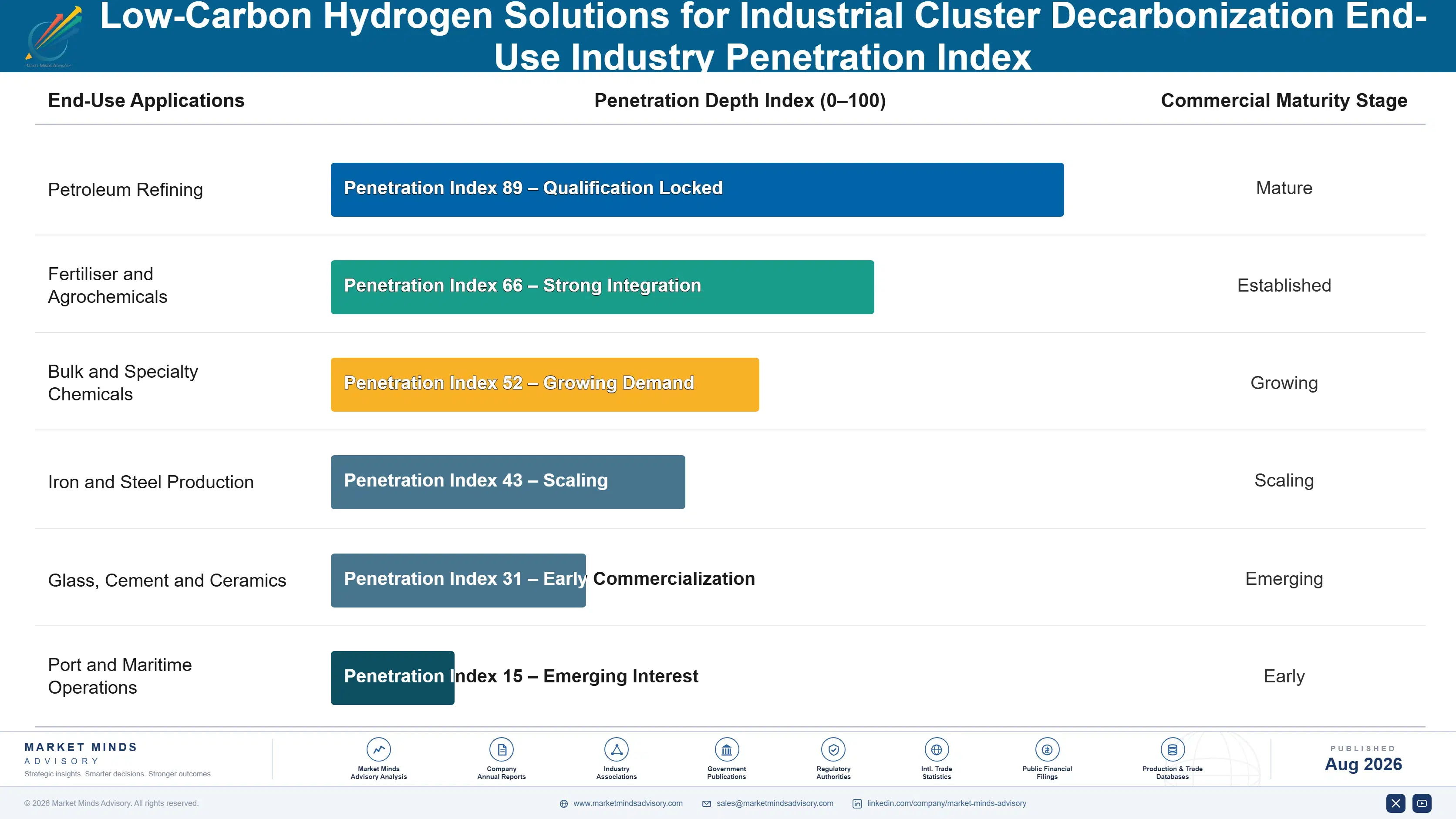
The annuity here is the longest in industrial gases and it is also the hardest to originate. A signed offtake runs around fourteen years with take-or-pay volume, which produces revenue a lender treats almost as an infrastructure bond and a supplier treats as the whole business case. Nothing about the relationship is competitive after signature, because the pipeline connects two specific parties and neither has an alternative counterparty nearby.
Adoption depth varies enormously by whether the buyer's own customer faces an obligation. A steelmaker supplying automotive manufacturers with emissions reporting requirements signs readily, because the premium travels down the chain. A refiner selling gasoline into a commodity market signs only under mandate, because it travels nowhere. Those two buyers sit in the same cluster, face the same supplier and behave in completely opposite ways.

Buyer profiles have shifted from operations toward regulatory affairs and treasury together, which is an unusual combination. An operations manager asked about purity, pressure and reliability. A regulatory affairs lead asks whether the certification satisfies the mandate, and a treasurer asks what a fourteen year take-or-pay does to the balance sheet. All three must agree, and most supplier organisations are equipped to persuade only the first.
low-carbon-hydrogen-solutions-for-industrial-clust-end-use-penetration-index-1788193693166

What Gets A Project Financed

These are among the four positions where our research anticipates prominent divergence between winners and laggards over the coming forecast period. Each is grounded in the demand model, the regulatory perimeter, and the announced capacity pipeline.
01 / OFFTAKE STRUCTURING CAPABILITY

Hire the financier before the next engineer

Only 9% of announced capacity has reached a final investment decision and almost none of the failures were technical, because electrolysis is well understood and equipment is available from many credible suppliers. Projects die on offtake term sheets, credit support structures and the gap between what a lender requires over fourteen years and what an industrial buyer will commit over five. A developer with genuine project finance capability inside the team resolves that during development rather than discovering it at the very end.
02 / BUYER OBLIGATION SCREENING

Sell to buyers whose customers already pay

A refiner selling gasoline into a world commodity market cannot recover 2.4 times its hydrogen cost from anybody at all, and no amount of relationship management changes that basic arithmetic. A steelmaker supplying automotive manufacturers with their own emissions reporting obligations already contracts green steel at a premium, which is precisely why that segment grows at 21.0%. Screening potential offtakers by whether their customer has an obligation, rather than by volume or credit rating, changes which conversations are worth having.
03 / MULTI BUYER AGGREGATION

Four signatures beat one impossible one

No single industrial consumer in most clusters will commit the volume and the duration a lender demands, but four consumers each taking a quarter of output on staggered terms arrive at the same place with far less individual exposure to any of it. Aggregation converts one impossible signature into four manageable ones and diversifies counterparty risk in a way that lenders reward with materially better terms. Somebody has to structure and hold that aggregation, and port authorities are the obvious unclaimed candidate.
04 / COMPLIANCE INDEXED PRICING

Price against the obligation, not against gas

Contracts indexed to natural gas leave the buyer exposed whenever gas is cheap, which is exactly when a fourteen year commitment looks worst and renegotiation conversations begin in earnest. Pricing against the value of compliance instead, whether a mandate penalty, a carbon price or a tradable certificate, aligns the contract with the actual reason the buyer is purchasing anything at all. Very few contracts in this sector are written that way, and the ones that are have survived pressure considerably better.

Engagement Snapshot From the Field

A live engagement with an industry participant carrying material or product regulatory and market exposure ahead of a defining policy shift, showing how our research translates into a defensible multi-year portfolio strategy.
MARKET MINDS ADVISORY · CLIENT ENGAGEMENT SUMMARY
Low-Carbon Hydrogen Solutions for Industrial Cluster Decarbonization Producer Strategic Portfolio Review and Transition Roadmap 2026·Investment Scenario on Low-Carbon Hydrogen Solutions for Industrial Cluster Decarbonization Exposure Evaluation 2025-26
CLIENT PROFILE
A European industrial gas group supplying conventional hydrogen into three refining and chemical clusters, holding board approval for low-carbon production capacity and unable to convert any of it into a signed offtake despite two years of negotiation (client-reported, unverified by MMA). Four separate customer discussions had reached term sheet and stopped there. Management could not explain why.
STRATEGIC CHALLENGE
Every existing customer wanted low-carbon hydrogen in principle and none would sign the fourteen year take-or-pay the group's lenders required. Management could not determine whether the obstacle was price, contract term, counterparty credit or something else entirely, and a competitor had recently signed in an adjacent cluster on terms nobody in the group understood.
MMA APPROACH
MMA reconstructed each of the four stalled negotiations against the buyer's own commercial position, examining whether that buyer's customers faced any emissions obligation and where a premium could travel. Forty-seven expert interviews with refiners, steelmakers, chemical producers, lenders and regulatory staff established what made a contract signable and what had stopped each of these four.
KEY FINDINGS
  1. All 4 stalled buyers sold into commodity markets with no route to recover a premium, while the competitor's signed buyer supplied automotive customers directly.
  2. Lenders interviewed would accept 4 aggregated buyers at shorter individual terms, a structure the group had never proposed to anybody at all.
  3. Contracts indexed to natural gas made the commitment look worst precisely when gas prices fell, which every buyer had raised as a specific objection.
  4. Two steel and methanol producers within reach of the same clusters had never been approached, because they were not existing conventional hydrogen customers.
CLIENT PROFILE
A European industrial gas group supplying conventional hydrogen into three refining and chemical clusters, holding board approval for low-carbon production capacity and unable to convert any of it into a signed offtake despite two years of negotiation (client-reported, unverified by MMA). Four separate customer discussions had reached term sheet and stopped there. Management could not explain why.
STRATEGIC CHALLENGE
Every existing customer wanted low-carbon hydrogen in principle and none would sign the fourteen year take-or-pay the group's lenders required. Management could not determine whether the obstacle was price, contract term, counterparty credit or something else entirely, and a competitor had recently signed in an adjacent cluster on terms nobody in the group understood.
MMA APPROACH
MMA reconstructed each of the four stalled negotiations against the buyer's own commercial position, examining whether that buyer's customers faced any emissions obligation and where a premium could travel. Forty-seven expert interviews with refiners, steelmakers, chemical producers, lenders and regulatory staff established what made a contract signable and what had stopped each of these four.
KEY FINDINGS
  1. All 4 stalled buyers sold into commodity markets with no route to recover a premium, while the competitor's signed buyer supplied automotive customers directly.
  2. Lenders interviewed would accept 4 aggregated buyers at shorter individual terms, a structure the group had never proposed to anybody at all.
  3. Contracts indexed to natural gas made the commitment look worst precisely when gas prices fell, which every buyer had raised as a specific objection.
  4. Two steel and methanol producers within reach of the same clusters had never been approached, because they were not existing conventional hydrogen customers.
RECOMMENDED STRATEGY
Phase 1: Phase one: approach the steel and methanol producers whose own customers face obligations, rather than continuing with the four commodity buyers. Phase 2: Phase two: restructure the offer as an aggregated multi-buyer contract with staggered terms, which lenders confirmed they would accept readily. Phase 3: Phase three: index pricing to compliance value rather than to natural gas, removing the objection every single buyer had raised independently.
OUTCOME
Within five quarters the group had signed an aggregated offtake covering three buyers including one steel producer, and reached a final investment decision on the first plant (client-reported, unverified by MMA). None of the four original negotiations was revived. The contract is indexed to compliance value throughout.

Frequently Asked Questions

Foundational context covering the market sizes, CAGR, scope, country, region and competition that inform every finding below. This section is provided to cover basics and most often pre-purchase conversations, answered from the MMA Primary Research Dataset.

What is the current size of the Low-Carbon Hydrogen Solutions for Industrial Cluster Decarbonization Market?

The global market was valued at USD 6.2 billion in 2025, covering integrated low-carbon hydrogen supply into co-located industrial consumers. The 2026 figure reaches USD 7.07 billion.

How large will the Low-Carbon Hydrogen Solutions for Industrial Cluster Decarbonization Market be by 2036?

MMA forecasts USD 26.21 billion by 2036, an increase of USD 19.14 billion over the 2026 base. That represents an expansion multiple of 3.71 times across the forecast period.

What is the CAGR for the Low-Carbon Hydrogen Solutions for Industrial Cluster Decarbonization Market 2026 to 2036?

The base case compound annual growth rate is 14.0%, with a bull case at 15.3% and a bear case at 12.7%. Historical growth between 2020 and 2025 ran at 12.8%.

Which segment is growing fastest?

Direct reduced iron and steelmaking grows at 21.0%, half again the market rate of 14.0%, because automotive buyers pay a contracted premium for green steel. Methanol follows at 16.5%.

Who are the major companies in the Low-Carbon Hydrogen Solutions for Industrial Cluster Decarbonization Market?

Air Liquide, Linde, Air Products, thyssenkrupp nucera and Plug Power lead on contracted supply volume, with combined CR5 of 27%. Concentration is low because no participant covers the whole solution.

Which country is growing fastest?

India grows fastest at 16.2%, on a national mission with production incentives and enormous existing hydrogen demand in refining and fertiliser. South Asia and Pacific leads regionally at 16.2%.

Report Segmentation Architecture

The full report scope spans multiple orthogonal segmentation dimensions, with cross-tabulated demand data provided for each dimension pair. Coverage extends further to regional breakdowns, trend trajectories, and the competitive detail needed to support segment-level decision-making.

By Displaced Application

  • Refinery Hydrotreating and Hydrocracking
  • Ammonia and Fertiliser Feedstock
  • Methanol and Chemical Feedstock
  • Direct Reduced Iron and Steelmaking
  • High-Temperature Process Heat
  • Port Bunkering and Heavy Mobility Offtake

By End-Use Industry

  • Petroleum Refining
  • Fertiliser and Agrochemicals
  • Bulk and Specialty Chemicals
  • Iron and Steel Production
  • Glass, Cement and Ceramics
  • Port and Maritime Operations

By Commercial Dimension

  • Long-Term Take-or-Pay Offtake
  • Aggregated Multi-Buyer Contracts
  • Merchant and Spot Supply
  • Shared Infrastructure Tariffs
  • Build Own Operate Arrangements
  • Offtake Structuring Services

By Region

  • North America
  • Western Europe
  • East Asia
  • South Asia and Pacific
  • Latin America
  • Middle East and Africa
  • Eastern Europe

Scope, Methodology, and Coverage

Every figure in this report is reproducible from documented input assumptions. The scope below maps the historical period, the forecast horizon, the segmentation dimensions, and the countries covered, alongside the underlying primary and qualitative methodology.
Historical Period
2020 to 2025
Forecast Period
2026 to 2036
Base Year
2025 (USD billions; MMA Primary Research Dataset, August 2026)
Market Definition
The low-carbon hydrogen solutions for industrial cluster decarbonization market covers integrated supply of hydrogen produced by electrolysis or by reforming with carbon capture, together with the storage, distribution and offtake arrangements that deliver it to co-located industrial consumers, segmented by displaced application across refinery hydrotreating and hydrocracking, ammonia and fertiliser feedstock, methanol and chemical feedstock, direct reduced iron and steelmaking, high-temperature process heat, and port bunkering and heavy mobility offtake. Scope is measured as contracted supply value into cluster consumers. Excluded are standalone electrolyser equipment sales, hydrogen for distributed transport refuelling outside clusters, ammonia traded as a commodity, unabated fossil hydrogen, and grid electricity supply.
Quantitative Units
USD billion, 2025 base year, 2026 to 2036 forecast period
Segmentation Dimensions
Displaced application, end-use industry, commercial model, region
Regions Covered
North America, Western Europe, East Asia, South Asia and Pacific, Latin America, Middle East and Africa, Eastern Europe
Countries Covered
United States, Canada, Germany, Netherlands, United Kingdom, France, Spain, Poland, China, Japan, South Korea, India, Australia, Brazil, Chile, Saudi Arabia, United Arab Emirates, Morocco
Key Companies Profiled
20 companies across industrial gas groups, electrolyser manufacturers and project developers
Quantitative Methodology
Primary survey, n=3,800 respondents, Q4 2025, six countries; demand-side model with trade association cross-validation
Qualitative Methodology
47 expert interviews, Q4 2025; applied to validate demand model assumptions, identify emerging dynamics, and assess competitive positioning
Report Format
PDF and XLSX data workbook (Word format preview document)
Publisher
Market Minds Advisory
Report Code
MMA-2026-ENE-371
Published
August 2026
Contact
sales@marketmindsadvisory.com | www.marketmindsadvisory.com

Purchase the full Low-Carbon Hydrogen Solutions for Industrial Cluster Decarbonization Market Report (2026 to 2036).

The full MMA report on low-carbon hydrogen solutions for industrial cluster decarbonization runs to detailed application and regional models across the 2026 to 2036 forecast period, with delivered cost benchmarks separated by power contracting route and utilisation assumption. It profiles 20 companies on a consistent contracted supply volume basis, covering industrial gas groups, electrolyser manufacturers and project developers. Offtake contract structures are analysed against what lenders have actually financed rather than against announcements. Regional chapters cover the seven MMA regions with country-level detail on the eighteen markets surveyed. Primary research draws on a quantitative survey of 3,800 respondents across six countries and 47 expert interviews conducted in Q4 2025.
Delivered cost benchmarks by power contracting route and utilisation
Offtake contract structures analysed against what lenders actually financed
Announced versus financed capacity tracked by cluster and region
Twenty company profiles on consistent contracted supply volume basis
Industry mandate timelines mapped against cluster compliance exposure
Seven regional chapters with eighteen country detail tables

Built For The People Who Decide

From boardroom strategy to bench-side execution, this report is read cover-to-cover by leaders shaping the next decade of their industry, turning demand scenarios, market dynamics and valuation benchmarks into decisions.
CXOs/ Presidents/ VPs/ Managers
M&A and Corporate Development
Strategy Teams and R&D Heads
Procurement and Product Directors
Regulatory and Compliance Leaders
Investor Relations and Equity Analysts