Market Minds Advisory
Low-Carb Vegan Food Market

Low-Carb Vegan Food Market: Protein density demand, fermentation proteins and the processing paradox to 2036

Weight loss drugs shrank how much people eat and raised how much protein they want per bite, which is the exact specification this category was already built around before anybody noticed.

Lead Analyst

Lisa Gevelber

Published

September 2026

Make Smarter Decisions with Customized Research Insights

Request a free sample report and evaluate market opportunities, growth trends, and competitive dynamics relevant to your business needs.

2025 MARKET VALUE$3.4BMarket Size 2025
2036 FORECAST VALUE$9.3BBase Case , 2026 to 2036
CAGR 2026 TO 20369.6 %Bull 10.9% / Bear 8.3%
INCREMENTAL OPPORTUNITY$5.6BNet 10- year value creation
EXPANSION MULTIPLE2.50x2036 value over 2026 base
Strategic Levers
M&A Pipeline
Regional Outlook
Country Rankings
Competitive Intelligence
Segmental Deep-dive
Call-Us : 91 93563 13602

Executive Snapshot and Market Trajectory

Appetite suppressant medication changed what a meal has to do. Users eat considerably less by volume and want protein density rather than bulk, which is precisely what this category delivers. Almost nobody selling it has built a marketing argument around that yet. The window will not stay open indefinitely.
Fermentation-derived protein products grow at 14.4%, half again the market rate of 9.6%, because mycoprotein and precision fermentation deliver complete amino acid profiles without the carbohydrate load that legumes and grains carry. North America holds 31% of value, where low-carbohydrate eating and plant-based eating overlap more than anywhere else. Repeat purchase sits at 38%, which is the number this category has to fix. Nobody has fixed it.
Five manufacturers hold just 22% of category value and the fragmentation is real, since brands here are small, founder-led and built on a specific dietary claim rather than on scale. The uncomfortable tension is that low-carbohydrate vegan formulation requires processing, and the same consumers pushing toward protein density are pushing against ultra-processed ingredient lists. Both pressures are genuine and they point in opposite directions. Reconciling them is the whole commercial problem now.
Market Definition
This report covers packaged food and beverage products formulated to be both plant-based and low in carbohydrate, spanning low-carb plant milks and beverages, nut and seed based snacks, fermentation-derived protein products, high-protein meal replacements and bars, konjac and low-carb noodle substitutes, and low-carb baking ingredients and flours. Value is measured at manufacturer level on retail sales. Excluded are conventional plant-based products without a carbohydrate claim, dairy and animal-derived low-carb products, dietary supplements, and foodservice preparation.
Base Year Value
$3.4B in 2025 (MMA Primary Research Dataset, August 2026)
Forecast Period
2026 to 2036, eleven discrete annual values
CAGR
9.6% base case. Bull 10.9%. Bear 8.3%.
Fastest Growth Segment
Fermentation-Derived Protein Products: 14.4% CAGR
Fastest Growth Country
India: 12.4% CAGR
Fastest Growth Region
South Asia and Pacific: 11.8% CAGR
Largest Region
North America: 31% of 2025 global value
Market Leaders
Danone, Monde Nissin, Nestle, Conagra Brands and The Simply Good Foods Company lead the market. Source: MMA Primary Research Dataset, July 2026.
Primary Survey
n=3,800 procurement and R&D decision-makers, Q4 2025, six countries
Methodology
Demand-side build-up, cross-validated against public data, 47 expert interviews

Low-Carb Vegan Food Market Forecast Scenarios

low-carb-vegan-food-market-trends-forecast-size-forecast-scenario-1787555302514
Growth ran at 8.4% between 2020 and 2025 and the period contained a boom and a correction that mostly cancelled out. Plant-based food expanded rapidly through 2020 and 2021 on curiosity and lockdown experimentation, then contracted through 2023 and 2024 as consumers rejected ultra-processed positioning and repeat purchase failed to materialise. What held up was the specifically low-carbohydrate portion, because it served a purpose beyond curiosity.
The 9.6% base case rests on three mechanisms. Appetite suppressant medication keeps expanding the population eating less by volume and prioritising protein per serving, which is this category's specification exactly. Fermentation-derived proteins keep taking share at 14.4% by delivering complete amino acid profiles without carbohydrate that conventional plant protein cannot avoid. And diabetes prevalence keeps rising across Asian markets where vegetarian eating is already established, which gives the combination an obvious medical logic.
The 10.9% bull case is fermentation protein reaching cost parity with conventional plant protein isolates, which would remove the price premium that currently caps household penetration. The 8.3% bear case is the clean label objection hardening further, since low-carbohydrate vegan formulation genuinely requires processing that a short ingredient list cannot accommodate. Manufacturers cannot answer that objection without giving up the claim.

The Category That Got Lucky

This category spent years serving a small, committed group of people managing two dietary constraints at once, and then something happened that had nothing to do with food. Appetite suppressant medication reached scale, and the people taking it eat far less while needing the same protein from what they do eat. Protein per calorie became the specification that matters. That is what a low-carbohydrate plant-based product already was, and the manufacturers who built it were not aiming at that customer at all.
TOP-FIVE CONCENTRATION22%Combined position across this category held by leading manufacturers
AVERAGE NET CARB CONTENT6 gTypical carbohydrate load per serving across qualifying products
PROTEIN DENSITY THRESHOLD20%Minimum protein by weight buyers now expect from meals
INGREDIENT COST SHARE47%Portion of manufacturer cost attributable to raw formulation inputs
PRIVATE LABEL PENETRATION14%Share of category volume sold under retailer own brands
REPEAT PURCHASE RATE38%Portion of first-time buyers who purchase the product again
Formulation is the constraint that shapes everything here. Most vegan protein sources carry substantial carbohydrate alongside the protein, because legumes and grains are what plant protein usually means. Nuts, seeds and fungal proteins do not, which is why the category exists at all and why fermentation-derived products compound at 14.4%. Mycoprotein and precision fermentation deliver complete amino acid profiles at carbohydrate levels no pea or soy isolate approaches.
The unresolved tension is processing. Achieving low carbohydrate without animal ingredients requires formulation work that produces a long ingredient list, and the same consumers demanding protein density are objecting to exactly that. Repeat purchase at 38% suggests the objection is winning more often than manufacturers admit.
"This category was handed a demand shift by the pharmaceutical industry and most of it is still marketing to vegans about ethics. The customer who eats a third less and needs the same protein has never heard of these brands."
Principal, Nutrition and Consumer Health Foods Practice · MMA Agriculture and Food Practice · August 2026

Market Trends

Appetite suppressant medication reshapes what a portion delivers

People taking incretin-based weight management medication eat considerably less by volume while still requiring protein, fibre and micronutrients in the amounts a body needs, which turns protein per calorie into the governing purchase criterion rather than taste or price alone. That is a demand profile this category was already formulated to serve, entirely by accident. Manufacturers have been slow to recognise it, since the marketing language of plant-based food has been ethical and environmental rather than nutritional for a decade. The commercial opportunity sits with whoever repositions first, because the population involved is growing and buys on specification.
Market Impact: Segment compounds at 14.4% annually

Clean label objection collides with low-carbohydrate formulation

Achieving a low carbohydrate count without animal ingredients means replacing what starch normally does for structure, texture and mouthfeel, and that replacement work produces ingredient lists consumers increasingly read and reject. The plant-based category already learned this expensively when meat analogue sales fell across several markets on ultra-processed objections. Repeat purchase at 38% suggests the same problem operating here. Manufacturers responding to it are simplifying formulations toward whole nut, seed and fungal ingredients rather than isolates and gums, which costs more and delivers a label a shopper will accept. Cost is the price of that decision.
Market Impact: Drives 12.4% Indian growth

Market Opportunities and Growth Drivers

Fermentation proteins solve the carbohydrate problem conventionally unsolvable

Plant protein usually means legumes or grains, and both carry substantial carbohydrate alongside the protein, which is the fundamental obstacle a low-carbohydrate vegan product has to work around. Mycoprotein and precision fermentation proteins carry complete amino acid profiles at carbohydrate levels no pea or soy isolate reaches, and they deliver fibrous texture that formulators otherwise build from starches and gums. Growth at 14.4% follows that technical advantage rather than any marketing position. The constraint is cost, since fermentation capacity is capital-intensive and scale remains well below what conventional protein processing achieves.
Market Impact: Loses 62% of first buyers

Rising diabetes prevalence meets established vegetarian eating in Asia

India has one of the largest diabetic populations anywhere alongside a vegetarian tradition that needs no persuading, which makes low-carbohydrate plant-based food a medically rational category rather than a lifestyle one. That combination does not exist in the same form in Western markets, where low-carbohydrate eating and plant-based eating draw on different consumer motivations entirely. Clinical guidance in several Asian markets now recommends carbohydrate moderation explicitly, which reaches consumers through physicians rather than through advertising. Growth here runs well ahead of the global average and rests on demographics and medicine rather than on food fashion.
Market Impact: Sets 47% of manufacturer cost

Market Restraints and Challenges

Repeat purchase failure caps category growth severely

Only 38% of first-time buyers purchase again, which means the category spends heavily to acquire customers who do not return and grows mostly by finding new ones. The root cause is that products meeting two dietary constraints simultaneously usually compromise on texture, taste or both, and a consumer trying something once out of curiosity has no reason to accept that twice. Commercially this makes marketing spend enormously inefficient relative to revenue. Manufacturers responding to it are investing in sensory development rather than in claims, and several have found that fixing texture matters considerably more than adding a nutritional statement.
Market Impact: Targets a 20% protein threshold

Ingredient cost sits high and specialty inputs stay scarce

Raw formulation inputs account for around 47% of manufacturer cost, and the ingredients this category depends on are specialty rather than commodity: almond and macadamia flours, allulose and monk fruit, mycoprotein and konjac. The root cause is that each has limited production capacity relative to conventional alternatives and several depend on specific growing regions or fermentation assets. Commercially this keeps retail prices well above conventional equivalents and caps household penetration accordingly. Manufacturers are responding by contracting supply forward and by reformulating toward inputs with broader production bases wherever the nutritional profile permits.
Market Impact: Holds repeat purchase at 38%
4 additional market trends, 3 additional growth drivers, and 2 additional restraints and challenges are covered in the full report. Contact sales@marketmindsadvisory.com to access the complete intelligence.

Segment CAGR and Growth Architecture

Products are classified here by consumption format, since that determines the retail aisle, the purchase occasion and the formulation challenge involved. Protein source, distribution channel and dietary claim are handled separately in the framework, because a single format draws on several protein sources and reaches shoppers through the same retail structure regardless of what is inside.
low-carb-vegan-food-market-trends-forecast-market-share-analysis-1787555303044

Fermentation-Derived Protein Products

Growing at 14.4%, half again the market rate, this segment exists because fermentation solves a problem conventional plant protein cannot. Legumes and grains carry carbohydrate alongside their protein and no amount of processing separates the two cleanly enough for a genuinely low-carbohydrate claim. Mycoprotein and precision fermentation proteins carry complete amino acid profiles at carbohydrate levels no isolate approaches, and they arrive with fibrous structure that formulators otherwise build from starches and gums a consumer will read on the label and dislike. The constraint is production cost, since fermentation capacity is capital-intensive and operates far below the scale conventional protein processing reached decades ago. That gap is closing slowly. Nobody expects it to close suddenly.
CAGR 14.4%

High-Protein Meal Replacements and Bars

Meal replacement is where the appetite suppressant medication effect shows up most directly, since somebody eating a third less by volume needs a format that delivers complete nutrition in a small portion rather than a snack that fills a gap. Growth at 12.2% reflects that shift alongside continued demand from conventional low-carbohydrate dieting. The formulation difficulty is severe, because delivering twenty percent protein by weight without dairy, without carbohydrate and with an ingredient list a shopper accepts requires compromises somewhere. Most products compromise on texture, which is exactly where repeat purchase fails. Manufacturers fixing the sensory problem rather than adding claims are the ones building genuine repeat business here. Claims have never fixed a texture problem.
CAGR 12.2%
Full segment breakdown across 6 segments available in the complete report.

Regional Architecture and Country Demand Map

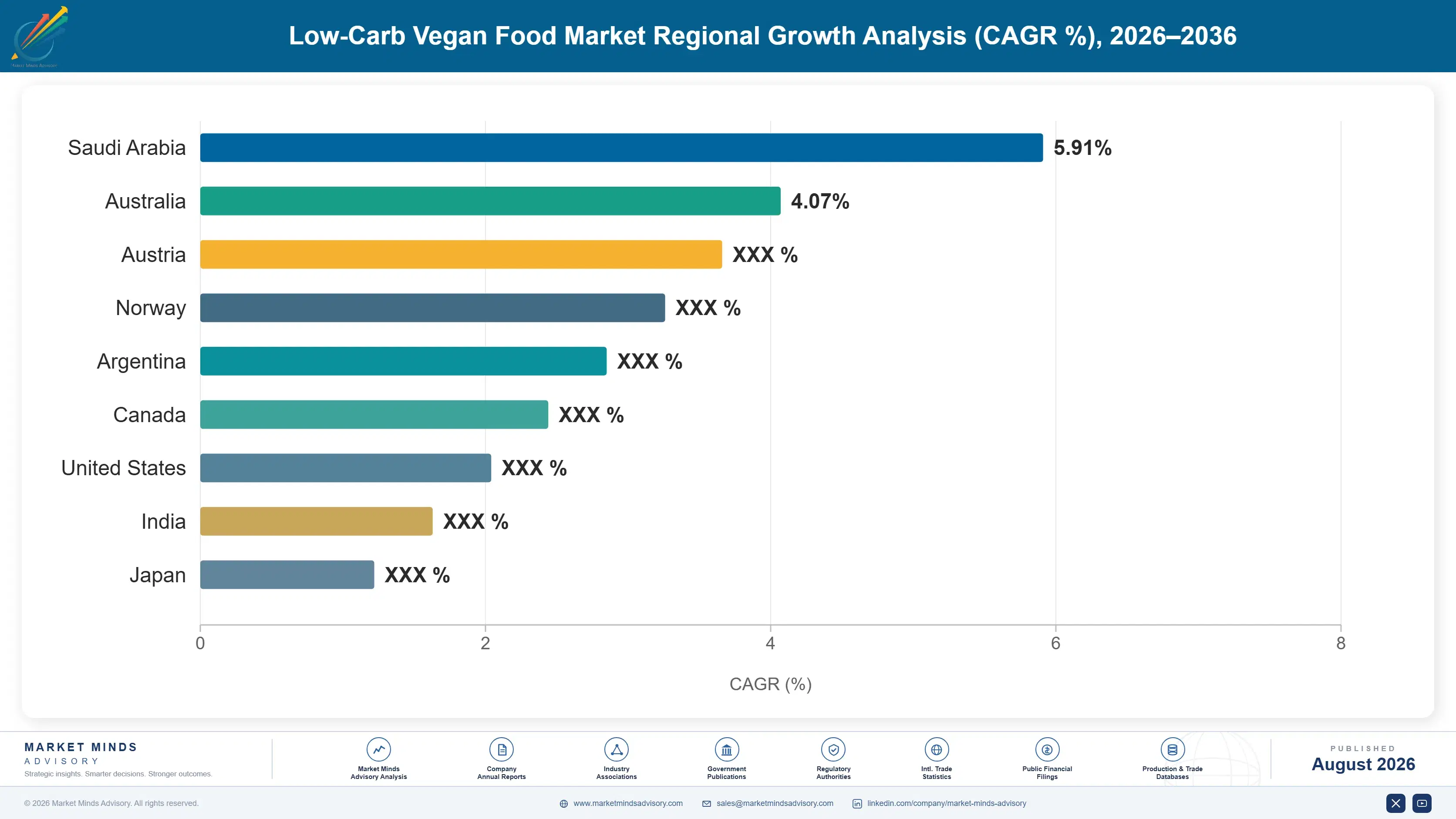
North America holds 31% of value because low-carbohydrate eating and plant-based eating overlap there more than anywhere else, and both have been mainstream for longer. Western Europe follows at 25% on regulatory labelling clarity and retailer commitment. Asian growth rests on medicine rather than lifestyle.

North America

Two dietary movements that developed independently overlap here more than anywhere else, since low-carbohydrate eating has been mainstream American practice for two decades and plant-based eating arrived alongside it rather than replacing it. That overlap is what makes this the largest regional market by a clear margin. Appetite suppressant medication has reached higher population penetration here than in any other market, and the consequences for food purchasing are visible in category data already. Retail distribution is broad and specialty channels are deep. Growth at 9.2% sits below the market average because the category is further developed here and the easy household penetration already happened. Later penetration comes harder and costs considerably more.
Share: 31% | CAGR: 9.2% (2026 to 2036)

Western Europe

Regulatory clarity on nutrition labelling gives this region something no other market has, since carbohydrate declaration is mandatory and consistent, which lets a low-carbohydrate claim mean something a shopper can verify. British and German retailers have committed shelf space to plant-based ranges well beyond what volumes strictly justify, and low-carbohydrate variants sit inside that commitment. The ultra-processed objection is stronger here than anywhere, which caps formulations depending on isolates and gums. Nordic markets show unusually high per-household consumption. Growth at 8.0% is the weakest of the seven regions and reflects a mature plant-based sector rather than any category-specific weakness. Mature rather than weak is the correct reading of it. Nobody expects a sudden change.
Share: 25% | CAGR: 8.0% (2026 to 2036)
Regional intelligence for 5 additional markets available in the complete report: East Asia, South Asia and Pacific, Latin America, Middle East and Africa, Eastern Europe. Contact sales@marketmindsadvisory.com.
low-carb-vegan-food-market-trends-forecast-country-cagr-analysis-1787555303563

Where Category Margin Actually Sits

Four moves matter for a manufacturer in a category that has just been handed a demand shift it did not earn and is mostly failing to notice. Two are about the customer that medication created, and two are about the repeat purchase problem that caps everything. Adding another nutritional claim is not among them.

Reposition against medication-driven appetite change now

People on incretin-based weight management medication eat far less by volume and need the same protein and micronutrients, which makes protein per calorie the purchase criterion and makes this category's existing formulation the answer. Almost nobody here is marketing to that customer, because plant-based language has been ethical and environmental for a decade rather than nutritional. Repositioning costs packaging and communication rather than product development, since the product already meets a 20% protein threshold. The population involved is growing quickly and buys on specification rather than on brand loyalty, which favours whoever arrives first.
Market Impact: Reaches buyers wanting at least 20% protein density

Fix texture before adding another claim

Repeat purchase sits at 38%, which means the category spends to acquire customers who try once and do not return, and every marketing pound is working against that leak. The failure is sensory rather than nutritional in almost every case, since a product meeting two dietary constraints usually compromises on texture and a curious first-time buyer has no reason to accept it twice. Investment in sensory development delivers considerably more than another front-of-pack statement. Manufacturers who fixed texture rather than claims have moved repeat rates into the fifties, which changes the entire economics of customer acquisition.
Market Impact: Lifts repeat purchase well above the 38% average

Simplify the label toward whole ingredients

Low-carbohydrate vegan formulation replaces what starch normally does, and that replacement usually arrives as isolates, gums and modified starches a shopper reads and rejects. The plant-based meat category learned this expensively when sales fell across several markets on ultra-processed objections. Reformulating toward whole nut, seed and fungal ingredients costs perhaps 15% more in raw materials and produces a label that survives scrutiny at the shelf. Manufacturers still defending long ingredient lists on technical grounds are winning an argument the consumer stopped having with them some time ago. That argument is over and they lost it.
Market Impact: Adds roughly 15% to the raw ingredient cost

Follow clinical demand into Asian markets

Indian and Chinese diabetes prevalence is rising sharply against established vegetarian eating and clinical guidance that addresses carbohydrate load explicitly, which makes this a medical category rather than a lifestyle one across much of Asia. Demand reaching consumers through physicians converts more slowly and retains far better than demand reaching them through advertising. Growth at 12.4% in India runs well ahead of anywhere else. Manufacturers building clinical and pharmacy channel presence rather than retail brand marketing are positioning for a demand curve that behaves nothing like the Western one. Nobody Western has built that channel yet.
Market Impact: Enters clinical markets now growing at 12.4% annually

Who Controls the Margin Pool

Five manufacturers hold just 22% of category value, measured on retail sales at manufacturer level, the basis used throughout this section. That fragmentation follows from how the category formed: small founder-led brands built on a specific dietary claim, funded by venture capital rather than by scale, and reaching shelves through specialty retail before mainstream grocery. The gap between leaders and everybody else is distribution reach rather than any formulation advantage.
Competition runs on three dimensions. Retail distribution, since shelf space in mainstream grocery is what separates a brand from a specialty product. Sensory quality, because repeat purchase at 38% is where this category actually loses. And ingredient access, given that specialty inputs have limited production capacity and forward contracts matter. Price competes less than the category's cost structure suggests it should.

Rankings shift where large food manufacturers acquire founder brands and put distribution behind them, which has happened repeatedly and will continue. Fermentation protein producers hold positions that scale cannot easily replicate, since the capacity is capital-intensive and slow to build. Private label at 14% is rising and will compress branded pricing further. Branded pricing has not adjusted to that yet.
low-carb-vegan-food-market-trends-forecast-company-positioning-matrix-1787555304084

Competitive Moat and Risk Dimensions

DANONE

Moat: Chilled distribution and scale

Danone holds chilled retail distribution across most developed markets that a founder-led brand spends a decade trying to reach, and plant-based products live or die on whether a shopper encounters them. That reach converts a modest formulation advantage into a commanding shelf position. Competitors with better products and no distribution remain specialty items regardless of how good the product is.
DANONE

Risk: Category positioning conflict

The company's plant-based portfolio is built on dairy alternative positioning aimed at a mainstream shopper, and low-carbohydrate claims appeal to a different buyer with a different motivation entirely. Serving both from one brand architecture confuses the message. Specialist competitors speaking to one customer clearly reach that customer more effectively than a broad portfolio ever manages.
MONDE NISSIN

Moat: Mycoprotein production capability

Quorn gives the company mycoprotein fermentation capacity built over decades, which is exactly the capability the fastest-growing segment depends on and which no competitor can build quickly. Fermentation assets are capital-intensive and slow to commission, and the process knowledge around them takes years to accumulate. That combination makes the position genuinely difficult to attack from outside.
MONDE NISSIN

Risk: Ultra-processed perception exposure

Mycoprotein products carry ingredient lists that read as processed to a consumer scrutinising labels, and the category's clean label objection reaches this positioning directly. Sales pressure across plant-based meat analogues has already demonstrated how quickly that objection converts into volume decline. Competitors formulating from whole nut and seed ingredients face far less of that exposure.

Players Tracked

Prominent Players

Danone
Monde Nissin
Nestle
Conagra Brands
The Simply Good Foods Company

Other Key Players

Beyond Meat
Oatly Group
Califia Farms
Blue Diamond Growers
Meati Foods
Nature's Fynd
ENOUGH
Hain Celestial
Amy's Kitchen
Upfield
Vivera
Heura Foods
THIS
Otsuka Holdings
Marukome

Recent Developments

FEBRUARY 2025

A American brand repositioned its range around protein density

An American plant-based manufacturer relaunched its range with front-of-pack protein density claims aimed explicitly at consumers eating smaller portions on weight management medication. This was a marketing and packaging change rather than any transaction or reformulation, and it is among the first direct commercial responses to that demand shift.
Signal: The first brand to name this customer explicitly will define the category language, and most competitors have not started
JULY 2025

A fermentation protein producer expanded manufacturing capacity

A fermentation protein producer commissioned additional capacity aimed at low-carbohydrate applications where conventional plant isolates cannot meet the specification. The expansion was organic capital investment rather than any partnership or acquisition, and it addresses the cost gap that currently caps household penetration in the segment.
Signal: Capacity rather than formulation is the binding constraint on fermentation protein, and it is finally being addressed
NOVEMBER 2025

A European retailer launched a low-carbohydrate plant-based private label

A major European grocery retailer introduced a private label range combining plant-based and low-carbohydrate positioning, sourced from contract manufacturers rather than through any acquisition or joint venture. Private label penetration in the category had previously sat well below mainstream grocery averages. That threshold has now been crossed.
Signal: Retailer entry at private label pricing will compress branded margins and confirms the category has reached mainstream volume

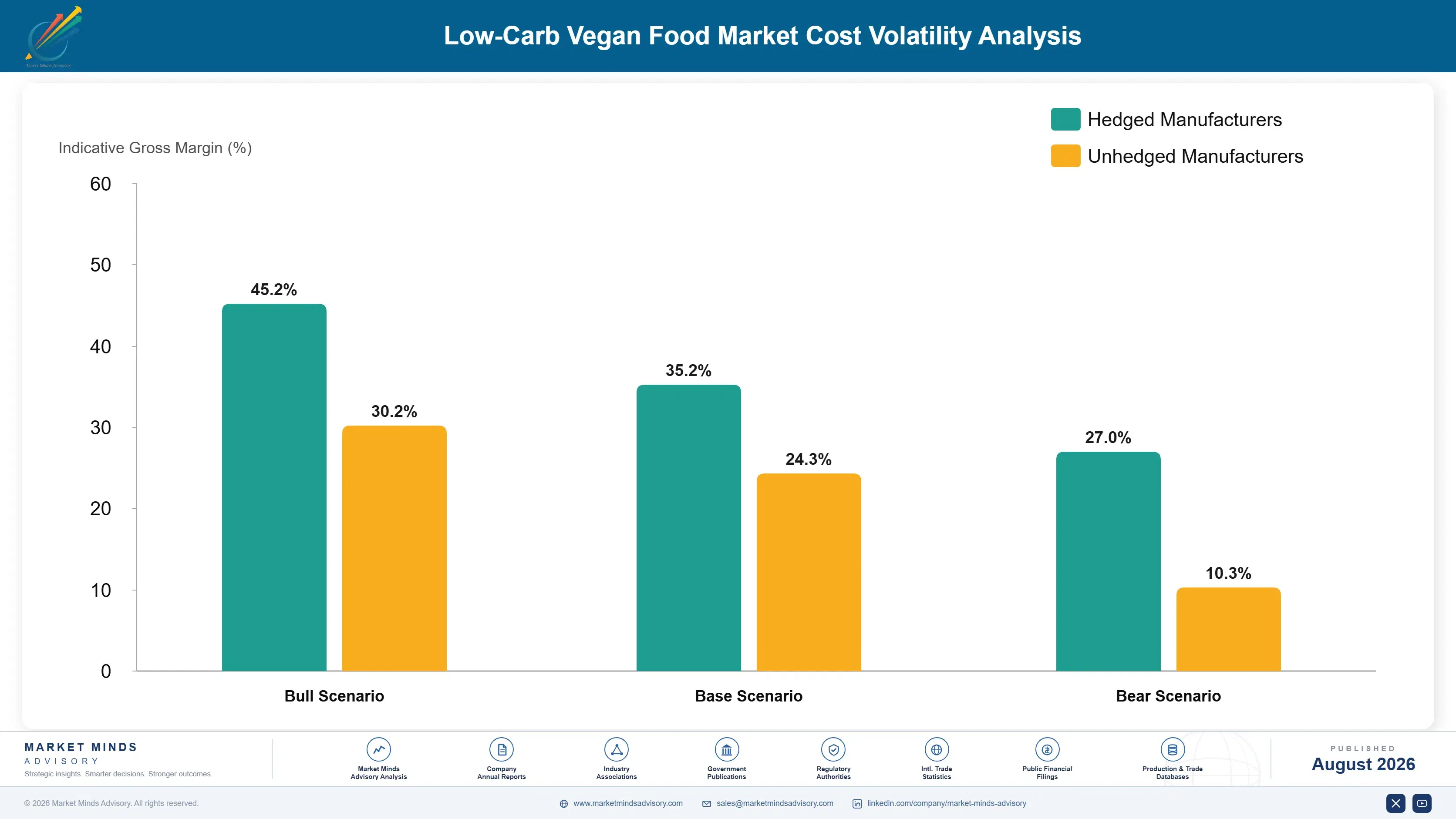
What Moves Manufacturer Cost

Raw formulation inputs account for around 47% of manufacturer cost, and almost all of them are specialty rather than commodity. Almond and macadamia flours, allulose and monk fruit extract, mycoprotein and konjac each have limited production capacity relative to conventional alternatives. Packaging, chilled or ambient distribution and retail trade spend make up most of the remainder. Manufacturing conversion cost is modest by comparison.
Almond prices moved sharply through 2021 and 2022 on Californian drought and water allocation, and USDA data record the acreage and yield pressure across those seasons. Danone noted input cost inflation across its plant-based operations in its Annual Report 2022. Manufacturers on annual retail price agreements absorbed most of the movement, since a grocery retailer sets shelf price for a period and does not reopen it because a crop failed.

Specialty input concentration is what makes this exposure unusual rather than merely irritating. A conventional food manufacturer buying commodity ingredients has alternatives, while a formulation requiring macadamia flour or monk fruit extract has very few. Manufacturers with forward contracts and multiple qualified sources carry considerably less risk than those buying spot. Smaller brands without purchasing scale face both worse pricing and worse availability at the same time.
low-carb-vegan-food-market-trends-forecast-cost-volatility-analysis-1787555304278

Contract specialty inputs forward across multiple seasons

Almond, macadamia and monk fruit supply depends on specific growing regions and behaves like agriculture rather than like a chemical input, which makes spot purchasing a bet on weather. Forward contracts convert that into a known cost and secure allocation when harvests disappoint. Smaller brands lacking scale should aggregate through co-manufacturers holding better positions.

Qualify second sources for every specialty formulation input

A formulation depending on one supplier of a specialty ingredient has an availability problem rather than a pricing problem, and availability problems stop production entirely. Qualifying alternative sources costs development time and delivers continuity worth considerably more than the saving from a single-source discount. Manufacturers who discovered this during recent harvest failures generally rebuilt their specifications afterwards.

Reformulate toward inputs with broader production bases

Several specialty ingredients deliver nutritional profiles that broader-production alternatives match closely enough for the claim to survive intact. Sunflower and pumpkin seed flours substitute for scarcer nut flours at lower cost. The work is sensory rather than nutritional, and manufacturers who never revisited original formulations are usually paying a premium for an ingredient choice made years ago.

Portfolio Architecture for Margin Defence

Margin in this category tracks formulation difficulty rather than volume, because a product meeting two dietary constraints simultaneously commands a price a conventional equivalent cannot. Low-carbohydrate plant milks and baking ingredients run at gross margins in the high twenties against private label pressure that is rising. Nut and seed snacks run better on brand and ingredient quality. Fermentation protein products and high-protein meal replacements run higher again, because the formulation and the production capability both exclude most competitors.
The tension is that plant milks and snacks build household penetration while meal replacements and fermentation products earn the returns, and they reach shoppers through different aisles and different purchase occasions. A brand known for beverages struggles to be taken seriously in nutrition, and the retail buyer treats the two as unrelated categories. Manufacturers spanning both have generally found the volume business consuming the marketing budget that the higher-margin products needed to establish themselves.

High-value pools sit in fermentation-derived protein, medication-aligned meal replacement and clinical channel positioning across Asian markets. None of the three is where current household penetration is. Brand recognition by itself defends very little in a category with 38% repeat purchase.

Volume / Commodity-Adjacent

Low-carbohydrate plant milks, baking flours and basic snack formats where private label at 14% penetration is competing directly on price. The eight-point range separates brands with forward-contracted specialty inputs from those buying spot against volatile harvests.
Gross Margin: 24%-32%

Premium / Certified

Nut and seed based snacks, konjac substitutes and branded formats where ingredient quality and clean labelling carry the price rather than the dietary claim alone. The ten-point spread reflects repeat purchase, which separates brands that fixed texture from those that added claims.
Gross Margin: 34%-44%

Sustainability / Regulatory / Next-Generation

Fermentation-derived proteins, medication-aligned meal replacement and clinically positioned products in Asian markets. The sixteen-point range is wide because fermentation capacity is scarce and clinical positioning prices against a medical need rather than a food comparison.
Gross Margin: 42%-58%
low-carb-vegan-food-market-trends-forecast-portfolio-architecture-1787555304780

High-value Sub-segments and Strategic Watch-out

Medication-Aligned Meal Replacement

Compounding at 12.2% and handed a demand shift by the pharmaceutical industry that almost nobody in this category is marketing toward yet. Somebody eating a third less needs complete nutrition in a small portion, which is exactly the existing product specification. Almost nobody has said so out loud.
Gross Margin: 44%-58%

Fermentation-Derived Protein

Growing at 14.4% and defended by capital-intensive capacity nobody builds quickly, delivering complete amino acid profiles at carbohydrate levels no legume isolate reaches. Cost remains the constraint, and it is closing slowly rather than suddenly at any point. Capacity is the only real constraint here.
Gross Margin: 42%-56%

Low-Carbohydrate Plant Milks

The household penetration volume, growing at 7.8% with private label at 14% and climbing steadily. Manage it for distribution reach and shelf presence rather than for margin, because margin here is heading in one direction only. Retailers will own this segment within a decade, comfortably.
Gross Margin: 24%-32%

Asian Clinical Channel Positioning

Rising diabetes prevalence against established vegetarian eating produces 12.4% Indian growth on medical logic rather than dietary fashion. Demand arriving through physicians converts slowly and retains far better than anything advertising ever produces. Western manufacturers have almost no presence in that channel at all. That gap will not stay open.
Gross Margin: 38%-52%

How Category Demand Renews

Demand here renews on the shopping trip and almost nothing protects it. A consumer chooses again every week against every alternative on the shelf, with no contract, no switching cost and no relationship beyond whether the last one was good. Repeat purchase at 38% describes exactly that vulnerability. The category acquires expensively and retains badly, which is the single economic fact that governs everything else about it.
Stickiness varies by motivation rather than by product. Consumers eating this way for medical reasons retain far better than those doing it for weight management or curiosity, because the reason does not go away and a physician reinforced it. Medication-driven buyers sit between the two, retaining while they take the medication. Curiosity buyers, who are the majority of first purchases, mostly do not return at all after one attempt.

The buyer profile is shifting faster than the marketing. This category was built for committed dietary adherents choosing on ethics and principle. It increasingly serves people with a clinical prescription or a medication changing their appetite, neither of whom cares about the environmental argument that dominates the packaging they are holding.
low-carb-vegan-food-market-trends-forecast-end-use-penetration-index-1787555305265

Where To Place The Bet

These are among the four positions where our research anticipates prominent divergence between winners and laggards over the coming forecast period. Each is grounded in the demand model, the regulatory perimeter, and the announced capacity pipeline.
01 / MEDICATION DEMAND REPOSITIONING

Market to the smaller appetite, not the ethics

People taking incretin-based weight management medication eat considerably less by volume while requiring the same protein and micronutrients, which makes protein per calorie the governing purchase criterion for a fast-growing population. That is exactly what a low-carbohydrate plant-based product already delivers, and the manufacturers who built these formulations were aiming at an entirely different customer. Repositioning costs packaging and communication rather than product development, and whoever names this customer first will define the category language everybody else has to follow.
02 / SENSORY DEVELOPMENT PRIORITY

Fix the texture before adding another claim

Repeat purchase sits at 38%, which means this category spends heavily to acquire customers who try once and never return, and every additional marketing pound works against a leak nobody has plugged. The failure is almost always sensory rather than nutritional, because a product satisfying two dietary constraints compromises on texture and a curious first-time buyer has no reason at all to accept that twice. Manufacturers who invested in sensory development instead of front-of-pack statements have moved repeat rates into the fifties and transformed their acquisition economics.
03 / LABEL SIMPLIFICATION DISCIPLINE

Shorten the ingredient list before consumers force it

Achieving low carbohydrate without animal ingredients means replacing what starch does for structure and mouthfeel, and that replacement usually arrives as isolates, gums and modified starches that a shopper reads at the shelf and puts back down again. The plant-based meat category already learned this expensively when analogue sales fell across several markets on ultra-processed objections nobody had forecast. Reformulating toward whole nut, seed and fungal ingredients costs roughly 15% more in raw materials and produces a label that survives the scrutiny consumers now apply.
04 / ASIAN CLINICAL CHANNEL ENTRY

Follow physicians into markets with medical demand

Indian and Chinese diabetes prevalence is rising sharply alongside established vegetarian eating and clinical guidance that now addresses carbohydrate load explicitly, which makes this a medical category across much of Asia rather than a lifestyle one. Demand reaching consumers through a physician converts considerably more slowly than advertising and retains dramatically better once it converts, because the reason for buying does not go away. Growth at 12.4% in India runs well ahead of anywhere else and almost no Western manufacturer has built the clinical channel presence to reach it.

Engagement Snapshot From the Field

A live engagement with an industry participant carrying material or product regulatory and market exposure ahead of a defining policy shift, showing how our research translates into a defensible multi-year portfolio strategy.
MARKET MINDS ADVISORY · CLIENT ENGAGEMENT SUMMARY
Low-Carb Vegan Food Producer Strategic Portfolio Review and Transition Roadmap 2026·Investment Scenario on Low-Carb Vegan Food Exposure Evaluation 2025-26
CLIENT PROFILE
A European plant-based food manufacturer with annual revenue around EUR 95 million (client-reported, unverified by MMA), producing low-carbohydrate snacks, meal replacements and plant milks across two facilities. Distribution ran through grocery and specialty health retail in six markets. Marketing spend was heavily weighted toward digital acquisition. Repeat purchase across the portfolio sat near the category average.
STRATEGIC CHALLENGE
Customer acquisition cost had risen for three consecutive years (client-reported, unverified by MMA) while revenue growth slowed, and management proposed increasing digital spend to compensate. Nobody had examined why acquired customers were not returning, which meant the proposed response would have bought more of a customer the business was already failing to keep.
MMA APPROACH
MMA separated the client's growth problem into acquisition efficiency and retention rather than accepting the spending explanation, using purchase panel data across the served markets. Sensory testing was commissioned against competitor products on the specific attributes driving non-repeat. Medication-driven demand was sized through the expert interview programme, and label composition was benchmarked against what consumers in each market reported rejecting.
KEY FINDINGS
  1. Retention rather than acquisition explained almost all of the growth slowdown, which meant additional digital spend would have made the underlying economics considerably worse.
  2. Sensory testing placed two of the client's three meal replacement products below every competitor tested on texture, which matched exactly where repeat purchase failed.
  3. No competitor in the client's markets was addressing medication-driven appetite change in packaging or communication anywhere, which left that positioning entirely available.
  4. The client's ingredient lists averaged nineteen items against a consumer tolerance the research placed nearer twelve, which explained rejection at shelf better than price did.
CLIENT PROFILE
A European plant-based food manufacturer with annual revenue around EUR 95 million (client-reported, unverified by MMA), producing low-carbohydrate snacks, meal replacements and plant milks across two facilities. Distribution ran through grocery and specialty health retail in six markets. Marketing spend was heavily weighted toward digital acquisition. Repeat purchase across the portfolio sat near the category average.
STRATEGIC CHALLENGE
Customer acquisition cost had risen for three consecutive years (client-reported, unverified by MMA) while revenue growth slowed, and management proposed increasing digital spend to compensate. Nobody had examined why acquired customers were not returning, which meant the proposed response would have bought more of a customer the business was already failing to keep.
MMA APPROACH
MMA separated the client's growth problem into acquisition efficiency and retention rather than accepting the spending explanation, using purchase panel data across the served markets. Sensory testing was commissioned against competitor products on the specific attributes driving non-repeat. Medication-driven demand was sized through the expert interview programme, and label composition was benchmarked against what consumers in each market reported rejecting.
KEY FINDINGS
  1. Retention rather than acquisition explained almost all of the growth slowdown, which meant additional digital spend would have made the underlying economics considerably worse.
  2. Sensory testing placed two of the client's three meal replacement products below every competitor tested on texture, which matched exactly where repeat purchase failed.
  3. No competitor in the client's markets was addressing medication-driven appetite change in packaging or communication anywhere, which left that positioning entirely available.
  4. The client's ingredient lists averaged nineteen items against a consumer tolerance the research placed nearer twelve, which explained rejection at shelf better than price did.
RECOMMENDED STRATEGY
Phase 1: Phase one: freeze the digital spend increase and redirect the budget into sensory reformulation of the two failing meal replacement products. Phase 2: Phase two: reposition the meal replacement range around protein density for consumers eating smaller portions, ahead of any competitor claiming it. Phase 3: Phase three: reformulate toward whole nut, seed and fungal ingredients across the portfolio, accepting higher raw material cost for a shorter label.
OUTCOME
Digital spend was held flat and both meal replacement products reformulated. The repositioned range launched in early 2026 with protein density claims. Label simplification is under way across the portfolio, and the client reports repeat purchase improving materially for the first time since launch (client-reported, unverified by MMA).

Frequently Asked Questions

Foundational context covering the market sizes, CAGR, scope, country, region and competition that inform every finding below. This section is provided to cover basics and most often pre-purchase conversations, answered from the MMA Primary Research Dataset.

What is the current size of the Low-Carb Vegan Food Market?

The market was valued at USD 3.4 billion in 2025, rising to an estimated USD 3.73 billion in 2026. North America holds the largest regional share at 31% of value.

How large will the Low-Carb Vegan Food Market be by 2036?

MMA forecasts USD 9.32 billion by 2036 under the base case, an expansion multiple of 2.50 times the 2026 value. That represents USD 5.59 billion of incremental value.

What is the CAGR for the Low-Carb Vegan Food Market 2026 to 2036?

The base case runs at 9.6% compound annual growth between 2026 and 2036, with a bull case at 10.9% and a bear case at 8.3%. Historical growth from 2020 to 2025 was 8.4%.

Which segment is growing fastest?

Fermentation-derived protein products lead at 14.4%, half again the market rate, because mycoprotein carries complete amino acids without the carbohydrate. Meal replacements follow at 12.2%.

Who are the major companies in the Low-Carb Vegan Food Market?

Danone, Monde Nissin, Nestle, Conagra Brands and Simply Good Foods hold just 22% of value between them. Distribution reach rather than formulation advantage sustains those positions.

Which country is growing fastest?

India leads at 12.4%, where one of the world's largest diabetic populations meets an established vegetarian tradition. Physicians rather than advertising drive most of that demand.

Report Segmentation Architecture

The full report scope spans multiple orthogonal segmentation dimensions, with cross-tabulated demand data provided for each dimension pair. Coverage extends further to regional breakdowns, trend trajectories, and the competitive detail needed to support segment-level decision-making.

By Consumption Format

  • Low-Carb Plant Milks and Beverages
  • Nut and Seed Based Snacks and Crackers
  • Fermentation-Derived Protein Products
  • High-Protein Meal Replacements and Bars
  • Konjac and Low-Carb Noodle Substitutes
  • Low-Carb Baking Ingredients and Flours

By End-Use Industry

  • Grocery Retail
  • Specialty Health Retail
  • Pharmacy and Clinical Channel
  • Online Direct to Consumer
  • Gym and Wellness Retail
  • Workplace and Institutional Catering

By Consumer Motivation

  • Medically Directed Purchase
  • Weight Management Medication Users
  • Athletic and Body Composition
  • Ethical and Environmental Adherents
  • Occasional and Curiosity Purchase

By Region

  • North America
  • Western Europe
  • East Asia
  • South Asia and Pacific
  • Latin America
  • Middle East and Africa
  • Eastern Europe

Scope, Methodology, and Coverage

Every figure in this report is reproducible from documented input assumptions. The scope below maps the historical period, the forecast horizon, the segmentation dimensions, and the countries covered, alongside the underlying primary and qualitative methodology.
Historical Period
2020 to 2025
Forecast Period
2026 to 2036
Base Year
2025 (USD billions; MMA Primary Research Dataset, August 2026)
Market Definition
The market comprises packaged food and beverage products formulated to be simultaneously plant-based and low in carbohydrate, covering low-carb plant milks and beverages, nut and seed based snacks and crackers, fermentation-derived protein products, high-protein meal replacements and bars, konjac and low-carb noodle substitutes, and low-carb baking ingredients and flours. Value is measured at manufacturer level on retail sales across grocery, specialty, pharmacy and online channels. Conventional plant-based products without a carbohydrate claim, dairy and animal-derived low-carb products, dietary supplements and powders, and foodservice preparation fall outside scope.
Quantitative Units
USD billions (current prices); thousand tonnes of product sold annually; USD per kilogram by consumption format
Segmentation Dimensions
By Consumption Format; By End-Use Industry; By Consumer Motivation; By Region
Regions Covered
North America, Western Europe, East Asia, South Asia and Pacific, Latin America, Middle East and Africa, Eastern Europe
Countries Covered
United States, Canada, Mexico, Brazil, Argentina, Chile, United Kingdom, Germany, France, Netherlands, Sweden, Denmark, Spain, Italy, Poland, Czechia, Hungary, Romania, Japan, South Korea, China, Taiwan, India, Australia, New Zealand, Thailand, Singapore, United Arab Emirates, Israel, South Africa
Key Companies Profiled
Danone, Monde Nissin, Nestle, Conagra Brands, The Simply Good Foods Company, Beyond Meat, Oatly Group, Califia Farms, Blue Diamond Growers, Meati Foods, Nature's Fynd, ENOUGH, Hain Celestial, Amy's Kitchen, Upfield, Vivera, Heura Foods, THIS, Otsuka Holdings, Marukome
Quantitative Methodology
Primary survey, n=3,800 respondents, Q4 2025, six countries; demand-side model with trade association cross-validation
Qualitative Methodology
47 expert interviews, Q4 2025; applied to validate demand model assumptions, identify emerging dynamics, and assess competitive positioning
Report Format
PDF and XLSX data workbook (Word format preview document)
Publisher
Market Minds Advisory
Report Code
MMA-2026-AGR-091
Published
August 2026
Contact
sales@marketmindsadvisory.com | www.marketmindsadvisory.com

Purchase the full Low-Carb Vegan Food Market Report (2026 to 2036).

The full report sizes the global low-carb vegan food market to 2036 across six consumption formats and seven regions, measured on retail sales at manufacturer level. It treats appetite-suppressant medication as a demand driver rather than a curiosity and sizes the population it creates separately from conventional dietary buyers. Competitive analysis covers 20 participants evaluated on retail sales value, with moat and risk assessment for the two leaders. Repeat purchase failure is quantified by format and by consumer motivation, since that is where category economics actually break. Four quantified revenue levers close the analysis.
Six-format segment sizing with segment-level growth rates
Seven-region share and growth breakdown to 2036
Twenty-participant competitive map on one retail basis
Medication-driven demand sized separately from dietary buyers
Repeat purchase failure quantified by format and motivation
Four quantified revenue levers with commercial impact ranges

Built For The People Who Decide

From boardroom strategy to bench-side execution, this report is read cover-to-cover by leaders shaping the next decade of their industry, turning demand scenarios, market dynamics and valuation benchmarks into decisions.
CXOs/ Presidents/ VPs/ Managers
M&A and Corporate Development
Strategy Teams and R&D Heads
Procurement and Product Directors
Regulatory and Compliance Leaders
Investor Relations and Equity Analysts