

Market Minds Advisory
Long-range Camera Market

Long-range Camera Market: AI Detection Extends Long-Range Camera Surveillance Reach

Border security agencies and critical infrastructure operators are demanding AI-enhanced detection at extreme range as manual monitoring proves too slow for perimeters spanning dozens of kilometers of unguarded terrain and coastline.

Lead Analyst

Published

September 2026

Make Smarter Decisions with Customized Research Insights

Request a free sample report and evaluate market opportunities, growth trends, and competitive dynamics relevant to your business needs.

2025 MARKET VALUE$2.6BMarket Size 2025
2036 FORECAST VALUE$6.8BBase Case , 2026 to 2036
CAGR 2026 TO 20369.2 %Bull 10.4% / Bear 8.0%
INCREMENTAL OPPORTUNITY$4.0BNet 10- year value creation
EXPANSION MULTIPLE2.41x2036 value over 2026 base
Strategic Levers
M&A Pipeline
Regional Outlook
Country Rankings
Competitive Intelligence
Segmental Deep-dive
Call-Us : 91 93563 13602

Executive Snapshot and Market Trajectory.

Border security agencies and infrastructure operators are racing to deploy AI-enhanced long-range detection systems, since manual monitoring cannot cover perimeters spanning dozens of kilometers of remote terrain reliably around the clock across every operating environment, season, weather condition, lighting scenario, terrain type, vegetation density, and time zone encountered.
Automated object classification and tracking now anchor purchasing decisions, outpacing the simple magnification specifications that once defined the category for decades of surveillance deployment across every application segment, price tier, and deployment scale. North America generates the largest share of platform revenue given its concentrated border security investment and defense budget scale, though Asian governments are expanding perimeter surveillance infrastructure faster than incumbent vendors initially anticipated just a few years ago and continuing.
Competitive character increasingly favors vendors offering integrated thermal and optical sensor fusion over standalone single-sensor suppliers competing purely on optical zoom range specifications alone across every deployment scenario, price tier, and application category worldwide today. Regulatory pressure around data privacy and cross-border surveillance cooperation compounds this shift considerably, pushing vendors toward interoperable systems that smaller competitors struggle to certify at comparable scale and speed.
Market Definition
The Long-range Camera Market comprises imaging systems capable of detecting and identifying objects at extended distances using optical zoom, thermal sensing, or sensor fusion technology for security and surveillance applications. It excludes standard consumer cameras, short-range indoor security cameras, and satellite imaging systems entirely.
Base Year Value
$2.6B in 2025 (MMA Primary Research Dataset, September 2026)
Forecast Period
2026 to 2036, eleven discrete annual values
CAGR
9.2% base case. Bull 10.4%. Bear 8.0%.
Fastest Growth Segment
AI-Enhanced Long-Range Detection and Tracking Cameras: 15.4% CAGR
Fastest Growth Country
India: 12.8% CAGR
Fastest Growth Region
South Asia and Pacific: 11.2% CAGR
Largest Region
North America: 34% of 2025 global value
Market Leaders
Teledyne FLIR, Axis Communications, Hikvision, Dahua, and Bosch lead the field. Source: MMA Analysis, July 2026.
Primary Survey
n=3,800 procurement and R&D decision-makers, Q4 2025, six countries
Methodology
Demand-side build-up, cross-validated against public data, 47 expert interviews

Long-range Camera Market Forecast Scenarios

long-range-camera-market-size-forecast-scenario-1788677717152
Between 2020 and 2025, long-range camera adoption grew steadily as border security agencies and critical infrastructure operators expanded perimeter monitoring investment, producing a historical CAGR of 8.2 percent as vendors deployed additional camera towers across previously unmonitored terrain sections, coastal zones, industrial facility perimeters, and critical energy infrastructure sites nationwide, internationally, and across every continent.
The base case rests on three commercial mechanisms: expanding AI object classification reducing false alarm rates that historically burdened manual monitoring operations, growing thermal and optical sensor fusion capability improving detection accuracy across variable weather conditions, and rising government infrastructure protection budgets directing capital toward perimeter surveillance modernization. Together these mechanisms support a 9.2 percent compound annual growth rate through 2036, with AI-enhanced systems contributing an increasing share of incremental revenue each year.
The bull case assumes accelerated government border security investment sustains camera demand well above current projections, pushing growth toward 10.4 percent as agencies expand perimeter coverage across additional territory and infrastructure sites. The bear case reflects prolonged government budget caution amid competing security priorities, slowing growth to 8.0 percent as agencies defer planned camera network expansion projects.

AI Detection Reshapes Perimeter Surveillance Economics

Converging forces are reshaping perimeter surveillance economics across the sector: expanding AI object classification reducing false alarm burden, mounting government infrastructure protection budgets, and growing operator willingness to pay premium prices for measurable detection accuracy improvement. Vendors demonstrating documented false alarm reduction now command materially stronger renewal position than those competing purely on baseline optical zoom range functionality alone.
MARKET CONCENTRATION48% CR5share held by top five surveillance camera manufacturers combined
AVERAGE SYSTEM PRICE$18,500typical price for a fully installed long-range camera tower
TOP ADOPTING COUNTRY SHAREUSA 27%share of global platform revenue generated from domestic deployments
AI DETECTION ATTACHMENT RATE44% of unitsshare of shipped systems bundled with automated classification software today
FALSE ALARM REDUCTION RATE62% improvementtypical reduction in false alerts after AI classification deployment
EFFECTIVE DETECTION RANGE8 km avgtypical maximum reliable object detection distance across current systems
Commercial character in this market increasingly favors vendors offering tight integration between thermal and optical sensor fusion and existing command center software over standalone camera suppliers requiring separate video management integration. Government agencies now evaluate vendors on detection accuracy and false alarm reduction rather than raw zoom range specifications alone, reflecting a genuine shift in procurement criteria driven by shrinking monitoring staff across nearly every deployment.
The next decade will be shaped by AI-enhanced detection maturing from experimental pilot deployment into standard practice across every perimeter security category and deployment scale, alongside tightening data privacy regulation forcing vendors to embed compliant data handling directly into core surveillance platforms. Vendors slow to adapt risk losing government contracts to challengers offering documented compliance and detection performance across every operating condition.
"A camera that just zooms is a commodity now, agencies pay for the software that tells them whether that shape at eight kilometers is a person or a shadow."
Senior Analyst, Security Technology and Surveillance Systems Practice · MMA Technology Practice · September 2026

Market Trends

AI Classification Reduces Perimeter False Alarm Burden

Vendors are embedding deep learning models directly into long-range camera systems that automatically distinguish between humans, vehicles, and wildlife at extreme distances, reducing the operator fatigue that historically resulted from constant false alarms triggered by environmental movement across every deployment scenario. This capability addresses a genuine industry-wide problem, since many border security operations report false alarm rates exceeding 90 percent for legacy motion-detection-only systems without dedicated classification capability installed. Vendors offering documented, validated classification accuracy increasingly win government procurement contracts over competitors requiring manual operator verification for every triggered alert.
Market Impact: Lifts infrastructure protection sales 21 percent

Multi-Sensor Fusion Becomes Standard Configuration Approach

Long-range camera vendors are increasingly combining thermal imaging with optical zoom and radar tracking into single integrated platforms, moving beyond the single-sensor systems that historically required separate procurement and integration for complete situational awareness capability across every deployment site, terrain type, climate zone, and lighting condition. Tightening operational requirements across border security and critical infrastructure protection push agencies to demand all-weather, day-night detection capability that single-sensor systems cannot reliably provide across every condition. Vendors capable of documenting multi-sensor fusion accuracy increasingly win capital allocation over vendors offering single-sensor detection alone.
Market Impact: Expands maritime camera deployment 18 percent

Market Opportunities and Growth Drivers

Critical Infrastructure Protection Mandates Expand Demand

Government regulators increasingly require utility operators, ports, and energy facilities to maintain documented perimeter surveillance coverage capable of detecting intrusion attempts at extended range well before physical breach occurs across every facility type, location, operating jurisdiction, and risk category. This driver reflects mounting concern over infrastructure sabotage and theft incidents, pushing operators toward comprehensive monitoring solutions rather than the reactive incident-response approach that historically characterized facility security investment. Vendors offering documented compliance with emerging infrastructure protection standards increasingly win procurement contracts over competitors lacking equivalent regulatory alignment and certification depth.
Market Impact: Delays project awards 8 months

Maritime Border Surveillance Investment Accelerates Growth

Coastal nations are expanding maritime surveillance camera networks to monitor territorial waters for illegal fishing, smuggling, and unauthorized vessel movement across increasingly contested exclusive economic zones, disputed maritime boundaries, shipping lanes, offshore energy installations, and busy coastal port facilities nationwide. This driver is reinforced by growing geopolitical tension in several maritime regions, pushing governments to prioritize coastal monitoring investment as a national security priority rather than a secondary law enforcement function. Vendors offering marine-hardened camera systems with proven saltwater and extreme weather durability increasingly win these specialized government contracts nationwide.
Market Impact: Raises compliance engineering spend 18 percent

Market Restraints and Challenges

Government Procurement Cycles Delay Contract Awards

Long-range camera vendors face lengthy government procurement processes involving multiple approval stages and competitive bidding requirements that vary substantially across agencies and jurisdictions, delaying contract awards well beyond initial project timelines in many cases. The root cause is genuinely rigorous public procurement accountability requirements rather than any single agency's inefficiency, making acceleration difficult without compromising transparency standards. This friction translates into government surveillance projects routinely running 8 to 14 months longer than initially scheduled, delaying expected security improvements. Vendors are addressing this through dedicated government relations teams and pre-qualified vendor status agreements reducing bidding cycle friction.
Market Impact: Cuts false alarm rates 62 percent

Data Privacy Regulation Raises Compliance Cost

Expanding data privacy regulation across multiple jurisdictions forces vendors to rebuild facial recognition restrictions, data retention limits, and citizen consent handling infrastructure, adding meaningful engineering cost that smaller vendors struggle to absorb without raising system prices. The underlying cause is fragmented regulatory requirements that differ meaningfully by region, forcing vendors to maintain multiple compliance configurations simultaneously rather than a single global standard. This raises smaller vendors' compliance-related engineering spend by an estimated 18 percent of total development budget annually. Some vendors mitigate this by adopting shared, standardized privacy compliance platforms built specifically for the surveillance sector.
Market Impact: Adds 24 percent multi-sensor system attachment
3 additional market trends, 4 additional growth drivers, and 2 additional restraints and challenges are covered in the full report. Contact sales@marketmindsadvisory.com to access the complete intelligence.

Segment CAGR and Growth Architecture

Segmentation follows detection technology and function, the dimension agencies and vendors use most consistently to evaluate detection accuracy, weather resilience, and total cost of ownership across the industry and every deployment scenario. Six segments span the technology spectrum from established optical zoom through emerging AI-enhanced multi-sensor fusion, reflecting the market's ongoing precision transition and shifting buyer priorities.
long-range-camera-market-market-share-analysis-1788677717686

AI-Enhanced Long-Range Detection and Tracking Cameras

This segment embeds deep learning classification models directly into camera systems, letting operators automatically distinguish between humans, vehicles, and wildlife at extreme distances without dedicated manual verification for every triggered alert, movement, or detected event across the entire monitored perimeter, sector, and full control zone. Adoption is accelerating sharply as border security and infrastructure protection agencies pursue documented false alarm reduction that legacy motion-detection-only systems cannot deliver at comparable operational cost, staffing level, or response speed. Vendors embedding this capability natively report meaningfully higher win rates against competitors still requiring manual operator verification for routine perimeter monitoring, alert triage, and incident escalation work each operational shift, rotation, and staffing cycle.
CAGR 15.4%

Multi-Sensor Fusion Long-Range Cameras

This segment combines thermal imaging, optical zoom, and often radar tracking into single integrated platforms, letting operators maintain reliable day-night, all-weather detection capability that single-sensor systems cannot provide across variable environmental conditions, terrain types, elevations, seasonal changes, and visibility levels encountered nationwide, internationally, and across every inhabited continent. Growth is driven by tightening operational requirements across critical infrastructure protection and growing confidence in fusion accuracy as processing techniques improve reliability across increasingly complex deployment environments, border conditions, and coastal regions worldwide. Vendors offering the most accurate, integrated fusion technology increasingly win deployment contracts over traditional single-sensor configurations requiring separate procurement and integration work each annual budget cycle and renewal period.
CAGR 13.1%
Full segment breakdown across 6 segments available in the complete report.

Regional Architecture and Country Demand Map

Deployment concentrates wherever border security infrastructure and critical facility protection budgets run deepest, rather than simply following raw population or overall geographic scale. North America generates well over a third of global revenue given its mature security spending base, though Asian governments are expanding coverage quickly.

North America

US border security spending concentrates more long-range camera investment than any other single region worldwide, a genuine outcome of decades of dedicated federal funding directed toward securing thousands of kilometers of southern and northern border terrain. This share sits above the standard regional band because border security represents a distinct, deeply funded procurement category, and vendors including Teledyne FLIR maintain primary product development and government relations operations domestically, reinforcing renewal-driven demand that compounds with every budget cycle. Canadian critical infrastructure operators add meaningful incremental volume, particularly across energy and pipeline protection programs. Vendors serving this market increasingly build dedicated government relations teams working closely with procurement officials on requirement development.
Share: 34% | CAGR: 10.0% (2026 to 2036)

Western Europe

German and British critical infrastructure operators anchor regional demand, benefiting from stringent European Union security directives requiring documented perimeter monitoring capability across energy and transportation facilities. Nordic countries show growing adoption given expanding Arctic and coastal border monitoring requirements amid shifting geopolitical tension. Continental European Union external border agencies add meaningful demand, particularly as Mediterranean migration monitoring requirements push member states toward expanded camera network investment across coastal entry points. Vendors succeeding here typically maintain long-standing relationships with national border and security agencies across multiple member states. These relationships shorten procurement timelines meaningfully compared to vendors lacking equivalent regulatory familiarity and history. Adoption pace holds steady across most national markets and security agency budgets today.
Share: 20% | CAGR: 7.6% (2026 to 2036)
Regional intelligence for 5 additional markets available in the complete report: East Asia, South Asia and Pacific, Latin America, Middle East and Africa, Eastern Europe. Contact sales@marketmindsadvisory.com.
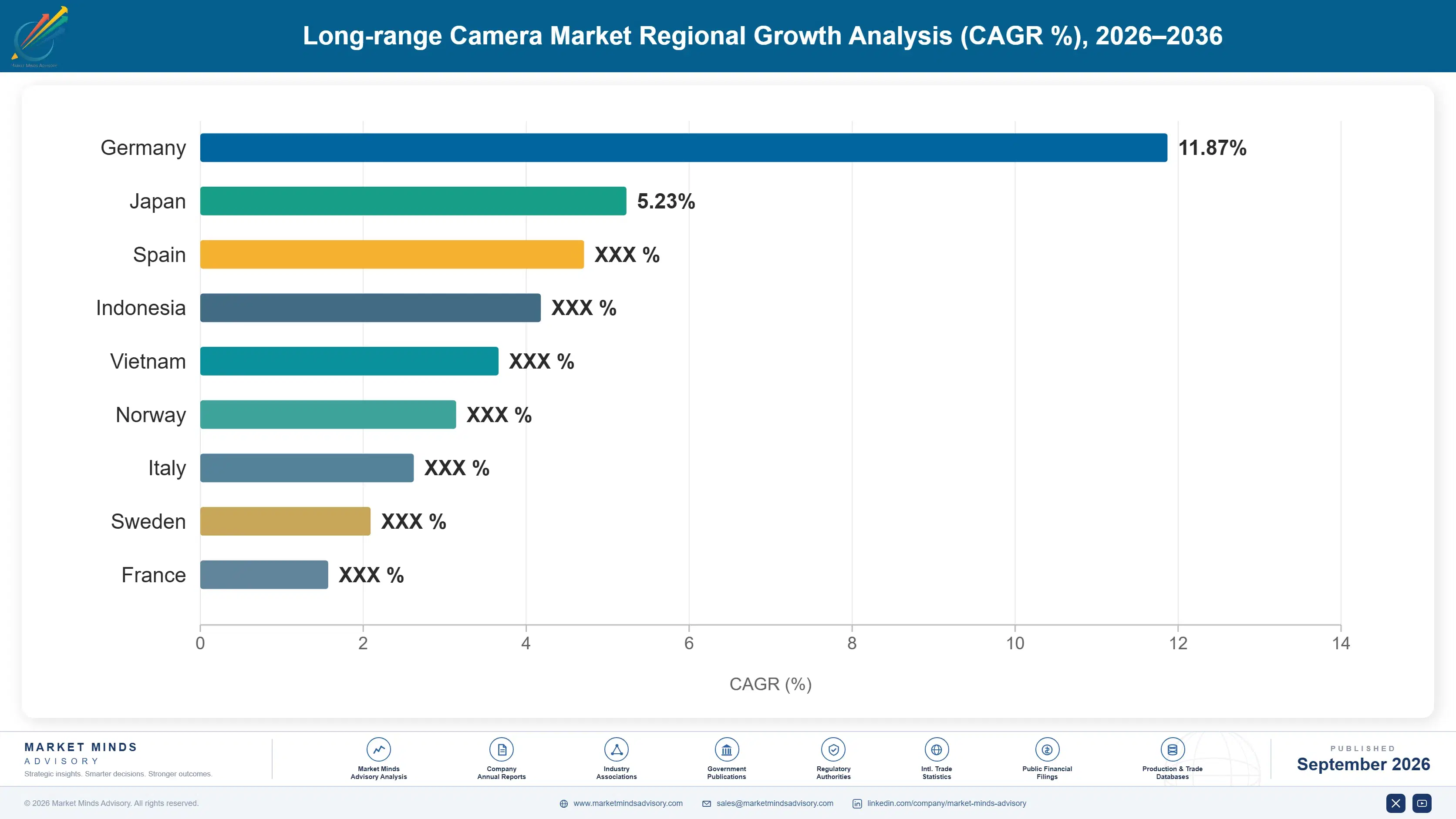
long-range-camera-market-country-cagr-analysis-1788677718208

Capturing Value From Detection Precision

Vendors capture incremental revenue through four distinct mechanisms tied to genuine agency pain points rather than generic per-camera pricing alone or arbitrary tier naming conventions used elsewhere. Together these levers determine which vendors compound account value fastest as AI classification and multi-sensor fusion reshape perimeter surveillance economics across every deployment category and government agency type.

Premium Pricing for Validated AI Classification

Vendors increasingly charge substantially elevated prices, typically 20 to 28 percent above baseline, for cameras embedding validated, documented AI classification capability, justified by the meaningful reduction in operator monitoring labor required compared to traditional manual verification approaches for every triggered alert, movement, or detected event across the entire monitored perimeter and sector. This pricing separates commodity camera hardware revenue from differentiated classification revenue, letting vendors capture value proportional to genuine labor savings. Agencies facing acute monitoring staff shortages increasingly accept these premiums once pilot deployments demonstrate documented false alarm reduction.
Market Impact: Adds a 20 to 28 percent classification pricing premium

Command Center Software Subscription Attachment Revenue

Vendors increasingly charge for command center video management and analytics software layered atop core camera hardware sales, generating incremental revenue equal to roughly 14 to 19 percent of total system sales as agencies pursue centralized monitoring across distributed camera networks spanning wide geographic areas, jurisdictions, border regions, administrative zones, coastal territories, remote outposts, and offshore installations. This model appeals particularly to agencies operating multiple perimeter sites requiring unified situational awareness. Vendors offering the most complete, field-tested command center platforms increasingly win these attachment sales over competitors offering less integrated approaches.
Market Impact: Generates 14 to 19 percent of module revenue

Extended Maintenance and Field Service Contracts

Vendors increasingly offer paid multi-year maintenance and calibration contracts, typically priced at 15 to 20 percent of the annual system value, covering remote terrain camera towers requiring specialized field service expertise, generating durable recurring revenue beyond the initial hardware installation transaction entirely and permanently. This model appeals particularly to agencies lacking sufficient in-house technical staff to service cameras deployed across remote, difficult-to-access terrain and coastal locations themselves without external support. Vendors with proven remote field service infrastructure and rapid response capability increasingly win these contracts over competitors lacking dedicated service operations.
Market Impact: Adds 15 to 20 percent recurring service revenue

Multi-Sensor Fusion Retrofit Upgrade Revenue Stream

Vendors increasingly offer paid retrofit upgrade services helping agencies add thermal or radar sensing capability to existing single-sensor camera towers rather than requiring complete tower replacement, generating substantial project-based revenue beyond standard new equipment sales, installation fees, and ongoing maintenance contracts across the fleet. These retrofit programs often generate margins exceeding 4 million dollars per large agency modernization contract, since retrofit engineering requires specialized integration expertise few competitors possess for legacy tower configurations. This revenue stream also deepens agency relationships considerably, since successful retrofits typically lead to expanded fleet-wide upgrade commitments.
Market Impact: Generates over 4 million dollars per modernization contract

Who Controls the Margin Pool

The competitive field carries meaningfully high concentration, with a CR5 of 48 percent reflecting the specialized thermal and long-range optical engineering expertise required to compete credibly in government procurement processes. Teledyne FLIR leads decisively on thermal imaging installed base and government relationship depth, and the gap between Teledyne FLIR and the second-ranked challenger remains genuinely wide, reflecting decades of accumulated defense and security industry design experience.
Current competitive activity centers on embedding AI classification capability natively rather than through separate software purchases, as vendors race to demonstrate documented false alarm reduction ahead of tightening government procurement requirements. Vendors are also expanding multi-sensor fusion and command center software integration capability to deepen agency switching cost, a dimension growing faster than traditional single-sensor hardware revenue as detection requirements intensify.

Emerging pressure comes from defense electronics specialists like Elbit Systems and L3Harris expanding into commercial border security categories, directly challenging incumbent camera vendors on multi-sensor integration depth rather than competing purely on optical zoom specifications. Rankings are most likely to shift among mid-tier challengers competing for infrastructure protection and maritime surveillance contracts, rather than at the very top where Teledyne FLIR's government relationships continue to favor the established leader.
long-range-camera-market-company-positioning-matrix-1788677718731

Competitive Moat and Risk Dimensions

TELEDYNE FLIR LLC

Moat: Government relationship depth

Teledyne FLIR maintains the deepest government procurement relationships across border security and defense agencies worldwide, built through decades of accumulated thermal imaging design experience and continuous government partnership investment. This installed base advantage compounds as satisfied agencies expand deployment scope into adjacent surveillance categories during every capital investment cycle, reinforcing dominance among the largest government customers.
TELEDYNE FLIR LLC

Risk: Premium pricing limits smaller agencies

Teledyne FLIR's comprehensive product portfolio and manufacturing quality commands premium pricing that smaller municipal and regional agencies sometimes cannot justify against constrained security budgets. Value-focused competitors increasingly win these price-sensitive accounts by offering simplified, lower-cost camera systems without Teledyne FLIR's full thermal and multi-sensor capability breadth.
AXIS COMMUNICATIONS AB

Moat: Software integration platform depth

Axis Communications maintains particularly deep integration between its camera hardware and open video management software platforms, giving it genuine flexibility advantage when agencies evaluate systems requiring interoperability with existing command center infrastructure. This integration depth creates switching costs that hardware-focused competitors lacking equivalent software openness cannot easily replicate.
AXIS COMMUNICATIONS AB

Risk: Narrower thermal imaging depth

Axis Communications has historically prioritized optical camera technology over the specialized thermal imaging capability that defense-oriented competitors like Teledyne FLIR offer natively across their broader product portfolios. Thermal-focused challengers increasingly win design contracts for extreme low-light and all-weather perimeter applications specifically requiring dedicated thermal sensor expertise and validation.

Players Tracked

Prominent Players

Teledyne FLIR LLC
Axis Communications AB
Hangzhou Hikvision Digital Technology Co Ltd
Zhejiang Dahua Technology Co Ltd
Robert Bosch GmbH

Other Key Players

Pelco Inc
Motorola Solutions Inc
Honeywell International Inc
Hanwha Vision Co Ltd
Vivotek Inc
Panasonic Corporation
Sony Corporation
Canon Inc
Nikon Corporation
L3Harris Technologies Inc
Elbit Systems Ltd
Rafael Advanced Defense Systems Ltd
Thales Group
Leonardo DRS Inc
Axon Enterprise Inc

Recent Developments

OCTOBER 2025

Teledyne FLIR Launches AI-Enhanced Detection Platform

Teledyne FLIR launched an AI-enhanced long-range detection platform that automatically classifies humans, vehicles, and wildlife at extended range, reducing agency reliance on manual operator verification and strengthening its competitive position ahead of expanding border security modernization programs across multiple government contracts nationwide, internationally, and across every terrain type.
Signal: Signals leading vendors racing to embed automated classification capability ahead of tightening government procurement standards nationwide.
JANUARY 2026

Axis Communications Expands Multi-Sensor Fusion Line

Axis Communications expanded its multi-sensor fusion product line combining thermal imaging with optical zoom and radar tracking, targeting infrastructure protection agencies requiring documented all-weather detection capability across critical energy and transportation facility perimeters nationwide, internationally, across every deployment site, terrain type, border zone, and coastal region.
Signal: Signals continued vendor investment in multi-sensor fusion capability ahead of tightening infrastructure protection mandates worldwide today.
APRIL 2026

Hikvision Acquires Maritime Surveillance Analytics Startup

Hikvision acquired a specialized maritime surveillance analytics startup to strengthen its coastal border monitoring capability, adding proprietary vessel classification technology that rival camera vendors currently lack in comparable form, reinforcing its position among agencies pursuing expanded territorial water surveillance across every major coastal region and port.
Signal: Signals continued consolidation toward maritime surveillance analytics capability among leading long-range camera vendors globally and domestically.

Optical and Thermal Sensor Cost Exposure

Thermal microbolometer arrays and precision optical zoom lens assemblies together account for roughly 50 to 60 percent of camera system cost of goods sold, sourced primarily from specialized manufacturing facilities concentrated in the United States, France, and increasingly China and Japan. Ruggedized housing materials represent a smaller but meaningful input as vendors expand extreme-environment deployment capability.
Thermal sensor component pricing rose meaningfully through 2024 and into 2025 as demand for military-grade infrared imaging outpaced available specialized manufacturing capacity amid rising global defense procurement and geopolitical tension worldwide, according to United States Census Bureau precision instrument manufacturing data. Vendors competing for constrained thermal sensor supply absorbed noticeably higher input costs during this period, squeezing margins for smaller vendors lacking long-term supplier relationships.

Smaller vendors lacking established thermal sensor supplier relationships face a genuine cost disadvantage against larger competitors like Teledyne FLIR and Axis Communications, which secure priority allocation and volume discount pricing through decades of accumulated defense and security industry partnerships. This dynamic favors scale incumbents in price-sensitive municipal segments, since undercapitalized challengers cannot sustain premium component sourcing without compressing margins below sustainable levels for long.
long-range-camera-market-cost-volatility-analysis-1788677718931

Long-Term Thermal Sensor Supplier Agreements

Some vendors negotiate multi-year framework agreements with thermal sensor manufacturers guaranteeing priority production allocation and volume discount pricing in exchange for committed annual purchase volume, reducing exposure to spot market pricing spikes during periods of peak defense industry demand across every product line served worldwide, domestically, internationally, and across every distinct deployment channel available.

Modular Design to Reduce Component Variety

Leading vendors design camera platforms using standardized, interchangeable thermal and optical modules shared across multiple product lines and every deployment tier, reducing the total number of distinct components requiring separate sourcing relationships and inventory management while lowering per-unit manufacturing complexity and cost across the entire portfolio and every future product generation offered to global customers worldwide.

Regional Manufacturing Diversification Strategy

Some vendors establish manufacturing partnerships across multiple countries rather than depending on a single production region, using this geographic diversification to secure competitive pricing while reducing exposure to any single region's supply disruption, export controls, currency fluctuation risk, or unexpected trade policy shifts affecting overall long-term cost stability and gross profit margins substantially over time.

Portfolio Architecture for Margin Defence

The long-range camera field splits cleanly between commodity fixed optical systems priced near marginal cost and premium AI-enhanced multi-sensor fusion commanding meaningfully higher prices through documented detection accuracy improvement across every agency type. Gross margin architecture reflects this split directly, with AI-enhanced tiers generating substantially wider margins than basic optical zoom functionality sold mostly on price to smaller agencies.
Volume fixed camera revenue still dominates unit count across smaller municipal deployments, but premium AI-enhanced and multi-sensor fusion revenue is growing faster and increasingly drives new vendor investment decisions across the industry. Vendors face a genuine tension allocating engineering resources between defending baseline optical zoom share against low-cost entrants and building premium detection capability that commands durable pricing power over multi-year government contracts.

High-value margin pools concentrate overwhelmingly in large border security and infrastructure protection accounts adopting full AI-enhanced suites bundled with command center software and field service contracts, rather than in standalone fixed cameras sold individually to smaller agencies. Vendors capturing this bundled premium tier increasingly separate themselves from commodity competitors on realized account economics, even where headline system pricing looks broadly comparable across the field today.

Volume / Commodity-Adjacent Tier

Basic fixed optical zoom camera systems priced near marginal cost, generating gross margins of roughly 38 to 46 percent as vendors compete primarily on price and reliability for smaller municipal agencies.
Gross Margin: 38-46%

Premium / Certified Tier

Thermal and PTZ camera systems bundled with command center software integration, generating gross margins of roughly 50 to 58 percent through demonstrated detection accuracy, consistency, reliability, and long-term operational durability.
Gross Margin: 50-58%

Sustainability / Regulatory / Next-Generation Tier

AI-enhanced multi-sensor fusion platforms commanding gross margins of roughly 58 to 68 percent as agencies actively pursue documented false alarm reduction and long-term regulatory compliance certification strategies broadly and consistently.
Gross Margin: 58-68%
long-range-camera-market-portfolio-architecture-1788677719439

High-value Sub-segments and Strategic Watch-out

AI-Enhanced Long-Range Detection and Tracking Cameras

This segment commands the widest gross margins in the entire portfolio while growing fastest at 15.4 percent, driven by agencies demanding documented, validated classification accuracy across every deployed camera each renewal cycle, annual budget review, and staffing decision approaching amid worsening monitoring staff shortages nationwide.
Gross Margin: 58-68%

Multi-Sensor Fusion Long-Range Cameras

Multi-sensor fusion generates strong margins with steady, fast growth as agencies increasingly require all-weather, day-night detection capability across every deployment site each generational product refresh, design cycle, annual planning decision, budget approval process, stakeholder review, and vendor evaluation session globally, domestically, and internationally each year.
Gross Margin: 50-58%

Fixed Long-Range Surveillance Cameras

This segment anchors overall unit volume and remains the largest revenue contributor today, even as its relative growth rate trails premium AI-enhanced and fusion tiers across most municipal and infrastructure accounts evaluating renewal and expansion decisions each budget cycle, negotiation period, and annual strategic review.
Gross Margin: 38-46%

Optical Zoom Long-Range Cameras

Standalone single-sensor optical zoom cameras face gradual displacement as bundled multi-sensor platforms absorb this functionality natively through integrated thermal and radar tracking, leaving standalone vendors exposed to shrinking addressable demand over the coming decade unless they consolidate, specialize further, pivot toward adjacent categories, or exit entirely.
Gross Margin: 35-43%

Renewal Economics of Perimeter Camera Platforms

Long-range camera systems run on multi-year capital equipment cycles tied to government infrastructure budget approval, producing recurring service revenue that compounds as agencies expand camera tower counts across additional perimeter sections over successive budget years. Renewal rates exceed 80 percent among established deployments once integration with command center software reaches production status, since replacing embedded surveillance infrastructure carries genuine operational and continuity risk.
Adoption depth varies meaningfully by end-use vertical across the customer base. Border security agencies deploy the deepest camera coverage, often equipping continuous perimeter lines with overlapping detection zones for redundant coverage, while smaller industrial facility operators typically deploy only a handful of cameras at the most vulnerable access points. Maritime port authorities show growing adoption depth as coastal security requirements expand monitoring scope.

Buyer profiles are shifting generationally as digitally fluent security operations managers replace veteran surveillance coordinators who once relied on manual visual monitoring built over decades of on-the-ground field experience. Younger buyers expect automated alert dashboards and integrated analytics by default, pushing vendors to prioritize software usability over the standalone hardware specifications that once defined competitive advantage in this market.
long-range-camera-market-end-use-penetration-index-1788677719929

Priorities for Surveillance Technology Investors

These are among the four positions where our research anticipates prominent divergence between winners and laggards over the coming forecast period. Each is grounded in the demand model, the regulatory perimeter, and the announced capacity pipeline.
01 / AI CLASSIFICATION INVESTMENT PRIORITY

Prioritize AI Classification Over Zoom Range Breadth

Vendors that under-invest in AI classification and detection capability will lose government renewal battles to rivals offering documented false alarm reduction ahead of worsening monitoring staff scarcity across every agency type. Teledyne FLIR and Axis Communications already lead decisively on this dimension, and the gap compounds each renewal cycle as satisfied agencies expand deployment scope into adjacent surveillance categories and facilities. Smaller vendors should concentrate engineering resources narrowly on classification depth rather than chasing broad, undifferentiated zoom range parity across every product configuration available today.
02 / MULTI-SENSOR DEVELOPMENT PRIORITY

Build Sensor Fusion Depth Before Demand Peaks

Multi-sensor fusion capability increasingly separates leading vendors from commodity competitors, since agencies value platforms offering documented all-weather detection without lengthy custom integration delays or extensive rework each time environmental conditions shift unexpectedly across deployment sites. Vendors lacking meaningful fusion depth face a widening disadvantage as leaders expand contract wins through targeted sensor integration investment across multiple deployment categories and geographies. Acting early to build genuine fusion depth costs considerably less than catching up after rivals lock in exclusive agency partnerships for good.
03 / REGIONAL DEFENSE STRATEGY

Defend Regional Accounts Against Domestic Challengers

Domestically developed camera vendors in sensitive government markets are targeting regional agencies with lower-cost alternatives, directly threatening the account base that established international vendors depend on for stable recurring revenue growth each fiscal year across the industry. Established vendors must respond with localized manufacturing and support partnerships rather than assuming brand reputation alone will protect their broader market position over the coming decade. Losing regional share now weakens future upsell potential considerably across the account base and narrows the addressable pipeline.
04 / THERMAL COMPONENT COST DISCIPLINE

Secure Sensor Partnerships to Protect Margins

Vendors competing for scarce thermal sensor components without differentiated supplier relationships face meaningful margin compression as component costs rise faster than system pricing can absorb without triggering agency pushback at contract renewal negotiations each cycle. Long-term supplier agreements and modular design strategies protect gross margins meaningfully over multi-year planning horizons across the entire deployed system portfolio and every product tier offered. Vendors that delay this discipline risk ceding pricing power entirely to better-capitalized competitors within a relatively short number of years going forward from today.

Engagement Snapshot From the Field

A live engagement with an industry participant carrying material or product regulatory and market exposure ahead of a defining policy shift, showing how our research translates into a defensible multi-year portfolio strategy.
MARKET MINDS ADVISORY · CLIENT ENGAGEMENT SUMMARY
Long-range Camera Producer Strategic Portfolio Review and Transition Roadmap 2026·Investment Scenario on Long-range Camera Exposure Evaluation 2025-26
CLIENT PROFILE
The client is a regional port authority operating three cargo terminals along a 45-kilometer coastline, generating roughly 680 million dollars in annual throughput revenue (client-reported, unverified by MMA) with an aging camera network built primarily around fixed optical zoom cameras installed over a decade ago. The client faced growing pressure to modernize detection capability amid rising smuggling and unauthorized vessel incidents.
STRATEGIC CHALLENGE
The client's legacy cameras generated frequent false alarms triggered by weather and wildlife, overwhelming a small monitoring team unable to verify every alert manually across the extended coastline and terminal perimeter. Leadership needed an independent evaluation of modernization options before committing capital given constrained budget and uncertain future funding availability.
MMA APPROACH
MMA conducted a structured vendor evaluation spanning four leading long-range camera suppliers, benchmarking AI classification accuracy, thermal and optical fusion capability, and total cost of ownership against the client's specific coastline configuration and staffing constraints. The engagement combined technical capability assessment, operator interviews, and quantitative modeling of projected false alarm reduction under realistic conditions.
KEY FINDINGS
  1. AI classification capability could reduce false alarm volume by an estimated 58 percent based on the client's current camera configuration and historical alert patterns.
  2. Two of four evaluated vendors offered marine-hardened multi-sensor systems specifically validated for saltwater exposure and extended coastal deployment conditions across multiple terminal environments.
  3. Total modernization cost varied by nearly 28 percent across evaluated vendors once phased deployment timelines and command center software integration were factored into projections.
  4. The client's compressed monitoring staff made vendor-provided remote diagnostics and maintenance services essential regardless of platform selection, given limited internal technical capacity.
CLIENT PROFILE
The client is a regional port authority operating three cargo terminals along a 45-kilometer coastline, generating roughly 680 million dollars in annual throughput revenue (client-reported, unverified by MMA) with an aging camera network built primarily around fixed optical zoom cameras installed over a decade ago. The client faced growing pressure to modernize detection capability amid rising smuggling and unauthorized vessel incidents.
STRATEGIC CHALLENGE
The client's legacy cameras generated frequent false alarms triggered by weather and wildlife, overwhelming a small monitoring team unable to verify every alert manually across the extended coastline and terminal perimeter. Leadership needed an independent evaluation of modernization options before committing capital given constrained budget and uncertain future funding availability.
MMA APPROACH
MMA conducted a structured vendor evaluation spanning four leading long-range camera suppliers, benchmarking AI classification accuracy, thermal and optical fusion capability, and total cost of ownership against the client's specific coastline configuration and staffing constraints. The engagement combined technical capability assessment, operator interviews, and quantitative modeling of projected false alarm reduction under realistic conditions.
KEY FINDINGS
  1. AI classification capability could reduce false alarm volume by an estimated 58 percent based on the client's current camera configuration and historical alert patterns.
  2. Two of four evaluated vendors offered marine-hardened multi-sensor systems specifically validated for saltwater exposure and extended coastal deployment conditions across multiple terminal environments.
  3. Total modernization cost varied by nearly 28 percent across evaluated vendors once phased deployment timelines and command center software integration were factored into projections.
  4. The client's compressed monitoring staff made vendor-provided remote diagnostics and maintenance services essential regardless of platform selection, given limited internal technical capacity.
RECOMMENDED STRATEGY
Phase 1: Phase 1 (Months 1 to 3): Select the top-scoring vendor and deploy AI classification across the highest-traffic terminal location first. Phase 2: Phase 2 (Months 4 to 8): Expand deployment across remaining terminals and validate false alarm reduction against established baseline metrics. Phase 3: Phase 3 (Months 9 to 12): Complete full coastline coverage and transition fully to remote monitoring and maintenance support services.
OUTCOME
Within ten months of initial deployment, the client reported a 52 percent reduction in false alarm volume and successfully identified two unauthorized vessel incursions previously undetected by legacy equipment (client-reported, unverified by MMA). Leadership credited the phased approach with maintaining continuous coverage throughout the transition period.

Frequently Asked Questions

Foundational context covering the market sizes, CAGR, scope, country, region and competition that inform every finding below. This section is provided to cover basics and most often pre-purchase conversations, answered from the MMA Primary Research Dataset.

What is the current size of the Long-range Camera Market?

The Long-range Camera Market reached 2.6 billion dollars in base year 2025. Growth is driven by AI classification adoption and expanding border security and infrastructure protection investment worldwide.

How large will the Long-range Camera Market be by 2036?

The market is projected to reach 6.85 billion dollars by 2036, representing a 2.41 times expansion over the 2026 base value of 2.84 billion dollars across the ten-year forecast window.

What is the CAGR for the Long-range Camera Market 2026 to 2036?

The market is forecast to grow at a 9.2 percent compound annual growth rate between 2026 and 2036, with bull and bear scenarios ranging from 8.0 to 10.4 percent respectively.

Which segment is growing fastest?

AI-Enhanced Long-Range Detection and Tracking Cameras leads at 15.4 percent CAGR, roughly 1.67 times the overall market rate, driven by false alarm reduction and staffing demand.

Who are the major companies in the Long-range Camera Market?

Teledyne FLIR, Axis Communications, Hikvision, Dahua, and Bosch lead the field, together holding a CR5 of 48 percent given specialized thermal imaging engineering expertise required.

Which country is growing fastest?

India leads at 12.8 percent CAGR, driven by rapid border security expansion across contested Himalayan and western border regions requiring far extended detection range coverage.

Report Segmentation Architecture

The full report scope spans multiple orthogonal segmentation dimensions, with cross-tabulated demand data provided for each dimension pair. Coverage extends further to regional breakdowns, trend trajectories, and the competitive detail needed to support segment-level decision-making.

By Primary Market Dimension

  • Optical Zoom Long-Range Cameras
  • Thermal Imaging Long-Range Cameras
  • Multi-Sensor Fusion Long-Range Cameras
  • Pan-Tilt-Zoom Long-Range Camera Systems
  • Fixed Long-Range Surveillance Cameras
  • AI-Enhanced Long-Range Detection and Tracking Cameras

By End-Use Industry

  • Border and Perimeter Security
  • Critical Infrastructure Protection
  • Maritime and Coastal Surveillance
  • Defense and Military
  • Wildlife and Environmental Monitoring

By Commercial Dimension

  • Government and Defense Agencies
  • Private Infrastructure Operators
  • Systems Integrators
  • Distributors and Resellers

By Region

  • North America
  • Western Europe
  • East Asia
  • South Asia and Pacific
  • Latin America
  • Middle East and Africa
  • Eastern Europe

Scope, Methodology, and Coverage

Every figure in this report is reproducible from documented input assumptions. The scope below maps the historical period, the forecast horizon, the segmentation dimensions, and the countries covered, alongside the underlying primary and qualitative methodology.
Historical Period
2020 to 2025
Forecast Period
2026 to 2036
Base Year
2025 (USD billions; MMA Primary Research Dataset, September 2026)
Market Definition
The Long-range Camera Market comprises imaging systems capable of detecting and identifying objects at extended distances using optical zoom, thermal sensing, or sensor fusion technology for security and surveillance applications. It excludes standard consumer cameras, short-range indoor security cameras, and satellite imaging systems entirely.
Quantitative Units
USD billions (current prices); market share percentages; compound annual growth rates
Segmentation Dimensions
By Primary Market Dimension; By End-Use Industry; By Commercial Dimension; By Region
Regions Covered
North America, Western Europe, East Asia, South Asia and Pacific, Latin America, Middle East and Africa, Eastern Europe
Countries Covered
USA, China, Germany, France, UK, Japan, South Korea, India, Australia, Canada, Brazil, Mexico, Indonesia, Vietnam, Thailand, Malaysia, UAE, Saudi Arabia, South Africa, Nigeria, Turkey, Poland, Netherlands, Italy, Spain, Sweden, Switzerland, Argentina, Colombia, Singapore, and additional markets relevant to this sector
Key Companies Profiled
Teledyne FLIR LLC, Axis Communications AB, Hangzhou Hikvision Digital Technology Co Ltd, Zhejiang Dahua Technology Co Ltd, Robert Bosch GmbH, Pelco Inc, Motorola Solutions Inc, Honeywell International Inc, Hanwha Vision Co Ltd, Vivotek Inc, Panasonic Corporation, Sony Corporation, Canon Inc, Nikon Corporation, L3Harris Technologies Inc, Elbit Systems Ltd, Rafael Advanced Defense Systems Ltd, Thales Group, Leonardo DRS Inc, Axon Enterprise Inc
Quantitative Methodology
Primary survey, n=3,800 respondents, Q4 2025, six countries; demand-side model with trade association cross-validation
Qualitative Methodology
47 expert interviews, Q4 2025; applied to validate demand model assumptions, identify emerging dynamics, and assess competitive positioning
Report Format
PDF and XLSX data workbook (Word format preview document)
Publisher
Market Minds Advisory
Report Code
MMA-2026-TEC-833
Published
September 2026
Contact
sales@marketmindsadvisory.com | www.marketmindsadvisory.com

Purchase the full Long-range Camera Market Report (2026 to 2036).

This report delivers a comprehensive assessment of the global Long-range Camera Market, covering demand drivers, competitive dynamics, and regional adoption patterns across government agencies and infrastructure operators worldwide today. It includes detailed segmentation analysis, five-year and ten-year forecast scenarios, and vendor competitive profiles. Twenty leading vendors are profiled, spanning established thermal imaging specialists and defense electronics challengers across every major deployment category and geography. Buyers receive quantified input cost exposure, portfolio tier economics, and strategic recommendations tailored to vendor investment and agency procurement decisions alike.
Twenty vendor competitive profiles and positioning analysis
Ten-year base, bull, and bear forecast scenarios
Seven-region demand and growth trend analysis
Six-segment MECE market breakdown and sizing
Input cost exposure and mitigation pathways
Portfolio tier and margin economics modeling

Built For The People Who Decide

From boardroom strategy to bench-side execution, this report is read cover-to-cover by leaders shaping the next decade of their industry, turning demand scenarios, market dynamics and valuation benchmarks into decisions.
CXOs/ Presidents/ VPs/ Managers
M&A and Corporate Development
Strategy Teams and R&D Heads
Procurement and Product Directors
Regulatory and Compliance Leaders
Investor Relations and Equity Analysts