Market Minds Advisory
Locks Market

Locks Market: Locks Market: The Frame Gives Way Before The Cylinder Does, And A Keyway Patent Annuity With Six Years Left, 2026 to 2036

About 73% of forced entries defeat the door or frame rather than the cylinder everybody specifies. Electronic locks reintroduced the battery, and their mechanical override runs two grades below the lock itself.

Lead Analyst

Published

September 2026

Make Smarter Decisions with Customized Research Insights

Request a free sample report and evaluate market opportunities, growth trends, and competitive dynamics relevant to your business needs.

2025 MARKET VALUE$12.4BMarket Size 2025
2036 FORECAST VALUE$24.1BBase Case , 2026 to 2036
CAGR 2026 TO 20366.2 %Bull 7.4% / Bear 5.0%
INCREMENTAL OPPORTUNITY$10.9BNet 10- year value creation
EXPANSION MULTIPLE1.83x2036 value over 2026 base
Strategic Levers
M&A Pipeline
Regional Outlook
Country Rankings
Competitive Intelligence
Segmental Deep-dive
Call-Us : 91 93563 13602

Executive Snapshot and Market Trajectory.

Roughly 73% of forced entries defeat the door, the frame, or the glazing rather than the cylinder. The specification argument is almost entirely about cylinder grade, and the failure is almost entirely somewhere else. Strike plates go into softwood jambs while the pin stack gets a page.
Electronic and smart lock systems grow at 9.3%, half again the market rate of 6.2%, on residential retrofit and credential convenience rather than on any measured security gain. Electric strikes and magnetic locks follow at 8.1%. Mechanical cylinder locks grow slowest of anything covered, on a replacement cycle running a median of 27 years. Their mechanical override typically runs two grades below the electronic lock protecting the door.
East Asia holds 34% of demand, and Indian growth of 10.4% leads every market covered. The restricted keyway annuity that funds much of this industry has a median of six years of patent protection remaining across systems in service, and aftermarket blanks appear within months of expiry. Very few operators have modelled what happens then. Aftermarket blanks price the annuity out within months of expiry rather than eroding it slowly. The cliff is abrupt.
Market Definition
This market covers door and access locking hardware, including mechanical cylinder locks, mortise and cylindrical lever locksets, padlocks, high-security restricted keyway cylinders, electronic and smart lock systems, and electric strikes and magnetic locks. It excludes access control software platforms and credential management systems, vehicle locks, safes and vaults, alarm and surveillance systems, and furniture and cabinet hardware.
Base Year Value
$12.4B in 2025 (MMA Primary Research Dataset, September 2026)
Forecast Period
2026 to 2036, eleven discrete annual values
CAGR
6.2% base case. Bull 7.4%. Bear 5.0%.
Fastest Growth Segment
Electronic And Smart Lock Systems: 9.3% CAGR
Fastest Growth Country
India: 10.4% CAGR
Fastest Growth Region
South Asia and Pacific: 8.2% CAGR
Largest Region
East Asia: 34% of 2025 global value
Market Leaders
Assa Abloy, Allegion, dormakaba, Fortune Brands Innovations, and Salto Systems lead the field. Source: MMA Primary Research Dataset, July 2026.
Primary Survey
n=3,800 procurement and R&D decision-makers, Q4 2025, six countries
Methodology
Demand-side build-up, cross-validated against public data, 47 expert interviews

Locks Market Forecast Scenarios

locks-market-size-forecast-scenario-1790017913476
Growth from 2020 to 2025 ran at 5.1% and came from two places at once. Residential smart lock adoption moved from novelty to mainstream across China, South Korea, and North America, adding volume on a retrofit cycle that mechanical hardware had never had. Commercial mechanical demand tracked construction activity closely and grew slowly, because a 27-year replacement cycle does not produce much annual turnover.
The base case at 6.2% rests on three mechanisms. Residential electronic retrofit continues in markets where smart lock penetration is still below half of new installations. Asian construction volume keeps adding mechanical and electronic hardware together, with Indian growth at 10.4% leading every country covered. And commercial credential migration pulls electric strike and magnetic lock demand alongside the access systems driving it. None of the three assumes specification practice moves from the cylinder to the door assembly.
The bull case at 7.4% depends on multifamily and commercial retrofit accelerating as credential technology standardises, which would compress a replacement cycle measured in decades. The bear case at 5.0% is the keyway annuity: a median of six years of patent life remains across restricted systems in service, and aftermarket blanks follow expiry within months rather than years.

Where The Door Actually Fails

Lock grading measures how long a cylinder resists picking, drilling, and manipulation, and the industry has spent a century improving that number. Around 73% of forced entries never touch it. The door splits, the frame gives at the strike, the glazing goes, or the hinge side fails. A specification arguing about pin stack configurations while the strike plate is fixed to softwood with three-quarter inch screws has optimised the wrong component entirely.
TOP FIVE CONCENTRATION41%Share of category revenue held by the leading manufacturers
FRAME FAILURE SHARE73%Forced entries defeating the door or frame rather than cylinder
MECHANICAL REPLACEMENT CYCLE27 yearsMedian service life before a mechanical lockset is replaced
OVERRIDE CYLINDER GRADE GAP2 gradesTypical shortfall between electronic lock and its mechanical override
KEYWAY PATENT LIFE REMAINING6 yearsMedian protection remaining across restricted keyway systems in service
BATTERY SERVICE EVENTS19%Electronic lock service calls caused by power depletion alone
Electronic locks solved credential management and reintroduced a failure mode mechanical hardware had eliminated. About 19% of service events on electronic locks are power depletion alone, and every one of them needs a person to attend. The mechanical override that exists precisely for those moments typically runs two grades below the electronic lock it protects, which caps the whole assembly at the security of its cheapest component.
The commercially important thing here is not the hardware at all. Restricted keyway systems generate an aftermarket annuity because patent-protected blanks cannot legally be cut by anybody else, and that annuity funds a large share of industry earnings. Median remaining patent life across systems in service is about six years. Aftermarket blanks appear within months, and the annuity does not decline.
"The entire specification conversation happens at the cylinder, which is the part that almost never fails. Meanwhile the strike plate goes into a softwood jamb with short screws, and no amount of pin stacking compensates for that."
Practice Director, Building Hardware and Physical Security · MMA Construction and Industrial Equipment Practice · September 2026

Market Trends

Electronic Retrofit Compresses A Decades-Long Replacement Cycle

Electronic and smart lock systems grow at 9.3%, fastest of the six types, on a residential retrofit wave that mechanical hardware never generated. A mechanical lockset sits for a median of 27 years and gets replaced when the door does. An electronic lock gets replaced when the credential technology changes, which has been roughly every six to eight years so far. That single difference is what turns a slow construction-linked category into a growing one, and it is the reason electronic share keeps rising faster than any security argument would justify.
Market Impact: Country grows at 10.4%
The Keyway Annuity Approaches A Cliff Nobody Modelled

Restricted keyway systems earn an aftermarket annuity on patent-protected key blanks that only authorised dealers can legally cut, and that revenue carries margins far above the hardware itself. Median remaining patent life across systems in service is around six years. Expiry does not erode the annuity gradually: aftermarket blanks appear within months and the pricing collapses. Manufacturers renew by launching successor keyways, but conversion requires rekeying an entire installed base, which building owners resist until something forces it. Creating a reason for owners to convert years ahead of expiry is the whole exercise, and very few manufacturers are running it.
Market Impact: Segment grows at 8.1%

Market Opportunities and Growth Drivers

Asian Residential Construction Adds Hardware At Volume

India grows at 10.4%, faster than any country covered, on residential completion volumes and a smart lock adoption curve that skipped much of the mechanical upgrade path Western markets went through. East Asia holds 34% of world demand, with Chinese residential smart lock penetration now the highest anywhere. Domestic manufacturers supply most of that volume at prices international brands cannot approach. The growth is real and it accrues substantially to local producers rather than to the established field. Western manufacturers competing on mechanical hardware alone find the cost gap unbridgeable.
Market Impact: Covers 73% of entries

Credential Migration Pulls Electrified Hardware Behind It

Electric strikes and magnetic locks grow at 8.1% because they are specified alongside access control systems rather than chosen on their own merits. When a building moves from mechanical keys to cards, then from cards to mobile credentials, the electrified hardware changes with it each time. That gives this segment a replacement rhythm driven by an adjacent technology cycle rather than by wear. Commercial and institutional buildings carry almost all of that demand, and specification sits with the systems integrator. That places the purchase decision with somebody who has never bought building hardware through a hardware channel.
Market Impact: Causes 19% of calls

Market Restraints and Challenges

Security Effort Concentrates On The Wrong Component

About 73% of forced entries defeat the door, frame, glazing, or hinge side rather than the cylinder, and the root cause is that grading standards measure cylinder resistance because that is what a manufacturer controls. Commercially this caps what a high-grade cylinder is worth, since the installation around it decides the outcome. Manufacturers respond with reinforced strike systems, with full-opening assembly ratings, and with installation specifications that treat the door as one system rather than six purchased parts. European burglary resistance standards already rate whole assemblies, which shows the approach works when a market adopts it.
Market Impact: Cycle falls from 27 years

Electronic Locks Depend On Their Weakest Component

Roughly 19% of electronic lock service events are power depletion alone, and the mechanical override provided for those moments typically runs two grades below the electronic lock, which is the root cause of the whole assembly's real rating. Commercially this undermines the premium the electronic product is sold at. Manufacturers respond with high-grade override cylinders, with external power contacts, and with battery telemetry that reports depletion before it strands anybody outside a door. The cost difference per unit is trivial against what an electronic lock sells for, which makes the current position difficult to defend when a specifier notices it.
Market Impact: Median 6 years protection remaining
3 additional market trends, 4 additional growth drivers, and 2 additional restraints and challenges are covered in the full report. Contact sales@marketmindsadvisory.com to access the complete intelligence.

Segment CAGR and Growth Architecture

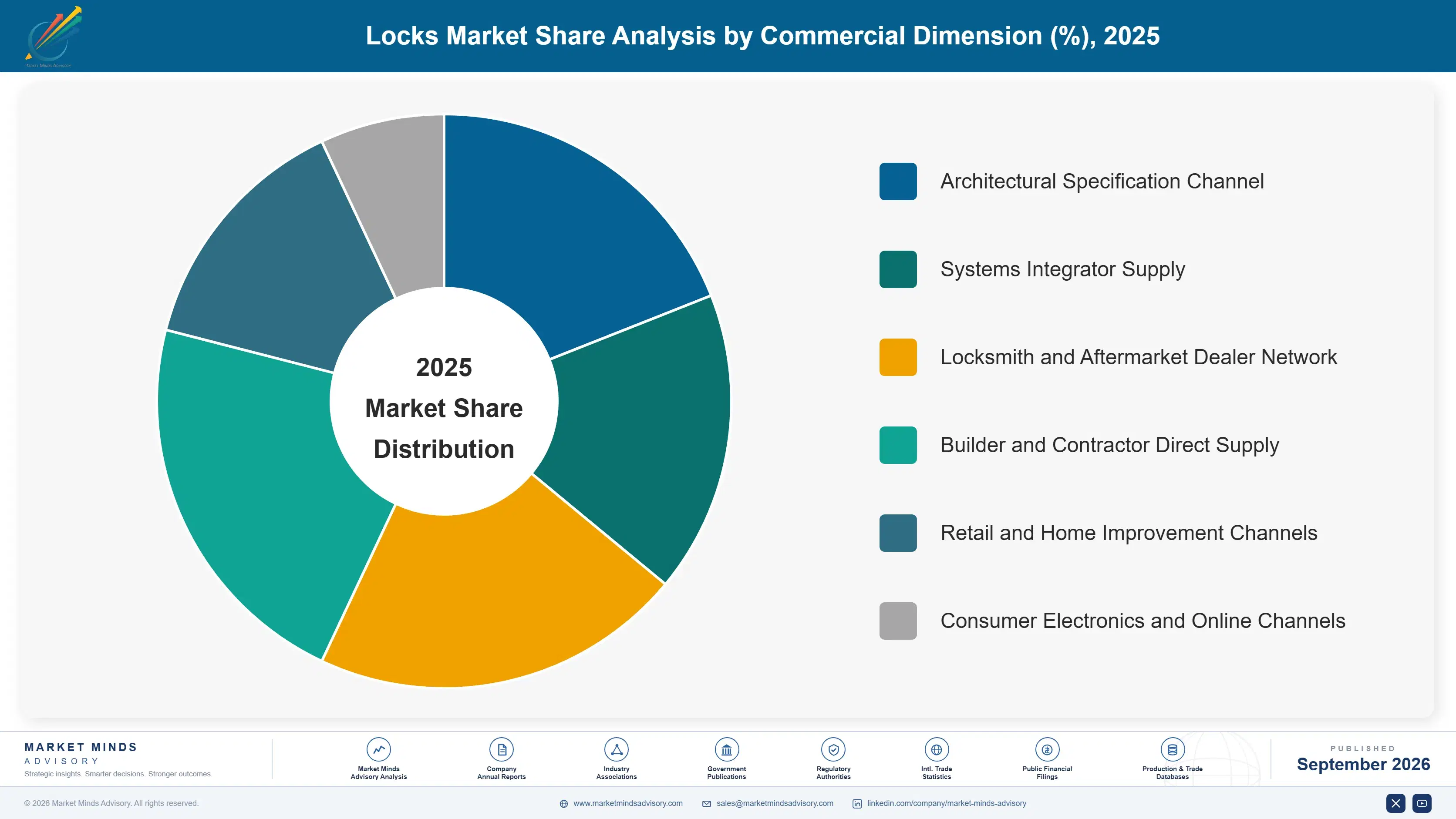
Segmentation follows locking hardware type across six categories: mechanical cylinder locks, mortise and cylindrical lever locksets, padlocks, high-security restricted keyway cylinders, electronic and smart lock systems, and electric strikes and magnetic locks. Building type, credential technology, and channel are treated as separate dimensions rather than folded into this hierarchy. Vehicle locks, safes, and cabinet hardware fall outside the defined scope.
locks-market-market-share-analysis-1790017914038

Electronic And Smart Lock Systems

Electronic and smart lock systems grow at 9.3%, half again the market rate of 6.2%, on a replacement rhythm mechanical hardware has never had. Credential technology changes every six to eight years while a mechanical lockset sits for a median of 27, and that difference alone reshapes the category's growth profile. Chinese and Korean residential penetration leads the world by a wide margin. The unresolved weakness is the mechanical override, which typically runs two grades below the electronic lock and caps the assembly at its cheapest component. Battery depletion accounts for around 19% of service events and remains the most common reason anybody calls. Consumer electronics entrants compete here on app experience rather than any security credential.
CAGR 9.3%

Electric Strikes And Magnetic Locks

Electric strikes and magnetic locks grow at 8.1% because they are specified by systems integrators alongside access control rather than selected on their own merits by anybody. Every credential migration a building undertakes, from mechanical keys to cards and from cards to mobile, pulls electrified hardware with it. That gives the segment a replacement cadence set by an adjacent technology cycle rather than by wear or by construction volume. Commercial, institutional, and multifamily buildings carry nearly all of the demand. Fire code and egress requirements shape which products are permissible in a way that limits competition on price alone. Specification sits with the systems integrator rather than the building owner or hardware distributor.
CAGR 8.1%
Full segment breakdown across 6 segments available in the complete report.

Regional Architecture and Country Demand Map

Regional shares reflect where locking hardware is installed rather than where it is manufactured. Three regions sit outside the standard bands, for reasons named in their own paragraphs and summarised below for operator review. Specification practice and credential adoption vary sharply by region, and each paragraph names the mechanism.

East Asia

At 34% this sits above the standard band, and the justification is that China is simultaneously the largest producer and the largest consumer of locking hardware, with residential smart lock penetration higher than anywhere else on earth. Growth of 7.2% runs above the world rate. Korean apartment construction has specified electronic entry as standard for well over a decade. Japanese demand skews toward mechanical quality and long service life rather than credential features. Domestic Chinese manufacturers supply most regional volume at prices international brands cannot approach. Restricted keyway systems are far less established here than in Western markets, which changes the aftermarket economics entirely. International brands hold the commercial specification end and little else.
Share: 34% | CAGR: 7.2% (2026 to 2036)

North America

Commercial specification practice is more formalised here than anywhere, with grading standards, fire ratings, and accessibility requirements written into building codes and enforced at inspection. Growth of 5.9% runs close to the world rate. Restricted keyway systems are more deeply established than in any other region, which makes the approaching patent expiries a larger commercial event here than elsewhere. Residential smart lock retrofit has run for several years and penetration is now high enough that growth is slowing. Multifamily is the remaining volume opportunity. Frame and strike reinforcement remains badly underspecified across residential construction. Systems integrators rather than hardware distributors increasingly write commercial specifications, which has moved the decision away from the channel most manufacturers were organised to serve.
Share: 24% | CAGR: 5.9% (2026 to 2036)
Regional intelligence for 5 additional markets available in the complete report: Western Europe, South Asia and Pacific, Latin America, Middle East and Africa, Eastern Europe. Contact sales@marketmindsadvisory.com.
locks-market-country-cagr-analysis-1790017914566

Where Lock Makers Actually Earn

Four commercial moves matter in a category where the specified component rarely fails and the profitable one runs on a patent clock. Each addresses something the industry knows and rarely says: the frame decides the outcome, the override caps the lock, the annuity has an expiry date, and the retrofit cycle is the real growth.

Sell The Door Assembly Not The Cylinder

About 73% of forced entries defeat the door, frame, glazing, or hinge side rather than the cylinder that carries the grading. Manufacturers selling reinforced strike systems, hinge protection, and full-assembly ratings report order values 2.7 times greater than cylinder supply alone. European burglary resistance standards already rate complete assemblies, which gives the argument an evidence base rather than a sales position. The component is cheap and the specification conversation is where the whole opportunity has been sitting unused. Reinforcement costs a fraction of a cylinder upgrade and addresses the mechanism most entries actually use.
Market Impact: Raises average order values to 2.7 times greater

Grade The Override To The Electronic Lock

Roughly 19% of electronic lock service events are power depletion, and the mechanical override provided for those moments runs about two grades below the lock it protects. Manufacturers specifying override cylinders at matching grade report premium realisation 1.8 times higher on electronic ranges. The cost difference per unit is small against the price the electronic product carries. What it removes is the argument that the whole assembly is only as secure as its cheapest component, which is currently true. Specifiers who notice the gap tend to notice it publicly rather than privately.
Market Impact: Raises premium price realisation to 1.8 times higher

Plan Keyway Succession Before Patents Lapse

Median remaining patent life across restricted keyway systems in service is around six years, and aftermarket blanks arrive within months of expiry rather than gradually. Manufacturers launching successor keyways and running structured conversion programmes ahead of expiry retain 3.1 times more aftermarket revenue than those converting reactively. Conversion means rekeying an installed base, which building owners resist without a reason. Creating that reason years in advance is the entire exercise, and very few are doing it. Pricing conversion below the cost of an unplanned rekey is the mechanism that works.
Market Impact: Retains 3.1 times more aftermarket revenue than reactive converters

Design For The Credential Replacement Rhythm

Mechanical hardware sits for a median of 27 years while credential technology changes every six to eight, and electronic locks are replaced on the shorter cycle. Manufacturers designing modular reader and credential modules that update without replacing the lock body report installed base retention 2.4 times higher. This deliberately reduces unit sales per building and increases the share of them a manufacturer keeps. Over a building's life that trade is comfortably positive for anybody who holds the position. The alternative is a consumer entrant replacing the whole lock each generation.
Market Impact: Raises installed base retention to 2.4 times higher

Who Controls the Margin Pool

Concentration is moderate. Five manufacturers hold 41% of category revenue, measured consistently on that basis across all participants, and the remainder divides between regional mechanical producers, Chinese and Indian volume manufacturers, and electronics-led entrants that arrived through consumer channels rather than building hardware distribution. The leader to challenger gap is wide in commercial specification and narrow in residential retrofit. That split matters because the two halves are contested on different terms.
Competition currently turns on three dimensions: specification presence with architects and integrators, which decides commercial and institutional work years before an order; restricted keyway position and its remaining patent runway; and electronic development capability, where consumer electronics competitors move considerably faster than building hardware cycles allow. Price decides in residential retail and in builder purchasing, which together account for a substantial share of unit volume across every region covered here.

Pressure builds from two directions. Chinese manufacturers hold cost positions on mechanical and increasingly on electronic hardware. Keyway patents are running down across the installed base. Rankings will shift toward manufacturers holding assembly-level specification depth and credible keyway succession plans rather than volume in any single product type. Manufacturers holding only residential mechanical volume are most exposed.
locks-market-company-positioning-matrix-1790017915090

Competitive Moat and Risk Dimensions

ASSA ABLOY

Moat: Keyway Estate And Specification Depth

The largest restricted keyway installed base anywhere generates an aftermarket annuity at margins the hardware itself cannot approach, and specification relationships with architects and integrators decide commercial work years before an order is placed. Both positions compound slowly and cannot be assembled by a competitor on any short timescale.
ASSA ABLOY

Risk: Patent Runway Across The Estate

A large keyway estate is an asset with an expiry schedule rather than a permanent position, and median remaining protection across systems in service runs about six years. Converting an installed base to successor keyways requires building owners to rekey without an obvious reason, which is a considerably harder sale than the original one.
ALLEGION

Moat: Commercial Code And Specification Position

Deep presence in commercial specification where fire rating, egress, and accessibility requirements narrow the permissible product field considerably gives a position that price competition cannot easily reach. Code-driven specification is renewed at every building refit rather than contested at every purchase order. Displacing an incumbent means reopening a document other trades have already built around.
ALLEGION

Risk: Residential Electronic Channel Distance

Commercial specification strength translates poorly into residential smart lock retrofit, where consumer electronics entrants compete on app experience, installation simplicity, and price through channels building hardware distribution does not reach. That segment is growing fastest and is being contested on terms this position was not built for.

Players Tracked

Prominent Players

Assa Abloy
Allegion
dormakaba
Fortune Brands Innovations
Salto Systems

Other Key Players

Stanley Black and Decker
Honeywell International
Hafele
Godrej and Boyce
ABUS August Bremicker Soehne
Guangdong Kaadas Intelligent Technology
Zhejiang Wangli Security Products
Lumi United Technology
U-tec Group
Guangdong Archie Hardware
MIWA Lock
Alpha Corporation
Nuki Home Solutions
Level Home
Hampton Products International

Recent Developments

FEBRUARY 2026

Assa Abloy Launches Successor Restricted Keyway Conversion Programme

Assa Abloy began a structured conversion programme moving installed restricted keyway systems onto successor platforms ahead of patent expiry. Conversion pricing was set below the cost of an unplanned rekey to give building owners a reason to move early. Dealer conversion incentives were published alongside the programme terms.
Signal: The annuity cliff is being managed in advance rather than absorbed on arrival. Owners need a budget argument.
SEPTEMBER 2025

Allegion Expands Modular Credential Module Manufacturing Capacity

Allegion completed an organic expansion of modular reader and credential module production, funded internally with no partner involved. The architecture allows credential technology updates without replacing the lock body or refitting the door. Existing lock bodies in the field accept the new modules without door rework.
Signal: Manufacturers are trading unit volume for installed base retention deliberately. Retention is valued above unit volume now.
APRIL 2025

dormakaba Acquires Reinforced Door Assembly Hardware Specialist

dormakaba completed an acquisition of a specialist in reinforced strike systems and hinge protection hardware. The transaction was an outright acquisition rather than a joint venture or minority stake, with assembly-level specification cited as the rationale. Specification and testing staff transferred with the business under agreed terms.
Signal: Assembly-level selling is being bought because component-level selling has stalled. Component-level selling has stalled where the component rarely fails.

What A Lock Costs To Build

Three cost groups dominate. Brass, zinc alloy, and steel run 30% to 38% of cost of goods sold across mechanical hardware, and the eight-point range separates integrated casting operations from open market buyers. Electronic components, motors, and batteries take 24% to 32% in smart lock products and nothing at all in mechanical ones. Machining, finishing, and assembly labour account for 20% to 28%, varying sharply by manufacturing location.
Copper and zinc pricing moved through 2024 and 2025 on mine supply and industrial demand together, and United States Geological Survey mineral commodity summaries documented the underlying movements across the period. Several hardware manufacturers described the resulting margin pressure in their annual reports. Electronic component costs fell across the same window as volumes rose in unrelated consumer categories entirely. The two moved in opposite directions.

The competitive disadvantage mechanism runs through manufacturing location rather than through material cost. A Western manufacturer of mechanical hardware competes against Chinese and Indian production carrying lower labour and closer proximity to brass casting, and cannot recover that gap on a residential lockset. Exposure therefore varies by product mix rather than by scale, and manufacturers weighted toward specification-driven commercial work are considerably better insulated.
locks-market-cost-volatility-analysis-1790017915287

Shift Mix Toward Specification-Driven Commercial Work

Residential mechanical hardware competes on manufacturing location and brass cost, neither of which a Western producer can win. Commercial work decided by fire rating, egress, and accessibility code narrows the permissible field before price is discussed at all, which is the only mix change that materially alters the exposure over a full cycle. Mix is the only lever here.

Contract Brass And Zinc Against Mine Supply Cycles

Copper and zinc pricing follows mine supply and industrial demand at volumes hardware manufacture cannot influence in any direction whatever. Contracting against those cycles rather than reacting to them removes most of the exposure and secures allocation through the tighter periods when larger industrial consumers are competing for the same output. Allocation matters more than price at the tightest points.

Specify Electronic Components At Consumer Volumes

Motor, radio, and processor costs are falling because unrelated consumer categories consume them at volumes locking hardware never will approach. Specifying parts already at scale in those categories rather than bespoke components captures a cost curve this industry contributes nothing to and would otherwise only watch from the outside. Bespoke parts forfeit a curve this industry does not drive.

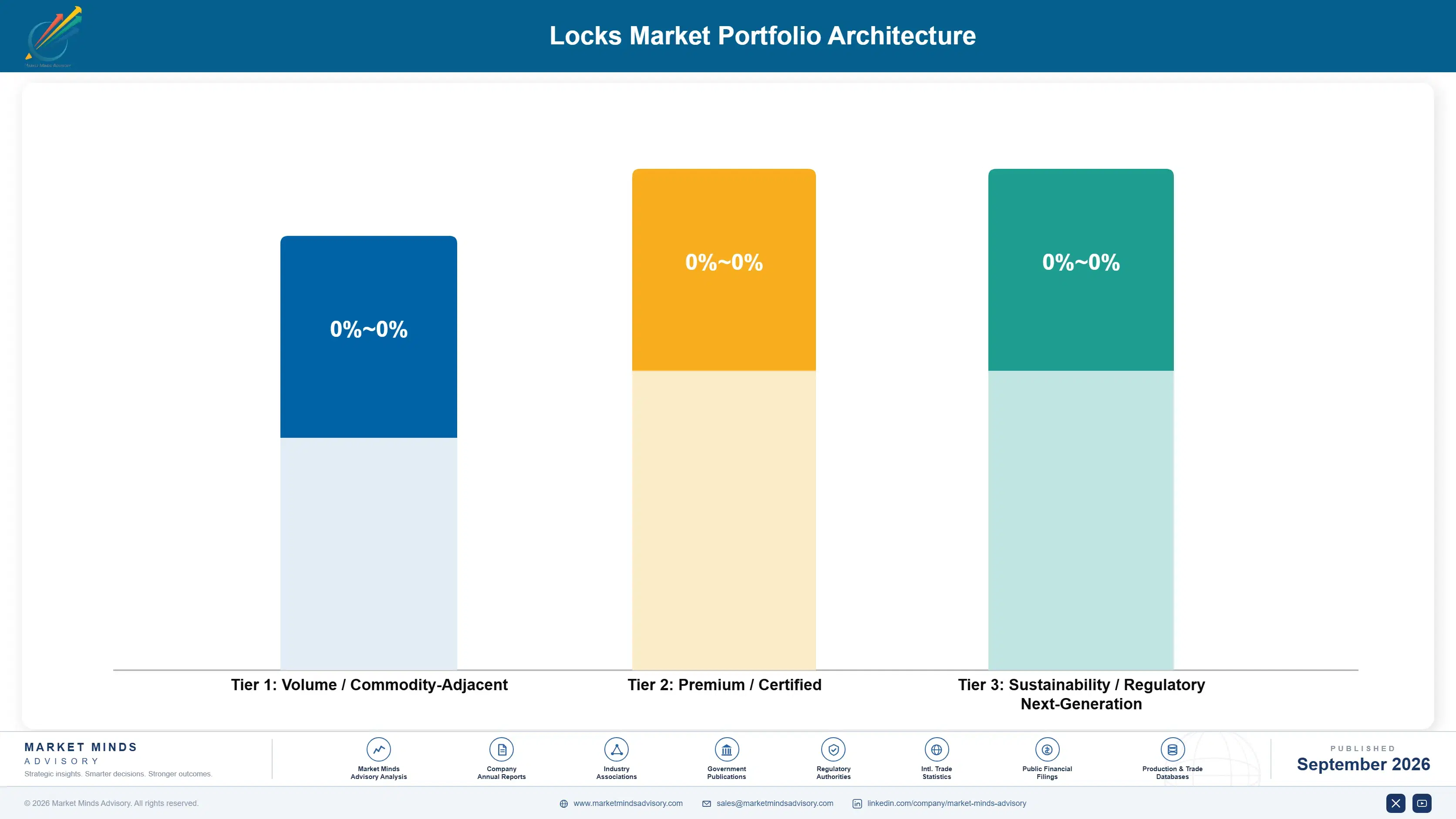
Portfolio Architecture for Margin Defence

Margin follows specification position and aftermarket control rather than the hardware itself. Residential mechanical locksets compete close to commodity terms against Asian production. Padlocks and standard commercial locksets earn modestly on brand and distribution. Electronic systems earn well where credential capability is genuinely differentiated, and restricted keyway systems earn most of anything in this market, on blanks rather than on locks.
The tension between volume and premium runs through who writes the specification. A builder buying residential locksets by grade and price is a purchasing exercise decided on landed cost. An architect or integrator specifying a keying schedule, an assembly rating, and a credential architecture is a project relationship, and the manufacturer present at that stage holds the building for its refit cycle without further contest.

High-value pools concentrate in restricted keyway aftermarket supply for as long as the patents hold, in code-driven commercial specification, and in modular credential architectures that keep an installed base through technology changes. Where the product is a residential mechanical lockset sold at retail against a grade and a price, Chinese and Indian producers hold cost and casting proximity together.

Volume / Commodity-Adjacent

Residential mechanical locksets, padlocks, and standard cylinders sold at retail or to builders against a grade and a price. The ten-point range reflects manufacturing location and casting position rather than any capability a specifier would pay a premium to obtain.
Gross Margin: 24% to 34%

Premium / Certified

Commercial mortise locksets, electric strikes, and magnetic locks specified against fire rating, egress, and accessibility code requirements. The twelve-point range separates genuine code and specification support capability from suppliers shipping certified product without it.
Gross Margin: 40% to 52%

Sustainability / Regulatory / Next-Generation

Restricted keyway systems with aftermarket blank control, and modular credential architectures retaining an installed base through technology changes. The sixteen-point range reflects patent runway and specification depth, neither of which can be built quickly.
Gross Margin: 58% to 74%
locks-market-portfolio-architecture-1790017915806

High-value Sub-segments and Strategic Watch-out

Restricted Keyway Aftermarket Systems

Highest value in the category and the most exposed, with median remaining patent life across systems in service running about six years. The sixteen-point range reflects patent runway rather than product difference, and expiry collapses pricing within months. Very few manufacturers have modelled the estate-level effect.
Gross Margin: 62% to 78%

Modular Credential Architectures

High value retaining an installed base through credential changes arriving every six to eight years against a 27-year hardware life. The fourteen-point range reflects genuine modularity, since a fixed reader forces a full replacement each cycle. Fixed readers force a full replacement every credential generation.
Gross Margin: 48% to 62%

Code-Specified Commercial Hardware

Volume core where fire rating, egress, and accessibility requirements narrow the field before price is discussed at all. The fourteen-point range reflects specification support depth, which decides whether a manufacturer is present when the schedule is written. Presence at schedule stage decides the building for its refit cycle.
Gross Margin: 40% to 54%

Residential Mechanical Locksets

The strategic watch-out. Slowest growing type, a 27-year replacement cycle, and Chinese and Indian producers holding labour and casting proximity together. The ten-point range reflects manufacturing location alone, with nothing else defending the position. Retail and builder channels buy on landed cost alone, nothing else.
Gross Margin: 22% to 32%

How This Demand Repeats

Mechanical hardware barely repeats at all on its own account. A lockset sits for a median of 27 years and is replaced when the door is, which ties demand to construction and refit activity rather than to anything a manufacturer influences. What does repeat is the keyway aftermarket: blanks, cylinders, and rekeying flow continuously from an installed base for as long as patent protection makes the manufacturer the only legal source.
Attachment depth follows who wrote the specification. A keying schedule and assembly rating set by an architect or integrator locks a building for its refit cycle, because changing it means reworking a document that other trades have already built around. A residential lockset bought at retail against a grade and a price is replaced by whatever the next builder prefers, with no continuity of any kind.

The buyer profile is splitting rather than shifting. Commercial specification is moving further toward systems integrators as credential architecture becomes the organising decision, while residential purchasing has moved toward consumers buying smart locks through electronics channels. Neither group came from traditional building hardware distribution, and manufacturers organised around that channel are increasingly absent from both conversations.
locks-market-end-use-penetration-index-1790017916295

Where This Market Rewards

These are among the four positions where our research anticipates prominent divergence between winners and laggards over the coming forecast period. Each is grounded in the demand model, the regulatory perimeter, and the announced capacity pipeline.
01 / ASSEMBLY LEVEL SPECIFICATION

The cylinder is not the failure point

Around 73% of forced entries defeat the door, frame, glazing, or hinge side rather than the cylinder that carries the grading everybody argues about. Manufacturers selling reinforced strike systems, hinge protection, and full-assembly ratings report order values 2.7 times greater than cylinder supply alone into the same buildings. European burglary resistance standards already rate complete assemblies, which gives the argument an evidence base rather than merely a commercial position, and reinforcement costs a fraction of the cylinder upgrade it usually replaces in a budget.
02 / OVERRIDE GRADE MATCHING

As secure as the cheapest part

Roughly 19% of electronic lock service events are power depletion alone, and the mechanical override supplied for exactly those moments typically runs two grades below the lock protecting the door. Manufacturers specifying override cylinders at matching grade report premium realisation 1.8 times higher across their electronic ranges. The cost difference per unit is trivial against the price an electronic product carries, and it removes an objection that is currently entirely fair, and specifiers who notice the gap tend to notice it publicly rather than privately.
03 / KEYWAY SUCCESSION PLANNING

Six years of annuity left

Median remaining patent life across restricted keyway systems in service is about six years, and aftermarket blanks arrive within months of expiry rather than eroding the annuity gradually over time. Manufacturers launching successor keyways and running structured conversion ahead of expiry retain 3.1 times more aftermarket revenue than reactive converters. Conversion requires rekeying an installed base, so creating a reason for owners to move early is the entire exercise, and pricing conversion below the cost of an unplanned rekey is what actually moves them.
04 / CREDENTIAL CYCLE ARCHITECTURE

Trade unit sales for installed base

Mechanical hardware sits for a median of 27 years while credential technology changes every six to eight, which means electronic locks are replaced on the shorter of two very different clocks. Manufacturers designing modular reader modules that update without replacing the lock body report installed base retention 2.4 times higher than fixed architectures. This reduces units sold per building deliberately and increases the share of them one manufacturer keeps across a full life, and the alternative is a consumer entrant replacing the whole lock each generation instead.

Engagement Snapshot From the Field

A live engagement with an industry participant carrying material or product regulatory and market exposure ahead of a defining policy shift, showing how our research translates into a defensible multi-year portfolio strategy.
MARKET MINDS ADVISORY · CLIENT ENGAGEMENT SUMMARY
Locks Producer Strategic Portfolio Review and Transition Roadmap 2026·Investment Scenario on Locks Exposure Evaluation 2025-26
CLIENT PROFILE
A university estates group managing around 240 buildings with annual locking hardware and access spend near USD 6.8 million (client-reported, unverified by MMA). Two campus break-ins in a single year had prompted a specification review, and the estates team had proposed upgrading cylinders across the highest-risk buildings at considerable cost. Nobody had reviewed how the entries were achieved.
STRATEGIC CHALLENGE
Nobody had examined how the two actual entries were achieved, and the master key system had grown through thirty years of additions without ever being redesigned. The restricted keyway underpinning the whole estate was also approaching patent expiry, which nobody in the estates function had been told about. Key control was assumed rather than verified.
MMA APPROACH
MMA reviewed incident reports and physical evidence from both entries, audited the master keying schedule for unintended key combinations, checked the patent status of the incumbent keyway, and modelled outcomes under cylinder upgrade, assembly reinforcement, and full keying redesign options against cost. The keying audit was run from the original schedule documents rather than from the estates team's current record.
KEY FINDINGS
  1. Both entries were achieved through the door frame at the strike, with the cylinders recovered intact and showing no evidence of picking, drilling, or manipulation of any kind.
  2. The master key system had accumulated enough levels over three decades that several unintended key combinations existed, any of which would open buildings the holder had no authorisation for.
  3. The incumbent restricted keyway had under two years of patent protection remaining, after which aftermarket blanks would remove the estate's key control entirely.
  4. Strike reinforcement across the highest-risk buildings cost roughly a fifth of the proposed cylinder upgrade and addressed the mechanism both entries had actually used.
CLIENT PROFILE
A university estates group managing around 240 buildings with annual locking hardware and access spend near USD 6.8 million (client-reported, unverified by MMA). Two campus break-ins in a single year had prompted a specification review, and the estates team had proposed upgrading cylinders across the highest-risk buildings at considerable cost. Nobody had reviewed how the entries were achieved.
STRATEGIC CHALLENGE
Nobody had examined how the two actual entries were achieved, and the master key system had grown through thirty years of additions without ever being redesigned. The restricted keyway underpinning the whole estate was also approaching patent expiry, which nobody in the estates function had been told about. Key control was assumed rather than verified.
MMA APPROACH
MMA reviewed incident reports and physical evidence from both entries, audited the master keying schedule for unintended key combinations, checked the patent status of the incumbent keyway, and modelled outcomes under cylinder upgrade, assembly reinforcement, and full keying redesign options against cost. The keying audit was run from the original schedule documents rather than from the estates team's current record.
KEY FINDINGS
  1. Both entries were achieved through the door frame at the strike, with the cylinders recovered intact and showing no evidence of picking, drilling, or manipulation of any kind.
  2. The master key system had accumulated enough levels over three decades that several unintended key combinations existed, any of which would open buildings the holder had no authorisation for.
  3. The incumbent restricted keyway had under two years of patent protection remaining, after which aftermarket blanks would remove the estate's key control entirely.
  4. Strike reinforcement across the highest-risk buildings cost roughly a fifth of the proposed cylinder upgrade and addressed the mechanism both entries had actually used.
RECOMMENDED STRATEGY
Phase 1: Phase one: cancel the cylinder upgrade and reinforce strikes, jambs, and hinge sides across the highest-risk buildings identified in the audit. Phase 2: Phase two: redesign the master key schedule from first principles rather than extending it further, removing the unintended combinations found. Phase 3: Phase three: convert the estate to a successor keyway before the incumbent patent lapses, timing it with the keying redesign.
OUTCOME
Reinforcement was completed across the highest-risk buildings for roughly a fifth of the proposed budget (client-reported, unverified by MMA). The keying redesign and keyway conversion were combined into one project. No further forced entry occurred in the following eighteen months. Key control was preserved across the estate throughout the transition.

Frequently Asked Questions

Foundational context covering the market sizes, CAGR, scope, country, region and competition that inform every finding below. This section is provided to cover basics and most often pre-purchase conversations, answered from the MMA Primary Research Dataset.

What is the current size of the Locks Market?

The market was worth USD 12.4 billion in 2025 and stands at USD 13.2 billion in 2026. Value covers door and access locking hardware at manufacturer selling price.

How large will the Locks Market be by 2036?

MMA forecasts USD 24.1 billion by 2036, an increase of USD 10.9 billion across the forecast period. That represents 1.83 times the 2026 base of USD 13.2 billion.

What is the CAGR for the Locks Market 2026 to 2036?

The base case compound annual growth rate is 6.2%, with a bull case at 7.4% and a bear case at 5.0%. Historical growth from 2020 to 2025 ran at 5.1%.

Which segment is growing fastest?

Electronic and smart lock systems grow at 9.3%, half again the market rate of 6.2%. They replace on a credential cycle rather than on a 27-year hardware life.

Who are the major companies in the Locks Market?

Assa Abloy, Allegion, dormakaba, Fortune Brands Innovations and Salto Systems lead the field. Together they hold 41% of category revenue, with Chinese producers strong in residential volume.

Which country is growing fastest?

India grows at 10.4%, on residential completion volumes and a smart lock adoption curve that skipped much of the mechanical upgrade path Western markets took.

Report Segmentation Architecture

The full report scope spans multiple orthogonal segmentation dimensions, with cross-tabulated demand data provided for each dimension pair. Coverage extends further to regional breakdowns, trend trajectories, and the competitive detail needed to support segment-level decision-making.

By Hardware Type

  • Mechanical Cylinder Locks
  • Mortise and Cylindrical Lever Locksets
  • Padlocks
  • High-Security Restricted Keyway Cylinders
  • Electronic and Smart Lock Systems
  • Electric Strikes and Magnetic Locks

By End-Use Industry

  • Residential Single Family
  • Multifamily and Rental Housing
  • Commercial Offices and Retail
  • Institutional and Education
  • Hospitality and Healthcare
  • Industrial and Logistics Facilities

By Commercial Dimension

  • Architectural Specification Channel
  • Systems Integrator Supply
  • Locksmith and Aftermarket Dealer Network
  • Builder and Contractor Direct Supply
  • Retail and Home Improvement Channels
  • Consumer Electronics and Online Channels

By Region

  • East Asia
  • North America
  • Western Europe
  • South Asia and Pacific
  • Latin America
  • Middle East and Africa
  • Eastern Europe

Scope, Methodology, and Coverage

Every figure in this report is reproducible from documented input assumptions. The scope below maps the historical period, the forecast horizon, the segmentation dimensions, and the countries covered, alongside the underlying primary and qualitative methodology.
Historical Period
2020 to 2025
Forecast Period
2026 to 2036
Base Year
2025 (USD billions; MMA Primary Research Dataset, September 2026)
Market Definition
This market covers door and access locking hardware, across mechanical cylinder locks, mortise and cylindrical lever locksets, padlocks, high-security restricted keyway cylinders, electronic and smart lock systems, and electric strikes and magnetic locks. It excludes access control software platforms and credential management systems, vehicle locks, safes and vaults, alarm and surveillance systems, and furniture and cabinet hardware.
Quantitative Units
USD billions, revenue at manufacturer selling price
Segmentation Dimensions
Hardware type, building end-use, commercial dimension, region
Regions Covered
East Asia, North America, Western Europe, South Asia and Pacific, Latin America, Middle East and Africa, Eastern Europe
Countries Covered
China, Japan, South Korea, Taiwan, India, Indonesia, Vietnam, Thailand, Australia, United States, Canada, Mexico, Germany, France, United Kingdom, Italy, Spain, Netherlands, Sweden, Switzerland, Poland, Czechia, Brazil, Argentina, Colombia, Saudi Arabia, United Arab Emirates, Turkey, Egypt, South Africa
Key Companies Profiled
Assa Abloy, Allegion, dormakaba, Fortune Brands Innovations, Salto Systems, Stanley Black and Decker, Honeywell International, Hafele, Godrej and Boyce, ABUS August Bremicker Soehne, Guangdong Kaadas Intelligent Technology, Zhejiang Wangli Security Products, Lumi United Technology, U-tec Group, Guangdong Archie Hardware, MIWA Lock, Alpha Corporation, Nuki Home Solutions, Level Home, Hampton Products International
Quantitative Methodology
Primary survey, n=3,800 respondents, Q4 2025, six countries; demand-side model with trade association cross-validation
Qualitative Methodology
47 expert interviews, Q4 2025; applied to validate demand model assumptions, identify emerging dynamics, and assess competitive positioning
Report Format
PDF and XLSX data workbook (Word format preview document)
Publisher
Market Minds Advisory
Report Code
MMA-2026-CON-521
Published
September 2026
Contact
sales@marketmindsadvisory.com | www.marketmindsadvisory.com

Purchase the full Locks Market Report (2026 to 2036).

The full report sizes the locks market across six hardware types, seven regions, and thirty countries, with forecasts to 2036 under base, bull, and bear cases. It quantifies where forced entries actually defeat a door, traces remaining patent life across restricted keyway systems in service, and separates the credential replacement cycle from the mechanical hardware life it now overrides. Competitive analysis covers twenty participants evaluated consistently on category revenue, with detailed treatment of specification presence and keyway succession planning. Cost structure by manufacturing location and product mix is analysed throughout. Primary research includes 3,800 survey responses and 47 expert interviews.
Six hardware types sized and forecast separately
Twenty participants evaluated on category revenue consistently
Forced entry mechanisms mapped by point of failure
Restricted keyway patent runway assessed across installed systems
Credential replacement cycles separated from mechanical hardware life
Specification channel presence benchmarked by manufacturer

Built For The People Who Decide

From boardroom strategy to bench-side execution, this report is read cover-to-cover by leaders shaping the next decade of their industry, turning demand scenarios, market dynamics and valuation benchmarks into decisions.
CXOs/ Presidents/ VPs/ Managers
M&A and Corporate Development
Strategy Teams and R&D Heads
Procurement and Product Directors
Regulatory and Compliance Leaders
Investor Relations and Equity Analysts