Market Minds Advisory
Lithium-ion Battery Separator Market

Lithium-ion Battery Separator Market: Overcapacity, coating value migration and localisation premiums to 2036

Separator volumes have tripled since 2021 and prices have fallen almost by half, which means most producers are shipping far more film than ever while earning considerably less for it.

Lead Analyst

Bilal Shaikh

Published

September 2026

Make Smarter Decisions with Customized Research Insights

Request a free sample report and evaluate market opportunities, growth trends, and competitive dynamics relevant to your business needs.

2025 MARKET VALUE$7.2BMarket Size 2025
2036 FORECAST VALUE$23.1BBase Case , 2026 to 2036
CAGR 2026 TO 203611.2 %Bull 12.4% / Bear 9.9%
INCREMENTAL OPPORTUNITY$15.1BNet 10- year value creation
EXPANSION MULTIPLE2.89x2036 value over 2026 base
Strategic Levers
M&A Pipeline
Regional Outlook
Country Rankings
Competitive Intelligence
Segmental Deep-dive
Call-Us : 91 93563 13602

Executive Snapshot and Market Trajectory

Base film prices have fallen roughly 47% since 2021 while volumes tripled, which is what happens when capacity gets built for a demand curve nobody wanted to miss. Industry utilisation sits near 58%. Coating is the only place margin survived. Very few producers positioned for that. Nobody else did.
Ceramic-coated separators grow at 16.8%, half again the market rate of 11.2%, because higher-nickel cathodes and thermal runaway requirements make an uncoated film unacceptable in most cell designs now. East Asia holds 46% of value, well outside any normal regional band, because roughly 74% of global separator capacity sits in China alone. Nothing about that is likely to change quickly. Not soon.
Five producers hold 68% of separator area shipped and the concentration is genuine, since a separator line costs several hundred million dollars and takes three years to qualify with a cell maker. The interesting commercial development is political rather than technical: American and European localisation rules have created a premium for non-Chinese supply that has nothing whatever to do with product performance. Producers outside China are pricing against a regulation rather than against a competitor.
Market Definition
This report covers microporous separator membranes supplied for lithium-ion cell manufacture, spanning dry process polypropylene monolayer, dry process trilayer, wet process polyethylene base film, ceramic-coated, polymer-coated and functional-coated, and nonwoven and specialty constructions. Value is measured at separator producer level on area shipped. Excluded are lead-acid and nickel battery separators, solid electrolytes, electrode foils, cathode and anode active materials, electrolyte formulations, and complete cell or pack assemblies.
Base Year Value
$7.2B in 2025 (MMA Primary Research Dataset, August 2026)
Forecast Period
2026 to 2036, eleven discrete annual values
CAGR
11.2% base case. Bull 12.4%. Bear 9.9%.
Fastest Growth Segment
Ceramic-Coated Separators: 16.8% CAGR
Fastest Growth Country
India: 16.2% CAGR
Fastest Growth Region
South Asia and Pacific: 13.5% CAGR
Largest Region
East Asia: 46% of 2025 global value
Market Leaders
Yunnan Energy New Material, Asahi Kasei, Toray Industries, SK IE Technology and Sinoma Science and Technology lead the market. Source: MMA Primary Research Dataset, July 2026.
Primary Survey
n=3,800 procurement and R&D decision-makers, Q4 2025, six countries
Methodology
Demand-side build-up, cross-validated against public data, 47 expert interviews

Lithium-ion Battery Separator Market Forecast Scenarios

lithium-ion-battery-separator-market-size-forecast-scenario-1787555284378
Growth ran at 9.8% between 2020 and 2025 and the figure conceals two curves moving in opposite directions. Separator area shipped roughly tripled as electric vehicle cell production expanded across China, Korea and increasingly Europe. Average selling price fell almost by half over the same period as Chinese capacity arrived faster than demand absorbed it.
The 11.2% base case rests on three mechanisms. Cell production keeps expanding on electric vehicle and grid storage demand, and every cell needs separator area regardless of chemistry. Ceramic and functional coating keeps taking share at 16.8% as cathode nickel content rises and thermal requirements tighten, which lifts value per square metre even where base film pricing does not recover. And localisation rules in America and Europe create a premium for non-Chinese supply.
The 12.4% bull case is grid storage deployment running ahead of current forecasts, which consumes separator area at scale without the price sensitivity automotive imposes. The 9.9% bear case is solid-state cells reaching commercial volume sooner than expected, since a solid electrolyte performs the separator function and removes the component entirely rather than merely competing with it.

When Volume And Value Diverged

Everybody who built separator capacity between 2020 and 2023 was reading the same demand forecast, and they were all roughly right about it. Cell production did expand enormously. What nobody modelled was everybody else building at the same time, which is how a market with tripling volumes ended up with base film prices down 47% and utilisation near 58%. That is not a demand failure. It is the ordinary consequence of a capital-intensive industry all reaching the same correct conclusion simultaneously.
TOP-FIVE CONCENTRATION68%Combined position across global separator supply held by leaders
CERAMIC COATING ATTACH RATE61%Share of separator area shipped with a ceramic layer
SEPARATOR COST SHARE8%Portion of finished cell cost attributable to the separator
CHINESE CAPACITY SHARE74%Portion of global separator manufacturing capacity located in China
CAPACITY UTILISATION RATE58%Average industry loading against installed separator manufacturing capability
PRICE DECLINE SINCE 202147%Fall in average selling price across the base film
Coating is where the value went. A ceramic layer on the separator surface raises thermal shrinkage resistance enough to matter in cells running high-nickel cathodes, and it has become effectively mandatory rather than optional across most automotive designs. Attach rates have reached 61% of area shipped. The coating is a fraction of the film's thickness and a substantial share of its value, which is a comfortable position for anybody who invested in coating capability rather than in more base film capacity.
The other value pool is political. American and European localisation requirements have created demand for non-Chinese separator supply at prices that reflect a regulation rather than a product difference. Producers outside China are competing on origin.
"This industry built exactly the capacity the forecasts justified and then discovered that being right at the same time as everybody else is worth nothing at all. The producers who put capital into coating rather than into another base film line are the ones still making money."
Director, Battery Materials and Energy Storage Practice · MMA Energy Practice · August 2026

Market Trends

Ceramic coating moved from optional to effectively mandatory

Raising cathode nickel content lifts energy density and lowers thermal stability at the same time, which puts more of the safety burden onto the separator than earlier chemistries ever did. A ceramic layer holds dimensional stability at temperatures where an uncoated polyolefin film shrinks and allows electrode contact, and cell makers have concluded that the cost is not optional. Attach rates have reached 61% of area shipped and continue climbing. Commercially this matters because the coating is a thin fraction of the product and a substantial share of its value, which is where margin migrated as base film pricing collapsed.
Market Impact: Follows 8% of cell cost

Localisation rules create a premium unrelated to product

American content requirements under domestic manufacturing incentives and European battery regulation both push cell makers toward separator supply produced outside China, and neither requirement has anything to do with how the film performs. That has created two prices for a comparable product depending on where it was made, which is an unusual commercial situation and a durable one while the rules stand. Non-Chinese producers are building capacity against it and several are running qualification programmes with cell makers who would not previously have considered them. The premium is real and nobody should mistake it for a technical advantage.
Market Impact: Supports 5.4% dry process growth

Market Opportunities and Growth Drivers

Cell production expansion consumes separator area regardless of chemistry

Every lithium-ion cell needs separator area between its electrodes, and that requirement holds across nickel-manganese-cobalt, lithium iron phosphate and every intermediate chemistry the industry has argued about. Electric vehicle cell production continues expanding across China, Korea, Europe and North America, and grid storage deployment adds a second demand curve that behaves differently and is growing faster from a smaller base. The commercially useful point is that separator demand is indifferent to the chemistry debate that consumes so much industry attention. Area shipped tracks gigawatt hours built, and gigawatt hours keep going up.
Market Impact: Cut prices 47% since 2021

Grid storage adds demand without automotive price sensitivity

Stationary storage buys cells against a different calculation from a vehicle manufacturer, since weight and volume matter far less and cycle life matters far more. That pushes grid storage toward lithium iron phosphate chemistries and toward dry process separators in many designs, which supports a segment automotive demand had been leaving behind. Deployment volumes have risen sharply with renewable generation build-out and with data centre power requirements across several markets. The commercial value here is that the buyer negotiates on total installed cost rather than squeezing every component supplier, which makes it a considerably more comfortable customer.
Market Impact: Threatens 100% of demand eventually

Market Restraints and Challenges

Overcapacity has cut base film prices almost by half

Average selling prices on base film have fallen roughly 47% since 2021 and industry utilisation sits near 58%, which means most producers are running lines well below the loading their financing assumed. The root cause is that everybody read the same correct demand forecast and built against it simultaneously, without anybody modelling the aggregate. Commercially this has destroyed returns on base film investment and pushed several smaller producers toward consolidation or exit. Producers responding to it are moving capital into coating capability rather than additional capacity, and several are pursuing the non-Chinese localisation premium as the only pricing power available.
Market Impact: Reaches 61% coating attach rate

Solid-state cells would remove the component entirely

A solid electrolyte performs the separation function within its own architecture, which means a successful solid-state cell does not need a separator at all rather than needing a different one. The root cause of the exposure is that this is substitution of a function rather than competition on a product, and no amount of separator development answers it. Commercial deployment remains some years away and the timelines have slipped repeatedly, which is the only comfort available. Producers responding to it are positioning coating and materials capability that transfers into solid electrolyte processing rather than defending the film itself.
Market Impact: Covers 2 major regulatory regimes
3 additional market trends, 4 additional growth drivers, and 2 additional restraints and challenges are covered in the full report. Contact sales@marketmindsadvisory.com to access the complete intelligence.

Segment CAGR and Growth Architecture

Separators are classified here by membrane construction and surface treatment, since that determines the thermal behaviour, the cell chemistry it suits and where value sits in the product. Cell format, end application and supply arrangement are handled separately in the framework, because one construction serves several cell designs without any change in how it is manufactured.
lithium-ion-battery-separator-market-market-share-analysis-1787555284921

Ceramic-Coated Separators

Growing at 16.8%, half again the market rate, this is where the value went when base film pricing collapsed. A thin alumina or boehmite layer holds the membrane dimensionally stable at temperatures that would shrink an uncoated polyolefin, which matters increasingly as cathode nickel content rises and the separator carries more of the thermal safety burden. Attach rates have reached 61% of area shipped and the coating has become effectively mandatory across automotive cell designs rather than a specification option. Commercially the layer is a small fraction of the product's thickness and a substantial share of its price, which is an unusually favourable ratio for whoever applies it. Coating capability rather than film capacity is what defends margin now.
CAGR 16.8%

Polymer-Coated and Functional-Coated Separators

Polymer coatings do a different job from ceramic, improving adhesion between separator and electrode so the cell stack holds together through assembly and cycling, and reducing the interfacial resistance that costs power capability. Growth at 14.6% follows cell makers pursuing faster charging and tighter stack tolerances, both of which put demands on the interface that an untreated film does not meet. Several producers now combine ceramic and polymer layers on opposite faces, which raises value per square metre considerably further. The processing knowledge here is genuinely narrow, since coating a twelve micron film uniformly at line speed without pinholes is harder than it sounds. That difficulty is the whole commercial argument.
CAGR 14.6%
Full segment breakdown across 6 segments available in the complete report.

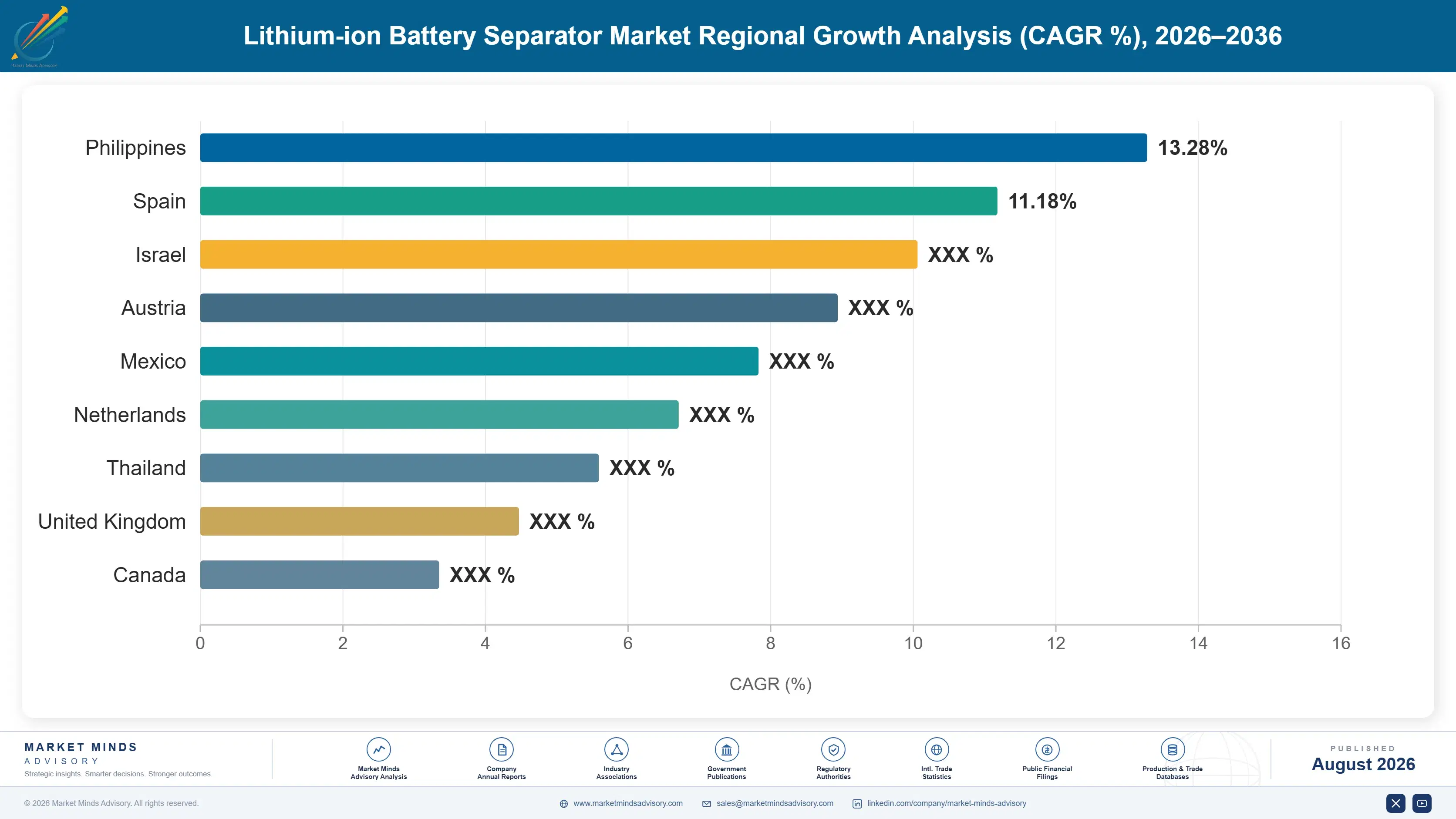
Regional Architecture and Country Demand Map

East Asia holds 46% of value, far outside any normal regional band, because roughly 74% of global separator manufacturing capacity sits in China with Japan and Korea holding most of the remainder. North America and Western Europe sit below their bands for the same reason. Manufacturing location decides everything.

North America

This region sits at 19%, below the 22% band floor, because separator manufacturing has historically been an Asian industry and domestic capacity remains small relative to the cell production being built here. Domestic content requirements under manufacturing incentives are changing that, creating demand for non-Chinese separator supply at prices reflecting a regulation rather than any product difference. Several Asian producers are building American plants against it and domestic producers are expanding into an opening they did not create. Growth at 12.6% is the second fastest on this table and rests on localisation policy rather than on any manufacturing advantage the region holds. Nobody here competes on cost. Policy is the whole regional argument here.
Share: 19% | CAGR: 12.6% (2026 to 2036)

Western Europe

At 16% this region sits below the 18% band floor, reflecting the same structure as North America: substantial cell production being built and very little separator manufacturing to serve it. European battery regulation and carbon footprint requirements create demand for locally produced supply, and several Asian and domestic producers are building against that. The region holds genuine capability in specialty film and coating chemistry that transfers into separator production usefully. Cell plant cancellations and delays across the region have slowed the demand curve considerably. Growth at 9.6% is the weakest of the seven regions and reflects those delays rather than any absence of policy support. Delay rather than intent explains the number entirely.
Share: 16% | CAGR: 9.6% (2026 to 2036)
Regional intelligence for 5 additional markets available in the complete report: East Asia, South Asia and Pacific, Latin America, Middle East and Africa, Eastern Europe. Contact sales@marketmindsadvisory.com.
lithium-ion-battery-separator-market-country-cagr-analysis-1787555285457

Where Separator Margin Actually Sits

Four moves matter in a market where prices fell 47% while volumes tripled and everybody's capacity forecast turned out correct and worthless. Two are about the value that migrated into coating, and two are about the pricing power that regulation created rather than performance. Building more base film capacity is not among them. Nobody needs more film.

Put capital into coating rather than more film

Base film pricing has fallen roughly 47% since 2021 with utilisation near 58%, which makes additional capacity the worst available use of capital in this industry. Ceramic and polymer coating compounds at 16.8% and 14.6% respectively, and the coating is a small fraction of the product's thickness against a substantial share of its price. Coating lines cost far less than base film lines and qualify faster with cell makers. Producers who converted capital expenditure from capacity to coating between 2022 and 2024 are earning returns that base film producers can no longer approach at any volume.
Market Impact: Enters coating segments compounding at 16.8% each year

Price origin where regulation created a premium

American domestic content requirements and European battery regulation both push cell makers toward non-Chinese separator supply, and neither has any connection to how the film performs. That creates two prices for a comparable product based purely on where it was manufactured, which is an unusual and durable commercial position while the rules stand. Producers outside China should price against the regulation rather than against Chinese quotations, since the customer cannot substitute regardless of cost difference. Several are still benchmarking against Chinese pricing and giving away roughly 20% of available value by doing so.
Market Impact: Captures roughly 20% of the value currently available

Qualify with cell makers before they need you

Separator qualification with a cell manufacturer takes around 3 years of testing and process validation, and no cell maker repeats that work casually once it is complete. That timeline is the single strongest defensive position available in this market, and it also means a producer cannot respond to demand when it arrives. Cell plants being built in America, Europe and India now will qualify suppliers well before they produce anything. Producers waiting for those plants to start before approaching them will find the position taken by somebody who arrived three years earlier.
Market Impact: Locks in a full 3 year qualification cycle

Follow grid storage into a less punishing customer

Stationary storage buys on total installed cost and cycle life rather than on weight and volume, which makes it a considerably more comfortable customer than an automotive manufacturer squeezing every component supplier annually. Those designs favour lithium iron phosphate chemistries and dry process separators in many cases, supporting a segment automotive demand had been abandoning at 5.4%. Deployment is expanding with renewable generation and with data centre power requirements. Producers with dry process capacity written down through the automotive decline can serve this demand at margins the automotive channel stopped offering years ago.
Market Impact: Serves storage demand growing at 5.4% each year

Who Controls the Margin Pool

Five producers hold 68% of separator area shipped, measured on square metres supplied annually at producer level, the basis used throughout this section. That concentration follows from capital and time: a wet process line costs several hundred million dollars and qualification with a cell maker takes around three years, which excludes anybody without both patience and a balance sheet. The gap between leaders and everybody else is coating capability rather than film capacity.
Competition runs on three dimensions and price is only the loudest. Coating capability, since that is where value migrated when base film pricing collapsed. Qualification position with cell makers, which takes three years to build and cannot be bought. And manufacturing origin, because localisation rules have made where a film was made a commercial characteristic rather than a logistical detail.

Rankings shift as non-Chinese capacity comes online against localisation requirements, which will redistribute value without anybody improving a product. Japanese producers hold coating positions that price above the market and look secure. Chinese producers competing on base film price against each other are consolidating, and several smaller operations have already stopped. Consolidation there has further to run.
lithium-ion-battery-separator-market-company-positioning-matrix-1787555285981

Competitive Moat and Risk Dimensions

YUNNAN ENERGY NEW MATERIAL

Moat: Wet process scale advantage

The company operates wet process capacity at a scale nothing outside China approaches, which delivers a unit cost position competitors cannot match on base film at any volume they could realistically build. That scale also means qualification positions across most major Chinese cell makers, and those relationships took years that a new entrant cannot compress.
YUNNAN ENERGY NEW MATERIAL

Risk: Exposure to localisation rules

American and European content requirements exclude Chinese-origin separator supply from a growing share of demand regardless of price or quality, which turns the company's cost advantage into an irrelevance in those markets. Building capacity outside China answers it partially and carries the cost structure of the destination rather than the origin. Competitors already manufacturing outside China face none of this.
ASAHI KASEI

Moat: Coating and process depth

Asahi Kasei holds coating chemistry and application process capability developed across decades, which matters more each year as value migrates from base film into the surface layers applied to it. Coating a twelve micron film uniformly at line speed without pinholes is genuinely difficult, and the producers who do it consistently price accordingly rather than against base film quotations.
ASAHI KASEI

Risk: Cost position against Chinese scale

Japanese manufacturing costs sit well above Chinese equivalents on base film, which means the coating premium has to carry the whole comparison rather than improve it. Where coating requirements are modest, that comparison goes the wrong way. Competitors combining Chinese base film with adequate coating serve the middle of the market at prices this position cannot reach at all.

Players Tracked

Prominent Players

Yunnan Energy New Material
Asahi Kasei
Toray Industries
SK IE Technology
Sinoma Science and Technology

Other Key Players

W-Scope
Shenzhen Senior Technology Material
Cangzhou Mingzhu
Entek International
UBE Corporation
Sumitomo Chemical
Mitsubishi Chemical
Daramic
Freudenberg Performance Materials
Nitto Denko
Hebei Gellec New Energy
Zhongxing New Material
Jiangsu Horizon New Energy
Dreamweaver International
Teijin

Recent Developments

MARCH 2025

Asahi Kasei committed separator capacity in North America

Asahi Kasei confirmed separator manufacturing capacity in North America serving cell producers subject to domestic content requirements. The commitment was organic capital investment rather than any joint venture or acquisition, and it responds to a localisation premium created by regulation rather than to any shortage of global supply.
Signal: Capacity is being built where rules require it rather than where costs favour it, which shows what drives investment
AUGUST 2025

A Chinese producer suspended base film expansion plans

A Chinese separator producer suspended previously announced base film capacity expansion, citing utilisation levels across the industry that no longer justify additional lines. This was an internal capital allocation decision rather than any transaction, and it acknowledges an overcapacity condition the industry had been reluctant to name.
Signal: Expansion is being cancelled rather than delayed, which suggests producers have accepted that base film pricing will not recover
DECEMBER 2025

A Korean producer qualified dual-coated separators for fast charging

A Korean separator manufacturer completed cell maker qualification for separators carrying ceramic and polymer layers on opposite faces, targeting fast charging designs where interfacial resistance limits power capability. This was an organic development programme rather than any partnership, and it raises value per square metre considerably above single-coated product.
Signal: Value keeps migrating further into the coating layers, which favours process capability over film manufacturing scale

What Moves Producer Cost

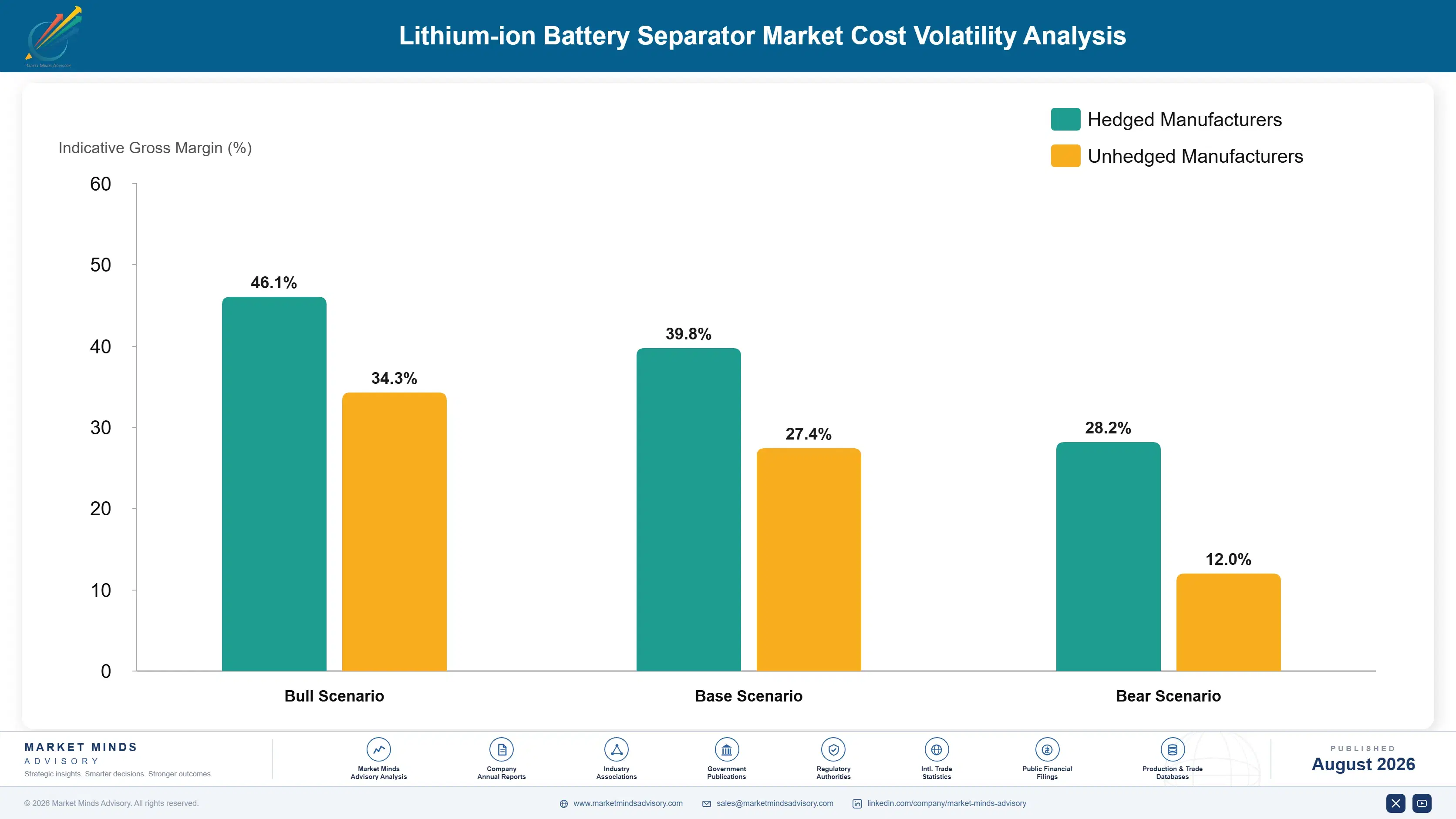
Polyethylene and polypropylene resin account for around 22% of separator cost, which is lower than most converted products because processing dominates. Extraction solvent, ceramic and binder materials for coating, and energy for extrusion, stretching and drying make up most of the remainder. Capital depreciation is unusually heavy given line costs and current utilisation. Resin comes from regional petrochemical suppliers on annual terms.
Resin prices moved sharply through 2021 and 2022 on petrochemical feedstock and European energy costs, and IEA data show European industrial gas well above American and Asian levels. Toray recorded raw material and energy cost pressure across its films operations in its Annual Report 2022. What dominated producer economics was not input cost but the collapse in selling price, which fell faster than any input rose.

Depreciation against low utilisation is the real cost problem here rather than materials. A line running at 58% carries its full capital charge across barely half the output it was financed for, which is why unit costs vary enormously between producers with identical technology. Chinese producers with newer, larger and better-loaded lines hold a position that has nothing to do with resin purchasing.
lithium-ion-battery-separator-market-cost-volatility-analysis-1787555286176

Convert capital allocation from capacity to coating lines

Base film utilisation near 58% makes further capacity the worst use of capital available, while coating compounds at 16.8% on lines costing a fraction of what an extrusion and stretching train requires. Producers still expanding film capacity are financing an asset nobody needs. Coating also qualifies faster, because the base film underneath is already approved.

Index resin supply and stop negotiating annually

Resin is 22% of cost and prices on petrochemical feedstock that moves for reasons entirely unconnected to battery demand. Annual negotiation against that produces an input price wrong from the day it is agreed. Indexing to published polyolefin benchmarks with quarterly reset removes the argument and the exposure together, and suppliers accept it readily.

Load lines against grid storage when automotive softens

Stationary storage buys separator area on total installed cost rather than squeezing component prices annually, and its demand curve moves independently of vehicle production cycles. Producers with capacity uncommitted to automotive programmes can load lines against it during the seasonal and cyclical gaps automotive leaves. Utilisation is the dominant cost variable at current loading, so any incremental volume helps considerably.

Portfolio Architecture for Margin Defence

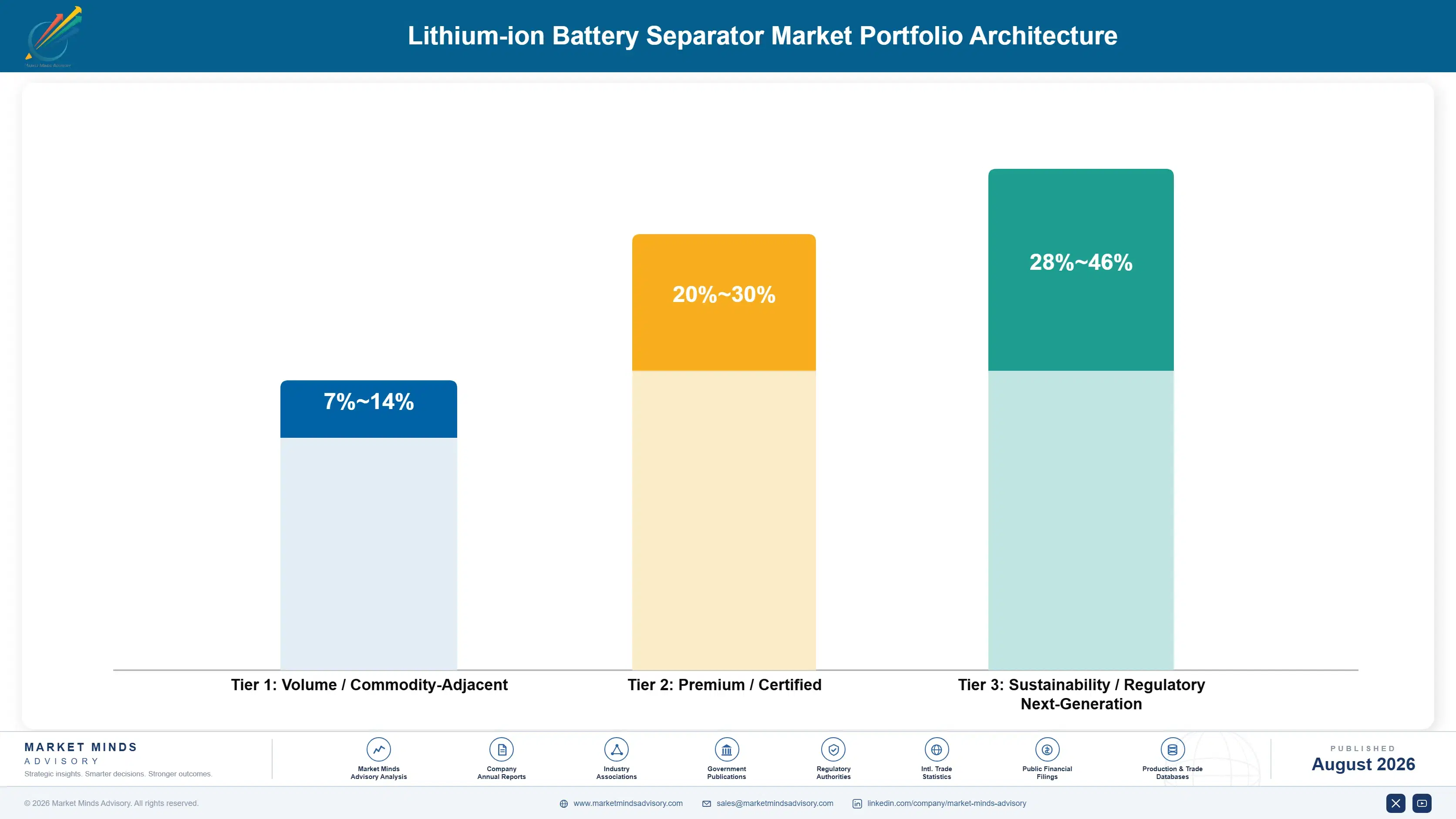
Margin in separators tracks surface treatment rather than film manufacture, because base film has been commoditised thoroughly and dozens of lines produce acceptable product. Uncoated dry and wet process film runs at gross margins in the high single digits against Chinese pricing that most producers cannot match. Ceramic-coated product runs considerably better, since coating uniformity at line speed narrows the field meaningfully. Dual-coated and functional product runs higher again, because the process knowledge excludes most competitors outright.
The tension is that base film fills the lines and coating earns the returns, and the two carry completely different capital profiles. An extrusion and stretching train costs several hundred million dollars and a coating line a fraction of that, yet the coating carries the margin. Producers who financed capacity between 2020 and 2023 are servicing debt against an asset that earns almost nothing, while competitors who spent less on coating are earning more.

High-value pools sit in dual-coated product, functional coatings for fast charging and non-Chinese manufacturing origin. None of the three is where the installed capacity is. Film capacity by itself defends nothing at all in this market now.

Volume / Commodity-Adjacent

Uncoated dry and wet process base film competed on price against Chinese capacity running at scale and low utilisation. The seven-point range separates producers with newer well-loaded lines from those carrying depreciation across half-empty older capacity.
Gross Margin: 7%-14%

Premium / Certified

Single ceramic-coated and polymer-coated product where coating uniformity at line speed narrows the supplier field considerably. The ten-point spread reflects process maturity, since pinhole and defect rates on a twelve micron film separate competent operations from struggling ones.
Gross Margin: 20%-30%

Sustainability / Regulatory / Next-Generation

Dual-coated and functional separators for fast charging, and any product qualifying under American or European localisation requirements. The eighteen-point range is wide because origin-based pricing reflects a regulation rather than a cost, and nothing benchmarks it.
Gross Margin: 28%-46%
lithium-ion-battery-separator-market-portfolio-architecture-1787555286670

High-value Sub-segments and Strategic Watch-out

Dual-Coated Functional Separators

Compounding at 14.6% and defended by process capability rather than capacity, since coating a twelve micron film uniformly on both faces at line speed is genuinely hard. Fast charging designs need it and very few producers can deliver it consistently at all. Nobody acquires that quickly.
Gross Margin: 30%-46%

Non-Chinese Manufacturing Origin

A premium created entirely by American and European localisation rules rather than by any product difference, and durable while those rules stand. Producers still benchmarking against Chinese quotations are giving away roughly a fifth of the available value here. That premium will not last forever, so take it now.
Gross Margin: 26%-44%

Uncoated Base Film Supply

The volume that fills the lines, growing at around 10% while prices fell 47% since 2021 and utilisation sits near 58%. Manage it for loading rather than for margin. Nobody outside China wins this on cost, and probably nobody ever will. Loading is the only variable worth managing.
Gross Margin: 7%-14%

Grid Storage Separator Demand

A customer that buys on total installed cost rather than squeezing components annually, favouring iron phosphate chemistries and dry process film at 5.4%. It supports a segment automotive was abandoning and asks far less of the supplier commercially. It also grows independently of vehicle production cycles entirely.
Gross Margin: 16%-26%

How Separator Demand Renews

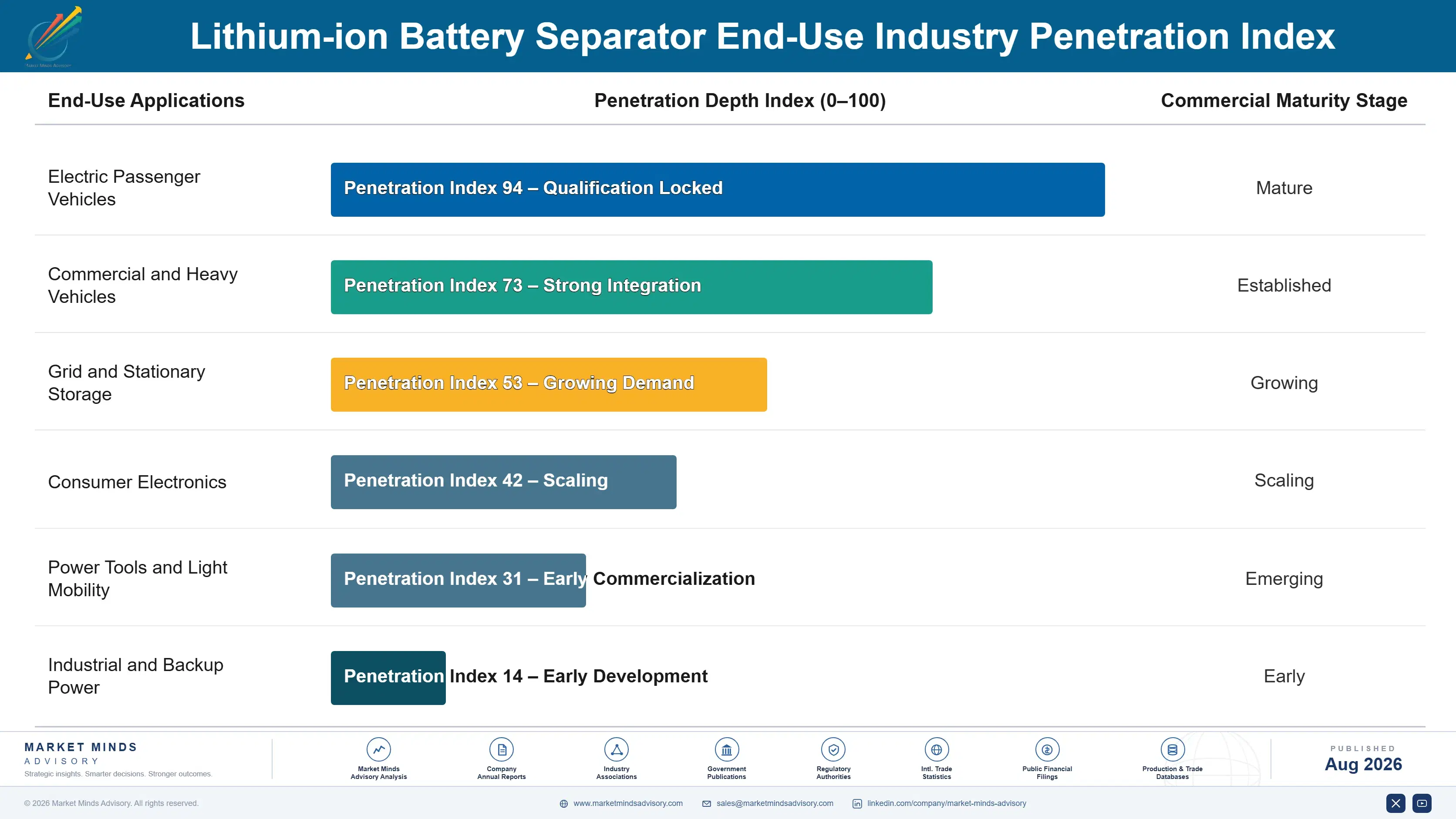
Separator demand renews on cell production volume rather than on any purchasing decision. Once a producer is qualified into a cell design, area ships continuously for as long as that cell is built, with no repurchasing conversation and volumes set by whatever the cell maker sells. The renewal moment is qualification, which takes around three years and happens years before the plant producing anything. That timeline is both the defence and the trap.
Stickiness is unusually high and unevenly distributed. Automotive cell qualifications are close to permanent, since requalifying means repeating three years of testing nobody will fund twice for a component at 8% of cell cost. Consumer electronics positions turn over faster on price. Grid storage sits between the two, sticky on performance history and looser on commercial terms than automotive ever is.

The buyer has moved upstream and most producers still call on the old one. Separator selection sat with cell engineering weighing porosity, thickness and thermal shrinkage. It now sits alongside procurement functions checking manufacturing origin against content rules and sustainability functions checking carbon footprint, neither of which reads a shrinkage curve at all.
lithium-ion-battery-separator-market-end-use-penetration-index-1787555287158

Where To Place The Bet

These are among the four positions where our research anticipates prominent divergence between winners and laggards over the coming forecast period. Each is grounded in the demand model, the regulatory perimeter, and the announced capacity pipeline.
01 / COATING CAPITAL ALLOCATION

Stop building film and start building coating

Base film prices have fallen roughly 47% since 2021 with industry utilisation near 58%, which makes another extrusion and stretching train comfortably the worst available use of capital in this industry today. Ceramic and polymer coating compound at 16.8% and 14.6% respectively, on lines costing a fraction of what base film capacity requires and qualifying considerably faster because the underlying film is already approved. Producers who redirected capital expenditure from capacity into coating between 2022 and 2024 are earning returns that base film producers can no longer approach.
02 / ORIGIN PREMIUM PRICING

Price against the regulation, not the competitor

American domestic content requirements and European battery regulation both push cell makers toward non-Chinese separator supply, and neither requirement bears any relationship to how the film actually performs in a cell. That creates two prices for a comparable product based purely on manufacturing location, which is an unusual commercial position and a durable one for as long as the rules stand unchanged. Producers outside China still benchmarking their quotations against Chinese pricing are giving away roughly a fifth of the value available to them.
03 / QUALIFICATION TIMING DISCIPLINE

Qualify three years before the plant runs

Separator qualification with a cell manufacturer takes around three years of testing and process validation, and no cell maker repeats that work once a supplier is approved and performing to specification. That makes qualification the strongest defensive position available in this market and simultaneously means a producer cannot respond to demand at the moment it appears. Cell plants under construction across America, Europe and India will pick suppliers long before they produce anything, and whoever arrives late finds the position already taken.
04 / STORAGE CHANNEL DEVELOPMENT

Follow grid storage away from automotive pressure

Stationary storage buys cells on total installed cost and cycle life rather than on weight and volume, which makes it a considerably less punishing customer than a vehicle manufacturer running an annual component cost reduction programme. Those designs favour iron phosphate chemistries and dry process separators in many cases, supporting a segment automotive demand had been steadily abandoning at 5.4% growth. Producers holding dry process capacity already written down through the automotive decline can serve that demand at margins automotive stopped offering years ago.

Engagement Snapshot From the Field

A live engagement with an industry participant carrying material or product regulatory and market exposure ahead of a defining policy shift, showing how our research translates into a defensible multi-year portfolio strategy.
MARKET MINDS ADVISORY · CLIENT ENGAGEMENT SUMMARY
Lithium-ion Battery Separator Producer Strategic Portfolio Review and Transition Roadmap 2026·Investment Scenario on Lithium-ion Battery Separator Exposure Evaluation 2025-26
CLIENT PROFILE
An Asian separator producer with annual revenue around USD 290 million (client-reported, unverified by MMA), operating wet process base film lines across two sites with limited ceramic coating capacity. Roughly 80% of output shipped uncoated. The business held qualification positions with four cell makers, all serving automotive programmes. A third base film line had been approved but not yet ordered.
STRATEGIC CHALLENGE
Margins had compressed for three consecutive years (client-reported, unverified by MMA) as base film prices fell and utilisation dropped below 60%. Management attributed the compression to Chinese competition and proposed the third line to improve unit cost through scale. Nobody had asked whether more capacity addressed a problem that was already one of too much capacity.
MMA APPROACH
MMA modelled the client's margin compression against price decline and utilisation separately rather than accepting scale as the answer, establishing which one actually drove the result. Coating line economics were compared against the approved base film investment on capital cost, payback and qualification timeline. Localisation premium availability was assessed against the client's manufacturing footprint through the expert interview programme.
KEY FINDINGS
  1. Price decline rather than unit cost explained almost all of the margin compression, which meant additional scale would have deepened the problem instead of addressing it.
  2. Coating capacity would have cost roughly a sixth of the approved base film line and delivered payback in under three years against more than eight for the line.
  3. Two of the client's four qualified cell makers were already specifying ceramic coating that the client was buying in from a competitor at considerable cost.
  4. The client's manufacturing footprint qualified for European localisation demand it had never once approached, since all commercial effort targeted its existing automotive customers.
CLIENT PROFILE
An Asian separator producer with annual revenue around USD 290 million (client-reported, unverified by MMA), operating wet process base film lines across two sites with limited ceramic coating capacity. Roughly 80% of output shipped uncoated. The business held qualification positions with four cell makers, all serving automotive programmes. A third base film line had been approved but not yet ordered.
STRATEGIC CHALLENGE
Margins had compressed for three consecutive years (client-reported, unverified by MMA) as base film prices fell and utilisation dropped below 60%. Management attributed the compression to Chinese competition and proposed the third line to improve unit cost through scale. Nobody had asked whether more capacity addressed a problem that was already one of too much capacity.
MMA APPROACH
MMA modelled the client's margin compression against price decline and utilisation separately rather than accepting scale as the answer, establishing which one actually drove the result. Coating line economics were compared against the approved base film investment on capital cost, payback and qualification timeline. Localisation premium availability was assessed against the client's manufacturing footprint through the expert interview programme.
KEY FINDINGS
  1. Price decline rather than unit cost explained almost all of the margin compression, which meant additional scale would have deepened the problem instead of addressing it.
  2. Coating capacity would have cost roughly a sixth of the approved base film line and delivered payback in under three years against more than eight for the line.
  3. Two of the client's four qualified cell makers were already specifying ceramic coating that the client was buying in from a competitor at considerable cost.
  4. The client's manufacturing footprint qualified for European localisation demand it had never once approached, since all commercial effort targeted its existing automotive customers.
RECOMMENDED STRATEGY
Phase 1: Phase one: cancel the third base film line and redirect the approved capital toward ceramic coating capacity at the existing sites. Phase 2: Phase two: stop buying coating from a competitor and bring the two affected cell maker programmes onto internally coated product. Phase 3: Phase three: open commercial approach to European cell makers on manufacturing origin, pricing against the regulation rather than against Chinese quotations.
OUTCOME
The third line was cancelled and coating capacity is commissioning at both sites. Both affected programmes have moved to internally coated product. European commercial approach is under way with two cell makers in qualification, and the client reports margin recovering for the first time in four years (client-reported, unverified by MMA).

Frequently Asked Questions

Foundational context covering the market sizes, CAGR, scope, country, region and competition that inform every finding below. This section is provided to cover basics and most often pre-purchase conversations, answered from the MMA Primary Research Dataset.

What is the current size of the Lithium-ion Battery Separator Market?

The market was valued at USD 7.2 billion in 2025, rising to an estimated USD 8.01 billion in 2026. East Asia holds the largest regional share at 46% of value.

How large will the Lithium-ion Battery Separator Market be by 2036?

MMA forecasts USD 23.15 billion by 2036 under the base case, an expansion multiple of 2.89 times the 2026 value. That represents USD 15.14 billion of incremental value.

What is the CAGR for the Lithium-ion Battery Separator Market 2026 to 2036?

The base case runs at 11.2% compound annual growth between 2026 and 2036, with a bull case at 12.4% and a bear case at 9.9%. Historical growth from 2020 to 2025 was 9.8%.

Which segment is growing fastest?

Ceramic-coated separators lead at 16.8%, half again the market rate, because higher-nickel cathodes put more thermal burden on the membrane. Polymer-coated product follows at 14.6%.

Who are the major companies in the Lithium-ion Battery Separator Market?

Yunnan Energy New Material, Asahi Kasei, Toray, SK IE Technology and Sinoma hold 68% between them. Coating capability rather than film capacity sustains the profitable positions.

Which country is growing fastest?

India leads at 16.2%, driven by cell manufacturing built almost from nothing under production-linked incentive programmes. The base is small enough that percentages flatter it.

Report Segmentation Architecture

The full report scope spans multiple orthogonal segmentation dimensions, with cross-tabulated demand data provided for each dimension pair. Coverage extends further to regional breakdowns, trend trajectories, and the competitive detail needed to support segment-level decision-making.

By Membrane Construction

  • Dry Process Polypropylene Monolayer
  • Dry Process Trilayer
  • Wet Process Polyethylene Base Film
  • Ceramic-Coated Separators
  • Polymer-Coated and Functional-Coated Separators
  • Nonwoven and Specialty Separators

By End-Use Industry

  • Electric Passenger Vehicles
  • Commercial and Heavy Vehicles
  • Grid and Stationary Storage
  • Consumer Electronics
  • Power Tools and Light Mobility
  • Industrial and Backup Power

By Supply Arrangement

  • Direct Cell Maker Supply
  • Contract Coating Service
  • Distributor and Trading Channel
  • Pilot and Development Supply
  • Toll Conversion Arrangement

By Region

  • North America
  • Western Europe
  • East Asia
  • South Asia and Pacific
  • Latin America
  • Middle East and Africa
  • Eastern Europe

Scope, Methodology, and Coverage

Every figure in this report is reproducible from documented input assumptions. The scope below maps the historical period, the forecast horizon, the segmentation dimensions, and the countries covered, alongside the underlying primary and qualitative methodology.
Historical Period
2020 to 2025
Forecast Period
2026 to 2036
Base Year
2025 (USD billions; MMA Primary Research Dataset, August 2026)
Market Definition
The market comprises microporous separator membranes supplied for lithium-ion cell manufacture across automotive, grid storage, consumer electronics and industrial applications, covering dry process polypropylene monolayer, dry process trilayer, wet process polyethylene base film, ceramic-coated, polymer-coated and functional-coated, and nonwoven and specialty constructions. Value is measured at separator producer level on square metres of area shipped annually. Lead-acid and nickel battery separators, solid electrolytes, electrode current collector foils, cathode and anode active materials, electrolyte formulations and complete cell or pack assemblies fall outside scope.
Quantitative Units
USD billions (current prices); billion square metres of separator area shipped annually; USD per square metre by construction type
Segmentation Dimensions
By Membrane Construction; By End-Use Industry; By Supply Arrangement; By Region
Regions Covered
North America, Western Europe, East Asia, South Asia and Pacific, Latin America, Middle East and Africa, Eastern Europe
Countries Covered
China, Japan, South Korea, Taiwan, India, Indonesia, Thailand, Vietnam, Australia, United States, Canada, Mexico, Germany, France, Sweden, Norway, United Kingdom, Spain, Italy, Netherlands, Poland, Hungary, Czechia, Slovakia, Brazil, Chile, Argentina, Saudi Arabia, United Arab Emirates, Morocco
Key Companies Profiled
Yunnan Energy New Material, Asahi Kasei, Toray Industries, SK IE Technology, Sinoma Science and Technology, W-Scope, Shenzhen Senior Technology Material, Cangzhou Mingzhu, Entek International, UBE Corporation, Sumitomo Chemical, Mitsubishi Chemical, Daramic, Freudenberg Performance Materials, Nitto Denko, Hebei Gellec New Energy, Zhongxing New Material, Jiangsu Horizon New Energy, Dreamweaver International, Teijin
Quantitative Methodology
Primary survey, n=3,800 respondents, Q4 2025, six countries; demand-side model with trade association cross-validation
Qualitative Methodology
47 expert interviews, Q4 2025; applied to validate demand model assumptions, identify emerging dynamics, and assess competitive positioning
Report Format
PDF and XLSX data workbook (Word format preview document)
Publisher
Market Minds Advisory
Report Code
MMA-2026-ENE-127
Published
August 2026
Contact
sales@marketmindsadvisory.com | www.marketmindsadvisory.com

Purchase the full Lithium-ion Battery Separator Market Report (2026 to 2036).

The full report sizes the global lithium-ion battery separator market to 2036 across six membrane constructions and seven regions, measured on area shipped at producer level. It separates volume growth from value growth throughout, since prices fell roughly 47% while area tripled and most commentary treats the two as one number. Competitive analysis covers 20 participants evaluated on area shipped, with moat and risk assessment for the two leaders. The localisation premium created by American and European content rules is sized separately from any product-based pricing. Four quantified revenue levers close the analysis.
Six-construction segment sizing with segment-level growth rates
Seven-region share and growth breakdown to 2036
Twenty-participant competitive map on one area basis
Volume growth separated from value growth across the period
Localisation premium sized against product-based pricing separately
Four quantified revenue levers with commercial impact ranges

Built For The People Who Decide

From boardroom strategy to bench-side execution, this report is read cover-to-cover by leaders shaping the next decade of their industry, turning demand scenarios, market dynamics and valuation benchmarks into decisions.
CXOs/ Presidents/ VPs/ Managers
M&A and Corporate Development
Strategy Teams and R&D Heads
Procurement and Product Directors
Regulatory and Compliance Leaders
Investor Relations and Equity Analysts