Market Minds Advisory
Lithium Extraction From Brine Technology Market

Lithium Extraction From Brine Technology Market: Lithium Extraction From Brine Technology Market: Process Classes, Bankability and Water Permitting 2026 to 2036

Pumping brine into a pond and waiting eighteen months for the sun to do the work recovers less than half the lithium. Everybody knows a better way exists. Nobody has financed one at scale.

Lead Analyst

Published

September 2026

Make Smarter Decisions with Customized Research Insights

Request a free sample report and evaluate market opportunities, growth trends, and competitive dynamics relevant to your business needs.

2025 MARKET VALUE$1.9BMarket Size 2025
2036 FORECAST VALUE$8.5BBase Case , 2026 to 2036
CAGR 2026 TO 203614.6 %Bull 15.8% / Bear 13.4%
INCREMENTAL OPPORTUNITY$6.3BNet 10- year value creation
EXPANSION MULTIPLE3.91x2036 value over 2026 base
Strategic Levers
M&A Pipeline
Regional Outlook
Country Rankings
Competitive Intelligence
Segmental Deep-dive
Call-Us : 91 93563 13602

Executive Snapshot and Market Trajectory.

Lithium brine has been processed the same way for forty years: pump it into a pond, wait for the sun, recover maybe half of what you pumped. Direct extraction recovers 82% in two days instead. The obstacle has never been the chemistry; it has always been the financing.
The market reaches USD 2.18 billion in 2026 and USD 8.52 billion by 2036, a 3.91 times expansion at 14.6%. Adsorption direct extraction systems grow at 21.9%, half again the market rate of 14.6%, because aluminate sorbents have the longest commercial operating record of any direct method. Latin America holds 42% of spending, since the lithium triangle contains most of the world's brine resource, and Argentina grows at 19.8%. Nowhere else comes close on resource.
Five suppliers hold 34% of technology and equipment contract revenue, which is fragmented because nobody has yet built the reference plant that would consolidate the field. Sunresin sells sorbent at volume from a Chinese base. SLB and Veolia bring process engineering credibility that start-ups cannot buy. A dozen venture-funded technology developers hold pilots and no commercial track record at all. That group is running short of patience.
Market Definition
This report covers technology, equipment and process systems used to extract lithium from continental, geothermal and oilfield brine: adsorption direct extraction systems, ion exchange systems, solvent extraction systems, membrane and electrodialysis systems, evaporation pond infrastructure, and brine pretreatment and impurity removal equipment. It excludes hard rock spodumene mining and concentration, lithium carbonate and hydroxide conversion plants downstream of extraction, cathode and battery manufacturing, and the lithium chemical products themselves.
Base Year Value
$1.9B in 2025 (MMA Primary Research Dataset, September 2026)
Forecast Period
2026 to 2036, eleven discrete annual values
CAGR
14.6% base case. Bull 15.8%. Bear 13.4%.
Fastest Growth Segment
Adsorption Direct Lithium Extraction Systems: 21.9% CAGR
Fastest Growth Country
Argentina: 19.8% CAGR
Fastest Growth Region
South Asia and Pacific: 16.6% CAGR
Largest Region
Latin America: 42% of 2025 global value
Market Leaders
Sunresin New Materials, SLB, Veolia Water Technologies, Koch Technology Solutions and Eramet lead on technology and equipment contract revenue. Source: MMA Analysis.
Primary Survey
n=3,800 procurement and R&D decision-makers, Q4 2025, six countries
Methodology
Demand-side build-up, cross-validated against public data, 47 expert interviews

Lithium Extraction From Brine Technology Market Forecast Scenarios

lithium-extraction-from-brine-technology-market-size-forecast-scenario-1789985110436
Between 2020 and 2025 the category compounded at 13.2% and the lithium price did most of the steering. The 2022 spike funded pilot plants nobody would have financed a year earlier, and the 2023 and 2024 collapse killed several of them before they finished commissioning. What survived was the work backed by producers rather than by venture capital, which is a useful filter.
The base case holds 14.6% on three mechanisms. Argentine project development is proceeding at a pace nothing else matches, with a dozen brine operations in construction, each specifying extraction technology rather than ponds. Water permitting has become the binding constraint on new capacity in Chile and Argentina, and direct extraction reinjects most of the brine, which changes what a regulator will approve. And Chinese producers are deploying adsorption systems on Qinghai brine at commercial scale already.
The bull case at 15.8% assumes an American Smackover or Salton Sea project reaches steady commercial production, which would give lenders the reference plant this industry has never had. The bear case at 13.4% is a sustained low lithium price: producers defer projects, technology developers run out of funding before proving anything, and pond expansion becomes the cheap answer again.

Ponds, Sunshine And Eighteen Months

The conventional process is agricultural in character. Brine is pumped from beneath a salar into a sequence of ponds, the sun evaporates water over roughly 18 months, and what remains is concentrated enough to process. It works, it costs almost nothing to run, and it recovers perhaps half the lithium that went in. The rest stays in the residual brine and is discarded.
TOP FIVE CONCENTRATION34%Fragmented across technology licensors and process engineering contractors
LITHIUM RECOVERY RATE82%Achieved by direct extraction against conventional pond evaporation
PROCESS CYCLE TIME48 hoursBrine intake to concentrated eluate under direct extraction
EVAPORATION POND DURATION18 monthsTime from brine pumping to battery grade concentrate
FRESHWATER CONSUMPTION RATIO70 tonnesWater required per tonne of lithium carbonate equivalent
PROJECT CAPITAL INTENSITYUSD 22000Installed cost per annual tonne of nameplate capacity
Direct extraction does the same job in 48 hours at 82% recovery, using a sorbent, a resin or a membrane that grabs lithium and lets everything else pass. The chemistry has been understood for decades. What has not been established is whether any of these processes runs for years on real brine with real impurities without the sorbent degrading, and lenders have noticed that nobody can point to one.
Water is what changes the argument. A pond operation consumes around 70 tonnes of freshwater per tonne of lithium carbonate equivalent and evaporates the brine permanently. Direct extraction reinjects most of it. In Chile and Argentina, where water permitting now decides whether a project proceeds at all, that difference has moved from an environmental talking point to the commercial case.
"Nobody in this industry is arguing about whether direct extraction works. They are arguing about whether a bank will lend against a process that has run for eighteen months on one salar and never anywhere else."
Director, Battery Materials and Extraction Technology Practice · MMA Chemicals and Materials Practice · September 2026

Market Trends

Water Permitting Now Decides Which Projects Proceed

A pond operation consumes roughly 70 tonnes of freshwater per tonne of lithium carbonate equivalent and permanently removes the brine it evaporates, in regions where indigenous communities and agriculture depend on the same aquifers. Chilean and Argentine regulators have made water the decisive question in project approval, and several expansions have stalled entirely on it. Direct extraction reinjects most of the brine after stripping the lithium, which is a different conversation with a permitting authority. That regulatory shift has done more to sell this technology than any recovery rate ever managed to.
Market Impact: Recovery rises to 82%

Argentine Project Pipeline Outpaces Everywhere Else Combined

Argentina has more brine projects in construction than the rest of the world together, across Salta, Catamarca and Jujuy, and the national investment regime introduced to attract them has held through a change of government. Each of those projects specifies extraction technology at design rather than defaulting to ponds, which makes them the deciding customers for this whole industry. Argentina grows at 19.8%, faster than any other country here. Technology suppliers without a presence in Salta are competing for a fraction of the addressable work available. That concentration is unusual even by mining standards.
Market Impact: Opens 2 non-traditional resource types

Market Opportunities and Growth Drivers

Recovery Rates Double What Evaporation Ponds Achieve

A pond recovers perhaps half the lithium pumped from the salar and discards the rest in residual brine. Direct extraction reaches 82%, which nearly doubles the output from the same resource and the same pumping infrastructure. For a producer holding a fixed brine concession, that is not an efficiency improvement but an increase in the reserve. The arithmetic is compelling enough that every major producer runs a direct extraction programme, and cautious enough that most still build ponds alongside them while they wait for someone else to prove it. Nobody wants to be first.
Market Impact: Zero plants past 5 years

Oilfield And Geothermal Brine Opens Non-Traditional Resources

Lithium sits in produced water from oil and gas wells across the Smackover formation in Arkansas and in geothermal brine at the Salton Sea and the Upper Rhine Graben. Those resources were commercially worthless while ponds were the only process, because the brine is already at the surface and evaporating it makes no sense. Direct extraction changes that: the fluid is being pumped anyway for other reasons, and the lithium is a co-product on infrastructure somebody else already paid for. Exxon, Standard Lithium and Vulcan Energy are all working this angle.
Market Impact: Testing adds 9 months typically

Market Restraints and Challenges

No Reference Plant Exists For Project Lenders

Project finance requires a technology that has operated commercially for long enough to establish what it costs and how it degrades, and outside China no direct extraction process has that record. The root cause is timing rather than capability: the technology matured just as the lithium price collapsed, and nobody funds a first-of-a-kind plant in a downturn. Commercially this forces developers toward ponds or toward expensive equity rather than debt, which raises project cost enough to change the investment case. Mitigation runs through producer-backed demonstration plants, which is why the surviving programmes are all attached to established operators.
Market Impact: Cuts 70 tonnes water use

Brine Chemistry Varies Enough To Invalidate Processes

A process that works beautifully on Atacama brine can fail on a salar two hundred kilometres away, because magnesium, calcium, boron and sulphate ratios differ enormously between deposits. The root cause is geological: each salar has its own evaporation history and its own impurity profile, and sorbent selectivity is sensitive to all of it. Commercially this means a technology developer cannot generalise from one successful pilot, and every new project needs its own testing programme running months. Mitigation runs through pretreatment systems that normalise the feed before extraction, which adds capital cost and complexity nobody wanted.
Market Impact: Over 12 projects in construction
4 additional market trends, 3 additional growth drivers, and 2 additional restraints and challenges are covered in the full report. Contact sales@marketmindsadvisory.com to access the complete intelligence.

Segment CAGR and Growth Architecture

Segmentation follows extraction technology class, since the separation mechanism determines capital cost, recovery rate and which brine chemistries a process can handle. Six classes cover the market: adsorption direct extraction, ion exchange direct extraction, membrane and electrodialysis systems, brine pretreatment and impurity removal, solvent extraction direct systems, and evaporation pond infrastructure. Resource type and contracting model are separate dimensions.
lithium-extraction-from-brine-technology-market-market-share-analysis-1789985111023

Adsorption Direct Lithium Extraction Systems

Adsorption systems grow at 21.9%, half again the market rate of 14.6%, and the reason is operating record rather than superior chemistry. Aluminate sorbents have run commercially on Qinghai brine in China for years, which is the only sustained industrial evidence any direct extraction method can offer, and a project lender reads that as risk reduction. Sunresin supplies most of that sorbent and has taken the position that Western technology developers assumed would be theirs. The weakness is sorbent degradation over cycles, which shows up slowly and is expensive to establish, and the disclosed operating data on it remains thinner than any financier would like. Nobody outside China has matched that record yet.
CAGR 21.9%

Ion Exchange Direct Lithium Extraction Systems

Ion exchange systems grow at 18.4% and attract the most venture funding of any approach here, mostly on selectivity arguments. A resin that binds lithium and rejects magnesium handles brine chemistries where sorbents struggle, which matters because magnesium to lithium ratios vary by an order of magnitude between salars. Lilac Solutions and several others have built the technology around that advantage. The commercial problem is acid consumption: regenerating the resin needs reagent at volumes that change the operating cost model, and on a remote salar the acid has to be trucked in or made on site. Neither answer is cheap, and the difference shows up in every operating cost model anyone builds.
CAGR 18.4%
Full segment breakdown across 6 segments available in the complete report.

Regional Architecture and Country Demand Map

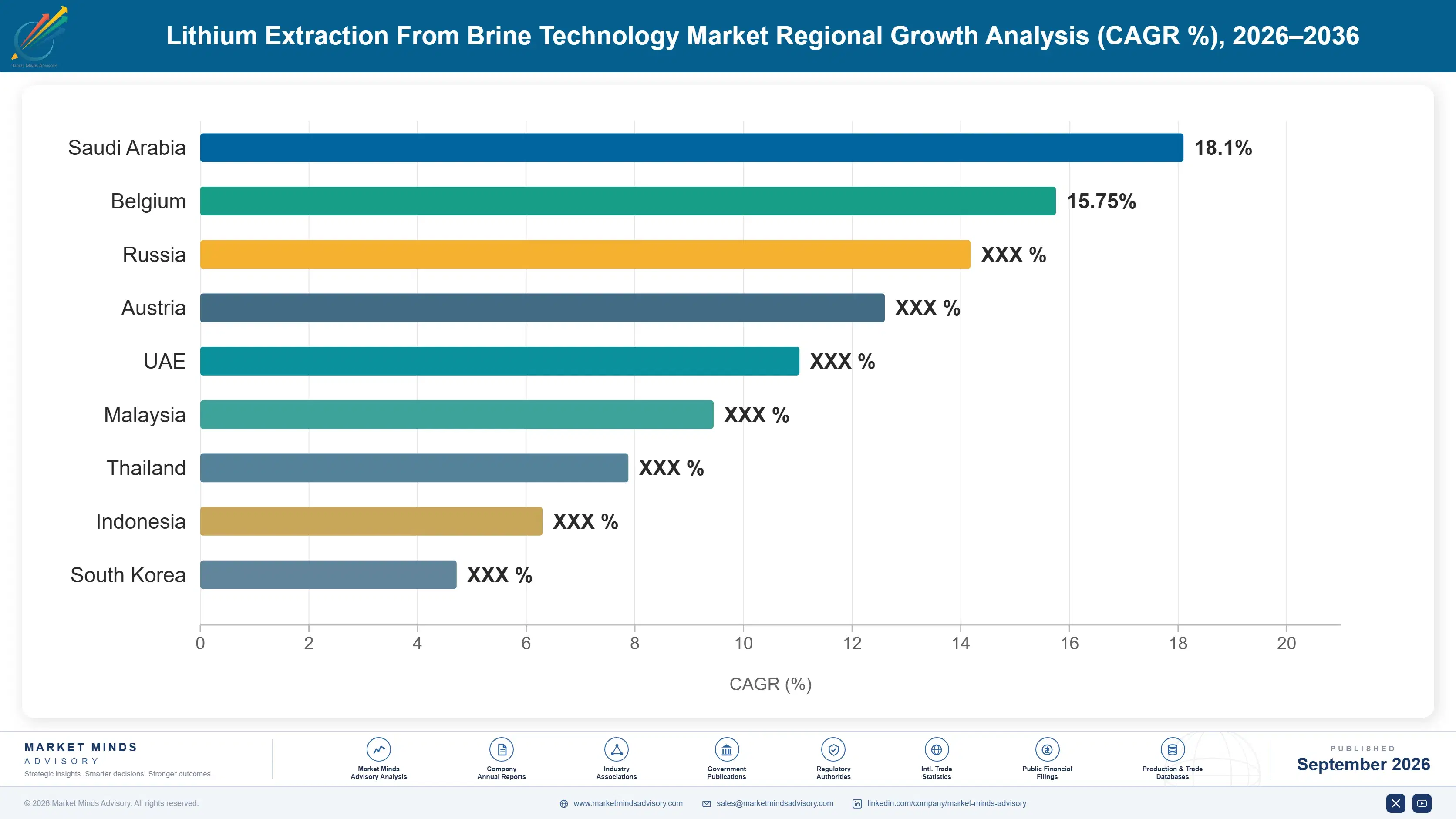
Latin America leads at 42%, far outside the standard band, because the lithium triangle across Chile, Argentina and Bolivia contains most of the world's brine resource. North America and Western Europe sit below their bands on resource geology rather than any lack of capital. Geology decides this section.

Latin America

Latin America holds 42% of spending, far above the 9% band ceiling, and the lithium triangle is the entire explanation: Chile, Argentina and Bolivia sit on most of the world's brine resource, and there is no substitute for being where the salars are. Argentina drives the growth at 19.8%, with more projects in construction across Salta, Catamarca and Jujuy than the rest of the world combined. Chile operates the largest producing brine assets under a state participation model that shapes technology selection. Bolivian resource is enormous and the development record is poor. Water permitting has become the deciding question everywhere in the region, and it now outranks recovery rate in every tender.
Share: 42% | CAGR: 15.0% (2026 to 2036)

East Asia

Chinese salt lake operations account for almost all of East Asia's 22%, and they are the only place where direct extraction has run at commercial scale for years. Qinghai and Tibetan brine carries very high magnesium relative to lithium, which made conventional evaporation impractical and forced Chinese producers to solve the problem earlier than anyone else. Sunresin, Jiuwu and several domestic engineering firms built that capability and now export it. Japanese and Korean interest runs through battery supply chain investment in projects elsewhere rather than domestic resource. Growth at 15.4% reflects continued salt lake capacity expansion. The operating experience here is the industry's only real evidence base, and Western developers rarely acknowledge it.
Share: 22% | CAGR: 15.4% (2026 to 2036)
Regional intelligence for 5 additional markets available in the complete report: North America, Western Europe, South Asia and Pacific, Middle East and Africa, Eastern Europe. Contact sales@marketmindsadvisory.com.
lithium-extraction-from-brine-technology-market-country-cagr-analysis-1789985111545

How To Get A Plant Financed

The technology argument in this market was settled some time ago and the financing argument was not. What separates suppliers is whether a lender will accept their operating record, whether their process survives a brine chemistry it has not seen, and whether they are physically present where the projects are. The levers below address that.

Buy Operating Hours Before Buying Better Chemistry

Adsorption systems compound at 21.9% against 14.6% for the market, and it is not because aluminate sorbents outperform ion exchange resins on any technical measure. They have run commercially on Chinese brine for years, and that operating record is what a project lender accepts. A developer with a better process and 18 months of pilot data competes against one with an inferior process and a decade of plant history, and loses. Buying, licensing or partnering into accumulated operating hours is faster than accumulating them, and considerably faster than waiting. Nobody funds a first-of-a-kind plant during a price downturn.
Market Impact: Operating record beats 18 months of pilot data

Sell Water Reinjection To The Permitting Authority

Conventional ponds consume roughly 70 tonnes of freshwater per tonne of lithium carbonate equivalent and permanently remove the brine they evaporate, in regions where communities and agriculture draw on the same aquifers. Chilean and Argentine regulators have made water the decisive approval question and several expansions have stalled entirely on it. A supplier who arrives with a reinjection case, water balance modelling and community-facing documentation is answering the question that actually blocks projects. Recovery rate is the second conversation, and quite a few suppliers still open with it. That ordering costs them tenders they should win.
Market Impact: Reinjection answers the 70 tonne freshwater question directly

Build Testing Capacity Close To The Salars

Brine chemistry differs enough between salars that a process proven on one deposit needs its own testing programme on the next, typically running about 9 months before anybody commits capital. A supplier with laboratory and pilot capacity in Salta or Antofagasta runs that programme in weeks of elapsed shipping rather than months, and stays in the technical conversation while the developer makes decisions. Suppliers testing in Europe or North America send drums of brine across an ocean and wait. Argentina alone carries more projects in construction than everywhere else combined.
Market Impact: Testing programmes each run about 9 months locally

Target Oilfield And Geothermal Produced Water

Lithium in produced water was worthless while evaporation was the only process, because the fluid is already at surface and drying it makes no sense. Direct extraction turns it into a co-product on infrastructure somebody already built for oil, gas or geothermal power. Smackover operators in Arkansas, Salton Sea geothermal plants and Gulf national oil companies are all evaluating it, and 2 distinct resource types open that never existed as lithium sources before. The customer is an energy operator rather than a miner, which most technology suppliers are badly organised to reach.
Market Impact: Opens 2 resource types that were worth nothing

Who Controls the Margin Pool

Five suppliers hold 34% of technology and equipment contract revenue, fragmented because the reference plant that would consolidate this field does not exist yet. Sunresin leads on sorbent volume from a Chinese operating base nobody outside China can match. SLB, Veolia and Koch bring process engineering credibility and balance sheets that project lenders recognise. Eramet runs its own Argentine plant. All participants are assessed on technology and equipment contract revenue.
Competition runs on bankability rather than on performance data, which is unusual and reflects how early this industry is. A developer choosing a process is choosing what a lender will accept, so operating hours, corporate covenant strength and process guarantee capacity decide more selections than recovery rate does. Venture-funded developers with genuinely better chemistry keep losing to incumbents on exactly that basis.

Rankings shift the moment somebody finishes a plant. A first commercial Western operation running steadily for two years would resolve the financing question and consolidate this field, and the supplier attached to it takes a position nobody can attack for a decade. The other pressure is Chinese export: Sunresin and its domestic peers are bidding on South American projects with an operating record their competitors cannot produce.
lithium-extraction-from-brine-technology-market-company-positioning-matrix-1789985112076

Competitive Moat and Risk Dimensions

SUNRESIN NEW MATERIALS

Moat: Commercial Operating Record

Sunresin's adsorbents have run on Chinese salt lake brine at commercial scale for years, which is the only sustained industrial evidence any direct extraction method can offer. Project lenders reading a technical due diligence report weigh that operating history above laboratory selectivity data from a competitor. No amount of venture funding shortens the time needed to accumulate it.
SUNRESIN NEW MATERIALS

Risk: Geopolitical Procurement Exposure

Chinese-supplied technology faces procurement restrictions in American and increasingly European projects, on grounds unrelated to product quality. Those are precisely the developments with the most capital behind them and the longest contract terms. Western competitors with weaker operating records win that work by default, which is a disadvantage no technical performance answers at all.
SLB

Moat: Balance Sheet And Guarantees

SLB can offer process performance guarantees backed by a corporate balance sheet that a project lender treats as real security, which almost no technology developer in this field can match. It also understands subsurface fluid handling and reinjection from decades of oilfield work, and reinjection is the permitting argument. That combination reaches customers a specialist never will.
SLB

Risk: Lithium Remains Peripheral

Lithium extraction is a small line beside an oilfield services business measured in tens of billions, and attention follows revenue rather than strategic interest. A dedicated developer commits its entire engineering capacity to one process and responds faster when a brine chemistry surprises everybody. Corporate priorities also shift with the oil price, which has nothing to do with lithium.

Players Tracked

Prominent Players

Sunresin New Materials
SLB
Veolia Water Technologies
Koch Technology Solutions
Eramet

Other Key Players

Lilac Solutions
EnergySource Minerals
Summit Nanotech
Adionics
Rivalia Chemical
Evove
Membrion
Saltworks Technologies
GEA Group
Andritz
Hatch
Worley
Tenova Advanced Technologies
Jiangsu Jiuwu Hi-Tech
Vulcan Energy Resources

Recent Developments

APRIL 2025

Eramet Ramps Direct Extraction Plant In Argentina

Eramet continued ramping its Centenario direct lithium extraction operation in Salta province, an organic project development rather than an acquisition or joint venture. The plant is among the first Western direct extraction facilities to reach production, and the operating data it generates matters far beyond the company itself.
Signal: The industry needs a reference plant more than it needs another process, and this is one.
NOVEMBER 2024

Sunresin Expands Lithium Adsorbent Capacity For Export Projects

Sunresin New Materials expanded its lithium adsorbent manufacturing capacity, an organic capital investment rather than a transaction. The expansion targets South American brine projects rather than the Chinese salt lakes where the technology was proven, and it puts an operating record into markets Western developers had assumed were theirs.
Signal: An operating record travels across borders far more easily than most Western developers had expected it to.
JUNE 2025

ExxonMobil Advances Smackover Lithium Development In Arkansas

ExxonMobil advanced its Smackover formation lithium development in Arkansas, an organic project development rather than an acquisition. The resource is lithium in produced water from existing subsurface operations, which makes direct extraction the only workable process and gives an energy major a reason to fund a first commercial plant.
Signal: Energy majors can fund a first-of-a-kind plant at a moment when nobody else in the industry will.

What Extraction Technology Costs To Run

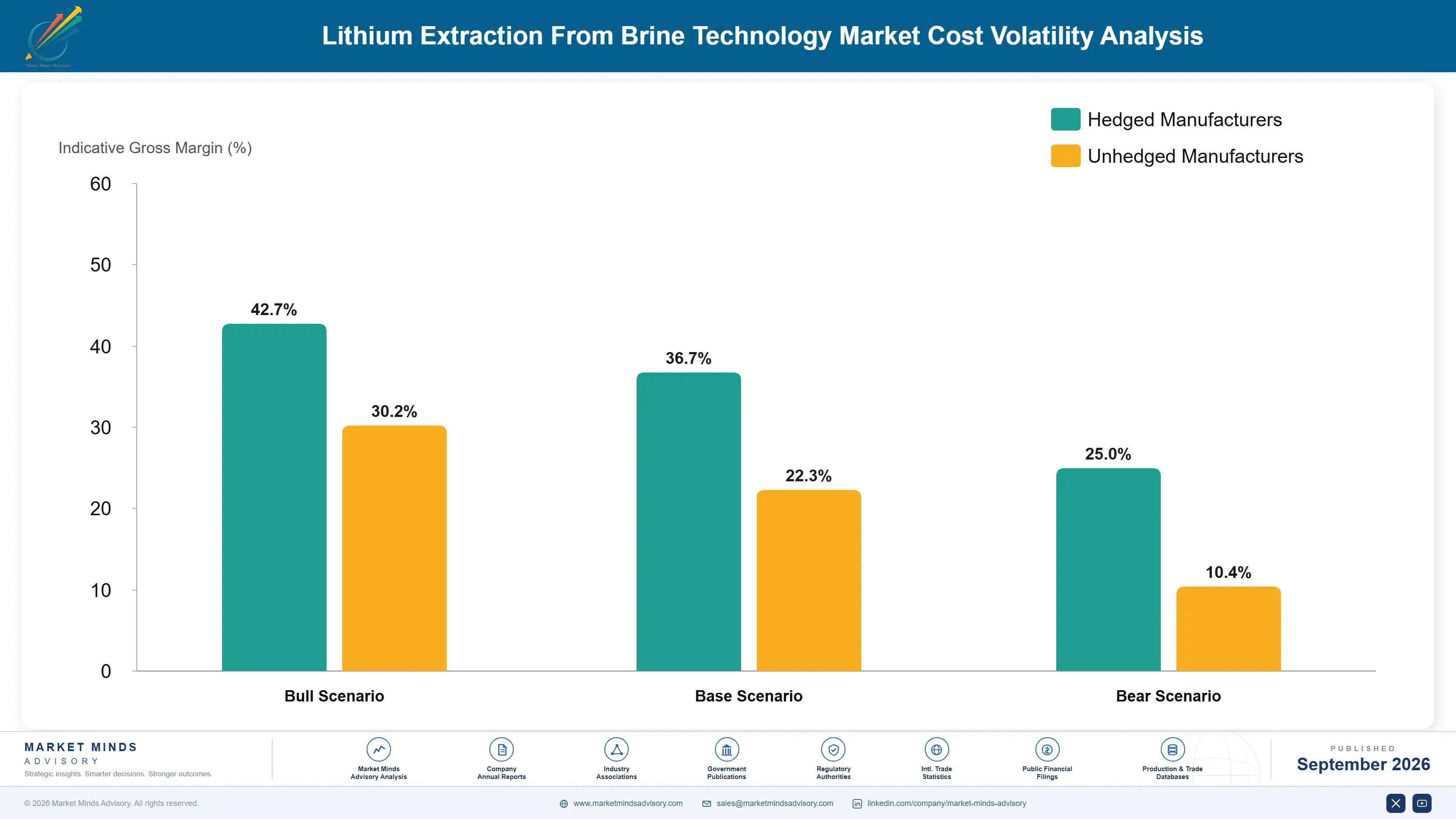
Sorbent and resin media account for roughly 31% of direct extraction operating cost, produced by a small group of specialty chemical manufacturers concentrated in China and Europe. Reagents for elution and regeneration, mainly hydrochloric acid and soda ash, add about 24%, sourced regionally and trucked to remote sites. Electricity and pumping carry around 18%, and membrane replacement most of the balance.
Eramet Annual Report 2024 records reagent and energy cost as the dominant operating variables at its Argentine direct extraction operation. SQM Annual Report 2024 notes comparable pressure across its Atacama operations, with logistics to remote sites cited alongside reagent pricing. The 2022 soda ash price rise raised reagent cost sharply across South American operations, and producers on remote salars absorbed both that increase and a trucking cost rising with diesel.

The competitive disadvantage mechanism is altitude and remoteness rather than any input price. A salar at four thousand metres consumes more energy per unit pumped, pays more for every reagent tonne trucked in, and struggles to keep skilled operators on site. Chinese salt lake operations sit at comparable altitude with far shorter supply lines. Geography rather than technology decides operating cost here, and no process choice changes it.
lithium-extraction-from-brine-technology-market-cost-volatility-analysis-1789985112273

Contract Reagent Supply Before Committing To A Site

Elution and regeneration reagents run about 24% of operating cost and arrive by truck on roads that are long, high and occasionally closed. Contracting supply and haulage before a plant is committed removes the exposure that caught operators during the 2022 soda ash rise. The working capital cost is modest against a line that cannot be reduced by process design.

Qualify A Second Sorbent Media Supplier

Sorbent and resin media run about 31% of operating cost from a narrow manufacturer base in China and Europe, which is a single point of failure for a plant that cannot pause. Qualifying an alternative media takes months of testing on the site's own brine and cannot be rushed later. The cost is duplicated validation nobody enjoys funding.

Generate Reagents On Site Where Power Allows

Trucking hydrochloric acid to a salar at four thousand metres costs more than the acid does, and the road is occasionally closed. Where a project has surplus power, generating reagent on site converts a logistics exposure into an electricity one that behaves far more predictably. The capital is a plant nobody budgeted and the payback runs over the operation's life.

Portfolio Architecture for Margin Defence

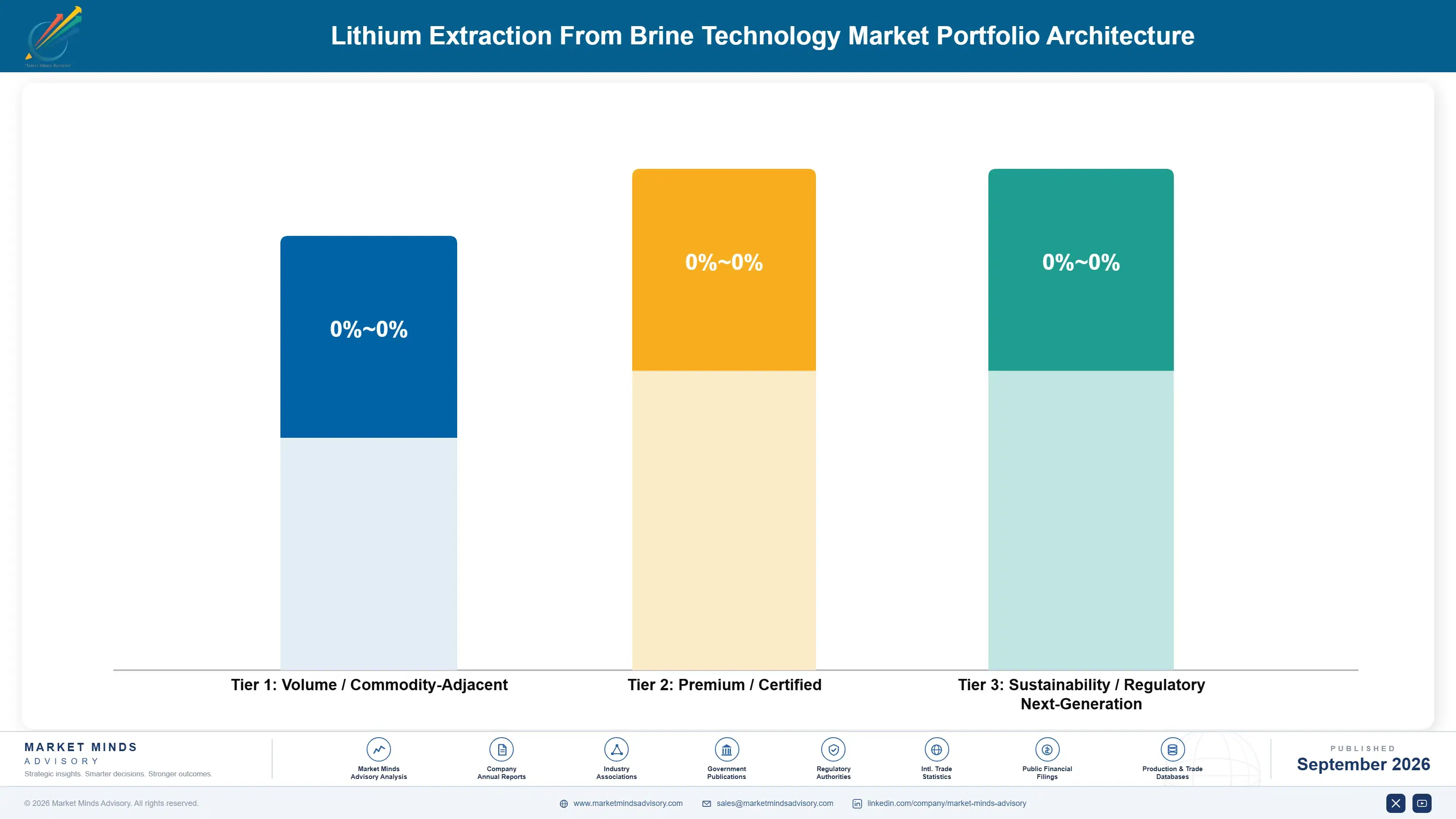
Margin architecture separates on how much of the process risk a supplier carries. Evaporation pond infrastructure earns least, since it is earthworks and liner sold by civil contractors against no technical differentiation whatsoever. Brine pretreatment and solvent extraction sit in the middle on conventional process engineering. Adsorption and ion exchange systems earn most, because a supplier offering a recovery guarantee on unfamiliar brine is pricing a risk very few competitors can underwrite at all.
The volume versus premium tension is really a balance sheet question. Guaranteeing a recovery rate on a brine chemistry nobody has run at scale is an underwriting decision, and a venture-funded developer cannot make it credibly however good the technology is. Large engineering firms can, which is why they win work against better processes. The tension inside those firms is whether lithium justifies the guarantee capacity it consumes.

High-value pools sit in adsorption and ion exchange systems, and both reward things that take years to build. Adsorption rewards accumulated operating hours, which cannot be bought quickly. Ion exchange rewards selectivity on difficult brine plus the reagent logistics to support it. Sunresin holds one, several Western developers are chasing the other, and nobody holds both convincingly.

Volume / Commodity-Adjacent

Evaporation pond infrastructure sold as earthworks, liner and civil construction with no technical differentiation between bidders. The eight point spread separates contractors with regional plant and labour from those mobilising equipment across borders.
Gross Margin: 12% to 20%

Premium / Certified

Brine pretreatment, impurity removal and solvent extraction systems sold as conventional process engineering against several credible bidders. The ten point spread tracks whether a supplier carries process guarantees or delivers equipment against a client specification.
Gross Margin: 26% to 36%

Sustainability / Regulatory / Next-Generation

Adsorption and ion exchange direct extraction systems, where operating record and recovery guarantees limit the credible supplier list severely. The twelve point spread reflects how differently each supplier prices the process risk it agrees to underwrite.
Gross Margin: 42% to 54%
lithium-extraction-from-brine-technology-market-portfolio-architecture-1789985112773

High-value Sub-segments and Strategic Watch-out

Adsorption Direct Extraction Systems

Grows at 21.9% on an operating record that no other method can match outside China, which is what project lenders actually accept. The twelve point spread reflects how differently suppliers price recovery guarantees. Sorbent degradation over cycles remains the disclosed weakness nobody has resolved yet.
Gross Margin: 42% to 54%

Ion Exchange Direct Extraction Systems

Grows at 18.4% on selectivity that handles brine chemistries where sorbents struggle, which matters because magnesium ratios vary by an order of magnitude. The twelve point spread reflects reagent logistics capability. Acid consumption for resin regeneration changes the operating cost model entirely on remote sites.
Gross Margin: 42% to 54%

Brine Pretreatment And Impurity Removal

Grows at 13.0% and appears in every project regardless of which extraction method follows it, since brine chemistry varies enough to require normalising the feed. The ten point spread tracks guarantee capacity rather than technology. This is the steadiest revenue line in the whole market.
Gross Margin: 26% to 36%

Evaporation Pond Infrastructure

Grows at 4.8%, by far the slowest here, because every new project specifies direct extraction and pond work is now expansion of existing operations only. The eight point spread reflects regional contractor scale. Water permitting has made new pond capacity difficult to approve anywhere now.
Gross Margin: 12% to 20%

How Projects Choose A Process

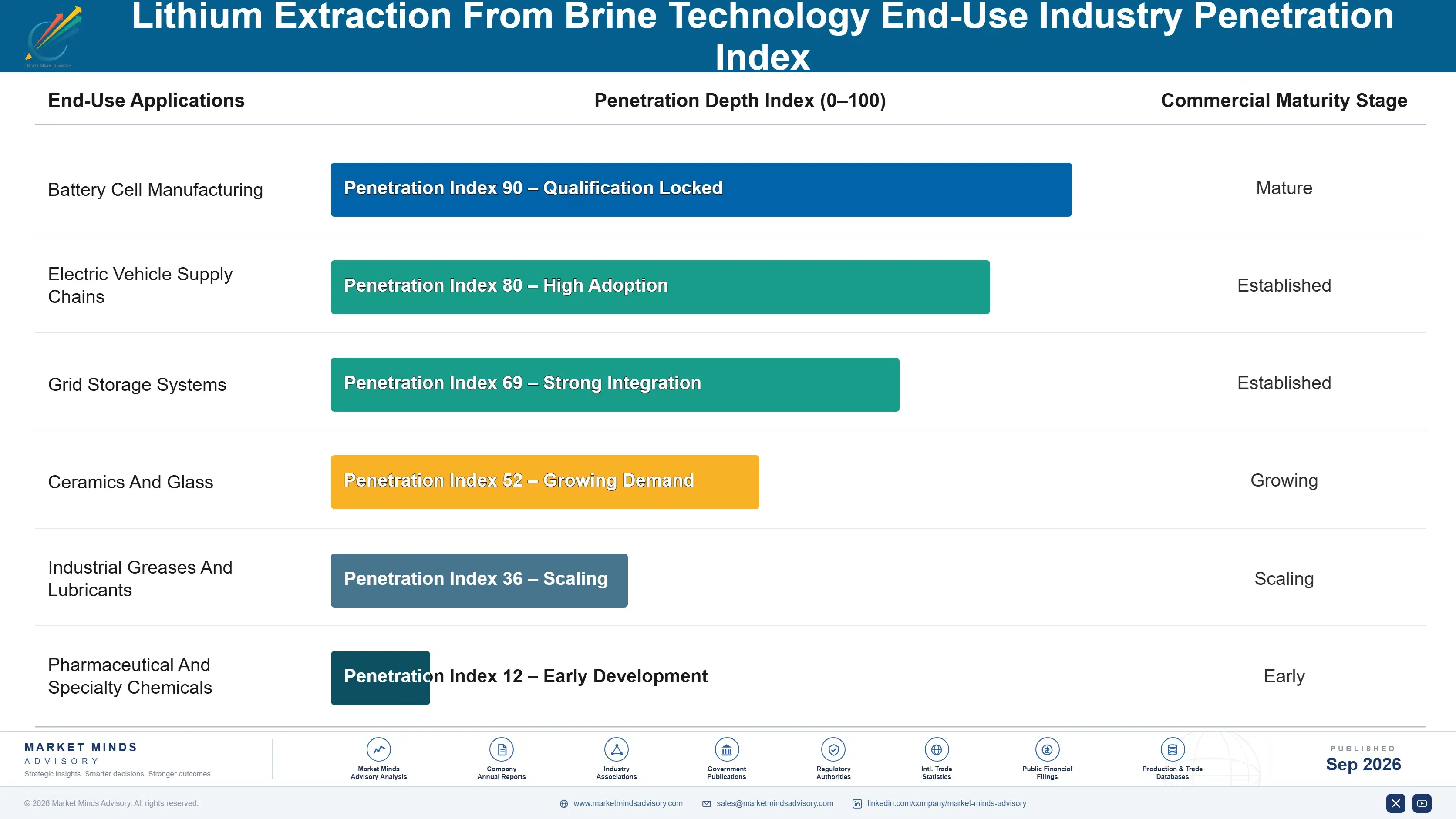
The annuity is sorbent and reagent supply rather than the plant. A project that installs an adsorption system buys replacement media for the life of the operation, which runs decades, and that consumable stream is worth several times the original equipment sale. Technology suppliers who sell a licence and walk away collected once. Those who supply the media collect every year the plant runs.
Adoption depth varies by operator type more than by geography. Established producers adopt cautiously, running direct extraction alongside ponds rather than instead of them, because the existing asset works and nobody wants to explain a failure. New developers adopt fully because they have no pond infrastructure to defend and water permitting leaves them little choice. Energy majors adopt on entirely different logic again, since the fluid is already being pumped.

The deciding buyer has moved from a metallurgist to a project financier, which changed what wins. A metallurgist compared recovery rates and reagent consumption. A financier asks how many plant-years of operating data exist and who stands behind the performance guarantee, and no laboratory result answers either question. That shift explains most of the current rankings.
lithium-extraction-from-brine-technology-market-end-use-penetration-index-1789985113264

Where The Money Actually Goes

These are among the four positions where our research anticipates prominent divergence between winners and laggards over the coming forecast period. Each is grounded in the demand model, the regulatory perimeter, and the announced capacity pipeline.
01 / OPERATING RECORD PRIORITY

Acquire Plant Years, Not Better Chemistry

Adsorption systems compound at 21.9% against 14.6% for the market, and not because aluminate sorbents beat ion exchange resins on any technical measure anybody publishes. They have run commercially on Chinese brine for years, and that accumulated operating record is what a project lender accepts when the technical due diligence report lands on the desk. A developer with better chemistry and 18 months of pilot data loses to one with an inferior process and a decade of plant history, so buying, licensing or partnering into those hours beats waiting.
02 / WATER PERMITTING POSITIONING

Lead With Reinjection, Not Recovery Rate

Conventional ponds consume roughly 70 tonnes of freshwater per tonne of lithium carbonate equivalent and permanently remove the brine they evaporate, in regions where communities and agriculture draw on the same aquifers. Chilean and Argentine regulators have made water the decisive approval question, and several expansions have stalled entirely on it regardless of what the economics looked like. A supplier arriving with a reinjection case, water balance modelling and community-facing documentation is answering the question that actually blocks projects, while competitors still opening on recovery rate are losing tenders.
03 / LOCAL TESTING PRESENCE

Put Pilot Capacity Inside The Lithium Triangle

Brine chemistry differs enough between salars that a process proven on one deposit needs its own testing programme on the next, typically running about 9 months before anybody commits capital. A supplier with laboratory and pilot capacity in Salta or Antofagasta runs that programme without shipping drums of brine across an ocean, and stays in the technical conversation while the developer is deciding. Argentina alone carries more projects in construction than the rest of the world combined, so a supplier without presence there competes for a fraction of the work.
04 / UNCONVENTIONAL RESOURCE TARGETING

Chase Produced Water, Not Just Salars

Lithium in oilfield and geothermal produced water was commercially worthless while evaporation was the only process, because the fluid is already at surface and drying it makes no sense. Direct extraction turns it into a co-product on infrastructure somebody already built and paid for, which opens 2 resource types that never existed as lithium sources before. Smackover operators in Arkansas, Salton Sea geothermal plants and Gulf national oil companies are all evaluating it, and the customer is an energy operator rather than a miner, which most technology suppliers cannot reach.

Engagement Snapshot From the Field

A live engagement with an industry participant carrying material or product regulatory and market exposure ahead of a defining policy shift, showing how our research translates into a defensible multi-year portfolio strategy.
MARKET MINDS ADVISORY · CLIENT ENGAGEMENT SUMMARY
Lithium Extraction From Brine Technology Producer Strategic Portfolio Review and Transition Roadmap 2026·Investment Scenario on Lithium Extraction From Brine Technology Exposure Evaluation 2025-26
CLIENT PROFILE
An Argentine lithium developer holding a brine concession in Salta province, moving from feasibility toward a construction decision on a plant of roughly twenty thousand tonnes annual capacity. Four extraction technologies had been shortlisted and the technical team preferred one that no lender on the syndicate had heard of. The financing package was already being assembled around a different assumption entirely.
STRATEGIC CHALLENGE
Metallurgy favoured a novel ion exchange process on selectivity grounds against the local brine chemistry. The lenders wanted operating history and process guarantees the developer could not produce. Neither side had modelled what the technology choice did to the cost of capital, which turned out to matter more than the recovery rate difference between the options.
MMA APPROACH
MMA modelled each shortlisted technology against the project's brine chemistry and then against the financing terms each would attract, converting operating record and guarantee capacity into a cost of capital rather than a qualitative preference. We drew on 47 expert interviews conducted in Q4 2025 across technology suppliers, project lenders, engineering contractors, and operators running comparable Argentine plants.
KEY FINDINGS
  1. The preferred novel process carried a financing cost premium of roughly 3 percentage points, which exceeded the value of its recovery advantage several times over (client-reported, unverified by MMA).
  2. Only 2 of the 4 shortlisted suppliers could offer a process performance guarantee backed by a balance sheet the lending syndicate would accept.
  3. Brine testing on the actual concession had been run for only 4 months, well short of the period lenders expected before committing to a technology.
  4. Water reinjection performance rather than recovery rate had driven the provincial permitting conversation, and none of the shortlist documentation addressed it directly.
CLIENT PROFILE
An Argentine lithium developer holding a brine concession in Salta province, moving from feasibility toward a construction decision on a plant of roughly twenty thousand tonnes annual capacity. Four extraction technologies had been shortlisted and the technical team preferred one that no lender on the syndicate had heard of. The financing package was already being assembled around a different assumption entirely.
STRATEGIC CHALLENGE
Metallurgy favoured a novel ion exchange process on selectivity grounds against the local brine chemistry. The lenders wanted operating history and process guarantees the developer could not produce. Neither side had modelled what the technology choice did to the cost of capital, which turned out to matter more than the recovery rate difference between the options.
MMA APPROACH
MMA modelled each shortlisted technology against the project's brine chemistry and then against the financing terms each would attract, converting operating record and guarantee capacity into a cost of capital rather than a qualitative preference. We drew on 47 expert interviews conducted in Q4 2025 across technology suppliers, project lenders, engineering contractors, and operators running comparable Argentine plants.
KEY FINDINGS
  1. The preferred novel process carried a financing cost premium of roughly 3 percentage points, which exceeded the value of its recovery advantage several times over (client-reported, unverified by MMA).
  2. Only 2 of the 4 shortlisted suppliers could offer a process performance guarantee backed by a balance sheet the lending syndicate would accept.
  3. Brine testing on the actual concession had been run for only 4 months, well short of the period lenders expected before committing to a technology.
  4. Water reinjection performance rather than recovery rate had driven the provincial permitting conversation, and none of the shortlist documentation addressed it directly.
RECOMMENDED STRATEGY
Phase 1: Phase one: reprice the shortlist on cost of capital rather than recovery rate, since the financing difference dwarfs the metallurgical difference between these options. Phase 2: Phase two: extend concession brine testing to at least twelve months with the two guarantee-capable suppliers, running both in parallel rather than sequentially. Phase 3: Phase three: rebuild the permitting submission around water reinjection performance, since that is the question the province is actually asking.
OUTCOME
The developer selected a guarantee-capable supplier over its metallurgical preference and closed financing two quarters later (client-reported, unverified by MMA). The recovery rate accepted was slightly lower and the cost of capital was materially better. Water reinjection modelling now leads the provincial permitting submission rather than appearing as an appendix.

Frequently Asked Questions

Foundational context covering the market sizes, CAGR, scope, country, region and competition that inform every finding below. This section is provided to cover basics and most often pre-purchase conversations, answered from the MMA Primary Research Dataset.

What is the current size of the Lithium Extraction From Brine Technology Market?

Global value reaches USD 2.18 billion in 2026, measured as technology and equipment contract revenue across all brine extraction process classes. The 2025 base is USD 1.9 billion.

How large will the Lithium Extraction From Brine Technology Market be by 2036?

Contract revenue reaches USD 8.52 billion by 2036, an increase of USD 6.34 billion over the forecast period. That represents 3.91 times expansion from the 2026 base.

What is the CAGR for the Lithium Extraction From Brine Technology Market 2026 to 2036?

The base case runs at 14.6% annually, with a bull case at 15.8% if an American project reaches steady commercial production and a bear case at 13.4% if lithium prices stay low.

Which segment is growing fastest?

Adsorption direct extraction systems grow at 21.9%, half again the market rate of 14.6%. Aluminate sorbents carry the longest commercial operating record of any direct method, which is what project lenders accept.

Who are the major companies in the Lithium Extraction From Brine Technology Market?

Sunresin New Materials, SLB, Veolia Water Technologies, Koch Technology Solutions and Eramet lead on technology and equipment contract revenue, together holding 34%. Lilac Solutions and Summit Nanotech hold pilot-stage positions.

Which country is growing fastest?

Argentina leads at 19.8%, with more brine projects in construction across Salta, Catamarca and Jujuy than the rest of the world combined. Chile and China follow some way behind.

Report Segmentation Architecture

The full report scope spans multiple orthogonal segmentation dimensions, with cross-tabulated demand data provided for each dimension pair. Coverage extends further to regional breakdowns, trend trajectories, and the competitive detail needed to support segment-level decision-making.

By Extraction Technology

  • Adsorption Direct Lithium Extraction Systems
  • Ion Exchange Direct Lithium Extraction Systems
  • Membrane And Electrodialysis Systems
  • Brine Pretreatment And Impurity Removal
  • Solvent Extraction Direct Systems
  • Evaporation Pond Infrastructure

By End-Use Industry

  • Battery Cell Manufacturing
  • Electric Vehicle Supply Chains
  • Grid Storage Systems
  • Ceramics And Glass
  • Industrial Greases And Lubricants
  • Pharmaceutical And Specialty Chemicals

By Commercial Dimension

  • Technology Licensing Agreements
  • Engineering Procurement And Construction
  • Direct Equipment Supply
  • Consumable Media Supply Contracts
  • Build Own Operate Arrangements
  • Pilot And Testing Services

By Region

  • North America
  • Western Europe
  • East Asia
  • South Asia and Pacific
  • Latin America
  • Middle East and Africa
  • Eastern Europe

Scope, Methodology, and Coverage

Every figure in this report is reproducible from documented input assumptions. The scope below maps the historical period, the forecast horizon, the segmentation dimensions, and the countries covered, alongside the underlying primary and qualitative methodology.
Historical Period
2020 to 2025
Forecast Period
2026 to 2036
Base Year
2025 (USD billions; MMA Primary Research Dataset, September 2026)
Market Definition
This report covers technology, equipment and process systems used to extract lithium from continental, geothermal and oilfield brine: adsorption direct extraction systems, ion exchange systems, solvent extraction systems, membrane and electrodialysis systems, evaporation pond infrastructure, and brine pretreatment and impurity removal equipment. It excludes hard rock spodumene mining and concentration, lithium carbonate and hydroxide conversion plants downstream of extraction, cathode and battery manufacturing, and the lithium chemical products themselves.
Quantitative Units
USD millions, technology and equipment contract revenue basis; lithium recovery rate as a percentage; process cycle time in hours; freshwater consumption in tonnes per tonne of lithium carbonate equivalent; installed capital cost per annual tonne.
Segmentation Dimensions
Extraction technology class; end-use industry; commercial contracting model; geography across seven regions.
Regions Covered
North America, Western Europe, East Asia, South Asia and Pacific, Latin America, Middle East and Africa, Eastern Europe
Countries Covered
Chile, Argentina, Bolivia, Brazil, Mexico, United States, Canada, China, Japan, South Korea, India, Australia, Germany, France, United Kingdom, Poland, Kazakhstan, Saudi Arabia, United Arab Emirates, Zimbabwe.
Key Companies Profiled
Sunresin New Materials, SLB, Veolia Water Technologies, Koch Technology Solutions, Eramet, Lilac Solutions, EnergySource Minerals, Summit Nanotech, Adionics, Saltworks Technologies, GEA Group, Andritz, Worley, Jiangsu Jiuwu Hi-Tech, Vulcan Energy Resources.
Quantitative Methodology
Primary survey, n=3,800 respondents, Q4 2025, six countries; demand-side model with trade association cross-validation
Qualitative Methodology
47 expert interviews, Q4 2025; applied to validate demand model assumptions, identify emerging dynamics, and assess competitive positioning
Report Format
PDF and XLSX data workbook (Word format preview document)
Publisher
Market Minds Advisory
Report Code
MMA-2026-CHM-201
Published
September 2026
Contact
sales@marketmindsadvisory.com | www.marketmindsadvisory.com

Purchase the full Lithium Extraction From Brine Technology Market Report (2026 to 2036).

This report sizes the global lithium brine extraction technology market from 2026 to 2036 across six technology classes, six end-use industries and seven regions. It explains why project financing rather than process performance decides technology selection, and why no reference plant outside China has yet resolved that. Operating cost composition is sourced to company annual reports, with sorbent and resin media at 31% of direct extraction cost. Regional analysis explains why Latin America leads at 42% of spending on the lithium triangle resource. Competitive assessment covers 20 named suppliers with four revenue lever analyses and an anonymised Argentine technology selection engagement.
Financing bankability modelled against process performance data
Six extraction technology classes sized through to 2036
Sorbent and reagent cost composition from annual reports
Twenty named suppliers assessed on contract revenue
Four revenue levers with quantified commercial impact
Anonymised Argentine technology selection engagement included in full

Built For The People Who Decide

From boardroom strategy to bench-side execution, this report is read cover-to-cover by leaders shaping the next decade of their industry, turning demand scenarios, market dynamics and valuation benchmarks into decisions.
CXOs/ Presidents/ VPs/ Managers
M&A and Corporate Development
Strategy Teams and R&D Heads
Procurement and Product Directors
Regulatory and Compliance Leaders
Investor Relations and Equity Analysts