Lithium and Lithium-Ion Battery Electrolyte Market
Lithium and Lithium-Ion Battery Electrolyte Market: Gigafactory Buildout Concentrates Supply Around a Handful of Asian Formulators
EV gigafactory expansion is pulling electrolyte demand toward formulators co-located with Chinese, Japanese, and Korean cell manufacturing, leaving Western automakers dependent on a supply base thousands of miles from their assembly lines.
2025 MARKET VALUE$8.5BMarket Size 2025
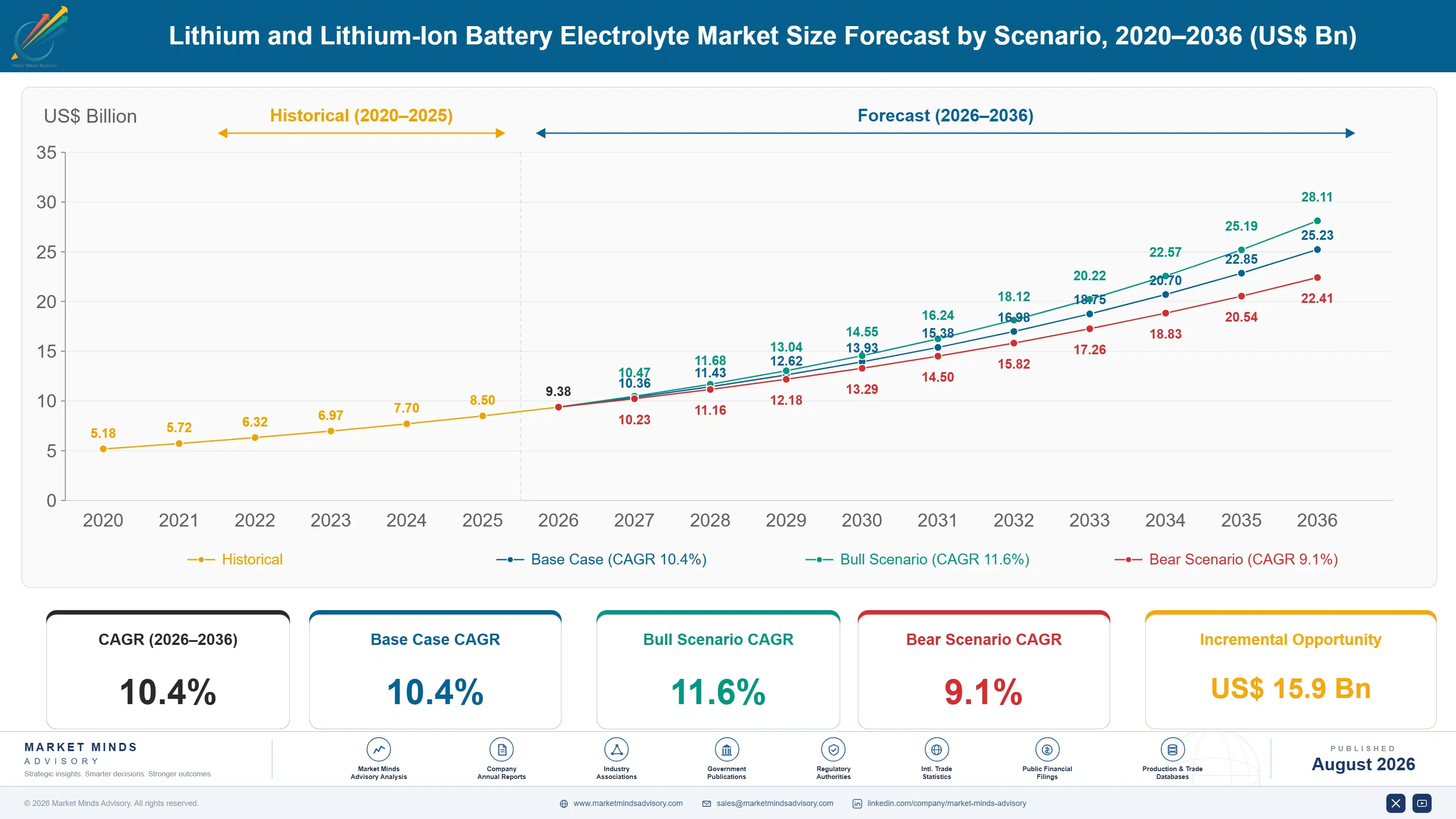
2036 FORECAST VALUE$25.2BBase Case , 2026 to 2036
CAGR 2026 TO 203610.4 %Bull 11.6% / Bear 9.1%
INCREMENTAL OPPORTUNITY$15.9BNet 10- year value creation
EXPANSION MULTIPLE2.69x2036 value over 2026 base
Strategic Levers
M&A Pipeline
Regional Outlook
Country Rankings
Competitive Intelligence
Segmental Deep-dive
Executive Snapshot and Market Trajectory
Electrolyte manufacturing has stayed remarkably concentrated even as battery cell production spreads globally, and automakers building gigafactories outside Asia now face a formulator base still overwhelmingly clustered in China, Japan, and Korea, a mismatch reshaping supply contracts. Buyers face few substitution options as a result.
LFP-compatible electrolyte formulations account for the largest share of near-term volume, but solid-state and gel polymer electrolytes are growing fastest as next-generation cell architectures move from pilot lines toward early commercial production. China's electrolyte manufacturing base dwarfs every other geography combined, a concentration far exceeding what most other battery material categories carry today. North America and Western Europe both remain years behind matching that production scale. Formulators increasingly cite that gap as a risk.
Mitsubishi Chemical and Tinci Materials set formulation and pricing benchmarks that smaller regional blenders struggle to match on cost. Tightening LiPF6 salt purity requirements and rapidly evolving next-generation cell chemistries are both reshaping which formulators can keep pace with automaker qualification timelines each year. Buyers increasingly diversify qualification across multiple formulators rather than depend on any single supplier for critical next-generation volume. Buyers weigh these forces when selecting formulation partners.
Market Definition
The lithium and lithium-ion battery electrolyte market covers liquid, gel polymer, and solid-state electrolyte formulations, including lithium salts, organic solvents, and functional additives, used inside lithium-ion and next-generation lithium battery cells. It excludes the battery cells themselves, cathode and anode active materials, and separator films sold as standalone components.
Base Year Value
$8.5B in 2025 (MMA Primary Research Dataset, August 2026)
Forecast Period
2026 to 2036, eleven discrete annual values
CAGR
10.4% base case. Bull 11.6%. Bear 9.1%.
Fastest Growth Segment
Solid-State and Gel Polymer Electrolyte: 19.2% CAGR
Fastest Growth Country
China: 13.2% CAGR
Fastest Growth Region
South Asia and Pacific: 12.4% CAGR
Largest Region
East Asia: 65% of 2025 global value
Market Leaders
Mitsubishi Chemical Group Corporation, Guotai-Huarong New Chemical Materials Co. Ltd., Tinci Materials Co. Ltd., Capchem Technology Co. Ltd., BASF SE. Source: MMA Analysis based on company annual reports and primary research, July 2026.
Primary Survey
n=3,800 procurement and R&D decision-makers, Q4 2025, six countries
Methodology
Demand-side build-up, cross-validated against public data, 47 expert interviews
Lithium and Lithium-Ion Battery Electrolyte Market Forecast Scenarios

Electrolyte demand grew rapidly across 2020 to 2025 as EV production scaled globally, though periodic cell manufacturer inventory corrections created uneven quarterly ordering patterns for formulators. The market grew at an estimated 9.0% historical CAGR across the period, reflecting that mix of steady EV-driven growth and cyclical inventory swings across major cell manufacturers, a pattern likely to continue.
The base case assumes global EV production continues climbing through 2030, solid-state and gel polymer cell architectures move from pilot to early commercial volume by 2029, and formulators add incremental LiPF6 salt and solvent capacity to meet both liquid and next-generation demand pools. Together these three commercial mechanisms support a 10.4% forecast CAGR, with LFP-compatible liquid electrolyte remaining the volume anchor even as next-generation chemistries narrow the value gap across every major producing region through the decade.
The bull case centers on solid-state cells reaching commercial-scale automaker qualification well ahead of current 2029 timelines, pulling next-generation electrolyte volume forward. The bear case centers on a renewed EV demand slowdown, whether from reduced subsidies or consumer hesitancy, which would strand incremental electrolyte capacity investment across formulators worldwide for several years across the industry.
The base case assumes global EV production continues climbing through 2030, solid-state and gel polymer cell architectures move from pilot to early commercial volume by 2029, and formulators add incremental LiPF6 salt and solvent capacity to meet both liquid and next-generation demand pools. Together these three commercial mechanisms support a 10.4% forecast CAGR, with LFP-compatible liquid electrolyte remaining the volume anchor even as next-generation chemistries narrow the value gap across every major producing region through the decade.
The bull case centers on solid-state cells reaching commercial-scale automaker qualification well ahead of current 2029 timelines, pulling next-generation electrolyte volume forward. The bear case centers on a renewed EV demand slowdown, whether from reduced subsidies or consumer hesitancy, which would strand incremental electrolyte capacity investment across formulators worldwide for several years across the industry.
Gigafactory Growth Meets a Concentrated Formulator Base
Electrolyte formulation sits at the intersection of specialty chemistry and cell engineering, since qualifying a new formulation for a specific cell chemistry can take twelve to eighteen months of cycle-life and safety testing. That qualification barrier has kept formulators clustered near their cell manufacturer customers, and cell makers rarely requalify a supplier once a formulation clears validation. Buyers rarely switch mid-program as a result.
MARKET CONCENTRATION (CR5)54%Top five formulators hold majority share of volume
AVERAGE SELLING PRICE$4,200 per tonneReflects salt purity, additive package, and cell chemistry
TOP PRODUCING COUNTRY SHAREChina, 58%Largest single national base for total formulation capacity
CAPACITY UTILIZATION RATE76%Formulators expanding faster than near-term demand fully absorbs
TRADE INTENSITY48% cross-borderNearly half of shipped volume crosses a border
LIPF6 SALT COST SHARE42% of COGSLargest single cost line in total formulation overall
Commercially, the market splits between a mature LFP and NMC liquid electrolyte base sold through long-term formulation agreements tied to specific cell chemistries, and a smaller but faster-growing next-generation tier sold on ionic conductivity and safety performance for solid-state and gel polymer cell architectures. Additive suppliers round out the value chain with specialized performance-enhancing compounds sold alongside base formulations. Pricing differs meaningfully across each tier.
Over the next decade, formulation qualification depth will matter more than raw capacity alone, since nearly every major cell manufacturer already sources from a qualified formulator cluster near its own gigafactories. The formulators that can add incremental LiPF6 salt and next-generation formulation capacity fastest stand to capture a widening share of a market that solid-state cells are reshaping from the ground up, across every major producing geography today.
"Electrolyte is the most overlooked bottleneck in battery supply chains. Everyone tracks cathode and lithium metal, but a qualified electrolyte formulator shortage can stall a gigafactory just as fast."
Market Trends
Solid-state and gel polymer battery developers are running qualification trials with specialized electrolyte formulators as they move from lab-scale cells toward pilot production lines targeting commercial launch by 2028 and 2029. Toyota, Samsung SDI, and QuantumScape have all disclosed solid-state pilot line timelines that reference electrolyte formulation partnerships as a critical qualification milestone, since ionic conductivity and interfacial stability at the solid electrolyte boundary remain the primary technical barrier to commercial-scale production. Formulators that clear qualification on an early solid-state pilot line often retain that relationship through commercial scale-up, since switching partners mid-development risks losing years of validation data.
Market Impact: Adds capacity roughly 18 months ahe
LFP Cell Chemistry Volume Share Growth
LFP cell chemistry has grown from a minority share of global EV battery production toward the majority of new capacity announcements since 2023, driven by lower raw material cost and improved energy density from cell-to-pack architecture innovations. Each LFP cell chemistry requires its own electrolyte formulation optimized for the chemistry's specific voltage window and thermal stability profile, distinct from NMC and NCA formulations that dominated the market through 2022. Formulators including Tinci Materials and Capchem Technology have both disclosed capacity expansion targeting LFP-compatible electrolyte production as Chinese and emerging market cell manufacturers scale LFP output faster than any other chemistry.
Market Impact: Expands formulation requirements ac
Market Opportunities and Growth Drivers
Global EV Gigafactory Capacity Expansion Continues
Global battery gigafactory capacity announcements have continued climbing through 2025 as automakers and cell manufacturers commit to production targets extending through 2030, each requiring a defined electrolyte supply agreement matched to the specific cell chemistries produced at that facility. Every gigawatt-hour of new cell capacity translates into a proportional electrolyte volume requirement, signaling demand roughly eighteen months ahead of production. Formulators are responding by pre-committing capacity investment near major gigafactory clusters in China, and increasingly near new facilities in the United States and Europe, to secure long-term supply agreements ahead of qualification competition from rival formulators.
Market Impact: Concentrates supply in 3 core geogr
Next-Generation Cell Chemistry Transition Rapidly Accelerates
Battery cell manufacturers are simultaneously pursuing LFP cost reduction, high-nickel NMC energy density gains, and early solid-state commercialization, and each chemistry pathway requires its own distinct electrolyte formulation rather than a single universal solution. That chemistry fragmentation is expanding the addressable electrolyte formulation market even as it raises the qualification burden on formulators trying to serve multiple cell chemistries simultaneously across different customer accounts. Leading formulators including Mitsubishi Chemical and Guotai-Huarong have both disclosed multi-chemistry formulation portfolios spanning LFP, NMC, and early solid-state programs to avoid overexposure to any single cell chemistry's adoption trajectory.
Market Impact: Swings salt pricing 30% or more
Market Restraints and Challenges
Geographic Concentration Around Asian Cell Clusters
Electrolyte formulation capacity remains heavily concentrated in China, Japan, and Korea, co-located with the vast majority of global battery cell manufacturing capacity, leaving automakers building gigafactories in North America and Europe dependent on long-distance supply chains or nascent local formulator investment. That concentration means new Western gigafactories often face electrolyte lead times and logistics costs that Asian-based competitors do not carry, a meaningful cost disadvantage industry-wide. Formulators including Enchem and Soulbrain are responding by building new formulation capacity directly adjacent to Western gigafactories, though matching Asian-scale cost efficiency at smaller Western plants remains a multi-year undertaking.
Market Impact: Targets commercial launch by 2028
LiPF6 Salt Price and Supply Volatility
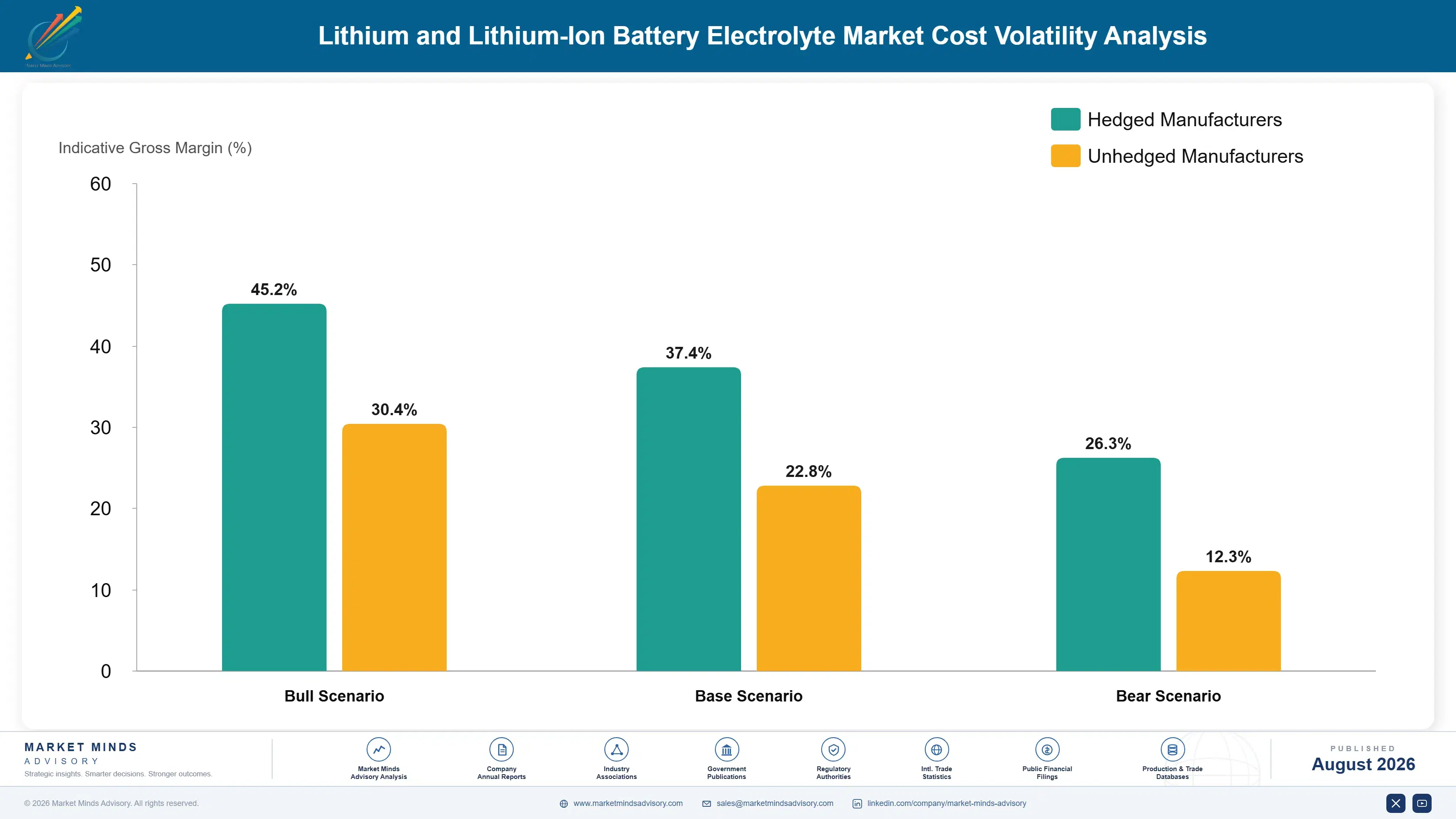
Lithium hexafluorophosphate salt, the primary conductive component in most liquid electrolyte formulations, has experienced significant price volatility tied to lithium carbonate feedstock pricing and periodic overcapacity cycles among Chinese salt producers. That volatility complicates long-term electrolyte pricing contracts between formulators and cell manufacturers, since neither party wants to lock in pricing that could swing significantly before contract renewal. Formulators are responding by negotiating shorter-duration pricing adjustment mechanisms tied to published lithium carbonate benchmark pricing, passing volatility through to customers rather than absorbing it entirely on their own balance sheets. Formulators without pricing flexibility clauses risk losing contracts to better-hedged competitors.
Market Impact: Shifts 60% of capacity to LFP
3 additional market trends, 4 additional growth drivers, and 3 additional restraints and challenges are covered in the full report. Contact sales@marketmindsadvisory.com to access the complete intelligence.
Segment CAGR and Growth Architecture
Electrolyte segments by cell chemistry and formulation technology, the classification formulators and cell manufacturers use to set qualification pathway, additive package, and contract structure, since LFP, NMC, and solid-state buyers each negotiate under distinct commercial and technical terms across the industry each year. Formulators price each chemistry differently depending on volume commitment and qualification depth required.

Solid-State and Gel Polymer Electrolyte
Solid-state and gel polymer electrolytes are the fastest-growing segment as cell developers move from lab-scale validation toward pilot production lines targeting commercial launch by 2029. Toyota, Samsung SDI, and QuantumScape have all disclosed solid-state program timelines referencing electrolyte formulation partnerships as a qualification milestone, since interfacial stability remains the primary technical barrier. Formulators that clear qualification on an early solid-state pilot line often retain that relationship through commercial scale-up, since switching partners mid-development risks losing years of validation data. If two or three solid-state programs reach commercial launch by 2029, this segment could approach a meaningful share of total formulation value within five years, a pace far exceeding any established liquid electrolyte category today.
CAGR 19.2%
Sodium-Ion Battery Electrolyte
Sodium-ion battery electrolyte is the second-fastest-growing segment as cell manufacturers pursue sodium-ion chemistry for stationary storage and lower-cost entry-level EV applications where lithium's cost premium matters less than affordability. CATL, HiNa Battery, and other Chinese cell manufacturers have disclosed sodium-ion commercialization timelines that require electrolyte formulations distinct from lithium-based chemistry, since sodium ion transport properties differ from lithium at the molecular level. Formulators with early sodium-ion qualification experience are positioning to capture disproportionate share as this segment scales from its small base, since few competitors have invested in sodium-specific formulation expertise. Grid storage applications are likely to adopt sodium-ion electrolyte faster than passenger EVs given their tolerance for lower energy density in exchange for lower total system cost across deployments.
CAGR 17.5%
Full segment breakdown across 6 segments available in the complete report.
Regional Architecture and Country Demand Map
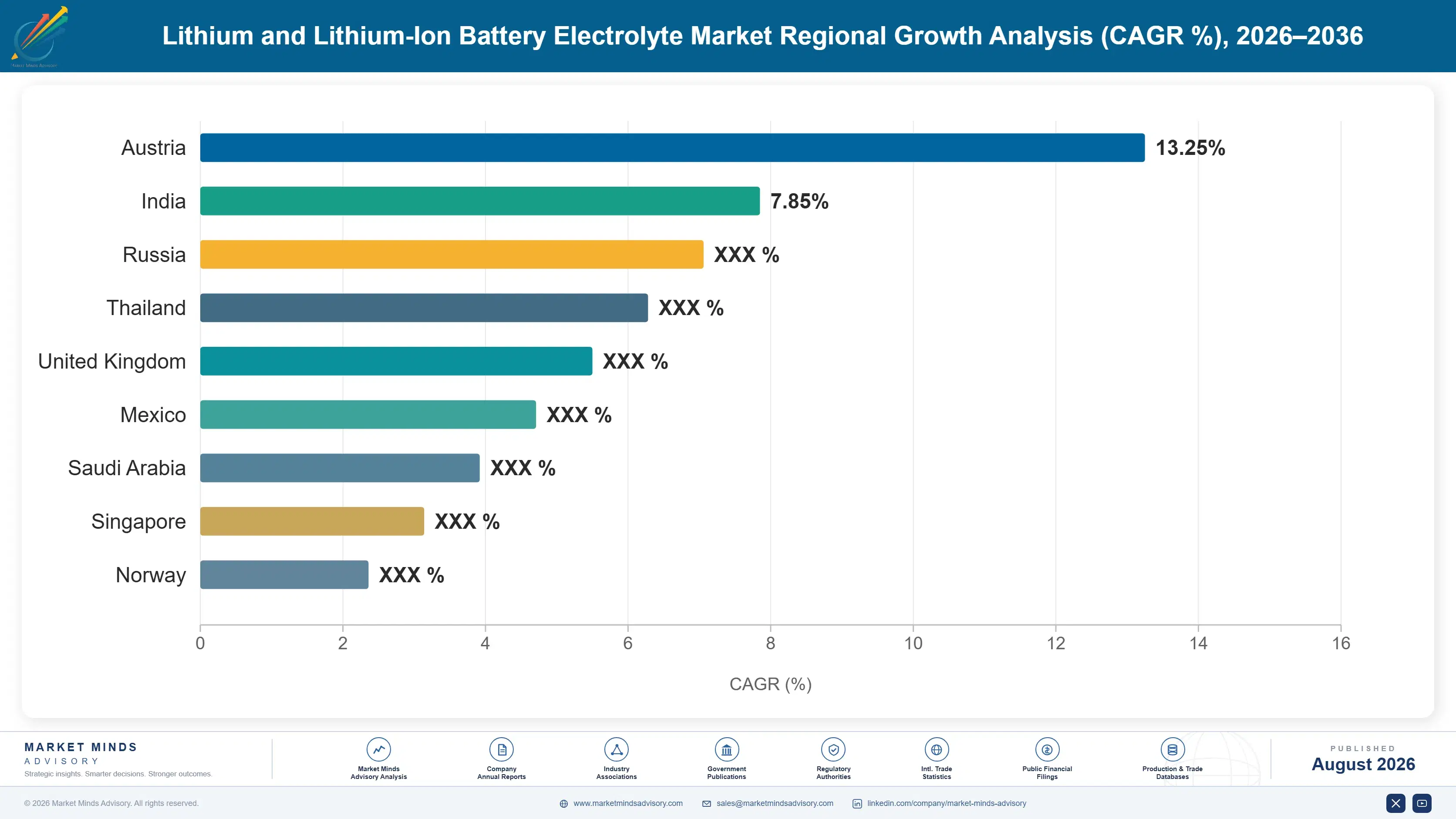
Electrolyte manufacturing concentrates overwhelmingly in East Asia rather than following gigafactory demand geography worldwide. East Asia leads by a wide margin given co-located cell manufacturing scale, while North America and Western Europe both remain well below their typical shares as domestic formulation capacity only slowly develops.
North America
North America holds a share of global electrolyte manufacturing well below this region's typical band across MMA's broader chemicals coverage, a deviation justified by how recently domestic formulation capacity has begun scaling: the United States hosts a growing but still nascent formulator base led by Enchem and Soulbrain facilities in Georgia built specifically to serve nearby gigafactories. Rising IRA-linked battery manufacturing investment is the primary driver behind new formulation capacity commitments, since automakers increasingly prefer domestic electrolyte sourcing to reduce supply chain risk and qualify for domestic content incentives. Canada contributes a smaller, emerging demand pool tied to its own battery gigafactory investment announcements. Mexico's contribution remains minimal, relying on imported electrolyte for its small but growing EV assembly sector.
Share: 12% | CAGR: 11.2% (2026 to 2036)
Western Europe
Western Europe also holds a share of global electrolyte manufacturing below this region's typical band, justified because domestic formulation capacity, while growing, still trails the scale that European gigafactory announcements would otherwise imply: BASF's Schwarzheide facility and Solvay's French operations anchor the region's nascent formulation base. Germany and France lead regional demand given their concentrated automotive and gigafactory manufacturing base, both of which increasingly specify European-sourced electrolyte to reduce logistics risk from Asian suppliers. The United Kingdom contributes a smaller demand pool tied to its own emerging gigafactory investment. Growth here trails East Asia's pace given a formulator base still years behind matching Asian production scale and cost efficiency, a gap most industry observers expect to persist.
Share: 12% | CAGR: 8.9% (2026 to 2036)
Regional intelligence for 5 additional markets available in the complete report: East Asia, South Asia and Pacific, Latin America, Middle East and Africa, Eastern Europe. Contact sales@marketmindsadvisory.com.

Where Electrolyte Formulators Are Capturing Margin
Four commercial moves separate electrolyte formulators capturing outsized margin from those competing purely on delivered kilogram price, each tied to formulation depth, geographic proximity to gigafactories, or next-generation chemistry qualification that shields volume from commodity price competition across the industry each year. Each move requires a different mix of capital investment and multi-year commercial commitment before it meaningfully improves margin.
Solid-State Electrolyte Qualification Investment Growth Strategy
Formulators investing early in solid-state and gel polymer electrolyte qualification, ahead of confirmed commercial cell adoption, are positioning to capture first-mover share in a segment growing faster than any established liquid electrolyte category today. Developing a qualified solid-state electrolyte formulation typically costs $20 million to $50 million in ionic conductivity, interfacial stability, and safety testing against next-generation cell developer requirements. Formulators without early solid-state investment risk missing the qualification window entirely once cell developers commit to a preferred electrolyte partner ahead of commercial-scale production launches. Formulators without such investment risk permanent exclusion from next-generation supply chains.
Market Impact: Costs $20 to $50 million per new pr
Western Gigafactory-Adjacent Capacity Investment Growth Strategy
Formulators building new formulation capacity directly adjacent to North American and European gigafactories are capturing premium pricing that reflects the logistics cost and lead time advantage over importing from Asian production hubs. Building a new Western formulation facility typically costs $80 million to $200 million depending on capacity scale and local regulatory requirements, but each qualified Western facility then commands demand that Asian-based competitors cannot serve as competitively given shipping time and cost. Formulators without Western capacity increasingly lose new gigafactory qualification opportunities to better-positioned local competitors. Formulators without Western presence increasingly cede these accounts entirely.
Market Impact: Costs $80 to $200 million per new f
Multi-Chemistry Formulation Portfolio Development Growth Strategy
Formulators developing qualified formulations across LFP, NMC, and early solid-state chemistries simultaneously, rather than specializing in a single chemistry, are capturing allocation priority as cell manufacturers diversify their own chemistry mix to hedge against any single technology's adoption risk. Building qualification across an additional cell chemistry typically requires $10 million to $25 million in formulation and testing investment, but each qualified chemistry then commands demand that narrower competitors cannot serve. Formulators with single-chemistry qualification increasingly lose allocation priority to broader-portfolio competitors during periods of chemistry transition. Formulators without this breadth increasingly lose bids to better-diversified rivals.
Market Impact: Costs $10 to $25 million per new ch
Long-Term Cell Manufacturer Supply Agreement Program
Formulators securing multi-year supply agreements with major cell manufacturers, guaranteeing defined volume against gigafactory production ramp schedules, are capturing premium pricing that protects against spot-market competition from smaller regional blenders without comparable formulation consistency. These agreements typically carry a 5 to 12% price premium over transactional purchasing, reflecting the value cell manufacturers place on guaranteed formulation supply during critical gigafactory ramp periods. Formulators able to demonstrate consistent quality and reliable delivery increasingly win renewal negotiations over lower-cost competitors lacking comparable track records. Formulators without such agreements compete purely on price when gigafactory volume is scarce.
Market Impact: Commands 5 to 12% premium over spot
Who Controls the Margin Pool
The top five formulators hold an estimated 54% of global electrolyte shipment volume, a moderate concentration reflecting the qualification barriers that favor incumbents and a long tail of smaller regional blenders serving less demanding applications. Mitsubishi Chemical and Tinci Materials lead on formulation breadth and cell manufacturer relationships, while a second tier of Chinese and Korean formulators competes on price for LFP and NMC categories that do not require premium purity.
Current competitive activity centers on three fronts. Solid-state electrolyte qualification investment is opening a new front for formulators willing to commit testing capital ahead of confirmed commercial adoption. Western gigafactory-adjacent capacity investment is becoming common as automakers push suppliers to localize production. And formulators are pursuing multi-chemistry portfolio expansion to hedge against any single cell chemistry's adoption trajectory.
Emerging pressure comes from smaller Chinese formulators moving up the value chain as domestic LiPF6 salt production scales and cell manufacturer relationships deepen, though matching incumbents' multi-chemistry qualification breadth remains years away for most. If these challengers close that breadth gap, expect share to shift within China first, before any material pressure reaches Mitsubishi Chemical or Korean and Japanese incumbents given how embedded existing supply agreements are across the industry.

Competitive Moat and Risk Dimensions
Moat: Multi-Region Manufacturing Footprint
Mitsubishi Chemical operates qualified electrolyte formulation capacity across Japan, China, and North America, giving it a geographic breadth that most Chinese-focused competitors cannot match when automakers require regionally diversified supply. That footprint took decades to build and lets Mitsubishi Chemical serve gigafactories on multiple continents from qualified local capacity.
Risk: High-Cost Base Versus Chinese Rivals
Mitsubishi Chemical's manufacturing cost base runs meaningfully higher than Chinese competitors benefiting from vertically integrated LiPF6 salt production and lower labor costs. That gap leaves Mitsubishi Chemical more exposed to price-based competition in commodity LFP categories where formulation differentiation matters less than delivered cost. That gap widens further as Chinese overcapacity persists.
Moat: Vertically Integrated LiPF6 Production
Tinci Materials controls its own LiPF6 salt production rather than purchasing from third-party suppliers, giving it cost and supply security advantages that formulators dependent on external salt sourcing cannot match. This integration lets Tinci flex pricing more aggressively during salt price volatility than non-integrated competitors.
Risk: Overexposure to Chinese Price Competition
Tinci's revenue concentration within China's intensely competitive domestic formulator market leaves it more exposed than geographically diversified competitors to domestic overcapacity cycles and aggressive price competition. Expanding meaningfully outside China would require years of new qualification work with non-Chinese cell manufacturers. That geographic concentration also leaves Tinci more exposed to any single regulatory shift within China.
Players Tracked
Prominent Players
Mitsubishi Chemical Group Corporation
Guotai-Huarong New Chemical Materials Co. Ltd.
Tinci Materials Co. Ltd.
Capchem Technology Co. Ltd.
BASF SE
Other Key Players
Enchem Co., Ltd.
Soulbrain Co., Ltd.
Foosung Co., Ltd.
Central Glass Co., Ltd.
Ube Corporation
Mitsui Chemicals, Inc.
Solvay SA
Panax Etec Co., Ltd.
Targray Technology International Inc.
Zhejiang Yongtai Technology Co., Ltd.
Ningbo Shanshan Co., Ltd.
Do-Fluoride New Materials Co., Ltd.
Nippon Shokubai Co., Ltd.
LG Chem Ltd.
Kishida Chemical Co., Ltd.
Recent Developments
Mitsubishi Chemical Expands North American Electrolyte Capacity
Mitsubishi Chemical commissioned additional electrolyte formulation capacity at its North American facility, expanding dedicated output to meet rising gigafactory demand across the region. The expansion followed multi-year supply agreements signed with major cell manufacturers as North American gigafactory construction accelerated through 2025. Similar expansions are expected across other qualified sites.
Signal: Confirms formulators are pre-committing We
Tinci Materials Signs Multi-Year LFP Supply Agreement
Tinci Materials secured a multi-year reserved supply agreement with a major Chinese cell manufacturer covering LFP-compatible electrolyte formulations, guaranteeing defined volume through 2028. The agreement reflects cell manufacturers' broader push to lock in qualified formulation supply ahead of further LFP capacity expansion. Similar agreements are expected across other qualified formulators.
Signal: Shows cell manufacturers prioritizing supp
Enchem Announces Georgia Formulation Facility Investment
Enchem announced incremental electrolyte formulation capacity investment at its Georgia facility to serve nearby North American gigafactory customers directly. The investment followed sustained automaker pressure for domestically sourced electrolyte under IRA-linked content requirements. Industry analysts expect similar investments across other regional formulators serving nearby customers.
Signal: Signals Western capacity buildout remains
LiPF6 Salt Dependence and Solvent Cost Exposure
Lithium hexafluorophosphate salt accounts for roughly 42% of cost of goods sold in electrolyte formulation, sourced from vertically integrated Chinese producers given the complexity of high-purity salt manufacturing. Organic solvents and functional additives add a further significant share, with production concentrated among formulators holding both chemistry expertise and salt supply relationships. That concentration leaves formulators exposed to a narrow upstream supply base.
LiPF6 salt prices spiked during 2022 as lithium carbonate feedstock costs surged alongside EV demand growth, with several formulators reporting input cost increases exceeding 40% in their 2022 annual reports before pricing stabilized through 2023. Industry supply chain reviews have flagged LiPF6 salt as electrolyte formulation's single most volatile cost component, more than other inputs. Several formulators have publicly flagged this salt price exposure as a leading operational risk heading into 2026.
Smaller formulators without integrated salt production or supply agreements absorbed the 2022 price spike hardest, losing contract bids to larger competitors including Tinci Materials and Guotai-Huarong that had secured integrated salt supply years earlier. Formulators with integrated salt production weathered the volatility better than those dependent on external salt sourcing, a cost advantage that persists sharply across smaller Western and Korean formulators today.

Vertical Integration Into Salt Production
Larger formulators are investing directly in LiPF6 salt production capacity, reducing dependence on third-party salt suppliers and gaining pricing control that non-integrated competitors cannot match during periods of feedstock volatility and tight allocation. This integration also reduces formulators' exposure to spot market price swings that have repeatedly disadvantaged non-integrated competitors during past tightening cycles.
Long-Term Lithium Carbonate Supply Agreements
Several formulators are locking in multi-year lithium carbonate supply agreements directly with mining and refining companies, guaranteeing predictable feedstock costs ahead of demand increases rather than relying on spot market pricing that has grown increasingly volatile. This approach adds cost certainty to production planning even when spot lithium carbonate pricing swings sharply during periods of tight supply.
Formulation Portfolio Diversification
Formulators are pursuing solid-state and sodium-ion qualification partly to diversify revenue beyond LiPF6-dependent liquid electrolyte formulations most exposed to lithium carbonate feedstock and salt price pass-through limitations under long-term contracts. This diversification strategy also spreads formulator revenue across a broader set of chemistry categories, reducing dependence on any single feedstock or pricing cycle for volume.
Portfolio Architecture for Margin Defence
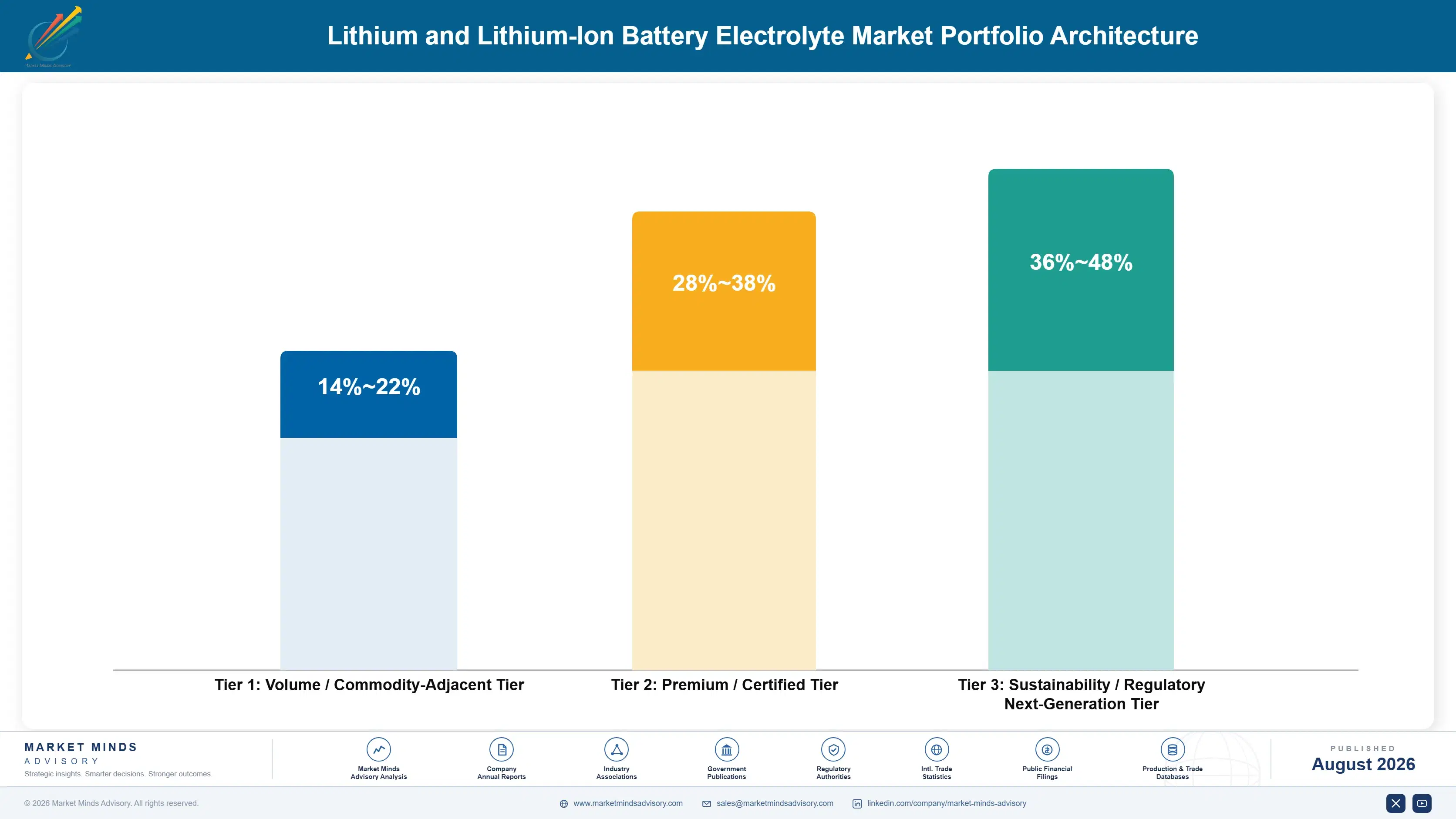
Electrolyte portfolios span three margin tiers, from commodity-adjacent LFP liquid formulations sold largely on price, through certified NMC and NCA formulations carrying chemistry-specific premiums, toward an emerging next-generation tier built around solid-state, gel polymer, and sodium-ion formulations still in early qualification. Gross margin widens meaningfully at each tier as formulation complexity and qualification depth increase across the industry today. Buyers pay for certification de
The volume versus premium tension centers on capacity allocation. Formulators must choose between dedicating qualified production lines to high-margin next-generation programs with uncertain near-term volume, or serving lower-margin LFP demand that fills out current production capacity reliably. Formulators without spare capacity increasingly favor higher-margin next-generation programs where competition remains thin. That allocation decision increasingly shapes which formulators win the highest-margin next-generation accounts each year.
High-value margin pools concentrate in solid-state and sodium-ion formulation programs, where technical barriers keep competition thin and cell developers pay a premium for proven reliability. LFP liquid electrolyte remains the volume anchor but carries the thinnest margins across the entire portfolio, leaving smaller formulators with fewer diversification options than vertically integrated competitors. Formulators that diversify across both premium and volume tiers capture the widest margin spread available today.
Volume / Commodity-Adjacent Tier
LFP liquid electrolyte formulations sold largely on price and delivery reliability without chemistry-specific certification premiums, competing mainly on cost against other qualified LFP suppliers across most commodity LFP buyer segments worldwide each year.
Gross Margin: 14%-22%
Premium / Certified Tier
NMC and NCA formulations sold under multi-year supply agreements carrying chemistry-specific pricing power built through years of qualification and proven cycle-life performance across major automaker accounts worldwide each year overall.
Gross Margin: 28%-38%
Sustainability / Regulatory / Next-Generation Tier
Solid-state, gel polymer, and sodium-ion formulations in active qualification, commanding premium pricing against limited proven alternatives as cell developers wait for confirmed commercial-scale validation before committing further capital investment overall.
Gross Margin: 36%-48%

Chemistry Lock-In Meets Rapid Technology Shift
Electrolyte purchasing functions closer to an annuity than a transactional sale once a formulator clears qualification on a specific cell chemistry and gigafactory production line, since cell manufacturers rarely requalify a supplier mid-program given the cost and schedule risk of validation testing. That relationship typically persists for the production line's entire operating life, often seven to ten years, locking in recurring revenue for incumbent formulators well beyond any single purchase
Adoption depth varies sharply by end-use vertical. Premium EV and energy storage cell manufacturers show the deepest stickiness given multi-year qualification cycles and safety-critical certification requirements, while lower-tier consumer electronics and entry-level EV buyers switch suppliers more readily since qualification barriers are lower and price sensitivity plays a larger role in purchasing decisions. Pricing pressure also concentrates in these lower-tier accounts.
A generational shift is underway as solid-state and sodium-ion cell developers, who have no legacy relationship with existing liquid electrolyte formulators, evaluate suppliers on ionic conductivity and safety performance data rather than decades-long supply relationships. That openness gives newer, next-generation-focused formulators a rare opening to win share in a market where liquid electrolyte incumbency has otherwise been difficult to dislodge, across every major cell chemistry category today.

Where Electrolyte Formulators Should Focus Next
These are among the four positions where our research anticipates prominent divergence between winners and laggards over the coming forecast period. Each is grounded in the demand model, the regulatory perimeter, and the announced capacity pipeline.
Fund solid-state qualification testing before cell developers commit
Solid-state and gel polymer cell developers have not yet committed to a preferred electrolyte partner across most programs, leaving a genuine first-mover opportunity for formulators willing to fund qualification testing ahead of confirmed commercial adoption. Waiting for developers to formally commit risks missing the qualification window entirely once a preferred supplier relationship forms. The capital required is meaningful but modest relative to what a lost multi-year cell relationship would cost a formulator over the following decade, a scarce advantage as next-generation programs multiply.
Prioritize gigafactory-adjacent capacity in North America and Europe
Automakers building gigafactories outside Asia increasingly prefer domestically sourced electrolyte to reduce supply chain risk and qualify for regional content incentives under programs like the IRA. Formulators concentrating capacity solely in Asia risk ceding these qualification opportunities to competitors already investing in Western facilities. Early Western capacity investment offers a meaningful head start over rivals still shipping formulation across long, cost-exposed supply chains from Asian production hubs, and formulators that wait for automakers to finalize sourcing mandates risk losing the qualification window to faster-moving competitors already investing in Western capacity.
Pursue vertical integration into salt production before next tightening
LiPF6 salt price volatility has repeatedly disadvantaged formulators without integrated production or long-term supply agreements, and another tightening cycle would likely repeat that pattern given how little spare qualified salt capacity currently exists. Vertically integrated competitors like Tinci Materials weathered the last volatility cycle far better than non-integrated peers. Formulators pursuing integration now, while capital costs remain reasonable, protect margin against the next inevitable feedstock disruption, since formulators that delay integration risk repeating the same costly disadvantage during the next supply tightening cycle.
Build formulation depth across LFP, NMC, and next-generation chemistries
Cell manufacturers are diversifying their own chemistry mix to hedge against any single technology's adoption risk, and formulators with narrow single-chemistry qualification increasingly lose allocation priority during these transitions. Building multi-chemistry depth requires meaningful testing investment but positions formulators to capture demand regardless of which chemistry ultimately wins in a given application segment. Formulators betting entirely on one chemistry risk being stranded if that chemistry's adoption trajectory disappoints relative to current expectations, a risk that grows the longer formulators wait to diversify their qualified chemistry portfolio.
Engagement Snapshot From the Field
A live engagement with an industry participant carrying material or product regulatory and market exposure ahead of a defining policy shift, showing how our research translates into a defensible multi-year portfolio strategy.
MARKET MINDS ADVISORY · CLIENT ENGAGEMENT SUMMARY
Lithium and Lithium-Ion Battery Electrolyte Producer Strategic Portfolio Review and Transition Roadmap 2026·Investment Scenario on Lithium and Lithium-Ion Battery Electrolyte Exposure Evaluation 2025-26
CLIENT PROFILE
The client is a North American battery gigafactory operator supplying cells to two major automakers, with annual electrolyte procurement spend in the low hundreds of millions of dollars (client-reported, unverified by MMA). The client faced rising pressure to localize its supply chain under IRA-linked domestic content requirements while managing formulation qualification risk during its ramp-up phase.
STRATEGIC CHALLENGE
The client needed to decide how quickly to transition from its incumbent Asian electrolyte supplier toward a qualified North American formulator, given uncertainty over whether domestic formulation capacity could match the cycle-life and safety performance its existing Asian supply chain already delivered reliably at scale, while balancing capital constraints typical of a first-time large-scale localization effort.
MMA APPROACH
MMA benchmarked the client's supplier qualification timeline against three competing gigafactory operators pursuing similar localization strategies and modeled cost and performance scenarios comparing Asian import supply against emerging North American formulator capacity, incorporating primary interview data from cell manufacturers and formulators on qualification timelines. The analysis also benchmarked domestic content incentive capture across five competing gigafactory operators pursuing similar localization strategies.
KEY FINDINGS
- The client's continued reliance on a single Asian electrolyte supplier left it more exposed to shipping delay and tariff risk than competitors already qualifying a second domestic source.
- Qualifying a North American formulator required roughly twelve months of parallel testing but ultimately matched incumbent cycle-life performance within an acceptable tolerance range.
- Competitors that had already secured domestic content qualification were positioned to capture incentive value the client's current single-source Asian supply chain could not access.
- LiPF6 salt price exposure at the client's incumbent supplier posed a greater near-term cost risk than the qualification risk of switching to a domestic formulator, a factor initially underweighted in planning.
CLIENT PROFILE
The client is a North American battery gigafactory operator supplying cells to two major automakers, with annual electrolyte procurement spend in the low hundreds of millions of dollars (client-reported, unverified by MMA). The client faced rising pressure to localize its supply chain under IRA-linked domestic content requirements while managing formulation qualification risk during its ramp-up phase.
STRATEGIC CHALLENGE
The client needed to decide how quickly to transition from its incumbent Asian electrolyte supplier toward a qualified North American formulator, given uncertainty over whether domestic formulation capacity could match the cycle-life and safety performance its existing Asian supply chain already delivered reliably at scale, while balancing capital constraints typical of a first-time large-scale localization effort.
MMA APPROACH
MMA benchmarked the client's supplier qualification timeline against three competing gigafactory operators pursuing similar localization strategies and modeled cost and performance scenarios comparing Asian import supply against emerging North American formulator capacity, incorporating primary interview data from cell manufacturers and formulators on qualification timelines. The analysis also benchmarked domestic content incentive capture across five competing gigafactory operators pursuing similar localization strategies.
KEY FINDINGS
- The client's continued reliance on a single Asian electrolyte supplier left it more exposed to shipping delay and tariff risk than competitors already qualifying a second domestic source.
- Qualifying a North American formulator required roughly twelve months of parallel testing but ultimately matched incumbent cycle-life performance within an acceptable tolerance range.
- Competitors that had already secured domestic content qualification were positioned to capture incentive value the client's current single-source Asian supply chain could not access.
- LiPF6 salt price exposure at the client's incumbent supplier posed a greater near-term cost risk than the qualification risk of switching to a domestic formulator, a factor initially underweighted in planning.
RECOMMENDED STRATEGY
Phase 1: Phase 1 (Months 1 to 5): Initiate parallel qualification testing with a domestic North American electrolyte formulator alongside existing Asian supply. Phase 2: Phase 2 (Months 6 to 12): Validate domestic formulator performance against incumbent benchmarks and begin phased volume transition planning and document results. Phase 3: Phase 3 (Months 13 to 18): Formalize a dual-source supply structure weighted toward domestic content for incentive qualification purposes across all facilities.
OUTCOME
Within eighteen months of implementation, the client qualified a domestic North American electrolyte formulator and began transitioning a meaningful share of volume away from its single Asian supplier. Client-reported domestic content incentive capture increased by an estimated 22% over the following year, though this figure is client-reported and unverified by MMA.
Frequently Asked Questions
Foundational context covering the market sizes, CAGR, scope, country, region and competition that inform every finding below. This section is provided to cover basics and most often pre-purchase conversations, answered from the MMA Primary Research Dataset.
What is the current size of the Lithium and Lithium-Ion Battery Electrolyte Market?
The global lithium and lithium-ion battery electrolyte market reached an estimated $8.5 billion in 2025. LFP-compatible liquid electrolyte accounts for the largest share of that volume.
How large will the Lithium and Lithium-Ion Battery Electrolyte Market be by 2036?
MMA forecasts the market will reach approximately $25.24 billion by 2036. That represents a 2.69x expansion over the 2026 base value across the ten-year forecast period.
What is the CAGR for the Lithium and Lithium-Ion Battery Electrolyte Market 2026 to 2036?
The base case forecast CAGR is 10.4%, with a bull case of 11.6% and a bear case of 9.1% depending on EV demand and next-generation cell commercialization pace.
Which segment is growing fastest?
Solid-State and Gel Polymer Electrolyte is growing fastest at a 19.2% CAGR, roughly 1.85 times the overall market rate, as next-generation cell developers move toward commercial launch.
Who are the major companies in the Lithium and Lithium-Ion Battery Electrolyte Market?
Mitsubishi Chemical Group, Guotai-Huarong, Tinci Materials, Capchem Technology, and BASF lead the market. Together the top five hold an estimated 54% of global shipment volume.
Which country is growing fastest?
China leads growth as its formulator base and gigafactory network both continue scaling faster than any other geography, growing at an estimated 13.2% CAGR through 2036.
Report Segmentation Architecture
The full report scope spans multiple orthogonal segmentation dimensions, with cross-tabulated demand data provided for each dimension pair. Coverage extends further to regional breakdowns, trend trajectories, and the competitive detail needed to support segment-level decision-making.
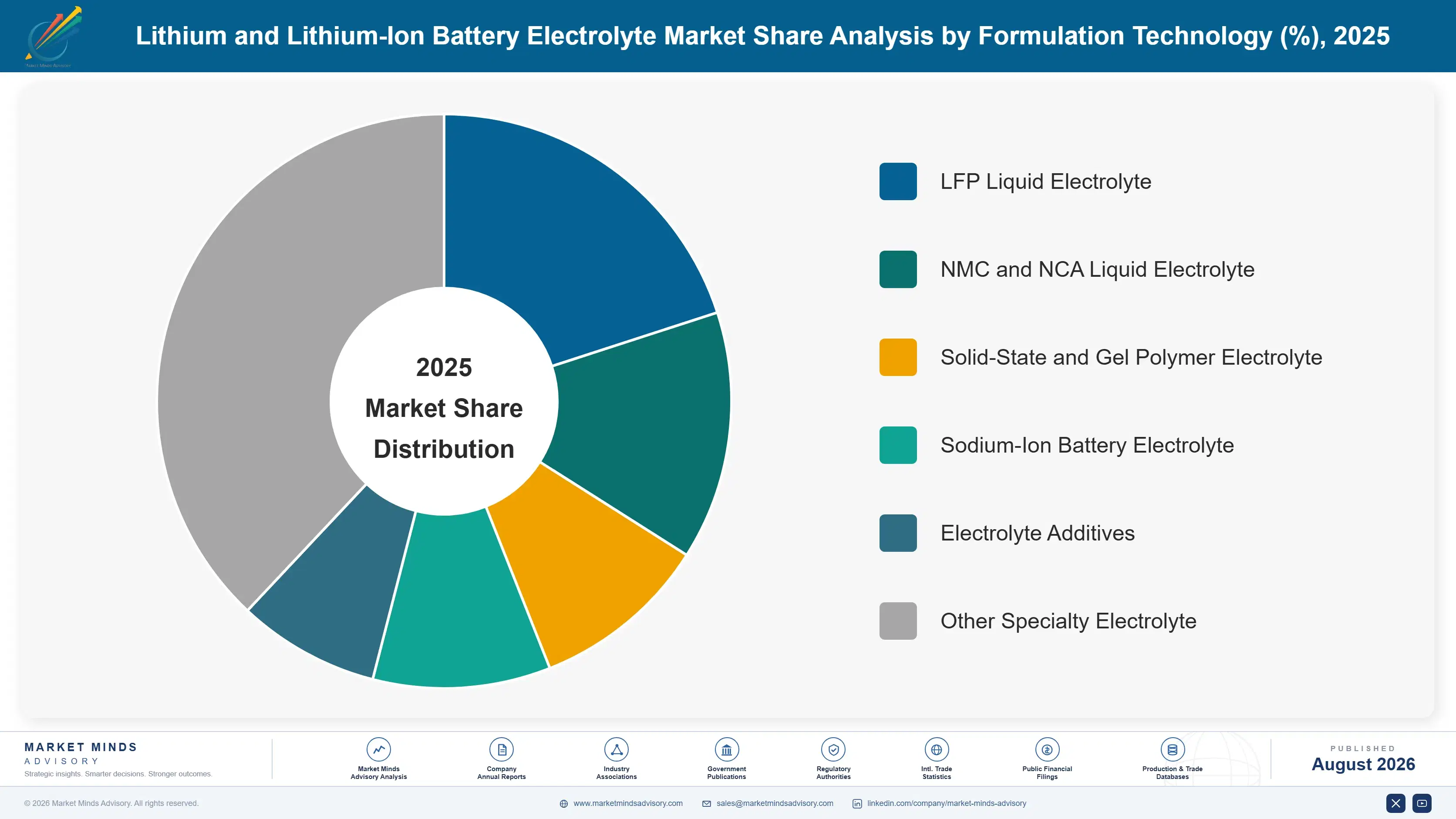
By Formulation Technology
- LFP Liquid Electrolyte
- NMC and NCA Liquid Electrolyte
- Solid-State and Gel Polymer Electrolyte
- Sodium-Ion Battery Electrolyte
- Electrolyte Additives
- Other Specialty Electrolyte
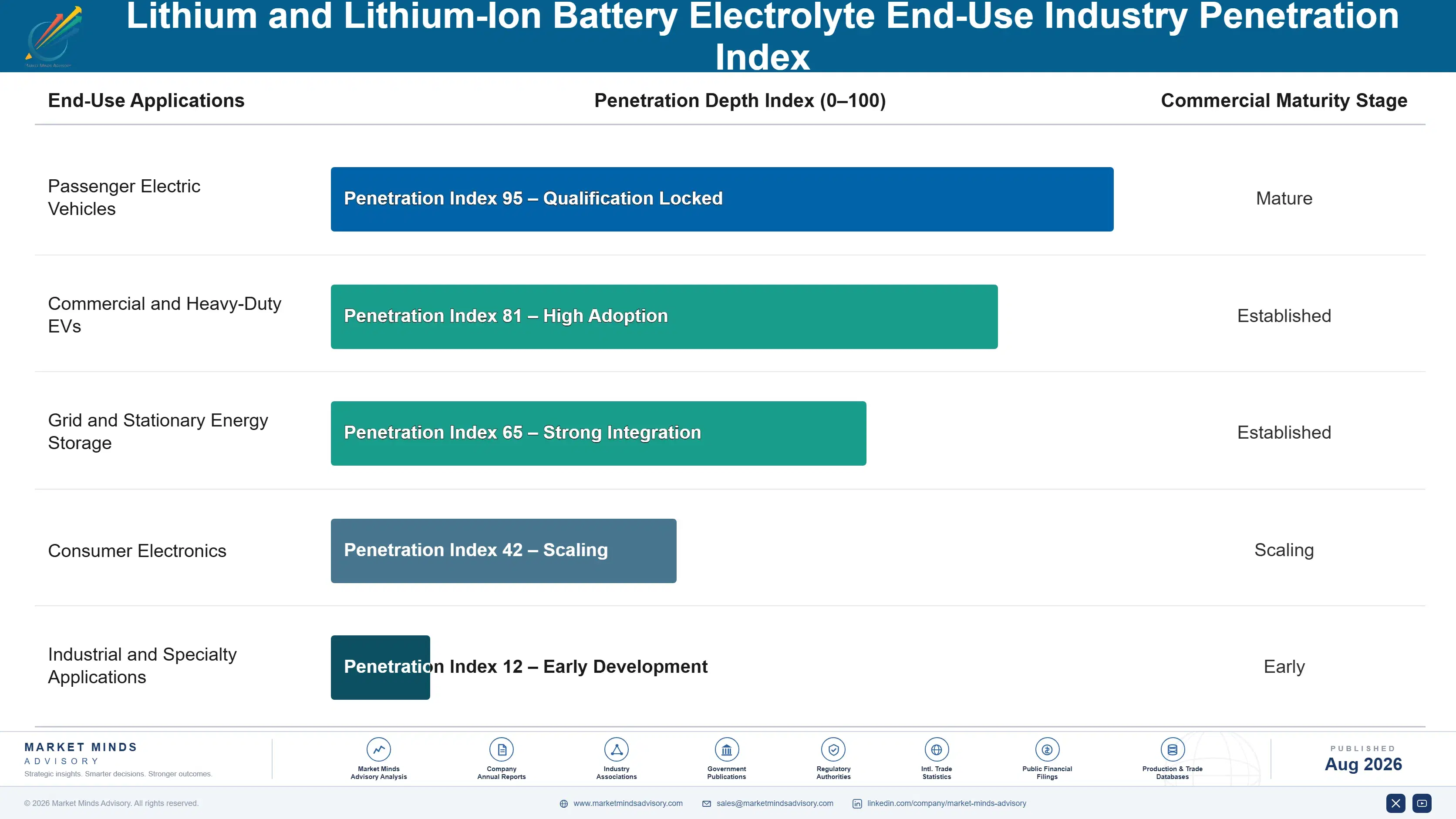
By End-Use Industry
- Passenger Electric Vehicles
- Commercial and Heavy-Duty EVs
- Grid and Stationary Energy Storage
- Consumer Electronics
- Industrial and Specialty Applications
By Commercial Dimension
- Long-Term Cell Manufacturer Agreements
- Reserved Capacity Contracts
- Spot and Transactional Purchasing
- Formulation-Assist Technical Services
By Region
- North America
- Western Europe
- East Asia
- South Asia and Pacific
- Latin America
- Middle East and Africa
- Eastern Europe
Scope, Methodology, and Coverage
Every figure in this report is reproducible from documented input assumptions. The scope below maps the historical period, the forecast horizon, the segmentation dimensions, and the countries covered, alongside the underlying primary and qualitative methodology.
Historical Period
2020 to 2025
Forecast Period
2026 to 2036
Base Year
2025 (USD billions; MMA Primary Research Dataset, August 2026)
Market Definition
This report covers liquid, gel polymer, and solid-state electrolyte formulations, including lithium salts, organic solvents, and functional additives, used inside lithium-ion and next-generation lithium battery cells. It excludes the battery cells themselves, cathode and anode active materials, and separator films sold as standalone components.
Quantitative Units
USD billions (current prices); metric tonnes of electrolyte formulation where disclosed
Segmentation Dimensions
By Formulation Technology; By End-Use Industry; By Commercial Dimension; By Region
Regions Covered
North America, Western Europe, East Asia, South Asia and Pacific, Latin America, Middle East and Africa, Eastern Europe
Countries Covered
USA, China, Germany, France, UK, Japan, South Korea, India, Australia, Canada, Brazil, Mexico, Indonesia, Vietnam, Thailand, Malaysia, UAE, Saudi Arabia, South Africa, Nigeria, Turkey, Poland, Netherlands, Italy, Spain, Sweden, Switzerland, Argentina, Colombia, Singapore, Morocco, Hungary, and additional markets relevant to this sector
Key Companies Profiled
Mitsubishi Chemical Group Corporation, Guotai-Huarong New Chemical Materials Co. Ltd., Tinci Materials Co. Ltd., Capchem Technology Co. Ltd., BASF SE, Enchem Co. Ltd., Soulbrain Co. Ltd., Foosung Co. Ltd., Central Glass Co. Ltd., Ube Corporation, Mitsui Chemicals Inc., Solvay SA, Panax Etec Co. Ltd., Targray Technology International Inc., Zhejiang Yongtai Technology Co. Ltd., Ningbo Shanshan Co. Ltd., Do-Fluoride New Materials Co. Ltd., Nippon Shokubai Co. Ltd., LG Chem Ltd., Kishida Chemical Co. Ltd.
Quantitative Methodology
Primary survey, n=3,800 respondents, Q4 2025, six countries; demand-side model with trade association cross-validation
Qualitative Methodology
47 expert interviews, Q4 2025; applied to validate demand model assumptions, identify emerging dynamics, and assess competitive positioning
Report Format
PDF and XLSX data workbook (Word format preview document)
Publisher
Market Minds Advisory
Report Code
MMA-2026-CHM-134
Published
August 2026
Contact
sales@marketmindsadvisory.com | www.marketmindsadvisory.com
Purchase the full Lithium and Lithium-Ion Battery Electrolyte Market Report (2026 to 2036).
The full report delivers a complete assessment of the global lithium and lithium-ion battery electrolyte market across all six formulation technology segments and seven world regions through 2036. It includes detailed competitive profiling of twenty active formulators, primary survey data from procurement and formulation decision-makers, and a dedicated deep-dive on solid-state qualification timelines. Buyers receive access to underlying segment and regional data tables alongside the full narrative analysis, supporting both supply localization planning and supplier evaluation decisions. The report also benchmarks revenue lever adoption and input cost exposure across the top twenty profiled companies, drawing on MMA's primary survey of 3,800 respondents and 47 expert interviews conducted in Q4 2025.
Twenty-company competitive profiling and margin benchmarking
Six-segment formulation technology forecast data and tables
Seven-region demand and CAGR breakdown data
Solid-state qualification timeline deep-dive overview report
LiPF6 salt supply chain risk assessment
Primary interview data from procurement decision-makers
Built For The People Who Decide
From boardroom strategy to bench-side execution, this report is read cover-to-cover by leaders shaping the next decade of their industry, turning demand scenarios, market dynamics and valuation benchmarks into decisions.
CXOs/ Presidents/ VPs/ Managers
M&A and Corporate Development
Strategy Teams and R&D Heads
Procurement and Product Directors
Regulatory and Compliance Leaders
Investor Relations and Equity Analysts