Market Minds Advisory
Liquid Flavour System Market

Liquid Flavour System Market: Natural Declaration Pressure, Emulsion Stability And Development Work That Locks In Supply

Flavour houses win volume by doing a manufacturer's development work rather than by selling a compound, and once a system is in a formulation nobody reopens it without a reason that genuinely forces them to.

Lead Analyst

Lisa Gevelber

Published

September 2026

Make Smarter Decisions with Customized Research Insights

Request a free sample report and evaluate market opportunities, growth trends, and competitive dynamics relevant to your business needs.

2025 MARKET VALUE$9.4BMarket Size 2025
2036 FORECAST VALUE$20.6BBase Case , 2026 to 2036
CAGR 2026 TO 20367.4 %Bull 8.6% / Bear 6.2%
INCREMENTAL OPPORTUNITY$10.5BNet 10- year value creation
EXPANSION MULTIPLE2.04x2036 value over 2026 base
Strategic Levers
M&A Pipeline
Regional Outlook
Country Rankings
Competitive Intelligence
Segmental Deep-dive
Call-Us : 91 93563 13602

Executive Snapshot and Market Trajectory

Flavour houses do not really sell compounds. They sell development work, and the compound arrives afterwards as the thing that gets invoiced. A manufacturer who has had a flavour system built around its own process does not reopen that decision casually. Reopening it gains them nothing at all.
Natural systems carry the growth because the ingredient declaration on a finished product is what consumers actually read, and fermentation-derived natural compounds are closing the intensity and consistency gaps that extraction alone never did. Beverage systems grow nearly as fast on the most demanding technical requirements in the category. East Asia holds the largest share on Chinese and Southeast Asian food and beverage manufacturing scale.
Concentration reads at 58% for the top five, high because flavour creation combines analytical chemistry, sensory capability and application support that very few organisations assemble properly. Emulsion stability is the recurring technical problem in liquid systems rather than flavour design itself, and it is where most supplier failures in beverage applications actually originate. Positions change hands at reformulation events and almost nowhere else, and there are not many of those in any given year.
Market Definition
This market covers liquid flavour systems supplied into food and beverage manufacturing, spanning natural liquid flavour systems, beverage-specific liquid systems, emulsion and encapsulated liquid flavours, savoury and culinary liquid systems, and liquid flavour concentrates for dilution. Dry and powdered flavours, individual aroma chemicals sold as isolated compounds, essential oils sold as botanical extracts rather than formulated systems, and flavour enhancers without flavour character are excluded.
Base Year Value
$9.4B in 2025 (MMA Primary Research Dataset, August 2026)
Forecast Period
2026 to 2036, eleven discrete annual values
CAGR
7.4% base case. Bull 8.6%. Bear 6.2%.
Fastest Growth Segment
Natural Liquid Flavour Systems: 11.1% CAGR
Fastest Growth Country
India: 10.6% CAGR
Fastest Growth Region
South Asia and Pacific: 9.7% CAGR
Largest Region
East Asia: 29% of 2025 global value
Market Leaders
Givaudan, International Flavors and Fragrances, Firmenich, Symrise and Takasago International lead on liquid flavour system revenue. Source: MMA Primary Research Dataset, July 2026.
Primary Survey
n=3,800 procurement and R&D decision-makers, Q4 2025, six countries
Methodology
Demand-side build-up, cross-validated against public data, 47 expert interviews

Liquid Flavour System Market Forecast Scenarios

liquid-flavour-system-market-trends-size-forecast-scenario-1787457963797
Growth ran at 6.3% annually between 2020 and 2025, and reformulation activity rather than underlying food volume did most of the work. Sugar reduction programmes, natural declaration pressure and clean-label commitments each forced manufacturers back into development, and every reformulation is a fresh opportunity for a flavour house to win or lose a position it had previously held securely.
The base case at 7.4% rests on three mechanisms. Natural declaration pressure keeps pushing systems away from synthetic aroma chemicals, and fermentation-derived compounds now make that switch technically feasible rather than merely aspirational. Beverage reformulation continues as sugar reduction programmes work through portfolios. And Indian and Southeast Asian food manufacturing expands quickly, with local flavour development capability building alongside the demand. None of the three depends on underlying food volume growing quickly.
The bull case at 8.6% turns on fermentation-derived natural compounds reaching cost parity with synthetic equivalents, which would remove the last commercial argument against natural declaration across mainstream products. The bear case at 6.2% reflects manufacturers deferring reformulation under margin pressure, since flavour development work is discretionary in a way ingredient purchasing is not. Development work is discretionary in a way purchasing is not.

Development Work Is What Actually Gets Sold

The commercial mechanism in flavour is unusual and widely misunderstood. A flavour house does not win business by having a better compound in a catalogue. It wins by doing a manufacturer's development work, building a system around that manufacturer's specific process, ingredients and shelf life requirement, and then supplying what the resulting formulation needs. That distinction is widely misunderstood outside the industry.
TOP FIVE CONCENTRATION58%High, since flavour creation capability is genuinely difficult to assemble
NATURAL SYSTEM SHARE61%Portion of value in systems carrying natural declaration status
NATURAL COST PREMIUM2.7 timesNatural system cost against comparable synthetic aroma chemical formulation
DEVELOPMENT CYCLE9 monthsTypical time from brief to commercial launch of a system
BEVERAGE APPLICATION SHARE38%Portion of volume entering beverage manufacturing rather than food
POSITION RETENTION7 yearsAverage duration a system holds inside a manufactured product
That work is what locks the position in. A system inside a manufactured product stays there an average of seven years, because reopening it means new sensory validation, new stability work and new consumer testing that the manufacturer gains nothing from. Development takes around nine months from brief to launch. Reformulation events are therefore where positions actually change hands, and there are not many of them.
Natural declaration is the force creating those events. Roughly 61% of value now sits in systems carrying natural status, and natural sources deliver weaker intensity and more variable composition than synthetic equivalents at around 2.7 times the cost. Fermentation-derived natural compounds narrow both gaps simultaneously, which is why flavour houses invested heavily in them rather than reformulating around extraction alone.
"Everybody thinks flavour houses sell flavour. They sell nine months of somebody else's development work, and the material invoice afterwards is really just the subscription payment on that."
Director, Flavour Systems and Food Ingredients Practice · MMA Food Ingredients Practice · August 2026

Market Trends

Fermentation Compounds Make Natural Declaration Technically Feasible

Natural sources deliver weaker intensity and considerably more variable composition than synthetic aroma chemicals, so a formulator needs more of a material that costs more and behaves less predictably from batch to batch. That combination kept natural declaration aspirational rather than practical across many mainstream products. Fermentation-derived natural compounds narrow both gaps at once, which is why flavour houses invested heavily rather than reformulating around extraction alone. Roughly 61% of value now carries natural status. Flavour houses invested heavily rather than attempting to reformulate around extraction alone. The switch is feasible now.
Market Impact: Beverage takes 38% of volume

Development Work Rather Than Compound Supply Locks Positions

A flavour house wins by building a system around a manufacturer's specific process, ingredients and shelf life requirement, then supplying what that formulation needs afterwards. The development work is what creates the position rather than any catalogue compound. Systems hold inside a product an average of seven years because reopening means new sensory validation, stability work and consumer testing the manufacturer gains nothing from. Positions therefore change hands at reformulation events and almost nowhere else. Development-led suppliers realise considerably higher margin than those quoting against a written specification. Reformulation events are rare.
Market Impact: India grows at 10.6% annually

Market Opportunities and Growth Drivers

Sugar Reduction Programmes Force Reformulation Across Beverage Portfolios

Removing sugar from a beverage changes mouthfeel, sweetness onset and the way flavour releases across the palate, which means a flavour system built for the original product no longer works and has to be rebuilt entirely. Sugar reduction programmes are working through beverage portfolios across most developed markets and several emerging ones. Every reformulation is a fresh opportunity for a flavour house to win or lose a position it had previously held securely for years. Sweetness onset and flavour release both change when sugar comes out of a formulation. Positions move at those moments.
Market Impact: Causes 34% of position losses

Indian And Southeast Asian Manufacturing Builds Local Development Capability

Indian and Southeast Asian food and beverage manufacturing is expanding quickly and increasingly develops products locally rather than adapting formulations transferred in from elsewhere, which requires flavour development capability in the region rather than remote support. Indian demand grows near 10.6% annually as a result. Regional taste preferences also differ enough that Western systems transfer badly, which makes local creative capability a genuine commercial requirement rather than a convenience. Local creative capability is a genuine commercial requirement here rather than any convenience. Remote support loses briefs outright. Western systems transfer badly here.
Market Impact: Defers projects 11 months typically

Market Restraints and Challenges

Emulsion Stability Failures Cost Positions Faster Than Anything Else

Liquid flavour systems in beverages must stay in solution across months of shelf life while surviving pasteurisation, carbonation, acidity and light exposure, and separation or ringing on a bottle neck is immediately visible to a consumer. The root cause is physical chemistry rather than flavour design, which is where most suppliers concentrate their capability. Commercially a stability failure ends a position faster than any pricing decision. Participants are responding with emulsion specialists, accelerated stability protocols and application testing under real conditions. Most houses concentrate capability on flavour design instead. Application testing under real conditions helps.
Market Impact: Natural systems hold 61% of value

Reformulation Deferral Under Margin Pressure Delays Development Revenue

Flavour development work is discretionary in a way ingredient purchasing is not, so manufacturers defending margin postpone reformulation projects and continue running existing systems rather than commissioning new ones. The root cause is that a working formulation costs nothing to leave alone. Commercially this delays the events where positions change hands and pushes development revenue into later periods. Participants are responding with development cost sharing, staged project structures, and application support that keeps relationships active between projects. A working formulation costs nothing at all to leave alone. Development revenue shifts into later periods.
Market Impact: Systems hold position for 7 years
4 additional market trends, 2 additional growth drivers, and 3 additional restraints and challenges are covered in the full report. Contact sales@marketmindsadvisory.com to access the complete intelligence.

Segment CAGR and Growth Architecture

Five system categories divide this market on declaration status and application requirement rather than on flavour profile, which numbers in the thousands and tells a supplier nothing commercially useful. Declaration status determines cost and technical difficulty while application determines the stability, processing and shelf life demands a system must actually survive. Profile tells a supplier almost nothing.
liquid-flavour-system-market-trends-market-share-analysis-1787457964353

Natural Liquid Flavour Systems

Growing at 11.1% and the fastest part of this market. Natural liquid flavour systems built from extracts, distillates and fermentation-derived compounds rather than synthetic aroma chemicals carry the growth because the declaration on a finished product is what consumers actually read. The technical difficulty is that natural sources deliver variable composition and considerably weaker intensity than synthetic equivalents, so a formulator needs more of a material that costs more and behaves less predictably batch to batch. Fermentation-derived natural compounds narrow both gaps at once, which is why flavour houses have invested in them heavily rather than reformulating around extraction alone. Declaration status is what consumers actually read on a finished product.
CAGR 11.1%

Beverage-Specific Liquid Systems

Growing at 9.8% on liquid systems developed for beverage manufacturing, which is where the largest single volume of flavour actually goes and where the technical requirements are most demanding. Flavour has to survive pasteurisation, stay in solution across a shelf life measured in months, and hold up against carbonation, acidity and light exposure that would destroy most formulations. Emulsion stability is the recurring problem rather than flavour design itself. Beverage manufacturers also reformulate frequently in response to sugar reduction and new product cycles, which produces steady development work alongside the supply volume itself. Reformulation activity produces steady development work alongside the supply volume. Stability rather than flavour design decides most outcomes here.
CAGR 9.8%
Full segment breakdown across 5 segments available in the complete report.

Regional Architecture and Country Demand Map

East Asia holds 29% of global value on Chinese and Southeast Asian food and beverage manufacturing scale plus local development capability that flavour houses have built out substantially. North America follows at 24%, while South Asia and Pacific grows fastest on Indian manufacturing expansion. Natural pressure is strongest in Europe.

East Asia

Chinese food and beverage manufacturing operates at a scale nothing else approaches and flavour houses have built substantial local creation capability rather than serving the region from elsewhere, which reflects how badly Western systems transfer against regional taste preferences. Domestic flavour companies compete increasingly on creative capability rather than only on cost. Japanese demand is smaller, technically demanding and weighted toward beverage applications where stability expectations are exacting. Korean food manufacturing is growing quickly and exports considerably. Natural declaration pressure is less developed than in Western markets, which means synthetic systems retain positions that would have been lost further west. Local creation capability reflects how badly Western systems transfer into regional taste preferences.
Share: 29% | CAGR: 8.5% (2026 to 2036)

North America

Beverage manufacturing carries most of the volume here and sugar reduction programmes have driven reformulation activity across portfolios, creating the events where flavour positions actually change hands. Natural declaration pressure is strong and consumers read ingredient lists, though somewhat less rigidly than in parts of Western Europe. All the major flavour houses maintain substantial creation and application capability domestically, since development work has to happen close to the manufacturer whose process it is built around. Food and Drug Administration natural flavour definitions shape declaration decisions considerably. Canadian demand follows American formulation patterns closely at smaller scale. Development work has to happen close to the manufacturer whose process it serves. Reformulation activity has been considerable.
Share: 24% | CAGR: 7.8% (2026 to 2036)
Regional intelligence for 5 additional markets available in the complete report: Western Europe, South Asia and Pacific, Latin America, Middle East and Africa, Eastern Europe. Contact sales@marketmindsadvisory.com.
liquid-flavour-system-market-trends-country-cagr-analysis-1787457964882

Where Flavour System Value Is Created

Four positions separate flavour houses holding durable business from those quoting compounds against a specification: doing the development work that creates a position, building fermentation-derived natural capability, solving emulsion stability before a customer discovers it, and siting creative capability where the manufacturer actually develops products. Only the second requires capital at any real scale.

Do The Development Work That Creates The Position

A flavour house wins by building a system around a manufacturer's specific process, ingredients and shelf life requirement rather than by offering a better compound from a catalogue. That work takes around nine months and produces a position holding an average of seven years, because reopening it means sensory validation, stability work and consumer testing the manufacturer gains nothing from. Development-led suppliers realise 35% to 45% higher margin than those quoting against a written specification. The compound arrives afterwards as the thing that gets invoiced. Catalogue selling wins almost nothing now.
Market Impact: Holds positions averaging around 7 years in length

Build Fermentation-Derived Natural Compound Capability Internally

Natural sources deliver weaker intensity and more variable composition than synthetic aroma chemicals at roughly 2.7 times the cost, which kept natural declaration aspirational rather than practical across mainstream products for years. Fermentation-derived compounds narrow both gaps at once and make the switch technically feasible. Roughly 61% of value now carries natural status, and houses holding fermentation capability reach reformulation briefs that extraction-based competitors cannot answer at all. Extraction alone was never going to close either gap, whatever anybody hoped. The investment takes years to build and separates houses that can answer briefs from those that cannot.
Market Impact: Reaches the 61% natural share of total value

Solve Emulsion Stability Before The Customer Discovers It

Separation or ringing on a bottle neck is immediately visible to a consumer and ends a flavour position faster than any pricing decision does, and it causes roughly 34% of position losses in beverage applications. The root capability is physical chemistry rather than flavour design, which is where most houses concentrate. Suppliers running accelerated stability protocols and application testing under real processing conditions retain positions that creative capability alone never protects. Creative capability alone protects nothing against a stability failure appearing in trade. Physical chemistry rather than flavour design is the requirement.
Market Impact: Prevents 34% of all beverage position losses annually

Site Creative Capability Where Products Are Developed

Development work has to happen close to the manufacturer whose process it is built around, and regional taste preferences differ enough that Western systems transfer badly into Asian and Latin American products. Houses building local creation capability win briefs that remote support loses outright, and Indian demand growing near 10.6% annually makes that increasingly consequential. The investment is people and application laboratories rather than manufacturing capital, which makes it faster to deploy than it looks. People and application laboratories deploy faster than manufacturing capital ever does. Regional preferences differ more than most houses expect.
Market Impact: Serves markets growing at roughly 10.6% every year

Who Controls the Margin Pool

Concentration reads at 58% for the top five measured on liquid flavour system revenue, the basis used throughout this section, and it is high because flavour creation combines analytical chemistry, sensory science and application support that very few organisations assemble properly. Givaudan, International Flavors and Fragrances, Firmenich and Symrise hold global creation networks. Takasago brings particular depth across Asian taste preferences.
Competition runs on three fronts. Development capability is the first and by a wide margin the most decisive, since it creates positions that compound supply alone never does. Fermentation-derived natural capability is the second, determining which reformulation briefs a house can answer at all. Emulsion and application stability is the third, and it is where positions are actually lost. None of the three is a pricing argument.

Pressure arrives from two directions. Regional flavour houses in China, India and Brazil are competing on creative capability rather than only on cost, which is a considerably more serious position than price competition. Separately, fermentation specialists supply natural compounds to anybody. Rankings will shift toward houses combining local creative capability with fermentation access rather than global scale alone. Global scale alone stopped being sufficient some time ago.
liquid-flavour-system-market-trends-company-positioning-matrix-1787457965411

Competitive Moat and Risk Dimensions

GIVAUDAN

Moat: Creation network and fermentation depth

Creation centres sited close to manufacturers across every major market let the group do development work where products are actually developed, which is what creates positions rather than any catalogue. Fermentation-derived natural compound capability built through sustained investment also answers reformulation briefs that extraction-based competitors cannot address at any price.
GIVAUDAN

Risk: Regional creative competition rising

Regional flavour houses in China, India and Brazil are competing on creative capability rather than only on cost, and they sit closer to local taste preferences than a global creation network naturally does. Fermentation specialists supplying natural compounds to anybody also erode the ingredient advantage that sustained investment was supposed to secure.
TAKASAGO INTERNATIONAL

Moat: Asian taste preference expertise

Depth across Asian taste preferences built over decades gives the business creative positions in markets where Western systems transfer badly and where growth is concentrated. Beverage application capability in demanding Japanese conditions also produces stability expertise that transfers usefully into other markets facing similar processing and shelf life requirements.
TAKASAGO INTERNATIONAL

Risk: Scale against global networks

Smaller creation and application footprint than the largest global houses limits how many simultaneous development projects can be supported, particularly as manufacturers consolidate supplier lists toward houses that can serve them everywhere. Fermentation capability also requires investment at a scale that a mid-sized house funds less comfortably than the largest competitors do.

Players Tracked

Prominent Players

Givaudan
International Flavors and Fragrances
Firmenich
Symrise
Takasago International

Other Key Players

Mane SA
Robertet Group
Sensient Technologies
Kerry Group
T Hasegawa
Huabao International
Apple Flavor and Fragrance
Bell Flavors and Fragrances
Flavorchem Corporation
Prova SAS
Frutarom Industries
Comax Flavors
Ungerer and Company
Wild Flavors
Blue Pacific Flavors

Recent Developments

FEBRUARY 2025

Fermentation-derived natural compound range extended for beverage systems

A flavour house extended its fermentation-derived natural compound range into beverage applications, addressing the intensity and consistency gaps that had kept natural declaration aspirational rather than practical across several mainstream product categories. Two manufacturers reformulated toward natural declaration on the strength of it. Intensity gaps narrowed measurably.
Signal: Fermentation narrows the intensity and consistency gaps that extraction alone was never going to close properly
JUNE 2025

Creation centre opened to serve local development in growth market

A flavour house opened a creation and application centre serving local product development rather than adapting formulations transferred from elsewhere, responding to manufacturers developing regionally and to taste preferences that Western systems transfer into badly. Brief volume in the market had been going to locally present competitors beforehand.
Signal: Development work has to happen close to the manufacturer whose process the system is built around
OCTOBER 2025

Beverage position lost following emulsion separation in market

A beverage manufacturer replaced an incumbent flavour supplier after emulsion separation appeared on product in trade, ending a position held for several years and demonstrating that stability failures cost positions faster than any pricing decision does. The incumbent had held that position for several years without incident beforehand.
Signal: Stability failures end positions faster than pricing decisions, and creative capability does not protect against them

What Drives Flavour System Cost

Aroma chemicals, extracts and fermentation-derived compounds account for roughly 46% of manufactured cost, with natural materials running around 2.7 times synthetic equivalents for comparable intensity. Carrier solvents and emulsifiers add about 14%. Creation and application development costs are carried as operating expense rather than in cost of goods, though they represent roughly 8% of revenue across the industry. Packaging and distribution reach close to 12%.
Natural extract pricing moved sharply through 2023 and 2024 on agricultural conditions across several sourcing origins, with United States Department of Agriculture and national statistical office data showing the movement in vanilla, citrus and mint particularly. Synthetic aroma chemical costs followed petrochemical feedstock markets reported in International Energy Agency data across the same period. Houses absorbed a considerable share of both movements rather than repricing systems mid-contract.

The disadvantage mechanism is natural material cost carried against a declaration requirement, and it falls on houses serving markets where natural status is expected. A synthetic system costs a fraction as much and performs more consistently but cannot be declared natural, so the premium is a market access cost. Exposure varies by region, since natural declaration pressure is far stronger in Western markets than Asian ones.
liquid-flavour-system-market-trends-cost-volatility-analysis-1787457965609

Invest in fermentation routes to natural compound supply

Fermentation-derived natural compounds narrow both the intensity and consistency gaps against synthetic equivalents while carrying natural declaration status, which is the only route addressing cost and performance together. Extraction alone was never going to close either gap. The investment is substantial and takes years, which is precisely why the capability separates houses that can answer briefs from those that cannot.

Carry development cost against position value not project fee

Development work priced as a project fee undervalues what it actually creates, since the resulting position holds an average of seven years and generates supply revenue across all of it. Pricing development against position value rather than hours changes the commercial conversation entirely. Manufacturers resist paying for development directly, which is why the cost usually sits inside material pricing instead.

Contract natural extract supply across multiple origins

Vanilla, citrus and mint each price on entirely different agricultural conditions with almost no correlation between them, so single-origin exposure leaves a house carrying risk nobody intended. Multi-origin contracting reflects how those markets genuinely behave. The administrative burden is real, and the alternative is discovering a correlation assumption was wrong during a harvest failure somewhere.

Portfolio Architecture for Margin Defence

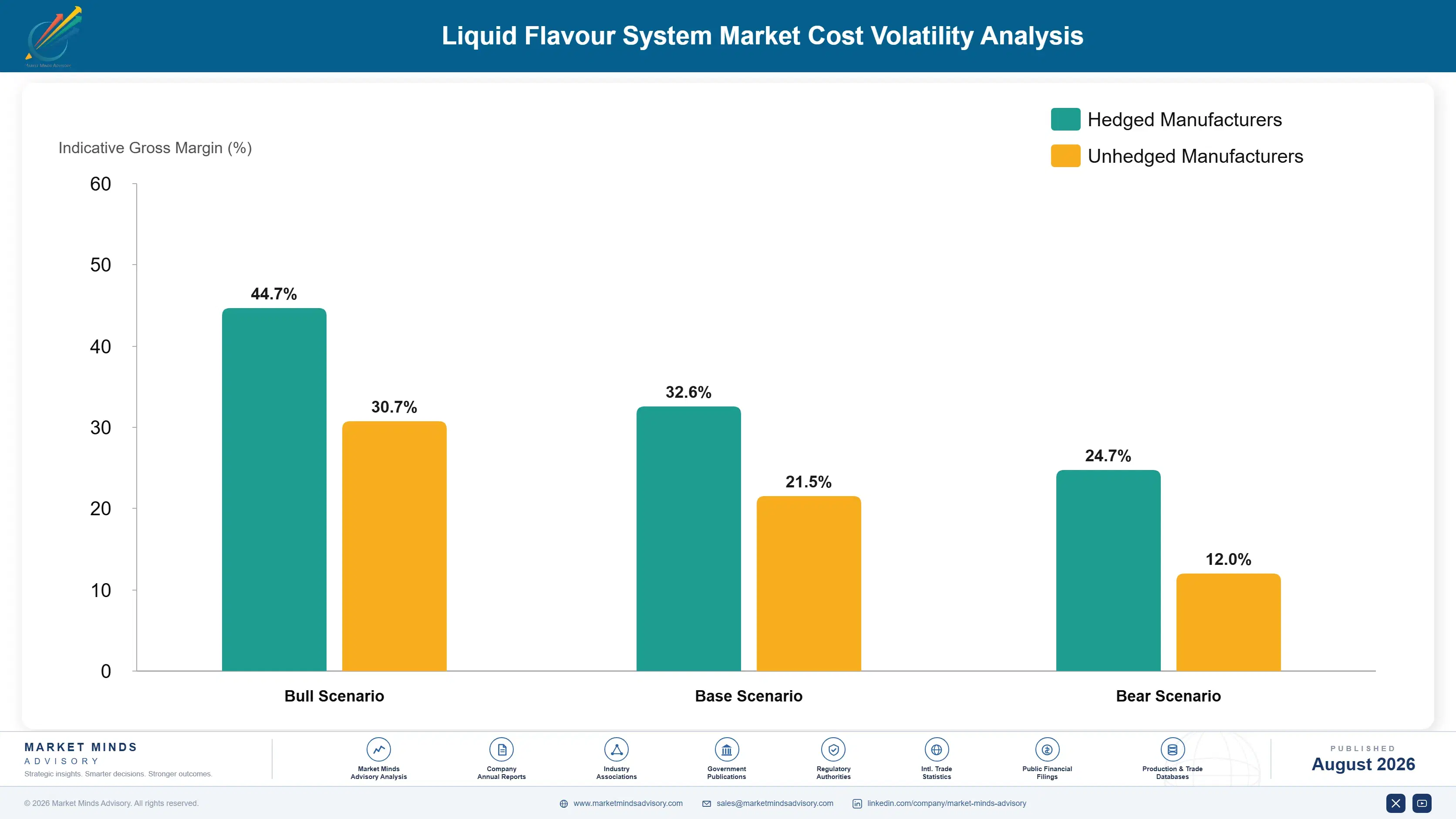
Portfolio economics here divide on how a position was won rather than on what the system contains. Compound supply quoted against a written specification a manufacturer developed elsewhere carries no defence at all, since the next quotation displaces it and nothing about the relationship makes switching difficult for the buyer. Nothing about that position is defensible for long.
The middle tier is development-led systems in food applications. Nine months of work building around a manufacturer's process produces a position holding an average of seven years, because reopening it triggers validation work the manufacturer gains nothing from. Margins reach the mid thirties and hold across the life of the product itself. Application support after launch deepens it further. Duration is the whole point.

Above both sit fermentation-backed natural systems in beverage applications. Natural declaration reaches 61% of value and fermentation makes it technically feasible, beverage stability requirements exclude houses without emulsion capability, and margins reach the low fifties. The position requires creative capability, fermentation access and application science together, which is why only a handful of organisations genuinely hold it. Only a handful of organisations genuinely hold all three.

Volume / Commodity-Adjacent

Compound supply quoted against a specification developed elsewhere. The range reflects aroma chemical cost rather than commercial skill, and the next quotation displaces the position without any friction at all.
Gross Margin: 18 to 26%

Premium / Certified

Development-led liquid systems built around a manufacturer's own process. The range reflects how deeply the development work was integrated and whether application support continues after the launch itself. Reopening triggers validation work.
Gross Margin: 31 to 40%

Sustainability / Regulatory / Next-Generation

Fermentation-backed natural systems in demanding beverage applications. The wide range reflects fermentation access and whether emulsion stability capability is held internally or bought in from elsewhere. Three capabilities are needed together.
Gross Margin: 46 to 57%
liquid-flavour-system-market-trends-portfolio-architecture-1787457966125

High-value Sub-segments and Strategic Watch-out

Fermentation-Backed Natural Beverage Systems

High value and high growth together, combining natural declaration with the most demanding stability requirements in the category. The wide range reflects fermentation access and whether emulsion capability is held internally rather than bought in. Stability capability decides beverage outcomes. Fermentation access is the entry cost.
Gross Margin: 46 to 57%

Development-Led Food System Positions

High value on steady growth and the most defensible ordinary position here. Nine months of development produces a position averaging seven years. The range reflects integration depth and whether application support continues beyond the product launch. Reopening gains the manufacturer nothing. Development depth decides duration entirely.
Gross Margin: 38 to 48%

Local Market Creation Capability

A genuinely growing pool serving manufacturers developing products regionally rather than adapting transferred formulations. The range reflects how established local creative capability is, since remote support loses briefs that local presence wins outright. Regional taste preferences differ considerably. Remote support loses briefs outright here. Presence wins them.
Gross Margin: 33 to 42%

Specification Quoted Compound Supply

The strategic watch-out. Volumes exist but the manufacturer did its development elsewhere, the next quotation displaces the position, and nothing makes switching difficult. The range reflects aroma chemical cost rather than any commercial decision. Switching costs the buyer nothing at all. The next quotation displaces it.
Gross Margin: 18 to 26%

How Flavour System Demand Repeats

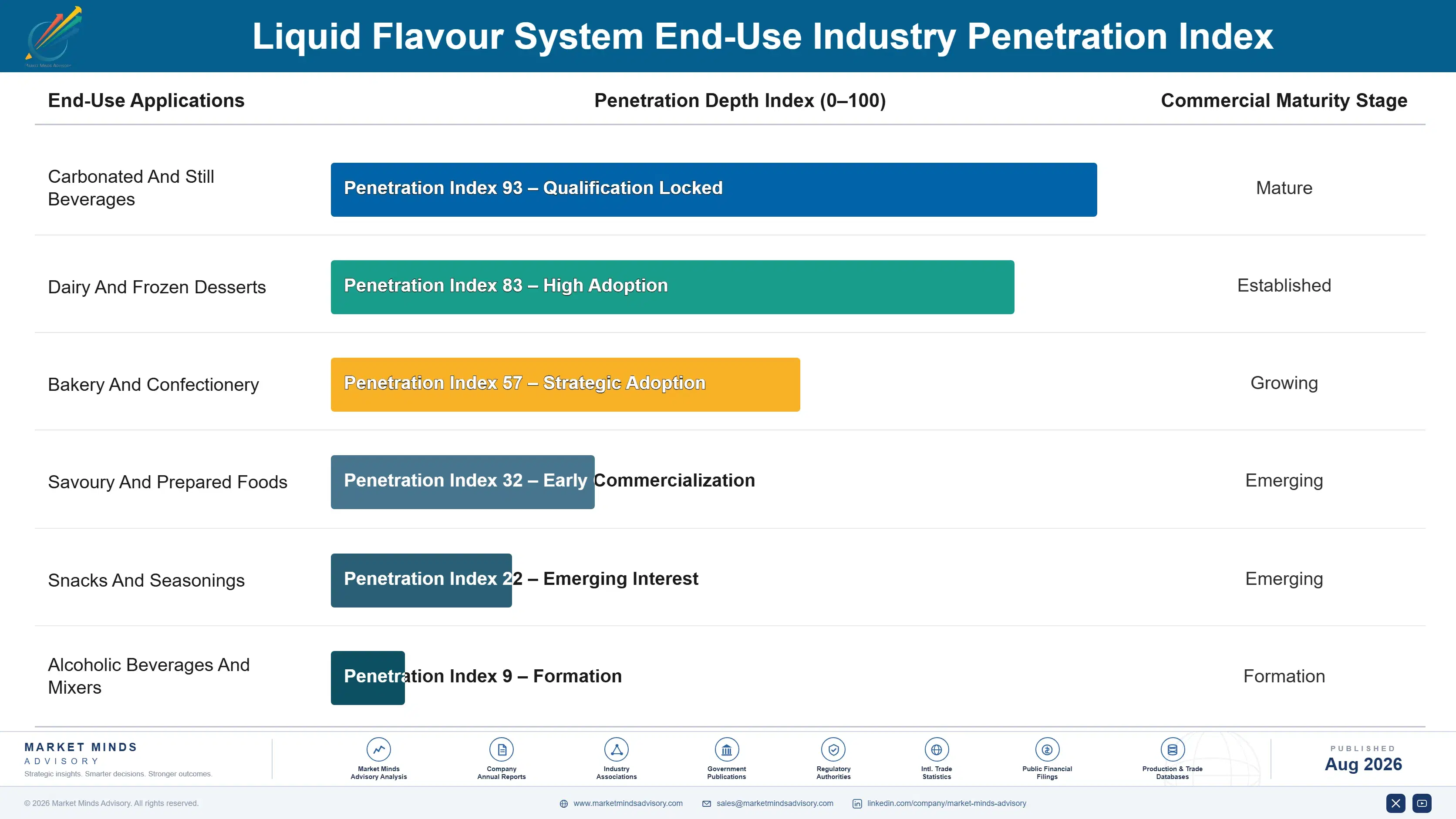
This is among the most durable repeat businesses in food ingredients and the reason is procedural rather than commercial. A system inside a manufactured product repeats every production run for as long as the product is made, averaging seven years, because reopening it triggers sensory validation, stability testing and consumer work the manufacturer gains nothing from. Positions change at reformulation events and almost nowhere else at all.
Stickiness varies sharply by how the position was won. Development-led positions hold best, since the system was built around a specific process nobody else understands as well. Fermentation-backed natural systems hold well because switching means finding another house with the same capability. Beverage positions hold until a stability failure appears in trade. Specification-quoted compound supply holds only until the next quotation arrives.

The buyer profile has shifted noticeably. Flavour buying once ran through procurement functions comparing quotations against a written specification the manufacturer had developed itself. Product development teams now increasingly lead the relationship, briefing flavour houses to build a system rather than to quote against one, which rewards creative and application capability and disadvantages houses whose commercial argument was a competitive price.
liquid-flavour-system-market-trends-end-use-penetration-index-1787457966618

Where To Compete And Why

These are among the four positions where our research anticipates prominent divergence between winners and laggards over the coming forecast period. Each is grounded in the demand model, the regulatory perimeter, and the announced capacity pipeline.
01 / DEVELOPMENT-LED POSITION BUILDING

They buy the work, not the compound

A flavour house wins by building a system around a manufacturer's specific process, ingredients and shelf life requirement rather than by offering a better compound from any catalogue. That development work takes around nine months and produces a position averaging fully seven years, since reopening it triggers validation work that the manufacturer gains nothing at all from. Development-led suppliers realise 35% to 45% higher margin than those quoting against a specification that somebody else wrote first, and that gap has kept widening steadily.
02 / FERMENTATION CAPABILITY INVESTMENT

Extraction was never going to close it

Natural sources deliver weaker intensity and more variable composition than synthetic aroma chemicals at roughly 2.7 times the cost, which kept natural declaration aspirational rather than genuinely practical across mainstream products for years. Fermentation-derived compounds narrow both of those gaps simultaneously and make the switch genuinely feasible at last. Roughly 61% of value now carries natural status, and houses without fermentation capability cannot answer those reformulation briefs at any price, whatever their creative capability happens to look like on paper.
03 / EMULSION STABILITY DISCIPLINE

Ringing on a neck ends positions

Separation or ringing on a bottle neck is immediately visible to a consumer and ends a flavour position faster than any pricing decision ever does, causing roughly 34% of position losses across beverage applications. The root capability is physical chemistry rather than flavour design, which is where most houses concentrate their people and attention. Accelerated stability protocols and real-condition application testing protect positions that creative capability alone never protects, and a failure of that kind is immediately visible to any consumer.
04 / LOCAL CREATION SITING

Remote support loses the brief

Development work has to happen close to the manufacturer whose process it is built around, and regional taste preferences differ enough that Western systems transfer badly into Asian and Latin American products. Houses building local creation capability win briefs that remote support loses outright, and Indian demand growing near 10.6% annually makes that increasingly consequential. The investment is people and application laboratories rather than manufacturing capital entirely, which makes it considerably faster to deploy than it generally looks from outside.

Engagement Snapshot From the Field

A live engagement with an industry participant carrying material or product regulatory and market exposure ahead of a defining policy shift, showing how our research translates into a defensible multi-year portfolio strategy.
MARKET MINDS ADVISORY · CLIENT ENGAGEMENT SUMMARY
Liquid Flavour System Producer Strategic Portfolio Review and Transition Roadmap 2026·Investment Scenario on Liquid Flavour System Exposure Evaluation 2025-26
CLIENT PROFILE
A European mid-sized flavour house with annual revenue near $214 million (client-reported, unverified by MMA), supplying liquid systems to food and beverage manufacturers across nine countries. Roughly 58% of that revenue came from compound supply quoted against customer specifications, with development-led positions concentrated in a small number of long-standing and unusually durable customer accounts indeed.
STRATEGIC CHALLENGE
Quoted compound business had been lost to competitors on price across three consecutive years while development-led accounts held firm and grew, and two natural reformulation briefs had been declined because the house lacked fermentation-derived compound access. Management needed to decide between defending quoted volume, investing in fermentation capability, or building local creation presence in growth markets.
MMA APPROACH
MMA modelled contribution and position duration by how each account had been won across five years of the client's own data, benchmarked fermentation access against competing houses, and assessed creation centre economics in two growth markets. Twenty-three expert interviews with food manufacturer development leads, procurement functions and fermentation suppliers tested each route.
KEY FINDINGS
  1. Development-led positions had averaged seven years and roughly 27 percentage points more margin than quoted compound supply, which had averaged under two years before displacement.
  2. Both declined natural briefs went to competitors holding fermentation access, and one of those competitors subsequently won additional business at the same manufacturer on the strength of it.
  3. Manufacturers interviewed increasingly briefed development teams rather than issuing specifications, and several stated they no longer ran competitive quotations for systems developed with a partner.
  4. Creation centre investment in one growth market was justifiable on demonstrated brief volume already being lost to locally present competitors, while the second market was not yet ready.
CLIENT PROFILE
A European mid-sized flavour house with annual revenue near $214 million (client-reported, unverified by MMA), supplying liquid systems to food and beverage manufacturers across nine countries. Roughly 58% of that revenue came from compound supply quoted against customer specifications, with development-led positions concentrated in a small number of long-standing and unusually durable customer accounts indeed.
STRATEGIC CHALLENGE
Quoted compound business had been lost to competitors on price across three consecutive years while development-led accounts held firm and grew, and two natural reformulation briefs had been declined because the house lacked fermentation-derived compound access. Management needed to decide between defending quoted volume, investing in fermentation capability, or building local creation presence in growth markets.
MMA APPROACH
MMA modelled contribution and position duration by how each account had been won across five years of the client's own data, benchmarked fermentation access against competing houses, and assessed creation centre economics in two growth markets. Twenty-three expert interviews with food manufacturer development leads, procurement functions and fermentation suppliers tested each route.
KEY FINDINGS
  1. Development-led positions had averaged seven years and roughly 27 percentage points more margin than quoted compound supply, which had averaged under two years before displacement.
  2. Both declined natural briefs went to competitors holding fermentation access, and one of those competitors subsequently won additional business at the same manufacturer on the strength of it.
  3. Manufacturers interviewed increasingly briefed development teams rather than issuing specifications, and several stated they no longer ran competitive quotations for systems developed with a partner.
  4. Creation centre investment in one growth market was justifiable on demonstrated brief volume already being lost to locally present competitors, while the second market was not yet ready.
RECOMMENDED STRATEGY
Phase 1: Phase one: redirect commercial effort from quoted compound supply toward development-led briefs, since position duration and margin both differ by a wide margin. Phase 2: Phase two: secure fermentation-derived natural compound access through partnership rather than internal build, which addresses declined briefs within a workable timeframe. Phase 3: Phase three: commit creation centre investment in the market where brief volume is already demonstrated, deferring the second until demand justifies it.
OUTCOME
The client shifted development-led business from 42% to 61% of revenue within eighteen months and signed a fermentation supply partnership (client-reported, unverified by MMA). Both previously declined briefs were re-entered and one was won, blended gross margin improved by roughly nine points, and the first creation centre opened during 2026.

Frequently Asked Questions

Foundational context covering the market sizes, CAGR, scope, country, region and competition that inform every finding below. This section is provided to cover basics and most often pre-purchase conversations, answered from the MMA Primary Research Dataset.

What is the current size of the Liquid Flavour System Market?

The global liquid flavour system market was valued at $9.40 billion in 2025, reaching an estimated $10.10 billion in 2026. That covers liquid flavour systems supplied into food and beverage manufacturing.

How large will the Liquid Flavour System Market be by 2036?

MMA forecasts the market reaching $20.62 billion by 2036, an increase of $10.52 billion over the 2026 base. That represents an expansion multiple of 2.04 times across the forecast period.

What is the CAGR for the Liquid Flavour System Market 2026 to 2036?

The base case compound annual growth rate is 7.4%, with a bull case of 8.6% and a bear case of 6.2%. Historical growth between 2020 and 2025 ran at 6.3% annually.

Which segment is growing fastest?

Natural liquid flavour systems grow at 11.1%, a full 1.50 times the market rate, as fermentation compounds make natural declaration technically feasible. Beverage-specific systems follow at 9.8%.

Who are the major companies in the Liquid Flavour System Market?

Givaudan, International Flavors and Fragrances, Firmenich, Symrise and Takasago International lead on liquid flavour system revenue. Together they account for roughly 58% of global value.

Which country is growing fastest?

India grows fastest at 10.6% annually as food and beverage manufacturing expands and increasingly develops products locally rather than adapting transferred formulations. China follows closely.

Report Segmentation Architecture

The full report scope spans multiple orthogonal segmentation dimensions, with cross-tabulated demand data provided for each dimension pair. Coverage extends further to regional breakdowns, trend trajectories, and the competitive detail needed to support segment-level decision-making.

By System Type

  • Natural Liquid Flavour Systems
  • Beverage-Specific Liquid Systems
  • Emulsion And Encapsulated Liquid Flavours
  • Savoury And Culinary Liquid Systems
  • Liquid Flavour Concentrates For Dilution

By End-Use Industry

  • Carbonated And Still Beverages
  • Dairy And Frozen Desserts
  • Bakery And Confectionery
  • Savoury And Prepared Foods
  • Snacks And Seasonings
  • Alcoholic Beverages And Mixers

By Commercial Dimension

  • Development-Led System Partnerships
  • Specification Quoted Compound Supply
  • Distributor And Trading Channel
  • Contract Manufacturer Supply
  • Private Label And Own-Brand Development

By Region

  • North America
  • Western Europe
  • East Asia
  • South Asia and Pacific
  • Latin America
  • Middle East and Africa
  • Eastern Europe

Scope, Methodology, and Coverage

Every figure in this report is reproducible from documented input assumptions. The scope below maps the historical period, the forecast horizon, the segmentation dimensions, and the countries covered, alongside the underlying primary and qualitative methodology.
Historical Period
2020 to 2025
Forecast Period
2026 to 2036
Base Year
2025 (USD billions; MMA Primary Research Dataset, August 2026)
Market Definition
This report covers liquid flavour systems supplied into food and beverage manufacturing, spanning natural liquid flavour systems, beverage-specific liquid systems, emulsion and encapsulated liquid flavours, savoury and culinary liquid systems, and liquid flavour concentrates supplied for dilution, across development-led partnership, specification quoted, distribution, contract manufacturing and private label channels. Dry and powdered flavours, individual aroma chemicals sold as isolated compounds, essential oils sold as botanical extracts rather than formulated systems, flavour enhancers without flavour character, and fragrance applications are excluded from the sizing.
Quantitative Units
USD billions at supplier realised value; volume in thousand tonnes; realised pricing in USD per kilogram.
Segmentation Dimensions
By system type; by end-use industry; by commercial dimension; by region.
Regions Covered
North America, Western Europe, East Asia, South Asia and Pacific, Latin America, Middle East and Africa, Eastern Europe
Countries Covered
China, Japan, South Korea, India, Indonesia, Thailand, Vietnam, Australia, United States, Canada, Mexico, Brazil, Argentina, Germany, France, Netherlands, United Kingdom, Poland, Turkey, South Africa.
Key Companies Profiled
Givaudan, International Flavors and Fragrances, Firmenich, Symrise, Takasago International, Mane SA, Robertet Group, Sensient Technologies, Kerry Group, T Hasegawa, Huabao International, Bell Flavors and Fragrances, Prova SAS, Blue Pacific Flavors and others.
Quantitative Methodology
Primary survey, n=3,800 respondents, Q4 2025, six countries; demand-side model with trade association cross-validation
Qualitative Methodology
47 expert interviews, Q4 2025; applied to validate demand model assumptions, identify emerging dynamics, and assess competitive positioning
Report Format
PDF and XLSX data workbook (Word format preview document)
Publisher
Market Minds Advisory
Report Code
MMA-2026-AGR-229
Published
August 2026
Contact
sales@marketmindsadvisory.com | www.marketmindsadvisory.com

Purchase the full Liquid Flavour System Market Report (2026 to 2036).

The full report sizes the liquid flavour system market across five system types, six end-use categories and seven regions, with tonnage and realised pricing detail behind every value estimate. It profiles twenty companies on creation network reach, fermentation capability and application science depth. Regional chapters cover natural declaration expectations, manufacturing scale and local creation capability by market. Cost analysis quantifies natural material, synthetic and development expense by system type. Position analysis measures how long systems hold inside products and what actually causes them to change hands.
Tonnage and realised pricing by system type
Natural declaration definitions compared across major jurisdictions
Position duration and displacement causes measured across accounts
Fermentation-derived natural compound access mapped by house
Competitive position assessments across twenty companies
Local creation capability and brief win rates assessed regionally

Built For The People Who Decide

From boardroom strategy to bench-side execution, this report is read cover-to-cover by leaders shaping the next decade of their industry, turning demand scenarios, market dynamics and valuation benchmarks into decisions.
CXOs/ Presidents/ VPs/ Managers
M&A and Corporate Development
Strategy Teams and R&D Heads
Procurement and Product Directors
Regulatory and Compliance Leaders
Investor Relations and Equity Analysts