Market Minds Advisory
Liquid-Filled Capsule Market

Liquid-Filled Capsule Market: Where Bioavailability Meets Formulation Science

Liquid-filled capsule demand is shifting from traditional gelatin softgels toward liquid-filled hard capsules, as bioavailability requirements for poorly soluble drug compounds and plant-based shell preferences reshape pharmaceutical and nutraceutical formulation strategy.

Lead Analyst

Alice Ballenger

Published

September 2026

Make Smarter Decisions with Customized Research Insights

Request a free sample report and evaluate market opportunities, growth trends, and competitive dynamics relevant to your business needs.

2025 MARKET VALUE$8.5BMarket Size 2025
2036 FORECAST VALUE$17.5BBase Case , 2026 to 2036
CAGR 2026 TO 20366.8 %Bull 8.1% / Bear 5.5%
INCREMENTAL OPPORTUNITY$8.4BNet 10- year value creation
EXPANSION MULTIPLE1.93x2036 value over 2026 base
Strategic Levers
M&A Pipeline
Regional Outlook
Country Rankings
Competitive Intelligence
Segmental Deep-dive
Call-Us : 91 93563 13602

Executive Snapshot and Market Trajectory

Liquid-filled capsule formulation decisions increasingly hinge on bioavailability enhancement for poorly soluble active ingredients rather than pure manufacturing cost, since pharmaceutical companies now treat capsule technology as a genuine formulation lever rather than a packaging afterthought across most major reimbursed treatment categories.
Rising prevalence of poorly water-soluble drug compounds requiring bioavailability enhancement, expanding nutraceutical and OTC softgel consumption tied to consumer wellness spending, and East Asian contract manufacturing capacity expansion serving both domestic and export demand are together concentrating demand upside in two clear directions: East Asian markets where contract manufacturing capacity runs furthest ahead of most other regional markets, and liquid-filled hard capsules that give formulators genuine bioavailability advantages previously unavailable through traditional gelatin softgel formats.
Catalent, Aenova Group, and Sirio Pharma lead a moderately fragmented field where formulation science and bioavailability enhancement capability is becoming as commercially decisive as core manufacturing throughput, while regional Asian contract manufacturers compete primarily on price for standard nutraceutical softgel formats serving smaller pharmaceutical and supplement brands across price-sensitive emerging markets currently expanding their formulation and manufacturing capacity rapidly across most participating countries, territories, and regional distribution networks.
Market Definition
The liquid-filled capsule market covers softgel and liquid-filled hard capsule formats used to encapsulate liquid, semi-solid, or suspension formulations for pharmaceutical and nutraceutical delivery. Dry powder hard capsules and tablet dosage forms are excluded from scope.
Base Year Value
$8.5B in 2025 (MMA Primary Research Dataset, August 2026)
Forecast Period
2026 to 2036, eleven discrete annual values
CAGR
6.8% base case. Bull 8.1%. Bear 5.5%.
Fastest Growth Segment
Liquid-Filled Hard Capsules: 12.5% CAGR
Fastest Growth Country
China: 7.8% CAGR
Fastest Growth Region
South Asia and Pacific: 9.1% CAGR
Largest Region
East Asia: 28% of 2025 global value
Market Leaders
Catalent, Aenova Group, Sirio Pharma, Procaps Group, ACG Capsules. Source: MMA Analysis, July 2026.
Primary Survey
n=3,800 procurement and R&D decision-makers, Q4 2025, six countries
Methodology
Demand-side build-up, cross-validated against public data, 47 expert interviews

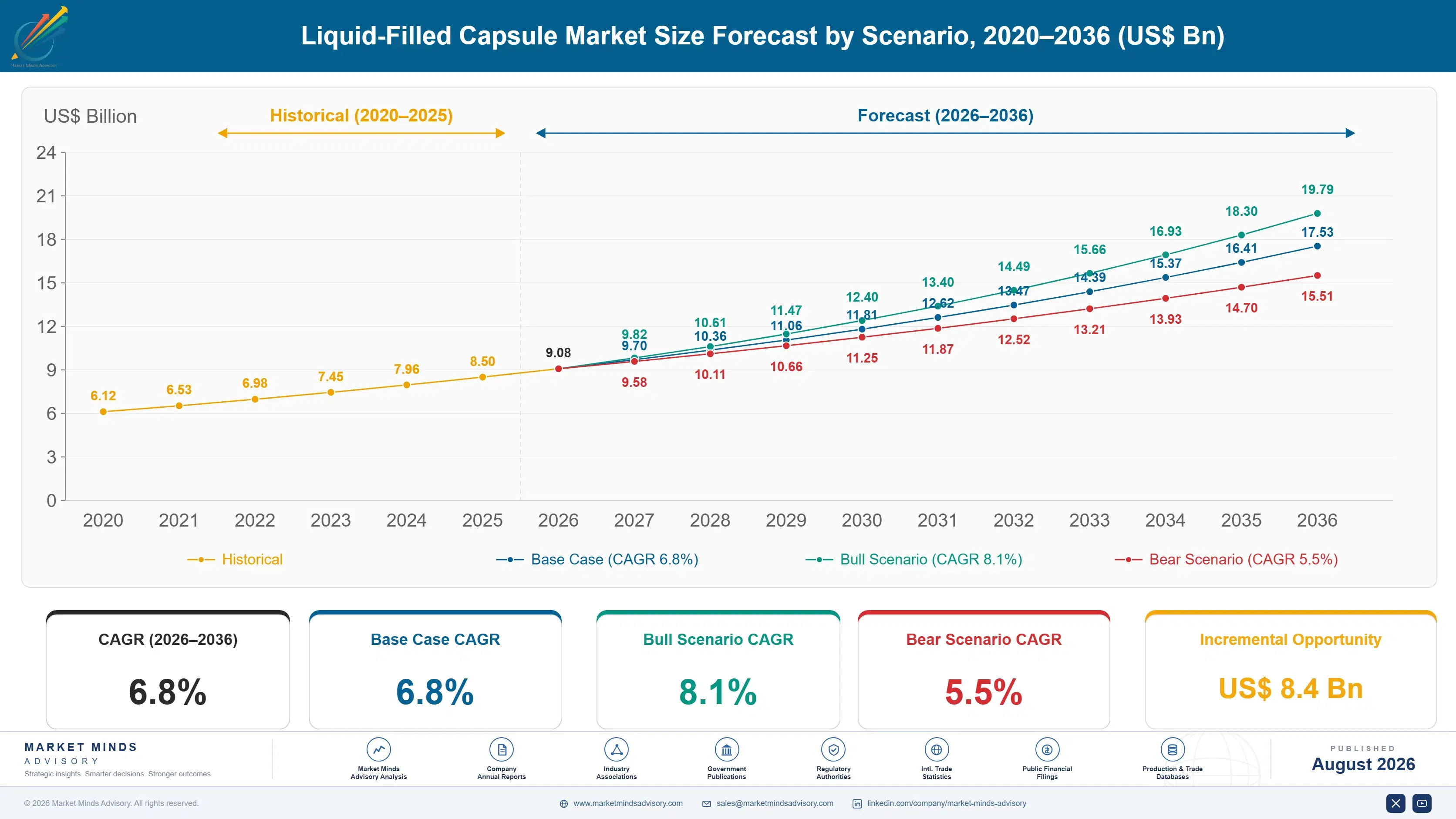
Liquid-Filled Capsule Market Forecast Scenarios

liquid-filled-capsule-market-size-forecast-scenario-1787305809515
Liquid-filled capsule demand grew steadily between 2020 and 2025, with pandemic-driven nutraceutical and immune support supplement consumption pulling growth forward before moderating into a calmer, formulation-driven pattern by 2024. Liquid-filled hard capsule technology adoption accelerated meaningfully during the back half of the historical period as pharmaceutical formulators sought bioavailability alternatives to traditional gelatin softgel manufacturing constraints.
The base case assumes 6.8 percent annual growth through 2036, anchored on three commercial mechanisms: rising prevalence of poorly water-soluble drug compounds requiring bioavailability enhancement through liquid encapsulation technology, expanding nutraceutical and OTC softgel consumption tied to sustained consumer wellness spending across most developed and emerging markets, and East Asian contract manufacturing capacity expansion supplying both domestic consumption and growing export volume to Western pharmaceutical and supplement brands currently outsourcing formulation and fill capacity.
The bull case centers on faster-than-expected liquid-filled hard capsule cost parity with traditional softgels, pulling forward broader pharmaceutical formulation conversion across generic and branded categories alike. The bear case flags gelatin and plant-based shell raw material cost volatility and slower nutraceutical demand growth in mature markets, which could compress converter margin and leave capacity expansion running ahead of realized demand for longer than currently planned.

Where Bioavailability Meets Formulation Science

Liquid-filled capsules occupy a category where formulation science increasingly matters as much as manufacturing scale, since pharmaceutical companies now select capsule technology specifically for bioavailability enhancement rather than treating encapsulation as a generic packaging decision. Traditional gelatin softgels still dominate nutraceutical volume, but liquid-filled hard capsules are gaining share fastest wherever poorly soluble active ingredient bioavailability has become a genuine for
MARKET CONCENTRATIONCR5 42%Top five producers control roughly two fifths of shipments
AVERAGE SELLING PRICEUSD 0.03/unitBlended average price across softgel and hard capsule formats
TOP PRODUCING COUNTRY SHARE26%Share of global manufacturing capacity concentrated in leading country
CAPACITY UTILISATION82%Average fill line operating rate across major contract facilities
TRADE INTENSITY39%Portion of unit volume crossing borders versus locally consumed
INPUT COST SHARE48%Gelatin and shell material costs as share of unit cost
Contract manufacturing capacity varies sharply by geography and shapes formulation partner selection considerably across markets. Pharmaceutical and supplement brands that have expanded relationships with East Asian contract manufacturers have seen formulation development timelines accelerate meaningfully within a short window, while brands still relying on Western-only manufacturing capacity show markedly longer development cycles despite comparable formulation science availability and manufacturing quality standards.
Plant-based and vegan shell technology continues expanding beyond nutraceutical applications into pharmaceutical formulation as brand owners and prescribers respond to consumer dietary preference and regulatory sustainability pressure. Gelatin and specialty shell material cost volatility remains a meaningful swing factor in converter margin, with raw material pricing tied closely to broader agricultural and chemical feedstock cycles that most converters can only partially hedge through long-term supply contracts.
"A softgel used to be the boring, cheap option a formulator picked last. Now it is often the thing that decides whether a poorly soluble drug even clears its bioavailability target at all."
Director, Pharmaceutical Formulation Practice · MMA Healthcare / Pharmaceutical

Market Trends

Liquid-Filled Hard Capsules Gain Bioavailability Adoption

Liquid-filled hard capsule technology, which combines the bioavailability advantages of liquid encapsulation with the manufacturing flexibility of hard capsule shells, has moved from a niche formulation option into mainstream pharmaceutical development pipelines for poorly water-soluble compounds. Several major pharmaceutical companies have published formulation studies demonstrating meaningful bioavailability improvement compared to conventional tablet and dry powder capsule formats. This technology shift is reshaping formulation science hiring and capital investment priorities at contract manufacturers, pulling development resources toward liquid-fill capability that traditional softgel-only converters increasingly struggle to match without dedicated capital investment.
Market Impact: Over 40% of new drugs affected

Plant-Based Shell Technology Expands Beyond Nutraceuticals

Plant-based and vegan capsule shell technology, historically confined to nutraceutical and dietary supplement applications, is increasingly entering pharmaceutical formulation pipelines as brand owners respond to consumer dietary preference and regulatory sustainability pressure across most major reimbursed markets tracked. Several converters have invested in scaling plant-based shell production capacity to match gelatin-equivalent barrier and dissolution performance, closing a historical performance gap that limited pharmaceutical adoption. This shift is broadening the addressable formulation base considerably, since plant-based shells increasingly serve markets and patient populations with religious or dietary restrictions on animal-derived gelatin.
Market Impact: Wellness spending grows over 6% ann

Market Opportunities and Growth Drivers

Poorly Soluble Drug Pipelines Drive Encapsulation Demand

A growing share of new pharmaceutical drug candidates entering development exhibit poor water solubility, a formulation challenge that liquid encapsulation technology addresses more effectively than conventional tablet or dry powder capsule formats in many cases. This pipeline shift is pushing pharmaceutical companies toward earlier engagement with liquid-filled capsule formulation specialists during drug development rather than treating encapsulation as a late-stage manufacturing decision. Contract manufacturers with dedicated formulation science capability are capturing disproportionate share of this increasingly demanding and technically complex pharmaceutical development pipeline across most major drug development programs tracked.
Market Impact: Gelatin prices swing 15 to 25%

Nutraceutical Wellness Spending Sustains Softgel Volume

Consumer wellness and preventive health spending continues expanding across most developed and emerging markets, sustaining steady demand for nutraceutical and dietary supplement softgels even as pharmaceutical applications increasingly command premium formulation attention and capital investment. Softgel format remains the preferred delivery vehicle for many popular supplement categories including omega-3 fatty acids, vitamins, and botanical extracts, given established consumer familiarity and manufacturing scale economics. This consumer-driven volume base provides converters with stable baseline demand that helps justify continued capital investment in adjacent higher-margin pharmaceutical formulation capability development across most established converter operations.
Market Impact: Equipment investment often exceeds

Market Restraints and Challenges

Gelatin Raw Material Cost Volatility Pressures Margin

Gelatin raw material prices have swung meaningfully in recent years, a volatility rooted in the agricultural commodity nature of gelatin production and periodic disease-related livestock supply disruption affecting bovine and porcine sourcing globally and regionally. This volatility compresses converter margin sharply during price spikes, since most contract manufacturing agreements include only partial and lagged raw material cost pass-through clauses to brand owner customers. Converters are mitigating this restraint through longer-term gelatin supply agreements and increased use of plant-based shell alternatives that reduce exposure to animal-derived raw material price cycles entirely.
Market Impact: Studies show 30 to 50% gains

Liquid-Fill Manufacturing Complexity Limits Smaller Converter Entry

Liquid-filled hard capsule manufacturing requires specialized equipment and formulation expertise considerably beyond conventional softgel or dry powder capsule production, a complexity rooted in the precise fill volume control and sealing technology required to prevent leakage and ensure content uniformity across every production batch and shift. This restraint limits smaller converters from entering the fastest-growing segment of the category without substantial capital investment. Larger converters are mitigating this restraint for customers through contract manufacturing partnerships that let smaller pharmaceutical and nutraceutical brands access liquid-fill capability without building internal manufacturing infrastructure themselves.
Market Impact: Plant-based shells now serve 15%
4 additional market trends, 4 additional growth drivers, and 4 additional restraints and challenges are covered in the full report. Contact sales@marketmindsadvisory.com to access the complete intelligence.

Segment CAGR and Growth Architecture

Liquid-filled capsules segment by product and technology type across six categories spanning shell chemistry, fill technology, and service dimensions used across pharmaceutical and nutraceutical manufacturing. Liquid-filled hard capsules and plant-based and vegan capsule shells are the two fastest-growing categories tracked, both expanding well ahead of the broader market as formulation science and consumer preference reshape converter product roadmaps.
liquid-filled-capsule-market-market-share-analysis-1787305810064

Liquid-Filled Hard Capsules

Liquid-filled hard capsules, which combine bioavailability advantages of liquid encapsulation with the manufacturing consistency of hard capsule shells, are converting the fastest share of new pharmaceutical formulation budgets as poorly water-soluble drug pipelines expand across most major therapeutic categories and drug classes. This format increasingly displaces conventional tablet and softgel formulations for compounds requiring enhanced bioavailability, particularly in generic drug development where formulation differentiation carries genuine commercial value against competing manufacturers. Contract manufacturers investing early in liquid-fill capability are winning disproportionate share of new pharmaceutical formulation partnerships, since specialized fill and sealing equipment requires substantial capital investment that smaller converters increasingly struggle to justify without dedicated pharmaceutical customer commitments already secured.
CAGR 12.5%

Plant-Based and Vegan Capsule Shells

Plant-based and vegan capsule shells, formulated from starch, carrageenan, or cellulose-based materials rather than animal-derived gelatin, are expanding rapidly as brand owners respond to consumer dietary preference and religious dietary restriction requirements across most major nutraceutical and increasingly pharmaceutical markets and product categories worldwide. Growth here tracks consumer wellness spending and sustainability preference directly, with converters closing the historical barrier and dissolution performance gap against gelatin through improved formulation chemistry. This category benefits directly from broader plant-based consumer product trends extending well beyond food into pharmaceutical and nutraceutical packaging decisions, giving early-moving converters a genuine competitive advantage over gelatin-only competitors across most developed consumer markets tracked closely by MMA analysts.
CAGR 10.5%
Full segment breakdown across 6 segments available in the complete report.

Regional Architecture and Country Demand Map

Liquid-filled capsule production and demand concentrate heavily in East Asia, where contract manufacturing capacity and formulation development investment run furthest ahead of most other regions. North America follows on value, while South Asia and Pacific markets post the fastest regional growth off a rapidly expanding contract manufacturing base.

North America

North America follows East Asia closely in absolute revenue terms, supported by a dense concentration of pharmaceutical formulation science expertise and premium nutraceutical brand demand generating steady value-added manufacturing revenue across most established markets, product categories, distribution channels, and specialty formulation segments tracked closely. The United States accounts for the large majority of regional volume, with bioavailability-focused formulation partnerships increasingly determining converter selection among established pharmaceutical companies. Canada contributes a smaller but steadily growing share tied to comparable nutraceutical and pharmaceutical manufacturing activity. Formulation science capability affects North American converter competitiveness considerably, since premium pharmaceutical customers increasingly select partners based on demonstrated bioavailability enhancement expertise rather than pure manufacturing cost.
Share: 26% | CAGR: 7.3% (2026 to 2036)

Western Europe

Western Europe generates a meaningful share of global revenue, anchored by Germany, France, and the United Kingdom, where established pharmaceutical and nutraceutical manufacturers fund formulation development on multi-year capital cycles and coordinated regulatory approval schedules across most participating countries, regions, health authorities, and manufacturing networks tracked closely. Plant-based shell adoption is more advanced here than in most other regions, reflecting stronger consumer sustainability preference and more developed vegetarian and vegan dietary considerations across the population. Germany maintains the largest converting capacity base in the region, reflecting its dense pharmaceutical manufacturing network. Growth trails East Asia and South Asia as the market matures, though formulation-driven product transition sustains steady capital investment.
Share: 21% | CAGR: 5.3% (2026 to 2036)
Regional intelligence for 5 additional markets available in the complete report: East Asia, South Asia and Pacific, Latin America, Middle East and Africa, Eastern Europe. Contact sales@marketmindsadvisory.com.
liquid-filled-capsule-market-country-cagr-analysis-1787305810609

Formulation Science and Bioavailability Value Capture

Liquid-filled capsule converters are pursuing several distinct paths to grow revenue beyond commodity fill volume as formulation science and bioavailability enhancement reshape purchasing criteria across the industry today. Four levers stand out as commercially significant across the forecast period, spanning bioavailability formulation services, liquid-fill capacity premiums, plant-based shell licensing, and long-term pharmaceutical supply contracts.

Bioavailability Formulation Development Service Fee Strategy

Converters offering dedicated bioavailability formulation development services, generating proprietary drug-shell compatibility data that pharmaceutical companies use in regulatory submissions, are capturing meaningful service revenue beyond core capsule manufacturing across most therapeutic categories and drug classes. These formulation services typically carry gross margin considerably above standard fill and shell sales, since delivery requires specialized formulation science expertise rather than additional production capacity. Leading converters now attach formulation development service contracts to more than 35 percent of new pharmaceutical customer relationships, reflecting how central bioavailability evidence has become to overall drug development partnership decisions.
Market Impact: Formulation development services no

Liquid-Fill Capacity Price Premium Capture Strategy

Converters that have successfully scaled liquid-filled hard capsule manufacturing capacity are capturing meaningful price premiums over conventional softgel formats, with early movers reporting premiums of roughly 40 percent on liquid-fill contracts serving bioavailability-focused pharmaceutical customers across most major markets. This premium reflects both genuine manufacturing investment and scarcity value, since specialized fill and sealing equipment capacity remains limited relative to surging pharmaceutical formulation demand. The premium is expected to compress gradually as production scale increases, making early capacity investment timing commercially important for converters seeking to capture this current window.
Market Impact: Liquid-fill contracts command a rou

Plant-Based Shell Technology Licensing Agreement Strategy

Converters holding proprietary plant-based shell formulation technology are increasingly licensing their intellectual property to other manufacturers rather than competing solely on direct capsule sales, converting a historically product-only business into a distinct recurring licensing revenue stream that already reaches roughly 15 percent of eligible converter accounts. This licensing model generates margin considerably above standard manufacturing sales alone, since the underlying formulation development cost is largely fixed regardless of licensing volume growth. This lever matters most for converters with the deepest plant-based formulation research investment, since licensing value compounds with adoption breadth across the broader industry.
Market Impact: Licensing revenue rises as adoption

Long-Term Pharmaceutical Supply Contract Structuring Strategy

Converters negotiating long-term supply contracts directly with pharmaceutical companies, rather than competing for spot purchase orders repeatedly, are securing predictable recurring revenue that generates margin considerably above transactional capsule sales alone across most account types and product categories. These structured contracts, now covering an estimated 42 percent of major pharmaceutical customer capsule volume, lock in pricing and delivery commitments across multi-year terms that reduce both converter and customer exposure to short-term raw material price volatility. This lever matters most for converters with proven quality and regulatory compliance track records serving large pharmaceutical manufacturing accounts.
Market Impact: Structured contracts now cover 42 p

Who Controls the Margin Pool

Liquid-filled capsules carries a CR5 near forty-two percent, reflecting a moderately fragmented industry where regional contract manufacturers compete alongside multinational specialty majors across most product categories. The gap between Catalent, the largest single converter, and the next tier of challengers is meaningful but not overwhelming, since manufacturing capacity itself is relatively replicable with sufficient capital investment.
Current competitive activity plays out across three dimensions: bioavailability formulation science races among converters serving pharmaceutical customers requiring solubility enhancement, capacity expansion into East Asian and South Asian markets ahead of outsourcing demand growth, and consolidation among smaller regional converters lacking capital to fund liquid-fill research and development independently. Larger converters are also pursuing selective acquisitions of plant-based shell technology specialist firms.

Emerging pressure comes from East Asian domestic converters expanding export-oriented capacity at costs multinational majors increasingly struggle to match, and from pharmaceutical companies building in-house formulation capability to reduce dependence on external contract manufacturers. Rankings could shift meaningfully if bioavailability formulation science speed diverges significantly between leaders, particularly as pharmaceutical companies increasingly favor converters demonstrating the fastest credible path to solubility enhancement across their entire formulation development pipeline.
liquid-filled-capsule-market-company-positioning-matrix-1787305811138

Competitive Moat and Risk Dimensions

CATALENT

Moat: Formulation Science Depth Advantage

Catalent operates the deepest formulation science and bioavailability enhancement research capability among all liquid-filled capsule converters tracked, built through decades of pharmaceutical partnership experience across thousands of drug development programs. This scientific depth gives Catalent a genuine advantage in winning early-stage pharmaceutical formulation partnerships where solubility enhancement expertise matters more than pure manufacturing price.
CATALENT

Risk: Premium Pricing Competitive Exposure

Catalent premium positioning and formulation science focus means its pricing runs meaningfully above regional Asian contract manufacturers competing primarily on cost for standard nutraceutical softgel formats. Slower response on price-sensitive commodity segments could cede volume share to lower-cost competitors even as Catalent retains leadership in premium pharmaceutical formulation partnerships.
AENOVA GROUP

Moat: European Manufacturing Network Depth

Aenova Group maintains a particularly strong European manufacturing footprint spanning multiple countries, built over years of pharmaceutical and nutraceutical contract manufacturing experience that gives it preferred vendor status across regional health system procurement processes. This regional depth positions Aenova favorably for European pharmaceutical customers prioritizing supply chain proximity and regulatory alignment.
AENOVA GROUP

Risk: Limited East Asian Manufacturing Presence

Aenova has historically concentrated manufacturing strength in Europe, leaving it with comparatively thinner presence in East Asia where contract manufacturing capacity and cost competitiveness drive some of the fastest volume growth globally. Building East Asian distribution and manufacturing infrastructure from a smaller base could limit near-term share gains against domestically established competitors.

Players Tracked

Prominent Players

Catalent
Aenova Group
Sirio Pharma
Procaps Group
ACG Capsules

Other Key Players

Lonza Group
Qualicaps
Suheung Co.
Medi-Caps Limited
Bright Pharma Caps
Captek Softgel International
Health Caps India
Pharmasol Corporation
Soft Gel Technologies
Cronus Pharma
Patheon
Chongqing Shenghuaxi Pharmaceutical
Nature's Farm
InCap Pharmaceuticals
Sunil Healthcare

Recent Developments

JUNE 2025

Catalent Expands Liquid-Filled Hard Capsule Manufacturing Facility in Ireland

Catalent completed a capacity expansion at its Irish manufacturing facility dedicated to liquid-filled hard capsule production, adding new fill and sealing lines targeting bioavailability-focused pharmaceutical formulations. The expansion supports growing pharmaceutical customer demand for poorly soluble compound formulation ahead of several major generic drug patent expirations.
Signal: Signals accelerating capital investment in
NOVEMBER 2024

Aenova Group Signs Long-Term Supply Agreement With Major Nutraceutical Brand

Aenova Group signed a long-term supply agreement with a major European nutraceutical brand covering softgel manufacturing across multiple product lines, replacing fragmented multi-vendor procurement with standardized supply terms. The agreement includes pricing stability provisions through 2029 and coordinated formulation development support across the entire product portfolio.
Signal: Signals growing brand owner preference for
FEBRUARY 2025

Sirio Pharma Acquires Plant-Based Shell Technology Firm

Sirio Pharma completed the acquisition of a plant-based shell technology firm specializing in starch and carrageenan-based capsule formulations, strengthening its vegan and vegetarian nutraceutical product portfolio considerably going forward. The acquisition accelerates Sirio Pharma internal plant-based formulation roadmap, reducing dependence on third-party shell technology licensing partnerships.
Signal: Signals continued industry consolidation a

Gelatin and Specialty Shell Material Cost

Gelatin, plant-based shell polymers, and specialty fill oils and excipients together represent roughly forty-five to fifty percent of liquid-filled capsule cost of goods sold, reflecting the category unusual blend of agricultural and specialty chemical input dependence. These materials are sourced from a moderately concentrated global supplier base spanning animal processing, plant-based polymer, and specialty chemical manufacturers.
Gelatin prices rose meaningfully during 2021 and 2022 amid disease-related livestock supply disruption and broader agricultural commodity inflation affecting converters alongside many other pharmaceutical and food categories facing similar constraints. Several converters disclosed in annual reports that raw material cost inflation compressed manufacturing margin during this period, prompting some manufacturers toward alternative supplier qualification and increased plant-based shell adoption to stabilize costs through 2023 and into 2024.

Cost exposure varies by converter manufacturing model and scale. Larger converters with in-house gelatin processing and plant-based polymer capability absorb raw material volatility more easily than smaller competitors purchasing shell materials entirely from third-party suppliers. Geographic exposure also differs: converters sourcing gelatin primarily from European or South American processors face different cost and logistics patterns than those relying on Asian plant-based polymer production.
liquid-filled-capsule-market-cost-volatility-analysis-1787305811339

Dual-Source Gelatin Supplier Qualification

Converters are qualifying second suppliers for gelatin and specialty shell materials to reduce dependence on any single manufacturer during periods of supply tightness affecting the broader category. This lengthens initial qualification cycles but meaningfully reduces exposure to regional supply disruption, giving procurement teams greater negotiating leverage on pricing during periods of raw material tightness and allocation constraints.

Plant-Based Shell Adoption as Hedge

Several major converters have expanded plant-based shell production capacity partly to reduce dependence on volatile gelatin pricing tied to agricultural and livestock supply cycles across multiple sourcing regions. This shift requires meaningful upfront formulation research investment but reduces exposure to gelatin-specific cost volatility over multi-year manufacturing cycles while also addressing rising consumer sustainability preference.

Long-Term Raw Material Supply Agreements

Converters are negotiating longer-term gelatin and specialty shell material supply agreements, locking in pricing and delivery commitments rather than relying on shorter-term spot purchasing arrangements across most sourcing categories. This reduces margin volatility during periods of raw material cost inflation and gives finance teams clearer forward visibility into manufacturing cost trajectory across upcoming quarters and planning cycles.

Portfolio Architecture for Margin Defence

Liquid-filled capsule portfolios span three margin tiers running from commodity-adjacent standard gelatin softgels through certified bioavailability-enhanced formulations to sustainability-linked next-generation liquid-filled hard capsule and plant-based platforms. Gross margin widens considerably moving up the tier structure, driven primarily by formulation science depth and shell technology differentiation rather than fill volume or bill of materials differences alone across most vendor produc
Volume tier competition centers on price and basic manufacturing reliability for cost-constrained nutraceutical brands, where converting scale and gelatin purchasing power determine competitiveness more than formulation differentiation across most product categories tracked. Premium tier competition instead centers on bioavailability enhancement evidence, liquid-fill capability, and regulatory documentation depth, an entirely different buying calculus that rewards converters with dedicated formulation research capability built over many years.

High-value margin pools concentrate overwhelmingly in the premium and next-generation tiers, where formulation service fees and liquid-fill capacity premiums generate meaningfully better margin than any commodity softgel transaction. Converters increasingly steer capital investment and research and development spending toward this upper tier as volume-tier margin continues compressing under sustained gelatin cost pressure and intensifying price competition from lower-cost regional converters.

Volume / Commodity-Adjacent Tier

Standard gelatin softgel formats targeting price-sensitive nutraceutical and dietary supplement brands where converting scale and gelatin cost management matter more than bioavailability enhancement or advanced formulation science capability across most established markets.
Gross Margin: 22%-30%

Premium / Certified Tier

Certified bioavailability-enhanced formulations meeting pharmaceutical solubility requirements, typically sold with formulation development services to pharmaceutical companies seeking demonstrated bioavailability improvement for poorly soluble drug compounds entering development pipelines today and beyond.
Gross Margin: 40%-48%

Sustainability / Regulatory / Next-Generation Tier

Liquid-filled hard capsule and plant-based shell platforms bundling advanced formulation science, sustainability credentials, and regulatory documentation capability, targeting leading pharmaceutical companies piloting next-generation solubility enhancement technology ahead of broader industry adoption.
Gross Margin: 52%-60%
liquid-filled-capsule-market-portfolio-architecture-1787305811869

High-value Sub-segments and Strategic Watch-out

Liquid-Filled Hard Capsules

Liquid-filled hard capsules are the fastest-growing, highest-margin pool as pharmaceutical companies race to formulate an expanding pipeline of poorly soluble drug compounds across most therapeutic categories. Converters with deep formulation science and liquid-fill manufacturing capability capture disproportionate share as buyer evaluation criteria shift decisively toward bioavailability credentials.
Gross Margin: 48%-56%

Bioavailability Formulation Development Services

Dedicated formulation development services generate steady high-margin recurring revenue tied closely to pharmaceutical customer relationships and drug development pipeline depth across most therapeutic areas. Growth here tracks pharmaceutical formulation partnership volume with a lag, offering converters predictable service revenue even as new capsule hardware pricing compresses under competition.
Gross Margin: 46%-54%

Standard Gelatin Nutraceutical Softgels

The largest volume category by unit count, standard gelatin softgels remain the backbone of nutraceutical and dietary supplement manufacturing worldwide. Margins are thinner and growth slower than premium categories, but installed base scale sustains steady replacement demand and anchors long-term supply relationships across most established consumer brand accounts.
Gross Margin: 20%-28%

East Asian Converter Price Competition

Rapidly improving East Asian and South Asian converters are moving upmarket from entry-level softgel formats into liquid-fill formulation categories at meaningfully lower price points. This trend bears close watching, since it threatens to compress mid-tier margin for multinational converters faster than formulation differentiation alone can offset within key accounts.
Gross Margin: 16%-24%

Formulation Cycles and Converter Trust

Liquid-filled capsule demand carries genuine annuity characteristics through multi-year pharmaceutical formulation partnerships anchored by regulatory submission continuity, since pharmaceutical companies rarely switch formulation partners mid-development given the documentation continuity regulatory bodies expect across successive drug approval milestones. Converters increasingly value long-term formulation partnership over pure initial contract revenue, restructuring sales models to prioritize
Adoption depth varies sharply by end-use vertical. Pharmaceutical formulation for poorly soluble compounds shows the deepest, most sustained engagement, layering bioavailability science across nearly their entire relevant drug pipeline given the highest commercial stakes. Nutraceutical and dietary supplement brands adopt more gradually, with formulation differentiation still catching up as budgets prioritize highest-margin premium product lines first before expanding across broader categories.

A generational shift in buyer profile is underway as younger formulation scientists trained on modern solubility enhancement techniques reach purchasing influence roles within pharmaceutical and nutraceutical organizations. This cohort expects bioavailability evidence as a baseline requirement rather than a premium add-on, reshaping procurement criteria toward formulation science depth and away from pure manufacturing cost specifications that dominated purchasing decisions a decade ago.
liquid-filled-capsule-market-end-use-penetration-index-1787305812377

Where Liquid-Filled Capsule Value Concentrates

These are among the four positions where our research anticipates prominent divergence between winners and laggards over the coming forecast period. Each is grounded in the demand model, the regulatory perimeter, and the announced capacity pipeline.
01 / FORMULATION SCIENCE INVESTMENT

Prioritize Bioavailability Formulation Over Pure Manufacturing Scale

Converters that invest in bioavailability formulation science are capturing disproportionate share of new pharmaceutical development partnerships across most major poorly soluble drug pipelines active today and across the coming years of therapeutic development. Pharmaceutical companies increasingly weigh formulation science depth alongside manufacturing reliability, a shift that rewards sustained research investment over incremental capacity expansion alone. Converters slow to build genuine formulation depth risk losing pharmaceutical partnership opportunities within three to five years as this becomes the clear industry evaluation standard.
02 / EAST ASIAN CAPACITY EXPANSION

Expand East Asian Capacity Ahead of Outsourcing Demand Growth

Western pharmaceutical and nutraceutical brands are outsourcing formulation and fill capacity to East Asian markets faster than most converters currently have local manufacturing infrastructure to serve profitably at meaningful scale across most affected countries, territories, and regional distribution networks today. Establishing production capacity ahead of demand requires patient multi-year investment but positions converters to capture disproportionate share as outsourcing volume continues accelerating steadily throughout the forecast period. Converters waiting for demand signals will face a steeper and more expensive path later.
03 / PLANT-BASED SHELL POSITIONING

Build Plant-Based Shell Capability Ahead of Consumer Preference Shift

Consumer dietary preference and sustainability expectations are shifting toward plant-based capsule formats faster than established gelatin-focused vendors can offset through pure manufacturing efficiency alone across most standard nutraceutical and increasingly pharmaceutical procurement decisions worldwide, internationally, and across most retail channels and product categories each year. Converters need genuine plant-based formulation capability that regional competitors cannot easily replicate without comparable research investment of their own. Converters failing to build this capability risk losing the consumer-facing brand accounts that increasingly drive category growth.
04 / LIQUID-FILL CAPACITY DEFENSE

Defend Liquid-Fill Capacity Premium Before Competitors Scale Up

Liquid-filled hard capsule capacity remains genuinely scarce relative to surging pharmaceutical bioavailability demand, giving early-moving converters meaningful pricing power that will compress as competitors scale their own manufacturing capacity over the coming years and decades ahead of current expectations. Converters need to lock in long-term pharmaceutical partnerships now while capacity constraints still favor established suppliers over new entrants still building validated manufacturing infrastructure. Converters that delay capacity investment risk missing the current premium pricing window entirely as supply catches up with demand.

Engagement Snapshot From the Field

A live engagement with an industry participant carrying material or product regulatory and market exposure ahead of a defining policy shift, showing how our research translates into a defensible multi-year portfolio strategy.
MARKET MINDS ADVISORY · CLIENT ENGAGEMENT SUMMARY
Liquid-Filled Capsule Producer Strategic Portfolio Review and Transition Roadmap 2026·Investment Scenario on Liquid-Filled Capsule Exposure Evaluation 2025-26
CLIENT PROFILE
The client is a mid-size generic pharmaceutical company developing a bioequivalent formulation of a poorly water-soluble branded drug facing imminent patent expiration, competing against several other generic manufacturers racing to launch first. The company had limited internal formulation science capability for liquid encapsulation technology and needed to select a contract manufacturing partner capable of achieving bioequivalence within an aggressive development timeline.
STRATEGIC CHALLENGE
Leadership needed to evaluate whether liquid-filled hard capsule technology could achieve bioequivalence to the branded reference product faster than conventional tablet reformulation approaches, given the compound known solubility challenges. The company also needed to secure adequate manufacturing capacity commitments given widely reported industry-wide liquid-fill capacity constraints affecting competing generic launches.
MMA APPROACH
MMA conducted an independent formulation partner assessment across four contract manufacturers with liquid-fill capability, benchmarking bioequivalence study track records, manufacturing capacity availability, and development timeline feasibility against the company competitive launch window. The engagement combined primary interviews with formulation scientists at each candidate firm, competitive benchmarking against peer generic manufacturer formulation strategies, and phased development planning sequenced by regulatory milestone.
KEY FINDINGS
  1. Two of four candidate contract manufacturers had prior bioequivalence success with structurally similar poorly soluble compounds, meaningfully de-risking the formulation development timeline for this specific project.
  2. The selected manufacturing partner offered reserved liquid-fill capacity slots within the required launch window, avoiding the industry-wide capacity backlog affecting several competing generic developers (client-reported, unverified by MMA).
  3. Formulation development and bioequivalence study completion took approximately eleven months, faster than the company initial internal timeline estimate of fifteen months for this specific molecule.
  4. Total formulation development cost ran an estimated eighteen percent above the company original budget, primarily due to additional bioequivalence study iterations required to optimize dissolution performance.
CLIENT PROFILE
The client is a mid-size generic pharmaceutical company developing a bioequivalent formulation of a poorly water-soluble branded drug facing imminent patent expiration, competing against several other generic manufacturers racing to launch first. The company had limited internal formulation science capability for liquid encapsulation technology and needed to select a contract manufacturing partner capable of achieving bioequivalence within an aggressive development timeline.
STRATEGIC CHALLENGE
Leadership needed to evaluate whether liquid-filled hard capsule technology could achieve bioequivalence to the branded reference product faster than conventional tablet reformulation approaches, given the compound known solubility challenges. The company also needed to secure adequate manufacturing capacity commitments given widely reported industry-wide liquid-fill capacity constraints affecting competing generic launches.
MMA APPROACH
MMA conducted an independent formulation partner assessment across four contract manufacturers with liquid-fill capability, benchmarking bioequivalence study track records, manufacturing capacity availability, and development timeline feasibility against the company competitive launch window. The engagement combined primary interviews with formulation scientists at each candidate firm, competitive benchmarking against peer generic manufacturer formulation strategies, and phased development planning sequenced by regulatory milestone.
KEY FINDINGS
  1. Two of four candidate contract manufacturers had prior bioequivalence success with structurally similar poorly soluble compounds, meaningfully de-risking the formulation development timeline for this specific project.
  2. The selected manufacturing partner offered reserved liquid-fill capacity slots within the required launch window, avoiding the industry-wide capacity backlog affecting several competing generic developers (client-reported, unverified by MMA).
  3. Formulation development and bioequivalence study completion took approximately eleven months, faster than the company initial internal timeline estimate of fifteen months for this specific molecule.
  4. Total formulation development cost ran an estimated eighteen percent above the company original budget, primarily due to additional bioequivalence study iterations required to optimize dissolution performance.
RECOMMENDED STRATEGY
Phase 1: Phase 1 (Months 1 to 2): Complete contract manufacturer capability assessment and capacity availability confirmation across all four candidate formulation partners. Phase 2: Phase 2 (Months 3 to 9): Execute formulation development and bioequivalence studies with the selected partner, tracking dissolution performance against reference product closely. Phase 3: Phase 3 (Months 10 to 12): Finalize regulatory submission documentation and secure reserved manufacturing capacity ahead of commercial launch timing.
OUTCOME
Within twelve months, the generic pharmaceutical company completed formulation development and bioequivalence studies, secured reserved liquid-fill manufacturing capacity ahead of several competing generic launches, and submitted its regulatory application on schedule (client-reported, unverified by MMA). The company has since applied the same formulation partner selection framework to two additional pipeline compounds.

Frequently Asked Questions

Foundational context covering the market sizes, CAGR, scope, country, region and competition that inform every finding below. This section is provided to cover basics and most often pre-purchase conversations, answered from the MMA Primary Research Dataset.

What is the current size of the Liquid-Filled Capsule Market?

The global liquid-filled capsule market was valued at 8.5 billion dollars in 2025. This figure covers softgel and liquid-filled hard capsule formats used across pharmaceutical and nutraceutical delivery.

How large will the Liquid-Filled Capsule Market be by 2036?

MMA forecasts the market will reach 17.53 billion dollars by 2036, roughly doubling in value. This growth is driven primarily by bioavailability enhancement demand and nutraceutical consumption growth.

What is the CAGR for the Liquid-Filled Capsule Market 2026 to 2036?

The base case CAGR is 6.8 percent annually across the forecast period. Bull and bear scenarios range from 8.1 percent to 5.5 percent depending on formulation adoption pace.

Which segment is growing fastest?

Liquid-filled hard capsules are the fastest-growing segment, expanding at approximately 12.5 percent annually. This is roughly 1.8 times the overall market growth rate, driven by bioavailability demand.

Who are the major companies in the Liquid-Filled Capsule Market?

Leading companies include Catalent, Aenova Group, Sirio Pharma, Procaps Group, and ACG Capsules. These five converters hold a combined CR5 near forty-two percent of the global market.

Which country is growing fastest?

China is the fastest-growing national market, expanding at approximately 7.8 percent annually. This reflects its dominant contract manufacturing capacity and expanding formulation development infrastructure nationwide.

Report Segmentation Architecture

The full report scope spans multiple orthogonal segmentation dimensions, with cross-tabulated demand data provided for each dimension pair. Coverage extends further to regional breakdowns, trend trajectories, and the competitive detail needed to support segment-level decision-making.

By Product and Technology Type

  • Liquid-Filled Hard Capsules
  • Plant-Based and Vegan Capsule Shells
  • Modified-Release Liquid-Filled Capsules
  • Contract Manufacturing Services
  • Nutraceutical and OTC Softgels
  • Softgel Capsules (Gelatin-Based)

By End-Use Industry

  • Pharmaceutical Manufacturing
  • Nutraceutical and Dietary Supplements
  • Over-the-Counter Consumer Health
  • Veterinary Pharmaceutical Applications
  • Contract Research Organizations

By Commercial Dimension

  • Direct Pharmaceutical Company Sales
  • Brand Owner Nutraceutical Contracts
  • Distributor and Channel Sales
  • Formulation Licensing Agreements

By Region

  • North America
  • Western Europe
  • East Asia
  • South Asia and Pacific
  • Latin America
  • Middle East and Africa
  • Eastern Europe

Scope, Methodology, and Coverage

Every figure in this report is reproducible from documented input assumptions. The scope below maps the historical period, the forecast horizon, the segmentation dimensions, and the countries covered, alongside the underlying primary and qualitative methodology.
Historical Period
2020 to 2025
Forecast Period
2026 to 2036
Base Year
2025 (USD billions; MMA Primary Research Dataset, August 2026)
Market Definition
The liquid-filled capsule market covers softgel and liquid-filled hard capsule formats used to encapsulate liquid, semi-solid, or suspension formulations for pharmaceutical and nutraceutical delivery. Dry powder hard capsules and tablet dosage forms are excluded from scope.
Quantitative Units
USD billions (current prices); unit shipment volume where applicable
Segmentation Dimensions
By Product and Technology Type; By End-Use Industry; By Commercial Dimension; By Region
Regions Covered
North America, Western Europe, East Asia, South Asia and Pacific, Latin America, Middle East and Africa, Eastern Europe
Countries Covered
USA, China, Germany, France, UK, Japan, South Korea, India, Australia, Canada, Brazil, Mexico, Indonesia, Vietnam, Thailand, Malaysia, UAE, Saudi Arabia, South Africa, Nigeria, Turkey, Poland, Netherlands, Italy, Spain, Sweden, Switzerland, Argentina, Colombia, Singapore, and additional markets relevant to this sector
Key Companies Profiled
Catalent, Aenova Group, Sirio Pharma, Procaps Group, ACG Capsules, Lonza Group, Qualicaps, Suheung Co., Medi-Caps Limited, Bright Pharma Caps, Captek Softgel International, Health Caps India, Pharmasol Corporation, Soft Gel Technologies, Cronus Pharma, Patheon, Chongqing Shenghuaxi Pharmaceutical, Nature's Farm, InCap Pharmaceuticals, Sunil Healthcare
Quantitative Methodology
Primary survey, n=3,800 respondents, Q4 2025, six countries; demand-side model with trade association cross-validation
Qualitative Methodology
47 expert interviews, Q4 2025; applied to validate demand model assumptions, identify emerging dynamics, and assess competitive positioning
Report Format
PDF and XLSX data workbook (Word format preview document)
Publisher
Market Minds Advisory
Report Code
MMA-2026-HLT-527
Published
August 2026
Contact
sales@marketmindsadvisory.com | www.marketmindsadvisory.com

Purchase the full Liquid-Filled Capsule Market Report (2026 to 2036).

The full report delivers detailed segment-level revenue forecasts across all six product categories through 2036. It includes country-level breakdowns for the fourteen markets carrying the deepest primary research coverage, alongside a complete competitive benchmarking module covering all twenty profiled companies. Proprietary MMA survey data drawn from 3,800 respondents across six countries supports the demand analysis, complemented by expert interview findings from 47 industry specialists gathered during the fourth quarter of 2025. Buyers also receive editable data tables and a quarterly market monitor update subscription for twelve months following purchase.
Segment-level revenue forecasts across six product categories
Country-level breakdowns for fourteen deeply researched markets
Competitive benchmarking module covering twenty profiled companies
Proprietary survey data from 3,800 respondents worldwide
Expert interview findings from 47 industry specialists
Twelve months of quarterly market monitor updates

Built For The People Who Decide

From boardroom strategy to bench-side execution, this report is read cover-to-cover by leaders shaping the next decade of their industry, turning demand scenarios, market dynamics and valuation benchmarks into decisions.
CXOs/ Presidents/ VPs/ Managers
M&A and Corporate Development
Strategy Teams and R&D Heads
Procurement and Product Directors
Regulatory and Compliance Leaders
Investor Relations and Equity Analysts