Market Minds Advisory
Liquid Feed Supplements Market

Liquid Feed Supplements Market: Formulation, Delivery, and Regional Demand to 2036

Feedlot operators are shifting from dry mineral bags to metered liquid supplement systems as labor costs climb, while molasses price swings and tightening antibiotic-use rules push formulators toward non-medicated, precision-dosed protein and mineral blends.

Lead Analyst

Lisa Gevelber

Published

September 2026

Make Smarter Decisions with Customized Research Insights

Request a free sample report and evaluate market opportunities, growth trends, and competitive dynamics relevant to your business needs.

2025 MARKET VALUE$4.2BMarket Size 2025
2036 FORECAST VALUE$8.3BBase Case , 2026 to 2036
CAGR 2026 TO 20366.4 %Bull 7.6% / Bear 5.2%
INCREMENTAL OPPORTUNITY$3.8BNet 10- year value creation
EXPANSION MULTIPLE1.86x2036 value over 2026 base
Strategic Levers
M&A Pipeline
Regional Outlook
Country Rankings
Competitive Intelligence
Segmental Deep-dive
Call-Us : 91 93563 13602

Executive Snapshot and Market Trajectory

Liquid feed supplements have moved from a regional feedlot practice into a core input across dairy, beef, and specialty livestock operations, as producers trade labor-intensive dry mineral programs for metered liquid delivery that cuts feed waste, improves palatability, and holds intake consistency across widely varying herd sizes and geographies.
Mineral and vitamin fortified formulations are growing fastest as dairy operators chase measurable gains in conception rates and milk yield, pulling volume away from plain molasses bases. China's rapidly consolidating large-scale dairy herds and Southeast Asia's expanding feedlot infrastructure are absorbing a growing share of global supply, even as United States range cattle operations retain the deepest installed base of liquid feeding equipment and formulation expertise built over decades.
Competition sits between global animal nutrition majors offering branded, research-backed formulations and regional blenders competing on delivery cost and local feedstock access. Tightening restrictions on medicated additives in several markets are accelerating a shift toward non-antibiotic, enzyme and organic-acid based liquid programs, while precision livestock monitoring is pushing suppliers to formulate supplements that pair with automated dosing and intake-tracking hardware across modern feedlots and remote pasture systems alike, especially on large commercial dairies.
Market Definition
Liquid feed supplements are pumpable molasses, protein, mineral, and vitamin-based products delivered to cattle, dairy, and other ruminant livestock through troughs, lick tanks, or metered dosing systems, formulated to supplement forage-based diets. The market excludes dry mineral blocks, pelleted concentrates, and complete dry feed rations.
Base Year Value
$4.2B in 2025 (MMA Primary Research Dataset, August 2026)
Forecast Period
2026 to 2036, eleven discrete annual values
CAGR
6.4% base case. Bull 7.6%. Bear 5.2%.
Fastest Growth Segment
Mineral and Vitamin Fortified Supplements: 8.2% CAGR
Fastest Growth Country
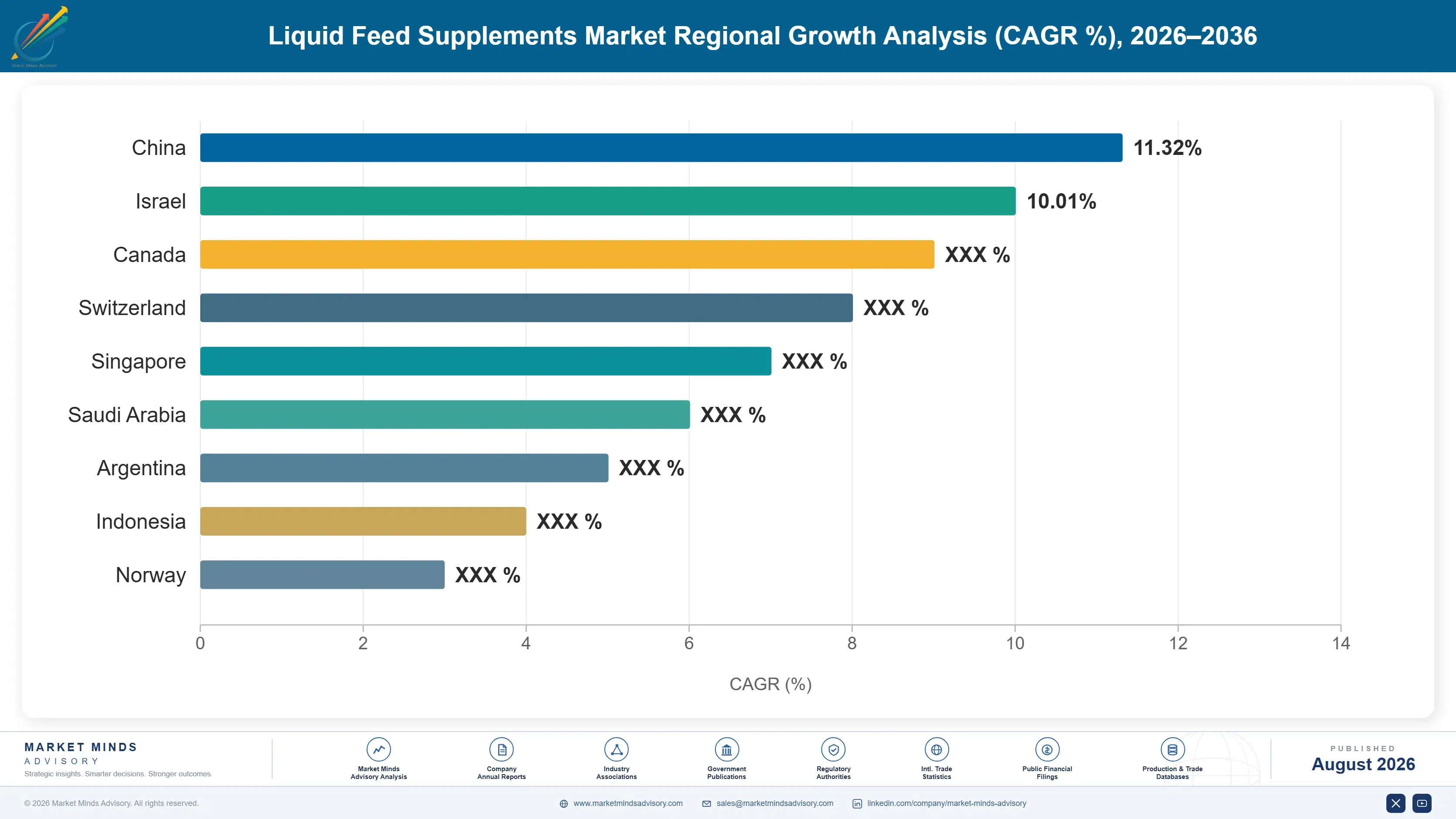
China: 7.9% CAGR
Fastest Growth Region
South Asia and Pacific: 8.4% CAGR
Largest Region
East Asia: 29% of 2025 global value
Market Leaders
Cargill, Archer Daniels Midland, Westway Feed Products, Land O'Lakes Purina, and Alltech lead the field. Source: MMA Analysis based on company annual reports.
Primary Survey
n=3,800 procurement and R&D decision-makers, Q4 2025, six countries
Methodology
Demand-side build-up, cross-validated against public data, 47 expert interviews

Liquid Feed Supplements Market Forecast Scenarios

liquid-feed-supplements-market-trends-size-forecast-scenario-1787556160717
Between 2020 and 2025 liquid feed supplement demand grew at roughly 5.4 percent a year, recovering unevenly from pandemic-era feedlot disruptions before accelerating as beef and dairy herd consolidation favored larger, mechanised operations. Drought years across parts of North America and Australia pushed producers toward supplemental feeding programs earlier in the season than historical norms, adding volume even where herd counts stayed flat.
The base case assumes continued growth as three mechanisms compound: herd consolidation into fewer, larger commercial operations that favor bulk liquid delivery over labor-intensive dry mineral programs; rising adoption of mineral and vitamin fortified formulations tied to measurable gains in reproduction and milk yield; and expanding feedlot finishing capacity across Southeast Asia and Latin America, where liquid supplement infrastructure is being built out alongside new feedlot construction rather than retrofitted into legacy dry-feed systems.
The bull case turns on faster-than-expected feedlot mechanisation across China's beef sector, where liquid delivery could scale well ahead of current forecasts. The bear case centers on a sustained molasses price spike, which has historically pushed smaller operators back toward cheaper dry mineral programs and slowed liquid system installations, a pattern last seen during the 2022 molasses cost surge.

Feedlot Mechanisation and Precision Nutrition Economics

Liquid feed supplements sit at the intersection of livestock consolidation, labor economics, and rising expectations for measurable herd performance. As feedlots and dairies scale up, the labor cost of hand-distributing dry mineral bags has become harder to justify against automated liquid dosing systems that cut handling time and reduce product waste, even where the per-tonne price of liquid supplement runs above dry alternatives.
FEEDSTOCK COST SHARE41% of COGSMolasses pricing remains the dominant driver of formulation cost
TOP PRODUCER SHARETop 3 countries: 47%Production concentrated among a handful of exporting nations
CAPACITY UTILISATION71%Blending plants run below full capacity most quarters
AVERAGE SELLING PRICE$285 per tonnePrices track molasses and protein feedstock cost swings
TRADE INTENSITY18% cross-borderMost volume consumed near the point of blending
MARKET CONCENTRATIONCR5: 34%Ownership stays fragmented across many regional feed blenders
Commercially the category splits between commodity molasses blends sold largely on price and fortified programs sold on performance data, veterinary endorsement, and formulation science. Global nutrition majors compete on research and branded additive packages, while regional blenders win on delivery logistics and feedstock proximity, since liquid supplement is costly to ship far from the point of production or the sugar mills that supply its molasses base.
The next decade will be shaped by tightening antibiotic-use regulation, the spread of precision dosing hardware that ties supplement delivery to individual animal data, and the build-out of feedlot infrastructure across Southeast Asia and Latin America. Formulators that can pair fortified, non-medicated blends with sensor-based delivery systems stand to capture share from suppliers still selling molasses alone.
"The liquid supplement buyers who win aren't the ones with the cheapest molasses; they're the ones who can prove a fortified blend paid for itself in one calving season. That's a data problem as much as a formulation one."
Director, Animal Nutrition and Feed Ingredients Practice · MMA Agriculture and Animal Nutrition Practice · August 2026

Market Trends

Shift From Dry Mineral Bags To Metered Liquid Dosing

Large commercial feedlots and dairies are replacing hand-distributed dry mineral bags with metered liquid dosing systems that track intake per animal and cut labor hours spent on manual feeding rounds. The shift is most visible on operations above 5,000 head, where labor availability has tightened and wage costs have risen faster than feed input costs across most producing regions. Equipment suppliers report installation backlogs stretching several months in parts of the American Midwest and northern China, and several major nutrition companies have begun bundling dosing hardware with supplement supply contracts rather than selling formulation alone.
Market Impact: Adds 4 percent volume yearly
Antibiotic-Free Reformulation Ahead Of Tightening Feed Additive Rules

Regulators across the European Union, several Southeast Asian markets, and individual US states are narrowing approved uses of medicated feed additives in ruminant liquid supplements, pushing formulators toward enzyme, organic-acid, and essential-oil based alternatives that claim similar performance without antibiotic residue concerns. Reformulation has raised input costs for some producers by an estimated eight to twelve percent per tonne during the transition period, since replacement actives are typically sourced from smaller specialty chemical suppliers rather than bulk commodity channels. Buyers in export-oriented beef and dairy supply chains are adopting non-medicated formulations fastest, anticipating stricter residue testing from importing countries.
Market Impact: Cuts calving interval 9 days

Market Opportunities and Growth Drivers

Herd Consolidation Into Larger Commercial Feedlot Operations

Beef and dairy herds are consolidating into fewer, larger commercial operations across North America, East Asia, and parts of Latin America, and larger operations are the natural buyers of liquid feed infrastructure because the capital cost of tanks, pumps, and dosing lines amortises better over higher head counts. The US Department of Agriculture has tracked a steady decline in the number of small cattle operations alongside rising average herd size for a decade, and similar consolidation is underway in China's dairy sector as provincial governments incentivise large-scale, mechanised dairy parks over smallholder herds through capital subsidies and land access policy.
Market Impact: Adds up to 12 percent cost

Fortified Formulations Linked To Measurable Reproduction Gains

Dairy and beef operators are paying a premium for mineral and vitamin fortified liquid programs because trial data ties specific formulations to measurable gains in conception rates, calving intervals, and milk yield per lactation. Several large nutrition suppliers now publish herd-level performance data alongside product literature, a practice that was rare a decade ago, and veterinary nutritionists increasingly specify liquid fortification programs as part of standard herd health protocols rather than an optional add-on. Producers report payback periods under one breeding season, which has made fortified liquid supplements one of the few feed categories where buyers accept higher per-tonne price.
Market Impact: Cuts shelf life 45 days

Market Restraints and Challenges

Molasses Price Volatility Squeezes Formulation Margins

Molasses, the base carrier for most liquid supplements, is a byproduct of sugar refining, so its price tracks global sugar markets rather than livestock feed demand, creating volatility that formulators cannot hedge through their own end market. Root causes include weather-driven sugarcane harvest swings in Brazil and India and periodic export restrictions tied to domestic sugar policy. When molasses prices spike, blenders either absorb margin compression or pass costs to producers, some of whom shift back toward dry mineral programs. Larger suppliers are mitigating exposure through multi-origin sourcing contracts and selective carrier substitution.
Market Impact: Cuts feeding labor 30 percent

Limited Shelf Stability In Hot Climate Storage

Liquid supplements are more prone to microbial spoilage and separation than dry mineral products, particularly in hot, humid storage conditions common across parts of Southeast Asia, the Gulf, and the American South. The root cause is the product's high moisture and sugar content, which supports microbial growth once tanks are exposed to temperature swings or contamination during transfer. Spoiled batches represent a direct margin loss for blenders and a trust problem with producers, since a single bad batch can affect an entire herd's intake for days. Suppliers are addressing the issue with sealed tank systems and shorter delivery cycles.
Market Impact: Adds 8 to 12 percent cost
3 additional market trends, 3 additional growth drivers, and 3 additional restraints and challenges are covered in the full report. Contact sales@marketmindsadvisory.com to access the complete intelligence.

Segment CAGR and Growth Architecture

Liquid feed supplements segment most usefully by formulation type, since molasses-based, protein-enriched, fortified, and medicated products carry distinct cost structures, margins, and regulatory exposure. This framework separates commodity molasses carriers from higher-value fortified and specialty formulations, mirroring how nutrition companies price, market, and compete across the category rather than blending distinct product economics into one undifferentiated bucket.
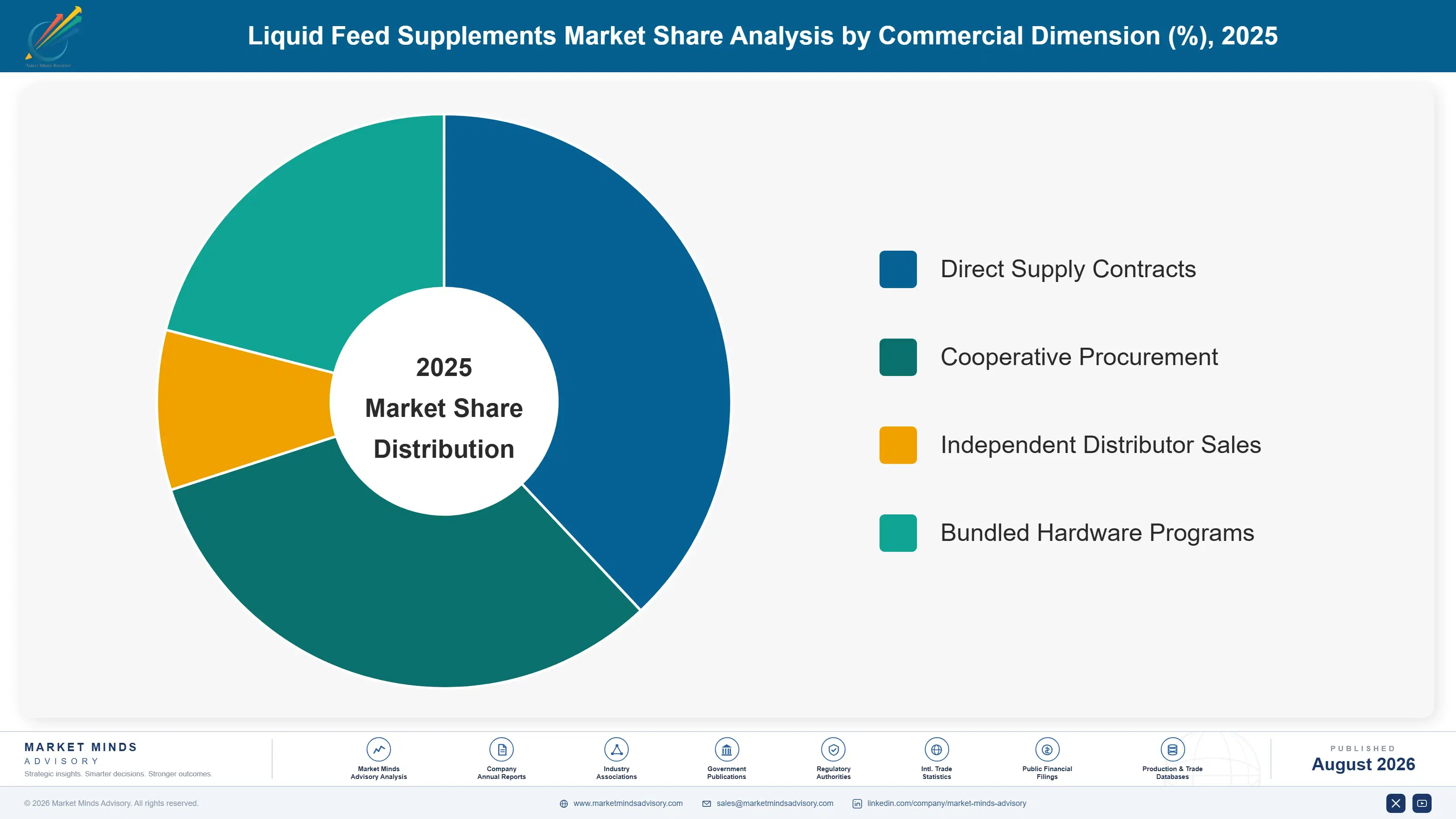
liquid-feed-supplements-market-trends-market-share-analysis-1787556161270

Mineral and Vitamin Fortified Supplements

Mineral and vitamin fortified liquid supplements are the fastest-growing segment as dairy and beef operators pay a premium for formulations tied to measurable gains in conception rates, calving intervals, and milk yield per lactation. Demand is concentrated among mid-to-large commercial dairies and integrated beef finishing operations that can justify the higher per-tonne cost against documented herd performance data, and veterinary nutritionists increasingly write fortified liquid programs into standard herd health protocols rather than treating them as optional. Growth is fastest in China's consolidating dairy sector and across large US feedlots, where operators track cost per unit of milk or gain closely enough to value a formulation with a clear, provable return within a single production cycle and beyond.
CAGR 8.2%

Medicated and Specialty Liquid Supplements

Medicated and specialty liquid supplements, including ionophore, enzyme, and organic-acid based formulations, form the second-fastest segment as feedlot operators seek performance gains beyond basic nutrition. Ionophores remain widely used in beef finishing to improve feed conversion, even as several export markets tighten residue tolerances, pushing some suppliers toward non-antibiotic specialty actives marketed on comparable performance claims. Growth concentrates in large-scale commercial feedlots across North America and expanding operations in Latin America, where finishing efficiency directly determines profitability. Regulatory divergence between domestic and export-oriented protocols is fragmenting the segment into two distinct formulation tracks, medicated and non-medicated, each requiring separate manufacturing and labeling processes today. Buyers increasingly request documentation proving which formulation track a shipment follows before accepting delivery.
CAGR 7.8%
Full segment breakdown across 6 segments available in the complete report.

Regional Architecture and Country Demand Map

Liquid feed supplement demand concentrates where commercial-scale cattle and dairy operations are most developed. East Asia's consolidating dairy sector and North America's mature feedlot infrastructure together account for well over half of global volume, while Southeast Asia, Latin America, and the Gulf represent the fastest-growing but smaller demand bases.

East Asia

China's dairy sector is consolidating at a pace unmatched elsewhere, with provincial governments subsidising large-scale, mechanised dairy parks that replace thousands of smallholder herds with a handful of thousand-head operations built for liquid feeding infrastructure from the ground up. Beef feedlot capacity is expanding alongside rising domestic beef consumption, and new facilities are specifying liquid dosing systems at construction rather than retrofitting dry programs later. South Korea and Japan contribute smaller but stable demand from established dairy and beef sectors with strict feed traceability requirements. Import reliance on molasses feedstock from Southeast Asian sugar producers ties regional pricing to cross-border logistics costs, and several Chinese nutrition companies have begun backward-integrating into molasses supply to secure margin and stability.
Share: 29% | CAGR: 7.6% (2026 to 2036)

North America

Range cattle operations across the American Great Plains and Canadian prairies built the liquid supplement category decades ago, and the region still carries the deepest installed base of lick tanks, metered troughs, and blending infrastructure anywhere in the world. Feedlot consolidation continues to push volume toward mechanised delivery, and drought conditions across parts of Texas and the Southwest have pushed producers toward supplemental feeding programs earlier in recent grazing seasons. Antibiotic-use restrictions at the state level are accelerating a shift toward non-medicated fortified formulations among export-oriented beef operations. Growth trails the global average because the market is already mature, with expansion coming mostly from formulation upgrades rather than new installations across the region.
Share: 27% | CAGR: 6.9% (2026 to 2036)
Regional intelligence for 5 additional markets available in the complete report: Western Europe, South Asia and Pacific, Latin America, Middle East and Africa, Eastern Europe. Contact sales@marketmindsadvisory.com.
liquid-feed-supplements-market-trends-country-cagr-analysis-1787556161779

Formulation Upgrades and Delivery Infrastructure Sales

Suppliers can grow revenue per tonne even where volume growth is modest by pushing customers toward fortified, higher-margin formulations, bundling dosing hardware with supply contracts, and using performance data to justify premium pricing. The most durable gains come from deepening the customer relationship beyond a single commodity transaction into a lasting formulation and equipment partnership.

Bundling Dosing Hardware With Long-Term Supply Contracts

Nutrition suppliers are increasingly bundling metered dosing tanks and pumps with multi-year supply agreements rather than selling formulation and hardware separately, locking in customer volume while capturing installation margin that previously went to third-party equipment vendors. Operators that adopt bundled hardware typically see supplier switching costs rise sharply, since replacing a dosing system mid-contract carries real capital cost, and several major nutrition companies report that bundled accounts retain customers roughly three times longer than formulation-only contracts. The approach works best on operations above 2,000 head, where the capital outlay for dedicated liquid infrastructure amortises quickly against labor savings.
Market Impact: Extends average customer contract retention by roughly 3 times

Premiumising Toward Fortified, Performance-Linked Formulation Programs

Shifting customers from plain molasses blends to mineral and vitamin fortified programs raises average selling price by roughly 20 to 30 percent per tonne while requiring only modest incremental formulation cost, since the premium is driven largely by micronutrient packages and performance data rather than expensive base ingredients. Suppliers that can document herd-level outcomes convert commodity buyers into fortified-program customers fastest, and several nutrition majors now employ dedicated field agronomists and veterinary liaisons to support conversion. The lever works best where buyers already track herd performance metrics closely enough to value a formulation with demonstrable return.
Market Impact: Lifts average selling price 20 to 30 percent

Expanding Into Feedlot Construction Partnerships In Growth Markets

Rather than waiting for feedlot operators in Southeast Asia and Latin America to retrofit dry-feed systems, several nutrition suppliers are partnering directly with feedlot developers to specify liquid infrastructure at construction, capturing decades of future formulation revenue from a single infrastructure decision. These partnerships typically include discounted or subsidised initial equipment in exchange for exclusive or preferred supply terms lasting 5 to 10 years, since installed liquid infrastructure rarely gets replaced once built. Early movers in Vietnam and Indonesia report that construction-stage partnerships convert into supply agreements at a substantially higher rate than post-construction sales efforts.
Market Impact: Secures exclusive supply terms for 5 to 10 years

Monetising Herd Performance Data Through Subscription Advisory Services

Several suppliers now charge separately for herd performance dashboards and advisory subscriptions that track intake, conception rates, and feed conversion alongside the physical supplement, turning what was once a free customer relationship tool into a standalone revenue line worth an estimated 4 to 6 percent of account value annually. Because the data pairs directly with the supplier's own formulation, switching to a competitor means losing the historical performance record, which reinforces retention beyond the hardware bundling lever alone. Adoption concentrates among larger commercial operations that already invest in data-driven herd management and are willing to pay for integrated advisory services.
Market Impact: Adds 4 to 6 percent recurring account value annually

Who Controls the Margin Pool

The liquid feed supplement market is moderately fragmented, with an estimated CR5 near 34 percent, since feedstock proximity and delivery logistics matter as much as brand strength. Cargill and Archer Daniels Midland lead on scale and formulation breadth, but the gap to mid-tier regional blenders is narrower than in most branded feed categories, since molasses sourcing and local distribution economics constrain how far even the largest suppliers can expand.
Competitive activity centers on three fronts: formulation science replacing medicated actives ahead of tightening regulation, hardware bundling to raise switching costs, and geographic expansion into Southeast Asia and Latin America through construction-stage partnerships. Acquisitions of smaller regional blenders have picked up as majors seek local molasses sourcing and distribution networks that are difficult to replicate organically, particularly in Latin America.

Emerging pressure comes from specialty chemical suppliers pushing further into organic-acid and enzyme-based additive formulations, threatening to disintermediate nutrition majors on the highest-margin fortified segment. Regional blenders with strong molasses sourcing relationships in Brazil and Southeast Asia are also gaining share against global players constrained by higher logistics costs on bulky liquid product. Rankings could shift meaningfully if a specialty ingredient supplier successfully integrates forward into finished liquid formulation.
liquid-feed-supplements-market-trends-company-positioning-matrix-1787556162315

Competitive Moat and Risk Dimensions

CARGILL

Moat: Molasses Supply Chain Integration

Cargill's ownership stakes in sugar processing and grain logistics give it direct access to molasses feedstock at costs regional blenders cannot easily match, particularly during price spikes when spot molasses becomes scarce. That integrated position lets Cargill hold formulation margins steadier through commodity cycles than competitors dependent entirely on open-market feedstock purchases, reinforcing its cost position across most producing regions.
CARGILL

Risk: Slower Regional Response Speed

Cargill's scale and centralised formulation development make it slower to adapt products to fast-moving regional regulatory changes, such as country-specific antibiotic restrictions, than smaller blenders who can reformulate a single regional product line quickly. This has occasionally cost the company share in fast-regulating markets where nimbler local suppliers reached compliant reformulations first, well ahead of Cargill's global product review process.
ARCHER DANIELS MIDLAND

Moat: Broad Nutrition Research Platform

ADM's investment in animal nutrition research, spanning enzymes, probiotics, and specialty additives across multiple species, gives it a formulation bench that smaller regional blenders cannot replicate, supporting premium fortified product lines backed by published performance data. That research depth helps ADM defend share in the fastest-growing fortified segment even as commodity molasses blend margins compress industry-wide across most regions.
ARCHER DANIELS MIDLAND

Risk: Exposure To Grain Trading Volatility

ADM's animal nutrition division sits inside a much larger grain trading and processing business whose earnings volatility can pull capital and management attention away from steady investment in the liquid feed supplement category during difficult trading years. Smaller, more focused competitors without that internal competition for capital have out-invested ADM in dedicated liquid supplement capacity during weaker trading periods.

Players Tracked

Prominent Players

Cargill
Archer Daniels Midland
Westway Feed Products
Land O'Lakes Purina
Alltech

Other Key Players

Kent Nutrition Group
Ridley Corporation
Purina Animal Nutrition
Zinpro Corporation
Kemin Industries
Trouw Nutrition
De Heus Animal Nutrition
CHS Inc.
Southern States Cooperative
United Suppliers
Golden State Feed
Producers Cooperative Association
Sweetwater Feeds
Multimin USA
Anpario plc

Recent Developments

MARCH 2026

Cargill Expands Molasses Blending Capacity in Vietnam

Cargill opened a new liquid feed supplement blending facility in southern Vietnam with dedicated molasses storage and metered dosing equipment production, aimed at supplying expanding feedlot and dairy operations across Vietnam, Indonesia, and the Philippines from a regional hub rather than importing finished product from existing Asian facilities.
Signal: Signals nutrition majors prioritising construction-stage Southeast Asian feedlot infrastructure over exporting finished liquid product. from established regional facilities.
SEPTEMBER 2025

ADM Launches Non-Medicated Fortified Line for Export Beef Producers

ADM introduced a new non-medicated, enzyme and organic-acid based fortified liquid supplement line targeted at export-oriented beef feedlots facing tightening residue tolerance requirements in key importing markets, positioning the product as a direct replacement for ionophore-based formulations without sacrificing documented feed conversion performance, according to company trial data.
Signal: Confirms regulatory pressure is now shaping mainstream product launches, not just niche specialty formulations. across the largest global nutrition suppliers.
JANUARY 2026

Westway Feed Products Acquires Regional Brazilian Blender

Westway Feed Products acquired a mid-sized Brazilian liquid feed supplement blender with established molasses sourcing relationships and distribution across three southern states, extending Westway's Latin American footprint and securing feedstock access ahead of anticipated feedlot finishing capacity growth in the region as Brazilian beef exports continue expanding.
Signal: Marks continued consolidation of regional blenders as majors seek local molasses sourcing and distribution networks. in fast-growing Latin American markets.

Molasses and Feedstock Cost Exposure

Molasses accounts for roughly 45 percent of cost of goods sold across most liquid feed supplement formulations, with protein meals and mineral premixes making up most of the remainder. Molasses feedstock originates almost entirely from sugarcane and sugar beet processing byproducts, concentrated in Brazil, India, Thailand, and the European Union, which ties formulation costs directly to sugar market dynamics rather than livestock feed demand.
Brazilian sugarcane harvest shortfalls during the 2023-2024 season, driven by unfavourable weather, pushed molasses spot prices up by more than 30 percent within several months, according to USDA reporting on global sugar and byproduct markets. Blenders without multi-origin sourcing contracts absorbed significant margin compression, and several smaller regional suppliers passed costs through to producers, triggering a temporary shift back toward dry mineral programs among price-sensitive operations.

Exposure varies by player type: integrated majors like Cargill weather price spikes with far less margin disruption than independent blenders reliant on open-market molasses purchases. Geographic exposure differs too, since suppliers sourcing primarily from Brazil face different risk timing than those dependent on Thai or Indian sugar harvests, meaning a single global molasses index understates the real cost volatility individual formulators face.
liquid-feed-supplements-market-trends-cost-volatility-analysis-1787556162509

Diversifying Molasses Sourcing Across Multiple Growing Regions

Suppliers are increasingly signing sourcing contracts spanning Brazil, India, and Thailand simultaneously rather than relying on a single origin, so a poor harvest in one region does not disrupt overall feedstock availability. This diversification raises logistics complexity but significantly reduces the risk of the sharp, single-origin price spikes that hit under-diversified blenders hardest during recent volatility.

Partial Substitution With Glycerin And Alternative Carriers

When molasses pricing turns unfavourable, some formulators substitute a portion of the molasses base with glycerin or other liquid carbohydrate carriers, which trade on different commodity cycles and can dampen overall formulation cost volatility. Substitution is limited by palatability and viscosity requirements, so it functions as a partial hedge rather than a full replacement strategy across most product lines industry-wide.

Backward Integration Into Sugar Processing Byproduct Supply

The largest nutrition suppliers are pursuing equity stakes or long-term offtake agreements directly with sugar processors, securing molasses supply ahead of the open market and capturing margin that would otherwise go to feedstock intermediaries. This approach requires capital most regional blenders lack, reinforcing a durable cost advantage for scale players during periods of feedstock scarcity and price volatility.

Portfolio Architecture for Margin Defence

Liquid feed supplements organise into three commercial tiers running from commodity molasses blends through certified performance formulations to next-generation non-medicated and precision-dosed programs. Gross margins widen sharply moving up the tiers, since commodity molasses carriers compete almost entirely on feedstock cost and logistics, while fortified and specialty formulations capture value from documented performance data, veterinary endorsement, and regulatory positioning rather than raw ingredient cost alone.
The tension between volume and premium is central to how suppliers allocate capital: commodity molasses blends generate the cash flow that funds formulation research, but fortified and specialty lines generate the margin that justifies continued investment in that research. Suppliers overweighted toward commodity volume face margin compression during feedstock price spikes with little pricing power to offset it, while premium-weighted suppliers carry lower volume but steadier profitability through commodity cycles.

High-value pools concentrate among mineral and vitamin fortified programs sold to large commercial dairies with documented herd performance tracking, and among non-medicated specialty formulations sold into export-oriented beef supply chains facing tightening residue requirements. Both pools reward suppliers who can pair formulation science with measurable outcomes data rather than competing purely on molasses cost alone.

Volume / Commodity-Adjacent Tier

Plain and lightly fortified molasses-based liquid supplements sold largely on price and feedstock proximity, competing on delivery logistics rather than formulation differentiation, serving price-sensitive commodity cattle and dairy producers across most regions.
Gross Margin: 8-14%

Premium / Certified Tier

Mineral and vitamin fortified formulations backed by herd performance data and veterinary endorsement, sold at a meaningful premium to mid-to-large commercial dairies and beef operations valuing documented conception rate and milk yield improvements.
Gross Margin: 22-30%

Sustainability / Regulatory / Next-Generation Tier

Non-medicated, enzyme and organic-acid based formulations developed ahead of tightening antibiotic-use regulation, paired increasingly with sensor-based precision dosing hardware, sold to export-oriented operations preparing for stricter residue standards. and represents the smallest but fastest-expanding tier by volume today.
Gross Margin: 26-34%
liquid-feed-supplements-market-trends-portfolio-architecture-1787556163013

High-value Sub-segments and Strategic Watch-out

Mineral and Vitamin Fortified Dairy Programs

Fortified formulations tied to documented conception rate and milk yield gains command the category's highest margins and fastest growth, concentrated among large commercial dairies in China and North America willing to pay a premium for a formulation with provable herd-level return. within a single production cycle.
Gross Margin: 24-30%

Non-Medicated Specialty Formulations For Export Beef

Enzyme and organic-acid based formulations sold into export-oriented beef supply chains carry strong margins tied to regulatory positioning, though growth is more moderate than fortified dairy programs since adoption depends on importing-country residue rule tightening across individual export markets. and the pace of buyer-specific compliance timelines across regions.
Gross Margin: 26-32%

Standard Molasses-Based Liquid Supplements

Plain and lightly fortified molasses blends remain the largest volume category by far, generating steady if unglamorous cash flow across price-sensitive commodity cattle and dairy operations, even as growth increasingly shifts toward fortified and specialty formulations elsewhere in the portfolio. and remains the primary revenue base for most regional blenders.
Gross Margin: 8-13%

Dry Mineral Block Substitution Risk In Price Spikes

Sustained molasses price spikes periodically push smaller, price-sensitive operators back toward cheaper dry mineral programs, representing a ceiling on liquid supplement penetration in cost-constrained markets that suppliers must monitor closely during feedstock volatility episodes and margin-squeeze periods. particularly across smaller Latin American and Eastern European operations with limited hedging capacity.
Gross Margin: n/a

Annuity Economics Of Herd Nutrition

Liquid feed supplement demand behaves like an annuity once installed, since a dosing system and supply contract typically lock in years of recurring formulation purchases rather than a one-time transaction. Switching suppliers mid-contract carries real capital and operational cost, given dedicated tanks and pumps are rarely compatible across different formulation viscosities, which keeps churn low relative to most agricultural input categories. That durability shapes capacity planning.
Adoption depth varies sharply by vertical: large commercial dairies penetrate deepest, often running fortified programs across their entire herd, while smaller mixed cattle operations adopt more selectively, using liquid supplements seasonally during drought or late-gestation periods rather than year-round. Beef feedlots sit between the two, with adoption depth tracking closely to finishing scale and the sophistication of in-house nutrition management practice. Seasonal timing differs across these groups.

A generational shift in buyer profiles is underway as younger operators, often formally trained in animal science, increasingly demand performance data and documented return on formulation spend before committing to a supplier, replacing an older generation that selected suppliers primarily on relationship and price. That shift favors suppliers who can produce credible herd-level outcomes data over those competing on relationship alone. Slow adapters risk losing share.
liquid-feed-supplements-market-trends-end-use-penetration-index-1787556163501

Where To Focus Capital Next

These are among the four positions where our research anticipates prominent divergence between winners and laggards over the coming forecast period. Each is grounded in the demand model, the regulatory perimeter, and the announced capacity pipeline.
01 / FORTIFIED FORMULATION INVESTMENT

Prioritise Fortified, Performance-Linked Programs Over Commodity Molasses Volume

Fortified mineral and vitamin programs are growing fastest and carry the category's widest margins, driven by documented gains in conception rates and milk yield that justify premium pricing across large commercial operations. Suppliers that pair formulation science with credible herd-level performance data are converting commodity buyers at a faster rate than those competing on molasses cost alone. Capital allocated toward veterinary liaison teams and outcomes tracking will likely generate better returns than capacity expansion in the commodity tier over the next several years of the forecast.
02 / REGULATORY REFORMULATION TIMING

Move Non-Medicated Formulations To Market Ahead Of Tightening Rules

Antibiotic-use restrictions are tightening across the European Union, several Southeast Asian markets, and individual US states, and suppliers who reformulate ahead of enforcement capture export-oriented customers before competitors catch up to the new standard. Reformulation raises near-term input costs, but early movers are establishing performance credibility with regulators and buyers that laggards will struggle to replicate once rules take full effect across markets. Waiting for mandatory compliance dates risks ceding the fastest-growing specialty segment to faster-moving rivals already selling compliant alternatives.
03 / HARDWARE BUNDLING STRATEGY

Bundle Dosing Infrastructure With Supply Contracts To Raise Retention

Bundling metered dosing hardware with multi-year supply agreements meaningfully raises customer switching costs, since replacing installed infrastructure mid-contract carries real capital expense for the buyer and meaningfully disrupts day-to-day feeding operations. Suppliers that have adopted this approach report materially longer average customer retention than formulation-only competitors, turning a commodity relationship into something closer to an infrastructure partnership over time. The approach requires upfront capital investment in equipment financing, favoring larger suppliers able to absorb that cost against multi-year contracted revenue streams.
04 / GEOGRAPHIC EXPANSION SEQUENCING

Enter Southeast Asia And Latin America At The Construction Stage

New feedlot and dairy construction in Vietnam, Indonesia, and Brazil represents a rare opportunity to specify liquid infrastructure from the outset rather than competing to displace entrenched dry-feed systems later in the build cycle. Suppliers partnering directly with developers at the construction stage are converting projects into multi-year exclusive supply agreements at meaningfully higher rates than post-construction sales efforts. This sequencing advantage will narrow as regional infrastructure build-out matures, making near-term positioning in these markets disproportionately valuable for early movers.

Engagement Snapshot From the Field

A live engagement with an industry participant carrying material or product regulatory and market exposure ahead of a defining policy shift, showing how our research translates into a defensible multi-year portfolio strategy.
MARKET MINDS ADVISORY · CLIENT ENGAGEMENT SUMMARY
Liquid Feed Supplements Producer Strategic Portfolio Review and Transition Roadmap 2026·Investment Scenario on Liquid Feed Supplements Exposure Evaluation 2025-26
CLIENT PROFILE
The client is a regional dairy cooperative operating across roughly 40 member farms in the American Midwest, representing a combined herd of approximately 18,000 head (client-reported, unverified by MMA). The cooperative had relied on a single commodity molasses supplement supplier for over a decade and faced rising member pressure to demonstrate measurable returns on feed input spending as milk pricing tightened member margins.
STRATEGIC CHALLENGE
Member farms were paying a uniform commodity price for liquid supplement regardless of individual herd performance, and the cooperative lacked data to determine whether upgrading to a fortified formulation would justify the incremental cost across its varied membership base. Leadership needed an independent assessment of formulation options and expected returns before committing to a cooperative-wide supplier change affecting member costs for years.
MMA APPROACH
MMA analysts benchmarked the cooperative's current formulation against fortified alternatives from three suppliers, modeling expected conception rate and milk yield improvements against incremental cost across representative member herd profiles. The engagement combined primary interviews with member farm managers, supplier formulation data review, and comparison against MMA's broader dataset of documented fortified-program outcomes across similarly sized commercial dairy operations.
KEY FINDINGS
  1. Fortified formulation adoption showed a projected payback period under one full breeding season across roughly 70 percent of member herds, based on modeled conception rate improvements (client-reported, unverified by MMA).
  2. The cooperative's existing supplier lacked multi-origin molasses sourcing, exposing members to a documented 30 percent cost spike during the prior season's feedstock shortage.
  3. Smaller member farms with fewer than 200 head showed meaningfully longer payback periods, suggesting a tiered rollout would outperform a uniform cooperative-wide formulation switch.
  4. Two of three benchmarked suppliers offered dosing hardware bundling that would reduce upfront capital cost for smaller members lacking existing liquid infrastructure entirely.
CLIENT PROFILE
The client is a regional dairy cooperative operating across roughly 40 member farms in the American Midwest, representing a combined herd of approximately 18,000 head (client-reported, unverified by MMA). The cooperative had relied on a single commodity molasses supplement supplier for over a decade and faced rising member pressure to demonstrate measurable returns on feed input spending as milk pricing tightened member margins.
STRATEGIC CHALLENGE
Member farms were paying a uniform commodity price for liquid supplement regardless of individual herd performance, and the cooperative lacked data to determine whether upgrading to a fortified formulation would justify the incremental cost across its varied membership base. Leadership needed an independent assessment of formulation options and expected returns before committing to a cooperative-wide supplier change affecting member costs for years.
MMA APPROACH
MMA analysts benchmarked the cooperative's current formulation against fortified alternatives from three suppliers, modeling expected conception rate and milk yield improvements against incremental cost across representative member herd profiles. The engagement combined primary interviews with member farm managers, supplier formulation data review, and comparison against MMA's broader dataset of documented fortified-program outcomes across similarly sized commercial dairy operations.
KEY FINDINGS
  1. Fortified formulation adoption showed a projected payback period under one full breeding season across roughly 70 percent of member herds, based on modeled conception rate improvements (client-reported, unverified by MMA).
  2. The cooperative's existing supplier lacked multi-origin molasses sourcing, exposing members to a documented 30 percent cost spike during the prior season's feedstock shortage.
  3. Smaller member farms with fewer than 200 head showed meaningfully longer payback periods, suggesting a tiered rollout would outperform a uniform cooperative-wide formulation switch.
  4. Two of three benchmarked suppliers offered dosing hardware bundling that would reduce upfront capital cost for smaller members lacking existing liquid infrastructure entirely.
RECOMMENDED STRATEGY
Phase 1: Phase 1 (Months 1 to 3): Pilot fortified formulation with the largest 15 member farms to validate modeled performance gains before wider cooperative rollout. Phase 2: Phase 2 (Months 4 to 9): Extend fortified adoption to mid-sized members using hardware-bundled contracts to offset smaller farms' capital constraints. Phase 3: Phase 3 (Months 10 to 18): Negotiate cooperative-wide multi-origin sourcing terms directly with the selected supplier to lock in feedstock cost stability.
OUTCOME
The cooperative selected a supplier offering hardware-bundled fortified contracts and began phased rollout across its largest member farms. Early-adopting members reported measurable milk yield improvements within the first breeding season (client-reported, unverified by MMA), and cooperative leadership credited the phased approach with securing broader member buy-in than a uniform switch would have achieved.

Frequently Asked Questions

Foundational context covering the market sizes, CAGR, scope, country, region and competition that inform every finding below. This section is provided to cover basics and most often pre-purchase conversations, answered from the MMA Primary Research Dataset.

What is the current size of the Liquid Feed Supplements Market?

The global liquid feed supplements market was valued at approximately $4.2 billion in 2025. Growth is concentrated among commercial dairy and beef feedlot operations scaling toward mechanised, metered delivery systems.

How large will the Liquid Feed Supplements Market be by 2036?

MMA forecasts the market will reach approximately $8.31 billion by 2036, roughly 1.86 times its 2026 value. Growth is driven by herd consolidation and rising adoption of fortified, performance-linked formulations.

What is the CAGR for the Liquid Feed Supplements Market 2026 to 2036?

The market is projected to grow at a compound annual growth rate of 6.4 percent between 2026 and 2036. Bull and bear scenarios range from roughly 5.2 to 7.6 percent depending on feedstock cost trends.

Which segment is growing fastest?

Mineral and vitamin fortified liquid supplements are the fastest-growing segment, expanding at approximately 8.2 percent annually. Growth is driven by documented gains in conception rates and milk yield that justify premium pricing.

Who are the major companies in the Liquid Feed Supplements Market?

Leading suppliers include Cargill, Archer Daniels Midland, Westway Feed Products, Land O'Lakes Purina, and Alltech. Competition centers on molasses sourcing, formulation science, and dosing hardware bundling rather than brand alone.

Which country is growing fastest?

China is the fastest-growing major market, driven by rapid dairy herd consolidation into large, mechanised operations built for liquid feeding infrastructure from construction onward. Provincial subsidies are accelerating that transition.

Report Segmentation Architecture

The full report scope spans multiple orthogonal segmentation dimensions, with cross-tabulated demand data provided for each dimension pair. Coverage extends further to regional breakdowns, trend trajectories, and the competitive detail needed to support segment-level decision-making.

By Formulation Type

  • Molasses-Based Supplements
  • Protein-Enriched Supplements
  • Mineral and Vitamin Fortified Supplements
  • Non-Protein Nitrogen Concentrate Supplements
  • Medicated and Specialty Supplements
  • Custom Blended Programs

By End-Use Livestock Category

  • Beef Cattle
  • Dairy Cattle
  • Sheep and Goats
  • Other Ruminants
  • Mixed Livestock Operations

By Commercial Dimension

  • Direct Supply Contracts
  • Cooperative Procurement
  • Independent Distributor Sales
  • Bundled Hardware Programs

By Region

  • North America
  • Western Europe
  • East Asia
  • South Asia and Pacific
  • Latin America
  • Middle East and Africa
  • Eastern Europe

Scope, Methodology, and Coverage

Every figure in this report is reproducible from documented input assumptions. The scope below maps the historical period, the forecast horizon, the segmentation dimensions, and the countries covered, alongside the underlying primary and qualitative methodology.
Historical Period
2020 to 2025
Forecast Period
2026 to 2036
Base Year
2025 (USD billions; MMA Primary Research Dataset, August 2026)
Market Definition
The liquid feed supplements market covers pumpable molasses, protein, mineral, and vitamin-based products delivered to ruminant livestock via troughs, lick tanks, or metered dosing systems as a supplement to forage-based diets. It excludes dry mineral blocks, pelleted concentrates, and complete dry feed rations.
Quantitative Units
USD billions (current prices); volume in metric tonnes where cited
Segmentation Dimensions
By Formulation Type; By End-Use Livestock Category; By Commercial Dimension; By Region
Regions Covered
North America, Western Europe, East Asia, South Asia and Pacific, Latin America, Middle East and Africa, Eastern Europe
Countries Covered
USA, China, Germany, France, UK, Japan, South Korea, India, Australia, Canada, Brazil, Mexico, Indonesia, Vietnam, Thailand, Malaysia, UAE, Saudi Arabia, South Africa, Nigeria, Turkey, Poland, Netherlands, Italy, Spain, Sweden, Switzerland, Argentina, Colombia, Singapore, and additional markets relevant to this sector
Key Companies Profiled
Cargill, Archer Daniels Midland, Westway Feed Products, Land O'Lakes Purina, Alltech, Kent Nutrition Group, Ridley Corporation, Purina Animal Nutrition, Zinpro Corporation, Kemin Industries, Trouw Nutrition, De Heus Animal Nutrition, CHS Inc., Southern States Cooperative, United Suppliers, Golden State Feed, Producers Cooperative Association, Sweetwater Feeds, Multimin USA, Anpario plc
Quantitative Methodology
Primary survey, n=3,800 respondents, Q4 2025, six countries; demand-side model with trade association cross-validation
Qualitative Methodology
47 expert interviews, Q4 2025; applied to validate demand model assumptions, identify emerging dynamics, and assess competitive positioning
Report Format
PDF and XLSX data workbook (Word format preview document)
Publisher
Market Minds Advisory
Report Code
MMA-2026-AGR-101
Published
August 2026
Contact
sales@marketmindsadvisory.com | www.marketmindsadvisory.com

Purchase the full Liquid Feed Supplements Market Report (2026 to 2036).

The full report provides a complete quantitative and qualitative assessment of the global liquid feed supplements market through 2036, including detailed regional sizing across all seven MMA-tracked geographies and formulation-level segmentation covering molasses-based, fortified, medicated, and specialty product categories. It profiles twenty leading and emerging suppliers, benchmarking competitive positioning, molasses sourcing strategies, and dosing hardware bundling approaches across the industry landscape. The report includes primary survey findings from 3,800 respondents and 47 expert interviews conducted in the fourth quarter of 2025, alongside detailed input cost and regulatory risk analysis. Buyers receive segment-level revenue models, editable data tables, and a structured framework for evaluating formulation and market entry decisions.
Seven-region market sizing with segment-level revenue breakdowns
Twenty-company competitive profiles with moat and risk analysis
Primary survey data from 3,800 respondents across six countries
Forty-seven expert interviews on formulation and regulatory trends
Editable data tables for custom scenario and sensitivity modeling
Input cost and molasses feedstock volatility risk assessment

Built For The People Who Decide

From boardroom strategy to bench-side execution, this report is read cover-to-cover by leaders shaping the next decade of their industry, turning demand scenarios, market dynamics and valuation benchmarks into decisions.
CXOs/ Presidents/ VPs/ Managers
M&A and Corporate Development
Strategy Teams and R&D Heads
Procurement and Product Directors
Regulatory and Compliance Leaders
Investor Relations and Equity Analysts