Market Minds Advisory
Liquid Encapsulation Market

Liquid Encapsulation Market: Liquid Encapsulation Market. Advanced Packaging Growth Sustains Specialty Encapsulant Demand

Shrinking package dimensions and rising power density are colliding as semiconductor assemblers qualify liquid encapsulation chemistries fast enough to protect increasingly delicate chip interconnects without slowing packaging line throughput considerably.

Lead Analyst

Published

September 2026

Make Smarter Decisions with Customized Research Insights

Request a free sample report and evaluate market opportunities, growth trends, and competitive dynamics relevant to your business needs.

2025 MARKET VALUE$2.1BMarket Size 2025
2036 FORECAST VALUE$5.5BBase Case , 2026 to 2036
CAGR 2026 TO 20369.2 %Bull 10.5% / Bear 7.9%
INCREMENTAL OPPORTUNITY$3.2BNet 10- year value creation
EXPANSION MULTIPLE2.41x2036 value over 2026 base
Strategic Levers
M&A Pipeline
Regional Outlook
Country Rankings
Competitive Intelligence
Segmental Deep-dive
Call-Us : 91 93563 13602

Executive Snapshot and Market Trajectory.

Liquid encapsulation materials are gaining ground against traditional granular molding compounds as advanced packaging formats demand finer flow control and lower stress on increasingly delicate chip interconnects. Manufacturers investing early in liquid formulation expertise increasingly capture meaningful design wins. Growth here shows no sign of slowing.
Power semiconductor and sensor applications are emerging as the fastest-growing demand categories, pulling established encapsulant chemistries suppliers into new formulation programs while automotive electrification and renewable energy power electronics expand the addressable base beyond traditional consumer electronics packaging applications. Established suppliers with existing consumer electronics qualification credentials increasingly extend that formulation expertise into these adjacent categories. This crossover extends into new formulation programs across the industry's most established suppliers. Timing matters here.
Competitive dynamics remain concentrated among established specialty chemical manufacturers with deep formulation expertise, since qualification cycles for new encapsulant chemistries at major semiconductor assemblers reward proven reliability track records over aggressive price competition from newer entrants. This dynamic keeps the competitive field relatively stable even as end-use application diversity continues expanding across multiple new industries and use cases each year. Investors reward manufacturers demonstrating consistent execution. Steadiness helps.
Market Definition
This report covers liquid encapsulation materials used to protect semiconductor die, interconnects, and sensitive electronic components during and after packaging assembly, including liquid epoxy molding compounds, underfills, and glob top formulations, measured on a global volume basis. It excludes granular and solid molding compounds and non-liquid encapsulation formats.
Base Year Value
$2.1B in 2025 (MMA Primary Research Dataset, September 2026)
Forecast Period
2026 to 2036, eleven discrete annual values
CAGR
9.2% base case. Bull 10.5%. Bear 7.9%.
Fastest Growth Segment
Power Semiconductor Encapsulants: 13.5% CAGR
Fastest Growth Country
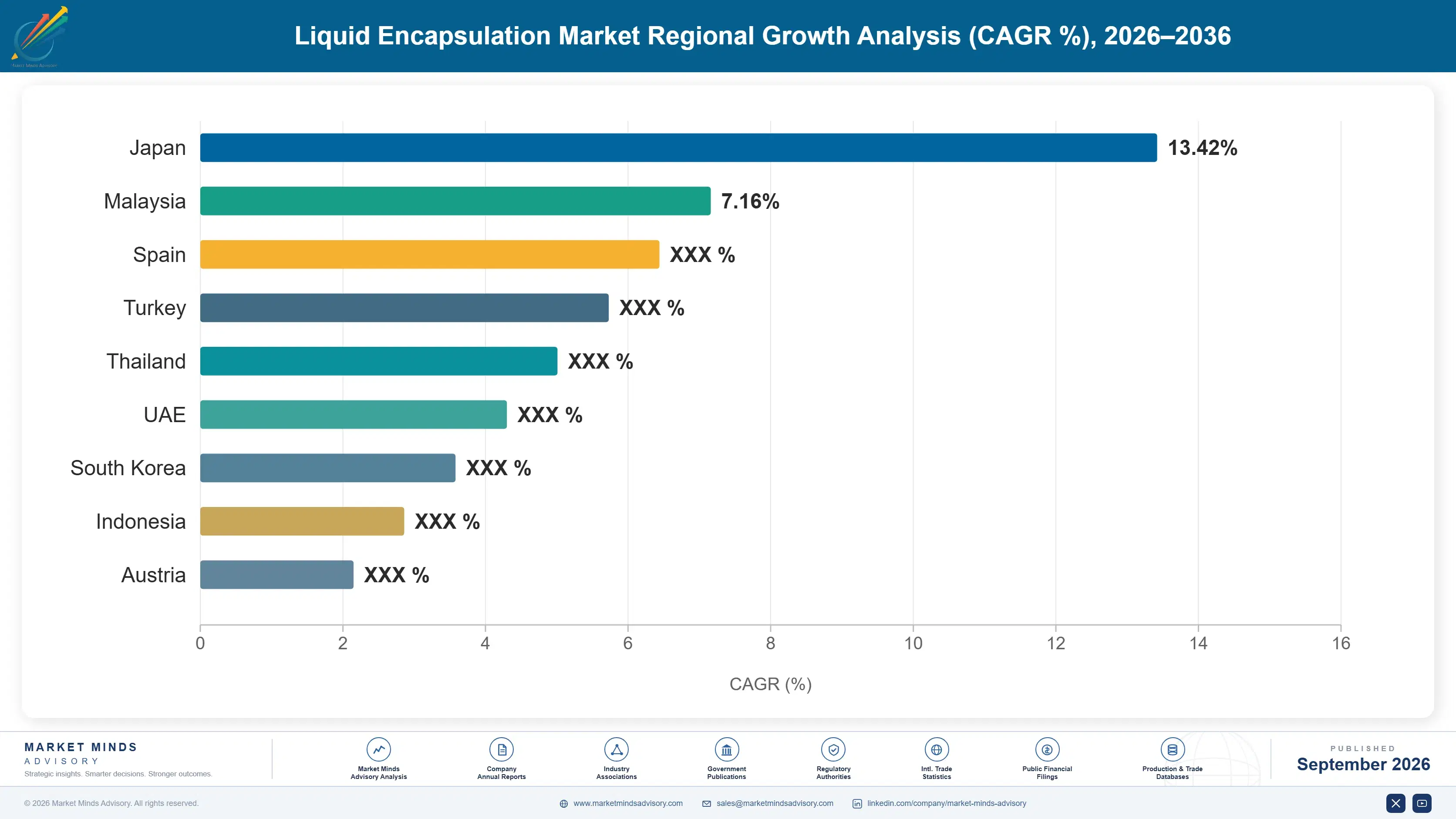
Vietnam: 12.0% CAGR
Fastest Growth Region
South Asia and Pacific: 11.2% CAGR
Largest Region
East Asia: 30% of 2025 global value
Market Leaders
Henkel, Sumitomo Bakelite, Showa Denko, Nagase, Namics
Primary Survey
n=3,800 procurement and R&D decision-makers, Q4 2025, six countries
Methodology
Demand-side build-up, cross-validated against public data, 47 expert interviews

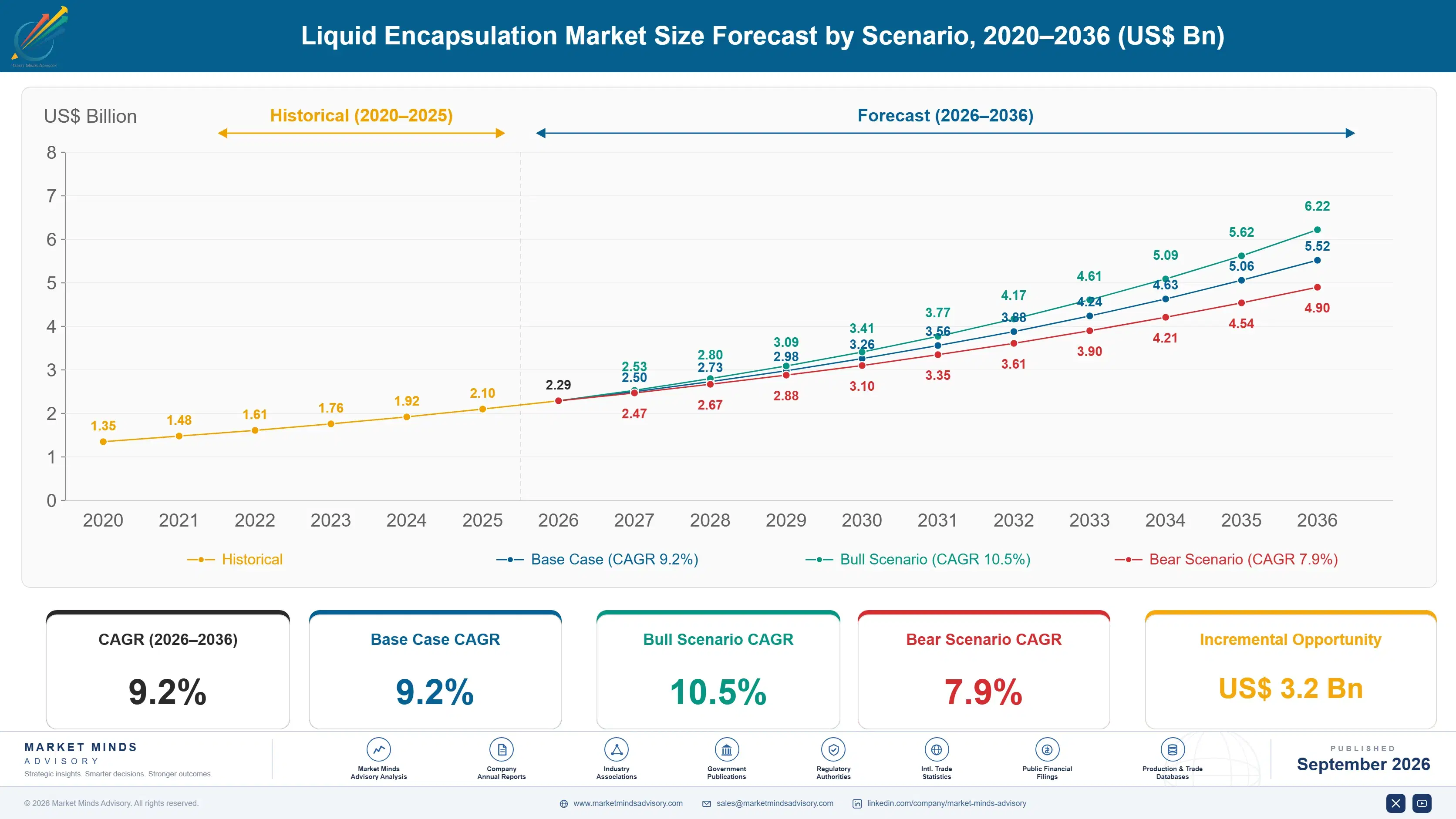
Liquid Encapsulation Market Forecast Scenarios

liquid-encapsulation-market-size-forecast-scenario-1788413656696
Between 2020 and 2025, liquid encapsulation demand grew steadily as advanced packaging adoption expanded across memory, logic, and increasingly power semiconductor applications, though granular molding compounds retained majority share in conventional consumer electronics packaging formats. Established suppliers used this period to expand liquid formulation capacity and qualification credentials ahead of the broader shift now underway.
The base case rests on three mechanisms holding through the forecast window: continued advanced packaging adoption favoring liquid chemistries over granular alternatives, expanding power semiconductor production requiring specialized high-reliability encapsulant formulations, and growing sensor and MEMS device production across automotive and industrial applications requiring precise liquid encapsulation. These mechanisms reinforce each other, since suppliers serving power semiconductor customers increasingly apply that formulation expertise to win business in adjacent sensor and MEMS applications requiring comparable reliability standards and testing rigor.
A bull scenario emerges if power semiconductor and electric vehicle production accelerates faster than currently projected, pulling forward specialized encapsulant demand, while a bear risk centers on semiconductor industry capital expenditure slowdowns delaying new packaging capacity investment that liquid encapsulation demand ultimately depends upon. Manufacturer diversification across multiple end markets increasingly cushions against single-category volatility.

Advanced Packaging Formats Favor Liquid Chemistries

Package geometry and thermal reliability requirements, not raw material cost, increasingly drive encapsulant selection decisions, since a failed encapsulation in an advanced packaging or power semiconductor application can compromise an entire multi-chip assembly worth far more than any material cost saved. Manufacturers routinely model the cost of field failure and warranty exposure when justifying premium formulation investment to procurement teams focused primarily on unit material cost comparisons.
TOP REGION SHARE30%East Asia's share of global liquid encapsulant volume today
ADVANCED PACKAGING ATTACH RATE42%Share of new packages using liquid rather than granular compounds
AVERAGE CURE TIME90 minTypical processing time required for standard encapsulant formulations
MARKET CONCENTRATION48%Combined volume share held by the top five manufacturers
POWER SEMICONDUCTOR SHARE22%Portion of total demand from power semiconductor applications
AVERAGE QUALIFICATION TIME12 monthsTypical time required for new formulation qualification approval
Manufacturers increasingly differentiate through flow characteristics and low-stress formulation chemistry rather than pursuing fundamentally new base chemistries, since epoxy-based systems have remained the dominant platform for decades while surrounding filler and additive technology continues advancing steadily. Filler particle size distribution and thermal expansion coefficient matching represent the primary areas of ongoing engineering investment across most established manufacturer product roadmaps and development pipelines.
Crossover demand from power semiconductor and sensor applications is pulling established consumer electronics encapsulant suppliers into new qualification programs, applying comparable formulation expertise to markets that historically required different reliability and thermal cycling performance characteristics entirely. This crossover trend is reshaping which manufacturers win business in emerging application categories that previously favored suppliers with narrower, more specialized formulation portfolios entirely.
"The chemistry hasn't changed dramatically. What's changed is how unforgiving the packages asking for it have become."
Practice Lead, Semiconductor Packaging Materials · MMA Semiconductor Packaging Materials and Specialty Chemicals Practice · September 2026

Market Trends

Advanced Packaging Adoption Accelerates Liquid Chemistry Share

Advanced packaging formats including fan-out wafer-level packaging and 2.5D and 3D chip stacking increasingly require liquid encapsulation chemistries capable of filling narrower gaps and lower-stress cure profiles than traditional granular molding compounds can reliably achieve. Liquid encapsulants now capture roughly 42 percent of new advanced package designs, up from under 25 percent five years earlier, as chip manufacturers increasingly specify liquid chemistries in their reference packaging designs from the outset. This shift is reshaping capital investment priorities among major encapsulant suppliers who previously focused primarily on granular compound manufacturing capacity expansion.
Market Impact: Advanced packaging capex grows 15%+ yearly
Power Semiconductor Growth Drives Specialized Formulation Demand

Electric vehicle and renewable energy power electronics adoption is driving demand for specialized liquid encapsulants capable of withstanding higher operating temperatures and thermal cycling stress than conventional consumer electronics encapsulation requires. Power semiconductor applications now represent roughly 22 percent of total liquid encapsulant demand, up meaningfully from a smaller share five years earlier, as silicon carbide and gallium nitride power device adoption accelerates across automotive and grid infrastructure applications. Suppliers with specialized high-temperature formulation expertise increasingly capture disproportionate share of this fast-growing demand category. Continued electrification investment should sustain this trajectory over the coming decade.
Market Impact: Requires 40% higher thermal tolerance

Market Opportunities and Growth Drivers

Semiconductor Advanced Packaging Investment Expands Rapidly

Major semiconductor manufacturers and foundries are investing heavily in advanced packaging capacity, including chiplet-based architectures and heterogeneous integration approaches that require liquid encapsulation chemistries throughout the assembly process to manage narrow gap filling and thermal stress requirements. Industry capital expenditure on advanced packaging capacity has grown considerably faster than traditional wafer fabrication investment over the past several years, directly expanding the addressable market for specialized liquid encapsulant formulations across every major semiconductor manufacturing region currently investing in this capability. This investment trajectory shows no sign of slowing given continued strong demand for high-performance computing and AI accelerator packaging capacity.
Market Impact: Costs run 10 to 20% less

Electric Vehicle Power Electronics Adoption Sustains Demand

Growing electric vehicle production and the corresponding expansion of power semiconductor manufacturing capacity is sustaining strong demand for specialized high-temperature liquid encapsulants capable of protecting silicon carbide and gallium nitride power devices operating under considerably more demanding thermal conditions than traditional silicon-based components. Automotive power electronics manufacturers report encapsulant specification requirements considerably more stringent than consumer electronics applications ever historically demanded, sustaining premium pricing for suppliers with proven automotive-grade qualification credentials and testing infrastructure already established. Manufacturers investing early in this specialization increasingly capture disproportionate share of new automotive design wins across major vehicle platforms.
Market Impact: Qualification requires 12 months minimum

Market Restraints and Challenges

Granular Compounds Remain Cost-Competitive for Standard Packages

Traditional granular molding compounds remain 10 to 20 percent cheaper than liquid alternatives for standard, low-complexity packages where the marginal reliability advantage of liquid encapsulation matters less than raw material cost efficiency at high production volumes. The root cause is that liquid formulations require more expensive base resins and dispensing equipment than granular alternatives that established, fully depreciated molding equipment can process cost-effectively. Manufacturers are responding by developing cost-optimized liquid formulations targeting price-sensitive standard package applications without fully abandoning granular compound production capacity. This price gap persists most stubbornly in commodity consumer electronics applications.
Market Impact: Used in 42% of packages

Formulation Qualification Cycles Slow New Product Introduction

New encapsulant formulation qualification at major semiconductor assemblers typically requires 12 months of reliability testing and process validation before a new chemistry can be specified in production, creating a substantial barrier that limits how quickly suppliers can respond to emerging application requirements. The root cause is genuinely rigorous reliability testing that semiconductor manufacturers are unwilling to compress given the catastrophic cost of field failures in qualified production applications. Suppliers are responding by maintaining pre-qualified formulation platforms that can be rapidly customized without triggering full requalification for minor variations. Established platforms increasingly capture business slower competitors cannot address quickly.
Market Impact: Reaches 22% of total encapsulant demand
4 additional market trends, 3 additional growth drivers, and 3 additional restraints and challenges are covered in the full report. Contact sales@marketmindsadvisory.com to access the complete intelligence.

Segment CAGR and Growth Architecture

The liquid encapsulation market splits into six product-type segments defined by application and formulation chemistry, from mature liquid epoxy molding compounds through fast-growing power semiconductor and sensor variants. Growth diverges sharply as electrification and advanced packaging reshape which formulation categories capture the most investment. These segment dynamics reflect genuine end-use thermal and mechanical requirements rather than arbitrary categorization choices.
liquid-encapsulation-market-market-share-analysis-1788413657226

Power Semiconductor Encapsulants

Power semiconductor encapsulants represent the fastest-growing segment, engineered specifically to withstand the higher operating temperatures and thermal cycling stress that silicon carbide and gallium nitride power devices experience in automotive and grid infrastructure applications. Adoption tracks closely with electric vehicle and renewable energy power electronics production growth, which continues expanding faster than traditional consumer electronics semiconductor demand across most major manufacturing regions. Manufacturers including Henkel and Sumitomo Bakelite have launched dedicated power semiconductor product lines, betting that this application category will sustain durable premium pricing given its demanding technical requirements and qualification barriers. Continued electrification investment seems highly likely to sustain this trajectory well into the coming decade. Growth remains strong.
CAGR 13.5%

Sensor and MEMS Encapsulation Materials

Sensor and MEMS encapsulation materials protect increasingly miniaturized mechanical and electrical sensor components used across automotive, industrial, and consumer electronics applications requiring precise environmental protection without compromising sensor functionality or mechanical movement. This segment benefits from growing sensor content per vehicle and expanding industrial IoT deployment requiring reliable, long-lifespan sensor packaging solutions across demanding operating environments. Manufacturers with specialized low-stress formulation expertise increasingly capture design wins ahead of general-purpose encapsulant suppliers lacking comparable precision formulation and dispensing capability for these delicate applications. Growth remains steady as connected industrial and automotive sensor adoption continues expanding across most major manufacturing regions and applications. Interest keeps rising steadily across multiple end-use categories. Momentum remains solid.
CAGR 11.0%
Full segment breakdown across 7 segments available in the complete report.

Regional Architecture and Country Demand Map

East Asia leads global liquid encapsulant volume, anchored by Taiwan, China, and South Korea's concentrated semiconductor assembly and packaging capacity across the region, while South Asia and Pacific posts the fastest regional growth rate as new packaging investment continues expanding rapidly through the 2036 forecast horizon.

East Asia

Taiwan's concentration of leading-edge semiconductor foundries and outsourced assembly and test providers anchors the region's dominant liquid encapsulant demand, with TSMC's advanced packaging investment driving substantial specialized formulation requirements. China's growing domestic semiconductor packaging capacity, supported by government industrial policy, is expanding rapidly even as the country builds increasingly sophisticated domestic encapsulant supply chains. South Korea's memory and logic semiconductor manufacturers sustain substantial baseline demand tied to Samsung and SK Hynix production volumes. Japan maintains strong formulation chemistry expertise given its historical leadership in specialty electronic materials development. Local certification standards also shape which imported entrants can compete meaningfully in this large and technically demanding category. Momentum remains strong. Interest keeps rising.
Share: 30% | CAGR: 10.2% (2026 to 2036)

North America

The United States hosts substantial power semiconductor and advanced packaging capacity, with domestic chip manufacturers increasingly investing in onshore packaging capability supported by federal semiconductor manufacturing incentive programs. Texas and Arizona host growing advanced packaging investment tied to broader domestic semiconductor manufacturing expansion initiatives currently underway across multiple companies. Canada's smaller market follows similar demand patterns tied to its integration with North American semiconductor supply chains. Domestic formulation chemistry expertise at companies like Henkel supports meaningful onshore encapsulant production capacity serving this expanding regional demand base. Federal incentive structures continue shaping which suppliers win the largest onshore manufacturing contracts. Domestic capacity investment continues rising steadily across most major semiconductor manufacturing regions and companies.
Share: 24% | CAGR: 9.0% (2026 to 2036)
Regional intelligence for 5 additional markets available in the complete report: Western Europe, South Asia and Pacific, Latin America, Middle East and Africa, Eastern Europe. Contact sales@marketmindsadvisory.com.
liquid-encapsulation-market-country-cagr-analysis-1788413657732

Power Semiconductor and Qualification Priorities

Manufacturers generate outsized returns not from commodity encapsulant sales alone but from power semiconductor formulation depth, advanced packaging qualification credentials, and rapid customization capability. Four levers stand out as the clearest paths to margin expansion across the forecast period, each requiring distinct formulation and testing investment. Adoption timing and formulation depth increasingly separate leading manufacturers from smaller regional competitors.

Expand Power Semiconductor Formulation Capability Aggressively

Investing in high-temperature, thermal cycling-resistant encapsulant formulations captures share of the fastest-growing application segment, where power semiconductor demand now represents roughly 22 percent of total encapsulant volume, up meaningfully from a smaller share five years earlier. Manufacturers with existing automotive-grade qualification infrastructure can extend that expertise into this specialized category more efficiently than pure-play consumer electronics suppliers building comparable testing capability from scratch entirely. This crossover expertise increasingly determines which manufacturers win the largest design contracts in this rapidly expanding application category. This durable advantage compounds over successive contract cycles and product generations.
Market Impact: Targets a growing 22% power semiconductor market share

Develop Advanced Packaging Qualification Credentials Broadly

Building dedicated qualification credentials for advanced packaging formats including fan-out wafer-level packaging and chip stacking architectures captures premium pricing from semiconductor manufacturers requiring proven liquid chemistry performance at increasingly narrow gap dimensions. This qualification investment commands a 20 to 30 percent price premium over general-purpose formulations, since chip manufacturers value proven reliability track records considerably more than marginal cost savings from unproven alternative suppliers lacking comparable advanced packaging credentials. Manufacturers with established advanced packaging credentials increasingly capture disproportionate share of new design wins. Contract renewals remain historically high across most established manufacturer relationships.
Market Impact: Commands premium pricing of 20 to 30% overall

Accelerate Pre-Qualified Formulation Platform Strategies Broadly

Maintaining pre-qualified formulation platforms that can be rapidly customized without triggering full requalification testing reduces the 12-month qualification timeline that typically constrains new formulation introduction at major semiconductor assemblers. This approach lets manufacturers respond faster to customer requests than competitors requiring full requalification for every formulation variation, capturing time-sensitive business that would otherwise go to established incumbents with existing qualified formulation families already available for deployment. Customers increasingly value this responsiveness when selecting between otherwise comparable qualified suppliers. Portfolio breadth increasingly matters as much as raw technical capability in customer evaluations.
Market Impact: Cuts qualification time by 40 to 60% overall

Pursue Sensor and MEMS Precision Formulation Development

Developing precision, low-stress formulation capability for increasingly miniaturized sensor and MEMS applications captures design wins in space-constrained assemblies where standard formulations cannot reliably protect delicate mechanical components without compromising functionality. This precision capability has already captured roughly 10 percent of the fast-growing sensor encapsulation segment, and manufacturers with advanced dispensing and formulation capability increasingly capture disproportionate share of new design wins in these demanding applications. Precision equipment investment remains substantial but pays back over successive product generations. Early movers in this segment continue building meaningful competitive advantage over slower-moving rivals.
Market Impact: Captures roughly a 10% share of segment growth

Who Controls the Margin Pool

The market remains moderately concentrated, with the top five manufacturers holding an estimated 48 percent combined shipment volume share. Henkel and Sumitomo Bakelite lead through extensive formulation expertise and established qualification credentials across consumer electronics, automotive, and industrial applications. Smaller regional formulators compete mainly through localized pricing and technical service advantages rather than proprietary chemistry or qualification credentials.
Current competitive activity centers on power semiconductor formulation development, advanced packaging qualification expansion, and precision sensor encapsulation capability rather than pure price competition in commodity formulations. Established suppliers increasingly compete for design wins in these adjacent application categories against both incumbents and newer specialized entrants. Warranty terms and demonstrated reliability at scale increasingly serve as key differentiators across most demanding customer selection processes.

Rankings could shift meaningfully as power semiconductor and advanced packaging applications continue expanding faster than traditional consumer electronics demand. Manufacturers without crossover formulation expertise risk losing ground to diversified competitors capturing disproportionate share of these faster-growing application segments across the broader competitive field. Providers with strong balance sheets increasingly acquire smaller specialized competitors rather than developing comparable formulation credentials organically. This consolidation trend seems likely to continue accelerating over the coming years.
liquid-encapsulation-market-company-positioning-matrix-1788413658252

Competitive Moat and Risk Dimensions

HENKEL

Moat: Diversified Application Portfolio Depth

Henkel's extensive product portfolio spanning consumer electronics, automotive, and industrial applications gives it cross-selling advantages and shared research infrastructure that narrower competitors lack, supporting resilient margins across varying end-market demand cycles. This diversification also provides valuable cross-application engineering insight that narrower single-market competitors cannot easily replicate given their more limited customer exposure.
HENKEL

Risk: Broad Portfolio Focus Dilution Risk

Henkel's diversified approach risks diluting research focus across too many application categories simultaneously, potentially disadvantaging it against specialized competitors concentrating resources on the fastest-growing individual segments specifically. Rivals with sharper application focus can sometimes out-innovate Henkel within any single fast-moving category. This risk grows more pronounced as fast-moving applications like power semiconductors demand highly specialized engineering focus.
SUMITOMO BAKELITE

Moat: Advanced Packaging Qualification Depth

Sumitomo Bakelite's deep existing relationships with major Asian semiconductor foundries and assemblers position it favorably to capture growing advanced packaging demand ahead of competitors lacking comparable regional supply chain integration and customer relationships. This positioning gives Sumitomo Bakelite a meaningful head start capturing the fastest-growing segment of the entire encapsulant market.
SUMITOMO BAKELITE

Risk: Regional Concentration Exposure Risk

Sumitomo Bakelite's substantial East Asian customer concentration leaves it more exposed to regional semiconductor industry cyclicality than competitors with more geographically diversified end-market exposure across multiple continents. A sudden Asian semiconductor industry downturn could disproportionately affect Sumitomo Bakelite relative to more diversified competitors. Investors monitor this exposure closely given its potential earnings volatility implications.

Players Tracked

Prominent Players

Henkel
Sumitomo Bakelite
Showa Denko
Nagase
Namics

Other Key Players

Panasonic
KYOCERA
Nitto Denko
Shin-Etsu Chemical
Hitachi Chemical
Toray Industries
Dow
Lord Corporation
Master Bond
Dymax
Sika AG
3M
Resonac
Mitsui Chemicals
Elantas

Recent Developments

FEBRUARY 2026

Henkel launched a new high-temperature liquid encapsulant product line specifically engineered for silicon carbide power semiconductor applications, targeting the rapidly expanding automotive electrification segment across multiple vehicle platforms and manufacturers. Financial terms of the product launch investment were not disclosed publicly by the company. Analysts view it favorably.
Signal: Signals established manufacturers are prioritizing power semiconductor product development amid accelerating demand today nationwide and abroad
OCTOBER 2025

Sumitomo Bakelite expanded its advanced packaging qualification program with a major Taiwanese semiconductor foundry, securing multi-year supply visibility tied to the foundry's planned chip stacking capacity expansion project. Financial terms of the qualification partnership were not disclosed publicly by either party. Analysts view it positively.
Signal: Signals long-term supply agreements remain the dominant commercial structure for advanced packaging materials today nationwide overall
MAY 2025

Showa Denko acquired a specialized sensor encapsulation materials manufacturer to expand its precision formulation product line, strengthening its position within the fast-growing sensor and MEMS encapsulation segment nationwide. Financial terms of the transaction were not disclosed publicly by either company involved. Analysts view it favorably too.
Signal: Signals established manufacturers are acquiring specialized capability rather than developing it entirely organically today and abroad

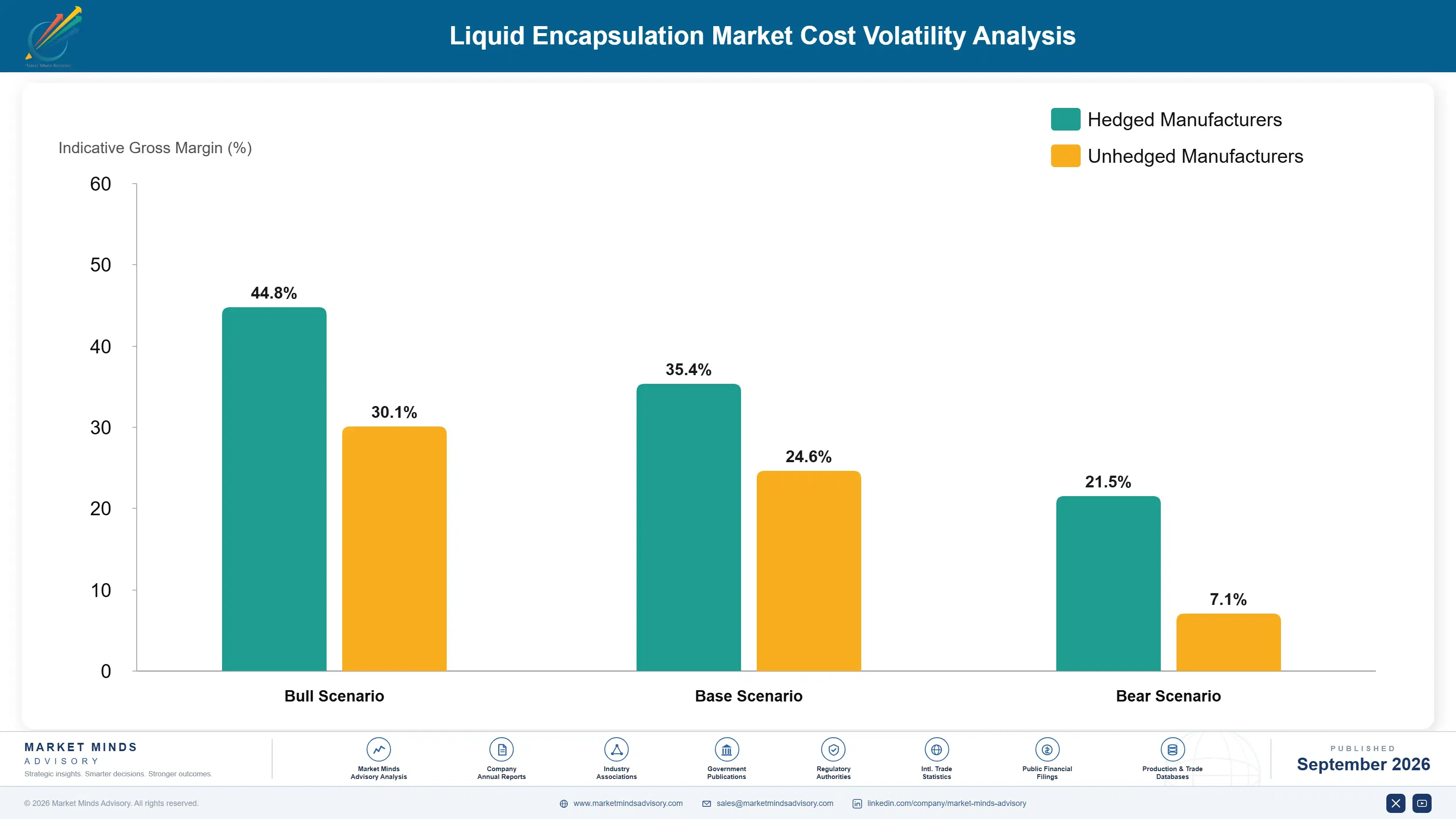
Specialty Resin Costs Dominate Formulation Economics

Epoxy resin, silica filler, and specialty additive materials represent 50 to 60 percent of total production cost, with epoxy resin pricing tracking closely with underlying petrochemical feedstock cost movements across most global supply chains. Manufacturers with globally diversified sourcing footprints increasingly centralize procurement to capture regional pricing arbitrage opportunities and hedge against localized supply disruption.
Epoxy resin prices rose more than 20 percent during 2024 amid petrochemical feedstock cost increases and supply constraints, according to industry pricing data, squeezing manufacturer margins on standard formulations while premium specialty formulations retained somewhat greater pricing power given their differentiated performance characteristics. This episode prompted several manufacturers to reassess their resin procurement strategy and explore alternative supplier relationships for less demanding standard formulations. Prices have since partially retreated but remain elevated relative to historical norms.

Manufacturers without long-term resin supply contracts face considerably higher margin volatility than larger competitors with dedicated procurement teams and forward-purchasing capability. This dynamic increasingly favors scaled manufacturers like Henkel and Sumitomo Bakelite over smaller specialists dependent on spot-market resin purchasing at unpredictable prices. Independent specialists increasingly pursue joint purchasing arrangements with industry partners to capture comparable volume discount pricing on resin inputs.
liquid-encapsulation-market-cost-volatility-analysis-1788413658446

Secure Long-Term Resin Supply Contracts

Forward-purchasing agreements with epoxy resin suppliers smooth input cost volatility, trading some upside during favorable price periods for protection against the sharp spikes that have repeatedly compressed manufacturer margins during recent volatile years. Manufacturers with established multi-source qualification programs weathered the last price spike cycle considerably better than single-source-dependent competitors. Contract terms vary. Adoption grows.

Diversify Filler and Additive Sourcing

Establishing qualified relationships with multiple filler and additive suppliers reduces exposure to single-source supply disruption, protecting production continuity during component shortage events affecting any single specialized chemical supplier. This flexibility becomes particularly valuable during periods of concentrated chemical manufacturer capacity constraints affecting the broader industry. Adoption grows steadily across most manufacturer procurement strategies. Costs decline.

Optimize Formulation Composition for Efficiency

Redesigning formulation composition to reduce resin volume per unit while maintaining performance specifications lowers material cost meaningfully without requiring customers to accept reduced reliability standards or specifications. This design optimization approach requires more upfront engineering investment but pays back considerably during high-volume production runs. Adoption grows steadily across most product lines and manufacturer segments.

Portfolio Architecture for Margin Defence

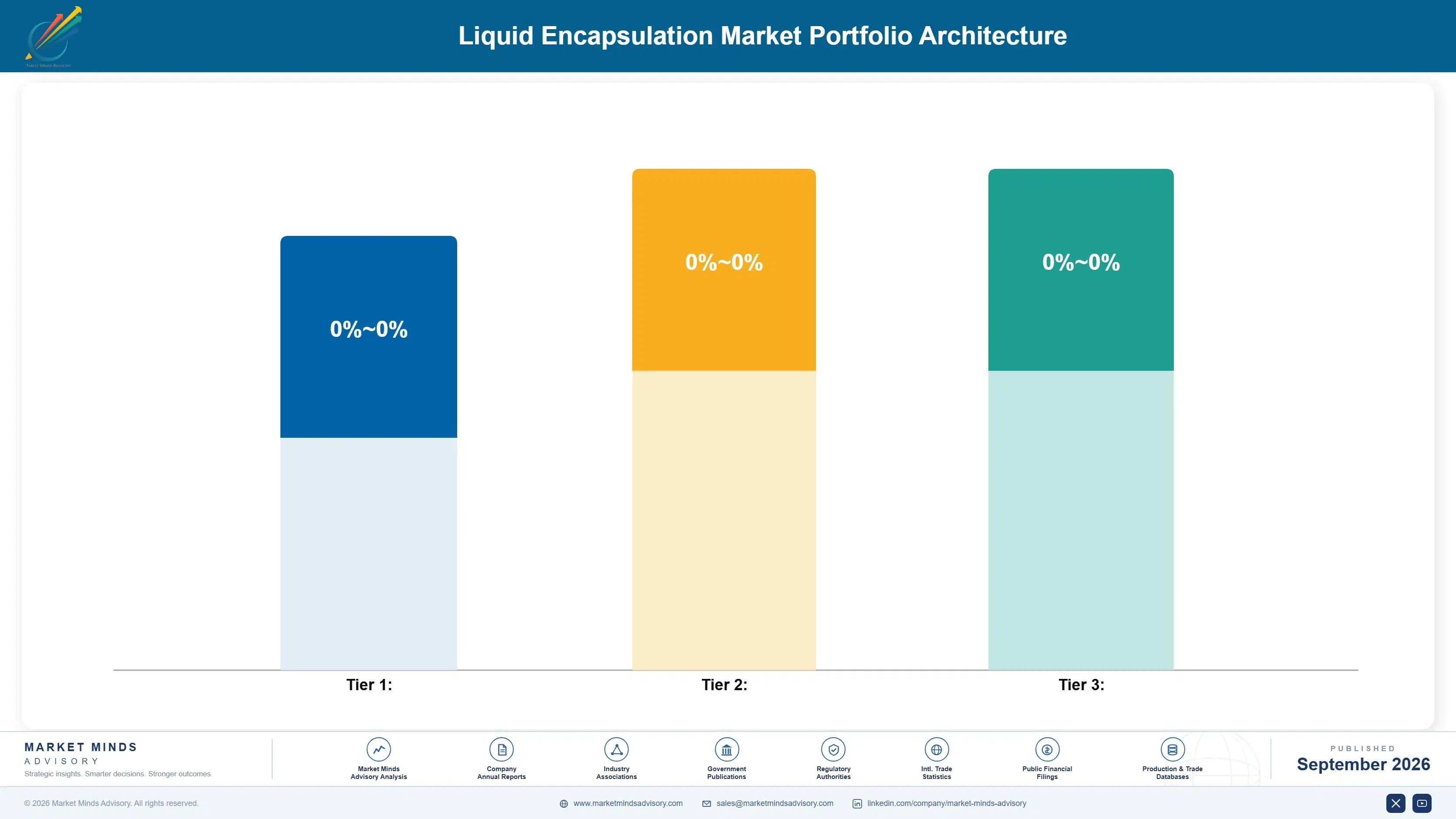
Manufacturer portfolios split across three tiers: commodity consumer electronics encapsulants competing on price, certified automotive and industrial formulations commanding qualification-driven premiums, and next-generation power semiconductor and precision sensor variants still gaining commercial scale. Margin economics diverge considerably between tiers. Investment increasingly follows this margin logic across most manufacturer product development roadmaps. This bifurcation increasingly shapes manufacturer capital investment and hiring decisions.
Commodity formulations compete almost entirely on manufacturing cost and delivery reliability, with thin margins that leave little room for differentiation beyond price and basic quality consistency. Certified automotive and power semiconductor formulations capture meaningfully wider margins through qualification credential depth, insulating manufacturers from pure commodity price competition that defines the volume tier. Manufacturers without a credible qualification narrative increasingly struggle to defend premium pricing against well-positioned competitors.

High-value pools concentrate in power semiconductor and precision sensor formulations, where qualification expertise and crossover application knowledge reward manufacturers willing to invest in specialized certification capability. Commodity consumer electronics encapsulants remain the volume anchor but offer limited margin upside absent meaningful application-specific differentiation. Investment allocation increasingly follows this margin logic across most manufacturer strategic planning decisions. Manufacturers that recognized this shift early now hold a meaningful competitive advantage over slower-moving rivals.

Commodity consumer electronics encapsulants competing primarily on manufacturing cost and delivery reliability for standard applications. Price competition among established manufacturers keeps margins thin across most standard deployment scenarios. Margins remain thin.
Gross Margin

Automotive and power semiconductor formulations with qualification credentials commanding premium pricing from reliability-focused buyers. Demand grows steadily as reliability-focused buyers value proven qualification track records highly. Demand grows steadily too.
Gross Margin

Power semiconductor and precision sensor variants still gaining commercial scale among fast-growing application categories. Early adoption remains concentrated among the largest, most technically sophisticated original equipment manufacturers. Adoption grows steadily too.
Gross Margin
liquid-encapsulation-market-portfolio-architecture-1788413658946

High-value Sub-segments and Strategic Watch-out

Power Semiconductor Encapsulants

The clearest high-value, high-growth pool, combining strong crossover margins with a 13.5 percent CAGR as electrification accelerates. Engineering firms report a growing design pipeline across most major electric vehicle platform launches globally today. Momentum remains strong. Adoption continues expanding steadily. Momentum holds firm. Progress continues.

Sensor and MEMS Encapsulation Materials

Strong margins and steady growth from expanding automotive and industrial IoT sensor adoption requiring precise environmental protection solutions. Certification investment increasingly pays back as connected sensor adoption continues expanding across most industrial settings. Interest keeps rising. Adoption continues expanding steadily. Growth continues steadily. Progress continues.

Liquid Epoxy Molding Compounds

The volume core, generating most industry revenue despite thinner margins, anchored by decades of established consumer electronics adoption. Price competition remains intense here as differentiation opportunities narrow considerably relative to premium application alternatives. Volume stays high. Demand remains resilient overall. Volume grows slowly. Progress continues.

Glob Top Encapsulants

A strategic watch-out given commoditization pressure despite steady demand, since differentiation from basic formulations remains genuinely difficult. Manufacturers still serving this niche increasingly focus on legacy customer retention rather than new product development. Decline continues steadily. Interest keeps fading steadily. Focus narrows further. Progress persists.

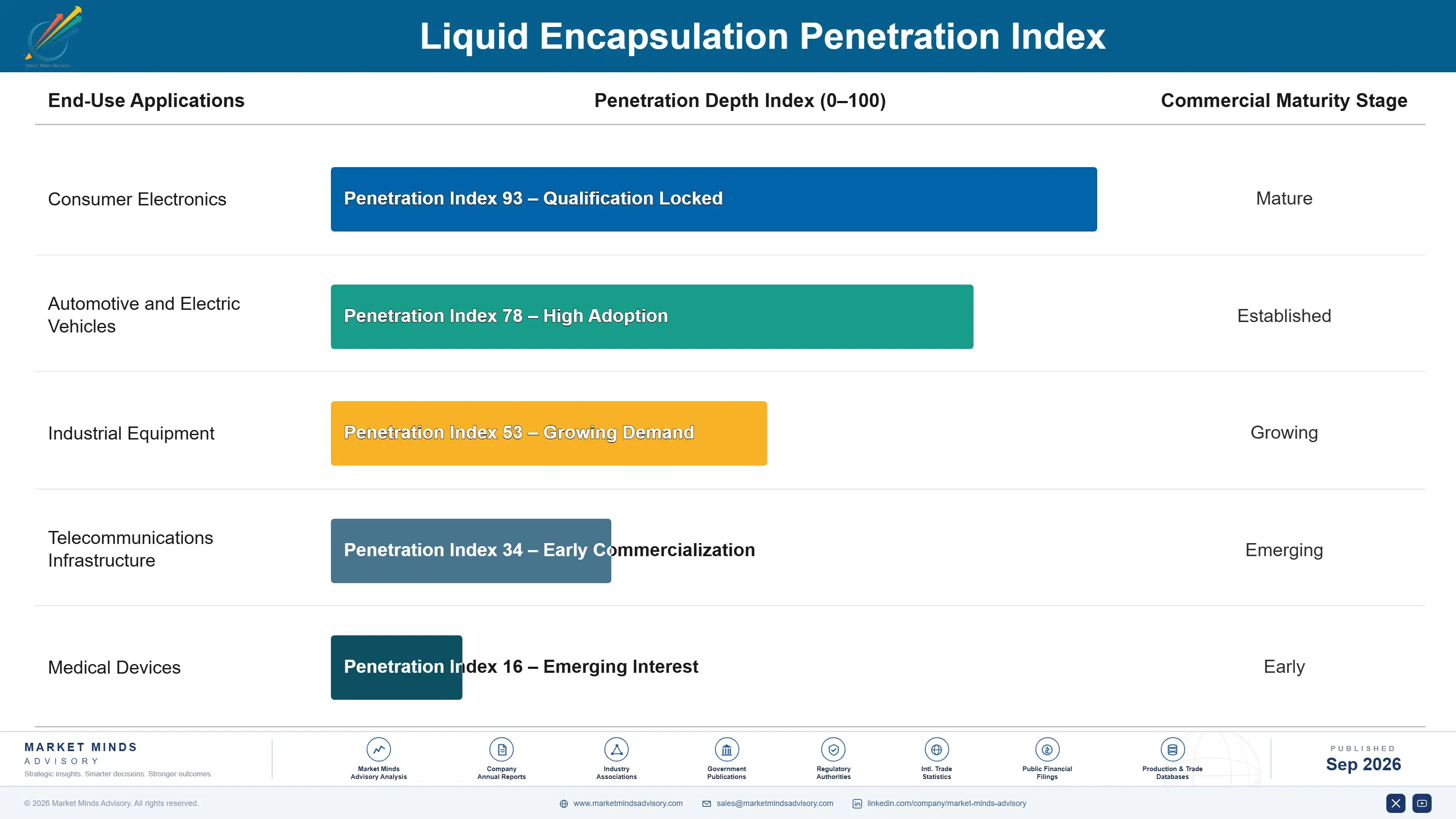
Qualification Credentials Anchor Recurring Business

Demand for qualified liquid encapsulants behaves as a specification-locked annuity rather than a competitively re-bid commodity purchase, since major semiconductor assemblers typically specify a qualified formulation for the entire production lifecycle of a package design rather than re-competing suppliers periodically. This specification lock-in insulates incumbent suppliers from the price competition that periodically affects commodity material categories lacking comparable qualification requirements and long product lifecycles.
Adoption depth varies considerably by end-use vertical: automotive and power semiconductor programs show near-total lock-in to originally qualified suppliers, while commercial consumer electronics applications retain considerably more price-driven supplier flexibility and periodic re-competition among multiple qualified alternatives. Manufacturers serving both ends of this spectrum increasingly maintain distinct sales and technical support teams tailored to each customer segment's fundamentally different purchasing behavior and decision timelines.

Buyer profiles are shifting as automotive and power semiconductor engineering teams, historically less familiar with specialty formulation qualification processes, increasingly adopt similar rigorous testing and documentation requirements as their own products face growing reliability scrutiny from regulators and end customers. This convergence creates meaningful opportunity for manufacturers with established qualification expertise to extend their competitive advantage into these newly rigorous adjacent application categories.
liquid-encapsulation-market-end-use-penetration-index-1788413659425

Power Semiconductor and Qualification Priorities

These are among the four positions where our research anticipates prominent divergence between winners and laggards over the coming forecast period. Each is grounded in the demand model, the regulatory perimeter, and the announced capacity pipeline.
01 / POWER SEMICONDUCTOR FORMULATION STRATEGY

Build high-temperature formulation capability before demand peaks

Manufacturers without high-temperature, thermal cycling-resistant formulation capability face a widening gap against competitors already capturing the fastest-growing segment of the entire market, where power semiconductor demand continues climbing considerably faster than traditional consumer electronics applications. Building comparable formulation expertise from scratch takes years that pure-play consumer electronics suppliers lacking this heritage cannot easily compress. Manufacturers that delay this investment risk losing the highest-growth segment of the market to faster-moving, better-prepared competitors already investing heavily in this rapidly expanding application category.
02 / ADVANCED PACKAGING QUALIFICATION

Extend qualification credentials into advanced packaging formats

Advanced packaging formats increasingly require liquid encapsulation chemistries capable of finer gap filling and lower-stress cure profiles than traditional granular molding compounds can reliably achieve at comparable production volumes. This qualification gap favors manufacturers already serving advanced packaging customers over new entrants attempting to compete purely on price in this specialized category. Manufacturers investing now position themselves ahead of competitors still lacking comparable advanced packaging validation credentials in this growing and increasingly competitive advanced packaging category across most major semiconductor manufacturing regions.
03 / PRE-QUALIFIED PLATFORM STRATEGY

Maintain pre-qualified formulations to speed customization

Semiconductor assembler qualification processes typically require 12 months of testing, creating a substantial barrier that favors manufacturers maintaining pre-qualified formulation families over those requiring full requalification for every design variation customers request. This approach lets manufacturers respond faster to time-sensitive customer requests than competitors starting from scratch on each new qualification cycle. Building this capability now captures business that would otherwise default to slower-moving established incumbents lacking comparable platform flexibility, rapid customization capability, and an established, well-documented qualification track record.
04 / SENSOR FORMULATION INVESTMENT

Invest in precision formulation for sensor applications

Increasingly miniaturized sensor and MEMS components across automotive and industrial applications favor manufacturers capable of precise, low-stress formulation dispensing without compromising delicate mechanical component functionality or reliability. This precision capability has already captured meaningful share of the fast-growing sensor encapsulation segment, and manufacturers lagging on this dimension risk losing design wins to more capable competitors already investing heavily. Precision equipment investment now positions manufacturers favorably for the coming decade of increasingly demanding sensor applications across the broader industry and its expanding customer base.

Engagement Snapshot From the Field

A live engagement with an industry participant carrying material or product regulatory and market exposure ahead of a defining policy shift, showing how our research translates into a defensible multi-year portfolio strategy.
MARKET MINDS ADVISORY · CLIENT ENGAGEMENT SUMMARY
Liquid Encapsulation Producer Strategic Portfolio Review and Transition Roadmap 2026·Investment Scenario on Liquid Encapsulation Exposure Evaluation 2025-26
CLIENT PROFILE
A mid-sized encapsulant manufacturer with an established consumer electronics product line and meaningful market presence across East Asia sought to evaluate whether developing power semiconductor formulation capability made commercial sense given accelerating electric vehicle production and growing competition from automotive-focused encapsulant suppliers entering its core addressable market. The client's board needed a data-driven recommendation before committing significant engineering resources to a new formulation category.
STRATEGIC CHALLENGE
The client's engineering resources were focused on maintaining its existing consumer electronics formulation line, leaving limited capacity for new high-temperature development work, while competing manufacturers were already shipping dedicated power semiconductor formulations and capturing early share in the fastest-growing segment of the broader encapsulant market. Leadership needed clarity on the fastest viable path forward before competitors captured the emerging opportunity entirely.
MMA APPROACH
MMA benchmarked power semiconductor formulation launches from three category leaders, modeled the revenue opportunity from the client's existing automotive-adjacent customer base, and evaluated build-versus-partner options for acquiring high-temperature formulation expertise within a realistic eighteen-month development timeline given the client's current resource constraints. Interviews with prospective chemistry partners informed the final strategic recommendation and timeline.
KEY FINDINGS
  1. A dedicated formulation team could develop a competitive high-temperature product within roughly fourteen months of sustained development effort (client-reported, unverified by MMA).
  2. Existing customers showed strong interest in a power semiconductor formulation, with 55 percent indicating likely early adoption interest (client-reported, unverified by MMA).
  3. Partnering with a specialized chemistry developer could reduce development time by approximately four months compared to solo development (client-reported, unverified by MMA).
  4. Competitors without power semiconductor formulations saw meaningful share loss within their core automotive-adjacent customer segments over the past year (client-reported, unverified by MMA).
CLIENT PROFILE
A mid-sized encapsulant manufacturer with an established consumer electronics product line and meaningful market presence across East Asia sought to evaluate whether developing power semiconductor formulation capability made commercial sense given accelerating electric vehicle production and growing competition from automotive-focused encapsulant suppliers entering its core addressable market. The client's board needed a data-driven recommendation before committing significant engineering resources to a new formulation category.
STRATEGIC CHALLENGE
The client's engineering resources were focused on maintaining its existing consumer electronics formulation line, leaving limited capacity for new high-temperature development work, while competing manufacturers were already shipping dedicated power semiconductor formulations and capturing early share in the fastest-growing segment of the broader encapsulant market. Leadership needed clarity on the fastest viable path forward before competitors captured the emerging opportunity entirely.
MMA APPROACH
MMA benchmarked power semiconductor formulation launches from three category leaders, modeled the revenue opportunity from the client's existing automotive-adjacent customer base, and evaluated build-versus-partner options for acquiring high-temperature formulation expertise within a realistic eighteen-month development timeline given the client's current resource constraints. Interviews with prospective chemistry partners informed the final strategic recommendation and timeline.
KEY FINDINGS
  1. A dedicated formulation team could develop a competitive high-temperature product within roughly fourteen months of sustained development effort (client-reported, unverified by MMA).
  2. Existing customers showed strong interest in a power semiconductor formulation, with 55 percent indicating likely early adoption interest (client-reported, unverified by MMA).
  3. Partnering with a specialized chemistry developer could reduce development time by approximately four months compared to solo development (client-reported, unverified by MMA).
  4. Competitors without power semiconductor formulations saw meaningful share loss within their core automotive-adjacent customer segments over the past year (client-reported, unverified by MMA).
RECOMMENDED STRATEGY
Phase 1: Phase one: partner with a specialized chemistry developer to meaningfully accelerate formulation development timelines and reduce risk. Timeline discipline mattered considerably here. Phase 2: Phase two: launch a pilot power semiconductor formulation with existing customers before beginning full-scale commercial rollout activities. Pilot feedback informed final formulation refinements. Phase 3: Phase three: scale production and marketing efforts once pilot performance data validates the formulation's reliability performance claims. Marketing should emphasize validated performance data.
OUTCOME
The client launched its power semiconductor formulation within thirteen months using the partnership approach, securing early orders from three existing customers who had indicated strong interest during the initial engagement (client-reported, unverified by MMA). Additional customer orders continued arriving steadily after the initial product launch.

Frequently Asked Questions

Foundational context covering the market sizes, CAGR, scope, country, region and competition that inform every finding below. This section is provided to cover basics and most often pre-purchase conversations, answered from the MMA Primary Research Dataset.

What is the current size of the Liquid Encapsulation Market?

The global liquid encapsulation market reached an estimated $2.1 billion in 2025, sustained by advanced packaging adoption and growing power semiconductor demand. East Asia hosts the largest manufacturing base.

How large will the Liquid Encapsulation Market be by 2036?

MMA projects the market will reach approximately $5.52 billion by 2036, up from $2.29 billion in 2026. That represents roughly a 2.41x expansion across the ten-year forecast window.

What is the CAGR for the Liquid Encapsulation Market 2026 to 2036?

The base case forecast CAGR is 9.2% across 2026 to 2036, with a bull scenario of 10.5% and a bear scenario of 7.9% depending on power semiconductor and advanced packaging trends.

Which segment is growing fastest?

Power Semiconductor Encapsulants lead at a 13.5% CAGR, roughly 1.47 times the overall market rate, as electric vehicle and renewable energy applications expand rapidly worldwide.

Who are the major companies in the Liquid Encapsulation Market?

Henkel, Sumitomo Bakelite, Showa Denko, Nagase, and Namics lead the market, together holding an estimated combined shipment volume share of 48% measured globally across all applications.

Which country is growing fastest?

Vietnam leads growth at a 12.0% CAGR, emerging as a major new semiconductor packaging hub as global supply chains diversify further away from China nationwide.

Report Segmentation Architecture

The full report scope spans multiple orthogonal segmentation dimensions, with cross-tabulated demand data provided for each dimension pair. Coverage extends further to regional breakdowns, trend trajectories, and the competitive detail needed to support segment-level decision-making.
  • Liquid Epoxy Molding Compounds
  • Liquid Underfill Encapsulants
  • Glob Top Encapsulants
  • LED Encapsulation Materials
  • Power Semiconductor Encapsulants
  • Sensor and MEMS Encapsulation Materials
  • Consumer Electronics
  • Automotive and Electric Vehicles
  • Industrial Equipment
  • Telecommunications Infrastructure
  • Medical Devices
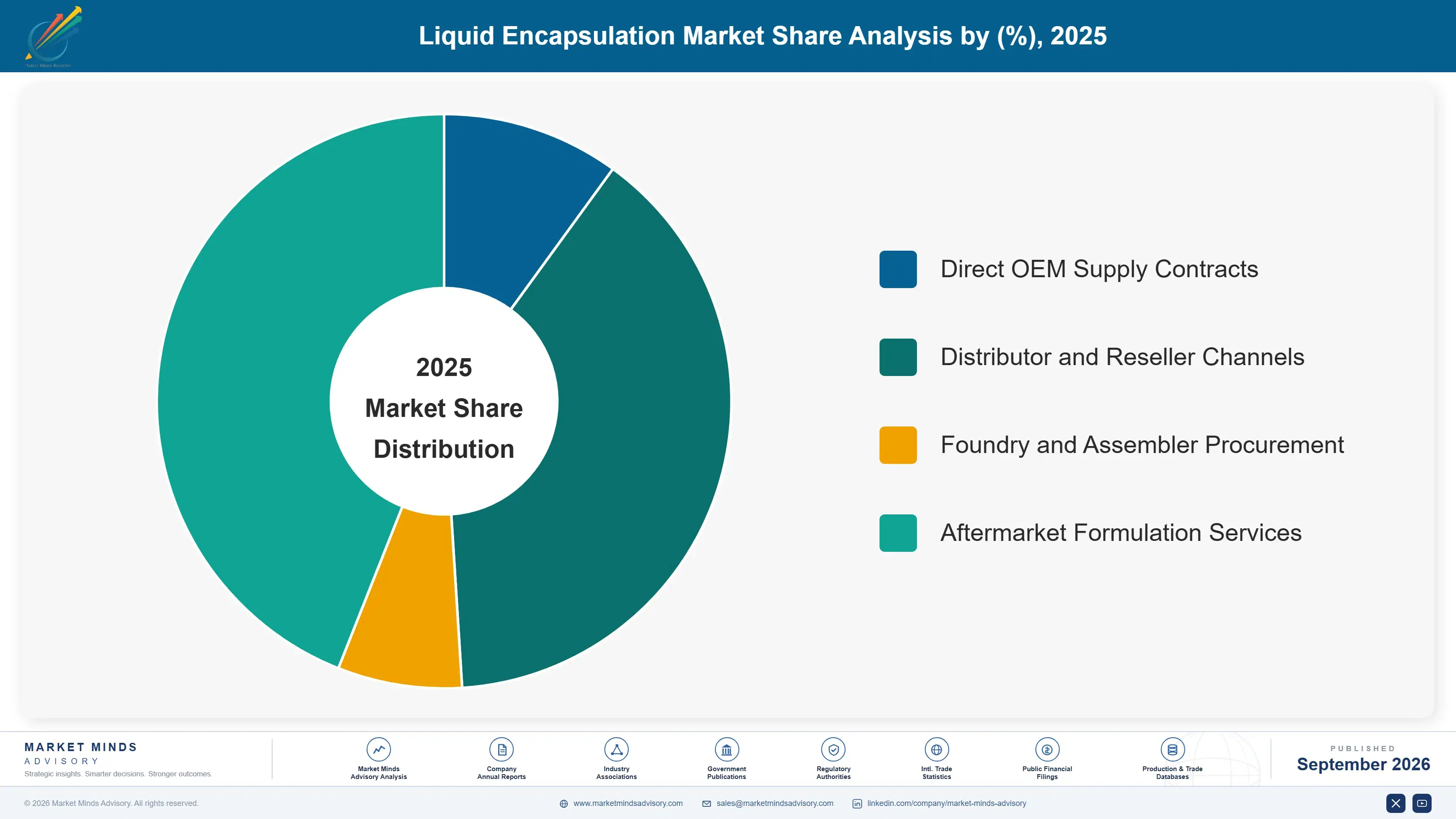
  • Direct OEM Supply Contracts
  • Distributor and Reseller Channels
  • Foundry and Assembler Procurement
  • Aftermarket Formulation Services

By Region

  • North America
  • Western Europe
  • East Asia
  • South Asia and Pacific
  • Latin America
  • Middle East and Africa
  • Eastern Europe

Scope, Methodology, and Coverage

Every figure in this report is reproducible from documented input assumptions. The scope below maps the historical period, the forecast horizon, the segmentation dimensions, and the countries covered, alongside the underlying primary and qualitative methodology.
Historical Period
2020 to 2025
Forecast Period
2026 to 2036
Base Year
2025 (USD billions; MMA Primary Research Dataset, September 2026)
Market Definition
This report covers liquid encapsulation materials used to protect semiconductor die, interconnects, and sensitive electronic components during and after packaging assembly, including liquid epoxy molding compounds, underfills, and glob top formulations, measured on a global volume basis. It excludes granular and solid molding compounds and non-liquid encapsulation formats.
Quantitative Units
USD billions, metric tons shipped, and percentage CAGR
Segmentation Dimensions
Product type (liquid epoxy molding, liquid underfill, glob top, LED encapsulation, power semiconductor, sensor/MEMS), end-use vertical, commercial channel, and geography
Regions Covered
North America, Western Europe, East Asia, South Asia and Pacific, Latin America, Middle East and Africa, Eastern Europe
Countries Covered
Taiwan, China, South Korea, United States, Germany, Vietnam, and 20+ additional countries across seven global regions
Key Companies Profiled
Henkel, Sumitomo Bakelite, Showa Denko, Nagase, Namics, and 15 additional manufacturers across the global competitive set
Quantitative Methodology
Primary survey, n=3,800 respondents, Q4 2025, six countries; demand-side model with trade association cross-validation
Qualitative Methodology
47 expert interviews, Q4 2025; applied to validate demand model assumptions, identify emerging dynamics, and assess competitive positioning
Report Format
PDF and XLSX data workbook (Word format preview document)
Publisher
Market Minds Advisory
Report Code
MMA-2026-CHM-144
Published
September 2026
Contact
sales@marketmindsadvisory.com | www.marketmindsadvisory.com

Purchase the full Liquid Encapsulation Market Report (2026 to 2036).

This report delivers a complete assessment of the global liquid encapsulation market across the full 2026 to 2036 forecast period ahead. It combines primary survey data from 3,800 respondents with 47 expert interviews to quantify segment, regional, and competitive dynamics in careful detail. Coverage spans consumer electronics, automotive, power semiconductor, and sensor encapsulation categories, alongside detailed manufacturer benchmarking across twenty companies. Analysts translate raw data into actionable formulation strategy, qualification investment, and market entry guidance for manufacturers, investors, and buyers evaluating this maturing but diversifying specialty chemical category.
Ten-year global market sizing and forecast model
Seven-region demand, pricing, and share breakdown
Twenty-company competitive benchmarking and positioning analysis
Segment-level growth, margin, and pricing analysis
Specialty resin cost exposure and supply risk assessment
Strategic verdict and prioritized investment guidance

Built For The People Who Decide

From boardroom strategy to bench-side execution, this report is read cover-to-cover by leaders shaping the next decade of their industry, turning demand scenarios, market dynamics and valuation benchmarks into decisions.
CXOs/ Presidents/ VPs/ Managers
M&A and Corporate Development
Strategy Teams and R&D Heads
Procurement and Product Directors
Regulatory and Compliance Leaders
Investor Relations and Equity Analysts