Market Minds Advisory
Lip Plumping and Filler Creams Market

Lip Plumping and Filler Creams Market: Lip Plumping and Filler Creams Market: A Controlled Inflammatory Response Sold As Volume, The Peptides That Work Better And Sell Worse, 2026 to 2036

Most of this category works by mild irritation producing localised swelling that fades in under an hour. The peptide products with measured volume data sell worse, because consumers reward the tingle they can feel.

Lead Analyst

Published

September 2026

Make Smarter Decisions with Customized Research Insights

Request a free sample report and evaluate market opportunities, growth trends, and competitive dynamics relevant to your business needs.

2025 MARKET VALUE$1.1BMarket Size 2025
2036 FORECAST VALUE$3.0BBase Case , 2026 to 2036
CAGR 2026 TO 20369.6 %Bull 10.9% / Bear 8.3%
INCREMENTAL OPPORTUNITY$1.8BNet 10- year value creation
EXPANSION MULTIPLE2.50x2036 value over 2026 base
Strategic Levers
M&A Pipeline
Regional Outlook
Country Rankings
Competitive Intelligence
Segmental Deep-dive
Call-Us : 91 93563 13602

Executive Snapshot and Market Trajectory.

About 58% of category volume works through vasodilation and mild irritation, which produces localised swelling lasting a median of 52 minutes. That is a controlled inflammatory response sold as volume, and no pack in the category describes it that way. The tingle is the irritation, not the evidence.
Peptide volumizing actives grow at 14.4%, half again the market rate of 9.6%, because they produce a measurable and durable change rather than a temporary one. Topical hyaluronic microsphere systems follow at 12.6%. Irritant vasodilator plumpers grow slowest of the mechanisms covered, at 8.2%, despite still holding most of the volume today. Optical volumising systems grow slowest overall at 7.4%, though they still contribute a large part of what consumers perceive.
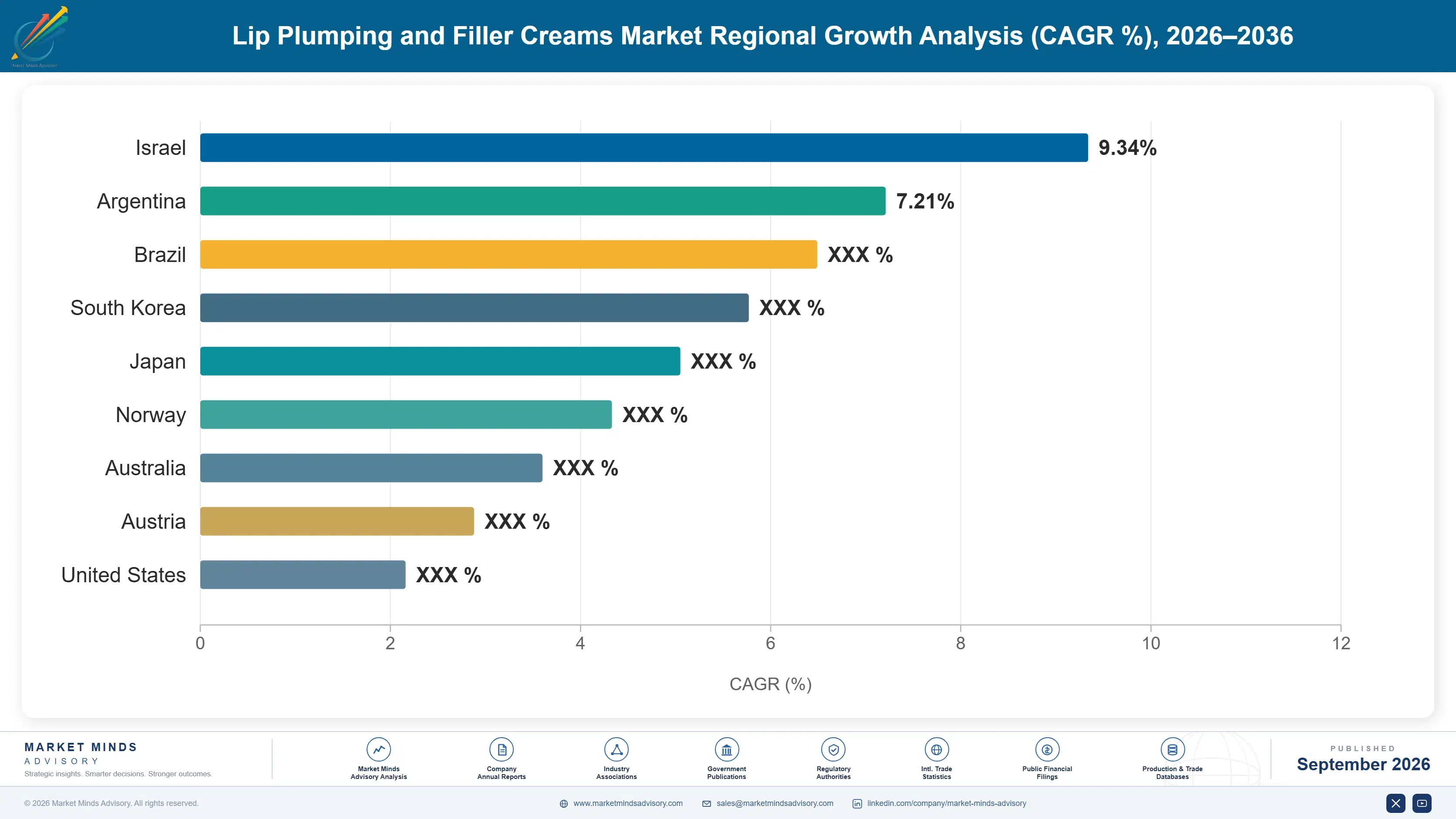
East Asia holds 36% of demand, with South Korean growth at 17.2% leading every market covered. Measured volume gain across the category averages around 7% under standardised imaging, and roughly 41% of the perceived effect comes from gloss and light reflection rather than from any change in tissue at all. Only six published studies examine repeated irritant use longitudinally. Concentration sits at just 29%, unusually low here.
Market Definition
This market covers topical cosmetic lip plumping and filler cream products, including irritant vasodilator plumpers, peptide volumizing actives, topical hyaluronic microsphere systems, collagen stimulating topicals, hydrating barrier plumpers, and optical volumising systems. It excludes injectable dermal fillers and lip augmentation procedures, suction and device based lip plumpers, conventional lipstick and lip colour cosmetics, and medicated or prescription lip treatments.
Base Year Value
$1.1B in 2025 (MMA Primary Research Dataset, September 2026)
Forecast Period
2026 to 2036, eleven discrete annual values
CAGR
9.6% base case. Bull 10.9%. Bear 8.3%.
Fastest Growth Segment
Peptide Volumizing Actives: 14.4% CAGR
Fastest Growth Country
South Korea: 17.2% CAGR
Fastest Growth Region
South Asia and Pacific: 11.6% CAGR
Largest Region
East Asia: 36% of 2025 global value
Market Leaders
L'Oreal Groupe, Estee Lauder Companies, LVMH Beauty, Amorepacific, and e.l.f. Beauty lead the field. Source: MMA Primary Research Dataset, July 2026.
Primary Survey
n=3,800 procurement and R&D decision-makers, Q4 2025, six countries
Methodology
Demand-side build-up, cross-validated against public data, 47 expert interviews

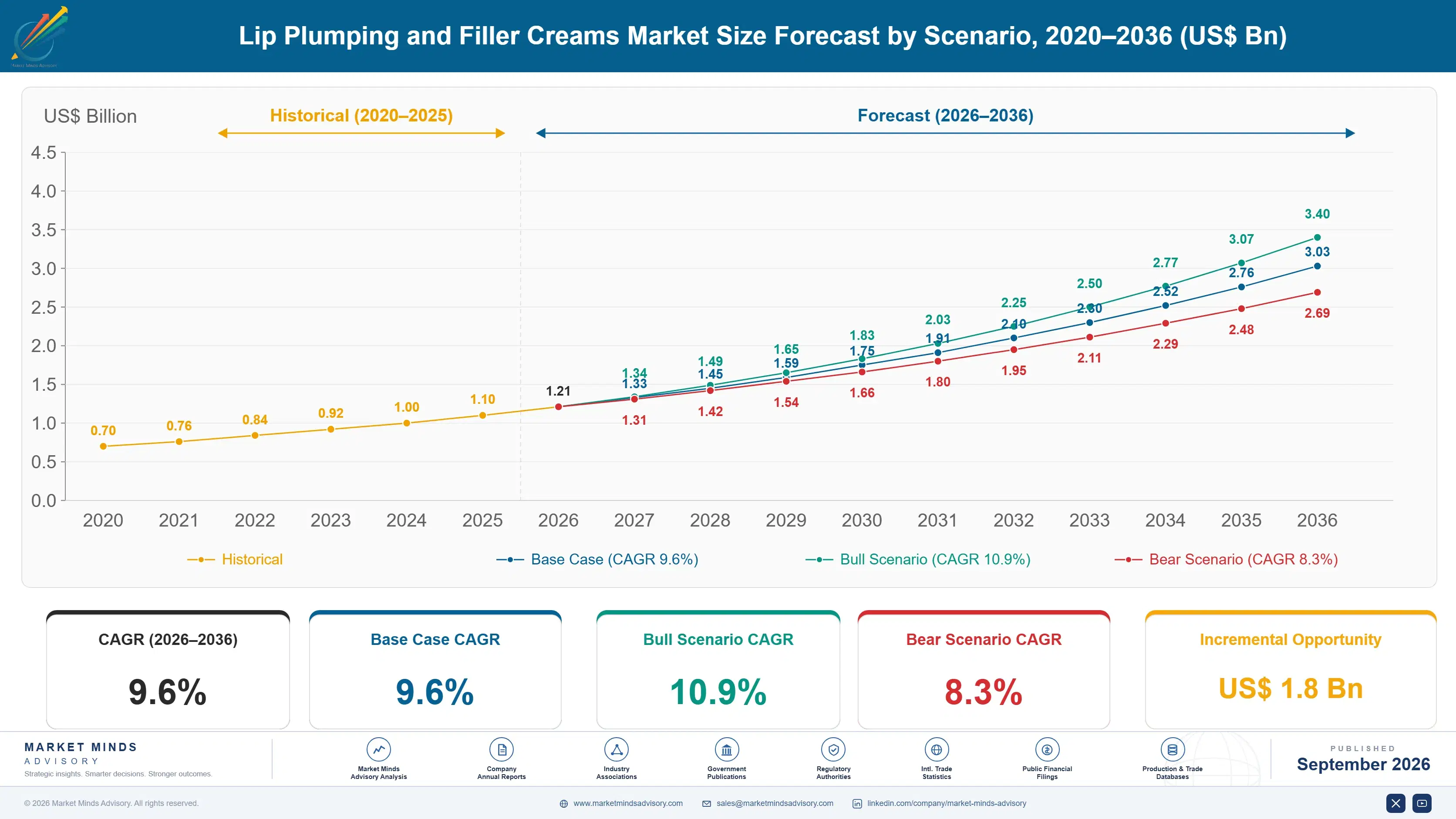
Lip Plumping and Filler Creams Market Forecast Scenarios

lip-plumping-and-filler-creams-market-size-forecast-scenario-1790016843186
Growth from 2020 to 2025 ran at 8.4% and was driven almost entirely by social video rather than by product development. Short-form demonstrations of visible immediate effect suited irritant plumpers perfectly, because the mechanism produces a change a camera can capture within minutes. Korean and Chinese brands scaled fastest on that channel, and Western incumbents followed roughly two years behind them.
The base case at 9.6% rests on three mechanisms. Injectable lip filler pricing keeps falling in most developed markets, which pulls the affordability margin toward topical products rather than away from them. Korean and Chinese formulation continues setting category direction through social channels. And peptide and hyaluronic systems keep taking share from irritants as consumers who have used the category for several years look for something durable. None assumes a new mechanism arrives before 2030.
The bull case at 10.9% depends on peptide systems producing imaging data strong enough to shift purchase away from the sensory cue, which would move the category onto a performance basis. The bear case at 8.3% is safety scrutiny: only six published studies examine repeated irritant use longitudinally, and a finding on barrier thinning would remove around 58% of current volume.

What The Tingle Actually Is

A capsicum or cinnamon based plumper works by irritating the lip enough to trigger vasodilation and mild localised oedema. That is a controlled inflammatory response, it produces a real and visible change, and it fades in a median of 52 minutes. Nothing is hidden exactly, but no pack says it plainly. The tingle consumers call the product working is the product irritating them.
TOP FIVE CONCENTRATION29%Share of category revenue held by the leading brand owners
MEASURED VOLUME GAIN7%Average lip volume increase recorded under standardised imaging
MEDIAN EFFECT DURATION52 minutesMedian time before measured volume returns to baseline
IRRITANT MECHANISM SHARE58%Category volume relying on vasodilation rather than measured actives
OPTICAL EFFECT CONTRIBUTION41%Perceived plumping attributable to gloss and light reflection
LONGITUDINAL SAFETY STUDIES6Published studies examining repeated irritant plumper use longitudinally
The measured effect is smaller than the category's imagery suggests. Standardised imaging puts average volume gain around 7%, and roughly 41% of what people perceive as plumping comes from gloss and light reflection rather than any change in tissue. A high-shine finish on a lip reads as fuller to the eye at almost no biological cost. Several better-selling products do more optical work than pharmacological work.
The commercially awkward part is that the products with better evidence sell worse. Peptide volumizing actives produce a measurable change that builds over weeks and they grow at 14.4%, fastest of the six mechanisms, but they do not tingle. Consumers use the sensory cue as proof, so a quiet product reads as one that does not work. That gap is the central problem in the category.
"The whole category rests on consumers treating a stinging sensation as evidence that something is working, when what it actually evidences is irritation. The peptide products are better and quieter, and quiet is a genuinely difficult thing to sell in a category built entirely on immediate feedback."
Practice Director, Colour Cosmetics and Skin Care · MMA Consumer Cosmetics and Personal Care Practice · September 2026

Market Trends

Evidence And Sales Are Pointing In Opposite Directions

Peptide volumizing actives grow at 14.4%, fastest of the six mechanisms, and produce a measurable change that builds over several weeks of use. They also produce no sensation at all. Irritant plumpers grow slowest at 8.2% while still holding around 58% of volume, because the tingle functions as proof of efficacy for a consumer with no other way to judge. Brands that switched to peptide systems without managing that expectation have generally seen repurchase rates fall rather than rise, which is a difficult lesson to unlearn. Pairing a disclosed sensory marker with the peptide answers it.
Market Impact: Country grows at 17.2%

Falling Injectable Prices Pull The Affordability Margin

Injectable lip filler pricing has fallen materially across most developed markets as practitioner supply expanded and product patents lapsed. That moves rather than removes topical demand, because the consumers leaving topicals for injectables are replaced by a larger group entering topicals from nothing at all. The category sits at the affordability margin of a procedure rather than in competition with it. Where injectable pricing falls fastest, topical volume growth slows without reversing, and the mix shifts toward peptide systems positioned as maintenance. That mix shift is worth more to margin than the volume lost at the top of the range.
Market Impact: Drives 58% of volume

Market Opportunities and Growth Drivers

Korean Formulation Sets Category Direction Through Video

South Korea grows at 17.2%, faster than any country covered, and Korean brands originate most of the formats that Western brands adopt eighteen to twenty-four months later. Short-form video suits this category unusually well, because irritant mechanisms produce a change a camera captures within minutes of application. East Asia holds 36% of world demand on that basis. Development cycles in Seoul run short enough that a format can reach shelves before a Western competitor has finished briefing its agency. Western brands consistently arrive after a format has already peaked on the channel that created it.
Market Impact: Rests on 6 published studies

Immediate Visible Effect Suits The Channel Perfectly

No other cosmetic category produces a filmable result inside the length of a social video, and that has driven the category's growth more than any formulation advance. A foundation or serum requires trust in a claim. A plumper demonstrates itself on camera in ninety seconds. That advantage attaches specifically to the irritant mechanism, which is why 58% of volume still sits there despite peptide systems producing considerably better measured outcomes over a course of use. That advantage is a channel property rather than a product one, and it holds while short-form video remains the discovery route.
Market Impact: Caps 14.4% segment growth

Market Restraints and Challenges

Repeated Irritant Use Has Almost No Longitudinal Data

Only six published studies examine repeated irritant plumper use over extended periods, and the root cause is that the category grew through cosmetic claim standards rather than any framework requiring long-term safety work. Commercially the exposure is concentrated: around 58% of current volume uses the mechanism, and a finding on lip barrier thinning would remove that volume rather than reprice it. Brands are commissioning longitudinal studies, reformulating toward lower irritant concentrations, and building peptide alternatives ahead of any regulatory interest. None of that helps if a finding arrives before the work is finished.
Market Impact: Peptides grow at 14.4%

Consumers Read Sensation As Proof Of Performance

Peptide systems produce measurable volume change and no sensation, and the root cause is that consumers have no accessible way to judge a cosmetic outcome except how it feels during application. Commercially this caps the fastest growing mechanism below its performance merit, since repurchase falls when the tingle disappears. Brands respond by pairing a low-level sensory marker with peptide actives, by publishing before and after imaging, and by framing peptide products as a course rather than an event. The marker answers the question at the moment the consumer actually asks it.
Market Impact: Shifts 12% of demand
3 additional market trends, 4 additional growth drivers, and 2 additional restraints and challenges are covered in the full report. Contact sales@marketmindsadvisory.com to access the complete intelligence.

Segment CAGR and Growth Architecture

Segmentation follows plumping mechanism across six categories: irritant vasodilator plumpers, peptide volumizing actives, topical hyaluronic microsphere systems, collagen stimulating topicals, hydrating barrier plumpers, and optical volumising systems. Product format, price tier, and distribution channel are treated as separate dimensions rather than folded into this hierarchy. Injectable fillers and device based plumpers fall outside the defined scope entirely.
lip-plumping-and-filler-creams-market-market-share-analysis-1790016843873

Peptide Volumizing Actives

Peptide actives grow at 14.4%, half again the market rate of 9.6%, and are the only mechanism in the category producing change that persists beyond the hour. Palmitoyl oligopeptide systems act on collagen and hyaluronic acid synthesis in lip tissue, building measurable volume across four to eight weeks of continuous use. The commercial problem is entirely sensory: they do nothing a user can feel, and consumers treat the absence of a tingle as evidence of a product that does not work. Brands pairing a mild sensory marker with peptide actives report materially better repurchase than those relying on imaging data alone. The chemistry was never the constraint here. The expectation the category taught its own consumers is.
CAGR 14.4%

Topical Hyaluronic Microsphere Systems

Hyaluronic microsphere systems grow at 12.6% by occupying the useful middle ground between an hour of irritation and eight weeks of patience. Cross-linked microspheres draw water into the outer lip and hold it for several hours, giving a visible result the same day without inflammation. Measured volume gain sits below what irritants achieve at peak but persists far longer, which suits a consumer buying for an evening rather than a photograph. Formulation difficulty is real: particle size distribution decides both the effect and the texture, and getting both right is genuinely hard. Consumers who have used the category for several years migrate here first, having learned that an hour-long effect is an hour long.
CAGR 12.6%
Full segment breakdown across 6 segments available in the complete report.

Regional Architecture and Country Demand Map

Regional shares reflect where lip plumping products are sold to consumers rather than where they are formulated or filled. Three regions sit outside the standard bands, for reasons named in their own paragraphs and summarised below for operator review. Mechanism mix varies sharply by region and price tier.

East Asia

At 36% this sits above the standard band, and the justification is that Korean and Chinese brands originate the formats this category runs on, with the rest of the world adopting them eighteen to twenty-four months later. South Korean growth of 17.2% leads every market covered. Chinese domestic brands have scaled faster in lip care than in any other cosmetic category. Japanese formulation leads on peptide and microsphere systems where texture tolerance is unusually demanding. Social video penetration and short development cycles reinforce each other here in a way no other region matches. Price tiers span a wider range than anywhere else covered. Domestic Chinese brands now compete on formulation rather than price alone.
Share: 36% | CAGR: 10.6% (2026 to 2036)

North America

Social video demonstration drives more of the purchase decision here than in any other Western market, and irritant mechanisms hold correspondingly high share. Growth of 9.9% runs close to the world rate. Injectable lip filler pricing has fallen further here than anywhere, which pulls some consumers upward while bringing a larger group into topicals for the first time. Independent and creator-led brands hold unusual strength, which is a large part of why category concentration sits at only 29%. Advertising claim scrutiny is applied more consistently than in most markets. Peptide positioning is furthest advanced among premium brands. Creator-led brands reach scale faster here than anywhere else covered, on distribution capability rather than any formulation advantage over the incumbents they displace.
Share: 24% | CAGR: 9.9% (2026 to 2036)
Regional intelligence for 5 additional markets available in the complete report: Western Europe, South Asia and Pacific, Latin America, Middle East and Africa, Eastern Europe. Contact sales@marketmindsadvisory.com.
lip-plumping-and-filler-creams-market-country-cagr-analysis-1790016844400

Where Brands Build Durable Position

Four commercial moves matter in a category whose best-selling mechanism is mild irritation and whose best-performing mechanism sells worse for lack of a sensation. Each addresses that gap directly: the sensory cue, the evidence base, the safety exposure, or the channel that built the category. None of the four requires inventing a new plumping mechanism.

Pair A Sensory Marker With Peptide Actives

Peptide systems grow at 14.4% and produce no sensation, while consumers read the tingle as proof a product works. Brands pairing a mild non-irritant sensory marker with peptide actives report repurchase rates 2.6 times higher than peptide products relying on imaging data alone. This is not deception, since the marker is disclosed and the peptide does the work. It answers the only question a consumer can actually ask at the moment of application, which is whether anything is happening. Brands that switched to peptide systems without solving this have generally watched repurchase fall rather than rise.
Market Impact: Raises repurchase rates to 2.6 times higher overall

Publish Standardised Imaging Before Anyone Requires It

Measured volume gain across the category averages around 7%, and roughly 41% of perceived effect is optical rather than tissue change. Brands publishing standardised imaging with a stated protocol report price realisation 1.9 times higher in premium tiers than those making unquantified claims. The data is inexpensive to generate and almost nobody in the category has generated it. Being first with a measurement standard also shapes what a regulator eventually asks everyone else to produce. It also shifts trial among consumers new to a brand, even where it does nothing for existing customers' repurchase behaviour.
Market Impact: Raises premium price realisation to 1.9 times higher

Fund Longitudinal Safety Work Ahead Of Scrutiny

Only six published studies examine repeated irritant use over extended periods, and about 58% of category volume depends on that mechanism. Brands commissioning longitudinal barrier studies report regulatory readiness that protects roughly 3.2 times more revenue than the study costs across a portfolio. The exposure is concentrated rather than spread, so a single adverse finding removes volume rather than repricing it. Waiting for a regulator to ask means starting the work years too late. Reformulating toward lower irritant concentrations in parallel reduces the exposure without abandoning the mechanism that most of the volume still depends on entirely.
Market Impact: Protects revenue worth 3.2 times the study cost

Build Formulation Speed Toward The Korean Cycle

South Korea grows at 17.2% and originates the formats this category runs on, with Western brands typically arriving eighteen to twenty-four months behind. Brands operating development cycles under six months report capturing 2.4 times more of a format's growth window than those on conventional annual cycles. The window itself is short, because social attention moves on. Arriving with a better product after the format has peaked is worth considerably less than arriving with an adequate one during it. Shortening the cycle is an operating decision rather than a research one.
Market Impact: Captures 2.4 times more of each growth window

Who Controls the Margin Pool

Concentration is very low. Five brand owners hold 29% of category revenue, measured consistently on that basis across all participants, and the remainder spreads across creator-led independents, Korean and Chinese domestic brands, and specialist lip businesses. Low formulation barriers and social distribution have let small entrants reach scale faster here than in almost any other cosmetic category. Concentration at this level is unusual for a cosmetic category of this size and maturity.
Competition currently turns on three dimensions: development cycle speed, which decides whether a brand reaches a format during its social window or after it; sensory design, since the mechanism a consumer can feel and the mechanism that works are not the same one; and claim evidence, which almost nobody has bothered to generate so far. Price matters less here, since purchase follows demonstration rather than shelf comparison.

Pressure builds from two directions. Korean and Chinese brands set format direction and reach shelves first. Safety scrutiny on irritant mechanisms is building slowly against a very thin evidence base. Rankings will shift toward brands holding peptide formulation depth and published imaging data rather than share of the current irritant volume. Brands holding only mass irritant volume are most exposed.
lip-plumping-and-filler-creams-market-company-positioning-matrix-1790016844969

Competitive Moat and Risk Dimensions

L'OREAL GROUPE

Moat: Formulation Depth Across Mechanisms

Research capability spanning peptide actives, hyaluronic systems, and optical polymers lets a single owner move a brand between mechanisms as evidence and regulation shift, rather than being committed to whichever chemistry the brand was built on. That flexibility matters more here than usual, given how concentrated the safety exposure is.
L'OREAL GROUPE

Risk: Slow Against Korean Cycles

Large group development and approval processes run considerably longer than the six-month cycles Korean competitors operate, and this category's formats peak inside that window. Arriving with a better formulation after social attention has moved elsewhere converts a research advantage into a commercial disadvantage repeatedly. Shortening approval cycles is an operating change rather than a research one.
AMOREPACIFIC

Moat: Korean Cycle And Format Origination

Operating inside the market that originates this category's formats gives both timing advantage and a genuine read on what will travel. Short development cycles and proximity to the social channels driving discovery mean a format can reach shelves before Western competitors have finished evaluating whether to pursue it at all.
AMOREPACIFIC

Risk: Western Premium Channel Distance

Strength in Korean and Southeast Asian retail does not automatically convert into Western premium department store and specialist beauty positions, where price realisation is highest. Building those relationships requires channel investment that has historically lagged the formulation and format capability considerably. Premium channel presence is where the category's price realisation actually sits, and it is not won through formulation.

Players Tracked

Prominent Players

L'Oreal Groupe
Estee Lauder Companies
LVMH Beauty
Amorepacific
e.l.f. Beauty

Other Key Players

Coty
Shiseido
Puig
Beiersdorf
Unilever
Kose
LG Household and Health Care
Revlon
Rare Beauty
Charlotte Tilbury Beauty
Grande Cosmetics
Perricone MD
Mentholatum Company
Yatsen Holding
Proya Cosmetics

Recent Developments

MARCH 2026

L'Oreal Publishes Standardised Lip Imaging Protocol And Results

L'Oreal Groupe released standardised three-dimensional lip imaging results across its plumping range alongside the measurement protocol used. The publication puts measured volume figures where unquantified claims have sat across the whole category. Effect duration was reported alongside volume gain for each product in the range.
Signal: A measurement standard set first tends to become the one regulators later require. Duration is harder to publish.
OCTOBER 2025

Amorepacific Expands Peptide Active Formulation Capacity

Amorepacific completed an organic expansion of peptide active formulation capacity at a Korean site, funded internally with no partner involved. Management cited durable-effect demand from consumers with several years of category use behind them. The expansion targets durable-effect formulations rather than additional volume in existing lines.
Signal: Repeat users rather than new entrants are driving the shift toward peptide systems. Tenure drives this mix shift.
MAY 2025

Estee Lauder Acquires Independent Lip Specialist Brand

Estee Lauder Companies completed an acquisition of an independent creator-led lip specialist. The transaction was an outright acquisition rather than a joint venture or minority investment, with social distribution capability cited as the rationale. Founder and creator relationships transferred with the business under the agreed terms.
Signal: Distribution speed rather than formulation capability is what large groups are buying here. Speed is what groups lack.

What A Plumper Costs To Make

Three cost groups dominate. Peptide and specialty actives run 26% to 34% of cost of goods sold in premium formulations and a small fraction of that in irritant-based mass products, which is most of the spread between tiers. Primary packaging and applicators take 24% to 32%, unusually high because lip products are bought partly as objects. Base formulation, emollients, and gloss polymers account for 18% to 26%.
Peptide active pricing eased through 2024 and 2025 as synthesis capacity expanded across several suppliers, while cosmetic-grade packaging costs moved the other way on resin and freight, and United States Census Bureau trade data recorded the divergence across the period. Several brand owners described packaging cost pressure specifically in their annual reports. Botanical irritant inputs followed unrelated agricultural cycles throughout. Botanical irritant inputs stayed comparatively stable throughout.

The competitive disadvantage mechanism runs through packaging rather than actives. A brand at mass price points carries applicator and component cost as a large share of a small unit price, and cannot absorb resin or freight movements the way a premium brand spreading the same component over a higher price can. Exposure varies by price tier rather than scale, and mid-tier creator brands are most squeezed.
lip-plumping-and-filler-creams-market-cost-volatility-analysis-1790016845167

Standardise Component Architecture Across The Range

Applicator and packaging cost runs close to a third of goods sold and rises fastest at the mass end where it can least be absorbed. A shared component architecture across a range converts a per-product tooling and inventory problem into a volume position, which is the only lever that materially moves this line for a mid-tier brand.

Contract Peptide Actives Across Multiple Seasons

Peptide synthesis capacity has expanded and pricing has eased, which is exactly when multi-season contracts are cheapest to secure. Locking supply now protects the fastest growing mechanism in the category against the tightening that follows whenever demand catches up with the capacity additions that preceded it. Capacity additions and price easing rarely last long in specialty actives.

Hold Botanical And Synthetic Inputs On Separate Cycles

Capsicum, cinnamon, and ginger derivatives follow agricultural cycles with no relationship to peptide synthesis or petrochemical packaging inputs. Contracting them separately, on their own calendars, prevents a single procurement approach from carrying exposure to three markets that have never moved together in any useful way. Peptide, resin, and agricultural cycles have never aligned usefully.

Portfolio Architecture for Margin Defence

Margin follows mechanism and evidence rather than price point alone. Mass irritant plumpers compete close to commodity terms with packaging carrying most of the cost. Optical and hydrating systems earn modestly on formulation texture. Hyaluronic microsphere products earn well because particle engineering is genuinely difficult, and peptide systems with published imaging earn most of all in premium tiers.
The tension between volume and premium runs through what the consumer is buying. A mass plumper is bought for an immediate visible effect before an evening out, and it competes on price, packaging, and how well it demonstrates on camera. A premium peptide system is bought as a course of treatment, and it competes on evidence and on whether the brand can make a quiet product feel like it is doing something.

High-value pools concentrate in premium peptide systems with published data, in hyaluronic microsphere formulations where texture and particle distribution are hard to copy, and in Korean-originated formats reaching Western premium channels early. Where the product is a mass irritant plumper at a social-driven price point, formulation is broadly available and the contest is entirely about speed and distribution.

Volume / Commodity-Adjacent

Mass irritant plumpers and optical volumising glosses sold on immediate visible effect at accessible price points. The twelve-point range reflects packaging and component cost position rather than formulation capability, since the chemistry is broadly available to anybody.
Gross Margin: 42% to 54%

Premium / Certified

Hyaluronic microsphere systems and hydrating barrier plumpers where particle engineering and texture control are genuinely difficult to reproduce. The twelve-point range separates real formulation capability from products claiming a mechanism they have not properly executed.
Gross Margin: 58% to 70%

Sustainability / Regulatory / Next-Generation

Peptide volumizing systems supported by published standardised imaging and longitudinal safety data. The twelve-point range reflects evidence quality and sensory design, since a peptide product without a sensory answer does not hold its repurchase rate.
Gross Margin: 72% to 84%
lip-plumping-and-filler-creams-market-portfolio-architecture-1790016845680

High-value Sub-segments and Strategic Watch-out

Evidenced Peptide Volumizing Systems

Highest value in the category and the fastest growing mechanism at 14.4%, held back only by producing no sensation a user can detect. The twelve-point range reflects whether the brand has solved the sensory expectation problem alongside the chemistry. Very few have solved both at the same time.
Gross Margin: 74% to 86%

Hyaluronic Microsphere Formulations

High value occupying the ground between an hour of irritation and eight weeks of patience, with same-day visible effect and no inflammation. The twelve-point range reflects particle size control, which decides both the effect and the texture simultaneously. Getting both right at once is genuinely difficult work.
Gross Margin: 60% to 72%

Korean Originated Format Products

Volume core where timing rather than formulation decides the outcome, since formats peak inside a social window measured in months. The fourteen-point range reflects development cycle speed, which varies enormously between brand owners in this category. An adequate product during the window beats an excellent one afterwards.
Gross Margin: 52% to 66%

Mass Irritant Vasodilator Plumpers

The strategic watch-out. Slowest growing mechanism, 58% of volume, and six published longitudinal studies standing behind all of it. The twelve-point range reflects packaging cost position, with the formulation itself available to anyone. A single adverse finding removes the volume rather than repricing it downward.
Gross Margin: 40% to 52%

How This Demand Repeats

Repeat purchase behaves very differently by mechanism, which most brands discover only after switching. An irritant plumper is repurchased on habit and immediate satisfaction, with the sensation confirming the purchase every single time it is used. A peptide system is repurchased only if a consumer completes a course long enough to see the change, and a great many abandon it in the first fortnight because nothing appears to be happening.
Attachment deepens with category tenure rather than with brand loyalty. Consumers who have used plumpers for several years become the peptide and microsphere buyers, having learned that the hour-long effect is an hour long. First-time entrants almost always start with an irritant product, because that is what demonstrates on the channel they discovered the category through. The pipeline runs in one direction fairly reliably.

The buyer profile is shifting as the category ages. A cohort that entered through social video five years ago is now buying on durability and increasingly asking what the tingle actually is. Brands positioned only at the entry mechanism will keep acquiring new users and keep losing experienced ones, which is a workable model only while entry growth continues at present rates.
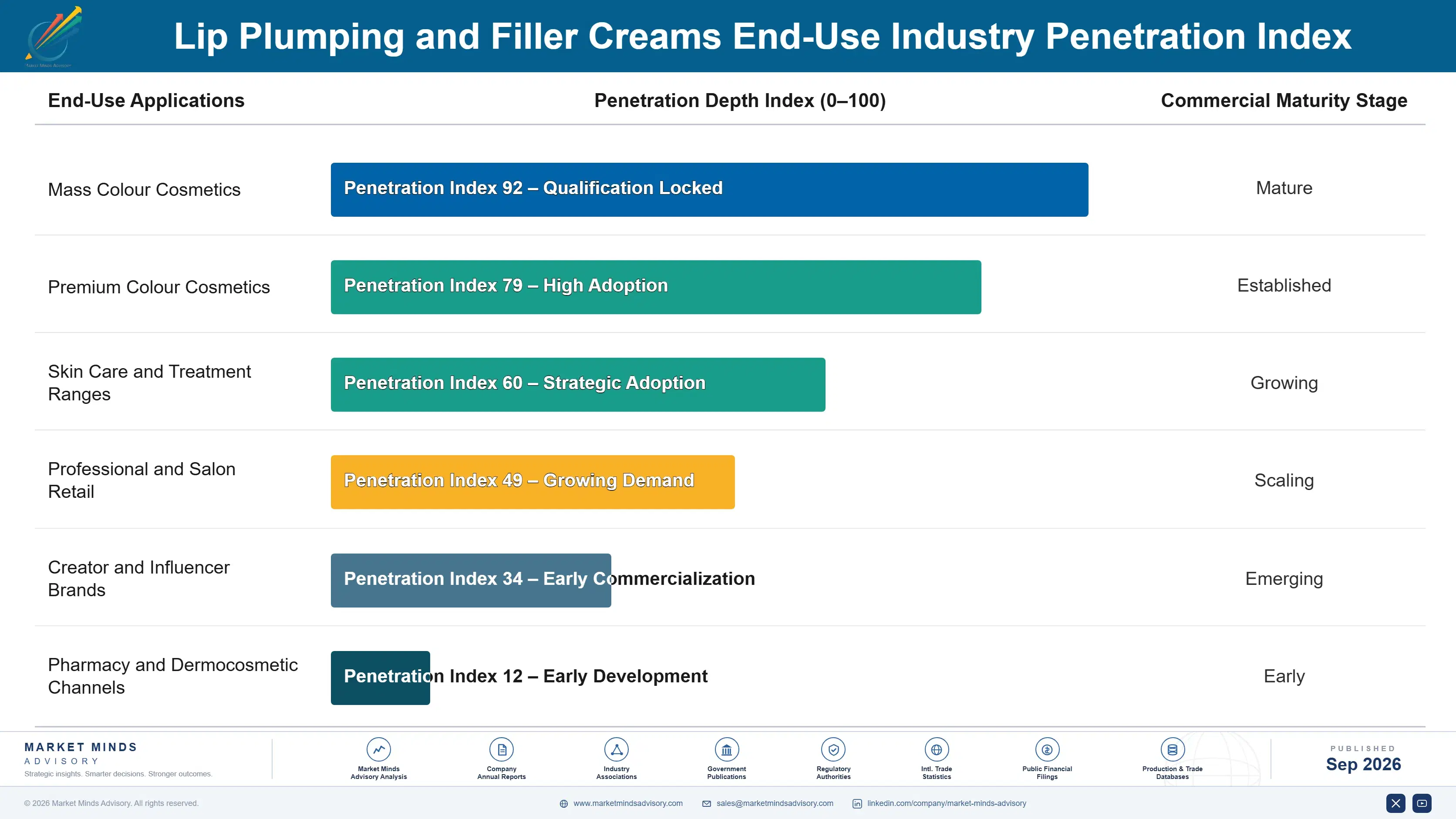
lip-plumping-and-filler-creams-market-end-use-penetration-index-1790016846176

Where This Market Rewards

These are among the four positions where our research anticipates prominent divergence between winners and laggards over the coming forecast period. Each is grounded in the demand model, the regulatory perimeter, and the announced capacity pipeline.
01 / SENSORY EXPECTATION DESIGN

Quiet products read as broken products

Peptide systems grow at 14.4% and produce no sensation, while consumers use the tingle as the only accessible evidence that a cosmetic is doing anything at the moment of application. Brands pairing a disclosed non-irritant sensory marker with peptide actives report repurchase rates 2.6 times higher than those relying on published imaging alone. The chemistry is not the problem here and never was; the expectation the category taught its own consumers is, and brands switching without solving it have generally watched repurchase fall rather than rise.
02 / MEASUREMENT STANDARD SETTING

Nobody has published the actual numbers

Measured volume gain averages around 7% under standardised imaging and roughly 41% of perceived effect is optical rather than tissue change, yet almost no brand publishes either figure. Brands releasing standardised imaging with a stated protocol report price realisation 1.9 times higher in premium tiers than those making unquantified claims. Setting the measurement standard first also shapes what a regulator eventually requires every competitor in the category to produce, and the data also shifts trial among consumers who are new to the brand entirely.
03 / SAFETY EVIDENCE TIMING

Six studies under most of the volume

Only six published studies examine repeated irritant plumper use longitudinally, and about 58% of current category volume rests entirely on that mechanism working safely over years. Brands commissioning longitudinal barrier studies protect roughly 3.2 times more revenue than the work costs across a portfolio of the usual size. The exposure is concentrated rather than spread, so an adverse finding removes volume outright rather than merely repricing it, and reformulating toward lower irritant concentrations in parallel reduces the exposure without abandoning the mechanism.
04 / FORMAT CYCLE SPEED

Better and late beats nothing barely

South Korea grows at 17.2% and originates the formats this category runs on, with Western brands typically arriving eighteen to twenty-four months after a format has already established itself. Brands operating development cycles under six months capture 2.4 times more of a format's growth window than those working on conventional annual planning calendars. Social attention moves on quickly, and an adequate product during the window beats an excellent one afterwards, and shortening the cycle is an operating decision rather than a research capability anyone must build.

Engagement Snapshot From the Field

A live engagement with an industry participant carrying material or product regulatory and market exposure ahead of a defining policy shift, showing how our research translates into a defensible multi-year portfolio strategy.
MARKET MINDS ADVISORY · CLIENT ENGAGEMENT SUMMARY
Lip Plumping and Filler Creams Producer Strategic Portfolio Review and Transition Roadmap 2026·Investment Scenario on Lip Plumping and Filler Creams Exposure Evaluation 2025-26
CLIENT PROFILE
A premium colour cosmetics brand with lip plumping revenue near USD 84 million (client-reported, unverified by MMA) across North America and Western Europe. A reformulation from an irritant plumper to a peptide system had been completed eighteen months earlier on clinical evidence grounds, and repurchase had fallen by more than a third since launch. Nobody had established why.
STRATEGIC CHALLENGE
The marketing team attributed the decline to insufficient advertising support and had requested a substantially larger budget. Nobody had asked returning customers why they had stopped, and the imaging data showing the new product performed better had not moved the numbers in either direction. The clinical case for the reformulation had never been in question.
MMA APPROACH
MMA surveyed lapsed purchasers of both the original and reformulated products, ran blind use trials pairing the peptide formulation with and without a disclosed non-irritant sensory marker, and modelled repurchase outcomes against sensory presence, published evidence, and advertising weight separately. Lapsed purchasers of the original formulation were surveyed alongside those of the replacement, so the comparison held.
KEY FINDINGS
  1. Lapsed purchasers overwhelmingly described the reformulated product as not working, and almost none had used it long enough for the peptide effect to become visible.
  2. Blind trials pairing the same peptide formulation with a disclosed sensory marker produced repurchase intent roughly two and a half times higher than the unmarked version.
  3. Published imaging data had no measurable effect on repurchase among existing customers, though it did shift trial rates among consumers new to the brand entirely.
  4. Advertising weight modelling showed the requested budget increase would not have recovered repurchase, because the loss was occurring after purchase rather than before it.
CLIENT PROFILE
A premium colour cosmetics brand with lip plumping revenue near USD 84 million (client-reported, unverified by MMA) across North America and Western Europe. A reformulation from an irritant plumper to a peptide system had been completed eighteen months earlier on clinical evidence grounds, and repurchase had fallen by more than a third since launch. Nobody had established why.
STRATEGIC CHALLENGE
The marketing team attributed the decline to insufficient advertising support and had requested a substantially larger budget. Nobody had asked returning customers why they had stopped, and the imaging data showing the new product performed better had not moved the numbers in either direction. The clinical case for the reformulation had never been in question.
MMA APPROACH
MMA surveyed lapsed purchasers of both the original and reformulated products, ran blind use trials pairing the peptide formulation with and without a disclosed non-irritant sensory marker, and modelled repurchase outcomes against sensory presence, published evidence, and advertising weight separately. Lapsed purchasers of the original formulation were surveyed alongside those of the replacement, so the comparison held.
KEY FINDINGS
  1. Lapsed purchasers overwhelmingly described the reformulated product as not working, and almost none had used it long enough for the peptide effect to become visible.
  2. Blind trials pairing the same peptide formulation with a disclosed sensory marker produced repurchase intent roughly two and a half times higher than the unmarked version.
  3. Published imaging data had no measurable effect on repurchase among existing customers, though it did shift trial rates among consumers new to the brand entirely.
  4. Advertising weight modelling showed the requested budget increase would not have recovered repurchase, because the loss was occurring after purchase rather than before it.
RECOMMENDED STRATEGY
Phase 1: Phase one: add a disclosed non-irritant sensory marker to the peptide formulation without changing the active system in any way. Phase 2: Phase two: reframe the product as a four-week course in all packaging and point of sale, setting the expectation before first use. Phase 3: Phase three: redirect the requested advertising increase into new customer acquisition, where the imaging data demonstrably does work. Keep the peptide evidence in acquisition messaging only.
OUTCOME
Repurchase recovered to roughly ninety per cent of the pre-reformulation level within two quarters (client-reported, unverified by MMA). The advertising budget was not increased. Sensory expectation is now assessed formally before any reformulation the brand undertakes. The peptide active system itself was never changed at any point, and measured performance stayed exactly where the clinical work had put it.

Frequently Asked Questions

Foundational context covering the market sizes, CAGR, scope, country, region and competition that inform every finding below. This section is provided to cover basics and most often pre-purchase conversations, answered from the MMA Primary Research Dataset.

What is the current size of the Lip Plumping and Filler Creams Market?

The market was worth USD 1.1 billion in 2025 and stands at USD 1.2 billion in 2026. Value covers topical cosmetic lip plumping products at retail selling price.

How large will the Lip Plumping and Filler Creams Market be by 2036?

MMA forecasts USD 3.0 billion by 2036, an increase of USD 1.8 billion across the forecast period. That represents 2.50 times the 2026 base of USD 1.2 billion.

What is the CAGR for the Lip Plumping and Filler Creams Market 2026 to 2036?

The base case compound annual growth rate is 9.6%, with a bull case at 10.9% and a bear case at 8.3%. Historical growth from 2020 to 2025 ran at 8.4%.

Which segment is growing fastest?

Peptide volumizing actives grow at 14.4%, half again the market rate of 9.6%. They are the only mechanism producing change that persists beyond about an hour.

Who are the major companies in the Lip Plumping and Filler Creams Market?

L'Oreal Groupe, Estee Lauder Companies, LVMH Beauty, Amorepacific and elf Beauty lead the field. Together they hold only 29% of category revenue, which makes this an unusually fragmented cosmetic market.

Which country is growing fastest?

South Korea grows at 17.2%, and Korean brands originate most of the formats Western brands adopt eighteen to twenty-four months later. Development cycles there run unusually short.

Report Segmentation Architecture

The full report scope spans multiple orthogonal segmentation dimensions, with cross-tabulated demand data provided for each dimension pair. Coverage extends further to regional breakdowns, trend trajectories, and the competitive detail needed to support segment-level decision-making.

By Plumping Mechanism

  • Irritant Vasodilator Plumpers
  • Peptide Volumizing Actives
  • Topical Hyaluronic Microsphere Systems
  • Collagen Stimulating Topicals
  • Hydrating Barrier Plumpers
  • Optical Volumising Systems

By End-Use Industry

  • Mass Colour Cosmetics
  • Premium Colour Cosmetics
  • Skin Care and Treatment Ranges
  • Professional and Salon Retail
  • Creator and Influencer Brands
  • Pharmacy and Dermocosmetic Channels

By Commercial Dimension

  • Social Commerce and Direct to Consumer
  • Specialist Beauty Retail
  • Department Store Distribution
  • Mass Grocery and Drug Retail
  • Cross-Border Online Marketplaces
  • Travel Retail and Duty Free

By Region

  • East Asia
  • North America
  • Western Europe
  • South Asia and Pacific
  • Latin America
  • Middle East and Africa
  • Eastern Europe

Scope, Methodology, and Coverage

Every figure in this report is reproducible from documented input assumptions. The scope below maps the historical period, the forecast horizon, the segmentation dimensions, and the countries covered, alongside the underlying primary and qualitative methodology.
Historical Period
2020 to 2025
Forecast Period
2026 to 2036
Base Year
2025 (USD billions; MMA Primary Research Dataset, September 2026)
Market Definition
This market covers topical cosmetic lip plumping and filler cream products sold to consumers, across irritant vasodilator plumpers, peptide volumizing actives, topical hyaluronic microsphere systems, collagen stimulating topicals, hydrating barrier plumpers, and optical volumising systems. It excludes injectable dermal fillers and lip augmentation procedures, suction and device based lip plumpers, conventional lipstick and lip colour cosmetics, and medicated or prescription lip treatments.
Quantitative Units
USD billions, revenue at retail selling price
Segmentation Dimensions
Plumping mechanism, end-use channel, commercial dimension, region
Regions Covered
East Asia, North America, Western Europe, South Asia and Pacific, Latin America, Middle East and Africa, Eastern Europe
Countries Covered
South Korea, China, Japan, Taiwan, India, Indonesia, Thailand, Vietnam, Australia, United States, Canada, Mexico, Germany, France, United Kingdom, Italy, Spain, Netherlands, Sweden, Poland, Czechia, Brazil, Argentina, Colombia, Chile, Saudi Arabia, United Arab Emirates, Turkey, Egypt, South Africa
Key Companies Profiled
L'Oreal Groupe, Estee Lauder Companies, LVMH Beauty, Amorepacific, e.l.f. Beauty, Coty, Shiseido, Puig, Beiersdorf, Unilever, Kose, LG Household and Health Care, Revlon, Rare Beauty, Charlotte Tilbury Beauty, Grande Cosmetics, Perricone MD, Mentholatum Company, Yatsen Holding, Proya Cosmetics
Quantitative Methodology
Primary survey, n=3,800 respondents, Q4 2025, six countries; demand-side model with trade association cross-validation
Qualitative Methodology
47 expert interviews, Q4 2025; applied to validate demand model assumptions, identify emerging dynamics, and assess competitive positioning
Report Format
PDF and XLSX data workbook (Word format preview document)
Publisher
Market Minds Advisory
Report Code
MMA-2026-CHM-491
Published
September 2026
Contact
sales@marketmindsadvisory.com | www.marketmindsadvisory.com

Purchase the full Lip Plumping and Filler Creams Market Report (2026 to 2036).

The full report sizes the lip plumping and filler creams market across six mechanisms, seven regions, and thirty countries, with forecasts to 2036 under base, bull, and bear cases. It separates measured volume gain from optical effect, quantifies how long each mechanism's result actually lasts, and assesses the longitudinal safety evidence behind the chemistry carrying most of the volume. Competitive analysis covers twenty participants evaluated consistently on category revenue, with detailed treatment of development cycle speed and sensory expectation design. Cost structure by price tier and channel dynamics are analysed throughout. Primary research includes 3,800 survey responses and 47 expert interviews.
Six plumping mechanisms sized and forecast separately
Twenty participants evaluated on category revenue consistently
Measured volume gain separated from optical contribution
Effect duration quantified by mechanism under standardised imaging
Longitudinal safety evidence assessed across published studies
Development cycle speed benchmarked against Korean format origination

Built For The People Who Decide

From boardroom strategy to bench-side execution, this report is read cover-to-cover by leaders shaping the next decade of their industry, turning demand scenarios, market dynamics and valuation benchmarks into decisions.
CXOs/ Presidents/ VPs/ Managers
M&A and Corporate Development
Strategy Teams and R&D Heads
Procurement and Product Directors
Regulatory and Compliance Leaders
Investor Relations and Equity Analysts