Market Minds Advisory
Lights for Dental Healthcare Market

Lights for Dental Healthcare Market: LED Precision Meets the Curing Chemistry Bottleneck

Dental practices are replacing halogen operatory and curing lights with multi-wavelength LED systems as resin chemistry, caries diagnostics, and clinician ergonomics demand more precise, more controllable light than legacy fixtures can deliver.

Lead Analyst

Alice Ballenger

Published

September 2026

Make Smarter Decisions with Customized Research Insights

Request a free sample report and evaluate market opportunities, growth trends, and competitive dynamics relevant to your business needs.

2025 MARKET VALUE$1.2BMarket Size 2025
2036 FORECAST VALUE$2.4BBase Case , 2026 to 2036
CAGR 2026 TO 20366.3 %Bull 7.6% / Bear 5.0%
INCREMENTAL OPPORTUNITY$1.1BNet 10- year value creation
EXPANSION MULTIPLE1.84x2036 value over 2026 base
Strategic Levers
M&A Pipeline
Regional Outlook
Country Rankings
Competitive Intelligence
Segmental Deep-dive
Call-Us : 91 93563 13602

Executive Snapshot and Market Trajectory

LED lighting has displaced halogen across most new dental equipment purchases, but the real replacement cycle is only now reaching the installed base of older operatories still running fixtures that cannot deliver the precise wavelengths modern resin curing and caries diagnostics require. That gap defines the next purchasing wave.
Demand concentrates in three categories: overhead operatory lighting tied to new and refurbished clinic buildouts, LED curing lights replacing units too weak for deeper or faster-set composite resins, and diagnostic fluorescence lights that reveal early-stage decay invisible under standard illumination. Intraoral diagnostic and fluorescence lights are growing fastest as digital dentistry workflows integrate optical caries detection into routine exams. North America remains the largest single market on private clinic density.
Competitive intensity splits between full-line dental equipment manufacturers bundling lighting into broader operatory packages and specialist curing-light makers competing almost entirely on wavelength precision and cure depth. Regulatory scrutiny over blue-light output safety limits, tightened following updated IEC ophthalmic hazard standards, is forcing every curing-light maker to document exposure data before new products reach clinics. Smaller manufacturers without dedicated regulatory teams increasingly struggle to keep pace with that documentation burden industry-wide. That gap is widening.
Market Definition
The lights for dental healthcare market covers illumination equipment purpose-built for dental clinical use, including overhead operatory lighting, LED polymerization curing lights, loupe-mounted headlights, portable and handheld examination lights, and intraoral diagnostic fluorescence lighting. It excludes general medical examination lighting not dental-specific, dental imaging equipment such as X-ray or intraoral cameras, and standalone dental chairs and delivery units sold without integrated lighting.
Base Year Value
$1.2B in 2025 (MMA Primary Research Dataset, August 2026)
Forecast Period
2026 to 2036, eleven discrete annual values
CAGR
6.3% base case. Bull 7.6%. Bear 5.0%.
Fastest Growth Segment
Intraoral Diagnostic and Fluorescence Lights: 11.5% CAGR
Fastest Growth Country
India: 12.8% CAGR
Fastest Growth Region
South Asia and Pacific: 8.5% CAGR
Largest Region
North America: 31% of 2025 global value
Market Leaders
A-dec Inc., Midmark Corporation, Dentsply Sirona, KaVo Dental, Ultradent Products. Source: MMA Analysis based on company annual reports.
Primary Survey
n=3,800 procurement and R&D decision-makers, Q4 2025, six countries
Methodology
Demand-side build-up, cross-validated against public data, 47 expert interviews

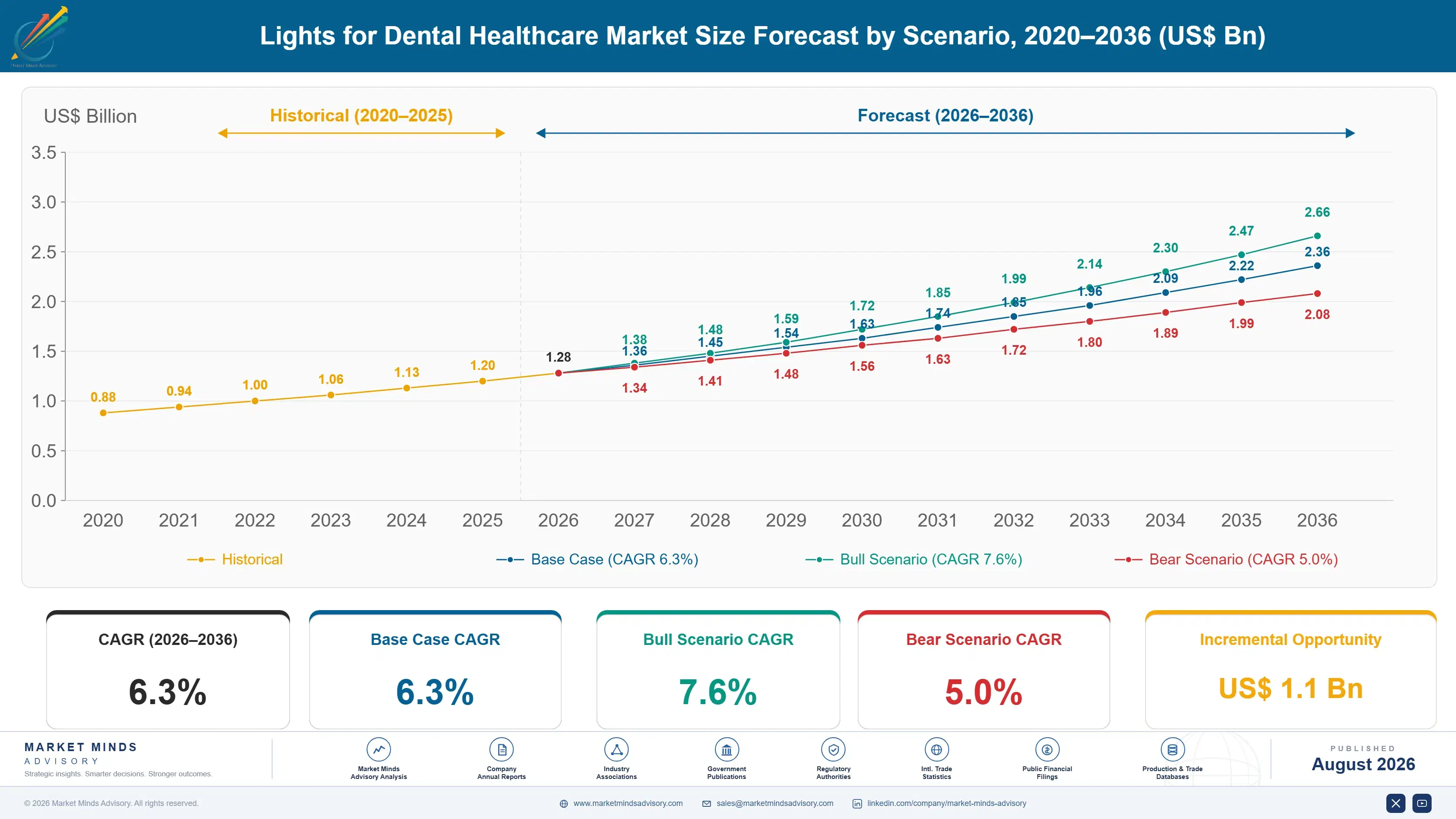
Lights for Dental Healthcare Market Forecast Scenarios

lights-for-dental-healthcare-market-size-forecast-scenario-1787305482695
Between 2020 and 2025 the market grew at roughly 5.6% a year, held back through 2020 and 2021 as elective dental visits and clinic capital spending both fell sharply during pandemic disruption, before recovering steadily as deferred equipment purchases and clinic reopenings resumed through 2023 and beyond. LED conversion was already well underway across new equipment sales through most of this period.
The base case carries the market to a 6.3% CAGR on three mechanisms. First, the large installed base of halogen and early-generation LED fixtures approaches replacement age simultaneously across markets that adopted LED lighting on similar timelines a decade ago. Second, resin manufacturers keep introducing composites requiring specific, higher-intensity wavelength profiles that older curing lights cannot deliver reliably. Third, digital dentistry workflows increasingly bundle diagnostic fluorescence lighting into standard exam protocols, expanding a category that barely existed a decade ago.
The bull case reaches 7.6% if dental insurers begin reimbursing fluorescence-based caries diagnostics at meaningfully higher rates, pulling adoption forward faster than modeled. The bear case falls to 5.0% if clinic capital budgets tighten under reimbursement pressure enough that practices extend equipment replacement cycles well beyond historical norms across mature markets. That divergence depends on unresolved insurer policy.

Wavelength Precision Is Becoming the Real Competitive Battleground

Three forces converge on this market at once. An aging installed base of first-generation LED fixtures reaches natural replacement timing, resin chemistry keeps advancing past what older curing lights can reliably polymerize, and diagnostic fluorescence lighting keeps moving from specialty tool into routine exam equipment. Manufacturers slow to update wavelength specifications risk losing accounts to faster-moving competitors entirely. Practices delaying this transition risk losing patients to b
MARKET CONCENTRATION (CR5)34%Top five manufacturers hold well under half share
AVERAGE CURING LIGHT PRICE$420/unitPremium multi-wavelength units command notably higher market pricing
TOP PRODUCING COUNTRY SHARE27%United States leads installed dental lighting manufacturing base
INSTALLED BASE AGE7.4 yearsAverage operatory fixture approaches typical clinic replacement timing
TRADE INTENSITY29%Nearly a third of units cross national borders annually
COMPONENT COST SHARE46% of COGSLED chips and optical components dominate manufacturing cost
Commercially, the market splits between bundled operatory lighting sold as part of full equipment packages, priced competitively to win the underlying chair and delivery unit sale, and standalone curing and diagnostic lights sold on clinical performance to practices upgrading incrementally rather than replacing entire operatories. That standalone category carries meaningfully higher margin because clinicians pay directly for measurable cure depth and diagnostic accuracy rather than accepting whatever ships with a bundled package.
Over the next decade the defining question is whether curing light wavelength standards converge around a small number of resin-compatible profiles or keep fragmenting as manufacturers differentiate on proprietary chemistry partnerships, a fragmentation that would raise switching costs for practices locked into a single resin platform. That fragmentation risk is already shaping how manufacturers court key resin partners.
"Everyone in this category talks about lumens, but lumens barely matter anymore. What actually separates a good curing light from a mediocre one is whether its wavelength spectrum matches the photoinitiator in the resin the clinician is using that day, and most buyers still do not ask that question."
Director, Dental Equipment and Diagnostics Practice · MMA Medical Devices / Dent

Market Trends

Multi-Wavelength Curing Lights Replace Single-Peak LED Units

First-generation LED curing lights emitted a narrow blue wavelength band tuned to camphorquinone photoinitiators, but newer bulk-fill and fast-set composites increasingly rely on alternative photoinitiators requiring violet and near-UV wavelengths those older lights cannot produce. Manufacturers including Ultradent and Ivoclar Vivadent have shifted new product lines almost entirely to multi-wavelength or broad-spectrum output to guarantee compatibility across the full range of resins a practice might use. Clinicians who mismatch light and resin risk under-cured restorations that fail prematurely, a quality problem malpractice insurers have begun flagging explicitly in continuing education materials distributed to dental practices.
Market Impact: Covers roughly 40% of installed uni
Fluorescence-Based Caries Diagnostics Enter Routine Exam Protocols

Laser and LED fluorescence technology, which highlights early-stage demineralization invisible to the naked eye under standard lighting, has moved from specialty pediatric and research use into mainstream adult exam protocols as digital dentistry adoption accelerates across group practices and dental service organizations. KaVo's DIAGNOdent platform and newer competing systems now integrate directly into practice management software, letting clinicians document and track lesion progression over multiple visits rather than relying on visual inspection alone. Adoption remains concentrated among larger, better-capitalized practices able to absorb the added equipment cost. That integration is becoming a standard purchasing criterion at larger group practices.
Market Impact: Used in 45% of restorations

Market Opportunities and Growth Drivers

Installed Base Replacement Cycle Reaches Peak Simultaneously

Dental practices that converted from halogen to first-generation LED lighting during the initial adoption wave roughly a decade ago are now reaching typical seven to eight year replacement age simultaneously across markets that adopted on similar timelines, creating a genuine capital replacement wave rather than steady organic growth. Equipment financing companies serving the dental sector report loan applications for lighting and curing equipment rising meaningfully faster than for other operatory equipment categories over the past two years, a leading indicator manufacturers are already building into production planning across their commercial organizations.
Market Impact: Adds 4 to 6 months delay

Advanced Composite Resins Demand Higher-Intensity Curing

Bulk-fill composite resins, which let clinicians place and cure restorative material in fewer, thicker increments than traditional layering technique, require curing lights capable of sustained higher-intensity output to fully polymerize resin at depth without under-curing the bottom layer. Dental schools have shifted curriculum toward bulk-fill technique for its chairside time savings, meaning newly trained clinicians increasingly expect and specify high-intensity multi-wavelength lights as standard equipment rather than an optional upgrade, pulling replacement demand forward across practices employing recent graduates. Manufacturers slow to update output specifications risk losing these newly trained buyers to competitors who moved faster on higher-intensity multi-wavelength platforms.
Market Impact: Affects 25% of resin brands

Market Restraints and Challenges

Blue-Light Safety Standards Add Compliance Cost and Delay

Updated IEC 62471 ophthalmic hazard standards for high-intensity blue-light sources require manufacturers to document retinal exposure limits and provide protective eyewear guidance before new curing lights reach clinical use, and the root cause is that higher-intensity outputs needed for advanced resins inherently raise blue-light hazard exposure for both clinicians and patients during extended procedures. Compliance testing can add several months to product development timelines and meaningful cost for smaller manufacturers without in-house optical safety testing capability. Several manufacturers are mitigating the delay by using shared third-party testing laboratories rather than building internal compliance infrastructure from scratch.
Market Impact: Cuts under-cure risk 30% to 40%

Fragmented Wavelength Standards Complicate Resin Compatibility

No industry-wide standard governs which wavelength profile a curing light must emit, and the root cause is that resin manufacturers each optimize their own photoinitiator chemistry independently, leaving clinicians to manually match light output against whichever resin brand they stock that week. This creates real clinical risk when practices switch resin suppliers without also verifying curing light compatibility, and it complicates purchasing decisions for practices trying to future-proof equipment against resin formulations that do not yet exist. Some manufacturers are mitigating the problem by publishing detailed compatibility charts and partnering directly with major resin brands to certify cross-compatibility.
Market Impact: Used in 18% of adult exams
3 additional market trends, 4 additional growth drivers, and 3 additional restraints and challenges are covered in the full report. Contact sales@marketmindsadvisory.com to access the complete intelligence.

Segment CAGR and Growth Architecture

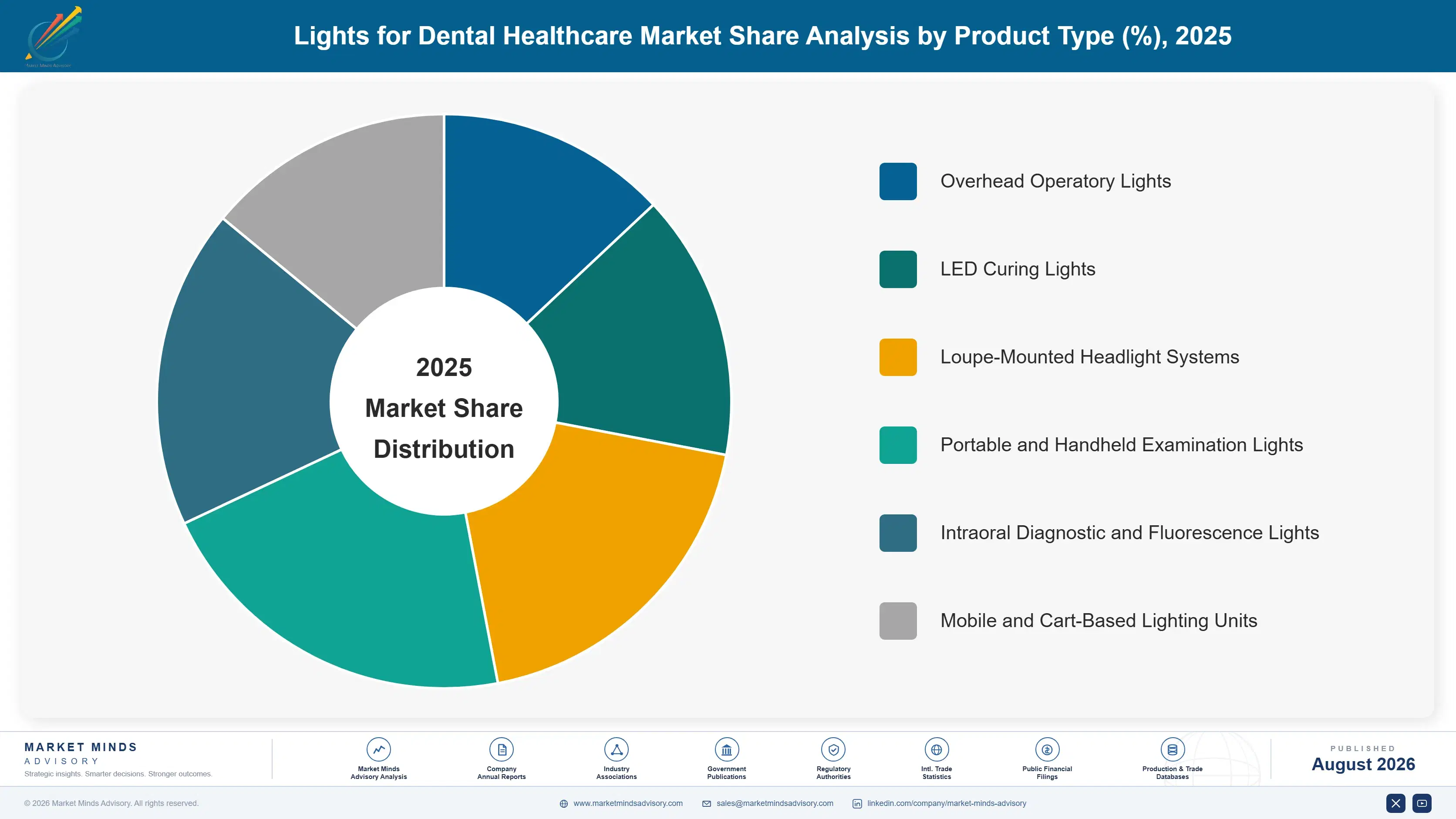
Segmentation follows product type, a single functional logic distinguishing how each fixture is used within clinical workflow. Downstream service, calibration, and equipment financing offerings are treated as separate commercial dimensions, not parallel segments within this product-based framework. Each product carries its own use case, replacement cycle, and price point, so commercial position tracks clinical function rather than purchasing channel.
lights-for-dental-healthcare-market-market-share-analysis-1787305483580

Intraoral Diagnostic and Fluorescence Lights

Diagnostic and fluorescence lighting grows fastest at 11.5%, about 1.83 times the overall rate, as caries detection technology moves from specialty research tool into routine exam equipment across group practices and dental service organizations. These devices use laser or LED-induced fluorescence to reveal early-stage demineralization before it becomes visible or symptomatic, letting clinicians document and track lesion progression digitally rather than relying on subjective visual inspection alone. Adoption concentrates among larger, better-capitalized practices and academic dental centers, where the equipment cost is easier to justify against improved diagnostic documentation and defensible treatment planning. Smaller independent practices adopt more slowly, constrained by upfront cost and limited reimbursement support from dental insurers who have been slow to recognize the diagnostic value directly.
CAGR 11.5%

Portable and Handheld Examination Lights

Portable and handheld examination lights grow at 8.0%, the second-fastest category, as mobile dental units serving underserved rural areas, school-based dental programs, and geriatric care facilities expand across both developed and emerging markets. Battery-powered LED units have largely replaced corded halogen handhelds, offering clinicians consistent illumination without requiring a fixed operatory infrastructure investment. Public health dental outreach programs, increasingly funded through government and philanthropic initiatives targeting access gaps in underserved communities, represent a growing recurring buyer segment distinct from traditional private practice equipment purchasing. Growth here outpaces the broader market as access-focused dental care delivery models continue expanding globally. Manufacturers serving public health procurement channels are positioning early for continued expansion of access-focused dental care funding worldwide.
CAGR 8.0%
Full segment breakdown across 6 segments available in the complete report.

Regional Architecture and Country Demand Map

North America leads on dense private clinic infrastructure and consistent equipment upgrade spending, East Asia follows closely on expanding clinic networks, and South Asia and Pacific compounds fastest off a smaller installed base. Western Europe and Latin America hold steady middle positions on established but slower-growing practice networks.

North America

United States dental practices maintain the world's highest per-capita equipment spending, with roughly two hundred thousand active practices supporting consistent replacement demand for operatory and curing lighting. A-dec and Midmark both run their primary manufacturing operations domestically, serving a dealer network that reaches practices in every state with service and financing support bundled into the purchase. Dental service organizations, which now account for a rising share of United States practice ownership, standardize equipment specifications across their growing networks, concentrating purchasing decisions among fewer but larger buyers than the traditional independent practice model. Growth trails East Asia and South Asia and Pacific because the region's installed base is already dense, leaving replacement as the primary demand driver.
Share: 31% | CAGR: 5.8% (2026 to 2036)

Western Europe

Germany and the United Kingdom host the region's largest concentrations of private dental practices, with national health service and statutory insurance reimbursement structures shaping equipment purchasing timelines differently than the cash and private-insurance-driven United States market. Sirona's legacy manufacturing base in Germany, now part of Dentsply Sirona, anchors substantial regional production capacity serving both domestic and export markets across the continent. Updated European Union medical device regulation compliance requirements have added meaningful documentation burden for lighting manufacturers selling into the bloc, slowing new product introduction timelines modestly. Growth trails East Asia and South Asia and Pacific as the region's practice base and equipment penetration are both already mature relative to faster-growing emerging markets.
Share: 22% | CAGR: 4.8% (2026 to 2036)
Regional intelligence for 5 additional markets available in the complete report: East Asia, South Asia and Pacific, Latin America, Middle East and Africa, Eastern Europe. Contact sales@marketmindsadvisory.com.
lights-for-dental-healthcare-market-country-cagr-analysis-1787305484445

Where Dental Lighting Makers Can Defend Margin

Four commercial moves separate manufacturers gaining share from those losing it to bundled commodity pricing: resin-compatibility certification, diagnostic subscription bundling, dealer network financing partnerships, and dental service organization standardization contracts. Each move converts a technical or logistics advantage into a defensible revenue line competitors without matching certification depth or account reach cannot easily replicate.

Certify Wavelength Compatibility With Major Resin Brands

Clinicians increasingly ask whether a curing light is verified compatible with the specific resin brand they stock, and manufacturers who formally partner with major resin makers to publish certified compatibility data reduce a genuine purchasing anxiety competitors leave unaddressed. Ivoclar Vivadent and Ultradent have both pursued direct compatibility partnerships, and certified lights command a measurable premium over uncertified competitors at similar specification levels. This also creates a durable co-marketing relationship, since resin manufacturers have their own commercial incentive to recommend certified lighting partners to their customer base. That premium often reaches 12% to 18% over uncertified units.
Market Impact: Commands 12% to 18% premium over un

Bundle Diagnostic Fluorescence Lighting Into Subscription Software

Fluorescence diagnostic devices generate lesion-tracking data with more recurring value when paired with cloud-based practice management software that documents progression across visits, and manufacturers bundling hardware with a subscription analytics platform capture recurring revenue beyond the one-time equipment sale. KaVo's DIAGNOdent-linked software offerings illustrate the model, converting a single capital purchase into a multi-year account relationship. Subscription attach rates remain modest today but are rising steadily as practices see the documentation value in insurance and liability contexts alike. Attach rates near 15% today are expected to approach 35% within five years as documentation value becomes more widely recognized industry-wide.
Market Impact: Adds $200 to $400 per unit in annua

Build Dealer Financing Partnerships for Replacement-Cycle Timing

Equipment financing terms, more than raw price, often determine which manufacturer wins a replacement purchase decision, and manufacturers partnering directly with equipment finance companies to offer favorable terms at the moment a practice's existing lighting approaches typical replacement age capture sales that pure price competition would otherwise lose to lower-cost alternatives. A-dec's dealer network model, built over decades, demonstrates how financing and service bundling together defend share more durably than product specification alone ever could against determined new entrants. Practices offered financing at the exact replacement moment convert at rates roughly 2 times those receiving only a standard price quote.
Market Impact: Improves replacement-cycle win rate

Win Standardization Contracts With Dental Service Organizations

Dental service organizations, which now control an increasing share of United States practice ownership, standardize equipment specifications across dozens or hundreds of affiliated practices at once, making a single standardization win worth far more than an equivalent number of independent practice sales negotiated separately. Manufacturers who dedicate account teams specifically to dental service organization procurement capture disproportionate volume relative to their broader market share, and these contracts typically run multiple years, insulating a meaningful share of revenue from single-purchase price competition entirely. These contracts often span 3 to 5 years, representing more volume than 50 independent practices combined.
Market Impact: Single contracts cover 50 to 200 pr

Who Controls the Margin Pool

Concentration sits at a moderate CR5 of 34%, with a real gap separating full-line equipment manufacturers from specialist lighting makers. Dentsply Sirona and A-dec compete on bundled operatory package breadth and dealer network reach, while Ultradent and Midmark anchor strong positions in curing and standalone lighting respectively. Numerous smaller regional manufacturers compete on price for standard operatory fixtures.
Current competitive activity runs along three lines: multi-wavelength curing technology development, where Ultradent and Ivoclar Vivadent compete on resin compatibility depth; diagnostic fluorescence platform expansion, where KaVo has built a durable software-linked position; and dental service organization account capture, which several manufacturers are pursuing through dedicated commercial teams. All participants are assessed on one consistent basis, annual revenue from dental lighting products and services.

Pressure is building from two directions. Chinese manufacturers are scaling both price-competitive and increasingly technically capable curing and operatory lighting, challenging Western incumbents in price-sensitive segments first. Meanwhile blue-light safety compliance requirements are raising the technical and regulatory bar every manufacturer must clear, a burden smaller specialist makers without dedicated regulatory teams are struggling to absorb. Rankings over the next five years will likely shift toward manufacturers combining resin-compatibility depth with genuine dealer network and service reach.
lights-for-dental-healthcare-market-company-positioning-matrix-1787305485321

Competitive Moat and Risk Dimensions

A-DEC INC.

Moat: Dealer network and reliability reputation

A-dec's decades-long reputation for equipment reliability, reinforced by an independent dealer network handling sales, installation, and service, gives it a trust advantage among practices making a capital purchase they expect to run for a decade without failure. That dealer relationship depth is difficult for newer or import-focused competitors to replicate without years of local investment.
A-DEC INC.

Risk: Private ownership limits capital scale

As a privately held company, A-dec's expansion capital comes from retained earnings rather than public market access, constraining how quickly it can match publicly traded competitors on research spending or acquisition-driven growth. Should larger public competitors accelerate investment in diagnostic lighting technology or overseas manufacturing capacity, A-dec's more conservative capital structure could slow its ability to respond at comparable speed.
DENTSPLY SIRONA

Moat: Broadest integrated equipment portfolio

Dentsply Sirona's product breadth, spanning imaging, chairside CAD/CAM systems, and lighting within integrated operatory packages, lets it win equipment sales on total-solution value rather than lighting specification alone, a bundling advantage specialist lighting makers cannot match. That breadth also gives it cross-selling reach into practices already using its other equipment lines.
DENTSPLY SIRONA

Risk: Recent recalls and integration friction

Dentsply Sirona has faced product recalls and quality-related scrutiny on several equipment lines in recent years, drawing regulatory attention and denting clinician trust in ways competitors have used in sales conversations. Ongoing integration friction from its multi-decade history of acquisitions also complicates consistent quality control across a sprawling product portfolio spanning dozens of legacy brands and manufacturing sites.

Players Tracked

Prominent Players

A-dec Inc.
Midmark Corporation
Dentsply Sirona
KaVo Dental
Ultradent Products

Other Key Players

Bien-Air Dental
Planmeca
Takara Belmont
DentalEZ
Pelton and Crane
Forest Dental
Ivoclar Vivadent
Solventum
SDI Limited
Woodpecker Medical Instrument
Runyes Medical Instrument
Global Dental Impex
Coltene Holding
J. Morita Corporation
NSK Ltd.

Recent Developments

MARCH 2025

Ultradent Products launches next-generation VALO curing light platform

Ultradent introduced an updated version of its VALO curing light line featuring expanded multi-wavelength output designed for compatibility with a broader range of bulk-fill composite resins. This was an organic product launch, not an acquisition or partnership, developed entirely through internal research and development investment over several years.
Signal: A major incumbent refreshing its flagship
SEPTEMBER 2024

Midmark Corporation takes minority equity stake in LED lighting start-up

Midmark acquired a minority equity position in an early-stage LED dental lighting technology developer, gaining a board observer seat but no operational control. The transaction was structured as a minority investment, not an acquisition or joint venture, giving Midmark visibility into emerging lighting technology without a full internal development commitment.
Signal: A minority stake, not a takeover, shows an
JANUARY 2025

Dentsply Sirona completes divestiture of certain non-core equipment lines

Dentsply Sirona completed the divestiture of several non-core equipment product lines to a private equity buyer as part of a broader portfolio simplification strategy. This was a divestiture, not an acquisition, merger, or joint venture, and narrows the company's product focus toward its core imaging and CAD/CAM equipment categories.
Signal: Portfolio simplification suggests incumben

LED Components Still Anchor Manufacturing Cost

LED chips and optical components together account for roughly forty-six percent of production COGS, sourced primarily from specialty semiconductor manufacturers concentrated in Taiwan, South Korea, and increasingly China, where domestic LED chip production capacity has scaled substantially since 2021. Housing, control electronics, and battery components for portable units add a smaller but meaningful additional cost share.
The clearest recent volatility event traces to the 2021 and 2022 global semiconductor shortage, which the United States Department of Commerce documented as extending lead times across LED and optical component categories broadly. Several dental lighting manufacturers reported multi-month order backlogs during the worst of the shortage, as automotive and consumer electronics buyers with larger order volumes crowded out smaller-volume medical device categories for available semiconductor fabrication capacity industry-wide.

Exposure varies by manufacturer scale and sourcing relationships. Larger manufacturers with direct long-term LED chip supply agreements weathered the shortage with less production disruption than smaller specialist makers dependent on distributor inventory and spot purchasing. Manufacturers serving dental service organizations under multi-year supply contracts faced particular pressure to maintain delivery commitments despite component shortages, sometimes absorbing cost increases rather than passing them through immediately to contracted institutional buyers.
lights-for-dental-healthcare-market-cost-volatility-analysis-1787305485653

Secure Direct LED Chip Supply Agreements With Manufacturers

Larger manufacturers are increasingly bypassing distributors to negotiate direct multi-year supply agreements with LED chip fabricators, securing priority allocation during future shortage events and more predictable pricing than spot market purchasing allows for a critical, concentrated component category. This mirrors sourcing discipline standard across medical device manufacturing, where single-supplier dependency has caused costly delays before.

Qualify Multiple LED Chip Suppliers Across Regions

Manufacturers are qualifying second and third LED chip sourcing options across Taiwan, South Korea, and China rather than relying on a single supplier relationship, reducing exposure to any one facility disruption, regional trade policy shift, or capacity allocation decision favoring larger buyers. Smaller manufacturers are increasingly pooling purchasing volume through industry associations to negotiate comparable allocation priority.

Redesign Fixtures Toward Standardized Component Platforms

Several manufacturers are consolidating product lines around shared LED and control electronics platforms across multiple product tiers, increasing purchasing volume per component and improving negotiating leverage with suppliers while simplifying inventory management across a smaller number of distinct part numbers. That platform consolidation also shortens qualification time for any single component change across the full product range.

Portfolio Architecture for Margin Defence

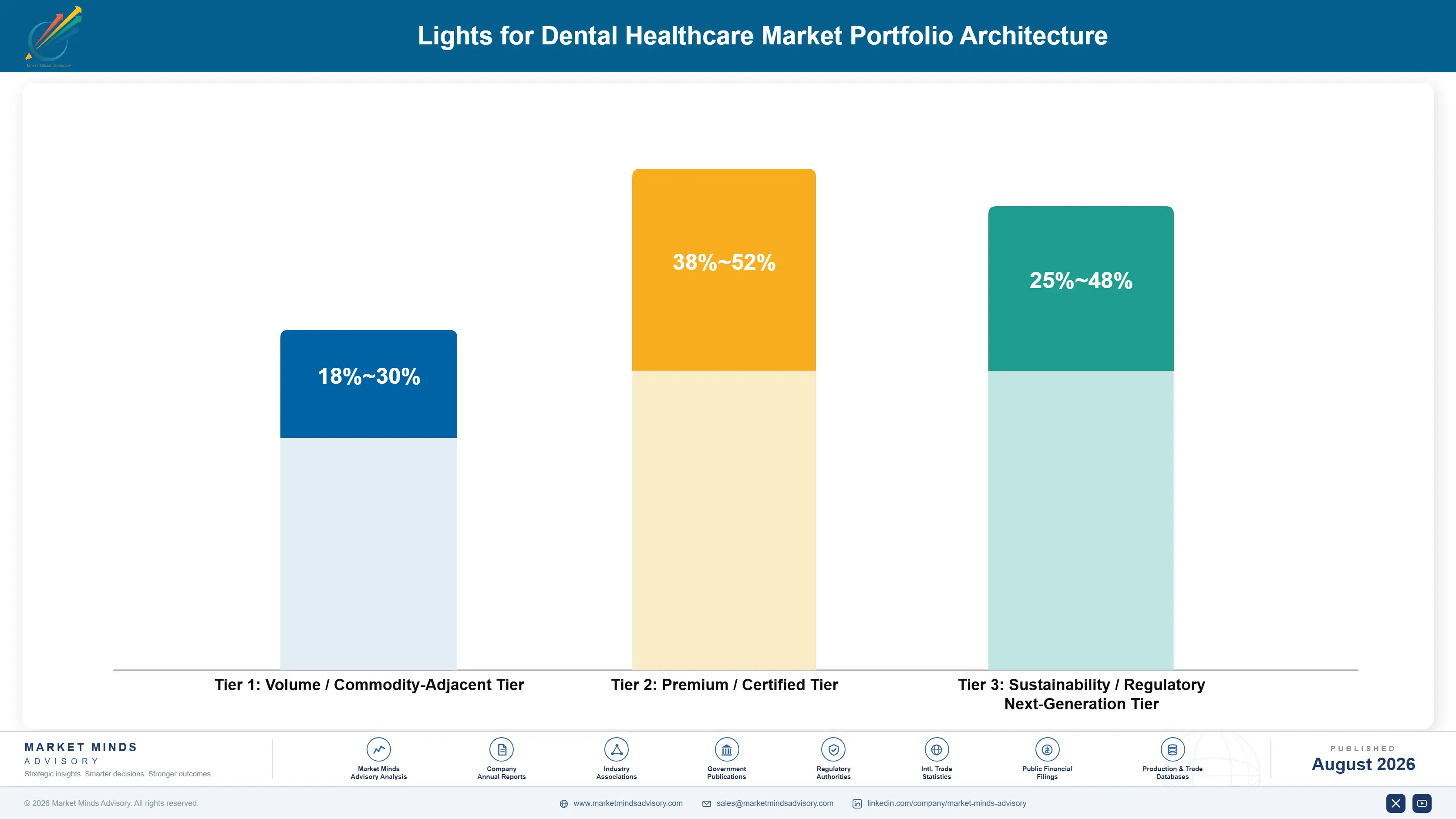
The portfolio splits into three tiers with real margin separation. Volume operatory lighting bundled into standard equipment packages competes largely on price to win the underlying chair sale, earning modest margins defended through dealer network scale. Certified premium curing and diagnostic lighting earns substantially more because clinicians pay directly for measurable wavelength precision and diagnostic accuracy rather than accepting bundled defaults. That gap widens further as clinicians
The tension between bundled and standalone lighting shapes manufacturer strategy directly: bundled sales keep dealer networks selling complete operatories, but manufacturers that let bundled defaults crowd out standalone premium development risk losing the fastest-growing, highest-margin diagnostic and curing categories to specialist competitors. Manufacturers that manage this balance well retain both revenue streams across their full dealer and direct sales channels.

High-value pools concentrate in diagnostic fluorescence platforms and certified multi-wavelength curing lights serving practices willing to pay for documented clinical performance, where technical differentiation justifies premium pricing few bundled-package competitors can match. The emerging next-generation subscription-linked diagnostic tier currently earns unevenly as manufacturers absorb software development cost against still-scaling recurring revenue adoption. That unevenness should ease as subscription attach rates climb toward broader practice adoption.

Volume / Commodity-Adjacent Tier

Standard operatory lighting bundled into equipment packages, sold primarily to win the underlying chair and delivery unit sale., where dealer network scale and installation efficiency determine which manufacturers can sustain acceptable margin under competitive bundled pricing.
Gross Margin: 18-30%

Premium / Certified Tier

Multi-wavelength curing lights and resin-compatibility certified fixtures purchased directly by clinicians for documented clinical performance., who pay a durable premium for verified compatibility rather than risk restoration failures or diagnostic uncertainty in daily practice.
Gross Margin: 38-52%

Sustainability / Regulatory / Next-Generation Tier

Subscription-linked diagnostic fluorescence platforms still absorbing software development investment against developing recurring revenue adoption., where manufacturers are betting today's development budget on a recurring revenue model they expect practices to demand as standard within a few years.
Gross Margin: 25-48%
lights-for-dental-healthcare-market-portfolio-architecture-1787305486476

How Dental Lighting Demand Actually Recurs

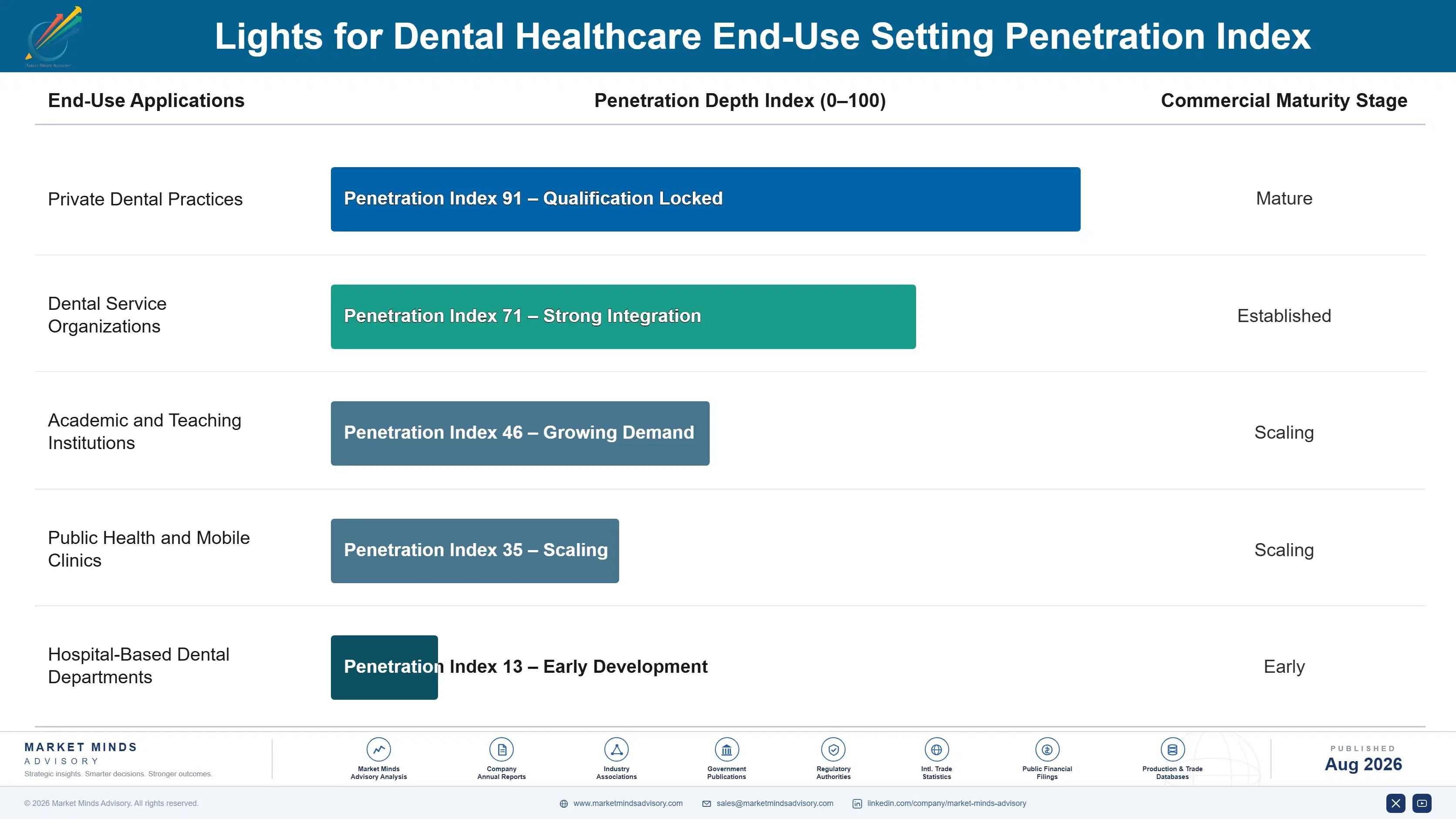
Demand here runs on a long capital replacement cycle rather than repeat consumable purchase. A practice buys operatory and curing lighting once and runs it for seven to eight years before replacement, meaning a single equipment sale represents a durable relationship rather than the start of recurring per-unit revenue the way consumables or subscriptions would provide. That long cycle rewards manufacturers who win trust at the moment of purchase.
Adoption depth varies sharply by vertical. Dental service organizations integrate lighting specifications deeply into standardized equipment programs across every affiliated practice, making a single successful sale worth many multiples of an independent practice purchase. Independent practices, by contrast, purchase more idiosyncratically based on individual clinician preference and dealer relationships, creating more frequent but smaller-volume switching opportunities for competing manufacturers pursuing that segment. That difference forces manufacturers to split strategy accordingly.

Buyer profiles are shifting generationally as newly trained clinicians, taught bulk-fill technique and digital diagnostic workflows in dental school, arrive at practices already expecting multi-wavelength curing and fluorescence diagnostic equipment as standard rather than optional. Older clinicians trained on halogen-era equipment are retiring steadily, accelerating the pace at which practice-level purchasing preferences shift toward the newer specification standard.
lights-for-dental-healthcare-market-end-use-penetration-index-1787305487281

Where Dental Lighting Value Concentrates Next

These are among the four positions where our research anticipates prominent divergence between winners and laggards over the coming forecast period. Each is grounded in the demand model, the regulatory perimeter, and the announced capacity pipeline.
01 / WAVELENGTH CERTIFICATION INVESTMENT

Prioritize resin-compatibility certification over raw output claims

Clinicians are increasingly sophisticated about wavelength compatibility, and manufacturers still marketing on raw lumen output alone are losing credibility with buyers who now ask pointed questions about photoinitiator matching before purchase. Formal certification partnerships with major resin brands convert a technical detail into a defensible commercial claim competitors without equivalent partnerships cannot easily counter. Manufacturers who invest here now will own the credibility question before competitors catch up to where buyer sophistication has already moved., a lead that compounds every year buyer sophistication continues to rise across the practice base.
02 / DIAGNOSTIC SUBSCRIPTION BUNDLING

Treat fluorescence diagnostics as a software relationship, not a device sale

The device itself is a one-time capital purchase, but the data it generates has recurring value for treatment planning, insurance documentation, and liability protection that a subscription software layer can monetize continuously. Manufacturers who bundle hardware with cloud-based tracking capture revenue standalone device sales leave entirely on the table. As reimbursement recognition for diagnostic documentation improves, this recurring layer will likely become the more valuable half of the relationship., eventually generating more lifetime revenue per practice than the original hardware sale itself ever could.
03 / DENTAL SERVICE ORGANIZATION FOCUS

Build dedicated commercial teams for standardization contracts

Dental service organizations are consolidating purchasing power at a pace independent practice sales cannot match, and manufacturers without dedicated account teams pursuing these standardization contracts are ceding disproportionate volume to competitors who have already invested there. A single won contract can be worth dozens or hundreds of independent practice sales combined. This concentration will only deepen as consolidation continues reshaping practice ownership across major markets over the coming decade., leaving manufacturers without an organizational sales strategy increasingly dependent on a shrinking pool of independent accounts.
04 / INSTALLED BASE REPLACEMENT TIMING

Time dealer financing offers to the simultaneous replacement wave

A large cohort of first-generation LED fixtures is approaching replacement age at roughly the same time across markets that adopted LED lighting on similar schedules a decade ago, creating a genuine, time-limited demand surge rather than steady baseline growth. Manufacturers with financing partnerships ready to capture that wave at the moment of replacement decision will win share that generic price competition alone would not secure. Missing this window means competing for the same accounts on worse terms later., after competitors have already locked in the relationship.

Engagement Snapshot From the Field

A live engagement with an industry participant carrying material or product regulatory and market exposure ahead of a defining policy shift, showing how our research translates into a defensible multi-year portfolio strategy.
MARKET MINDS ADVISORY · CLIENT ENGAGEMENT SUMMARY
Lights for Dental Healthcare Producer Strategic Portfolio Review and Transition Roadmap 2026·Investment Scenario on Lights for Dental Healthcare Exposure Evaluation 2025-26
CLIENT PROFILE
A regional dental service organization operating 85 affiliated practices across three states approached MMA while evaluating a full lighting equipment standardization program ahead of a planned expansion to 150 locations. The client reported roughly USD 12 million in annual equipment capital spending across its network, with lighting specifications varying widely across legacy acquired practices (client-reported, unverified by MMA).
STRATEGIC CHALLENGE
Management wanted to standardize curing and operatory lighting across all locations to simplify service contracts and clinical training, but lacked confidence about which manufacturer's wavelength specifications would remain compatible with the resin brands its clinical leadership preferred, while also fitting the organization's aggressive expansion timeline and existing dealer service relationships.
MMA APPROACH
MMA benchmarked wavelength compatibility and total cost of ownership across four manufacturers against the client's actual resin usage data by practice, modeled financing terms and replacement-cycle timing across the existing fleet, and assessed each manufacturer's dealer service capacity across the client's current and planned geographic footprint. We also interviewed clinical leadership at a sample of affiliated practices to confirm real-world resin preferences before finalizing recommendations.
KEY FINDINGS
  1. Roughly 40% of the client's existing curing lights already fell outside recommended compatibility ranges for the bulk-fill resins clinical leadership had standardized on the prior year.
  2. One manufacturer's certified compatibility program would have prevented the mismatch entirely, and switching going forward was projected to reduce under-cure-related redo procedures measurably across the network.
  3. Financing terms varied more than list pricing did across the four benchmarked manufacturers, making total cost of ownership a more useful comparison metric than sticker price alone for a network this size.
  4. Only two of four manufacturers had dealer service coverage adequate for the client's planned expansion markets, narrowing the credible standardization shortlist meaningfully ahead of the rollout decision (client-reported, unverified by MMA).
CLIENT PROFILE
A regional dental service organization operating 85 affiliated practices across three states approached MMA while evaluating a full lighting equipment standardization program ahead of a planned expansion to 150 locations. The client reported roughly USD 12 million in annual equipment capital spending across its network, with lighting specifications varying widely across legacy acquired practices (client-reported, unverified by MMA).
STRATEGIC CHALLENGE
Management wanted to standardize curing and operatory lighting across all locations to simplify service contracts and clinical training, but lacked confidence about which manufacturer's wavelength specifications would remain compatible with the resin brands its clinical leadership preferred, while also fitting the organization's aggressive expansion timeline and existing dealer service relationships.
MMA APPROACH
MMA benchmarked wavelength compatibility and total cost of ownership across four manufacturers against the client's actual resin usage data by practice, modeled financing terms and replacement-cycle timing across the existing fleet, and assessed each manufacturer's dealer service capacity across the client's current and planned geographic footprint. We also interviewed clinical leadership at a sample of affiliated practices to confirm real-world resin preferences before finalizing recommendations.
KEY FINDINGS
  1. Roughly 40% of the client's existing curing lights already fell outside recommended compatibility ranges for the bulk-fill resins clinical leadership had standardized on the prior year.
  2. One manufacturer's certified compatibility program would have prevented the mismatch entirely, and switching going forward was projected to reduce under-cure-related redo procedures measurably across the network.
  3. Financing terms varied more than list pricing did across the four benchmarked manufacturers, making total cost of ownership a more useful comparison metric than sticker price alone for a network this size.
  4. Only two of four manufacturers had dealer service coverage adequate for the client's planned expansion markets, narrowing the credible standardization shortlist meaningfully ahead of the rollout decision (client-reported, unverified by MMA).
RECOMMENDED STRATEGY
Phase 1: Phase 1 (0 to 6 months): Standardize all 85 existing locations on the certified-compatible manufacturer identified through the benchmarking exercise. Phase 2: Phase 2 (6 to 18 months): Negotiate a network-wide financing agreement covering both replacement of non-compliant units and new-location equipment for the planned expansion. Phase 3: Phase 3 (18 to 36 months): Extend the standardized specification to all newly acquired and opened practices as the network scales toward its 150-location target.
OUTCOME
The client selected the certified-compatible manufacturer and began Phase 1 rollout on schedule, reporting an estimated 25% reduction in under-cure-related redo procedures across converted locations within the first six months. The negotiated network-wide financing agreement also cut projected equipment financing cost by roughly USD 900,000 across the planned expansion (client-reported, unverified by MMA).

Frequently Asked Questions

Foundational context covering the market sizes, CAGR, scope, country, region and competition that inform every finding below. This section is provided to cover basics and most often pre-purchase conversations, answered from the MMA Primary Research Dataset.

What is the current size of the Lights for Dental Healthcare Market?

The lights for dental healthcare market was valued at USD 1.2 billion in 2025. Growth is driven by installed base replacement, advanced resin curing requirements, and expanding diagnostic fluorescence adoption.

How large will the Lights for Dental Healthcare Market be by 2036?

The market is projected to reach USD 2.36 billion by 2036 under the base case scenario. That reflects an expansion multiple of roughly 1.84 times the 2026 value.

What is the CAGR for the Lights for Dental Healthcare Market 2026 to 2036?

The base case CAGR is 6.3%, with a bull case of 7.6% and a bear case of 5.0%. Diagnostic reimbursement recognition is the main swing factor between scenarios.

Which segment is growing fastest?

Intraoral diagnostic and fluorescence lights grow fastest at 11.5% CAGR, roughly 1.83 times the overall market rate. Portable and handheld examination lights follow as the second-fastest segment at 8.0%.

Who are the major companies in the Lights for Dental Healthcare Market?

Leading manufacturers include A-dec Inc., Midmark Corporation, Dentsply Sirona, KaVo Dental, and Ultradent Products. The top five hold a combined 34% of the market, though concentration remains moderate enough to leave room for specialist and regional manufacturers to compete.

Which country is growing fastest?

India is the fastest-growing country at 12.8% CAGR, driven by expanding organized dental care chains and government oral health initiatives. Corporate dental networks anchor much of that growth.

Report Segmentation Architecture

The full report scope spans multiple orthogonal segmentation dimensions, with cross-tabulated demand data provided for each dimension pair. Coverage extends further to regional breakdowns, trend trajectories, and the competitive detail needed to support segment-level decision-making.

By Product Type

  • Overhead Operatory Lights
  • LED Curing Lights
  • Loupe-Mounted Headlight Systems
  • Portable and Handheld Examination Lights
  • Intraoral Diagnostic and Fluorescence Lights
  • Mobile and Cart-Based Lighting Units

By End-Use Setting

  • Private Dental Practices
  • Dental Service Organizations
  • Academic and Teaching Institutions
  • Public Health and Mobile Clinics
  • Hospital-Based Dental Departments

By Commercial Dimension

  • Bundled Equipment Package Sales
  • Standalone Direct Sales
  • Dealer and Distributor Channel
  • Financed and Subscription Programs

By Region

  • North America
  • Western Europe
  • East Asia
  • South Asia and Pacific
  • Latin America
  • Middle East and Africa
  • Eastern Europe

Scope, Methodology, and Coverage

Every figure in this report is reproducible from documented input assumptions. The scope below maps the historical period, the forecast horizon, the segmentation dimensions, and the countries covered, alongside the underlying primary and qualitative methodology.
Historical Period
2020 to 2025
Forecast Period
2026 to 2036
Base Year
2025 (USD billions; MMA Primary Research Dataset, August 2026)
Market Definition
The lights for dental healthcare market comprises illumination equipment purpose-built for dental clinical use, including overhead operatory lighting, LED polymerization curing lights, loupe-mounted headlights, portable and handheld examination lights, and intraoral diagnostic fluorescence lighting. General medical examination lighting not dental-specific, dental imaging equipment, and standalone dental chairs and delivery units sold without integrated lighting are excluded.
Quantitative Units
USD millions (current prices); installed unit volume where applicable
Segmentation Dimensions
By Product Type; By End-Use Setting; By Commercial Dimension; By Region
Regions Covered
North America, Western Europe, East Asia, South Asia and Pacific, Latin America, Middle East and Africa, Eastern Europe
Countries Covered
USA, China, Germany, France, UK, Japan, South Korea, India, Australia, Canada, Brazil, Mexico, Indonesia, Vietnam, Thailand, Malaysia, UAE, Saudi Arabia, South Africa, Nigeria, Turkey, Poland, Netherlands, Italy, Spain, Sweden, Switzerland, Argentina, Colombia, Singapore, and additional markets relevant to this sector
Key Companies Profiled
A-dec Inc., Midmark Corporation, Dentsply Sirona, KaVo Dental, Ultradent Products, Bien-Air Dental, Planmeca, Takara Belmont, DentalEZ, Pelton and Crane, Forest Dental, Ivoclar Vivadent, Solventum, SDI Limited, Woodpecker Medical Instrument, Runyes Medical Instrument, Global Dental Impex, Coltene Holding, J. Morita Corporation, NSK Ltd.
Quantitative Methodology
Primary survey, n=3,800 respondents, Q4 2025, six countries; demand-side model with trade association cross-validation
Qualitative Methodology
47 expert interviews, Q4 2025; applied to validate demand model assumptions, identify emerging dynamics, and assess competitive positioning
Report Format
PDF and XLSX data workbook (Word format preview document)
Publisher
Market Minds Advisory
Report Code
MMA-2026-MED-301
Published
August 2026
Contact
sales@marketmindsadvisory.com | www.marketmindsadvisory.com

Purchase the full Lights for Dental Healthcare Market Report (2026 to 2036).

The full MMA Lights for Dental Healthcare Market report sizes demand across six product types, five end-use settings, four commercial dimensions, and seven regions through 2036. It profiles twenty participants on a consistent revenue basis, scoring each on wavelength technology depth, dealer network reach, and diagnostic software integration. Scenario models quantify how installed base replacement timing and diagnostic reimbursement recognition move both demand and realizable pricing. The report includes delivered-cost modeling by product type and a manufacturer resin-compatibility readiness screen built for procurement and clinical strategy teams.
Wavelength compatibility benchmarking across major resin brands
Installed base replacement-cycle timing models by region
Diagnostic fluorescence adoption forecasts by practice type
Dealer network and financing partnership mapping
Component cost exposure modeling by manufacturer scale
Dental service organization standardization contract tracking

Built For The People Who Decide

From boardroom strategy to bench-side execution, this report is read cover-to-cover by leaders shaping the next decade of their industry, turning demand scenarios, market dynamics and valuation benchmarks into decisions.
CXOs/ Presidents/ VPs/ Managers
M&A and Corporate Development
Strategy Teams and R&D Heads
Procurement and Product Directors
Regulatory and Compliance Leaders
Investor Relations and Equity Analysts