Market Minds Advisory
Light Up Shoes Market

Light Up Shoes Market: Light Up Shoes Market: Novelty Retail, Safety Specification and the Module Nobody Prices

Two businesses share one shelf: a novelty children's category with a seven month replacement cycle, and a high-visibility safety footwear business that road safety regulation is quietly turning into the profitable half.

Lead Analyst

Published

September 2026

Make Smarter Decisions with Customized Research Insights

Request a free sample report and evaluate market opportunities, growth trends, and competitive dynamics relevant to your business needs.

2025 MARKET VALUE$1.2BMarket Size 2025
2036 FORECAST VALUE$3.0BBase Case , 2026 to 2036
CAGR 2026 TO 20368.6 %Bull 9.8% / Bear 7.4%
INCREMENTAL OPPORTUNITY$1.7BNet 10- year value creation
EXPANSION MULTIPLE2.28x2036 value over 2026 base
Strategic Levers
M&A Pipeline
Regional Outlook
Country Rankings
Competitive Intelligence
Segmental Deep-dive
Call-Us : 91 93563 13602

Executive Snapshot and Market Trajectory.

The novelty shoe pays the rent. The safety shoe is where the business is going. Illuminated footwear looks like a single category on a retail shelf, and it behaves like two entirely different industries once you look at who buys, how often, and why they come back.
High-visibility illuminated footwear grows at 12.9%, half again the market rate of 8.6%, pulled by vulnerable road user programmes and warehouse safety specification rather than by anything a child asked for. East Asia holds 30% of demand and roughly three quarters of world assembly, which means the cost structure is set in Fujian and Guangdong regardless of where the brand sits. Nobody selling into Western retail escapes that arithmetic, and very few try.
Concentration is low at 18%, and the fragmentation is real: assembly is available to anybody with a purchase order, so the barrier is battery compliance rather than manufacturing. A 9.4% online return rate, almost all of it electronic failure, decides which participants make money. Brands that solved module reliability are quietly out-earning brands that spent the very same money on licensing popular cartoon characters instead.
Market Definition
The light up shoes market covers finished footwear incorporating an integrated illumination system, whether light emitting diodes in the midsole, electroluminescent panels in the upper, or fibre optic elements. Scope spans children's and adult footwear across casual, sports, sandal, boot, slipper and high-visibility safety formats sold through retail and online channels. Excluded are clip-on or aftermarket lighting accessories, reflective-only footwear carrying no powered element, and standalone illumination modules sold to manufacturers.
Base Year Value
$1.2B in 2025 (MMA Primary Research Dataset, August 2026)
Forecast Period
2026 to 2036, eleven discrete annual values
CAGR
8.6% base case. Bull 9.8%. Bear 7.4%.
Fastest Growth Segment
Illuminated Safety and High-Visibility Footwear: 12.9% CAGR
Fastest Growth Country
India: 10.7% CAGR
Fastest Growth Region
South Asia and Pacific: 10.7% CAGR
Largest Region
East Asia: 30% of 2025 global value
Market Leaders
Skechers USA, Anta Sports Products, Crocs, Geox and ABC Kids International Holdings. Source: MMA Analysis, July 2026.
Primary Survey
n=3,800 procurement and R&D decision-makers, Q4 2025, six countries
Methodology
Demand-side build-up, cross-validated against public data, 47 expert interviews

Light Up Shoes Market Forecast Scenarios

light-up-shoes-market-size-forecast-scenario-1788169634395
Between 2020 and 2025 the category compounded at 7.4%, and most of that came from rechargeable modules replacing sealed battery construction. The older design died at the first flat cell, which capped repeat purchase and fed a return rate nobody wanted to publish. USB charging changed the product from a novelty with an expiry date into something a parent would buy twice.
The 8.6% base case rests on three mechanisms. Vulnerable road user rules across European and East Asian municipalities are pulling illuminated footwear into safety specification, which is a procurement channel rather than a retail one. Rechargeable construction has lifted repeat purchase enough to change the category's unit economics. And Chinese assembly capacity keeps landed cost falling faster than retail price, which widens gross margin for anybody with distribution. None of the three depends on the novelty holding its appeal.
The bull case at 9.8% turns on safety specification moving from municipal pilot to national procurement, which would add a buyer that does not care about fashion cycles. The bear case at 7.4% is regulatory in the other direction: a tightening of button cell rules that forces a construction change across children's ranges faster than tooling allows.

Two Businesses On One Shelf

Illuminated footwear is an electronics assembly problem wearing a shoe. The upper, the sole and the stitching are ordinary footwear manufacturing that thousands of factories can do. The module, the cell, the switch and the waterproofing at the sole join are not, and that is where every quality complaint originates. Participants that treat this as a footwear business lose money on returns every single season.
TOP FIVE CONCENTRATION18%Share held by the five largest illuminated footwear sellers
AVERAGE SELLING PRICEUSD 34.50Mean retail price across children and adult illuminated lines
ELECTRONIC MODULE COST22% of COGSLight emitting modules and cells as share of production cost
CHINA PRODUCTION SHARE76%Portion of global output assembled in a single producing country
RETURN RATE9.4%Share of online orders returned, mostly for electronic failure
REPLACEMENT CYCLE7 monthsMedian interval before a child outgrows or breaks the pair
The electronic module runs at roughly 22% of cost of goods, which is unusual for footwear and it changes how the category behaves. Lithium cell pricing moves on battery industry cycles that have nothing to do with shoes, and a producer buying modules on the spot market carries a cost line it cannot forecast. Vertical assemblers absorb that swing. Everybody else prices in the dark and hopes.
A seven month replacement cycle in children's footwear sounds like a weakness and it is the opposite. A child outgrows the shoe before the battery degrades, which means the product almost never has to survive a second year. That tolerance lets producers use cheaper cells than a safety application permits, and it explains why the same factory cannot simply sell into the safety channel without redesigning.
"Everybody in this category benchmarks against other shoe companies. The ones making real money benchmark against consumer electronics, because that is what they are actually selling and that is where the returns come from."
Principal, Consumer Products and Footwear Practice · MMA Technology Practice · August 2026

Market Trends

Vulnerable road user rules pull footwear into safety

Municipal road safety programmes across European and East Asian cities have begun specifying illuminated or actively lit footwear for school children, cyclists and elderly pedestrians, moving the product from a retail impulse purchase to a procured item with a written specification. That specification demands things the novelty product never had to deliver: minimum luminance held over a stated runtime, water ingress protection, and a cell that survives repeated charging. Producers that qualify sell into a buyer who reorders on a budget cycle rather than a fashion one, and who does not return anything.
Market Impact: Removes 3 low-cost construction types

Rechargeable modules replaced sealed battery construction entirely

Sealed button cell construction dominated the category until roughly 2020 and it carried an obvious flaw: when the cell died the shoe became an ordinary shoe, usually within 3 months. USB rechargeable modules removed that failure and changed the purchase from a one-off novelty into something a household repeats. The design change also cut warranty claims sharply, because the most common complaint had never been a manufacturing fault at all. Producers still shipping sealed construction are competing on price in a segment growing at less than half the category rate.
Market Impact: Cuts module cost 18% cumulatively

Market Opportunities and Growth Drivers

Button cell safety regulation reshapes children's construction

United States requirements following Reese's Law obliged consumer products containing button or coin cells to use secured compartments and carry specific warnings, and the Consumer Product Safety Commission enforcement dates arrived faster than several importers had planned for. Children's illuminated footwear sits squarely inside that scope. The compliant answer is a sealed rechargeable module with no user-accessible cell, which happens to be the construction the better producers had already adopted for commercial reasons. Regulation therefore accelerated a design transition that was already under way and removed the cheapest competitors from the shelf.
Market Impact: Drives a 9.4% return rate

Chinese module supply keeps landed cost falling

LED packages, driver chips and small pouch cells are produced at scale in Guangdong for applications far larger than footwear, and illuminated shoe producers buy at prices set by that volume rather than by their own. Module cost per pair has fallen steadily while retail pricing has held, which widens gross margin without any brand doing anything clever. The consequence is that distribution access matters more than manufacturing skill in this category, and the participants gaining share are the ones with retail relationships rather than the ones with better factories.
Market Impact: Adds 5 weeks to replenishment

Market Restraints and Challenges

Electronic failure drives a punishing return rate

Online returns run at 9.4% and the great majority are electronic rather than fit related, which is a different problem from the one footwear retailers are set up to handle. The root cause is the sole join: water and repeated flexing at the point where the module sits produce intermittent failures that pass factory testing and fail in a puddle. Commercial impact is severe because a returned illuminated shoe cannot be resold. Participants are responding with potted modules, higher ingress protection ratings and extended bench flex testing, and the better ones now quote a failure rate to their retail buyers.
Market Impact: Opens 12.9% procurement growth channel

Air freight restrictions complicate lithium cell shipping

Footwear containing lithium cells falls under dangerous goods rules for air transport, which limits the fast replenishment that fashion retail depends on and pushes producers onto sea freight running 5 weeks or more. The root cause is regulatory classification rather than any physical risk at these cell sizes, and it applies equally to a novelty sneaker and a safety boot. Commercial impact lands hardest on brands chasing seasonal demand, since a missed reorder cannot be recovered by air. Mitigation runs through regional stockholding, low-capacity cell selection that falls below the restricted threshold, and consolidated sea shipping planned a season ahead.
Market Impact: Cuts warranty claims 40%
3 additional market trends, 2 additional growth drivers, and 4 additional restraints and challenges are covered in the full report. Contact sales@marketmindsadvisory.com to access the complete intelligence.

Segment CAGR and Growth Architecture

Segmentation follows footwear product format, the dimension on which tooling, certification and retail buying all operate. Sneakers carry the volume. Safety and high-visibility formats carry the growth and the specification burden, and they sell to a buyer who has never set foot in a shoe shop. The spread between those growth rates is the whole commercial story here.
light-up-shoes-market-market-share-analysis-1788169634980

Illuminated Safety and High-Visibility Footwear

Safety footwear grows at 12.9%, half again the market rate of 8.6%, and almost none of that demand comes from consumers choosing it. Municipal road safety programmes, warehouse operators and construction contractors specify active illumination alongside the reflective materials required under EN ISO 20471, because reflectivity only works when something is already shining at you. The commercial character is completely different from the rest of the category: unit prices run three to four times higher, orders arrive on tender cycles, and returns are effectively zero because the buyer specified what they wanted before they bought it. Very few novelty producers can qualify. The qualification barrier is doing more to shape this segment than any product design ever has.
CAGR 12.9%

Illuminated Sandals and Slides

Sandals and slides at 10.4% benefit from the simplest engineering problem in the category. There is no enclosed upper to seal, the module sits in a thick moulded sole with room around it, and the flex loading that destroys sneaker modules barely exists. That translates into a return rate roughly half the category average and a gross margin most sneaker producers would take gratefully. Demand skews toward warm-climate markets and toward the summer festival and event buyer rather than the school run, which gives the segment a seasonal shape that retail planners dislike and manufacturers rather enjoy. It is the most profitable corner of this market and almost nobody talks about it that way.
CAGR 10.4%
Full segment breakdown across 6 segments available in the complete report.

Regional Architecture and Country Demand Map

East Asia takes 30%, and it takes considerably more than that of world assembly, which sets the cost floor everybody else sells against. Western demand is regulation-shaped and channel-driven; South Asian demand is price-driven and growing fastest of any region in this entire market today.

East Asia

Assembly capacity explains this position before consumption does. Jinjiang and Putian produce the footwear, Guangdong produces the LED modules and cells, and the two sit close enough that a producer can iterate a design in days rather than quarters. Chinese domestic demand has grown alongside that capability, particularly in children's footwear where illuminated styles have become an ordinary shelf presence rather than a novelty. Japanese and Korean demand is smaller and skews toward safety and elderly mobility applications, driven by ageing populations and municipal pedestrian programmes. What makes the region commercially decisive is that its cost structure sets the price everybody in every other region has to meet, whether they like that arrangement or not.
Share: 30% | CAGR: 9.6% (2026 to 2036)

North America

Regulation rather than fashion has done most of the recent reshaping here. Reese's Law and the subsequent Consumer Product Safety Commission requirements on button cell containment forced a construction change across children's ranges, and importers who had built their offer on the cheapest sealed modules found the shelf closed to them. Skechers holds a position in this region that no other participant approaches, built through decades of children's retail relationships rather than through any technical advantage. Safety demand is growing through warehouse and logistics operators rather than through municipal programmes, which is a slower channel to enter but a considerably larger one once opened. Very few importers have even started that qualification work at all.
Share: 24% | CAGR: 8.0% (2026 to 2036)
Regional intelligence for 5 additional markets available in the complete report: Western Europe, South Asia and Pacific, Latin America, Middle East and Africa, Eastern Europe. Contact sales@marketmindsadvisory.com.
light-up-shoes-market-country-cagr-analysis-1788169635495

Four Moves Beyond The Novelty

None of these four requires a new shoe. Each takes something the business already has, the tooling, the module supplier, the retail relationship, the failure data nobody looks at, and turns it into revenue a competitor without those assets cannot reach. Three of the four move the business toward the specification buyer, which is where the margin has quietly gone.

Qualify one style for safety specification

Qualifying a single existing style against EN ISO 20471 and a municipal luminance requirement costs a few tens of thousands in testing and perhaps 6 months of documentation. The reward is access to a buyer paying 3 to 4 times the retail unit price, ordering on a budget cycle, and returning essentially nothing. Most producers already own tooling that could pass with a module upgrade and a sole redesign at the ingress point. The barrier is paperwork rather than engineering, which is precisely why so few consumer footwear brands have crossed it.
Market Impact: Reaches buyers paying 3 to 4 times retail

Pot the module and publish the failure rate

A 9.4% online return rate on a product that cannot be resold is the single largest margin leak in this category, and roughly two thirds of it traces to water and flex at the sole join. Potting the module and raising the ingress protection rating adds perhaps 4% to unit cost and removes most of that leak within one production cycle. The second half of the move is commercial: quote the tested failure rate to retail buyers, who currently have no way to distinguish between suppliers and therefore assume the worst about everybody.
Market Impact: Recovers most of a 9.4% category return rate

Build the sandal range before the sneaker range

Sandals and slides carry roughly half the failure rate of enclosed styles, cost less to tool, and grow at 10.4% against a category rate of 8.6%. The module sits in a thick moulded sole with space around it and no upper to seal, which removes the two failure modes that generate warranty claims elsewhere. Most participants treat sandals as a seasonal afterthought behind the sneaker line and allocate development budget accordingly. Reversing that order improves blended margin immediately and reduces the working capital tied up in returns processing every season.
Market Impact: Grows 10.4% at half the enclosed failure rate

Contract module supply on annual volume terms

Buying LED modules and pouch cells on the spot market exposes the whole range to battery industry pricing that has nothing to do with footwear demand. Annual volume agreements with a Guangdong module house cost perhaps 3% above best spot in a soft market and remove the cost line that makes seasonal pricing a guess. The agreement also buys engineering attention, which matters more than the price: a supplier holding your volume will redesign the potting for you, and a spot supplier will not take the call at all, ever.
Market Impact: Caps module cost within 3% of best spot

Who Controls the Margin Pool

CR5 stands at 18%, measured on retail unit shipment volume rather than revenue, since almost no participant discloses illuminated footwear separately. That is unusually low even for footwear, and it reflects a category where contract assembly is available to anybody with a purchase order. The gap between Skechers and the second ranked participant is nonetheless wide, which is what a fragmented tail beneath a single large seller looks like.
Competition runs on three things at the moment. Retail shelf access decides volume, and it is held by brands with children's footwear relationships built over decades. Module reliability decides profit, and it is invisible to the shopper. Battery compliance decides who can sell at all in regulated markets, which has already cleared a layer of importers from North American and European shelves. Advertising decides remarkably little.

Rankings will move where the safety channel opens. A participant holding EN ISO 20471 qualification and a municipal reference sells into a buyer the consumer brands cannot reach. Chinese producers are moving that way already, since they hold the module capability and the certification cost is a smaller share of their base. The pressure runs upward from assembly rather than downward from brand.
light-up-shoes-market-company-positioning-matrix-1788169636013

Competitive Moat and Risk Dimensions

SKECHERS USA

Moat: Children's retail shelf position

Decades of children's footwear relationships give the company shelf space in family retail that competitors cannot buy at any price, and illuminated styles ride on that placement. The S-Lights range has been continuously stocked long enough that buyers treat it as a fixture rather than a seasonal decision. Rebuilding that position would take longer than most challengers can fund.
SKECHERS USA

Risk: Private ownership shortens horizons

The 2025 acquisition by 3G Capital took the company private, and that ownership model has historically favoured cost discipline over category development. Illuminated footwear needs module engineering investment that pays back slowly, and it competes internally against clearer returns in a large footwear portfolio. A decision to treat the range as a mature cash line would open room for challengers.
ANTA SPORTS PRODUCTS

Moat: Module supply sits internally

Proximity to Guangdong module production and in-house assembly give the group cost visibility that brands buying finished pairs do not have, and it can iterate a design between seasons rather than across them. Vertical position also removes the spot market exposure that leaves competitors pricing blind. Replicating it means investing in electronics capability that most footwear companies have no appetite.
ANTA SPORTS PRODUCTS

Risk: Western retail access limited

Position outside East Asia depends on distributors rather than direct retail relationships, which caps how quickly it can convert manufacturing advantage into Western shelf space. Documentation for North American button cell requirements and European safety rules adds a compliance burden that domestic sales never demanded. Competing on cost alone rarely wins a children's footwear buyer thinking about recall exposure.

Players Tracked

Prominent Players

Skechers USA
Anta Sports Products
Crocs
Geox
ABC Kids International Holdings

Other Key Players

Li Ning
Xtep International
Peak Sport Products
361 Degrees International
Bata Corporation
Wolverine World Wide
Clarks
Artsana Group
Grendene
Bibi Calcados
Semir Garment
Legero United
Pablosky
Uvex Group
Honeywell Safety Products

Recent Developments

FEBRUARY 2025

Button cell containment requirements reached full enforcement

Consumer Product Safety Commission requirements following Reese's Law reached full enforcement for consumer products containing button or coin cells, covering children's illuminated footwear directly. Importers shipping user-accessible cell compartments were obliged to redesign or withdraw, and several low-cost suppliers left North American retail entirely rather than retool.
Signal: Product safety regulation cleared the bottom of the market more effectively than any competitor ever managed.
SEPTEMBER 2025

3G Capital completed its acquisition of Skechers USA

3G Capital completed the acquisition of Skechers USA, taking the largest seller of illuminated children's footwear into private ownership. The transaction was an acquisition rather than a merger or joint venture, and it placed category investment decisions under an ownership model known for cost discipline rather than range development.
Signal: The category leader now answers to owners who measure footwear ranges on return rather than novelty.
NOVEMBER 2025

Anta commissioned an in-house illumination module assembly line

Anta Sports Products brought an internal illumination module assembly line into operation in Fujian, an organic capacity expansion rather than any acquisition or joint venture. The line supplies potted modules to the group's children's footwear ranges, removing a spot purchasing exposure that had made seasonal pricing unpredictable across the portfolio.
Signal: Owning the module removes the one cost line that nobody in this category could previously forecast.

The Battery Bill Nobody Forecasts

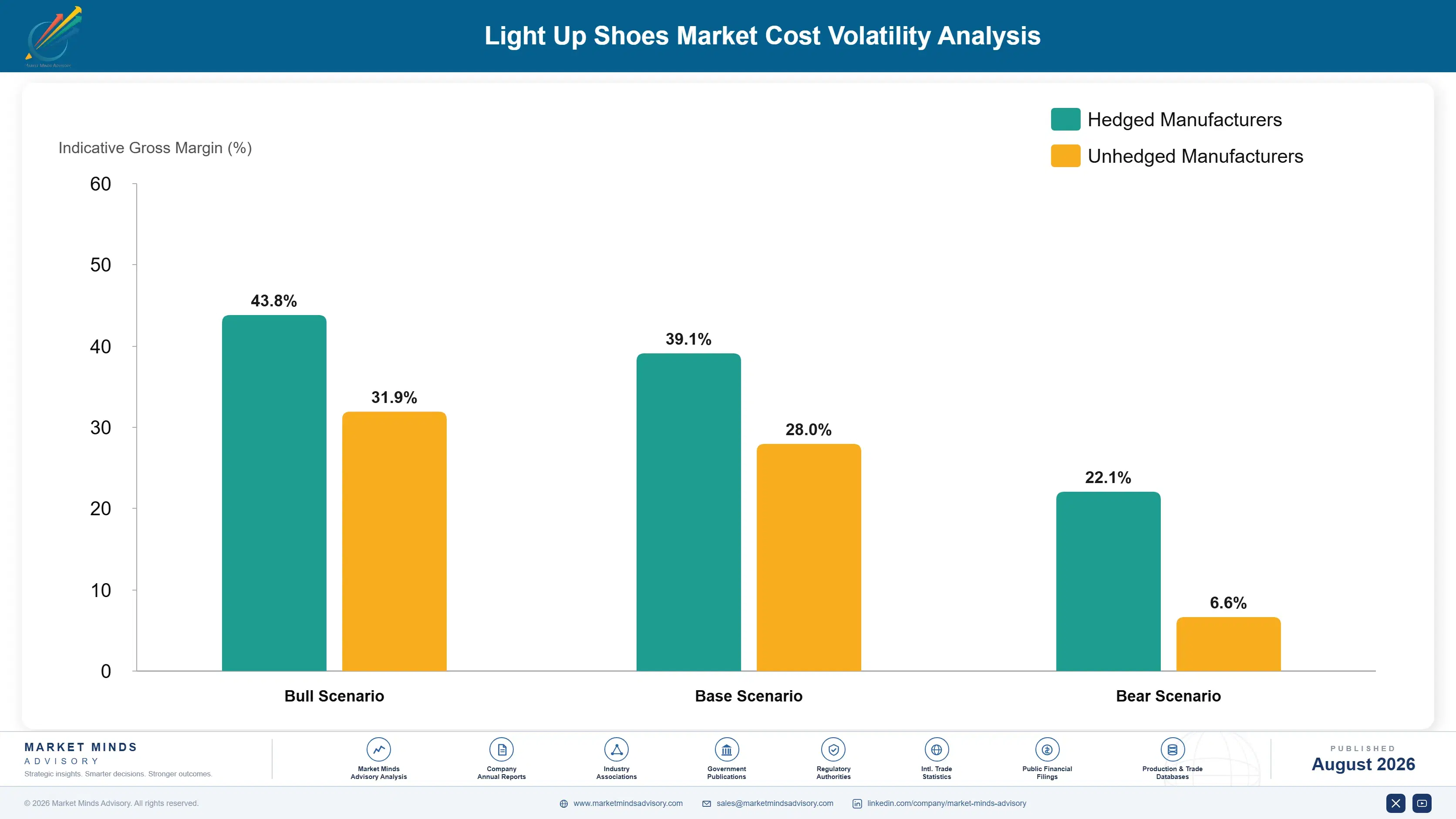
Sole and upper materials account for roughly 31% of cost of goods, ordinary footwear economics, while the illumination module and its cell add a further 22%. Modules come almost entirely from Guangdong, cells from the same Chinese lithium supply chain that serves power tools and consumer electronics. Assembly labour sits mainly in Fujian and increasingly in Vietnam.
Lithium pricing gave the category a demonstration of its exposure. The IEA Global EV Outlook 2025 documented the extraordinary swing in lithium carbonate pricing since 2022, from historic highs to a sustained collapse, and small-cell buyers rode that whole cycle without any hedging instrument available to them. Footwear producers holding annual module contracts through the peak paid materially less than spot buyers, and several of the spot buyers repriced mid-season and lost retail listings.

The disadvantage falls unevenly. A vertically integrated producer assembling its own modules sees cell cost directly and plans around it. A brand buying finished pairs from a contract factory sees only a quoted unit price that moves without explanation, usually after the retail price list has been agreed. Geography compounds it: producers outside East Asia pay freight and duty on top of a cost they already cannot forecast.
light-up-shoes-market-cost-volatility-analysis-1788169636208

Contract module volume annually rather than buying spot

Annual volume agreements with a module house remove the single unforecastable line in the cost sheet, at roughly 3% above best spot pricing in a soft market. The agreement also secures engineering support when a design needs changing. Producers who held contracts through the last lithium cycle priced their retail lists once and kept them.

Design around a lower capacity cell

Selecting a cell below the air transport restriction threshold changes the logistics position entirely, since restricted classification is what forces sea freight and five week replenishment. Smaller cells cut runtime, so the design must recover it through more efficient drivers and lower duty cycles. The trade is worth making for any range sold on a seasonal retail calendar.

Qualify a second assembly country

Concentrating three quarters of world assembly in one country is a tariff and disruption exposure rather than a cost advantage. Vietnamese and Indonesian footwear plants can take illuminated assembly with module imports, and qualifying one costs a season of engineering time. The return is optionality, which only looks valuable in the quarter a trade measure lands.

Portfolio Architecture for Margin Defence

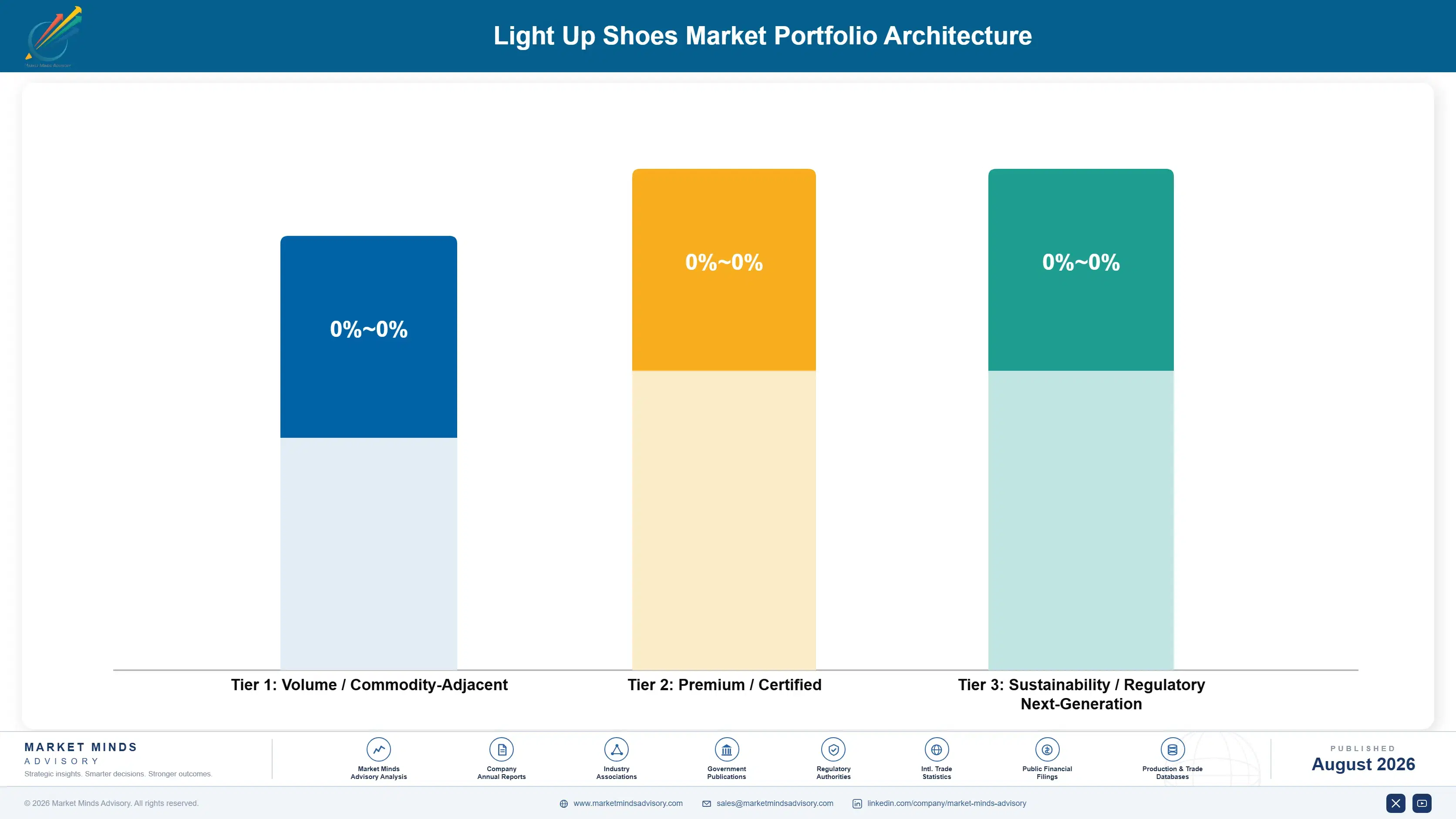
Margin in this category tracks failure rate rather than price point, which is not how footwear normally works. A novelty sneaker at a low price with a 12% return rate earns less than a sandal at the same price with a 5% one, and the difference never appears in a price list. Participants who measure margin after returns processing run a different portfolio from participants who measure it before.
Volume and premium pull against each other sharply here. The volume tier funds the module purchase scale that makes the premium tier's engineering affordable, so abandoning it raises unit cost across the whole range. But volume also carries the return rate that eats the blended margin. The workable answer is to hold volume in formats that fail rarely, which means sandals and slides rather than enclosed sneakers.

The high-value pool sits in safety specification and almost nobody in consumer footwear is in it. Unit prices run three to four times retail, returns are negligible, and the buyer reorders on a budget cycle that ignores fashion entirely. The second pool is module supply itself: producers with internal assembly are beginning to sell modules to competitors, which is higher margin than the shoes.

Volume / Commodity-Adjacent

Entry price children's illuminated sneakers sold through mass retail and marketplace channels. Competes on price against near-identical product from the same assembly base, and the return rate absorbs much of it. The 9 point spread reflects how much of the range uses sealed construction.
Gross Margin: 24 to 33%

Premium / Certified

Branded rechargeable ranges with potted modules and published ingress ratings, sold through family footwear retail. Reliability rather than styling supports the price, and returns run well below the category average. The 9 point spread reflects the difference between direct retail and wholesale distribution.
Gross Margin: 42 to 51%

Sustainability / Regulatory / Next-Generation

High-visibility safety footwear qualified against occupational and municipal specifications, plus module supply sold to other producers. Margins are high because qualification is scarce rather than because volume is large. The 12 point spread separates tender supply from module component sales.
Gross Margin: 54 to 66%
light-up-shoes-market-portfolio-architecture-1788169636709

High-value Sub-segments and Strategic Watch-out

Illuminated Safety and High-Visibility Footwear

High value and high growth at 12.9%. Specification buyers pay three to four times retail unit prices, reorder on budget cycles and return almost nothing. The 8 point spread reflects whether supply runs through public tender or through private contractor procurement channels. Qualification is the only barrier.
Gross Margin: 56 to 64%

Illuminated Sandals and Slides

High value with moderate growth at 10.4%. The simplest engineering in the category produces the lowest failure rate and the best blended margin. The 8 point spread reflects seasonal clearance depth, which varies enormously between warm-climate markets and markets with a short selling window each year.
Gross Margin: 47 to 55%

Children's Illuminated Sneakers

The volume core. It earns little after returns but it funds the module purchase scale and the retail relationships that everything else in the portfolio depends on. The 9 point spread reflects the proportion of sealed versus rechargeable construction still shipping in the range today.
Gross Margin: 26 to 35%

Illuminated Formal and Dress Footwear

The strategic watch-out. Growth trails the category badly at 4.8%, because the aesthetic works against the occasion and adult buyers reject it outside novelty events. The 14 point spread reflects how much of the volume clears at full price rather than at deep discount later.
Gross Margin: 38 to 52%

Why The Repeat Purchase Happens

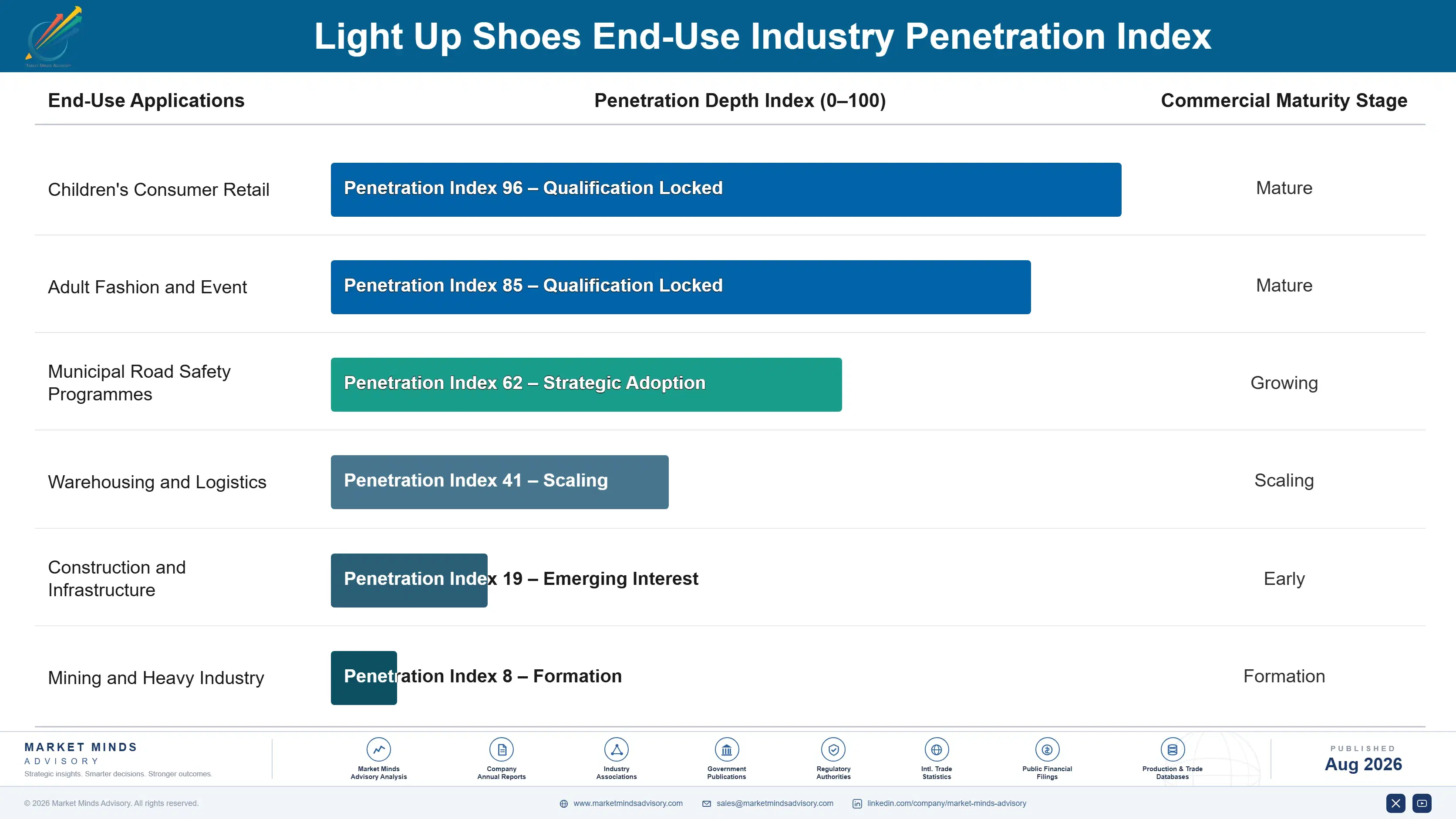
This is a replacement business driven by feet growing rather than by product wearing out. A child outgrows illuminated footwear in roughly 7 months, which produces a repurchase rhythm no marketing programme could manufacture. The annuity is genuine but shallow: the household repeats the category, not necessarily the brand, and there is very little to hold them beyond whatever was on the shelf that week.
Stickiness varies enormously by end use. Safety buyers are the stickiest by a distance, because requalifying a supplier costs more than the price difference and nobody in procurement enjoys explaining a change. Children's retail buyers show almost no loyalty and switch on shelf position. Adult fashion buyers are the least reliable, treating the purchase as event-specific and rarely returning to the category once the event is over.

Buyer profiles have shifted in a way that changed what the product has to do. The first generation of parents bought illuminated footwear because a child asked for it. The current generation buys it because they want the child visible crossing a road in December, and they check runtime and charging before styling. That shift moved the purchase decision from the child to the adult.
light-up-shoes-market-end-use-penetration-index-1788169637200

Where The Money Actually Is

These are among the four positions where our research anticipates prominent divergence between winners and laggards over the coming forecast period. Each is grounded in the demand model, the regulatory perimeter, and the announced capacity pipeline.
01 / SAFETY CHANNEL QUALIFICATION

Qualify one style and stop competing on shelf price

Qualifying an existing style against EN ISO 20471 and municipal luminance requirements costs testing money and roughly 6 months of documentation, which is trivial next to what a retail listing costs to win. The buyer on the other side pays 3 to 4 times the retail unit price, reorders on a budget cycle and returns essentially nothing at all. Very few consumer footwear participants have crossed into that channel, and the ones who have are not talking about it publicly.
02 / MODULE RELIABILITY ECONOMICS

Fix the sole join before touching the marketing budget

A 9.4% online return rate on a product that cannot be resold destroys more margin than any pricing decision in this category makes back. Two thirds of those returns trace to water and flex at the sole join, and potting the module with a higher ingress rating adds roughly 4% to unit cost. That trade pays back inside a single production cycle, and it is available to every participant who bothers to measure where the failures actually come from in the first place.
03 / FORMAT PORTFOLIO DISCIPLINE

Build the sandal line before the sneaker line

Sandals and slides grow at 10.4% against a category rate of 8.6% and carry roughly half the failure rate of enclosed styles, because the module sits in a thick sole with no upper to seal. Most participants treat the format as a seasonal afterthought and allocate development budget to sneakers by habit rather than by arithmetic. Reversing that priority lifts blended margin immediately and frees the working capital currently tied up processing returns that nobody is able to resell anyway.
04 / CELL SUPPLY CONTRACTING

Contract module volume before the next lithium cycle

Cell and module cost is 22% of goods sold and it moves on a battery industry cycle that has no relationship to footwear demand at all. Annual volume agreements with a Guangdong module house cost about 3% above best spot pricing and remove the one line in the cost sheet nobody can forecast. They also buy engineering attention, which a spot supplier will never provide when a potting design suddenly needs changing in the middle of a live selling season.

Engagement Snapshot From the Field

A live engagement with an industry participant carrying material or product regulatory and market exposure ahead of a defining policy shift, showing how our research translates into a defensible multi-year portfolio strategy.
MARKET MINDS ADVISORY · CLIENT ENGAGEMENT SUMMARY
Light Up Shoes Producer Strategic Portfolio Review and Transition Roadmap 2026·Investment Scenario on Light Up Shoes Exposure Evaluation 2025-26
CLIENT PROFILE
A global children's footwear brand with illuminated ranges sold across mass retail and marketplace channels in nineteen countries, with annual footwear revenue in the low billions of dollars (client-reported, unverified by MMA). Illuminated styles represented a mid single digit share of units but a considerably larger share of customer service volume, which is what prompted the engagement in the first place.
STRATEGIC CHALLENGE
Online return rates on illuminated styles ran above 11% against 4% for the conventional range, and returned pairs could not be resold at all. Management wanted to know whether the problem was a supplier quality issue that could be contracted away, or a design issue requiring investment, and separately whether the category was worth keeping at that return rate.
MMA APPROACH
MMA obtained returned units from three markets and had them examined for failure mode, then mapped the results against construction type and assembly site. Forty-seven expert interviews across module suppliers, footwear engineers and retail buyers established what ingress protection standards were achievable at what cost, and what failure rate retail buyers would accept if a supplier quoted one.
KEY FINDINGS
  1. Water ingress at the sole join accounted for 64% of examined failures, and it concentrated in two of the four assembly sites in use.
  2. Sandal and slide styles returned at less than half the rate of enclosed sneakers while carrying a higher gross margin at the same retail price.
  3. Potted modules with a higher ingress rating were available from two existing suppliers at roughly 4% additional unit cost, requiring no tooling change.
  4. Retail buyers said they would accept a quoted failure rate as a purchasing criterion, and none of them had ever been offered one by any supplier.
CLIENT PROFILE
A global children's footwear brand with illuminated ranges sold across mass retail and marketplace channels in nineteen countries, with annual footwear revenue in the low billions of dollars (client-reported, unverified by MMA). Illuminated styles represented a mid single digit share of units but a considerably larger share of customer service volume, which is what prompted the engagement in the first place.
STRATEGIC CHALLENGE
Online return rates on illuminated styles ran above 11% against 4% for the conventional range, and returned pairs could not be resold at all. Management wanted to know whether the problem was a supplier quality issue that could be contracted away, or a design issue requiring investment, and separately whether the category was worth keeping at that return rate.
MMA APPROACH
MMA obtained returned units from three markets and had them examined for failure mode, then mapped the results against construction type and assembly site. Forty-seven expert interviews across module suppliers, footwear engineers and retail buyers established what ingress protection standards were achievable at what cost, and what failure rate retail buyers would accept if a supplier quoted one.
KEY FINDINGS
  1. Water ingress at the sole join accounted for 64% of examined failures, and it concentrated in two of the four assembly sites in use.
  2. Sandal and slide styles returned at less than half the rate of enclosed sneakers while carrying a higher gross margin at the same retail price.
  3. Potted modules with a higher ingress rating were available from two existing suppliers at roughly 4% additional unit cost, requiring no tooling change.
  4. Retail buyers said they would accept a quoted failure rate as a purchasing criterion, and none of them had ever been offered one by any supplier.
RECOMMENDED STRATEGY
Phase 1: Phase one: move all illuminated production to potted modules and consolidate assembly away from the two sites producing most of the failures. Phase 2: Phase two: shift range development weighting toward sandal and slide formats, which return less often and carry better margin at identical retail price points. Phase 3: Phase three: publish a tested failure rate to retail buyers as a commercial differentiator, since no competing supplier currently offers one at all.
OUTCOME
Within three quarters the illuminated return rate had fallen from above 11% to roughly 6%, and the additional module cost was recovered several times over in avoided returns handling (client-reported, unverified by MMA). Two retail accounts expanded their illuminated assortment after the failure rate was disclosed to them, and sandal styles moved from a seasonal filler to a planned range.

Frequently Asked Questions

Foundational context covering the market sizes, CAGR, scope, country, region and competition that inform every finding below. This section is provided to cover basics and most often pre-purchase conversations, answered from the MMA Primary Research Dataset.

What is the current size of the Light Up Shoes Market?

The global light up shoes market was valued at USD 1.2 billion in 2025, covering all footwear with an integrated illumination system. The 2026 figure reaches USD 1.3 billion.

How large will the Light Up Shoes Market be by 2036?

MMA forecasts USD 2.97 billion by 2036, an increase of USD 1.67 billion over the 2026 base. That represents an expansion multiple of 2.28 times across the forecast period.

What is the CAGR for the Light Up Shoes Market 2026 to 2036?

The base case compound annual growth rate is 8.6%, with a bull case at 9.8% and a bear case at 7.4%. Historical growth between 2020 and 2025 ran at 7.4%.

Which segment is growing fastest?

Illuminated safety and high-visibility footwear grows at 12.9%, half again the market rate of 8.6%, pulled by municipal road safety and occupational specification. Sandals and slides follow at 10.4%.

Who are the major companies in the Light Up Shoes Market?

Skechers USA, Anta Sports Products, Crocs, Geox and ABC Kids International Holdings lead on retail unit shipment volume, with combined CR5 of 18%. The remainder is unusually fragmented.

Which country is growing fastest?

India grows fastest at 10.7%, driven by children's footwear volume through general trade at price points local assembly can reach. South Asia and Pacific leads regionally at 10.7%.

Report Segmentation Architecture

The full report scope spans multiple orthogonal segmentation dimensions, with cross-tabulated demand data provided for each dimension pair. Coverage extends further to regional breakdowns, trend trajectories, and the competitive detail needed to support segment-level decision-making.

By Product Format

  • Illuminated Sneakers and Trainers
  • Illuminated Safety and High-Visibility Footwear
  • Illuminated Sandals and Slides
  • Illuminated Boots
  • Illuminated Slippers and Indoor Footwear
  • Illuminated Formal and Dress Footwear

By End-Use Industry

  • Children's Consumer Retail
  • Adult Fashion and Event
  • Municipal Road Safety Programmes
  • Warehousing and Logistics
  • Construction and Infrastructure
  • Mining and Heavy Industry

By Commercial Dimension

  • Mass Retail Chains
  • Specialist Footwear Retail
  • Online Marketplaces
  • Brand Direct Channels
  • Public Tender Procurement
  • Contractor and Distributor Supply

By Region

  • North America
  • Western Europe
  • East Asia
  • South Asia and Pacific
  • Latin America
  • Middle East and Africa
  • Eastern Europe

Scope, Methodology, and Coverage

Every figure in this report is reproducible from documented input assumptions. The scope below maps the historical period, the forecast horizon, the segmentation dimensions, and the countries covered, alongside the underlying primary and qualitative methodology.
Historical Period
2020 to 2025
Forecast Period
2026 to 2036
Base Year
2025 (USD billions; MMA Primary Research Dataset, August 2026)
Market Definition
The light up shoes market covers finished footwear incorporating an integrated illumination system, whether light emitting diodes in the midsole, electroluminescent panels in the upper, or fibre optic elements. Scope spans children's and adult footwear across casual, sports, sandal, boot, slipper and high-visibility safety formats sold through retail and online channels. Excluded are clip-on or aftermarket lighting accessories, reflective-only footwear carrying no powered element, and standalone illumination modules sold to manufacturers.
Quantitative Units
USD billion, 2025 base year, 2026 to 2036 forecast period
Segmentation Dimensions
Product format, end-use industry, commercial channel, region
Regions Covered
North America, Western Europe, East Asia, South Asia and Pacific, Latin America, Middle East and Africa, Eastern Europe
Countries Covered
United States, Canada, Germany, France, United Kingdom, Netherlands, Sweden, Poland, China, Japan, South Korea, India, Australia, Brazil, Mexico, Saudi Arabia, United Arab Emirates, South Africa
Key Companies Profiled
20 companies across consumer footwear brands, East Asian assemblers and safety footwear specialists
Quantitative Methodology
Primary survey, n=3,800 respondents, Q4 2025, six countries; demand-side model with trade association cross-validation
Qualitative Methodology
47 expert interviews, Q4 2025; applied to validate demand model assumptions, identify emerging dynamics, and assess competitive positioning
Report Format
PDF and XLSX data workbook (Word format preview document)
Publisher
Market Minds Advisory
Report Code
MMA-2026-TEC-511
Published
August 2026
Contact
sales@marketmindsadvisory.com | www.marketmindsadvisory.com

Purchase the full Light Up Shoes Market Report (2026 to 2036).

The full MMA report on the light up shoes market runs to detailed format and regional models across the 2026 to 2036 forecast period, with module cost benchmarks and return rate analysis by construction type. It profiles 20 companies on a consistent retail unit shipment basis, covering consumer footwear brands, East Asian assemblers and the safety footwear specialists now entering the category. Qualification requirements for municipal and occupational specification channels are set out fully. Regional chapters cover the seven MMA regions with country-level detail on the eighteen markets surveyed. Primary research draws on a quantitative survey of 3,800 respondents across six countries and 47 expert interviews conducted in Q4 2025.
Module cost benchmarks by construction and supplier
Return rate analysis by product format
Safety qualification requirements across municipal and occupational channels
Twenty company profiles on consistent shipment volume basis
Battery compliance status across major regulated markets
Seven regional chapters with eighteen country detail tables

Built For The People Who Decide

From boardroom strategy to bench-side execution, this report is read cover-to-cover by leaders shaping the next decade of their industry, turning demand scenarios, market dynamics and valuation benchmarks into decisions.
CXOs/ Presidents/ VPs/ Managers
M&A and Corporate Development
Strategy Teams and R&D Heads
Procurement and Product Directors
Regulatory and Compliance Leaders
Investor Relations and Equity Analysts